Tag Archives: Elliot Gould

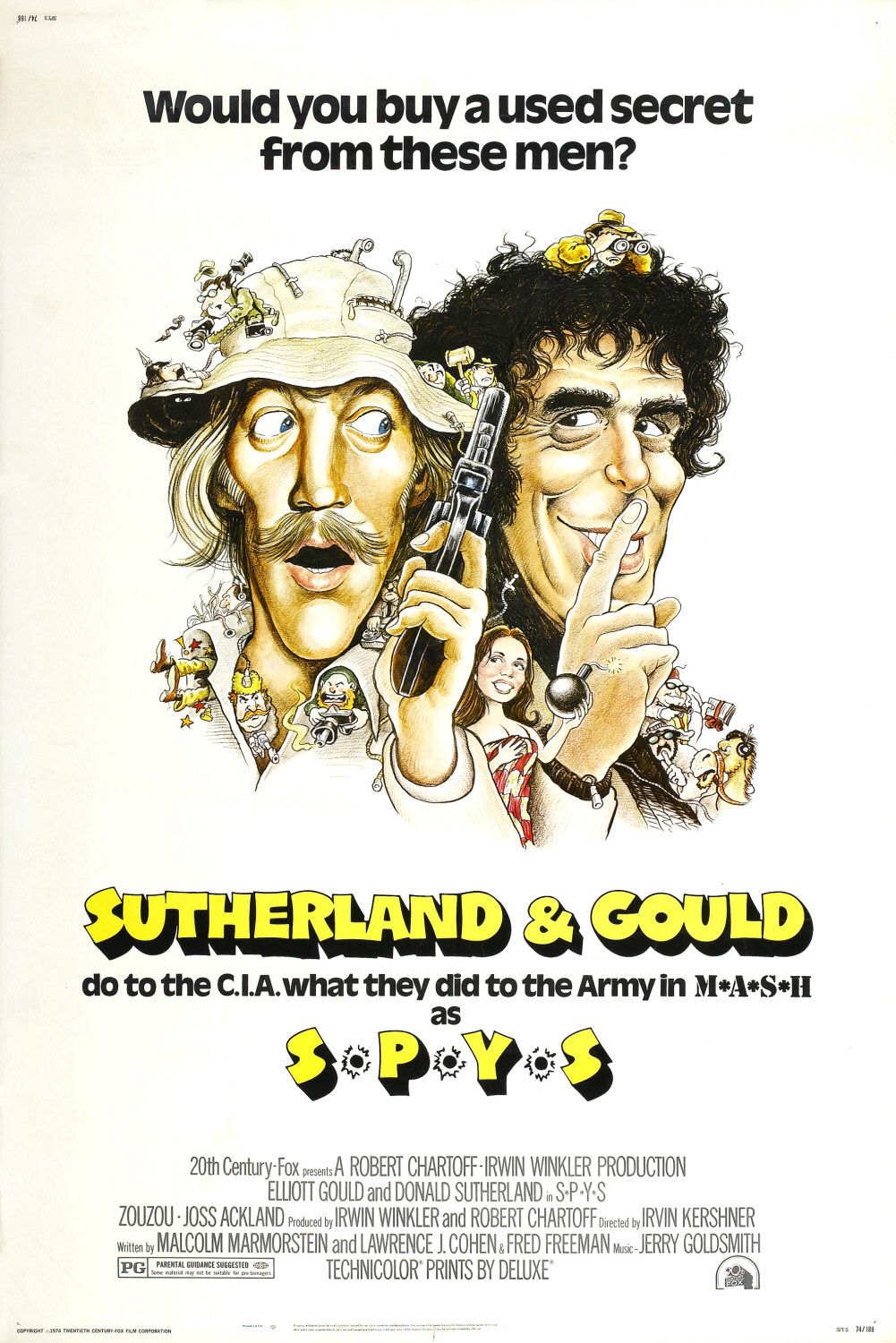
S*P*Y*S (1974)

By Richard Winters

My Rating: 4 out of 10

4-Word Review: Targeted to be killed.

Bruland (Donald Sutherland) and Griff (Elliot Gould) are two CIA agents stationed in France who prove to be inept at every turn. When they accidentally kill a Russian gymnast defector (Michael Petrovitch) the head of the CIA Paris unit, Martinson (Joss Ackland), makes a deal with the soviets to have the two killed. This would then avoid a dangerous retaliation that could lead to a nuclear war. However, neither Bruland or Griff are made aware of this until they start getting attacked by people from all ends including the KGB, the CIA, the Chinese communists, and even a French terrorist group. In their pursuit to survive the two, who initially disliked the other, form an uneasy alliance.

The film’s original title was ‘Wet Stuff’, but the producers wanted a tie-in with M*A*S*H that had been hugely successful and also starred Gould and Sutherland, so they changed it to make it seem similar to that one, but the attempt failed and the movie became a huge bomb with the both audiences and critics alike. Viewers came in expecting the same irreverent humor, which this doesn’t have, so audiences left disappointed and the word of mouth quickly spread causing it to play in the theaters for only a short while. The irony though is that in countries that hadn’t seen M*A*S*H, like the Netherlands and Germany, it fared better because the expectations going in weren’t as high.

On a comic level it’s not bad and even has its share of amusing bits. The way the defector gets killed, shot by a gun disguised as a camera, was clever and there’s also a unique car chase in which Gould takes over the steering wheel from the backseat while someone else puts their foot to the pedal. The initial rendezvous between Sutherland and his on-and-off girlfriend (Zouzou) has its moments too as he finds her in bed with another guy while a second one is in the bathroom forcing him to have to pee in the kitchen sink. Gould then, who thought she was ‘raping him with her eyes’ when they first met, takes over and gets into a threesome while the dejected Sutherland has to sleep on the couch.

On the negative end the characterizations are poor to the point of being nonexistent. Initially it comes-off like Gould and Sutherland are rivals, which could’ve been an interesting dynamic, but this gets smoothed over too quickly. Having the two bicker and compete would’ve been far more fun. There’s also no sense of urgency. While Sutherland does lose his spy job and forced to pretend to feign illness to get out of paying a restaurant bill it’s then later revealed that he did have the money, but this then ruins any possible tension. Had they been in a true desperate situation the viewer might’ve gotten more caught up in their dilemma, but as it is it’s just too playful. The villains are equally clownish and in fact become the center of the comedy by the final act, which takes place at a wedding, while the two leads sit back and watch making them benign observers in their own vehicle.

The film needed somebody that was normal and the viewer could identify with. Buffoons can be entertaining, but ultimately someone needs to anchor it and this movie has no one. I thought for a while that Zouzou would be that person, and she could’ve been good, but she and her terrorist pals end up trying to assassinate the two like everybody else, which adds too much to the already cluttered chaos. The satire also needed to be centered on something. For instance, with Airplane the humor was structured around famous disaster flicks from the 70’s and all the jokes had a knowing tie-in. Here though it’s all over the place. Yes, it pokes fun of spies, but that’s too easy, and having it connected to let’s say James Bond movies would’ve given it a clearer angle and slicker storyline.

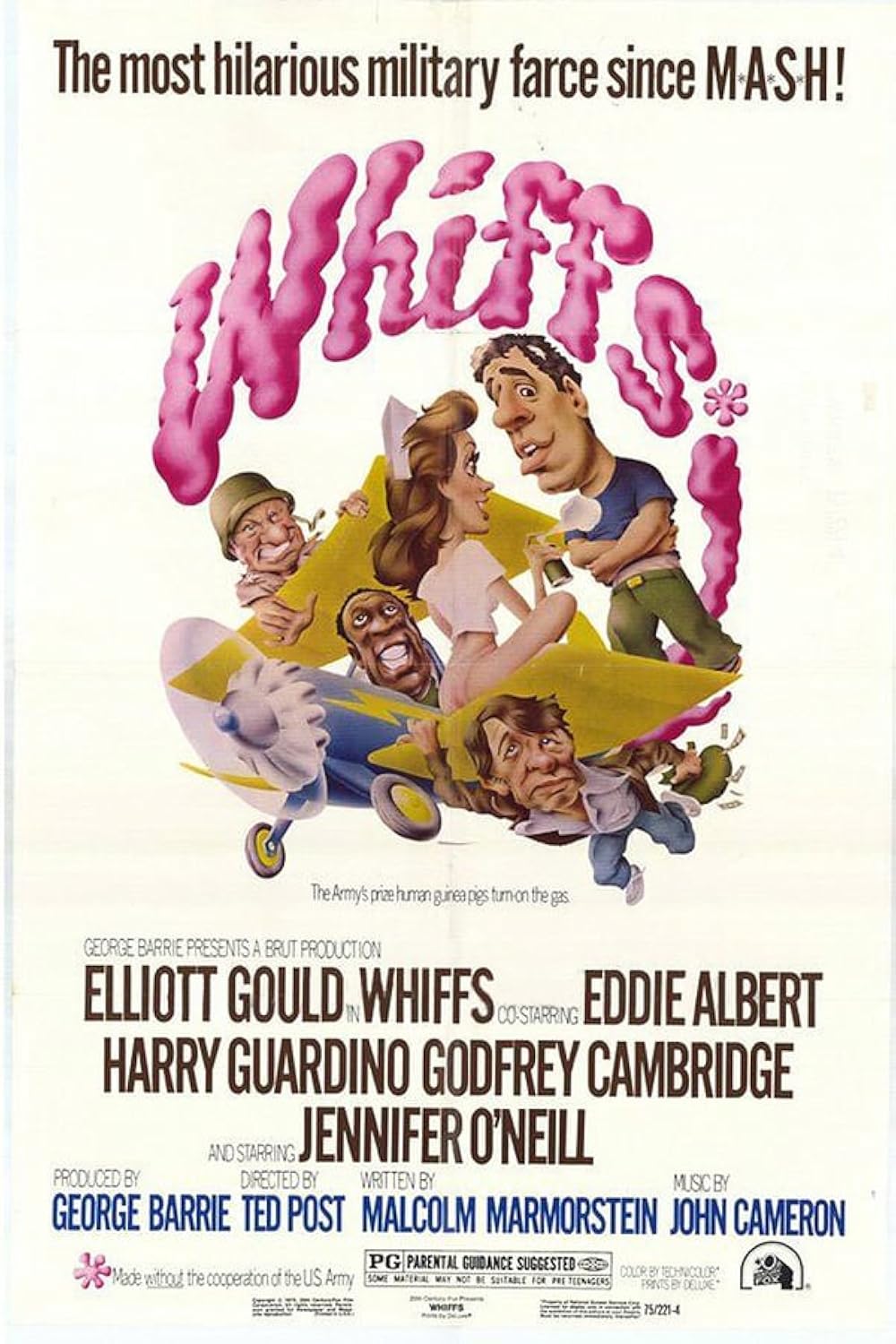
Since it did have a modicum of success in certain countries it convinced screenwriter Malcolm Marmorstein to continue to pursue the formula as he was sure it was simply the botched marketing that had ruined this one, so he wrote another parody script, this time poking fun at the army, just a year later, which also starred Gould, and was called Whiffs, which will be reviewed next.

My Rating: 4 out of 10

Released: June 28, 1974

Runtime: 1 Hour 40 Minutes

Rated PG

Director: Irvin Kershner

Studio: 20th Century Fox

Available: DVD-R
I Love My…Wife (1970)

ilove

By Richard Winters

My Rating: 6 out of 10

4-Word Review: He’s bored with marriage.

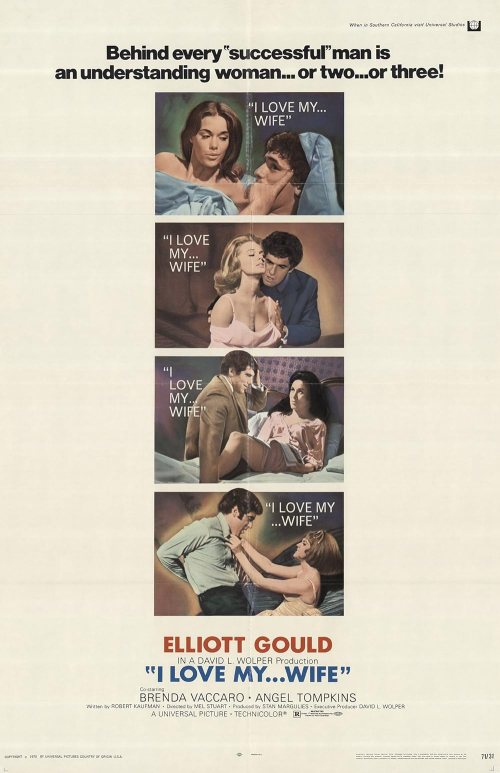
Richard (Elliot Gould) is a medical student when he meets Jody (Brenda Vaccaro) and the two quickly fall-in-love and get married. She then gets pregnant while he’s still in school and they don’t believe they have enough money to financially support a child, so they initially consider an abortion, but at the last minute Richard changes his mind and feels they should have the child. Jody though gains a lot of weight during the pregnancy, which Richard finds unattractive. Once the baby is born she’s unable to burn-off the excessive pounds causing their sex life to go even further into the tank. He has a few flings with some of the nurses before finally setting his sights on Helene (Angel Tompkins) a beautiful model who’s married to a baseball star (Dabney Coleman). At first she resists his advances, but the two eventually bed and then fall-in-love. She insists that Richard leave his wife, so that they can be together and no longer have to meet-on-the-sly. Richard tries to break-up with Jody, but because they have two kids finds that he can’t and instead begins lying to Helene as he plays both women at the same time, which soon turns into a losing situation.

The odd way this thing opens really hurts it and although it does improve a bit as it goes along some viewers may not be patient enough to stick with it. Having the opening credits deal with Richard’s relationship with his mother (Helen Westcott) and the sheltered way that she raised him isn’t funny and because the mother never appears again in the movie it wasn’t worth introducing her at all. Since the wife is the main focus I felt the opening scenes should’ve dealt with their dating period, which the movie breezes over too quickly. The clips from old movies, which get spliced in from time-to-time, add nothing and make it seem too much like Myra Breckenridge, which came out around the same time and best left forgotten. At least in that movie the clips came at predictable intervals, but here it’s sporadic making it seem, when they do get shown, as jarring and out-of-place.

Gould certainly excels at this type of role and he’s quite possibly the only actor who could play a shallow person and still manage to make it come-off as semi-likable. Vaccaro though is the real surprise as she’s usually best at drama and initially I felt she was miscast, but she comes through in making her character complex and even amusing as she goes through her tirades, some of it justified, at Gould. This is also the first movie to ever explore the issue of women who gain weight during their pregnancy, but can’t lose it afterwards and how this could affect their sex life, which I felt deserved kudos for being ground-breaking. The film makes the mistake though of showing too much from her point-of-view to the extent that we start to sympathize with her over the main character and almost start to dislike him in the process.

The introduction of Helene really does help as it’s her presence that gives the story a unique angle. Before this it comes-off more like your typical run-of-the-mill flick about a cad of a husband who can’t stay faithful, which has been done a lot and this movie doesn’t add anything insightful in that vein. However, the affair itself is interesting. For one thing she plays hard-to-get and doesn’t just jump immediately into the bed sheets at Gould’s beck-and-call, which is good as too much of the time, especially in 70’s movies, the women seem way too easy in a way that isn’t realistic. What I liked even more though is that the affair really doesn’t solve anything. Sure he finds her hot and sexy and they do get along, but she also has demands of her own and Gould finds himself in the same quandary as with his wife showing how extra marital flings really aren’t the ‘escape’ that they’re intended, but instead more of a problem.

Spoiler Alert!

The script by Robert Kaufman brings out many harsh truths about marriage and doesn’t insult us with any placid answers. Yet when the movie should go hard it goes soft instead. I liked how Vaccaro, who spent the whole time trying to win him back, finally gives up and starts seeing someone else, but Gould though upset and rebuffed, doesn’t learn anything from it. He goes back to the bar and tries picking-up an attractive stewardess he meets like he’s now making some sort of ‘fresh start’ when the film spent its entire running time exposing how this ‘cruising for chicks’ is a vicious cycle that just leads to more emptiness. Seeing Gould’s character change, or learn from his mistakes and display some regret would’ve been a far better way to have ended it.

My Rating: 6 out of 10

Released: December 21, 1970

Runtime: 1 Hour 38 Minutes

Rated R

Director: Mel Stuart

Studio: Universal

Available: DVD-R (dvdlady.com, modcinema.com)

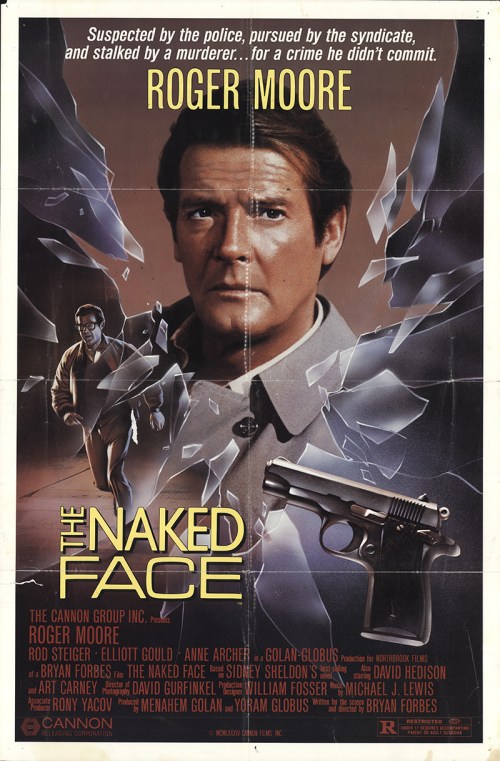
The Naked Face (1984)

naked1

By Richard Winters

My Rating: 7 out of 10

4-Word Review: Is psychoanalyst being targeted?

Judd Stevens (Roger Moore) is a psychoanalyst residing in Chicago who suddenly finds that people he knows are turning up dead. First it was one of his patients, whom he let borrow his raincoat. Then it’s his secretary and soon the police are suspecting him of the killings. Lieutenant McGreavy (Rod Steiger) doesn’t like Judd as it was Judd’s expert testimony that got a cop killer sent to an institution versus a jail cell where McGreavy felt he belonged. In order to get the cops off his back and find the real killer Judd  hires Morgens (Art Carney), private investigator, who seems to get a lead when he calls Judd and tells him that a ‘Don Vinton’ is behind it, but then Morgens ends up dead too, so Judd puts his trust in another police detective named Angeli (Elliot Gould) only to learn that he has ulterior motives.

The story is based on the Sidney Sheldon novel of the same name that was written in 1970 and besides this one has been remade two other times: in 1992 in Ukraine as Sheriff’s Star and then again in 2007 in India as Kshana Kshana. This version was produced by the notorious Cannon Group, which always makes me hold my breath in apprehension every time I see their logo come up before the movie begins as I’m never sure if this is going to be one of their cheaper productions, or one that was given a decent budget. While Leonard Maltin, in his review, describes it as ‘low budget’ I’d say this was one of their passable efforts as the production standards aren’t compromised in any way and if anything is rather slick. The on-location shooting done in Chicago, this was changed from the novel where the setting was Manhattan, is excellent and the plot is well paced with incremental twists to keep it flowing.

The film’s main selling point is seeing Moore playing against type as he was known as an action star, but here plays an intellectual. For the most part he does quite well and even able to hold his own when sharing a scene with Steiger, who otherwise likes to chew up the scenery and everyone else in it, but I didn’t like the big Harry Caray-type glasses that he wears. I guess this was done to make him look ‘smart’, but it wasn’t needed. The best part is seeing him get beat-up by the bad guys. When Moore was playing Bond it always seemed a bit absurd that this aging 50-something would be able to take-on virtually any villain, no matter the size, and come-out on top every time. Here he gets flattened with one punch and it’s kind of funny.

Steiger, with  his intense delivery, dominates. He’s given a lot of screen time during the first half almost making him seem like he’s the star and his stewing anger lends adequate tension, but his good-cop/bad-cop routine doesn’t work because he’s the type of character who’s impossible to like, so he needed to stay bad all the way. I also couldn’t stand the wig. He supposed to be an ugly, unlikable guy, so might as well have him naturally bald, as the rug gives him a campy look.

Gould is the outlier. He was during the 70’s a major headlining star, so seeing him pushed to the background where Steiger takes center stage is almost shocking. I remember him saying once in an interview that he didn’t like the pressure of being a leading man, so maybe this supporting bit was right for him. His character does become more prominent towards the end, but for the most part he comes-off like a faceless walk-on  and a sign of a career decline.

Spoiler Alert!

The twist ending in which it’s found that the crime syndicate was behind the killings due to the wife (Anne Archer) of the crime boss seeing Judd and fearing she may be giving him secret information during their sessions was not particularly original. It also opened up some loopholes. For instance Judd’s patient at the beginning is stabbed on the streets because he was mistaken for being Judd, but later when Judd is kidnapped and in the crime boss’ presence he isn’t immediately killed as they first want him to divulge what his wife told him, but if the idea was to extract information then why was the patient offed right away instead of taken somewhere for interrogation?

At the very end Moore is walking with Archer outside and suddenly she gets hit with a bullet, but not Moore. If she was shot by a hit man for giving out secret info then Moore should’ve received a bullet as well because it was he that she had confided in, or at least that was what they had presumed.

My Rating: 7 out of 10

Released: June 6, 1984

Runtime: 1 Hour 45 Minutes

Rated R

Director: Bryan Forbes

Studio: Cannon Film Distributors

Available: DVD, Tubi

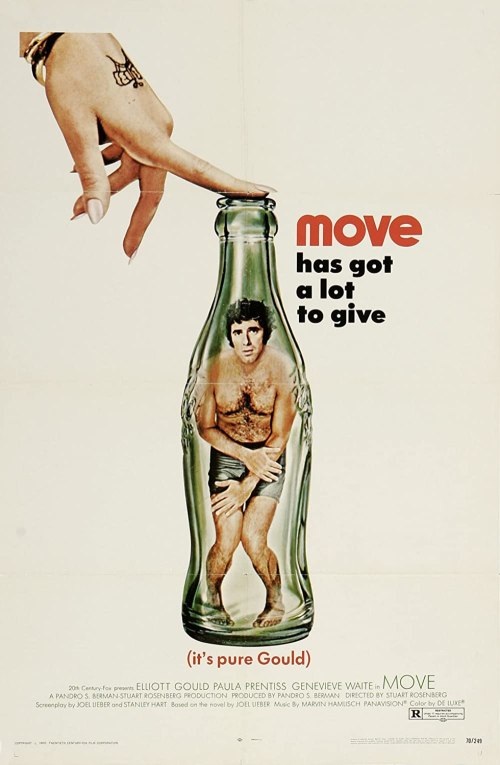
Move (1970)

move

By Richard Winters

My Rating: 1 out of 10

4-Word Review: Relocating to another apartment.

Hiram (Elliot Gould) dreams of being a successful playwright, but is only able to find work writing sex stories for adult magazines. He and his wife Dolly are both bored in their marriage, but find no alternatives, so they continue to exist in a union that no longer has any zing. They also prepare to move into another apartment, but complications with the movers and repeatedly strange phone calls from a man claiming to be holding their stuff hostage, only increases Hiram’s ongoing anxiety. Just when things begin to look completely bleak he bumps into a beautiful young lady (Genevieve Waite) one day while walking a dog. Just like a plot in one of his sex stories she invites him back to her apartment for an afternoon of unbridled passion. Hiram enjoys the visit and returns the next day for a rendezvous, but finds she no longer is there and no one he asks knows who she is. Was she simply a fleeting stranger, or a product of his over-active imagination?

While I’m a fan of quirky, offbeat comedies from the early 70’s this one doesn’t hit-the-mark. It’s quite similar in theme and style to Little Murdersa dark comedy that dealt with the alienation of living in New York City and also starred Gould, as well as The Steagleabout a man who enlivens his otherwise mundane life by living out wild fantasies in his head.  Both those movies had a far faster pace, which is what a zany comedy needs, and were able to distinguish the fantasy elements from the real-life. Here it gets confusing and you can’t tell it’s a dream until well into the segment. Since the rest of the movie is slow and boring the fantasy moments needed to be over-the-top to make-up for it, but instead they get underplayed making the whole thing a big, pointless mess.

Much of the blame could be squarely placed on 20th Century Fox who paid $85,000 for the rights to the novel before it had even been published. The studio execs apparently felt that the theme of apartment living in New York was trendy enough to be worth taking a risk on before even knowing if the story itself was workable. They labeled it ‘dirty Barefoot in the Park’ and gave the book’s author, Joel Lieber, who jumped to his death from his Upper West side apartment just a year later, the job of writing the screenplay. However, his lacking a background in screenwriting shows as there’s no cohesive structure. Assigning Stuart Rosenberg to direct, who up until then had solely focused on dramas, only helped to cement this thing into the disaster that it became.

I did enjoy the wild costume party that Gould goes to near the end where all the guests, many of them seen earlier in character roles, wear tasteless and provocative stuff, but the film doesn’t stay on this segment long enough to make sitting through the dull drivel that comes before it worth it. Waite, who’s the mother of Bijou Phillips and former girlfriend of Mama’s and Papa’s lead singer John Phillips, does offer some unique energy during her moments, which are alas too brief. Otherwise nothing else works. There needed to be more of a clear point to what we were seeing for instance revolving around all the crazy mishaps that can occur during a move, which could’ve been both funny and original, but examining the inner turmoil of the main character, in a medium that places emphasis on the visual, was a problematic idea that should never have been green-lit.

My Rating: 1 out of 10

Released: July 31, 1970

Runtime: 1 Hour 29 Minutes

Rated R

Director: Stuart Rosenberg

Studio: 20th Century Fox

Available: DVD-R
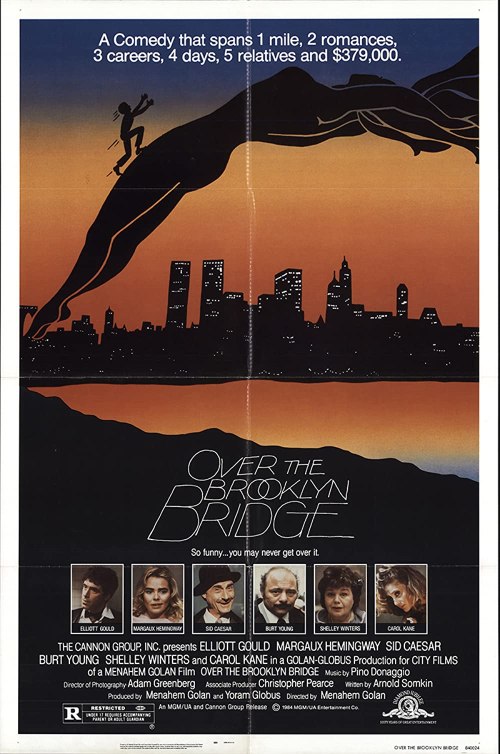
Over the Brooklyn Bridge (1984)

over1

By Richard Winters

My Rating: 3 out of 10

4-Word Review: Hoping to buy restaurant.

Alby (Elliot Gould) is tired of slaving away as a cook at a small Brooklyn diner run by both he and his mother (Shelley Winters). He dreams of owning a swanky restaurant in downtown Manhattan and finds the perfect place, but he needs help with the financing. He goes to his rich uncle Benjamin (Sid Caesar), who at first is reluctant to loan him the needed money, but eventually agrees. However, it comes with one big stipulation; Alby can get the money, but only if he ends his relationship with his live-in girlfriend Elizabeth (Margaux Hemingway), who his uncle has never liked since she’s not Jewish.

From the outset I internally groaned when I saw that it was produced by Cannon Pictures, which was notorious for making a lot of cheesy action flicks during the decade, but this one is approached differently. The script, by Arnold Shulman, who died at the young age of 48 before filming of his screenplay had even begun, is much more personal than the usual Cannon fodder as it delves into the close-knit, extended Jewish family who can be both a source of great support and hindrance.

I was happy too, at least initially, to see Hemingway get another shot at a co-starring role. She was a model, and granddaughter of Ernest Hemingway, who broke into the movie scene with the controversial hit Lipstickwhere she played a rape victim, which was too demanding of a part for someone with so little acting experience. This role here was more reasonable, but without sounding too harsh, I couldn’t stand her voice. Her famous sister Mariel has a very pretty sounding one, so why Margaux got stuck with such an unusually raspy one that belied her otherwise young age I didn’t understand. I know when I watched Lipstickwhich was released 8 years earlier, her voice was only slightly raspy making me believe her smoking caused it to get worse and in my opinion the reason why her onscreen career never took-off.

Gould’s presence doesn’t help either. During the 70’s he was a cinematic counter-culture hero taking it to the establishment, but by the 80’s that persona was no longer in vogue, so he had to settle for benign, nice-guy parts, which is clearly not his forte. He tries hard, and at one point tells-off a few people in semi-classic Gould-style, but for the most part he’s quite boring. His attempt to portray a 36-year-old even though he was actually 45 doesn’t quite work and there’s no explanation for why this frumpy guy with a limited income is able to snare such a young, good-looking babe.

Winters, who seems born to play the meddling, overly-protective Jewish mother, which she did to great success in Next Stop, Greenwich Village, but here her character is too subdued making her presence transparent. Ceasar is a surprise. After his work in the 50’s TV-show ‘Your Show of Shows’ his later parts couldn’t quite match his unique talents, but he scores both on the comedy and drama end here. Carol Kane is a delight as she courts Gould and talks breathlessly about philosophy as she hurriedly walks in a New York subway and then later at her place reveals some very bizarre sexual fetishes. Burt Young has some very funny scenes too as Gould’s cynical friend who doesn’t shy away from expressing his low opinion of marriage.

The story though is too simple for such an a relatively long runtime and by the second-half becomes strained. The idea that Gould had such a great relationship with Hemingway as the movie wants us to believe is dubious as she immediately dumps him the second his uncle tells her to leave him and then callously throws Gould out of the apartment instead of being honest and telling him about her meeting with the uncle and then talking it out like a truly close couple would. Later when Gould, who still doesn’t understand why the break-up happened, calls her to get an explanation and try to make amends, she coldly hangs-up making it seem like he was way more into her than she was into him and thus causing this to be a weak romance instead of a strong one.

My Rating: 3 out of 10

Released: March 2, 1984

Runtime: 1 Hour 43 Minutes

Rated R

Director: Menahem Golan

Studio: Golan-Globus Productions

Available: VHS, DVD-R

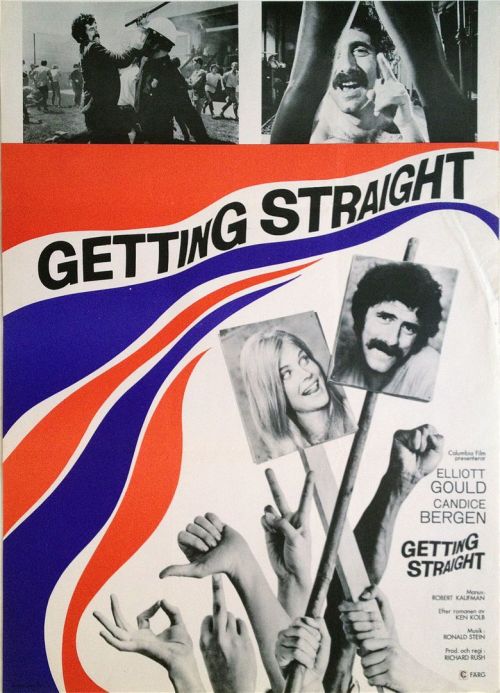
Getting Straight (1970)

getting straight1

By Richard Winters

My Rating: 5 out of 10

4-Word Review: Student unrest plagues campus.

Harry Bailey (Elliot Gould) was at one time a student radical, but after returning to campus from serving time in Vietnam his perspectives have changed. Now he simply aspires to get a teaching degree, but the other students want him to take part in their campus protests, which he resists. His girlfriend Jan (Candice Bergen), who is much younger, starts to get active in the student movement, which creates further pressure for Harry. He sees the absurdity on both sides, but as the protests become more violent and the response from school administrators more inept, Harry comes to the conclusion that he can no longer sit on the sidelines.

If there is one thing that really stands out it’s Gould’s performance in a part he was clearly born to play. In fact the studio refused to go ahead with the project unless Gould made a commitment to star in it. Had he decided not to take the part the studio would’ve shelved the project permanently as they felt there was no other actor that was right for the role and they were correct. Fortunately Gould did accept and his running, raucous, irreverent commentary is the most entertaining thing about it.

Unfortunately his presence is so powerful that he dominates Bergen who comes off as transparent and overwhelmed. She certainly looks quite beautiful and I particularly enjoyed her cowgirl look with two ponytails, but her presence is blah. Maybe the producers wanted a weaker performer to expose how unequal the character’s relationship was with each other, but the result makes the conversations that the two have dull and tepid because Bergen can simply not keep up with Gould’s rapid-fire delivery.

Their fights are a little more entertaining with some of the jabs Gould throws out being downright funny especially when he accuses Bergen of being ‘just a guy with a hole in the middle.’ Yet the fact that the two get back together after flinging out some very nasty insults made no sense. There are certain things that were said here that got personal and couldn’t just get written-off as having been said in a ‘fit of anger’ like they do here. In most real-life relationships it would’ve created a rift that would never have returned things to the way it was before.

The protests come-off looking too staged, which includes one scene where Gould and Bergen stand in the middle of all of the chaos and manage to somehow hold an extended conversation even as everyone around them is getting beat-up.  In the original novel by Ken Kolb there weren’t any student protests and were only added in by director Richard Rush to give the story a more topical feel, but there were too many other films with a similar theme that  were more effective. Even The Strawberry Statement starring Bruce Davison, which had its share of faults, still at least managed to make the student’s confrontations with the police look more authentic and intense.

Some of the arguments that Gould dishes out as he battles with administrators, and sometimes with the students too, are on-target and even funny like when he challenges the new curfew rule by pointing to one of the students (played by John Rubinstein) and stating: “At the start of the school year he just wanted to get laid. Now he wants to kill somebody…you should’ve just let him get laid.”

Gould’s angry confrontation with Jon Lormer who plays one of the school board members has a riveting quality and that’s where this movie should’ve ended. Having it continue to where Gould then later confronts Leonard Stone, who plays another school board member, gets too heavy-handed and ultimately kills the film’s best moments with a lot of talky bits that seem insightful, but really aren’t.

My Rating: 5 out of 10

Released: May 13, 1970

Runtime: 2 Hours 5 Minutes

Rated R

Director: Richard Rush

Studio: Columbia Pictures

Available: DVD, Amazon Video, Youtube

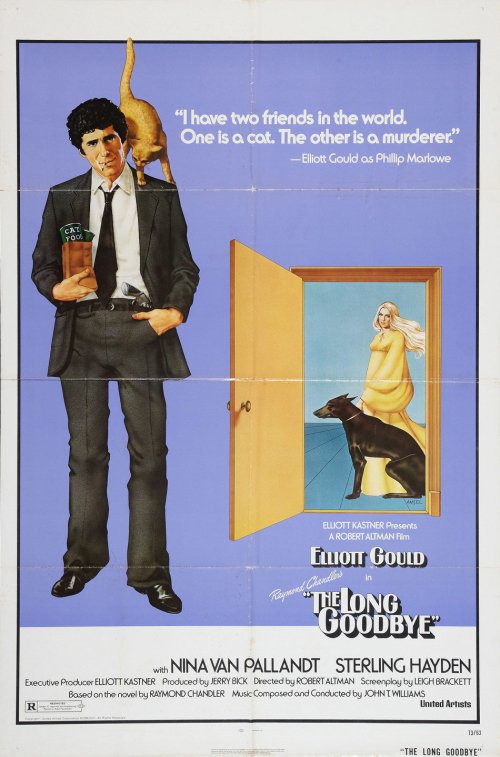
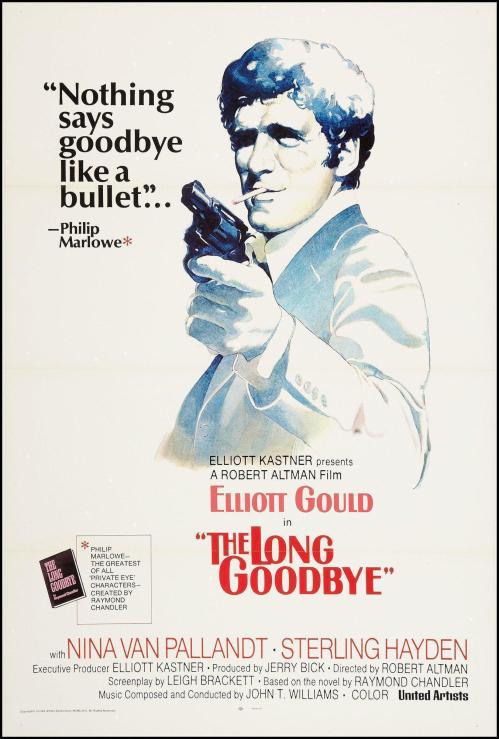
The Long Goodbye (1973)

By Richard Winters

My Rating: 7 out of 10

4-Word Review: His cat is hungry.

One night detective Phillip Marlowe (Elliot Gould) is visited in his home by his long time pal Terry Lennox (Jim Boulton), who informs Marlowe that he’s had a fight with his wife and asks him if he can have a ride to the Mexican border, which he obliges. When he returns home he is met by two cops (Jerry Jones, John S. Davies) who bring him into the station with questions about the whereabouts of Lennox whom they insist has just killed his wife. When Marlowe refuses to divulge anything he gets put into jail only to released 3-days later when it’s reported that Lennox has killed himself. Marlowe becomes suspicious about the suicide and determined to do his own investigation while also getting involved with Eileen Wade (Nina van Pallandt) and her alcoholic, writer husband Roger (Sterling Hayden) both of whom may hold the secret to Lennox and what really happened.

By the early 70’s only two of Raymond Chandler’s novels had yet to be filmed, this one and ‘Playback’. United Artists agreed to finance the film and commissioned Leigh Brackett, who had been the screenwriter for another Chandler novel turned into a movie 1946’s The Big Sleep, to write the screenplay for this one. Robert Altman was later approached to direct it and while he was not a fan of the Phillip Marlowe character, whom he labeled as being a ‘loser’, he agreed to take on the project due to the unexpected ending, which had not been in the novel, but that Brackett had added into the screenplay.

While Altman may have seemed an odd choice, he never even read the source novel of which the film is based, the eccentric little sidelights that he adds into the proceedings make it worth it. Some of the movies that he did towards the late 70’s became a bit too undisciplined where his films would go off on tangents with stuff that had very little to do with the main plot, but here the story is strong, so the little detours that Altman adds in helped to playfully accentuate the plot instead of drowning it out.

Some of my favorite Altmanisms included  Marlowe looking for food to feed his hungry cat, who I might add for an animal gives a spectacular performance, and how a stocker that he meets at the grocery store while searching for cat food he ends up meeting again at random at the police station. The next door female nudists, who are also into yoga and attract the attention of both the police and the bad guys who come to Marlowe’s place, are fun too.

There’s some marvelous framing by cinematographer Vilmos Zsigmond including capturing Roger and Eileen having an argument inside their home, which was filmed at Altman’s Malibu residence, through a glass patio door while at the same time in the reflection you see Gould walking along the beech. Later while Eileen and Marlowe are having a conversation by an open window you can see in a distance, which the other two are unaware of, Roger walking into the ocean in an attempt to kill himself.

Spoiler Alert!

The film also features what I feel is one of the most shocking and disturbing scenes that I’ve ever seen put into a movie and that’s a statement that I don’t use lightly. I’ve seen hundreds of gory horror films, but what happens here I’ve found far more unsettling. I think the reason is because it’s completely unexpected as it features the character played by film director Mark Rydell smashing a glass coke bottle onto the face of his girlfriend who just seconds earlier he had stated that he was deeply in-love with. Hearing her scream out in unending pain while cupping her hands over her face as blood spews out makes it come-off as very real. Even more amazing is that the part of the girlfriend was played by an amateur named Jo Ann Brody who never appeared in any other film and was a waitress that Altman and Brackett met when they went out to dinner while working on the script and who they asked on-the-spot if she’d like to be in their movie.

Altman admitted that he knew this violent scene, which had not been in the book, would upset some fans, but he felt it was important to bring the viewer back to the reality that these were violent characters at heart. This could also be seen as a foreshadowing to the surprise ending when Marlowe finds Lennox still alive in Mexico and then unexpectedly shoots him. In the novel Marlowe allows Lennox to walk away unharmed, but Altman liked the violent twist.

Personally I was ambivalent with the ending here and might actually have preferred the way it was done in the book. My main issue though with it is that Eileen spots Marlowe leaving the place where Lennox was just shot and since she was in a relationship with Lennox and also had strong criminal connections I’d think she’d end up, one way or another, going after Marlowe once she realized he had killed her lover causing the ending to leave open too many potentially interesting tangents that should’ve been followed through on.

My Rating: 7 out of 10

Released: March 7, 1973

Runtime: 1 Hour 52 Minutes

Rated R

Director: Robert Altman

Studio: United Artists

Available: DVD, Blu-ray, Amazon Video

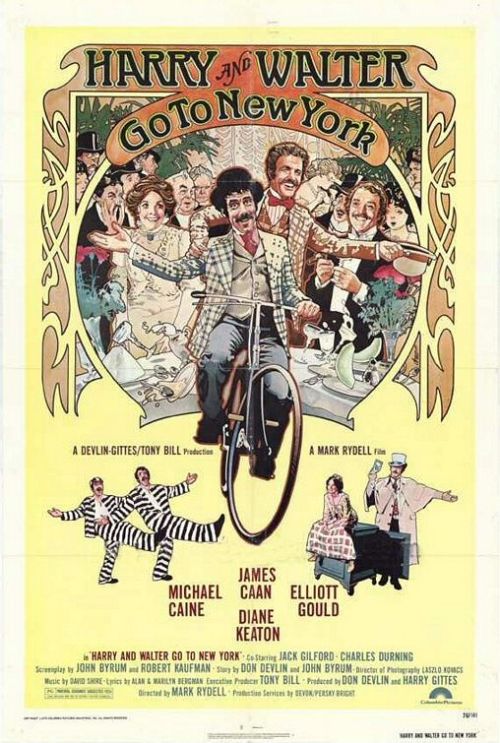
Harry and Walter Go to New York (1976)

By Richard Winters

My Rating: 7 out of 10

4-Word Review: Two vaudevillians rob bank.

Harry and Walter (James Caan, Elliot Gould) are two down-on-their-luck marginally talented comedians living in the 1920’s who go to jail when they’re caught trying to rob their audience members during a tacky onstage ‘psychic’ stunt that goes horribly wrong. While in the slammer they meet up with Adam Worth (Michael Caine) a rich man from society’s upper crust who enjoys robbing banks just for the thrill of it. They come upon the blue print for his next proposed heist and take a picture of it and then after they escape from jail challenge Adam on who will be able to rob the bank first.

This is one of those 70’s movies that I found to be refreshingly original and quite funny, but when it was released it was met with harsh reviews and was a bomb at the box office. After some bad test audience reactions it was heavily cut much to director Mark Rydell’s dismay who felt a lot of the better jokes went missing although producer Tony Bill and star Caan blame Rydell for the film’s failure and insist that much of the humor in the original script was never even filmed or used.

I can’t explain why the film didn’t do well as I personally found as bank heist movies go this one to be quite  unique. So many bank robbing films from that era, and even today, paint the scheme in a one-dimensional way by portraying the robbers, who we are usually supposed to sympathize with, as a modern-day Robin Hood, while the cops and those out to stop them are represented as being the greedy,oppressive establishment, but this film takes things a step further, which is what I found interesting. The competition aspect gives it an extra.,likable edge and really made me want to root for Harry and Walter and their gang of losers who take on the arrogant Caine and his snotty buddies. Instead of the viewer just being intrigued at how they’re able to pull of the robbery as is the case with most heist films we are much more emotionally invested with its outcome.

Caan and Gould are what Warren Beatty and Dustin Hoffman should’ve been in Ishtar. These guys are definite losers, but still appealing and comical at the same time. Caan has never been known for his comedy and he has referred to this movie as ‘Harry and Walter Go to the Toilet’, which is a shame because he shows nice energy here and is able to keep Gould in check by not allowing him to drone on and steal the spotlight as he can sometimes do when left alone or with a less capable co-star.

If the film fails at all it’s by entering in too many supporting players. The title mentions only Harry and Walter and they should’ve pulled off the heist alone with maybe only Keaton tagging along for balance. As it is though a whole massive group gets in on it to the point that the two leads have little to do. While the group is busily trying to figure out how to open the safe Harry and Walter are on stage trying to extend a stage play  The film still works pretty well despite this issue, but technically the two men should be at the center of the action and in a lot of ways they really aren’t and in fact become almost like supporting players by the end.

The film also goes on too long with the denouncement being far more extended than it should, but it’s still a fun, breezy watch that reflects the gilded age flavor well and uses leftover sets from Hello Dolly to enhance the scenery perfectly.

My Rating: 7 out of 10

Released: June 17, 1976

Runtime: 1 Hour 55 Minutes

Rated PG

Director: Mark Rydell

Studio: Columbia Pictures

Available: DVD, Blu-ray, Amazon Video

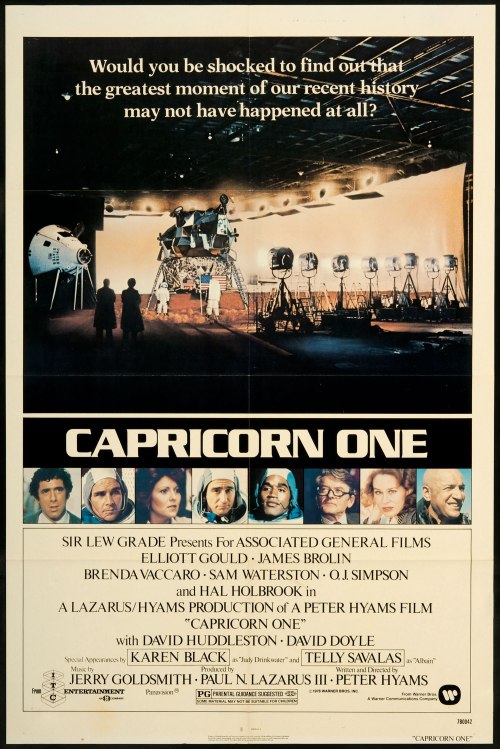
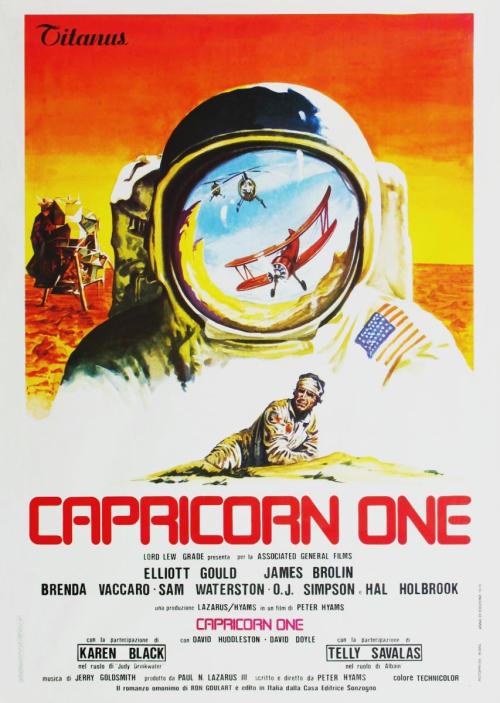
Capricorn One (1978)

By Richard Winters

My Rating: 6 out of 10

4-Word Review: Mars landing is fake.

Due to finding out about having a faulty life support system James Kelloway (Hal Holbrook), who heads the NASA mars mission, decides to have the three astronauts (James Brolin, Sam Waterston, O. J. Simpson) removed from inside the rocket just before it is ready to blast off. He then allows the rocket to take off leaving everyone on the ground with the mistaken impression that the astronauts are still inside. The astronauts later walk onto a soundstage that is made to replicate the mars surface where they pretend to be walking on the planet live on television. As the rocket stays on mars the three astronauts remain trapped inside the NASA space center unable to let even their families in on their secret, but when the rocket returns to earth it gets accidently destroyed. Since the three men are still thought to be inside and since the government wouldn’t want to whole world to know it was a hoax the men are forced to make a daring escape across the hot desert in order to avoid being killed.

The script was originally written in 1969 and was an attempt by director Peter Hyams to take advantage of the moon landing conspiracy that was going on at the time, but no studio was willing to take it on, so it took 9 years and a change of planets before it finally got the green light. I’m not a big fan of conspiracy theories as I think a lot of them are too dependent on a great many people working together and being able to keep a secret in order for them to be pulled off. Since it’s hard for just two people to pull off a crime such as a murder without one eventually turning on the other, or breaking down under pressure, then it’s even harder to believe hundreds could keep quiet it in order to successfully pull off the so-called moon landing hoax, or that at some later time one of them wouldn’t have divulged the secret to a family member, friend, or even anonymously to the press.

In either case it’s an entertaining movie for the most part although the first hour is spotty and it only really gets gripping during second-half. To some degree I thought it would’ve been more interesting had the focus been on the people setting up the ruse and working to make the soundstage look like mars than on the astronauts. It also might’ve been more impactful to the viewer had they been given the idea that the landing was real and only when the men are seen walking on the mars surface does the camera pull back to show that it was all fake instead of revealing the conspiracy right from the start.

The problem that I had though was with Elliot Gould’s character. Don’t get me wrong I liked the way he plays the part as a sort-of disheveled, loser hero who strikes out with the ladies, but the fact that the government is on him so quickly and trying to kill him before he has even written one single report about the mars landing makes little sense. Later on he gets bailed out of jail by his boss, played by David Doyle, who openly admits to hating Gould and immediately fires him the second he pays his bail, but why spend company money on someone you don’t like and don’t want working for you?

Spoiler Alert!

The ending features a well photographed aerial chase through the skies that is very exciting, but the wrap-up in which James Brolin, who is the last surviving astronaut that manages to escape the deadly clutches of the government and appears to shock of everyone at his own funeral seems to ruin the premise. For conspiracy theories to hold their mystique there needs to be the idea that the bad guys were able to get away with it and that it is actually possible to successfully kill off all the possible leaks and manage to hold the rest to strict secrecy. By having someone survive only proves the point that I made earlier and thus makes all those other conspiracy theories that permeate modern culture seem dubious as well because mostly likely the same result would’ve ultimately happened with those that happened with this one.

End of Spoiler Alert!

My Rating: 6 out of 10

Released: June 2, 1978

Runtime: 2 Hours 3 Minutes

Rated PG

Director: Peter Hyams

Studio: Warner Brothers

Available: DVD, YouTube, Amazon Video, Blu-ray

The Lady Vanishes (1979)

By Richard Winters

My Rating: 4 out of 10

4-Word Review: Where’s the old lady?

In 1939 while traveling by train from Bavaria to Switzerland American Heiress Amanda (Cybill Shepherd) befriends an English nanny named Miss Froy (Angela Lansbury). The two sit across from each other inside a train compartment. When Amanda awakens from a nap she notices that Miss Froy has disappeared and when she asks others where she went to everybody denies having even seen her. Amanda starts to question her own sanity and tries to use the assistance of American photographer Robert Condon (Elliot Gould) to help her figure out what is going on.

This film is a remake of the classic 1938 movie of the same name, which was directed by Alfred Hitchcock and based on the novel ‘The Wheel Spins’ by Ethel Lina White. I last saw the original over 30 years ago while attending college, so my memories of it are fuzzy and I’ll be unable to compare the two. However, I do remember enjoying it and feeling that this thing doesn’t quite reach the same level.

The biggest issue is the casting of Shepherd. I think she’s a gorgeous lady, I loved seeing her in the low cut white dress and at one point she even appears to bravely do her stunts by jumping off a moving train, but her acting is not up to par. She can be great as a bitchy, sarcastic woman or even as a kooky eccentric, but as someone we want to root for or sympathize with, no way. Some of her former co-stars including Bruce Willis and Christine Baranski have described her as being cold and competitive to deal with and that’s the exactly same vibe I get every time I see her. Her efforts to cover that up in an attempt to play a more likable character doesn’t work, so instead producers should cast her in parts that mesh with her personality while getting someone else more affable for this role.

Gould has the same problem. He looks bored and out-of-place and I don’t know why the nationalities of the two lead characters, which had been British in the original, were changed to American here, but it doesn’t help. Besides there is absolutely no chemistry between he and Shepherd, which makes the romantic angle come off as quite forced. He was also considerably older than her and they should’ve at the very least cast two people more in the same age range.

Even the great Angela Lansbury is all wrong here. She still gives the role a stellar performance with her best moment coming when her eyes well up with tears as the other passengers openly contemplate throwing her off the train and into the clutches of an SS officer standing outside, which proves that the truly great stars don’t need any speaking lines to convey just the right emotion.  However, she was only in her 50’s at the time and didn’t come off looking elderly. Dame May Whitty played the part in the original and was in her 70’s, which is what the age of the actress playing the part here should’ve been.

The basic premise is still entertaining enough to keep things passable, but I would’ve liked the mystery angle played up more by showing things only from Amanda’s perspective until the viewer started to question her sanity as well. The scene where Amanda sees the name Miss Froy written in the dust of a train window by the Lansbury character earlier and then having that name strangely disappear off the window after they go through a tunnel makes no sense. This was supposed to be a ‘realistic’ thriller and therefore surreal elements should not have been thrown in.

The climactic sequence is entertaining, Arthur Lowe is enjoyable in a supporting part, and the Austrian scenery is luscious, but the movie is marginal and only helps to make the viewer appreciate the original more than anything.

My Rating: 4 out of 10

Released: May 8, 1979

Runtime: 1 Hour 35 Minutes

Rated PG

Director: Anthony Page

Studio: Rank Film Distributors

Available: DVD, Amazon Video