Tag Archives: Dom DeLuise

Johnny Dangerously (1984)

johnnydangerously

By Richard Winters

My Rating: 3 out of 10

4-Word Review: From newsboy to gangster.

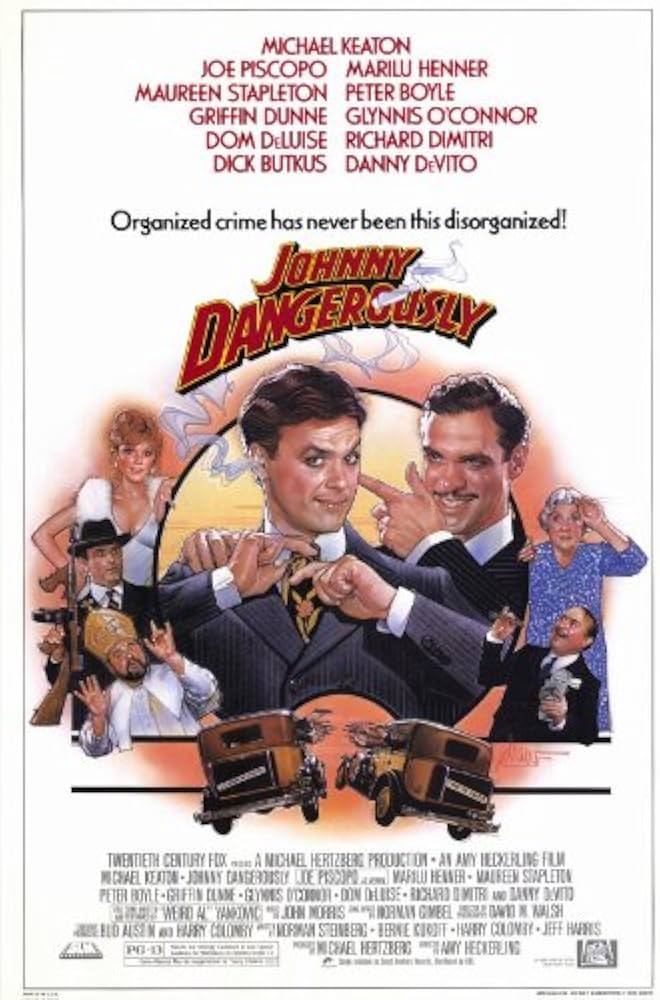
Young Johnny (Byron Thames) must find some income to help his mother (Maureen Stapleton) with her medical expenses. He catches the eye of Jocko (Peter Boyle) a notorious gangster who offers him odd crime jobs to do part-time and Johnny takes him up on it but feels guilty. The years pass and a grown-up Johnny (Micheal Keaton) finds that his mother’s health hasn’t improved, and the bills continue, so he decides to get into the gangster business full-time and even takes over as head of the gang once run by Jocko. The money is so good that it not only covers everything his mother could need but also helps his younger brother Tommy (Griffin Dunne) get through law school. However, once Tommy graduates, he gets a job at the D.A. office where becomes committed to stamp out corruption and put all criminals behind bars even if it would mean his older brother.

The pace and structure are modeled after the more successful Airplane movies in which the light plot works as a platform for a barrage of rapid-fire jokes and pratfalls mostly satirizing gangster movies from the ’30’s. While Airplane came off as fresh and funny as it poked fun of all the disaster movies from the ’70’s this thing seems old and tired before it’s barely even begun. The biggest issue is that gangsters had already been parodied for many years both in TV and on the big screen. By the time this movie came-out most of the jokes had already been used many times over and the comedy fails to create anything inventive. The characters are nothing more than walking-talking cliches that mouth banal one-liners and not much else. Almost all the jokes fall flat, nothing sticks and has no edge to it. It’s something that could’ve easily been made for TV and it should be no surprise that the writers were two men who helped create the ‘Different Strokes’ TV-show.

What surprised me most is that it wasn’t even dirty, or at least not that much. It’s directed by Amy Heckerling who had just gotten done doing Fast Times at Ridgemont High, which seemed to have bawdiness and sexual innuendoes in almost every frame and yet here there’s surprisingly very little. Yes, there’s an animated segment dealing with victims of enlarge scrotums, which doesn’t have much to do with the story, but is kind of amusing, but that’s about it. Some more sex and even nudity could’ve helped enliven things, or at the very least given something more to laugh it. The malapropisms by the gangster character Moronie, played by Richard Dimitri, where he uses a lot of colorful language that sounds like curse words, but really aren’t I didn’t find to be clever at all. Today words like fuck and fucking are used liberally in social media and even casual daily conversations. I even hear young neighborhood kids saying it, so for a movie to think that it’s ‘pushing the envelope’ by having someone use phrases the sound like the F-word but aren’t makes the movie seem quite dated.

I didn’t care for Keaton. He comes-off like some smart ass who’s phoning in his performance with a pasted-on smile that never leaves his face. It’s like he isn’t even acting or trying to create any type of character. He just casually walks on, makes a semi-amusing remark, and then walks-off. Thames who played the younger version of Johnny was better and the movie could’ve been more engaging had Johnny remained a kid the whole way and then watching an innocent teen take down the gangsters and even ultimately become their leader would’ve had some original spin that’s otherwise lacking.

Joe Piscopo, who plays Johnny’s criminal rival, is quite good and as opposed to Keaton, seems to be making some sort of effort to play a role and I thought he should’ve been in it more, or even just given the reins and taken over completely. The film’s promotional poster makes it seem like the two will have equal screentime, but that’s shockingly not the case and Joe’s presence amounts to a few walk-ons, which is a shame.

The rest of the supporting cast are equally wasted. Marilu Henner sings a nice dance number but otherwise doesn’t do or say anything else that’s interesting. Stapleton looks way too old for the role of a mother and would be more suited as a grandmother. At one point she even refers to herself as being ’29’ despite having gray hair. Don’t know if this was meant to be a ‘funny joke’, but it doesn’t work and is dumb like most everything else. Dunne is miscast as well. He’s supposed to be this young idealist but appears much more like someone already in their 30’s and would’ve been more authentic had they gotten a college aged student with a wide-eyed, clean-cut image versus Dunne who’s always had more of a weary and beaten down impression. Dom Deluise though is the most out-of-place in a part that amounts to being a cameo as the Pope who appears inexplicably on a city sidewalk for some strange reason that misses-the-mark completely in a gag that like everything else gets thrown-in with little thought, or care.

I did do enjoy Danny DeVito who amazes me how even when given small roles still manage to steal the proceedings especially with his impromptu hosting of a game show send-up. I’ll even give a few props to the ‘pass the secret message’ segment done inside a jail where one prisoner whispers something into another prisoner’s ear, who then passes it along to yet another guy and so forth down the line until it gets to the last one where the initial message has now become completely distorted, which got me to laugh, but honestly that was the only time during the whole viewing that I did.

My Rating: 3 out of 10

Released: December 21, 1984

Runtime: 1 Hour 30 Minutes

Rated PG-13

Director: Amy Heckerling

Studio: 20th Century Fox

Available: DVD
The Adventure of Sherlock Holmes’ Smarter Brother (1975)

sherlock

By Richard Winters

My Rating: 6 out of 10

4-Word Review: Sibling solves the case.

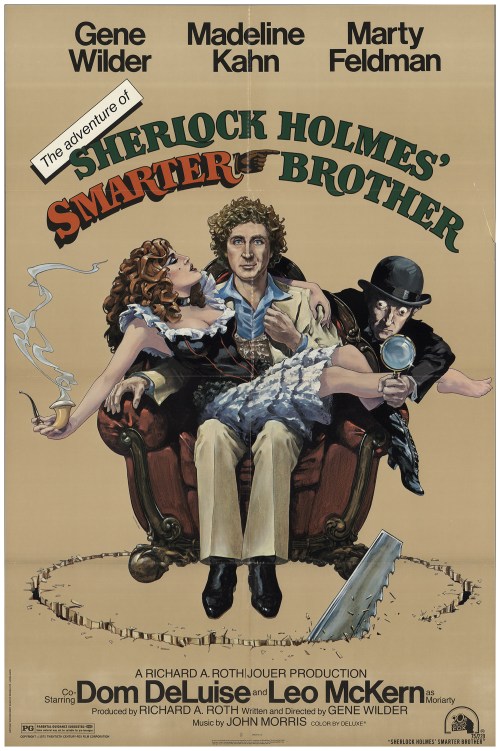
Gene Wilder plays Sigerson Holmes, the jealous younger brother of Sherlock, who is upset that his sibling is so famous for solving crimes while he sits in obscurity having not seen as much success though he feels he’s just as smart if not smarter. One day Sigerson gets a case that his brother doesn’t want to get involved in due to him desiring to lay low for awhile. It involves Jenny Hill (Madeline Kahn) who’s a beautiful music hall dancer who is being blackmailed by an opera singer named Eduardo (Dom DeLuise) over a lewd letter she sent him years ago. However, the document proves to be much more than just a letter and is in fact an important paper that foreign powers will pay high price to get their hands on. Eduardo agrees to sell it to the evil Professor Moriarty (Leo McKern), but will only hand it over to him during one of his operas, which Sigerson and his loyal partner Orville (Marty Feldman) plan to attend in order to intercept the paper before it gets into the wrong hands.

Gene Wilder was approached by producer Richard Roth to do a parody of Sherlock Holmes, but Wilder didn’t like the idea of poking fun of what he felt was an iconic character. Roth told him to think about it and then approached him a week later. By this point Wilder said he had come up with a better idea instead of it being about Sherlock it would focus on his jealous brother Sigerson. Roth found the premise intriguing and suggested Wilder begin writing the screenplay which he did while working on Young Frankenstein. Once completed he asked his friend Mel Brooks to direct, but Brooks declined saying he didn’t like working on projects that were not his own idea, so Wilder took the reins himself calling it a ‘terrifying commitment’.

While the movie has some good moments the Sigerson character is not interesting. For one thing he’s poorly defined. One minute he’s cunning and sharp and then the next he proves dimwitted and clumsy almost becoming another Inspector Clouseu. The comedy should feed off the character, but with it unclear whether he’s brilliant or buffoon it never catches its stride and for the most part the scenes with him in it are boring and the audience doesn’t care if he solves the case nor feel that there’s any redemption if he does. He’s also genuinely unlikable particularly with the way he snaps at Jenny Hill making you almost want to despise the guy and hope he doesn’t succeed. Also, if he really is Sherlock’s brother then I felt there needed to be some scenes with them together and the interplay between the two could’ve been amusing if done right, but this never happens.

Wilder directs the film the way most actors turning director do by having the scenes more extended and allowing the actors to drive the pace and momentum versus the editing. With a so-called ‘zany’ comedy like this that doesn’t work and there’s several segments that go on too long until it becomes dull and looking a bit amateurish. The biggest example of this is when Jenny arrives a Sigerson’s place to tell him about the letter. Their interplay doesn’t go anywhere and ultimately in order to get out of it the characters, for some unexplained reason, break-out into song and dance making it seem like its a musical, which it isn’t, but either way it’s dumb and not funny. During Jenny’s music hall show, which Sigerson and Orville attend, she sings a long song there too, which wasn’t needed and saps the comic energy.

There are though some offbeat moments much of which comes from McKern a usually serious actor who shines in his campy part and really plays it up to the point that he becomes the highlight. The part where he goes to a fortune telling machine, that he has inside his residence, is inspired and his visit with Eduardo in which the two strangely fondle each other and even go to bed together that gives off weird homoerotic vibes is good too in a sort of bizarre ‘what am I looking at’ type of way.

The best part though is when a giant saw blade cuts off the back of Wilder’s and Feldman’s trousers causing their bare behinds to be exposed. They then go to a formal dance party and shock everyone who sees their asses with them still not aware that they’re showing. What’s so interesting about this part is that they both have really good looking butts especially Feldman. You’d think with his freaking looking face that his rear wouldn’t be so hot either, but it amazingly is, so in keeping with our current male ass scorecard we still have Dabney Coleman, who bears his behind in Modern Problemscoming in first and Tim Matheson’s in Impulsebeing a close second and then Wilder and Feldman tying for third place.

My Rating: 6 out of 10

Released: December 14, 1975

Runtime: 1 Hour 31 Minutes

Rated PG

Director: Gene Wilder

Studio: 20th Century Fox

Available: DVD, Blu-ray

Haunted Honeymoon (1986)

haunted

By Richard Winters

My Rating: 1 out of 10

4-Word Review: Boyhood home is haunted.

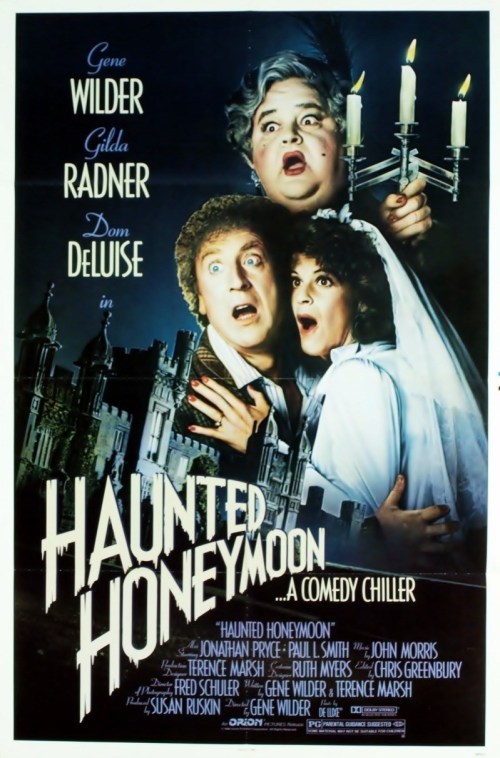
Larry (Gene Wilder) and Vickie (Gilda Radner) are performers on a popular radio show who are also engaged to be married. Ever since the wedding date has been set Larry has been going through a variety of odd behaviors including flubbing his lines and even making incoherent statements during the production that go over the air. Vickie thinks it’s just his nerves about getting married, but Dr. Paul Abbott (Paul L. Smith), who also happens to be Larry’s uncle, thinks it’s much more than that. He feels the only way to cure him will be shock therapy, or in this case to ‘scare him to death’. Since Larry plans on having his wedding at his boyhood home, which is an old rural castle, the doctor feels this will be the perfect spot to engage with the frights. Everyone on the premises is in on the plan, eventually even including Vickie, but as the make believe haunting commences it soon becomes obvious that there’s some real scares too that frightens everyone.

Gene grew up as a child reportedly scared of horror movies and tried to avoid them, but did enjoy what he called ‘comedy chillers’, which were movies that had some scares, but also balanced with laughs and sought out to create one of his own. He started writing the script while he was starring in Silver Streak, but then lost interest and put it away. While he was filming Hanky Pankyin which he met Radner whom he later married, he got interested in continuing with the script especially at her insistence as she felt it would make a great vehicle for the two.

The problem with it is that he created something completely out of touch with the times. Haunted houses, werewolves and other elements from 1930’s movies had all been parodied for decades to the point it had almost become a cliche in itself. This film adds nothing fresh to the mix and feeds off of gags and stunts that had been done hundreds of times making it lame right from the start. Had it been more updated to add in elements from modern day horror movies, or changed the setting so it wasn’t just the predictable rural castle complete with thunder and lightning outside, then maybe it might’ve had a chance, or at least piqued people’s interests, but as it is here the stuff is routine and lacking in originality.

The biggest shock is that you have Dom DeLuise in full drag and yet he isn’t funny at all. Wilder got the idea to use him for the part when he saw him impersonate Ethel Barrymore years earlier at a dinner theater he attended, but the mistake was that Gene wanted him to literally play it straight, but why put a guy in full female get-up if you’re not going to give it any type of payoff? It’s a shame too because I’ve found Dom to sometimes be quite hilarious and even be the scene stealer in some of his other films. Jonathan Pryce, who was also in the movie, stated how the entire cast and crew would sit around and let Dom entertain them between takes, but whatever he said and did off camera was missing onscreen and even the duet that he sings with Gilda fails to elicit even a chuckle.

The story creates this big set-up and then goes nowhere with it. Gene gives himself a few amusing bits and I suppose Bryan Pringle, who plays the aging butler named Pfister, and even Ann Way with her distinctive hawk-like facial features, have a couple of funny moments, but everything else falls flat including Radner who isn’t funny at all and overall given a very thankless part by no less than her own husband.

The film lost money at the box office and despite a month of promotions and ads it only managed to remain in theaters for week before it was pulled. It polled poorly amongst critics and audiences alike, which is probably the only real funny thing is what occurred behind-the-scense as the studio, Orion Pictures, refused to screen it for critics before giving it a general release. Usually when this happens it’s a sign that the studio heads know they have a stinker on their hands, but they denied this saying they were ‘very comfortable’ with the movie and ‘behind it 100 percent’ and only avoided the advance screening because there had been a ‘tendency lately by critics to be quite vicious about films’ in general and they didn’t want to ‘cater’ to that, but you’d think if they really knew they had a great movie their fear of ‘vicious reviews’ wouldn’t have been a factor.

My Rating: 1 out of 10

Released: July 25, 1986

Runtime: 1 Hour 22 Minutes

Rated PG

Director: Gene Wilder

Studio: Orion Pictures

Available: DVD, Blu-ray

The Twelve Chairs (1970)

twelve

By Richard Winters

My Rating: 7 out of 10

4-Word Review: Which chair has fortune?

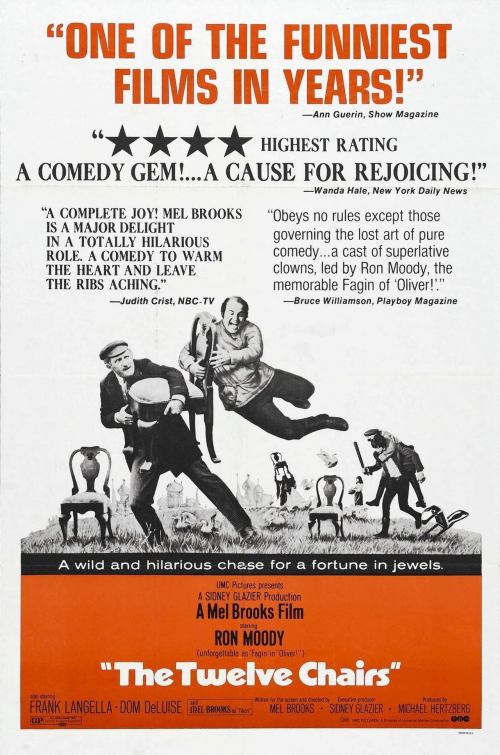
Vorobyaninov (Ron Moody), an poor man living in 1920’s Russia, is summoned to the deathbed of his mother-in-law. She confides in him that there’s a stash of priceless jewels sewn into the seat cushions of one of the twelve chairs from the family’s dinning room set. Unfortunately the newly formed Russian state has appropriated all private property and it’s up to Vorobyaninov to track them down. He teams up with Ostop (Frank Langella) a local con-man to help him, but they have competition. Father Fyodor (Dom DeLuise), a priest, also becomes aware of the jewels when he goes to the mother-in-law’s home to give her the last rites. All three go on a mad dash to retrieve the jewels, but the more chairs they manage to find the more frustrated they become.

The film is based on the 1928 Russian novel of the same name by Ilf and Petrov a famous duo who were quite popular during the early soviet period and wrote not only many satirical novels, including this one and its sequel ‘A Little Golden Calf’, but also several short stories, articles, theatrical plays, and even screenplays. The Twelve Chairs novel though was their most popular and has been made into a movie 18 different times. It had already been done 6 times before Mel Brooks did his with the first version being in 1933 and the most recent rendition of it done in 2013 in Italy.

This version is the most popular and a bit of stretch from Brooks’ other films, which relied on a lot of gags and slapstick. This one has its fair share of those though the first act is quite talky and not too much going on. Brooks himself appears as a character, but he can’t really enliven it. It’s not until the men finally come upon the chairs and start tearing them up one-by-one that it really starts to get funny. The chair thing could’ve gotten redundant as the men rip open the seat cushions in pretty much the same quick way, but Brooks manages to approach each of these scenes in a creative way, so instead of becoming monotonous it remains fresh and comical. My favorite of these is when Ron Moody and Frank Langella chase Dom, who has one of the chairs, through an open field that’s done in stop-action.

The film’s detraction though is the casting of the two main characters. Langella is a terrific actor, but not in comedy. He did appear in the dark comedy Diary of a Mad Housewife, where he was very good, but that took advantage of his glib demeanor and pouty expression and his character there was meant to be unlikable. Here though he has nothing amusing to say and remains a complete jerk the whole way. There is one point where he and Moody are in a row boat and Moody states that he’s cold and Langella gives him a jacket to wear, which I guess was Brooks’ attempt to make him likable, but it’s not enough and the movie is really hurt by spending so much time focused on a guy who’s one-dimensionally cold and responds to antics around him in the same sneering way. He was recommended to Brooks by his wife Anne Bancroft who had performed with Langella in a Broadway play that had a short run, but I felt this is one time when he shouldn’t have listened to her.

Ron Moody, a talented actor as well, has the same issue. The character is meant to be dim-witted, but it doesn’t come-off in a natural way. His banter with Langella is flat and annoying with the bickering doing nothing but slowing up the pacing. Without question DeLuise is the funniest. He’s just as conniving and greedy as the other two, but for whatever reason it doesn’t seem as ingratiating. His character’s ineptness had me laughing and he should’ve been the star while Langella and Moody could’ve been shown only sporadically as the occasional nemesis.

Spoiler Alert!

The ending is much different than the one in the book. In the novel version Vorobyaninov kills Ostap by slitting his throat with a razor in order to keep the loot for himself only to find that it’s not there, so he then goes insane. In the movie Vorobyaninov and Ostap team up to become beggars on the street by pretending Vorobyaninov has an epileptic condition and requesting people throw money at him to help him. Wikipedia, in a line that has since been deleted, stated that this was a ‘happier’ ending though trying to make a living being a street beggar all day can’t be all that fun.

What amused me though is that in both versions the jewels are never recovered by the two men. In the movie the jewels were found first by someone else who used it to build a clubhouse for pompous old men making it seem like greed was inevitable. In the book though the money gets used to build a recreational center that can be used by the entire community and thus giving it more of a pro-communist bent.

My Rating: 7 out of 10

Released: October 28, 1970

Runtime: 1 Hour 33 Minutes

Rated G

Director: Mel Brooks

Studio: UMC Pictures

Available: DVD

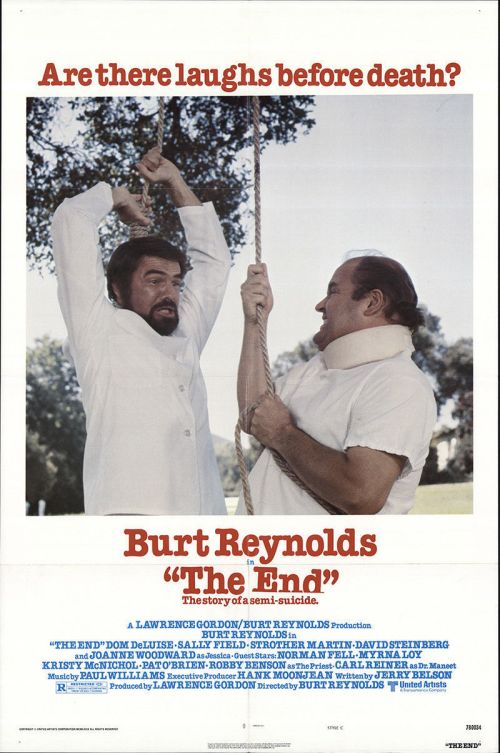
The End (1978)

end2

By Richard Winters

My Rating: 7 out of 10

4-Word Review: His days are numbered.

Sonny (Burt Reynolds) is a real estate broker known to make crooked deals. He gets diagnosed with an incurable disease and told he has only a limited time left. He says goodbye to his ex-wife (Joanne Woodward) who seems more interested in her new boyfriend, his daughter (Kristy McNichol) and his folks (Pat O’Brien, Myrna Loy) and even his live-in girlfriend (Sally Field) without actually telling them his condition. He then attempts suicide, but this gets him stuck in a mental hospital where he comes into contact with Marlon (Dom DeLuise) who agrees to help kill him, so Sonny can avoid going through the agony of the disease, but then after several aborted attempts Sonny decides he wants to live, or at least as long as he can, while Marlon continues to try and kill him and can’t seemingly be stopped.

The script was written by Jerry Belson, who also did the brilliant satire Smile and the original Fun With Dick and Jane, two of the funniest films to come out during the 70’s. This one is no exception, yet despite be written in 1971 and purchased by a studio, no one seemed to want to touch it. Many stars and producers felt the theme was too maudlin and wouldn’t be able to sell as a comedy. Reynolds though felt it was one of the funniest scripts he had read, and the character most closely identified to who he really was, and therefore jumped at the chance to direct and star in it though the studio was still reluctant and only agreed to finance it once he accepted starring in Hooper, which they felt was the sure money-maker though this one ended up doing quite well, surprising many, at the box office too.

Much of the credit goes to Reynolds who plays the part perfectly. Somehow he can create the slimiest of characters, and this one is a bit scummy with his admittedly shady real estate deals, and yet with his comic talent are still able to make him seem endearing. The studio had wanted the character’s profession to be a stock car racer, but this seemed too stereotypical, so I was happy that he kept it in the white collar realm and openly able to expose all of his personal flaws, which made him quite relatable. It’s also one of the rare times you get to see him with both a mustache and beard, or at least through the whole movie. The studio wanted to nix this too, but it helps give him a distinctive look.

Like with most actors turned director Burt allows for long takes, particularly during the first act, where the supporting cast is given ample time to play out their scenes without any interruption, which leads to many funny moments. I enjoyed Norman Fell as the doctor, and Robby Benson’s as a young priest who listens to Burt’s confession while he takes off his collar and puts it into his mouth, which creates a weird popping noise. These segments have an entertaining quality, but come-off more as vignettes and don’t help to propel the story along.

The second act, in which Burt ends up in the mental ward, are the best and his teaming with DeLuise is hilarious. I realize not all the critics enjoyed Dom’s take on a crazy man, Variety Magazine, labeled his performance as being ‘absolutely dreadful’, but there’s no denying the infectious chemistry he and Burt have, making the scene where he tries to drop Burt from a bell tower, or the segment where he tries to hang him up by a noose, quite memorable. The segment though where Burt goes swimming out into the ocean in an attempt to drown and then has a change of heart and tries getting back to shore and the voice-over prayer that he gives to the Almighty he order to help him back is laugh-out-loud and not only the top comedy moment in this movie, but quite possibly any movie ever.

Spoiler Alert!

The only problem I had was with the ending. In the original script the DeLuise character was supposed to kill Burt after he got out of the ocean, but Burt felt the movie needed some ‘hope’, so instead he has DeLuise attempting to chase Burt along the shoreline, in a sort of stop-action way that looks cartoonish. I felt there needed to be more of a resolution. If Reynolds does decide to live out the rest of his days what does he do with it? Does he try to mend his ways by paying back all those he had swindled? Or does he make amends with the people in his life including his ex and daughter? None of this gets answered, which is disappointing. A good movie needs a healthy character arch and this one doesn’t really have any. A better third act would’ve shown how the diagnosis had changed him and had the film not labored so much with the comical vignettes of the first half we might’ve gotten there and it’s just a shame that we never do.

My Rating: 7 out of 10

Released: May 10, 1978

Runtime: 1 Hour 41 Minutes

Rated R

Director: Burt Reynolds

Studio: United Artists

Available: DVD, Blu-ray, Amazon Video, YouTube

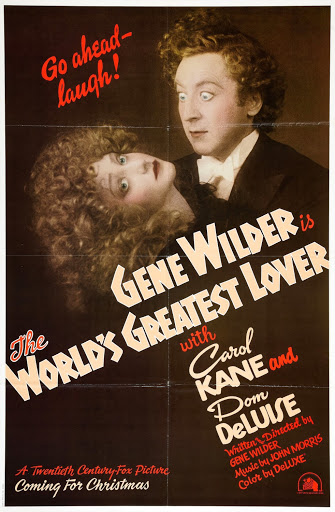
The World’s Greatest Lover (1977)

By Richard Winters

My Rating: 7 out of 10

4-Word Review: Seeking silent film stardom.

Adolph Zitz (Dom DeLuise) is upset that Rainbow Studios, which he heads, is not making as much of a profit as his rival and figures it’s because they don’t have silent film star Rudolph Valentino. He decides, after a meeting with his yes men who constantly surround him, to put out a national search for the world’s greatest lover who will come to Hollywood for a screen test to then become the next big star to rival that of Valentino. Rudy (Gene Wilder) is a hapless baker recently fired from his job who figures that entering this contest could be his ticket out of his penniless doldrums and travels to Hollywood for a screen test. However, once they get there his wife (Carol Kane) breaks away from him and sneaks off to the rival studio in order to try and have a chance encounter with her screen idol Rudolph Valentino (Matt Collins).

While the film did well at the box office bringing in a profit of $21 million off of a $4.8 million budget it flopped badly with the critics who ravaged both Wilder’s screenplay and direction. In a lot of ways they had valid points as the script veers off from the main theme quite a bit and seeming more like a collection of broad gags than a story. The comic bits take a long time to play out becoming almost like skits within a movie. The period atmosphere is poor and you never feel like you’re being transported back to a different era, or that there was even much thought or effort in this area to be authentic. Wilder’s character is problematic too. He can be great when he’s in an exasperated, frantic state and shouting at the top of his lungs, but he goes to this well too often making his character come-off as abrasive.

The one thing that saves it is that it’s surprisingly quite funny. I found myself laugh- out-out-loud at a lot of the bits no matter how meandering they became and really enjoyed the reaction shots from the supporting players. My favorite segment is when Wilder and Kane stay at a hotel with a sunken living room, which accidently gets filled up with water and then Wilder goes swimming in it and pretends it’s a pool when some family members of his come to visit. I also liked how it ultimately drains out onto some guests below who are ordering dinner. I even found the running joke dealing with DeLuise and his man servant barber (played by Michael Huddleston the son of character actor David Huddleston who also appears in the movie) and how he eventually learns to trust his business advice after always beating him up about it first.

The film manages to also make some interesting observations about people although this too borders a bit on getting botched particularly the scene where Kane goes into a tent to meet with what she thinks is Valentino, but really Wilder wearing a veil over the bottom of his face. However, it is clear to the audience just by looking at his eyes, which are very distinct, that it’s Wilder, so if it’s obvious to us it should be obvious to her since she’s been living with him for many years, but it isn’t. I did do like the point that the scene makes where she never enjoyed the sex with her hubby, but when she thought her hubby was somebody else suddenly the sex was ‘great’, which shows how much fantasy works into love making and a fundamental part of its enjoyment.

Wilder’s screen tests are quite amusing too and overall I found myself laughing consistently all the way through. If you’re looking for something light and comical that’s even a bit romantic then this should do the trick.

My Rating: 7 out of 10

Released: December 16, 1977

Runtime: 1 Hour 29 Minutes

Rated PG

Director: Gene Wilder

Studio: 20th Century Fox

Available: DVD
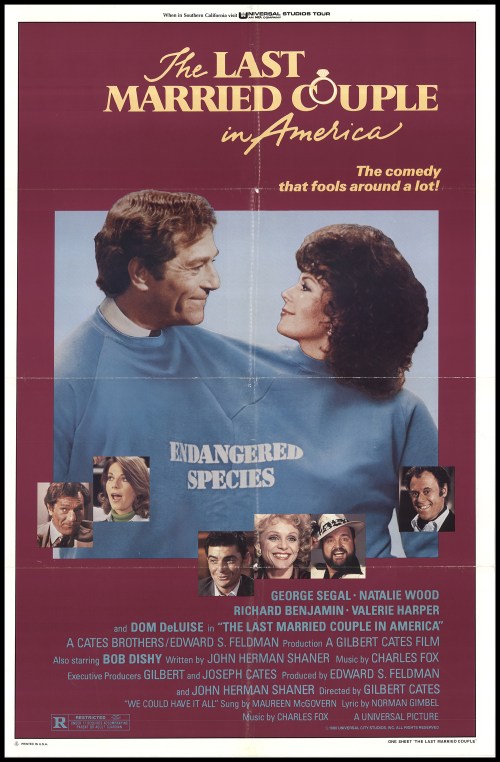
The Last Married Couple in America (1980)

By Richard Winters

My Rating: 2 out of 10

4-Word Review: Everybody’s getting a divorce.

Jeff and Marie (George Segal, Natalie Wood) have been happily married for quite a while, but suddenly all of their friends, who seemed to be in happy relationships as well, begin divorcing. They start to wonder if their marriage is as fulfilling as they thought. Jeff then sneaks off to have an affair with Barbara (Valerie Harper) and when Marie finds out she leaves him and takes up with a younger man, but the more the two are apart the more they long to get back together.

Wood described this film as being Bob & Carol & Ted & Alice 10 years later, but this lacks the bite and insight of that one. The first act goes on too long. Jeff and Marie’s conversations about their friend’s divorcing are transparent and it takes almost 40 minutes before the film finally works into act two. The story as a whole is shallow and makes no real point while filled with lackluster humor that goes nowhere.

The supporting characters are the most annoying as they are portrayed as being these one-dimensional, sexual revolution zombies whose sole purpose in life is to fool around with anyone they come into contact with married or not. They fail to pick-up on basic social signals that a normal person would and are completely oblivious to the concept that others may not be as ‘liberated’ as they are. If one chooses to be a swinger that’s fine, but they still have to be cognizant to the fact that they live in a world where not everyone will share that liberal lifestyle and having everyone lack this basic understanding makes them seem inhuman and nothing more than cardboard caricatures.

Wood comes off best and is the most relatable. Dom DeLuise is somewhat amusing as a male porn star. We never actually see his character at work, but just the idea that this pudgy man would make a living having sex in front of the camera is funny enough. Harper sporting a bleach blonde hairstyle is solid as well, but Segal with his overly exaggerated reactions and facial expressions is a major detriment.

As for the humor one could find more chuckles from an old episode of ‘Gilligan’s Island’. However, there is one moment that got me to laugh. It entails a conversation that Segal has with his friend (Richard Benjamin) at a bar. The two men lament about getting older and Segal states that having a weak stream while going to the bathroom is a strong signal of aging. The two then go to the men’s room to analyze theirs. While Benjamin stands at the urinal he suddenly looks up with a horrified expression while exclaiming “Oh my God, there’s two!”

My Rating: 2 out of 10

Release: February 8, 1980

Runtime: 1 Hour 43 Minutes

Rated R

Director: Gilbert Cates

Studio: Universal Pictures

Available: DVD-R (Universal Vault Series)

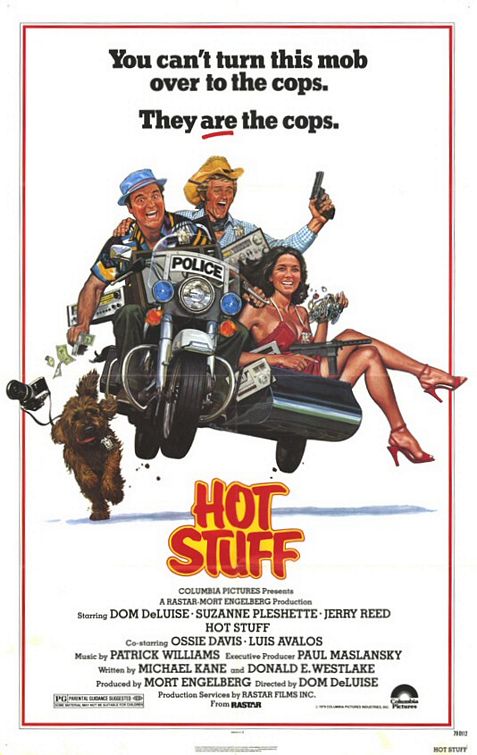
Hot Stuff (1979)

By Richard Winters

My Rating: 3 out of 10

4-Word Review: A phony pawn shop.

Tired of seeing the criminals they apprehend getting off on legal technicalities three cops (Dom DeLuise, Jerry Reed, Suzanne Pleshette) decide to turn-the-tables by opening up their own pawn shop, which will work as a front to reel in the crooks that try to resell stolen items. They use the magic of a hidden camera and video tape, which was a new thing at the time, to record the criminals as they bring in the stolen loot and therefore leave no question as to their guilt, but their plan gets off to a rocky start and only gets more convoluted as they proceed with it.

The film, which was directed by DeLuise, starts out fast and includes a car chase before the opening credits even occur, but once the premise is established it bogs down. Supposedly much of what occurs is based on real-life accounts taken from various police cases, but it lacks cohesion. There are gun battles and a wide array of criminal characters that pop up out of nowhere with the pawn shop setting being the only thing that loosely ties it together. Any element of reality gets lost during its farcical ending, which involves all the criminals attending a party that quickly turns into a long drawn slapstick-like battle that resembles something found in a cartoon and is really inane particularly the pathetic ‘fights’ that occur between the various characters where it is clear the actors are pulling their punches and not doing a very good job of disguising it.

The film does make an effort, at least at the beginning, to show the private side of a cop’s life and many of the frustrations that go along with doing the job, but by the end the characters seem too comically inept to be believable. I also found it amusing that DeLuise uses his own children to play the kids of his character even though with their blonde hair they looked more like they should be Reed’s offspring instead.

The one funny moment comes when DeLuise smokes some weed and goes off on a long laughing binge that is genuinely memorable, but otherwise this thing, which was shockingly co-written by the normally reliable Donald E. Westlake, suffers from an uneven focus that is more content at showing slapdash comedy than conveying something that is original, interesting or multi-dimensional.

My Rating: 3 out of 10

Released: August 10, 1979

Runtime: 1Hour 31Minutes

Rated PG

Director: Dom DeLuise

Studio: Columbia Pictures

Available: DVD

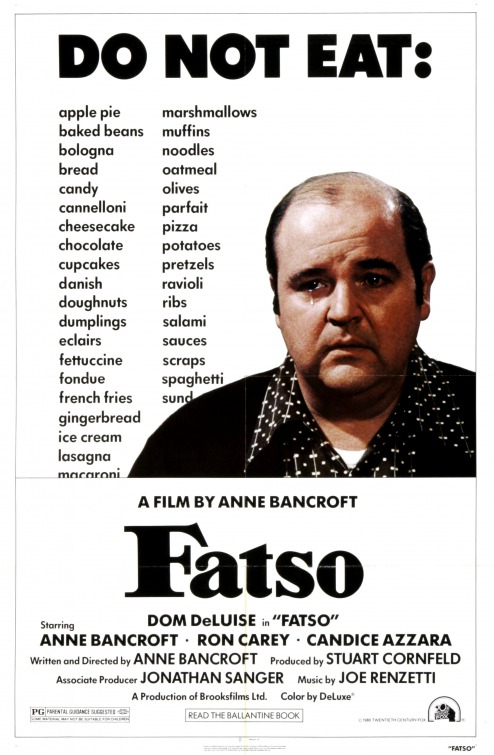
Fatso (1980)

fatso

By Richard Winters

My Rating: 3 out of 10

4-Word Review: He can’t stop eating.

When her cousin dies at the age of 39 from being overweight Antoinette (Anne Bancroft) puts pressure on her brother Dom (Dom DeLuise) to work on losing some weight of his own. Dom tries but his lifelong obsession with food cannot be curbed. He ties a chain around the cupboards in his kitchen so he can’t get at the food inside and then has his brother Frankie (Ron Carey) hide the key. He even joins a club called the Chubby Checkers who are on-call at all hours to come to his home and counsel him should his willpower falter and yet it does no good until he meets Lydi (Candice Azzara) and her love for him helps him find strength.

This was Bancroft’s one-and-only foray behind the camera and unfortunately it’s a jumbled misguided mess that seems like a comedy at some points only to quickly turnover into a hard wrought drama the next. I enjoyed the recreation of the extended Italian family living in the New York, which was right on-target particularly the way they lean on each other in times of need while also vigorously fighting amongst themselves at other points. I also appreciated how religion is shown playing an important part in their lives particularly the crosses and pictures of Christ seen in almost every room even the bathroom. I’m not a religious person myself, but the film still helps the viewer understand and appreciate how spirituality can play a vital role to those whose lives seem empty and challenging otherwise.

The comical moments, or at least when they manage to randomly pop-up, aren’t bad either with the scene involving the two brothers attacking each other at different times while using the same knife being the best. DeLuise gives an excellent and highly underrated performance. The scene where he reads greeting cards out loud while constantly breaking into sobs is hilarious as is his first awkward meeting with Lydia. Unfortunately Dom became much more rotund later in his life and by comparison seems almost thin here.

The film gives the viewer a nice, sensitive portal to how tough fighting the urge to eat must be for those who are fat and manages to nicely expose the human side of the issue without ever mocking them. Bancroft does her emotional drama bit, from which she is best known for, quite well, but I felt the material really didn’t call for it and it becomes almost over-the-top. The pacing is also off and the story is never compelling despite the earnest efforts of its cast. It all would’ve played out better had it stuck firmly to the comical angle and the fact that it doesn’t really hurts it.

My Rating: 3 out of 10

Released: February 1, 1980

Runtime: 1Hour 33Minutes

Rated PG

Director: Anne Bancroft

Studio: 20th Century Fox

Available: DVD (Out-of-Print/Anchor Bay)
The Busy Body (1967)

busy body

By Richard Winters

My Rating: 3 out of 10

4-Word Review: Find the dead body.

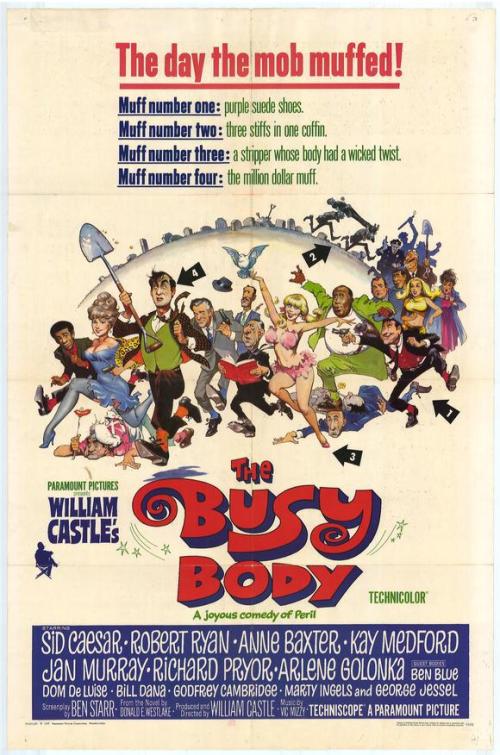
George Norton (Sid Caesar) is a nebbish mama’s boy who, for whatever reason, gets taken in by Charley (Robert Ryan) a Chicago mob boss. Charley even gives George a seat on his board of governors. When a fellow crime boss (Bill Dana) gets killed in a freak accident it is George who selects a blue suit for the corpse to wear at the funeral. Unfortunately that blue suit was lined with a million dollars and Charley demands that George dig up the body and retrieve the money, but when he does he finds that the body is gone and thus begins a long, winding, ‘madcap’ search for the missing body and money.

Noted horror director/producer William Castle decided late in his career to give comedy a stab and this is the result. The beginning is mildly amusing, but the humor gets terribly strained and a 100 minute runtime is just too long for such trite material. Everything gets suppressed into silliness with an overplayed music score that has too much of a playful quality to it making the whole thing thoroughly ingrained on the kiddie level from start-to-finish.

Dom DeLuise has an amusing bit as a mortician that would really rather be a hairdresser and Kay Medford is quite funny as George’s doting mother, but the rest of the supporting cast is wasted, which includes Richard Pryor, in his film debut, playing in a role that does not take advantage of his comic skill. Caesar is just not leading man material and his vaudeville-like shtick is quite passé and predictable. His co-star Ryan is far funnier and without having to try half as hard.

The plot goes off on wild tangents until it becomes impossible to follow and quite pointless. The whole production is horribly dated and will not appeal to kids or adults. In fact the film’s intended audience has long ago passed away making this thing a silly relic of its time and nothing more.

My Rating: 3 out of 10

Released: March 12, 1967

Runtime: 1Hour 40Minutes

Not Rated

Director: William Castle

Studio: Paramount

Available: DVD, Amazon Instant Video