Tag Archives: 60’s Movies

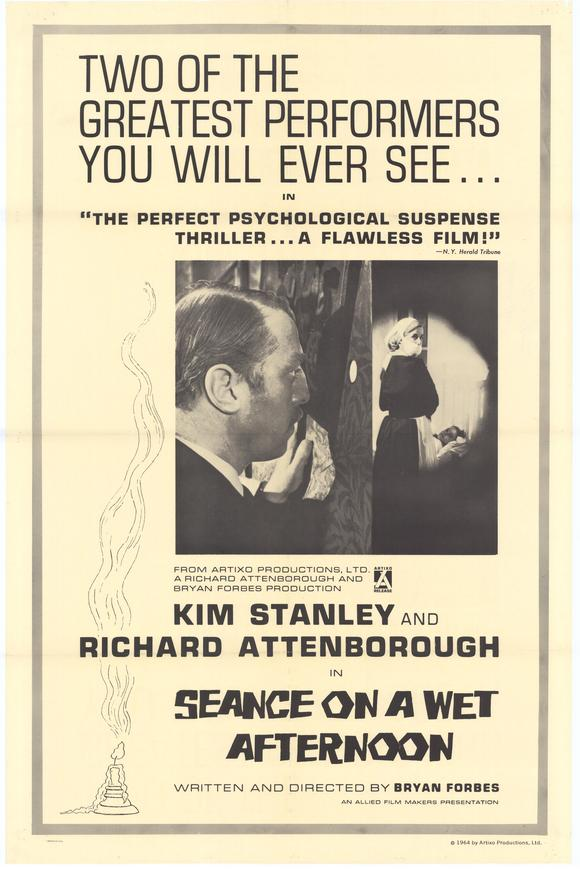
Seance on a Wet Afternoon (1964)

seance on a wet afternoon

By Richard Winters

My Rating: 6 out of 10

4-Word Review: Psychic is a phoney.

Myra Savage (Kim Stanley) is an emotionally unbalanced woman and failed psychic who comes up with an idea that she hopes will revive her career. The plan is for her husband Billy (Richard Attenborough) to kidnap Amanda Clayton (Judith Donner) who is the young daughter of a rich businessman. They will then place her at a strategic location and hold a public séance at which time Myra will ‘miraculously’ predict her whereabouts. This will then, they hope, make her famous and world renowned, but of course things don’t work out as expected.

This is indeed a unique and unusual film that taps into some rare qualities. First and foremost is the black and white cinematography. Every camera shot and angle has a certain evocative flair that is well captured and vivid. The on-location shots pick up just the right amount of ambiance and lighting with each setting. The music score is great and helps create excellent tension. You also will love the little girl that they kidnap. She is adorable without it being forced. Her matter-of-fact sensibilities are a great contrast to Attenborough and Stanley whose characters are child-like and pathetic.

Yet the film doesn’t completely work. The story is handled in a plodding and methodical way without any twists or surprises. There is very little action, some definite slow spots and the conclusion is limp.

If you watch it for the performances then you will be more intrigued. Stage actress Stanley gives a rare film appearance here. It is easy to see why she took the role even though she was known to dislike doing films. The takes are long and give almost unlimited possibilities in creating a character, which is what all stage actors enjoy. She does well and at times may remind one of another legendary actress Geraldine Page who would have also been perfect for the part. Attenborough proves almost her equal. His expressions of shock and worry are memorable. The interplay between the two is fun especially towards the end when this otherwise passive man stands up to the domineering woman.

Overall there are some unique moments, but it is just not suspenseful enough and results in being only slightly above average.

My Rating: 6 out of 10

Released: November 5, 1964

Runtime: 1Hour 55Minutes

Rating: NR (Not Rated)

Director: Bryan Forbes

Studio: Artixo Productions

Available: VHS, DVD (Region 1 & 2)

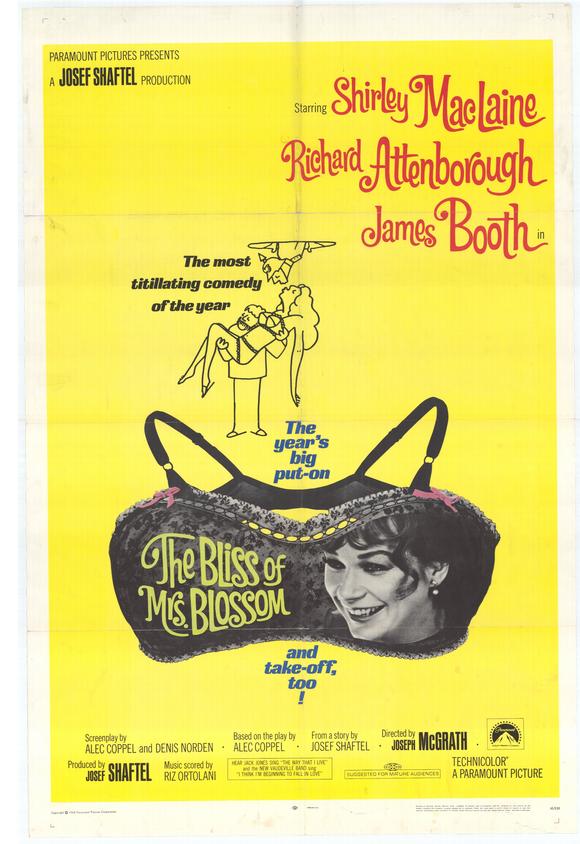
The Bliss of Mrs. Blossom (1968)

By Richard Winters

My Rating: 6 out of 10

4-Word Review: Lover in the attic.

This wacky film nicely exudes the mod, experimental wave of filmmaking that permeated the era of the late 60’s. The story takes place in London and is about a clothing manufacturer’s wife named Harriet Blossom (Shirley MacLaine) who one day calls her husband Robert (Richard Attenborough) while he is at work to tell him that her sewing machine has broken down. Robert sends his lowly assistant Ambrose Tuttle (James Booth) over to their house to help her fix it. Harriet is a bit bored with life and feels neglected by her husband, so she not so subtly seduces Ambrose and then hides him in the attic where he soon takes up residence.  He comes out only when Robert is away, but the unexplained strange noises that Robert hears and the many close calls make him think he is going insane and leads him to a nervous breakdown.

Director Joseph McGrath’s highly visual style is the real star. The lighting, editing, camera angles, set design, and costumes are creative and imaginative.  The home that was chosen for the setting has a nice architectural flair especially the attic and billiards room, which seems to be draped by a large stain glass window. Certain film professors show this movie to their classes as an example of how stylish direction can help accentuate a story as well as deftly define its era. I was disappointed to see that although McGrath is still alive he hasn’t done a film since 1984, which is a shame as it is obvious from this that he is quite gifted and I would have liked to see him doing more.

This is generally considered a vehicle for MacLaine, but to me her performance isn’t interesting. I think she is a first rate actress, but her character here is the only normal one in the film and she acts more like an anchor trying to corral the craziness around her. Booth, as her lover, goes to the other extreme, but doesn’t fare any better. He is too clownish and is always wearing various disguises and going through different personas, which makes the character unrealistic and cartoonish. If anything, out of the three main leads, it is actually Attenborough who does the best. His nervous and confused facial expressions are priceless. The scenes were he comes home from work and to ‘unwind’ pretends to be a conductor of a large orchestra while listening to a loud record, is amusing.

The colorful supporting cast though, full of legendary British Pros, is what steals the film. Some of them appear just briefly, but they still make a memorable and funny impression. Barry Humphries, playing a male character and not Dame Edna, is good as an art dealer. John Cleese, in one of his very first roles, is engaging as an argumentative postal clerk.  The best however is far and away Freddie Jones as the snippy, suspicious, relentless detective that will leave no stone unturned in his pursuit of Ambrose, who once he moves into Harriet’s attic proceeds to completely drop of society and disappear.

Although generally entertaining the plot doesn’t go anywhere and is simply a set-up for a lot of absurdity. What is worse is the fact that this based on a true story that in its own right was very intriguing.  In the real-life incident that took place in 1913 a 33 year old woman by the name of Dolly Oesterreich met a 17 year old named Otto Sanhuber. She, like the character in the movie, was a bored wife of a wealthy textile manufacturer, and took in the young man as her ‘sex slave’, which he readily accepted. To avoid possible suspicion she had him move into their attic, where he remained for five years and despite some close calls was never caught.  When the Oesterreich’s moved to Los Angeles in 1918 Dolly made sure that their new home had an attic as well and Otto then took up residence there and the deception continued until 1920 when Otto finally ended up killing the husband.

Of course none of that happens here. In fact Ambrose is fond of the husband and considers the three to be one big happy ‘family’, which is offbeat for sure, but not particularly satisfying. Again, this film does have some funny moments. I thought the scene where Robert invents the world’s first inflatable bra only to have the system go awry during an exhibition, which forces the model’s breasts to grow to unbelievable proportions before they go floating in the air, to be hilarious.  Still the end result of this production can best be described as cinematic soufflé.

My Rating: 6 out of 10

Released: September 11, 1968

Runtime: 1Hour 33Minutes

Rating: NR (Not Rated)

Director: Joseph McGrath

Studio: Paramount

Available: VHS

Lady in Cement (1968)


My Rating: 4 out of 10

4-Word Review: Tony solves the case.

Frank Sinatra returns as detective Tony Rome in this sequel to the 1967 hit. Here, while going on a diving expedition off the coast of Florida, he finds a naked woman underwater with her feet encased in cement.  He then meets a large and mysterious man by the name of Gronski (Dan Blocker) who hires him to find the girl’s killer, but he is not so sure that Gronski himself may have something to do with it.

            One of the things I really liked about the film as well as in the first one is the very cynical, world-weary, streetwise nature of the detective character. It seems to be a part that Sinatra was born to play and he does it well. I don’t think it was too far off from Sinatra’s real personality, which is why it works. I loved the cryptic dialogue and snappy one-liners. The banter is fun and intoxicating. It was the best thing about the first film and continues to be the case in this one. If anything it is the one thing that really carries it.

            The mystery itself is dull.  In the first film the case was more intriguing and complex. Here it seems mechanical and uninspired. It gets played out in a formulaic way with the standard suspects that seem borrowed from other, better stories. The twists and turns aren’t exciting, or surprising. The movie is more concerned with being amusing and filled with hip banter making the case itself seem like a side-light and not allowing the story to move forward. Yes, the bickering is fun, but there still needs to be a plot to match it and that was not the case here. The suspense is lacking with a final denouncement that is nothing special. The climatic fight sequence is particularly clichéd and forced.

            The opening bit where Tony finds the dead woman underwater is poor as well. It happens right away with no build-up even though I felt one was needed. I would think if a dead person had been trapped underwater for any period of time there would be some discoloration and decay. Instead the woman looks gorgeous, wearing a provocative expression one would find on an erotic model. Her skin is unblemished and she even still has her lipstick and make-up on, which I thought was unrealistic and pretty much ruins the story’s validity before it even gets going.

            The presence of actor Dan Blocker is a major asset and helps the film’s appeal. Blocker was probably better known for playing the character Hoss in the hit TV-series ‘Bonanza’. The fight sequences that he is in are amusing because he can simply throw the other men around like they are toys and seems unstoppable in the process. Like in the TV-series he exudes a lot of charm and is very engaging. There is even a brief in-joke where he is sitting in his room watching an episode of ‘Bonanza’. He and Sinatra make an unlikely, but interesting pair although when shown together he does make Frankie look puny, out of shape, and even a bit washed-up by comparison.

            One of the biggest issues I had with the first film was that there were a lot of loopholes. Particularly one scene where Tony kills a man and then he glibly tells the police that it was ‘clearly self-defense’ and he is never brought in for questioning, or arrested. That just didn’t jibe with me as there are many cases where a person kills someone in self-defense, but the case still ends up being brought to trial. Tony is very good friends with the police chief (Richard Conte), but I still didn’t think that would make him untouchable. At least here when Tony gets framed for a murder the police tell him they are going to have to take him in, which seems more plausible.  This culminates into an extended car chase sequence, which due to the long edits, slow speeds, bird’s eye view camera shots, and laid-back music, make it one of the least riveting and most uninteresting car chases you’ll ever see.

The production values are high and I have no real complaint on it from a technical stand point.  Everything is slickly handled despite a weak story.  There are some strong homophobic undertones, which may offend some, but I felt it fit the era. If you like Sinatra then you will find this passable, but if you enjoy a good mystery then don’t bother because in that area this thing falls flat.

My Rating: 4 out of 10

Released: November 20, 1968

Runtime: 1Hour 33Minutes

Director: Gordon Douglas

Studio: 20th Century Fox

Available: VHS, DVD

The Detective (1968)

detective

By Richard Winters

My Rating: 8 out of 10

4-Word Review: Up against the system.

Many people may not realize that Frank Sinatra was the original choice of Harry Callahan for Dirty Harry.  Due to various reasons he turned down the part despite the fact that he was interested.  You can’t help but wonder what that film might have been like had he accepted.  A good indication may be the character of detective Joe Leland that he plays hereIt has a similar theme of a tough cop tired of ‘the system’ and breaking off on his own to solve a bizarre case.

The murder itself is particularly gruesome and ahead of its time as it deals with the killing of a gay man found nude on the floor of his apartment with his genitals cut off. The actual shot of the victim is conveniently framed so that a fern, yes a fern, is strategically placed over the offending area, which is a little corny.  Yet the dialogue and description of the case seems incredibly graphic for the time. Ol’ Blue Eyes even says the word penis, which I think has to be a movie history first.

The way it deals with the homosexual topic is also surprisingly enlightening. Gays are not labeled as ‘sick’ and ‘perverse’, at least not by the Leland character. In one good bit the Sinatra character even slugs another officer, played by Robert Duvall, in retaliation for getting  rough with a gay man that he was questioning for no apparent reason except that he was gay.

There is another electrifying sequence involving Leland questioning the victim’s live-in lover and chief suspect. The part is well played by actor Tony Musante who gives his character all sorts of weird body gestures and nervous ticks, which makes the viewer feel uneasy but still compelled to keep watching until it becomes a fascinating experience. The Leland character again shows an amazing amount of compassion and enlightenment for the gay lifestyle during the interrogation, which should be enough to give this film a landmark status.

However, for all of its apparent sophistication, there are also things that hold it back and make it dated. One is reverting to what was a trend in the 40’s and 50’s, which was to film a person driving their car while sitting in front of a blue screen and holding onto a steering wheel that is not connected to any dashboard. It was considered a ‘ingenious’ way to stay under budget and not having to go through the ordeal of mounting a camera onto an actual car, but for today’s sharp audiences it comes off looking obvious and cheesy.

The casting of Sinatra is another drawback. He was already 53 at the time and he looked it.  The part seems to be screaming for a younger, more rugged method type of actor like Steve McQueen or Paul Newman, who would have done better.  Sinatra overplays the tough guy thing too much until it becomes one-dimensional and boring. The character needed more personal quirks and odd habits in order to make him more filled out and interesting.  He also wears outfits worn by the ‘old school’ investigators of yesteryear even though the character is one looking to break from tradition and fighting the mainstream.

I also wasn’t quite sure why Lee Remick’s role as Sinatra’s love interest was necessary. I usually dislike it when crime dramas feel the need to work in a romance angle as a side story because it usually bogs everything down and in this case was no different. Now Remick is always reliable and her character was interestingly flawed, but how that was supposed to connect with everything else was not clear.

The story works in three different parts. The first deals with the murder and the homosexual community of the period.  The second analyzes the politics of the police department while the third involves a mysterious suicide of a successful businessman. The third part, which doesn’t start until the second hour of the film, was the most intriguing for me. The suicide is shown from the point-of-view of the victim. They literally took a camera and heaved it over the edge of a building until it crashes directly onto the pavement below, which actually made me flinch. It is not until the very end where you see how all three of these parts come together, but the twist is excellent and made viewing this film well worthwhile.

Overall the cinematography, editing, writing, directing, and supporting acting are first rate.  There are a lot of familiar faces in supporting roles including: Jack Klugman, William Windom, Lloyd Bochner, Jacqueline Bisset, Horace McMahon and Al Freeman Jr. They all do splendidly. The subject matter and the way it is handled easily elevates this from other melodramas of the period.  The resolution should make this entertaining even for today’s viewers and enough to overlook a few dated elements.

My Rating: 8 out of 10

Released: May 28, 1968

Runtime: 1Hour 54Minutes

Rated R

Director: Gordon Douglas

Studio: 20th Century Fox

Available: VHS, DVD

Paper Lion (1968)

By Richard Winters

My Rating: 6 out of 10

4-Word Review: Scrawny guy plays quarterback.

            Lighthearted adaptation of George Plimpton’s best-selling novel detailing his account of playing for the Detroit Lions football team as a back-up quarterback despite having no real experience.  Alan Alda plays Plimpton and the movie’s main focus is during the team’s training camp and his shock at just how hard and rigorous being a pro-quarterback really is.

The film’s most amusing moments come during the many weeks of practice when Plimpton finds that even throwing a pass is difficult because the defenders are so quick that they are in his face and have him on the ground before he is even able to react. Even taking a hand-off from his center proves to be a difficult process as it jams his thumb. Director Alex March does a fine job of giving the viewer a feeling of Plimpton’s experience by having the defenders come barreling towards the camera until you feel like you’ve been tackled yourself.

What makes the story interesting is the fact that despite being an intellectual man from Harvard Plimpton still ends up having the same competitive spirit as the rest of the players. He becomes determined to prove himself by memorizing the playbook and practicing until he is able to function decently in the position. He even finds himself getting into a potential fist-fight with another man at a bar when the man makes a disparaging remark about the team.  Although the players quickly realize that he is not a legitimate athlete and try to scare him away they become impressed enough with his perseverance and fiery spirit to eventually be willing to play for him, which is a nice touch.

The cast is loaded with actual players and coaches incluing: John Gordy, Mike Lucci, Alex Karras, Sugar Ray Robinson, Roger Brown, Frank Gifford and the then head coach Joe Schmidt. All of them are given a lot of screen time and a surprising amount of lines. Despite what one may think they do an exceptionally good job. They are likable and believable especially coach Schmidt. In fact it is their presence that really helps make the movie succeed and gives the viewer the impression that they are experiencing the NFL as it is, or at least as it was at that time. There is even a segment featuring legendary coach Vince Lombardi, which is special.

Probably the only character that I felt wasn’t necessary was Lauren Hutton as Plimpton’s super-hot model girlfriend.  Now, I have never read the book, so I am not sure if Plimpton had an attractive girlfriend in real-life, or not, but the character here seemed to be put in for eye candy and added little if anything to the story.

The footage shown of an actual exhibition game that the Lions play against the St Louis Cardinals at the old Busch Stadium is vivid. So many times film of this nature will borrow footage from another source and then incorporate it in, but the grainy film stock always makes this evident and distracting and here that wasn’t the case. The camera gets right down on the field with the players and you see the plays and hits up close. You even hear the trash talk and a bit of cursing although they do edit some of that out.

The film’s drawback is that it is too serene for its own good. There is never any dramatic tension, or conflict. The pace and music is so easy going that at times it seems ready to put you to sleep. The film had the backing of the league, which I felt ended up compromising it. Some of the harsher ugly elements of football boot camp were clearly glossed over. I would have wanted something a little bit meatier, even if it had been for a only a few brief scenes. The film hasn’t particularly aged well. The ‘big’ players of yesteryear look rather puny by today’s standards. The game and conditioning has evolved a lot and I felt this story should be revisited in the modern day setting.

My Rating: 6 out of 10

Released: October 23, 1968

Runtime: 1Hour 47Minutes

Rated NR (Not Rated)

Director: Alex March

Studio: United Artists

Available: VHS, Netflix streaming

The April Fools (1969)

By Richard Winters

My Rating: 2 out of 10

4-Word Review: Affair between married people.

Director Stuart Rosenberg was on a high note in 1967.  He had just won rave reviews for his cult hit Cool Hand Luke and many felt he was well on his way to being Hollywood’s next top director only to follow it up with this incredibly vapid and stupid romance movie.

It involves a married man by the name of Howard Brubaker (Jack Lemon) who meets an attractive woman named Catherine Gunther (Catherine Deneuve) at a party. They spend the evening walking around outside and having nothing more than a casual conversation, which is enough to make him decide to leave his wife (Sally Kellerman) and child, quit his high paying executive job, and run off with her to Paris.

The story is pretty threadbare and filled with a lot of characters and situations that are not fleshed out at all.  This almost seems like a partial treatment to a main script that never got completed.  This movie provides no real tension, conflict, or subplots.  Most movies dealing with potential romances usually has one or both of the participants second guessing themselves as to whether they should move ahead with the relationship especially when both of the people are married like they are here.  These two fall in love so amazingly quickly that they make the art and act of dating seem completely unnecessary.

A much better idea would have been to have this quick romance act as only the starting point.  The film then should have cut to 5 or 10 years later where we could have seen how this relationship fared, or evolved. This would have given much better perspective to both the movie and characters.

I also have never felt that two people having an affair is a real good catalyst for a love story because it seems to go against the whole ‘true and everlasting love’ theme that propels most romance stories.  After all if someone can’t stay fully committed to one person what is to say that they will be able to do so with someone else.  To give the argument that they are just ‘crazy’ about this new person doesn’t work because at some point they must have been ‘crazy’ about the person they are currently with or they wouldn’t have married them. So what is to say that in a few years time when the newness of the relationship wears off that the whole vicious cycle won’t just get repeated.  I don’t have the exact statistics in front of me, but research has shown that people who cheat on one person are prone to doing it with their next partner simply because it is in their nature.

In some ways I could see why Catherine would consider leaving her husband, which is well played by Peter Lawford, simply because the guy is a womanizing lout in the worst way.  It is understandable that she may have been initially mesmerized by his wealth and charisma and only had her eyes opened to his shallowness years later.  However, Howard’s marriage didn’t really seem that bad and what is worse is the fact that he had a 5 year old son whom he seemed to have no problem abandoning without even a second thought.

The whole thing comes off like some uninspired idea by some studio head who wanted to make a ‘sure-fire’ hit by throwing together every contrived romantic element he could think of, piecing it together with a flimsy script, and then using the star-power of Lemon and Deneuve to cover up all the holes.  Everything here seems forced and that includes the humor.  Lemon’s duel with Charles Boyer is overdone and irrelevant.  There is also a scene where Howard’s friend (Jack Weston) drives him to the airport while being completely drunk and weaving in and out of on-coming traffic.  Today’s audiences would find this to be highly irresponsible and also terribly unfunny, which it is.

There are some potentially funny ideas that scriptwriter Hal Dresner never seems to think of.  For instance Catherine ends up being the wife of Howard’s new boss.  This could have been a goldmine of a lot of funny scenarios as the two tried sneaking around behind his back. The Lawford character does eventually corner Howard at the airport just as he is ready to board the plane and go off to Paris with Catherine, but even this potential confrontation gets botched badly.

I did really like Deneuve and her presence is the only real good thing about this movie. She looks radiant and I enjoyed the cool, chic way she responds to all the situations she is put in. This also marked her American movie debut.

Lemon though does not fare as well.  He overplays the high-strung businessman persona until it becomes tiresome.  He is nervous and befuddles every second that he is on the screen until you wonder how he was ever able to impress anyone enough to be able to obtain the prestigious position that he has at his company.

The supporting cast is stellar, but not used enough.  Jack Weston has a funny bit as he explains the goofy way that he handled an affair of his own.  Harvey Korman is amusing as a man who tries stealing the alluring Deneuve away from Lemon at the last minute.  It is also fun to see Melinda Dillon in her film debut.  She is best known for her supporting dramatic roles, but here she plays a giggling, ditzy blonde.  She is paired up with comic character actor Kenneth Mars and the two have the makings of being a great hammy couple. Unfortunately they are not given enough screen time, nor enough good lines, to really make it gel. Myrna Loy and Charles Boyer, as a long-time married couple, are essentially wasted.

Besides Deneuve there were a few other things that I did like about the movie.  The Burt Bacharach score is certainly pleasing on the ears.  There is a funky, mod 60’s party that takes place at the beginning of the film that features a lot of weird art exhibits that are nicely realized by award-winning set designer Richard Sylbert. I found the exhibit that featured a faucet dangling in mid-air while running a constant stream of water to be fascinating. I also enjoyed the scene where Deneuve and Lemon go to a wild nightclub where they are handed pop guns as they sit down which they can use to shoot at the rear-ends of the waitresses when they want to get their attention. I thought this was a genuinely neat idea that should be used at every restaurant.

My Rating: 2 out of 10

Released: May 28, 1969

Runtime: 1Hour 35Minutes

Rated PG

Director: Stuart Rosenberg

Studio: National General Pictures

Available: VHS, DVD (Import)

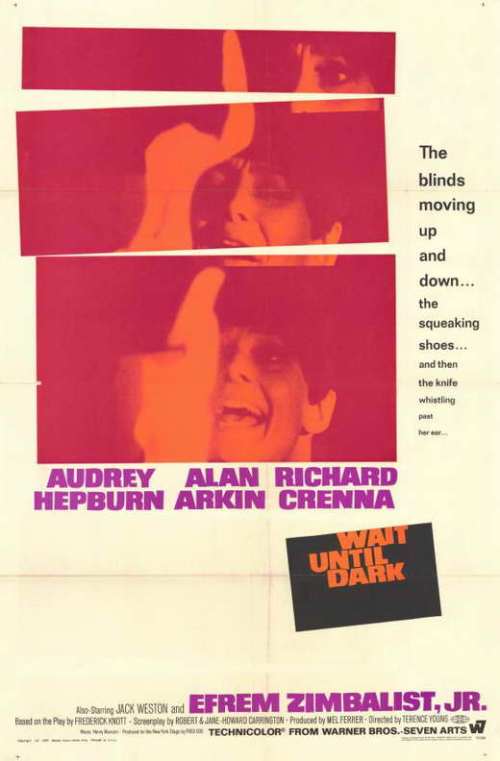
Wait Until Dark (1967)

wait

By Richard Winters

My Rating: 8 out of 10

4-Word Review: They want the doll.

Horror writer Stephan King, in his non-fiction book ‘Dance Macabre’, lists Wait Until Dark as the scariest movie ever made and Alan Arkin as one of the scariest film villains. Of course that is a statement that could be wildly debated, but as a thriller it is very well structured with a original storyline, a fantastic heroine, and a terrific climatic sequence that still rates as one of the best.

The film is based on the hit Broadway play by Frederick Knott and follows that script very closely.  It centers on a recently blinded woman named Susy Hendrix (Audrey Hepburn) who accidently acquires a doll filled with heroin and then becomes terrorized by the three drug dealers (Alan Arkin, Jack Weston, Richard Crenna) when they come to retrieve it. Trapped in her small apartment by the three men with her phone line cut off, she decides her only possible recourse is to smash all the light bulbs and then, in the pitch blackness, use her handicap to her advantage and try to escape.

Normally stage plays transferred to film don’t usually work too well namely because all the action takes place in one setting, which eventually creates visual boredom, but here this becomes an asset.  As the story progresses the viewer begins to feel claustrophobic and as entrapped as Susy as well as successfully tapping into the fear of isolation. The lighting is also impressive.  It may not be something one consciously thinks about, but good lighting can really help accentuate a film’s mood and style, which it does here.  I enjoyed the interesting color schemes and the contrasts between light and shadows that becomes more apparent as it goes along.

Of course the element that really makes this film special is the fantastic performance of Hepburn, which I consider to be her best.  She was nominated for the Academy Award and she should have won it.  She displays just the right level of emotions, which creates empathy from the viewer almost immediately. Her reactions as well as the fear and panic that she shows are very convincing. Arkin, as the villain, tends to get a little too flashy and hammy. I felt Hepburn easily out performed him and everyone else. The film just would not have been as good had anyone else played the part.  This also marks her career pinnacle as she went on a nine year sabbatical after this and when she did finally return, the films she did weren’t all too great.

I also like Julie Herrod as the child named Gloria who lives upstairs and becomes a very crucial link to the story.  So many movies portray children as either total brats, or overly wide-eyed innocents solely put on this planet to say cute and amusing things on cue.  Here the balance is just right and so believable she will remind you of kids that you know in real life as it certainly did with me.  She is sneaky and precocious at certain times, but also genuinely helpful and concerned at others, just like adults are.  The line she says to the Hepburn character just before she runs out to find help is a gem.

The climatic sequence still ranks as one of the best.  The clever ways that this petite, handicapped woman manages to outwit the brutal thugs are classic.  The viewer also gets the satisfaction of seeing the character grow and find an inner strength that she didn’t even know she had. It also features a very well staged scare/shock that sent viewers jumping out of their seats when it was first released and still does today as evidenced by the other people who watched the film with me and all screamed out loud when it happened.

As with any film released 40 years ago, there are some dated qualities that do hurt it.  Some of the ‘tough guy’ talk between the thugs seems a bit stilted.  The film was released a year before the ratings system took effect, so there is no cursing, but a little bit of it would have helped make it more authentic.  It would have also been a little more gritty had the bad guys actually carried guns instead of the brass knuckles and silly looking knives.  Air travelers of today will also be shocked at just how easily it was for people to get through airports in the old days.

However, even with these few weaknesses I still feel this film is a pretty solid, compact thriller that can be used as a blueprint for all other thrillers to follow.  There is also the excellent music score by Henry Mancini that is really creepy although the song played over the closing credits should have been avoided.

My Rating: 8 out of 10

Released: October 26, 1967

Runtime: 1Hour 48Minutes

Rated NR (Not Rated)

Director: Terence Young

Studio: Warner Brothers

Available: VHS, DVD, Blu-ray, Amazon Instant Video

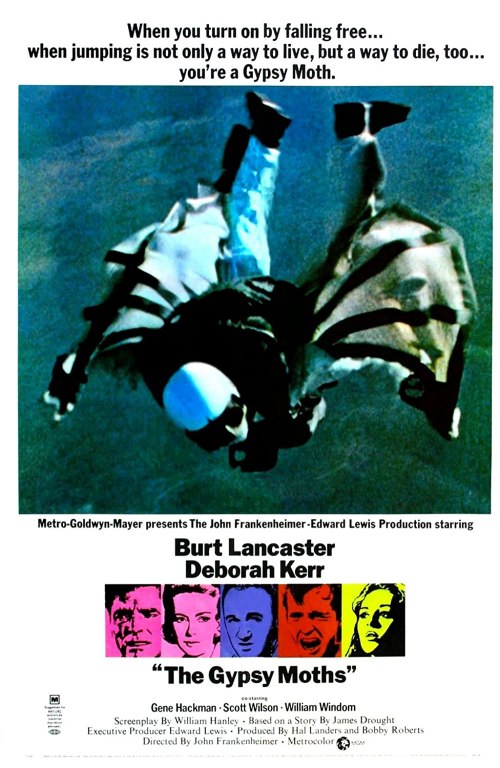
The Gypsy Moths (1969)

gypsy

By Richard Winters

My Rating: 4 out of 10

4-Word Review: Skydivers travel to Kansas.

Three skydivers, who make a living going around the country doing airshows for the public, stop off at a small Kansas town on a fourth of July weekend that ends up changing all of their lives. Mike Rettig (Burt Lancaster) is the eldest and the leader of the group. He seems unhappy and suffering from some inner turmoil that he is reluctant to elaborate on.  He ends up having an affair with one of the attractive middle-aged women in town named Elizabeth Brandon (Deborah Kerr).  Joe Browdy (Gene Hackman) is restless and impatient and has a fling with the town stripper (Sheree North).  Malcolm Webson (Scott Wilson) is the introspective member of the trio.  He grew up in the town that they are in and uses the visit as a way to reconcile with his demons from the past.

MGM was hoping for a big hit with this one as it reteamed Lancaster and Kerr 16 years after their famous embrace in From Here to Eternity. The film broke ground as it was the first to feature an established and respected actress who was nearly 50 years of age doing a nude scene. Kerr, who looked great both with her clothes on and off, can be seen fully nude from the front and back during a lovemaking scene with Lancaster.  Yet the film failed to gel with the public.

There were some things that I did like. One is the fact that it was filmed on location in Kansas. The opening shots capturing the countryside of the Midwest really gives a strong visual sense of Americana.  The scenes taking place in the neighborhoods of the small town give the film an added dimension that a studio back-lot just couldn’t do.  The skydiving sequences, which take up the majority of the time, are breathtaking and exciting. The aerial photography makes you feel like you are right there jumping out of the plane and free falling into the air.

The basic plot though is dull and uninteresting.  The characters and situations are contrived and derivative.  It is almost like the story was a second thought to the stunt work and put in merely as filler. I also didn’t like the pretentious quality of the production that made it seem like it was making some sort of profound statement when in reality it was nothing more than second rate soap opera.  The whole thing would have worked better had they skipped the story and made it into a documentary on skydiving instead.

Spoiler Alert!

The most frustrating thing about the movie is the fact that the Mike character dies at the end when he decides, for no apparent reason, not to open his chute and goes, literally, splat on the ground right in front of a throng of spectators. I actually thought this was one of Lancaster’s better later career performances and I was intrigued as to what was causing his character’s inner-strife, but the film offers us no clue, or hint.  I thought there should have been a backstory and even some flashbacks. The ambiguity leaves the viewer cold and unsatisfied and makes the film seem incomplete.

The only possible explanation may come through researching actual Gypsy moths and then correlating the species to the characters. Per Wikipedia, the female gypsy moth is unable to fly. This would then explain why Elizabeth refused to run off with Mike despite her unhappy marriage simply because she could not ‘spread her wings’.  The adult male moth always dies in July, which would then explain Mike’s death. No reason for his demise was needed because his life cycle was ending regardless. July is also the time when the moth lays her eggs, which would explain why Joe and Malcolm, who were much younger than Mike, decided to go off on their own separate ways at the end.

End of Spoiler Alert!

I  ended up finding more misses than hits with this one and can’t help but label it as a misfire.

My Rating: 4 out of 10

Released: August 28, 1969

Runtime: 1Hour 47Minutes

Rated R

Director: John Frankenheimer

Studio: MGM

Available: VHS, DVD

Privilege (1967)

By Richard Winters

My Rating: 5 out of 10

4-Word Review: Teen idol is pawn.

A British pop singer by the name of Steven Shorter (Paul Jones) becomes a major hit with the young teen audience of the day and his managers realize they have a powerful and influential weapon on their hands.  They assign him to do an ad for apples and soon everyone is eating apples. They then use him as an example to support God and Country by making him sing a rock rendition of ‘Onward Christian Soldiers’.  With the help of some high-ranking church leaders they get him to introduce a Nazi type salute to everyone in order for them to show their allegiance.  Steven is aware of how he is being manipulated and is unhappy with it, but can’t seem to find a way out it.

This reminded me a lot of the Fonzi character on the old ‘Happy Days’ TV-show from the 70’s, a character with a rebel image who eventually became benign and unrealistic when the producers tried to turn him into a role model for his young audience. The film’s message is certainly a good one and as pertinent today as ever.   Unfortunately it is done in an extremely heavy-handed way that made this viewer feel like he was being hit over-the-head.

I became a fan of director Peter Watkins after seeing the pseudo-documentary Punishment Park where a group of hippies are thrown into the dessert and forced by the military to play a brutal game of survival.  That film featured some emotionally charged scenes that were amazing and the execution was so flawless that it seemed almost authentic.  This film takes the same documentary approach, but it is not as consistent with it nor as effective.  The result is a weird mishmash between the surreal and allegorical to the dramatic and satirical and it never comes together as a whole. It does contain a few moments of funny humor, but there needed to be more of it and most of it comes in film’s first half. The drama is awkward and at times clumsy. It ended up leaving me alienated with it.

I had equally mixed feelings with the lead character.  He was played by Paul Jones better known as the lead singer to the 60’s group Manfred Mann who did such hits as ‘Do-Wah Diddy’ and ‘Mighty Quinn’.  He certainly had the chiseled, boyish good looks that one would expect from a teen idol and resembled Jim Morrison from The Doors.  However, he seems passive to extreme with no ability to ever stand up for himself.  Although looks are certainly one element, a rock star also needs to have some charisma and this guy had none and I would think the public would quickly see that.  He allows his managers to almost completely dominate him and the constant shots of his pained and unhappy facial expressions become, like everything else in the film, way over-done.  I could never understand why a singer with millions of adoring fans would feel so powerless. I would think he would have a healthy ego and sense of empowerment and if was unhappy with his managers then he would simply fire them, which happens all the time in the music world.

I did think that the camera work and cinematography were excellent and probably has a lot to do with director Watkins background.  The scene at the assembly where there is a giant picture of Steven and then the actual Steven stands in front of it making it look like he is being devoured by his own image was effective symbolism.

The points that the film makes in regards to conformity, those in position of power, and the superficiality of pop idols are all right on target.  I just wished that the narrative and storyline were done in a little more sophisticated way and that the characters were more fleshed out. The works of British director Lindsay Anderson came to mind as I watched this film. A lot of his films had the same types of themes like If, Britannia Hospital, and O Lucky Man. However, those films were more cerebral and layered and the wit was more consistent and biting.

My Rating: 5 out of 10

Released: February 28, 1967

Runtime: 1Hour 43Minutes

Rated NR (Not Rated)

Director: Peter Watkins

Studio: Universal

Available: DVD

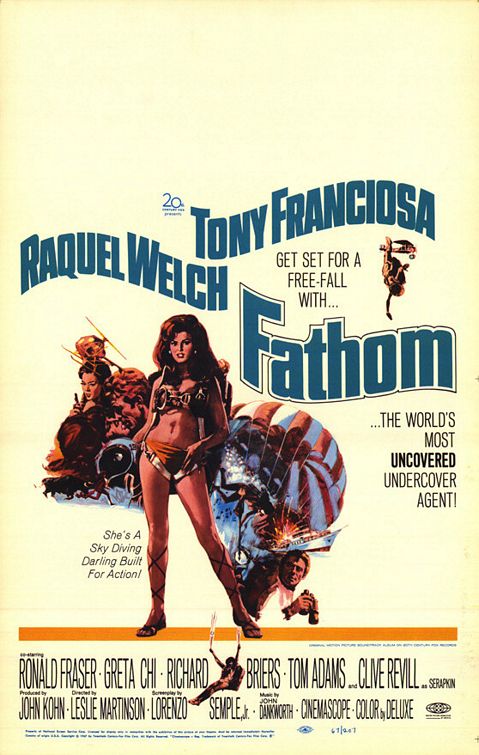
Fathom (1967)

fathom1

By Richard Winters

My Rating: 4 out of 10

4-Word Review: Dental assistant becomes spy.

The spy genre became a big craze in the late 60’s with the success of the James Bond films.  Studios were busily either coming out with imitations of the genre, like the Matt Helm films with Dean Martin, or spoofs of the genre.  This film, starring the voluptuous Raquel Welch, is a combination of both.

The premise is slightly unique as the Welch character, whose name is the same as the film’s title, is not actually a spy. She is a dental assistant and part-time parachutist. This attracts the attention of the British secret service who want to use her parachuting skills to have her ‘drop-in’ to the island mansion of bad guy Tony Franciosa and plant a bug on his premises. They need this done so that they can monitor his conversations and find the whereabouts of a priceless Chinese dragon statue that they are after.

Initially I was intrigued with the idea of the Welch character being just a regular person who gets trained to be a spy from the ground up. However, this concept almost immediately falls flat and ends up pretty much ruining the whole film.  One of the problems is that the Welch character goes through no training to speak of and agrees to this potentially dangerous mission that comes out of nowhere without any conversation regarding her compensation.  She also ends up thinking way too quickly on her feet and behaving like a seasoned spy without any of the expected awkwardness. The character is also poorly fleshed out having no personal life, relationships, history, or even a few odd little quirks.  There are constant references to her beauty, but this quickly become tiresome.  Raquel’s typically one-dimensional performance doesn’t help.

The storyline becomes too convoluted and suffers from having too many plot twists. Reportedly even the cast members found the story confusing.  The good guys become the bad guys and then become good guys again with boring regularity.  A decent spy film needs one true bad guy who is evil and nefarious and seemingly unstoppable because that is what builds the tension.  This film has no tension whatsoever and the musical score sounds like Herb Alpert or Sergio Mendes, which would be better suited for a romance.

The one thing that did impress me was the stunt work.  There are a few that look genuinely dangerous and are shot and edited very well.  One involves Raquel trapped in a bull ring while wearing a red dress.  There is no question that it is a real bull and several shots have her stumbling to the ground while the bull stands right over her. The editing is so well done that I could not tell when the stuntwoman was put in, as usually I can spot this.  Even if a stunt person was used it still looked quite dangerous and very real.  Another good one features Raquel swimming away from a bad guy who continues to shot at her with a spear gun. Both the underwater and aerial photography in this segment are outstanding.

Alas, none of this is good enough to save the film as a whole.  The tongue-in-cheek humor and pacing is poor, and the film ends up being boring and contrived.

My Rating: 4 out of 10

Released: December 13, 1967

Runtime: 1Hour 39Minutes

Rated NR (Not Rated)

Director: Leslie H. Martinson

Studio: 20th Century Fox

Available: DVD