Daisy Miller (1974)

By Richard Winters

My Rating: 7 out of 10

4-Word Review: She’s a real tease.

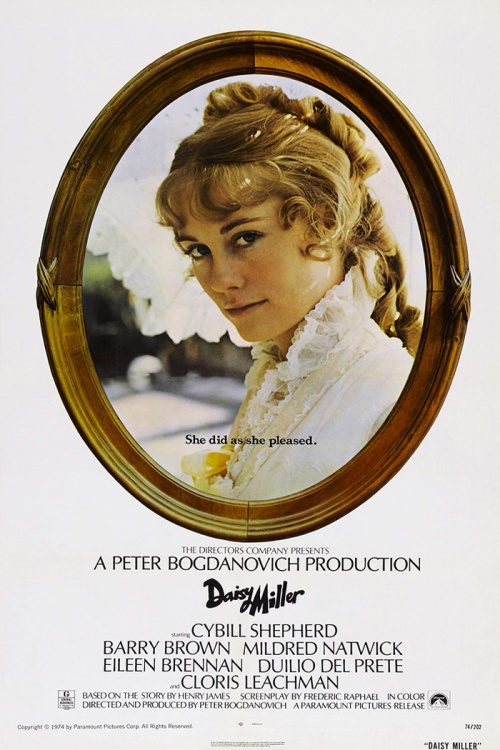
While studying in turn-of-the-century Switzerland Frederick (Barry Brown) comes upon the beautiful Daisy Miller (Cybill Shepherd) who’s touring Europe along with her nervous and talkative mother (Cloris Leachman) and precocious younger brother Randolph (James McMurty). Frederick is smitten with her beauty, but unable to handle her free-thinking ways. Nonetheless he follows her around Europe where he continually becomes confounded with whether she likes him or not, or whether he’ll ever be able to convey his true feelings towards her.

This film, which is based on a short story by Henry James, was originally conceived by Peter Bogdanovich as being a vehicle for both him and his then girlfriend Shepherd to star in with Peter playing the part of Frederick and Orson Welles directing it. Peter had become mesmerized with Cybill while directing her in The Last Picture Show and left his then wife and children to move in with her in a situation that was later satirized in Irreconcilable DifferencesFortunately Welles realized that Peter’s obsession with making Cybill a big screen star had sapped him from all common sense and bowed out of the film project considering the material to be weak and lightweight, which it is, but this only then helped to convince the determined Peter to direct it himself.

The result isn’t as bad as I had initially presumed and in a lot ways it’s strangely engaging and certainly  far better than At Long Last Love another Bogdanovich/Shepherd concoction that was rejected by both audiences and critics alike. This one though takes advantage of Cybill’s conniving, flirtatious nature, which is something I feel she’s been doing her whole life and therefore makes this character a reflection of who she truly is. Leonard Maltin described her performance as “hollow”, which I agree as we only see one side to her personality, but when she plays that one side as well as she does then it becomes entertaining nonetheless.

Brown is excellent too and far better in the role than Peter ever would’ve been as Brown manages to retain the necessary modicum of self-respect even as he chases her around like a lovesick mope. Instead of this becoming off-putting we sympathize with his internal quandary and this then helps to propel the story forward even as it seems to be going nowhere.

The film’s other big asset is its on-location shooting. Some viewers have described the period costumes and set-pieces as being great, but for me this was only so-so. What I really liked though was the scene done inside the Coliseum at night under the moonlight, which gives off both a surreal and creepy feeling and adds an extra ambiance making me wish the segment had been extended as well as adding a trip to Rome on my own personal bucket list.

Spoiler Alert!

The film’s biggest failing though comes at the end where Daisy catches malaria and promptly dies, but we never see her sick and only gets told this after she’s already dead. Having a scene showing her ill and vulnerable as opposed to always being free-spirited and in control would’ve helped give the character an added dimension especially if it had been done with Frederick at her bedside.

The idea that if Frederick had just been less ‘stiff’ towards her that the relationship might’ve blossomed is ridiculous as I think this was the type of woman who enjoyed manipulating men and even if she got married to one she’d continually toy with them until she got bored and moved on to the next. Having her die isn’t ‘sad’ as the film suggests, but instead a happy one for Frederick as now he’s ultimately out of her grip and able to free himself to find someone who would really care for him.

My Rating: 7 out of 10

Released: May 22, 1974

Runtime: 1 Hour 31 Minutes

Rated G

Director: Peter Bogdanovich

Studio: Paramount Pictures

Available: DVD, Amazon Video, YouTube

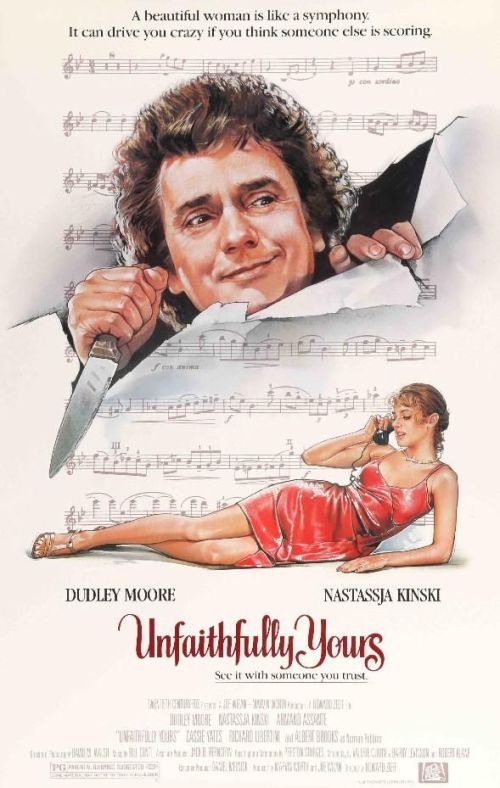
Unfaithfully Yours (1984)

By Richard Winters

My Rating: 7 out of 10

4-Word Review: Conductor suspects wife’s infidelity.

Claude Eastman (Dudley Moore) is a famous orchestra conductor who’s married to Daniella (Nastassja Kinski). While he is on vacation his friend Norman (Albert Brooks) hires a detective (Richard B. Shull) to keep an eye on her and he mistakenly thinks that she’s cheating on Claude with Maximillan (Armand Assante). When Claude finds this out he comes up with a crafty plot to kill her and frame it on Maximillian, but once he tries to put the plan into action everything goes awry.

This is a remake of the film with the same title that was released in 1948 and starred Rex Harrison. That film was quite funny especially the second-half, but it wasn’t perfect and this one makes several changes to the original script that I felt actually improved it. One of the changes is that while Claude is conducting the orchestra he comes up with the plan of how he wants to kill her, but in the original it was three different ideas while here it is only one. Some viewers have complained about this, but the truth is that the other two ideas weren’t very funny or interesting, so whittling it down to only one works better.

I also felt that it was dumb at how in the original Harrison had no interest in reading the report that the private eye hands him and at one point even tries to set it on fire, but I would think any reasonable person, even if they wanted to believe that their partner wouldn’t cheat on them, would still be curious enough to want to take a look at it. In this version Moore initially resists but eventually his curiosity gets the better of him, which is how I think 99 % of other people would act if in the same situation, which therefore makes Moore’s attempts at retrieving the report after initially discarding it all the more comical.

The actual murder plan though is better handled in the first one, where if done exactly right was rather ingenious and even believable. Here though the idea that Moore comes up with has a lot of glaring holes in it right from the start including the fact that he attempts to record his wife’s laughter/screams while inside a restaurant, but the noise of the other customers would conceivably drown out the wife’s voice. The recorder is also placed too far away from where the wife is sitting making whatever noise it does pick-up from her come off as quite muffled and distant.

I felt that Harrison’s acting in the original was what really made it work, but Moore does just as good here particularly in the animated way he conducts, which is a laugh onto itself. However, the scene where he mistakenly drinks some coke that is laced with crushed tranquilizer pills, which presumably should’ve knocked him out completely, but instead it makes him behave in a slightly drunken state is too reminiscent to the alcoholic character that he played in Arthur and therefore should not have been done here due to the comparison.

Although it doesn’t quite hold-up and loses steam by the end it’s still an entertaining ride. If you’re more into classic Hollywood films, or you want to watch and compare both, then I’d say the black-and-white original is just as good as both films had me laughing-out-loud at several points and both deserve a 7 out of 10.

My Rating: 7 out of 10

Released: February 10, 1984

Runtime: 1 Hour 36 Minutes

Rated PG

Director: Howard Zieff

Studio: 20th Century Fox

Available: DVD

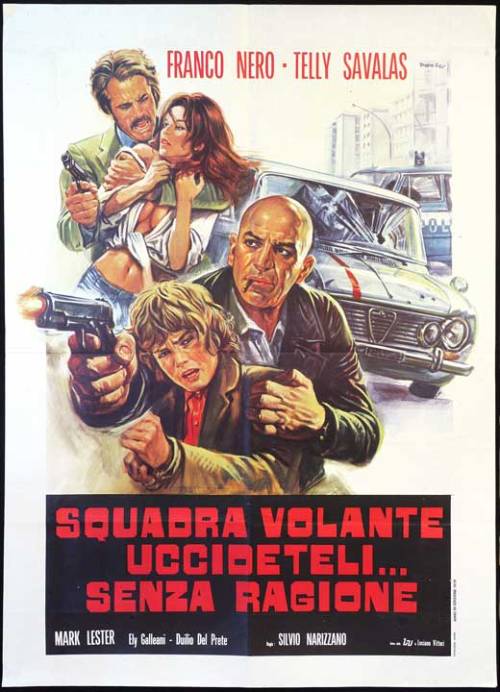
Redneck (1973)

By Richard Winters

My Rating: 3 out of 10

4-Word Review: Robbers accidentally kidnap kid.

Memphis (Telly Savalas) and Mosquito (Franco Nero) are two crooks who try to pull off a jewelry store heist, but end up nabbing much less than they wanted. During their getaway attempt the car being driven by their driver Maria (Ely Galleani) crashes forcing them to stop another car and physically removing its driver (Beatrice Clary) out of the vehicle. Yet as they drive off inside the stolen car they are unaware of a 12-year-old child (Mark Lester) hidden in the backseat who ends up stymieing all of their plans.

This was yet another ill-fated film project that Lester took on after the tremendous success of Oliver! that was supposedly done to help make him a solid big-screen star, but instead turned his career to literal ashes by 1977, which pushed him out of the acting altogether and into a career in sports medicine. The film starts out okay with some excellent action that’s vividly done and had it kept up its fast-pace throughout it might’ve done better.

Unfortunately whenever the story slows done it gets boring real fast. Part of the problem is there is no backstory given to any of its characters. Everything starts out very abruptly going right into the robbery and subsequent getaway, which is fine, but at some point we need to learn more about these people; what makes them tick and gives them distinction, which never happens. It’s hard to get caught up in the action or tension when everyone, including Lester, comes off as blah and transparent. The film’s original Italian title was Senza Ragione, which translates into ‘with no reason’ and that’s exactly what you get here: sadistic, mindless calamity that serves no purpose.

Lester’s presence isn’t interesting and he barely even has much dialogue. He’s too much of a passive victim that doesn’t fight back enough while his bonding with Nero happens too quickly. His  eventual downward spiral, where he goes from innocent child to a nutcase that craves violence is also too quick and does not seem genuine. The part where he tries to escape from the crooks and is chased through an empty field is jarring because playful, cartoon-like music gets played over it making it seem almost like a slapstick comedy even though the rest of the film is approached like a thriller with a pounding soundtrack, which makes the production come-off like it has a split-personality.

The film is also somewhat controversial because Lester, who was only 13 at the time of filming,  for no apparent reason strips naked although the viewer only sees him from behind, but it’s still a bizarre moment nonetheless. However, to me what was more shocking was having him watch an adult couple making love in the backseat of a car.

Savalas is certainly a lot of fun and can make the most of any low grade picture, but even here his campiness gets a bit overdone including his incessant whistling. The ending, in which the characters go from a summer climate to a winter one in seemingly a matter of a day is quite confusing. To some extent I liked the snowy landscape and howling wind, which created a surreal effect, but having a movie change seasons so drastically and without any explanation is a true sign of really bad filmmaking.

Alternate Title: Senza Ragione

My Rating: 3 out of 10

Released: January 26, 1973

Runtime: 1 Hour 29 Minutes

Rated R

Director: Silvio Narizzano

Studio: Crawford Productions

Available: VHS

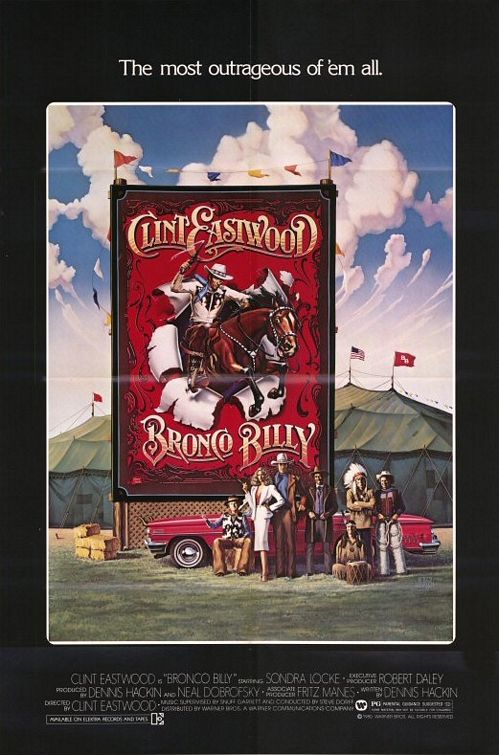
Bronco Billy (1980)

By Richard Winters

My Rating: 4 out of 10

4-Word Review: Rich lady and cowboy.

Bronco Billy (Clint Eastwood) is an aging modern-day cowboy who runs a traveling wild west show that is no longer attracting customers and making it hard for him to pay his employees. While at a gas station he meets Antoinette (Sondra Locke) a rich heiress with a haughty attitude who has just gotten dumped by her husband (Geoffrey Lewis) who also absconded with all of her money. Billy decides to hire her onto his show despite the fact that her presence causes animosity amongst the rest of his crew.

After Locke’s recent death, one person on Twitter, I don’t remember who, stated that this was the ‘greatest movie ever made’ and I’m not sure if he was joking or not, but if he wasn’t then I adamantly must disagree.  The film does start out okay and even has a certain charm to it, but the story and situations get too exaggerated until it’s impossible to take any of it seriously while also being too hokey to find funny.

The biggest logic gaps occur during the story thread dealing with Lewis being convinced to lie to the authorities that he killed Locke even though he really didn’t, so that he can get his share of her inheritance once he gets out. He’s told that if he pleads insanity that he will be ‘guaranteed’ to be released in only 3 years, but when in the history of the world has this ever happened and who would ever be dumb enough to believe it?  And that staying at a mental hospital is ‘no big deal’ and almost like a ‘resort’, which describes no mental hospital that I’ve ever head of.  There’s also no attempt by the police, or at least none is ever shown, to investigate the case to make sure Locke really has been murdered and try and retrieve her body.

The proverbial barroom brawl segment (must every western-themed film have this?) that occurs in the middle is as cliched and silly as it sounds and puts the whole rest of the film on a very cartoonish level. What’s even dumber is that during the brawl Locke goes outside to the parking lot where she gets accosted by two men, but just before they’re able to assault her Eastwood and his buddies magically appear to save her, but how could they have no known that she was in trouble when just a minute before they were shown taking part in the wild ruckus inside?

Locke’s rich-bitch personality is too much of a caricature and quickly becomes irritating to the point that when she eventually does soften, which takes awhile, it still doesn’t help. Having her able to shoot a pistol just as well as Billy seems out of character and never sufficiently explained. It would’ve been funnier had her dainty, cushy lifestyle been challenged more by throwing her into a rugged experience that she wasn’t used to, which doesn’t get played-up half as much as it could’ve or should’ve.

Eastwood’s character isn’t likable either. I would hate working for somebody that couldn’t pay me fore several months straight nor not allowing his employees to ad-lib any of their lines that he writes for them during the western skits that they put on even though people work better in their jobs when their allowed to have creativity and leeway in what they do and how they do it.

Why he would immediately fall head-over-heels for this woman is a mystery as Locke is only average in the looks department and her arrogant attitude is such an extreme turn-off that just about any guy would quickly dump her and never look back instead of continually pursuing her like Billy pretty much does here. Having them consummate their relationship should’ve only occurred at the very end while displaying much more of their personality clashes, which gets underplayed.

The scene where Billy and his gang try to hold-up a train is really funny and I enjoyed the inspired casting of having Woodrow Parfrey, who usually plays weirdo types, being cast as the head of the mental hospital, but other than that I felt the film was too predictable. You know where it’s headed right from the start and the theme of the old-fashioned, rugged individualist fighting more modern-day sensibilities has been done in so many other Eastwood films that here it becomes redundant.

My Rating: 4 out of 10

Release: June 11, 1980

Runtime: 1 Hour 56 Minutes

Rated PG

Director: Clint Eastwood

Studio: Warner Brothers

Available: DVD, Amazon Video, YouTube

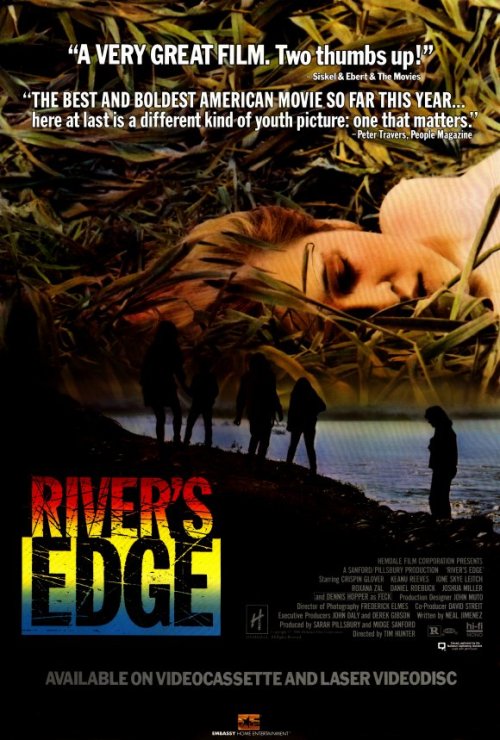
River’s Edge (1986)

By Richard Winters

My Rating: 7 out of 10

4-Word Review: Teens ambivalent to murder.

A high school clique must deal with conflicting issues when one of their members (Daniel Roebuck) murders his girlfriend (Danyi Deats) and leaves her nude corpse along the riverbed where he then proudly shows it off to anyone who wants to see it. Some of them consider going to the police while others like Layne (Crispin Glover) thinks they should simply bury the body and cover-up for John’s deeds since he’s their friend.

While I liked the film’s atmosphere and the strong drama I didn’t care for the preachy tone. This is most evident in the scenes with Jim Metzler playing a teacher who’s a baby boomer and brags about how great his generation is compared to today’s teens and even at one point wags his finger at them over their apathy, but never once answers why they’ve become that way. Every generation likes to feel that they’re superior to the one that comes after it and the film seems to want to align itself with that point-of-view; that the kids today just don’t seem to ‘get-it’, but what’s caused that? Is it just some ‘bad DNA’ or instead a crumbling societal structure and if so then the adults are partially to blame for it, which is a complex area that the film seems reluctant to go to.

The fact that there isn’t any real insight to the cause and it doesn’t even analyze the family life of all its characters is a bit frustrating. It does show the chaotic, broken home life to one of them, which could be construed as part of the problem, but then later this gets negated when the teen from that household is the one who ultimately goes to the police.

Keanu Reeves character is a further detraction as he becomes too much of the conventional hero. Watching him literally shake from guilt while sitting in a classroom gives away all the tension as it makes it clear he will eventually go to the police and it would’ve been more intriguing had this instead been kept a mystery. Initially we’re supposed to be ‘shocked’ that the teens don’t immediately run to the police upon discovering the body, but then having him later get accused of the crime once he does go only helps to make those that didn’t seem the wiser.

Dennis Hopper’s character is a problem too. He’s great actor who plays the part brilliantly even though it seems too similar, at least initially, to the one he played in Blue Velvet almost to the point of it being typecasting. Having the guy start out as this weird, overly eccentric, mentally unstable loner who goes around in public with his sex doll only to then turn around and become a moral authority to ‘the crazy kids of today’ is just too much of a weird clash.

Crispin Glover, with his androgenic looks and wild, hybrid VW that he drives around in, is the film’s true star and many might even say that he IS the movie. His warped idea of friendship, loyalty, and ‘honor’ is amusing and even engaging and in a offbeat way brings a sense of innocence to an otherwise jaded climate. The plot would’ve worked better had it made him the centerpiece by turning it into a black comedy where he becomes the anti-hero by trying to save his friend from getting into trouble, which ultimately would’ve hit home the same message that the drama does anyways.

Despite having its plot start from the middle and work into a nebulous finish, it’s still a gripping and groundbreaking film and something I found myself quite caught up in. I just wished it hadn’t felt the need to envelope it with a social message, but instead allowed the situation play out naturally with an ambiguous tone, which would’ve then forced the viewer to ponder the ramifications of it by themselves instead of trying to do it for them.

Although the film never mentions it this it is actually based, or at least inspired by a true incident that occurred in Milpitas, California when 14 year-old Marcy Renee Conrad was murdered by 16 year-old Anthony Broussard on November 3, 1981. After dumping the dead body into a ravine Broussard then showed it off to 10 of his friends who didn’t do anything about it until finally 2 of them decided to go to the police. However, there are some major differences from the real case to the one portrayed here. In the actual incident Marcy was also raped and Broussard was African American and his ultimate fate was much different than what happens to the killer in the movie.

My Rating: 7 out of 10

Released: August 7, 1986

Runtime: 1 Hour 39 Minutes

Rated R

Director: Tim Hunter

Studio: Island Pictures

Available: DVD, Blu-ray, Amazon Video

Promises in the Dark (1979)

By Richard Winters

My Rating: 3 out of 10

4-Word Review: Caring for cancer patient.

Elizabeth ‘Buffy’ (Kathleen Beller) is a 17-year-old high school senior who breaks her leg while kicking a soccer ball. Alexandra (Marsha Mason) is the attending physician who feels that a beak of that magnitude should not have occurred simply by kicking a ball, so after doing more x-rays they find a cancerous tumor, which necessitates having the leg amputated. While Buffy recovers from that further tests reveal that the cancer has spread and this causes Alexandra to lose her cold, defensive exterior as she tries to comfort Buffy through the remaining time that she has.

This film nicely keeps everything at an earnest level and avoids jazzing things up for dramatic purposes, which is refreshing. The acting from Ned Beatty as Buffy’s father and Susan Clark as the mother is outstanding with Clark’s character being particularly interesting especially when she doesn’t run to her sick daughter’s aid when she hears her cry for help, but instead remains frozen at the bottom of the stairs, which was something I wanted to have explored more.

Mason’s excellent dramatic talents seemed ripe for this type of material, but strangely she doesn’t come-off as well as I would’ve expected. I liked that she is portrayed as being strong and in control and the fact that she just happens to be female, in a time when doctors was still a male dominated profession,  and it’s never used against her is great, but the character’s arch, in which she learns to open-up more after her divorce, is not half as compelling as Buffy’s struggles, which should’ve made her the main character while the Dr. role thrown in as a minor secondary one.

Alexandra’s romantic relationship with another Dr., played by Michael Brandon, wasn’t necessary either. To some degree I liked how the film keeps this at a realistic level, by having the relationship full of a lot of ups-and-downs as opposed to having their eyes magically lock on each other and then in the next shot showing them in bed together like a lot of other movies do, but supposedly the element of this story was Alexandra’s friendship with Buffy and that in many ways becomes secondary to the romance.

Beller is the best thing as her sensitive portrayal connects strongly with the viewer making what she goes through quite upsetting. Having to watch a likable person learn to adjust to life with only one leg, which she does quite commendably, is one thing, but having her then go through more cancer treatments until she is left a virtual vegetable is just too much to bear and it makes the second hour downright tortuous to have to sit through.

Spoiler Alert!

Some may argue that having Buffy die was just keeping things real, but then why throw in a whole secondary story-line that doesn’t get introduced until the third act, which has a Karen Ann Quinlan-like quality to it as it deals with Buffy being kept alive long after her brain activity has ceased and Alexandra’s fight with Buffy’s parents to have the machine shut off. The fact that Alexandra eventually succeeds in turning it off only brings up more questions like did this get her into trouble with her job/reputation, or sued in court by Buffy’s parents? None of this gets answered or even touched on, but should’ve and in essence seems like a plot for a whole other movie.

Films from the 70’s were notorious for having sad endings, which in many ways made them more sincere. Yet this movie is so unrelentingly with it that I failed to see how anyone could enjoy it. Certainly it’s not something you’d ever want to watch more than once, or one that you’d ever want to invite a friend or date to as it would put a damper to any evening. This may be too maudlin for even fans of tearjerkers, which are the only people that could possibly like it.

My Rating: 3 out of 10

Released: November 2, 1979

Runtime: 1 Hour 58 Minutes

Rated PG

Director: Jerome Hellman

Studio: Orion Pictures

Available: DVD (Warner Archive), Amazon Video

Skaterdater (1965)

A still photo from the 1965 Academy Award-nominated short film “Skaterdater.” The 18-minute film was shot on location in the South Bay without dialog and starring a bunch of skateboarding kids.

By Richard Winters

My Rating: 6 out of 10

4-Word Review: From skateboards to girls.

Director Noel Black, who had just graduated from USC film school, wanted to put together a production reel that he could show to potential producers and studios and  after securing $17,000 for financial backing decided to make a short movie examining the then new craze of skateboarding. The story centers on some neighborhood skateboarders in Torrance, California who enjoy spending their summer afternoons skating around town. One day one of the boys (Michael Mel) spots a pretty girl (Melissa Mallory) and decides she’s more interesting than his friends, so he starts spending all of his time with her, which makes his other friends jealous and one of them (Gregg Carroll) challenges him to a skateboarding ‘duel’ along a steep, hillside street.

Despite the limited production values this still comes off as fresh and original and it’s officially the very first film ever made about skateboarding. In many ways not much has changed. The only real difference is that businesses back them did not have the sway to put up signs banning skaters from using their parking lots or sidewalks and one amusing segment shows the disgruntled look of local business owners having to put up with the distracting skateboarding noise outside although unfortunately director Black over-accentuates the noise for effect making the sound and ultimately the segment annoying to the viewer as well.

Some of the stuntwork though is impressive and the fact that there is no dialogue or names given to the characters is a benefit as it gives the thing a universal appeal knowing that this same type of scenario gets repeated all over the country from one generation to the next. The film was met with strong critical praise and has led to it getting preserved into the Academy Film Archive in 2010 as well as helping to boost director Black’s filmmaking career, which directly  led to him getting a chance to direct Pretty Poison, starring Anthony Perkins and Tuesday Weld, which has since garnered a strong cult following.

As for the cast none of them became famous or found a career in front of the camera, but they’re all still alive and recently got together for a reunion with pics showing them as they were back then and how they look today :

L-R back row Bill McKig, Gary Jennings, Marshal Backlar, producer. L-R front row Michael Mel, Melissa Mosley and Bart Jahn all reunited 50 years after making the 1965 Academy Award-nominated short film “Skaterdater.” The 18-minute film was shot on location in the South Bay without dialog and starring a bunch of skateboarding kids.
Redondo Beach June 27, 2015.
(Photo by Brittany Murray / Daily Breeze)


My Rating: 6 out of 10

Released: November 11, 1965

Runtime: 17 Minutes

Not Rated

Director: Noel Black

Studio: United Artists

Available: YouTube

Cuba (1979)

By Richard Winters

My Rating: 7 out of 10

4-Word Review: Cuba during the revolution.

Robert Dapes (Sean Connery) is a British mercenary who travels to Cuba to train the army to resist the approaching forces of the revolution lead by Fidel Castro. While there he becomes reacquainted with Alexandra (Brooke Adams) his former lover who has 15 when he first knew her, but is now 30 and married to Juan (Chris Sarandon) who owns a rum and cigar factory that he inherited from his family, but run by Alexandra.

The film from a purely visual standpoint is a masterpiece with David Watkin’s cinematography giving a very vivid feel to the ambiance of the period by capturing not only the slums of the region, but the affluence as well. Despite being filmed in Spain it still manages to create an interesting Cuban atmosphere that has an intoxicating quality that makes it entertaining to watch even though the story especially during the first half doesn’t go anywhere.

The romantic angle really wasn’t needed. The idea was to create a Casablanca scenario, but it comes off as forced and cliched. The chemistry between Adams and Connery isn’t there and she appears far too young for him. She states that she is 30, but doesn’t even look that old and the fact that he was apparently having sex with her when she was 15, although the Connery character states that he thought she had been 17, is still something that won’t go over well with today’s audiences.

Connery doesn’t seem to be the best type of actor for this part either. For one thing the character should’ve been American as the Cuban revolution was more of a direct threat to the US than England. He also doesn’t have too much to do and his patented rugged brashness is missing. His characters usually take control of things, but here he’s passive and almost like he’s under a spell from the constant hot-and-cold act that Adam’s gives  him that eventually makes him come-off as benign and ineffectual. Jack Weston as a befuddled American businessman is much more engaging and would’ve made a better lead as he gives the thing some balance with needed light humor.

I also thought both Adams and Sarandon could’ve given more effort to create an authentic Cuban accent. Both are made to look Cuban, but they don’t sound like one. Adams seems to at times convey an accent while Sarandon makes no attempts to have one at all.

On the technical end  it works and is an impressive dramatic effort for director Richard Lester who was better known for slapstick comedies, but it misses the potential of a being a sprawling epic, which is where it should’ve gone. Constricting the whole thing to just two characters with Weston tagging along for momentary comic relief does not do the production justice. Instead it should’ve branched out into several different, interweaving story-lines that analyzed the unique perspectives and situations of the various people involved, which would’ve given the viewer a more robust viewpoint of this important moment in history.

My Rating: 7 out of 10

Released: December 21, 1979

Runtime: 2 Hours 2 Minutes

Rated R

Director: Richard Lester

Studio: United Artists

Teachers (1984)

By Richard Winters

My Rating: 5 out of 10

4-Word Review: Teaching can be difficult.

Alex (Nick Nolte) is a burned-out teacher who feels that the system is working against him as he tries to do his job in an inner-city school despite having no support from administrators. Things come to an ugly light when Lisa (JoBeth Williams) a former student of his who’s now an attorney takes part in a lawsuit suing the school for graduating a student who could not read.

Producer Irwin Russo drew on his 10-years as a teacher at an inner-city New York high school as the basis for the story and the film has some good trenchant points, but trying to put a satirical spin to it was a mistake. To make a good satire you gotta go all-in and this film timidly goes half-way with humor that at times, especially at the beginning, is off-putting. It’s not until the second-half when it gets more serious does it ever start catching its stride and the production would’ve been better had it remained a drama from the very beginning.

Nolte comes off like he’s suffering from one long hang-over, which may have been the intention, but the way he basically sleepwalks through the role gives the film no energy and makes the viewer feel as drowsy as he is. His relationship with Lisa, his former student, is forced and uninteresting and even a bit unbelievable since they look to be basically the same age. Judd Hirsh who plays the vice principal should’ve been the lead adult character as he does a great job of balancing the comedy with the drama by playing it straight and simply responding in sometimes glib and humorous ways to the insanity around him.

Ultimately it would’ve worked better had Ralph Macchio been made the star as he’s excellent despite the irony that he was already 23 at the time, but looking more like he was still in the eight grade. Crispin Glover as his goofball friend doesn’t work as well. Sometimes his pseudo-psycho characters are interesting, but here it is poorly defined and distracting. Laura Dern’s character is annoying as she plays another one of those perennial teen girls who gets pregnant and then wants an abortion, which has been so overused in so many other high school films that by now it seems like a cliche.

I did like the on-location shooting done at the former Central High School in Columbus, Ohio and the student body looks to be made up of actual teens and not just young adults trying to play one, but they did seem at times to be a bit unrealistically too well behaved. The scene where a teacher Mr. Stiles (Royal Dano) would fall asleep behind his desk and the students would still quietly do their homework made no sense as I would think they’d take advantage of the situation and goof-off instead.  Richard Mulligan’s role as an escaped mental patient pretending to be a substitute teacher is equally implausible as I thought the authorities would’ve caught up to him much sooner than they do although it is fun seeing him wearing a General Custer outfit as it looks quite similar to the one he wore in Little Big Man when he played the actual Custer.

There are a few good moments here and there, but it’s badly undermined by the misguided humor and corny ending. The eclectic supporting cast though is a treat to watch. I enjoyed William Schallert as a principal who seemingly wants to avoid confrontation at all costs as well as Lee Grant as a lawyer, which is the type of profession her acting style seems born to play. Originally the part was written for a man, but she plays it better than any guy ever could and I also enjoyed seeing her with a brunette hairdo instead of her usual red one, which makes her appear younger than she did in the 70’s.

My Rating: 5 out of 10

Released: October 5, 1984

Runtime: 1 Hour 47 Minutes

Rated R

Director: Arthur Hiller

Studio: MGM/UA

Available: DVD

Shamus (1973)

By Richard Winters

My Rating: 6 out of 10

4-Word Review: Detective uses unorthodox methods.

Shamus (Burt Reynolds) is a down-and-out private detective who uses a pool table for a bed and seems more able to attract woman that he doesn’t know for indiscriminate sex than he does at finding cases to solve. Eventually he gets hired by a millionaire businessman (Ron Weyand) to retrieve diamonds stolen during a violent robbery, but the more he pursues the case the more convinced he becomes that it’s a set-up.

This film has the perfect blend of funny Burt/tough-guy Burt and it’s one of the main reasons why it manages to remain engaging. Most other films that he was in never had the right balance. By the late 70’s his humorous side had gotten overused to the point that his image had become that of a silly country boy, but then in the 80’s he over-corrected by starring in a lot of sterile action flicks where his characters were overly-serious and moody and even less entertaining than his comical side. Here though it’s a fun mix as he playfully jumps from saying quips with a twinkle in his eye to beating the crap out of the bad guys when he needs to and the opening bit where he wakes-up and tries to get ready for the day after a long night of partying is a total gem.

The actions of his character though gets a bit over-the-top particularly with the way he extorts information from those he encounters. Unfortunately he’s no Jim Rockford who would use his cunning and wit to get people to talk, but here Shamus gets physically rough with them to the point that he literally strangles a man with a chain until his face turns purple making it look like he was as bad as those he was pursuing. It also made me wonder how long he could go on using these unsavory methods before it would finally catch-up with him.

He also doesn’t use much of his own brain power as he gets underlings at a bar he frequents to do most of the research for him making it seem like they should be the ones receiving the pay. I was also confused why he’d stay on the case even after the person who had hired him cuts off his funds. For the majority of the film he’s emotionally detached and only doing what he needs to, to get paid, so why continue to pursue something when the incentive is gone especially when there’s nothing in it personally for him?

The story has a lot of twists and complications, but it all ends up circling back to the person that we had suspected from the very beginning making the ending not only predictable but boring. It would also have been nice since this film does make some attempts at being gritty to not have every lead that he comes upon always magically pan out. In real-life many so-called ‘hot leads’ go nowhere and for the sake of balance the film should’ve shown Burt coming to a few dead-ends before finally getting the clues that he needed.

As for the action it’s okay and the foot chase outside of a warehouse is good not so much for what happens, but more because it was shot in late autumn and the orange sunlight coupled with the bare trees gives off a surreal feeling, which gets ruined later during another foot chase where everything is suddenly plush and green and strangely turned springtime without warning. The fact that Burt is always able to jump into vehicles that routinely have their keys already in the ignition hurts the credibility and how he was able to get a forklift to drive itself during the warehouse segment is even more perplexing.

The film starts off with a bang and I was hoping this would be something really different, but ultimately it becomes like a slow, leaking tire that gets flatter as it goes along. That’s not to say it isn’t adequate as it is, but there’s nothing about it that’s truly memorable. Dyan Cannon’s is particularly wasted. Supposedly she had to be coaxed out of semi-retirement to do this after her bad experience in Such Good Friends, but I failed to see the point as her character doesn’t have much to do with the story and could’ve easily been cut out altogether.

My Rating: 6 out of 10

Released: January 31, 1973

Runtime: 1 Hour 46 Minutes

Rated PG

Director: Buzz Kulik

Studio: Columbia Pictures

Available: DVD, Amazon Video