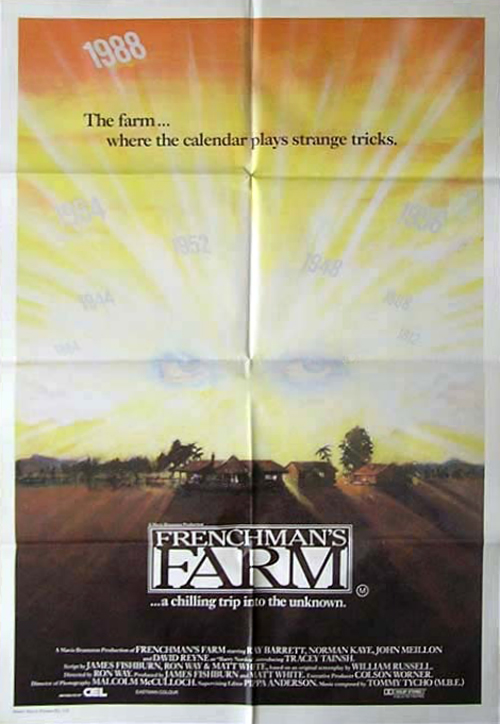
Frenchman’s Farm (1987)

By Richard Winters

My Rating: 3 out of 10

4-Word Review: Witnessing a past murder.

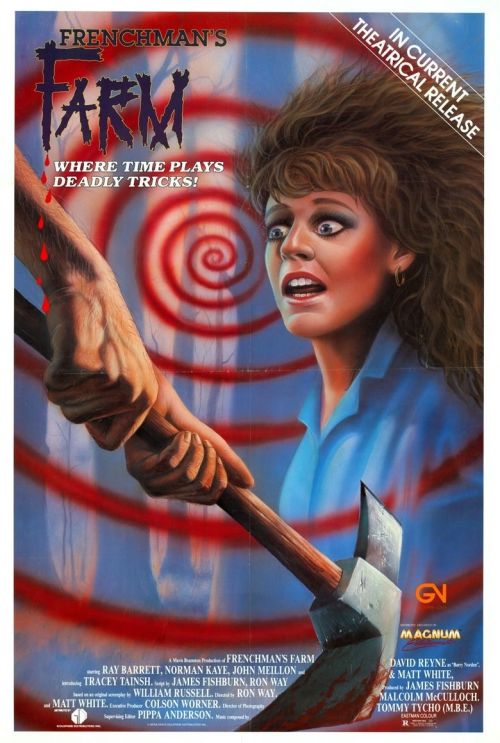
Jackie (Tracey Tainsh) goes traveling in her car throughout the Australian countryside while bush fires rage all around her. When her car breaks down she visits the nearest farmstead for help. It is there that she finds herself suddenly swept back to the year 1944 where she witnesses a murder and then just as quickly she comes back to the present day. When she tries to tell others what happened nobody believes her, but eventually her boyfriend Barry (David Reyne) takes up her cause and with the benefit of old news articles help find the real killer and the secret behind what motivated it.

Although marketed as a horror flick, it seems more like iffy sci-fi and could’ve easily have been targeted to a pre-teen audience since it’s not all that tense, or scary, especially with the majority of it filmed in the bright sunny daytime. When it does finally take place in the darkness of night a cliched thunderstorm gets conveniently put in while the killer is made out to being a ghost who pops in and out like it’s The Ghost and Mrs. Muir.

Initially I kind of liked that that she didn’t stay stuck in the past and was able to be her own detective, which kept me intrigued for awhile yet it started to make me wonder why the time traveling event occurred to begin with, which the movie has no suitable explanation for except to say that the bush fires created some sort of ‘atmospheric disturbance’, but if that was the case why was she the only one affected? The film also does a poor job of recreating a past era, as Jackie and her boyfriend go back to the farm where the murder occurred, but do it in the present day and yet the trees in the backyard where she witnessed the killing 40 years earlier all look the same even though they should’ve either died or grown bigger.

I found it annoying too that the boyfriend, who has a generic ‘surfer dude’ presence, starts to take over the investigation even though it really wasn’t his personal battle to solve. In order for him to take such an interest he should’ve been transported back in time with Jackie, or for a more original touch, it could’ve been Jackie and a female friend who witnessed the killing and then proceeded to becoming amateur sleuths together.

A few veteran Aussie character actors, such as an aging John Meillon, help give it some stature, but the production overall is quite bland and how it ever got considered as being a part of the Ozploitation genre, which stands for Australian exploitation cinema, is beyond me since outside of a brief skinny-dipping minute there’s nothing titillating or shocking about it.

The ‘surprise ending’ is also really dumb and doesn’t even involve the main character who gets phased out of the storyline before the ending even comes about, which is not satisfying for the viewer to follow a character around  for the whole movie only to have her ultimate fate left open to a murky explanation.
 

My Rating: 3 out of 10

Released: September 9, 1987

Runtime: 1 Hour 38 Minutes

Rated R

Director: Ron Way

Studio: CEL Film Distribution

Available: DVD
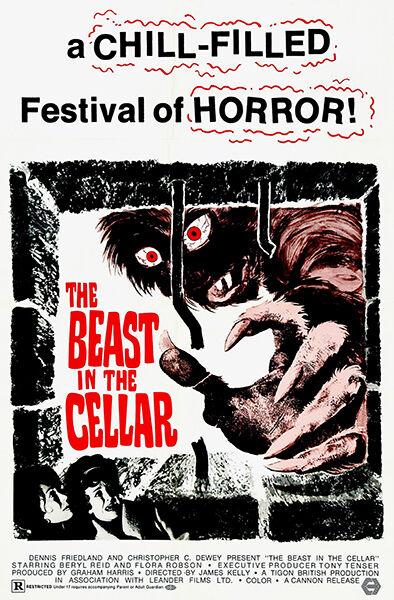
The Beast in the Cellar (1971)

By Richard Winters

My Rating: 4 out of 10

4-Word Review: Elderly sisters harbor prisoner.

Soldiers throughout the English countryside are being gruesomely murdered by what seems to be some wild beast, but the authorities have no idea what type of creature it is, or where it came from. Ellie (Beryl Reid) and Joyce (Flora Robson) are two elderly sisters living together in an isolated rural home, who fear they may know the answer and it has something to do with a dark family secret that lies imprisoned in their basement.

The film’s perceived charm revolves around the casting of two legendary actresses in offbeat roles where they at times come-off both as antagonists and the anti-heroes. Reid is especially interesting because here she’s a child-like individual while just a few years earlier she was a controlling, domineering woman to Susannah York’s child-like one in The Killing of Sister George, so seeing her able to play both parts effectively is fun and impressive.

The banter between the two though needed to be played-up more and I was expecting, given the storyline, more of a campy, dark humored tone, which really never manifests. The dialogue gets too extended, as the women do nothing, but pretty much talk, talk, talk until it seemed to be almost a filmed stageplay with the camera locked in the house and nothing visually stimulating to captivate the viewer.

The scares consist mainly of a handheld camera swinging back and forth  in an apparent attempt to replicate the beast attacking the victim, which ends up being more dizzying and amateurish looking than frightening and the fact that this technique gets done with each attack makes it quite derivative. It would’ve been better had the attacks not been played-out at all, but instead simply revealed the mangled. bloody body afterwards. The film also makes the tacky error of portraying the eyeball, which gets gouged out on one victim, as being shaped like a ping pong ball, which is probably what was used, when in reality it is more oval shaped.

A good horror film should have a frightening image to latch onto, but here that’s lacking despite a few prime opportunities where one could’ve been implemented. Reid’s retelling to the police inspector about the backstory dealing with their basement prisoner has some interesting cutaways making it the best part of the movie, but no shot of the shell-shocked, war weary father even though he’s an integral component to the plot. The ultimate reveal of the beast is highly disappointing in a climactic finish that completely fizzles, which makes sitting through this not worth your time.

My Rating: 4 out of 10

Released: April 14, 1971

Runtime: 1 Hour 28 Minutes

Rated R

Director: James Kelly

Studio: Tigon Film Distributors

Available: DVD, Amazon Video

Allison’s Birthday (1981)

By Richard Winters

My Rating: 5 out of 10

4-Word Review: Teen ages very rapidly.

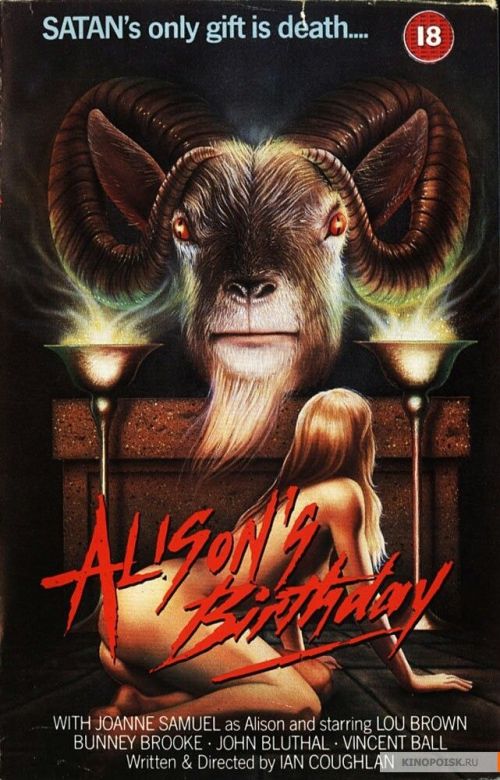
Allison (Joanne Samuel) decides to spend her 19th birthday with her aunt (Bunney Brooke) and uncle (John Bluthal) who live in rural Australia and have been raising her ever since her parents died when she was just a child. However, this visit includes her meeting her elderly grandmother (Marion Jones) for the first time and a mysterious illness that also affects her while she is there. Her aunt and uncle refuse to allow her boyfriend Peter (Lou Brown) to visit causing him to go to great lengths to get her away from them and back to safety as he fears they’ve come under the influence of a cult.

This low budget Australian sleeper managed to become a hit in its own country mainly from its attempts to work against-the-grain of that era by creating a horror film that did not involve blood and gore, but instead relied on good old fashioned creepiness. For the most part it succeeds, but gets hampered by a plot that plays itself out too slowly.

It becomes too obvious that her aunt and uncle have some evil intent in mind and this should’ve been camouflaged better because when the big reveal finally does come about during the third act it’s not surprising at all. The cult that they’re involved with is portrayed in such a cliched way from the tacky black robes that they wear to the Stonehenge-like meeting place that  it seems like high camp. The opening sequence featuring a ouji board and a talking spirit, is equally heavy-handed and almost sinks this thing before it’s barely begun.

Some of the action segments particularly her boyfriend’s attempts to outrun the cult members who try chasing him down is exciting, but he’s in too much of the movie, while Allison remains virtually bedridden making it seem like he’s the main character instead of her. A good protagonist should be able to fight her own battles and in this case she does too little, which doesn’t elicit enough emotion from the viewer to want to cheer her on.

Spoiler Alert!

The film’s twist ending in which, due to the ritual ceremony done by the cult, a young Allison suddenly wakes up to find herself trapped inside the body of her grandmother, is pretty cool and genuinely quite horrifying when you think about it. However, this should’ve occurred during the middle part and the rest of the film spent with her trying to return her spirit back to her youthful body, which could’ve involved a wide array of intriguing and unique elements. Unfortunately this doesn’t happen making the film only a skeletal blueprint of what it could’ve been.

My Rating: 5 out of 10

Released: May 1, 1981

Runtime: 1 Hour 37 Minutes

Not Rated

Director: Ian Coughlan

Studio: Australian Film Institute

Available: VHS

Happy Mother’s Day, Love George (1973)

By Richard Winters

My Rating: 3 out of 10

4-Word Review: Searching for his father.

Johnny (Ron Howard) is a young man who arrives in a small seaside town searching for the identity of his parents. After speaking with the various eccentric personalities that live there he come to the determination that a waitress at a local cafe named Ronda (Cloris Leachman) is his mother, but she refuses to divulge who the father is and he begins to suspect that the secret may lie in the strained relationship that she has with her sister Cara (Patricia Neal).

It’s hard to tell what motivates people to take on certain projects. Darren McGavin had a great career in front of the camera, but this remains outside of a few TV episodes that he did, his only foray as a director. Yet it means little as the story is quite pedestrian and moves at a slow pace making it seem more like a drama and it takes until the third act before there are any chills at all.

The on-location shooting, which was done in the seaside towns of Mahone Bay and Lunenburg that are both situated in the Canadian province of Nova Scotia, is quite scenic and it almost seemed like McGavin and his crew had access to the entire town as the camera follows Howard walking up and down the residential streets while homeowners stare out their windows at him at each house that he passes. If this was a film specializing in the New England vibe it would be a success, but as a horror film the plot progresses too slowly and by the time the mystery finally gets answered you really don’t care  anymore.

The eclectic cast is interesting and really the only reason to watch it. Bobby Darin, in his last film, shows great potential as a feisty short-order cook, but his screen time is painfully limited. Neal gets in a few snarky remarks, but not much else and Leachman essentially channels the same character that she played in The Last Picture Show.

The one that gets the showiest part is Tessa Dahl who was Neal’s daughter in real-life and looks almost exactly like her to the point that I initially thought she was Neal at first. Her British accent helps add some flair as does her knife-wielding finish. Even more ironic is the fact that she has grown in recent years to suffer serious mental health issues much like her character.

As a novelty this film, which was reissued as Run Stranger Run, might be worth checking out just to see Opie with dark brown hair instead of his trademark red, but as a horror flick it lacks punch and has very little scares.

Alternate Title: Run Stranger Run

Released: August 17, 1973

Runtime: 1 Hour 30 Minutes

Rated PG

Director: Darren McGavin

Studio: Cinema 5 Distributing

Available: VHS

April Fool’s Day (1986)

By Richard Winters

My Rating: 3 out of 10

4-Word Review: It’s all a prank.

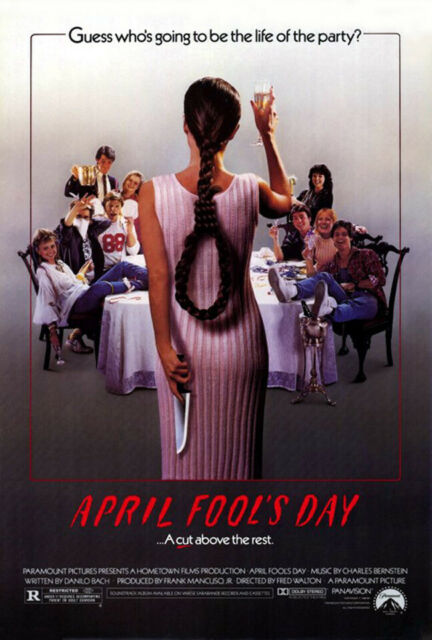
A group of college students get together at an excluded island home of one of their friends Muffy (Deborah Foreman) to celebrate their last year in school together. Then as the weekend progresses they find that a killer is knocking them off one-by-one. Will the remaining survivors be able to escape, or is there something more to these murders that no one realizes?

The film was an attempt to revive what at the time was a lost interest in the slasher genre by creating a irreverent tone to the staid formula and in that regard it does an okay job. The main issue though is that it gets too jokey making it seem more like a misguided comedy that losses sight of its intended horror fan audience completely.

I didn’t mind a few of the pranks, but too much time gets spent on them and 40 minutes seemed to be a ridiculous wait (if you don’t count the injury that occurs on the initial boat ride in, which seemed more like an accident) before we even get to the first killing. The pranks bordered on being too elaborate and something a regular person wouldn’t be able to pull off. For instance one deals with Rob (Ken Olandt) turning off one light in a room only to have another one turn on, all to the amusement of his girlfriend (Amy Steel) who apparently (I guess?) rigged the lights to do this, but where did she  get the electrical background or time to wire the room in this manner?

If the pranks are supposed to revolve around the fact that it’s April Fool’s Day then all the action should  take place within a 24-hour period instead of over several days. The scenery doesn’t have a spring-like look either as there should be blossoms and buds on the trees, but instead, since it was filmed in August, it looks more like late summer.

The cast comes-off too much like crude and obnoxious junior high kids whose only topic of conversation is sex instead of young adults ready to enter the working world and their dialogue doesn’t seem genuine.  One dumb bit has Harvey (Jay Baker) trying to make amends with Nikki (Deborah Goodrich) by trying to prove to her he really isn’t as much of a ‘dick’ as she thinks, but then proceeds to tell that he’d like to ‘plow her field’, which would only convince her otherwise.

Spoiler Alert!

The killings are brief and feature virtually no gore at all, which will disappoint those expecting to see at least a little. The ending, which reveals the killings to being just another gag, was novel, but there still needed to be a secondary twist. In the film’s original cut Skip (Griffin O’ Neal) kills Muffy after everyone else has left the island, but the studio execs nixed this opting for an ‘upbeat’ ending instead. Upbeat endings are fine if it’s a comedy, but a horror film should have a dark undertone and the fact that this one doesn’t have one at all makes it woefully undernourished.

My Rating: 3 out of 10

Released: March 28, 1986

Runtime: 1 Hour 29 Minutes

Rated R

Director: Fred Walton

Studio: Paramount

Available: DVD, Blu-ray, Amazon Video, YouTube.

The 8th Annual Horrorween Film Festival

We here at Scopophilia are proud to announce our 8th Annual Horrorween fest where between now and Halloween we’ll review horror movies only, but this year there will be a slight twist to it. Usually we only review films from the 60’s through the 80’s, but this year we’ll also take a look at a couple of post 2000 horror films that were remakes of classics from the 70’s and see how they compare to the originals. So bolt your windows and lock your doors and get ready to be scared!

Boardwalk (1979)

By Richard Winters

My Rating: 4 out of 10

4-Word Review: Gang terrorizes elderly couple.

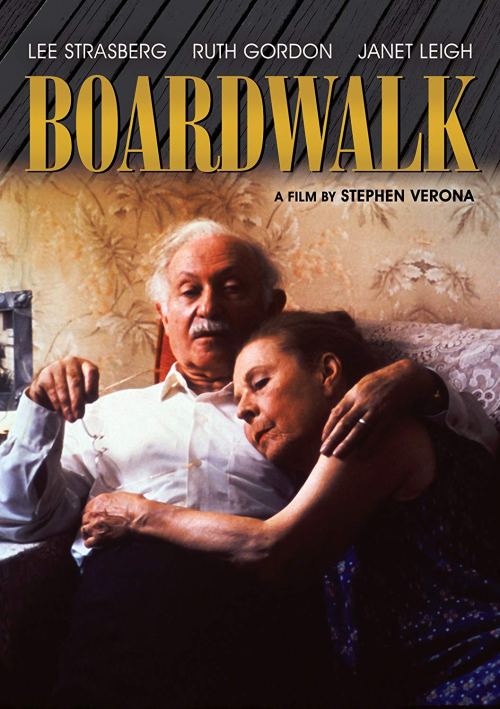
David and Becky (Lee Strasberg, Ruth Gordon) are an elderly couple who spent their entire lives living on Coney Island, but find that their once nice neighborhood has been overtaken by a street gang lead by Strut (Kim Delgado) who demands money from David for ‘protection’. When David refuses to comply it causes Strut and his gang to go on an unrelenting terror campaign where they not only evade David’s home and scare Becky, but also destroy the synagogue where he worships.

The film has a nice independent feel to it and I enjoyed the way the neighborhood’s of Coney Island, many of them with old and picturesque homes gets captured, but this also proves problematic because the area comes off looking too nice to be marred by gangs. In order for the plot to make more sense the couple should’ve been living in a rundown tenet building in an extremely bad part of town instead something looking straight out of a Norman Rockwell painting.

The gang itself is laughable and outside of their campy looking leader seem to be made up of children no older than the fifth or fourth grade. The kids behave threateningly one minute and then get quickly scared off the next. The way they scurry off like a flock of frightened birds makes them seem not very street tough at all, but instead like a bunch of hellions with too much time on their hands and not enough adult supervision. I was also confused why they never get caught and thrown into juvenile detention since they commit most of their crimes in broad daylight for everyone to see.

The story doesn’t focus that much on their activities either as there are long segments in between the gang activities that deal instead with Becky’s cancer and David’s grandson Peter’s (Michael Ayr) rocky love-life, which is actually more interesting and made me believe that the gang storyline could’ve been cut out completely and the movie would’ve been better off for it.

Strasberg, gives a good performance though he’s a bit too serious and probably unable to play a comedic role, or be funny even if he wanted to. Gordon is okay too, despite the fact that her delivery always makes her sound like she’s drunk, but having her collapse and die quite literally in the middle of their 50th wedding anniversary party was over-the-top.

I enjoyed Joe Silver’s supporting performance as David’s grown son especially when he chases a kid who refuses to pay for his food out onto the street and then physically drags him back inside. The scene where David and Becky look through an issue of Playboy before going to sleep is amusing too, but overall the amateurish way it portrays the young gang and the violence that they commit ends up sinking it especially with its  laughable ending.

My Rating: 4 out of 10

Released: November 14, 1979

Runtime: 1 Hour 38 Minutes

Rated PG

Director: Stephen Verona

Studio: Atlantic Releasing Corporation

Available: YouTube

Dad (1989)

By Richard Winters

My Rating: 2 out of 10

4-Word Review: Son cares for father.

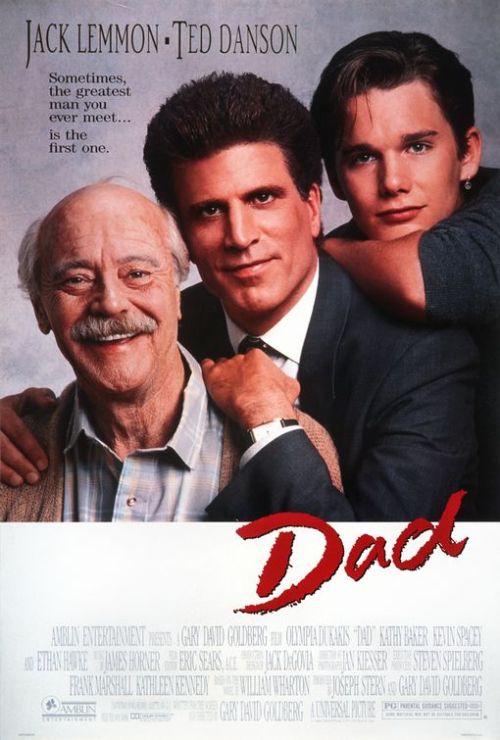
John (Ted Danson) is a busy executive who learns during one of his business meetings that his mother (Olympia Dukakis) has had a heart attack and rushes back home to care for his father (Jack Lemmon) who isn’t use to doing things on his own. John teaches his father how to do the every day chores while also learning to bond with his own son Billy (Ethan Hawke) who comes to visit. Just as things seem to be getting better and his mother gets out of the hospital it is the father who then gets sick with cancer leading to even further complications.

The film is based on the 1981 novel of the same name by William Wharton, which I’ve never read, but if it’s anything like this script then it’s not too good. One the main problems is the extreme shifts in tone that starts out with elements of Rain Man and then at the halfway mark becomes like a dark satire of incompetent medical delivery in the vein of Hospital and then in the third act turns almost fable-like.

My biggest beef is the pseudo-science that gets thrown in after the father goes to the hospital with his cancer. This is when the old man suddenly without warning starts going delusional and then ultimately into coma only to one day miraculous snap out of it. We’re told that the explanation for this is that the father was so fearful of cancer that the brain produced some sort of enzyme that acted as a defense mechanism that shut off the mind so it wouldn’t have to deal with it and it was the love shown by the son that ultimately allowed the dad to come back to consciousness, but what reputable medical journal has ever discussed this phenomenon?  Things get even more ludicrous when the old guy starts thinking he’s on a farm in a different time period and we’re told this is a schizophrenic condition caused by the cancer and everyone needs to play along with it, or he’ll go back into a coma.

Danson, for what it’s worth, gives a strong performance here, probably the best in his otherwise lukewarm film career. I found it frustrating though that his character doesn’t have all that much of an arch. Supposedly he’s self-centered at the start and needs to learn to be caring, but this only gets explained by the character during a long soliloquy during the middle part, when the viewer should’ve instead seen the transition play out. I also thought it was wacky that he’d be allowed to bring in a cot and stay with his father inside his hospital room as I’m pretty sure most doctors would not allow this.

Lemmon’s performance is good too, but I didn’t like how a tuft of white hair was kept on his otherwise balding head as I found it distracting. While it was nice that his character wasn’t a crotchety old man, which has become a bit of a cliche, I found his extreme dependency on his wife, to the point where he allowed her to dress him and even butter his toast despite the fact that he was physically able to do it himself, as pathetic. His later transition to laid-back hippie who wears colorfully garish outfits as he takes on a whole new perspective on life is too jarring and extreme.

The film never comes together as a whole and if anything could’ve been shortened with the first half dealing with the mother’s heart attack taken out and just started with the father’s cancer diagnosis as that’s when the main plot gets going. In either case it tries too hard to be cute while compromising too much on the believability.

My Rating: 2 out of 10

Released: November 10, 1989

Runtime: 1 Hour 57 Minutes

Rated PG

Director: Gary David Goldberg

Studio: Universal Pictures

Available: DVD, Amazon Video, YouTube

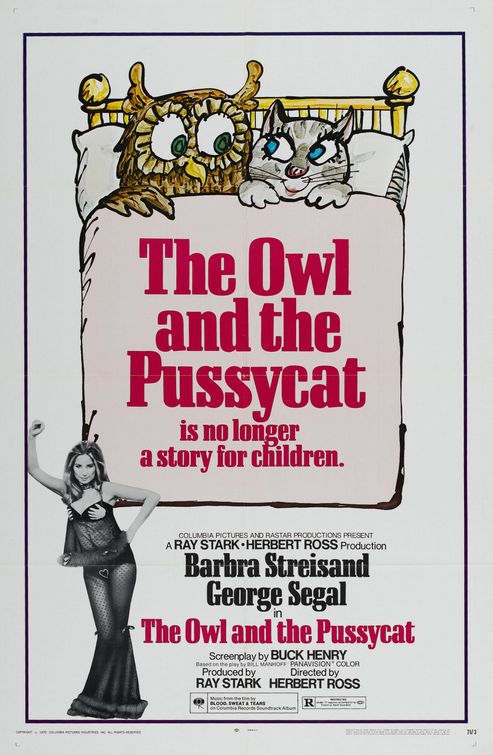
The Owl and the Pussycat (1970)

By Richard Winters

My Rating: 4 out of 10

4-Word Review: Sometimes opposites do attract.

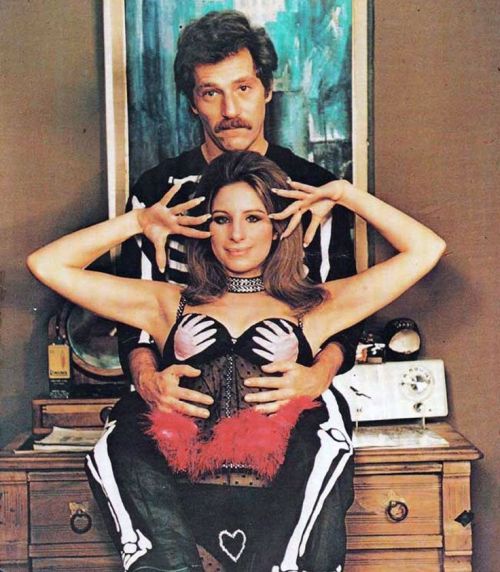
Felix (George Segal) works at a bookstore, but dreams of becoming a successful novelist only to receive rejection letters every time he sends a manuscript out. One night while residing in his cramped New York apartment he spots, through his binoculars, his neighbor Doris (Barbra Streisand) accepting payment for sex and he immediately calls his landlord (Jacques Sandulescu) to report this and it gets her evicted. In anger she goes to Felix’s apartment at 3 in the morning to argue with him about what he did. The two share little in common, but eventually after hours of bickering they form a bond.

The film was originally written as a Broadway play, which in-turn was inspired by a poem of the same name written by Edward Lear in 1871. The play, which ran during the 1964-65 season, starred Alan Alda and Diana Sands and differed considerably from the film in that it had only two characters and one setting. The biggest change though was that in the play the Doris character was a black women, but the studio feared mainstream audiences weren’t ready for that, which is a shame. Streisand is amusing, but she’s unable to convey a tough street-smart attitude. Having an African American woman and a white man come together with vastly different socio-economic backgrounds would’ve made the polar opposites theme even more pronounced and their eventual bonding far more profound.

In an attempt to make the story more cinematic director Herbert Ross had the couple kicked out of Segal’s apartment and then forced to go to his friend Barney’s (Robert Klein) apartment. Initially this seemed fun as Segal and Streisand are allowed to sleep in the living room while Klein and his girlfriend (Marilyn Chambers) remain in the bedroom, but Segal and Streisand continue with their bickering, which forces Klein and Chambers to leave their own apartment, which made no sense. If the guests are the ones causing the racket then they’re the ones asked to leave not the people paying the rent. This also becomes a missed opportunity because it could’ve heightened the comedy by having the couple forced to move to seedier locations each time they’re kicked-out of the previous one.

During the second half Segal and Streisand enter a large home, which was apparently the residence of his fiance’s family, but this is jarring since there had been no mention of the fiancee earlier. It also works against the theme as these characters were portrayed as being lonely and forced to deal with each other despite their many differences because they had no where else to go, but then throwing in Segal’s connection to affluence ends up diminishing the desperation angle.

I also didn’t like that Doris got portrayed as being so painfully uneducated that she couldn’t understand some of the words Felix said, which was heavy-handed since his language wasn’t all that elaborate. I’ve found that most sex workers are quite defensive when it comes to the ‘they must be dumb’ stereotype and make concerted efforts to play against this. Most people, especially with someone they’ve just met, would never admit to not understanding some words spoken by the other because it would make that other person believe that they were intellectually superior and therefore given unfair leverage.

There are few funny moments but it mainly comes during the first half while the second and third act drone on.  The only real distinction are the opening credits, where a jazzy score by Blood, Sweat & Tears gets played while a greenish moon sets behind a cropped cutout of the New York skyline, which is pretty cool.

My Rating: 4 out of 10

Released: November 3, 1970

Runtime: 1 Hour 36 Minutes

Rated PG

Director: Herbert Ross

Studio: Columbia Pictures

Available: DVD

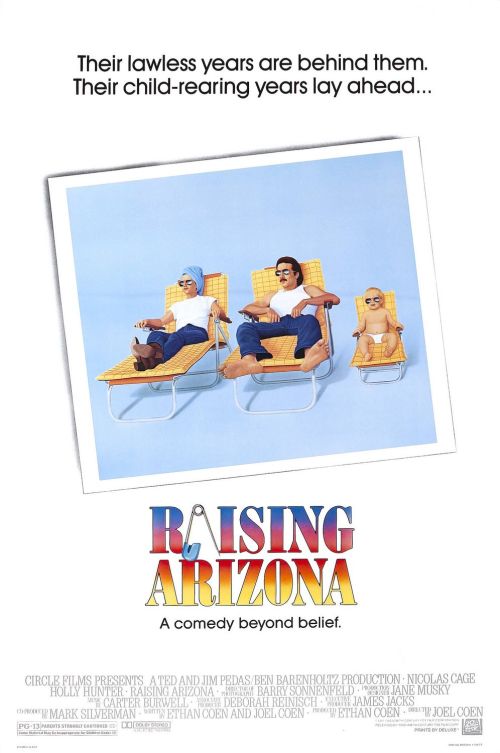
Raising Arizona (1987)

By Richard Winters

My Rating: 8 out of 10

4-Word Review: Childless couple kidnap baby.

Hi McDunnough (Nicholas Cage) is a repeat offender who goes in and out of the state penitentiary. It is there that he meets Edwina (Holly Hunter) an officer in charge of taking his mugshot each time he gets rearrested for holding up convenience stores. Eventually the two form a bond and when he finally gets released they marry, but find that she’s unable to bear children. They then hatch a plan to kidnap one of the quintuplets of furniture store owner Nathan Arizona (Trey Wilson), but find this leads to more complications than they were prepared for.

While the Coen’s directing is sharp and on-target there were still those that criticized it as being overly stylistic and, as critic Vincent Canby stated, outside of the technical expertise the story has no life of it’s own, which is kind of true. The editing does give the film a personality, but there were times where slowing it down and allowing the scenes to breathe could’ve heightened the humor. For instance having Cage break into the Arizona residence to kidnap the baby happens much too quickly and there should’ve been a scene showing Cage trying to figure out which window to break into to get to the baby’s nursery as it was a big house, so how exactly would he have known where to go?

With that said there are still plenty of times where the distinct directorial touches spark the comedy and make it years ahead-of-its-time. I particularly liked the Coen’s patented camera tracking during Cage’s dream sequence where he views things from the bounty hunter’s (Randall ‘Tex’ Cobb) perspective as he rides his motorbike over obstacles on the front lawn and then supposedly straight into a bedroom. A chase sequence that starts out on the street and then winds up going through a person’s private residence is quite ingenious and the running-joke dealing Dr. Spock’s child rearing book is very funny too.

The script offers only caricatures, which would normally be a detriment, but here it just adds to the zaniness. I really enjoyed Wilson as the stereotypical aggressive, brash salesman and the scene where he talks to the police after the kidnapping has occurred I found to be the funniest moment of the movie. John Goodman and William Forsythe are also great as a pair of inept bank robbers and Sam McMurray and Frances McDormand are hilarious as the in-laws from hell.

Spoiler Alert!

My only real grievance, and it’s on a minor level, was the kidnap scenario, which could’ve been played-out more. I also thought it was weird that this rich couple would have all these kids and not hire a nanny to help them care for the babies. It’s a head-scratcher too that when Cage and Hunter decide to return the baby that they were able to break-into the same window that they did before. Wouldn’t you think that after a kidnapping this rich couple would’ve implemented crime alarms and cameras in ever room? Also, Nathan Arizona, catches the couple in the bedroom returning the kid to his crib and then after talking to them a bit he leaves the room with Cage and Hunter still with the baby, but you would think that after they took the kid once that the father would be too paranoid to ever leave the baby alone with them again.

The ending in typical Coen fashion doesn’t equal the same energy and imagination as the rest of the story and is a bit of a letdown. It deals with a dream that Cage has where he imagines having a really big family, but I thought it would’ve been funnier had the dream started out pleasant where he thinks about all the good things about family life only to have it slowly deteriorate into a nightmare where the harsh realities of raising kids come into play making him wake-up in a cold sweat and feeling lucky that they couldn’t have children after all.

My Rating: 8 out of 10

Released: April 17, 1987

Runtime: 1 Hour 34 Minutes

Rated PG-13

Director: Joel and Ethan Coen

Studio: 20th Century Fox

Available: DVD, Blu-ray, Amazon Video, YouTube