Snowball Express (1972)

By Richard Winters

My Rating: 4 out of 10

4-Word Review: Family rehabilitates rundown hotel.

Johnny (Dean Jones) works as an accountant in New York, but is bored with his job and looking for a way out. He finds his escape with an inheritance that he receives naming him the beneficiary of the Grand Imperial Hotel in Colorado that he’s promised can bring in $14,000 a month. He immediately quits his job and moves his reluctant family to the snowy Rockies where they find the hotel to be in bad shape, but Johnny is determined to still make a go of it and turns the place into a ski resort. At first they have some success with it, but calamity strikes, which destroys the place and forces Johnny to enter into a snow mobile race where he hopes to be the winner and use the earnings from the prize to rebuild the place.

There were aspects to the film that I liked. For one I felt Jones was quite engaging here. Usually his performances in some of his other Disney films were flat and one-dimensional, but here his resiliency had an emotional appeal. I also liked how even though the film is aimed for kids it still dealt with real-world adult issues like going to a bank to get a loan and then how to allocate that money to build equity. Even though children may be too young to grasp all of it, it’s still good to condition them into working world scenarios and what it takes to create a business from the ground up.

The story though lacks the physical comedy that is so prevalent in other Disney comedies. It does have a scene where Jones skis down a hill backwards while knocking over everyone else that is in his way, which is funny, but then the film repeats this same scenario two more times until it’s no longer funny and instead just boring. The scene where Harry Morgan’s character accidentally crashes his logging engine through the hotel is more depressing than funny since the family had spent so much time rebuilding it it was frustrating seeing it get destroyed for such a silly reason.

The climactic snowmobile race is okay and I liked seeing some of the wipeouts, which I wished there had been more of. However, having this really old guy played by Keenan Wynn beating out everyone else year after year as the snowmobile champion seemed weird. Granted he was actually only in his 50’s at the time it was filmed, but with his gray beard and hair he looked to be more in his 70’s, so it seemed a bit goofy why such an elderly guy, who was nothing more than a bank manager during the day, would have such an ability to always beat out everybody else.  Why the race required two men on each snowmobile didn’t make much sense either. I was born and raised in Minnesota and say a few snowmobile races in my time and they had only one person on each vehicle, so I couldn’t understand why it was necessary to have a second person behind the driver since they did nothing but  act like a spectator while holding for dear life as the driver cruised through the snow.

The film needed a more aggressive bad guy. Disney films from the 70’s were fun because the villains were usually so colorful, but here Keenan Wynn just sits behind his desk for most of the film and does nothing more than deny Jones a loan. It would’ve been better had Wynn instead sneaked around behind the scenes doing things that hurt Jones’ business, which would’ve created more of an antagonistic feeling from the viewer and thus made the final confrontation between the two, which gets underplayed anyways, more interesting.

My Rating: 4 out of 10

Released: December 22, 1972

Runtime: 1 Hour 33 Minutes

Rated G

Director: Norman Tokar

Studio: Buena Vista

Available: DVD, Amazon Video, YouTube

The Gig (1985)

By Richard Winters

My Rating: 5 out of 10

4-Word Review: Band’s first paid engagement.

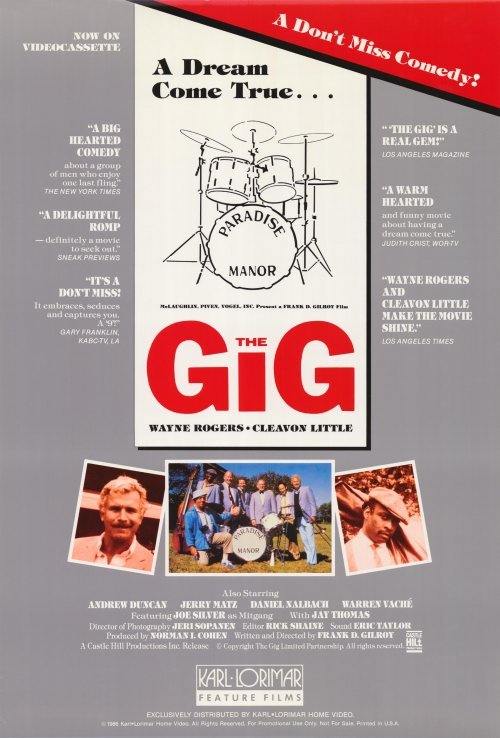
Marty (Warren Rogers) works as a used car salesman during the day, but in the evening he gets together with 5 other middle-aged male friends and takes part in a Dixie style jazz band. For 15 years they’ve been doing this until they get an offer with pay to play at the Catskills for two weeks. Marty is initially quite excited, but the others have family and job obligations and aren’t sure if they can do it. He’s finally able to get 4 of them to agree, but with one bowing out due to surgery is forced to add in a professional bass player named Marshall (Cleavon Little) who is talented, but also arrogant and opinionated. Once they finally arrive at the location they find their living quarters to be small and cramped and the resort owner (Joe Silver) to be overbearing making them wish they hadn’t come and  leads to the group’s unraveling.

The film, which was written and directed by Frank D. Gilroy, takes a realistic view of middle-aged life. Most films have the perspective that middle-aged people in the affluent suburbs are in control of their lives and do things on a whim if they so please while here it’s the exact opposite. In fact the whole first act, which I found to be the most entertaining, is spent showing how each member frets about whether they’ll be able to get time off from their jobs and permission from their wives to go, which perfectly illustrates how even doing something on a lark can have potentially far reaching consequences.

Unfortunately the second half stagnates as certain potentially interesting conflicts get introduced, but then all end up getting resolved in pat and uninteresting ways a few minutes later making it feel like the story isn’t really going anywhere, or leading to anything. A few of the characters become a bit too strained even for henpecked suburbanites especially Arthur, played by Daniel Nalbach, who is in his 50’s, but still a mama’s boy who becomes guilt ridden when he’s away from his mother for even a couple of days, which gets a bit pathetic. There’s also the issue of Rogers speaking in a sort of slick-salesman type dialect, which I found annoying.

The third act offers some spark with arrival of an obnoxious singer, wonderfully played by Jay Thomas, whose over-sized ego outweighs his talents and who openly clashes with the band, which promises to lead to potential fireworks. Yet the film doesn’t play this part up enough having the band leave before the brewing anger can come to a full peak.

Those that have played gigs in amateur bands may take to this better as I’m sure they’ll relate a lot to what goes on here and I really did love the final shot showing the band playing a moving tribute along the roadside of a busy highway, but everything that come in-between is trite. The drama is too contained making it feel, especially when coupled with its dull, low budget cinematic look, more like a one-hour TV dramedy than a theatrical feature.

It also would’ve been nice had more of a backstory been done of the group and their many years of playing together instead of starting right away with them getting the gig offer. Showing them during the good times where they got along would’ve then made the scenes where they eventually unravel more compelling.

My Rating: 5 out of 10

Released: November 26, 1985

Runtime: 1 Hour 32 Minutes

Rated PG

Director: Frank D. Gilroy

Studio: Manson International

Available: VHS

I Walk the Line (1970)

By Richard Winters

My Rating: 8 out of 10

4-Word Review: Sheriff covers for moonshiners.

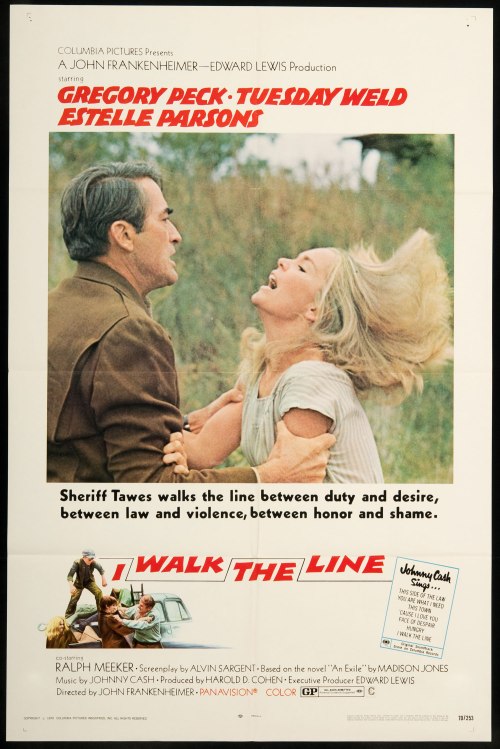
Aging Sheriff Henry Tawes (Gregory Peck) has always been a strong pillar of his community, but recently has found himself bored with his domestic life and looking for diversion. He becomes smitten with Alma (Tuesday Weld) a young woman half his age, who lives on the poor side of town with her father (Ralph Meeker) who runs an illegal distillery. Despite the risks Henry begins an open affair with her with her family’s blessing as long as Henry agrees not to report their distillery, but then a federal agent (Lonny Chapman) arrives in town threatening to shut down every moonshiner he finds. Henry’s deputy Hunnicutt (Charles Durning) also becomes suspicious of Henry’s shady actions, which forces Henry to take some calculated risks, which all backfire on him in shocking ways.

This film is a perfect testament to something that I’ve mentioned before on this blog, which is how shooting a film on-location in an actual small town versus one being built on a studio backlot can make all the difference on whether it succeeds at the box office, or not. This one was done in the tiny hamlet of Gainesboro, Tennessee, which has just over a 1,000 people and in fact its downtown, which includes the prominent courthouse, barely looks any different now then it did when principle photography took place in October of 1969. Director John Frankenheimer makes good use of the townsfolk focusing in on their old, weathered faces at the beginning and glum expressions, which helps accentuate Henry’s bored and static life as well as the abandoned, decrepit house the lovers meet-in, which illustrates their empty, vanquished souls.

The script by Alvin Sargent, which is based on the novel ‘An Exile’ by Madison Jones, allows the visuals and action to do most of the talking while keeping the dialogue subtle and concise. I even enjoyed the music interludes by Johnny Cash. Some critics at the time complained that there was no need for this as Johnny’s words that he sings seem to be simply explaining what the viewer is already seeing onscreen, but the music still conveys a raw southern flavor and Cash’s singing style makes it seem more like he’s talking to the viewer and like he’s another character in the film.

Peck’s performance is good here despite the fact that Frankenheimer wanted Gene Hackman for the role, but was forced to settle with Peck because he was already under contract with the studio. Normally Hackman would’ve been the better choice, but here Peck’s usual stiffness and detached delivery brings out convey his character’s inner turmoil. Durning is outstanding as his nefarious deputy and with his energetic and impulsive presence because an interesting contrast to Peck’s more reserved one.

Spoiler Alert!

Weld is great too even though the part she plays seems very similar to the one that she did in Pretty Poison although here at least the character isn’t portrayed as being completely evil, but instead somewhat naive and sheltered, which helps make her more multi-dimensional. Her motivations though are confusing and the film’s one major drawback. I could not understand, and the film never bothers to make clear, why she’d want to stay stuck with her family and their dismal, impoverished situation. Granted she didn’t really love Henry, which is obvious, but she had already manipulated him quite a bit,  and even had sex with him,so why not run off with him like he wanted and use his money to live a better life while also siphoning some of it back to her family to help them too?

Even if one would argue that she had a close-knit bond to her family it still doesn’t make sense. Many young woman have close ties to their family, but at some point they still leave the nest especially when vanquished to abject poverty otherwise. With her good looks a lot of doors could be opened, so why not see what else is out there? It comes out later that she’s married to another man who’s in jail, but the film glosses over this like she’s not any more in love with him than Henry and still doesn’t help to explain much. It also would’ve worked better had the viewer been left in the dark until the end as to whether she was really in-love with Henry or not instead of making it obvious that she was playing him, which lessens the shock effect for what occurs at the end.

My Rating: 8 out of 10

Released: October 12, 1970

Runtime: 1 Hour 37 Minutes

Rated GP

Director: John Frankenheimer

Studio: Columbia Pictures

Available: DVD, Amazon Video, YouTube

Harry & Son (1984)

By Richard Winters

My Rating: 7 out of 10

4-Word Review: Looking for a job.

Harry (Paul Newman) is a construction worker who starts to have seizures involving headaches and blackouts that causes him to lose his job. He asks his son Howard (Robby Benson), who lives with him, to help out by finding a full-time job of his own, but Howard, who has graduated from college, seems content with his part-time car washing gig and no aspirations for anything other than one day becoming a famous writer. Harry feels Howard is not being practical and prods him to take working life more seriously or risk getting thrown out of the house.

Although this wasn’t a critical darling when it was released it still has a nice slice-of-life feel to it dealing with believable people going through some very real everyday problems, which keeps it compelling. Newman does well as a director and co-scripwriter, but his performance is one-dimensional. Normally he’s a terrific actor, and one of my favorites, but Harry remains too grouchy and bitter, almost like he’s channeling his character from Hud, and only near the end shows a different side to him, which is too late.

Benson’s scenes prove to be more interesting although as an actor he’s just as one-dimensional in the other way as he continually shows a deer-in-headlights expression all the way through like that’s the only type of emotion he can convey and it’s no wonder that his career in movies eventually faded. There is one moment though where he shows intense anger and gets in his father’s face to the point that I thought a fist-fight would break out, which would’ve been cool, but ultimately it doesn’t happen.

What I did like about his scenes was when he goes to work at a ‘real job’, which features a wonderful performance by Morgan Freeman as his supervisor, and he’s unable to keep up with the demands of  it, which perfectly illustrates how kids getting out of college can be highly educated but woefully underskilled to everyday work demands. His scenes with Ossie Davis, where he tries to steal his car as a re-possessor, are quite memorable as well.

What I didn’t like about his character was that he gets back into a relationship with a girl, played by Ellen Barkin, who had cheated on him previously by sleeping around with a lot of different guys. If a person is prone to cheat on you once they’re apt to do it again, so why put yourself through heartache a second time? She’s also carrying a baby, which is not is, in fact she isn’t sure whose it is, so why agree to take on all the bills, responsibility, and stress of a kid if you don’t actually have to?

The female roles here are not needed and tend to just make the movie longer than it needs to be. The title of the film promises to examine the relationship between a father and son, but it does not delve into it as much as it should. Having Harry’s daughter, played by Katharine Borowitz, enter into the story does nothing but add needless drama that goes nowhere. Judith Ivey’s character is not necessary either as she plays a nympho who sleeps with both father and son at different times and the two men then talk and joke about it afterwards even though in real-life I’d think most fathers and sons would feel very awkward talking about their mutual sexual conquests making this scene insincere.

Spoiler Alert!

The film’s ending goes against the entire grain of the flick by having Howard receive $1,500 check after he sends out a story submission to a publisher, but most publishers like to work through an agent and I don’t think they’d blindly send out money to an unproven writer without first coming up with some sort of contract. Since the film starts with a blue collar theme that’s where it should’ve ended by having Howard adjust to jobs requiring manual labor instead of inserting the Hollywood pipe dream.

Howard’s reaction to Harry’s death is odd too. He runs into his dad’s bedroom only to find his father lying on the floor motionless and then proceeds to just sit there and cry  even though the more normal thing would be to call 9-1-1 or attempt to resuscitate him. It’s also annoying that we never find out exactly what Harry’s ailment was making it like one of those cliched, generic mystery illness that befalls movie characters for no other reason than to keep the drama going.

My Rating: 7 out of 10

Released: March 2, 1984

Runtime: 1 Hour 57 Minutes

Rated PG

Director: Paul Newman

Studio: Orion Pictures

Available: DVD, Blu-ray, Amazon Video
Heartbeeps (1981)

By Richard Winters

My Rating: 1 out of 10

4-Word Review: Robots fall in love.

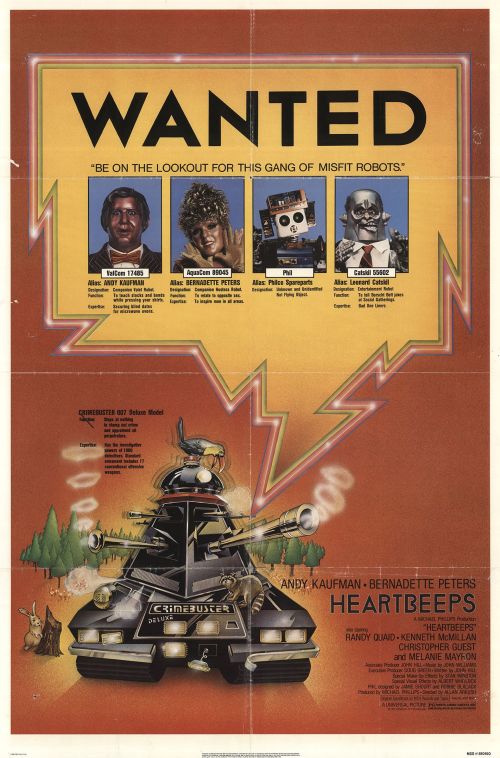
Val (Andy Kaufman) and Aqua (Bernadette Peters) are two robots who meet one day at the factory while awaiting repairs. They quickly fall in love and decide to escape out into the wilderness while bringing alone Phil a small robot who does not speak as well as Catskill (voice of Jack Carter) a robot made to resemble a cigar smoking vaudeville-type stand-up comedian. However, two employees from the factory, Max (Kenneth McMillan) and Charlie (Randy Quaid) go on a pursuit to retrieve them. There’s also the malfunctioning law enforcement robot known as Crimebuster who also chases after the robots and will stop at nothing to bring them back.

This is a highly unusual film in that it uses robots as its main characters and has their point-of-view the whole way through. Other films have had robots of course, but they are put in supporting roles to the humans.  Here director Allan Arkush was determined to keep it authentic to the ‘robot experience’, by implementing a computer-type logic to everything that goes on, which creates  some surreal moments, but ultimately falls flat.

To be a successful film you still need to have characters that the viewer finds relatable and the robots are too, pardon the pun, mechanical. They never say anything that is interesting or funny and while they at times have an endearing child-like quality they do not create any emotional bond with the audience.

There still needed to be a human as the centerpiece, maybe someone the robots met during their escape, who takes them in and helps them in their quest to hide from those that are after them while also having the robots in some way help their new human friend in whatever personal challenges or battles they were going through.  They are a couple of times that the robots do come into contact with people with one occurring when they crash a party at a swanky hilltop resort with Paul Bartel and Mary Woronov playing two of the partiers, but the guests at the party are broadly played caricatures and the scene itself too brief. They also later meet-up with a couple, played by Melanie Mayron and Christopher Guest, who run a junkyard, but this occurs too late in the movie and should’ve been introduced earlier.

While the wilderness setting is scenic it fails to add much in the way of either excitement or comedy. Having the two escape into a big city would’ve been more compelling. The crimebuster robot that chases after them is too goofy and offers no tension or intrigue. Sometimes even in a comedy it’s good to have a little bit of that, or at least a bad guy that is competent enough to make the viewer wonder, if even for a second, whether our heroes are going to safely outsmart him or not, which doesn’t occur here.

It would’ve been nice too had there actually been some genuine laughs. The only attempts at humor are when Catskill cracks one of his long line of incredibly dumb jokes, which are intended to be lame, but having a few that were actually clever, would’ve helped. Even the talented Kaufman flounders as he uses the same accent of his famous foreign man character that he did during his stand-up routines as well as in the TV-show ‘Taxi’ ultimately making it seem like Latka in a robot disguise.

The make-up effects by Stan Winston are impressive especially the opening credit sequence at the beginning where the camera focuses onto the robots’ various parts close-up. Winston used a gelatin substance that gave off a authentic looking metallic appearance versus how it had always been done before where it had been painted on. However, two holes where created around the robots eyes, which gives it a mask-like appearance and ultimately ruins the attempt although it gets kudos for at least making a strong effort. I also liked the  clicking sound effect every time one of the robots blinked their eyes, which resembled the noise of a camera taking a picture. but it’s not consistent as it’s heard during the first half, but not during the second part.

My Rating: 1 out of 10

Released: December 18, 1981

Runtime: 1 Hour 18 Minutes

Rated PG

Director: Allan Arkush

Studio: Universal

Available: DVD, Blu-ray, Amazon Video, YouTube

Bugsy Malone (1976)

By Richard Winters

My Rating: 3 out of 10

4-Word Review: The gangsters are kids.

It’s the 1920’s and rival mobsters, who are all played by children, fight over control of a club that illegally sells liquor. Fat Sam ( John Cassisi) is the one who currently controls it, but Dandy Dan (Martin Lev) makes a play at a violent overthrow in which his men attack the club by using machine guns equipped with whipped cream that ‘splurge’ their victims. Bugsy Malone (Scott Baio) is a penniless boxing promoter caught in the middle. He tries to help aspiring singer Blousy (Florrie Dugger) get an audition at Sam’s club, but then becomes distracted by Sam’s alluring girlfriend Tallulah (Jodie Foster) who causes Sam’s ire by flirting with Bugsy.

This odd concoction was the product of Alan Parker in his feature film directorial debut who came up with the idea while driving his kids on a weekend trip to a countryside cottage. To keep his kids entertained he started telling them a story about some prohibition era gangsters based on old gangster movies he had seen as a child. It was at one point where one of the kids brought up the idea of having gangsters be children instead of adults.

The first 15 minutes or so are quite inventive and fun. I enjoyed the freeze-frames showing each victim splattered with whip cream and the pedaled powered automobiles, but after awhile it starts to repeat the same gags over and over becoming a one-dimensional, one-joke flick.

I kept wondering where the adults where and despite this being a fantasy what exactly where the ‘rules’. Is this a type of universe where there are no adults at all and the kids remain at that age forever and if so does that ultimately then make them the ‘adults’? For me it would’ve been better had the story been book-ended with some connection to the world as we know it. Perhaps with a Wizard of Oz type structure where the film starts out, maybe even in black-and-white, with adults in the parts of the gangsters and then one of them gets hit on the head or drinks something with a drug in it and has this weird dream involving kids suddenly taking over the roles previously played by the adults. Showing the differences at how kids approached things versus how the adults do would’ve been a funny contrast instead of keeping it at the kiddie-level the whole way through, which ultimately falls flat.

The performances of the young cast are quite energetic although I could’ve done without the musical numbers. Cassisi, who in real-life ended up serving jail time of his own for money laundering, steals it with his humorous send-up of a mob boss. Baio is quite good too especially with his over-the-top Brooklyn accent, but I felt Foster got shamefully underused. If anything her role should’ve been combined with Blousy’s to make one and cutting out Florrie Dugger, who now goes by the name of Florence Garland, completely. I didn’t have anything against her per say, but she didn’t have the onscreen spark that Foster did. She also apparently disliked Baio and the scene involving her hugging him required many retakes as she didn’t want to get near him and this lack of chemistry comes through onscreen.

My Rating: 3 out of 10

Released: September 12, 1976

Runtime: 1 Hour 33 Minutes

Rated G

Director: Alan Parker

Studio: Paramount Pictures

Available: DVD, Blu-ray, Amazon Video
Sweetie (1989)

By Richard Winters

My Rating: 8 out of 10

4-Word Review: Sister is mentally ill.

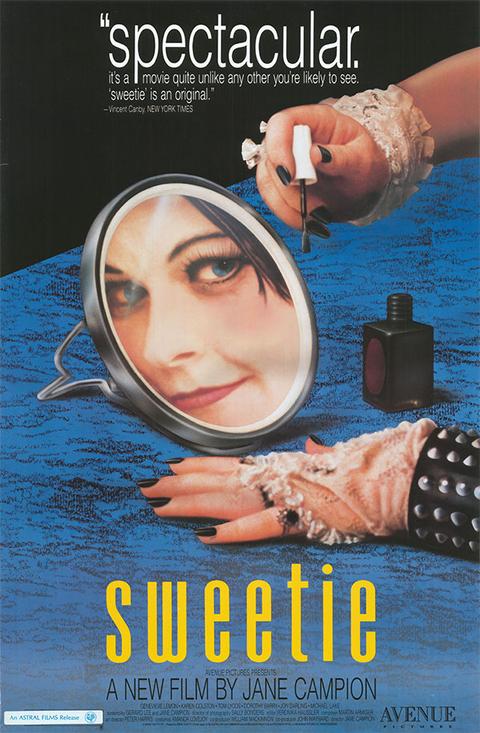
Kay (Karen Colston) has begun a relationship with Louis (Tom Lycos) and things seem to be going smoothly as they move into a home together, but it quickly unravels when he sister Dawn ‘Sweetie’ (Genevieve Lemon) shows up with her boyfriend Bob (Michael Lake). Sweetie has been institutionalized in the past and her wild mood swings and erratic behavior quickly cause turmoil particularly with Kay. She asks her parents (Jon Darling, Dorothy Barry) for help, but her dad refuses to recognize Sweetie’s tragic current state and instead continually hearkens back to her childhood years when she was a cute kid with budding talent who would perform songs and dances to the family’s entertainment and delight.

This is a hard film to critique  as it starts off as a quirky comedy, but by the midpoint it becomes more dramatic and filled with a lot of uncomfortable even cringe worthy scenes as Sweetie’s mental decline becomes achingly apparent. Not only do you feel sad for her, but also for how it causes such a severe strain for the rest of her family, which accurately illustrates how mental illness isn’t just a one person issue as their behaviors will adversely affect those around them too.

The fact that the film’s tone switches halfway through, which would be considered a major no-no by Hollywood standards, is part of the reason why it works as it replicates real-life where sometimes you can have a touching, humorous moment only to suddenly get thrown into a troubling one.  This also shapes what life is like living with a mentally-ill individuals who may seem ‘okay’, but can turn erratic sometimes without warning and this ongoing tension vividly comes through for the viewer until they feel the same way as the characters.

I found the father though to be the most entertaining and interesting. One minute he’s scheming to get Sweetie out of the family car, so they can leave on a trip without her and then the next minute he’s driving back to pick-her-up, so they can be ‘one happy family’ again. While this may sound overly contradictory to some I felt it brought out  the inner turmoil many parents feel in dealing with their grown children where at times they can’t stand them, for whatever reason, but at other points can’t stand to be without them either.

Director Jane Campion, in her feature film directorial debut, adds in interesting touches like having the camera frame the characters off-center where instead of seeing them captured in the center of the screen they are shown in the right-hand corner, which helps accentuate the tone of the subject matter. There’s also an odd time-lapsed cutaways detailing a seedling tree pushing its way through the dirt and above ground, which wasn’t exactly necessary to the main plot, but kind of cool nonetheless.

Campion also wisely doesn’t insult the viewer’s intelligence with pat answers to a complex problem. Mental illness cannot be cured or even  always stabilized with medications, so leaving the viewer with a feel-good ending where everything works out and everybody is happy would be a cop-out and thankfully gets avoided here. Instead the we’re left pondering troubling questions, which stays with you long after it’s over and makes this a far better movie than most because of it.

My Rating: 8 out of 10

Released: September 28, 1989

Runtime: 1 Hour 37 Minutes

Rated R

Director: Jane Campion

Studio: Filmpac Distribution

Available: DVD, Blu-ray (Criterion Collection), Amazon Video

Fools (1970)

By Richard Winters

My Rating: 2 out of 10

4-Word Review: Lost souls find love.

Matthew (Jason Robards) is sitting in a park one day trying to read a book when two children begin taunting a dog, which causes it to bark and impedes Matthew’s peace and quiet. He then warns the children that if they don’t behave the dog will rip their arms out, which angers the dog’s owner (Marc Hannibal) who then proceeds to punch Matthew in the face. Anais (Katharine Ross), who was also in the park, comes to Matthew’s aid and the two quickly begin a romance, but she neglects to tell him that she’s being followed by a private detective (Robert C. Ferro Jr.) whose been hired by her jealous husband (Scott Hylands) who’ll stop at nothing to win her back.

The film is a very odd mix of drama and late 60’s quirkiness that never gels and most of the time comes-off as disjointed and amateurish. The relationship happens too fast and lacks any type of distinction from the thousands of other cookie-cutter romances already out there. The folk-tinged songs sung by Kenny Rogers and The First Edition are too sappy and bog the pace down, which is too slow and ambling to being with.

The biggest issue though is the way scriptwriter Robert Rudelson throws in all sorts of characters and bits that have nothing to do with the main plot. This includes two FBI agents appearing out-of-nowhere who raid the couple’s home and then just as quickly disappear and are forgotten. There’s also a weird bit where the couple confronts a trio of hippies, one of whom is played by Jack Nance in his film debut, who are strung-out on acid and it gets quite violent and ugly. Another segment deals with a psychiatrist (Mako) fighting off an oversexed patient (Laura Ash) and these two do not interact with the two main characters at all, so why this even gets put into the film is confusing.

85 minutes into its runtime the film also suddenly adds in flashbacks and surreal moments including Ross seeing herself jump off a tall building. Surrealism in film can be great, but it needs to get introduced earlier and trickle all the way through instead of popping up near the end, which throws off the tone completely.

Spoiler Alert!

The ending in which Ross gets violently gunned down inside a Church during a babies baptism is jarring, misplaced and like everything else comes completely out-of-nowhere. To some degree you can credit the film for being ahead-of-its-time as it deals with a stalking/jealous husband, which was a topic that had not yet come into the mainstream conversation, but the bird’s-eye view of Ross’ bloody corpse lying on the sidewalk is much too disturbing for a film that had otherwise been quite playful and lighthearted. The reactions by the other people inside the church, one of whom is played by a young Suzanne Somers, is off-putting too as they just stand there in a calm silence instead of screaming and panicking like you’d expect them to.

End of Spoiler Alert!

Robards, who is typically a very good actor, channels too much of the non-conformist quality similar to the character that he played in A Thousand Clowns, which in that film was charming, but here it’s annoying mainly because it doesn’t make sense. In that film he was poor and bordering on being homeless, so his contempt for society made sense, but here he’s a famous horror movie star renting a swanky apartment that overlooks the San Francisco skyline making his anger seem out-of-place. There’s also a brief bit where he attempts to climb over a barbed wire fence, the film cuts away so we don’t get to seem him fully do it, but it looked like a painful if not impossible thing to do and something that shouldn’t be done by someone who wasn’t insane.

Ross on the other-hand is appealing and quite beautiful in literally every shot she’s in, which is the only reason I’m giving this dopey production even two points, but she unfortunately is straddled with a script that appears to have no point to it and if it does it doesn’t convey it in any type of discernible way.

My Rating: 2 out of 10

Released: December 23, 1970

Runtime: 1 Hour 33 Minutes

Rated GP

Director: Tom Gries

Studio: Cinerama Releasing Corporation

Available: None at this time.

Fort Apache, The Bronx (1981)

By Richard Winters

My Rating: 7 out of 10

4-Word Review: Cops on the beat.

Murphy (Paul Newman) is a middle-aged cop working a beat in a tough Bronx neighborhood while partnered with Corelli (Ken Wahl) who is much younger. Murphy has become jaded to the corruption around him, but still feels a sense of purpose about coming forward when he witnesses a fellow cop killing an innocent bystander. Corelli, who also witnessed it, feels they should keep quiet about it, fearing the backlash they will inevitable get if they don’t, but Murphy quarrels with his conscious and considers risking his own safety and career in order to do the right thing.

While the film opened to mainly positive reviews and did quite well at the box office it was not without controversy as author Tom Walker, who had written the novel ‘Fort Apache’ which had a similar theme and storyline as this one, sued the production company claiming they had stolen many ideas from his book. However, the courts decided in the film’s favor arguing that the movie was filled with a lot of generalized stereotypes that is present in just about every cop film and therefore could not be signaled out as copyright infringement, which seemed more like a backhanded victory as it admits that a lot of what  you’ll see here is just one giant cliche.

From my perspective though I still enjoyed it especially the street scenes where the two protagonists find themselves dealing with petty crimes that makes up a lot of what real-life policemen have to deal with, as opposed to the sexy murder mysteries that cops in other police dramas get to investigate. The scene where Newman chases a suspect, but then runs out of breath and is unable to catch him nicely examines the exhausting physical nature of the job as well.

My biggest gripe has to do with a scene that comes right away, which involves a prostitute, wonderfully played by Pam Grier, who shoots and kills two unsuspecting cops sitting inside a squad car. The excuse is that these two were rookies and therefore not seasoned enough to catch the warning signs of what was going on, but I felt right away that something was off by the way the prostitute was fishing around her purse making me sense even before it happened that she was going for a gun and if I the viewer could’ve caught on to this then the two cops, whether they were new on the job or not, should’ve too.

Spoiler Alert!

I was disappointed that this storyline involving the psycho prostitute does not get fully played-out as she ends up getting killed in the middle of the film in a very random and uninteresting way, which ruins the anticipation/suspense of seeing her and Newman ultimately confront each other, which is what the viewer is primed into believing will happen.

The storyline dealing with the cop killing a defenseless man gets botched too as it occurs during the middle, but with no satisfying conclusion. We never get to see how Newman’s decision to come forward ultimately effected his life and safety.

I had problems with the sequence of events concerning Newman’s girlfriend, played by Rachel Ticotin, as well as we see her die from a lethal drug overdose, but this occurs before some gunmen take over the hospital where she worked as a nurse and held everyone hostage. It would’ve been far more suspenseful had the viewer at least thought that the girlfriend was one of the hostages instead of knowing upfront that she wasn’t, which ultimately makes this sequence less emotionally compelling.

End of Spoiler Alert!

Newman as usual gives a great performance and this marked the last role he played where his age was not a factor as his roles after this all dealt in some way with him becoming elderly. However with that said he still looks very much to be in his 50’s and he states at one point that he’s divorced with two daughters making me believe that they were most likely young adults, but instead we see a brief scene where he picks them up from school showing that they’re still young children, which given his very middle-aged appearance looked ridiculous.

Wahl is good as his young partner, but I felt his character should’ve been the one that was idealistic and wanted to go to the authorities while Newman, being older and more desensitized the one who tries to talk him out of it. Ed Asner, as the cantankerous new police chief gets wasted as does Pam Grier who’s real creepy and should’ve had both her character and motives explored much more.

My Rating: 7 out of 10

Released: February 6, 1981

Runtime: 2 Hours 5 Minutes

Rated R

Director: Daniel Petrie

Studio: 20th Century Fox

Available: DVD

Won Ton Ton: The Dog Who Saved Hollywood (1976)

By Richard Winters

My Rating: 1 out of 10

4-Word Review: Dog becomes a star.

Estie Del Ruth (Madeline Kahn) is a struggling actress still waiting for her big break. While roaming the streets she comes upon a homeless dog (Augustus Von Schumacher) and befriends it. Grayson (Bruce Dern) is a hapless tour guide driving a bus filled with tourists past the homes of the famous Hollywood stars. He’d rather be directing movies and has some great ideas, but is constantly getting turned down. Then one day famous studio mogul J.J. Fromberg (Art Carney) witnesses the dog saving Estie from a lecherous producer (Aldo Ray) and is so impressed that he wants to cast the dog in its own movie. Grayson, seeing this as his chance to finally break into the movie business, pretends to be the dog’s owner and therefore allowed to be in charge of directing the dog’s film, but the dog will only take orders from from Estie forcing him to allow her to tag along, but only if he helps her get a movie contract.

The story was originally titled ‘A Bark was Born’ and written by Cy Howard in 1971 and was an account of the famous 1920’s real-life dog star known as Rin Tin Tin. He commissioned Arnold Schulman to write the script for him. Schulman, who was coming off a good run of films as screenwriter including penning the scripts for Goodbye Columbus and Funny Lady decided to add some satirical elements to the story before finally handing it off to studio head David Picker to produce. However, the owners of Rin Tin Tin sued Picker for producing a film about their dog without authorization causing Picker to remove the fictional elements from the script and turning it into a all-out farcical parody of old-time Hollywood instead.

The film’s biggest problem is that it doesn’t give the viewer a feeling that they’re being transported to a different era as the 1920’s are played-up as being too cartonish and silly to be believable. The characters are caricatures that have no emotional connection to the audience, so watching their ascent into Hollywood success is neither interesting nor compelling. The humor relies too much on throwaway bits that have no connection to the main plot and mostly fall flat while moments that do have comic potential, like the dog only taking orders from Kahn, do not get played-up enough.

Kahn is a poor choice for the lead and single-handily bogs the production down, which wasn’t too great to begin with. She is perfect as a supporting actress playing over-the-top, eccentric characters, but as a normal person trying to elicit sympathy she does poorly. Lily Tomlin was the original choice for the part, but she wanted the script rewritten in order for it to have a more serious edge, which wouldn’t have been a bad idea,  but director Michael Winner wanted to keep the thing silly and lightweight and didn’t agree.

Dern, who expressed in an interview decades later, that doing this film was his one true career regret, is actually quite good and its fun seeing him play in a more lighthearted role versus the darker ones that have made up so much of his onscreen presence. However, by the second half he pretty much gets written-out, which was a shame. Ron Leibman, as the cross-dressing silent film star Rudy Montague, has a few interesting moments, but he plays the part in too much of an intense manner making him seem more creepy than funny.

Art Carney is not funny at all as the big-time studio head and the part would’ve been better served had it been played by Phil Silvers, who gets stuck in a much smaller role that does not take advantage of his comic talents. The rest of the cast is made-up of walk-on bits by famous stars of the past. Most these cameos are not amusing or interesting making their presence much like the movie itself quite pointless.

My Rating: 1 out of 10

Released: May 29, 1976

Runtime: 1 Hour 32 Minutes

Rated PG

Director: Michael Winner

Studio: Paramount Pictures

Available: DVD, Blu-ray, Amazon Video, YouTube