Who’s Been Sleeping in My Bed? (1963)

who1

By Richard Winters

My Rating: 3 out of 10

4-Word Review: Carol Burnett does striptease.

Every time I get annoyed by many of today’s Hollywood comedies that seem to be nothing more than a stretched out idea for an episode of a sitcom, one only has to go back into time to find that the comedies of yesteryear weren’t always much better. Of course there were some classics, but a lot of vapid ones in the mix as well. In fact this one is so trite that it becomes almost agonizing to sit through. It was considered in its time to be a ‘sex farce’, but fails to deliver on either.

The old adage ‘it’s not what you know, but who you know’ has never been truer in this instance. I have attended many screenwriting classes and seminars and can verify there is a lot of good stuff out there that hasn’t been read unfortunately because the authors don’t have the right connections. In this case the screenplay was written by Jack Rose who had previous writing success with such films as My Favorite Brunette, Houseboat, and The Road to Rio. Judging from its lack of creativity Rose probably wrote this real quickly to make some fast cash and the studio heads gave it the green light simply based on his past success without ever looking at it critically.

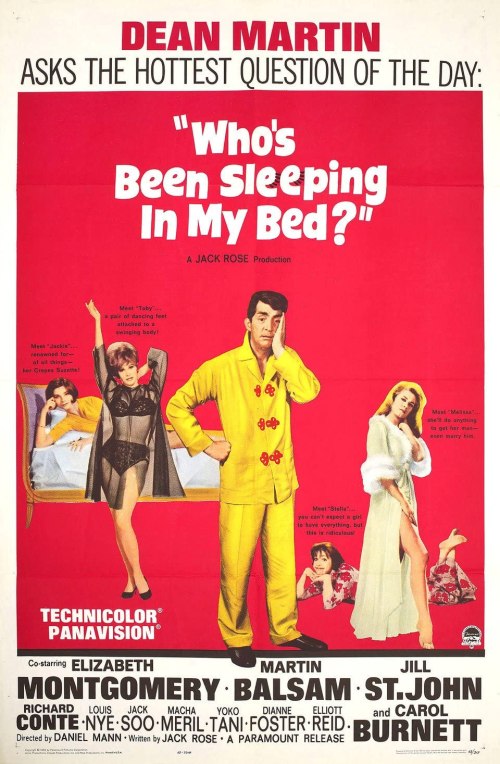
The plot, if you can call it that, has to do with TV-star Jason Steel (Dean Martin) who plays the part of a popular Dr. on a TV-series.  His TV character matches all the ideal qualities that women want in a man and thus he always has women chasing after him in real-life. He even has the wives of his friends coming on to him. With so many married women telling him how unhappy they are in their marriages he begins to fear that marriage may not be a good idea and thus calls off his impending engagement to beautiful Melisa Morris (Elizabeth Montgomery).  Melisa is devastated by this, so her goofy roommate Stella Irving (Carol Burnett, in her film debut) hatches up a kooky scheme in order to get him to reconsider.

This film gets tiring right from the beginning.  Jason goes out with his buddies every Thursday night to play poker, but then during the game he always gets a call from one of his buddy’s wives telling him they have to see him.  He leaves the game and meets them at his place and then fights off their advances. This silly scenario gets repeated four different times with all four of his friend’s wives and it’s like being told the same dumb joke over and over. This triviality ends up taking up the whole first hour before it moves into the scheme portion, which really doesn’t even measure up to a weak episode of ‘I Love Lucy’.

Out of the whole ninety minutes there are only two scenes that are mildly amusing.  One is when Jason pushes everyone into a pool and they fall in like dominoes and the other is when Stella goes to a strip club and is forced to go onstage and do a striptease when she can’t pay for her drinks, which makes great use of Burnett’s ad-libbing abilities.

Burnett and Montgomery make an interesting pair. Montgomery is a good straight-man to Burnett’s zaniness and with a better script this could’ve been ideal casting. Montgomery did this film just before she started her long running series ‘Bewitched’. She looks gorgeous and gives the film’s best performance.

There is a long list of excellent male character actors here including: Martin Balsam, Jack Soo, Richard Conte, Louis Nye, and Johnny Silver. All of them are wasted with very little to do. Except for the money I don’t know why any of them took their parts.

The satirical jabs at TV-dramas are too gentle and not even good for a chuckle.  If one is considering getting married then I would definitely not suggest it as the script takes so many potshots at the institution that it is liable to give anyone second thoughts.

Although this was made as a vehicle for Martin I feel even fans of Dino will be disappointed. It really doesn’t take advantage of his persona and he seems as bored with the material as the viewer and just going through the paces. Despite the interesting cast this is an all-around disappointment.

My Rating: 3 out of 10.

Released: December 25, 1963

Runtime: 1Hour 43Minutes

Rated NR (Not Rated)

Director: Delber Mann

Studio: Paramount

Available: Netflix Streaming
T. R. Baskin (1971)

tr baskin

By Richard Winters

My Rating: 8 out of 10

4-Word Review: Out on her own.

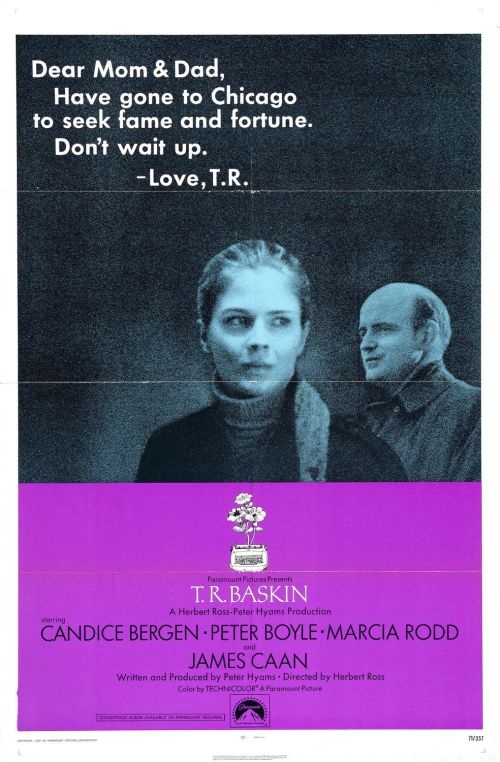
T. R. Baskin (Candice Bergen) is a young woman who leaves the nest by striking out on her own in Chicago. Unfortunately she finds nothing but a lot of loneliness, dead-end dates, crummy apartments, and soul-sucking jobs. Our protagonist becomes so emotionally beaten down that when a traveling salesman named Jack Mitchell (Peter Boyle) calls her looking for a ‘good time’, as he mistakenly is given her number under the impression that she is a prostitute, T.R. accepts his invitation simply as a chance to connect with someone. The film then cuts back and forth between conversations that she has with Jack in his hotel room as well as her experiences when she first gets into the Windy City.

Although this film does have its share of faults I was really taken aback by its strong emotional impact. The film was directed by Herbert Ross who would later do Footloose, The Goodbye Girl, and Steel Magnolias. The screenplay was written by Peter Hyams famous for writing and directing Capricorn One, Narrow Margin, and 2010 to name a few.

The film manages to recreate the monotony and isolation of day-to-day living better than just about any other movie that I have seen. Some of the best scenes include T.R.’s job interview process at an accounting firm as well as a long camera pan showing all the rows and rows of desks in the office and T.R. looking lost in the middle. There is another part where she sneaks back into the office on a weekend day in order to make silly announcements over their intercom system and the images of all the dark shadowy desks looks just as ominous. Another moving moment is when she is shown pacing her lonely apartment as well as her phone conversation with her parents where she tries to convince them that she is doing ‘just fine’, but breaks down into tears the second it ends.

The film leaves you with a strong impression. The music that was selected was first-rate and fits the mood of the picture perfectly. It is a real shame that this sleeper has never been released on either VHS or DVD and has not been shown on television since December of the 1980 when it was broadcast on Cinemax. It is well worth seeking out and certainly deserves more attention.

Bergen is terrific in the lead. This is before she attained her acerbic persona from her ‘Murphy Brown’ days and here comes off as more shy and sensitive. Her delicate and attractive features help capture the viewer instantly.

Boyle is equally good and the introspective conversations that the two have nicely runs the gamut between funny and sad. James Caan, who for some reason appears unbilled, has a nice cameo as an attractive and intelligent man that T.R. falls for only to have him callously break her heart.

If the film has any flaw it is in the fact that it is a bit uneven. It starts out with some terrific dry humor including a hilarious scene when she goes apartment hunting, but eventually the movie becomes too much of a downbeat drama. There are certainly universal truths to many of the sad situations that she goes through, but I found it frustrating that we are never shown her eventual fate. All we see is a small period in her life and then a very abrupt and unsatisfying ending. It would have been nice if the story had cut to five, ten, even twenty years down the road and allowed us to find out if she ever found ‘Mr. Right’ and some happiness.

Despite being made forty years ago this film is as trenchant and timely as it was back then. People who avoid watching older films because they believe that they are ‘dated’ are being foolish. This film has more bearing in reality and the human experience than a lot of the movies out today.

My Rating: 8 out of 10

Released: October 20, 1971

Runtime: 1Hour 30Minutes

Rated PG

Director: Herbert Ross

Studio: Paramount

Available: Amazon Instant Video

Targets (1968)

targets

By Richard Winters

My Rating: 6 out of 10

4-Word Review: He kills his family.

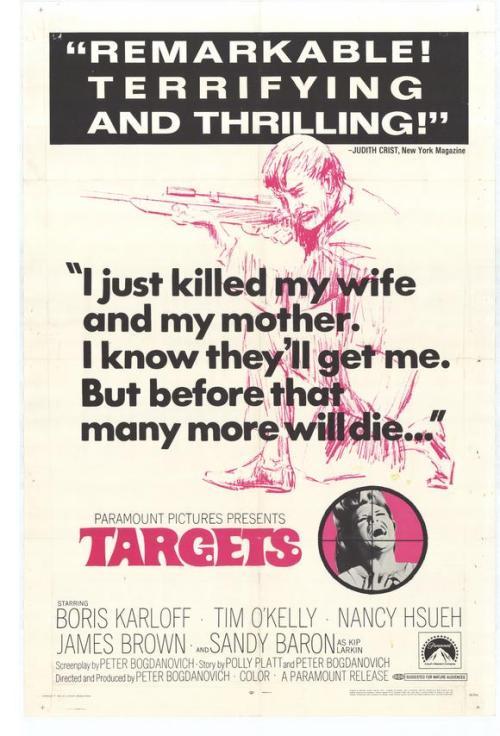
In 1967 producer Roger Corman gave fledgling director Peter Bogdanovich the green light to make any movie he wanted as long as he followed two stipulations.  The first one was that he had to use footage from Corman’s earlier film The Terror and the second one required that he use the acting services of Boris Karloff as Karloff still owed Corman two day’s work per his contract.  This movie is the result of that agreement, which kind of works and kind of doesn’t and seems more like two movies rolled into one.

The first story deals with a young, clean-cut man starting to have homicidal urges. The second scenario involves an aging actor played by Karloff, who decides he wants to retire despite the appeals of his agent and film studio. He plans to attend a showing of one of his films (The Terror) at a local drive-in where the sniper is waiting to shoot him.

I enjoyed the scenes involving the sniper and felt it helped elevate this film from the typical exploitation fare.  The character is based very closely on Charles Whitman, an All-American ex-marine, who on August 1, 1966, climbed to the top of the clock tower at the University of Texas in Austin and shot 32 people, killing 14. It was one of the very first mass-shootings in American history and it caused worldwide headlines.

Tim O’Kelly, the actor who plays the gunman, looks almost exactly like Whitman. What I liked about these scenes is the way it follows the character around and shows his interactions with his family. Like in real life there were no indicators, or violent past.  It is creepy watching him say grace at the dinner table, or having wholesome conversations with his wife when you know what’s going to happen.  The film goes into almost meticulous detail with the build-up and I found it gripping despite the fact that there is little action, or music.

The shootings are uniquely done.  Like in the actual incident, he shoots his mother and wife first and then puts a towel over their blood stains while carrying their dead bodies back to their bedrooms so it would look more ‘tidy’ when the police came.  This is all done with a docu-drama approach, which heightens the impact and realism.

The scenes involving the sniper shooting at people while they drive in their cars along a busy roadway are excellent as well.  It was done on an actual freeway and the viewer watches the action from the killer’s perspective through the telescope of his rifle, which is chilling. The cars veering off the road and people getting shot are vivid.  The only fault here is that Bogdanovich had the killer climb up on top of an ordinary tank at an oil refinery to do the shootings.  The clock tower in the actual incident was a very distinct structure and it would have been stronger visually had they found another one that was similar to it.

The parts involving Karloff are weak and tend to be cluttered with a lot of uninteresting dialogue.  Bogdanovich casts himself as the screenwriter for Karloff’s next proposed project.  I always thought it was a bit weird for a director, especially one that at the time was young and unknown, to cast himself in his own movie.  I know Woody Allen and Spike Lee, as well as others have done this, but it always came off as a bit narcissistic to me. However, I saw Bogdanovich in person a few months ago and he hasn’t seemed to have aged a day.

The climactic sequence in the drive-in is poorly handled. The dark lighting makes it hard to follow the action.  The final confrontation between Karloff and the killer is dull and unimaginative.  The only good points here is that it gives you a chance to see both Randy Quaid an Mike Farrell in their film debuts playing two of the sniper’s victims.

The film ends with a bird’s-eye view of the drive-in’s empty parking lot taken the next day with the sniper’s car being the only one left.  It was shot during the early morning hours so the sunlight gives it a surreal quality.  It also has a moody feel because the only sound is of blowing wind as the credits scrawl over, which I liked. However, the police would certainly have impounded his car and gone through it for clues and not have let it just sit there.

Under the conditions that he was given I think Bogdanovich did a commendable job. It is hard to know what category to put this film into.  At times it seems like a horror movie and then at other points it’s a drama. Some may even argue that it is a sentimental tale dealing with an aging actor moving into the final years of his life. Personally I wished it had gone all out as a horror film because the ingredients were there except that the tension was inconsistent. Fans of Bogdanovich may want to check this out because it is radically different from any of his later works.

My Rating: 6 out of 10

Released: August 15, 1968

Runtime: 1Hour 30Minutes

Rated R

Director: Peter Bogdanovich

Studio: Paramount

Available: DVD, Amazon Instant Video

The Landlord (1970)

By Richard Winters

My Rating: 8 out of 10

4-Word Review: In over his head.

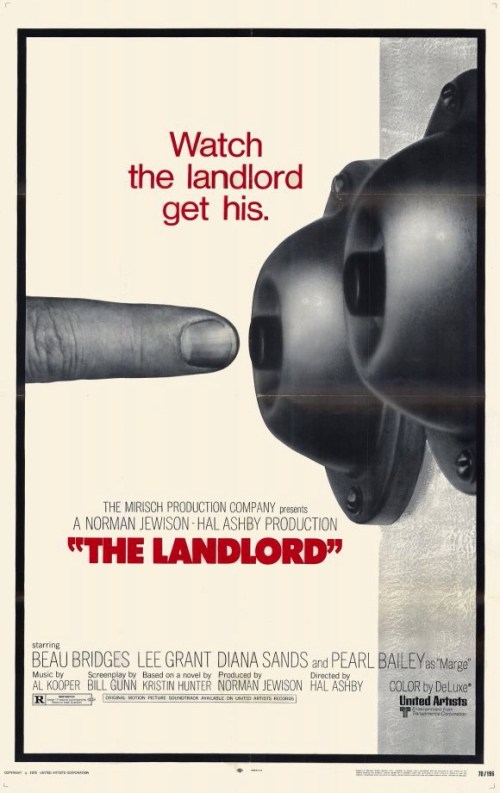
Elgar Enders (Beau Bridges) is a spoiled 29 year-old from a wealthy family who is still living at home with his parents in an affluent suburb of New York.  He decides it is time to ‘make his mark’ by purchasing a rundown building housing black tenants in inner-city Brooklyn.  He plans to evict the people and have the structure renovated into a posh flat.  He starts having second thoughts though as he gets to know the people and learns of their struggles.  He begins a relationship with one of the women (Diana Sands) and soon he is working to upgrade the building as well as trying to enlighten his racist, snobbish parents (Walter Brooke, Lee Grant) to embrace the black movement.

The Enders character is a perfect microcosm to the 70’s period where idealism and efforts to improve inner-city life, as well as some of the harsh realities that came with it, where at an all-time high.  Director Hal Ashby’s first film is full of strong gritty visuals from the rundown, graffiti-laden buildings to the garbage strewn lawns. Everything was filmed on-location and you get a vivid taste of the black experience. It is boosted even more by the detailed cinematography of Gordon Willis, which makes the most of the natural lighting and making you feel like you are right there.   The honest no-holes-barred approach is terrific. It perfectly captures the mood and feel of its era. I was surprised for a first time director, even a really good one like Ashby,  how well-constructed and technically sharp this was, which could have some link to the fact that it was produced by another great director, Norman Jewison, whom I’m sure lent a lot of input.

Initially I found the Elgar character to be off-putting, but that could’ve been intentional.  We first see him sitting on his lawn chair being served a drink by a black servant while talking about his great plan and looking like a spoiled, snot- nosed kid who has been coddled all his life.  The one scene that I remembered from this film when I first saw it over 20 years ago is when he  gets out of his Volkswagen bug to look at the building while wearing a tacky looking Pat Boone white dress suit.  When some of the black men sitting on the building’s front steps tease him a little, he immediately panics and runs eight blocks down the street in terror even though no one was chasing him.  However, he does start to grow on you as the film progresses.  I liked the fact that he faces adversity and is not scared away.  He learns to persist and adapt.  He genuinely starts to care about the people and backs-up what he says to the extent that he single-handedly carries new toilets one-by-one from the hardware store to the apartment building when the plumbing breaks down in an amusing vignette.  He isn’t afraid to tell off his arrogant parents when he needs too and his definition of NAACP is pretty funny.  It is satisfying to see him mature, learning that instituting change is not easy and things are the way they are for a reason.  He eventually is forced to confront his own limitations, but becomes a stronger person for it. This is without a doubt Bridges best performance to date.

There are other great performances as well.  Pearl Bailey is a gem as one of the building’s feisty, older women tenants who is the first to befriend Elgar.  Her awkward visit with Elgar’s equally feisty mother is considered the film’s highlight by many viewers and critics. I also loved the look she gives Elgar at the very end when he tries to wave goodbye to her.  The gorgeous Diana Sands is outstanding playing the role of Francine who has an ill-fated affair with Elgar. She shows just the right balance of sexiness and seriousness and it was a shame that just a few years after this film was made she ended up dying of cancer at the young age of 39. Susan Anspach is fun in one of her early roles as Elgar’s pot smoking sister.  The performance though that leaves the strongest impression is that of Lee Grant who is hilariously hammy as Elgar’s priggish mother.

When I first saw this film I came away thinking that it was uneven and a bit bipolar. It runs most of the way as a gentle, quirky satire filled with goofy cutaways, but then ends with a very stark and frightening scene with Elgar being chased down the grimy hallways of the building by Francine’s angry ax-waving husband (Louis Gossett Jr.) when he finds out that Elgar has gotten his wife pregnant.  The scene is ugly and intense and a far cry from the rest of the film’s gentle tone. Yet upon second viewing I think this scene works and was necessary. It makes a good statement at how volatile temperaments can be of those that are forced to leave in squalor as well showing how easily people, even with the best intentions, can get in over-their-heads when they don’t fully appreciate, or understand the situation that they are getting into it.

The side story involving a mulatto women (Marki Bey) who falls in love with Elgar is solid as well and gives the viewer a keen insight as to how difficult it is for someone who can’t seem to be accepted by either race. The language and conversations are tough and vulgar, but always laced with realism.

The only complaint I have with the film is the portrayal of the white characters who are buffoonish and overly idiotic even for satire.  I thought the idea of having them still use black servants was over-done, but then when one of them shows up at a party wearing blackface it was overkill. I thought it was unfair and unrealistic in the way that the film worked so hard to give depth to its black characters, but then turns around and, with the exception of Elgar, paints the whites as nothing more than broad caricatures.

The Landlord has finally been released on DVD through MGM’s Limited Edition Collection. I would suggest this film for anyone who enjoys an intelligent comedy-drama with something to say. It is also a great chance to see young up-and-coming actors. This includes Hector Elizondo as well as comedian Robert Klein. You can also get a very quick glimpse of Samuel L. Jackson who appears briefly in an uncredited role as a minister near the end.

My Rating: 8 out of 10

Released: May 20, 1970

Runtime: 1Hour 52Minutes

Rated R

Director: Hal Ashby

Studio: United Artists

Available: VHS, DVD

Tetsuo, The Iron Man (1989)

tetsuo2

By Richard Winters

My Rating: 6 out of 10

4-Word Review: Man turns into metal.

This is one of the most bizarre and fascinating films ever made. It reminded me a lot of David Lynch’s Eraserhead, but with a little more linear storyline and engaging tongue and cheek humor.  It all depends on one’s tolerance as to how much they will enjoy it. Some will find it weird and alienating while others will insist it’s brilliant.

The story centers on a very strange man, played by the film’s director Shinya Tsukamoto, who has a freakish compulsion to stick scraps of metal inside his body.  He cuts his leg open and crams a metal pipe inside of it, which causes him excruciating pain.  He runs through the streets screaming and is hit by a car driven by a man (Tomorowo Taguchi) who is never given any name.  The driver and his girlfriend think that they have killed him and decide to dump the body along a riverbank and then make love in front of it. The next day the man notices while shaving that a metal nail is protruding out of his cheek. Soon metal parts start to grow from every part of his body until he is completely unrecognizable.

Despite being made over twenty years ago I found the special effects to be awesome and able to stand-up to today’s standards. The opening part where the man stuffs a metal pipe into his cut open leg appears so real that it made me cringe. The amount of metal growing out of the main character’s body becomes almost mind boggling and has to be seen to be believed.  The immense metal suit that the actor ends up wearing and having to walk around in is massive and I wasn’t sure how he could even move in it as it looked incredibly heavy.  The stop-action photography is fluid and watching the metal metamorphose in different and imaginative ways is fun. I found the grainy black and white photography to be highly effective and it helps accentuate the nightmarish vision of the story.

The story also features dreamlike segments while although not always making sense and sometimes jarring to the story, still are memorable. The scene where the main character is chased through the catacombs of an isolated train station by a woman who has turned into a robotic mass of metal is cool.  There are a few kinky elements that are shocking, tasteless, and hilarious all at the same time. They include the man’s girlfriend with a mesmerizing stare who becomes a zombie during one of these visions and rapes him with a metal pipe that has sprouted out of her vagina.  Then, a few scenes later, he turns around and rapes her with his penis that has turned into a giant whirring drill.

Although I applauded the film’s no-holds-barred creativity that seemed years ahead of its time, I did feel that it was confusing and disconcerting.  There are too many jump cuts and wild images thrown at the viewer without any explanation. It does finally come together at the end, which is good, but I would have liked a better set-up. I wanted to see more character development, which basically is none and some explanation for why all of this was happening.  A little more conventional narrative could have gone a long way. I also felt that it became too one-dimensional. Metal grows into more metal that grows into yet even more metal until it becomes almost boring. Although the running time for the picture is only 64 minutes I felt that this was actually too long and I would have wanted it shortened even more as the story seems to play itself out and have nowhere to go.

(Spoiler Alert)

Fortunately it is saved by a very satisfying over-the-top ending that nicely brings it all together.  The strange man inexplicably comes back to life and the two duel things out in the vacant city streets. The apocalyptic over-tones here are terrific and the last sequence where the two fuse together to form one giant metal mountain has to be one of the most extraordinary images ever to be put on celluloid.  Their final conversation is insanely funny.

(End of Spoiler Alert)

Again, as I stated before, this is not going to be for everyone. There is a real underground look and feel here that is going to offend some while amaze others. Nonetheless it has justifiably acquired a large cult following that seems to never stop growing and it has spawned several sequels that have all been done by the same director. This one though is still the best of the series. I recommend it to those with perverse, offbeat tastes and an extremely dark sense of humor.

My Rating: 6 out of 10

Released: July 1, 1989

Runtime: 1Hour 7Minutes

Rated NR (Intense Imagery, Rape, Graphic Violence, Language)

Director: Shin’ya Tsukamoto

Studio: K2 Spirit

Available: VHS, DVD (Special Edition)

Avanti! (1972)

avanti1

By Richard Winters

My Rating: 7 out of 10

4-Word Review: Juliet shows her boobies.

Jack Lemmon plays Wendell Armbruster Jr. a conservative, set-in-his-ways businessman who travels to Italy to arrange the return of his father who died in a car accident. To his shock he finds that his father did not die alone, but instead was with his secret lady lover of twenty years. Apparently they would meet every summer and the two had been carrying on the secret affair without any of their family members knowing. Juliet Mills plays Pamela Piggott the daughter of the other woman. She comes to claim the body of her mother and after the two meet a certain romantic spark slowly begins to ignite.

This film is similar to The April Fools, which was another romantic Lemmon vehicle that was done just a few years earlier.  This film though works much better. For one thing there is a nice bit of mystery as to whether this thing will continue on or not and the ending leaves you guessing. Sometimes the best romances in life are the brief flings one has with someone that they know for only a short period of time and then move on and this film nicely captures that. The relationship grows at a realistic pace without ever being forced, clichéd, or sappy. In fact the two at first don’t even like each other.

Lemmon’s character here is much improved from the one in The April Fools. Instead of just being a bland schmuck he is more crusty, argumentative, and confrontational almost like talk show host Bill O’Reilly. His snappy comebacks and one-liners are fun and help hold the movie together. Mills (sister of Hayley, daughter of Sir John and wife of Maxwell Caulfield) is a delight as always playing a serene good-natured character similar to the one she did in her famous TV-show ‘Nanny and the Professor’. The fact that the two leads have such diametrically different dispositions helps give it a spark and make it intriguing.

Director Billy Wilder nicely captures the ambience and scenic beauty of the region and screenwriter I.A.L Diamond’s script is paced with amusing side-stories and characters. However, a 145 minute runtime is too long for such slight material and it spends a little too much time on side-stories that go nowhere. The scenes themselves are stretched out longer than they should with hardly any action and there is too much emphasis on the Neil Simon-like comical banter that ultimately makes this production seem more like a filmed stage play than a movie.

The film though does have some nice moments of humor. The part where the two go the morgue to identify the bodies and the very particular way the administrator sets out the legal documents to be signed and the way he packs them back up is amusing. There is also a scene where the two go skinny dipping and swim out to a small island. Yes, you do get to see both stars in the buff and although Mills isn’t bad, Lemon with his pale, out-of-shape, middle-aged-body, might be a bit too much for some. However, it is funny seeing him swim in the nude, but still leaving on his brown socks, which is a perfect testament to his uptight character. The best part and by far and away the funniest moment in the film comes when a boat load of sailors come by and start whooping and hollering at the nude Pamela. Wendell then tries to ‘protect Pamela’s modesty’ by taking off his wet, dripping socks and holding them over her ample bosoms while she merrily waves to the passing men. It’s a visual thing, but it had me laughing-out-loud.

I did have two issues with the film that I feel should be discussed. The first is the opening bit where Wendell gets on the plane without any luggage and wearing casual attire because he was given too short a notice to change clothes before he had to board the plane. He sees a man with a nice suit on and asks him if they could change clothes. Yes, it is a bit amusing when everyone on the plane, including the stewardesses and the pilots, crowd around the bathroom door in confusion after seeing two grown men go in, but the joke falls flat because it is not in any way believable. Who in their right mind would go into a small bathroom of a plane with a perfect stranger to change clothes with him, especially when there was no money exchanged? Most would probably think he was a kook and tell him to get lost. The first rule they teach you in comic screenwriting 101 is that for the joke to work there needs to be some grain of truth to it, or otherwise it will come off as stupid, which it does here.

The other problem has to do with Pamela and her apparent ‘weight problem’ that gets mentioned not only by her, but by the other characters as well. The truth of the matter is that she looks great and has a figure most women would die for. I noticed this same thing with the Anne Hathaway character in The Devil Wears Pavda where she was labeled as ‘fat’ when compared to the other models even though she looked terrific. Apparently Hollywood, in their never ending quest for ideal beauty, cannot bring themselves to actually cast a plain, over-weight woman in the pivotal role of a love interest even if the script calls for it so instead they get someone who is just slightly under the gorgeous level, but still way above the average woman, and then hope to pass her off as a ‘plain Jane’. The result becomes not only ridiculous, but highly annoying and even insulting especially when it continues to be brought up and discussed.

Overall romance fans should find it appealing as the story has all the necessary ingredients and fits the formula well.

My Rating: 7 out of 10

Released: December 17, 1972

Runtime: 2Hours 20Minutes

Rated PG

Director: Billy Wilder

Studio: United Artists

Available: VHS, DVD, Amazon Instant Video

Movie Movie (1978)

By Richard Winters

My Rating: 3 out of 10

4-Word Review: Two movies in one.

Initially, the unique concept for this film seems intriguing.  The idea was to recreate the movie viewing experience of the 30’s and 40’s by having a double bill feature along with theatrical trailers in between. The stories would have all the clichés, storylines, and characters from films of that era, but done with a tongue and cheek approach. The same core performers including: George C. Scott, his actress wife Trish Van Devere, Red Buttons, Art Carney, and Eli Wallach would play different characters in all the stories much like doing skits on a variety show. Legendary director Stanley Donen, famous for such films as Singing in the Rain, Royal Wedding, and Seven Brides for Seven Brothers, would direct and the screenplay would be written by Larry Gelbert best known for writing Oh God! and Tootsie.

Unfortunately, it never really takes off. Part of the reason is that the parody is too restrained. There are a few funny lines here and there, but that is about it. This was released two years before the Zucker brother’s groundbreaking hit Airplane that redefined parody and still stands as the standard today. This film doesn’t even come close to that. In fact certain audiences that saw this movie in other countries didn’t get the wry, gentle humor at all and took it seriously. I got the feeling that Gelbert and Donen had gone to the theaters as kids and watched these same types of films. Their affection and nostalgia for this stuff is clearly evident and prevented them from unleashing the over-the-top, in your face farce that would have really made this hilarious and is what most audiences of today expect.

The first feature is entitled ‘Dynamite Hands’ and is a story about a young boxer from the 30’s named Joey Popchik (Harry Hamlin, in his film debut) who becomes a prizefighter in order to pay for his kid sister’s (Kathleen Quinlan) eye operation. This segment features all the expected clichés, but the subtle humor that is injected fails to make it seem fresh or interesting. It was shot in color, but I felt black and white would have been better. The one thing I did like was Hamlin who these days seems pretty washed-up as he appears almost exclusively in direct to video fare, or dumb reality shows with his fat-lipped wife. Yet here he is right on target with his portrayal of the naïve, wet-behind-the-ears, All-American kid and I enjoyed it. Wallach is also fun as the heavy.

The middle segment is a mock theatrical trailer called “Zero Hour” that features Wallach, Scott, and Buttons as WWI flying aces. This was shot in black and white, but is brief and unexceptional. I was disappointed that there wasn’t any silly newsreel footage as this was also a mainstay in theaters during the time and could’ve been a riot.

The third part is a send-up of all the old Busby Berkley musicals and is entitled “Baxter’s Beauties of 1933”.  Scott, who is nicely hammy, plays a famous Broadway producer named Spats Baxter that finds out he is dying from a very rare illness and has only a month to live. He decides to go out on top by putting on the most lavish musical show that he can. Again, like with the others, this segment is a disappointment. The musical numbers, which were choreographed by Michael Kidd, are poorly photographed and with the exception of one routine done on a giant roulette wheel fail to match the spectacular and extravagant quality of Berkley’s. Van Devere’s kitschy performance as an alcoholic, tyrannical leading lady is the only thing that saves it. Gifted actress Barbra Harris is completely wasted in a thankless role of one of the chorus girls that doesn’t take any advantage of her talents.

George Burns, who is credited as the film’s ‘host’, appears only briefly at the beginning, but I would have liked to have seen more of him.

The cast and crew clearly had more fun making this than the viewer had in watching it. The formula is followed too closely and the result is tedium.  Even if you are a fan of films from that period I would still not suggest this as the originals are far better.

My Rating: 3 out of 10

Released: November 3, 1978

Runtime: 1Hour 45Minutes

Rated PG

Director: Stanley Donen

Studio: ITC Entertainment

Available: Amazon Instant Video

The Great Race (1965)

By Richard Winters

My Rating: 3 out of 10

4-Word Review: Slapstick isn’t always funny.

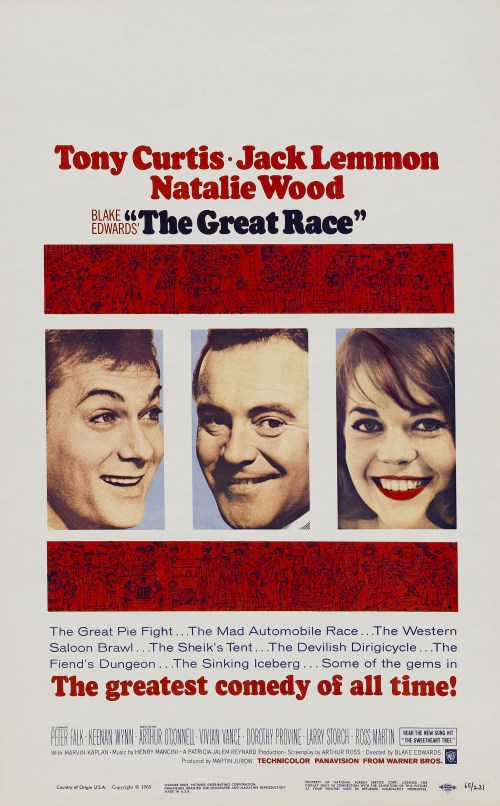
            The Great Leslie (Tony Curtis), who makes a living performing in wild stunts during the early twentieth century, decides to stage the world’s longest car race that will span over three continents. It will pit him against the evil Professor Fate (Jack Lemmon) and Fate’s slightly dimwitted assistant Maximilian Meen (Peter Falk) who will employ any dirty trick that they can in order to win.

It promises to be a grandiose comedy, but comes off as overlong and trite. In fact out of the total 160 minute run time I didn’t find any of it funny, it’s not even good for a chuckle. The gags are unimaginative, strained, and forced. It reverts to all the age-old shtick like a tired pie fight and equally tiring barroom brawl without adding anything new to it. Although the cinematography is excellent the action is cartoonish and will easily bore someone who is looking for something slightly more sophisticated. The film fails to achieve any momentum and seems to rely solely on its many lame jokes and stabs at unfunny humor to carry it.

The story is staggeringly threadbare with nowhere to go. The film’s title is misleading when you factor in that very little of an actual race is ever shown. The script goes off on a lot of side-stories and tangents all of which become increasingly more stupid as it goes along.  The worst one comes near the end when the audience should be gearing up for an exciting climax, but instead are treated to an inane scenario were the group find themselves trapped in a palace and dealing with a drunken prince who looks identical to Professor Fate (Jack Lemmon in a dual role).

It would have been better had there been more participants in the race instead of just the two. At the beginning there are several more drivers, but their vehicles all either crash, or break down right away in a highly uninspired fashion.

Curtis is boring in the lead and having him always seen in white makes him annoyingly clichéd. Lemmon’s character, who wears all black, is irritating as well in the opposite way.  Initially it was fun seeing Lemmon ham it up, but the character gets overplayed. I also didn’t like that medieval castle that he resided in, which appeared to be nothing more than a miniaturized model made of paper.

There are also many irritating logistical flaws that go overboard even for silly slapstick. One of the worst is the scene where both racers are stranded in a blizzard presumable somewhere in Alaska. Then the next morning they somehow find themselves on an iceberg that quickly melts as it floats into warmer waters, but how does that happen when before they were landlocked? Also, the Professor slips into the icy waters several times, which should have killed him.

If there is one good thing I can say about this film it is in the presence of Natalie Wood who plays a feisty feminist named Maggie Dubois. She is stunning and easily steals every scene that she is in. I loved the character’s gumption and I wished that she had been able to have her own car the whole way and competed against the two instead of having the derivative romance with Leslie. I also didn’t particularly care for ‘The Sweetheart Tree’ song that she sings, which is sappy, nor did I like the lyrics getting printed onto the screen along with a small bouncing ball.  Did writer/director Blake Edwards actually expect movie audiences to start singing along with her?

Supposedly this whole mess is a tribute to the slapstick films of the 20’s and 30’s particularly the Laurel and Hardy comedies, but as is the case with most of these things the originals are far better. The production values are high, there is a pretty good dual scene between Curtis and actor Ross Martin, and in the scene requiring a polar bear it is nice to see that a real one was used instead of a guy in a bear costume, which always looks tacky. Still, overall, it is a waste of celluloid that seems geared for an audience that no longer exists.

My Rating: 3 out of 10

Released: July 1, 1965

Runtime: 2Hours 40Minutes

Rated NR (Not Rated)

Director: Blake Edwards

Studio: Warner Brothers

Available: VHS, DVD, Amazon Instant Video

Dog Day Afternoon (1975)

dog

By Richard Winters

My Rating: 9 out of 10

4-Word Review: Money for sex change.

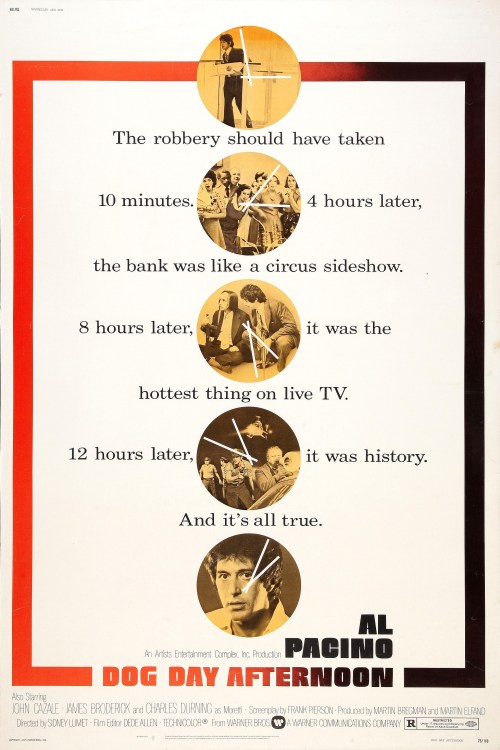
Dog Day Afternoon is a 1975 film based on a true story that took place on August 22, 1972.  It tells the tale of a man by the name of John Wojtowicz, who robbed a Brooklyn bank in order to pay for his gay lover’s sex change operation.  Here the character’s name has been altered slightly to John ‘Sonny’ Wortzik (played by Al Pacino), but otherwise this Oscar-winning script by Frank Pierson pretty much sticks closely to the actual events in this incredible saga about everything that can go wrong will.

Just about everyone who has watched this film will tell you how it manages to grab and pull you in right from the start.  It achieves this without having any special effects, pounding soundtrack, elaborate camera work, or artificial lighting.  Instead of ‘telegraphing all of its punches’ the film draws back and puts more emphasis on the little subtitles like the character’s facial expressions, side conversations, and other nuances that put together make this film very rich and textured.   In essence it successfully ‘shows’ instead of ‘tells’, which is a remarkable achievement since so many Hollywood films seem to want to do the exact opposite.

Director Sidney Lumet allowed for a lot of improvisation by his actors and gave each performer full rein on how to create their character, even the minor supporting ones. The result gives each and every one of the characters a distinct personality. The bank hostages become almost as fascinating as the thieves and it is interesting seeing all the different ways each one responds to the situation and how they interact with the robbers, which at times is both amusing and surprising.

The film also vividly captures 1970’s Brooklyn atmosphere. The sights and sounds of the area as well as the people’s personalities and the anti-establishment sentiment that was still quite prevalent at the time are all right on target.  After you finish watching this movie you feel like you just got back from a trip over there.  I really liked how during the opening credits you are shown all sorts of shots and scenes of Brooklyn, so by the time the story actually begins you are already well entrenched in the setting.

Pacino gives a dynamic performance in the starring role.  Some insist this is the best performance never to be nominated for an Oscar and I might have to agree.  If you are a Pacino fan than you absolutely have to see this, but if you are not a Pacino fan you still should see it because afterwards you might become one.

The supporting cast is stellar.  Sully Boyar, who was a real-life lawyer who did not enter into acting until he was in his 50’s, leaves a strong impression as the stoic bank manager.  As the police captain, the always durable Charles Durning is a blast especially during his frenzied and frantic negotiations with Pacino that almost become the film’s highlight. Another memorable moment is the improvised phone conversation between Sonny and his gay lover played by Chris Sarandon.  John Cazale is also amazing as Pacino’s bank robbing partner.  The partner in the actual incident was only 18 while Cazale was then 39, which created some controversy. However, Cazale is so convincing in the part that it is hard to imagine anyone else doing it as well.

In the end the film’s brilliance comes from its ability to convey the humanity of its characters. You can’t help but feel for the Sonny character despite his many flaws.  This a man who craves acceptance and yet goes through life being betrayed and hurt by everyone he meets. The shocked expression he shows at being betrayed by his own hostages, who he felt he had ‘bonded’ with, is, in my opinion, the most memorable shot of the whole film.

I only have two negative comments about this film and they are both minor.  One is the abrupt ending.  Since the film was made only a few years after the incident there wasn’t much of an epilogue to the characters.  The real John Wojtowicz, who really did look a lot like Pacino, didn’t end up dying until the year 2006.  It would have been a stronger conclusion by showing what happened to the Sonny character through the years and maybe even how he might of changed or grown.  My only other complaint is the fact that actress Carol Kane appears as one of the bank employees, but is shown very little.  A quirky and unique talent such as hers should have been given a bigger role.

Overall this is a great movie that I would recommend to any serious movie fan who can appreciate great film-making in top form.

My Rating: 9 out of 10

Released: September 21, 1975

Runtime: 2Hours 5Minutes

Rated R

Director: Sidney Lumet

Studio: Warner Brothers

Available: VHS, DVD (2-Disc Special Edition), Blu-ray, HDDVD, Amazon Instant Video

Eating Raoul (1982)

By Richard Winters

My Rating: 8 out of 10

4-Word Review: Get rid of perverts.

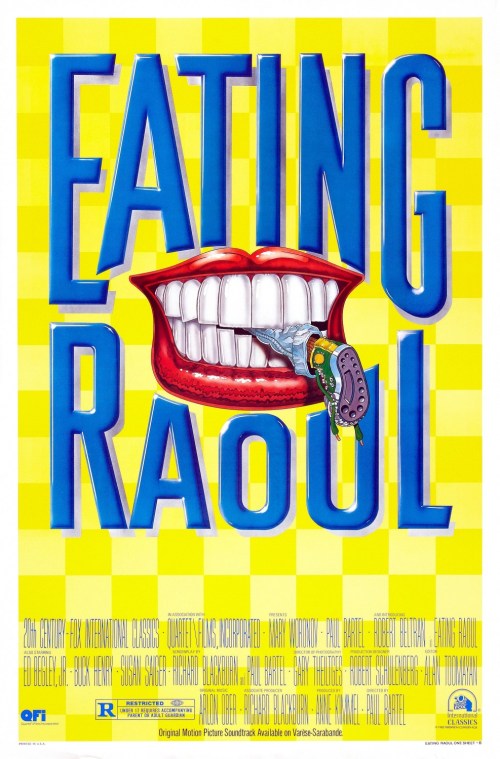
Paul and Mary Bland (Paul Bartel, Mary Woronov) are a very conservative couple that do not approve of open sexuality. They live in an apartment that is filled with swingers and spend most of the time trying to avoid them while abhorring their behavior.  Their dream is to purchase a large house in the countryside and convert it into a restaurant.  The problem is they have bad credit and are unable to secure any type of loan, so they decide to run an ad in the newspaper promising to fulfill and play-out people’s sexual fantasies. They insist everyone must pay in cash and then lure them to their apartment where Paul hits them over the head with a frying pan and kills them. That way they are able to collect the money they need while ridding the world of all the ‘perverts’.  However, a local con-man by the name of Raoul finds out about their act.  He is a young, good looking, self-described ‘hot-blooded Chicano’ who has the hots for Mary.  He allows them to continue with their scheme as long as he can have the dead bodies afterwards, which he then sells to a company who uses them to make dog food. Things go well for a while, but then complications ensue and that’s when it really starts to get crazy.

Paul Bartel’s hilarious script was initially rejected by all the studios and he spent six futile years trying to get it financed. It was only after his parent’s sold their house and gave him the money that he was able to get the film produced. It definitely has a very low budget look with a grainy film stock that gives it almost a home movie feel. However, this is a perfect example where a creative script can help overcome the film’s other shortcomings.  There are some genuinely funny moments the best is probably the swinger’s party and the infamous hot tub scene. This is the one thing that I remember most vividly about the film when I first saw it decades ago. I knew it was coming and still found myself laughing out loud when it did.  The swingers themselves are an obnoxious riot and you actually find yourself looking forward to seeing them get killed.

Writer, director, and star Bartel continues with his theme that perversion is a normal part of the human makeup.  Everyone has their own private sexual fetishes and fantasies that is unique only to them and may not be understood by others. He started this philosophy with his short film Naughty Nurse in 1969 where an otherwise respectable doctor and nurse would spend their lunch hour playing weird sex games. He continued it with his initial feature film Private Parts in 1972 that had a handsome young man who enjoyed having sex with a doll that he could fill up with water over real women and the weird relationship that transpired with the teen girl who lived next door and got-off watching him do it.  Here it continues with the sexual fantasies of Paul and Mary’s customers that become increasingly more outrageous (and hilarious) as they go on. Even the very strait-laced Paul and Mary have their own perversions. They dislike the actual act of sex and never do it. Instead they sleep in separate beds and cuddle with stuffed animals instead of each other, which is just as funny in the other way.

When I initially saw the film I thought Bartel was having a major ego trip by casting himself as being married to a very attractive lady like Woronov. He was a pudgy and bald man who in real-life would most likely not be able to attain such a woman. Upon second viewing I ended up liking the odd casting and felt it helped make the film stronger.  Usually beautiful women are shown as simmering with sexuality and even sex symbols, so I appreciated the way it went against type. It also helped to define how Paul and Mary had a very special understanding with each other that did not conform to conventional wisdom, which sometimes happens. I also enjoyed the way Mary stays true to Paul even when she ends up being severely tested.

I admired Woronov’s performance the second time around as well. She was majoring in sculpting in 1963 at Cambridge University when her class decided to take a field to the Andy Warhol factory. She became so impressed with the place that she stayed while the rest of the students went back.  She starred in some of his experimental films and now 80 independent/underground films later she has become a major cult icon.  I was only 18 when I first viewed this and at the time my hormones where more fixated on her sleek body as she does have a few good, but brief nude scenes. Her acting though indeed helps carry the film.

Successful Latino actor Robert Beltran is good in his part as Raoul, which also marked his film debut. I enjoyed the contrast of his aggressive, streetwise character against the stifled Blands. There is also shades from Roman Polanski’s classic Cul-de-sac where a coarse stranger disrupts the unique chemistry of an otherwise isolated couple.

Susan Saiger is fun as Doris the Dominatrix. I felt it was nice how the film starts out with her as a kinky woman with a whip at a party, but then turns around with a scene showing her as an everyday housewife and raising a kid during her off hours. I liked how Paul and her managed to get past their differences and form an interesting friendship.

Famous character actors pop-up in amusing cameos. Ed Begley Jr. is an over-the-top hippie sex freak. Edie Mclurg appears near the end of the film as one of the swingers. Famous dwarf actor Billy Curtis is one of the customers and has a pet Doberman that is bigger than he is! The best cameo goes to Buck Henry who plays an amorous bank manager who makes advances towards Mary and then the funny way he tries to back-track when he gets caught.

This film has acquired a major cult-following that seems to grow by the year.  Yes, there are some flaws. The beginning is a bit cheesy and awkward and it took me about 20 minutes before I could get into it. I also wondered, with so many people being killed, why the suspicions of the police, or anyone else, was never aroused. There is also the fact that not everyone would get killed by being hit over the head with a frying pan, some might just get knocked unconscious. Still, I found myself laughing at a lot of places. I think people who are fans of black humor will enjoy this especially since it doesn’t sell itself out and stays true to form the whole way.

Sadly Paul Bartel died in 2000 from cancer and I felt his full potential was never fully realized. This became is most popular work and although he did several films afterward, none of them were as good.  Mary Woronov continues to be quite busy even at the age of 68. A documentary about her life and career is set to be released later this year and I look forward to seeing it.

My Rating: 8 out of 10

Released: March 24, 1982

Runtime: 1Hour 30Minutes

Rated R

Director: Paul Bartel

Studio: Films Incorporated

Available: VHS, DVD