Two Moon Junction (1988)

By Richard Winters

My Rating: 6 out of 10

4-Word Review: Voyuers will like it.

            A young woman named April (Sherilynn Fenn) who is from a well-to-do Southern family and engaged to be married meets a rugged hunk named Perry (Richard Tyson) who works as a laborer at a travelling carnival and the two immediately share a strong sexual attraction.  She considers getting out of her engagement, but her controlling grandmother Belle (Louise Fletcher) puts the crooked town sheriff (Burl Ives) on Perry’s tale in order to ‘rid them of the problem’.

Normally ‘hot and steamy’ love triangles that take place in the south seem over-done, redundant, and cliché filled, but for some reason this one works to an extent. For one thing the sex scenes, especially the one at the end that takes place at the Two Moon Junction locale, is quite explicit with an abundance of nudity by actress Fenn who is pleasing in the buff. And for the lady viewers there is even a scene featuring naked male bodies, both front and back, near the beginning of the film. If that isn’t enough there is also actor Tyson who is seen ninety-eight percent of the time without his shirt.

For sex it fares pretty well and rises just enough above the tired 80’s clichés to make it seem fresh. However, the story is rather placid and fails to dig deeper than its basic storyline.  The stylish atmosphere is nice, but there needed to be more tension and action.  I wanted the Fletcher and Ives characters to be meaner. Adding some tongue and cheek humor to a genre that even back then was becoming tired would have really helped.  There are times when it seems to want to go there but then it pulls back.  Having veteran character actors like Fletcher, Ives, Herve Villechaize, and Dabbs Greer was a real nice touch, but they needed to be given more to do. In Ives case, whose last film this was, I felt he was wasted and in that regard I came away from this thing disappointed.

Tyson works surprisingly well in the male lead.  He resembles a Fabio wannabe and I would normally have found him annoying, but he displays just the right level of cockiness to stay interesting. The fact that he also shows some negative traits helps keep the character real. However, the part where he breaks into April’s parent’s large estate and then promptly starts to take a shower seemed absurd and ridiculous. And just where did he find that bathrobe that fit him so well? Or did he bring one along with him? I suppose the plumbing might not be so good at the ragtag traveling carnival he worked at, but still.

Fenn is surprisingly strong as the female lead. This was definitely a three-dimensional character and the internal struggle that she had at being attracted to a man that she knew she shouldn’t be was nicely realized. The parts where she would breakdown into bouts of sobbing after her sexual liaisons with Perry were effective and heartfelt.

Kristy McNichol was a nice sight as a bi-sexual cowgirl named Patti Jean and she looked even better when she went topless. The fact that she revealed some latent lesbian tendencies towards April seemed to me to create interesting dramatic variables, but the film fails to go with it and the character disappears, which was another disappointment.  However, Patti and April’s dance together on the barroom dance floor created some nice provocative imagery.

It also during the opening of this barroom scene that you can spot the movie’s most revealing mistake; as the camera pans across the floor you can clearly see the shadow of the camera as well as the cameraman reflecting along the shiny wooden floorboards. It is always surprising to me the fact that if I the viewer can see a mistake like that right away how come an entire production crew misses it? Or do they see it, but are too lazy to reshoot, so they hope that it will just ‘pass-by’ the viewer? Either way it is the sign of sloppy filmmaking.

This also marks the acting debut of Milla Jovovich who plays April’s younger sister Samantha.  She was only thirteen at the time, but she already had a stunning face and it is easy to see why she caught the attention of producers and photographers as a model. However, her acting ability here seemed limited and her facial expressions where undisciplined.  She also shows little awareness of the camera, or how to play to it.

The film is superficial and lacking in many ways and it fails to have the necessary edginess that would have given it cult potential, but I still found it to be passably entertaining. Voyeurs who watch it for the sex may find it a little bit better.

My Rating: 6 out of 10

Released: April 29, 1988

Runtime: 1Hour 44Minutes

Rated R

Director: Zalman King

Studio: Lorimar

Available: VHS, DVD
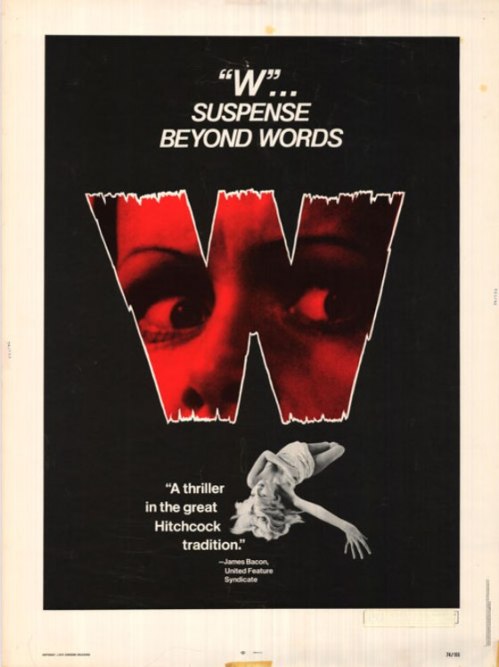
W (1974)

w1

By Richard Winters

My Rating: 1 out of 10

4-Word Review: Ex-husband is psycho.

For all you trivia buffs out there it may be good to know that Oliver Stone was not the first person to make a film with the twenty-third letter of the alphabet as its title, although that one technically has a period after it.  The first one was in 1974 and starred British super-model Twiggy. She had just made a splash in Ken Russell’s brilliant musical The Boy Friend and this film was supposed to send her to superstardom by proving that she could act by placing her in a completely different genre. Unfortunately for her it never happened.

The film is a thriller and the tagline read ‘W…suspense beyond words’. It is a story about a woman who has remarried but it still being stalked by her psycho ex-husband (Dirk Benedict). His name is William and at all of the scenes of his murders, or ‘accidents’, he scrawls the letter ‘W’, hence the film’s title.

At the time the critics came down hard on Twiggy’s performance, but I kind of liked it. She comes off as very innocuous and vulnerable and in this kind of role it works.  Her present husband was played by Michael Witney, who at the time was her real-life husband.  He was eighteen years older than her, but the age difference is not apparent.  You can tell that the two are genuinely fond of each other and that chemistry helps.  Yet they have no real onscreen presence and too much of the time is spent with only them in it, which hurts.

Viewers enjoyed Eugene Roche’s performance in a supporting role as a detective.  His gritty, matter-of-fact approach is refreshing and gives him some distinction over the other characters who are very transparent. Unfortunately he gets phased out rather quickly and this is too bad because it is the type of persona that could have really carried the film.

Where this film really fails is that way too much time is given to extraneous dialogue that is not interesting and does not propel the plot along.  The scenes are also excruciatingly slow and in great need of quicker cuts and edits.  I would have like to have seen cutaways showing the Twiggy’s character’s relationship with her ex-husband and how that all started, but it is never shown. She doesn’t even end up talking about it until well over an hour into the film and then it is only done briefly.

This is also one of the first thrillers that I have ever seen that has no creepy or pounding music score.  In fact the music is very soft and melodic like something you would hear in an elevator. There is also extended amount of footage showing the couple going sailing, walking hand in hand in a park, or spending time at their lavish beach house, making it seem more like a dreamy romance movie.  Some scary imagery, or just a few shocks are badly needed.  There is one nightmare sequence that has a little potential, but it lasts less than ten seconds and that just isn’t enough.

The film also has a lot of loopholes that completely throws you out of the story.  One is the fact that as they are becoming increasingly terrorized by this ex-husband they decide not to go to the police, but instead call on the services of a private detective, who has ulterior motives and just ends up making things worse. There is also a scene where the killer cuts off two of his fingers and attaches them to the victim’s burned body so when the police identify the body using the fingerprints they think it is the killer.  However, I wasn’t exactly sure how he pulled this off. Certainly he wouldn’t have the skill or time to actually graft the fingers onto the body and even if he did you would still think that the police would notice that the victim had too many fingers.

The biggest head scratcher of them all has got to be the fact that the prison in which the ex-husband resides gives daily tours to the public.  Now I have toured a prison myself in Boise, Idaho, but that was only after the prison had been closed and the prisoners shipped off to another facility.  Here the visitors can get right up next to the prisoners and observe them without any guards, or protection.  The person leading them around is not armed and dresses and acts like a tour guide to a museum.  I would think one of the prisoners could easily obtain a homemade knife of some kind, grab one of these visitors, and use them as a shield to break out. Of course in this film that doesn’t happen, but in real life I think it would, which just makes you wonder what kind of drugs were they on when they made this.

My only interest in watching this film to begin with was seeing Dirk Benedict playing the psychotic.  He is probably best known for the character of Face in the 80’s TV-show ‘The A-Team’.  Not that he is a real great actor or anything, but he has had a career where he usually always plays the nice guy, so I was interested in seeing him as the bad guy. Unfortunately he doesn’t appear until the final ten minutes and these scenes are strained and probably the most boring of the whole film.  His character is also poorly fleshed out with no reason given to his erratic, crazy behavior thus turning him into a cliche.

I came into this film expecting very little and I went away not even getting that much. Being an avid collector of lost films can be fun because every now and then you can come across a real gem, but that was definitely not the case here.

My Rating: 1 out of 10

Released: June 8, 1974

Runtime: 1Hour 35Minutes

Rated PG

Director: Richard Quine

Studio: Cinerama Releasing Corporation

Available: None

Deep End (1970)

deep

By Richard Winters

My Rating: 7 out of 10

4-Word Review: He will have her.

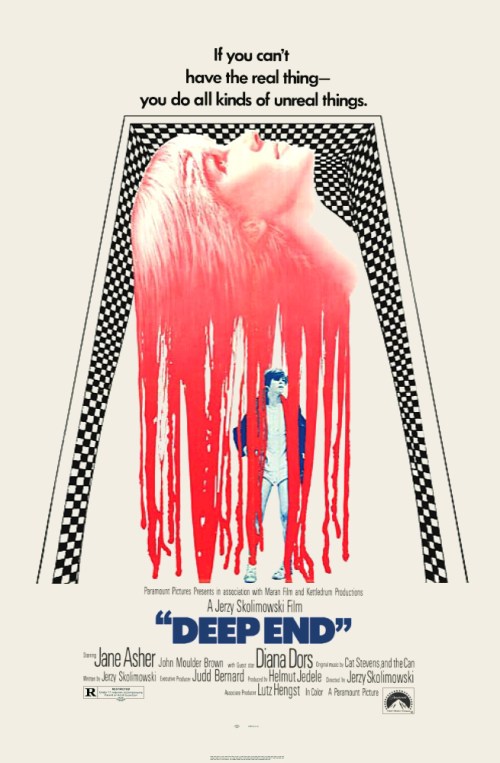
This is a moody drama detailing the story of a 15 year old boy named Mike (John Moulder-Brown) who goes to work at a public bath in London.  There he meets an alluring red-headed woman named Sue (Jane Asher).  She begins flirting with him, which causes him to become infatuated with her.  He starts following her around and even tries to scare off her two boyfriends as she is seeing both a man her own age as well as an older, married one.  Sue, who seems to enjoy manipulating all the men in her life, treats it all like it’s a silly game that ultimately ends with tragic results.

One of the things that really helps this film stand-out is the believability of the Mike character.  It was fascinating seeing all the different sides to his personality and I felt each one rang true for a boy his age.  There are times when he seems streetwise and even savvy and then there are other moments when he is immature, irresponsible, and emotionally out-of-control.  Although his obsession with Sue borders on being frightening I did like how he comes up with clever ways to help her like the ingenious way he finds her diamond that fell from her ring and into the snow.  I also liked how he becomes shocked at seeing a semi-nude poster of Sue outside a club, as she works as a stripper part-time, and how he steals it away in order to ‘protect her honor’.

Sue on the other hand seems almost all bad with very little good traits, but still equally believable.  She is mean and catty with everyone, abuses animals, and comes up emotionally hollow at every turn.  However, I could see how a young man of his age could become trapped by her seductive ways and perceived ‘maturity’, which makes the obsession itself as intriguing as their personalities.

Acclaimed writer/director Jerzy Skolimowski seems very much in control here and what buttons to press and when to do it.  I liked the color schemes especially his use of the color red. Having Cat Stevens do the music score gives the soundtrack and nice distinction.  I also liked how he foreshadows the film’s final shot several times during the movie.

I did end up having a few qualms with the film.  I wanted Mike’s initial interactions with Sue to be a little more extended than just the brief flirting that is shown.  The film takes place in buildings that are all old, rundown, and murky, which in some ways is good because it helps reflect the murky personalities of the characters.  Yet I wasn’t sure if this was all intentional or just the result of working on a low budget.  I would have liked a few scenes done against a more appealing background just to allow for  more visual variety.

The ending, especially the final shot, is very provocative and perverse.  It reminded me in a way of Nicholas Roeg’s excellent film Bad Timing: A Sensual Obsession (1980). Everything gets played out in such an odd way that it keeps you guessing until the final second as to what happens, which ends up staying with you long after the film is over.

Diana Dors, who was a popular British actress during the 50’s and 60’s and even considered a sex symbol for a time, gets a great cameo bit here that has to be seen to really be appreciated.  She plays a sexually frustrated middle-aged woman who rents a room at the public bath and then tricks Mike into coming into the room with her. She grabs his hair and shakes his head while describing a sexual fantasy that she has going on in her head.  When she is done she throws him back to the floor and says “You can go now, I don’t need you anymore.”

My Rating: 7 out of 10

Released: September 1, 1970

Runtime: 1Hour 33Minutes

Rated R (Sexual Situations, Adult Theme, Brief Nudity)

Director: Jerzy Skolimowski

Studio: Paramount

Available: DVD, Blu-ray (Import)

Dirty Mary Crazy Larry (1974)

dirty1

By Richard Winters

My Rating: 5 out of 10

4-Word Review: Fast cars fast women.

During the 70’s car chase movies were all the rage.  Smoky and the Bandit, Convoy, Vanishing Point, and Two-Lane Blacktop were just a few.  Most of these films followed the comedy adventure blueprint closely resembling the politics of the time where the police were the befuddled authority figures and those being chased symbolized the downtrodden masses looking to break free from the values and customs of yesteryear and find their own identities. Dirty Mary Crazy Larry is pretty much the same as the rest with a few notable exceptions the biggest being its very downbeat ending, which was quite talked about at the time of its release and one of the main reasons this film continues to have a strong cult following today.

The story is based on the novel by Richard Unekis called The Chase. It involves an out of work race car driver named Larry and his mechanic (Peter Fonda, Adam Roarke) who decide to rob a grocery store to make ends meet. Much to their dismay they are accompanied by a hooker named Mary (Susan George) and the three spend the rest of the film riding in Larry’s Dodge Charger with a powerful V-8 engine and avoiding the relentless pursuit of the police.

The screenplay follows the book pretty closely, but does make a few ill-advised changes. One is that in the book the two leads characters were career criminals who robbed for a living. I thought this made more sense and gave the characters a little more grounding.  I didn’t understand why a race car driver and his mechanic would suddenly be pushed to robbery, or what lead them into their fix. The robbery is executed in much too sophisticated a way for a pair of novices as they kidnap the store manager’s wife and daughter and then threaten to harm them unless the manager opens up the store’s safe. They also rig his home phone up to a tape recorder device so every time he calls home he hears the voice of the two and thinks they are still there even though they had already hit the road.  Criminals who had done this all their lives would be brazen enough not only to come up with this idea, but to also pull it off.  People with no background in robbery most likely would not.  There is also no explanation as to why they chose this store and how they planned the whole thing out, which would have helped.

Another change that was made was the addition of the Mary character.  In the book it was just the two men, which made it more gritty.  Although easy on the eyes the character serves no fundamental purpose to the story line.  All she does is have very redundant arguments with Larry that quickly become tiring.  I began to realize that these shouting matches were put in solely as filler material and it ends up getting inane.

Although I have like Peter Fonda in other films, most notably Easy Rider, I did not feel his laid back persona fit this part.  Larry is indeed a potentially interesting character as it is a person who can only find solace when he is taking extreme risks and driving real fast, but Fonda seemed unable to bring out this edginess effectively and his incessant gum chewing ends up becoming real annoying.

Vic Morrow probably gives the film’s best performance as the sheriff.  Normally the police are portrayed as bumbling idiots in this type of genre, but here they were a little more human and I liked the way that he was a bit of a non-conformist himself in the relentless way  he pursued the trio.

I also liked the attempt by the film makers to put in more realistic elements to a car chase that is never shown in most movies. One particular scene involves a pick-up truck that has nothing to do with the chase pulling out and getting side-swiped by Larry’s car.  For a minute the film becomes somber as they think they may have killed the other driver, which is good. Too many chase films always show other drivers and pedestrians miraculously getting out of the way and never being hit or injured even though in reality a lot of them probably would. The subject of seat belts also comes up, which is another pet peeve that I have with these films.  The occupants of these cars are never shown wearing them and with the stunts that they do they would all end up injured and killed without them.  They don’t wear them here either, but at least Larry does mention to Mary that she should put one on and there is also an amusing scene where a big yellow billboard stating ‘There is only one word for people that don’t wear seatbelts…STUPID’ which is shown briefly just before one of the out-of-control police cars goes careening through it.

Of course the best thing about the film and the one thing that has made this film so famous is the notorious ending, which is a downer for sure. If you consider this a spoiler then please don’t read any further, but the truth is when I first saw this film many years ago I already knew it was going to have a downbeat ending, but it kept me more intrigued because I didn’t know how it would happen.  Unless you count the film’s opening shot there is no foreshadowing of it and it happens very suddenly where the victims end up not knowing what hit them, which is also realistic.  Personally I loved it and most other viewers seem to also.  Too many chase movies have the good guys being able to escape one close call after another when in reality the odds will catch up with you sooner or later and with this film that is what happens, which in some ways can be considered ‘refreshing’. The scene is captured well and features one of the best explosions I have seen and without any of that tacky computerized special effects. I also liked the way the film ends very abruptly after it happens without any denouncement.

Normally I argue against Hollywood remakes, but this is one instance where it would be a good thing.  One of the main problems here is the film’s low-budget.  Although I felt they captured the central California countryside nicely (it was filmed in and around Stockton) the indoor sets are quite bland and dull. A bigger budget, tighter script, and some flashy camera work could work wonders here.  Too many times Hollywood seems driven to remake films that were already good the first time and only ends up tarnishing the original instead of remaking films that didn’t quite work on the first run and trying to make them better.

My Rating: 5 out of 10

Released: May 17, 1974

Runtime: 1Hour 33Minutes

Rated PG

Director: John Hough

Studio: 20th Century Fox

Available: VHS, DVD, Amazon Instant Video

Closely Watched Trains (1966)

closely watched trains

By Richard Winters

My Rating: 7 out of 10

4-Word Review: Boy loses his virginity.

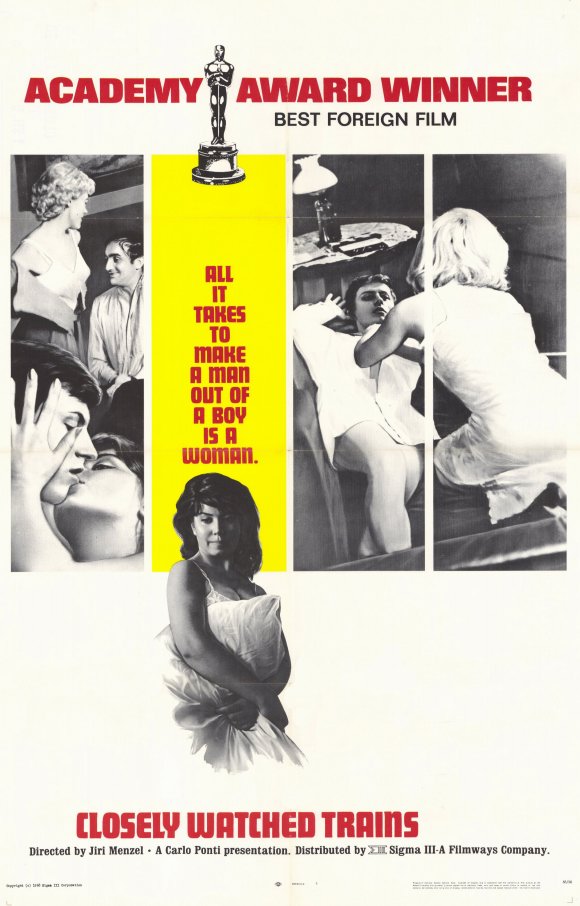
This is an engaging, amiable Czechoslovakian import that won the Academy Award for best foreign film of 1966. The story pertains to a young man named Milos (Vaclav Neckar) who follows in his father’s footsteps and gets a job at the local railway company during World War II. He almost immediately becomes bored with it and gets preoccupied with a beautiful young train conductor named Messa (Jitka Scoffin). The two have a sexual tryst, but Milos is unable to ‘rise to the occasion’.  He becomes despondent and even tries to commit suicide, but is saved at the last minute. While he is recuperating in the hospital the Dr. informs him that he suffers from premature ejaculation.  Milos then spends the rest of the time scouring the village for some prostitutes that he can ‘practice on’ so that he can learn to control his condition and become a ‘real man’.  A subplot involves plans to blow-up a German train carrying some high level ammunition.

Despite the fact that it is very leisurely paced and everything happens at one not very exciting location I still found the film to be immensely enjoyable. I had the feeling that director Jiri Menzel spoke straight from the heart with this one. The bleakness of the characters situation and the poor, hopeless conditions of their country is vivid and yet the ingenuity and perseverance of the human spirit never fades. Anyone who has dealt with an oppressive situation will most assuredly relate. The fact that this film stays so highly amusing and touching despite the depressing elements is what makes this a winner.

In a lot of ways this was years ahead of its time. The very liberal sexual attitudes and provocative scenes were stuff not yet seen in most movies and didn’t really become the norm, even for European films, until the 70’s and 80’s. Although not extreme there is indeed some lingering eroticism and even nudity. One segment involves Milos’s very amorous co-worker Hubicka (Josef Somr) rubber stamping the naked rear of Zdenka (Jitka Zelenohorska) who works as the station’s secretary. When her shocked mother finds out about this she parades her daughter all around town, exposing her rear to everyone, so that they can witness the ‘outrageous crime’ while the amused Zdenka finds it a turn-on.  There is also another scene, which another reviewer considered to be the most unique scene ever put on film that involves an old woman and a goose. I’ll agree it is very different, but I am not exactly sure what she was doing with it, or if I want to know, or if it is even legal, but it does indeed catch your attention.

Of course the drawback to this is the fact that the character’s attitudes seem far too modernistic for the era. At no time did I feel like I was really being transported back into the 1940’s.  There was also a little too much preoccupation with the sex angle and I felt there needed to be a little more balance with the actual war.

The Milos character is a bit too wide-eyed. He looks literally like a ‘deer-in-headlights’ through the entire progression of the movie. He seems overtly naïve for someone of 18. I know it was done for comical purposes, but having his mother dress him for his first day of work was going over the top. For the first half of the film he has hardly any dialogue and it is difficult for the viewer to relate to him, or get inside his head. Things do even out at the end when he ‘transforms into a man’, which I liked, but the opening half paints him too much as a caricature.

If there was one thing that really rubbed me the wrong way it would be the downbeat ending. I didn’t think it was necessary and tended to go against the film’s theme, which was human survival and coping. Still, it’s a good film with a great message. The budget was clearly very low, but it’s entertainment value high.

My Rating: 7 out of 10

Released: November 18, 1966

Runtime: 1Hour 33Minutes

Rated NR (Not Rated)

Director: Jiri Menzel

Studio: Filmove

Available: VHS, DVD (The Criterion Collection)

The Innocents (1961)

innocents 1

By Richard Winters

My Rating: 6 out of 10

4-Word Review: Children frighten their governess.

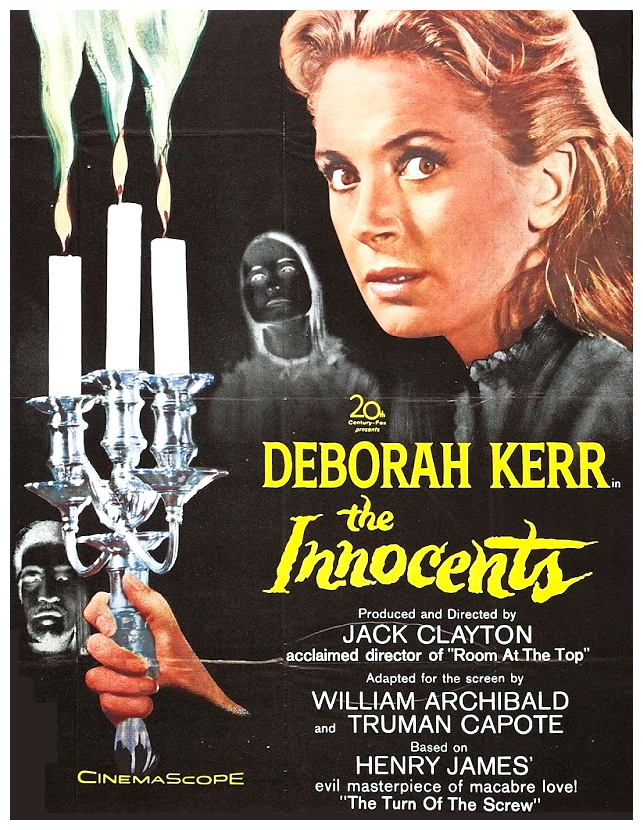
Legendary British actress Deborah Kerr plays Miss Giddens, the governess hired to care for two children at a sprawling English estate. However, the children are not exactly as they seem. Strange occurrences and behaviors begin to manifest as well as several ghostly sightings, which leads Miss Giddens into believing that the children may actually be possessed.

The film is based on the Henry James novel The Turn of the Screw. I have not read the book, but those that have feel this is a pretty satisfying adaptation. I did like the slow, methodical pacing. It helps to build the tension as well as enhance the mystery. Things are revealed in deliberate layers, which kept me intrigued throughout.

Director Jack Clayton shows a marvelous handle on the material.  The estate that they chose for the setting is perfect and captured well in glorious black and white by famed cinematographer Freddie Francis.  There is a lot of spooky imagery throughout including a creepy nightmare sequence in the middle.  The garden with its hulking, strange statues is used quite effectively especially in the haunting finale.  The music also grabs your attention right from the start with a very eerie song that is played before you see a single image on the screen. The song is similar to the one used in Rosemary’s Baby.  In fact there are several things here that reminded me of that film as well as The Shining.

Kerr was a good choice for the increasingly frightened governess.  I loved that scared expression on her face, which becomes progressively more frequent. Yet she is also effective when the character decides to become proactive by taking matters into her own hands and singlehandedly trying to ‘cure’ the children herself.  This also helps make both the character and the story a more multifaceted because you are never sure if this stuff is really happening or all just inside her head.

What really impressed me the most though was the performances of the two children especially Martin Stephens who plays Miles the young boy. His character shifts through many different moods, playing an innocuous child one minute and then a menacing, volatile one the next. He does each one flawlessly and becomes practically mesmerizing in the process.  Pamela Franklin is also fine in the role of Flora. This was her film debut. Eight years later her career would peak playing her signature role as Maggie Smith’s nemesis in The Prime of Miss Jean Brodie.

Another thing that I liked about the children is that they are initially portrayed as being normal and even engaging.  This is unlike other films with a similar theme like Children of the Damned or Children of the Corn where the kids are given creepy features right from the start. Here it works better and is more chilling to the viewer because the children’s dark side is unsuspected.

Unfortunately, despite the film’s impeccable technical quality, I still went away feeling unsatisfied. Part of the problem is that nothing really happens.  The ghosts appear but then do nothing but just stand there, which quickly becomes tiresome. One scene in particular has the camera constantly cutting back to the lady ghost standing across the lake until she starts to look like a mannequin, which I suspect she was.  The buildup is good, but I would have liked more of a payoff.  The ending is much too vague and gives no explanation as to why this was happening, if it was happening, or whatever became of the main character.

I couldn’t help but feel that this story would have worked better as an episode from one of the old horror anthology series like The Alfred Hitchcock Hour or even The Twilight Zone where it could have all been compacted into an hour. A hundred minutes seems like much too long for such little to happen. It is also interesting to note that in 1972 a film came out entitled The Nightcomers starring Marlon Brando that attempts to speculate what happened to the children before the main character of the governess arrives and before James’s original story begins.

My Rating: 6 out of 10

Released: December 25, 1961

Runtime: 1Hour 40Minutes

Rated NR (Not Rated)

Director: Jack Clayton

Studio: 20th Century Fox

Available: VHS, DVD

Lady in a Cage (1964)

lady2

By Richard Winters

My Rating: 4 out of 10

4-Word Review: Lady trapped in elevator.

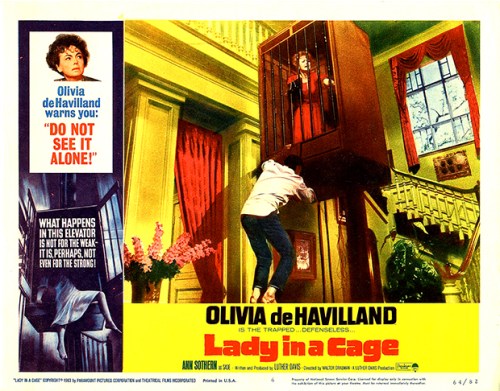
Olivia de Havilland, who as of this writing is the last surviving cast member from the film Gone With the Wind, plays a upper-middle class woman by the name of Cornelia Hilyard who gets stuck in her household elevator when the power goes out. A homeless man (Jeff Corey) becomes aware of her predicament and with the help of his sleazy girlfriend (Ann Southern) tries to rob the place. When they sell some of her items at a pawn shop a trio of juvenile delinquents (James Caan, Jennifer Billingsley, Rafael Campos) follow the two back to the place where they spend the rest of the film terrorizing Ms. Hilyard and ransacking her house further.

As a concept the film has some interesting ideas and imagery. The stark black and white photography looks great and helps accentuate the plot’s grim reality. The opening sequence is pretty good with an announcer reading off various startling news reports that are coupled with troubling images like a young girl on roller skates kicking at a homeless person lying in the street. There is also the fact that this all occurs within a large home amidst an upscale neighborhood that is right next to a busy street, which makes for some intriguing symbolism.

However, as a thriller it ends up being quite dull.  There is very little action and much too much talking that seems to go nowhere. There are no twists of any kind and the climax is forced, unimaginative, and unexciting.  Any violence that does happen is conveniently done out of view. The bad guys are portrayed as being dumb, careless, and just waiting to screw up. It is probably due to the period it was made in, but this potentially brutal subject matter seems way too restrained to the point that there is never much tension. There is also the issue of the elevator, which isn’t all that high up. Cornelia could have dropped herself out of it, which she eventually does, but had she done it earlier none of this would have needed to happen.

De Havilland does a good job here, but at times comes close to over-acting especially with her scared facial expressions, which some might find unintentionally funny. This marked James Caan’s film debut.  He is a great actor with an impressive career, but his performance here is lacking.  He seems uncomfortable in the role as the antagonist and he never manages to reach the level of being menacing. The final shot of his demise though is very graphic especially for the time. Jennifer Billingsley is probably the best thing about the film. She is attractive and gives a solid performance as the most jaded member of the gang.

Normally I always say these one-note thrillers that get stretched too thin at feature length would work better in one of those old horror anthology series like “The Alfred Hitchcock Hour”, however even there this story would be pushing it. Basically, in this instance, if you have read the synopsis then you have essentially ‘seen’ the film.

The trailer for the film and movie poster as seen above is actually much more entertaining than the film itself.  An announcer sends dire warnings that this film is ‘extremely shocking subject matter’ and ‘should not be viewed alone’.  It is pretty funny and even funnier when you see how lame the movie actually is.

My Rating: 4 out of 10

Released: July 8, 1964

Runtime: 1Hour 34Minutes

Rated NR (Not Rated)

Director: Walter Grauman

Studio: Paramount

Available: VHS, DVD, Amazon Instant Video

John and Mary (1969)

By Richard Winters

My Rating: 4 out of 10

4-Word Review: Sex and then relationship.

Considered provocative at the time this film detailed the new phenomenon of the one-night-stand, a fad in the late 60’s early 70’s that quickly went out of style upon the release of Looking for Mr Goodbar in 1977.  The story here details a rather nondescript man and woman (played by Dustin Hoffman and Mia Farrow) who meet at a singles bar and then go back to his place for sex.  The rest of the film involves them considering whether it can grow into a relationship.

The first ten minutes are pretty good. It nicely analyzes all the expected awkwardness one must have of waking up the next morning and not sure who you’ve been sleeping with. I liked how the John character secretly goes through Mary’s purse to find out more about her while Mary does the same with his telephone messages. Unfortunately after this segment Director Peter Yates unwisely decided to put in voice overs of their thoughts. This adds nothing to the proceedings and ends up being heavy-handed. It also takes away one of the fundamental points of good film-making, which is learning about characters through subtle visual observation.

The film is also no where near as sophisticated or daring as I think the film-makers would like us to believe. I expected, and would have like, the male character to have been a life-long swinger who has had many of these flings and now suddenly finds himself attracted to this woman and wants to go in a different direction. Instead we get a Hoffman character portrayed as being someone who has never done this before and only does so at the coaxing of his much more liberated friend.  This leads him to act all shy and unsure and coming off like an extension to the character he played in The Graduate. The end result is getting a very boring, bland person who responds to things in all the predicted ways instead of giving us a fresh new perspective by delving into the mind of someone living a lifestyle many of us have not experienced.  I also got a strong feeling that the film-makers had done very little research into this topic, thus giving the viewer no new insight whatsoever.  It ends up coming off like one of those trendy ‘statement movies’, but with no idea of what statement it actually wants to make.

There is no chemistry between Hoffman and Farrow at all.  Nothing is shown that would indicate why these two would want to pursue this thing any further. I actually found the scenes involving the side-story of Farrow’s affair with an older college professor (Michael Tolan) to be more interesting and filled with stronger more snappy dialogue.

In the end this ‘provocative drama’ deteriorates into being an uninspired love story. It concludes with the tired, cliche ridden scene of having John madly driving around the city of New York looking for this mysterious woman who he is convinced he is in love with despite the fact that he still does not know what her name is.  It is easy to see how, in Hoffman’s very distinguished career, why this film remains one of his lesser known efforts.

On the technical side this film is actually well done.  I liked how it inter-cut between the present day and the past as well as analyzing the previous relationships of the two characters. This film also offers a nice chance to see a young Tyne Daly as Farrow’s roommate.  Cleavon Little from Blazing Saddles fame appears briefly as a would-be film director.  Olympia Dukakis  has an amusing, non-speaking bit as Hoffman’s activist Mother.  This also marks the film debut of character actress Marian Mercer.

My Rating: 4 out of 10

Released: December 14, 1969

Runtime: 1Hour 32Minutes

Rated PG

Director: Peter Yates

Studio: 20th Century Fox

Available: VHS, DVD

$ (Dollars) (1971)

dollars

By Richard Winters

My Rating: 8 out of 10

4-Word Review: Robbery done inside safe.

Inspired by the British hit Perfect Friday this inventive and original bank heist film holds up well and has a great mix of action and comedy as well as oozing with cynical sensibilities and jaded characters.  It is one of the very few films ever made that has a symbol for its title and no words. Although most reference books do list the word ‘dollars’ in parenthesis, technically it is the dollar sign that is the official title. It also has the distinction of not displaying its title on screen in any type of print format. Instead a brief scene with a large steel structure made into a dollar sign is shown at the beginning being hauled in the air by a crane.

The story evolves around a crafty bank robbery devised by Joe Collins (Warren Beatty) who is also the bank’s security expert. He comes to realize that various criminals have stolen money stored in the safety deposit boxes inside the bank’s safe.  He figures that he could steal the money from them and they would be unable to go to the police. He gets a ditzy call-girl named Dawn Divine (Goldie Hawn), who has been a prostitute to most of the criminals whose money is in the safe, to call in a bomb threat to the bank. As the bank is evacuated, Joe enters the safe and closes it. He then methodically transfers the money from the bad guy’s boxes and into Dawn’s, who also rents a box there, as the bomb squad searches for the explosive. Then the next day Dawn takes the money from her box and stuffs it into her bag without anyone suspecting a thing.

Of course this is only the first-part. The second half deals with the crooks slowly figuring out what happened and chasing down Joe, who they think has the money. This begins one of the longest and most elaborate chase sequences ever put on film.  It takes up almost the whole second hour and it is amazing. Joe ends up being chased through city streets, tunnels, subways, trains, and even on a frozen lake with thin ice. Beatty did most of his own stunts here, which is impressive especially during the lake sequence, which was done on location in Sweden. When he goes through the ice he is really going into icy water and seems to be genuinely struggling to get out. Veteran character actor Scott Brady is memorable as one of the antagonists named Sarge.  He was much older than Beatty, but this contrast is fun, especially with the very relentless way he stays on Joe’s tail despite being out-of-shape.

Goldie is great as always, somehow her ditzy blonde routine never seems to get old and it is played to perfection here. I did have a few issues with the character though. She has sex with these slimy middle-aged men and even plays out their kinky fantasies, but ends up only taking $100 dollars from them for her ‘services’. I know this takes place in 1971, but even if you factor in inflation it still seemed low when these guys were loaded. I also thought her attitude was a little too carefree.  She invited these men into her apartment, but seemed to have no back-up plan in case things got out of control, which seemed risky. It is also never explained how Joe came to know her, or devise the plan that he did, but it would have been helpful. There also the fact that despite being a very crucial link in the plan she shows little confidence and describes how she always breaks down under pressure. It is nice that Joe stays supportive and sticks with her, but I felt it was unrealistic. Just about anyone else would have second thoughts about going through with it when they have a partner who is so shaky, or at the very least considered someone who is more self-assured.

Beatty is a terrific. He displays a cool demeanor and nicely underplays everything.  His mop-top Beatles like haircut  shows in a subtle, visual way his non-conformity from the more staid and conventionally dressed bank mangers.

Gert Frobe, best known as the villainous Auric Goldfinger from the classic James Bond film Goldfinger, is a hoot as the bumbling, clueless bank manager Mr. Kessel. The only actor I didn’t like was Arthur Brauss as ‘the candy man’. He certainly had the steely cold eyes of a killer, but his excessively raspy voice was a distraction and did not sound natural. There was no reason given why he sounded that way, but I would have liked one.

Even after 40 years the film still seems fresh. There are certain things here that I have never seen anywhere else. The prolonged chase is one, but there is also the scene where, to get Joe out of the safe, they have a torch burn a hole through the metal. They use an actual blowtorch and the sounds of it burning into the metal as well as the smoke and flying sparks is vivid and exciting.

I know my brother, who once watched the film with me, as well as other reviewers on IMDB, have complained that the first part of the film is too disjointed, slow and confusing. It does have a certain fragmented, cinema-vertite style to it where the viewer is forced to make their own connections, but I have watched this movie several times and it has never bothered me. The robbery and chase are so creative that I feel it more than makes up for any other limitations.  This early segment also effectively show how nasty the villainous men are and there is a part where, at a strip club, a stripper has a giant image of a dollar bill projected on her nude body, which I found to be evocative and artsy.

Critic Leonard Maltin has called this film ‘awfully similar to Perfect Friday’, but I have to disagree. I have seen both movies, which are excellent in their own right, but quite different in a lot of aspects. If you are looking for light entertainment that is exciting and still intelligently done, than this is a good flick to check-out.

My Rating: 8 out of 10

Released: December 17, 1971

Runtime: 2Hours 1Minute

Rated R

Director: Richard Brooks

Studio: Columbia Pictures

Available: DVD, Amazon Instant Video

The Anderson Tapes (1971)

By Richard Winters

My Rating: 8 out of 10

4-Word Review: They can hear everything.

In Sean Connery’s long and storied career in which he has played in a wide variety of films, The Anderson Tapes somehow always gets lost in the shuffle, which is unfair as it is really an offbeat gem waiting to be discovered and appreciated.  Fortunately in October it was finally released to DVD and the print is excellent and there is now discussions of a remake, but see the original first.

It involves a man by the name of Duke Anderson (Connery), who upon being released from prison, seeks to borrow money from the mob in order to finance a high scale robbery of an apartment building that is filled with affluent tenants. The problem is that Duke is being tailed by the government who, through means of sophisticated electronic devices, are able to record everything he says and does.  Even by today’s standards I thought the gadgetry and the way it was used was quite clever.

Many things help make this film stand out. One is the very distinctive music score by the legendary Quincy Jones.  It has a weird electronic, techno quality to it that nicely compliments all the gadgetry in the story.

The casting is also interesting.  Martin Balsam, who made a career playing typical, everyman characters, appears here as a flaming gay interior decorator, which he does hilariously well. Comedian Alan King gets cast in a serious role as the crime boss. Even the casting of Connery is offbeat.  Usually he plays characters with strong personalities who are very much in control.  Here he plays a character who is constantly forced to compromise and trying desperately just to hold everything together  he even ends up getting rejected by his girlfriend (played by Dyan Cannon) for another man and all Connery’s character can do is stand there looking dumbfounded.

The script has some really sharp dialogue. This is probably the third or fourth time that I have seen this film and yet I was still impressed by some of the great lines that I hadn’t caught from the previous viewings.  One should actually make a point to watch this film twice just so they can take in all the great writing, which coincidently was done by Fran Pierson the same person who did Dog Day Afternoon.

The most unique thing about the movie though is the actual robbery sequence, which is made memorable due to director Sidney Lumet’s innovative approach.  It is told in semi-flashback form where you see a scene of the robbery and then it cuts to a scene where the victim recounts what happened to the police, which makes for some creative segues. The robbery victims are full of odd quirks and quite amusing.  Two of the best ones involve Margaret Hamilton best know as the wicked witch from the Wizard of Oz who plays a cursing, argumentative elderly woman in this her final film role. I also like the bedridden, paraplegic young boy (Scott Jacoby) who is far more resourceful than anyone thinks and ends up single handily ruining all of their well thought out plans.

This sequence also edits in scenes of the police force quietly getting set-up to raid the building.  I especially like the shots of the S.W.A.T. team members sliding along a rope from one high rise rooftop to another.  It is photographed in a realistic way so you see them dangling high in the air with nothing but the street below, which made me cringe a little.  This is also a great chance to see Garret Morris in a pre-Saturday Night Live role playing the head of the S.W.A.T. team.

There is very little that I didn’t like in this film that I otherwise found to be original and engaging from start to finish. However, of the two issues that I do have, one is the ending, which in typical 70’s fashion was a bit of downer. It does have a twist to it, but it is not as clever as I think the film-makers thought it was.  There is also a glaring factual error that in a film as sophisticated and polished as this should never have happened.  It deals with a woman on a phone stating that she is calling from Wichita Falls, Kansas.  Now Kansas does have a city of Wichita, but Wichita Falls is actually in Texas.

I highly recommend this movie not only to those who may be fans of Connery or director Lumet, but also to those who enjoy movies with an offbeat story and approach.

My Rating: 8 out of 10

Released: June 17, 1971

Runtime: 1Hour 39Minutes

Rated PG

Director: Sidney Lumet

Studio: Columbia Pictures

Available: VHS, DVD, Amazon Instant Video