Family Business (1989)

family1

By Richard Winters

My Rating: 4 out of 10

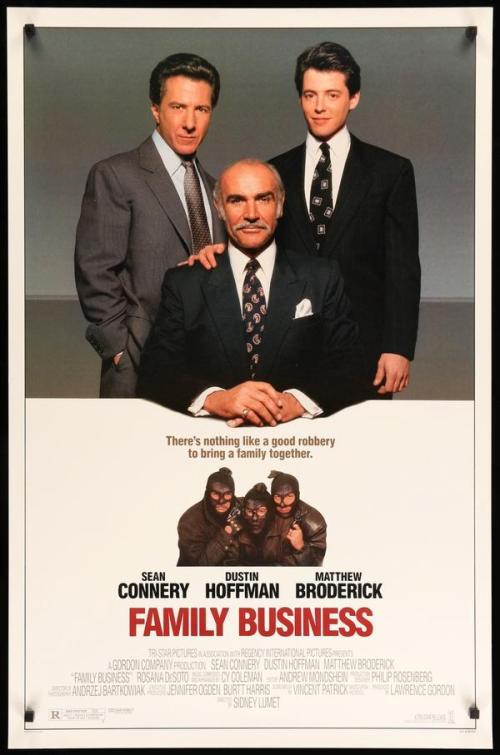
Any movie that casts Dustin Hoffman, Sean Connery, and Mathew Broderick as a father, son, and grandson team of robbers has me hooked before I have even seen the first frame. It was a great bit of inspired casting even if Connery was playing Hoffman’s father and in reality was only seven years older than him.  Throw in the fact that it was directed by the late, great Sidney Lumet and you should have a sure fire winner.

The story involves the grandfather Jessie (Connery) getting out of jail and trying to rekindle relations with both his son Vito (Hoffman) and grandson Adam (Broderick).  Vito wants nothing to do with his father as he has done time himself by getting mixed-up in some of his father’s old schemes and is now trying to go straight by working as a manager at a meat packing facility. However, Adam, who is going to college and has a promising career ahead of him, idolizes his grandfather and relishes the idea of pulling off a robbery himself. He has even come up with one that all three of them can do together. The robbery is unique in that they aren’t stealing from a bank, jewelry store, home of someone rich, or even a priceless artifact at a museum, but instead some important research materials at a science lab.

The crime itself is not elaborate and could have been easily pulled off with just one person. I was anticipating something a little more daring and exciting especially since Jessie and Vito were career criminals. It also takes too long to get to it. The first fifty minutes are spent with them endlessly arguing and rehashing the same old points.

The second part is a little more interesting as it deals with Adam getting caught while the other two are able to get away and all the dilemmas that they then face. Even here the drama becomes strained and talky.  The ending fizzles and leaves no emotional impact.  I saw a lot of similarities with this film and Sidney Lumet’s last film that he did before he died, which was Before the Devil Knows You’re Dead.  Both of these movies deal with robberies and the consequences of family members betraying one another and yet that film was far more gripping while this one falls flat.

I thought Connery was highly engaging and would have enjoyed seeing him take over the movie. Hoffman gives a solid dramatic performance, but his character is bland.

The Adam character got on my nerves. He had been given everything in life and yet refuses to appreciate it and seems almost ungrateful to his father for working so hard to give him a better life. He acts cocky about going through with the robbery and yet when they get there he is ill-prepared and confused. I understand sometimes people become curious about those that live a different lifestyle than they do and that they don’t fully understand, but I still felt there needed to be a little more balance.  I just didn’t understand why this kid would want to throw it all away just so he could be like his career criminal grandfather.

The film gives one a good taste of New York. I liked how it showed the different neighborhoods and boroughs. Not only do we get a good feel of the Bronx, but we also see Flushing, Brooklyn, and downtown Manhattan. Most films that take place in the Big Apple seem to concentrate in only one section of it while this one tried to give a broader feel.

The indoor sets are nicely realized. Everything from the trashed halls of the prison to Vito’s modernistic, sleek apartment, to the science lab and even Jessie’s small, cramped apartment looked authentic and distinct.

I did notice a few logistical errors. One is the fact that they discuss plans of the robbery in a lot of public places, which seemed just plain careless to me especially since these were ‘professional’ thieves. One discussion takes place at a bar, another on a busy sidewalk with pedestrians going by, and the third at a funeral with mourners standing right behind them. There is also the fact that they park their car on the side of the road in front of the lab and put a sign in the windshield stating that they are out of gas and will be back in one hour. I thought this seemed dumb because a policeman could come by and do a check on the license plate to find out who the owner is. Then, the next day when the robbery is reported, they would only have to put the two together to trace the culprits. There is also a scene were Vito fires one of his employees at his plant for stealing. He punches him violently in his office that is surrounded by windows and is in full view of the other workers.  The man leaves with a broken nose and bloodied face, but the workers do not react and go on with their tasks like nothing happened, which didn’t strike me as believable.

The music score is another problem.  It has a big band, show-tune type melody and sound, which might have worked for a Broadway production, but here it seems completely out-of-sync with the mood and tone of the story.

Although competently done this thing still seems like a misfire namely because the material isn’t diverting, or interesting enough for the cast that it has. I was expecting a little more razzle-dazzle and a lot more action and excitement. I almost felt that if this same story had been approached in a comic vein it might have done better.

My Rating: 4 out of 10

Released: December 15, 1989

Runtime: 1Hour 50Minutes

Rated R

Director: Sidney Lumet

Studio: TriStar Pictures

Available: VHS, DVD, Amazon Instant Video

The Verdict (1982)

verdict

By Richard Winters

My Rating: 8 out of 10

4-Word Review: Lawyer makes a comeback.

Frank Galvin (Paul Newman) is a lawyer that has hit rock bottom. He has lost his last four cases and become an alcoholic in the process. His associate Mickey (Jack Warden) hands him what appears to be an open and shut case dealing with a woman who was put into a permanent comatose state after being given the wrong type of anesthesia during the delivery of her child. Both parties are willing to settle out of court and Frank is initially happy to accept the settlement as he is hard up for funds, but after seeing the sad condition of the patient in the hospital he changes his mind.  He becomes convinced that the hospital is trying to hide something, but the other doctors and nurses that where present during the procedure are refusing to talk. He then tracks down the admitting nurse, who was the one person who refused to sign a sworn statement relieving the doctors of any wrong doing. Once he finds her it blows the case wide open.

This marked a turning point in Newman’s career. He was no longer the young, shirtless, virile hero, but now a grey haired, gravely voiced man showing the signs of aging and his roles from then on where all of older characters past their prime. Newman definitely looks tired and washed up and it is so effective that it makes the viewer feel the same way. Yet, he is still able to show the boyish side of his character by way he becomes engrossed with the pinball machine at the bar and getting excited when he achieves a high score.  Newman continues to be one of my favorite actors and his ability to act in a way that seems so effortless never ceases to amaze me. It may seem minor, but I liked when Galvin is forced to take a red-eye flight out of town in order to meet the former admitting nurse (Lindsey Crouse) who has moved to another city, he is shown to be unshaven. Too many times male characters placed in hectic scenarios in most films are clean shaven at all times even when it doesn’t make sense. Yet here Newman’s character isn’t. Being the consummate method actor who was always looking for realism I’m sure he decided to add this extra touch himself. Sometimes what separates the great ones from the average are the little things.

Director Sidney Lumet shows why he is a legend as well. The movie was shot in the late autumn, early winter in Boston. The cold climate and gray skies help accentuate Galvin’s state of mind and stage in life. I remember hearing Lumet state in an interview how he made sure that the color schemes in the entire film where of a dark, brownish color which he felt would reflect the story’s serious tone. In fact the color brown is the one quality I remember most of this film from when I first saw it years ago. I also liked the visual touch Lumet uses of having Frank taking Polaroid pictures of the victim lying motionless in her hospital bed. As the viewer watches the images of the woman on the Polaroids slowly develop it perfectly reflects Galvin’s developing empathy for her. My only quibble is that I wish that Lumet had shown a close-up of the woman so we the viewers could completely take in her sad condition as well. We are only shown the victim from a distance and even then it is never straight on, which doesn’t help us become as upset by her quandary as we should have.

Another thing I appreciated about the script, which was written by David Mamet and based on the novel by Barry Reed who was at one time a practicing attorney, is the fact that is focuses on all the behind-the-scenes tasks that a lawyer must do before the case comes to trial. Most courtroom dramas deal almost exclusively with the trial portion, but here we see how the attorneys prep their clients for questioning and cross-examination. We also take in the process of them interviewing potential jurors, researching legal issues, chasing down witnesses, and even discussing potential strategies with their clients. I found the approach here, as opposed to other legal dramas, to be more thorough, revealing, and satisfying.

The grievances that I had with the film all contain spoilers, so if you are interested in watching this movie then you may want to skip the next two paragraphs.

The first problem I had was with the Lindsay Crouse character who plays the admitting nurse whose bombshell testimony turns the tide of the case in the favor of Galvin’s client. Her scenes are certainly riveting and marked with all the classic ingredients of high drama. Her character states that the admittance sheet that she had filled out that day had been altered by the doctor and that she had the original. Yet neither the viewer nor the jury is shown the original making what she says, as compelling as it may be, seem like hearsay. The judge also orders everything that she said to be stricken from the record and not considered when the jurors come to their final decision. Yet the jurors openly ignore this order and side in Galvin’s favor anyways, which I couldn’t completely buy. I didn’t think all twelve of them would disregard the judge’s order especially when no documentation was ever shown to help verify what the witness stated.

I also did not like the Charlotte Rampling character who plays a woman that Frank meets at a bar and begins to date. She is also paid by the opposing attorney Ed Concannon (James Mason) to spy on Frank and give away all his strategies. I didn’t feel it was necessary to show this, or even bring in the character at all. We are already shown earlier that Concannon is underhanded by the way it is implied that another doctor, who was going to be the star witness for Galvin, was paid off not to testify and then just disappears. Having him go further by using Galvin’s girlfriend as a snitch seemed like over-kill. The movie strives for realism and therefore should keep extreme side-story scenarios like this out of it as I am sure it is not something that occurs every day.

The subject matter is serious and somber. On a dramatic level it is excellent and although some may find it slow and depressing others will appreciate the intelligent script and deliberate pace. It is also an unusually quiet film with long stretches with no dialogue, or music, which is a nice change of pace from most films, which feel it necessary to be loud and noisy, or risk losing the audience’s perceived short attention span.

My Rating: 8 out of 10

Released: December 8, 1982

Runtime: 2Hours 9Minutes

Rated R

Director: Sidney Lumet

Studio: 20th Century Fox

Available: VHS, DVD (2-Disc Collectors Edition), Amazon Instant Video

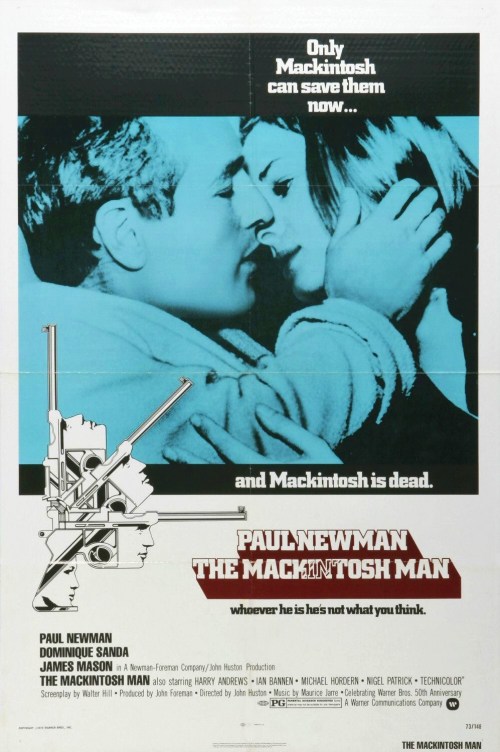
The Mackintosh Man (1973)

mack

By Richard Winters

My Rating: 6 out of 10

4-Word Review: Infiltrating a spy ring.

Joseph Reardon (Paul Newman) is a spy that is recruited by the British Intelligence to infiltrate a secret spy ring in order to expose a traitor from inside a high ranking government office. In order to do so he must assume the identity of an Australian criminal and allow himself to be caught and imprisoned. From there he is able to escape using the help of an inside organization that arranges the escapes for high profile prisoners. He is taken to an isolated mansion at an unknown location and trained to be a part of the criminal spy ring, but he unwittingly gives out his true identity, which forces him to make a daring escape and go on the run in the middle of nowhere.

As much as I like Paul Newman I felt he seemed out of place here and really didn’t completely fit the role. For one thing he is an American, but it is never explained why a foreigner is chosen for the operation instead of a British spy. There is also the fact that his alias is that he is from Sydney, Australia, but his Aussie accent does not sound convincing and tends to go in and out.

There is also the issue of him allowing himself to be put into prison. Normally a viewer has to relate to the protagonists circumstances in order to be wrapped up into their plight, but intentionally getting thrown in the slammer seems a bit hard to fathom. This was the maximum security type of jail with extremely small cells and prisoners asking him if he would ‘like to dance’. I realize this was part of the spy operation and spies are expected to take risks, but this seemed too reckless to me. What is going to guarantee that he is ever going to get out? This is after all a top secret organization, so how is he going to be able to hold them accountable if he gets stuck there. To me it is like asking someone to jump off a cliff and telling them there is a safety net to catch them even though they can’t see one.

The script, by the prolific Walter Hill, does have a few exciting scenes although it takes a while to get going. The best ones come when he is stuck at the isolated manor. I enjoyed how he singlehandedly overpowers them and is able to escape while setting the place on fire in the process. The shot showing the mansion on fire from a distance with the black cloud of flames rising into the grey sky had an artsy flair to it and the movie’s best moment.

I thought the barren landscape that he runs through, that doesn’t even have any trees, was cool. It reminded me a lot of the classic TV-series ‘The Prisoner’. This part also includes a viscous guard dog running after him, which is reminiscent of another memorable Newman role from the film Cool Hand Luke.  Here though he is able to exact his revenge on the mutt when he submerges it under water and drowns it, which might prove upsetting to animal lovers as looks realistic and the hound appears to struggle.

The car chase is excellent and nicely captured. Most chases seem to take place on city streets in the majority of films, so it was nice to see one done on curving, gravel roads in the countryside with Reardon stuck in nothing more than a rusty, rickety old pick-up. I loved how the camera shows in a longshot the car going over a cliff and falling several feet before landing with a loud thud. No intrusive computer effects here, nor flashy explosions. Everything was authentic with no cuts, which ends up making a much stronger impact.

A shout out must also go to James Mason as the villainous Sir George Wheeler. This guy is so effective at playing bad guys, and he does it with such ease, that it is almost scary. His ability to go from refined and dignified to vindictive is what makes him so good.

What hurts the film is a wretched music score that sounds like Russian dance music that has no place in a thriller. It is loud and blaring and does not build the mood, or tension in any way. It gets so bad that it almost ends up ruining the whole movie. The climatic sequence is a letdown as well. It features no action and it ends abruptly with a whimper.

It was a great idea to pair Newman with legendary director John Huston, but this product is not one of their best efforts for either individual. It is entertaining enough to be passable, but culminates in being just your average spy thriller.

Neman and Mason would team up nine years later to play adversaries again in the film The Verdict, which will be reviewed tomorrorow.

My Rating: 6 out of 10

Released: July 25, 1973

Runtime: 1Hour 38Minutes

Rated PG

Director: John Huston

Studio: Warner Brothers

Available: VHS, DVD (The Paul Newman Collection), Amazon Instant Video

Re-Animator (1985)

re animator

By Richard Winters

My Rating: 7 out of 10

4-Word Review: The dead come back.

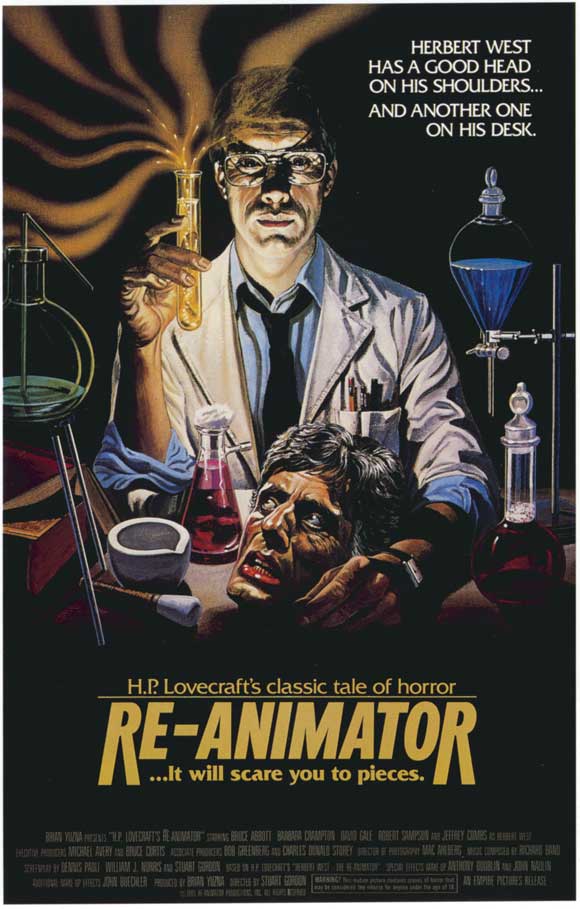
Daniel Cain (Bruce Abbott) is a student at a nearby medical college who decides to take in as a roommate a foreign student named Herbert West (Jeffrey Combs). West seems a bit anti-social and very intense about his work. He sets up a lab in Cain’s basement where he does experiments to bring back the dead by injecting them with his specially formulated serum. He starts with animals, which makes it intriguing enough for Cain to get in on it, but when they start to move onto cadavers at the school’s medical lab things spiral out of control.

Compared to most low-budget horror films of the 80’s, and I have seen many, this thing is nicely compact and well-paced. There is none of that extraneous dialogue and needlessly slow, drawn out scenes before you can get to any type of action, or horror. It grabs your attention right away with a clever, whimsical opening sequence and a musical score that although does sound similar to the one used in Psycho is still quite effective.

The gory special effects are excellent even when compared by today’s standards. Normally I have no problem watching these things no matter how high the gore factor is, but the scene where the instructor peels the skin off the head of one his cadavers during a class lecture and then cuts through the bone of the skull and takes out his brain had me feeling a bit queasy. The best part comes when Dr. Carl Hill (David Gale) gets his head chopped off at the end of a shovel, which is again well-done, and then has both his body and head injected with the serum. The scenes involving the headless body walking around while carrying this talking head are creepy, hilarious, and highly effective. It is realistically enough looking during a couple of sequences that it had me sitting there wondering how they pulled it off. My only quibble in this area would be the part where West reincarnates a cat that comes back to life and turns homicidal.  It is very clear that this ‘killer cat’ is nothing more than a stuffed animal as its fur looks fake and the body is unrealistically thin.

The film is directed by first-timer Stuart Gordon whose only claim to fame before this was when he was a student at the University of Wisconsin in 1969 and he brought in an audience into an auditorium to watch a play he had written and then locked the doors so they couldn’t get out. He intentionally made the play as boring and annoying as possible just to see how long it would take them to rise from their seats and clamor to be let out. Although this was enough to get him expelled I still admire the guy’s panache. That same type of snarky humor is evident here and woven in, in a way that nicely balances the horror. My favorite scene here, and one that I remember most distinctly from when I first saw it back in the 80’s, is when Dan meets his girlfriend Megan (Barbara Crampton) in the school’s hallway. He starts to kiss her passionately and she feels embarrassed and tells him ‘no, no, no’ and then it quickly cuts to show them in bed where she is saying ‘yes, yes, yes’.

Another thing that differentiates this from other low-budget horror films is the fact that the lead characters are not as bland as usual. I liked the way Dan has a moral quandary and teams up with West on some of his experiments. Both Dan and Megan are better fleshed out as characters and believable. Crampton also looks gorgeous and has a good nude sequence at the end.

Kudos must also go to Robert Sampson an actor who has worked steadily since the 1950’s, but has never become a household name. He plays Dean Halsey father of Meagan and his part takes off after he is accidently killed and brought back to life with Herbert’s serum where he turns into a mumbling, crazed lunatic. This isn’t as easy to pull off as you may think and his catatonic stares are fabulous.

David Gale deserves mention as well playing the evil doctor. His pale skin and sullen face make him look like he is dead from the very beginning and he has the perfect look for a horror film. He clearly relishes his role and hams it up nicely. He started to garner a large cult following after his performance here and offers to play similar roles in other horror films began to pour in when he unexpectedly died in 1991.

The only performance I really didn’t like was that of Jeffrey Combs. I know he has pretty much become the face of the Re-Animator franchise, but this guy seemed hammy without ever being amusing, or funny with it. I didn’t like the square, metal rim glasses that he wore as they were much too typical.  An eccentric character should wear eccentric looking glasses and attire to help accentuate his off-beat personality. I also didn’t dig his accent that seemed to waver between Bavarian, German, Russian, and some weird variant in between.

If you are looking for something different this Halloween then I suggest checking this one out. It has just the right amount of ingredients to be both entertaining and scary at the same time and it can still easily hold-up with today’s jaded viewers.

My Rating 7 out of 10

Released: October 18, 1985

Runtime: 1Hour 26Minutes

Rated R

Director: Stuart Gordon

Studio: Empire Pictures

Available: VHS, DVD, Blu-ray

The Bedroom Window (1987)

bedroom

By Richard Winters

My Rating: 7 out of 10

4-Word Review: What did she see?

Terry Lambert (Steve Guttenberg) is having an affair with Sylvia (Isabelle Huppert) the wife of his boss. The two go back to his apartment one night after an office party to engage in sex. In the middle of the night Terry gets up to go to the bathroom and this is when Sylvia is awakened by a scream coming from outside the bedroom window.  She goes to the window and sees a young woman struggling with a man on the sidewalk. When Sylvia opens the window the man runs away and by the time Terry gets there everyone is gone. The next day Terry reads in the paper about a similar murder to a woman that occurred later that night just a couple of blocks down the street. He is convinced there is a connection and that he should report the incident that Sylvia saw. In order to keep the affair a secret he decides to act as the witness and simply relay whatever Sylvia told him. However, in classic Hitchcock style things quickly spiral out of control and Terry soon finds himself in deep trouble.

Overall, this film is highly entertaining from beginning to end and a terrific Hitchcock imitation that should please even his devotees. However, Guttenberg as the lead seemed, at least initially, to be a poor choice.  The guy has always seemed very bland to me and has never shown any real type of strong onscreen presence. I could not buy into the idea that this guy would be cocky and shrewd enough to have sex with his boss’s wife right under his boss’s nose as Guttenberg seems to convey a very wide-eyed persona and looks like someone who is still in puberty and speaks in a high pitched voice. I did soften my stance on this as the story progressed simply because it would take an extraordinarily naïve person to get themselves into the mess that this character does and in that regard Guttenberg fits the bill perfectly.

His two female costars outshine him badly. Huppert is excellent as usual and may very well be one of the top five actresses alive today. I loved how her character starts out as kind and supportive, but eventually devolves into being cold and conniving. Huppert of course pulls this off almost effortlessly. She also looks great naked and has a pretty good nude scene, both front and back, when she is shown looking out the window.

Elizabeth McGovern, who plays Denise the waitress that Sylvia sees getting attacked, does a fine job as well. As Terry gets more involved with the case the two start to hook-up and end up making, dare I say, a cute couple. I did not like McGovern’s overly heavy Eastern accent that sounded too Bostonian to me even though the story takes place in Baltimore.

Bald, eccentric character actor Wallace Shawn, best known for his roles in My Dinner with Andre and Vanya on 42nd Street is terrific as the defense attorney. His clever cross-examining of Terry during the courtroom scene is a classic.

Curtis Hanson’s direction and script is what really makes this thing gel. The story is based off of a novel by Anne Holden and it manages to stay plausible and believable throughout. The direction is compact without the unnecessary flamboyance that can sometimes take away from the action. The pacing is good as it grabs you right away and holds you in throughout without any slow spots. The twists are well plotted and for the most part surprising. I also thought his recreating of a bar atmosphere at both the trendy nightclub and later at a small neighborhood pub was right on target. I liked that the story took place in Baltimore because outside of John Waters that seems to be a forgotten city in most movies. Hanson uses this setting to make some nice directorial touches like having a bar called The Nevermore with a mural of Edgar Allen Poe and there is even shot of a birthday cake with icing made to look like a raven.

Kevin Williamson is set to do a remake of this film and I will be intrigued to see it. Not that this version was bad because it certainly wasn’t, but a bigger budget and a better male lead could help improve what is already a sound plot.

My Rating: 7 out of 10

Released: January 16, 1987

Runtime: 1Hour 52Minutes

Rated R

Director: Curtis Hanson

Studio: 20th Century Fox

Available: VHS, DVD, Amazon Instant Video
Mixed Company (1974)

By Richard Winters

My Rating: 3 out of 10

4-Word Review: Racist coach adopts kids.

Kathy Morrison (Barbra Harris) works at an adoption agency that specializes in placing minority children into stable homes. Although she already has three children of her own, she comes under pressure to ‘practice what she preaches’ and adopt one herself. Her husband Pete (Joseph Bologna) is the head coach of the Phoenix Suns basketball team who are in amidst of a very long losing streak. He is reticent to the idea as he feels he will soon be fired and also harbors certain latent racist feelings. However, when it is found that they can longer conceive a child of their own due to him suffering from the mumps, they decide to go ahead with the idea. At first they adopt a young African American boy and eventually add a Vietnamese girl and an Indian boy.

The film was written and directed by Melville Shavelson, who only six years earlier had done the successful Yours, Mine, and Ours about a widow woman with eight children marrying a widower with ten. Clearly he was trying to go back to the same well, but the concept is uninspired and forced. The plot is too simple and formulaic. I sat through the whole thing feeling like I had seen it all somewhere else before. There is some snappy dialogue at the beginning, but it quickly runs out of gas. The pacing is poor and it plods along with no real momentum or cohesion.  The lighting is flat and the action is captured like it was made for a TV sitcom instead of the big screen.

The children deliver their lines in a robotic fashion and the script gives them little that is clever, or interesting to say. I did like the six year old Indian boy named Joe (Stephan Honanie) who is cute and precocious, but he does have a propensity to pick his nose and there is one icky scene where he appears to eat what he has picked out of it. The film did generate some controversy at the time of its release for featuring the kids swearing, but this amounts to nothing more than a few ‘damns’ here and there. I kind of liked the fact that the kids weren’t portrayed as complete wide-eyed innocents and their salty behavior seemed realistic, but the problems and issues that they deal with are highly contrived.

Joseph Bologna is a standout. His brash, flippant, hard-edged persona is terrific and fun. It is the one thing that holds the movie together and keeps it from being a complete bore.

The basketball sequences are clearly staged. They do edit in some actual footage, but it’s done on a different film stock, which is distracting. I think the one thing that really bugged me in this area is that Pete eventually gets fired as the coach due to the team’s continual losing. Yet, only a few days later the owner of the team comes back and begs him to return. Besides being a movie fan I am also an avid sports follower and I can attest that this has never happened. Yes, sometimes a coach is fired and then many years later he can return to coaching the same team, but that is usually because it is under different management and it is rare. There was also New York Yankees owner George Steinbrenner who hired and fired manager Billy Martin a total of five different times, but that was an extreme anomaly and he never rehired him after just a few games. I know movies and especially TV-shows never want to show our favorite characters getting fired and STAYING fired even though it happens to real people all the time and it only makes sense that film characters should deal with the same types of hardships.

It is difficult to tell what audience this movie was aimed for. There is not enough action or comedy to keep the kids entertained, but it also lacks the sophistication needed for adults. After a total of 105 minutes it becomes strained and tedious.

My Rating: 3 out of 10

Released: October 18, 1974

Runtime: 1Hour 49Minutes

Rated PG

Director: Melville Shavelson

Studio: United Artists

Available: Netflix streaming

Number One (1969)

By Richard Winters

My Rating: 0 out of 10

4-Word Review: Heston plays a quarterback.

            Ron Catlan (Charlton Heston) is an aging quarterback for the New Orleans Saints football team. At one time he was the best in the league and even won a championship, but now at age 40 his skills are declining and there’s a second string quarterback eager to take his place yet Ron isn’t emotionally ready to move on from the game even though he knows he should.

This is the type of film that gives dramas a bad reputation. The dialogue and scenarios are soap opera like. A few amusing bits would have helped eleviate an otherwise relentlessly downbeat tone. The same basic issue gets talked about and discussed over and over again until it is nauseating. There is no beginning middle and end to this thing. The storyline is introduced right from the start and then goes nowhere with it. The pacing is unbearably slow with no action and conversations that are general in nature and have no verve. The brief cutaways that are used are heavy handed and add nothing.

Heston looks goofy in a Saints helmet. Apparently he was unable to throw the ball accurately, or at a long distance, so they were forced to show a close-up of him going through the throwing motion, but then cut to a long shot of a professional player completing the throw, which becomes obvious and tacky looking. He also has the same grouchy expression on his face the whole time and the character is unlikable and uninteresting. The viewer never becomes emotionally caught up in his plight and it surprised me that the filmmakers ever thought that they would.

The climactic sequence consists of Catlan being hit by three Dallas Cowboy players, which injuries him enough to end his career. The intention was to make this stark and jarring for the viewer and the image of him lying on the field can be seen on the film’s promotional poster as seen above.  Supposedly the actual hit done during filming was so violent that it ended up cracking three of Heston’s ribs. However, capturing the hit and making the intended impact on the viewer is botched. The edits are too fast and it goes by so quickly that it doesn’t seem like a big deal when you see it. Most people will see similar types of hits during actual games while watching them on a regular Sunday. If anything the scene should have been done in slow motion and I am not sure why it wasn’t since other segments of the football action was.

The music choice was another mistake. I realize that the setting is New Orleans and in order to help create the ambience of the city director Tom Gries decided to give the film a jazz score and even has jazz legend Al Hirt make a cameo appearance, but the soft, light, laid back jazz sound does not coincide with the hard hitting and high adrenaline elements of the game.

Bruce Dern is terribly wasted. The women seem to give stronger performances than their male counterparts, but the movie is so bad as a whole that it hardly seems to mean anything.

The Saints seemed to be an odd choice as the football team since they had become an expansion team only two years prior to this film being made. I like the team’s unique colors and logo, but in the movie Catlan has supposedly won a championship with the team in prior years, which doesn’t make sense if one knows the team’s history.

I wrote previously in this column that The Longest Yard may very well be the best football movie ever made and if that is the case then this film is clearly the worst one. This film even makes the actual game itself and the action shown on the field seem boring and uninspired.

My Rating: 0 out of 10 

Released: August 21, 1969

Runtime: 1Hour 45Minutes

Rated M

Director: Tom Gries

Studio: United Artists

Available: None

The Longest Yard (1974)

longest1

By Richard Winters

My Rating: 8 out of 10

4-Word Review: Prisoners play football game.

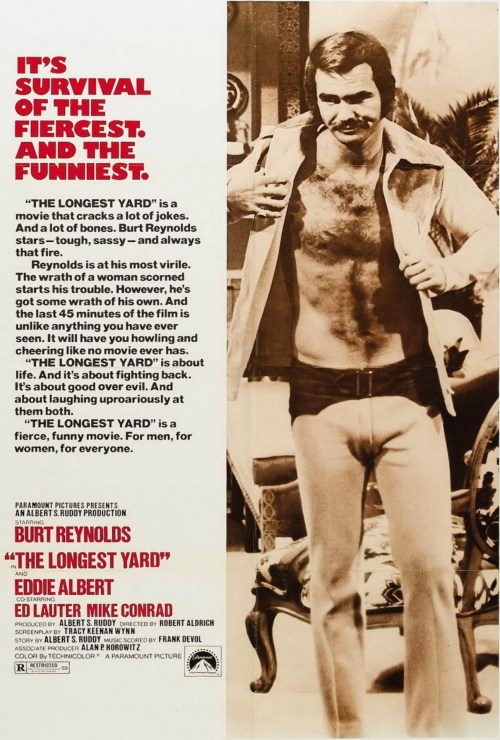
            Burt Reynolds is Paul Crewe a down-on-his-luck former professional football player who was kicked out of the league due to a point shaving scandal. After going on a long car chase with police he is thrown into the Georgia State Penitentiary where the crooked warden (Eddie Albert) tries to get him to coach the prison football team. Initially he refuses, but after some ‘convincing’ he eventually agrees to play in one game that will feature the guards versus the inmates. The prisoners use this contest as a way to get back at the guards and their brutal treatment of them while the guards approach it as a way to instill their authority.

Some consider this one of the best sports movies of all-time and I would have to agree it is up there. One of the things I liked about the movie is the way it taps into the emotional aspect of not only playing the sport, but watching it. There can be deep seated psychological reasons for why a spectator, or fan, roots for one team over the other.  The prisoners that cheer on their team use the game, as fleeting as it may be, as a sort of equalization and revenge factor to the guard’s authority and corruption. Watching the scenes showing the prisoners cheering their team as they score a touchdown is almost as emotionally charging as the action itself.  Director Robert Aldrich does a great job of using the prison setting and the game as a microcosm of 70’s society and the conflict between the counter-culture and the establishment as well as the haves and have-nots.

The game is nicely choreographed.  The hits look real and the plays are shot in a bird’s eye view just like watching an actual game on TV. The action is easy to follow and it is evident that the filmmakers have a good understanding and appreciation for the sport.  Outside of the final play that is done in slow motion there is none of the fluky, theatrical stuff thrown in that you usually see in most other films of this type. I found myself getting emotionally tied into the action even though I had seen the film many times before.

The only misgiving I had was the segment where the Richard Kiel character slams an opposing player to the ground and announces “I think I broke his fucking neck.” Of course this has become one of the film’s most popular lines and is made funnier when other players and even the game announcer repeats it several more times, but when the injured player is unable to come-to even after being given smelling salts and is carted off motionless from the field it starts to seem cruel to be laughing.

Another scene that I found surprising and had almost as much impact as the climatic contest is at the very beginning when Paul is shown arguing with his girlfriend Melissa (played by Anitra Ford one of the original models on ‘The Price is Right’ game show). She calls him a whore, which has to be the first and only time in film history that a woman has called a man that, but what is even more amazing is when he violently slaps her and knocks her to the floor.  I don’t think I can remember another time where a protagonist male character has done that to a female and yet the audience is still expected to sympathize with the male, which is interesting. The ensuing car chase is one of the better ones you’ll see and the part where he drives the car into a lake while the song ‘Saturday Night Special’ by Lynyrd Skynyrd is playing on the car’s radio and gets muffled as it goes under the water is cool.

Burt is perfect for the role. I love the glib way he delivers his lines and his laid back persona. The fact that he is an anti-hero with obvious personal flaws makes him even more fun. He seems right at home in the southern setting and filming it at an actual state prison gives the film a nice gritty subtext.

The supporting cast is unique. John Steadman as Pop, one of the prison’s oldest members, is memorable and he is the only other actor with a nose big enough to rival that of Karl Malden’s. It is nice to see Richard Kiel, one of the tallest actors you will ever see, with a speaking role.  The part where he starts to cry when he gets hit in the nose is funny.  Charles Tyner is perfectly creepy as Unger and Michael Conrad is compelling in his role as Nate Scarboro. This is also a great chance to see Bernadette Peters in an early career role as the warden’s ditzy and amorous secretary Miss Toot. She wears one of the worst looking beehive hairdos you’ll ever see although there probably isn’t a beehive hairdo that looks good anyways. Former football player Joe Kapp is good as one of the evil guards.

My Rating: 8 out of 10

Released: August 30, 1974

Runtime: 1Hour 1Minute

Rated R: (Adult Theme, Language, Violence)

Director: Robert Aldrich

Studio: Paramount

Available: VHS, DVD, Amazon Instant Video, Netflix Streaming

Johnny Be Good (1988)

By Richard Winters

My Rating: 2 out of 10

4-Word Review: College recruiters are sleazy.

            Johnny Walker (Anthony Michael Hall) is a star high school quarterback who finds that during his senior year he is being bombarded by college recruiters who try any means, legal, or otherwise, to get him to come to their school. Johnny enjoys taking advantage of it, which consists of going to their campuses and being lavished with parties, women, money, and other gifts. His girlfriend Georgia (Uma Thurman) doesn’t approve as she is afraid he may be tempted to cheat on her.

In some ways this is an interesting idea as the topic of college recruiting and some of the corruption that goes along with it has not been presented in any detailed fashion in too many other films, so it seems fresh. The film starts out as very farcical and humorous showing all these middle-aged men dressed like Herb Tarlek from WKRP in Cincinnati  slobbering over Johnny wherever he goes and promising him just about anything. The film though switches gears awkwardly. The majority of it is crude and adolescent, but then turns into a serious and preachy morality tale at the end. This uneven approach doesn’t work as the goofy comedy is so over-the-top that any attempt at seriousness is lost. It would have worked better and been more riveting had it been presented as a drama.

The comedy isn’t all that hilarious either. There are some amusing bits here and there, but most of it falls flat. Even the film’s best comic moment gets botched. It entails Johnny being lead onto a platform on the field’s fifty yard line by a recruiter’s attractive, sexy wife who tries to get him to have sex with her.  Some of the other people at the party follow them and project their antics onto the stadium’s scoreboard. Unfortunately Johnny resists and ends up running away even though I thought it would have been a lot funnier seeing them actually having sex. I suppose the filmmakers feared that audiences would not want their hero cheating on his girlfriend, but if you spend time setting up a wild scenario then you need to go for the gusto.

This also brings up another problem with the movie, which is that all the nudity, at least in the theatrical 84 minute version I saw, is cut out. Apparently there is an R-rated version available with more nudity intact, but why cut it out to begin with? This film’s sophistication level is extremely low and typically when the script consists of nothing more than crude comedy the nudity at least helps.

The third problem with the film is that the adults are portrayed as being so stupid that they seem almost inhuman. I know it became trendy during the teen movies of the 80’s to show adults and other authority figures as being clueless, unhip, and basically just plain out-of-it, but this film goes too far with it. Georgia’s parents are particularly irritating. The casting of Marshall Bell as Georgia’s overly authoritative father was a mistake as he looks and behaves too much like Paul Gleason, who plays the coach.

Hall is okay in the lead, but the part where he is sitting in his room playing on his drums even though his drumsticks never makes contact with any of them while looking at football highlights on the TV is annoying. For one thing the look on his face makes it appear that he is in some sort of trance and the scene goes on too long and then gets shown again during the end credits.

Although the part is not very demanding it is still fun to see Thurman in an early role as the girlfriend. Robert Downey Jr. is also amusing in an early role as Johnny’s best friend although he looks pudgy and out-of-shape and not in condition for playing football. His father Robert Downey Sr. appears as an investigator.

By far and away the best part in the film is Paul Gleason as the high strung coach Hisler. He plays an extension of the part that he did in The Breakfast Club   and is even more hyped-up. He steals every scene he is in and is the most memorable thing about the film and helps save it from being a complete disaster.

Legendary sports announcer Howard Cosell appears as himself in a couple of amusing cameos, which is fun, but his hand shakes so much as it is holding the telephone receiver that he is talking into that it becomes distracting. Former Chicago Bears quarterback also appears as himself, but most young football fans today probably won’t even know who he is.

My Rating: 2 out of 10

Released: March 25, 1988

Runtime: 1Hour 31Minutes (R version) 1Hour 24Minutes (PG-13 version)

Director: Bud S. Smith

Studio: Orion Pictures

Available: VHS, DVD, Netflix streaming

Semi-Tough (1977)

semi

By Richard Winters

My Rating: 7 out of 10

4-Word Review: Got to go pee.

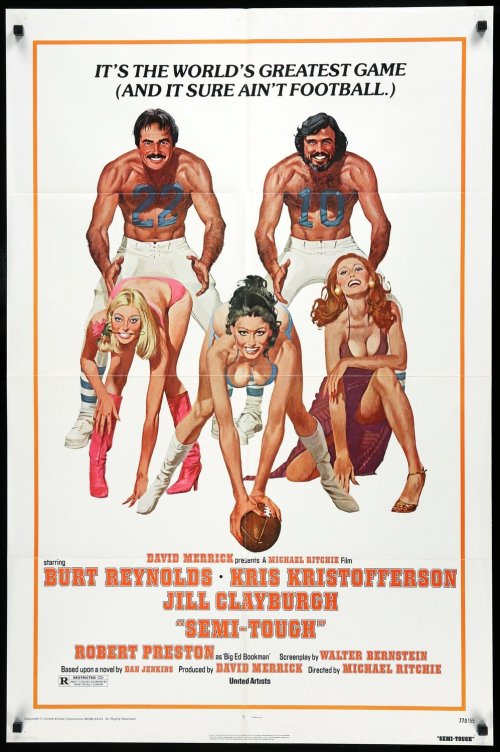
            Billy Clyde Puckett (Burt Reynolds) and Marvin Tiller (Kris Kristopherson) are two players for the Miami football team who just happened to live with the daughter of the team’s owner Barbra Jane Bookman (Jill Clayburgh). Strangely enough they do not have sexual relations and despite seeming like an odd arrangement to others the three manage to get along just fine until Marvin proposes to Barbra, which starts to make Billy jealous. Billy then spends the rest of the time trying to win her over and break-up the impending marriage.

This movie, based on the novel by Dan Jenkins, has an interesting premise, but I was disappointed that it didn’t start from the beginning when the three met and started rooming together. It certainly seemed to be an unusual set-up and I wanted more background to these characters and a history and the film doesn’t give any making it incomplete. The plot itself is a bit under-developed and at times seems to have nowhere to go. To make up for it the film delves into some odd comic scenarios that have nothing to do with the characters, or story. Some of these are interesting on their own terms while the others fall flat.

One of these segments features silent film actress Lotte Lenya in her last film appearance. Today’s audiences will know her for her outstanding performance as the villainess Rosa Klebb in the James Bond classic From Russia with Love. Her she plays a massage therapist named Clara Pelf who has some really weird and painful ideas about physical therapy. The scene seems just thrown in there for its own sake and doesn’t do much for the film as a whole, but seeing Lotte banter with Burt is a lot of fun regardless.

Another and even more bizarre segment features Bert Convy as a motivational speaker who hosts a marathon 48 hour self-help seminar, but will not allow any member of the audience to get up and go to the bathroom for the first 12 hours, which seemed too implausible even for satire. However, this scene does feature the film’s best line and quite possibly one of the best lines in film history, which occurs when one of the female members of the audience gets up and states in front of everyone “I just peed in my pants and it feels great!”

The football scenes don’t gel and in fact I wouldn’t even categorize this as a sports movie, or even a football one. For one thing director Michael Ritchie and writer Walter Bernstein didn’t seem to put much thought, or research into the sport, or how teams function. This becomes obvious in the segment where the players are shown staying up late and drinking at a bar the night before a big game and even bringing women back with them to their hotel rooms without having any type of curfew. There is another scene featuring Brian Dennehy as a big, intimidating player T.J. Lambert who dangles a woman off a roof and threatens to drop her when she does not give-in to his kinky sexual demands. He does this in front of the rest of the team who laugh it off like it is no big deal and state that he does it frequently when in reality the man would probably have a lot of lawsuits on his hands, jail time, and league suspension. It also paints big players too much as a stereotype and being nothing more than dumb out-of-control morons bordering on sociopathic.

The team logos and uniforms worn by the players during the games are unimaginative. The ones worn by the players representing the Denver team in the movie look almost exactly like the Texas Longhorns and I am almost surprised that they didn’t sue.

Burt of course is highly engaging throughout. The guy has terrific comic timing and I love the way he delivers his humorous lines. It is his presence alone that really makes this movie work. My only problem with his casting was that he was forty at the time and looking just a wee bit too old for the part. His hair also resembles a toupee and I don’t know of any player in football history who smokes a long pipe, or listens to Gene Autry records. What is worse is that he plays a lot of Gene’s records and forces the viewer to have to listen to the tunes although he makes up for it a bit with his Gene Autry quotes, which are funny.

Kristopherson as an actor has never connected with me even though I love him as a singer/songwriter. In the movies I have seen him in he always seems either half-a-sleep, or stoned. His presence and delivery is too laid back for my tastes however, the part where he is shown half-naked in bed and doing a commercial for a deodorant and then uses the product to create a mock erection is great.

Clayburgh is passable as the female lead, but I didn’t like her southern accent.  Robert Preston, who plays her father and the team owner, is okay, but his role is rather meaningless. The scene showing him crawling around on his office floor is stupid and pointless.

For some reason, despite certain flaws and an overall superficial treatment I still enjoyed this movie and found it entertaining. This is a great example of a 70’s romance with all the expected elements and clichés nicely put in place. It is also a chance to see Ron Silver in an early role as the team’s kicker who has no lines of dialogue, but ends up being a scene stealer anyways.

My Rating: 7 out of 10

Released: November 18, 1977

Runtime: 1Hour 48Minutes

Rated R

Director: Michael Ritchie

Studio: United Artists

Available: VHS, DVD (Widescreen Edition)