The Notorious Landlady (1962)

By Richard Winters

My Rating: 4 out of 10

4-Word Review: Landlady could be killer.

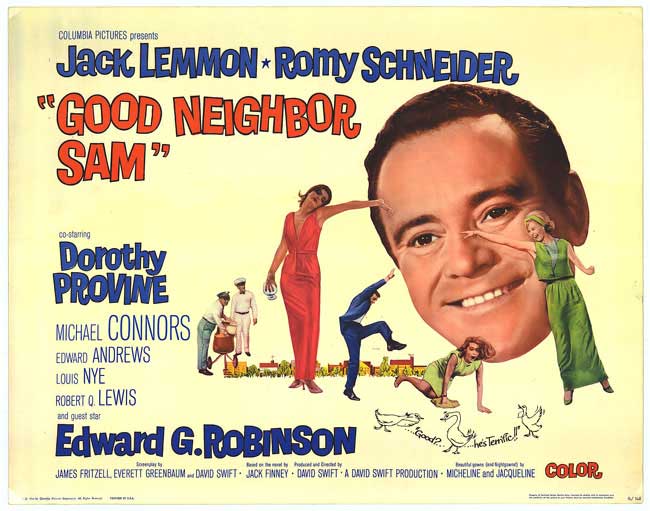
            William Gridley (Jack Lemmon) is an American who has arrived in London and looking for a place to stay. He rents a room from a home owned by Carly Hardwicke (Kim Novak) a gorgeous woman who Bill immediately becomes smitten with. The problem is that many people think Carly has killed in her husband even though his body has not been found. When Bill gets word of this he becomes determined to investigate the case and prove her innocence.

You would think a script written by Larry Gelbart and Blake Edwards would be funnier and full of zany scenarios and slapstick, but instead it gets grounded in a lot of dialogue for much of the first hour and forty-five minutes and only starts to get interesting during the final fifteen. The conversations lack any wit, or sharp one-liners, and the premise plods along at a much too leisurely pace. There is a segment where Bill accidentally sets fire to the patio, but I think this was simply thrown in for some action as there is very little else of it. The plot is formulaic and fails to add any new twist or perspective and once it is over it is easily forgettable. Lemmon’s character is bland and transparent and more than a little naïve since he falls in love with her immediately and is then convinced that she is innocent even though he has only known her for a day.

The best part comes at the very end where the two find themselves at a recital for a group of senior citizens that are all sitting in covered wheelchairs. This scene gets drawn out amusingly and includes a bit where an old lady named Mrs. Dunhill (Estelle Winwood) is pushed down the side of a hill, which is nicely captured in a silhouette style with Bill chasing after her. Winwood, who was already seventy-nine at the time, hams it up perfectly as the daffy old woman.  Of course all this comes much too late to really help the picture, or story, but at least it saves the film from being a complete bore, which it otherwise would have been.

Novak gives a surprisingly strong performance and a convincing British accent that I wish she had spoken in for the entire duration.  She was always a stunner, but here she may look her all-time best. One scene taken with her in the bathtub was highly risqué at the time and doesn’t leave much to the imagination. British character actor Lionel Jeffries is engaging as the inspector, but Fred Astaire is essentially wasted as Bill’s boss. The production values are decent, but the results are middling.

My Rating: 4 out of 10

Released: July 26, 1962

Runtime: 2Hours 3Minutes

Rated: NR (Not Rated)

Director: Richard Quine

Studio: Columbia

Available: VHS, DVD (Region 1 & 2)

Taking Off (1971)

taking off 1

By Richard Winters

My Rating: 9 out of 10

4-Word Review: Running away from home.

This is a thoroughly entertaining gem that takes a look at the early 70’s American culture through a foreigner’s eyes in this Milos Forman’s first American feature. The comedy bounces playfully from the wry, to the absurd and even the satirical without ever losing its charm.

The film examines what happens when parents Larry and Lynn Tyne (Buck Henry, Lynn Carlin) find that their daughter Jeannie (Linnea Heacock) has run away. Instead of focusing on the teen, as most films tend to do, it instead looks at the parents. It shows that the adolescent years can be as awkward for the father and mother as it is for the teen and parenting is a journey much like growing up is. I especially liked the part of the message showing how people in their forties have a need to run away and find themselves too.

The film matches its unique perspective with offbeat humor. You get to see parents smoking pot for the first time in order for them to experience what the kids go through. Another scene has them getting together for a wild game of strip poker. There are also amusing cutaways of auditioning singers, which is where the daughter runs away too. One of the singers is a sweet young thing who sings a soft melody that is laced with the word ‘fuck’ and has to be heard to be really appreciated.

Both actors who play the parents are excellent. Balding, bespectacled Henry fits the mold as the overworked, henpecked father/husband quite well and it is fun to see him display isolated moments of unexpected rebellion. Carlin conveys a nice characterization of an overwrought mother who wants to communicate with her daughter, but has no idea how.

Jeannie is the one we learn the least about, which is actually to the film’s benefit. This isn’t just the Tyne’s daughter, it’s everybody’s daughter complete with all the trials and tribulations that every parent goes through with their teen. In fact the film’s most definitive moment is probably the freeze-frame shot of disdain on the daughter’s face as her parents try to entertain her and her boyfriend with a song from ‘their’ generation. It’s the type of look that defines the parent/teenager relationship no matter if it’s today, tomorrow, or a hundred years from now, which may help to make it accessible to today’s viewers despite an overabundance of early 70’s period flavor.

Characters actors Audra Lindley, Paul Benedict, and Vincent Schiavelli are terrific in support. This also marked the film debuts of Georgia Engel and Kathy Bates. Ike and Tina Turner appear as themselves.

My Rating: 9 out of 10

Released: March 28, 1971

Runtime: 1Hour 33Minutes

Rated R (Language, Adult Theme, Brief Nudity)

Director: Milos Foreman

Studio: Universal

Available: DVD (Region 2)

Planes, Trains & Automobiles (1987)

planes

By Richard Winters

My Rating: 6 out of 10

4-Word Review: Thanksgiving on the road.

This movie’s plot, which is threadbare , deals with a middle-aged businessman named Neal Page (Steve Martin) who is trying desperately to get home to Chicago to celebrate the Thanksgiving holiday with his family. During his trip he inadvertently meets Del Griffith (John Candy) an overweight, slightly obnoxious shower curtain hanger salesman. Neal initially cannot stand the man, but is forced to sit with him through his plane flight when he is not able to get the first class seat that he had reserved. Unfortunately due to a snowstorm their flight is rerouted to Wichita, Kansas and the two men find themselves paired together again as they try any means of transportation possible to get themselves to the Windy City. Along the way they begrudgingly start up a friendship.

Martin is okay as the exasperated businessman. This film marked a transition for him as he was now moving away from roles where he played clownish, vapid, but lovable idiots and more into crusty and curmudgeon middle-aged men. He is basically used for his annoyed reactions at all of Candy’s crazy antics and for that part he is fine, but there are a wide assortment of other actors that could have played the part just as well if not better. Martin at times still goes back to some of his old shtick like the dopey way he puts on a clenched teeth grin when he is trying to run real fast, which I never found to be particularly funny when he was doing it way back with skits on Saturday Night Live and still don’t find it funny when he continues to do it now.

Candy is by far the best thing about the film and ends up saving the movie from being an uninspired, goofy mess. The character does at times border on being a caricature, but fortunately writer-director John Hughes pulls back just enough to let you see him as a real person. He does indeed have some laugh-out-loud moments. I chuckled at the way he tries to clear his throat when the two men are stuck in a motel room together. The part where he manages to get both his coat sleeves stuck on some car seat levers and he is forced to drive the car with his two legs is hilarious. I also liked the way he gyrates to a Ray Charles song that he listens to while driving and the conversation that he has with a policeman (Michael Mckean) when their burned out shell of a car gets pulled over is a classic.  I thought the idea of having him be a salesman for shower curtain hangers hit just the right note of absurdity and the fact that he carries around a little box displaying all the different types of hangers he has was novel. The only thing I didn’t like about the character is that at the end we find out that he is somehow rendered homeless simply because his wife died 8 years before. This doesn’t make a lot of sense, for one thing he seemed to have a lot of success selling his merchandise, so I’m sure he had money and for another thing there are many men and women whose spouses end up dying, but that doesn’t mean they no longer have a home to go to. To me it just ends up being a cheap excuse for a sloppy sentiment and it should have been avoided.

The late John Hughes’s writing and directing leaves a lot to be desired especially for the sophisticated viewer. The humor that is used is extremely broad and many times downright cartoonish. He seems to be either not confident in himself as a filmmaker, or in the intelligence of his audience to ever be subtle and subdued, but it would have been nice if a little bit of that had been thrown in. He also uses way too many poor plot devices that are simply used to propel the paper-thin story along and would be considered hack writing at most and something that a third grader could come up with. For instance why does the engine of train that the two men are riding in suddenly break down? No logical explanation is given and what are the odds of that happening as well as having Neal’s rental car missing when all the rest of the cars are there. There is also the cab driver named Wolf who decorates his cab with all sorts of pornographic pictures and other provocative ornaments, which is at first funny until you realize that he supposedly works in Wichita, which is a small conservative city and no one would be riding his cab for long and he would be out of business. If there is no truth to the joke then the joke will fail, which it does here. The same goes for the crude, gross, and very hick pick-up truck driver that relies way too heavily on stereotypes and seems to be put in solely as filler.

I did like the fact that it was filmed on-location as the stark wintry like landscapes does indeed put the viewer in the holiday frame of mind. I also liked the fact that for the most part real snow is used. I was born and raised in Minnesota and I can spot the fake stuff right away and I always find it annoying. I liked that many performers from Ferris Bueller’s Day Off appear in brief cameos including: Ben Stein and Edie McClurg although it would have been nice if they were given a little more to do. Kevin Bacon also appears as does William Windom who is amusing as a one of Neal’s clients who can’t decide on what photo layout to use. I was disappointed that he wasn’t given any lines of dialogue, but the fact that he does reappear at the very end after the credits  makes up for it a bit. I also must mention the burned-out skeleton car that the two men drive in, which is the damnedest looking thing since the bus filled with bullet holes in The Gauntlet.

The music score is awful. It has too much of that tinny, synthesized 80’s sound that is unoriginal and does not fit the mood, or tone of the picture in any way. It also gets overplayed in certain scenes and hurts the film’s overall enjoyment.

I would say this movie would be great for the whole family as it does rely a lot on the broad, fast paced humor that most kids love. However, there is one scene where Martin goes into a long, F-word laden rant with McClurg when he can’t find his rental car. The rant in itself is funny, but some might say it is not appropriate for children. Of course these days I have heard kids as young as six, or seven using the word and I have also heard it used just in casual conversation by people I pass by while walking the streets of Indianapolis, so trying to shield the child from it may be futile and they will all sooner or later hear it in abundance anyways.

My Rating: 6 out of 10

Released: November 25, 1987

Runtime: 1Hour 33Minutes

Rated PG: (Adult Language, Crude Humor)

Director: John Hughes

Studio: Paramount

Available: VHS, DVD, Blu-ray, Amazon Instant Video

Seance on a Wet Afternoon (1964)

seance on a wet afternoon

By Richard Winters

My Rating: 6 out of 10

4-Word Review: Psychic is a phoney.

Myra Savage (Kim Stanley) is an emotionally unbalanced woman and failed psychic who comes up with an idea that she hopes will revive her career. The plan is for her husband Billy (Richard Attenborough) to kidnap Amanda Clayton (Judith Donner) who is the young daughter of a rich businessman. They will then place her at a strategic location and hold a public séance at which time Myra will ‘miraculously’ predict her whereabouts. This will then, they hope, make her famous and world renowned, but of course things don’t work out as expected.

This is indeed a unique and unusual film that taps into some rare qualities. First and foremost is the black and white cinematography. Every camera shot and angle has a certain evocative flair that is well captured and vivid. The on-location shots pick up just the right amount of ambiance and lighting with each setting. The music score is great and helps create excellent tension. You also will love the little girl that they kidnap. She is adorable without it being forced. Her matter-of-fact sensibilities are a great contrast to Attenborough and Stanley whose characters are child-like and pathetic.

Yet the film doesn’t completely work. The story is handled in a plodding and methodical way without any twists or surprises. There is very little action, some definite slow spots and the conclusion is limp.

If you watch it for the performances then you will be more intrigued. Stage actress Stanley gives a rare film appearance here. It is easy to see why she took the role even though she was known to dislike doing films. The takes are long and give almost unlimited possibilities in creating a character, which is what all stage actors enjoy. She does well and at times may remind one of another legendary actress Geraldine Page who would have also been perfect for the part. Attenborough proves almost her equal. His expressions of shock and worry are memorable. The interplay between the two is fun especially towards the end when this otherwise passive man stands up to the domineering woman.

Overall there are some unique moments, but it is just not suspenseful enough and results in being only slightly above average.

My Rating: 6 out of 10

Released: November 5, 1964

Runtime: 1Hour 55Minutes

Rating: NR (Not Rated)

Director: Bryan Forbes

Studio: Artixo Productions

Available: VHS, DVD (Region 1 & 2)

The Bliss of Mrs. Blossom (1968)

By Richard Winters

My Rating: 6 out of 10

4-Word Review: Lover in the attic.

This wacky film nicely exudes the mod, experimental wave of filmmaking that permeated the era of the late 60’s. The story takes place in London and is about a clothing manufacturer’s wife named Harriet Blossom (Shirley MacLaine) who one day calls her husband Robert (Richard Attenborough) while he is at work to tell him that her sewing machine has broken down. Robert sends his lowly assistant Ambrose Tuttle (James Booth) over to their house to help her fix it. Harriet is a bit bored with life and feels neglected by her husband, so she not so subtly seduces Ambrose and then hides him in the attic where he soon takes up residence.  He comes out only when Robert is away, but the unexplained strange noises that Robert hears and the many close calls make him think he is going insane and leads him to a nervous breakdown.

Director Joseph McGrath’s highly visual style is the real star. The lighting, editing, camera angles, set design, and costumes are creative and imaginative.  The home that was chosen for the setting has a nice architectural flair especially the attic and billiards room, which seems to be draped by a large stain glass window. Certain film professors show this movie to their classes as an example of how stylish direction can help accentuate a story as well as deftly define its era. I was disappointed to see that although McGrath is still alive he hasn’t done a film since 1984, which is a shame as it is obvious from this that he is quite gifted and I would have liked to see him doing more.

This is generally considered a vehicle for MacLaine, but to me her performance isn’t interesting. I think she is a first rate actress, but her character here is the only normal one in the film and she acts more like an anchor trying to corral the craziness around her. Booth, as her lover, goes to the other extreme, but doesn’t fare any better. He is too clownish and is always wearing various disguises and going through different personas, which makes the character unrealistic and cartoonish. If anything, out of the three main leads, it is actually Attenborough who does the best. His nervous and confused facial expressions are priceless. The scenes were he comes home from work and to ‘unwind’ pretends to be a conductor of a large orchestra while listening to a loud record, is amusing.

The colorful supporting cast though, full of legendary British Pros, is what steals the film. Some of them appear just briefly, but they still make a memorable and funny impression. Barry Humphries, playing a male character and not Dame Edna, is good as an art dealer. John Cleese, in one of his very first roles, is engaging as an argumentative postal clerk.  The best however is far and away Freddie Jones as the snippy, suspicious, relentless detective that will leave no stone unturned in his pursuit of Ambrose, who once he moves into Harriet’s attic proceeds to completely drop of society and disappear.

Although generally entertaining the plot doesn’t go anywhere and is simply a set-up for a lot of absurdity. What is worse is the fact that this based on a true story that in its own right was very intriguing.  In the real-life incident that took place in 1913 a 33 year old woman by the name of Dolly Oesterreich met a 17 year old named Otto Sanhuber. She, like the character in the movie, was a bored wife of a wealthy textile manufacturer, and took in the young man as her ‘sex slave’, which he readily accepted. To avoid possible suspicion she had him move into their attic, where he remained for five years and despite some close calls was never caught.  When the Oesterreich’s moved to Los Angeles in 1918 Dolly made sure that their new home had an attic as well and Otto then took up residence there and the deception continued until 1920 when Otto finally ended up killing the husband.

Of course none of that happens here. In fact Ambrose is fond of the husband and considers the three to be one big happy ‘family’, which is offbeat for sure, but not particularly satisfying. Again, this film does have some funny moments. I thought the scene where Robert invents the world’s first inflatable bra only to have the system go awry during an exhibition, which forces the model’s breasts to grow to unbelievable proportions before they go floating in the air, to be hilarious.  Still the end result of this production can best be described as cinematic soufflé.

My Rating: 6 out of 10

Released: September 11, 1968

Runtime: 1Hour 33Minutes

Rating: NR (Not Rated)

Director: Joseph McGrath

Studio: Paramount

Available: VHS

SSSSSSS (1973)

ssss

By Richard Winters

My Rating: 6 out of 10

4-Word Review: Man turns into snake.

            Dr. Carl Stoner (Strother Martin) hires a college student named David Blake (Dirk Benedict) to work as his lab assistant on his research of snakes. David also finds himself attracted to the Dr.’s daughter Kristina who also works with her father on his research. However, unbeknownst to both of them the kindly Dr. has come up with a serum that can change a man, over the course of several weeks, into a king cobra snake.

Although clearly done on a limited budget, this film really impressed me in a few areas. The first was that the actors performed with actual snakes. The snake handling that Martin did was simply amazing. I found myself captivated in one scene where he takes a live Black Mamba out of its cage and grab its head and then force feeds it through a special type of mechanical tube. Another scene has him taking a King Cobra out of its cage where, while in front of a viewing audience, he is able to grab its head and make it secrete its venom into a jar. To top that off the film climaxes with a mongoose attacking and killing a cobra, which is quite violent. I almost wished that this had simply been done as a nature documentary as it could have been just as frightening and fascinating. The chilling throaty sounds that the King Cobra makes, which is all perfectly natural, would be enough to scare most people. There is even a segment where actor Reb Brown gets bitten by a snake on his foot and it is done in slow motion.

Another thing that was impressive was the make-up effects done by John Chambers. Benedict really starts to look like a snake and the final transformation is incredible.

The areas were the film is limited is in the horror portion itself. For one thing it takes too long to get going. The metamorphosis doesn’t start to get interesting until the final fifteen minutes.  The David character seems much too passive and trusting as he allows the Dr. to continue to inject him with the fluid even after he starts to have weird side-effects. The Dr. character is not menacing, or creepy enough to be scary.  For most of the movie he seemed pretty cool and I found it hard to cheer against anyone who is able and willing to handle snakes the way he does. The music is another problem as it is too soft and melodic without the jarring and foreboding undertones that is needed to help accentuate the tension. The setting is bland we get no sense of the locale outside of the Dr.’s residence, which looks too much like a studio back lot. The entire production has a cheap TV-movie quality and it is photographed in a flat, unimaginative way.

The side-story involving the budding romance between David and Kristina is uninteresting and unnecessary. The segment where the two go skinny dipping and their genitals are strategically covered by trees and plants at every conceivable camera angle looks cheesy.

            If you are into snakes, or make-up used for special effects, then you may find this film satisfying.

My Rating: 6 out of 10

Released: July 2, 1973

Runtime: 1Hour 38Minutes

Director: Bernard L. Kowalski

Rated PG

Studio: Universal

Available: DVD, VHS

Venom (1982)

By Richard Winters

My Rating: 3 out of 10

4-Word Review: Kidnappers versus deadly snake.

            Phillip Hopkins (Lance Holcomb) is an 8-year old boy and son of a wealthy couple. When his parents leave for a trip the family’s maid and chauffeur (Susan George, Oliver Reed) conspire to kidnap the boy and hold him for a ransom with the help of a ruthless gunman (Klaus Kinski).  Unbeknownst to any of them the boy has mistakenly acquired a black mamba snake that escapes from his cage. As the culprits try to pull off their crime they become trapped in the house by the deadly reptile that starts to attack them one-by-one.

For starters the cast is one of a kind. Besides the performers listed above the film also has Sarah Miles as a Dr. with a serum to help fight the snake’s poisonous venom. Nicol Williamson appears as the police negotiator and Sterling Hayden, in his last film role, plays the boy’s grandfather.  How anyone could manage to direct a cast with such legendarily huge egos and eccentric personalities seems hard to fathom and probably explains why original director Tobe Hooper left the production after only ten days of shooting and was replaced by Piers Haggard. Supposedly Reed and Kinski were at odds with each other during the entire production and their animosity clearly shows on screen. For the most part the talents of the cast is wasted with a script that is limited and filled with characterizations that allow for no range.

I did like Hayden in the scene where he is forced to go searching for the snake in a darkened room and armed with nothing more than a lamp and a makeshift weapon. George is also fun playing a duplicitous character for a change and I was disappointed that she gets killed off so soon. However, she does make the most of it with a very theatrical death scene. Probably the best performance in the whole film is that of the boy. He has a very sweet, young looking face and the widest most innocent pair of blue eyes you’ll ever see and the kind that most casting directors would kill for. The kid plays the frightened part well and does an effective asthma attack. He hasn’t done much since, but I am sure that if he wrote a book dealing with his experiences on the set and his interactions with that cast that if would most assuredly be a best-seller.

The set-up is good and I found myself riveted to it for the first half-hour. I liked the idea that an actual mamba snake was used. There is a part where the snake is slithering towards the camera and opens its wide, black mouth and hisses straight at the camera, which could be enough to get most viewers to jump out of their seat. Director Haggard uses the novel idea of shooting scenes from the snake’s point-of-view and he does it through a fuzzy and slightly distorted lens to help replicate the snake’s vision. The only problem I had in this area is that the snake is seen slithering throughout the picture inside the home’s venting system, which is shown to be very clean and spotless, which didn’t make sense to me since the home was old making me think that the metal piping would be more corroded and rusted.

Despite the excellent concept the film’s second hour is quite boring. The characters don’t have enough to do and spend most of the time standing around. The interplay between Kinski and Williamson brings no tension. There is one cringe inducing scene where the snake crawls up Reed’s pant leg, but overall the scares are quite sparse. The climatic sequence is too convenient and becomes more of a disappointment then a shock. It is hard to say if the film would have been better if Hooper had stayed on or not. Reportedly none of the footage that he shot is in the final cut. The film is based on a novel by Alan Scholefield, which I suspect is probably more intriguing and after watching this makes me interested in reading it.

My Rating: 3 out of 10

Released: January 29, 1982

Runtime: 1Hour 33Minutes

Rated R (Mature Theme, Violence, Language) 

Studio: Paramount

Director: Piers Haggard

Available: DVD

Midnight Run (1988)

By Richard Winters

My Rating: 8 out of 10

4-Word Review: Chased by the mob.

Jack Walsh (Robert De Niro) is a bounty hunter that is looking to get into a less stressful profession. He is offered 100,000 to find bail jumper Jonathan Mardukas (Charles Grodin) who worked as an accountant for the mob and skimmed 15 million from them. Jack thinks he can use the money to open up a coffee shop, but finds that the FBI is in hot pursuit of Mardukas as well. There is also rival bounty hunter Marvin Dorfler (John Ashton) who wants his hands on Mardukas and the money. Jack even finds himself chased by the mob looking to silence Mardukas before he can turn states evidence.

The catalyst of the film is the relationship between Jack and Jonathan and how it slowly turns into an unusual friendship during their long adventure. Both Grodin and De Niro have diametrically opposite personalities and acting styles, which is why this thing really works. The relationship ebbs and flows on the antagonistic level most of the time and the friendship really doesn’t build until the very end and even then it is tenuous, which is nice.  Too many times in ‘buddy’ movies such as this the sentiment becomes forced, but fortunately here it is very balanced and their interactions believable throughout.

Grodin was an inspired choice. I have always thought the guy to be a very talented, underappreciated, and unique comic performer. However, he was not a big name star and the studio heads originally wanted Robin Williams for the role and then even considered changing the sex of the Mardukas character to female and having Cher play the part, but director Martin Brest liked Grodin’s style during his audition and held out until he got him even though it meant losing the backing of Paramount and forcing them to go with Universal.

Grodin adds a lot that the other two stars, as very talented as they are, just wouldn’t be able to do.  One is a completely improvised conversation that he has with the De Niro character while they are stuck inside a train car, which is the one scene from this film that I remember most clearly from having first seen it over twenty years ago. There is another improvised scene involving Mardukas and Jack pretending to be FBI agents and going into a local bar looking for counterfeit bills that makes great use of Grodin’s sardonic humor and deadpan delivery.

John Ashton is a riot as Marvin the rival and slightly dim-witted bounty hunter. He is so over-the-top obnoxious and crude that you can’t help but laugh at it. He takes the caricature of the tough, brash, gruff, blue collar Chicagoan to a hilarious extreme. He is like legendary football coach Mike Ditka on speed. Denis Farina, as the mob boss, is also good as is Joe Pantiliano as the frantic bail bondsmen.

Another thing that makes this movie so successful is that it is able to work on three different levels in a very cerebral way. Not only is it a very good comedy and character study, but it’s not half bad with the action either. The best sequence here is when the two men get swept away by a strong river current, which has the actual actors doing most of the stunts.

Of course the script, by George Gallo, does have a few holes and implausibility’s that can’t avoid being mentioned since some of them are integral to the main plot. The biggest one is when Marvin, in an attempt to impede Jack and find his whereabouts, gets on the phone with Jack’s credit card company and identifies himself as Jack and is able to easily find out where the card was last used and have it cut off. However, with every credit card company I have worked with I am forced to give some more identification before I am given any information including my social security number, a secret word or phrase, or a PIN and yet here Marvin isn’t required to give any of that. There is also that fact that when Jack finds out that his credit card is being rejected he doesn’t just get on the phone with his credit card company and get it straightened out, which is what anyone else would do.

There is also a segment where Jack is somehow able to fleece the FBI badge from agent Alonzo Mosely (Yaphet Kotto), which Jack then uses to impersonate him with during his trip with Mardukas. However, this just would not have been possible as the two men met only briefly inside a car with Alonzo sitting in front and Jack in back scrunched between two other agents who keep a close eye on him. The FBI has also been searching for Mardukas for six years and yet Jack is able to find him easily, which to me seemed too convenient.

The excessive swearing is another issue. Yes, sometimes cursing can help build the grittiness of the characters, but here it goes overboard. Officially the word ‘Fuck’, or a variation of it, gets said a total of 119 times, but I was convinced it was more than that. Its overuse is so redundant that it almost becomes a distraction.

            All things considered this is still a winner. This is one of my favorite De Niro roles and in my opinion his best foray into comedy as I feel his work in the Meet the Parents series is generally wasted. There is also an emotionally strong scene when Jack goes back briefly to visit with his ex-wife and fourteen year old daughter. Normally these types of scenes end up being clichéd, but here it really hits the mark, especially Jack’s interactions with his daughter.

My Rating: 8 out of 10

Released: July 20, 1988

Runtime: 2Hours 6Minutes

Studio: Universal

Rated R (Language)

Director: Martin Brest

Available: DVD, HDDVD, VHS, Amazon Instant Video 

Lady in Cement (1968)


My Rating: 4 out of 10

4-Word Review: Tony solves the case.

Frank Sinatra returns as detective Tony Rome in this sequel to the 1967 hit. Here, while going on a diving expedition off the coast of Florida, he finds a naked woman underwater with her feet encased in cement.  He then meets a large and mysterious man by the name of Gronski (Dan Blocker) who hires him to find the girl’s killer, but he is not so sure that Gronski himself may have something to do with it.

            One of the things I really liked about the film as well as in the first one is the very cynical, world-weary, streetwise nature of the detective character. It seems to be a part that Sinatra was born to play and he does it well. I don’t think it was too far off from Sinatra’s real personality, which is why it works. I loved the cryptic dialogue and snappy one-liners. The banter is fun and intoxicating. It was the best thing about the first film and continues to be the case in this one. If anything it is the one thing that really carries it.

            The mystery itself is dull.  In the first film the case was more intriguing and complex. Here it seems mechanical and uninspired. It gets played out in a formulaic way with the standard suspects that seem borrowed from other, better stories. The twists and turns aren’t exciting, or surprising. The movie is more concerned with being amusing and filled with hip banter making the case itself seem like a side-light and not allowing the story to move forward. Yes, the bickering is fun, but there still needs to be a plot to match it and that was not the case here. The suspense is lacking with a final denouncement that is nothing special. The climatic fight sequence is particularly clichéd and forced.

            The opening bit where Tony finds the dead woman underwater is poor as well. It happens right away with no build-up even though I felt one was needed. I would think if a dead person had been trapped underwater for any period of time there would be some discoloration and decay. Instead the woman looks gorgeous, wearing a provocative expression one would find on an erotic model. Her skin is unblemished and she even still has her lipstick and make-up on, which I thought was unrealistic and pretty much ruins the story’s validity before it even gets going.

            The presence of actor Dan Blocker is a major asset and helps the film’s appeal. Blocker was probably better known for playing the character Hoss in the hit TV-series ‘Bonanza’. The fight sequences that he is in are amusing because he can simply throw the other men around like they are toys and seems unstoppable in the process. Like in the TV-series he exudes a lot of charm and is very engaging. There is even a brief in-joke where he is sitting in his room watching an episode of ‘Bonanza’. He and Sinatra make an unlikely, but interesting pair although when shown together he does make Frankie look puny, out of shape, and even a bit washed-up by comparison.

            One of the biggest issues I had with the first film was that there were a lot of loopholes. Particularly one scene where Tony kills a man and then he glibly tells the police that it was ‘clearly self-defense’ and he is never brought in for questioning, or arrested. That just didn’t jibe with me as there are many cases where a person kills someone in self-defense, but the case still ends up being brought to trial. Tony is very good friends with the police chief (Richard Conte), but I still didn’t think that would make him untouchable. At least here when Tony gets framed for a murder the police tell him they are going to have to take him in, which seems more plausible.  This culminates into an extended car chase sequence, which due to the long edits, slow speeds, bird’s eye view camera shots, and laid-back music, make it one of the least riveting and most uninteresting car chases you’ll ever see.

The production values are high and I have no real complaint on it from a technical stand point.  Everything is slickly handled despite a weak story.  There are some strong homophobic undertones, which may offend some, but I felt it fit the era. If you like Sinatra then you will find this passable, but if you enjoy a good mystery then don’t bother because in that area this thing falls flat.

My Rating: 4 out of 10

Released: November 20, 1968

Runtime: 1Hour 33Minutes

Director: Gordon Douglas

Studio: 20th Century Fox

Available: VHS, DVD

The Detective (1968)

detective

By Richard Winters

My Rating: 8 out of 10

4-Word Review: Up against the system.

Many people may not realize that Frank Sinatra was the original choice of Harry Callahan for Dirty Harry.  Due to various reasons he turned down the part despite the fact that he was interested.  You can’t help but wonder what that film might have been like had he accepted.  A good indication may be the character of detective Joe Leland that he plays hereIt has a similar theme of a tough cop tired of ‘the system’ and breaking off on his own to solve a bizarre case.

The murder itself is particularly gruesome and ahead of its time as it deals with the killing of a gay man found nude on the floor of his apartment with his genitals cut off. The actual shot of the victim is conveniently framed so that a fern, yes a fern, is strategically placed over the offending area, which is a little corny.  Yet the dialogue and description of the case seems incredibly graphic for the time. Ol’ Blue Eyes even says the word penis, which I think has to be a movie history first.

The way it deals with the homosexual topic is also surprisingly enlightening. Gays are not labeled as ‘sick’ and ‘perverse’, at least not by the Leland character. In one good bit the Sinatra character even slugs another officer, played by Robert Duvall, in retaliation for getting  rough with a gay man that he was questioning for no apparent reason except that he was gay.

There is another electrifying sequence involving Leland questioning the victim’s live-in lover and chief suspect. The part is well played by actor Tony Musante who gives his character all sorts of weird body gestures and nervous ticks, which makes the viewer feel uneasy but still compelled to keep watching until it becomes a fascinating experience. The Leland character again shows an amazing amount of compassion and enlightenment for the gay lifestyle during the interrogation, which should be enough to give this film a landmark status.

However, for all of its apparent sophistication, there are also things that hold it back and make it dated. One is reverting to what was a trend in the 40’s and 50’s, which was to film a person driving their car while sitting in front of a blue screen and holding onto a steering wheel that is not connected to any dashboard. It was considered a ‘ingenious’ way to stay under budget and not having to go through the ordeal of mounting a camera onto an actual car, but for today’s sharp audiences it comes off looking obvious and cheesy.

The casting of Sinatra is another drawback. He was already 53 at the time and he looked it.  The part seems to be screaming for a younger, more rugged method type of actor like Steve McQueen or Paul Newman, who would have done better.  Sinatra overplays the tough guy thing too much until it becomes one-dimensional and boring. The character needed more personal quirks and odd habits in order to make him more filled out and interesting.  He also wears outfits worn by the ‘old school’ investigators of yesteryear even though the character is one looking to break from tradition and fighting the mainstream.

I also wasn’t quite sure why Lee Remick’s role as Sinatra’s love interest was necessary. I usually dislike it when crime dramas feel the need to work in a romance angle as a side story because it usually bogs everything down and in this case was no different. Now Remick is always reliable and her character was interestingly flawed, but how that was supposed to connect with everything else was not clear.

The story works in three different parts. The first deals with the murder and the homosexual community of the period.  The second analyzes the politics of the police department while the third involves a mysterious suicide of a successful businessman. The third part, which doesn’t start until the second hour of the film, was the most intriguing for me. The suicide is shown from the point-of-view of the victim. They literally took a camera and heaved it over the edge of a building until it crashes directly onto the pavement below, which actually made me flinch. It is not until the very end where you see how all three of these parts come together, but the twist is excellent and made viewing this film well worthwhile.

Overall the cinematography, editing, writing, directing, and supporting acting are first rate.  There are a lot of familiar faces in supporting roles including: Jack Klugman, William Windom, Lloyd Bochner, Jacqueline Bisset, Horace McMahon and Al Freeman Jr. They all do splendidly. The subject matter and the way it is handled easily elevates this from other melodramas of the period.  The resolution should make this entertaining even for today’s viewers and enough to overlook a few dated elements.

My Rating: 8 out of 10

Released: May 28, 1968

Runtime: 1Hour 54Minutes

Rated R

Director: Gordon Douglas

Studio: 20th Century Fox

Available: VHS, DVD