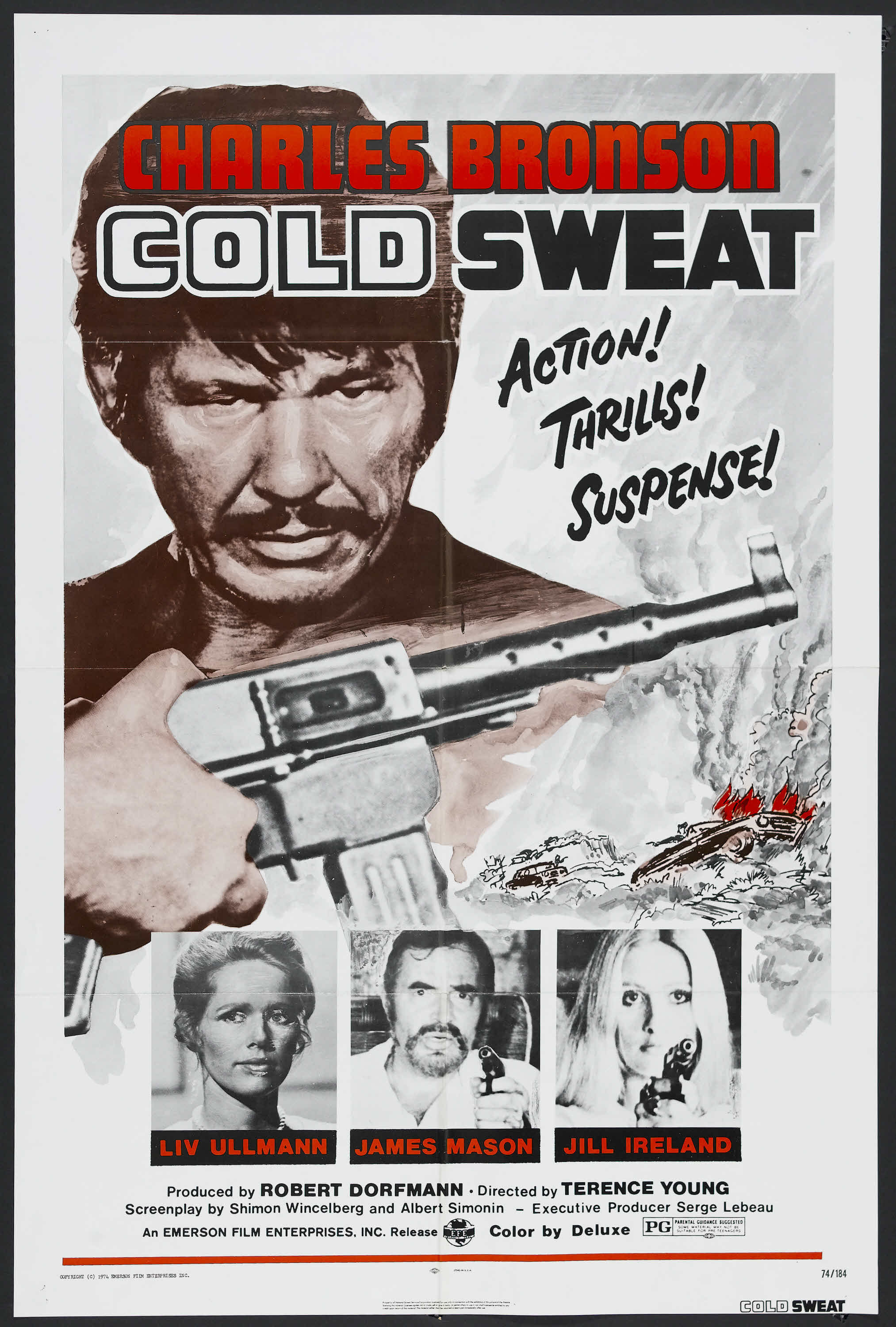
Cold Sweat (1970)

cold sweat

By Richard Winters

My Rating: 7 out of 10

4-Word Review: Chuck won’t be intimidated.

Joe Martin (Charles Bronson) is a man living with a past. Ten years earlier he was part of a prison break led by corrupt Captain Ross (James Mason). Joe was selected as the getaway driver, but after he witnesses one of them kill a police man he decides to drive off with the car and strand the others. Now he is living the quiet life in the south of France with his new wife Fabienne (Liv Ullmann) and her daughter Michele (Yannick Delulle), but as he starts to settle into his new lifestyle he finds that the old gang has tracked him down. They want him to be the boat driver in a drug deal they have planned and they won’t take ‘no’ for an answer. Fabienne and her daughter Michele are brought along for collateral, but Joe has a trick up his sleeve and instead kidnaps Ross’s girlfriend Moira (Jill Ireland) and puts her in an isolated cabin and when all parties converge onto the place is when the tensions and action boils over.

This is a simple film with the most basic of storylines. The characterizations are standard with no gray areas in-between. The good guys are really good and the bad guys really bad and nothing is ever nebulous as the tried and true formula gets followed from beginning to end. However, I liked it. Sometimes it is nice to have a film that isn’t trying to reinvent the genre and does things in a compact, crackling non-think style where the viewer can sit back and enjoy an old fashioned white knuckler without having to be challenged. After a slightly awkward start the film begins to roll and then never lets up. Chuck puts his gruff, stoic caricature to the hilt here helping propel the viewer emotionally into the action as he finds increasingly novel ways to overpower the baddies just as the odds look stacked against him.

Having him married to Ullmann was offbeat casting, but it works. Ullmann who has quite possibly one of the most expressive faces in all of cinema seems game for the proceedings. It was nice seeing her in something different than a brooding Ingmar Bergman drama. She gets right into the fray and becomes an integral part of the story and succeeds quite well.

The always reliable and many times brilliant Mason sports an American accent and its fun. He also takes part in a great death scene that gets amazingly prolonged until his increasingly pale complexion becomes genuinely disturbing.

Ireland shows flair as a jaded hippie type. Her and Chuck’s sparring clicks and casting the real-life couple as characters with animosity for the other is cute. I just wished that director Terence Young had played it up more and given Ireland more screen time.

Having the second half of the film take place almost exclusively at an isolated locale gives the picture added personality, but what impressed me the most was the action. In particular was a car chase along the long, winding French roads. I know the car chases in Bullitt and The French Connection get the honors for having the best and most famous chase sequences, but the one here comes amazingly close. I found myself turning uncomfortably in my seat as Chuck’s car travels each curve at high speeds and when he takes the auto off the road and onto the rugged terrain I was out of breath. The foot chase between Fabienne and her daughter and one of the lone gunmen along the ragged, rocky landscape is equally exciting and well captured at different angles.

This one is sure to please Bronson fans as it has all the ingredients his films are known for. My only complaint is with the DVD transfer available on Amazon Instant. Normally I love the way Amazon has made available films that are hard or even impossible to find and most of the time picture quality is decent to good, but here it looks like someone’s old home movie with a color that is faded and at certain spots completely washed out. It also very grainy and looks like it was taken from an old film stock, or lost VHS tape. The less than ideal presentation unfairly taints what is otherwise a solid production that deserves a much better looking reissue.

My Rating: 7 out of 10

Released: December 18, 1970

Runtime: 1Hour 34Minutes

Rated PG

Director: Terence Young

Studio: Fair Film

Available: DVD, Amazon Instant Video
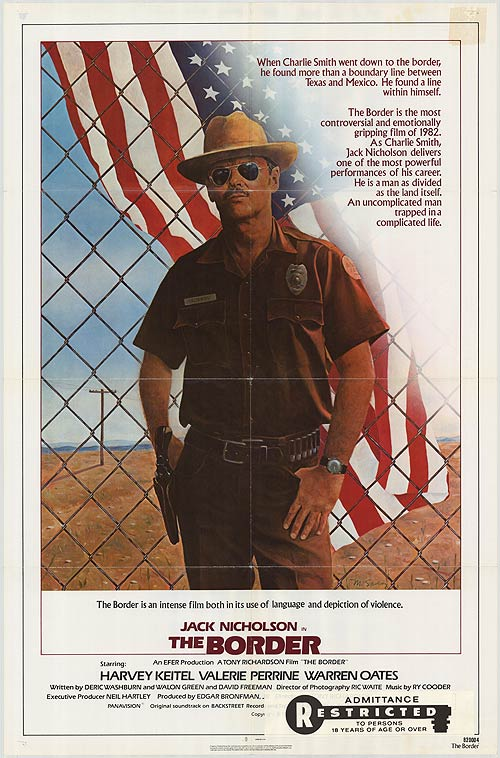
The Border (1982)

border

By Richard Winters

My Rating: 8 out of 10

4-Word Review: Border patrol isn’t easy.

Charlie Smith (Jack Nicholson) is a guard new to the border patrol who must learn to deal with the ugly realities that come along with his profession including becoming more and more pressured to get involved with the corruption that goes on there.

This is a stark presentation with an authentic atmosphere that at times makes it seem like a documentary. The viewer becomes submerged in this intelligent study on a serious and important issue with a result that is nothing short of enlightening. Unlike most other Hollywood movies nothing is over-the-top or melodramatic. It doesn’t try for shock value nor resort to clichés. The narrative is straightforward and uncompromising while offering no easy answers or annoyingly false wrap-ups.

Director Tony Richardson takes an expectedly humanistic approach and yet doesn’t seem inclined to push any type of agenda. This film has a look and feel different from any of his other films. He is known primarily for his wacky comedies (Tom Jones, The Loved One) and yet this film is grainy and grim. Much of that is due to the excellent use of natural lighting. This film has a very serious tone throughout and yet for some reason doesn’t end up being oppressive like some of those other ‘important’ pictures. It is also well paced with a riveting and compelling finish.

Nicholson gives a sensitive and sincere performance and a rare turn seeing him underplay everything. Valerie Perrine is very good as his wife and having her spend lavishly while oblivious to the poverty around her makes for interesting insight. Warren Oates is top-notch as always in support as Charlie’s supervisor. His character is brimming with a potential confrontation with Charlie and it is unfortunate that the movie doesn’t pursue this further.

Overall this is a strong picture that deserves more praise and attention and one of Nicholson’s best performances.

My Rating: 8 out of 10

Released: January 31, 1982

Runtime: 1Hour 48Minutes

Rated R

Director: Tony Richardson

Studio: Universal

Available: VHS, DVD, Amazon Instant Video

The Birthday Party (1968)

the birthday party 3

By Richard Winters

My Rating: 8 out of 10

4-Word Review: Tear up the newspaper.

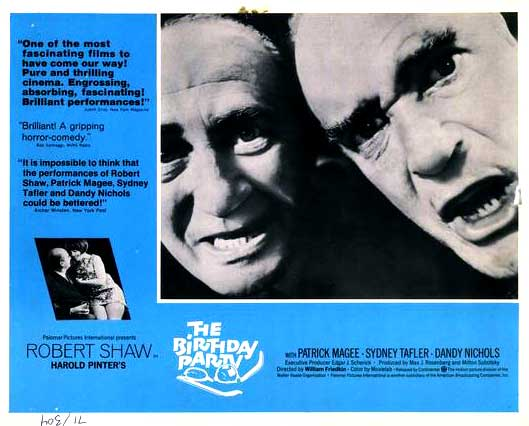
Since tomorrow will be my birthday I wanted to come up with a film that had birthdays as its theme and found this bizarre but fascinating obscurity. It is the story based on the play by Harold Pinter of Stanley Webber (Robert Shaw) a mysterious and private man who takes up lodging in a rundown British seaside house. He rents an upstairs room from Mr. and Mrs. Bowles (Moultrie Kelsall, Dandy Nichols) who are quite odd themselves. One day two men dressed in black suits (Patrick Magee, Sydney Tafler) come to pay Stanley a visit. They know something about Stanley’s past and their presence frightens him to the extent that it causes him to have a nervous breakdown.

On the surface this film shouldn’t work. There is an excessive amount of talking with dialogue that doesn’t say much and at times seems absurd. The set is drab and dirty with the camera seemingly locked down inside of it. There is never any explanation about Stanley’s past or what he is running from nor who the men are or what they know about him. The ending is elusive and the viewer will go away feeling more confused than they did at the start.

However, it is these ingredients that make the film so thoroughly intriguing. The seemingly banal dialogue is simply a façade for underlying thoughts and feelings. What Stanley is trying to run from is unimportant because it is really not about him at all and is instead more about ourselves, human nature and the quandary of our existence. It’s an examination of people’s futile attempts at trying to escape from who they are only to have society and life catch up with them. The set could be a metaphor for the inside of Stanley’s head. The grimy and decayed place symbolizes his decayed soul and the men in black suits are his conscience coming to haunt him.

Once you adjust to the eccentric narrative it then becomes a fantastic film for observing subtitles and nuance. Director William Friedkin shows a keenness for detail not only visually, but with the sound as well. The way the Magee character tears up a newspaper and the sound used for it could actually unnerve some viewers. Stanley’s meltdown scene is very unique and overall the direction is superb for such difficult material.

This movie was years ahead of its time, but for some it may be off-putting. However, it should be enjoyed by those who crave the avant-garde. It is also a rare chance to the see the normally strong-willed Shaw playing a very weak and vulnerable character. Nichols is also a stand-out playing an Edith Bunker type with a perverse streak lying just beneath the surface.

the birthday party 1

My Rating: 8 out of 10

Released: December 9, 1968

Runtime: 2Hours 3Minutes

Rated G

Director: William Friedkin

Studio: Palomar Pictures International

Available: VHS, DVD (Region 2)

Someone Behind the Door (1971)

someone behind the door 3

By Richard Winters

My Rating: 5 out of 10

4-Word Review: Chuck has no memory.

This review will kick-off a two month long tribute to movies done in the 70’s by Charles Bronson with his wife Jill Ireland. Each Friday I will review one of their films, which will run through April. The only ones that will not be reviewed during this stretch are Love and Bullets, which was already done during our January tribute to Rod Steiger and The Mechanic and Hard Times, which will be done at a later time.

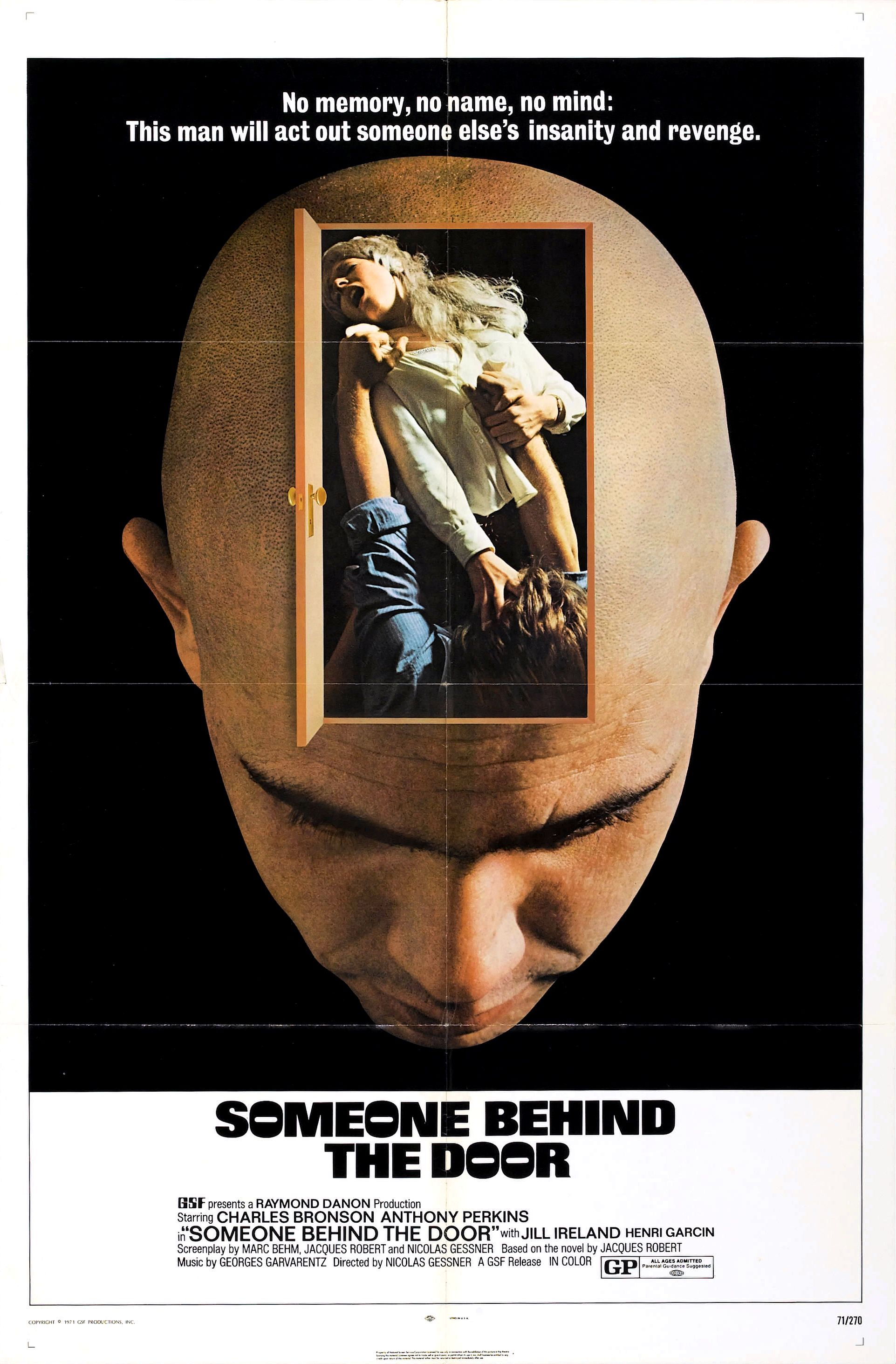
This film is one of the more unusual ones that they did and although not completely successful may still interest Bronson fans simply for a chance at seeing him in an offbeat part. The story concerns neurosurgeon Laurence Jeffries (Anthony Perkins) who takes in a man (Charles Bronson) who has lost his memory and has no idea who he is. Laurence decides to exploit this issue by brainwashing the man into thinking that Laurence’s cheating wife Frances (Jill Ireland) is actually his own and to take action by killing the woman’s lover (Henri Garcin).

The film has a great idea, but the set-up is much too rushed. We are given no backstory to any of the characters. The film opens with Laurence leaving his hospital job and by chance bumping into the man and taking him home before we even know what his motive or plan is. I also found it a bit perplexing that the Dr. character is supposedly conniving and crafty and yet he brings a man into his house while his wife is there sleeping in another room as well as their maid downstairs, which seemed reckless. When his wife awakens the next day and tries to go into the room where the stranger is Laurence panics, but I felt he should have been aware of that potentially happening from the very beginning. He also dictates his plans into a tape recorder, which seemed like prime material to be used for evidence later on.

The psychological side of the story is shallow and transparent. The way Laurence tricks the man into doing his evil bidding was too easy. I realize that the man has lost his memory, but it seems like he has lost his entire brain as well. The character is too child-like and gullible. I also thought that if the man cannot remember his wife and doesn’t know her from anyone else then why would he care if she is fooling around with someone, or get so over-the-top angry about it.

Bronson can be perfect in certain roles, but this is not one of them. Yes, he has a certain likable quality here simply because he plays such a vulnerable and trusting wide-eyed innocent, but the angry emotions that he displays are too rehearsed and over-acted.

Ireland on the other hand is attractive and alluring and comes off well though her part is minimal.  The nude photograph of her lying on a sofa that is shown in close-up is sexy.

The film has very little action especially for a Bronson vehicle though the part where the Bronson character sexually attacks Ireland and then the film intercuts this with him simultaneously attacking another woman on a lonely beach is interesting. The ending though is pathetic as it leaves everything wide-open while resolving nothing. The sequence where the camera cuts quickly back and forth between Perkin’s face and then Ireland’s, which is shown continuously over the closing credits is irritating and almost like the filmmaker’s wanted to drive the viewer as crazy as the kooky characters.

With that said I still found the film to be entertaining most of the way. The idea is a fascinating one and it kept me guessing throughout. Director Nicholas Gessner does an adequate job of taking advantage of the gray countryside to create a nice moody feel. A definite mixed bag.

My Rating: 5 out of 10

Released: July 28, 1971

Runtime: 1Hour 33Minutes

Rated R

Director: Nicholas Gessner

Studio: Lira Films

Available: DVD, Amazon Instant Video
Noises Off (1992)

noises off 2

By Richard Winters

My Rating: 3 out of 10

4-Word Review: Behind-the-scenes discord.

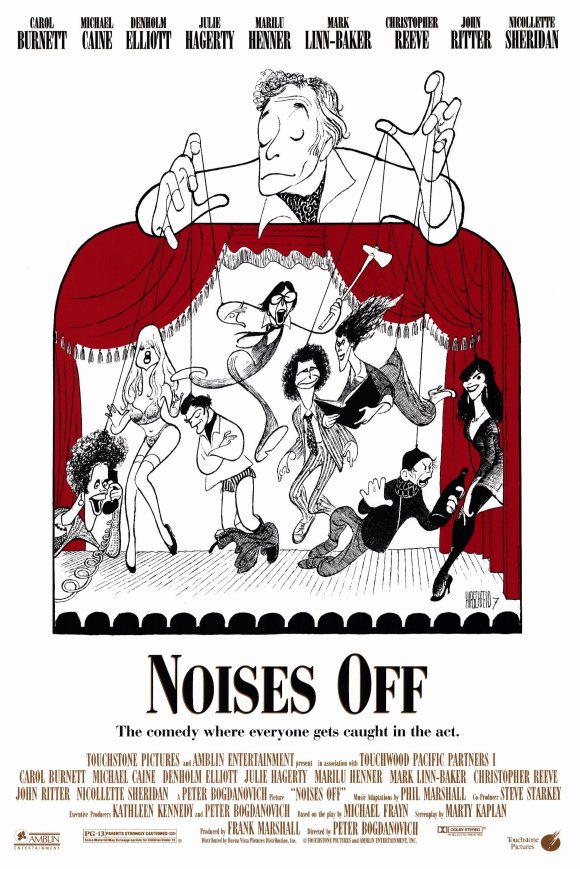
An eclectic group of actors put on a play that they take on tour. The play is a sort of door slamming British farce that is full of innuendos and misunderstandings and the film captures them during one particular scene of that play. It follows them as they rehearse that scene and then perform it live to an audience. It also shows the behind the scenes discord that develops between the cast and how this affects the performance of the scene, which culminates in a completely disastrous showing in Cleveland.

This should have been a really fun movie. It’s certainly an originally structured idea and it is slickly handled. It brings back the days of screwball comedy where things were funny just for the sake of being funny. Everything is contained and nothing is out of place or crude. In some ways it’s a refreshing change of pace.

The cast is certainly game and perfect for this type of comedy. Christopher Reeve and John Ritter come off best. Reeve seems to be playing his Clark Kent character only to a higher degree. Ritter does his Jack Tripper routine not only with the physical side, but also the nuance. His character tries very hard to be politically correct and it is amusing watching him never able to get to the point.

The film offers some light satire into the whole stage production process. Everything from the fragile temperaments of the actors to the high strung director is examined. It also takes some good shots at the plays themselves and how these stage comedies always seem to have such a high reliance on extreme coincidences.

There are some good laughs, but after a while it becomes a bit too much and exhausting to watch. The jokes and gags come so fast that if you blink you will miss some. There is also too much reliance on the frantic side of comedy, which eventually starts to lose its cuteness. The characters are placid and so are the situations. There is also the redundancy factor of having to see the same scene done over and over.

The end result is meticulously choreographed tripe and as silly as the play it seems to be mocking. It also has a glaring factual error. Michael Caine, the play’s director, talks about all the cities they have been too. He mentions Cairo, Missouri as one. There is a Cairo in Illinois but none in Missouri.

My Rating: 3 out of 10

Released: March 20, 1992

Runtime: 1Hour 41Minutes

Rated PG-13

Director: Peter Bogdanovich

Studio: Touchstone Pictures

Available: VHS, DVD

Surf II (1984)

surf 22

By Richard Winters

My Rating: 4 out of 10

4-Word Review: Surfers turn into zombies.

When compared to other low grade teen comedies of the 80’s this one fares a bit better. The story is about a nerd (Eddie Deezen) who decides to take revenge on all the ‘cool’ surfers by forcing them to drink a cola that will turn them into zombies.

The idea of mixing the crude humor of the 80’s with the zany surfer themed films of the 60’s is not a bad one. The film initially avoids the sterility that the other teen comedies usually have. The first fifteen minutes are fresh and inventive and there’s even a chuckle or two. It’s nice how it mixes old B-list actors with up and coming young stars like Eric Stoltz, Corinne Bohrer, and the late and underappreciated Tom Villard. The film also shows definite venom towards the surfers and some of which is accurate while taking some fun shots at the adults particularly two of the dads of the surfers who seem very much like what happens when ‘surfer dudes’ have to grow up and actually start earning a living. There is also a garbage eating contest between one of the zombies and a fat guy that has to set some sort of gross out precedent.

The problem comes with the fact that the story has no direction and eventually loses all momentum. There are too many absurd elements thrown in that have no connection to the main plot. The film comes off as derivative and convoluted and the manufactured calamity filled finale is incoherent.

Star Deezen looks and acts so much like a nerd you wonder if he was bred in some sort of laboratory. It is almost hard to believe how scrawny his arms are. Initially it is kind of funny and diverting to hear him say such megalomaniac statements with his high pitched voice, but his act is one-dimensional and eventually becomes annoying. Lyle Waggoner is another bad actor whose only claim to fame is his chiseled good looks. However, his bumbling police sergeant character Chief Boyardee is funny and he does get the film’s best line, which he says to a group of mouthy teens. “If I need any shit out of you kids I’ll squeeze your heads.” Ron Palillo who is best known for playing Horshak on ‘Welcome Back Kotter’ plays his deputy named Lt. Underwear and even sports gray hair! Cleavon Little though is wasted in a meaningless role of ‘Daddy-O’.

My Rating: 4 out of 10

Released: January 14, 1984

Runtime: 1Hour 31Minutes

Rated R

Director: Randall M. Badat

Studio: International Film Marketing

Available: VHS

The Oscar (1966)

oscar 1

By Richard Winters

My Rating: 2 out of 10

4-Word Review: Actor’s career on decline.

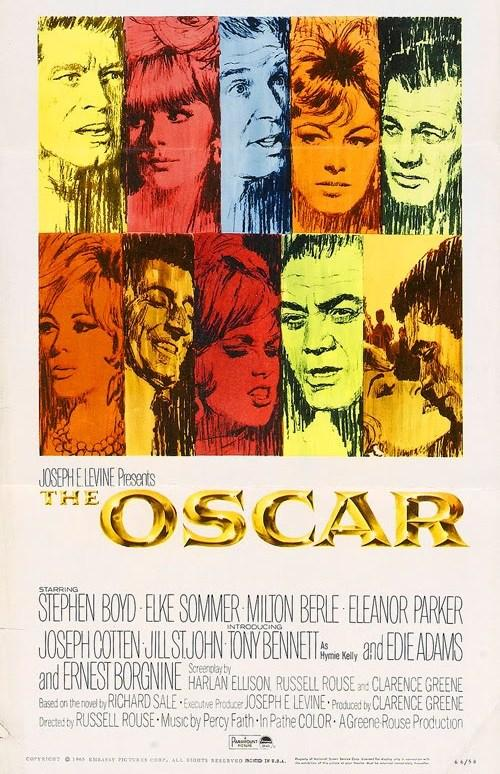
Frank Fane (Stephen Boyd) is a flippant, self-centered, and arrogant man who makes a living by setting up gigs for his stripper girlfriend Laurel (Jill St John) at local strip joints. By pure chance he watches the rehearsal of a play and in a fit of frustration jumps onto the stage to show the actors how to perform a knife fight when he doesn’t think they are doing it right. This impresses Sophie (Eleanor Parker) who uses her influence to get him signed to a contract at a big movie studio that makes Frank a star almost overnight, but as the years pass the quality and quantity of his roles diminish.  His overspending begins to catch up with him and just when he thinks his career may have faded he gets nominated for the Oscar. He feels a win will revive his career and will stop at nothing and use every dirty trick he can in order to influence the vote.

Adapted from the Richard Sale novel this is high drama at its worst. The scenarios are over-the-top and soap opera-like while bearing little relation to reality. The characterizations are on a kindergarten level and a composite of every Hollywood cliché and stereotype rolled together. The dialogue sounds like it was taken from a 50’s B-movie and comes off more like rants and speeches than anything any real person would actually say. Any attempt at gaining any insight into the behind-the-scenes world of Hollywood is lost with a script that becomes wildly off-center until it becomes absurd and ludicrous. Famed science fiction writer Harlan Ellison who scripted this mess was completely out of his realm here and the film is so botched, over-long, and redundant that it isn’t even good for laughs.

If the film had a glossy visual quality to it then it could at least be entertaining on that level, but director Russell Rouse shows no visual flair, or imagination. The scenes are lighted too brightly, which washes out the color and makes the sets look flat and one-dimensional. The music is too loud and used in a heavy-handed way similar to the canned laughter on some sitcoms. Every time there is some dramatic revelation, or shift the music comes booming out in order to alert the viewer who apparently was perceived by the filmmakers to be too dumb to pick up on it otherwise.

I did like Boyd in the lead. He has good looking chiseled features and parlays the necessary arrogance of the part, but the character is wholly dislikable and only gets worse as the film progresses and having to spend two hours watching a jerk be nothing but a jerk is too much.

The only time he shows any slight compassion is when he finds a fellow actor (Peter Lawford) down on his luck, but it is too extreme to believe that a one-time headlining movie star could one day fall to the point that he would have to wait tables to make a living and thus makes this moment as ridiculous and everything else in the movie. An ‘A’ list actor may fall down to becoming a ‘B’ list actor, or having to go from movies to guest spots on TV-shows, or even doing commercials, or infomercials, but having to become a waiter at a restaurant just isn’t plausible.

Elke Sommar gives a sincere performance and her German accent is sexy, but her character becomes too much of an emotional yo-yo. One minute she loves Frank then the next minute she hates him, only to quickly fall in-love with him again and then hate him shortly after that. Parker, as Frank’s mistress on the side, is good, but wasted despite looking as elegant as ever.

Tony Bennett is badly miscast as Frank’s best friend Hymie. This was to date his one and only film role and he may be a great crooner, but as an actor he is uncharismatic. Milton Berle fares almost as poorly playing Frank’s agent. Initially it was interesting seeing him take a dramatic turn instead of being the perennial comic ham, but his acting skills appear limited and his drama becomes as hammy as his comedy.

Ernest Borgnine gives the film’s only real solid performance as a shady and conniving private detective. The scene where Frank slugs him and it sends him flying backwards and toppling over his desk before crashing against the back wall is the film’s only good moment unless you count St John’s opening striptease.

Lots of cameos by famous stars and celebrities including famed costume designer Edith Head in a non-speaking part and gossip columnist Hedda Hopper in a part she did just before her death.

A good movie can inspire the viewer and expand their thinking and imagination, but this film had the absolute opposite effect. It made me feel like my mind had been sucked away by a giant vacuum. I felt depressed after watching it and continued to feel depressed the next day when I woke up.

oscar 2

My Rating: 2 out of 10

Released: March 4, 1966

Runtime: 1Hour 59Minutes

Not Rated

Director: Russell Rouse

Studio: Embassy Pictures Corporation

Available: VHS, YouTube

Night Watch (1973)

night watch 2

By Richard Winters

My Rating: 3 out of 10

4-Word Review: Murder in the window.

Ellen Wheeler (Elizabeth Taylor) is an emotionally unstable woman recovering from a nervous breakdown. Her first husband died in a car crash along with his young lady lover. Now her second husband John (Laurence Harvey) is fooling around with Ellen’s best friend Sara (Billie Whitelaw). One night Ellen witnesses a murder at the abandoned house next door, but because of Ellen’s past mental state no one believes her. Even the police doubt her story, which starts to send her over-the-edge.

I saw this play about a year ago with a group of friends at a local church. It was written by Lucille Fletcher best known for having done Sorry Wrong Number, which was later turned into a classic film starring Barbra Stanwyck. Although the play started out slowly the twist ending was impressive and something no one in the audience had predicted, but what I liked even better was that when you went back and thought about it, it made perfect sense. I thought at the time that it would make a great movie and was interested in seeing what this film did with it. I felt that there was no way they could screw up such a great story, but somehow they managed to do it.

Director Brian G. Hutton adds a lot of elements to make it more cinematic that should have helped it, but it really doesn’t. I liked the flashback sequences showing the car crash of the first husband as well as Ellen visiting the hospital and identifying the bodies. These segments have a good nightmarish visual quality to them, but Hutton goes back to it too often and eventually wears it out. I also liked that the film shows the police inspecting the inside of the abandoned home, which in the play you never see, but I felt they could have done a lot more to make the place seem more distinct and creepy. There is also a skirmish between two people inside the place at the end that you can hear, but not see because it is too dark and shadowy, which was annoying. The music is effectively creepy, but it also has a ringing quality that quickly becomes irritating and gets way over-played.

This was just one of the many misfires that Taylor did during the 70’s that helped extinguish her otherwise illustrious career long before it should’ve. This one fares slightly better than the others, but not by much. Her affected British accent could seem annoying to some and sounds kind of like the put-on one that Madonna sometimes does although for the record Taylor’s is better than hers. Liz’s emotionalism is a bit too theatrical and may come off as unintentionally funny to certain viewers although seeing her go completely nutty is impressive and fun.

Harvey is all wrong as the husband. His cold, detached presence can work in certain roles, but definitely not in this one. In the play that I saw the actor cast in this part looked more middle-aged with a spare tire stomach, balding head, and graying sideburns, which is what I felt the role called for. This is a character that is overburdened with a stressful job and unstable wife and yet Harvey shows none of this. His slick black hair and turtleneck shirts, which were fashionable at the time, make him look like someone still going out to the trendy nightclubs to pick up young chicks… or guys.

Whitelaw is one of the best British character actresses of all-time, but her talents are wasted with a part that doesn’t allow her to show any range. Her blonde hairdo is nice, but Taylor’s histrionics dominate the proceedings and unceremoniously push Whitelaw into the background.

The play had a lot of humor especially with the Mr. Appleby character played here by actor Robert Lange. Unfortunately the movie turns it into a serious drama making it seem more like a soap opera instead of a mystery. I came away from this feeling that the live production that I had seen was far more entertaining and intriguing. I would suggest to viewers to skip this film and wait for a chance to see it done as a play as the movie does not do the story justice.

night watch 1

My Rating: 3 out of 10

Released: August 9, 1973

Runtime: 1Hour 39Minutes

Rated PG

Director: Brian G. Hutton

Studio: AVCO Embassy Pictures

Available: DVD (Warner Archive), Amazon Instant Video

Windows (1980)

windows 3

By Richard Winters

My Rating: 1 out of 10

4-Word Review: She’s obsessed with her.

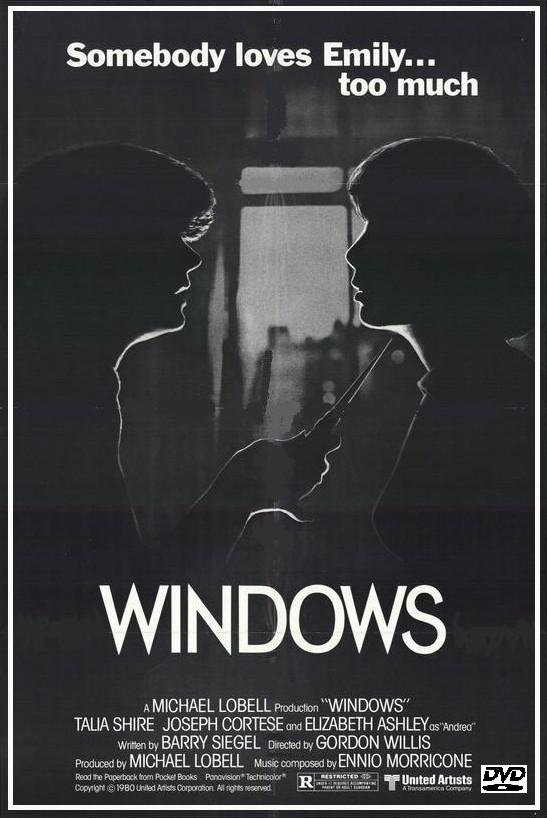
Emily (Talia Shire) is attacked in her apartment by a rapist (Rick Petrucelli) and when the police come to investigate the crime she starts to fall in love with Bob (Joe Cortese) the handsome police captain. Little does Emily know that her friend Andrea (Elizabeth Ashley) was behind the attack. She is a closet lesbian with a secret psychotic obsession for Emily who hired the man to rape her and record it, so Andrea could get-off on listening to the sounds of Emily moaning during the struggle. Now that Emily is going out with Bob it makes Andrea angry and her behavior becomes more dangerous and erratic.

For a thriller this film is extraordinarily low-key to the point that it also comes off like a drama, but fails on both ends. There is no mounting tension and little if any scares. The only one that they do have is when Andrea sticks Emily’s cat into a freezer and later it drops out of it like it was a Popsicle, which is actually unintentionally funny. There is also hardly any music. Ennio Morricone was hired to be the composer, but they don’t use him as much as they should. An amazing amount of the movie deals with the natural street sounds and ambience from life in New York, which is interesting for a while, but does nothing to elevate the tension, or create any excitement. Famed cinematographer Gordon Willis in his directorial debut seems more interested in capturing the New York skyline and creating shadowy interiors than actually making a movie with an original story, or interesting characters.

Shire is so quiet and awkward that she seems to be in a mental stupor. Her screen presence here is transparent and lifeless and it is easy to see why her leading lady status was brief. Cortese is no better as the male lead and the romantic side-story has no energy or chemistry and only helps to bog down an already boring story. Intercutting this with Andrea’s visits to her psychiatrist (Michael Lipton) successfully creates the first thriller to have no suspense whatsoever.

Ashley seems like the perfect choice for a homicidal lesbian, but the part is written in a way that doesn’t allow her to go over-the-top with it, which she should have although you do get to see her wearing quite possibly the biggest pair of sunglasses that I have ever seen. It might have worked better had the viewer not been aware from the start about Andrea’s psychosis and instead only revealed it at the end as a twist.

The climatic sequence between Emily and Andrea would be laughable if it weren’t so mind numbingly stilted and prolonged. The scene goes on for almost twenty minutes and features the two women standing in front of a window with Emily weeping incessantly while Andrea rambles incoherently. How anyone who was involved in the making of this movie would think anyone would flock to see this dull and contrived thing should have their brains checked. Has an air of pretense to it like it is trying to be a ‘sophisticated’ thriller, but it is pointless. If ‘Mystery Science Theater’ were still around this would be a great candidate for it.

My Rating: 1 out of 10

Released: January 18, 1980

Runtime: 1Hour 36Minutes

Rated R

Director: Gordon Willis

Studio: United Artists

Available: DVD, Amazon Instant Video
The Caretakers (1963)

the caretakers 2

By Richard Winters

My Rating: 6 out of 10

4-Word Review: Doctors with opposing viewpoints.

Two doctors working at a psychiatric hospital come at odds with each other over how to treat their patients. Dr. Donovan MacLeod (Robert Stack) believes in a more humanistic approach in treating mental illness including group therapy and more patient freedoms. Dr. Lucretia Terry (Joan Crawford) is hard-lined and exacts rules on her patients that have severe penalties if broken. The film examines their infighting and how it affects their patients.

Director Hall Bartlett has a nice cinema-verte style to the material that manages to avoid being ‘Hollywoodnized’ or overtly sanitized. The subject is approached in a matter of fact way and the patients are not portrayed as ‘crazy’ or ‘scary’, but instead as sick people looking to get well and learning how to do it. The opening sequence done over the credits and featuring all sorts of moody artsy drawings have an excellent avant-garde flair.

Polly Bergen is effective as Lorna a middle-aged mother and housewife who suffers a nervous breakdown and begrudgingly becomes a member of Dr. MacLeod’s therapy group. Some of her acting particularly when she is having her breakdown is theatrical and over-the-top, but I did like the way Bartlett shows things from her perspective allowing the viewer in a visual sense to feel what she is going through and makes one compassionate and sensitive to her condition.

It is great to see Crawford as always and the scene showing her in a leotard and teaching the other nurses judo lessons is a gem and much too brief. I was hoping to have her play up the part of the heavy more making her almost like a Nurse Ratched, which she could have easily done to perfection, but unfortunately the script doesn’t take advantage of it. I was also disappointed that we never see Crawford ever dealing directly with her patients, which seemed to me should have been necessary.

Stack in the lead is terrible and completely wrong for the part. The role required a man with a more youthful appeal instead of the middle-aged Stack who never displays the kind of sensitivity and compassion that his character supposedly has. Instead he delivers his lines in a stiff and monotone fashion and comes off like he came from the old school of acting.

The scene where his character allows the patients to go to an outdoor park for a picnic and mingle with the staff unsupervised seemed to be pushing the plausibility meter to the extreme. It also makes him look like a complete schmuck who should have known better especially when one of his patients leaves the picnic and runs away while he chases after her in a panic.

The supporting cast is outstanding showcasing many up and coming stars and is one of the major highlights for watching the film. Barbara Barrie is great as the silent and troubled Edna. Janis Paige is excellent as the brassy prostitute Marion. Susan Oliver gives one of her best performances as a young nurse who is just learning how to deal with those with mental illness and Robert Vaughn is also effective as Lorna’s long suffering and confused husband. This is also a great chance to see a young Van Williams before he starred as the Green Hornet as well as the beautiful Sharon Hugueny whose promising acting career was cut short when she was hit years later by a speeding police car.

If you come to this film looking for genuine insight into the illness you will be disappointed as it goes only to the most elementary level into the area of psychiatry. MacLeod’s speeches about how his group therapy can be a ‘cure’ to mental illness are shallow and almost laughable. However, for the era the film manages to be gritty and slick enough to pass as entertainment.

My Rating: 6 out of 10

Released: August 21, 1963

Runtime: 1Hour 37Minutes

Not Rated

Director: Hal Bartlett

Studio: United Artists

Available: VHS, DVD, Amazon Instant Video, Netflix streaming