Category Archives: Romance

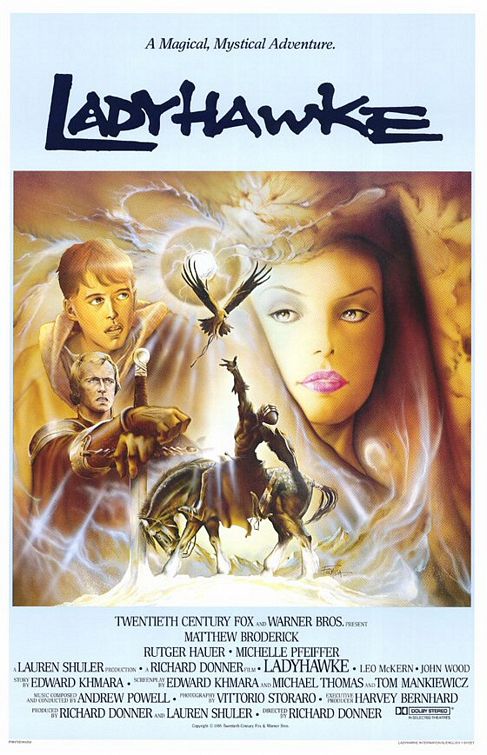
Ladyhawke (1985)

ladyhawke 1

By Richard Winters

My Rating: 5 out of 10

4-Word Review: Trying to reunite lovers.

Philipe (Matthew Broderick) is a thief who manages to escape the confines of the dungeon in Aquila by squeezing through a prison drain and then swimming through the underground sewer. When he finally reaches safety he meets up with Navarre (Rutger Hauer) who is also on the run and straddle with a very strange curse placed on him by the Bishop (John Wood). It seems that the Bishop had a thing for Lady Isabeau (Michelle Pfeiffer) and became enraged when he found that she loved Navarre and not him. As part of his revenge he made it so Navarre and Isabeau will never be able to meet in human form by having Navarre turn into a werewolf by night while Isabeau becomes a hawk by day. Now Navarre wants to use the reluctant Philipe’s knowledge of the city to help him find the Bishop and kill him, which he hopes will then end the curse.

I have to admit that medieval fantasy is my least favorite of all movie genres. The archaic living conditions always comes off as gloomy and depressing and the fact that the action is limited to only swordplay seems to make it less exciting. However, the film has some impressive cinematography and Broderick’s humorous character kept me engaged most of the way.

I also liked the pounding Philharmonic musical score. I realize that it doesn’t fit the sound of the 13th century setting and some fans of the film hate it for just that reason, but it still gives the film distinctiveness and helps boost the energy. I was actually disappointed it wasn’t used more as it seems to taper off too much after booming out strong at the beginning.

I am so used to seeing Hauer playing dark characters that I was initially thrown having him play a good guy, but pleasantly surprised at how well he did it. Leo McKern is a standout as the elderly Imperius.  His castle residence is marvelously captured and I loved all the booby traps he has in store for the invading soldiers. Pfeiffer on the other hand is a bit miscast mainly due to her model-like face that seems too glossy for the time period.

The exciting jousting sequence that takes place during the finale between Hauer and actor Alfred Molina’s character is outstanding, but it takes too damn long to get there. The simple plot could have been wrapped up in a much briefer runtime. The second hour is filled with a lot side dialogue and scenarios that add nothing to the story or characters and should’ve been cut completely. The romance angle is also handled too much from the perspective of a 14-year-old schoolgirl and the scene where the lovers reunite could be deemed as corny by some.

There is also the issue of Navarre looking directly at an eclipse that conveniently occurs through a broken stain glass window in a church. Normally a person would have to shield their eyes with their hand, squint or at the very least turn away from it after only a few seconds. Yet this character stares at it for an extended period without even blinking, which at the very least would’ve burned dark spots into his field of vision and yet strangely that doesn’t occur.

My Rating: 5 out of 10

Released: April 12, 1985

Runtime: 2Hours 4Minutes

Rated PG-13

Director: Richard Donner

Studio: Warner Brothers

Available: VHS, DVD, Blu-ray, Amazon Instant Video


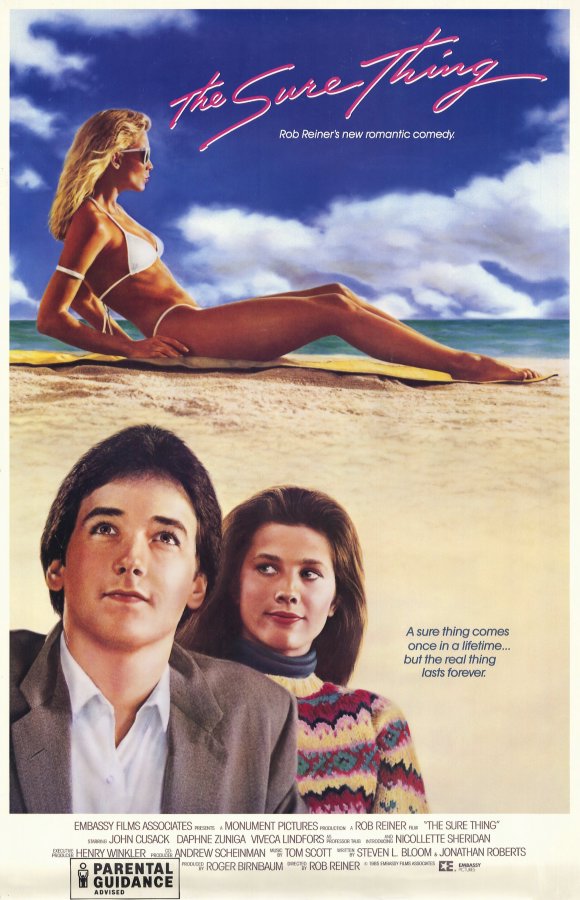
The Sure Thing (1985)

the sure thing 2

By Richard Winters

My Rating: 7 out of 10

4-Word Review: Love blossoms between opposites.

Walter Gibson (John Cusack) becomes smitten with Alison (Daphne Zuniga). He is a slacker while she is a very studious student. Both attend the same college English class and he uses the ruse of needing help with his studies as a ploy to get closer to her, but it doesn’t work and she ends up hating him. Then his friend Lance (Anthony Edwards) invites him out to California where he has a really hot girl (Nicollette Sheridan) waiting for him and promises that she is a ‘sure thing’. So Walter takes a ride with a couple (Tim Robbins, Mary Jane Persky) that is also going out there only to find that Alison is riding with them as she wants to visit her boyfriend.  Needless to say it is a rocky ride, but after several misadventures love finally begins to blossom between the two.

On a purely romantic level this film scores big time. It nicely recaptures the period in one’s life where everything is still new and exciting and before such things as marital discord, ugly divorces, child custody battles and all that other crap. Instead it emphasizes the rush one feels at being in the presence of someone they are really crazy about and learning to know them through layers. It’s the magical innocence of young love that makes it so endearing and engaging.

Zuniga is beautiful but fortunately not in an overdone, glamorous type of way. My favorite scene with her is when she tries to drink a beer for the first time ‘shotgun style’ and becomes a bit overwhelmed by it. Cusack shows his usual charm, but his social graces seem severely lacking at points near the beginning and I wouldn’t have been surprised if every girl would have found him to be an annoying geek.

In support Edwards is good as his friend and I especially liked his room that is lined with empty bottles of every different brand of beer that he has drunk. Viveca Lindfors is sexy and appealing in her own way as the English teacher and George Memmoli in his last film role has an engaging bit as an overweight man that Walter meets and befriends at a bar in a scene that I wished had been more extended.

The film though does have a few problems. One scene has Walter accusing Alison of being ‘repressed’ and so to prove him wrong she strips off her shirt and bra and then flashes some other cars that they are passing, which to me seemed like too much of an extreme shift in behavior and not realist for that type of character. There is another scene where the two are stranded in the middle of nowhere during a rainstorm and with no money since Alison forgot it at their last hotel stop only to find out that she has a credit card. The film then cuts to showing them eating at a fancy restaurant, which was too much of a jump as a credit card isn’t going to get them from an empty field by itself and the scene needed to show more of a connection on how or who got them out of there.

The biggest problem though is that we have this stunning beautiful, bikini clad blonde in the form of Nicollette Sheridan who apparently can’t get a guy on her own and needs to be ‘set-up’ on a date, which makes no sense. The scenes showing her walking around all alone at a party are absurd because in reality just about every guy in the room would be showing her some attention and she would have no reason to waiting around for an average guy like Cusack to come by to date here. This is the one segment in the movie were it goes dangerously close from being this pleasing slice-of-life romance to a crazy 80’s teen fantasy.

Despite the issues listed above I still thoroughly enjoyed it. It should appeal to the romantic in all of us and nicely balances the old-fashioned love story formula with modern day sensibilities.

My Rating: 7 out of 10

Released: March 1, 1985

Runtime: 1Hour 40Minutes

Rated PG-13

Director: Rob Reiner

Studio: Embassy Pictures

Available: VHS, DVD, Blu-ray

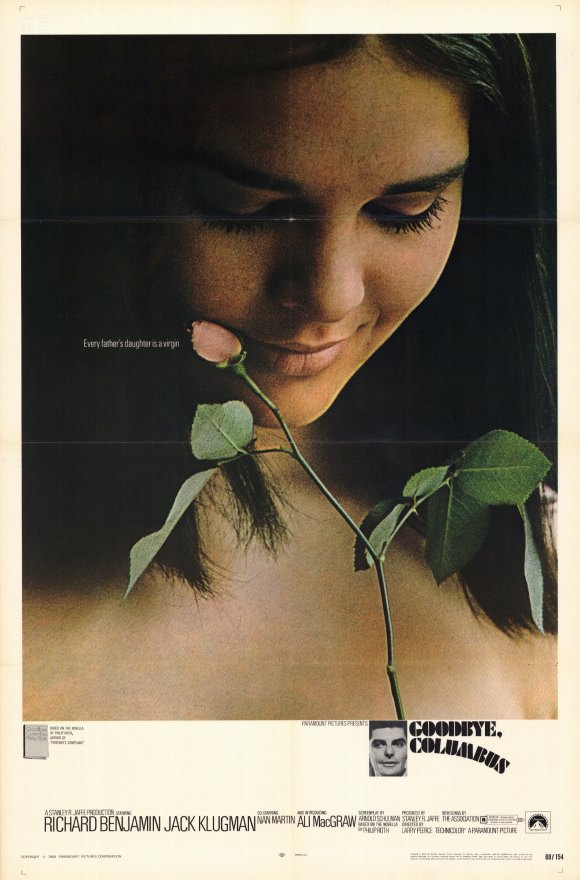
Goodbye, Columbus (1969)

goodbye columbus 2

By Richard Winters

My Rating: 8 out of 10

4-Word Review: Dating a rich girl.

One day while at a pool party Neil (Richard Benjamin) becomes infatuated with beautiful Brenda (Ali MacGraw) and proceeds to begin a relationship with her. He has just recently graduated from college and still not quite sure what direction he wants to take in life. He doesn’t want to fully ‘drop-out’, but isn’t so excited about diving in to the corporate business world where making a lot of money is the only focus. Brenda on the other hand is from a rich Jewish family who enjoys her privileged lifestyle, but not always the pretension that comes with it.  She continues to date Neil simply out of spite to her mother (Nan Martin) who doesn’t approve, but as things progress their differences and values become more pronounced and sends the relationship teetering on the brink.

Director Larry Peerce did some high quality films during the sixties and it is unfortunate that by the seventies his output dropped off. I think overall this is his most complete work and a wonderful compliment to the Philip Roth novella from which it is based. The location shooting is outstanding and one of the main things that gives the film a personality. The giant suburban house in which Brenda’s family lives makes one of the biggest impressions not only with its large exterior, but interior as well where every room is wallpapered with its own distinct color and design. The library where Neil works is also visually impressive especially with its large marble columns and painted cathedral ceilings.

The film is filled with a lot of memorable and amusing scenes. Neil’s interactions with Brenda’s ten-year-old younger sister Julie (Lori Shelle) is entertaining not only with a game of hoops that the play, but most especially their ping pong contest that they play later. Neil’s attempted conversation with a deaf man while inside the library is funny as is seeing Neil sneaking into Brenda’s bedroom each night when the parents are asleep. You also got to love Neil’s shocked response when he finds out Brenda has not been taking the pill and the scenes at the wedding reception of Brenda’s brother is filled with a lot of keen observations. If you look closely you will be able to spot Bette Midler, Michael Nouri, Jacklyn Smith and Susan Lucci as wedding guests.

MacGraw has never looked more beautiful and Peerce spends several minutes lovingly photographing her swimming in the pool, which isn’t bad. Her performance as a spoiled rich girl going through fits of rebellion, but not quite ready to completely break from her soft lifestyle is on-target and proves that she is not just a pretty face, but an excellent actress as well. Although already 30 at the time she plays a 20-year-old quite convincingly.

Michael Meyers as Brenda’s older brother Ron is a scene stealer not only with his empty ‘discussions’ with Neil, but also with the way he orders around the other workers as a supervisor at a job he wouldn’t have had, had he not been the owner’s son. This proved to be his one and only movie appearance. He eventually became a physician in real-life and wrote an autobiography entitled ‘Goodbye Columbus, Hello Medicine’.

In some ways I saw a lot of similarities to this film and The Graduate and consider it to be just as much of a classic. I enjoyed the way the film explores the different stages of the relationship and the final argument the two have is quite revealing.

My Rating: 8 out of 10

Released: April 3, 1969

Runtime: 1Hour 41Minutes

Rated R

Director: Larry Peerce

Studio: Paramount

Available: VHS, DVD, Laser disc, Amazon Instant Video, YouTube

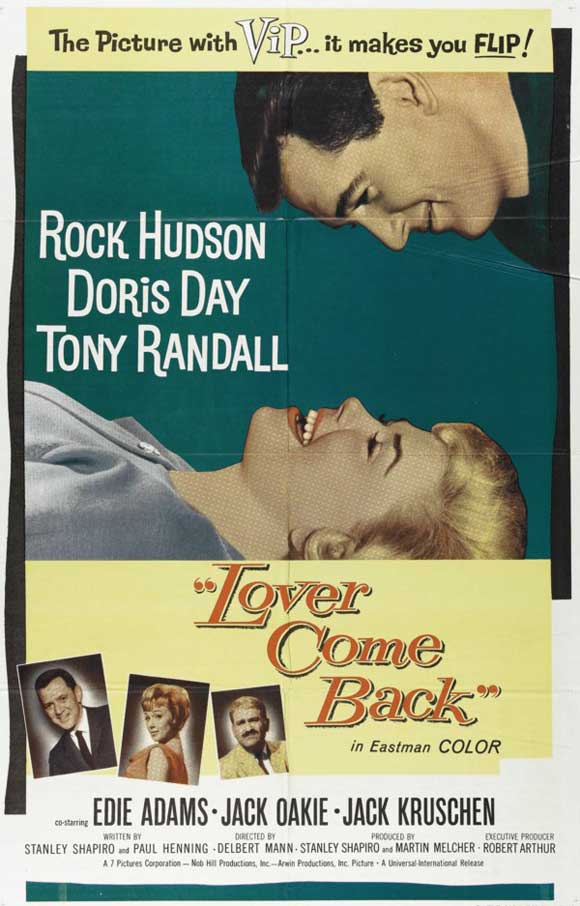
Lover Come Back (1961)

lover come back

By Richard Winters

My Rating: 6 out of 10

4-Word Review: They all want VIP.

Jerry Webster (Rock Hudson) steals clients from other ad agencies by throwing them parties filled with a lot of liquor and loose women. When Carol Templeton (Doris Day) who works at a competing ad agency finds out about this she goes on the offensive by getting Rebel (Edie Adams) a woman who attended one of Jerry’s wild parties to testify against him at the ad council board, which she hopes will get Jerry severely reprimanded. Jerry though gets Rebel to soften her testimony by promising her that she will be involved in the advertising campaign for a new product called VIP. The problem is that there is no such product, but Carol thinks there is, which leads to a lot of confusion including having Carol start a relationship with Jerry under the misguided notion that he is the chemist working on the new product.

The film is fast and fun for the most part although there isn’t as much physical comedy as in some of Day’s other vehicles, but makes up for it with some sharp dialogue. Although Day’s films have always been considered family friendly the film probably has just as much sexual references and innuendoes as any other movie.  There is even a scene where Day takes the Hudson character out to a strip club and has a stripper shed her pasties right on him. Even more amazing is the scene where the Day character actually considers having sex with Hudson before she is married to him. She ultimately doesn’t go through with it, but the fact that she was about to and even takes out a revealing nightie to wear seemed shocking enough.

Day’s costumes, which were designed by Irene Lentz who just a year after this film came out jumped to her death from a 14-story window, are chic and heighten the film’s visual appeal. I especially liked the variety of hats that she wears some of which go humorously over-the-top. I also got a kick out of Hudson’s garish suit that looks like it got splattered by twelve different cans of paint. My only complaint here is the absurdity of Day going to work looking like she is dressed for an elegant dinner party.

Day is gorgeous as ever, but her performance seems a bit one-note and amounts to nothing more than a collection of exasperated and perturbed reactions. It is actually Hudson who is typically a weak actor that steals it. The cocky way his character tries to finagle his way out of everything and his interactions with Tony Randall are the best.

The film ends with the two characters getting married, which I am sure fans of Day’s movies like and expect, but it really doesn’t make a lot of sense and seems quite contrived and formulaic. The script’s original ending had the two characters getting drunk and then checking into a hotel room, but Day insisted the characters get married instead even though it is unlikely any judge or minister would marry two people in a drunken state. The Hudson character was a raging playboy who could get attractive women whenever he wanted and clearly viewed sex as a conquest. It is most likely that after a few years of marriage he would get the itch to fool around again, which would culminate in an ugly divorce and make this ‘happy ending’ not so happy after all.

My Rating: 6 out of 10

Released: December 20, 1961

Runtime: 1Hour 46Minutes

Not Rated

Director: Delbert Mann

Studio: Universal

Available: VHS, DVD, Amazon Instant Video
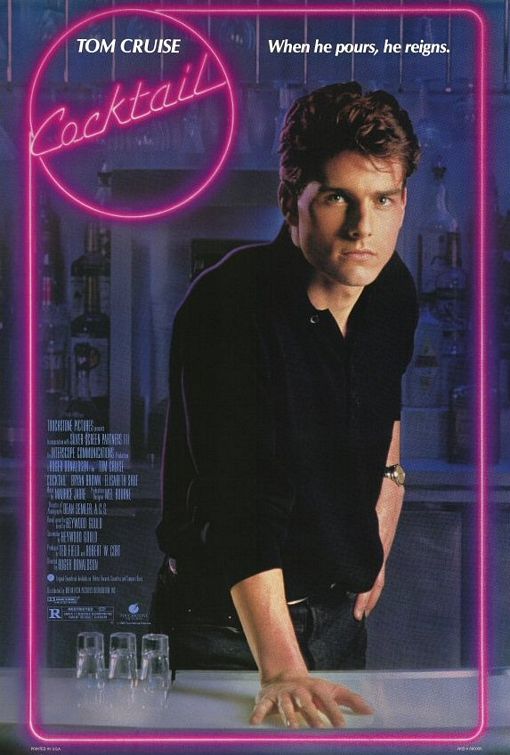
Cocktail (1988)

cocktail

By Richard Winters

My Rating: 4 out of 10

4-Word Review: Chasing the American dream.

Brian Flanagan (Tom Cruise) is an ambitious young man looking to somehow make it big in the business world. He reads all sorts of books detailing strategies to become rich, but finds that without a college degree his options are limited. After numerous rejections he finally gets a job as a bartender where he becomes friends with Doug (Bryan Brown). The two make a good team behind the counter and get promoted to a ritzy nightclub, but they end up having a falling out and Brian starts up a bar in Jamaica as well as a romance with Jordan (Elisabeth Shue) only to have Doug reappear years later with a tempting job offer that Brian isn’t so sure he can refuse.

Although Cruise is engaging and does quite well in the role I couldn’t help but feel that he has played this same type of cocky, ambitious type of character in just about all the movies that he has been in. It would be nice to see him play some sort of timid, shy introvert once just to prove that he has some actual acting range.

Brown is good in support and I liked their contrasting ages. Shue is always beautiful and solid and Kelly Lynch who plays Doug’s wife Kerry gets points simply for looking really hot in a thong bikini.

The story has a great start and I thoroughly enjoyed the first half. I’ve worked as a bartender and felt that the film captures both the bar and club atmosphere accurately as well as the hectic demands of the position. In fact the on-location shooting is splendid both in the scenes done in New York as well as the islands and the interior and exterior backdrops give the film a nice added texture.

There are also some really amusing scenes here including Brian’s many futile job interviews and his dealings with an arrogant college professor that is played perfectly on cue by the late Paul Benedict. I had high hopes for the film and felt it had a great foundation for a modern day rags-to-riches story, which is where it should’ve stayed. Unfortunately the second half devolves too much into the romantic and relationship angle. To some degree I went with it, but it ends up taking over the whole plot making it generic and losing the nice gritty edge that it had at the beginning. The final thirty minutes are filled with a lot of over-the-top dramatic twists that turns the whole things into a corny soap opera that ultimately overshadows the good points.

My Rating: 4 out of 10

Released: July 29, 1988

Runtime: 1Hour 44Minutes

Rated R

Director: Roger Donaldson

Studio: Buena Vista Pictures

Available: VHS, DVD, Blu-ray, Amazon Instant Video

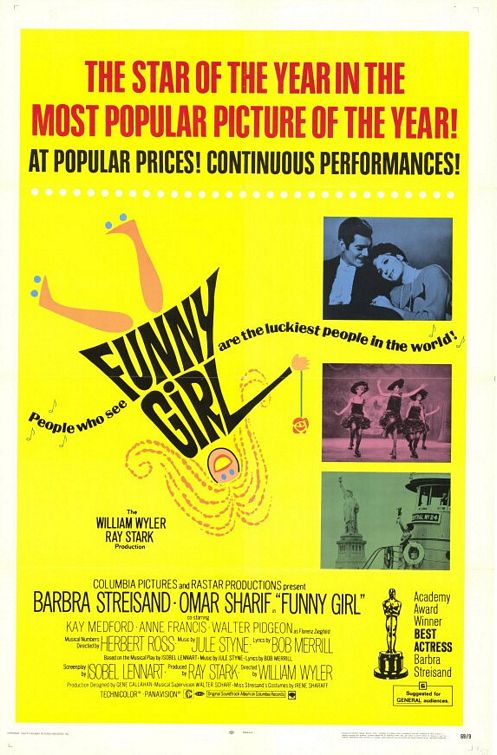
Funny Girl (1968)

funny girl

By Richard Winters

My Rating: 6 out of 10

4-Word Review: Fanny’s rise to stardom.

Barbra Streisand, in her film debut, plays Fanny Brice in this loose biography about the Jewish comedian’s rise to stardom in the Ziegfield Follies during the 20’s and 30’s. The story examines how she uses her homely looks to her advantage by honing in her comedic skills to allow her to stand-out. The second half of the film examines her romance and eventual marriage to professional gambler Nick Arnstein (Omar Sharif).

Streisand recreates her Broadway role in grand style and deserved her Oscar win in which she famously tied Katherine Hepburn that year for Best Actress. I’ve always liked her best when she is doing comedy and she has always shown a good knack for timing and delivery. Although stories abound how she was very difficult during the production and showed a tremendous ego, which culminated in the film going through two directors and cinematographers she still plays the very insecure Brice effectively and it’s this appealing ingredient the carries the film and character.

William Wyler’s direction is also outstanding and helps make up for a story that at times seems pretty light. He replaced Sidney Lumet early on and gives the film an added flair with lavish sets. I loved the French-style restaurant and expansive old fashioned New York train station. There is some excellent dance numbers in which Wyler takes full advantage of the visual element including a nifty ballet segment. The recreation of the period is authentic and there are even a few moments of dazzling camera work including the shot showing Fanny singing on top of a tugboat all alone in the New York harbor while the camera circles above her and then careens down.

Kay Medford adds good support as Fanny’s mother and it earned her an Academy Award nomination for supporting actress. Sharif is always solid, but the character seemed poorly fleshed-out and more of a personal background needed to be explored to help explain why he was so infatuated with the extremely insecure and awkward Brice when he could have easily attracted any girl. Walter Pidgeon lacks the commanding presence needed in the part of Florenz Ziegfield and instead comes off as a tired old man getting badly upstaged by Streisand in every scene he has with her.

The songs are pleasing and you may find yourself humming some of them for days afterwards, but I was surprised how few of them there really were with long dramatic intervals in-between. The story itself is placid as Brice’s rise to the top happens too quickly and too much time is spent on the romantic angle making the film seem unbalanced but it manages to be entertaining anyways due mainly to the high production values.

My Rating: 6 out of 10

Released: September 18, 1968

Runtime: 2Hours 30Minutes

Rated G

Director: William Wyler

Studio: Columbia Pictures

Available: VHS, DVD, Blu-ray, Amazon Instant Video

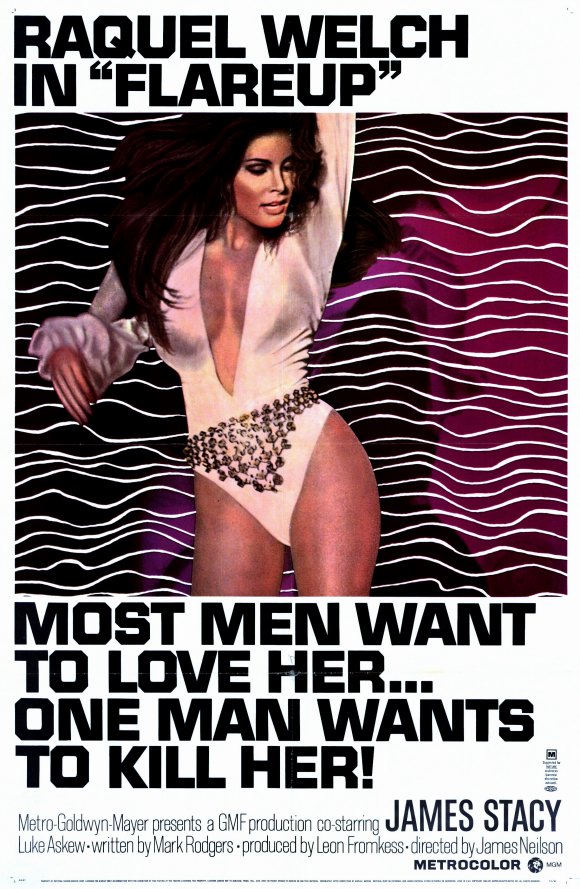
Flareup (1969)

flareup

By Richard Winters

My Rating: 3 out of 10

4-Word Review: Stalker terrorizes go-go dancer.

Michele (Raquel Welch) is a Las Vegas go-go dancer that attracts the unwanted attention of Alan (Luke Askew) who blames her for the breakup of his marriage. After killing his wife he then sets his sights on Michele who moves to Los Angeles in an attempt to lose him, but he figures out what club she is dancing at and continues his reign of terror. When Michele finds a new boyfriend named Joe (James Stacy) the psycho decides to add him to his already growing hit list.

Raquel is the whole movie. Her acting ability is definitely limited and at times even annoying, but in the looks department she gets an A+. In fact I’d say she is at her best looking here out of all the movies she has done. The scene where she gets on stage to gyrate her body during a provocative dance number is pretty much the highlight of the whole film. Although some of the other girls dance topless she does not and she very angrily rejects another female dancer who offers her some ‘woman love’, so there is no lesbian scene either, which could be a disappointment to some oversexed male viewers, but her presence offers enough eye candy to propel the movie on nonetheless.

Askew who wears a tacky bowl haircut looks a bit too clichéd, but he is a good enough actor to keep it tolerable. Stacy is decent as the love interest, but the romantic scenes bog down the pace. This was the last movie he did before he got into a motorcycle accident and lost his left leg and arm, which spiraled both his career and personal life downward and eventually led to a child molestation charge in 1995 that sent him to prison.

James Neilson’s direction is okay. The best part is the on-location shooting, which makes you feel like you are right back on the streets of Las Vegas from forty years ago and its fun seeing the different shops and billboards that were out during that era. The foot chase between Welch and Askew that occurs late at night in a zoo with wild animal noises heard in the background has potential, but should’ve gotten more extended.

The script though is one-note and gets stretched much too thin. The action starts out right away, but the pacing is poor and there is really never any tension. Everything gets done in a formulaic way with nothing that is unique or memorable.

Although I will give some credit to the finale that features a burning man the special effects are overall pretty shoddy. The psycho shoots at and kills people, but we never see any bullet holes or blood on the dead bodies. One scene has a security guard (Gordon Jump in an early role) shooting at Askew’s car and putting two bullet holes in its rear window, but then when the camera cuts away to a long view of the car the bullet holes have somehow miraculously disappeared.

My Rating: 3 out of 10

Released: November 10, 1969

Runtime: 1Hour 40Minutes

Rated M

Director: James Neilson

Studio: MGM

Available: VHS, DVD (Warner Archive)

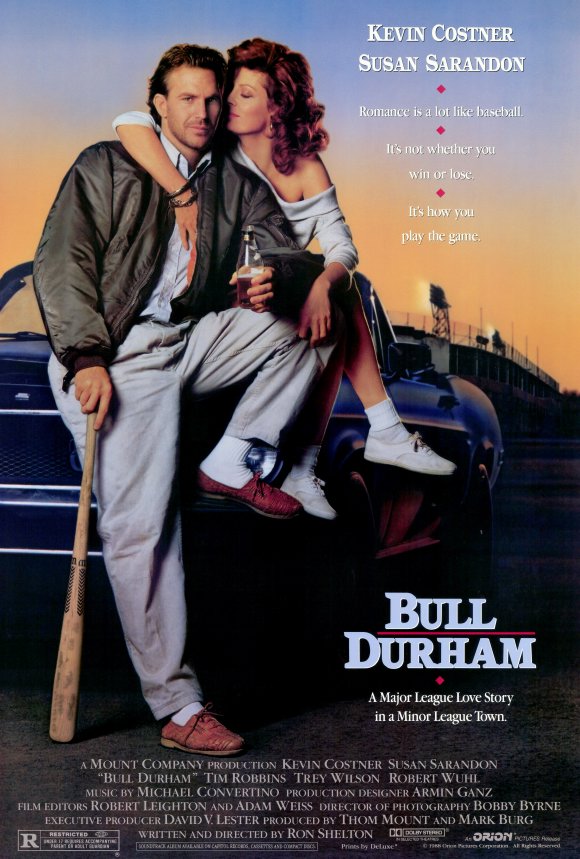
Bull Durham (1988)

bull durham

By Richard Winters

My Rating: 7 out of 10

4-Word Review: Catcher mentors a rookie.

Crash Davis (Kevin Costner) is a veteran of the minor league baseball system and is brought in to the Durham Bulls to help mentor Ebby Calvin ‘Nuke’ LaLoosh (Tim Robbins) a rookie pitcher with a ‘million dollar arm, but a five-cent brain’. Crash teaches Nuke all about the finer points of the game as well as learning to show discipline and control both on and off the field. Annie (Susan Sarandon) is a local fan who each year does some ‘mentoring’ of her own with one of the players by taking them in and having a torrid sexual relationship with them. This year she chooses Nuke much to the consternation of Crash who would like her for his own.

The film is loosely based on the experiences writer/director Ron Shelton had while being a minor league player during the late 60’s.  Keeping the focus solely on the minor league level and never analyzing the majors was to me a big strength. Too many times Hollywood sports movies try to capture that ‘championship season’ or ‘miracle victory’ while forgetting that there are hundreds if not thousands of players who never get to that point, but still have interesting stories to share. The minor league theme puts the game back to its grass roots level where it should be while evoking a wonderful feeling of modern day Americana.

The film makes the viewer feel that they are right down on the field with the players and they gain special insights into the game that they would never have just watching it in the stands on or TV. The thoughts that go through a hitters head as he stands at the plate are interesting as are the interplay between catcher and pitcher. The meeting at the mound scene where the players get together during a game to discuss what wedding gift to get another player who is about to be married is hilarious as is the segment where Crash teaches Nuke all the sports clichés to give when being interviewed by the media.

Robbins is terrific in what I still consider one of the best performances of his career. The character could have been annoying if there weren’t so many young men out there like that. The composite of the young, brash, cocky hot shot who thinks he knows everything, but actually knows very little is so perfectly done that just about anybody will be able to identify with somebody they know or have known who is just like it.

Costner on the other hand is a bit too detached and his performance comes off very much like the restrained way he dances during the closing credits. The character also seems like a flaming alcoholic as he is seen drinking in just about every other scene, but his ongoing exchanges with Robbins are great and the main ingredient that holds the film together.

Throwing in a sex angle was to me a turnoff as personally I never like to mix the two. The Millie (Jenny Robertson) character that is shown and known to sleep with a lot of the players seemed to me to be idiotic especially since this takes place in the 80’s, which was at the height of the AIDS scare.

Sarandon is okay although the part was originally intended for Kay Lenz who I think I would have preferred. The line where her character states that she would never sleep with a player who hit under 250 unless he had a lot of RBI’s and was a great glove man up the middle is classic and the scene near the end where her and Crash make love in a bathtub while surrounded by a throng of lighted candles is on a visual level a highlight.

I loved the bluesy music score as well as the shrine to Thurmon Munson seen at the end. I wouldn’t say this is my favorite sports movie, but the characters are richly textured and the dialogue instantly quotable, which makes it a winner anyways.

My Rating: 7 out of 10

Released: June 15, 1988

Runtime: 1Hour 48Minutes

Rated R

Director: Ron Shelton

Studio: Orion Pictures

Available: VHS, DVD, Blu-ray, Amazon Instant Video

Zabriskie Point (1970)

zabriskie point 2

By Richard Winters

My Rating: 8 out of 10

4-Word Review: Blow up the house.

Two young adults, a product of the turbulent sixties and from opposite ends of the social spectrum, meet and fall-in-love. Daria (Daria Halpern) is an anthropology student while Mark (Mark Frechette) is a dropout who’s wanted by the police. Together they try to endure the hypocrisies and materialism of a capitalistic society.

Writer/Director Michelangelo Antonioni’s camerawork is one-of-a-kind and if you see this film for one reason then see it for this. Everything gets captured in intricate, focused detail and the shots of the desert landscape are breathtaking. The scenes where Mark flirts with Daria while piloting his airplane while she is still on the ground is genuinely cool.

The sprawling, modernistic mansion in the middle of the barren landscape is visually imaginative. Seeing it get blown up is a bit depressing, but when it gets done 10 different times from 10 different angles then it becomes a unique cinematic experience. The exploding refrigerator and flying food, which is done in slow motion, as well as the ten or so different couples who make love on the desert floor at the same time is equally arresting.

Having the two leads played by amateurs with little or no acting experience ends up working well. There is a very natural and honest quality to their delivery that most professional actors in their quest to put on a ‘performance’ wouldn’t be able to convey. Rod Taylor on the other hand is wasted in a small and uninteresting role as is character actor Paul Fix.

This film was unfairly overlooked and criticized upon its initial release, but now deserves a fresh look. Having a scathing take on American society done by a foreigner isn’t quite fair, but his comments on capitalism are good nonetheless. The story itself is quite thin, but when it is as visually intoxicating and emotionally kinetic as this then who cares.

My Rating: 8 out of 10

Released: February 9, 1970

Runtime: 1Hour 50Minutes

Rated R

Director: Michelangelo Antonioni

Studio: MGM

Available: VHS, DVD

The Public Eye (1972)

the public eye 1

By Richard Winters

My Rating: 3 out of 10

4-Word Review: He follows her around.

This film, which is based on the Peter Schaffer play, deals with Charles (Michael Jayston) an uptight British accountant who thinks that his wife Belinda (Mia Farrow) is having an affair. He hires Julian (Topol) a goofy private detective to follow her around and see where she is going and what she is doing everyday while he is at work. Unfortunately for Charles Julian starts to fall in love with Belinda as he is following her and she in him, which only further complicates matters since she was initially not seeing anyone and all those trips that Charles thought were so suspicious were simply innocent excursions.

The biggest problem with this film is that it is too lightweight probably more so than even other lightweight films. Nothing really happens. Julian just follows Belinda around much to her amusement, but the two don’t share any dialogue nor ever consummate their pseudo-relationship. The film simply spends long drawn out sequences showing the two following each other throughout the streets of London and occasionally giggling at their ‘little game’ and that is about it. You keep waiting for that second act to kick in, but it never does, which after 95 minutes starts to make the whole thing almost pointless.

Topol is miscast in the lead and ends up being the film’s weakest link when he should have been the strongest. He was fresh off his award winning performance in Fiddler on the Roof and this movie was supposed to make him into a leading man, but the attempts at turning him into a variation of Inspector Clouseau fail badly. His bright white suit that he wears looks garish and ridiculous especially for an undercover spy. Watching him constantly stuffing his face with food starts to get obnoxious and his buffoonery becomes more annoying than engaging.

Farrow is appealing and her natural child-like fragility is perfect for the part. The scene where she states to the shock of an upper-crust crowd at a formal dinner party that rapists should be punished by having their ‘thing’ cut off publicly is amusingly edging and the film would have been better had it gone a little more in this route.

Jayston is the one that comes off best. He plays the proper British gentlemen with all his staid mannerisms perfectly. What I really like though about him is the fact that he does love Belinda, but just doesn’t know how to show it effectively.

This was an odd project for legendary director Sir Carol Reed whose final film this was. The story doesn’t allow for much visuals although the way Reed captures London both from aerial shots as well as the downtown streets that Belinda visits is excellent. The movie almost seems to work as a tour guide of London, which in some ways is the best thing that can be said about the film.

My Rating: 3 out of 10

Alternate Title: Follow Me

Released: July 18, 1972

Runtime: 1Hour 35Minutes

Rated G

Director: Carol Reed

Studio: Universal

Available: Netflix streaming