Category Archives: Offbeat

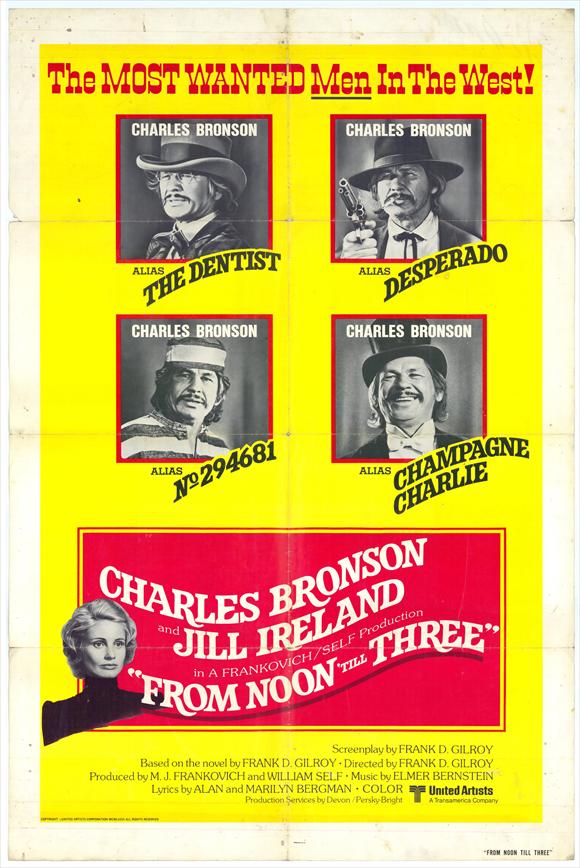
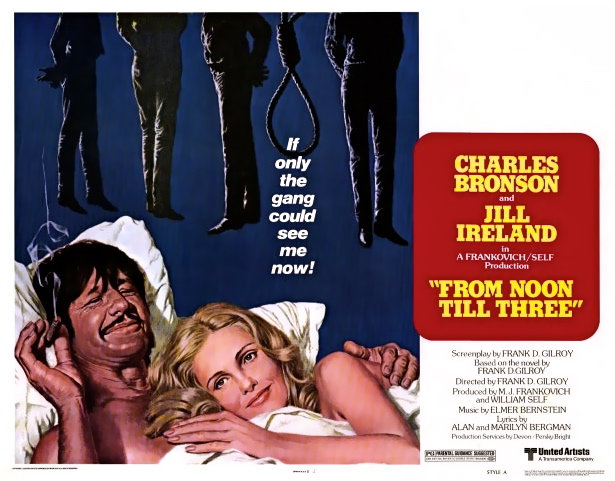
From Noon Till Three (1976)

from noon til 3 1

By Richard Winters

My Rating: 6 out of 10

4-Word Review: This western gets weird.

Graham (Charles Bronson) is a part of a four member bank robbing gang on their way to another hold-up. Before they get there Graham’s horse gets injured and has to be shot. Later on they come upon an isolated mansion sitting all alone in the rolling hills of the west. The gang asks the woman owner Amanda (Jill Ireland) if she has a horse for sale. She says no despite the fact that she does, so Graham stays with her while the other three rides off to rob the bank and assures them they will be back with the money at three. During this time Graham and Amanda fall in-love and when three o’clock hits everything goes off-kilter featuring one wild twist after another in this highly unusual one-of-a-kind western.

This film is so offbeat it is hard to describe any of the twists without giving too much away however, after a rather slow start it does become entertaining in a quirky sort of way and filled with amusingly ironic twists. Writer/director Frank D. Gilroy seems to be challenging himself at coming up with one weird plot device after another and keeping the viewer off balance throughout. While this is basically fun it does end up making it more like a gimmick than an actual plot driven, character motivated movie. Categorizing this more as a fable or fairy tale might be more accurate and Elmer Bernstein’s playful, lighthearted score helps cement this.

Bronson is amazingly game for the offbeat material that goes completely against his persona. The change of pace is refreshing and although the part does not call for any great acting range he is still quite engaging and endearing. The part where he talks to Amanda about his inability to ‘get it up’ and the erectile dysfunction that he has suffered from for the past seven years is priceless as is the scene where years later when he meets Amanda again and he unzips his pants and takes out is shriveled penis to show her in order for her to recognize him.

from noon til 3 3

Ireland is good and I loved the variety of dresses that she wears and hairstyle that is put up into a bun. This may be her best performance of her career and certainly the best one that she did with Chuck. She actually becomes the star of the story and even ends up with more screen time than him. As an added treat she sings the film’s closing song over the credits, which she does quite well.

I loved the image of this big mansion all alone in an otherwise stark and barren landscape, which has definite shades of Days of Heaven to it. I was interested in knowing if this was an actual house and where it was located, but the closing credits stated that the entire production was filmed at the Warner Brothers studios in Burbank California making it pretty clear that the home was just a prop built for the movie and most likely torn down after filming, which is a shame.

It is clear visually that Gilroy’s background was more in the writing end than in directing. While the story is full of unbridled wackiness the camera angles, editing, and staging is dull. There is also an opening segment where the men ride up on horseback to the bank and sky is completely cloudy. Then as the camera cuts to show them getting off their horses the sky is now suddenly sunny without a cloud in it. I realize most scenes are not shot in synchronized order and it is hard when filming outdoors to make the weather cooperate, so I am usually forgiving in this area, but this did seem extreme.

If you are in the mood for something different this novelty may do the trick and Bronson fans will be interested in seeing their favorite star in a more lighthearted type of role. The movie also makes a great statement at how the legend can sometimes overshadow the reality and at how people will sometimes perceive things the way they want to see them as opposed to the way they really are.

from noon til 3 2

My Rating: 6 out of 10

Released: August 8, 1976

Runtime: 1Hour 39Minutes

Rated PG

Director: Frank D. Gilroy

Studio: United Artists

Available: VHS, DVD, Amazon Instant Video

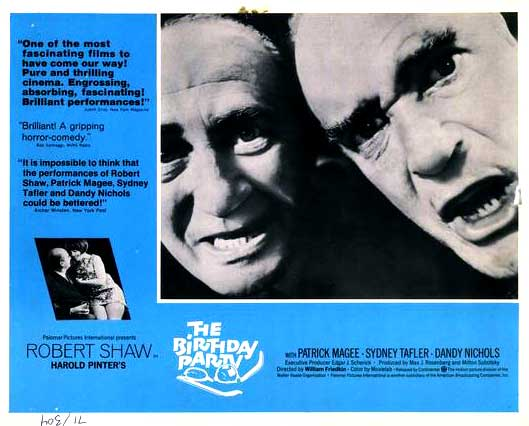
The Birthday Party (1968)

the birthday party 3

By Richard Winters

My Rating: 8 out of 10

4-Word Review: Tear up the newspaper.

Since tomorrow will be my birthday I wanted to come up with a film that had birthdays as its theme and found this bizarre but fascinating obscurity. It is the story based on the play by Harold Pinter of Stanley Webber (Robert Shaw) a mysterious and private man who takes up lodging in a rundown British seaside house. He rents an upstairs room from Mr. and Mrs. Bowles (Moultrie Kelsall, Dandy Nichols) who are quite odd themselves. One day two men dressed in black suits (Patrick Magee, Sydney Tafler) come to pay Stanley a visit. They know something about Stanley’s past and their presence frightens him to the extent that it causes him to have a nervous breakdown.

On the surface this film shouldn’t work. There is an excessive amount of talking with dialogue that doesn’t say much and at times seems absurd. The set is drab and dirty with the camera seemingly locked down inside of it. There is never any explanation about Stanley’s past or what he is running from nor who the men are or what they know about him. The ending is elusive and the viewer will go away feeling more confused than they did at the start.

However, it is these ingredients that make the film so thoroughly intriguing. The seemingly banal dialogue is simply a façade for underlying thoughts and feelings. What Stanley is trying to run from is unimportant because it is really not about him at all and is instead more about ourselves, human nature and the quandary of our existence. It’s an examination of people’s futile attempts at trying to escape from who they are only to have society and life catch up with them. The set could be a metaphor for the inside of Stanley’s head. The grimy and decayed place symbolizes his decayed soul and the men in black suits are his conscience coming to haunt him.

Once you adjust to the eccentric narrative it then becomes a fantastic film for observing subtitles and nuance. Director William Friedkin shows a keenness for detail not only visually, but with the sound as well. The way the Magee character tears up a newspaper and the sound used for it could actually unnerve some viewers. Stanley’s meltdown scene is very unique and overall the direction is superb for such difficult material.

This movie was years ahead of its time, but for some it may be off-putting. However, it should be enjoyed by those who crave the avant-garde. It is also a rare chance to the see the normally strong-willed Shaw playing a very weak and vulnerable character. Nichols is also a stand-out playing an Edith Bunker type with a perverse streak lying just beneath the surface.

the birthday party 1

My Rating: 8 out of 10

Released: December 9, 1968

Runtime: 2Hours 3Minutes

Rated G

Director: William Friedkin

Studio: Palomar Pictures International

Available: VHS, DVD (Region 2)

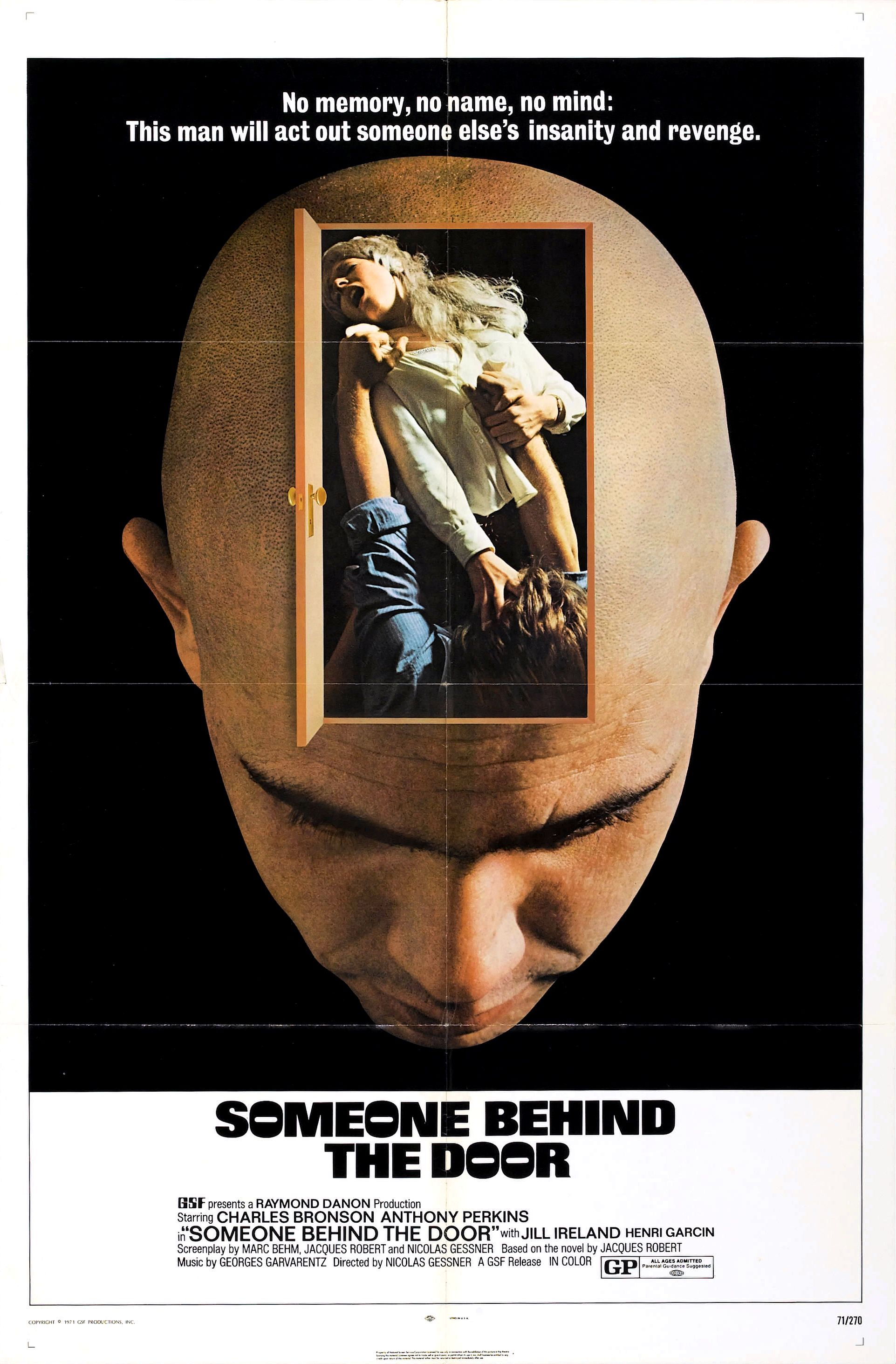
Someone Behind the Door (1971)

someone behind the door 3

By Richard Winters

My Rating: 5 out of 10

4-Word Review: Chuck has no memory.

This review will kick-off a two month long tribute to movies done in the 70’s by Charles Bronson with his wife Jill Ireland. Each Friday I will review one of their films, which will run through April. The only ones that will not be reviewed during this stretch are Love and Bullets, which was already done during our January tribute to Rod Steiger and The Mechanic and Hard Times, which will be done at a later time.

This film is one of the more unusual ones that they did and although not completely successful may still interest Bronson fans simply for a chance at seeing him in an offbeat part. The story concerns neurosurgeon Laurence Jeffries (Anthony Perkins) who takes in a man (Charles Bronson) who has lost his memory and has no idea who he is. Laurence decides to exploit this issue by brainwashing the man into thinking that Laurence’s cheating wife Frances (Jill Ireland) is actually his own and to take action by killing the woman’s lover (Henri Garcin).

The film has a great idea, but the set-up is much too rushed. We are given no backstory to any of the characters. The film opens with Laurence leaving his hospital job and by chance bumping into the man and taking him home before we even know what his motive or plan is. I also found it a bit perplexing that the Dr. character is supposedly conniving and crafty and yet he brings a man into his house while his wife is there sleeping in another room as well as their maid downstairs, which seemed reckless. When his wife awakens the next day and tries to go into the room where the stranger is Laurence panics, but I felt he should have been aware of that potentially happening from the very beginning. He also dictates his plans into a tape recorder, which seemed like prime material to be used for evidence later on.

The psychological side of the story is shallow and transparent. The way Laurence tricks the man into doing his evil bidding was too easy. I realize that the man has lost his memory, but it seems like he has lost his entire brain as well. The character is too child-like and gullible. I also thought that if the man cannot remember his wife and doesn’t know her from anyone else then why would he care if she is fooling around with someone, or get so over-the-top angry about it.

Bronson can be perfect in certain roles, but this is not one of them. Yes, he has a certain likable quality here simply because he plays such a vulnerable and trusting wide-eyed innocent, but the angry emotions that he displays are too rehearsed and over-acted.

Ireland on the other hand is attractive and alluring and comes off well though her part is minimal.  The nude photograph of her lying on a sofa that is shown in close-up is sexy.

The film has very little action especially for a Bronson vehicle though the part where the Bronson character sexually attacks Ireland and then the film intercuts this with him simultaneously attacking another woman on a lonely beach is interesting. The ending though is pathetic as it leaves everything wide-open while resolving nothing. The sequence where the camera cuts quickly back and forth between Perkin’s face and then Ireland’s, which is shown continuously over the closing credits is irritating and almost like the filmmaker’s wanted to drive the viewer as crazy as the kooky characters.

With that said I still found the film to be entertaining most of the way. The idea is a fascinating one and it kept me guessing throughout. Director Nicholas Gessner does an adequate job of taking advantage of the gray countryside to create a nice moody feel. A definite mixed bag.

My Rating: 5 out of 10

Released: July 28, 1971

Runtime: 1Hour 33Minutes

Rated R

Director: Nicholas Gessner

Studio: Lira Films

Available: DVD, Amazon Instant Video

Pulp (1972)

pulp

By Richard Winters

My Rating: 6 out of 10

4-Word Review: Running for his life.

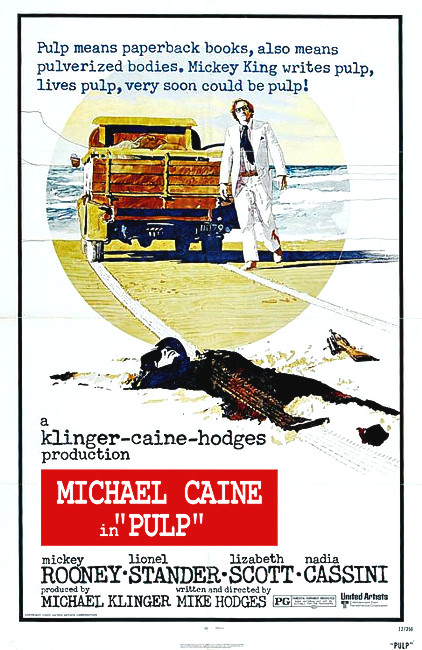
Michael Caine and director Mike Hodges teamed up again one year after doing the gritty classic Get Carter with this breezy oddity dealing with a pulp fiction writer Mickey King (Caine) who is hired to pen the autobiography of ex-Hollywood star Preston Gilbert (Mickey Rooney) who is now living in exile in Malta. The problem is that Gilbert has ties to the underworld and Mickey soon finds himself running for his life while meeting up with a barrage of oddball characters along the way.

The movie has a wonderfully quirky sense of humor with a few memorable laugh-out-loud sequences especially at the beginning. I got a real kick out of the man with a weak bladder who says a prayer to God to open up a locked bathroom door when he can’t get into it. The scene in the bus where we hear the different thoughts going on inside each of the passenger’s heads is great as well. The opening sequence featuring a row of lady typists writing up King’s latest manuscript is cute, but the one thing that holds it all together is Caine’s wry voice-over narration that remains consistently amusing.

Rooney though manages to steal the whole thing with his hilarious send-up of an aging actor. In fact this may be one of the funniest roles of his entire career. Even the scene showing him shadow boxing in his underwear is engaging although thankfully the camera doesn’t stay on it for too long. I was a bit disappointed that the character didn’t last through the film’s duration, but his death scene is so funny that it almost makes up for it.

It is nice to see Lizabeth Scott in her last film to date and first since 1957 when she was essentially blacklisted from Hollywood purportedly for her lesbian leanings. Although only 50 at the time her aging face looked like she was almost 70 and her deep, raspy voice sounded similar to the demon’s in The Exorcist. I thought she could’ve been given more to do and played a character that was more integral to the story as her screen time is much too brief.

The on-location shooting done on the island nation of Malta is another asset. The sunny weather has a nice exotic feel and the old architecture of the buildings helps give the film a visual distinction. The melodic piano soundtrack is pleasing and I wished it had been heard a little bit more.

The story is full of a lot of unexpected twists and turns that manages to be engaging for a while, but I felt it runs out of steam by the end. During the final 15 minutes I found myself a bit bored and no longer caught up in it. While I do like the scene where the gunmen gets run over by a pick-up and shown from the point-of-view of the driver I still felt that the ending lacked the finesse and quirkiness of the beginning. The offbeat ideas that writer/director Hodges showers into the film become dried up with a finish that lacks any payoff and unfortunately sullies what is otherwise an offbeat gem waiting to be discovered.

My Rating: 6 out of 10

Released: August 4, 1972

Runtime: 1Hour 35Minutes

Rated PG

Director: Mike Hodges

Studio: United Artists

Available: DVD, Amazon Instant Video

Nice Girls Don’t Explode (1987)


By Richard Winters

My Rating: 1 out of 10

4-Word Review: Love meets spontaeous combustion.

April Flowers (Michelle Meyrink) has a serious problem. Whenever she goes out on a date with a guy and gets even the slightest bit aroused by him she starts inadvertently setting off fires. Smoke comes popping out of nowhere and before her dates know what is happening their clothes are on fire or worse her date’s fancy cars. April is always sure to bring along protection and in this case that means a small fire extinguisher, but they can’t always put out all the fires that she creates. What April doesn’t know is that it is really her mother (Barbara Harris) who is setting the fires. She buys the explosive ingredients from a pyrotechnic (Wallace Shawn) secretly follows April on her dates and then at just the right moment she uses her remote control to set them off, but now April is dating Andy (William O’Leary) who is on to what the mother is doing and determined to expose her shenanigans to April.

Had this film stayed with the idea that April had some sort of ability to start these fires herself it might have worked as there are a plethora of different and interesting avenues that the story could have taken. Having the plot take the avenue that it does brings up more questions and loopholes and doesn’t really make any sense. Are we to believe that April has now grown into young adulthood and never once suspected that her mother is following her around everywhere and doing what she is doing? And what would compel a mother to torment her daughter in such a way and does she actually believe that she can go on achieving this bizarre stunt for the rest of her daughter’s life and never get caught? None of these questions get answered or even touched upon and instead we are given corny humor that becomes increasingly cartoonish as it progresses until is insulting to anyone with any resemblance of an intellect.

The movie is basically a bad example of a one-joke idea getting stretched out farther than it can or should. After the first five minutes the novelty wears off and has nowhere to go and limps along until it becomes excruciatingly boring and mindless.

Harris gives it her all and to some extent succeeds. I have always enjoyed her work no matter how bad the script, but this one really pushes it. I found it surprising why a woman who was nominated twice for the Academy Award, won several Tonys on Broadway, and was Alfred Hitchcock’s last leading lady would have to settle for this low-grade silliness simply to make a living. Unless of course screenwriter Paul Harris was in some way related to her, so she decided to do it as a favor, but that has never been confirmed.

Meyrink is appealing. She has a geeky quality, but still pretty with a good comic delivery and it is a shame that she did only one more movie after this before dropping out of the business completely. Shawn is also fun as the fire expert, but everyone else is either dull, or has no ability to act.

Someone really should have set fire to this script. Filmed on-location in Lawrence, Kansas this may be the only film in history that lists a stunt double for a cat.

My Rating: 1 out of 10

Released: February 22, 1987

Runtime: 1Hour 28Minutes

Rated PG

Director: Chuck Martinez

Studio: New World Pictures

Available: VHS

The Night of the Following Day (1969)

night of the following day 4

By Richard Winters

My Rating: 4 out of 10

4-Word Review: Kidnappers can’t get along.

A teenage girl (Pamela Franklin) is kidnapped by a group of professional killers who then demand a large ransom from her rich father (Hugues Wanner). Things deteriorate as the criminals begin fighting amongst themselves and eventually it all goes awry, which leads to ironic results.

Writer/director Hubert Cornfield creates a picturesque setting and a certain new wave look that subtly runs through it. The music has a new age sound, which helps to create a kind of metaphysical mindset. There are also some good camera angles and interesting edits, so it takes you awhile before you realize that this is just a lot to do about nothing.

The caper itself is too general and formulaic and in the end makes it a lame excuse for a movie. The infighting by the criminals is not that interesting. The characters are so one-dimensional that you really don’t care what happens to them. The twist ending is not that clever and in many ways simply signifies what a waste of time this really is.

Marlon Brando overacts with a part that doesn’t require it. He uses the hip lingo of the day like ‘freaky’ and ‘man’, which doesn’t really mesh with the middle-aged man that he was. His blonde wig looks awful and his trendy clothes including his big belt buckle gives him too much of a kitschy appearance. The attempts at making him a sort of anti-hero that is brave, sensitive, and concerned for his victim’s welfare despite being one of the perpetrators doesn’t work and makes the character a cliché like everything else in the movie.

Franklin is wasted. She goes through all the expected emotions of a kidnap victim, but barely utters a word in the process.

The neighboring policeman is put in to help create some tension, but ends up being annoying instead. However, Jess Hahn as Wally is quite good playing the film’s only believable character. He has very much of an average Joe type of looks and seems at the start to have an insignificant role, but ends up being the only one that holds it up together while the rest become whacked out.

Despite an interesting cast that also includes Rita Moreno and Richard Boone I found this to be a very cardboard thriller that runs out of gas after an okay beginning.

My Rating: 4 out of 10

Released: February 19, 1969

Runtime: 1Hour 33Minutes

Rated R

Director: Hubert Cornfield

Studio: Universal

Available: VHS, DVD

Britannia Hospital (1982)

Britannia hospital 1

By Richard Winters

My Rating: 7 out of 10

4-Word Review: This hospital needs help.

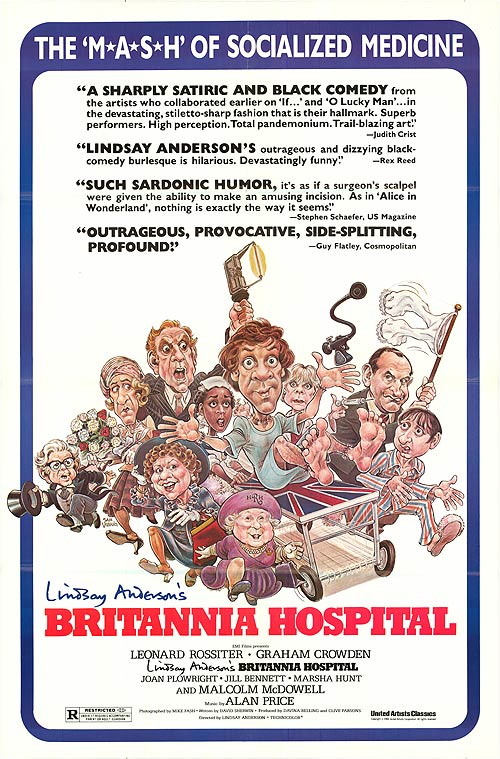
This is another surreal Lindsay Anderson piece that takes many wild forays and yet still manages to come together as a whole in the end. This is as good, as clever, and as pointed as any of his better known stuff. How this got lost in the shuffle is a mystery, but it really deserves a better look.

The plot pertains to a madcap hospital that is in complete disarray. The head surgeon is preoccupied with a ‘mad scientist’ experiment, the staff is threatening to strike, and the rich patients expect preferential treatment. All of this occurs while the Queen is set for a visit. Leonard Rossiter plays the head administrator that tries to keep it all under control.

Of course it’s not really about the hospital at all, but more a satirical look at British society and the arrogance of the upper crust as well as the apathy of the lower one. It shows how very wide apart they are and how the problem is only acerbated by the upper levels refusal to effectively deal with the lower level and their gripes.

The stuffy formalities of the British have never been played out better. At times it even goes for the jugular. Having the Queen and her entourage literally chased through the hospital by an angry mob is the best.

The cast is full of old British pros and all are quite hammy. Rossiter is the jewel. His nervous looking face and body tics have always been funny, but here they come to a hilt.

There are even a few gory segments that could satisfy almost any horror fan. In particular is Professor Millar (Graham Crowden). The scene where he cuts up a human brain, sticks it in a blender, and then has a cameraman drink it up like a milkshake, is outrageously funny.

The ending is a surprisingly sobering with a profound speech that deals not only with the inevitable advent of technology, but also the complexities of society’s problems, and the minimalism of our existence. Overall it’s not bad.

My Rating: 7 out of 10

Released: May 27, 1982

Runtime: 1Hour 56Minutes

Rated R

Director: Lindsay Anderson

Studio: EMI Films

Available: VHS, DVD, Amazon Instant Video

Dead Heat on a Merry-Go-Round (1966)

dead heat on a merry go round

By Richard Winters

My Rating: 6 out of 10

4-Word Review: Robbery at an airport.

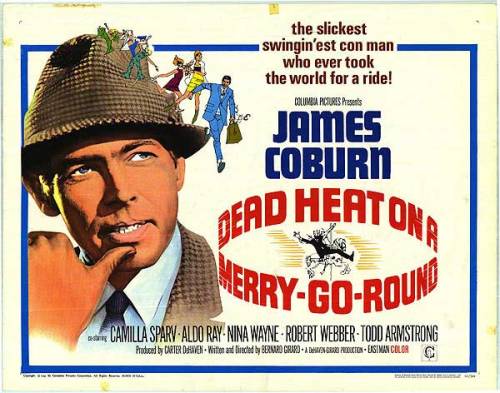
Eli Kotch (James Coburn) manages to con his way out of jail by playing on the affections of his pretty jailhouse psychiatrist (Marian McCargo). His plans are to rob the bank at the Los Angeles International Airport while they are hosting the arrival of a Soviet Premier, which he figures will sufficiently keep the security personal distracted. The blueprint for the bank will cost him a hefty sum, so to help finance it he travels across the country seducing rich women and making off with their expensive possessions and money. Once the blueprint is purchased he assembles his men and executes the daring and elaborate scheme.

The film, which was written and directed by Bernard Girard, is by all means slick although it goes a bit overboard. The first hour is hard to get into. The filmmakers seem intent to keep the viewer guessing about the Kotch’s motives and intricate plans as the rest of the characters. There is so much cutting back and forth between scenes in L.A. and Boston as well as all the lady victims that Kotch finds that it becomes confusing and off-putting. Everything comes off too easily for our protagonist. I suppose that is the intended charm, but a few hiccups here and there to their plans might have offered more tension and reality.

He also beds too many women almost like he is some sort of modern day Don Juan. Having even just one of them slap him across the face when he makes his advances instead of just robotically disrobing and hopping between the sheets with him would’ve been funny. If this film were to be remade the women characters would have to be updated as here they are simply caricatures of a bygone era.

Camilla Sparv’s character and the way Eli treats here was a particular problem with me. Sparv looks drop-dead gorgeous to the point of being breathtaking. Most men would feel blessed at having such a beautiful woman fall in-love with them, but Eli takes it all for granted. He callously lies to her and uses the genuine feelings she has for him to take advantage of her and use it for his own gain. It gets to the point where Eli starts to come off as a real cad and makes the viewer dislike him. There is a twist at the end involving the Sparv character, but it is not enough. I was really hoping that she would somehow manage to screw-up his plans whether intentional or not, but that doesn’t happen even though it should’ve.

Coburn’s toothy grin and deep laugh manages to carry it and probably no other leading man would’ve been able to pull off this type of part as well. The supporting cast is equally good. Rose Marie is fun in a brief part as an older woman that Eli cons. Severn Darden is effective as the nerdy and smart, but very nervous member of Eli’s group. Nina Wayne is funny as one of Eli’s first female victims, a ditzy blonde filled with very quirky philosophies on just about everything. Yet it is Robert Webber, a very under-rated character actor, who steals the show as the high-strung head of the airport security. You can also spot a young Harrison Ford in a brief bit as a bellhop.

The excellent on-location shooting gives the film an added flair. The shots of the Los Angeles International Airport are good especially the way it captures the iconic and modernistic Theme Building. Images of a wintry Boston during Eli’s jaunts to that city are quite scenic particularly all the tree branches covered with snow.

The film’s final half-hour is captivating and even intense. The editing is excellent and the sheer brazenness of the crime is amusing. There are certain things though that seemed implausible and whether such a plan could be pulled off in real-life is doubtful. Still, if you’re a fan of heist films this should offer two hours of suitably fluffy entertainment, but just don’t think about it too hard.

My Rating: 6 out of 10

Released: October 12, 1966

Runtime: 1Hour 44Minutes

Rated NR (Not Rated)

Director: Bernard Girard

Studio: Columbia Pictures

Available: VHS, DVD, Amazon Instant Video

Secret Ceremony (1968)

By Richard Winters

My Rating: 5 out of 10

4-Word Review: Women in weird relationship.

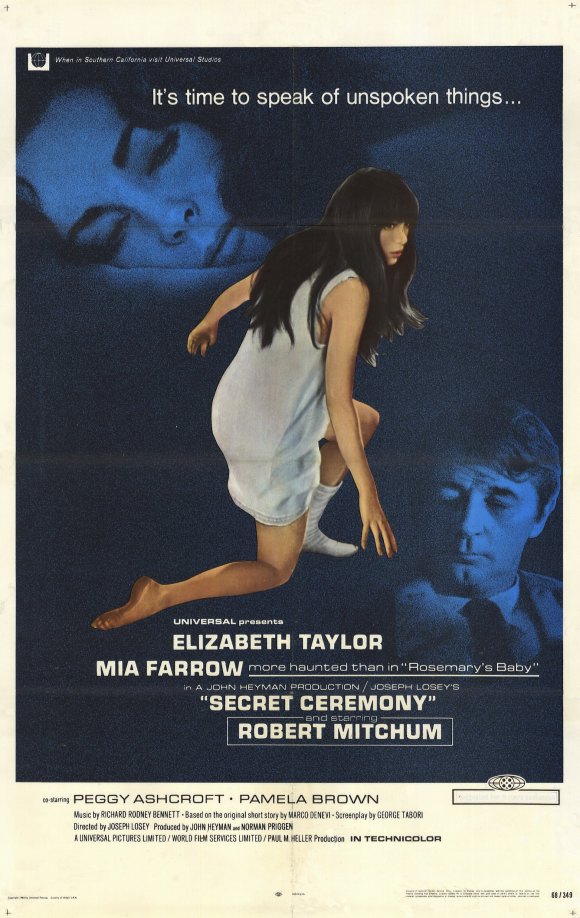
Lenora (Elizabeth Taylor) is a lonely woman who lost her young daughter tragically years before and now finds herself strangely attracted to Cenci (Mia Farrow) a young woman who resembles her. The two move into a large mansion only to have things begin to unravel upon the arrival of Cenci’s weird and menacing father (Robert Mitchum).

The story is bizarre and perverse enough to keep you watching all the way through although it will certainly test the tolerance to those who do not have an affinity for the offbeat. The cinematography is excellent as is the mansion setting. The use of Peggy Ashcroft and Pamela Brown as sneering elderly sisters gives the film some added flavor.

Farrow is genuinely convincing as a grown woman stuck in a childlike trance, but Taylor doesn’t seem completely right for her part. A different actress, especially a character actress would have been much better.

Although the film does manage to come together in the end it does take a long time to get there. There are a lot of slow spots and the patience of some viewers may be tested. There are also many intriguing elements simmering underneath the surface that the film fails to follow through on, but should have.

Fans of Joseph Loosey should find this satisfying while others may be put off by the odd characters and style of narrative.

My Rating: 5 out of 10

Released: October 23, 1968

Runtime: 1Hour 45Minutes

Rated NR (Not Rated)

Director: Joseph Loosey

Studio: Universal

Available: VHS

Goodbye Pork Pie (1981)

By Richard Winters

My Rating: 8 out of 10

4-Word Review: Minis are very durable.

A middle aged man named John (Tony Barry) whose wife has just left him and an unemployed nineteen year old named Gerry (Kelly Johnson) come together through circumstance and trek across New Zealand in a yellow mini while desperately trying to elude the police.

The film has a wonderfully carefree approach and anyone who has ever wanted to ‘drop out’ or stick it to authority will most assuredly enjoy this. There are some clever chase sequences involving the mini with the best coming at a Wellington shopping center. There are also a couple of good running bits including a stressed out vacationing couple dealing with their noisy kids and police officer doing a sexual role playing game with his wife while on duty. The vast age difference between the two main characters is refreshingly different from most ‘buddy’ movies and Johnson, as the younger one of the pair, is excellent. He shows a lot of star making appeal and it is amazing that his film career never flourished. Claire Olberman is gorgeous as a hitch-hiker that they pick up along the way and she closely resembles 80’s adult film star Stacey Donovan and it is a real shame that she doesn’t stay with them throughout the entire film. I also must mention the music score, which has a nice distinct quality to it.

On the negative side I felt Barry in the role of the middle aged man was a little too laid back in his performance. He needed to show more stress and tension, especially when he is put into such crazy and hectic scenarios. I felt his mellowness hurt the film’s believability and even to some extent the excitement. The ending is not very satisfying and seems like the screenwriter wrote himself into a hole that he didn’t know how to get out of. The police are made to look too hopeless and helpless and the film goes overboard in its attempts to mock them.

Despite some flaws this is a road movie the way all road movies should be. It is fun and engaging and will bring out the free spirit in anyone. Although small the minis are a durable and fast car and this film makes prime use of their abilities almost as well as the original The Italian Job did. It also features some great stunt work that most viewers should find impressive.

My Rating: 8 out of 10

Released: February 6, 1981

Runtime: 1Hour 45Minutes

Rated R

Director: Geoff Murphy

Studio: Greg Lynch Film Distributors

Available: VHS, DVD