Category Archives: Offbeat

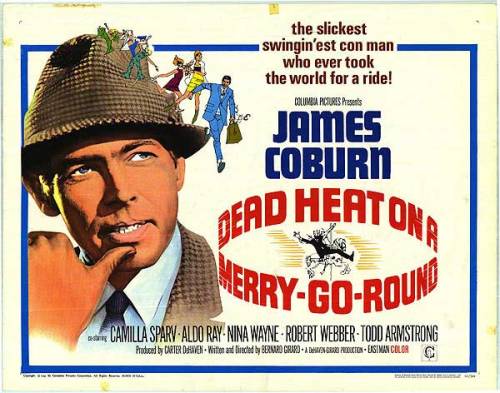
Dead Heat on a Merry-Go-Round (1966)

dead heat on a merry go round

By Richard Winters

My Rating: 6 out of 10

4-Word Review: Robbery at an airport.

Eli Kotch (James Coburn) manages to con his way out of jail by playing on the affections of his pretty jailhouse psychiatrist (Marian McCargo). His plans are to rob the bank at the Los Angeles International Airport while they are hosting the arrival of a Soviet Premier, which he figures will sufficiently keep the security personal distracted. The blueprint for the bank will cost him a hefty sum, so to help finance it he travels across the country seducing rich women and making off with their expensive possessions and money. Once the blueprint is purchased he assembles his men and executes the daring and elaborate scheme.

The film, which was written and directed by Bernard Girard, is by all means slick although it goes a bit overboard. The first hour is hard to get into. The filmmakers seem intent to keep the viewer guessing about the Kotch’s motives and intricate plans as the rest of the characters. There is so much cutting back and forth between scenes in L.A. and Boston as well as all the lady victims that Kotch finds that it becomes confusing and off-putting. Everything comes off too easily for our protagonist. I suppose that is the intended charm, but a few hiccups here and there to their plans might have offered more tension and reality.

He also beds too many women almost like he is some sort of modern day Don Juan. Having even just one of them slap him across the face when he makes his advances instead of just robotically disrobing and hopping between the sheets with him would’ve been funny. If this film were to be remade the women characters would have to be updated as here they are simply caricatures of a bygone era.

Camilla Sparv’s character and the way Eli treats here was a particular problem with me. Sparv looks drop-dead gorgeous to the point of being breathtaking. Most men would feel blessed at having such a beautiful woman fall in-love with them, but Eli takes it all for granted. He callously lies to her and uses the genuine feelings she has for him to take advantage of her and use it for his own gain. It gets to the point where Eli starts to come off as a real cad and makes the viewer dislike him. There is a twist at the end involving the Sparv character, but it is not enough. I was really hoping that she would somehow manage to screw-up his plans whether intentional or not, but that doesn’t happen even though it should’ve.

Coburn’s toothy grin and deep laugh manages to carry it and probably no other leading man would’ve been able to pull off this type of part as well. The supporting cast is equally good. Rose Marie is fun in a brief part as an older woman that Eli cons. Severn Darden is effective as the nerdy and smart, but very nervous member of Eli’s group. Nina Wayne is funny as one of Eli’s first female victims, a ditzy blonde filled with very quirky philosophies on just about everything. Yet it is Robert Webber, a very under-rated character actor, who steals the show as the high-strung head of the airport security. You can also spot a young Harrison Ford in a brief bit as a bellhop.

The excellent on-location shooting gives the film an added flair. The shots of the Los Angeles International Airport are good especially the way it captures the iconic and modernistic Theme Building. Images of a wintry Boston during Eli’s jaunts to that city are quite scenic particularly all the tree branches covered with snow.

The film’s final half-hour is captivating and even intense. The editing is excellent and the sheer brazenness of the crime is amusing. There are certain things though that seemed implausible and whether such a plan could be pulled off in real-life is doubtful. Still, if you’re a fan of heist films this should offer two hours of suitably fluffy entertainment, but just don’t think about it too hard.

My Rating: 6 out of 10

Released: October 12, 1966

Runtime: 1Hour 44Minutes

Rated NR (Not Rated)

Director: Bernard Girard

Studio: Columbia Pictures

Available: VHS, DVD, Amazon Instant Video
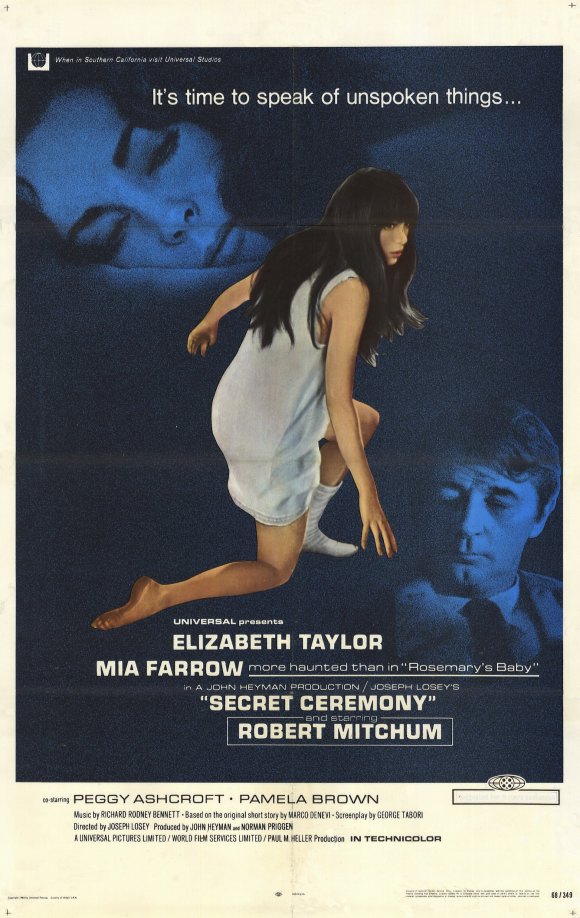
Secret Ceremony (1968)

By Richard Winters

My Rating: 5 out of 10

4-Word Review: Women in weird relationship.

Lenora (Elizabeth Taylor) is a lonely woman who lost her young daughter tragically years before and now finds herself strangely attracted to Cenci (Mia Farrow) a young woman who resembles her. The two move into a large mansion only to have things begin to unravel upon the arrival of Cenci’s weird and menacing father (Robert Mitchum).

The story is bizarre and perverse enough to keep you watching all the way through although it will certainly test the tolerance to those who do not have an affinity for the offbeat. The cinematography is excellent as is the mansion setting. The use of Peggy Ashcroft and Pamela Brown as sneering elderly sisters gives the film some added flavor.

Farrow is genuinely convincing as a grown woman stuck in a childlike trance, but Taylor doesn’t seem completely right for her part. A different actress, especially a character actress would have been much better.

Although the film does manage to come together in the end it does take a long time to get there. There are a lot of slow spots and the patience of some viewers may be tested. There are also many intriguing elements simmering underneath the surface that the film fails to follow through on, but should have.

Fans of Joseph Loosey should find this satisfying while others may be put off by the odd characters and style of narrative.

My Rating: 5 out of 10

Released: October 23, 1968

Runtime: 1Hour 45Minutes

Rated NR (Not Rated)

Director: Joseph Loosey

Studio: Universal

Available: VHS

Goodbye Pork Pie (1981)

By Richard Winters

My Rating: 8 out of 10

4-Word Review: Minis are very durable.

A middle aged man named John (Tony Barry) whose wife has just left him and an unemployed nineteen year old named Gerry (Kelly Johnson) come together through circumstance and trek across New Zealand in a yellow mini while desperately trying to elude the police.

The film has a wonderfully carefree approach and anyone who has ever wanted to ‘drop out’ or stick it to authority will most assuredly enjoy this. There are some clever chase sequences involving the mini with the best coming at a Wellington shopping center. There are also a couple of good running bits including a stressed out vacationing couple dealing with their noisy kids and police officer doing a sexual role playing game with his wife while on duty. The vast age difference between the two main characters is refreshingly different from most ‘buddy’ movies and Johnson, as the younger one of the pair, is excellent. He shows a lot of star making appeal and it is amazing that his film career never flourished. Claire Olberman is gorgeous as a hitch-hiker that they pick up along the way and she closely resembles 80’s adult film star Stacey Donovan and it is a real shame that she doesn’t stay with them throughout the entire film. I also must mention the music score, which has a nice distinct quality to it.

On the negative side I felt Barry in the role of the middle aged man was a little too laid back in his performance. He needed to show more stress and tension, especially when he is put into such crazy and hectic scenarios. I felt his mellowness hurt the film’s believability and even to some extent the excitement. The ending is not very satisfying and seems like the screenwriter wrote himself into a hole that he didn’t know how to get out of. The police are made to look too hopeless and helpless and the film goes overboard in its attempts to mock them.

Despite some flaws this is a road movie the way all road movies should be. It is fun and engaging and will bring out the free spirit in anyone. Although small the minis are a durable and fast car and this film makes prime use of their abilities almost as well as the original The Italian Job did. It also features some great stunt work that most viewers should find impressive.

My Rating: 8 out of 10

Released: February 6, 1981

Runtime: 1Hour 45Minutes

Rated R

Director: Geoff Murphy

Studio: Greg Lynch Film Distributors

Available: VHS, DVD

Skidoo (1968)

By Richard Winters

My Rating: 5 out of 10

4-Word Review: They were on LSD.

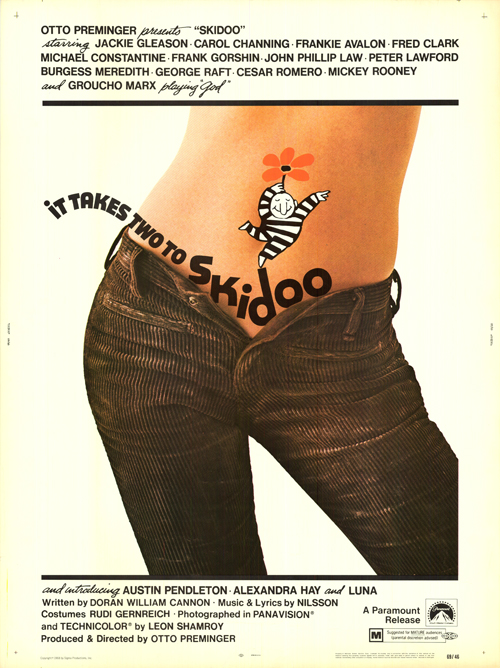
Jackie Gleason plays family man Tony Banks with mob past who is now trying to go straight yet gets sucked back in by a gangster leader named God (Groucho Marx). He orders Tony to disguise himself as a prisoner so he can infiltrate a prison system and knock off another prisoner and rival named George ‘Blue Chips’ Packard (Mickey Rooney). While in prison Tony mistakenly takes some LSD and goes on a wild drug induced trip.

Story wise it is limp. The humor is weird, but not altogether funny. It tries to satirize a lot of things yet none of it comes together. There is no singular voice or vision let alone cohesion. The pacing is poor and haphazard. It becomes so sloppy and nonsensical that you almost wonder if renowned director Otto Preminger was the one taking the LSD stuff.

The idea of mixing old school comedy with the mod hipness of the day was not new. Many films (and TV shows) of that period tried it with limited success. Yet few went to the extremes as this one. It is still a complete disaster yet odd enough to grab your attention and hold it. In some ways it’s enjoyable and even entertaining if viewed as an oddity and relic of its era.

There are a few good scenes. One involves a weird hippie speech by actor John Phillip Law where he professes a need to be ‘nothing’ which will somehow make him ‘everything’ and ‘anything’. There are also some quirky commercial spoofs at the beginning, a brief glimpse of Packard’s prison cell ‘office’, and the ‘the family tree’ of a crime syndicate. Gleason’s LSD trip really isn’t that funny, but it is still weird enough to stand out.

A lot of talented character actors are wasted with boring bit parts. Gleason though still comes through as his bombastic self. Unfortunately the same cannot be said for Groucho. He looks old and well past his prime. He mouths his lines with little or no energy. His conversation with actress Alexandra Hay seems particularly strange as he ‘talks to her’ but never once actually looks at her. Instead he looks off into another direction in a not so subtle attempt to read his cue cards. He does this in other scenes too. Some may still get a kick out of his presence because at the end he dresses as a hippie and even takes a puff of the weed. You also gotta love his mistress and her very low cut dress.

Austin Pendleton gives the best all- around performance playing the first in what has become a long line of nebbish, bookworm type characters. Carol Channing is a real surprise. She sings and even gives each one of the hippies a shampoo in her kitchen sink. There is also a freaky scene where she does a striptease and then lies half naked on Frankie Avalon’s bed. Her presence also gives Gleason a chance to write her a little love letter where states that how he misses her “even that voice of yours”.

Harry Nilsson’s music in Midnight Cowboy was perfect, but all wrong here. However hearing him sing EACH AND EVERYONE of the credits at the end is a goofy delight.

My Rating: 5 out of 10

Released: December 19, 1968

Runtime: 1Hour 37Minutes

Rated M

Director: Otto Preminger

Studio: Paramount

Available: DVD 

Heavy Traffic (1973)

By Richard Winters

My Rating: 6 out of 10

4-Word Review: A world without women.

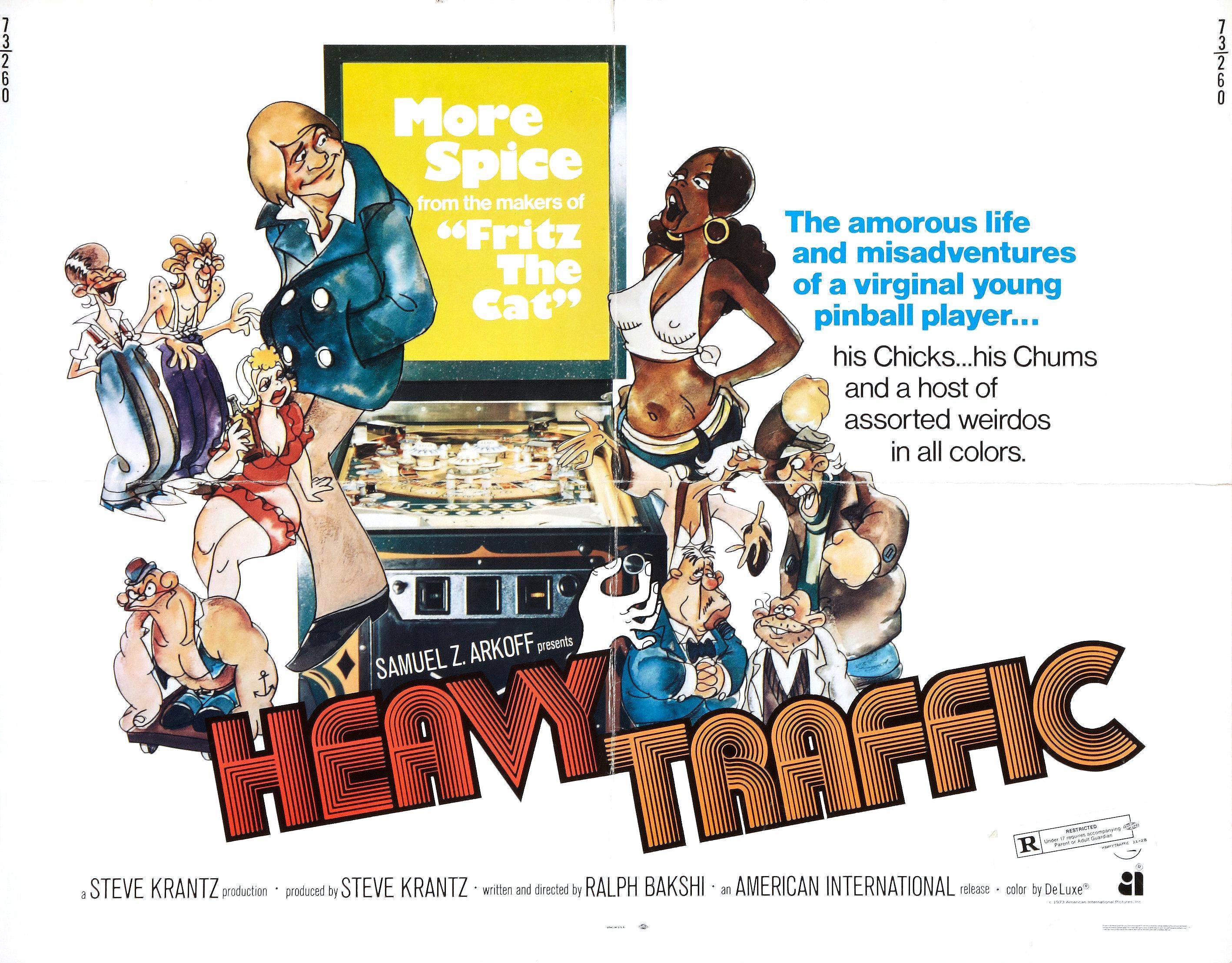
            Animated feature with some live-action scenes dealing with a lonely 24 year old artist named Michael who is still living with his parents in a rundown New York City apartment and aspires to be an underground cartoonist.

The film seems compelled right from the beginning to shock and offend as many viewers as it can. Violence and blood, lots of blood, seems to spurt out of characters heads and bodies every few minutes. Breasts pop out of female dresses with just as much regularity and there is even a segment dealing with spousal abuse that gets rather nasty.  Racial stereotypes abound and the N-word is used liberally by the white characters. Some may consider this groundbreaking while others might think it was done by someone who has been sitting alone in his studio too long and needs to seek professional help.  I can appreciate the no-holed-barred approach and the idea that cartoons don’t have to be just for kids, but the edginess is no longer as potent these days since Family Guy, American Dad, and South Park come quite close to what you see here and in some ways are even more outrageous.

The story is too free-form and lacks focus. It took quite a while before I could get into it and the beginning comes off like a lot torrid, wild images thrown at you without cohesion, or direction. The characters are vulgar, gross, and unlikable. Michael, as the protagonist, as some appeal, but he is too detached.

There were some scenes that I found to be quite funny, but they all come in the second half. The scene where Michael describes a new fantasy comic he wants to create to a very sickly, old publisher is great and nicely symbolizes how the old guard is out of touch with the tastes and ideas of the younger generation. His idea deals with an apocalyptic world that has no women, so the men have sex with a pile of garbage instead only to have a real woman appear and then be taken away by God who wants her for himself. This sequence is by far the funniest and most imaginatively perverse of the whole film and I wished that this had been the main premise.  Another segment has Michael’s father bringing home an obese prostitute for Michael, which in a gross sort of way is highly amusing. Another similar scene has Michael trying to have sex with another woman on the rooftop of a building, but inadvertently knocks her over the side wall and she spends the rest of the film dangling naked by a telephone wire. The Godfather who eats a hearty meal of spaghetti while in front of a row of urinals deserves mention as well.

The film is certainly not for all tastes. The animation may not hold up to today’ s standards and the live action segments are not as interesting. The ending falls flat and gets extended longer than it should. Supposedly the initial idea was to have it end with a climatic car chase with images of penny arcade pinball machines flashed across the sky, which would have been better, but due to budget restraints was scrapped.

My Rating: 6 out of 10

Released: August 8, 1973

Runtime: 1Hour 17Minutes

Rated R

Director: Ralph Bakshi

Studio: American International Pictures

Available: VHS, DVD

The Passion of Anna (1969)

By Richard Winters

My Rating: 8 out of 10

4-Word Review: Lonely little island retreat.

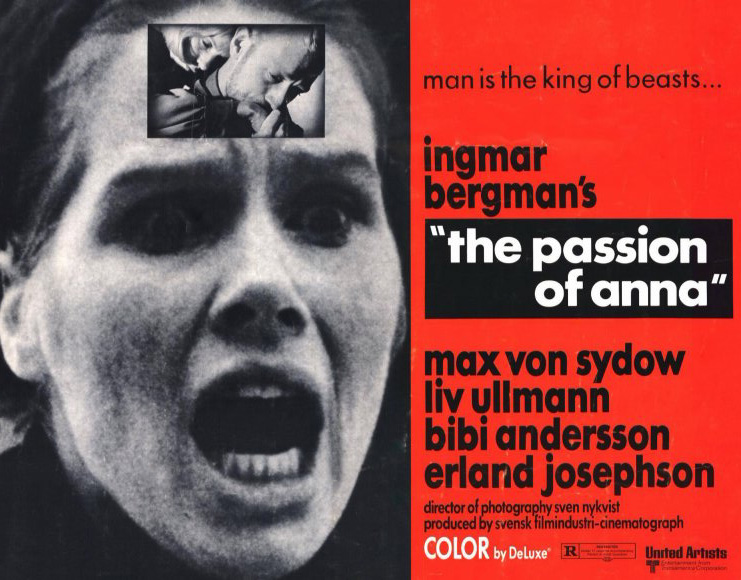
This is an intriguing film that seems quite similar to Roman Polanski’s Cul-De-Sac. Both films have a unique atmosphere and take place in a remote island setting and deal with a turbulent undercurrent that brews just underneath its deceivingly placid exterior.

Here we have Andreas (Max Von Sydow) living a lonely existence on an island retreat. He meets, by chance, Anna (Liv Ullmann) who is still grieving from the death of her first husband. The two form a tenuous relationship that slowly unravels as the dark corners of their personalities are eventually exposed.

In many ways this film has all the right ingredients. It wraps you up in its surreal nature and adds interesting effects. There are some creepy elements including a mad killer running around the island killing and torturing all the animals. Things work at a deliberate pace and leave no clue as to where it is headed. The characters are unpretentious and introspective. They are open about their faults and failures and give good reason as to why they have them. There are also fascinating cutaways to the actors themselves who help explain and interpret their characters motivations, which is a novel idea that gives the viewer a deeper understanding of the characters and adds an extra dimension.

Unfortunately it doesn’t come together and leaves no real emotional impact. There are a few good twists, but you can’t help but feel that it should have gone farther. There a certain scenarios that get touched on, but are never explored. For instance there is Andreas’s relationship with Elis (Erland Josephson).  Andreas has taken a loan out from him, but has also had an affair with his wife. This of course has some potential for fireworks and there is a moment where it begins to sizzle, but it never goes back to it. The same thing can be said for many of the other segments including the identity and reason for the animal killer.

Overall this is an outstanding experimental-like movie. It is not one of director Ingmar Bergman’s best, but it is still richer and more deeply textured than eighty percent of the other movies that are out there. The crisp and revealing dialogue alone makes it worth it and Bergman displays the most realistic perspective on the union of marriage.

My Rating: 8 out of 10

Released: November 10, 1969

Released: 1Hour 41Minutes

Rated R

Director: Ingmar Bergman

Studio: United Artists

Available: VHS, DVD

How to Murder Your Wife (1965)

By Richard Winters

My Rating: 7 out of 10

4-Word Review: Helpful advice for husbands.

            Stanley Ford (Jack Lemmon) is a successful cartoonist living the bachelor dream in a penthouse loaded with perks and helped run by his loyal butler Charles (Terry-Thomas). Things go horribly wrong when one night while attending a bachelor party for one of his friends he becomes drunk and finds himself the next day married to a beautiful Italian blonde who can’t speak a word of English. Despite this she starts to take over his life, running Charles out of the home and ruining his career and friendships in the process. To vent his frustrations he has the main character of his comic strip murder his wife and to insure that it is believable he plays out the murderous sequence in real life, but using a mannequin in the place of an actual body. When his wife sees the comic she becomes hurt and runs off making people believe that she was killed when no one can locate her.

This is a much edgier Lemmon comedy from what he has done in the past and the change is welcome. He plays a more sophisticated extension of the character that he did in Under the Yum Yum Tree. The scenario is clever and original for the most part, but what surprised me was the extreme cynicism it had towards the institution of marriage. Most films both before and after have made some tongue-in-check jokes towards it, but this things treats it like it’s an ugly monster that needs to be beaten with a club. This is done mainly from the man’s point-of-view, which is fun and refreshing simply for the fact that something this politically incorrect could never be made today, but also there are a few scenes were the Claire Trevor character teaches Lemmon’s wife how to manipulate the husband and get away with it. What is said is all right on target with the truth, which may make some cringe while they are laughing, or if you are single it will be just another excuse to gloat. The brilliantly written, hilarious court room segment at the end where Stanley tries to get his lawyer friend Harold (Eddie Mayhew) to press an imaginary button, which he convinces him will kill off his wife and allow him to be set ‘free’ is the best part.

Lisi does well in her role and the fact that she can’t speak any English, at least at the beginning, makes her presence more interesting. Although done many times before, her popping out of a giant cake at the bachelor party is quite steamy and enticing. Her dance on top of a piano is provocative and even more surprisingly is when older actress Trevor does the same dance later on and is almost as alluring.

Thomas is a legendary comic character actor and quite possibly one of the best who ever lived. His presence helps the film immeasurably and it is a shame that he is not in it the whole time. Mayhew is very good as well and although it takes a while for him to get going I found myself enjoying his scenes and his little quirks, including his weird laugh, more and more as it went along. His performance in the climactic courtroom segment is tops.

The script, by George Axelrod, seems a bit disjointed and over-long. It starts out as a quirky comedy then falls into being a contrived, fluffy comedy during a really slow middle part, only to recover with a resounding end. The script could have been tighter, but the finale is so funny that I forgave it and it is well-worth seeking out for the comedy fan looking for something a little different. In fact I am surprised this thing hasn’t acquired a cult following.

My only other complaint is the music score by Neal Hefti, which sounds much too similar to The Odd Couple score that came out only three years later and also starred Lemmon.

My Rating: 7 out of 10

Released: January 26, 1965

Runtime: 1Hour 58Minutes

Rated NR (Not Rated)

Director: Richard Quine

Studio: United Artists

Available: VHS, DVD (The Jack Lemmon Collection), Amazon Instant Video

The Gong Show Movie (1980)

By Richard Winters

My Rating: 5 out of 10

4-Word Review: Jaye P. Morgan topless.

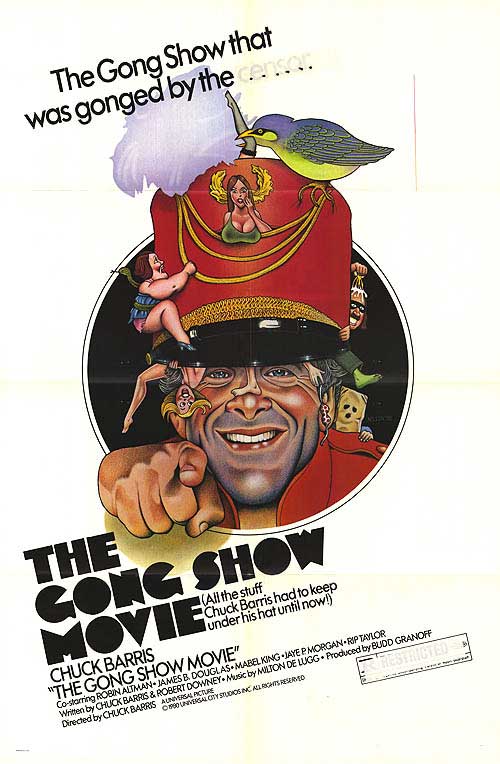
A very fractured, offbeat look at game show host Chuck Barris and his trials and tribulations as producer and host of the hit 70’s game show ‘The Gong Show’. In between there are some very short snippets of acts that never made it past the network censor. If you are unfamiliar with the show it featured three B-celebrities, usually Jamie Farr, Artie Johnson, and Jaye P. Morgan, who would watch talent acts performed by amateurs. The acts were usually done in the comic and absurd vein and could include anything from singing, dancing, or stand-up comedy. If they were really bad the celebrities would get out of their seats and bang a big gong that was behind them, which would have the performer thrown off. If the participant avoided being gonged they would then have the potential of winning a monetary prize at the end.

If you were not a fan of the show then you probably won’t be a fan of this movie either. If you were a fan you still might not like it because Barris acts consistently embarrassed by his creation and seems to want to disown it.

The film lacks cohesion. It mixes absurdity with surrealism and even trashy segments thrown in for good measure. The quirky bits are forced and the ‘hilarious’ dialogue is just plain stupid. There is also too many scenes involving a stuffy, uptight network boss who is so over- the-top clichéd that he becomes annoying.

Barris never seemed completely cut out for a game show host and even less as a leading man. He has no charisma and  spends the whole time moping around. He comes off as very burdened making you wonder if his stories about being a part-time CIA hit man were true. Either way he is not an engaging centerpiece for a movie. It would have been better had it broadened out and shown more of “The Gong Show” cast especially Jaye P. Morgan who is as raunchy as ever in the few scenes that she is in including her topless part!

The show always had a unique and perverse brilliance, which comes out every time it features one of the acts from the show making me feel that using this simply as a highlight reel of all of the best and most outrageous acts would have been a better idea. The ones that they show aren’t bad, but they are cut pretty short. A few of the ones that I liked featured two teenaged girls performing fellatio with their popsicles. Another one has three men standing at a urinal and making music with their zippers until one of their zippers gets caught! There is also two obese Siamese twins singing the Captain and Tennille hit ‘Love Will Keep Us Together’.

My Rating: 5 out of 10

Released: May 23, 1980

Runtime: 1Hour 29Minutes

Rated R (Language, Brief Nudity, Raunchy Humor)

Director: Chuck Barris

Studio: Universal

Available: None

The Little Girl Who Lives Down the Lane (1976)

By Richard Winters

My Rating: 3 out of 10

4-Word Review: She is all alone.

Rynn (Jodie Foster) is a 13-year-old girl living alone in a big house in the countryside. Her father has leased the place for three years from nosy landlady Mrs. Hallet (Alexis Smith) and her adult son Frank (Martin Sheen) who continually makes lecherous advances towards Rynn. No one has seen her father and when anyone asks for him she comes up with excuses, which starts to make everyone in town suspicious. She meets fellow teen Mario (Scott Jacoby) who she lets in on her secret and the two devise a plan that will rid them of the meddlesome Hallets.

Although she has stated in interviews that this is the least favorite out of all the movies that she has done I can’t think of anyone more perfect for the part of an independent headstrong young woman than Foster, who has always carried that persona. Despite the vast age difference she easily carries the picture from her older co-stars. There is even a nude scene involving her character although it was done by her older sister Connie working as a body double. This was done despite her adamant protests as was a scene where she goes to bed with Jacoby, which she has said made her extremely uncomfortable and probably explains her dislike for the film.

Sheen is menacing as the perverted Frank, who enjoys ‘younger girls’ and his ongoing banter and advances with Rynn is consistently creepy and tense. Alexis Smith is excellent as the mother and her worn face and attitude gives her a witchy presence and it is too bad she couldn’t have remained for the entire movie. I also found Jacoby engaging and amiable and I really enjoyed his character, which I found a bit surprising since he is best known for playing dark, sinister characters in Rivals and the TV-movie Bad Ronald.

The on-location shooting, which was done in both the Canadian province of Quebec and in Maine, is excellent and gives one a nice taste of small town life on the east coast. There is some nice synthesized music that gives the film a dark tone. The premise is offbeat and to some extent, at least during the first half, it is enough to keep you intrigued.

My main issue with the film is the fact that not enough happens. Almost all the action takes place in the main room of the house, which eventually becomes dull, especially visually. There are no scares, or shocks and the twists aren’t all that clever, or surprising. In fact the final twist I saw coming long before it happens. There are times when cutaways would have been helpful and spiced things up particularly when Rynn talks about a visit from her mother and her ‘long red finger nails’, which we never see and is just described. The conclusion leaves A LOT of unanswered questions making this thing empty and incomplete. The final shot is one very long take of a close-up of Foster staring at a subject while the credits role by, which eventually becomes annoying and it would have been better had they done a freeze-frame instead of forcing her to sit and stare at something way longer than humanely possible. Also, composer Mort Shulman is badly miscast as the policeman. His acting abilities are clearly limited and he shows no presence or authority and makes the scenes he is in weak.

It is hard to know what genre to put this in. It is really not scary and the mystery angle has too many loopholes to being taken seriously. The story, based on a novel by Laird Koenig, seems rather tame despite some dark elements and geared more for teens, or young adults.

My Rating: 3 out of 10

Released: December 25, 1976

Runtime: 1Hour 40Minutes

Rated PG (Brief Nudity, Mild Cursing)

Director: Nicholas Gessner

Studio: American International

Available:  VHS, DVD, Netflix Streaming

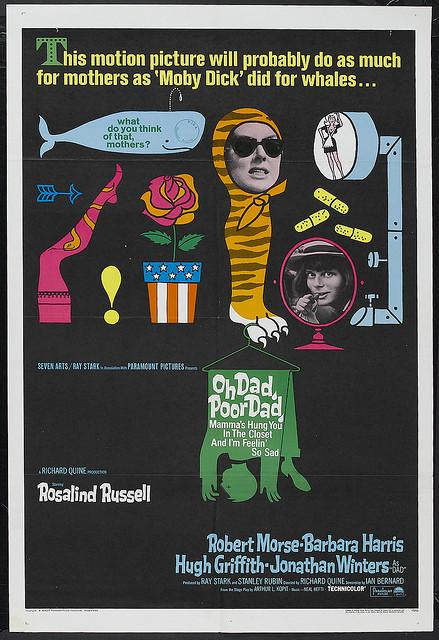
Oh Dad, Poor Dad, Mama’s Hung You in the Closet and I’m Feelin’ So Sad (1967)

oh dad poor dad

By Richard Winters

My Rating: 1 out of 10

4-Word Review: Overprotective mother dominates son.

This is an awful, awful film based on the Arthur Kopit stage play of the same name. Overly domineering mother Madame Rosepettle (Rosalind Russell) keeps her son Jonathan (Robert Morse), who is 25, in a near infantile state. She also travels around with her dead husband in a coffin. Problems ensue when they arrive at a resort and meet up with nubile Rosalie (Barbra Harris) who tempts Jonathan and threatens to break him away from his mother’s clutches.

If done right this film could have, I suppose, gained some sort of cult following. Yet it is so poorly realized and so thoroughly botched that it is impossible to know where one could begin to improve it as it deserves to be in the top ten of worst movies of all time.

One of the problems is the setting itself. For some reason it was filmed in Montego Bay, Jamaica. This certainly does provide for sunny and exotic scenery, but it does not at all work with its twisted, dark subject matter. The music score is also really bad. It was done by Neal Hefti the same man who did the music for the “Batman” TV-show and the soundtrack here sounds just like that one. He also has the theme song sung by children which is as irritating as nails scratching on a blackboard. The color schemes are garish and ugly. The humor is flat and the story itself is threadbare. When you get past the weird fringes all you have left is a stale, plodding coming-of- age tale.

Morse seems a natural for the part as the ‘man-child’ since he has always had a very boyish face. Yet, in an attempt to show that he is never let outside, he is made to look extremely pale and the effect is a bit sickening to look at. His infantile state is played too much to the extreme and comes off as pathetic. It is not at all funny even in an absurd, or dark way.

Russell’s presence makes it somewhat interesting. She was a legendary actress and this was certainly a very unique career move. Maybe she wanted to prove herself versatile after her Mother Superior part in The Trouble with Angels, which she had done just a year before doing this, yet in hindsight it was bad judgment. Seeing her in the strange part is fun for a few seconds, but eventually it gets over-the-top. She ends up looking like Faye Dunaway’s Joan Crawford in Mommie Dearest. You do however get to see her wear a variety of wigs and even do a wild water ski stunt at the end.

Harris has always been one terrific actress and she is good even here and the only reason I’m giving this film one point. She made a career out of playing neurotic women, but here plays a more normal one and it is interesting to compare this performance with her others.

Jonathan Winters (no relation) adds some amusing bits doing voice-over as the dead father. He was brought in after the film was completed and some of his lines have nothing to do with the plot.

The message of the story is nebulous. The video box cover states that it is a study of “human confusion”. Yet the characters seem too extreme to be relatable on any human level. They also don’t evolve and act the same idiotic way at the end as they did at the beginning so neither they nor the viewer come to any better understanding of anything. It is a complete waste of time.This film deserves its near extinct status and isn’t fun even as a curio.

My Rating: 1 out of 10

Released: February 15, 1967

Runtime: 1Hour 26Minutes

Rated NR (Not Rated)

Director: Richard Quine

Studio: Paramount

Available: VHS