Category Archives: Offbeat

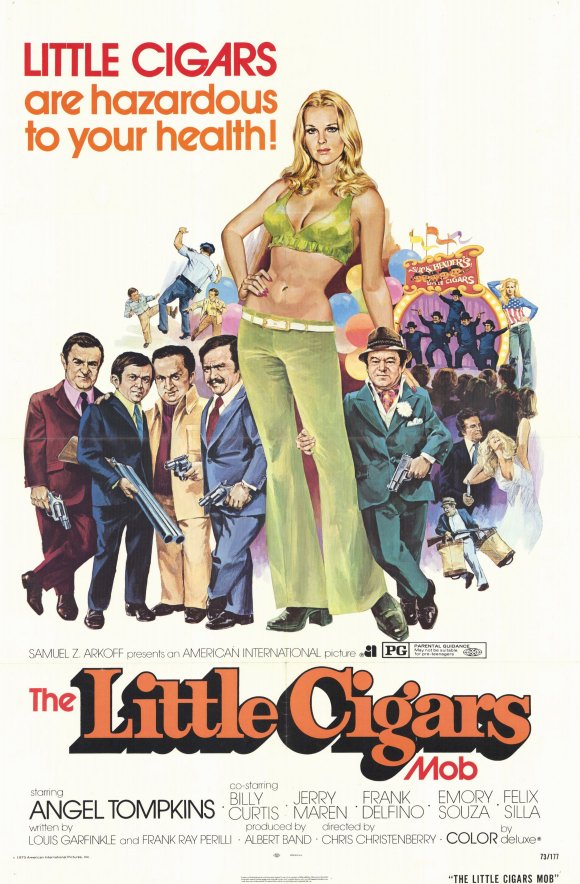
Little Cigars (1973)

little cigars

By Richard Winters

My Rating: 3 out of 10

4-Word Review:  Midgets turn to crime.

A young, beautiful blonde (Angel Tompkins) becomes an unlikely partner with a group of midgets who run a small (no pun intended) theft ring. With a title and premise like that you would expect a broad comedy, but that is not the case. Although there are a few snappy exchanges and a funny scene involving a police line-up of some very angry midgets, this is mainly handled on a gritty, violent level.

The midgets themselves aren’t too likable. This may be an attempt by the filmmakers to show them as real human beings and the effects of living in a society with a handicap, but they end up coming off as overly irritable, bad tempered, and vicious without ever confirming if this is some social statement.

Overall it’s just a standard crime yarn with midgets used instead of regular sized people. There is even a storyline involving a romance between Tompkins and head midget Billy Curtis showing how love can spring up between any two people no matter what their size. However, you can’t help but get a queasy feeling when you see a 60-year-old midget in bed kissing a young statuesque blonde.

The film leaves the viewer with a certain degree of unpleasantness too much actually, to consider it enjoyable or entertaining. The only part I really liked was the scene where Curtis goes into a tough bar and takes on a big guy who has his arms around ‘his’ girl, which is both amusing and exciting.

Also, Frank Bonner who later went on to play Herb in the classic TV-series ‘WKRP in Cincinnati’ can be seen very briefly as a hotel doorman.

My Rating: 3 out of 10

Released: June 11, 1973

Runtime: 1Hour 32Minutes

Rated PG

Director: Chris Christenberry

Studio: American International Pictures (AIP)

Available: DVD-R (MGM video on demand)

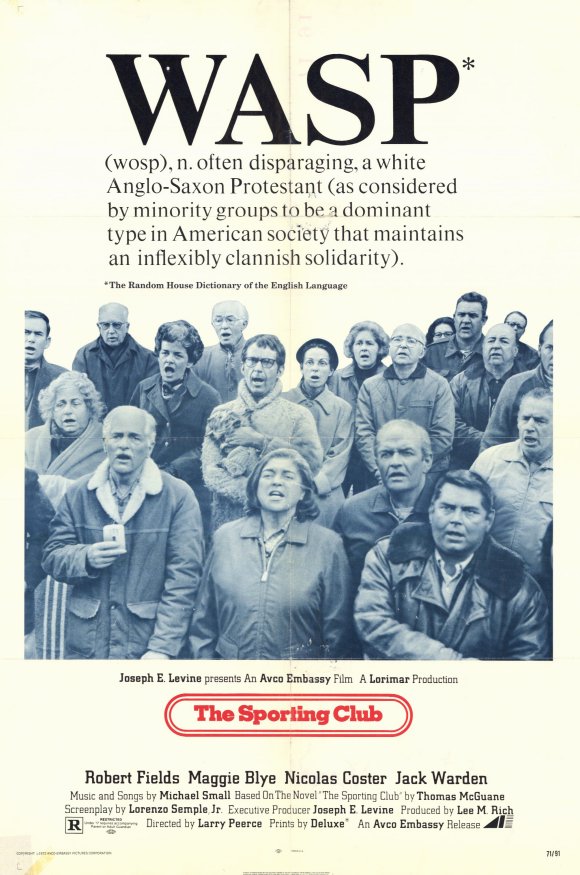
The Sporting Club (1971)

the sporting club 2

By Richard Winters

My Rating: 4 out of 10

4-Word Review: Haves versus have-nots.

Jim (Nicholas Coster) finds out that his business is going under and he barely has any money left. To escape the stress he decides to take a trip to the wilderness of northern Michigan for a little R&R. Unfortunately once there he meets his friend Verner (Robert Fields) who has built a shooting range in his basement and wants to challenge everyone to a duel. The snotty sporting club that Jim belongs to wants to boot him out when they realize he is no longer making an income and rebel- rouser Earl Olive (Jack Warden) gets into a war with the elitist at the sporting club, which sends things spiraling out-of-control between the two sides with Jim right in the middle.

Based on the Thomas McGuane novel the film has the right concept, but not the fluid essence or wry humor of his writing. Some of his later work that was brought to the screen fared better. This film version is too uneven and takes too long to get anywhere. It becomes somewhat intriguing when we are given the idea of this set-up of a wild shoot-out between Olive’s biker gang and the elderly members of the club, but just as things seem to be getting interesting the film veers into a radically different direction and has all the sporting club members getting into a bizarre sex orgy. This may sound funny or even sexy, but it really isn’t as all the people were in their 60’s or 70’s and seeing their naked bodies cavorting around comes off as gross and sick.

The satirical jabs at the snotty club members are funny to some extent. They represent society’s old order people still clinging to age-old traditions and values even though the rest of the world around them is changing. They boast about their exclusive club membership even though it no longer has any allure and their stubbornness only makes them more insignificant and absurd. The scene where they stare blankly like lost children at the blown-up remnants of their cottage is probably the best moment in the film. However, their caricatures end up going overboard they become too illogical and ridiculous like crazed stupid creatures instead of human beings.

Most anti-establishment films of the era, which in the end is what this is, usually cast young stars in the lead, but here we have Coster who was already middle-aged making it look too much like the old guard vs. the old guard, which did not connect with the young filmgoers and they stayed away. The middle-age audience of the time was the establishment themselves and they found the film’s crass humor and scenarios off-putting and thus the film alienated everybody and bombed terribly at the box office.

Robert Fields gives an excellent performance as a budding sociopath and his scenes have an added tension. Warden is also very good in an unusual role for him as a joint smoking trouble maker who loves to rock-the-boat. The gun duel he has with Fields is interesting and his presence helps give the film a few extra points. Margaret Blye has a beautiful face making her a pleasure to look at no matter what she is doing. Jo Ann Harris is also sexy and the scene where she strips down to her panties with the phrase ‘my grandmother loves me’ stenciled on the rear is fun.

The film is weird enough to be worth a look as a curio. Director Larry Peerce infuses some interesting camera work into the proceedings and Michael Small’s moody folk rock score deserves its own album. Despite the locale looking very much like Michigan it was actually filmed near Hot Springs, Arkansas.

My Rating: 4 out of 10

Released: February 28, 1971

Runtime: 1Hour 45Minutes

Rated R

Director: Larry Peerce

Studio: Avco Embassy Pictures

Available: None at this time.

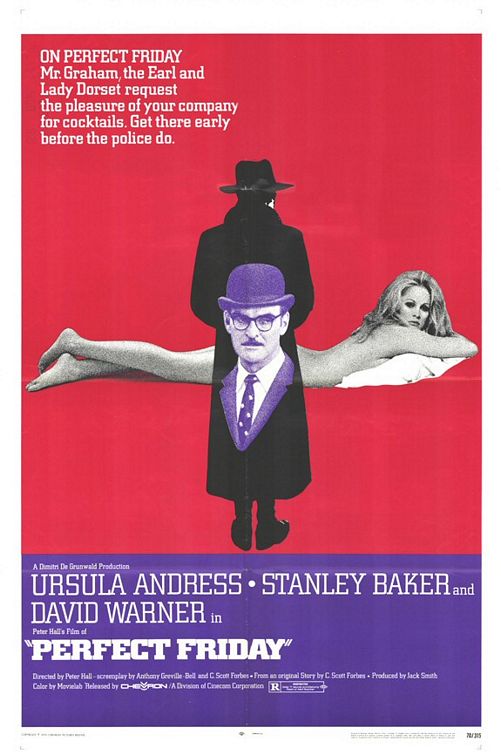
Perfect Friday (1970)

perfect friday

By Richard Winters

My Rating: 7 out of 10

4-Word Review: Kooky trio robs bank.

This uniquely structured and offbeat sleeper details an elaborate bank heist where staid bank employee Mr. Graham (Stanley Baker) uses his inside knowledge to pull off an ingenious robbery. Unfortunately he is dependent on the oddball couple of Nick (David Warner) and Britt (Ursula Andress) to help him.

This film is probably more of a kooky character study than it is a heist flick. The three characters are intrinsically different from each other and their constant bickering, feuding, and interplay are a treat. In fact they never get into the actual robbery or even the details of it until the last forty minutes.

Baker is fun in the lead. He is the perfect caricature of the stuffy British businessman. His contained pomposity and cryptic deliveries are right on-target. Warner makes for a good contrast. He is lazy and undisciplined with a tendency to wear outrageous looking outfits. It is interesting though that he can get serious when he needs to particularly during the crime itself.

Andress is the scene stealer and this is a perfect role for her limited acting abilities. She plays a greedy woman prone to outrageous extravagance and indulgence even if she lacks the funds for it. Her caricature of the materialistic woman gets taken to the extreme and is hilarious. In most cases she would be disliked, but here her beauty and innocuous way she delivers her lines make her amusing instead.

Director Peter Hall seems to pride himself on making it offbeat and full of many twists and succeeds most of the way even with his use of the glass offices that the bank employees have to work in. The robbery itself is intricate and believable and full of mounting tension. The film’s only real problem comes with its ending that is too abrupt and in many ways almost like a cop-out. There is such a fun chemistry between the three characters that it really could have been played out much more.

My Rating: 7 out of 10

Released: November 10, 1970

Runtime: 1Hour 34Minutes

Rated R

Director: Peter Hall

Studio: Chevron Pictures

Available: None at this time.

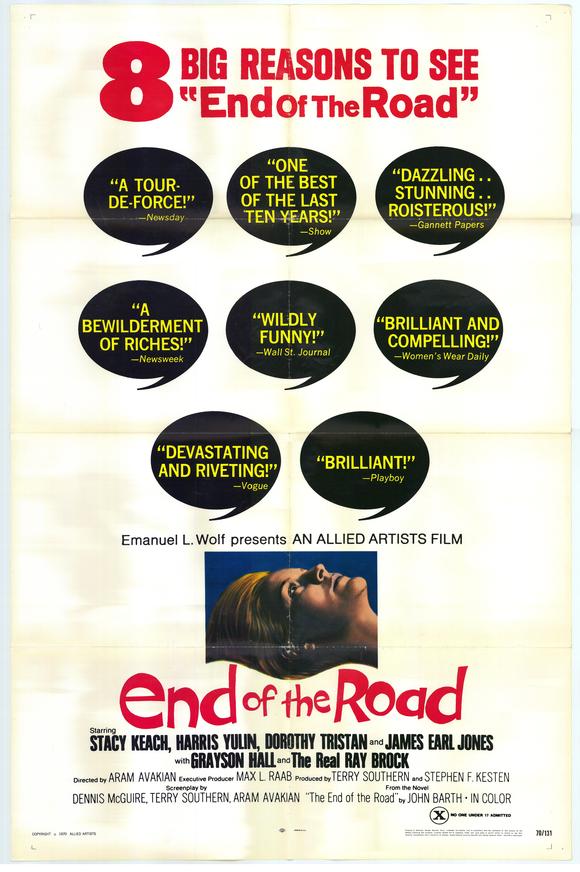
End of the Road (1970)

end of the road

By Richard Winters

My Rating: 6 out of 10

4-Word Review:  Too weird for words.

A bizarre adaptation of John Barth’s already bizarre novel detailing the story of a man (Stacy Keach) who goes into a catatonic state at a train station and is then sent to a strange mental hospital run by a weirdo named Doctor D (James Earl Jones). After he is considered to be ‘cured’ he takes a job as a college professor and proceeds to have an affair with the wife (Dorothy Tristan) of one of his colleagues (Harris Yulin).

It has been noted that author Barth disliked this film version of his novel and it is easy to see why. It gives only a basic outline of the story while leaving out all of the deeper meanings. It also tried to tie the story to the chaos and rebellion of the 60’s even though the book was written in 1955. The final result is a confusing mess that never comes together. The characters behave strangely and with no understanding to their motivations it becomes impossible to relate to them or anything else that goes on. Most viewers, especially those that are not familiar with the book, will easily become confused after the first five minutes if not sooner.

On the positive end the filmmaking style is refreshingly audacious in a way that is rarely seen anymore. Everything is thrown out there no matter how outrageous with little regard to mainstream acceptance. The kinetic imagery and music has a certain hypnotic effect that keeps you connected to it even if you don’t understand what is going on. The film culminates with a very intense, grizzly, and tasteless abortion sequence that will not be soon forgotten by anyone who sees it. Jones gives one of the most bizarre and over-the-top performances that you will ever see anywhere and anyone who is a fan of his or has an interest in acting MUST see him in this film.

It’s a misfired experiment that manages to be enough of a period artifact to make it interesting as a curio. It definitely has the ability to stay with you after it is over.

My Rating: 6 out of 10

Released: February 10, 1970

Runtime: 1Hour 50Minutes

Rated X

Director: Aram Avakian

Studio: Allie Artists Pictures

Available: DVD 

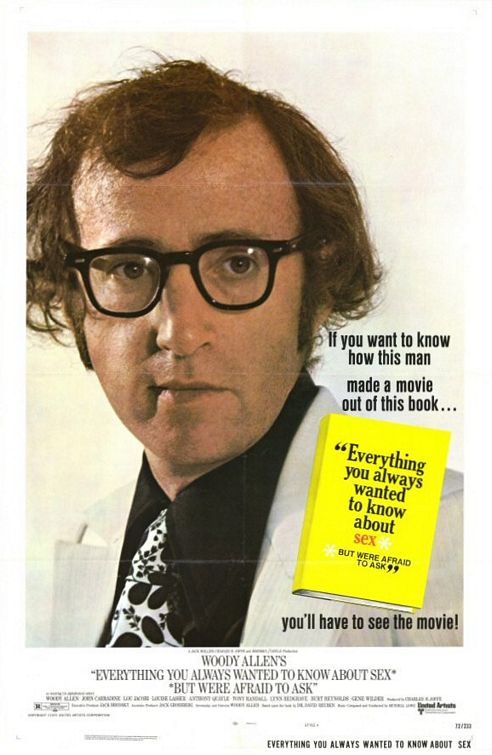
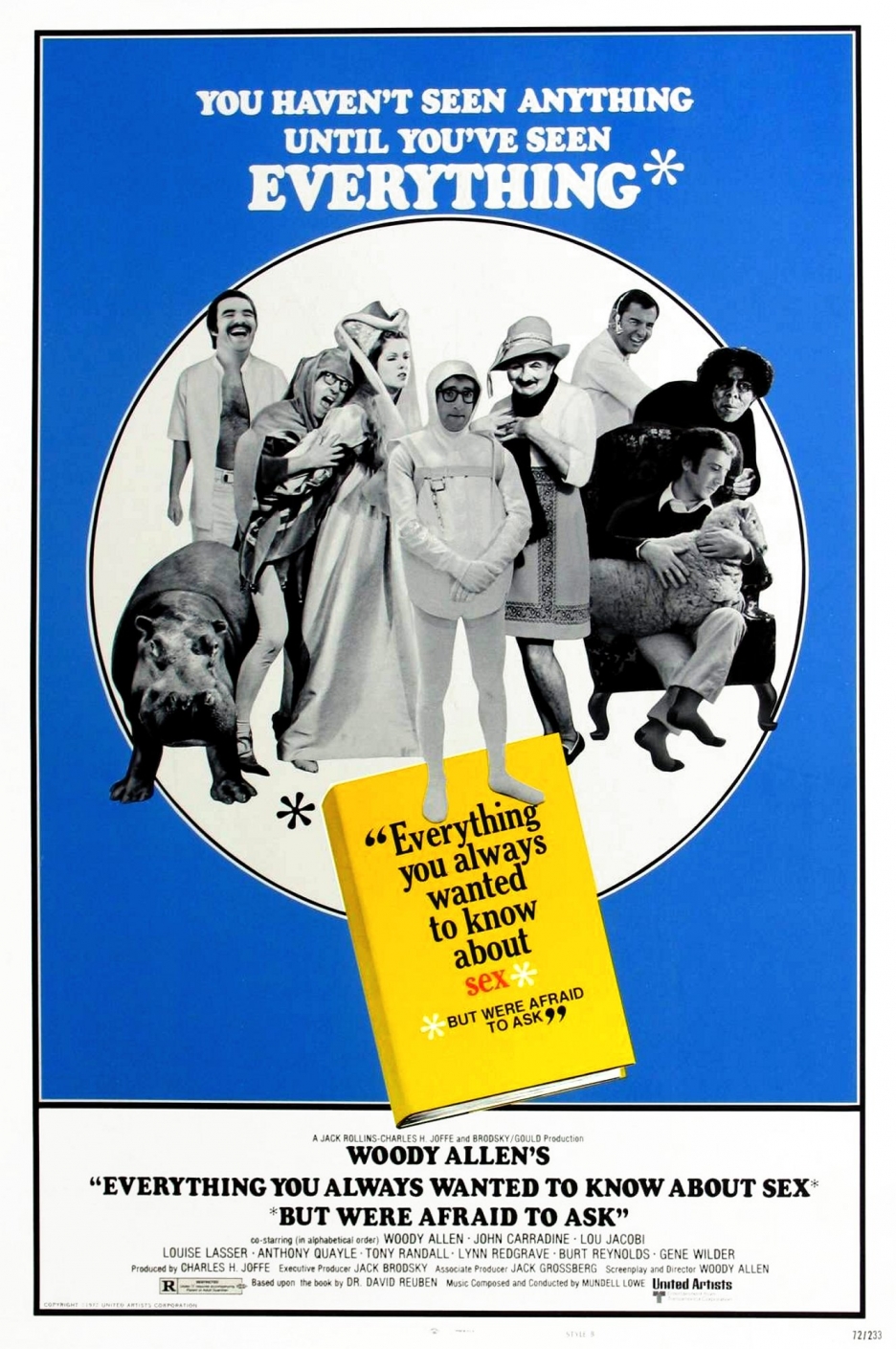
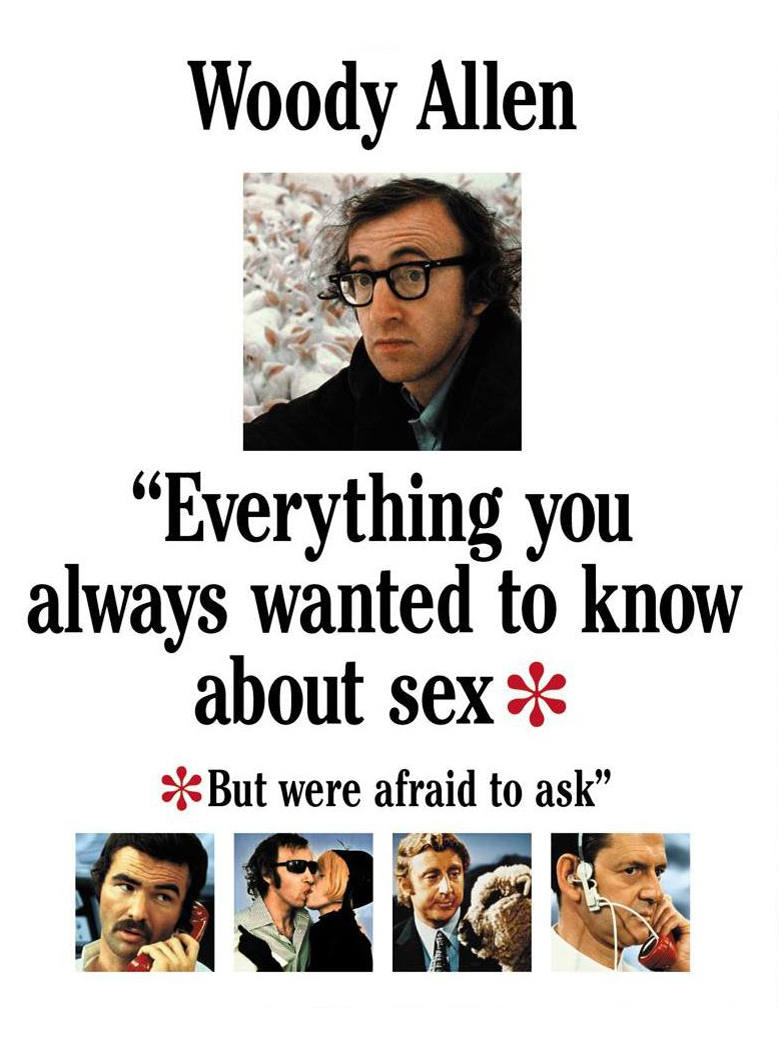
Everything You Always Wanted to Know About Sex *But Were Afraid to Ask (1972)

everything 1

By Richard Winters

My Rating: 9 out of 10

4-Word Review: Woody takes on sex.

This is a very loose adaptation by Woody Allen of the famous sex manual written by David Reuben, but given a comic spin. This was made when Allen was at his absolute peak as nearly everything is funny and original.

Some of the jokes are outrageously over the edge even for today. The highlights include Gene Wilder’s incredibly long reaction shot after a shepherd informs him that he has fallen in love with one of the sheep from his flock. Another highlight includes Allen trying to fight off a giant ‘monster breast’ by using a Crucifix and a giant bra. Cross dresser Lou Jacobi getting caught in a women’s dress while visiting a friend’s house is another classic as well as ‘What’s My Perversion’ a very brilliant and inspired send up of ‘What’s My Line’. Of course the best may be, should I say, the climactic sequence involving the control room of the inside of a man’s brain as he goes through ejaculation.

everything 2

The only negative is the second segment entitled ‘Why some Women can’t have orgasms’ is a misfire. The joke of having Allen and Lasser talk in only Italian with no subtitles wears thin pretty quickly. The only pluses from this segment involve seeing Allen in a pair of trendy glasses as well as watching an electric dildo catch on fire.

In a lot of ways I consider this to be Allen’s best comedy. Just about everything works and it’s all laugh- out-loud funny. Even the few things that don’t are still creative enough to get kudos.

everything 3

My Rating: 9 out of 10

Released: August 6, 1972

Runtime: 1Hour 28Minutes

Rated R

Director: Woody Allen

Studio: United Artists

Available: VHS, DVD, Amazon Instant Video

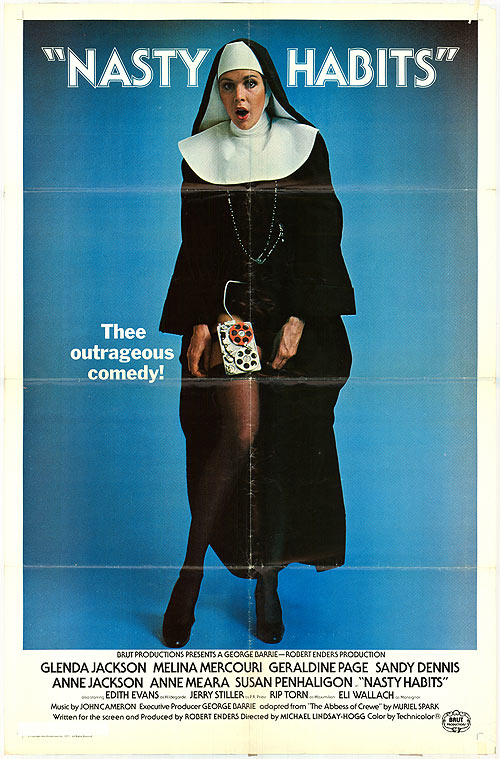
Nasty Habits (1977)

nasty habits 2

By Richard Winters

My Rating: 2 out of 10

4-Word Review: Watergate in a convent.

It’s the Watergate scenario all over again only this time inside a convent with nuns. It’s a unique idea for sure that unfortunately doesn’t work because the screenplay by Robert Enders, which is based on the novel by Muriel Sparks keys in on only one angle and then plays it out until it’s boring. It’s a one-joke movie with nothing standing out as funny. There is also no action to speak of and the dialogue is too dry to elicit even a chuckle.

The once in a lifetime cast is wasted. Dame Edith Evans, in her last film appearance, gets hit the worst as she is given the typical old lady treatment and shown for only a few minutes looking feeble and then promptly dying. Jerry Stiller, Anne Meara, Rip Torn, and Eli Wallach are on so briefly that their appearances seem almost non-existent.

Glenda Jackson comes off best as she manages to give her character an added dimension. The forcefulness of her personality comes through quite clearly for the viewer. However her adversary, which is played by Sue Penhaligon, doesn’t have that same type of strong presence and therefore there is no chemistry or confrontation between the two.

Even the always reliable Sandy Dennis becomes a problem. They have her playing a sort of extended version of her tipsy persona from Who’s Afraid of Virginia Woolf?, but her off- key voice and overall kooky behavior gets overplayed and eventually becomes annoying.

The electronic music score by John Cameron is obtrusive. The pacing is terrible and the lack of momentum will have people turning this off long before it is over, which is good since the climactic sequence falls horribly flat.

There are a few surprise cameos. One is by the late newscaster Jessica Savitch another by former talk show host Mike Douglas, but nothing that helps make this entertaining or memorable.

My Rating: 2 out of 10

Released: March 18, 1977

Runtime: 1Hour 36Minutes

Rated PG

Studio: Brut Productions

Director: Michael Lindsay-Hogg

Studio: Brut Productions

Available: VHS

Is There Sex After Death? (1971)

is there sex after death 2

By Richard Winters

My Rating: 4 out of 10

4-Word Review: It’s all about sex.

This is basically a compilation of vignettes all satirizing America’s new found sexual revolution and is not all that different from other similar ‘underground’ films of that period and should best be viewed as simply a relic of its era.

Some of the bits could be considered clever, but they fail to build any momentum. The one joke premise loses steam halfway through eventually making the constantly quirky insights by the constantly quirky characters tiresome and redundant. The sex and nudity, while in abundance, also become a turn-off. The majority of the participants, especially those in the nudist colony, are so old and out of shape you really wish they would have just left their clothes on.

Writer/director Alan Abel who also acts as the host and interviewer comes off best. His unblinking deadpan seriousness, even when in the middle of complete perversity, is right on target. It also features a funny interview with transvestite Holly Woodlawn, some spontaneous on the street moments and a climatic ‘Sex Olympics’. In fact if you get this on video it might be worth it to just fast forward it to that point.

My Rating: 4 out of 10

Released: October 24, 1971

Runtime: 1Hour 42Minutes

Rated X

Director: Alan Abel

Studio: Abel-Child Productions

Available: VHS

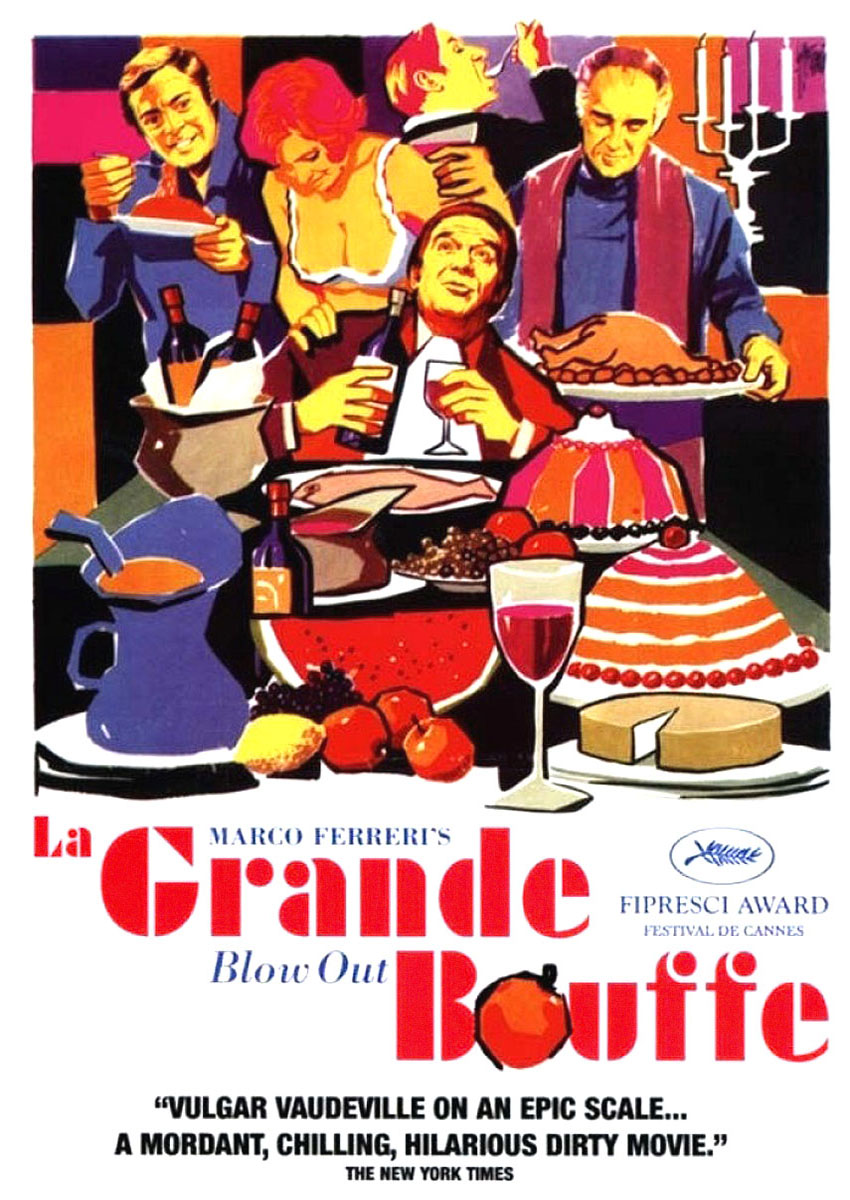
La Grande Bouffe (1973)

la grande bouffe 1

By Richard Winters

My Rating: 3 out of 10

4-Word Review: They stuff their faces.

This film will start an annual Thanksgiving Day theme of reviewing movies that have something to do with food and eating. This one may be the most notorious of them all and despite its offbeat plot and crude scenes won the Cannes Film Festival’s International Critics award as well as attaining a large cult following and be one of the highest grossing movies in the history of Italian cinema.

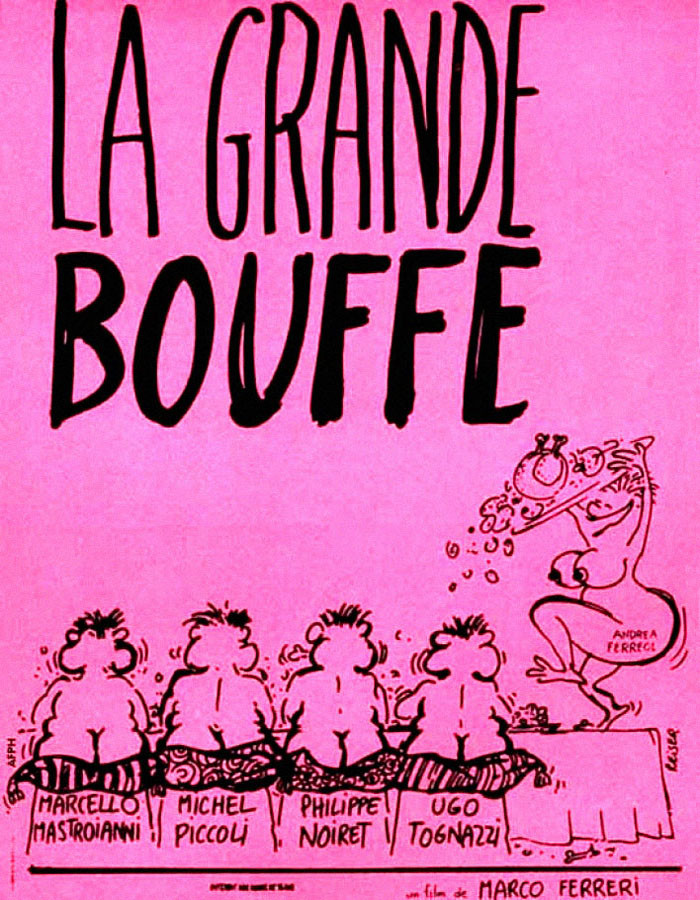
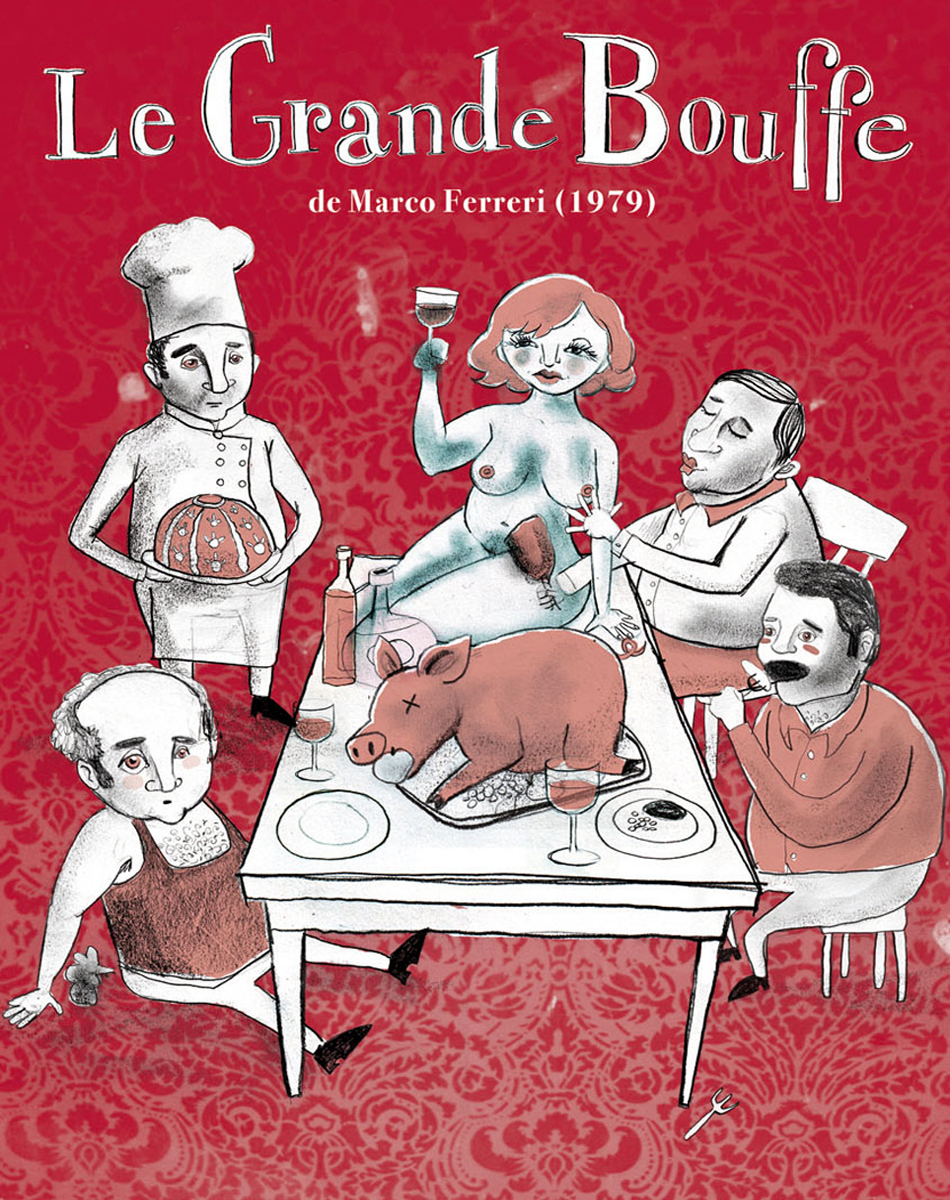
The story deals with four middle-aged men (Marcello Mastroianni, Ugo Tognazzi, Philippe Noiret, Michel Piccoli) who despite attaining affluence and wealth are bored with life and decide their only recourse is to get together for a weekend and commit group suicide by eating themselves to death.

At first the movie will make you hungry.  After an initial set-up the characters can be seen eating in just about every shot. The variety of foods and menu that is served is almost mouth-watering and features a wide array of exquisite dishes seen only in the most fanciest of restaurants. However, after visually seeing these people overeat I felt myself feeling as bloated as the characters and almost sick. The film also gets quite gross with several segments featuring loud sounds of flatulence and a scene where the toilet bursts and covers the men and room with feces that even drips down and gets into the kitchen.

Some may find this ‘hilarious’ while others will think it’s disgusting. For me despite the moments of over-the-top crudeness the strongest scene may actually be when the characters start dying and their dead bodies are carried into a freezer while the rest of them continue to make food and stuff their mouths like it is a compulsion.

la grande bouffe 2

The four leads are old pros who couldn’t give a bad performance if they tried. I started to wonder though how they could eat so much and whether the scenes were all done in one take with no retake as eventually I think they would all start puking. Mastroianni’s death scene is a stand-out simply because it manages to keep his expression completely frozen and does not manage to blink for several minutes, which I found impressive. Tognazzi’s death moment is also fun although it’s Andrea Ferreol who starts out as a proper school teacher, but ends up becoming as decadent and hedonistic as all the men combined that steals it.

The film makes a strong if not impactful statement about gluttony and how a life of prestige and luxury may actually be more of a trap and curse. The more some people get of it the more they want until it is never enough and death may end up being their only true source of salvation and escape.

The idea is outrageous and clever and I loved the concept, but the execution is lacking. The direction is too loose with scenes going on longer than they should. Some tighter editing would have helped the pace and momentum.  I also don’t think it is possible for a person to stuff themselves with food and then die as I think instead they would just vomit it all out.

la grande bouffe 3

My Rating: 3 out of 10

Released: May 17, 1973

Runtime: 2Hours 4Minutes

Rated NC-17

Director: Marco Ferreri

Studio: Films 66

Available: VHS, DVD

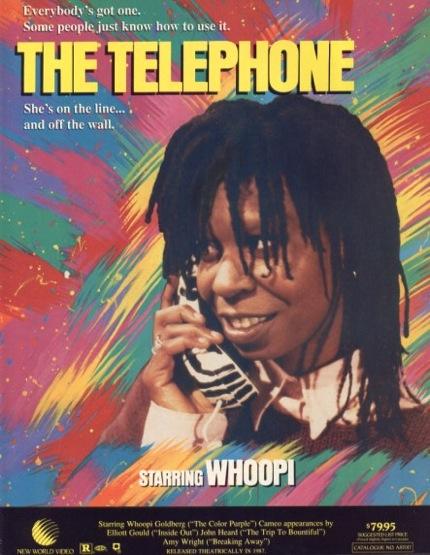
The Telephone (1988)

the telephone 2

By Richard Winters

My Rating: 1 out of 10

4-Word Review: I liked the owl.

Vashti Blue (Whoopi Goldberg) is an out-of-work actress sitting inside her dreary small apartment and having conversations with people over the phone. She also argues through a locked door that she shares with the women next door while waiting for a call from an agent for a job opportunity that never comes.

I am all for experimental cinema, which is the best way to describe this misguided project, but to work it still needs an artistic design and focus and this has none. It pretty much comes off as somebody’s cheap home video where a camera is turned on and then someone is allowed to rant and rave without pause for eighty minutes. Some could blame Rip Torn who is an actor turned first-time director here, but in subsequent interviews he has complained that Whoopi wouldn’t listen to any advice or direction that he gave and pretty much made his presence insignificant.  You could also blame the screenplay, which was written by the very odd pairing of Terry Southern and Harry Nilsson. Southern is best known for penning the screenplay for Dr. Strangelove while Nilsson is a famous singer/songwriter whose best work was doing the song ‘Everybody’s Talking’ that was the theme for the classic film Midnight Cowboy. However, Whoopi took great liberties with the material and ad-libbed a lot, so what was originally put down on paper and what is left on the screen could be minimal.

The conversations that Whoopi has over the phone ranges from lame to ridiculous. One includes calling the police and trying to get them to arrest a video store owner because he rented her a tape of Christmas in July with a scene excised is too absurd to be even remotely amusing. The Whoopi character also incorrectly stated that Frank Capra was the director of the film when it reality it was Preston Sturges.  Goldberg puts on a variety of accents including British, Japanese, Indian, and Southern as well as a few others, but her Irish one is suspect and her impression of John Wayne is terrible.

The apartment set is dull and bleak. The viewer feels trapped and with such little visual design their eyes and thoughts are apt to wander. Cutaways are sorely needed, but there are none. An infuriating moment is when there is a sound of a loud car pile-up outside, but despite this being a visual medium the camera never cuts away to show any of it. This was probably due to budget constraints, but what is even more perplexing is that there are sounds of people screaming, police sirens and even rioting and then a half minute later it all suddenly stops for no explained reason.

The supporting cast is eclectic but wasted. Noted character actor Severn Darden, in his last film role, appears in a brief bland bit as Whoopi’s neighbor. Elliot Gould gets a few minutes as Whoopi’s former agent and seems to be seriously slumming as he was a headline star during the seventies and now sadly stuck in this. John Heard is the only one who comes off best as a caustic, brash telephone repairman.

Whoopi’s two pets upstage the human cast by a mile. Her pet owl is very cute and I dug the goldfish particularly when he gets sucked down the drain of her bathtub and she must use a plunger to save him, which is the only time there is any action in the entire movie.

My Rating: 1 out of 10

Released: January 22, 1988

Runtime: 1Hour 20Minutes (The DVD cover states it’s 1Hour 36Minutes, but it is wrong.)

Rated R

Director: Rip Torn

Studio: New World Pictures

Available: VHS, DVD

The Jerk (1979)

the jerk

By Richard Winters

My Rating: 7 out of 10

4-Word Review: This is stupidly brilliant.

This is the type of film that looks like it was done by people that were stoned and meant for audiences that were equally stoned. The ‘story’ runs like it was conceived by someone who couldn’t come up with a real plot so they did this instead. The whole thing is as simple and mindless as the character it depicts with no real correlation to anything. Everything is thrown in haphazardly and at times looks like nothing but a very desperate and strained attempt for a laugh. This is coupled by a performance by Steve Martin that is very one-dimensional and even amateurish. He behaves like one of those annoying class clowns looking for attention and yet despite all this it still manages to be funny sometimes really, really funny.

This is a definite precursor to Dumb and Dumber and others like it and in many ways this is still the best as it completely stretches the stupidity axiom. It tests the audience’s perceptions on what is tolerable and logical. This doesn’t just have a couple of guys who are weird everybody and everything is weird. The humor works totally outside of the box. It gets you to laugh at things you didn’t think you would and also gets you to see things differently. It creates a warped world that for the first hour is consistent and fun, but by the second hour it begins to struggle and ultimately overreaches.

Martin’s ‘air head’ routine doesn’t seem too original since he had been using it previously in his stand-up acts and comedy guest stints. His character is too dumb and naive to be believable and there is never any explanation for it. He manages to give his performance a certain endearing quality, which is the only thing that saves it. The opening segment has him growing up a white boy amongst a poor black family, which borders dangerously close to being racist and stereotypical.

There is a good supporting cast, but they seem wasted and many of them only have a few lines. Bernadette Peters, as his love interest, really doesn’t add much however Jackie Mason is pretty good as Martin’s boss at a gas station. Maurice Evans is also fun as Martin’s butler and has an amusing way of responding to his wife’s sudden death. Rob Reiner, the director’s son, appears in a cameo as a truck driver who gives Martin a lift ‘up to the end of the fence.’

Overall this is pretty goofy stuff, but only for those who are in the right frame of mind for it. It’s a simple, scattershot formula that produces some genuine laughs.

My Rating: 7 out of 10

Released: December 14, 1979

Runtime: 1Hour 34Minutes

Rated R

Director: Carl Reiner

Studio: Universal

Available: VHS, DVD, HDDVD, Blu-ray, Amazon Instant Video