Category Archives: Obscure Movies

Hennessy (1975)

hennessy

By Richard Winters

My Rating: 6 out of 10

4-Word Review: Blow up the Queen.

This review will be the first in a month long series analyzing movies from the 70’s that starred Rod Steiger. Steiger was an interesting performer with a long and varied career who always brought a unique intensity to all of his roles. He performed in a wide variety of movies from Hollywood pictures to foreign films and from big productions to the low budget as well as going from the leading man to character actor. Every Friday during the month of January I will select films of his that will hopefully be able to spotlight a little bit of all of these.

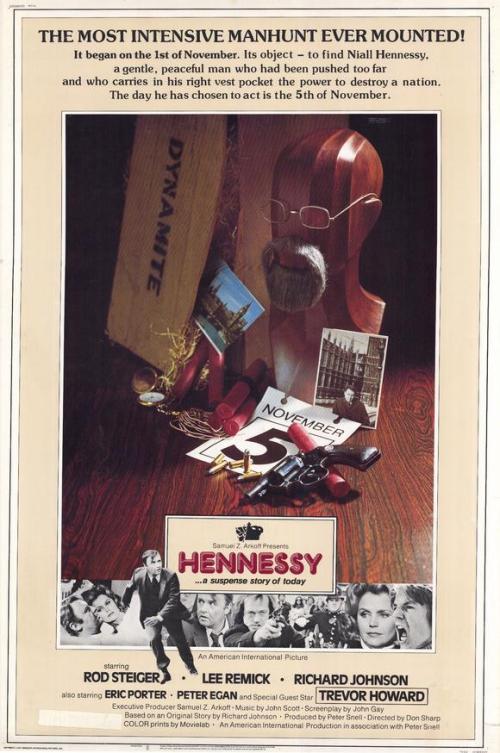
Today’s film deals with the story of Niall Hennessy (Steiger) an Irishman with ties to the IRA. When his wife and daughter are killed during a riot in Belfast he plots revenge with a plan to blow up the House of Parliament with the Queen Elizabeth inside.

The movie has a great concept, but the execution is a bit lacking. For one thing the police immediately pinpoint Hennessy as the man they are looking for as well as figuring out his plan. How they were so easily able to do this not only seemed a little farfetched, but also sapped a lot of the intrigue and tension out of the story. Having the police come to this conclusion more slowly would have plotted the suspense out longer and been more interesting.

This also opened the door to a few loopholes the biggest one being that they know Hennessy wants to blow up the Parliament so one would expect that the police would have their men staking out the place and on alert to spot Hennessy if he came near the premises, but instead Hennessy is able to go on a guided tour and able to canvas the building unheeded. Another scene later on has Hennessy trapped in an upstairs apartment by the police who have surrounded the building and yet he is somehow able to escape even though it is never shown how.

The scene showing his family getting killed during a bomb attack is not effective. We see the mother and daughter leave a nearby building and then the film cuts away from them and goes back to the fighting in the street only to go back to the two a few minutes later lying in the street motionless. However, there is neither blood on them nor any type of make-up effects to show injury making it look more like two people lying down with their eyes closed. Seeing them actually hit by the bomb and screaming would have been more jarring for the viewer and allowed them to get more emotionally attached to Hennessy’s plight. Also, when Steiger is shown standing over them I was expecting him to let out another one of his patented primal screams much like he famously did in The Pawnbroker, but here he doesn’t and the sequence is quite brief making me wonder why would they hire an actor known for his onscreen intensity and emotionalism if they aren’t going to allow him to do what he does best especially when the scene calls for it.

Steiger for the most part does well with the part although he is surprisingly restrained during most of it. It is a bit of unusual casting given that he wasn’t Irish or a native of the region however, the accent he uses is alright and I kind of got a kick out of the way he runs especially at the end. His biggest obstacle though was his wig. Rod became bald as he aged and instead of just appearing that way in his roles, which he finally did during his later years, he instead wore a variety of wigs for his parts. Some of them were okay and some weren’t and the one used here definitely wasn’t.

Richard Johnson is quite good playing the relentless Inspector Hollis and I liked seeing him with a moustache. The talented Lee Remick appears as Kate Brooke a lady friend to Hennessy who allows him to hide out at her home and although she has a few good lines she is ultimately wasted. Legendary Trevor Howard is wasted as well and only seen briefly as a police commander.

The best part about the movie and the one thing that gives it distinction is the ending when Hennessy goes into the parliament building with a bomb strapped to his body. Actual footage of the Queen is shown and it looks so authentic that many people thought she had been involved in the production, but she really wasn’t. Their ability to crop this footage in with the action is well done and almost seamless and certainly helps to heighten the tension. Seeing a young Prince Charles looking bored with the proceedings and the elaborately decorated interior of the building as well as its many large and majestic hallways and rooms is fun and interesting.

My Rating: 6 out of 10

Released: July 31, 1975

Runtime: 1Hour 43Minutes

Rated PG

Director: Don Sharp

Studio: American International Pictures

Available: Amazon Instant Video
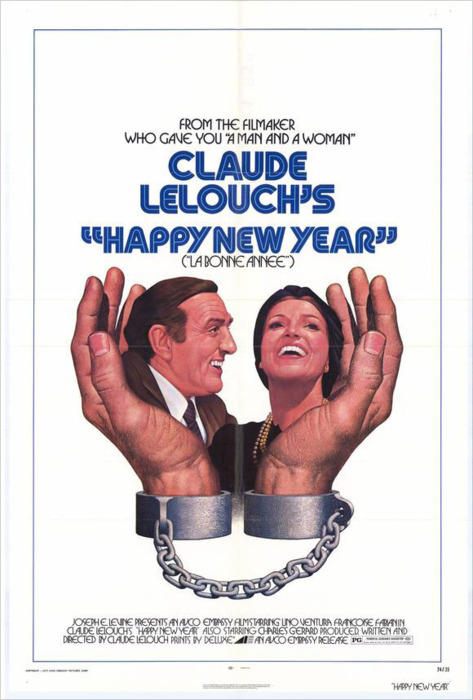
Happy New Year (1973)

happy new year

By Richard Winters

My Rating: 8 out of 10

4-Word Review: A robbery with romance.

Stylish, moody, charming, serene, glossy, and evocative are just a few of the words that come to mind when you view this film and that’s just after the first five minutes. This is truly a French picture. It has all the ingredients that lovers of that cinema enjoy. Unlike American films, French films take their time in telling their story and everything is leisurely paced. The viewer is actually allowed to soak in the visual experience without being told what to think. Director Claude Lelouch is a master at work. He wisely realizes that film viewing is a very personal experience. What the viewer will take from that experience is unique only to them. Thus you have a picture that stays rather wide open in regards to structure. The camera takes many wide shots, thus allowing the individual viewer to focus on whatever it is that intrigues them personally. The story, while still being focused, stays elusive and subtle throughout.

To say the plot is about a planned jewelry store heist is misleading since this only takes up a part of the movie. There is also a running mix of character study, romance, comedy, satire, and even drama. Some will enjoy the amusing banter and love-hate relationship of the two male leads. Others will like the blossoming romance between one of the crooks and a beautiful antique shop owner. Still others will like the wide array of conversational topics some of which include: unique observations on marriage, hairstyles, churchgoers, psychology, men’s definition of women, and women’s definition of men. There’s even a playful critique of an earlier Lelouch film A Man and a Woman.

Overall it’s perfectly made for the viewer with distinct tastes even though when you get right down to it, it really is just a piece of entertainment fluff made more intriguing because of its sophisticated approach. Like with its Wizard of Oz-like format where the beginning and end are in black and white while the middle is in color. Why do it this way? No reason, except, why not. Same with the long slow shots of actor Lino Ventura’s very lined and expressionless face, which manages to hold an unexplainable captivation.

The rather abrupt and elusive ending seems to be the film’s only real weak point and yet when taken into context with everything else, this too has its allure. An American version of this movie was made in 1987 under the same title and starring Peter Falk, but that version is far inferior to this one and not worth seeking out.

My Rating: 8 out of 10

Released: April 13, 1973

Runtime: 1Hour 30Minutes

Rated PG

Director: Claude Lelouch

Studio: Les Films 13

Available: DVD (Region 2)

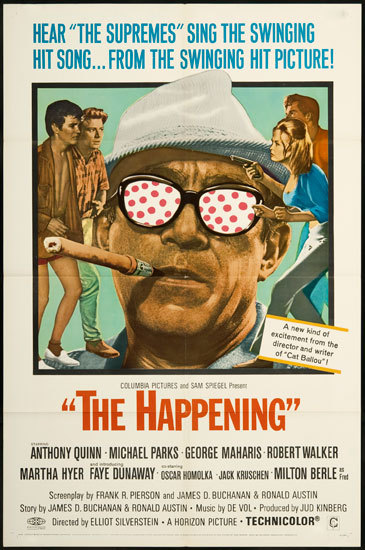
The Happening (1967)

the happening

By Richard Winters

My Rating: 3 out of 10

4-Word Review: Kidnap him for kicks.

After a night of partying a group of hippies wake up the next morning hung over. Sandy (Faye Dunaway) and Sureshot (Michael Parks) are two strangers that find that they’ve slept together outside for the night and slowly become acquainted. To escape a police raid that is rounding up the drunken partiers and arresting them for vagrancy they hop onto a nearby boat with two other men that they’ve just met Taurus (George Maharis) and Herby (Robert Walker Jr.). They happily go along the lake until some neighborhood kids who are dressed in army gear shoot at them with their toy guns. Taurus doesn’t appreciate this and docks the boat and chases them into their house. Inside is the boy’s father Roc Delmonico (Anthony Quinn) who is a former Mafia Kingpin. He thinks these four strangers are aware of his past and there to kidnap him. The group decides to play along with the ruse hoping to get some money from the ransom and also because they are just bored and looking for some kicks.

The set-up has to be one of the flimsiest I have ever seen and the fact that it took four writers to come up with something that is full of holes and ludicrous is all the more confounding.  The concept seems like something that never got past the first draft and very poorly thought out by everyone involved. The idea that four strangers who have known each other for just a few minutes could get together and kidnap someone that they don’t know on a mere lark is ridiculous. I would think a former kingpin would be better prepared for something like this and have a back-up plan instead of passively and stupidly falling into the kid’s clutches with no idea of what to do. The story would have been far stronger had this been a planned crime.

The film’s overall vapid nature is shocking when you realize that is was done on a good budget by a major studio and top director Elliot Silverstein making me wonder if anyone even cared or thought about what they were making, or simply more interested in getting into the mod mood of the times. The filmmakers portray the younger generation as being one-dimensional thrill seekers with no real or discernible personalities and in the process creates characters that are boring, unrealistic, and uninteresting. The attempts at hipness are shallow, flat, and ultimately annoying.

Despite the low plausibility the movie is slickly done making for periods of fluffy entertainment. Case in point is when the kids have their car pulled over by a policeman (Eugene Roche) when they go through a red-light and carrying Roc tied up in the trunk. In an attempt to create a ‘diversion’ Sureshot decides to get out of the car with his hands up in the air. When the cop tells him to put his hands down he refuses, which then somehow makes all the other cars on the road crash into each other. Yes, it is fun to see a big pile-up, but believing that something like that could happen over something so silly is pushing things too much to the extreme like with a lot of things in this movie.

Things improve during the second half when Roc with the help of the kids turns the tables on everyone he knows after finding out that no one is willing to pay for his ransom. The scene where they tear up his house is kind of funky despite the fact that all the furniture they smash up looks like obvious stage props. Unfortunately the ending is as weak as the beginning and offers no pay off, which most likely will make most viewers feel like they’ve wasted an hour and 45 minutes of their time.

Quinn is good and gives the script and character a lot more energy and heart than it deserves. Dunaway, in her film debut, is hot and plays the part of an immoral lady looking for cheap thrills even when she knows better quite well. Walker Jr. is good simply because he plays the only character that has any type of believability, but unfortunately he is not on enough to be completely effective. Maharis who is best known for his excellent work as Buz Murdock in the classic TV-show ‘Route 66’ is solid as the volatile and slightly unhinged member of the group.

Oskar Homolka has a few memorable moments as an aging crime boss. One scene has him in a steam room along with his henchman wrapped tightly in towels and looking like giant carrots while another segment shows him at a poolside surrounded by a bevy of beautiful bikini clad women, which like the first scene, is visually funny.

The Supremes sing the film’s theme song, which became a top ten hit, but it doesn’t get played until the closing credits and even then not in its entirety.

My Rating: 3 out of 10

Released: May 17, 1967

Runtime: 1Hour 41Minutes

Rated NR (Not Rated)

Director: Elliot Silverstein

Studio: Columbia

Available: None

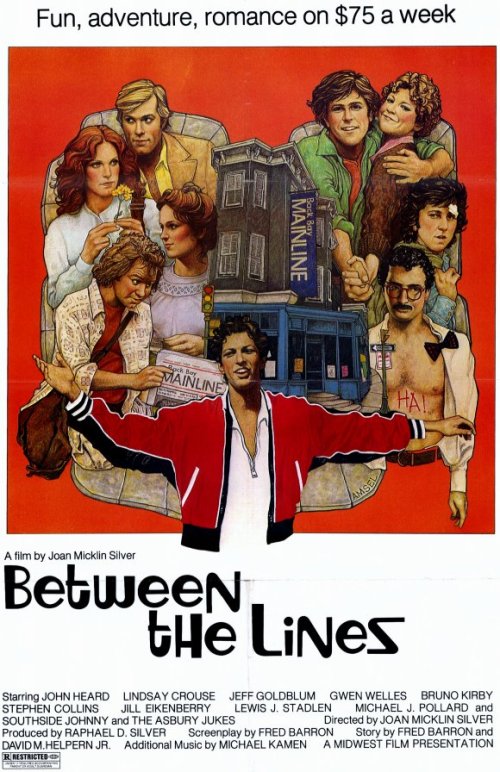
Between the Lines (1977)

between the lines

By Richard Winters

My Rating: 6 out of 10

4-Word Review: Newspaper get corporate takeover.

This is a look at an underground/counter-culture newspaper staff and the conflicts and concerns that they have at being taken over by a no-nonsense corporate owner (Lane Smith).

The film almost immediately takes you back to the bygone era of the late 70’s. The attitudes and conversations are realistic for that period and anyone who lived through it will most assuredly feel nostalgic .John Heard, Jeff Goldblum, and Bruno Kirby are engaging in their respective parts as is most of the cast. Stephen Collins is good also, but in an unusual role for him as he usually plays nice sensitive types, but here is a more driven, intense, and confrontational. This also works as a good unofficial statement to the death of the counter-culture movement and the eventual rise of materialism.

The story starts out well as it looks at the inside workings of an underground newspaper, but then spends too much of the middle part focusing on the relationships of some of the characters. Only at the end when the new owner takes over does it get back to the newspaper angle. Unfortunately it concludes just as things are getting interesting and we never get to see how the characters survive and adjust to the takeover. The film would have been much stronger and original had it stuck to scenarios involving the newspaper business and scrapped the relationship stuff, which tended to be derivative. Jon Korkes and Michael J. Pollard’s characters are seen too little and needed more screen time.

Also, when the film deals with the relationships there seems to be too much of a feminist bias as the men are always shown to be the ones at fault due to their ‘insensitive and selfish natures’ while the women come off the ones who are ‘reasonable and unfairly neglected’. This could be a product of the fact that it was directed by a woman as well as the era where men were somehow supposed to feel guilty simply because they were men.

This is fun as a time capsule as well as a great chance to see young stars in the making. However, the story does not take advantage enough of its original concept and ends up dealing with a lot of the same old scenarios and story lines that we’ve all seen before. Director Joan Micklin Silver and John Heard teamed up again two years later for Chilly Scenes of Winter, which I felt was better.

My Rating: 6 out of 10

Released:  April 27, 1977

Runtime: 1Hour 41Minutes

Rated R

Director: Joan Micklin Silver

Studio: Midwest Films

Available: DVD (MGM Vault)

Dealing: or the Berkeley-to-Boston Forty-Brick Lost-Bag Blues (1972)

dealing

By Richard Winters

My Rating: 5 out of 10

4-Word Review: Drugs are a trip.

This review was originally slated to post in February, but due to the death on Christmas Eve of Charles Durning I decided to post it now. Durning was one of the all-time great character actors who always brought an amazing amount of energy to every role he played and could do a wide variety of character types well. Although he has very few lines of dialogue in this movie he still manages to become the most interesting part of the proceedings and helps enliven an otherwise slow moving film.

The plot, based on a novel by Michael Crichton, pertains to Peter (Robert F. Lyons) who is a recent Harvard graduate hired by John (John Lithgow) to transport a suitcase full of marijuana from Boston to Berkeley, California. Peter is new at this and things do not go as planned, but he meets beautiful Susan (Barbara Hershey) along the way and the two fall in love. John next hires Susan to transport another suitcase of narcotics, but when she loses the luggage at the airport and then tries to go back and get it she is arrested by corrupt cop Murphy (Durning) who resells some of the recovered stash back out onto the street. In order to get Susan out of jail Peter plays an elaborate game of cat-and-mouse with the cop, which culminates in a violent showdown.

The story is done in a laid-back style similar to the approach taken by many European films. The emphasis is on mood and subtle nuance yet when the Europeans do it this style seems refreshing, but here it is more off-putting. I really had a hard time getting into it as the first hour is slow with too many scenes going on longer than it should. The set-up is too quick and there is not enough background, or history shown to the main character.

The second hour improves. Durning gives the proceedings some pizazz and Peter’s scheming is fun. The shootout done in the snow has flair and style.

The music by Michael Small is impressive. It is one of the most original scores I have heard and really fits the mood of the script. The best is over the opening credits.

Hershey is as always gorgeous and fans may like that she is shown topless. The part of a free-spirited hippy chick seems to be her forte and she excels. However, having her fall for a guy that is rather dull and ordinary didn’t make sense. Sure they make love right away, but I thought that was more just because it was a part of her lifestyle and she does after all go around in a dress without wearing any underwear. She just seemed to be diving into the free love atmosphere of the era. Obviously having Peter fall for her made sense because she is hot, but why would she go head-over-heels for this schmuck when there are so many other guys that would be more than willing to do it with her. The romantic angle was forced and hurt the credibility of the story.

Lithgow is okay in his film debut, but I had problems with the character. One minute he is cool, conniving, brash, and arrogant and then in the next instant he becomes scared, confused, and meek, which was too much of a quick transition.

The under-rated Lyons is excellent and makes for a terrific lead especially with this type of part. Despite being in his 30’s he looks and acts very much like a college kid from that period. His performance is nicely understated and believable throughout.

The on-location shooting in Boston is vivid and people from the area may like to view this just to see how much it has changed. The DVD transfer from Warner Archive is excellent with a nice clarity and vivid colors. The movie itself is slick, but it also has a detachment to it that doesn’t allow the viewer to get as connected with the characters, or the situations like they should and thus making it an interesting period artifact, but nothing more.

Also, Demond Wilson can be seen briefly as one of the drug dealers. He did this just before his signature role of Lamont in the hit TV-series ‘Sandford and Son’. Ellen Barber is real cute as Peter’s girlfriend and so is Joy Bang who later became a registered nurse. Normally I don’t like women with buck teeth, but with her it actually looks sexy.

My Rating: 5 out of 10

Released: February 25, 1972

Runtime: 1Hour 28Minutes

Rated R

Director: Paul Williams

Studio: Warner Brothers

Available: DVD (Warner Archive)

Up in the Cellar (1970)

up in the cellar 3

By Richard Winters

My Rating: 5 out of 10

4-Word Review: Senior citizens watch porno.

This is a variation of the film Three in the Attic and for a time was called Three in the Cellar to try and capitalize off of the success of that one. Ironically both films starred Judy Pace. In this one Colin Slade (Wes Stern) is a nerdy college student who loses his scholarship to a computer glitch. When he can’t get college president Maurice Chamber (Larry Hagman) to help him, he decides to get revenge by seducing both his wife (Joan Collins) and daughter (Catlin Adams).

The production proudly proclaims to be filmed on location in New Mexico, which is obvious from the start and nothing to really boast about since it hurts the film as a whole. Shot in wintertime it’s dusty, desolate landscape leaves the viewer with a cold, lonely feeling, which configures poorly with a story that is supposed to be lighthearted and whimsical. The big, modern cement buildings used as the campus looks like they would be better suited for a corporation than a student body. The students themselves, or what little you see of them, look all suspiciously over the age of 24.

Director Theodore J. Flicker nicely camouflages the fact that this is a very low budget production. His script is compact and well-paced. He frames and cuts his shots so you don’t notice how lacking in personality or energy it really is. Yet he also shows little connection to the student uprisings that dominated the campuses of that era and seems to view it as a sort of silly amusement. He keeps the film at this tone the whole time and thus makes it as silly and forgettable as the characters and situations he tries to satirize

Hagman comes off best. He plays it with a fun mixture of traits from two of his best known characters. He has J.R. Ewing’s arrogance coupled with Major Nelson’s frantic anxiety.

The film also has two fun and unique scenes. One has Hagman climbing up an actual radio tower to save Stern who is threatening to jump off. The second one has a pornographic movie shown to a group of unsuspecting and shocked senior citizens

My Rating: 5 out of 10

Released: August 12, 1970

Runtime: 1Hour 34Minutes

Rated R

Director: Theodore J. Flicker

Studio: American International Pictures

Available: Amazon Instant Video
Arnold (1973)

arnold 2

By Richard Winters

My Rating: 2 out of 10

4-Word Review: Dead body is lethal.

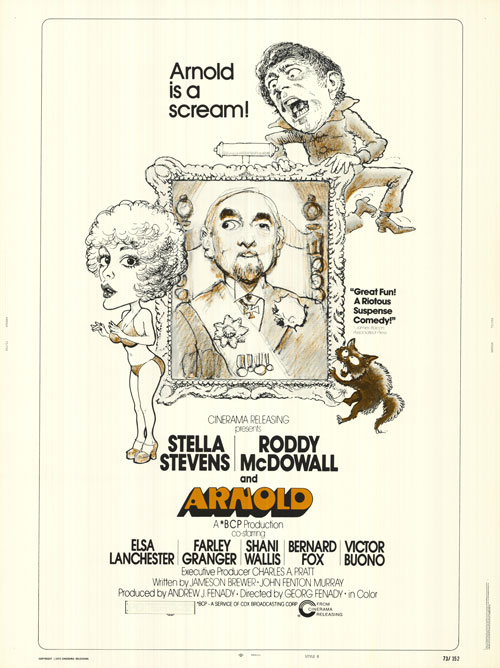
Arnold (Norman Stuart) is a dead corpse who at his funeral marries the ravishing Karen (Stella Stevens). She gets all of his wealth and to live in his mansion as long as she never leaves the side of his coffin and takes it everywhere she goes. His other greedy relatives aren’t happy with this arrangement, but they all end up being killed off in weird and mysterious ways, which makes Karen feel that Arnold may not actually be dead and that she may be his next victim.

Although this is an obscure film it has managed develop a small cult following, but I was not impressed with it. It has too much of the contrived old-fashioned horror movie elements without adding anything new to it. Even done in the spirit of parody it is too clichéd. The sets are unimaginative and cheap. All the outdoor scenes where clearly done inside on a soundstage, which is always annoying. The humor is sparse and relies mainly on corny one-liners. The story is devoid of any scares, gore, or special effects. The plot is cheesy and the whole thing looks like it would be better suited for a 70’s TV-sitcom than the movie screen. It was filmed simultaneously by the same director and writer as Terror in the Wax Museum and the whole thing has a very rushed and sloppy quality about it.

There are a plethora of B-actors making up the cast many of whom look to be phoning in their parts simply to collect a quick paycheck. Jamie Farr, in a heavy disguise, never even utters a word of dialogue, which is actually for the best. The only performance I liked was Bernard Fox as the incompetent police inspector. Some of his lines are amusing especially his last one and he is the one thing that saves this from being otherwise a complete waste of time.

I did like the theme song sung by Shani Wallis who also appears as Arnold’s widow Jocelyn. It has a certain toe-tapping quality to it and Shani gives it energy and verve. The complete rendition is sung over the closing credits.

My Rating: 2 out of 10

Released: November 16, 1973

Runtime: 1Hour 34Minutes

Rated PG

Director: Georg Fenady

Studio: Cinerama

Available: None

Oklahoma Crude (1973)

Oklahoma Crude

By Richard Winters

My Rating: 8 out of 10

4-Word Review: They want her land.

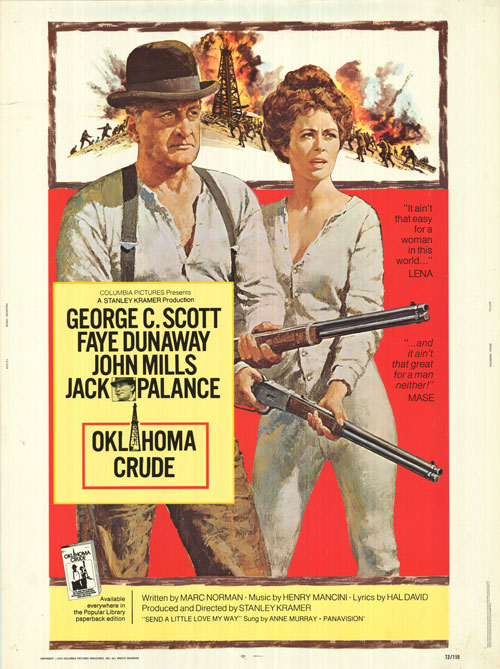
Lena Doyle (Faye Dunaway) runs a wildcat oil rig on land that she owns in Oklahoma. She is convinced that there is oil there and protects it with a feisty independence. Her father Cleon (John Mills) decides to hire Mason (George C. Scott) a lazy drifter that he picks up in town. Mason’s job is to guard against the impending invasion of the oil company headed by Hellman (Jack Palance) who wants the land and potential profits for themselves. Lena and Mason do not get along at first, but when Hellman and his men seize the land in a hostile takeover Lena and Mason form an uneasy alliance in an attempt to take it back.

Director Stanley Kramer can be considered overrated by many and I am pretty sure that he and critic Pauline Kael never exchanged Christmas gifts. However, this film has an edginess to it that I liked. The script, by Marc Norman, is full of original scenes and snappy dialogue. The on-going banter between Lena and Mason is particularly good with their conversation of how Lena wished she could be both a man and woman at once and which sexual organ she would favor being the best.  Although the line where is states “You gutless men don’t know your balls from teabags” is good too.

The movie nicely mixes in the feminist issues of the 70’s within the western motif and approaches it in an even keeled way. It was very in vogue at the time to arbitrarily label the male as the chauvinist, but here it examines the strengths and weaknesses of both sides while ultimately showing how both need to rely on the other to succeed.

Dunaway has always been a personal favorite of mine no matter what that silly Hilary Duff says. Is anyone going to remember Miss Duff in 20 or 30 years? I think not. Sure Dunaway can have her bitchy side, but maintaining a career in Hollywood can sometimes create that. Either way her bitchiness is put to terrific use here. Her pouty, icy cold stares that she gives to Mason were alone worthy of an Oscar nomination.

Scott was always known to have a strong and stubborn personality both in front of and behind the camera, so seeing him play a character that is meek and aloof is fun. His performance here rates as his most amusing second only to the one he did in Dr. Strangelove.

Palance again scores as the bad buy. He played a lot of heavies during his career, but this one is his best. There is just something about his deep, raspy voice and leering grin that make him a memorable villain.  Having him wear a bowler hat and black suit along with all of his henchman is perfect.

Mills comes close to stealing the film. The man has some very endearing moments and I felt the idea of pairing his refined British sensibilities along with Dunway’s caustic and vulgar manner was interesting. The scene where he climbs to the top of the oil rig in order to reattach the cable while Hellman and his men busily shoot at him is quite intense.

Why this great movie has never been released on VHS, DVD, or Blu-ray is a mystery. It has many fans and sure to gain more once they see it. The version existing right now on Amazon Instant Video is excellent. It is a widescreen with vivid colors and clarity. It nicely brings out the barren wide-open landscape and although it was not actually filmed in Oklahoma still gives one a good idea as to why the region is called ‘Big Sky Country’.

My Rating: 8 out of 10

Runtime: 1Hour 48Minutes

Rated PG

Director: Stanley Kramer

Studio: Columbia Pictures

Available: Amazon Instant Video
Unman, Wittering, and Zigo (1971)

By Richard Winters

My Rating: 7 out of 10

4-Word Review: These students are killers.

John Ebony (David Hemmings) leaves his job in advertising to follow his dream of becoming a school teacher. He gets a job at an all-boys private school in rural England replacing a teacher who died accidently by falling off a cliff. His pupils soon tell him that they were the ones who killed the teacher and they will do the same to him if he doesn’t do as they say. John can’t find anyone who believes him even his own wife Sylvia (Caroline Seymour) laughs it off. Soon John finds himself a virtual prisoner of his own students and forced to follow their dictates while he tries to figure out who the ringleader is and bring them to justice.

Director John Mackenzie does a terrific job of building the tension slowly. The film works at a deliberate pace allowing the viewer to see things from John’s point-view-of. The slower pace keeps things realistic and therefore more effective. Geoffrey Unswoth’s cinematography is vivid. I loved the way the steep cliffs are captured at the beginning and a camera is thrown off the cliff making the viewer feel like the victim as they see the landscape swirling on screen before completely submerging in water. A nightmare sequence where John dreams of being accosted by the boys in much the same way as his predecessor is visually exciting. The on-location shooting at an actual private boy’s school in Wales only helps to add to the authenticity.

The students themselves are quite effective and much better than their counterparts in the similar Child’s Play where they came off as too robotic. Here they have more diverse personalities. Their snarky behavior and the taunting both to their weaker peers and to John was so on-target that it made me feel like I was right back in high school. Their polite and formal facades are a thin veil to their sinister side that becomes increasingly more apparent as the film goes on. The pinnacle comes when they lock Sylvia in a darkened gymnasium and threaten to gang rape her. The lighting, done exclusively with flashlights and the frenzied action make this a memorably creepy moment.

John makes for a solid protagonist. The viewer can feel and understand his unique quandary and the character is believable enough to help make the movie engrossing from beginning to end. My only quibble would be near the end when the boys ask him to come with them to look for one of the students that have disappeared and he agrees. I thought this was a little hard to believe as it was right after they had tried to attack his wife and the search was being done near the cliffs, which would put John at a vulnerable risk.

The twist at the end is a bit of a surprise and is overall satisfying. Despite what is stated in the review in Leonard Maltin’s ‘Movie and Video Guide’ there is no revelation of any kind after the closing credits. I have seen this film now twice from two different sources and both times the only thing that comes after the credits is the Paramount logo.

My Rating: 7 out of 10

Released: June 13, 1971

Runtime: 1Hour 42Minutes

Rated PG

Director: John Mackenzie

Studio: Paramount

Available: Amazon Instant Video

Child’s Play (1972)

By Richard Winters

My Rating: 5 out of 10

4-Word Review: Private school is murder.

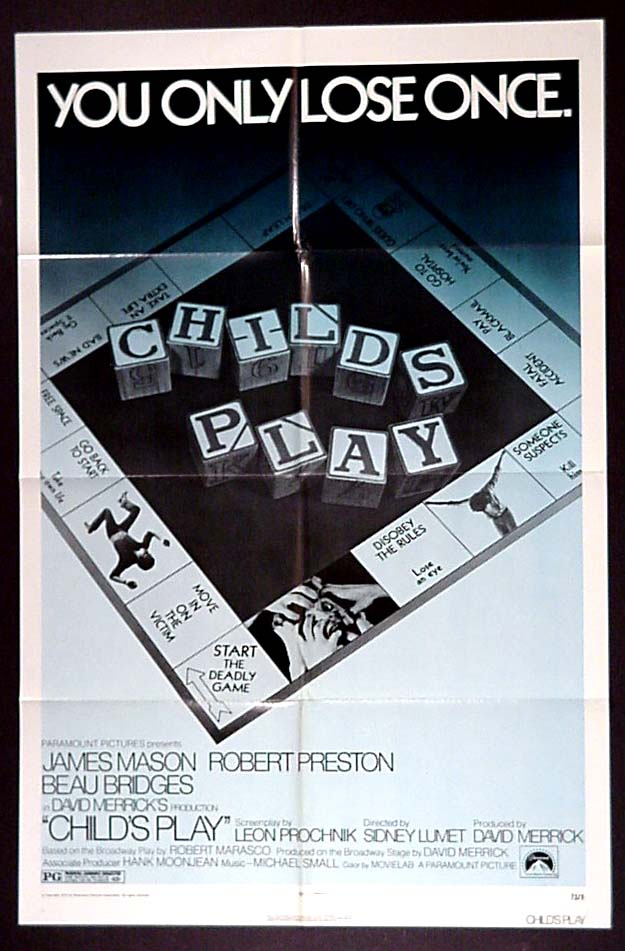
If you are looking for a review about the Chucky doll then you will have to wait as that will come at a later time. This is the first film to use that title and it is based on the Broadway play by Robert Marasco who in turn based it loosely on an early Ingmar Bergman movie called Torment. The story deals with an exclusive all-boys school where bizarre unexplained random acts of violence begin to occur between groups of students. New teacher Paul Reis (Beau Bridges) becomes determined to unravel the mystery and begins to suspect that it may have something to do with a long running feud between two of the school’s older instructors Joseph Dobbs (Robert Preston) and Jerome Malley (James Mason)

The film opens right away with a nice creepy tone and a foreboding score that immediately got me wrapped up into it. The dark, shadowy lighting of the interiors helped accentuate the sinister feel. It is also great to have the film shot in an actual boy’s school instead of building sets to recreate the look. Just hearing the floorboards creak underneath the feet of the actors as they walk around helps to create an already strong atmosphere.

Mason is terrific. I think it is impossible for the man to ever give a weak performance even if the script itself is poor. He is captivating every time he is on the screen and his ability to display wide ranging emotions without flaw never ceases to amaze me. Everything always seems to come so naturally with this man in all of his performances that you never see the acting, or technique behind it. It is a shame this movie is so obscure because watching his performance alone makes the film worth seeing and the desperate, lonely character that he plays is interesting in its own right.

Preston doesn’t seem as strong. He is a good actor at times, but not for this type of part and having him wearing a moustache doesn’t help. Supposedly the part was originally intended for Marlon Brando, who would have been more interesting, but he ended up backing out.

Bridges is okay as the protagonist, but he has played the role of a wide-eyed idealist coming into an ugly situation while oblivious to all of the dark aspects a little too often making it an annoying caricature.

The movie fails in the fact that it cannot hold the tension and there are too many talky scenes with little action in-between. The students come off as robotic like and the scenes involving them attacking another student inside a gymnasium looks staged and rehearsed. Director Sidney Lumet would have done better had he used a hand-held camera and gotten right in the middle of the fray making it seem more spontaneous and vivid.

I also had a hard time believing that so many students could get effectively brain washed and sworn to secrecy. I could buy maybe a few, but having so many seemed implausible and ruined the film for me. However, the explanation for the cause to the violence is an original one that I wouldn’t have thought up myself. Also, the surprise twist at the very end is kind of cool.

A similar film to this one entitled Unman, Wittering, and Zigo that also came out in the 70’s and dealt with murder at an all-boys private school will be reviewed next Friday and fares a bit better.

My Rating: 5 out of 10

Released: December 12, 1972

Runtime: 1Hour 40Minutes

Rated PG

Director: Sidney Lumet

Studio: Paramount

Available: Amazon Instant Video