Category Archives: Movies with Nudity

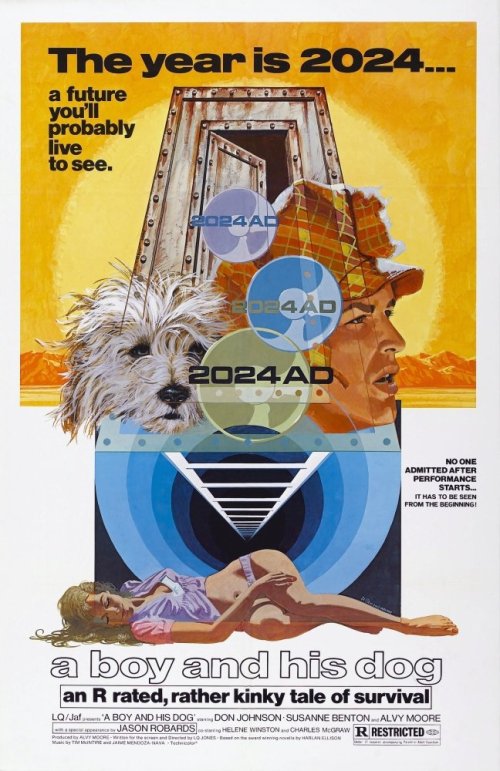
A Boy and His Dog (1975)

Version 1.0.0

Version 1.0.0

By Richard Winters

My Rating: 7 out of 10

4-Word Review: Surviving after nuclear holocaust.

The year is 2024 and the landscape of the U.S. has been turned into a wasteland due the after effects of a nuclear war that occurred in 2007. Vic (Don Johnson) is an 18-year-old that wanders around with his telepathic dog named Blood (voice of Tim McIntire). Blood helps Vic find women to rape while Vic scavenges for food for their survival. One night while watching an X-rated movie at a makeshift theater Blood is able to gain the scent of a woman nearby named Quilla (Susanne Benton). Quilla and Vic eventually have sex, but then she disappears to the underground society that survives inside a biosphere. Vic decides to follow her there while Blood remains above ground waiting for Vic’s return. Once Vic arrives he finds everyone there to be in whiteface and dressed like people living on the farm during the turn-of-the-century. He meets Lou (Jason Robards) along with Dr. Moore (Alvy Moore) and Mez (Helene Winstone) who all three run things. They convince Vic to stay there as he has a ‘purpose’ of becoming a stud and impregnating the young women since the men there can no longer do so. At first Vic is excited about his newfound ‘job’ as he is always quite horny, but after he finds out the details of what he must do he relinquishes his duty, but realizes it may be too late.

The story is based on the novella of the same name by Harlan Ellison who wrote the original screenplay that was later finished by director L.Q. Jones who used his own money to help get the film financed. While the movie does have some intriguing and memorable visuals, logic-wise there are some holes. One of the biggest ones is that, at least hypothetically, there would most likely have been a nuclear winter, which is what would be created after a nuclear war due to so much soot being blown into the atmosphere that it would block out most of the sunlight for several decades and create a night time effect and for this reason the outdoor scenes should’ve been filmed at night in order to replicate the ongoing darkness.

Vic’s conversations with his dog, which all gets done telepathically, is odd too and never sufficiently explained. How does this dog attain this ‘gift’ and why is it only him and not other mutts that can do it too? It would’ve been better had it been explained that some modern invention had been created that would allow communication between owners and their pets, but even this fails to explain how the dog manages to be so incredibly smart. Don’t get me wrong the voice-over work by McIntire is delightful, but how did the animal get so well-read that he even knows the Latin origin of words? Is there a dog college that teaches them this?

Vic’s extreme urges to have sex all the time seemed out-of-place too. Granted he’s a young guy with raging hormones, but psychologically when a person is in a desperate situation, in this case simply trying to survive in a hostile environment with very little food, then a person’s most basic needs come first and it’s all they’ll think about. Finding something to eat, they’re forced to go out each day and hunt for something, and acquiring shelter for sleep, would be their pressing needs and what would occupy their minds most day-in and day-out while the sex need would become secondary and only have his focus once the other needs were met, but in this story the sex urges seem to take precedent, which doesn’t make sense from a human behavioral perspective, nor where he’d get the energy to do it since he’s pretty malnourished to begin with.

The X-rated movie that they watch at a ‘theater’ is goofy too as it amounts to nothing more than a grainy black-and-white stag film from the 50’s even though technically by 2007, which is when the bombs dropped, there was porn on the internet and explicit DVD’s some of which would’ve probably survived the blast and thus they’d be watching those instead of something found in grandpa’s ancient collection. Though this is what makes the movie entertaining not so much for what it gets accurate in their predictions, which isn’t much, but more what it gets wrong.

The one thing though that really stands-out, at least for me, and makes the movie memorable, though this apparently wasn’t the case with the film’s initial test audience who called these scenes ‘slow’ and ‘boring’, are the moments that take place in the underground society. The look of everyone walking around like robots and resembling farmers from a bygone era has a kitschy flair like something out of a Federico Fellini movie. Hal Baylor, as one of the main menacing robots that can’t seem to ever go down even when being directly shot at, steals every scene he is in and helps create some definite tension. I also got a kick out of everyone wearing white face, which I thought was to explain their pale complexions due to not be out in the sun, but it seems to be instead obviously painted on, so I’m not sure what that was meant to represent.

The twist ending is terrific and the film’s final line, which Ellison detested and tried having taken out, is a keeper. While its attained a cult following there are still the detractors who feel its ‘misogynistic’ though I don’t really see it.  Sure Vic sees women as sex objects and ‘conquests’, but there’s guys out there that are like that. Quilla is conniving and duplicitous, but some women are like that too. The movie isn’t saying that all men and women are like this, but in environments that are as desperate as this one it will tend to bring out the worst in human nature, which was all the film was trying to convey from my standpoint.

My Rating: 7 out of 10

Released: May 15, 1975

Runtime: 1 Hour 31 Minutes

Rated R

Director: L.Q. Jones

Studio: LQ/Jaf Productions

Available: DVD, Blu-ray, Amazon Video, Pluto, Roku, Tubi, YouTube

Cutter’s Way (1981)

cutter1

By Richard Winters

My Rating: 6 out of 10

4-Word Review: Friends help catch murderer.

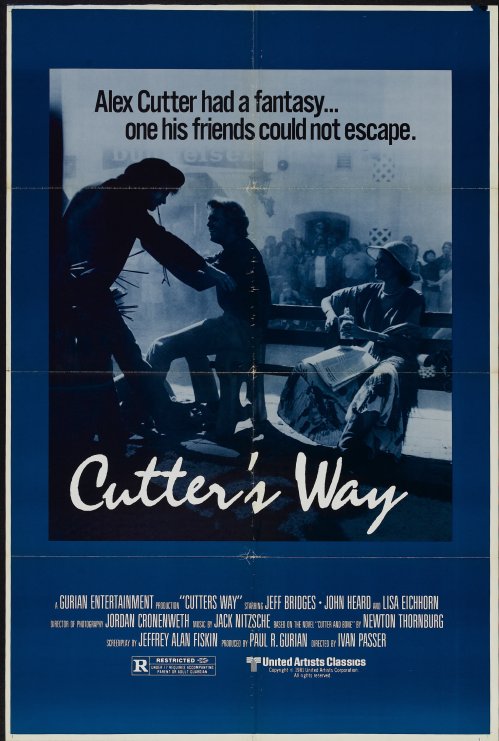
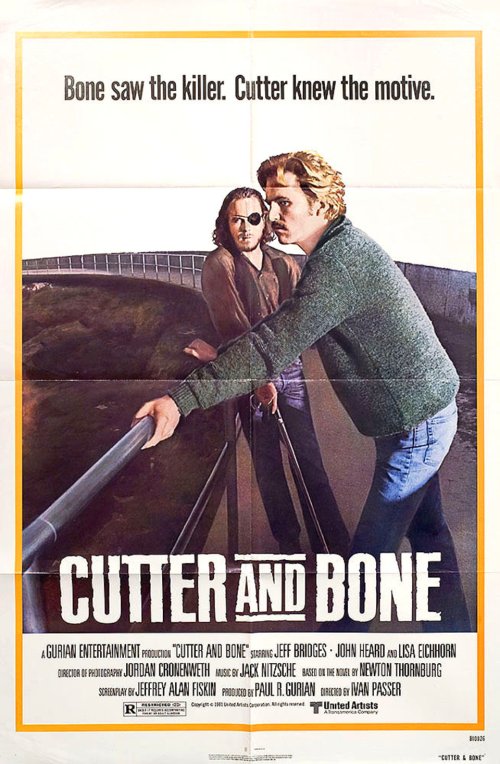
Richard Bone (Jeff Bridges) driving his old beat-up car, a 1966 Austin-Healey, which breaks down in a dark alley during a late night rain storm. From behind comes another vehicle where the driver dumps something into a nearby garbage can that turns out to being the dead body of a young girl. Since Bone’s car is still at the crime scene the next day when the authorities arrive he quickly becomes suspect number one. Bone’s friend, Alex Cutter (John Heard), a Vietnam vet struggling with alcoholism and PTSD, takes on the process of investigating the case to help get his friend out of trouble. The two soon hone in on a rich local businessman named J.J. Cord (Stephen Elliot) whom Bone swears was the man he saw driving the car that dumped the body.

The film is based on the 1976 novel ‘Cutter and Bone’ by Newton Thornburg. Producer Paul Gurian bought the rights to the book and asked struggling screenwriter Jeffrey Alan Fiskin if he’d be interested in adapting it to a screenplay. Since Fiskin was broke at the time, he last sold a screenplay, Angel Unchained, 10 years earlier, he was forced to shoplift the book in order to read and adapt it. David Field from United Artists was open to backing it for $3 million, but only if they could find a big-name star. Gurian then went to the home of Jeff Bridges, where he got attacked by one of Bridges’ dogs thus motivating Bridges to accept the part unseen in order to avoid a possible lawsuit. The film was released in the Spring of ’81 where it fared poorly with the critics and the studio was ready to scrap it only for it to pick-up good reviews a few weeks later. The studio then decided to place the film in their ‘classics’ division where it got retooled from it’s former title of ‘Cutter and Bone’, which they felt made it seem like a comedy about surgeons, to it’s current one and then rereleased it in the fall of that year were through good word-of-mouth it managed to recoup a modest profit.

Director Ivan Passer has stated that his motivation for directing the film was to go against what he felt was the ‘cripple mania’ at the time where film characters would get maimed usually through being in the war and then come back better, stronger people. Here he wanted to show that it didn’t make them better, but instead more dangerous.

While Heard certainly gives a good performance, it was originally intended for Richard Dreyfus, I felt he was too much of a caricature of an angry, wounded war vet and I didn’t find him interesting at all. Bridges was his usual transparent self and thus the interactions between two not all that captivating. Elliott is rather blah as well as the bad guy since for most of the runtime he’s only seen from a distance and never has any lines of dialogue until the final 9-minutes, though this does at least give him a certain creepy/mysterious vibe. Out of everyone I was most intrigued with Lisa Eichorn who plays a woman who bounces between the two friends and seems to want to play-off them both.

The emphasis is on the character study with long takes of Heard snarly at everybody he meets including the next door neighbor’s whose car he crashed into and the the subsequent police report, which goes on too long and doesn’t help the film or story move forward. The mystery isn’t as intriguing as it could’ve been because elements of it fall into place a little too conveniently. Bridges witnesses the killer driving away and then right away the next day spots the guy in a parade. Then a couple of days later the friends are talking about the case at a restaurant where the guys’ wife (Patricia Donohue) is sitting right next to them and overhears everything, which again is letting things fall too neatly into place without much effort.

There’s also questions about why the killer didn’t just run Bridges over with his car when he had the chance in order to avoid any witnesses. Also, Bridges is able to recognize the killer/driver, but when I saw the scene it was impossible to see the face of the driver. The viewer’s perspective should be the same as the protagonist, so if he’s able to get a good look at the culprit then we should’ve too.

Spoiler Alert!

Since everything is tied into circumstantial evidence I was hoping for some unexpected twist at the end. For instance having Bridges’ house get burnt down not because of Cale like they initially thought, but instead from the neighbors still angry over their car. The final confrontation in which Bone apparently shoots Cale (the screen fades to black and we only hear the noise of the gun going off) leaves more questions than answers. Does Bone and to an extent Cutter, who was there in the room with him, now go to jail for this? Seems like that should’ve been confirmed one way or the other and leaving it vague is like showing the viewer only half of the story.

cutter2

My Rating: 6 out of 10

Released: March 20, 1981

Runtime: 1 Hour 49 Minutes

Rated R

Director: Ivan Passer

Studio: United Artists

Available: DVD, Blu-ray, Amazon Video, Pluto, Freevee, Roku Channel, YouTube

Eureka (1982)

eureka1

By Richard Winters

My Rating: 6 out of 10

4-Word Review: He discovers some gold.

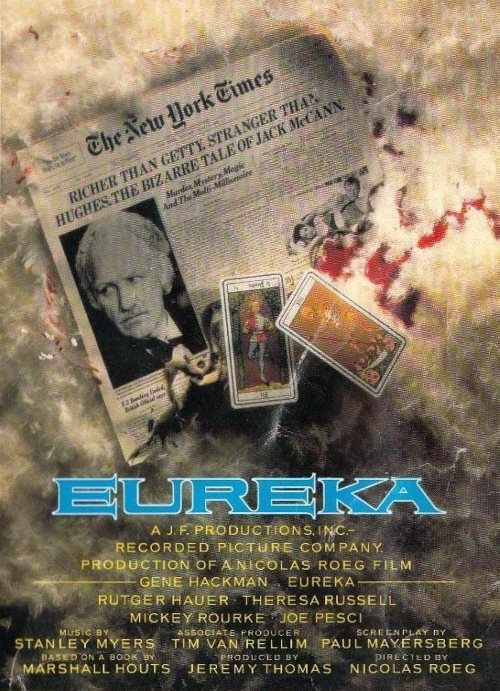
Jack (Gene Hackman) has been searching the Yukon for over 15 years in the hopes of one day coming upon some gold. Then one day he finds it and becomes super rich. 20 years later he’s living on his own island, married, and with a grown daughter named Tracy (Theresa Russell). Jack though has grown ornery through the years and has managed to alienate most of his family including Tracy’s husband Claude (Rutger Hauer) whom Jack can’t get along with and the two regularly argue to the point that it also affects his relationship with his daughter. Jack is also at odds with the local mobsters headed by Mayakofsky (Joe Pesci) who wanted to open a casino on the island and are willing to resort to any violent means necessary in order to get that done.

The film is based loosely on the life of Sir Harry Oakes who, like with the main character here, scoured many countries looking for gold for 15 years before finally laying claim to a fortune. He then retired to the Bahamas and ultimately was found murdered in 1943 in a crime that has remained unsolved. The studio though did not know what type of audience to aim the film to and thus shelved it for a year only to release it to limited theaters where it managed to recoup a paltry $123,572 out of its initial $11 million budget making it one of the biggest box office bombs in history.

As a visual exercise, given its director, its a spellbinding ride. Director Nicholas Roeg approaches it as a fable-like tale and creates the artic in a surreal type of way giving it an almost outer-worldly look and feel. To an extent this works and there’s a few memorable scenes including a barefoot man lying in the cold who blows his head-off, via a loaded gun, in one very unexpected, shocking moment that’s very realistically grisly. The death by blowtorch, which happens a bit later is effectively vivid as well. However, there’s other metaphysical elements like a mysterious stone that gets handed to Jack that alludes a bit too much to a magical quality and takes away that this is actually based on a true story and instead makes it seem like it’s all just a made-up metaphorical fable, which starts to have a pretentious quality.

The plot is too thin and the second act labors badly. Joe Pesci is a dynamic actor, but here his part is boring and he doesn’t come-off as threatening enough to give his scenes the proper tension. There’s also no insight given to why the gangsters choose to pick-on Jack, as this is a man who is quite rich and could hire his own protection and enforcers and not someone you’d think could be easily intimidated. So why bother with him at all and just find another island to build a casino on? In the real-life incident Harry Oakes went out of way to try to ban casinos from the entire island nation as he did not approve of gambling and thus caused the ire of the criminal underworld, but the movie doesn’t bother to explain this and thus makes the motivations of the bad guys confusing.

Acting-wise its a joy to watch especially Hackman. He has played so many heroes in his film career that it’s fun seeing him be a jerk and he does it well particularly when he gets on his alcoholic wife about ‘laying off the sauce’. Ed Lauter, who’s usually a heavy, is entertaining with this constant nervous look on his face as he ends up being the reluctant middle-man who gets played by both sides. Rutger Hauer is brilliant as usual giving each of his moments a creepy finesse as only he can do. Two of his more memorable bits are when he swallows a small piece of gold while in Jack’s presence and when he has a meltdown at a formal dinner party and angerly, even frighteningly, demands they all must go home.

Of course being that she’s the director’s wife you get ample visuals of Theresa Russell with and without clothes on. The two became a couple while filming Bad Timing a few years earlier and despite a nearly 30-year age difference got married. I’ve often think it’s odd though when a husband directs a movie in which she’s in bed naked with another man, in this case Hauer, who’s also sans clothes. Don’t know if many other husbands would like that idea as the erotic scenes weren’t necessarily needed though I kind of wonder if it’s not another case of the trophy wife syndrome where the old guy wants to brag to the world: look at this hot little number I get to go home to and you don’t and thus the nude scenes are just there to make all the other guys jealous.

Spoiler Alert!

The climactic court room scenes, in which Hauer is placed inside a cage during the proceedings, aren’t effective. Mainly because he acts as his own lawyer and questions Russell on the stand who goes on a long, teary-eyed, rant about her father and his perceived psychological motives, that ceases to be the proper question/answer decorum that would be expected in a regular court setting. It’s unlikely that any judge would let this go on the way it does, or that the jury, or other attorneys would be so captivated as they are and not begin rolling their eyes after awhile, or objecting to the histrionics. Having Hackman killed off doesn’t help things as he was the guy the viewer most connected with while Hauer was a creepy guy who behaved erratically and expecting the audience to suddenly emotionally side with him at the end was an overreach.

Released: May 20, 1983

Runtime: 2 Hours 10 Minutes

Rated R

Director: Nicholas Roeg

Studio: United Artists

Available: DVD-R, Blu-ray

My Bodyguard (1980)

my1

By Richard Winters

My Rating: 7 out of 10

4-Word Review: Hiring protection from bullies.

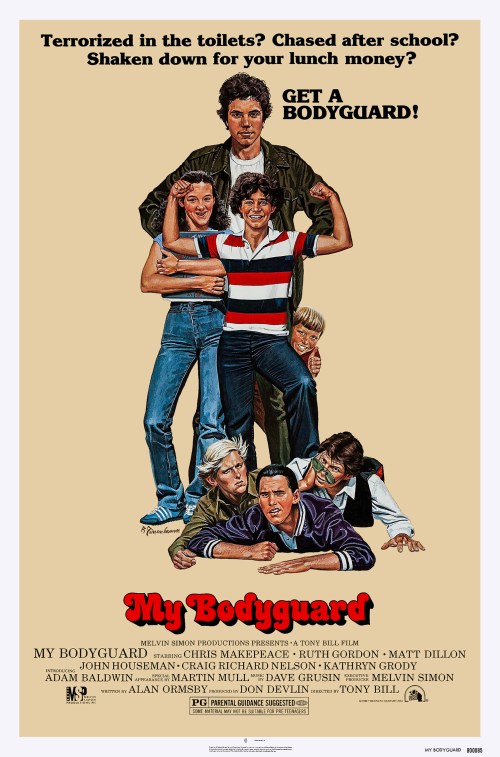
Clifford (Chris Makepeace) is a new student at a tough Chicago high school who finds himself at odds with the bullies who are headed by Melvin (Matt Dillion), who goes by the nickname ‘Big M’. He and his cronies want Clifford to pay them ‘protection money’ in order to defend him from Linderman (Adam Baldwin) who is a big, loner kid that supposedly killed his own brother. Clifford refuses and thus gets constantly hounded by them, so he decides to go to Linderman and offers him a deal where he’ll pay him some money each week and even agree to do his homework if he’ll become his bodyguard. At first Linderman declines, but eventually comes on board, which is enough to get Big M and his gang to leave them alone. Then a few days later Big M returns with his own ‘bodyguard’ named Mike (Hank Salas), a big muscular guy, who challenges Linderman to a fight, which he at first resists.

This teen movie is unusual in that it was not based off of a novel as its source material, even though you’d be convinced it was, and although a novel version of the story was eventually written after the film was released, it’s ultimately an original idea by screenwriter Alan Ormsby. Ormsby was at that point better known for writing low budget horror movies, with a couple of them he even starred in, and seemed the least likely to have penned something as good natured as this. It also stands out from other teen movies in that its music isn’t some pounding rock score, but instead soft classical that helps give it distinction and let it stand-out from just about all the other high school flicks out there particularly those from the 80’s.

Kids today may not relate to a school where every student doesn’t have an I-phone, a laptop, or piercings, but if you were a teen back then this movie captures that experience to a T. Everything from the bland school lunches where you had to drink milk out of a small carton to the creaky old school buildings (this one was filmed on-location at Lake Forest High) gets recreated. The teens are all realistically geeky and awkward, even Joan Cusack, in her film debut, looks nerdish especially as she smiles exposing a mouth full of metal. Many who see this, or see it again, it will bring back a fondness to their own school days to the point it may even make you feel you’re right back there.

Chris Makepeace is perfectly cast as a sensitive youth who must learn to ‘make connections’ or ‘network’ his way around the new environment and use what social skills he has to maneuver through the teen jungle. Dillon, in only his third movie, makes for a believable bully and Baldwin, in his film debut, is also excellent and while his character doesn’t say much he gives off a very effective almost creepy stare that proves memorable. In support I really got a kick out of Paul Quandt, who’s only film appearance this was, as a scrawny tyke who befriends Makepeace and always supplies funny side comments and reactions. You also get to see Joan and Jon Cusacks’ dad, Dick Cusack, as the school’s much put upon principal.

The only segments and characters that really don’t work are the scenes involving Makepeace’s home-life that are a bit unusual since he resides in a hotel that his father, Martin Mull, manages. He has no mother since she died in a car accident years earlier and Mull behaves more like a big brother, who is into looking at naked women with his son through their telescope, than any type of disciplinarian. Ruth Gordon plays Mull’s goofy mother and while Gordon is quite amusing her scenes go on too long and don’t have much if anything to do with the main plot. Mull’s moments don’t help either though one could argue that his scenes do have some outside connection to the theme as it shows adults have to deal with their own type of bullies in this case his crabby and demanding boss, played by Craig Richard Nelson, who is always threatening to terminate his employment.

Spoiler Alert!

The ending is different too in that it essentially says fighting may sometimes be necessary though many administrators of today try to persuade against the idea that violence is the answer and there are other more constructive ways to tackle conflicts. Of course watching Makepeace clobber Dillon while Baldwin handles Salas is quite satisfying especially since the whole rest of the movie is watching the kids, including even Baldwin, getting humiliate by the bullies, so the bad kids do ultimately get a much deserved come-uppance. However, just because one person ‘kicks some other person’s ass’ means only that they were the more skillful fighter, or just bigger physically, and not necessarily the moral superior.

Still it’s a very pleasant movie that has a rites of passage/ fleeting moment in time quality. The situation is portrayed as a growing pains issue and not a dire one. This is well before mass shootings and all of the ugliness you see happening in schools today where everything spews out into the adult world. Here it was still done at a time where these problems were contained within the school walls, which is the best thing about it.

My Rating: 7 out of 10

Released: July 11, 1980

Runtime: 1 Hour 36 Minutes

Rated PG

Director: Tony Bill

Studio: 20th Century Fox

Available: DVD, Blu-ray, Amazon Video, YouTube

The Adventure of Sherlock Holmes’ Smarter Brother (1975)

sherlock

By Richard Winters

My Rating: 6 out of 10

4-Word Review: Sibling solves the case.

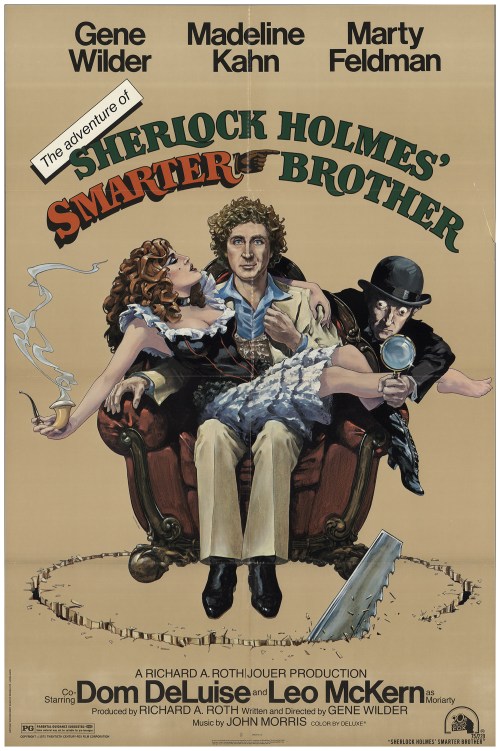
Gene Wilder plays Sigerson Holmes, the jealous younger brother of Sherlock, who is upset that his sibling is so famous for solving crimes while he sits in obscurity having not seen as much success though he feels he’s just as smart if not smarter. One day Sigerson gets a case that his brother doesn’t want to get involved in due to him desiring to lay low for awhile. It involves Jenny Hill (Madeline Kahn) who’s a beautiful music hall dancer who is being blackmailed by an opera singer named Eduardo (Dom DeLuise) over a lewd letter she sent him years ago. However, the document proves to be much more than just a letter and is in fact an important paper that foreign powers will pay high price to get their hands on. Eduardo agrees to sell it to the evil Professor Moriarty (Leo McKern), but will only hand it over to him during one of his operas, which Sigerson and his loyal partner Orville (Marty Feldman) plan to attend in order to intercept the paper before it gets into the wrong hands.

Gene Wilder was approached by producer Richard Roth to do a parody of Sherlock Holmes, but Wilder didn’t like the idea of poking fun of what he felt was an iconic character. Roth told him to think about it and then approached him a week later. By this point Wilder said he had come up with a better idea instead of it being about Sherlock it would focus on his jealous brother Sigerson. Roth found the premise intriguing and suggested Wilder begin writing the screenplay which he did while working on Young Frankenstein. Once completed he asked his friend Mel Brooks to direct, but Brooks declined saying he didn’t like working on projects that were not his own idea, so Wilder took the reins himself calling it a ‘terrifying commitment’.

While the movie has some good moments the Sigerson character is not interesting. For one thing he’s poorly defined. One minute he’s cunning and sharp and then the next he proves dimwitted and clumsy almost becoming another Inspector Clouseu. The comedy should feed off the character, but with it unclear whether he’s brilliant or buffoon it never catches its stride and for the most part the scenes with him in it are boring and the audience doesn’t care if he solves the case nor feel that there’s any redemption if he does. He’s also genuinely unlikable particularly with the way he snaps at Jenny Hill making you almost want to despise the guy and hope he doesn’t succeed. Also, if he really is Sherlock’s brother then I felt there needed to be some scenes with them together and the interplay between the two could’ve been amusing if done right, but this never happens.

Wilder directs the film the way most actors turning director do by having the scenes more extended and allowing the actors to drive the pace and momentum versus the editing. With a so-called ‘zany’ comedy like this that doesn’t work and there’s several segments that go on too long until it becomes dull and looking a bit amateurish. The biggest example of this is when Jenny arrives a Sigerson’s place to tell him about the letter. Their interplay doesn’t go anywhere and ultimately in order to get out of it the characters, for some unexplained reason, break-out into song and dance making it seem like its a musical, which it isn’t, but either way it’s dumb and not funny. During Jenny’s music hall show, which Sigerson and Orville attend, she sings a long song there too, which wasn’t needed and saps the comic energy.

There are though some offbeat moments much of which comes from McKern a usually serious actor who shines in his campy part and really plays it up to the point that he becomes the highlight. The part where he goes to a fortune telling machine, that he has inside his residence, is inspired and his visit with Eduardo in which the two strangely fondle each other and even go to bed together that gives off weird homoerotic vibes is good too in a sort of bizarre ‘what am I looking at’ type of way.

The best part though is when a giant saw blade cuts off the back of Wilder’s and Feldman’s trousers causing their bare behinds to be exposed. They then go to a formal dance party and shock everyone who sees their asses with them still not aware that they’re showing. What’s so interesting about this part is that they both have really good looking butts especially Feldman. You’d think with his freaking looking face that his rear wouldn’t be so hot either, but it amazingly is, so in keeping with our current male ass scorecard we still have Dabney Coleman, who bears his behind in Modern Problemscoming in first and Tim Matheson’s in Impulsebeing a close second and then Wilder and Feldman tying for third place.

My Rating: 6 out of 10

Released: December 14, 1975

Runtime: 1 Hour 31 Minutes

Rated PG

Director: Gene Wilder

Studio: 20th Century Fox

Available: DVD, Blu-ray

I Love My…Wife (1970)

ilove

By Richard Winters

My Rating: 6 out of 10

4-Word Review: He’s bored with marriage.

Richard (Elliot Gould) is a medical student when he meets Jody (Brenda Vaccaro) and the two quickly fall-in-love and get married. She then gets pregnant while he’s still in school and they don’t believe they have enough money to financially support a child, so they initially consider an abortion, but at the last minute Richard changes his mind and feels they should have the child. Jody though gains a lot of weight during the pregnancy, which Richard finds unattractive. Once the baby is born she’s unable to burn-off the excessive pounds causing their sex life to go even further into the tank. He has a few flings with some of the nurses before finally setting his sights on Helene (Angel Tompkins) a beautiful model who’s married to a baseball star (Dabney Coleman). At first she resists his advances, but the two eventually bed and then fall-in-love. She insists that Richard leave his wife, so that they can be together and no longer have to meet-on-the-sly. Richard tries to break-up with Jody, but because they have two kids finds that he can’t and instead begins lying to Helene as he plays both women at the same time, which soon turns into a losing situation.

The odd way this thing opens really hurts it and although it does improve a bit as it goes along some viewers may not be patient enough to stick with it. Having the opening credits deal with Richard’s relationship with his mother (Helen Westcott) and the sheltered way that she raised him isn’t funny and because the mother never appears again in the movie it wasn’t worth introducing her at all. Since the wife is the main focus I felt the opening scenes should’ve dealt with their dating period, which the movie breezes over too quickly. The clips from old movies, which get spliced in from time-to-time, add nothing and make it seem too much like Myra Breckenridge, which came out around the same time and best left forgotten. At least in that movie the clips came at predictable intervals, but here it’s sporadic making it seem, when they do get shown, as jarring and out-of-place.

Gould certainly excels at this type of role and he’s quite possibly the only actor who could play a shallow person and still manage to make it come-off as semi-likable. Vaccaro though is the real surprise as she’s usually best at drama and initially I felt she was miscast, but she comes through in making her character complex and even amusing as she goes through her tirades, some of it justified, at Gould. This is also the first movie to ever explore the issue of women who gain weight during their pregnancy, but can’t lose it afterwards and how this could affect their sex life, which I felt deserved kudos for being ground-breaking. The film makes the mistake though of showing too much from her point-of-view to the extent that we start to sympathize with her over the main character and almost start to dislike him in the process.

The introduction of Helene really does help as it’s her presence that gives the story a unique angle. Before this it comes-off more like your typical run-of-the-mill flick about a cad of a husband who can’t stay faithful, which has been done a lot and this movie doesn’t add anything insightful in that vein. However, the affair itself is interesting. For one thing she plays hard-to-get and doesn’t just jump immediately into the bed sheets at Gould’s beck-and-call, which is good as too much of the time, especially in 70’s movies, the women seem way too easy in a way that isn’t realistic. What I liked even more though is that the affair really doesn’t solve anything. Sure he finds her hot and sexy and they do get along, but she also has demands of her own and Gould finds himself in the same quandary as with his wife showing how extra marital flings really aren’t the ‘escape’ that they’re intended, but instead more of a problem.

Spoiler Alert!

The script by Robert Kaufman brings out many harsh truths about marriage and doesn’t insult us with any placid answers. Yet when the movie should go hard it goes soft instead. I liked how Vaccaro, who spent the whole time trying to win him back, finally gives up and starts seeing someone else, but Gould though upset and rebuffed, doesn’t learn anything from it. He goes back to the bar and tries picking-up an attractive stewardess he meets like he’s now making some sort of ‘fresh start’ when the film spent its entire running time exposing how this ‘cruising for chicks’ is a vicious cycle that just leads to more emptiness. Seeing Gould’s character change, or learn from his mistakes and display some regret would’ve been a far better way to have ended it.

My Rating: 6 out of 10

Released: December 21, 1970

Runtime: 1 Hour 38 Minutes

Rated R

Director: Mel Stuart

Studio: Universal

Available: DVD-R (dvdlady.com, modcinema.com)

The Wild Life (1984)

wild

By Richard Winters

My Rating: 5 out of 10

4-Word Review: One week before school.

The summer is winding down and the teens in suburban Los Angeles get ready to head back to school. Conrad (Eric Stoltz) has just graduated the previous year and is now planning to move into his own apartment, but finds it to be expensive and his salary working at a bowling alley doesn’t pay enough, so his buddy Tom (Chris Penn) volunteers to move in with him as his roommate and thus share the costs. The two though don’t see eye-to-eye on things particularly Tom’s penchant for wild parties, which Conrad fears will get them kicked-out. Conrad’s younger brother Jim (Ilan Mitchell-Smith) is fascinated with the Vietnam War and getting into trouble by smoking and underage drinking, which Conrad doesn’t like. Anita (Lea Thompson) is Conrad’s ex-girlfriend who’s having problems of her own as she’s still a teen, but having an affair with a cop (Hart Bochner) who is much older and also married.

The script was written by Cameron Crowe, who had great success with Fast Times at Ridgemont High, and took about trying to emulate that one. Instead of being all about crude jokes and pranks like with most teen flicks of that decade Crowe centered it more on studying the individual teen characters, but unfortunately they’re all rather banal and not that interesting to follow. The first half suffers from a lot of segments that go on too long and doesn’t help the pace. It moves along so leisurely that 20-minutes in I started to wonder when it was going to get on with the story and if there might not even be one though there eventually is. The humor, while amusing at times, is too soft and subtle and could’ve been played-up more to give the thing a much needed jolt. The word ‘wild’ is in the film’s title, but what we end up getting is just the typical teen stuff that hardly lives up to its name. I also could’ve done without the cigarette swallowing, which happens a few times with different people. To me it looked dangerous and enough to make somebody sick and was surprised the characters didn’t puke it out.

Mitchell-Smith has the face of a teen heartthrob, but his squeaky voice is a distraction and I would’ve considered dubbing it though I suppose funny sounding voices at that age as they go through the ‘big change’ may just reflect the reality. His character  is a bit over-the-top with his bravado and at one point challenges a guy who’s much bigger than him to punch him and in another segment he lies down on the street in front of a moving car. This type of behavior seems too reckless and brazen and isn’t normal. Teens are known to take some unwise risks, but it usually catches up with them, but never does here, which I found annoying. Also, when someone shows extreme bravery in one instance they can, as human nature goes, be amazingly scared about something else, but we never are shown that balance and thus making the character come-off as unrealistic.

Eric Stoltz has the same issue in reverse as he’s too clean-cut and responsible. Would’ve been nice and created a more three dimensional person had he been deviant at some point. Lea Thompson, who was already 23 at the time, looked too old to be playing a teen, and in fact just a year later got cast as the mother of a teen in Back to the Futureso I felt her appearance here didn’t work, I did however enjoy Chris Penn he’s definitely a doofus, but a lovable one and all his scenes elicit a chuckle. Robert Ridgely as the slick apartment manager, Hart Bochner as the corrupt cop with a mustache, and Rick Moranis as a preppy clothing store salesmen, with a puffy hairdo, are all funny too and help to give the proceedings a needed zing.

The third act does bring in a party, which gets out-of-hand, but not as much as it could’ve. Having all these people crammed into a tiny apartment should’ve created some fist fights when a boyfriend would catch another guy touching his girlfriend by accident due to having such little space between them. Spraying beer and food fights should’ve also followed, but never do, which makes these party goers too docile and well behaved. Having the guys break down the wall and evade the apartment next door and shock the neighboring couple (Ed Berke, Jessica Rains) was inspired, but we should’ve been shown these neighbors reactions the next day when the apartment manager surveys the damage. Overall though there’s just not enough here that stands-out especially from all the other teen flicks from that era and thus it’s easily and quickly forgotten.

My Rating: 5 out of 10

Released: September 28, 1984

Runtime: 1 Hour 36 Minutes

Rated R

Director: Art Linson

Studio: Universal

Available: DVD-R (Universal Vault Series)

The Devil’s Honey (1986)

devilshoney

By Richard Winters

My Rating: 4 out of 10

4-Word Review: Revenge on a doctor.

Jessica (Blanca Marsillach) is madly in-love with Johnny (Stefano Madia) who’s a famous saxophonist. The two share many kinky moments and have sex in the wildest of places. Wendell (Brett Halsey) is a surgeon who no longer has sex with his wife Carol (Corinne Clery) and instead seeks out prostitutes though even here the arousal is brief as he can’t achieve an erection for any extended period of time. Carol finds out about his philandering and asks for a divorce, which sets Wendell into a panic as he still enjoys having his wife around as a support system even if it isn’t for intercourse. As this is happening Johnny falls unconscious during one of his recording sessions due to a bump he got on his head while falling off his motorcycle earlier. He gets rushed to the hospital where Wendell is on-call, but he’s unable to concentrate on the surgery due to the stress of his marriage and Johnny ends up passing away. Jessica is outraged by this and sets a vendetta on Wendell to punish him for killing her boyfriend. It begins by her calling him constantly, but eventually she kidnaps him by taking him to her place and tying him up. She tortures him sexually, which strangely both of them begins to enjoy.

This was cult director Lucio Fulci’s return to a sex themed film, which he had started his career out as and away from the gory giallos he had become most known for. The attempt is not without merit as the sex is explicit and almost like a porn film with brief interludes of dialogue before it goes right back to the sexual imagery. Unfortunately on the erotic end it’s not all that titillating. The scene where Johnny blows his saxophone up Jessica’s vagina looked more laughable than kinky. The segment where he tries to get her to fondle his penis while they’re riding on a motorcycle, which almost gets them into a bad accident, I found genuinely cringey and not sexy at all. The fact that she’d be so into a guy that’s rather controlling and degrading to her seemed a mystery though it might’ve been meant as a quirk to her personality, but never explained sufficiently.

Outside of the sex the drama is weak. The moment inside the studio where he complains about having a headache, but the producer tells him to keep on playing anyways, so he blows out a few weak notes before tumbling to the floor came-off as unintentionally funny and had me laughing. Jessica’s distraught reaction where she bangs on the glass that separates the control room from the studio was ridiculous as she should’ve run into the studio to try to physically come to his aid, which had a better chance of actually helping him than just pounding on a window. I also got sick of hearing Johnny play the same piece over and over until it became nauseating.

Things improve with the presence of Halsey an American actor who appeared in many B-pictures during the 60’s and 70’s, but eventually went abroad by the 80’s when the film offers here began to dry up. While his face is chiseled and good-looking the hollow look in his eyes perfectly fits the character and thus becomes  a memorable image. Watching Jessica harass the hell out of him is kind of fun though no explanation for what the substance was that she used to knock him out, nor where she managed to attain it.

Spoiler Alert!

The third act has some tension though it gets ruined by all the flashbacks. Wendell’s wife also disappears completely and no scenes showing her reaction to the news that her husband’s been kidnapped. She had figured prominently in the first two acts and therefore we should’ve seen some sort of response from her in the third. Whether she was happy to have him gone, or had a change-of-heart and became upset is something we should’ve seen. There’s also no answer to what ultimately becomes of the new couple who end up liking the abuse that they give to each other. Do they go on cohabitating and if so does Wendell go back to being a surgeon and if not how do they survive financially? There needed to be more of a conclusion and just leaving it all hanging is not satisfying.

My Rating: 4 out of 10

Released: August 21, 1986

Runtime: 1 Hour 23 Minutes

Rated R

Director: Lucio Fulci

Studio: Selvaggia Film

Available: DVD-R, Blu-ray

Tribute (1980)

tribute

By Richard Winters

My Rating: 3 out of 10

4-Word Review: Father reconciling with son.

Scottie (Jack Lemmon) has been working in show business for decades and has built up many friends and fans, but finds it all come crashing down when, at the mere of age of 55, he gets diagnosed with leukemia. His greatest regret is not having a close relationship with his now grown son Jud (Robby Benson). He wants to reconcile, but not make it obvious that’s it’s because he’s about to die. When Jud comes over for a surprise visit with his mother (Lee Remick), whom Scottie has long since divorced, he tries to mend things and become the father he never had, but the hurt runs deep and Jud proves to be resistant to everything Scottie tries making him feel even more hopeless and forcing him to come to terms with his personal faults and inadequacies.

The film is based on the stageplay of the same name, which also starred Lemmon, and got sold into a $1 million movie deal before the stage version ever hit Broadway. On the surface it’s deemed a drama, but the script by Bernard Slade, who also penned the play, comes off more like a desperate comedy akin in tone to Same Time Next Year, which is Slade’s most famous work that had a strong dramedy vibe to it. This works on that same level as it attempts to lighten the poignant moments with comical bits, but it fails miserable.

Had some of it managed to actually been funny I might not have complained, but it amounts to cringe instead. The most eye-popping moment is watching Lemmon in a chicken costume run around his place going ‘balk-balk’ and even lay a giant egg on the sofa, which I felt was a career low point. What’s even dumber is his wooing of a young woman, played by Kim Cattrall, who’s also a patient at the hospital. He gets into her room by pretending to be a doctor and then gropes her breasts in a feeble attempt to check her heart rate. A normal woman of today, and even one back then, should respond with outrage for him copping-a-feel by disguising himself into being someone he isn’t, but in this stupid movie she’s instead ‘charmed’ by his antics and it’s enough to get her to go to bed with him later.

What’s worse and even more outlandish is that Scottie then sets her up with his son to have them conveniently ‘bump into each other’ in public and then begin going out. Yet how many sons are going to be cool with Dad sleeping with their girl first? Of course Scottie never tells him that he’s already ‘tested her out’, but it does end up showing inadvertently what a conniving jerk the old guy is and what the film considers to be nothing more than an amusing comic side-story really hurts the likability of the character if you think about it.

The acting is good. Lemmon is expectedly strong and so is Remick as his wife though her part is limited. I liked seeing Benson, who usually got stuck with immature parts due to his young, geeky features, play the mature and sensible, level-headed adult of which he does perfectly. Colleen Dewhurst has some strong moments as the caring nurse and Cattrall, despite the annoying nature of her dippy character, is pleasing enough. Yet the ultimate scene-stealer goes to Gale Garnett famous for the mid-60’s folk song ‘We’ll Sing in the Sunshine’, who plays a hooker and in one segment goes topless (looks great), but it’s a bit jarring when you realize it’s the same person who sang such a sweet-natured tune, tough in some ways you could say it’s also a testament that her creative talents are quite broad.

The third act, where they have this major tribute for Scotty has a touching potential, but gets overdone by filling-up an entire auditorium with all of his ‘close friends’, which even for a social butterfly seemed a bit exaggerated. The scene where the hooker gets a restaurant packed with all of her male clients who have ever slept with her has an amusing quality though again equally hard to believe that all of these men would be cool with everybody knowing that they’ve bedded a prostitute. I’ll give props though to the segment showing Scotty getting treatment in the hospital, which gets shown exclusively through still photos, which I found visually innovative.

Unfortunately everything else falls into second-rate melodramatics. It doesn’t even have the decency to tells us whether Scotty dies or not. When an entire movie deals with a character’s ultimate demise I think it should eventually get answered instead of leaving it open. It makes the whole terminal illness thing seem like a tease done to emotionally manipulate the viewer than an actual reality that it supposedly is.

My Rating: 3 out of 10

Released: December 19, 1980

Runtime: 2 Hours 1 Minute

Rated PG

Director: Bob Clark

Studio: 20th Century Fox

Available: DVD-R

Looking for Mr. Goodbar (1977)

looking

By Richard Winters

My Rating: 7 out of 10

4-Word Review: School teacher sleeps around.

Theresa (Diane Keaton) is a young school teacher trying to get over the break-up with Martin (Alan Feinstein) a married college professor of whom she’d been in a relationship with for several years. Tired of living with her parents (Priscilla Pointer, Richard Kiley) and her domineering father she decides to get a studio apartment near the club scene. She picks-up Tony (Richard Gere) at a bar one night and takes him home. His volatile, drug induced behavior scares her at first, but eventually she enjoys his unpredictable ways. When he disappears for long periods she begins bringing more strangers home finding the one-night-stands to be a liberating change from her repressive catholic upbringing, but the more she partakes in this edgy lifestyle the more danger she puts herself in.

The film is based on the Judith Rossner novel of the same name, which itself is based on the true story of Roseann Quinn. Quinn was a school teacher living in New York City who had a propensity of bringing home men she’d meet from a bar that was across the street from her studio apartment. On the evening of January 1st, 1973 she invited John Wayne Wilson, a man she met at the bar, back to her place for intended sex, but instead it resulted in murder when he was unable to achieve an erection and he felt she was making fun of him.

Rossner read about the incident in a newspaper and became intrigued with the case and intended to write about it for an upcoming article in Esquire magazine, but the editor feared legal action since it was based on an actual case and reneged on the assignment, so Rossner turned it into a novel using fictional names for the real-life people. It got published in 1975 to rave reviews and instantly became a best seller, which caught the attention of writer/director Richard Brooks who had turned other true crime stories into hits such as In Cold Blood and felt he could do the same with this. In fact the film did quite well as it raked in $22.5 million and was the top movie in the country on its opening weekend.

While Rossner openly detested the film version I felt it does a great job of exposing the bleak, lonely existence of the 70’s single’s scene and how sexual liberation can end up being just as much of a trap, if not more, as monogamy. The dim, dark lighting, particularly inside Theresa’s apartment brings out the grim existence, and twisted personalities, of its characters nicely. The viewer feels as caught up in the depressing, aimless world as the protagonist and its the vividness of the 70’s young adult, city culture that makes this an excellent film to see simply to understand the motivations of the people who lived it. While on paper reading about someone that was a school teacher for deaf students during the day turning into a reckless, sexually promiscuous lady by night may seem shocking and hard to fathom, the film seamlessly fills-in-the-blanks to the extent  that you fully grasp, from her stifling family and religious upbringing as well as her painful break-up and insecure body image, to what drove her to it and thus cultivates a very revealing character study.

Keaton, Kiley and Tuesday Weld, who plays Theresa’s older sister who experiments with the wild lifestyle herself, are all stand-outs, but the film also has some great performances from actors who at the time were unknowns. Gere is especially good, quite possibly one of the best acting jobs of his career, as the creepy, but still strangely endearing Tony. LeVar Burton has very few lines, but still makes an impression with his pouty facial expressions as the older brother to one of Theresa’s deaf students. Tom Berenger though turns out to being the ultimate scene stealer as the psychotic who’s so on edge with his personal demons that he lashes violently out over the smallest of provocations.

Spoiler Alert!

While the film is known mainly for its notorious ending, which still packs a bit of a punch, its effect is muted by director Brooks unwisely telegraphing it ahead of time. Virtually the whole movie is done from Theresa’s point-of-view and yet at the very end it cheats it by having a scene between Gary and his gay lover giving the viewer an unnecessary warning about his mental state, which wasn’t needed. For one thing in the real-life incident the assailant was a married man and not gay, so adding in the gay subtext and using it to explain his psychosis could be considered homophobic and armchair psychology. It also hurts the shock value as the audience knows what’s coming versus having them as surprised as Theresa when he suddenly lashes out unexpectedly, which would’ve made for a more emotionally impactful, gripping finish.

My Rating: 7 out of 10

Released: October 19, 1977

Runtime: 2 Hours 16 Minutes

Rated R

Director: Richard Brooks

Studio: Paramount

Available: DVD