Category Archives: Movies with Nudity

The Devil’s Honey (1986)

devilshoney

By Richard Winters

My Rating: 4 out of 10

4-Word Review: Revenge on a doctor.

Jessica (Blanca Marsillach) is madly in-love with Johnny (Stefano Madia) who’s a famous saxophonist. The two share many kinky moments and have sex in the wildest of places. Wendell (Brett Halsey) is a surgeon who no longer has sex with his wife Carol (Corinne Clery) and instead seeks out prostitutes though even here the arousal is brief as he can’t achieve an erection for any extended period of time. Carol finds out about his philandering and asks for a divorce, which sets Wendell into a panic as he still enjoys having his wife around as a support system even if it isn’t for intercourse. As this is happening Johnny falls unconscious during one of his recording sessions due to a bump he got on his head while falling off his motorcycle earlier. He gets rushed to the hospital where Wendell is on-call, but he’s unable to concentrate on the surgery due to the stress of his marriage and Johnny ends up passing away. Jessica is outraged by this and sets a vendetta on Wendell to punish him for killing her boyfriend. It begins by her calling him constantly, but eventually she kidnaps him by taking him to her place and tying him up. She tortures him sexually, which strangely both of them begins to enjoy.

This was cult director Lucio Fulci’s return to a sex themed film, which he had started his career out as and away from the gory giallos he had become most known for. The attempt is not without merit as the sex is explicit and almost like a porn film with brief interludes of dialogue before it goes right back to the sexual imagery. Unfortunately on the erotic end it’s not all that titillating. The scene where Johnny blows his saxophone up Jessica’s vagina looked more laughable than kinky. The segment where he tries to get her to fondle his penis while they’re riding on a motorcycle, which almost gets them into a bad accident, I found genuinely cringey and not sexy at all. The fact that she’d be so into a guy that’s rather controlling and degrading to her seemed a mystery though it might’ve been meant as a quirk to her personality, but never explained sufficiently.

Outside of the sex the drama is weak. The moment inside the studio where he complains about having a headache, but the producer tells him to keep on playing anyways, so he blows out a few weak notes before tumbling to the floor came-off as unintentionally funny and had me laughing. Jessica’s distraught reaction where she bangs on the glass that separates the control room from the studio was ridiculous as she should’ve run into the studio to try to physically come to his aid, which had a better chance of actually helping him than just pounding on a window. I also got sick of hearing Johnny play the same piece over and over until it became nauseating.

Things improve with the presence of Halsey an American actor who appeared in many B-pictures during the 60’s and 70’s, but eventually went abroad by the 80’s when the film offers here began to dry up. While his face is chiseled and good-looking the hollow look in his eyes perfectly fits the character and thus becomes  a memorable image. Watching Jessica harass the hell out of him is kind of fun though no explanation for what the substance was that she used to knock him out, nor where she managed to attain it.

Spoiler Alert!

The third act has some tension though it gets ruined by all the flashbacks. Wendell’s wife also disappears completely and no scenes showing her reaction to the news that her husband’s been kidnapped. She had figured prominently in the first two acts and therefore we should’ve seen some sort of response from her in the third. Whether she was happy to have him gone, or had a change-of-heart and became upset is something we should’ve seen. There’s also no answer to what ultimately becomes of the new couple who end up liking the abuse that they give to each other. Do they go on cohabitating and if so does Wendell go back to being a surgeon and if not how do they survive financially? There needed to be more of a conclusion and just leaving it all hanging is not satisfying.

My Rating: 4 out of 10

Released: August 21, 1986

Runtime: 1 Hour 23 Minutes

Rated R

Director: Lucio Fulci

Studio: Selvaggia Film

Available: DVD-R, Blu-ray

Tribute (1980)

tribute

By Richard Winters

My Rating: 3 out of 10

4-Word Review: Father reconciling with son.

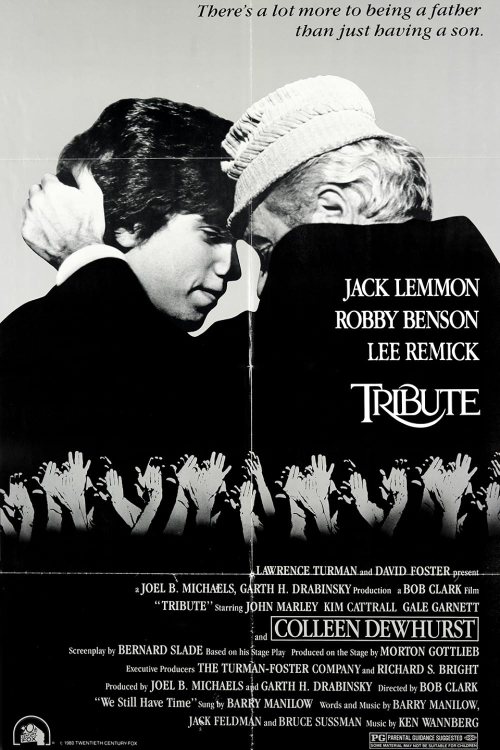
Scottie (Jack Lemmon) has been working in show business for decades and has built up many friends and fans, but finds it all come crashing down when, at the mere of age of 55, he gets diagnosed with leukemia. His greatest regret is not having a close relationship with his now grown son Jud (Robby Benson). He wants to reconcile, but not make it obvious that’s it’s because he’s about to die. When Jud comes over for a surprise visit with his mother (Lee Remick), whom Scottie has long since divorced, he tries to mend things and become the father he never had, but the hurt runs deep and Jud proves to be resistant to everything Scottie tries making him feel even more hopeless and forcing him to come to terms with his personal faults and inadequacies.

The film is based on the stageplay of the same name, which also starred Lemmon, and got sold into a $1 million movie deal before the stage version ever hit Broadway. On the surface it’s deemed a drama, but the script by Bernard Slade, who also penned the play, comes off more like a desperate comedy akin in tone to Same Time Next Year, which is Slade’s most famous work that had a strong dramedy vibe to it. This works on that same level as it attempts to lighten the poignant moments with comical bits, but it fails miserable.

Had some of it managed to actually been funny I might not have complained, but it amounts to cringe instead. The most eye-popping moment is watching Lemmon in a chicken costume run around his place going ‘balk-balk’ and even lay a giant egg on the sofa, which I felt was a career low point. What’s even dumber is his wooing of a young woman, played by Kim Cattrall, who’s also a patient at the hospital. He gets into her room by pretending to be a doctor and then gropes her breasts in a feeble attempt to check her heart rate. A normal woman of today, and even one back then, should respond with outrage for him copping-a-feel by disguising himself into being someone he isn’t, but in this stupid movie she’s instead ‘charmed’ by his antics and it’s enough to get her to go to bed with him later.

What’s worse and even more outlandish is that Scottie then sets her up with his son to have them conveniently ‘bump into each other’ in public and then begin going out. Yet how many sons are going to be cool with Dad sleeping with their girl first? Of course Scottie never tells him that he’s already ‘tested her out’, but it does end up showing inadvertently what a conniving jerk the old guy is and what the film considers to be nothing more than an amusing comic side-story really hurts the likability of the character if you think about it.

The acting is good. Lemmon is expectedly strong and so is Remick as his wife though her part is limited. I liked seeing Benson, who usually got stuck with immature parts due to his young, geeky features, play the mature and sensible, level-headed adult of which he does perfectly. Colleen Dewhurst has some strong moments as the caring nurse and Cattrall, despite the annoying nature of her dippy character, is pleasing enough. Yet the ultimate scene-stealer goes to Gale Garnett famous for the mid-60’s folk song ‘We’ll Sing in the Sunshine’, who plays a hooker and in one segment goes topless (looks great), but it’s a bit jarring when you realize it’s the same person who sang such a sweet-natured tune, tough in some ways you could say it’s also a testament that her creative talents are quite broad.

The third act, where they have this major tribute for Scotty has a touching potential, but gets overdone by filling-up an entire auditorium with all of his ‘close friends’, which even for a social butterfly seemed a bit exaggerated. The scene where the hooker gets a restaurant packed with all of her male clients who have ever slept with her has an amusing quality though again equally hard to believe that all of these men would be cool with everybody knowing that they’ve bedded a prostitute. I’ll give props though to the segment showing Scotty getting treatment in the hospital, which gets shown exclusively through still photos, which I found visually innovative.

Unfortunately everything else falls into second-rate melodramatics. It doesn’t even have the decency to tells us whether Scotty dies or not. When an entire movie deals with a character’s ultimate demise I think it should eventually get answered instead of leaving it open. It makes the whole terminal illness thing seem like a tease done to emotionally manipulate the viewer than an actual reality that it supposedly is.

My Rating: 3 out of 10

Released: December 19, 1980

Runtime: 2 Hours 1 Minute

Rated PG

Director: Bob Clark

Studio: 20th Century Fox

Available: DVD-R

Looking for Mr. Goodbar (1977)

looking

By Richard Winters

My Rating: 7 out of 10

4-Word Review: School teacher sleeps around.

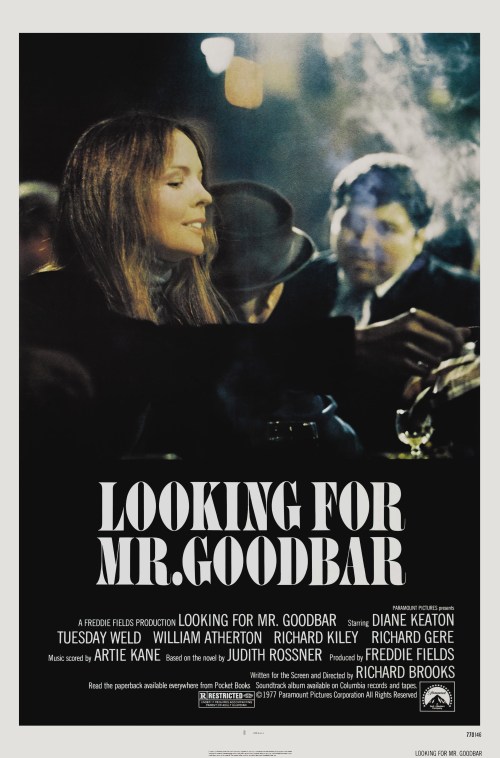
Theresa (Diane Keaton) is a young school teacher trying to get over the break-up with Martin (Alan Feinstein) a married college professor of whom she’d been in a relationship with for several years. Tired of living with her parents (Priscilla Pointer, Richard Kiley) and her domineering father she decides to get a studio apartment near the club scene. She picks-up Tony (Richard Gere) at a bar one night and takes him home. His volatile, drug induced behavior scares her at first, but eventually she enjoys his unpredictable ways. When he disappears for long periods she begins bringing more strangers home finding the one-night-stands to be a liberating change from her repressive catholic upbringing, but the more she partakes in this edgy lifestyle the more danger she puts herself in.

The film is based on the Judith Rossner novel of the same name, which itself is based on the true story of Roseann Quinn. Quinn was a school teacher living in New York City who had a propensity of bringing home men she’d meet from a bar that was across the street from her studio apartment. On the evening of January 1st, 1973 she invited John Wayne Wilson, a man she met at the bar, back to her place for intended sex, but instead it resulted in murder when he was unable to achieve an erection and he felt she was making fun of him.

Rossner read about the incident in a newspaper and became intrigued with the case and intended to write about it for an upcoming article in Esquire magazine, but the editor feared legal action since it was based on an actual case and reneged on the assignment, so Rossner turned it into a novel using fictional names for the real-life people. It got published in 1975 to rave reviews and instantly became a best seller, which caught the attention of writer/director Richard Brooks who had turned other true crime stories into hits such as In Cold Blood and felt he could do the same with this. In fact the film did quite well as it raked in $22.5 million and was the top movie in the country on its opening weekend.

While Rossner openly detested the film version I felt it does a great job of exposing the bleak, lonely existence of the 70’s single’s scene and how sexual liberation can end up being just as much of a trap, if not more, as monogamy. The dim, dark lighting, particularly inside Theresa’s apartment brings out the grim existence, and twisted personalities, of its characters nicely. The viewer feels as caught up in the depressing, aimless world as the protagonist and its the vividness of the 70’s young adult, city culture that makes this an excellent film to see simply to understand the motivations of the people who lived it. While on paper reading about someone that was a school teacher for deaf students during the day turning into a reckless, sexually promiscuous lady by night may seem shocking and hard to fathom, the film seamlessly fills-in-the-blanks to the extent  that you fully grasp, from her stifling family and religious upbringing as well as her painful break-up and insecure body image, to what drove her to it and thus cultivates a very revealing character study.

Keaton, Kiley and Tuesday Weld, who plays Theresa’s older sister who experiments with the wild lifestyle herself, are all stand-outs, but the film also has some great performances from actors who at the time were unknowns. Gere is especially good, quite possibly one of the best acting jobs of his career, as the creepy, but still strangely endearing Tony. LeVar Burton has very few lines, but still makes an impression with his pouty facial expressions as the older brother to one of Theresa’s deaf students. Tom Berenger though turns out to being the ultimate scene stealer as the psychotic who’s so on edge with his personal demons that he lashes violently out over the smallest of provocations.

Spoiler Alert!

While the film is known mainly for its notorious ending, which still packs a bit of a punch, its effect is muted by director Brooks unwisely telegraphing it ahead of time. Virtually the whole movie is done from Theresa’s point-of-view and yet at the very end it cheats it by having a scene between Gary and his gay lover giving the viewer an unnecessary warning about his mental state, which wasn’t needed. For one thing in the real-life incident the assailant was a married man and not gay, so adding in the gay subtext and using it to explain his psychosis could be considered homophobic and armchair psychology. It also hurts the shock value as the audience knows what’s coming versus having them as surprised as Theresa when he suddenly lashes out unexpectedly, which would’ve made for a more emotionally impactful, gripping finish.

My Rating: 7 out of 10

Released: October 19, 1977

Runtime: 2 Hours 16 Minutes

Rated R

Director: Richard Brooks

Studio: Paramount

Available: DVD

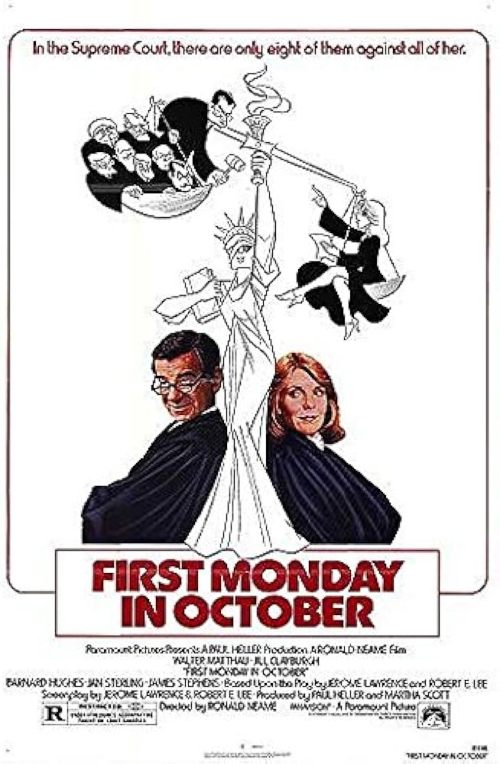
First Monday in October (1981)

firstoctober

By Richard Winters

My Rating: 3 out of 10

4-Word Review: The first lady justice.

While Daniel Snow (Walter Matthau), an associate justice on the Supreme Court who leans heavily left on most issues, is on vacation in Alaska, he gets word that the staunch conservative judge has passed away. The President then decides to nominate a woman to the court by the name of Ruth Loomis (Jill Clayburgh). Unfortunately Daniel is not happy about this as she’s as conservative as the man she replaced. Once the nomination is confirmed the two are immediately at odds over such things as pornographic movies and corporations that pollute the environment. While they bicker and debate constantly they do end up becoming friends, which comes in handy when Ruth realizes that her late husband was involved in some unscrupulous matters and she considers resigning from her position though Daniel tries desperately to talk her out of it.

The film is based on the 1978 play of the same name written by Jerome Lawrence and Robert Edwin Lee, who also wrote the screenplay. Initially the play, which first starred Jean Arthur and Melvyn Douglas received such terrible reviews that it soon closed and was revamped with Henry Fonda and Jane Alexander, was considered a novelty as up to that time no woman had ever served on the nation’s highest court. That all changed when Ronald Reagan nominated Sandra Day O’ Connor in July of 1981 forcing this film, in an effort to appear timely, to move up its release date to August, but the timing didn’t work and the movie was overall panned by both the critics and public.

The only interesting aspect is watching it from today’s perspective where the Supreme Court has now become a toxic and divisive issue when back in the early 80’s that was not the case. When the Girl Scouts of America posted on Twitter commemorating Amy Coney Barret getting nominated and approaching it as an achievement for women it got a lot of pushback from those unhappy with her due to her conservative leanings. Yet in this movie the fact that the character is staunchly conservative is not considered a problem and feminists and other women are seen during the senate hearings proudly cheer her on and considering her nomination a landmark.

In some ways having the political drama that the modern day court holds today might’ve made the story more interesting as the thing is so genteel that it’s enough to put most people to sleep. The script would’ve had more intrigue had their been a bad guy, maybe like the producer of the porn movies who gets talked about, but never seen, or even the elusive head of a mysterious corporation whose case the court is set to hear, that should’ve been added in to create genuine conflict, which is otherwise sorely missing.

I did like the scene where the judges get together inside a viewing room to watch the porno flick ‘The Naked Nymphomaniac’, but Matthau’s character should’ve been present during this and it’s less funny without him. Their subsequent arguments about whether X-rated movies should be allowed under the First Amendment seems quite dated as this issue had already been considered settled law and by the 80’s most video stores were offering adult films for rental and cable movie channels were showing porn late at night making the plot here woefully out of touch with the times.

Matthau and Clayburgh are great actors, but their performances here prove to be dull and lifeless. Having some sort of romance enter into the picture, it gets briefly alluded to when Matthau admits to having a certain attraction to Jill, but immediately dropped, might’ve given it a spicy angle, but just portraying them as friends with different viewpoints isn’t enough to keep it captivating. There’s  not too much that’s funny either. There’s a couple of semi-humorous lines here and there, but nothing that will make anyone break out into uproarious laughter. Matthau’s inability to eat his lunch using chopsticks while in a Chinese restaurant might amuse some slightly, but overall it’s a dull, empty ride. Very surprising that this thing received an R-rating. The only objectionable part is when they watch a porn flick, but nothing much in the way of nudity or sex is shown.

My Rating: 3 out of 10

Released: August 21, 1981

Runtime: 1 Hour 39 Minutes

Rated R

Director: Ronald Neame

Studio: Paramount Pictures

Available: DVD, Amazon Video, YouTube

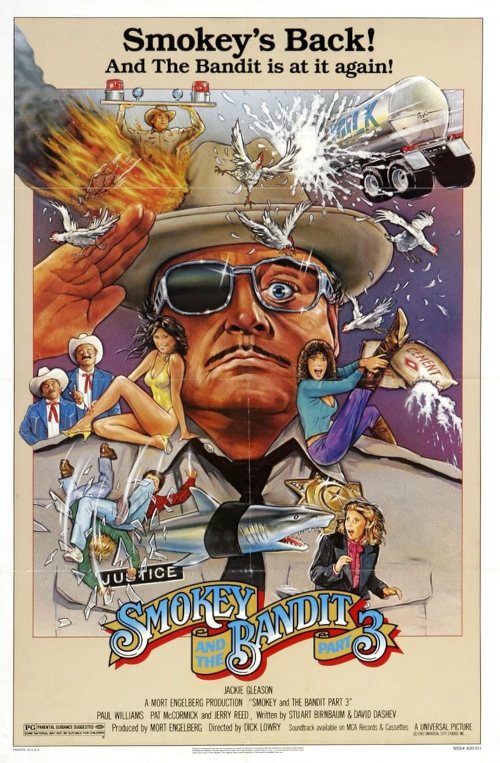
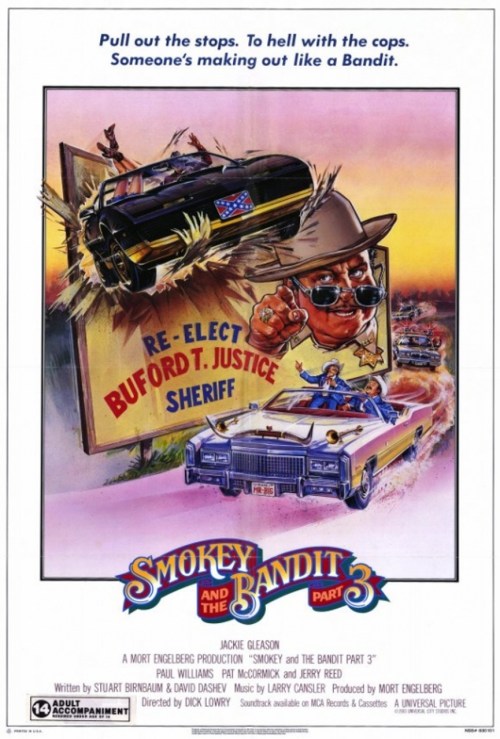
Smokey and the Bandit Part 3 (1983)

smokey1

By Richard Winters

My Rating: 0 out of 10

4-Word Review: Where is the Bandit?

Buford T. Justice (Jackie Gleason) announces his retirement as sheriff after more than 30 years of service. He decides to spend his time in Florida where he expects to get some rest and relaxation. However, once he becomes a part of the senior community he doesn’t enjoy it and feels the need to get back to what he liked doing most, which was chasing after the elusive Bandit. Big Enos (Pat McCormick) and Little Enos (Paul Williams) offer him a deal to get back into the swing of things. They bet that he can’t drive his police car from Miami, Florida to Austin, Texas, a total of 1,400 miles, in two days with a stuffed fish tied to the top of the car. If he’s able to succeed at the challenge he’ll make $250,000, which Buford readily accepts. To keep him from getting there the two Enos brothers set-up traps along the way in order to stymie his progress, but Buford and his dim-witted son Junior (Mike Henry) manage to get out of each predicament that gets thrown at them, so the Enos brothers decide to call-in Snowman (Jerry Reed) to help them. Snowman is a trucker, but in this instance he gets to pretend he’s the Bandit and even dress in his get-up and drive Bandit’s fancy black and gold Pontiac Trans Am. The new Bandit, who picks-up Dusty (Colleen Camp), a disgruntled used car sales woman along the way, soon catches up with Buford and son and steals their stuffed fish, which turns-the-tables and forces Buford to go after them.

By 1982 both Hal Needham, who had directed the first two installments, and Burt Reynolds, who had played the Bandit in the first two go-arounds, were no longer interested in getting involved in the project for another time as both were already busy working together on Stroker Ace. The studio though didn’t want to give up on the idea of a third installment since the first two had made a lot of money, so they signed-on Gleason to reprise his role as Buford with the promise that he’d have full script approval, which proved difficult as he didn’t like any of the scripts that were handed to him and at one point made the glib remark “with scripts like these who needs writers?’. After going through 11 rejections the writers finally hit on the idea of letting Gleason play dual roles of both the Bandit and the sheriff. Initially Gleason didn’t like this either, but the prospect of hamming up two different characters, which he had already done in Part 2 where he played Buford’s two cousins Gaylord and Reginald, got the better of his ego, so it received the green light.

In October of 1982 the script with Gleason in both roles was shot, but with no explanation for why he was playing the Bandit and everyone else in the story playing it straight like they didn’t see the difference. Eventually upon completion it was sent to a test audience in Pittsburgh where they gave the film unanimously negative feedback convincing the studio that the experimental novelty wasn’t going to work. They then hired Jerry Reed, who wasn’t even in the project before then, and asked him to reprise his role as Snowman who would then disguise himself as the Bandit. Then every scene that originally had Gleason in the role as Bandit was reshot with Reed now doing the part, but all the rest of the scenes that had already been filmed without the Bandit remained intact. The reshot Bandit segments were filmed in April of 1983 and the film eventually got its release in August of that year where the response of audiences and critics alike remained just as negative.

For years this was considered by many to be an urban myth as no footage with Gleason as the bandit was ever seen, but then in 2010 a promo of Gleason playing Buford, but talking about becoming the Bandit, or ‘his own worst enemy’ appeared on YouTube with the title of Smokey IS the Bandit Part 3 and Jerry Reed’s name not appearing anywhere on the cast list. Then in 2016 the actual shooting script that was shot in October of 1982 was downloaded to IMDb’s message board (back when they still had them), which plainly detailed Gleason as the Bandit, but had no written dialogue for those scenes since Gleason was routinely allowed to ad-lib his lines. The lost footage of Gleason in the Bandit scenes is purportedly in the control of the Gleason estate where it’s kept under wraps never to be shown to anyone again by apparently Gleason himself who felt humiliated by the test audiences negative reaction.

As it is the movie is not funny at all and unsurprisingly did not do well at the box office. Nothing much makes sense and the humor is highly strained including a drawn-out segment featuring the Klu Klux Klan, which I found downright offensive. Having a Blu-ray release of the lost footage of Gleason in dual roles would most likely be a big money maker as through the years it’s built up a lot of curiosity. It might be confusing and weird just like the original test audiences said it was, but it couldn’t be any worse than what we ultimately get here, which is as bottom-of-the-barrel as they come.

smokey2

My Rating: 0 out of 10

Released: August 12, 1983

Runtime: 1 Hour 25 Minutes

Rated PG

Director: Dick Lowry

Studio: Universal

Available: DVD, Blu-ray

Who can Kill a Child? (1976)

who3

By Richard Winters

My Rating: 6 out of 10

4-Word Review: Children kill the adults.

Tom (Lewis Fiander) and Evelyn (Prunella Ransome), who is pregnant, travel to an island off the coast of Spain in order to find some peace and quiet while on vacation. Once they arrive they find the place conspicuously devoid of any adults with many of the shops and bars looking like they’ve been abandoned. The only people around are children who behave strangely and will not talk to Tom, or Evelyn even when spoken to directly. They then come upon an adult survivor named Padre (Antonio Iranzo) who describes to them how the night before the children suddenly went crazy and began killing all the adults on the island without any provocation. Can Tom and Evelyn escape, or will they become yet another victim?

While there’s been other movies detailing children, or even groups of kids, who murder the adults around them this one is considered the granddaddy of all of them and, though not ever verified, the possible inspiration to Stephen King’s Children of the Corn. The film’s creepiness comes not so much with scares, as there’s very little of that, but more through its quiet atmosphere and isolation that grows increasingly more ominous as it goes. Violence-wise it’s scarce with only the minimum of gore though the sequence done over the opening credits, which has grisly real-life footage of victims of the Holocaust as well as both the Korean and Vietnam Wars is not for the squeamish and may be too explicit and grim for some to sit through.

The script was written in only a matter of 4 short days and it shows with character motivations that aren’t particularly well thought out. For instance I didn’t understand why Tom wouldn’t tell Evelyn about what he saw, in regards to the child beating up and eventually killing an old man, and wanted to somehow play down and even lie about what was going on. This is a pregnant woman who has a right to know about the dangers lurking about. Shielding her from the horrifying realities isn’t going to help her be alert and put up her defenses and if anything just make her more vulnerable to be taken advantage of by the kids. What kind of husband lies to his wife about such urgent matters? Does he think because she’s female she won’t be ‘strong enough’ to handle the truth? If so it makes him sexist and not particularly likable because of it.

Tom also is too slow to respond to things. Even after witnessing first hand the children’s atrocities he doesn’t immediately try to arm himself, get off the island, or board him and his wife off in some sort of safe room with a fortified door. Instead they remain pretty much out in the open in an abandoned hotel with both the entrances and exits wide open for anyone to come into. At one point he even gives his wife a sedative and tells her to take a nap inside one of the hotel rooms while leaving the door open as he goes downstairs to speak to the male survivor, but how does he know a kid won’t sneak into the room while he’s gone?

It’s strange too how the children kill a Dutch woman and even strip off her clothes, but when Tom walks in they all scurry away. If they’ve already killed a vast number of adults why would they fear Tom when he comes in and instead not just attack him too? For that matter why does Tom feel so emboldened to walk in on these kids to begin with? He’s seen what terrible things they can do, so why does he risk exposing himself to them? These clearly aren’t normal kids, so he should remain at a safe distance and view what they’re doing from a hiding spot.

While there’s creepy moments and imagery it all mainly comes during the third act and some more scares and action earlier could’ve helped. The special effects aren’t too great either with the shot of the bloodied old man, whose supposedly just been killed, clearly still breathing as his chest heaves up and down, though Tom carries him away like he’s now nothing more than a corpse. Having Padre describe the violent attacks of the children onto the adults from the previous night was disappointing as this should’ve been played out visually, even if through flashback, as it would be much scarier to see this instead of just being told about it.

Spoiler Alert!

The ending has its fair share of suspenseful moments, but again more logic loopholes. When Tom and Prunella are trapped in a room behind a wooden door a small child crawls through the window space and tries to shoot at them, but Tom manages to hit the kid with a bullet first with a rifle he’s found. The other kids then quit trying to break the door down the couple are in once they hear the shot and all go filing away. Tom says this is because none of the other adults responded with aggression and violence towards them like he did. Once they realized, by hearing the gunshot, that Tom meant business they all backed off knowing that he might kill them as well. However, the kids could not see through the door, the tiny window on it was too high up for them to look through, so for all they knew the gunshot was the sound of the small kid shooting the couple with his gun and therefore they should’ve continued the attack and not immediately stopped.

The children are also able to somehow brainwash their peers into doing their evil bidding by simply looking into their eyes, which somehow puts them under a spell. They even use this power to get the fetus inside Evelyn’s womb to attack her, but where do they get this power from? What kind of entity is behind all of this? Nothing gets answered, which leaves too many questions open and thus not as effective as it could’ve been.

My Rating: 6 out of 10

Released: April 26, 1976

Runtime: 1 Hour 53 Minutes

Rated R

Director: Narciso Ibanez Serrador

Studio: Penta Films

Available: DVD (Region 0), Blu-ray (Region B/2)

Sleepaway Camp III: Teenage Wasteland (1989)

sleepaway3

By Richard Winters

My Rating: 3 out of 10

4-Word Review: Angela commits more murders.

When Maria (Kashina Kessler), who has the words ‘milk’ and ‘shake’ tattooed to her breasts, goes off to camp, she is impeded by a truck driven by Angela (Pamela Springsteen) that runs her over and allows Angela to take on her identity. Angela then returns to the same campsite where she committed her atrocities from the last film, but which is now run by husband and wife Herman (Michael J. Pollard) and Lilly (Sandra Dorsey), who have turned it into a place to help reform teens with a criminal record and renamed Camp New Horizons. It doesn’t take long though for Angela to revert to her old ways and soon both campers and counselors begin disappearing with a frightening regularity.

While Part II was filming producer Jerry Silva was so impressed with what he was seeing that he immediately authorized another sequel with a script for this one being written while that one was still being shot and then only one weekend for pre-production. This also pushed the filming date back into October where not only were the leaves already changing, but in one segment you can see the breaths of the actors when they speak, which certainly does not give the viewer a summery feel.

The second installment had an okay balance between the black comedy and horror, but this one goes overboard into silly season. The initial killing is especially problematic as it has the victim chased down by a big truck in broad daylight. Yes, she eventually gets run over when she runs into a back alley, but the semi starts barreling down on her when she’s walking on an busy road with other cars, so other people would’ve witnessed what was happening and reported it making the odds of Angela getting away with it quite slim. Also, where does a woman, who was 13 when she got locked up into a mental hospital and been there most of the time until her recent release, find the time and money to learn how to drive a big rig and how was she able to steal one?

While Springsteen’s performance was slightly tolerable in the second installment I felt it got plain annoying here. She isn’t scary and even though this is meant as a dark comedy the villain should still have some frightening presence and she has none making for no suspense at all. She also has her hair dyed blonde, in order to resemble Maria, which has her looking even less like Felissa Rose who played the character in the first one and further way from the original concept making this seem like its own little movie with name-only connections to the other two.

The murders though are an improvement and the only thing that saves it. Part II put no creativity or imagination into the killings, but here we get a couple of memorable ones including Angela roasting marshmallows on a fire that’s burning two of her victims. Killing one of the campers via tying them up to a flagpole and then allowing them to drop many feet to the hard cement below was my favorite though the death by lawnmower, which apparently made some of the women members on the MPAA board, who were hired to give the movie its rating, physically sick, deserves honorable mention. Even here though there’s problems like when Angela stands over the body of a man and swings an ax on him, but then returns to the campsite wearing the same clothes she had, which would’ve been highly doubtful as they would’ve most assuredly been covered with blood splatter.

The only element I found interesting was the appearance of Michael J. Pollard who was at one time starring in Hollywood classics like Bonnie and Clyde and was even given a couple of leading man roles in  studio produced films, but here relegated to low budget direct-to-video fare. He isn’t even in it all that much as his character is one of the first to be killed though he does at least get to make-out with a hot young chick (Stacie Lambert), which may have made it worth it.

My Rating: 3 out of 10

Released: August 4, 1989

Runtime: 1 Hour 20 Minutes

Rated R

Director: Michael A. Simpson

Studio: Double Helix Films

Available: DVD, Blu-ray, Freevee, Pluto TV, Tubi, Amazon Video

Sleepaway Camp II: Unhappy Campers (1988)

sleepaway2

By Richard Winters

My Rating: 3 out of 10

4-Word Review: Angela returns to camp.

Angela (Pamela Springsteen), the teen killer in the first film, has now been ‘reformed’ after going through years of shock therapy and sexual reassignment surgery. She gets a job as a counselor at a camp named Rolling Hills, which is 60 miles away from Camp Arawak, the site where she had previously killed all those people. The campers and other counselors have no idea about her past and have a hard time getting along with her and she’s quite strict with no tolerance for anyone who breaks the rules. If someone does draw her ire she quickly dispenses with them by reverting to her old habits and after they’re offed she goes and tells the camp leader, Uncle John (Walter Gotell), that she ‘sent them home’, but when she starts doing this to too many kids everyone’s suspicions begin to rise.

While on the technical end the production is decent the storyline is ridiculous even when taken into context of a black comedy, which is what the filmmakers were hoping for, it doesn’t work. The idea that Angela would be let out of a mental hospital in such a short period of time, just 5 years, after killing so many people is absolutely absurd and would create a national, media uproar. Since the murders were all deliberate and plotted out she most likely would be considered sane and stood trial and sent to a regular prison anyways. Why would any campsite hire her? Don’t these people do background checks? A way to have resolved this would’ve been to shown her at the beginning escaping from the mental hospital, and possibly killing a few orderlies along the way, which would’ve helped the story make more sense and also been an excuse to show blood and guts, which is what audiences for these types of films pretty just want anyways.

While Pamela Springsteen, who’s the younger sister of Bruce Springsteen, may be a quality actress in her other films she does not play the role here in a convincing way. What made Angela so memorable in the first was her penetrating stare, which we don’t see any of. Angela’s inner angst came from her gender issue and not that she was some old-fashioned prude, like in this one, that kills people who don’t live up to her high moral standard. It’s like a completely different person who’s connection to the other one is in name only. Apparently Felissa Rose, who played the role in the original, auditioned for the part, but because she couldn’t convey the one-liners in a humorous way that they wanted they decided to go with Pamela. Personally I feel they shouldn’t have even bothered to make it if Felissa couldn’t have recreated the role, which I felt she had earned the right to.

The killings are not as creative either and in fact look downright pathetic. I’ll give some credit to the death in the outhouse where a victim is shoved into the hole were people relieve themselves and then she struggles several times to come up, with more and more waste appearing on her as she does, but otherwise it’s tacky fare especially the end where they come into an abandoned home featuring all the dead victims that looks too obvious as being mannequins with red paint.  I also didn’t care for the nightmare segment, apparently done to help pad the runtime, that rehashes the killing scenes we’ve already seen and is highly redundant.

Fans of the film say it’s the humor that sells it. Yes, some of it is kind of funny like when the male counselor (Brian Patrick Clarke) smells underneath his arm pits after Angela walks away thinking that the reason she was so cold to him wasn’t because she’s a psycho, but more because of his possibly bad body odor. My favorite though is when Ally (Valerie Hartman) has sex with a man and then only after it’s over does she bother to ask him if he has ‘AIDS’. Yet outside of this it’s a letdown. As sequels go it’s not the worst of its kind, but I would’ve preferred more of a straight horror approach that tried to stay faithful to the first one, both in tone and with the cast.

My Rating: 3 out of 10

Released: February 28, 1988

Runtime: 1 Hour 20 Minutes

Rated R

Director: Michael A. Simpson

Studio: Double Helix Films

Available: DVD, Blu-ray, Amazon Video, Pluto, Tubi, YouTube

Sleepaway Camp (1983)

sleepaway

By Richard Winters

My Rating: 6 out of 10

4-Word Review: Somebody’s killing the campers.

In 1975 two children are out on a lake with their father when the boat they’re in capsizes. As they are swimming in the water another boat that is being recklessly driven rams into them killing both the father and one of the children. Fast forward to 1982 one of the surviving children, Angela (Felissa Rose), is now living with her eccentric Aunt Martha (Desiree Gold) and Martha’s son Ricky (Jonathan Tiersten). Because Angela is very shy Martha has decided to send her off with Ricky to summer camp so that she can learn to socialize better. Once there Angela’s quiet nature causes her to be bullied by the other kids, which soon leads to all sorts of violent deaths amongst both the campers and counselors. The camp owner, Mel (Mike Kellin), wants to keep the deaths out of the press and insists they’re all just been accidents, but while he does this he becomes convinced that it’s Ricky who’s behind it and resolves to teach the kid a very brutal and violent lesson.

Initially this was a low budget film made near the end of the golden age of slasher flicks that was not intended to do all that well as most studios had considered this type of horror film to have gone out of style. The critics at the time savaged it, but since then it has gained a strong cult following and considered even ground breaking for its gay subtext and gender identity roles. Writer/director Robert Hiltzik shot it at a camp in upstate New York that he used to attend when he was growing up. The camp atmosphere is very authentic and I was impressed with how many kids they were able to bring on to make it seem like a genuine camp day with tons of kids running around everywhere and all of them age appropriate to the role versus having older kids over the age of 18 trying to look younger than they are, which is what you get in most other teen flicks. The only caveat is that it was filmed in September/October of ’82 and seeing some of the trees in the background changing colors does not help give off much of a summer time feel.

The film is noted amongst slasher aficionados for its grisly deaths. When I first saw this movie back in the 90’s I hadn’t seen as many slasher movie so I wasn’t aware of how the killings here are much different  than what you usually see. In most other films of this nature the victim dies usually by a quick slash of a knife, or strangulation, which isn’t either creative or memorable, but here you get all sorts of novel deaths. Two of the best is when an overweight man (Owen Hughes) has his entire body doused with scalding water and the throbbing blisters on his skin look realistic. He also doesn’t die, which is unusual because usually the victim passes away without that much of a struggle. The death by bee hive in which the victim has his face covered by hundreds of stinging bees is equally vivid and well played-out.

The acting is impressive too as not only do you get to see Christopher Collet in his film debut, and witness his bare behind in a brief bit, but also Felissa Rose, whose quiet stare is quite penetrating and becomes the film’s most lasting impression. She apparently got the part because during the audition they were asked not to convey any lines, but to simply stare off in space while pretending to eat some candy. Prolific character actor Mike Kellin, this was his last film and he was already dying of lung cancer when he did this, is fun particularly his incredibly unfashionable choice of clothes that bring out the worst styles of the 70’s and are reminiscent of a what a middle aged suburban dad of that era might wear when attending a neighborhood backyard BBQ.

Spoiler Alert!

On the negative end I didn’t find Angela, who we learn at the very end is really a boy, to be able to realistically pull-off the murders that she does. I don’t believe she (he) would’ve had the strength to pull out the chair from underneath a heavy-set man, nor dunk the head of a bigger boy under the water, or be able to force a knife through a metal wall of a shower stall. The argument that she’s really a boy doesn’t work as her (his) body type is quite small no matter the sex and the arms are scrawny. The film does well in coming up with novel deaths, but they should’ve worked harder at thinking up killings that a small fame teen could accomplish and still be in the realm of reality, which I don’t feel these are.

With that said it’s still a cool ending. I enjoyed the weird facial expression that Angela gives off once she’s caught and the camera freezes on it while morphing into a green backdrop. The final song that gets played is creepy too, so all in all the film succeeds though it will require some suspension of belief in order to be fully enjoyable.

My Rating: 6 out of 10

Released: November 18, 1983

Runtime: 1 Hour 24 Minutes

Rated R

Director: Robert Hiltzik

Studio: United Film Distributors

Available: DVD, Blu-ray, Freeve, Pluto, Tubi, Amazon Video, 

Hellraiser (1987)

hellraiser

By Richard Winters

My Rating: 6 out of 10

4-Word Review: Former lover needs blood.

Frank Cotton (Sean Chapman) purchases a puzzle box and brings it home to solve it. When he does he finds that it brings out demons known as Cenobites who enjoy inflicting pain on others for their own pleasure. After tearing Frank apart they reset the box and return to their own dimension. Larry (Andrew Robinson), Frank’s brother, moves into the house along with his wife Julia (Clare Higgins), who at one time, unbeknownst to Larry, had a brief affair with Frank. While moving in some boxes Larry cuts his finger and bleeds onto the attic floor where Frank was killed. Pieces of Frank still exist under the floor boards and the blood allows him to regain life though his body still needs more blood to regain its full form. He convinces Julia to bring in strangers from the bar home, so that she can kill them and allow Frank to drink their blood and regain more strength. Julia agrees to do this, but then Kristy (Ashley Laurence) becomes aware of what Julia is doing and is determined to put a stop to it by confronting Frank and taking away his puzzle box.

This was the first movie directed by Clive Barker and is based on his 1986 novel ‘The Hellbound Heart’. After being dissatisfied with how Rawhead Rex, based on another novel Barker had written, he became determined to direct the next feature in order to give it, in his words, some ‘directorial oomph’, which he had felt was missing in the previous film. Special effects wise the film hits all marks and is a precursor to what’s called Horror Porn today with a lot focus put on the effects that are both realistic and cruel. Watching Frank’s body slowly take form by growing out of the floorboards is quite impressive, but my only complaint are the close-ups of the skin particularly when a hook slices it open, which to me resembled more silly putty.

While the effects are great the characters aren’t. All of them come-off as dark and mean and there’s really no one to cheer for, or side with. Supposedly it’s Kristy the viewer is intended to get behind, but she came-off looking older than college aged and more like she was in her late 20’s. She’s also worldy-wise and seems able to handle herself, as is seen when she comes into contact with a couple of lecherous movers, quite effortlessly, so there’s no real character arch. Having her start-off as shy and sheltered and then grow stronger and confident as she learns to take on the cenobites would’ve been much more interesting and would’ve allowed for tension as you would initially question whether she had to guts to confront the evil like she eventually does.

The Julia character is weak too. I didn’t understand what drew her to Frank. Maybe in the novel this gets better explained, but in the movie it’s nebulous. Her brief fling with Frank, in the few backstory scenes that get shown, makes it seem like it was rather cold and distant and Frank doesn’t necessarily treat her all that well, so why would she bother helping to bring him back to life? Maybe she had a sadomaschistic bent, but if that was the case why would she marry Larry who treats her differently almost like he’s the passive and she’s more in control. If the woman prefers the man to be in control then that’s what she looks for in her next relationship not the opposite.

Spoiler Alert!

The twist near the end where Frank kills Larry and then begins to wear his skin gets botched too. It’s intended to be a surprise reveal for the viewer who, like with Kristy, initially think it’s the real Larry though it’s pretty obvious something isn’t right as blood is seeping out on the edges of his face, which Kristy should notice, but apparently because she’s so upset she doesn’t. It would’ve been better though to have the killing played-out and shown the final shocked expression on Larry’s face when he realizes he’s been betrayed by not only his brother, but wife too, which would’ve been priceless.

What’s even more perplexing though is why is Frank speaking in Larry’s voice? He may have his skin, but not the voice box. Even if he had tried to disguise it, in an effort to trick Kristy, I don’t think it would’ve come-off so convincingly. Then, once the gig is up and Kristy realizes it’s Frank, he still continues speak with Larry’s voice by why bother at that point since he no longer needed to fool her?

My Rating: 6 out of 10

Released: September 11, 1987

Runtime: 1 Hour 34 Minutes

Rated R

Director: Clive Barker

Studio: New World Pictures

Available: DVD, Blu-ray, Amazon Video, Pluto TV, Tubi, YouTube