Category Archives: Movies with a rural setting

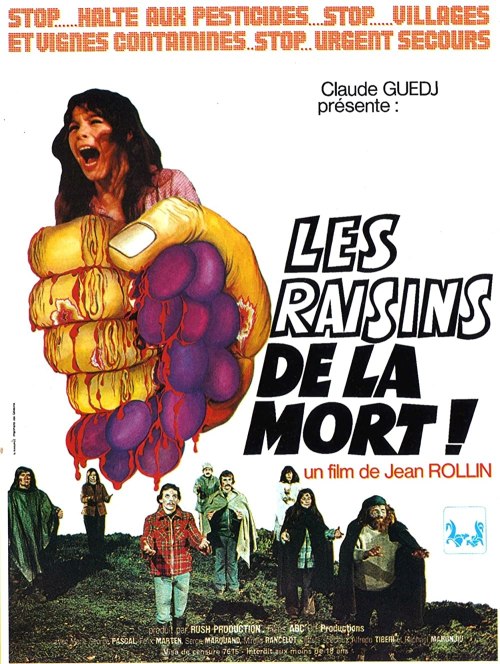
The Grapes of Death (1978)

grapes

By Richard Winters

My Rating: 7 out of 10

4-Word Review: Zombies created by pesticide.

The film opens with a shot of immigrants spraying grapes with a pesticide in a vineyard owned and run by Michel (Michel Herval). One of the men (Francois Pasal) complains of a pain on the side of his neck, but Michel insists he keep working and quit complaining. The film then cuts to two women riding inside a train car, one of them is Elisabeth (Marie-Georges Pascal) who’s the fiancee to Michel and coming to visit him. Once the train stops the man from the vineyards complaining of the pain walks onboard and proceeds to kill Brigitte (Evelyne Thomas) who was inside the train bathroom. He then takes a seat in the train car that Elisabeth is in, but once she notices the growing tumor on the side of his neck and then the dead body of her friend she runs screaming off the train. She then finds herself all alone in deserted town where everyone has the same type of tumors growing on their faces and all seem intent on trying to kill her.

This was the first mainstream horror film directed by Jean Rollin and credited as being the first gore film ever to be made in France. Rollin had made several experimental vampire flicks in the early part of the decade, but they had failed to catch-on and lost him a lot of money, which forced him into directing porn movies under the pseudonym of Michel Gentil. By the late 70’s he had made enough money with those that he was ready to jump back into doing another feature film, which for a zombie story is unique as the zombie’s here are fully conscious and well aware of what’s happening to them and kill out of a sense of rage. The film is also, for a horror movie, very quiet lacking the traditional pounding music score and instead has extended moments of near silence especially during the town scenes, which helps accentuate the creepiness.

Rollin hired an Italian production company to do the special effects, which are quite impressive. Normally I’m on here complaining how fake the effects look in most other low budget horrors, but here I was amazed with how realistic they were. The scene where a woman gets stabbed with a pitchfork while lying on a table and then continues to breath with it still in her really looks like the blades went right through her body. Another scene dealing with the decapitation of a nude woman (Mirella Rancelot) and then having one of the zombies carry the head around is one of the most graphic of its type. I did have some issues with the tumor make-up. On the train car where Elisabeth watches it grow on the side of the man’s head was cool, but on the people in the town it starts to look like smeared pizza and I wanted to see a shot of someone that had it all over their face instead just on a little part of it.

While Rollin stated that he admired the acting of his leading lady I felt she was the weakest link. Her fearful expressions and screams are great, but her performance otherwise is one-note. Part of what made Night of the Living Dead so great was the contrasting personalities of the main characters and I felt there needed to be that here. Having the two men (Felix Marten, Serge Marquand) enter near the end of the second act to help Elisabeth fight of the zombies is a great addition, but I had wished they came in sooner. I also didn’t like the way Elisabeth conveniently finds a gun inside the car she has just stolen, which she is able to use in the nick-of-time to shoot the zombies, but what are the odds? The gun should’ve been introduced earlier, perhaps as something she brought along with her at the beginning for her trip, and not just thrown-in haphazardly.

The twist at the end is not satisfying leaving the viewer feeling down and depressed when it’s over when a robust showdown was needed. I felt too that the reason for why the people were turning into zombies, which was the pesticide, should’ve been kept a mystery until the very end. Instead of opening it with the men spraying we should’ve seen the townsfolk going about their day in a normal fashion, which would’ve made a striking contrast to when Elisabeth gets there and they’re all crazy. Maybe a shot of a man spraying in the background behind the people talking could’ve been done as a little hint, or clue, but as it gets done here it’s too obvious when a subtle approach was needed.

My Rating: 7 out of 10

Released: July 5, 1978

Runtime: 1 Hour 25 Minutes

Rated R

Director: Jean Rollin

Studio: Rush Productions

Available: DVD, Blu-ray

Evil Town (1987)

evil1

By Richard Winters

My Rating: 2 out of 10

4-Word Review: Old people kidnap travelers.

Chris and Julie (James Keach, Michele Marsh) along with another couple (Robert Walker Jr., Doria Cook-Nelson) are traveling through rural California from Los Angeles when they begin to have car trouble and stop-off at a rundown gas station in a small town. Earl (E.J. Andre), the old man who runs the station, inspects the vehicle and tells them it’s a water pump issue that will take at least a day to repair. Since it’s late at night he and his wife Mildred (Lurene Tuttle) offer them their spares room to sleep over in, but the couples decide they’d rather camp-out. However, they become harassed by unknown peepers, so when that car is found to have even more issues the next day and forced to spend yet another night there, they agree to stay at the elderly couple’s home. It is here that they get fed a poison that knocks them-out and they are then taken to a nearby hospital run by Dr. Schaeffer (Dean Jagger) who needs bodies of young people in order to conduct his experiments on the aging process.

This film is a great example of how funding is so crucial to a production and once it runs out there isn’t much else to do. Filming began under the working title ‘God Bless Grandma and Grandpa’ in the fall of 1973 in Mendocino, California and was directed by the talented Curtis Hanson, but money ran out before they could shoot the ending. In 1977 a different production company bought the unfinished footage and tried to market it as a movie under the title Dr. Shagetz, but with no real ending it failed to catch-on and the entire thing fell into obscurity. Then in 1984 another independent studio bought the lost footage and attempted to again redistribute it, but this time by adding in new footage, which they hoped to edit around the old footage in an effort to make it seem like a complete movie and then ultimately released to select theaters on June 2, 1987.

Unfortunately by the time they were ready to shoot the new stuff many of the elderly actors from the original were already dead, or to old at that point to perform. The four younger stars who made-up the two couples had no interest going back to finish shooting a movie the had long ago forgot about. This resulted in new actors getting hired to play both the roles of the protagonists and the bad-guys and while it’s edited in a way to make it seem like the new stars are interacting with the old ones from the lost footage it’s quite clear that they really aren’t and whole thing ultimately comes-off as two bad movies compressed into one really lousy one.

The story idea I liked and has definite similarities with Homebodies that also featured old people as the killers. There are a few good moments like having the actions scenes done in slow-motion and Keach forced to fight-off the old people who attack him by jumping on him one after the other. The scene where he gets surrounded by a group of chanting old folks while trapped in an old, nonoperational car isn’t bad either, but the pacing is slow and takes too long to get going.  The added footage is highly exploitative and basically consists of Playboy Playmate Lynda Wiesmeier running around topless in the night as she tries to avoid two killers.

Jagger, who was clearly at the tail-end of his long career, which at one point featured winning an Academy Award in 1949 for best supporting actor, gives an interesting performance. His shiny bald head along with the shaded glasses he wears gives him a creepy look and the odd speech pattern that he uses here make him seem genuinely menacing. Had the story stayed focused solely on him and had the original production been better funded and retained the first director this thing might’ve had a chance and even cult potential, but the way it is now it’s just a sad curio showing what might’ve been.

My Rating: 2 out of 10

Released: June 2, 1987

Runtime: 1 Hour 22 Minutes

Director: Curtis Hanson (70’s footage), Mardi Rustam (80’s footage)

Rated R

Studio: Trans World Entertainment

Available: Blu-ray

Grotesque (1988)

grotesque

By Richard Winters

My Rating: 0 out of 10

4-Word Review: Punks versus deformed boy.

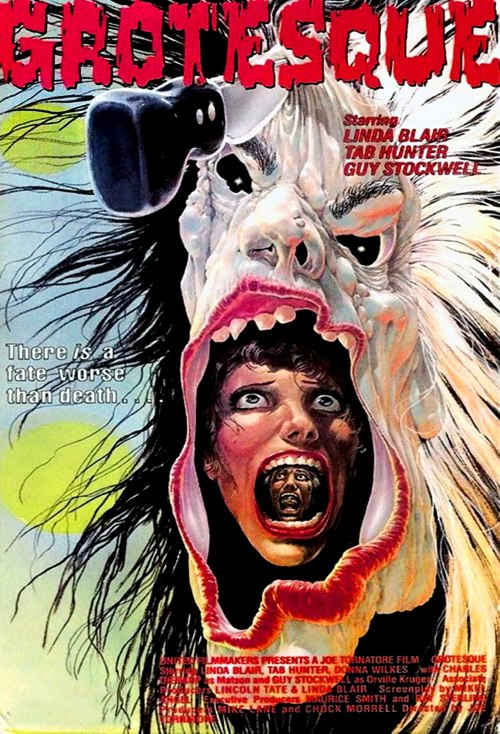
Lisa (Linda Blair) invites her friend Kathy (Donna Wilkes) over to her remote parent’s cabin for the weekend to help her get over a recent painful break-up. Lisa’s father Orville (Guy Stockwell) is a famous special effects artist for horror movies and the home is filled with all sorts of spooky masks and props. Unfortunately a gang of punks lead by Scratch (Brad Wilson) invade the home looking for money. Lisa’s parents are brutally murdered as well as Kathy. Lisa manages to get away, but eventually chased down outside in the snow. Yet the punks do not realize that another person is in the home, Patrick (Robert Apisa), who resides in a hidden room. He’s a boy with massive facial deformities that the parents kept in a secret room, but who is able to escape after the massacre. He then chases the punks down and begins offing them one-by-one while the police and Orville’s brother Rod (Tab Hunter) also go after the punks.

Filmed on-location in Big Bear Lake the film has a similar storyline to the Canadian cult classic Death Weekend and while that one had its share of faults it’s still far better than this, which has so many issues it’s had to know where to begin. The overly exaggerated performances of the punks, particularly by their leader who acts like he’s consumed way too much caffeine, is one of the bigger problems. There’s also no explanation for how they manage to find Orville’s very remote house especially since their van breaks down on the way. They try to ask Lisa for help, but she drives on, so who eventually came to their rescue to get them back on the road, or did they walk there and if so that should’ve been shown. It’s also irritating how they’re shown outside the home one second and then magically inside the place the next, but with no explanation for how they get in.

Linda Blair is certainly a fine actress, but she gets partially to blame for this monstrosity since she also co-produced. Donna Wilkes is quite appealing as usual and had she stayed in it the whole way and became the heroine I would’ve given it more points, but once she goes down it really gets bad. I felt the idea of having her sleep in the same bed with Lisa in Lisa’s bedroom looked a bit odd. If they were 8-year-olds on a sleepover that might be fine, but adult women, who were not in an intimate relationship, would most likely want more privacy and the home from the outside looked to have three stories, so you’d think there would be an extra spare bedroom, or two.

I didn’t like the addition of the Patrick character at all. Patrick gets mentioned briefly by Lisa and her mother, but I felt the viewer needed to be more fully aware that there was a secret room and someone in it long before the punks arrive. I didn’t understand why this deformed individual had such amazing strength either. If he had been cooped-up in a tiny room his whole life then I’d think the reverse would be true. His muscles would atrophy due to under use and he’d be weaker than normal instead of stronger.

Spoiler Alert!

The addition of the Tab Hunter character I actually liked. He plays a rugged, macho guy who tries to single-handily hunt down the punks and plays it with a fun style. I could’ve even tolerated the one twist ending that revealed Patrick to be his son and that Hunter himself was deformed and only able to hide it by wearing a plastic, form-fitting mask created by his brother. What I couldn’t stand was the double-twist, which has the whole thing being a movie created by Orville and as everyone is sitting in the theater watching it the film reel inside the projection booth gets messed with by a wolf man and Frankenstein, who then proceed to scare everyone out of the cinema when they walk in.

There’s no way anyone would get scared by two idiots that look to be wearing a tacky Halloween get-up and to give the whole thing a comical ending when the rest of it had been played-up as being serious is quite jarring. Normally after watching a bad movie and I feel disappointed, but in his case I was angry. It’s a genuine insult to have to sit through this and I honestly felt the writer-director should’ve been punished for having the audacity to make it and think anyone would be stupid enough to enjoy it.

My Rating: 0 out of 10

Released: September 9, 1988

Runtime: 1 Hour 29 Minutes

Rated R

Director: Joe Tornatore

Studio: Empire Pictures

Available: DVD, Fandor, Plex, Tubi, Amazon Video

The Farmer (1977)

farmer1

By Richard Winters

My Rating: 7 out of 10

4-Word Review: Country man seeks vengeance.

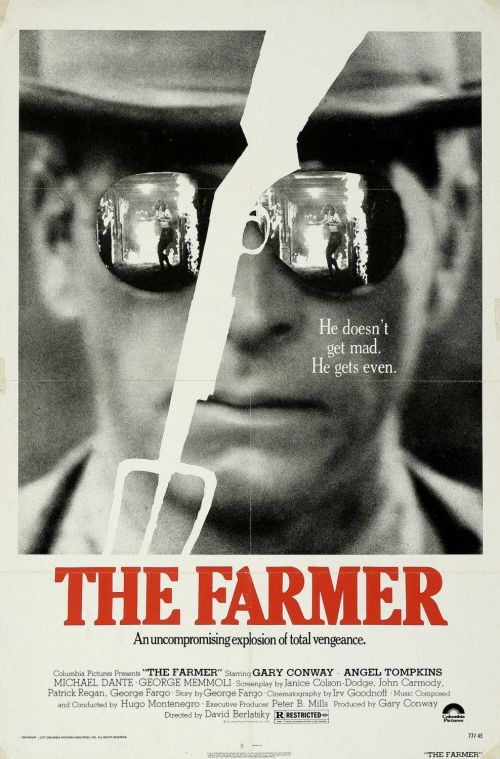
Kyle (Gary Conway) returns from fighting in WWII a decorated hero, but finds when he gets back home that trying to run a profitable farm to be tough going and risks having it foreclosed on by the bank. One night while swerving to avoid an animal on the road professional gambler Johnny (Michael Dante) gets injured in a car accident near were Kyle lives. Kyle and his friend Gumshoe (Ken Renard) nurse Johnny back to health and for repayment Johnny gives Kyle $1,500, which is enough to help his farmstead survive for a little while longer. Johnny though soon gets into trouble with racketeer Passini (George Memmoli) who permanently blinds him by dumping acid on his face. Johnny wants revenge and hires Kyle, who’s farm continues to struggle, to do it by having him use his superior shooting skills to kill-off Passini and his men while using Johnny’s inside knowledge to track them down. At first Kyle resists, even after Johnny offers him $50,000, but when one of Passini’s men (Timothy Scott) burns down Kyle’s barn, kills Gumshoe, and rapes his new girlfriend (Angel Tompkins) he then decides to go on the warpath.

This has become, especially in the past decade, known as a ‘lost film’. It had never been shown on broadcast TV nor cable and had never received a DVD release, or Blu-ray, or even VHS. It became impossible to find even a bootleg copy and many had become convinced this was the obscure of the obscure. Code Red promised 10 years ago, much to the excitement of rare film collectors, to release it on DVD, but after some promotion the deal fell through, which frustrated many and gave this film even more of a cult status. Some had come to believe that maybe the movie was simply a ‘myth’ and really didn’t exist at all. Just when everything looked bleak Scorpion Rising gave it a Blu-ray release in February of this year and the print is excellent and the film itself isn’t bad either.

It’s noted for its graphic violence, which may have been the chief reason it never got shown on TV or cable. Some of it is quite cruel, particularly the acid scene and the rape is quite intense too. This tough does effectively get the viewer emotionally riled-up making them want to see Kyle get revenge and relishing the third act when he does. The revenge scenes are just as bloody, but I was disappointed that, as graphic as the movie is, the segment where Kyle shoves one of Passini’s men out a high-story window is not shown. The camera cuts away when Kyle pushes him instead of seeing the body drop down which might’ve been hard to film since a parade was going on below, but an effort should’ve been made.

Conway’s acting is only adequate though he does at least convey a stoic quality. Angel Tompkins does better and while some of her other B-movie roles weren’t so great this one is clearly her best and proves she could act versus just looking pretty. Memmoli is memorable as the slimy villain and he should’ve been in it more, but he got injured on the set while riding in a stunt car and was cooped-up in a hospital during most of the production, which also ultimately lead to his career downfall and death. The former comic who graduated into character actor roles had always struggled with weight, but had gotten himself down to 190 pounds when he was in this movie, but when the accident occurred and he was laid-up his weight ballooned out to as high as 490 and causing him to have to turn down subsequent film parts due to his physical limitations.

The review in Maltin’s book claims that there’s a lot of ‘anachronistic errors’ in the movie and having read the review beforehand I kept my eagle-eye out looking for them, but I really didn’t see any. Again I never lived in the 40’s and technically Maltin, who was born in 1950, didn’t either, but to me I felt it came-off okay. I liked the way it approaches the era in a gritty way versus a nostalgic one and the frequent use of the hand-held camera, which was ahead-of-its-time. The surprise twist at the end isn’t bad either.

My Rating: 7 out of 10

Released: March 9, 1977

Runtime: 1 Hour 37 Minutes

Rated R

Director: David Berlatsky

Studio: Columbia Pictures

Available: Blu-ray

Stigma (1972)

stigma1

By Richard Winters

My Rating: 4 out of 10

4-Word Review: Venereal disease on island.

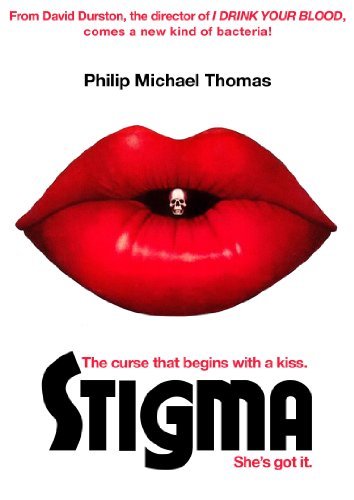
Calvin (Phillip Michael Thomas) is a doctor recently released from prison who gets a job assisting Dr. Thor (David E. Durston) at his island clinic. When Calvin gets there he’s given a cold greeting by the islanders who do not like a man of color, nor does the town’s racist sheriff (Peter Clune). When he arrives at the clinic he finds that the doctor has already passed-away as well as a tape he left behind warning of an epidemic on the island, but not saying specifically what it is. While staying at the clinic he’s met late one night by Jeremy (William Magerman) an old man residing at the nearby lighthouse. He complains about being in a great deal of pain and upon further testing is found to have syphilis. Calvin tries to go on a crusade to warn the others while also searching for who else may have it, which ultimately leads him to the sheriff’s rebellious daughter D.D. (Josie Johnson).

It’s always interesting seeing how low budget films from a bygone era before the advent of computerized special effects could succeed or fail on the merit of story alone. This one, which was done by David E. Durston who had previously directed the cult-hit I Drink Your Blood just a year earlier, manages to for the most part, blemishes and all, to hold it together. The difficulties though of filming on a shoestring is still widely apparent especially at the beginning where there’s a lot of shaking camera movement and jump cuts. Where Calvin goes to hitch a ride is particularly amusing. Since they didn’t have money to get a permit, or hold-up traffic on a legitimate highway, the scene had to be done on an isolated dirt road that looked like it hadn’t been traveled on in 10 years and normally Calvin would’ve had to have stood there that long with his thumb out before he ever saw a car and yet here this non-descript road gets quite busy by using the film’s crew members driving by with their own vehicles in order to give it a well-trafficked look.

This is also one of those films were the genre is unclear. Some have listed it as a horror film while others label it a drama, or even a comedy. My guess is that it was intended as a drama with some side comedy thrown-in as ill-advised ‘comic relief’. The story though never gets tense enough to need a lighthearted moment and the funny bits are eye-rolling making the production seem even more amateurish than it already is. There’s also a surprisingly graphic moment where pictures of actual syphilis patients are shown including close-ups of their sores and deformed noses, which some could find genuinely stomach-churning.

Thomas is best known for his co-starring role in the 80’s cop drama ‘Miami Vice’, but I found him far more engaging here. Magerman is memorable playing a mute with no teeth, who never says a word, but does have an amusing giggle. Johnson is certainly beautiful, which makes up for her lack of acting, but Clune as the villainous sheriff is all-wrong. He may have looked the part of an aging bigot, but he never gives the role the necessary energy or panache. Lawrence Tierny was original choice for the part, but due this drinking problems was eventually passed over, which was ashame.

In recent years this film has gained notoriety due to it being directed by David E. Durston (1921-2010) and some movie podcasts connecting him to the mysterious deaths of both Diane Linkletter (Art Linkletter’s daughter) and actress Carol Wayne. Durston was with Diane the night she jumped to her death from her apartment window in 1969, which authorities deemed a suicide though some wondered if Durston may have pushed her out. Durston was also dating Carol Wayne in 1985 when the two had an argument while vacationing in Mexico and she left their hotel room only to be found drowned in a lake later on. Further research though has concluded that the man in question in both of these events was Edward Dale Durston, a Los Angeles car salesman born in 1942, and no connection with the film director.

My Rating: 4 out of 10

Released: August 18, 1972

Runtime: 1 Hour 33 Minutes

Rated R

Director: David E. Durston

Studio: Cinerama Releasing

Available: DVD-R (Code Red)

The Track (1975)

track3

By Richard Winters

My Rating: 9 out of 10

4-Word Review: Hunters chase down woman.

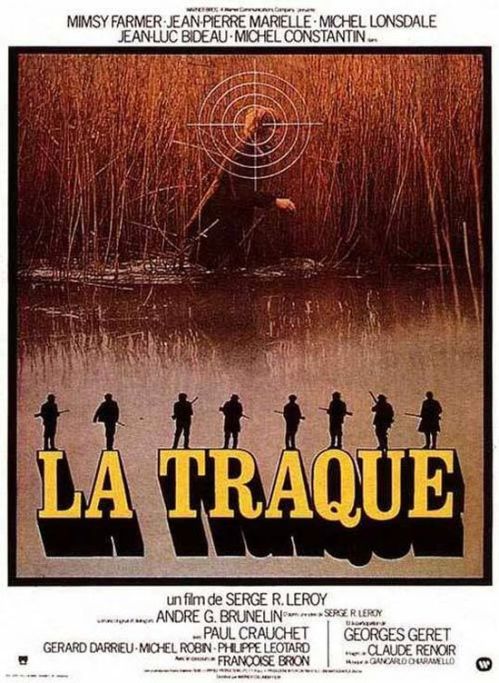
Helen (Mimsy Farmer) is an American who has traveled to rural France in order to teach at a local university. At the train station she meets Philippe (Jean-Luc Bideau) who agrees to take her to the isolated cottage where she is to stay. Along the way they come into contact with Philippe’s boisterous friends who drive them off the road. The men are going out for a wild pig hunt and a few of them particularly Paul (Philippe Leotard) shows a sexual interest in her, but Philippe assures her that they’re ‘harmless’. While Helen moves in to her new place the men go off on their hunt, but when she walks outside to check-out a nearby barn she again comes into contact with Paul along with his brother Albert (Jean-Pierre Marielle) and Chamond (Michel Robin). Paul uses the opportunity to rape her while Albert holds her down and Chamond acts as the lookout. As they are about to leave Helen shoots and critically injures Paul with Chamond’s gun, which he had inadvertently set down, before she goes on the run deep inside the forest. The rest of the group tries tracking her down in an attempt to negotiate some sort of deal, so she won’t go to the authorities, or silence her permanently if she still insists that she will.

Some have labeled this the French version of Straw Dogs, but I consider it much more like Deliverance. In that film you had middle-aged suburbanite males wanting to prove their ‘macho manhood’ by roughing it in the wilderness for a weekend only to find that they weren’t quite as prepared for the harsh elements as they thought. This film works in kind of the same way. The men go hunting to get in touch with their rugged side, but when forced to face tough issues, like helping a woman in distress, they succumb to group pressure and prove ultimately to be wimpy.

Unlike other films in the rape/revenge genre the main character here is shown the least. Farmer does well during the rape segment and screams and fights in a way that elicits genuine horror, but otherwise her facial expressions and mannerisms are quite one-dimensional though I was impressed with the way she did her own stunt work and forced to navigate her way through some difficult and inhospitable terrain.

The main focus is on the male characters who are fascinating and multi-faceted. The most interesting aspect is how they start-out seeming benign and domesticated only to slowly unravel into a aggressively threatening group. The segment where they kill a pig and the animal struggles after being shot will make some animal activists uncomfortable, but like with Jean Renoirs’ Rules of the Game, which had a hunting segment even more graphic than here, it does effectively illustrate that if people are willing to kill an animal for sport; how thin is the line for them to cross-over to a person?

The lack of a soundtrack is a plus. Many thrillers will have a pounding score and sometimes it works to accentuate the tension, but here the natural sounds particularly Helen’s heavy breathing as she runs through the underbrush is far more effective. There’s also no forewarning of what’s going to happen nor buildup. Everything occurs out of nowhere. Most victims who survive a crime will say the same thing that things were peaceful and normal one minute and then all hell broke loose the next.

Spoiler Alert!

The only two things I might’ve done differently had I directed was not showing the rape. As rape scenes go this one is rather mild, but my feeling was it would’ve been creepier had the viewer been in the dark about what occurred as were initially the other men. They’re told the story that the gun went off accidentally and the woman ran in a panic only for them to slowly learn the dark details later on. Having the viewer come to this realization along with the other men would’ve added an extra layer to the story versus it being spelled out.

While the ending is effectively unsettling I still wanted a denouement showing how the strains of this experience changed them, which would’ve added insight. Overall though it’s a brilliant especially for the way it reveals how some of the men considered themselves more ethical than the others only to end up being no better. Everyone likes to feel that they, or their friends, would do the right thing when put in a stressful situation and ‘be the hero’, but this movie expertly examines how that might not always be the case.

Alternate Title: La Traque

Released: May 14, 1975

Runtime: 1 Hour 32 Minutes

Not Rated

Director: Serge Leroy

Studio: Warner Brothers

Available: DVD-R (French with English Subtitles) (dvdlady.com, jfhi.com)

Conrack (1974)

conrack2

By Richard Winters

My Rating: 7 out of 10

4-Word Review: He teaches underprivileged kids.

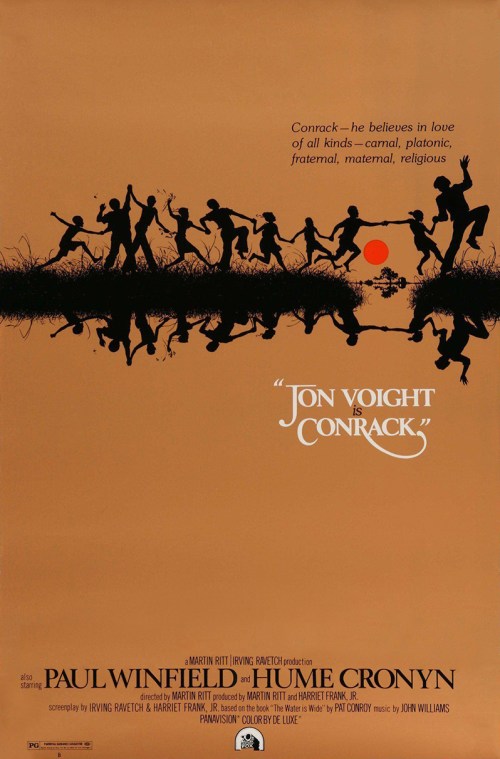
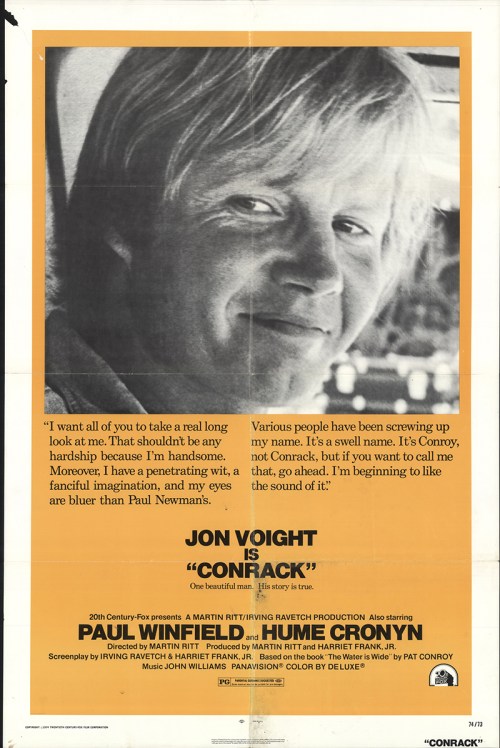
In the spring of 1969 Pat Conroy gets a job teaching children in grades 5 through 8 in a one room schoolhouse off the coast of South Carolina on an island known as Yamacraw. He soon finds that the students, all of whom are poor and African American, don’t know even the basics of arithmetic, or geography and can’t read. He becomes compelled to change that by instituting unorthodox teaching methods, which he hopes will ‘jostle’ them from their intellectual slumber and get them into learning and enjoying it. Mrs. Scott (Madge Sinclair) is the principal who’s not keen to these methods and routinely lectures him. Mr. Skeffington (Hume Cronyn) is the superintendent who also frowns on some of the things Pat is doing and proceeds to have him fired. Pat tries to win his job back and the students and townspeople help him in his fight, but will it be enough?

The film is based on the novel ‘The Water is Wide’, which was written by Pat Conroy, who later went on to even greater success with The Great Santiniwhich was based on his father, and also made into a movie. This story was supposedly based on some of Pat’s true-life experiences while teaching on Daufuskie Island. Some of what’s shown is revealing and even captivating, but I couldn’t help but feel certain other aspects were exaggerated. I realize that these kids didn’t have the best education system and certainly might not be as well read as certain other kids their age, but to not know what 2 + 2 was, or that they lived in the U.S.A. came off as too extreme to me. There’s also no real explanation for why the teacher before him failed to teach even these most basic things to them. Was she/he just lazy, or grossly incompetent?

The film also comes-off a bit too much like a vanity project where Conroy is portrayed as being this ‘amazing’ teacher who’s able to get extraordinary results from kids that no one else could simply by his sheer presence alone. All the students bond with him quickly and there’s no trouble-maker, or discipline issues. One could argue that Mary (Tina Andrews) was difficult because she refused to show-up to class, but truancy and in-class disruptions, as well as those students who test authority, are two entirely different things and the fact that Pat is able to avoid that is something few other teachers can say they’ve been able to do as well.

Voight is certainly energetic and engaging, but the students themselves fail to elicit any distinctive personalities and it’s hard to distinguish any of them from the others. I enjoyed Sinclair a great deal and felt she gave a great performance, but her confrontations with Pat could’ve been played-up more. The side-story dealing with Paul Winfield as an illiterate hermit whom Pat teaches to read is a total waste mainly because his character is underdeveloped and not in it long enough to really care about.

I enjoyed Pat’s visit with Edna (Ruth Attaway), one of the elderly townspeople, but his relationship with the other people in town should’ve been shown intermittently all through the film instead of just saving it until the third act where they all attempt to come to his rescue when he loses his job. They seemed to really like him, which is great, but I wasn’t sure they even knew he existed since there were never any scenes showing him interacting with them up until then.

Spoiler Alert!

The ending had me raising my eyebrow a bit, as Pat, once he’s let go of his job, proceeds to drive around the local town and broadcast his grievances through a speaker attached to the roof of his pick-up, which had me concerned that in typical Hollywood fashion he would be able to win his employment back even though in real-life stunts like that usually don’t work. Fortunately that doesn’t happen making the film, which was already idealized to begin with, not seem quite as fabricated. If you can forgive some of these issues, the production as a whole is well down and the always reliable director Martin Ritt perfectly captures the rural setting and ambiance, which is the best thing about it.

conrack1

My Rating: 7 out of 10

Released: March 15, 1974

Runtime: 1 Hour 46 Minutes

Rated PG

Director: Martin Ritt

Studio: 20th Century Fox

Available: Blu-ray (Out-of-Print), DVD-R

Dead Mountaineer’s Hotel (1979)

dead1

By Richard Winters

My Rating: 8 out of 10

4-Word Review: Bizarre occurrences at lodge.

Inspector Glebsky (Uldis Pucitis) is summoned to a remote winter lodge known as the Dead Mountaineers due to a climber who fell to his death off a nearby cliff and whose faithful St. Bernard sleeps underneath a portrait of him in the hotel’s lobby. Glebsky was informed from the anonymous call of some unusual activity that was occurring at the place, but once he gets there no one, including the innkeeper Alex (Juri Jarvet), know what he’s talking about. After he meets the strange collection of guests he becomes even more suspicious. Then he’s handed a note stating that Hinkus (Mikk Mikiver), a man supposedly weakened by tuberculosis, is planning to commit murder. When one of the guests, Olaf (Tiit Harm), does turn-up dead, but Hinkus is later found tied-up in his bed, so he couldn’t have done it. A avalanche blocks off all outside roads trapping Glebsky and the guests in the building where more and more weird things begin to occur until the inspector can no longer trust his senses, or even his logic.

Some people ask; what makes a great movie? And the answer is that a good movie needs a unique and distinctive image that impresses the viewer right from the start and which they can take away with them once it’s over. This film has just that image with a bird’s eye view of the hotel that’s so remote, as it’s nestled in the snowy, mountain landscape, and so small when glimpsed from high up, that at first I thought it was a prop, but it’s a real building, which makes it all the more impressive. I don’t know if I’ve ever seen such an isolated place, it doesn’t even seem to have roads leading into it. This shot alone, of which it goes back to it a few times, brilliantly sets the tone for the rest of the movie where everything is totally unique and like nothing you’ve ever seen before.

The fact that this was all shot in what was then the Soviet Union, in this case what is now Kazakhstan, makes it even more jaw-dropping as productions there didn’t receive the same type of budget as a studio driven Hollywood one and yet the visual design is impeccable. The inside of the place has a pronounced, surreal look with excellent shadowy lighting and the special effects, while sparse, come into strong play during the climactic surprise ending that like with the beginning leaves an equally lasting impression. The music by Sven Grunberg has a distinct futuristic tone that helps accentuate the outer worldly quality while the sun glistening off the bright white snow during the outdoor scenes makes it seem almost like another planet.

The story was written by Arkady and Boris Strugatsky and based on their book of the same name. They’re better known for their novel ‘Roadside Picnic’, which was turned into the acclaimed Stalker directed by Andrei Tarkovsky. Both brothers also wrote the screenplay and it pretty much stays faithful to the book though there’s a few missing characters and Glebsky’s motivation for going to the lodge is different. Here it was due a mysterious phone call while in the book it was for vacation. The plot at first gets played-up like it’s just another police/murder investigation complete with interviews with potential suspects and even Agatha Christie-like flashbacks showing what each guest was doing when the murder occurred, which had me getting bored as the movie starts out as something really different, so to have it devolve into the conventional murder mystery was disappointing, but by the second act this all changes and that’s when it gets really interesting.

The acting is solid and I enjoyed Pucitis in the lead, who despite having his voice dubbed, has the perfect chiseled features of a hardened police detective. My only complaint, and it’s a minor one and probably the only one in this potential cult classic that desperately needs more attention and a Blu-ray/dvd release, comes at the beginning during Glebsky’s voice-over narration where he speaks in the present about his time at the hotel and how during a ‘slow shift’ the events that he witnessed there comes back to haunt him. I found it hard to believe that he’d only think about this when there was nothing else to do, or in this case a ‘slow shift’, as I’d think it would be on his mind all the time to the extent that he may never be able to go back to police work again as the events would’ve been too traumatizing.

My Rating: 8 out of 10

Released: August 27, 1979

Runtime: 1 Hour 20 Minutes

Not Rated

Director: Grigori Kromanov

Studio: Tallinnfilm

Available: dvdlady

Cancel My Reservation (1972)

cancel

By Richard Winters

My Rating: 2 out of 10

4-Word Review: Celebrity accused of murder.

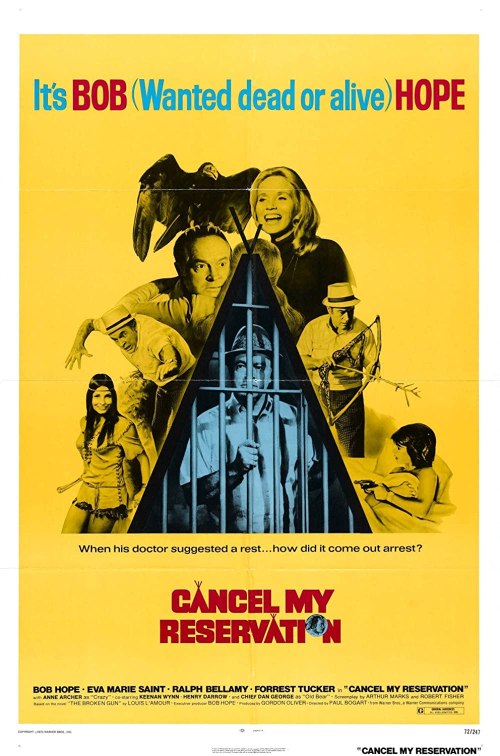
Dan (Bob Hope) is the exhausted TV-personality of a New York talk show that he co-hosts with his wife Sheila (Eva Marie Saint). The two have spent a lot of time bickering and on his Dr.’s advice decides he needs to retreat to a rural area to catch-up on some rest and relaxation. He travels to Arizona where he briefly meets Mary Little Cloud (Betty Ann Carr) at the Phoenix airport. Later on when he arrives at the ranch he discovers Mary’s dead body in his bedroom. When he goes back to the living room to notify the police and then returns to the bedroom her body is gone. Later the police find her corpse in the back of his car and immediately arrest him on the suspicion of murder. Now out on bond he and Sheila must follow the clues in order to solve the case themselves to prevent him from spending the rest of his life in the slammer.

This marked Hope’s last starring vehicle and may be close to being the worst film he did. Reports were that at the premiere he kept complaining to his wife that he looked too old on the screen and felt he was no longer leading man material. A lot of the fault for this goes to Hope himself had he played a character his same age, like a grandpa who enjoys spending his retirement being an amateur sleuth, then it might’ve worked, but instead he tries to play-it like he’s a middle-aged guy, which is just absurd. This comes to a ridiculous head right at the start when he’s brought into the police station and the sheriff, played by Keenan Wynn, asks him his age and Hope, who looks every bit of the 68 years of age that he was, replies that he’s ’42’. I had to actually rewind the film just to make sure I heard it right and the cops don’t look at him with an incredulous look like anyone else would’ve, which makes this the funniest moment in the film even though it’s unintentional.

Pairing with Saint was another mistake. Originally he was supposed to re-team with Lucille Ball, but at the last minute changed course and decided to go with Saint. Presumably this was again for his own vanity as he thought playing a character with a hot, youthful-looking blonde would make him come-off appearing younger even though it does the exact opposite and just makes him seem even older, like an aging daddy going out with his daughter. The two share no chemistry and Saint lacks the comic ability that Ball could’ve brought. The two don’t even fight. They do a little bit at the start while they’re still in New York, but once they reach Arizona they get along even though having them bicker would’ve at least allowed some comic banter, which is otherwise lacking.

The story, which is based on a Louis L’Amour novel ‘The Broken Gun’, is uninspired and gives away the identity of the killer half-way through. What’s the use of sitting through a mystery if you know well before it’s over who the bad guy is? Paul Bogart’s direction has no visual style with bland sets that would be better suited for a TV-sitcom than the big screen.

Hope’s voice-over narration are the only amusing bits. There’s also a dream segment where Hope imagines himself being hung in front of a large group of onlookers, which amongst the crowd is Johnny Carson, Bing Crosby, and John Wayne, who say brief quips as they watch the noose being fitted around his neck, which is the film’s only diverting sequence. I came away thinking it would’ve been more interesting had Carson, Crosby, and Wayne starred in the film alongside Hope playing a group of actors set to do a film, but then turn detectives when one of the cast gets murdered. It might not have been perfect, but certainly couldn’t have been any worse than this.

My Rating: 2 out of 10

Released: September 21, 1972

Runtime: 1 Hour 39 Minutes

Rated G

Director: Paul Bogart

Studio: Warner Brothers

Available: VHS

Goldenrod (1976)

goldenrod1

By Richard Winters

My Rating: 4 out of 10

4-Word Review: Injured champ seeks comeback.

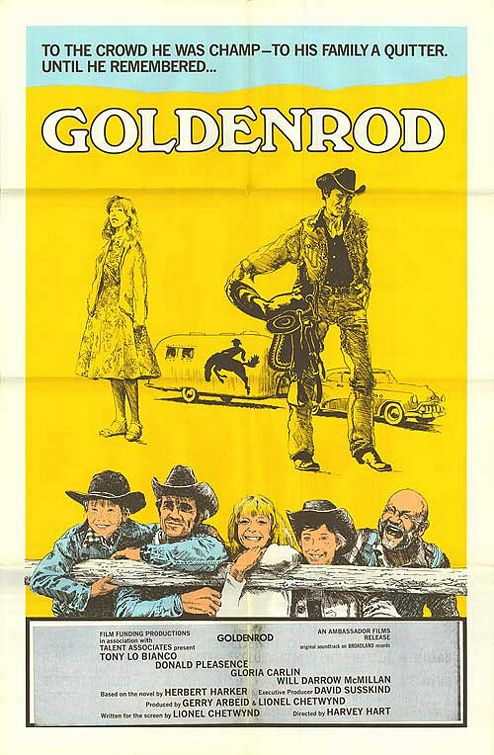
Jessie (Tony Lo Bianco) is a successful rodeo rider who’s idolized by his oldest son Ethan (Will Darrow McMillan). His fortunes though take a turn for the worse when he’s seriously injured by a horse who stamps on his hip. Doctors tell him he’ll never be able to ride again, which causes him to become depressed. His wife Shirley (Gloria Carlin) leaves him for another man (Donnelly Rhodes) forcing him to go searching for other employment. After doing odd jobs he finally gets hired by John (Donald Pleasance) a alcoholic who lives alone on a farmstead and promises big things, but delivers little. Jessie’s depression worsens and he even attempts to kill himself, but his son Ethan saves him. Ethan then tells him that he wants to be a rodeo rider, hoping that the money he wins can help get the family back on track, but Jessie worries that Ethan will face the same hardships that he did and tries to talk him out of it, but to no avail.

This Canadian entry, which was filmed on-location in the province of Alberta, and partially shot at the world famous Calgary stampede, works off the same formula as the Canadian classic Goin Down the Road, which focused on two losers with big dreams who get in way over-their-heads. Jessie character is the same way. When he’s winning he’s arrogant and thinks he’s above the common man only to then learn a hard lesson. This type of character arc though isn’t interesting as the viewer shares no emotional connection in the protagonist’s plight and in some ways delights at seeing his misfortune since he was so diluted at the start that it all seems like a good comeuppance to bring him back down-to-earth.

Lo Bianco plays the part surprisingly well being that he was an Italian-American born and raised in Brooklyn, so why the producers felt he’d be a good pick to play a Canadian cowboy is a mystery, but he pulls it off and even manages to speak in a Canadian accent while losing his Italian one that he spoke with in The Honeymoon KillersThe character though is almost cartoonish with a child-like optimism that you’d think by middle-aged would’ve been vanquished. He starts to show some humility towards the end, but more of it should’ve come-out already at the beginning in order to make him appealing and relatable.

The film focuses quite a bit on the wife at the start only to have her disappear and then eventually come back at the very end, but this is too much of a departure and the movie should’ve cut back and forth, at least a little bit, showing how she was getting along with her new hubby while Jessie struggled raising the kids. Also, you’d think if she really loved the kids she’d want to stay in contact with them and not just abandon them, which is how it comes-off. Pleasance, who spent the 70’s dotting-the-globe working on films in three different continents, gets wasted in a role that starts out with potential, but ultimately doesn’t lead to much.

The picturesque scenery is nice, but the benign story doesn’t have anything unique or memorable. The dialogue lacks a conversational quality and used more to help narrate the story and describe what’s going on that in a good film should’ve been shown visually. I was surprised too that it takes place in the 50’s because it wasn’t until halfway through when a poster advertising a rodeo and the date on it is 1953 that I had even became aware of this. Up until then it could’ve easily been the 70’s. The only two things that give it a bit of a period flavor are the older model cars, but since some people like to drive these refurbished vehicles I didn’t consider it a tell-tale sign that it was a bygone decade. There’s also brief shots of the Canadian Red Ensign, which was the Canadian Flag before the Maple Leaf one, which didn’t come into effect until 1965. Otherwise this could’ve easily been a modern day story and probably should’ve been as setting it in the past doesn’t give it any added insight.

My Rating: 4 out of 10

Released: September 22, 1976

Runtime: 1 Hour 37 Minutes

Not Rated

Director: Harvey Hart

Studio: Ambassador Film Distributors

Available: None