Category Archives: Movies that take place in the Big Apple

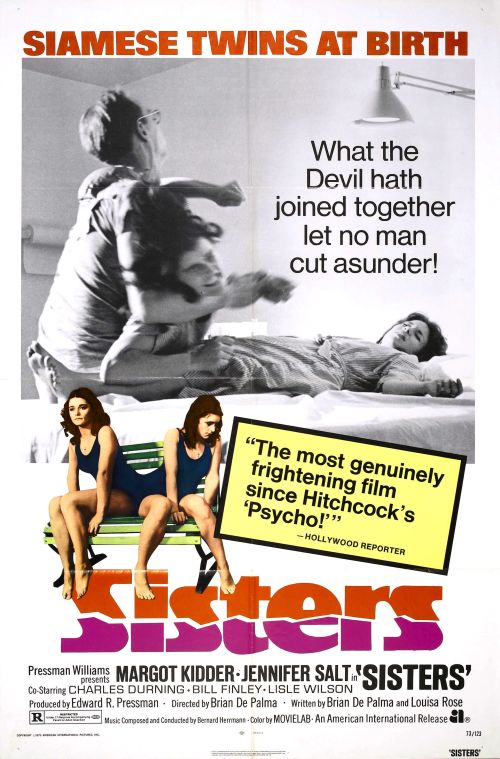
Sisters (1972)

sisters

By Richard Winters

My Rating: 7 out of 10

4-Word Review: Model has evil twin.

Danielle (Margot Kidder) is a young French-Canadian women from Quebec who aspires to be a fashion model and actress. She takes part in a TV-show styled after ‘Candid Camera’ where unsuspecting people find themselves caught up in a prank, which is where she meets Phillip (Lisle Wilson). The two go out on a date, but while at the restaurant she gets harassed by Emil (William Finley) her ex-husband. Then when they get back to her apartment Phillip overhears her arguing with another woman, which Danielle says is her twin sister Dominque. Since it is both of their birthdays Phillip decides to go out to get them a cake, but when he returns he gets viciously stabbed by the psychotic Dominque, but just before he dies he’s able to scribble the word ‘help’ onto the window with his own blood that Grace (Jennifer Salt), a journalist that resides across the street, sees. She immediately calls the police, but when they arrive into Danielle’s apartment there’s no sign of a body, or a struggle and Grace gets written-off as being a kook whose been imagining things, but she refuses to relent and begins her own investigation where she uncovers some dark details about Danielle and her sister who were once conjoined.

This was writer/director Brian De Palma’s first attempt at horror after completing many successful comedies that had gained a cult following. The story was inspired by real-life conjoined twins Masha and Dasha Krivoshlyapova who’s sad upbringing where they were taken away from their mother and had abusive medical experiments done on them at a secret hospital in the Soviet Union, and which was chronicled, much like in the movie, in a story in Life Magazine in 1966, which after reading it De Palma couldn’t get out of his head. Visually it’s excellent with great use of editing and superior score by the legendary Bernard Herrmann, who was semi-retired at the time, but enjoyed the script so much that he agreed to be the composer.

Many of De Palma’s famous directorial touches are apparent including his use of the split-screen. While it’s been used, and some may say overused, in many films from that era, it gets worked to perfection as we get to see Danielle and her ex busily cleaning-up the crime scene while Grace gets held up by the detectives and they’re not able to go into the apartment right away. My only complaint here is that with the blood splatter all over I’m just not sure they would’ve been able to wipe it all away in such a short time frame, basically about 8 to 10 minutes, which should’ve more likely taken them several hours. Not showing the clean-up and having Grace and detectives arrive to find the place spotless with no body would’ve actually added more intrigue and thus in this case the use of the split-screen, while done adequately, I don’t think was needed.

Spoiler Alert!

The script leaves open a fair amount of loopholes, for instance we see Danielle walk into a bedroom and the shadow of her head on the wall along with another one, which is supposed to represent Dominque’s, but we learn later that Dominque died years early during the surgery to separate them, so we’ve should’ve only seen one head shadow and not two. Also, Danielle is told point-blank by Grace that she’s been spying on them from across the street, so you’d think later that she and Emil would make damn sure to close the blinds on their windows when they try to remove the sofa, which has the dead body inside, but instead they continue to leave the shades wide open and allow Grace, now back in her own apartment, to continue to peer in while the couple show no awareness to the possibility and don’t even bother to look out the window to see if they can catch Grace looking in. Another head-scratcher is why there was no blood splatter on Danielle’s clothing, since she ultimately is the one that killed Phillip, when Emil walks into the apartment.

The most confusing thing though is the ending in which Grace becomes hypnotized while inside a mental hospital and begins to see herself, through a long dream sequence, as being Dominque and attached to Danielle. When I first saw this, back in the 90’s, I thought it meant that Grace was the long lost twin and that they had been separated years earlier. While Grace doesn’t look exactly like Danielle most twins don’t, and she was still around the same age, hair color, and body type, so it seemed like a legitimate explanation and I wouldn’t blame anyone else who came to this same conclusion. Apparently though that’s not the case as Grace comes back out of it only convinced, through the hypnotism, that she didn’t see the murder of Phillip, but I felt they should’ve taken it one step further by convincing her that she was Dominque, whether it was true, or not, and then brain washed to take credit for all the murders while Danielle could then get off scot-free and this would’ve then been the ultimate twist.

Granted Grace’s character is shown as having a mother (Mary Davenport), but the script could’ve been rewritten to have her taken out and Grace could’ve instead been portrayed as being an orphan, or adopted, which could’ve left open the possibility. In either case the dream segment, which is creepy and stylish done, would’ve had more of a payoff then it does had it taken this route.

My Rating: 7 out of 10

Released: November 18, 1972

Runtime: 1 Hour 33 Minutes

Rated R

Director: Brian De Palma

Studio: American International Pictures

Available: DVD, Blu-ray (Criterion Collection), Amazon Video

The Squeeze (1987)

squeeze

By Richard Winters

My Rating: 4 out of 10

4-Word Review: They rig the lottery.

When struggling artist and conman Harry (Michael Keaton) goes back to his ex-wife’s apartment to retrieve a mysterious package she had forgotten he finds a dead body and immediately becomes entangled in a complex mystery as well as a target of a secret organization. He enlists the help of private investigator Rachel (Rae Dawn Chong) and together they come to realize that the package that everyone is after is a large magnet that can be used to rig the lottery as it can manipulate the ping pong balls that display the winning numbers since those numbers are painted using a metallic substance. They proceed to try and stop the live broadcast of the lottery, which is being held onboard a naval ship and being hosted by the secretly nefarious Honest Tom T. Murray (John Davidson).

The film has come to have a notorious reputation on many levels. Not only did it sink at the box office where it managed to recoup a paltry $2 million from its $22 million budget, but the film’s promotional poster has star Keaton being squeezed between the World Trade Center buildings, which ultimately went down on 9-11. Even worse is that behind-the-scenes stunt driver Victor Magnotta, the movie is dedicated in his memory, died when the car he was driving went into the Hudson river on its side instead of flat, which trapped him inside the vehicle and unable to get out before he drowned though the stunt itself is left in.

While many critics and even commenters on IMDb have very little to say that’s nice about it I kind of felt that the movie was misunderstood as I saw it more as a parody of spy espionage stories and in that vein I think it works well, but since American audiences aren’t all that adept to satire and many times don’t get it, or take it seriously when they shouldn’t, it’s easy to see why this thing fell through the cracks. It does though have a few memorable moments including an unusual car chase where instead of having the hero speeding away from the bad guys they instead play a game of chicken where they intentionally crash their vehicles into the other one until both cars are left almost inoperable. I also thought the giant sized bull that Keaton created inside his apartment and made-up of a bunch of television sets was pretty cool too.

Keaton is certainly quite likable and without him the movie would’ve done far worse than it does. His engaging ability to make a joke, or even an insult, to someone, but always able to get away with it, by displaying his boyish trademark smile, is what makes his screentime entertaining though I felt the running conversation involving the old TV-show ‘Bonanza’ was a mistake. Young people of today won’t even know what that show was and even back then during the 80’s many teens would have only a vague idea of the series was as it had already been off the air since 1972 and didn’t do well in syndication and thus making the humor and inside jokes about it as out-of-touch and dated even for its own time period.

Chong is miscast, the part was intended for Mariel Hemingway who unfortunately got fired early on. While Chong can be great playing strong minded, outspoken characters she’s not as adept as a romantic lead and I failed to see much chemistry between the two. She falls-in-love with the guy a bit too quickly especially since they don’t get off to a good start. Having her come back to Keaton’s place and become outraged at seeing him in bed with another woman was out of place as no relationship had been established at that point. If anything she would’ve masked the feelings she had for him when seeing him with another lady and played it cool in order to avoid embarrassing herself when it became painfully obvious, at least at that point, that she was more into him than he was in her.

Ronald Guttman as the chief villain is a total bore and with his greased back hair looks more like a model for an Italian chick flick romance than a bad guy and his collection of shrunken heads doesn’t get played-up enough to be interesting. Meat Loaf though as his henchman is great. He has no lines of dialogue until he gets killed, via the pointy needle of a giant sized replica of the Empire State Building, which is pretty cool, though what he does say is very funny.

The film does at least give one a vivid feeling of what living in New York is like as it captures all the different levels of the city from its skyline, to the river, to its neighborhood shops and even the skid row area. Even this though does get botched as there are segments done late at night where there appears to be no other cars on the street, or pedestrians giving it a surreal look that isn’t realistic as New York is known as the city that never sleeps and thus portraying it as being virtually empty just because the action takes place in the wee hours of the morning isn’t authentic.

My Rating: 4 out of 10

Released: July 10, 1987

Runtime: 1 Hour 41 Minutes

Rated PG-13

Director: Roger Young

Studio: TriStar Pictures

Available: Blu-ray, Amazon Video, YouTube

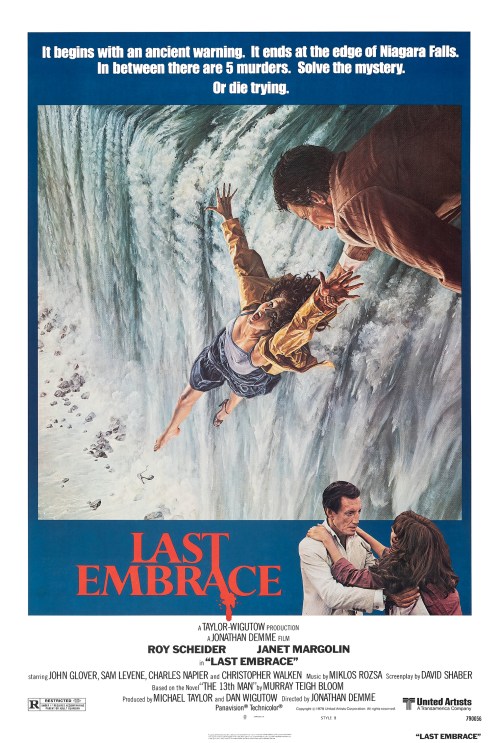
Last Embrace (1979)

lastembrace

By Richard Winters

My Rating: 7 out of 10

4-Word Review: Someone wants him dead.

Loosely based on the novel ‘The 13th Man’ by Murray Teigh Bloom the story centers around Harry (Roy Scheider) a government agent who has a nervous breakdown after his wife gets killed during a shootout while he was on a secret mission. After spending time in a sanitarium he gets out to realize that his agency no longer has any assignments for him and he fears they may want him dead while trying to make it look like an accident. When he gets back to his apartment he finds that it’s been sublet to Ellie (Janet Margolin), a doctoral student at Princeton University. He tries to get her to move-out, but can’t and then starts to receive threatening notes in Hebrew and uses Ellie’s background in that language to help him decipher what they’re saying. Soon the two go on the run convinced that the same person after Harry may also now be targeting Ellie, but nothing is exactly as it seems.

Jonathan Demme, despite his immense talent and admirable film output, never received name recognition and for the greater part of his career failed to have a hit at the box office. In fact it wasn’t until the success of The Silence of the Lambs that he even became a sought after Hollywood commodity. Even then when most people think about that movie it’s Anthony Hopkins, or even Jodie Foster that comes to mind while Demme’s directorial efforts seem overlooked. In many of his interviews this was his biggest complaint and that no matter what he did he could never break-out of the bubble to have his name put over the title like with Spielberg, Scorssese, or Hitchcock. I could understand his frustration as his movies were step above your basic indie flick and while not perfect still had far more going for it than a usual B-picture and if anything this film should’ve been the one that got him noticed.

There’s been many Hitchcock imitations with a lot of them done by Brian Di Palma, but those seemed overdone while this one gets just the right balance. The on-location shooting is splendid with my favorite moments being at Princeton University bell tower and of course the climactic sequence at Niagara Falls. I’ve personally been to the falls, but found this movie made me feel closer and more immersed in it than in person especially with the sequences shot inside the Robert Moses Niagara Power Plant and another done in the Cave of the Winds, which is what really makes the film stand-out. The music score by Miklos Rozsa, has the perfect blend of what would’ve been used by Bernard Herrman, which was Hitch’s main composer, which helps to make this seem like a movie Hitch himself could of very well done himself.

Scheider’s acting is good as he’s constantly cranky and irritable, which anyone going through his situation would be, so it was realistic and relatable, but I really hated the white suits that he wore. For one thing the guy was out of work and no longer a professional agent, so why he felt the need to dress-up all the time when he really wasn’t on the job anymore didn’t make much sense. Why they were all white was even more head-scratching. Outside of Pat Boone I don’t know of anyone who wears a white suit and it made him stand-out in all the wrong ways. If this guy is afraid that he’s being targeted then he should be dressing down so he could then blend-in, which in this movie he definitely wasn’t.

Margolin, best known for her work in the landmark indie flick David and Lisa, is good too especially with her dual personalities where she plays a nerdy student and her alluring, sexy vamp alter ego at other points. She though was not the original choice for the part as Demme wanted Lynn Lowry, who had been in his previous film Fighting Mad, but Scheider, who was dating Margolin at the time, preferred her and studio backed him on it forcing Demme to drop Lowry, but out of guilt he still paid her and allowed her to collect residuals despite her never appearing in any of it.

Spoiler Alert!

The plot is fast-moving and well crafted and keeps you guessing while also introducing a wide array of new twists without ever getting too confusing. The final twist though, in which we find that Ellie is the one after Harry and has been murdering other men as well in a revenge plot for what Harry’s and the other men’s grandfathers did to her grandmother who was gang raped by them at age 15. The idea was to tie the Ellie character to the Biblical avenger of Goel, which sounds cool, but ultimately an overreach. Had Ellie been raped directly by these men then I could see her going out of her way to seek rough justice, but doing it all for a grandmother she barely knew just didn’t seem all that believable. Also, how does this then ‘right the wrong’ by taking vengeance out on the grandchildren of the men who committed the actual crime? The grand kids had no control over what their grandparents did and weren’t even around when it happened, so how is any of this fair, or even make sense?

A better way to have ended it was to have Ellie portrayed as being a crazy kook going after these men due to a belief in some conspiracy theory only for the viewer to finally realize that she was an actual rape victim and Scheider, who we thought was this good guy, was instead the villain. Since she was raped at 15 her features could’ve changed, which would thus explain why Scheider didn’t recognize her initially. With a movie so compelled to have one twist after the other, this would’ve been the ultimate jaw-dropper. It’s just a shame they hadn’t chosen this route as the film, as slick as it is most of the way, leaves the viewer with an empty feeling after it’s over.

My Rating: 7 out of 10

Released: May 4, 1979

Runtime: 1 Hour 42 Minutes

Rated PG

Director: Jonathan Demme

Studio: United Artists

Available: DVD, Blu-ray, Tubi

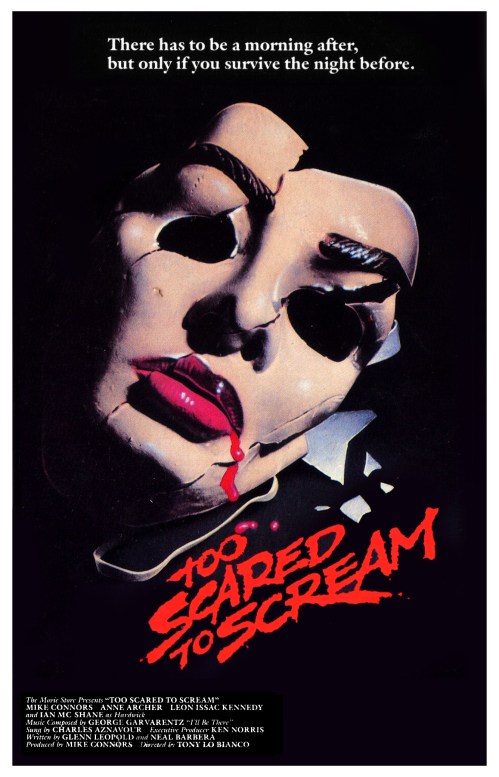
Too Scared to Scream (1984)

tooscared3

By Richard Winters

My Rating: 3 out of 10

4-Word Review: Who’s killing the tenants?

Female tenants living in a New York City high-rise building are turning-up dead in brutal fashion. Lieutenant Alex Dinardo (Mike Connors) and his younger, female partner Kate (Anne Archer) are convinced that the culprit is Vincent (Ian McShane) who works as the overnight watchmen at the apartment building and since all the crimes happen during his shift he quickly becomes suspect number one. Though getting enough evidence in order to arrest him becomes a delicate matter. Alex then decides to asks Kate to move-in to the building as a new tenant and thus keep tabs on what Vincent is doing and hopefully lure him into a situation where he’ll incriminate himself, but Kate soon finds herself in over-her-head as the killer is on-top of what’s going on and he soon bates her into a dangerous game of cat-and-mouse where Alex and the other policemen are not able to help her.

The film was an attempt at creating an American version of an Italian giallo complete with gory murders and an intricate mystery where you don’t know who the real killer is until the final twist ending. It’s also the only film to date to be directed by actor Tony Lo Bianco. Severely straddled during production as it was shot in 1982, but due to the production studio that financed the project going bankrupt it was never released until 3 years later where it was given little fanfare and came and went with few people seeing it.

The biggest problem with it is that it plays-up McShane’s role too much. Granted he’s a gifted actor who’s best known today for his work in the TV-series ‘Deadwood’, but by overemphasizing his character it makes it seem right from the start that he’s the culprit and thus making the investigation uninteresting because you feel it’s just a matter of time before he’s found out and thus little mystery, or intrigue. Granted there are a couple of other suspects, but they seem thrown-in simply as red herrings and aren’t seen much. The story would’ve had better tension had the suspects shared equal screen time and a more balance of clues making it seem like any one of them could’ve done it and thus some genuine interest at getting at what the truth is versus having it seem like it’s all spelled-out from the start. If anything Maureen O’Sullivan, who plays McShane’s near comatose mother whom he takes care of, is far more captivating, despite the fact that she doesn’t speak any line of dialogue and trapped in a wheelchair, then anything McShane himself does.

The unusual pairing of a 60-something male cop alongside a female one that appears to be only around 30 should’ve been what the film focused on as I found their contrasting personalities and different ways they approached their police work to be something that could’ve been played-off of more. Unfortunately the film taps into this just slightly and then quickly moves on and thus misses the opportunity for what could’ve lead to captivating confrontations and debates. Connor does seem a bit too old for this kind of thing and seeing him trying to chase down a young athletic man who was only 20 came-off as almost laughable and I was surprised he didn’t just fall over from a heart attack, or exhaustion before he ever managed to get near the guy. Having him lose a fight to the younger guy and have to depend on his partner to bail him out of it was realistic, so it gets props there, but the way he goes about his police work, which includes physically beating-up on suspects, is highly unethical and should’ve gotten him demoted, or fired.

Spoiler Alert!

I had issues with Archer’s character as well. This comes when she agrees to move into the apartment and work undercover, but seems woefully unprepared for it. She manages to carry a gun with her when she goes down to the basement of the building to do laundry, but then when she gets back to her place she does a goofy aerobics workout where she gets caught off-guard, but wouldn’t a seasoned cop know to carry a weapon on her at all times especially when she’s intentionally making herself a target to the killer? Also, what kind of person walks into their apartment and then doesn’t turn around and immediately lock the door once they’re inside? If you want to argue that this was intentional (I don’t think it was) because she wanted to lure the killer inside, so as to apprehend him, then fine, but she should then make damn sure she was a gun in-hand, pointed at him, when he does, which in this case she didn’t.

You must likely won’t be able to guess who the true killer is, but it’s not worth sitting through. The script doesn’t offer any clues, or hints either, so even an alert viewer won’t figure it out, but that doesn’t mean it’s a good mystery because it really isn’t. The story is sloppily put together without much imagination, or character development. Unlike a true giallo the murders are quick and without much blood, so if you’re a gorehound this thing won’t suffice. The concept had potential, but the execution is half-hearted.

My Rating: 3 out of 10

Released: September 28, 1984

Runtime: 1 Hour 40 Minutes

Rated R

Director: Tony Lo Bianco

Studio: International Film Marketing

Available: Blu-ray (Import), DVD-R

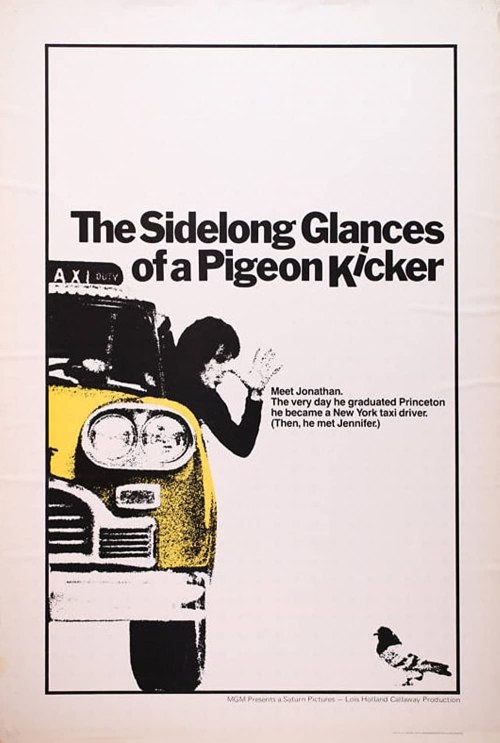
The Sidelong Glances of a Pigeon Kicker (1970)

pigeon

By Richard Winters

My Rating: 5 out of 10

4-Word Review: Cab driver dislikes pigeons.

Based on the novel of the same name by David Boyer, the story centers on Jonathan (Jordan Christopher) a Princeton graduate who spends his days working as a New York cab driver with no ambition to climb up the corporate ladder. Jonathan detests the establishment, but is too old to be a part of the hippie movement, so he rebels from society in other ways by being flippant with his customers and kicking at pigeons in Central Park. His friend Winslow (Robert Walden) has problems of his own as he’s 24, but still a virgin. Jonathan takes Winslow to a party in an effort to find him a woman, but Winslow is so socially awkward that they all turn him down. Back at his apartment Jonathan meets-up with Jennifer (Jill O’Hara) who’s busy trying to ‘find herself’ while living off of her parent’s money. Initially Jonathan resists her advances, but since they’re both lonely he eventually agrees to a relationship with her as long as there are no strings attached. He even brings her to visit his mother (Kate Reid), but then at a holiday party Jennifer makes the mistake of  saying she wants to get married and have kids, which scares Jonathan away and the two break-up only for Jennifer to then sleep with Winslow, which causes Jonathan to become jealous.

This was one of an assortment of youth pictures from the early 70’s trying to analyze the alienation of the love generation and their resistance to conformity and middle class values. These films tended to be much less structured and in certain cases downright experimental, but the subject matter was still considered topical enough that the studio heads at MGM decided to pick it up for distribution only to then quickly drop it when previews of it scored low with test audiences. It was then handed over to a fledgling film company known as Plaza Pictures that re-edited it down to 90 minutes while cutting-out much of the second act in the process and then re-naming it as Pigeons, but this version did no better and the film sat in obscurity for many decades before finally getting a DVD release in 2014.

While I do like offbeat movies I did find the way this one began hard to get into as the lackadaisical pace makes it seem like there isn’t any plot and just a lot of throwaway segments dealing with the angst of big city living. It does improve and manages to even have a few keen moments. John Dexter’s direction, he was better known for his work in the theater as well as his rude behavior towards women, helps a lot. In fact it’s the directing that keeps the thing watchable and despite the modest budget it’s quite polished with the most impressive moment, outside of a taxi car driving off the dock and into the water, is when Jonathan goes under his kitchen cabinet in an attempt to exterminate hundreds of ants. This isn’t as easy as it sounds to get a camera and lighting into such a small space, nor finding all the ants, and I suspect the cabinet was specially made for the production, but still on a small scale it’s impressively done.

The film also features a great supporting cast including Walden in his film debut who is both believable and amusing as Jonathan’s shy and apprehensive friend. O’Hara is equally engaging, she looks exactly like her more famous sister Jenny O’Hara and for awhile I thought it was the same woman. Kate Reid is a scene-stealer as the meddling, oppressive mother and William Redfield has a great moment near the end playing the stepfather who openly has a one-night-stand with a lady he meets at a Christmas party and then comes home late at night to talk to Jonathan about it.

The film’s Achilles heal is the casting of Christopher. He rose to fame as the singer of The Wild Ones, which got him cast as a rock singer for the cult hit Angel, Angel Down We Gowhich generated enough notice that producers decided to take a chance on him in a lead role, but it doesn’t work. His character is unlikable and he lacks a dynamic presence let alone his disheveled mop-head hair-do that resembles a bird’s nest. Having the film begin by showing him kicking at pigeons in Central Park, fortunately his foot doesn’t seem to actually hit any of them, makes the viewer despise him right from the start and things never improve.

Spoiler Alert!

The cop-out ending is a disappointment as it features Jonathan riding off on a train headed to Des Moines, Iowa, but I’ve rarely found anyone who’s been born and raised in New York to move to the farmlands of the Midwest. Sure many New Yorkers have gripes about where they live, most anyone is never completely happy with their home city, but ultimately they remain because it’s what they’re used to. Instead of ending it with him riding away it should’ve made this a part of the movie showing his adapting to a completely new and alien place, which could’ve given the movie some interesting insight and made a stronger impression than it otherwise does.

Alternate Title: Pigeons

My Rating: 5 out of 10

Released: October 28, 1970

Runtime: 1 Hour 46 Minutes (DVD version runs 1 Hour 30 Minutes)

Rated R

Director: John Dexter

Studio: Plaza Pictures

Available: DVD

Off Beat (1986)

offbeat1

By Richard Winters

My Rating: 4 out of 10

4-Word Review: Not really a cop.

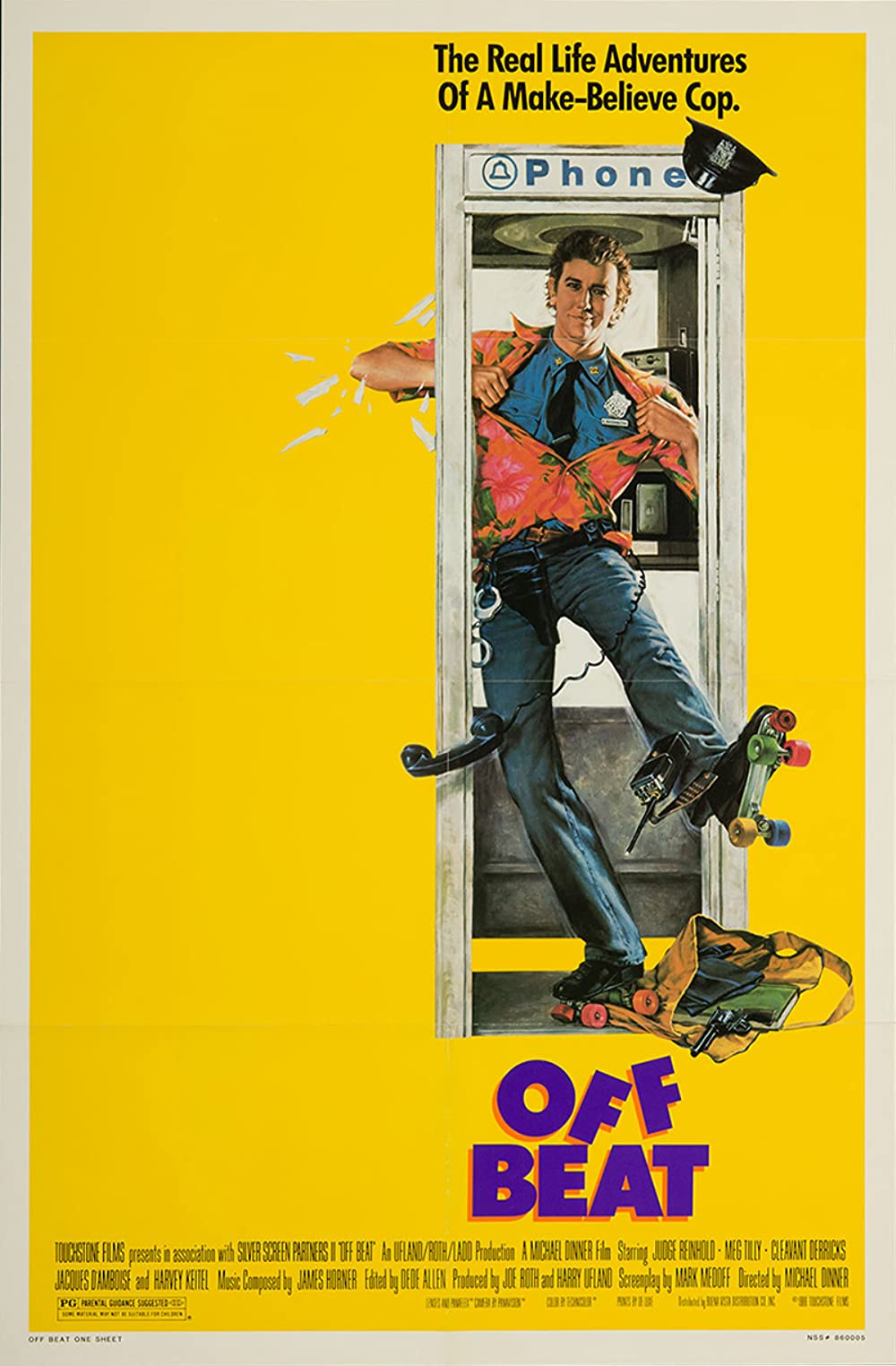
Joe (Judge Reinhold) works in the basement of a library. While he doesn’t hate his job he’s still looking for direction in life and feels he has missed his calling though he’s not really sure what that is. He’s friend with Abe (Cleavant Derricks) who is a New York City cop. One day Joe inadvertently messes-up a criminal sting that Abe was working on and in an effort to make it up to him Joe agrees to volunteer for a charity event that will require him to do ballet. It’s part of a city wide effort to get one policeman from each precinct to take part and Abe was chosen by his supervisor, but he has no interest, so he gets Joe to take his place while Joe pretends that he’s a cop in order to qualify for the audition. Joe is convinced he won’t make the cut, but when he meets the beautiful Rachel (Meg Tilly), who’s a cop that’s also trying out for the performance, he decides to press-on with it and in-turn finds that dancing gives him the interesting challenge that was otherwise missing in his life as well as a romantic relationship with Rachel. 

One of the things that really hurts the film right from the start is the totally wacky premise that seems to stretch all credibility. I found it very hard to buy into the idea that a policeman would be obligated, and in some ways almost forced, to get involved in a charity event that would take-up so much of his free time and require an extraordinary amount of rigorous training for no pay. Asking some cops to spend a few hours on one weekend at a soup kitchen passing out meals to the homeless is more reasonable, but pushing people into ballet that have no skills, or business in doing is just plain far-fetched. I felt too it was testing the friendship to obligate Joe in what turns out to being a very time consuming endeavor. Granted he learns to enjoy it, but upfront I can’t expect anyone to go that out of their way, even for a friend, over some simple mistake that the made earlier. Originally, and I can’t remember where I read this, the premise was for the characters to be prisoners and getting involved in the dance charity event would allow them the potential of getting their sentences shorten, which made much more sense, but the producers wanted to take advantage of the spate of comical cop movies that were popular at the time and therefore changed the characters into cops, but this just makes it dumb. 

The attempted comedy doesn’t gel either. It starts out at a park with undercover cops secretly listening into a conversation of two people, which seemed to have been taken right out of the opening scene in the far better movie The Conversation. It’s not made clear if that was meant to be an attempted parody of that one, but it doesn’t work either way and it’s best not to imitate a classic if you can’t improve on it as it ends up reminding one of that movie and how much more entertaining it was than this one. Later on there’s a bank robbery segment, which again seemed strikingly similar to another 70’s classic Dog Day Afternoonand again it’s not clear if this was intentionally stealing from that one in an effort to be amusing, but it doesn’t click either way. 

Reinhold shows why his Hollywood leading man career never lasted. He’s just not funny and all he seems good at is having that wide-eyed deer-in-headlights look and not much else. Other talented actors like Joe Mantegna, as Reinhold’s dance rival, and John Turturro, as Reinhold’s obnoxious boss, don’t get enough screen time and the friction that their characters create isn’t played-up enough, or results in any interesting confrontation. I did though really like Meg Tilly, who plays against type, as she’s usually cast as soft-spoken, flighty characters, but here plays someone who is tough and outspoken and does quite well.

The script, which was written by Mark Medoff, who had better success penning stageplays like Children of a Lesser God and When You Comin’ Back, Red Ryder?, does have a few heartfelt moments and having a main character feeling lost and directionless in this confusing world will be easily relatable to many, but there are just too many segments where the comedy misses-the-mark. The scenes where Reinhold is forced to try and chase down a thief and another moment where he has to arrest someone, but because he’s not a trained cop he doesn’t really know what he’s doing, could’ve been comical gold, but the film doesn’t play it out enough to be effectively hilarious. It peters-out with a fizzle by the end making it a definite misfire that didn’t do well with either the critics, or at the box office. 

My Rating: 4 out of 10

Released: April 11, 1986

Runtime: 1 Hour 32 Minutes

Rated PG

Director: Michael Dinner

Studio: Touchstone Pictures

Available: VHS, DVD (Region 2)

The Projectionist (1970)

projectionist1

By Richard Winters

My Rating: 5 out of 10

4-Word Review: Projectionist escapes into fantasy.

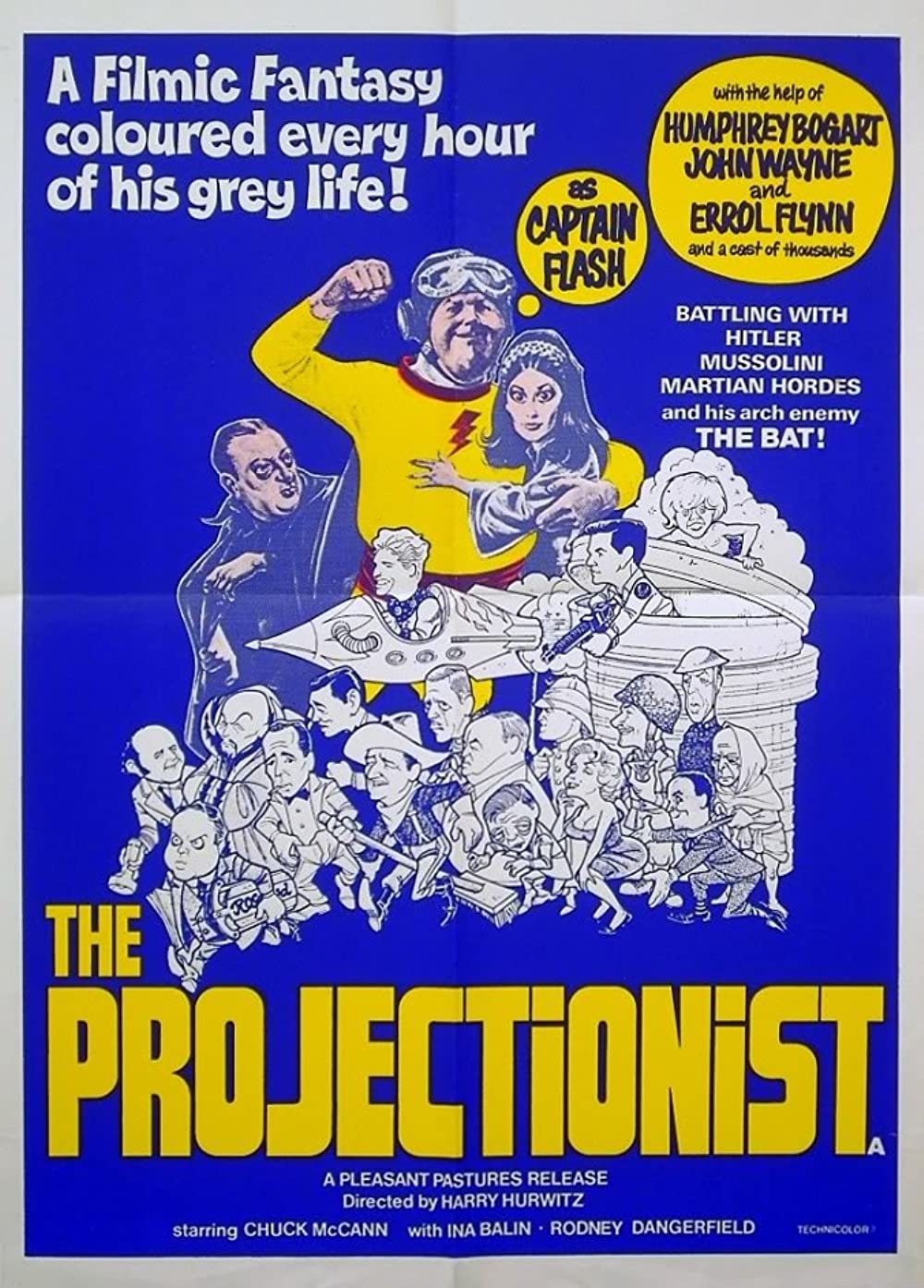
Chuck McCann plays a man named Chuck McCann who works in a projection booth of a New York theater. He spends his isolated days winding the film reels and putting them into the film machines so that they can be broadcast onto the big screen. He finds his job boring and he does not get along with Renaldi (Rodney Dangerfield) who is the head usher at the theater and routinely chews him out for minor infractions. To escape his mundane existence he imagines himself the star of his own movie playing the superhero Captain Flash who helps save a beautiful damsel in distress (Ina Balin) while also fighting-off the evil villain known as The Bat, which he sees as being Renaldi and his way of getting ‘back at him’ without having to do it in real-life.

Writer/director Harry Hurwitz, who appears as an usher who visits Chuck in his film booth, had some creative movie ideas during his career though most of the movies he made were hampered by a low budget and not fully realized enough to break-out and gain mainstream attention. This film, which was his first, is generally considered his best. It was shot in September-October of 1969, at the same time as Myra Breckenridge, with both movies being credited as the first to use superimposition of older movies, known as Hollywood’s Golden era, into the main story. Some of the clips, which features everything from old cartoons to news reel footage, is fun and even at times provocative. The Captain Flash segments, which are filmed in a grainy black-and-white to replicate the other older clips, are amusing and I really enjoyed seeing actual photographs of Chuck when he was younger, from infancy to a teen and then young adult, over the opening credits. There’s even some cool surreal moments where he walks out of the theater he’s working in and on the marquee is advertised the film we’re watching as well as a segment where Chuck the actor walks down the red carpet at the premiere of this film while talking about playing Chuck the character.

McCann, who’s probably best known for co-starring with Bob Denver in the 70’s children’s TV-show ‘Far Out Space Nuts’, reveals definite talent particularly his spot-on impressions of famous stars making you wonder with that much talent why does this character not make an attempt to go on stage at a local amateur night and show his stuff to an audience instead of hiding it away to himself. If the character has stage fright, or social anxiety, and that’s why he’s so shy and lonely then that needs to be brought out, which it isn’t, making the character poorly fleshed-out and in-turn makes the film less interesting.

The segments examining Chuck’s day-to-day activities, between the old film clips, are dull and have low energy. It’s like the production was completely dependent on the old footage to save it, which is not how a good movie works. ALL the scenes in a successful film need to be captivating in some way and a great number of them here fall flat. The character does not grow, or change in any way. In would’ve been fun to see Chuck confront Dangerfield in real-life instead of just fantasizing about it, or making an attempt to ask-out the beautiful woman instead of dreaming about her from afar.

Dangerfield, in his film debut, plays against type. Normally he’s the loser taking-it to the oppressive authority figure, but here he’s the heavy and helps keep it engaging. Ina Balin, on the other-hand, is beautiful, but I found it frustrating that she wasn’t given a single thing to say.

The story doesn’t evolve and ultimately comes-off as an experiment that fails to click. I was also surprised with the dark nature of  some of the old clips including bits with Adolph Hitler, Mussolini, the Klu Klux Klan and even one recreating the assassination of Lincoln, which didn’t have anything to do with the main theme and not sure why they were put-in.

My Rating: 5 out of 10

Released: October 17, 1970

Runtime: 1 Hour 28 Minutes

Rated GP

Director: Harry Hurwitz

Studio: Maron Films

Available: DVD-R

Bum Rap (1988)

bum1

By Richard Winters

My Rating: 3 out of 10

4-Word Review: 72 hours to live.

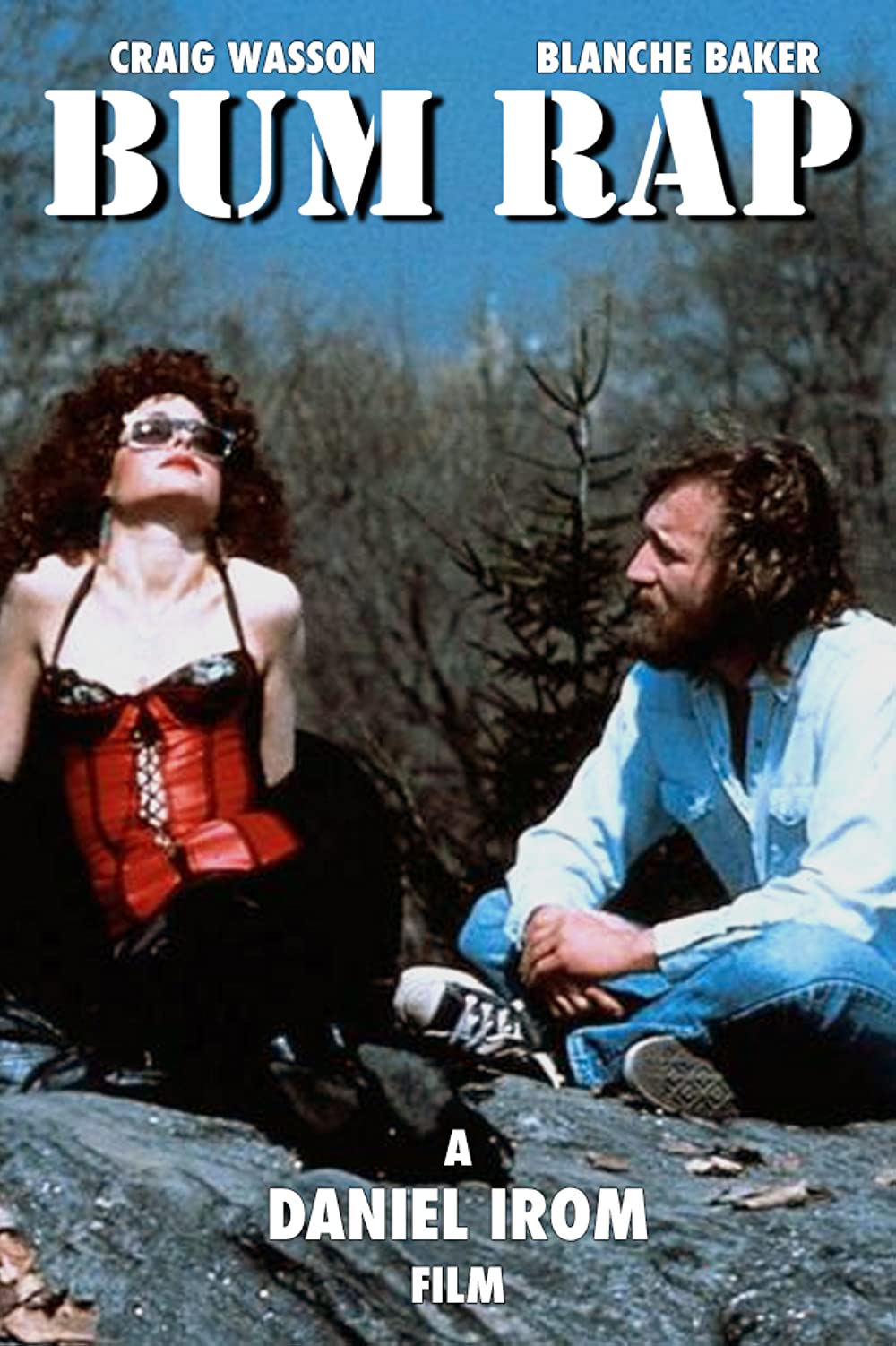
Paul Colson (Craig Wasson) seems to have very little luck. While he works during the day as a New York cab driver he longs to be an actor and he practices his craft while alone in his cab as he waits for a customer. During his free time he attends auditions, but routinely finds himself being turned down for the part. His love life isn’t much better as he’s constantly getting stuck in the ‘friend zone’ with all the eligible women that he meets. Now things have turned even more sour when he goes to a Dr. about a ringing in his ear only to diagnosed with a rare blood disorder that will kill him in only 72 hours. Will Paul find any meaning and happiness with the time he has left? He isn’t sure, but becomes determined to find out by getting together with his friends and parents (Barton Heyman, Augusta Dabney) for one last goodbye while doing so with the company of Lisa (Blanche Baker) a street prostitute he has picked-up and agrees to go along with him for his last hurrah while also harboring the same ambitions of becoming an actor.

The film seems to want to tap into the indie vibe of Stranger Than Paradise, a quirky independent, cult hit that sent it’s writer/director Jim Jarmush into stardom. It even starts out in black-and-white like that one and there are a few keen moments here. When I was younger and just out of college I attended a few acting auditions like this character and found the same thankless experiences as he did; getting turned down not so much for a lack of talent, but more because he auditioned with someone who was sexier and better looking, so naturally they get all the attention and he doesn’t. His dating quandary where he treats the women real nice, and they get along well, but in the end they still chase after a married a man who treats them poorly can be a testament to what happens to a lot of single nice guys and in this area, examining the basic struggles of an ordinary life, it hits the bullseye.

Unfortunately the film fails to gain any momentum, or move along with an intriguing pace. The scenes lack energy and in certain instances, like when he invites his friends over for a game of cards, get bogged down with archaic chatter that does not propel the plot, or reveal anything about the characters. The disease, where the doctors can pinpoint exactly what hour the person will die and in what way, comes-off like something out of a sci-fi movie and hard to take seriously. I didn’t get why it shifts from black-and-white to suddenly color after he gets the grim diagnoses. You’d think it should work in reverse, be colorful when he still thinks he’s got his future ahead of him, only to turn black-and-white when he realizes his time is very limited, or at the very least don’t have it turn color until the very end when he’s learned to accept his condition and die gracefully, or leaves to enter some sort of afterlife

Wasson, who hasn’t appeared in a movie since 2006 and now makes a living as a audio book narrator, has stated that this was his most favorite movie that he was in and it’s easy to see why as he basically propels it along particularly with his impressions of famous actors, but his character’s transition through the 5-stages of grief is much too quick. It’s odd too that he chooses not to tell any of his friends or family that he’s dying as I’d think most other people in the same situation would want to say what’s going to happen to them if for anything to look for some comfort as they grieve.

Blanche Baker, the daughter of legendary actress Carroll Baker, is a good actor, but her character is cliched. As a street prostitute she lets down her guard too easily and quickly. For all she knows this guy could be lying to her about having a terminal illness in order to gain some cheap sympathy and since she’s been a hooker for awhile and spent time with other guys of a dubious quality, I’d think her opinion of men would be pretty low and she’d not be so trusting of Wasson when he tells her his situation and instead be cynical. This idea that all prostitutes have a ‘heart-of-gold’ if you just get past their rough exterior is a stereotype as some of them due to the harsh life on the streets can be genuinely embittered. Having Wasson deal with a more hardened one would’ve not only made it more realistic, but given the scenes some pizzazz as they could bicker and argue, versus having it get so sappy that it becomes cringe-worthy.

I suppose if you give it enough time it does have a way of growing on you emotionally, but the overly choreographed ending takes away all realism. Ultimately it’s a potentially interesting idea that thinks it has a deeper message and statement than it really does.

My Rating: 3 out of 10

Released: September 26, 1988

Runtime: 1 Hour 58 Minutes

Rated R

Director: Danny Irom

Studio: Light Age Filmworks ltd.

Available: None

Roseland (1977)

roseland2

By Richard Winters

My Rating: 7 out of 10

4-Word Review: Participants of ballroom dancing.

In 1976 director James Ivory, who had already collaborated with writer Ruth Prawer Jhabvala on 5 other films, wanted to turn her short story ‘How I Became a Holy Mother’ into yet another movie. The story required one scene to be shot at The Roseland Ballroom, a dancing venue in New York City, that was originally built as a ice skating rink in 1922 and then converted to roller skating only to eventually become a popular retreat for ballroom dancers. When Ivory approached potential investors none of them liked the story, but did like the idea of shooting a movie inside Roseland. They agreed to give money to the project as long as the entire setting took place in that venue.

Ivory then had Jhabvala interview the people at the club to get a better understanding of the folks who went there and to help generate story ideas. It was through these visits that Jhabvala was able to come-up with three different vignettes that is based closely on real-life events that occurred with people who attended the Roseland throughout the years and most of the dancers seen in the background were actual members of the dance hall and not paid extras.

While the owners of the Roseland were happy to give permission to shoot there it did come with several stipulations. One was they could only shoot during the day on Wednesdays and could not alter any of the interiors in any way, which included the lighting. Despite these restrictions he was able to succeed pretty well though at the 30-minute mark it’s obvious in a scene where Christopher Walken and Geraldine Chaplin are supposedly in a room alone that there’s a cameraman there as you can easily see his reflection on the wall mirror. Ivory was also forced, much to his chagrin, to hire a scenic artist and art director onto his crew even though they were unable to make any changes to the set, but union rules required one must be hired anyways, and the teamsters union picketed the production outside the building until Ivory finally relented, which resulted in 2 extra people being brought onto the crew to sit around and do absolutely nothing, but still getting paid.

As for the stories they’re okay, though the first one, ‘The Waltz’ is clearly the weakest despite excellent performances by the two leads. It stars Theresa Wright as a widow named May who keeps seeing a reflection of herself and her former husband when they were much younger in a mirror in the ballroom as she dances with her new partner named Stan (played by Lou Jacobi). No one else sees this same reflection except for May and most think she’s going nutty. Stan wants May to get over her memories of her old husband and focus solely on him, but when she doesn’t he loses interest in her though May finally comes around when she realizes that the past is the past and there’s no going back, so why not instead live for the present. This segment, unlike the others, relies heavily on voice-over narration of Helen Gallagher, who plays Cleo, a dance instructor, it also enters in weird supernatural elements as it’s never explained why May keeps seeing these reflections, is she really going nuts, or is some ghostly phenomenon trying to speak to her from the afterlife? This never gets answered and hence is why the story really doesn’t amount to much.

The second story, ‘The Hustle’, is the best one and features a terrific performance by Chaplin. It involves Russel (Christopher Walken) who is seeing the much older Pauline (Joan Copeland) not so much because he loves her, but more because she pays him to be her escort and he likes the money. He then meets Marilyn (Chaplin) who has just gone through a rough break-up. He immediately becomes smitten. Marilyn is at first reluctant in getting into another relationship, but eventually falls for Russel only to learn that he’s not quite ready to give-up Pauline, or her money and seems to want to juggle the two, which Marilyn does not want. While this segment is quite captivating I would’ve like a better, more dramatic confrontation and less of an ambiguous conclusion.

‘The Peabody’ is the third and final segment. It deals with Ruth (Lilia Skala) an older woman with a strong personality looking for a suitable dance partner to win a competition. She meets Arthur (David Thomas) a meek elderly man who agrees to partner with her despite having a weak heart. Ruth takes his friendship for granted and is quite demanding of him only to learn to regret it when he’s no longer around. Skala’s performance, of which she got nominated for the Golden Globe, makes catching this part well worth it.

My Rating: 7 out of 10

Released: October 2, 1977

Runtime: 1 Hour 44 Minutes

Rated R

Director: James Ivory

Studio: Merchant Ivory Productions

Available: DVD

Not a Pretty Picture (1976)

not

By Richard Winters

My Rating: 5 out of 10

4-Word Review: Reenacting a rape incident.

While Martha Coolidge is known today for having directed such 80’s classics as Valley Girl and Joy of Sex she started her career in the 70’s doing documentaries mainly about high school students. After having done three of those she decided to do one that was more personal and dealt with a real-life incident that occurred to her when she was 16 when she got raped on a date with a college student who was 20. While she went about casting the actress to play her as a teen she was shocked to learn that the actress, Michele Manenti, had a similar experience. The film then weaves between reenactments of the date rape and the situations that lead up to it as well as the aftermath. There’s also interviews with the cast members who talk about the emotions they go through while playing the characters including Jim Carrington, who plays the rapist named Curly, who confesses that he thought women secretly wanted to be raped due to his belief that they fantasize about it.

What I got out of the film and enjoyed the most was looking at the acting process and how the performers used elements of their own experiences to help shape the characters that they play. I was genuinely surprised that only one of the cast members, Amy Wright who has a small role as Cindy, ever went on to do another movie. The two stars, who I felt were both outstanding, never acted in anything at least film or TV wise even though I felt they should’ve had long careers. I realize that the acting profession is a very competitive business and what may seem like the cream-of-the-crop in college may not be able to rise to the top in the real-world, but it still seemed sad that they weren’t able to do more, or at least more in front of the camera. It’s also surprising how non-dated this is. The conversations they have both about dating and acting is something that could’ve easily been shot today and just as topical. If it weren’t for them openly smoking indoors in a public setting, which is a major no-no now, you would never have known this was done in the 70’s.

While the conversations that Coolidge has with the cast proves to be insightful the reenactments aren’t as compelling. The scene involving the conversations that the four friends have inside a car has some interesting points, but it goes on too long and gets static. The aftermath where Martha is ridiculed by the other girls at her school and called a ‘whore’ because of the rumors that Curly spreads stating that she was a ‘willing participant’ and the stressful moments she has when she doesn’t get her period and fears she may be pregnant are quite dramatic, but the most important scene, the rape itself, gets botched. All the other recreated scenes where done as if in real-time and with sets that replicated the era, which was 1962, but with the rape it’s staged as a rehearsal with Martha and the other stagehands clearly in view as it occurs and Coolidge constantly stops the action to have them redo the scene several times in order to get it right, but this takes the viewer out of the moment and mutes the emotional impact. In hindsight I think they should’ve done the entire recreation, both the rape and what lead up to it as well as the aftermath, first and then went to the behind-the-scenes footage afterwards instead of inter-cutting it, which may have been novel for the time, but eventually gets off-putting.

The film’s focus was apparently intended to be on Martha and her reactions at seeing her own rape get played-out as the camera keeps panning back to her face as she watches the actors perform it and then at the end she describes her feelings in a emotional way. While I’m sure this was a tough thing for her to do I still felt it would’ve been more encompassing to have it about all the other women, including the actress in this film, that this has happened to and how men in that time period were able to get away with it and never had to be accountable. That to me was more disturbing and the film ends up missing that point, or not hitting-it-home hard enough, and thus isn’t as strong, or ground-breaking as it could’ve been.

My Rating: 5 out of 10

Released: March 31, 1976

Runtime: 1 Hour 23 Minutes

Not Rated

Director: Martha Coolidge

Studio: Coolidge Productions

Available: Vimeo