Category Archives: Movies for the Whole Family

Pee Wee’s Big Adventure (1985)

pee wee big adventure

By Richard Winters

My Rating: 6 out of 10

4-Word Review: Searching for his bike.

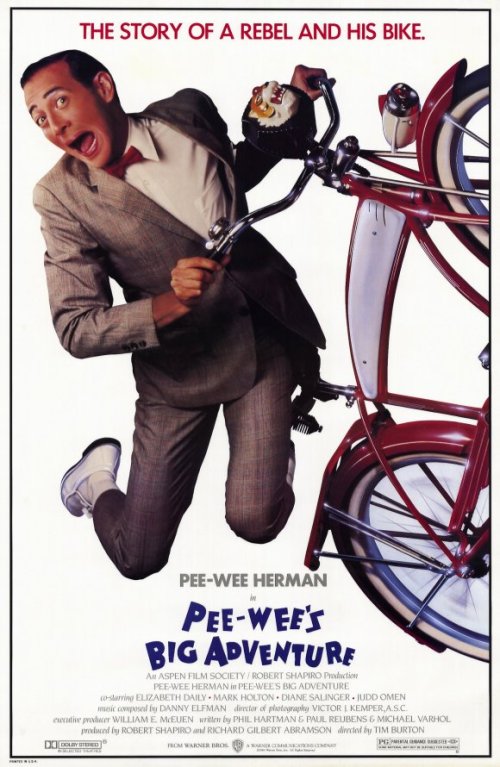
Due to the release this weekend of Pee Wee’s Big Holiday I thought it would be appropriate to go back and take a look at the ‘80s classic that started it all. Here we have Pee Wee (Paul Reubens) living with his small pet dog Speck inside a home full of colorful contraptions. His prized possession is his bicycle, which he takes great care of and carefully chains up every time he leaves it alone. However, a hateful bully named Francis (Mark Holton), who is from an affluent household and used to getting whatever he wants, decides that he wants Pee Wee’s bike for himself. When his monetary offer gets rejected he then hires a professional thief to steal it for him, which sends Pee Wee on a mad frenzy across the country to try and retrieve it.

The movie is an exercise in high camp that could’ve easily failed, but instead it succeeds mainly because it doesn’t put the eccentric main character into the real world, but instead pulls the viewer into the quirky 10-year-old mindset of the protagonist. Here we don’t deal with people who reject or mock him, but instead much like with all children he becomes the ‘king of his own domain’ where he is liked and accepted by most everyone he meets and in control of all situations while the harsher realities get ignored or overlooked completely.

The film also manages to accentuate Pee Wee’s odd personality with garishly colorful set-pieces and odd contraptions that almost become the film’s main attraction. Reubens plays the role in an engaging manner, but the character’s persona is one-dimensional and could border on getting annoying had it been the film’s sole avenue of humor, but fortunately director Tim Burton manages to give the film a complete vision by instilling a storyline and visual design that match the weirdness of its protagonist and makes the proceedings come off as fresh and inventive.

I also liked that it wasn’t geared completely towards children, but instead made to attract those of all ages with a taste for the offbeat and absurd. Going the kiddie flick route would’ve made it come off as formulaic and infantile, but instead by emphasizing the surreal it becomes intriguing and impossible to predict.

The loosely structured script, which was co-written by Reubens and actor Phil Hartman, manages to go a long way on what amounts to being pretty much just a one-joke premise, but it does eventually start to lose steam by the 60-minute mark only to recover in grand style at the end with a delightful chase through the backlot of the Warner Brothers studio. It is similar to the ending used in Blazing Saddles where the film breaks the fourth wall and becomes a movie-in-a-movie although I felt this one was funnier than the Mel Brooks version.

The film is sprinkled with a lot of cameo appearances as well with my favorite ones being Milton Berle as well as James Brolin playing Pee Wee in the Hollywood movie version and Morgan Fairchild as the Hollywoodized version of his girlfriend. I also got a kick out of Jason Hervey who is best known for playing Fred Savage’s older brother in ‘The Wonder Years’ and who does a very funny caricature of a spoiled child film star here.

The film is also known for making the ‘50s instrumental ‘Tequila’ by the Champs a very recognizable melody. In fact it is almost impossible to think of the Pee Wee character and not have that melody start to play in your head, or if you do hear the melody playing somewhere you can’t help but have the image of Pee Wee pop-up when you do. However, in the actual film the song ends up being played only briefly.

My Rating: 6 out of 10

Released: July 26, 1985

Runtime: 1Hour 31Minutes

Rated PG

Director: Tim Burton

Studio: Warner Brothers
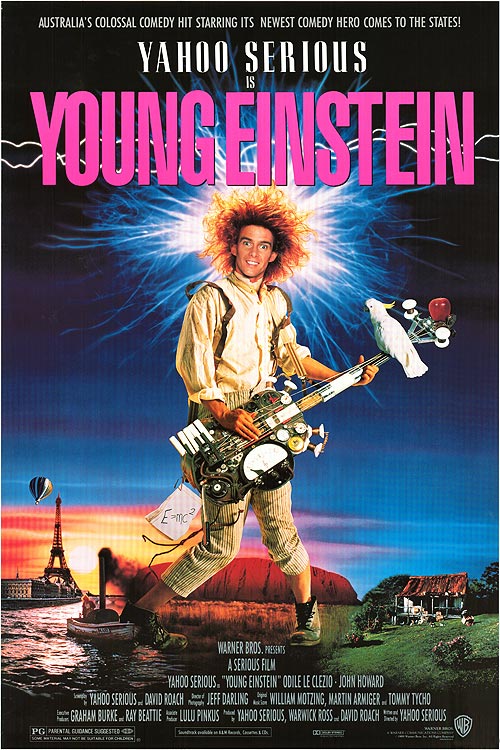
Young Einstein (1988)

young einstein

By Richard Winters

My Rating: 4 out of 10

4-Word Review: The first rock star.

Forget all those things that you’ve read in the history books because they’re all wrong. Albert Einstein was never born in Germany instead he was the son of an apple farmer in Tasmania who grew up to not only invent the theory of relativity, but also rock ‘n’ roll, the electric guitar, bubbles in beer and even surfing. He also had a bad haircut that looked just like Carrot Top’s.

The term one-hit-wonder gets used a lot in the music business to describe a band or singer that comes out of nowhere, gets a chart topping hit and then proceeds back to obscurity. Normally it’s never used in movie jargon, but if it was this would be a perfect example. Writer/director/star/composer Yahoo Serious, whose birth name was Greg Pead until he had it legally changed in 1980, seemed to be the next creative prodigy when he concocted this thing after spending years making educational documentaries. It was a huge success in Australia, which was enough to get Warner Brothers to pick it up as they thought they had another Crocodile Dundee on their hands and spent $8 million promoting it only for it to fail dismally at the box office and in effect so did Serious’ career as he has not made a movie, or even been in one since 2000.

To some extent I was initially surprised at how well directed it was and how Serious showed an astute eye for detail. I loved how he captured the majestic Australian landscape and the music score is quite distinctive and cool. The humor is funny, but mostly when it involves a visual device that has nothing to do with the action. For instance there is a homeless man in one scene carrying a sign stating ‘The end is near’, but instead of spelling ‘near’ in the conventional way it gets spelled as ‘nigh’ to replicate his Aussie accent.

Unfortunately the comedy stays too much at an innocuous level, which is why I believe it didn’t catch on here, or become a cult hit despite its potential. Everything is geared exclusively to a preteen audience, who may love it, but for it to appeal to adults or a more discriminating viewer it needed to have a darker edge, or some attempts at satire instead of just complete, non-stop silliness.

Serious is only so-so as the lead. He certainly does have the chiseled, boyish good looks that could make the young teen girls swoon, but he had too much of a laid-back, mellow persona and seemingly unable to convey any other type of emotion. His radical, punk-like hairstyle starts to become a distraction to the point where you find yourself looking at it even when you don’t want to.

Originally the script was called ‘The Great Galute’ and was a story about some ordinary fella who invented the electric guitar and the Einstein angle was only added in after Serious took a boat ride down the Amazon and noticed a kid wearing an Albert Einstein T-shirt. In a lot ways the film would’ve been better had it stayed with its initial concept as it’s a bit disrespectful to the actual person and it’s never even remotely funny that this guy with a perpetual surfer dude mentality could’ve really been a super genius.

The ridiculous plot proceeds to get dumber as it goes along until it becomes just downright embarrassing by the end. The romantic side-story and the film’s villain (John Howard) are pointless, boring additions that add nothing and should’ve been scrapped. The film would’ve been more successful had it done away with a conventional narrative completely and instead taken the Jacques Tati approach where all emphasis was placed on visual non-sequiturs as this was the only time that I found the film to be even slightly engaging.

My Rating: 4 out of 10

Released: December 15, 1988

Runtime: 1Hour 31Minutes

Rated PG

Director: Yahoo Serious

Studio: Warner Brothers

Available: DVD, Amazon Instant Video, YouTube

It’s Only Money (1962)


its only money

By Richard Winters

My Rating: 3 out of 10

4-Word Review: TV repairman gets rich.

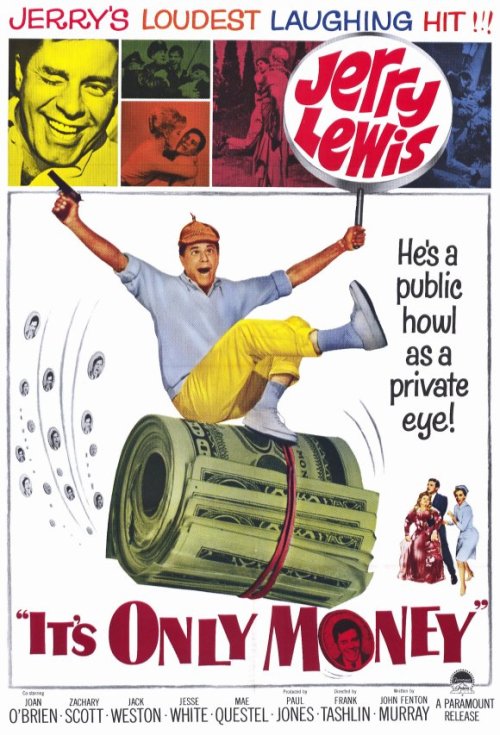
Lester March (Jerry Lewis) is a dimwitted TV repairman who has a penchant for reading detective magazines and desires to become a private eye. When Pete Flint (Jesse White) who is an actual detective comes to his shop one day with a broken TV set Lester uses the opportunity to ‘audition’ himself as Pete’s assistant on his next case. Pete decides to try him out by putting him on a case involving a rich family whose heir to their fortune is missing yet when Lester starts to investigate he realizes it may be himself that they are looking for.

The script by John Fenton Murray comes off like it was written in one day and could’ve possibly been done by a 10-year-old in a matter of an hour. The plot is lame and flimsy, the humor excessively silly and the movie offers nothing new or creative. The running gag involving the Jack Weston character and his many attempts at trying to kill Lester is nothing more than a live action, subpar version of the Wiley E. Coyote/Road Runner formula.

How much one enjoys this film relies heavily on how much they can tolerate Lewis. To some extent he is mercifully more restrained here and not as obnoxious as usual, but there are still several scenes that get unnecessarily extended just so he can play up a gag that has nothing to do with the plot and isn’t funny. The biggest issue I have with the character is that he’s too unrealistically and painfully stupid. It’s one thing to be a slightly dimwitted schmuck, but this guy speaks and acts like he has a severe mental defect and needs clinical help.

Mae Questel, who was best known as the voice of cartoon character Betty Boop, is far funnier and without trying half as hard. The scene where she gets into a tight jumpsuit despite being quite overweight and elderly and then tries to do some exercises will certainly elicit a few genuine chuckles from just about anybody and the only real funny part in the movie. Weston isn’t too bad as the nemesis especially the scene involving his attempts to run Lester over with a car.

The climactic sequence involves Lester being chased around by robotic lawn mowers, which offers a slight diversion, but the rest of the film is forgettable and subpar even for Jerry Lewis standards.

My Rating: 3 out of 10

Released: November 21, 1962

Runtime: 1Hour 23Minutes

Not Rated

Director: Frank Tashlin

Studio: Paramount

Available: DVD, Amazon Instant Video, You Tube

Way…Way Out (1966)

way way out

By Richard Winters

My Rating: 3 out of 10

4-Word Review: Living on the moon.

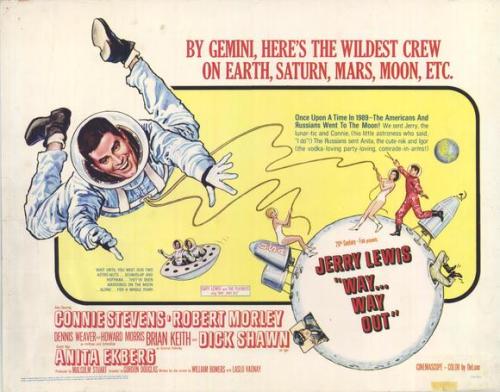
The year is 1989 and both the Russians and Americans have set-up bases on the moon. Each base has 2-people living in them. For the Russians things go smoothly mainly because they have a man and a woman (Dick Shawn, Anita Ekberg) cohabitating while the Americans have two men (Dennis Weaver, Howard Morris) who quickly go crazy because there are no women around for sex. NASA decides to replace the two men with a man and woman like the Russians have, but insist that unlike the Russians the American couple must be married. Pete (Jerry Lewis) who is a long time employee of the space agency is chosen and his female counterpart is fellow astronaut Eileen (Connie Stevens). The two had never met and are forced to accelerate their courtship and eventual marriage in a matter of 3 days before getting rocketed up into orbit.

To some degree this is an interesting idea and the first 15 minutes or so allows for some comic intrigue, but the filmmakers blow it by backing off of their novel approach and turning the whole thing into just another contrived romance. Stevens may be attractive, but her acting is limited and her presence adds no other added element to the proceedings besides being ‘eye candy’. The film would’ve been funnier had Pete been forced to go up with agency’s second choice, which was Esther (Bobo Lewis) who was a more aggressive, less attractive woman who could’ve added humorous conflicts. The spats between Pete and Eileen is banal and the second half devolves into one long drunken party between the American and Russian couple that isn’t funny and more like filler  put in when the writers ran out of ideas from their original concept.

From a sci-fi angle it is implausible. The rocket ship takes only a few minutes to get from earth to the moon and when they get there the lack of gravity is never addressed and they are able to walk around normally except for the few times when they get into fights, which sends one person flying off into the air when punched by the other. The earth that is shown in the sky has no clouds even though clouds can always be seen from just about every satellite shot taken of earth from space. The film also ruins the most intriguing element, which is seeing how they might’ve predicted things would look like in the ‘80’s from a ‘60’s perspective by having a narrator state right away that ‘little has changed’ in the past 23 years and therefore making no attempt to show anything from a futuristic viewpoint.

Lewis is amazingly restrained and doesn’t end up ruining things with his overacting, which instead gets done by Shawn. Weaver has a few good moments as the stressed out astronaut slowly going nutty as well as Brian Keith as a gruff American general, but Robert Morley is the funniest as the over-worked and over-burdened head of the space program.

Since one must set the bar very low from the beginning with any Lewis comedy this manages to be tolerable despite being more benign than it needed to be.

My Rating: 3 out of 10

Released: October 26, 1966

Runtime: 1Hour 41Minutes

Not Rated

Director: Gordon Douglas

Studio: 20th Century Fox

Available: DVD (Region 2), Amazon Instant Video

The Princess Bride (1987)

princess bride 1

By Richard Winters

My Rating: 7 out of 10

4-Word Review: Grandson likes bedtime story.

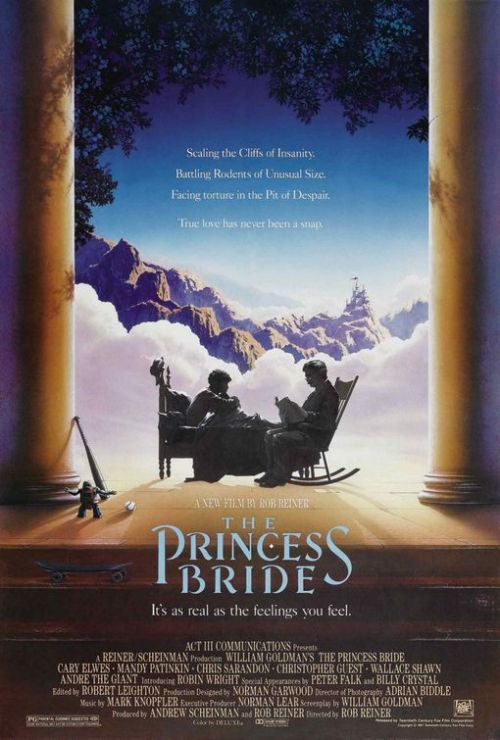
Based on the 1973 William Goldman novel, who also wrote the screenplay, a grandfather (Peter Falk) arrives to read to his sick grandson (Fred Savage) a fairytale. Initially the grandson is more interested in playing video games, but soon finds himself enraptured with the story despite his initial reluctance. The tale involves a country girl named Buttercup (Robin Wright) who falls in love with a farmhand named Westley (Cary Elwes). When Buttercup mistakenly thinks that Westley has been killed by some pirates she agrees to marry Prince Humperdinck (Chris Sarandon) only to end up getting kidnapped before her wedding and saved by Westley who was never dead to begin with. The two then must fight off the evil Prince who still insists on marry Buttercup and doing away with Westley.

The film, which was directed by Rob Reiner and produced by his former ‘All in the Family’ creator Norman Lear, is engaging from beginning to end and filled with endlessly funny dialogue and exciting adventures that remain pleasantly amusing throughout. My favorite moment is seeing a completely unrecognizable Billy Crystal hamming it up as an old man magician who tries to revive Westley while sounding like a comedian from vaudeville.

The special effects are impressive especially the shot showing Buttercup’s three kidnappers climbing a rope up a steep mountain while being followed close behind by Westley. To me though the best part is when Westley gets attacked by what appears to be a giant rodent that, with the exception of his fake looking fur, looks amazingly real and not like a stuntman in a body suit or a computerized image.

The performers are well cast with my favorite being former wrestler Andre the Giant who steals it despite having no acting experience and at times difficulty enunciating his words. The only negative is Christopher Guest as a six fingered man who supposedly attacked the Mandy Patinkin character when he was a child, but now that Patinkin has grown he faces Guest again even though Guest looks to be practically his same age and not someone who should be significantly older.

The story is basic and lacks the grandiose and dark quality that many of the classic Grimm fairytales possess. The banter between the grandson and Grandfather is fun and I wished it had cut back-and-forth between the two and the story more often than it does. The context is simple and straight forward and its ‘message’ of teaching kids to learn to enjoy reading is a bit too obvious, but overall as non-think escapism it scores a bullseye and through the years has managed to acquire a strong cult following.

My Rating: 7 out of 10

Released: September 25, 1987

Runtime: 1Hour 38Minutes

Rated PG

Director: Rob Reiner

Studio: 20th Century Fox

Available: VHS, DVD, Blu-ray, Amazon Instant Video, YouTube


Goin’ Coconuts (1978)

goin coconuts

By Richard Winters

My Rating: 3 out of 10

4-Word Review: Donny and Marie movie.

Donny and Marie Osmond, the brother and sister act from Utah who had a short-lived variety show on ABC during the late ‘70s, take their act to the big screen in this thinly plotted comedy aimed solely at the kiddies. The story has them flying to Hawaii for a performance, but not before a mysterious Priest (Jack Collins) hands them a necklace. Marie decides to wear it not knowing that it is stolen and wanted by various and competing criminals. Will the non-stop barrage of attempts that the thieves make to get the necklace back end up driving the pair nuts? Will this break up their act or better yet will any of this cause you not to sleep at night?

I think the funniest thing about this flick is that it took two writers to come up with a concept that a 6-year-old could’ve thought up in less than a minute. The script is clearly threadbare material and the forced hijinks and ‘zany’ villains aren’t any better. I realize this is aimed at the younger crowd, so one must measure it in a different way, but even so it doesn’t have enough action or special effects to hold their attention and kids of today will probably have no idea who Donny and Marie are or even care.

I realize the Osmonds have been plagued their whole careers with their ‘goody-goody’ image that at one put even gets made fun of by the Kenneth Mars character, but with that said they’re still quite likable and they really can sing rather well. I liked some of their brother-sister banter and the gender bending scene of having Marie driving a motorcycle. I was also impressed with how mature these two were especially when you consider that Donny was only 20 at the time of filming and Marie was 19.

The recognizable character actors who make up the supporting cast helps a little. This marks the final film appearance for both Ted Cassidy and Khigh Dheigh. In Cassidy’s case I was genuinely surprised to find that he passed away less than 3 months after this film’s release as he appeared quite young and energetic.

Mars does another of his over-the-top caricatures that closely resembles the one he did in The Producers, which should make it old and tiring, but he still manages to somehow keep it fresh and lively. Herb Edelman is fun as the high-strung manager and famous bad guy Marc Lawrence has an amusing bit trying to chase down the pair while driving a car with an old lady passenger.

Osmond fans may rate this slightly better, but there’s very little to recommend and best viewed as a curio on a slow night.

My Rating: 3 out of 10

Released: October 6, 1978

Runtime: 1Hour 36Minutes

Rated PG

Director: Howard Morris

Studio: Osmond Entertainment

Available: VHS, DVD

Hardly Working (1981)

hardly working

By Richard Winters

My Rating: 2 out of 10

4-Word Review: Klutz can’t find work.

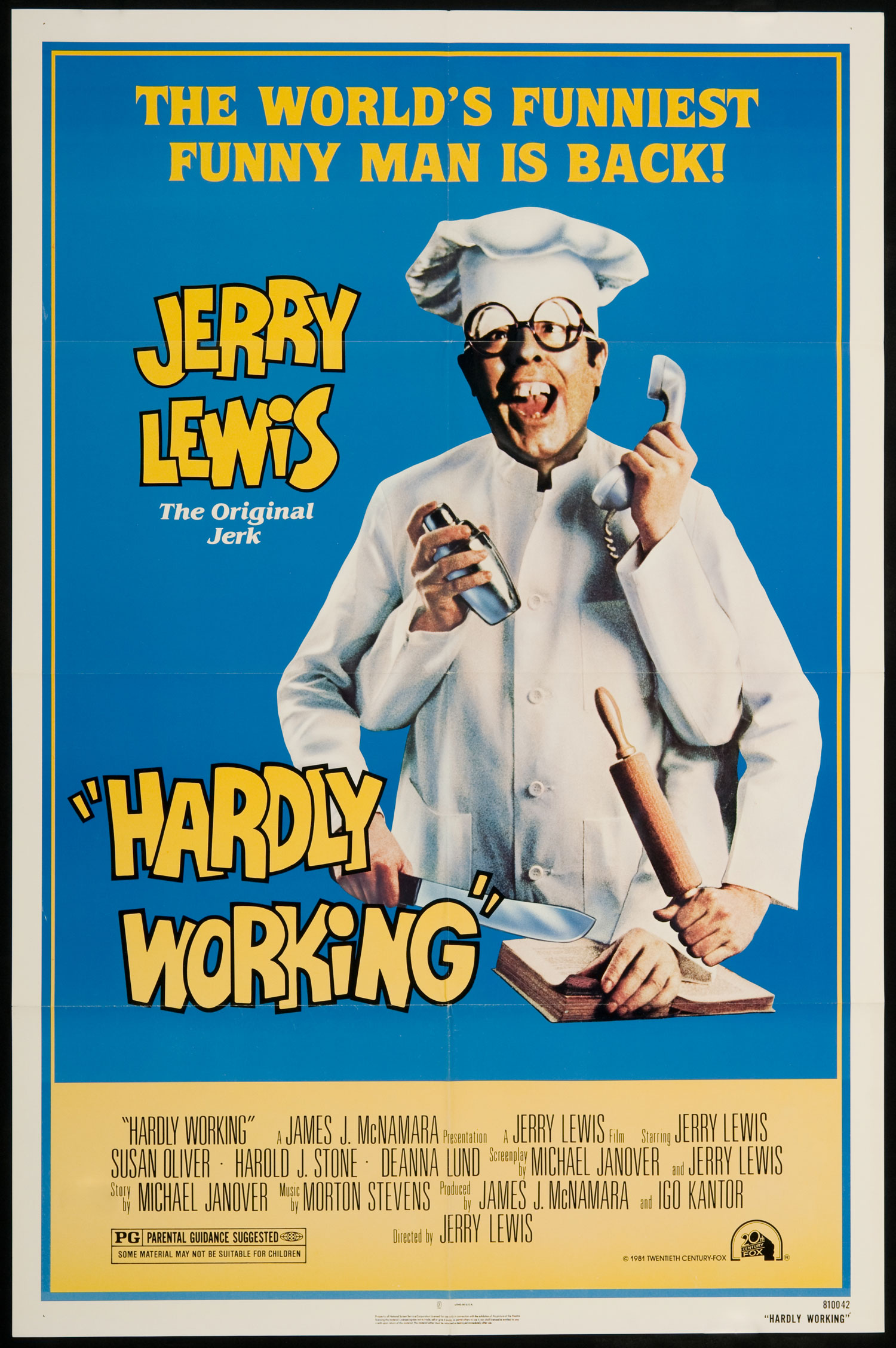
Bo Hooper (Jerry Lewis) is a circus clown who finds himself out of a job. His sister Claire (Susan Oliver) and her belligerent husband Robert (Roger C. Carmel) agree to take him in and help him find a new source of income. Things aren’t easy as Bo proves to be a major klutz at everything and gets fired from most of his jobs on his very first day. He finally gets hired as a mailman that after a rough start begins to go semi-smoothly, but will his secret relationship with Millie (Deanna Lund) who is his boss’s daughter help ruin it?

I admit I’ve never been much of a Lewis fan. His routine seems too much like that of a 5-year-old desperate for attention and willing to do any inane thing for a cheap laugh. Peter Sellers and Don Knotts have played similar klutzy characters, but they at least came off as semi-believable adults albeit not very bright ones. Lewis though is this middle-aged man who for no warning or reason will suddenly revert to the behavior of a 6-year-old, which isn’t funny, but creepy, weird and pathetic instead. You start to wonder how this character was able to make it in the adult world as long as he had without being sent away somewhere instead of whether he will get a job or not.

His shtick amounts to nothing more than accidently knocking something over and spilling contents onto the floor, which is about as simplistic and basic as you can get. In many cases he doesn’t even offer to pick it up, which forces others to do it instead. In one instance he knocks over some materials that were lying on top of his boss’s file cabinet and then just lets them remain on the floor only to have the stuff three minutes later magically reappear on the top of the cabinet anyways.

The empty logic of this already threadbare concept is another issue. Why must this circus clown resort to doing jobs he has no experience in? Aren’t there other circuses out there that he could work for? And wouldn’t a man who has spent years working in that industry have built up a network of contacts that he could go to in time of need?

His foray working as a sushi chef where he pretends to be Japanese will be deemed offensive and racist by today’s standards, but the film’s worst scene is the one involving a blimp. He decides on a whim to pilot one despite being on-the-clock as a postman. Since the character is unable to flip even a light switch without causing a catastrophe one would expect his blimp drive to have dire consequences, but instead he pulls it off without a hitch and then somehow doesn’t lose his job or get arrested afterwards.

Filmed in 1979 the production was forced to go on hiatus for 6 months when it lost funding, which may be why Oliver and Carmel, who appear predominantly during the first half, disappear completely without explanation during the second part. In either event Lewis’ ‘big comeback’ after a 10-year absence from the big screen is a complete misfire. His material hasn’t evolved at all and he relies on the most infantile jokes and insipid scenarios imaginable that wouldn’t entertain a bored child let alone an adult.

My Rating: 2 out of 10

Released: April 3, 1981

Runtime: 1Hour 29Minutes

Rated PG

Director: Jerry Lewis

Studio: 20th Century Fox

Available: VHS

Watch Out, We’re Mad! (1974)

watch out were mad

By Richard Winters

My Rating: 6 out of 10

4-Word Review: Replacing a red buggy.

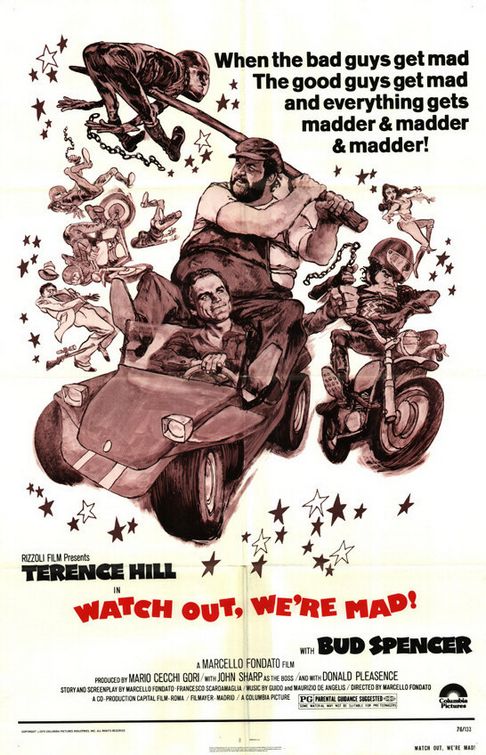
Kid (Terence Hill) and Ben (Bud Spencer) are two race car drivers who participate in a race that ends in a tie that forces the two to settle on sharing the prize, which is a red dune buggy. The two though want the vehicle all for themselves and decide to settle on who gets to keep it by having a hot dog eating contest at a local bar. As they busily eat their hot dogs a local mobster known as The Boss (John Sharp) orders his men to destroy the place in an effort to get local businesses to leave, so that they can then use the land to build a giant skyscraper. Ken and Ben don’t mind the chaos, but when the mobsters then destroy the buggy they get mad…really mad! They confront The Boss and his equally nefarious psychiatrist (Donald Pleasence) insisting that the buggy MUST be replaced and it MUST be the same red color, or there will be trouble. The mobsters initially scoff, but find that these two men are far more resourceful and determined than they could’ve imagined.

This is the seventh teaming of Hill and Spencer who did their first movie together in the 1967 spaghetti western Blood River. They work well together and it is clear that they share a deep camaraderie. The film is full of all sorts of zany slapstick and I enjoyed most of it particularly the bar scene as well as a bumper car segment at a carnival. The best moment though is when they ram their car through the doors of a ritzy restaurant where the mobsters are dining and proceed to drive the car through every inch of the place while popping hundreds upon hundreds of giant balloons that lay all over.

The biggest issue though it that it doesn’t make any sense why these two would be so cocky and arrogant in the face of otherwise dangerous mobsters. Yes, it’s funny that these two ordinary schmucks seem oblivious to danger and can more than handle themselves, but it would’ve worked better had they been initially intimated and then slowly evolved into being more confident. You also have to question how these men acquired such powerful fighting skills, which made me believe that the characters should’ve been portrayed as police or government agents with some kind of combat training instead of just ordinary car mechanics that would not in any way be able to fight these bad guys off as consistently as they do.

The story is one dimensional and there really isn’t much of a third act with the broad plot simply an excuse to showcase a lot of slapstick. The humor is clearly on a kiddie level, but funnier than you might think even though there are certain routines that go on longer than they should and some that seem to repeat themselves. Still it’s refreshing to watch a film made in an era where slapstick was still considered a legitimate form of entertainment and not simply relegated to kid flicks and cartoons.

My Rating: 6 out of 10

Released: March 29, 1974

Runtime: 1Hour 37Minutes

Rated G

Director: Marcello Fondato

Studio: Columbia Pictures

Available: DVD

Amazing Grace and Chuck (1987)

amazing grace

By Richard Winters

My Rating: 1 out of 10

4-Word Review: Kid stops playing baseball.

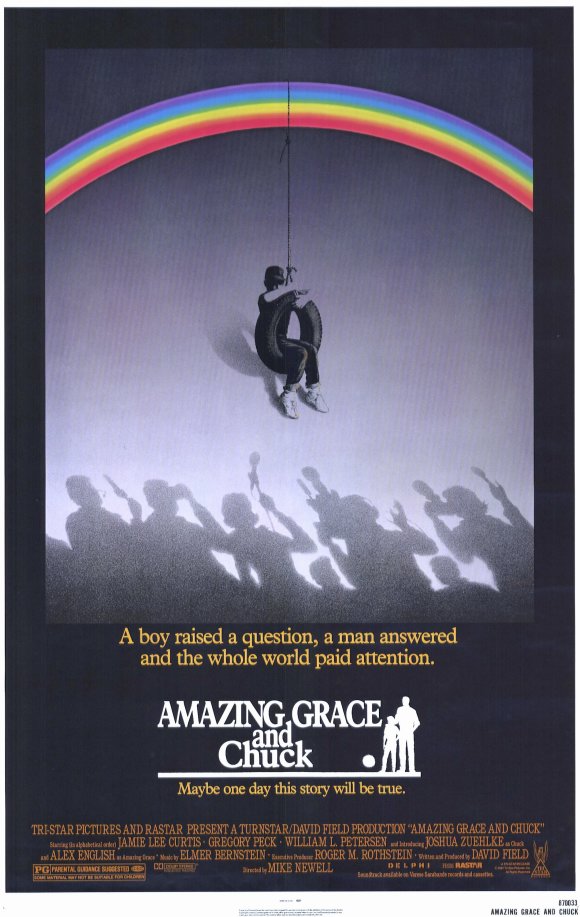
After touring a nuclear missile plant 11-year-old Chuck (Joshua Zuehlke) becomes traumatized at the prospect of nuclear war and wants to come up with some way to help prevent it. His solution is to quit playing little league baseball until there is complete nuclear disarmament as his pitching skills are impressive and therefore his talents will be sorely missed and thus make a strong statement to others about his commitment. After reading about him in a newspaper Amazing Grace (Alex English) a star basketball player for the Boston Celtics decides to do the same thing. He even moves to Livingston, Montana where Chuck resides so the two can carry on their self-styled protest together. Soon other athletes jump onto the bandwagon until a genuine movement is created that eventually gets the attention of world leaders.

The plot is indeed idealistic if not extraordinarily fanciful and has the stigma of being written by David Field who later went on to write the script for ‘Invisible Child’ a notorious Lifetime movie that has gained a cult following for having one of the dumbest plotlines ever and this one isn’t all that far behind. My eyes were already rolling before it even began, but I still wanted to give it a chance. Mike Newell’s direction is competent and Zuehlke’s performance in this his one and only film appearance is convincing and it even has a cameo appearance by coaching legend Red Auerbach.

I found it almost unnatural though that any kid could have such a strong resolve and commit to such a major sacrifice as at that age they can go through a lot of different phases and whatever they may be into one day can be something completely different just a few days later. Even responsible adults can have a hard time sticking to their commitments, so expecting a kid to do so seemed almost outlandish, but I forgave it because his Dad was a fighter pilot and therefore it made it more personal.

I was even willing to forgive the second act, which gets increasingly more strained and implausible by the minute because of the presence of Chuck’s father (William Petersen) who manages to keep things somewhat grounded by being the film’s only cynical character. However, the idea that a famous and successful player, which is played by an actual former NBA star who gives a wooden performance, would read a short article about a kid in a newspaper and that would be enough to ‘inspire’ him to quit everything and move to the middle of nowhere is just downright ridiculous as is Chuck being called to White House all alone and not accompanied by his parents, so that he could speak with the President (Gregory Peck) who begged him to start playing again because his stubborn stance has somehow hurt their bargaining power with the Russians.

The third act though is when it all gets to be too much and something that no logical or rational person will be able to swallow no matter how optimistic they may be. The film also enters in a side story dealing with Grace being stalked by a terrorist group threatening to kill him unless he goes back to playing basketball, which seemed to come from some completely different movie altogether and makes this already implausible story all the more absurd.

I’m all for a ‘feel-good’ movie, but there has to be some bearing in reality and when every player around the world quits playing and all the children quit speaking in order to show their solidarity for Chuck then this thing becomes just plain stupid and takes the concept of wish fulfillment to ridiculously new and embarrassing heights.

Of course there are some who feel the ‘positive message’ outweighs its otherwise fairy tale-like theme. There is even one reviewer on Amazon who shows his students this movie as a way to teach them the importance of having a ‘cause’. I for one think this would be a bad thing to show to young viewers because it gives them the idea that fighting for social change will be a quick and satisfying experience while also making them ‘famous’ in the process, which seems to be setting them up for a tremendous fall when they actually get out into the real world and find things to be the exact opposite.

My Rating: 1 out of 10

Released: May 19, 1987

Runtime: 1Hour 56Minutes

Rated PG

Director: Mike Newell

Studio: Tri Star Pictures

Available: VHS, DVD-R, Amazon Instant Video, YouTube

Viva Max! (1969)

viva max 2

By Richard Winters

My Rating: 3 out of 10

4-Word Review: Taking back the Alamo.

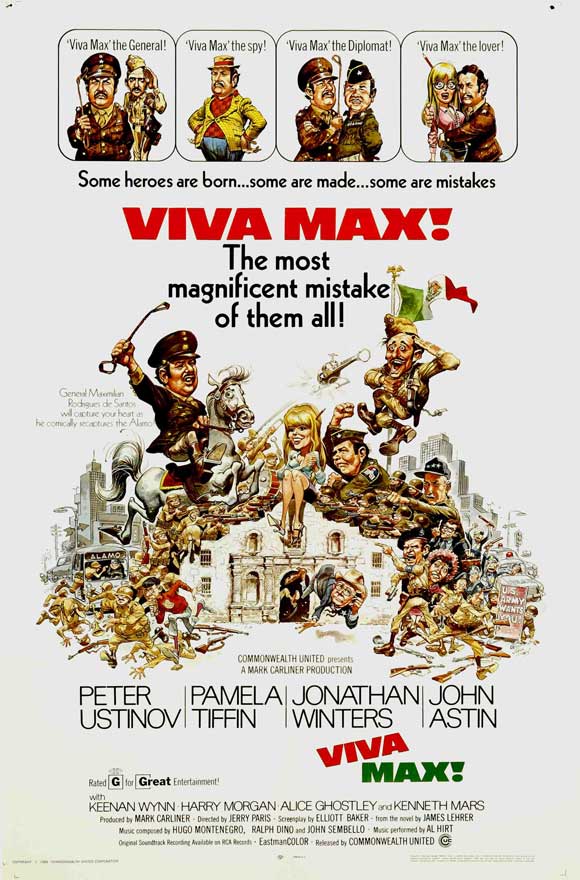
A small ragtag Mexican army led by the affable, but incompetent General De Santo (Peter Ustinov) decides to cross the border and recapture the Alamo. The process goes much easier than expected despite the fact that the army used no bullets in their guns. The National Guard is then sent in to weed them out, but they too decide not to load their guns with bullets leading to some unusual results.

The film is based on the novel written by PBS newsman Jim Lehrer and the movie’s behind-the-scenes politics ends up being much more interesting than the plot itself. Filmed in April of 1969 the production initially had permission from the state to film right on the actual site of the Alamo and a major portion was done there before various citizen groups became aware of it and began protesting the crew’s presence in what they considered to be sacred ground. Some of their protests was captured on film and incorporated into the story, but their loud presence eventually disrupted the production forcing some scenes to be done on an indoor studio soundstage while still others were completed in Italy.

The commotion and ‘controversy’ was not worth the effort as the film is an overall bore. The first 15-minutes are amusing and even mildly engaging, but once it gets inside to the actual Alamo the action and pace come to a screeching halt and kill any possible potential that the film may have had.

The script also has some illogical loopholes one of them being the army deciding to invade a place, but without using any ammunition, which is never explained and highly improbably. What is even more ridiculous is that the National Guard would decide not to use bullets in their guns either since this is the U.S. of A. where guns and force are considered a national birthright and thus makes this ill-conceived plot twist to be unbelievable to the extreme. The fact that De Santos and his men and able to freely leave at the end and go back to their country without dealing with any type of consequence for their actions is equally absurd.

Ustinov is funny and speaks in an authentic Mexican accent, but he’s unfortunately limited by the broad caricature of his role. John Astin comes off best as the Sergeant that’s second in command and does most of the actual disciplining and leading and Jonathan Winters is good as a clueless American general. Alice Ghostley lends some energy as an innocent bystander that becomes one of the army’s prisoners and Pamela Tiffin looks great wearing glasses and having her hair tinged in blonde.  Gino Conforti, Paul Sand, Jack Colvin, Anne Morgan Guilbert and Kenneth Mars can also be spotted in small roles, but even with their competent performances it fails to mask the film’s otherwise glaring inadequacies.

My Rating: 3 out of 10

Released: December 16, 1969

Runtime: 1Hour 34Minutes

Rated G

Director: Jerry Paris

Studio: Commonwealth United Entertainment

Available: VHS