Category Archives: Movies for the Whole Family

Private Eyes (1980)

privateeyes

By Richard Winters

My Rating: 3 out of 10

4-Word Review: Inept detectives investigate case.

Inspector Winship (Don Knotts) and Dr. Tart (Tim Conway) are two American detectives hired by Scotland Yard to investigate the murder of two people at a country estate in the 1920’s. Despite receiving a letter from one of the murdered victims asking them to investigate their murder the two prove to be quite inept. The various members of the mansion’s staff begin to turn-up dead one-by-one, which further deepens the mystery as a figure shrouded in a dark robe menaces the two as they investigate the case.

After the surprise box office success of The Prize Fighter, which became one of the most profitable films ever released by New World Pictures, screenwriter John Myhers, who had co-wrote that one, convinced Conway and Knotts to do another one. This one also did well earning a big profit, but for whatever reason it was the last of the Conway/Knotts comedies and they appeared together only once more in a brief cameo as two highway cops in Cannonball Run II

To some degree this is an improvement over their other one because here the entire cast is allowed to be funny and there’s none of the awkward, corny drama. Conway has a few good moments like when he stuffs his mouth full of apricots, or tries to cut a rope tied around Knotts’ hands with a sword that’s still connected to a knight’s armor. These two also get to reveal that they have a sex drive as they fight with each other over who gets to look through a tiny peephole to see the ravishing Mistress Phyillis, played by Trisha Noble, undress.

On the negative end a lot of the comedy falls flat. The opening animated bit, styled after the Inspector Clouseau Pink Panther films, is especially lame and should’ve been nixed. The running gag where the killer leaves notes where the last word never rhymes with the others is amusing for awhile, but gets overplayed. The stunts, pratfalls, and special effects are cheap and despite being filmed on-location at the Biltmore Estate in Asheville, North Carolina you really only get to see a few rooms of it making it seem like a waste.

Conway and Knotts can certainly be amusing at times, but they’ve played these types of characters for so long that they now have become predictable and boring. The Sherlock Holmes-styled parody has been done many, many times and this adds nothing new to the mix. It’s also hard to understand why if these guys are really this hopeless and everyone in the world seems to know it how they’d continue to find work and why Scotland Yard continues to give them employment and doesn’t just let them go. Inspector Clouseau was also very inept, but he always managed through irony and dumb luck to solve the case and come-out still looking like the ‘hero’ to the public, which only helped to bolster his career. These guys though don’t ever get anything right and are perpetually clueless, so why are they detectives to begin with?

A much better idea would’ve been to have placed the setting into the modern day especially since none of the humor, or pratfalls are contingent to the period. They could’ve played two guys who were out of work and saw an ad in the newspaper looking for amateur private eyes and they decide taking a stab at it as a ‘fresh start’. Then all of their bungling would make more sense and actually would’ve been funnier since the comedy would’ve had a more plausible setting.

Spoiler Alert!

Beyond just the bland comedy the case itself, particularly the final explanation, is illogical as it has one of the victims, Lord Morley, played by Fred Stuthman, coming back to life at the end as he essentially faked his own death. This though doesn’t make sense as we see a screaming newspaper headline at the beginning stating that two people were killed, or two bodies found when the car that Lord and Lady Morley were in drove into a lake, so if Lord Morley wasn’t one of the bodies then whose was it?

My Rating: 3 out of 10

Released: April 17, 1980

Runtime: 1 Hour 31 Minutes

Rated PG

Director: Lang Elliot

Studio: New World Pictures

Available: DVD, Blu-ray, Amazon Video
Walk Like a Man (1987)

walk

By Richard Winters

My Rating: 1 out of 10

4-Word Review: Raised as a wolf.

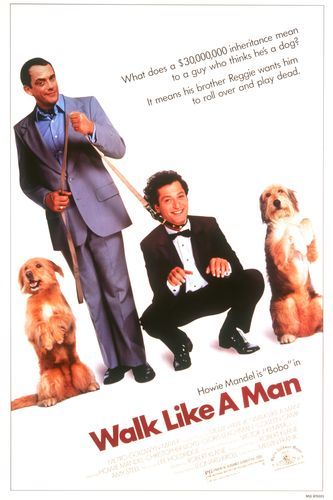
Henry (Christopher Lloyd) travels with his family to Alaska in the search of gold. His oldest son Reggie though doesn’t like the cold and so after finding his fortune Henry tells his family they’re leaving via a dog sled. Reggie is told that he’s now old enough to push the sled, which he doesn’t like, so when his father isn’t looking he hops onto the sled where his mother (Cloris Leachman) and younger 2-year-old brother, nicknamed Bobo, are. Bobo ends up getting pushed off the sled and lost in the icy wilderness where, despite the arduous search by his father who perishes while looking for him, is presumed dead. 28 years later a biologist named Penny (Amy Steel) comes across a man (Howie Mandel) with a pack of wolves. He gets identified through a tattoo as being the lost son and ‘returned’ to a now grown Reggie (Christopher Lloyd), his mother and Reggie’s wife Rhonda (Colleen Camp). Reggie has no interest in caring for his brother, who behaves like he’s a wolf, but because he’s squandered his father’s fortune and because Bobo was given a $30 million inheritance, Reggie agrees to let Penny teach him how to write, so he can ultimately sign over his money to Reggie.

The script was written by Robert Klane who burst onto the scene during the late 60’s with both ‘The Horse is Dead’, a highly irreverent, politically incorrect novel, but still quite funny, and ‘Where’s Poppa’, about a man trying to kill his senile mother. The latter got made into a movie, which was directed by Carl Reiner with the script written by Klane, that’s considered a landmark in dark comedy. So, how someone goes from doing stuff that’s highly inventive to this empty-headed, bare bones ‘comedy’ is hard to fathom, but the results are ‘blah’. The plot is threadbare and hinges on a lot of slapstick scenarios that prove to be predictable and overly-extended. Instead of picking up the pace, as a good comedic scene should, it saps the energy right out making the movie, as a whole, strained and boring.

The problems start out right away during the Alaska scene, which was clearly shot on a soundstage using fake snow, where the young Bobo falls off the sled, which if you think about it is quite horrifying as there is simply no way a toddler could survive in that climate. There’s no chance the wolves would ‘raise him’ either and instead would just eat him. Also, when he gets found by Penny he’s seen running around wearing a loincloth, but if he thinks he’s a wolf he shouldn’t be wearing anything at all just like the other wolves. Where did he find this cloth to wear, or did the wolves make that when they took up parenting him?

The running joke of Reggie’s neighbor, played by George DiCenzo, getting upset because Bobo keeps trampling through his freshly paved cement driveway, is overdone. The first time it happens it’s good for maybe a slight chuckle, but then several months later it goes back to Bobo doing it again, but the neighbor should’ve learned from the past and built a fence, or partition around the cement to prevent Bobo from going on it, or at the very least not be so shocked when the driveway gets ruined again since its already happened several times already.

The only interesting aspect is seeing Lloyd, who has later described this film as an ’embarrassment’, playing the lead. Usually he does likable, but eccentric character roles, so seeing him actually carry a film, which he does well despite the mess, is interesting and in fact he’s the only thing that gives it any energy and when he’s not in it it all falls flat. Mandel on the other hand isn’t dynamic enough to make his scenes work and his wolf routine is more tiresome than funny.

Leachman steals it as the mother with child-like instincts. She does have a few funny lines and her sitting with Bobo as Penny tries to teach him to read and write and her reactions to things being almost as clueless and fanciful is Bobo’s is definitely amusing. Steel, while quite bland, is good simply because she’s the only normal one in the movie, which when doing wacky comedies it’s nice to at least have one sensible person to help ground things.

I’ll give a point to the segment dealing with a trip to mall and the infamous sneezing scene, which did get me to laugh-out-loud, but everything else clunks badly. The final courtroom battle is especially cringey. Showing clips of ‘funny moments’ during the closing credits, which weren’t all that great when we saw them the first time, and acting like it’s some sort of ‘highlight reel’ just extends the pain further. If anything they should’ve shown bloopers and outtakes of the actor’s messing up their lines, which would’ve been funnier than hearing them speak the actual ones.

My Rating: 1 out of 10

Released: April 17, 1987

Runtime: 1 Hour 26 Minutes

Rated PG

Director: Melvin Frank

Studio: MGM

Available: DVD

One of Our Dinosaurs is Missing (1975)

one2

By Richard Winters

My Rating: 3 out of 10

4-Word Review: Nannies to the rescue.

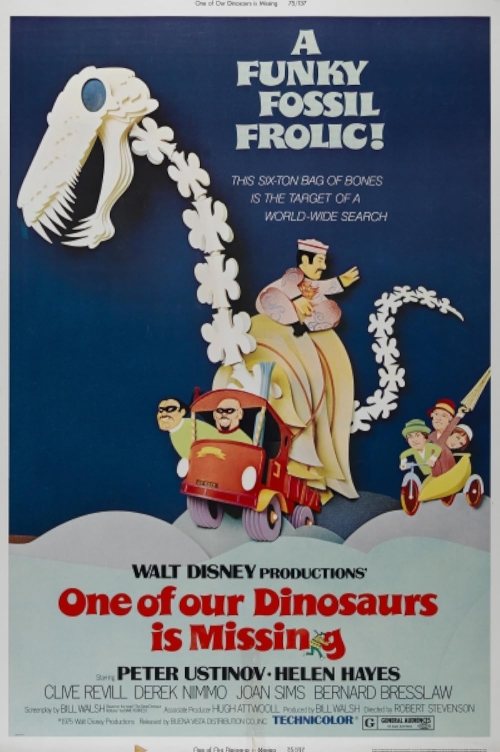
Lord Southmere (Derek Nimmo) is on the run from Chinese spies lead by Hnup Wan (Peter Ustinov) after he gets his hands on a microdot that carries top secret information. After escaping the clutches of an assassin disguised as a chauffeur he runs into a nearby building, which happens to be the Natural History Museum. It is there that he hides the microdot in the skeleton of a dinosaur that’s on display. He then bumps into Hattie (Helen Hayes) who used to his nanny and is taking a tour at the museum with other nannies. Southmere tells Hattie about the microfilm inside the dinosaur just before he faints and is captured by the Chinese. Hattie then takes it upon herself, along with her nanny friends Emily (Joan Sims) and Susan (Natasha Pyne) to retrieve the important hidden document and take it to the proper authorities.

The film is based on the 1970 novel of the same name written by David Eliades and Robert Forrest Webb, but with many changes. The book took place in the 70’s in New York City while in the movie the setting is 1920’s London. The book was also intended for an adult audience and had sex and violence in it, which got taken out for the movie, which angered the authors, who later disowned the film, as they felt the plot got too ‘dummied-down and sanitized’ in an effort to appease children viewers.

The movie really has only two amusing moments. One is where the group of nannies get on the tall skeleton of the dinosaur to search for the microfilm, which from simply a visual perspective is goofy to see and most likely will elicit a few chuckles. The second is when Hayes and company steal the dinosaur on the back of a steam lorry and the spies give chase throughout the streets of foggy London, which offers some moments of humorous reaction shots from bystanders. Otherwise there isn’t much else going for it. The opening bit that supposedly takes place in China clearly has an outdoor backdrop that is a painting and looks tacky like it was done by filmmakers that really didn’t have much heart in the material and didn’t care how cheap it came-off looking. The interior lighting is dark and dingy and having the whole plot revolve around the extreme coincidence of the protagonist bumping into his childhood nanny at the most opportune time is a bit much.

The film’s main controversy, at least by today’s standards, is Ustinov’s portrayal of a Chinese spy. To his credit he at least puts more energy into it than he did as Charlie Chan in the 80’s film Charlie Chan and the Curse of the Dragon Queenwhere he seemed noticeably uncomfortable and just phoning-it-in. Yet even here nothing his character says or does is funny. The humor is intended to come from the broad caricature, which along with his sing-song sounding delivery quickly becomes tiring. Clive Revill, another white European, also gets into the Asian get-up as Quon Ustinov’s chief rival, but he proves to be just as bland. Why they needed to be Chinese at all is hard to answer as they could’ve easily been Russian, or German and might’ve been better had they taken that route.

Hayes for her part is engaging. Most people think of her as just being this sweet old lady of which she’s the perfect caricature, but here she gives her character a feisty side. I enjoyed seeing her strut, which is far funnier than anything Ustinov does and without even hardly trying. Her ordering the other nannies around like they’re on a big-time mission and her interactions with Natasha Pyne, who plays her polar opposite as this naive and fun-loving youth who approaches the whole thing as some cool diversion, are the only things that help keep it mildly watchable.

The twist ending may make it worth it to some, but overall it’s a second-rate Disney effort that’s so poorly shot and dated. I can’t imagine any kids today could get into it. It seems like the only fans of the film were simply kids back in the 70’s who saw it then and now enjoy watching again simply for nostalgic reasons, but everyone else won’t be missing much if they decide to skip it.

My Rating: 3 out of 10

Released: July 9, 1975

Runtime: 1 Hour 34 Minutes

Rated G

Director: Robert Stevenson

Studio: Buena Vista

Available: DVD (Region 2), Amazon Video, YouTube

Three Men and a Baby (1987)

threemenbaby

By Richard Winters

My Rating: 7 out of 10

4-Word Review: Infant on their doorstep.

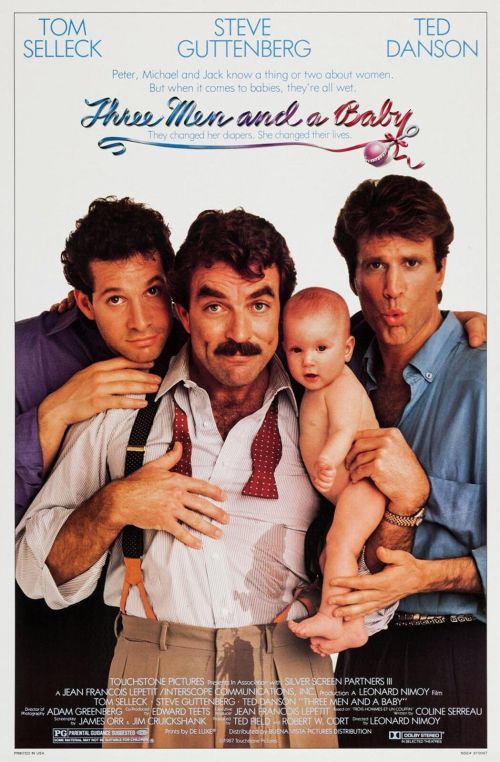
Peter (Tom Selleck) is an architect, Michael (Steve Guttenberg) is an artist, and Jack (Ted Danson) is an actor. All three live in a large apartment in downtown Manhattan. None are married and spend most of their time, when not working, hosting lavish parties and dating beautiful women. One day a baby gets left at their doorstep while Jack is away starring in a movie that’s filming in Turkey. Peter and Michael find the infant and attached note stating that it’s from one of Jack’s previous girlfriends whom had a brief fling with while starring in a play. The two men have no idea how to take care of it, which leads to many amusing mishaps. Once Jack returns they find themselves in even more chaos when drug dealers appear at the apartment looking for a package of heroin that had also been delivered there.

This is the American version of the French hit Three Men and a Cradle and while I’ve been routinely critical of most Hollywood remakes from European films this one, which was directed by Leonard Nimoy, makes many improvements on the story. There’s nothing that’s hugely different, but there’s enough small changes to the plot that helps fill in the caveats from the first one.

One of the things this one does better is it shows the men’s partying side, which the first one didn’t do as well as it started pretty much right away with the baby’s arrival and only elaborated about their wild ways while here, in perfect movie fashion, we see it. Although a bit garish, I enjoyed Michael’s artwork that gets drawn all over the outside walls of the apartment and creates a rather surreal look. There’s also definite strong 80’s vibe that permeates almost every shot at the beginning from the colorful lettering of the opening credits to the theme of ‘Bad Boys’ by Gloria Estefan and the Miami Sound Machine, which was a big band back in the day. There’s even Guttenberg doing a corny imitation of Robin Leach from ‘Lifestyles of the Rich and Famous’ though anyone that didn’t live through the decade will most likely not get that one.

The characters are much better defined with each having a distinct personality. While his movie career never really took-off Selleck shines as the leader of the group due to him being the oldest and at times the most stern. Guttenberg, with his boyish face, is perfect as the immature and clueless one while Danson scores as the eccentric actor. I liked that the men continued to work their jobs even as they looked after the baby, while in the first one they would just call in ‘sick’, which became excessive and unrealistic. In fact probably the funniest moment in the whole movie, at least for me, is when Danson is on stage rehearsing a play with the baby strapped to his back.

Even the drug dealing scenario gets handled better. In the first one the guys return the drugs to the dealers by putting it into one of the babies diapers and then tossing it into a trashcan in a park, but here the men use the opportunity to catch the crooks in the crime by having Guttenberg secretly filming them as they take the drugs back and there’s even some legitimate tension as they try to outrun them when the bad guys catch-on to the scheme. I also liked that the dealers infiltrate the apartment while a babysitter is there as in the French version the infant gets left alone and even though it was supposedly only for a short time was still irresponsible.

There’s a girlfriend character as well, or in this case ex-girlfriend, gets added for Selleck, she gets played by Margaret Colin, and reveals how Selleck just automatically presumes because she’s a woman she’ll know exactly what to do with a baby even when she states she doesn’t. This I felt finely observed how the different sexes can misjudge the other, or project characteristics onto them that they may not actually have.

Spoiler Alert!

Even the ending is a bit better though there’s still the issue of the girlfriend leaving a helpless child at someone else’s doorstep without warning, or making sure there would be someone there to take care of it, which in the real world would be dangerously reckless. At least though there’s more action as the three rush to the airport to try to stop the plane the girlfriend is on with the baby while in the French version the three guys just sit at home moping around, which isn’t as interesting.

It’s still problematic that the girlfriend, played by Nancy Travis who speaks with an accent, moves into the apartment with the bachelors to help take care of the kid. This though goes against the title as it states Three MEN and a baby, so I felt the Travis character should’ve just given up her parental rights and let the guys do all the parenting since they had become better at it anyways.

End of Spoiler Alert!

The only change that I didn’t like is when Danson brings his mother, played by Celeste Holm, to see the baby and tries to get her to agree to take care of it for awhile. In the French version the Jacques character tries the same ploy with his mother only to learn, to his shock, she has no interest in raising another kid and wants to spend her retirement having fun like traveling the world, which I felt was a good statement on ageism and how not all seniors want to be stuck being homebodies. Here Holm’s acts like a strict parent who doesn’t want to be bothered with a kid because Danson needs to ‘grow-up’ and learn to amend for his mistakes though if she was really a proper parent she probably should’ve warned him when he was younger to always wear a condom, so he wouldn’t have gotten himself into this mess in the first place.

This is also the scene that became a bit notorious back around August of 1990 when a rumor started that an image of a little boy, who it was said had killed himself in the place where it was filmed, can be seen in the window that Holm and Danson walk past. Granted it does look a little spooky at first, but upon second glance you can plainly see that it’s actually a cardboard cut-out of Danson wearing a top hat. The whole film was shot on a soundstage in Toronto and not a house where any boy past or present had ever lived.

My Rating: 7 out of 10

Released: November 23, 1987

Runtime: 1 Hour 42 Minutes

Rated PG

Director: Leonard Nimoy

Studio: Touchstone

Available: DVD, Blu-ray, Amazon Video, YouTube

My Bodyguard (1980)

my1

By Richard Winters

My Rating: 7 out of 10

4-Word Review: Hiring protection from bullies.

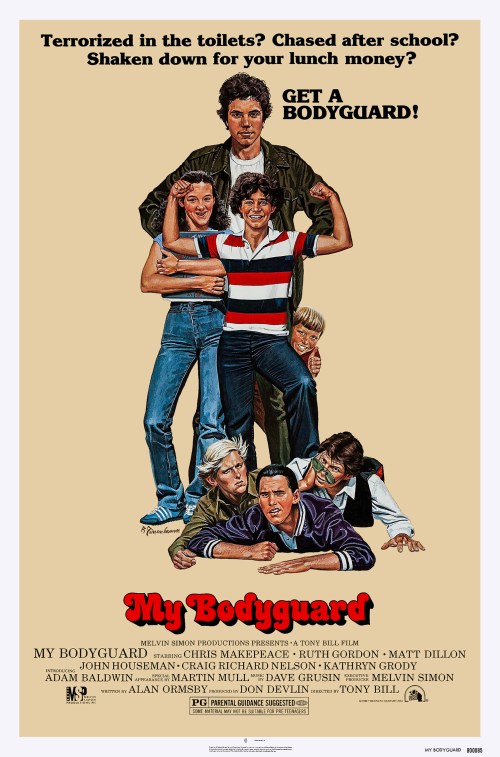
Clifford (Chris Makepeace) is a new student at a tough Chicago high school who finds himself at odds with the bullies who are headed by Melvin (Matt Dillion), who goes by the nickname ‘Big M’. He and his cronies want Clifford to pay them ‘protection money’ in order to defend him from Linderman (Adam Baldwin) who is a big, loner kid that supposedly killed his own brother. Clifford refuses and thus gets constantly hounded by them, so he decides to go to Linderman and offers him a deal where he’ll pay him some money each week and even agree to do his homework if he’ll become his bodyguard. At first Linderman declines, but eventually comes on board, which is enough to get Big M and his gang to leave them alone. Then a few days later Big M returns with his own ‘bodyguard’ named Mike (Hank Salas), a big muscular guy, who challenges Linderman to a fight, which he at first resists.

This teen movie is unusual in that it was not based off of a novel as its source material, even though you’d be convinced it was, and although a novel version of the story was eventually written after the film was released, it’s ultimately an original idea by screenwriter Alan Ormsby. Ormsby was at that point better known for writing low budget horror movies, with a couple of them he even starred in, and seemed the least likely to have penned something as good natured as this. It also stands out from other teen movies in that its music isn’t some pounding rock score, but instead soft classical that helps give it distinction and let it stand-out from just about all the other high school flicks out there particularly those from the 80’s.

Kids today may not relate to a school where every student doesn’t have an I-phone, a laptop, or piercings, but if you were a teen back then this movie captures that experience to a T. Everything from the bland school lunches where you had to drink milk out of a small carton to the creaky old school buildings (this one was filmed on-location at Lake Forest High) gets recreated. The teens are all realistically geeky and awkward, even Joan Cusack, in her film debut, looks nerdish especially as she smiles exposing a mouth full of metal. Many who see this, or see it again, it will bring back a fondness to their own school days to the point it may even make you feel you’re right back there.

Chris Makepeace is perfectly cast as a sensitive youth who must learn to ‘make connections’ or ‘network’ his way around the new environment and use what social skills he has to maneuver through the teen jungle. Dillon, in only his third movie, makes for a believable bully and Baldwin, in his film debut, is also excellent and while his character doesn’t say much he gives off a very effective almost creepy stare that proves memorable. In support I really got a kick out of Paul Quandt, who’s only film appearance this was, as a scrawny tyke who befriends Makepeace and always supplies funny side comments and reactions. You also get to see Joan and Jon Cusacks’ dad, Dick Cusack, as the school’s much put upon principal.

The only segments and characters that really don’t work are the scenes involving Makepeace’s home-life that are a bit unusual since he resides in a hotel that his father, Martin Mull, manages. He has no mother since she died in a car accident years earlier and Mull behaves more like a big brother, who is into looking at naked women with his son through their telescope, than any type of disciplinarian. Ruth Gordon plays Mull’s goofy mother and while Gordon is quite amusing her scenes go on too long and don’t have much if anything to do with the main plot. Mull’s moments don’t help either though one could argue that his scenes do have some outside connection to the theme as it shows adults have to deal with their own type of bullies in this case his crabby and demanding boss, played by Craig Richard Nelson, who is always threatening to terminate his employment.

Spoiler Alert!

The ending is different too in that it essentially says fighting may sometimes be necessary though many administrators of today try to persuade against the idea that violence is the answer and there are other more constructive ways to tackle conflicts. Of course watching Makepeace clobber Dillon while Baldwin handles Salas is quite satisfying especially since the whole rest of the movie is watching the kids, including even Baldwin, getting humiliate by the bullies, so the bad kids do ultimately get a much deserved come-uppance. However, just because one person ‘kicks some other person’s ass’ means only that they were the more skillful fighter, or just bigger physically, and not necessarily the moral superior.

Still it’s a very pleasant movie that has a rites of passage/ fleeting moment in time quality. The situation is portrayed as a growing pains issue and not a dire one. This is well before mass shootings and all of the ugliness you see happening in schools today where everything spews out into the adult world. Here it was still done at a time where these problems were contained within the school walls, which is the best thing about it.

My Rating: 7 out of 10

Released: July 11, 1980

Runtime: 1 Hour 36 Minutes

Rated PG

Director: Tony Bill

Studio: 20th Century Fox

Available: DVD, Blu-ray, Amazon Video, YouTube

How to Frame a Figg (1971)

how

By Richard Winters

My Rating: 1 out of 10

4-Word Review: Tricking a dumb bookkeeper.

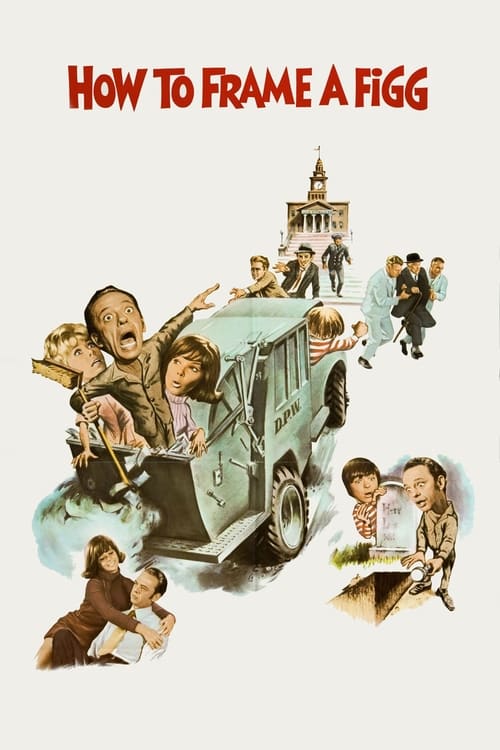
Hollis Fig (Don Knotts) is an inept bookkeeper working as an accountant at City Hall. The place is run by the Mayor (Edward Andrews), his staff, and the richest man in town who is also quite elderly, Charley Spaulding (Parker Fennelly). Together this bunch, unbeknownst to Figg, are skimming city funds. They decide though that they must cover their tracks by firing all of the other accountants and keeping only Figg who they deem as not smart enough to catch-on to what they’re doing. They also install a computer to do the bookkeeping and tell Figg it’s his job to maintain it, but nothing more. However, Figg and his friend Prentiss (Frank Walker) become suspicious when the computer readouts involving the city’s budget show that much of the money has gone missing. When Figg brings these findings to the mayor they divert his attention by hiring him a sexy secretary (Yvonne Craig) who will flirt so heavily with him that he’ll forget about everything else that’s going on, but this doesn’t sit well with Figg’s girlfriend Ema Letha (Elaine Joyce) who works across the street as a waitress.

This was the final movie produced from Knotts’ 6-picture deal that he signed with Universal in 1964 after he rose to fame in the ‘Andy Griffith’ TV-show. While none of the movies produced from that contract were very good this one has to be the weakest. The story is slow moving and lacks any action, or sight gags, which will bore most kids who are the intended audience. Visually it’s quite banal and looks like it could’ve easily been an episode for a TV-show with the biggest failing being that it was shot on a studio backlot, so the town is nothing more than propped up buildings. While it would’ve cost more shooting it in a real town it would also have given the production more of a distinct look, but at least it uses the same courthouse that was eventually also in Back to the Future.

Knotts is a funny guy, but he’s just playing the same Barney Fife caricature over and over and thus making everything that he does here quite predictable. Edward Andrews and Joy Flynn are both talented character actors, but together they end-up negating the other. In this instance Andrews totally dominates making Flynn’s efforts negligible and not worth appearing at all. Frank Welker, who later became a very famous voice artist including speaking for the Fred character in the ‘Scooby-Doo’ cartoons, makes for a strange buddy to Knotts since there was over a 20-year difference between the two and it shows. It would’ve been better if they were around the same age and Welker’s character not so painfully stupid as having two dimwits becomes tiring and monotonous.

I did however enjoy Yvonne Craig, best known for playing Batgirl on the ‘Batman’ TV-show, here she enlivens things as the vixen.  Parker Fennelly, who was 80 at the time, but looking more like 100, is very funny, and in many ways the best thing in the movie, as the crotchety, but still conniving codger, who violently slams down his cane when he gets angry and has everyone else at his beck-and-call.

Spoiler Alert!

Had the script not spelled everything out right at the start and instead had the viewer to see things completely from Figg’s perspective would’ve allowed for a few twists and surprises, but the way the plot gets presented here is quite routine. The ending, in which Figg and his new bride travel to Rio de Janeiro for their honeymoon and explicably bump into the Mayor and his staff who are hiding-out there is disappointing.  Do the bad guys ultimately escape justice, or does Figg figure a way to take them down? Or do they kill/kidnap Figg to keep him from talking? Either way none of this gets answered, which is a letdown. At least with the Disney films of that era everything would end with one big car chase, or ultimate showdown of some kind, which is what this film, as dull as it already was, sorely needed.

how2

My Rating: 1 out of 10

Released: February 2, 1971

Runtime: 1 Hour 43 Minutes

Rated G

Director: Alan Rafkin

Studio: Universal

Available: DVD

Think Big (1989)

thinkbig1

By Richard Winters

My Rating: 1 out of 10

4-Word Review: Truckers with big muscles.

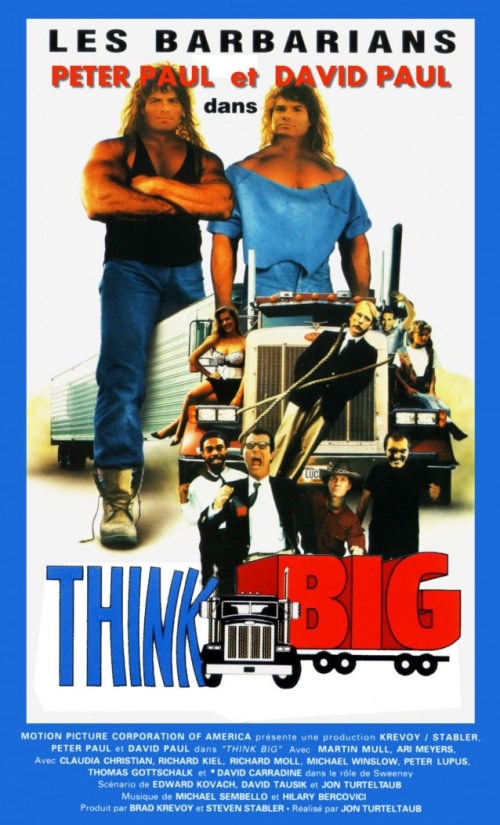
Rafe and Victor (Peter Paul, David Paul) are brothers who make a living driving a truck though they’re always missing the freight deadline to the constant consternation of their boss (Richard Moll). He gives them the ultimatum: either get this new delivery to its intended destination within 30 hours, or find a new job. Holly (Ari Meyers) is a teen genius who has invented a mechanism that can electronically deactivate any code allowing one to start, or stop any other device without having a key, or password to do it. When she finds out that the company she’s been working at, or more honestly enslaved at, wants to use her invention for unscrupulous means she escapes with her device in hand and then hides inside the brothers’ truck. Initially the brothers want to throw her out as they consider her presence a sign of bad luck, but eventually they help her out in her quest to avoid the bad guys.

The Pauls, who were bodybuilders before they got into acting, made their film debut in D.C. Cab, as The Barbarian Brothers, which lead to guest starring roles in TV-Shows like ‘Knight Rider’ that eventually got them starring in their own movie The Barbarians, that did well enough at the box office that producers gave them this comedic vehicle though it proved to be a disaster. Most of the problems lie with the silly script that’s filled with pseudo science, dated technology, and campy humor, which will amount to one long, continuous eye roll from the viewer.

The brothers are poor actors with their scenes in Natural Born Killers getting deleted because of what director Oliver Stone felt was shameless overacting, and their dialogue here doesn’t help. It’s one thing to be bit dimwitted, but these guys are infantile and their chicken bone chant that they do is highly redundant and annoying. For big guys they’re quite wimpy as they allow their boss to grab them by the neck and during fights they get punched by men who are far smaller and immediately fall down backwards by the power of the blow though you’d think in reality the person doing the punching would get their hand injured and they’d run-off hollering while these two big buys would remain standing. Their profession isn’t interesting either and puts to waste their big muscles. Instead of driving a big rig they should be working as club bouncers, or security for celebrities, or even just owning a workout gym.

The plot is also cluttered with villains. Martin Mull plays the head of the evil agency and while he does get a few funny ad-libs I didn’t feel his part was necessary. David Carradine, who plays this cantankerous repo man that tries to take back the brothers’ truck, gets wasted too. Initially I was surprised why a star with his stature would even appear in this though I did find him amusing and the caricature he creates to be colorful, but the stupidity of the script overshadows him and since he’s only seen sporadically his acting efforts get lost.

Richard Kiel was the one bad guy that I did like.  In his past roles he’s played the one who’s strong, but not bright, but in this film he’s the exasperated leader that gets irritated by the dummies around him. For this reason I thought he should’ve been the main heavy and Mull’s presence cut out completely. It’s also interesting seeing him take-on the Paul brothers as usually his physical presence dominates everyone else, but here it’s a much more of an even fight. I did though find it frustrating that we see him struggling to get out from underneath a car and the film then cuts away, only to see his character appear later, uninjured, with no explanation for how he got out of his predicament.

While Ari Meyers’, who’s best known for her work on the ‘Kate & Allie’ TV-show, acting isn’t the best she’s still easy-on-the-eyes and therefore should’ve been made the lead while the brothers could’ve been cast in support as these bumbling truckers she’d meet along the way, where their presence could be used as comic relief, but having the whole thing centered around them kills the movie right from the start. Throwing-in a sappy ‘life lesson’ speech at the end just makes it even worse and a genuine insult to the intelligence of anyone who sits through it.

My Rating: 1 out of 10

Released: October 23, 1989

Runtime: 1 Hour 26 Minutes

Rated PG-13

Director: Jon Turteltaub

Studio: Motion Picture Corporation of America

Available: VHS, DVD-R (dvdlady.com)

Overboard (1987)

overboard

By Richard Winters

My Rating: 1 out of 10

4-Word Review: Rich bitch loses memory.

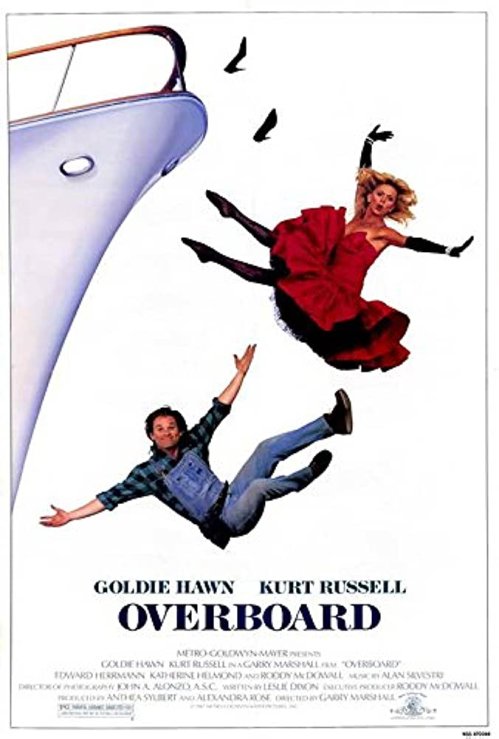
Heiress Joanna (Goldie Hawn) is a wealthy and snobby woman who hires Dean (Kurt Russell), a carpenter, to remodel the closet that she has on her yacht. Since Dean is a widowed father of four boys (Mike Hagerty, Jared Rushton, Jeffrey Wiseman, Brian Price) he’s more than happy to take on the job in order to bring in extra money, but Joanna, treats Dean poorly, is unsatisfied with his work and refuses to pay him. She ends up throwing him overboard with his tools. Later that night while still on the yacht she goes on deck to retrieve a lost ear ring and falls overboard causing her to hit her head and lose her memory. She is rescued and taken to a local hospital. News shows report on the incident along with pictures of Joanna asking if anyone knows who she is. Dean, who is with friends at a bowling alley, sees the report and concocts a scheme to take advantage of her amnesia by pretending she is his wife and bringing her to his home to do chores and take care of his kids in order to repay her debt to him. The  plan starts out seamlessly, but eventually she begins to bond with both the kids and Dean and then her real husband, Grant (Edward Herrmann) arrives at Dean’s residence in order to take her back with him.

Russell and Hawn began their real-life relationship while working on Swing Shift and wanted to do another picture together. This uninspired script, which was written by Leslie Dixon who had better success with Outrageous Fortuneis a misguided hybrid between Houseboat, a 50’s romantic comedy that starred Cary Grant and Sophia Loren, and Swept Away, a classic 70’s Italian film involving a rich, snotty woman stranded on an island with a working-class man. Unfortunately all nuance gets thrown overboard (pun intended) and we get left with the most extreme caricatures possible. While Hawn is certainly a fine actress her over-the-top character is too cliched and heavy-handed to be even remotely interesting or believable and the film falls hopelessly apart before it even gets going.

The basic premise is full of loopholes. The idea that just anyone could show up at a hospital and insist that some woman is his wife when that women shows no recollection of him and he’s able to bring her home without showing any type of documentation, marriage license, or photograph of the two together is beyond ridiculous. Just saying he recognizes a tattoo on her rear end wouldn’t be enough; maybe the two had a one-night-stand, but it wouldn’t be proof positive that he was married to her and yet for this hospital staff it was. Also, it’s very unlikely that Grant, Joanna’s real husband, would be able to get away with denying her existence as long as he does. He pretends he doesn’t recognize her when he goes to the hospital, so he can then bring young women onto his yacht to fool around with, but his friends and most certainly Joanna’s meddlesome mother, played by Katherine Helmond, would’ve seen the news reports too and gotten on him to go retrieve her, but for some reason in this movie rich people don’t watch the news only the poor folks.

Russell seems to enjoy his part, but like with Hawn his character is a tired caricature that’s not remotely original, or unique in any way. While the movie tries hard to get you to like him I still felt what he does with Joanna by tricking her into thinking she’s his wife was highly exploitive and not forgivable even when factoring in the poor way she had treated him.

The four boys are yet another issue. With the exception of the one who talks in Pee Wee Herman’s voice, which was apparently ad-libbed and not a part of the script, there was no distinction between any of them and they all could’ve been combined into just one. It’s also hard to believe that they’d all agree to play along with Dean and pretend she was their mother when they really knew she wasn’t as most kids are notorious for not be able to keep a secret. I was surprised too that the kids would all accept this new woman into their life and forget that their real mother ever even existed. These kids, or at least one of them, would’ve had some bonding with the real one and been reluctant to just let that go and welcome in her ‘replacement’. The kids were also used to having no rules and doing what they wanted while their dad was away at work, so having a new person come in out of nowhere and start enforcing discipline would most likely caused a rebellion instead of them all embracing this newfound orderly lifestyle.

Had the characters and comedy been more subtle like perhaps having the Hawn character not being a super rich heiress, but just a suburbanite living in a better part of town who has a slight disagreement with Russell when he comes to her house to do some work, then this idea might’ve had potential. However, as it is, the caricatures are too silly and overblown for any viewer with discernable tastes to get into. Also, for such slight and predictable material it takes way too damn long to play-out. Should’ve only been 80 minutes not almost 2-hours.

My Rating: 1 out of 10

Released: December 16, 1987

Runtime:  1-Hour, 52 Minutes

Rated PG

Director: Gary Marshall

Studio: MGM

Available: DVD, Blu-ray, Amazon Video
The Prize Fighter (1979)

prize1

By Richard Winters

My Rating: 1 out of 10

4-Word Review: Boxer wins rigged fights.

Bags (Tim Conway) is a former boxer who lost all 20 matches that he was in and now helps his former trainer Shakes (Don Knotts) train new fighters, but neither of them is having much luck. Bags decides to go back into the ring during an amateur fight night and this gets the attention of local crime boss Mike (Robin Clarke). Mike is trying to build a convention center, but is stymied by Pop Morgan (David Wayne) who owns a gym on the block Mike wans to build on and he’s refusing to sell at any cost. Mike decides to rig the fights that Bags is in, unbeknownst to both Bags and Shakes, to the extent that it looks like Bags is ‘unbeatable’. He then will entice Pop to bet on the fight that Bags has with the The Butcher (Michael LaGuardia). Pops will be under the presumption it’ll be a ‘safe bet’, but this time Mike won’t rig it and presumably Bags will go down and Mike will be able to get his hands on Pop’s gym and tear it down for his new building. 

While Knotts and Conway had success with their pairing in The Apple Dumpling Gangthis foray, an attempted parody of Rocky, goes nowhere. Instead of being filled with a lot of gags and pratfalls, which is what you’d expect, it’s a slow story filled with every cringy cliche from a fight movie out there. Comedy is supposed to make fun of the cliches instead of propping them up, but unfortunately that’s the approach taken and it bombs massively.

Comedy movies should also have all the characters be funny in some way, but here most of them are not. Possibly that was for vanity reasons as Conway, who also wrote the script, didn’t want to be upstaged, but this forces the viewer to go through long periods of trite drama in every scene that he’s not in. The supporting characters are extreme caricatures of the 1930’s which the film is set in. Robin Clarke is particularly annoying (not necessarily his fault as that was just the way the part was written) as he attempts to channel Al Pacino from The Godfather while speaking like a poor man’s Marlon Brando. David Wayne is cast to resemble Burgess Mereridith who was in Rocky (ironically both men played villains in the 60’s ‘Batman’ TV-show with Meredith as the Penguin and Wayne as The Mad Hatter). Here though Wayne speaks, in an effort to sound like Meredith, in a gravely voice that makes him sound like a duck. I also found John Myhers, who co-wrote the script, put-on Irish accent to be equally irritating.  

Even Knotts gets wasted. Some enjoy the moment where he cracks a bunch of raw eggs in a glass and then tries to force Conway to drink it, but other than that he doesn’t elicit too many laughs. Yes, Conway is amusing at times, but his perpetually clueless shtick gets a bit old by the end. The only performer that had me laughing was Mary Ellen O’Neill who plays Mike’s senile old mother and who does some wildly bizarre things while in Conway and Knotts’ presence. She’s a scene stealer and should’ve been in it more and while she’s at the boxing match as she watches the fight with Mike she should’ve continued to do weird things while the fight was going on, which outside of swearing she doesn’t, and it was a missed opportunity.

I will give credit for the climatic bout, which is surprisingly well choreographed and effectively has a large crowd watching, which gives it an electric atmosphere, but everything else falls flat. The irony I suppose is that the film ended up being a money-maker and in fact was one of the most successful films released by New World Pictures, but I think this was mainly because a lot of people went to it based off the reputations of the two stars more than the movie itself being good. I remember I went with my dad and two siblings to see it at the local theater because we were fans of Conway and Knotts, but all of us, our dad included, were quite bored and went home unimpressed and it clearly hasn’t improved with age. 

My Rating: 1 out of 10

Released: November 16, 1979

Runtime: 1 Hour 39 Minutes

Rated PG

Director: Michael Preece

Studio: New World Pictures

Available: DVD


Ghosts That Still Walk (1977)

ghosts

By Richard Winters

My Rating: 3 out of 10

4-Word Review: Teen possessed by ghost.

Mark (Matthew Boston) is the 15-year-old son of Ruth (Caroline Howe) who is a researcher that specializes in astral projection. She goes out one day to an abandoned cave and brings home the decayed corpse of an ancient Indian Medicine Man and attempts to speak to the ghostly spirit that she feels is still inside it. Mark catches her talking to it when he comes home early from school and this sight spooks him enough that he runs away. When he eventually does return he begins to behave erratically and his concerned grandmother (Ann Nelson) sends him to a psychiatrist (Rita Crafts) who tries to get to the bottom of the matter.

This film, while not very good, is unique in several ways in that it’s one of the few horror movies that could be watched by the entire family. The mild frights are in the supernatural vein that may spook a child, who I believe was the intended audience, slightly, but won’t traumatize. This is also a rare horror film that features no blood, no gore, no nudity or swearing, and no psychos, or monsters. It also has virtually all of the scenes taking place outside in the bright sunlight versus doing them in the dark of night like with most scary movies. This marks as well the film debut of Ann Nelson, an elderly actress who went on to play a lot of old lady roles in TV-shows and movies during the 80’s and here as a hyper-anxious, deeply religious grandma is entertaining and helps give the film a few more points.

Reviewers on IMDb all seem to remember one specific scene that stands-out that stood out to them, which is the moment where boulders roll across the flat desert terrain by a invisible force, which is indeed a cool visual. However, I didn’t like the way they would conveniently bounce-up and avoid the camper that the old couple are driving in versus having one of the boulders come directly towards the camera and crash into the windshield, which would’ve been effectively dramatic.

Other scare segments don’t work as well. The scene where the camper begins driving itself goes on too long and isn’t as intense as it could’ve been as it’s done on a deserted highway and would’ve been more exciting had we seen the vehicle going into oncoming traffic. Cutting back-and-forth to the grandma getting bounced around on the interior walls as it drives crazily elicits unintended laughs instead of tension.

It’s also confusing as to who the main character is supposed to be. It starts out with the kid, who’s likable enough, but then he goes away for a long period and we get stuck exclusively with the elderly couple in a flashback bit and then it segues to the mother and in-between there’s extended scenes, with voice-over, of the psychiatrist as she researches the case. The kid, who I liked best, finally comes back near the end, but it’s not enough to save it and the way it gets structured here makes it seem like 4 different stories that get awkwardly merged instead of having one protagonist throughout.

The ending peters-out with a fizzle giving the viewer no climactic pay-off at all. The title is also goofy as I didn’t think ghosts walked, but instead floated.

My Rating: 3 out of 10

Released: September 25, 1977

Runtime: 1 Hour 32 Minutes

Not Rated

Director: James T. Flocker

Studio: James Flocker Enterprises

Available: VHS, DVD-R (dvdlady.com)