Category Archives: Movies Based on Novels

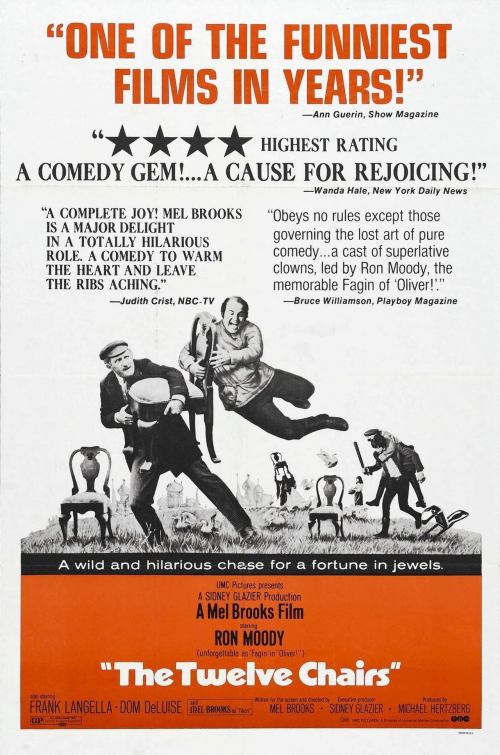
The Twelve Chairs (1970)

twelve

By Richard Winters

My Rating: 7 out of 10

4-Word Review: Which chair has fortune?

Vorobyaninov (Ron Moody), an poor man living in 1920’s Russia, is summoned to the deathbed of his mother-in-law. She confides in him that there’s a stash of priceless jewels sewn into the seat cushions of one of the twelve chairs from the family’s dinning room set. Unfortunately the newly formed Russian state has appropriated all private property and it’s up to Vorobyaninov to track them down. He teams up with Ostop (Frank Langella) a local con-man to help him, but they have competition. Father Fyodor (Dom DeLuise), a priest, also becomes aware of the jewels when he goes to the mother-in-law’s home to give her the last rites. All three go on a mad dash to retrieve the jewels, but the more chairs they manage to find the more frustrated they become.

The film is based on the 1928 Russian novel of the same name by Ilf and Petrov a famous duo who were quite popular during the early soviet period and wrote not only many satirical novels, including this one and its sequel ‘A Little Golden Calf’, but also several short stories, articles, theatrical plays, and even screenplays. The Twelve Chairs novel though was their most popular and has been made into a movie 18 different times. It had already been done 6 times before Mel Brooks did his with the first version being in 1933 and the most recent rendition of it done in 2013 in Italy.

This version is the most popular and a bit of stretch from Brooks’ other films, which relied on a lot of gags and slapstick. This one has its fair share of those though the first act is quite talky and not too much going on. Brooks himself appears as a character, but he can’t really enliven it. It’s not until the men finally come upon the chairs and start tearing them up one-by-one that it really starts to get funny. The chair thing could’ve gotten redundant as the men rip open the seat cushions in pretty much the same quick way, but Brooks manages to approach each of these scenes in a creative way, so instead of becoming monotonous it remains fresh and comical. My favorite of these is when Ron Moody and Frank Langella chase Dom, who has one of the chairs, through an open field that’s done in stop-action.

The film’s detraction though is the casting of the two main characters. Langella is a terrific actor, but not in comedy. He did appear in the dark comedy Diary of a Mad Housewife, where he was very good, but that took advantage of his glib demeanor and pouty expression and his character there was meant to be unlikable. Here though he has nothing amusing to say and remains a complete jerk the whole way. There is one point where he and Moody are in a row boat and Moody states that he’s cold and Langella gives him a jacket to wear, which I guess was Brooks’ attempt to make him likable, but it’s not enough and the movie is really hurt by spending so much time focused on a guy who’s one-dimensionally cold and responds to antics around him in the same sneering way. He was recommended to Brooks by his wife Anne Bancroft who had performed with Langella in a Broadway play that had a short run, but I felt this is one time when he shouldn’t have listened to her.

Ron Moody, a talented actor as well, has the same issue. The character is meant to be dim-witted, but it doesn’t come-off in a natural way. His banter with Langella is flat and annoying with the bickering doing nothing but slowing up the pacing. Without question DeLuise is the funniest. He’s just as conniving and greedy as the other two, but for whatever reason it doesn’t seem as ingratiating. His character’s ineptness had me laughing and he should’ve been the star while Langella and Moody could’ve been shown only sporadically as the occasional nemesis.

Spoiler Alert!

The ending is much different than the one in the book. In the novel version Vorobyaninov kills Ostap by slitting his throat with a razor in order to keep the loot for himself only to find that it’s not there, so he then goes insane. In the movie Vorobyaninov and Ostap team up to become beggars on the street by pretending Vorobyaninov has an epileptic condition and requesting people throw money at him to help him. Wikipedia, in a line that has since been deleted, stated that this was a ‘happier’ ending though trying to make a living being a street beggar all day can’t be all that fun.

What amused me though is that in both versions the jewels are never recovered by the two men. In the movie the jewels were found first by someone else who used it to build a clubhouse for pompous old men making it seem like greed was inevitable. In the book though the money gets used to build a recreational center that can be used by the entire community and thus giving it more of a pro-communist bent.

My Rating: 7 out of 10

Released: October 28, 1970

Runtime: 1 Hour 33 Minutes

Rated G

Director: Mel Brooks

Studio: UMC Pictures

Available: DVD

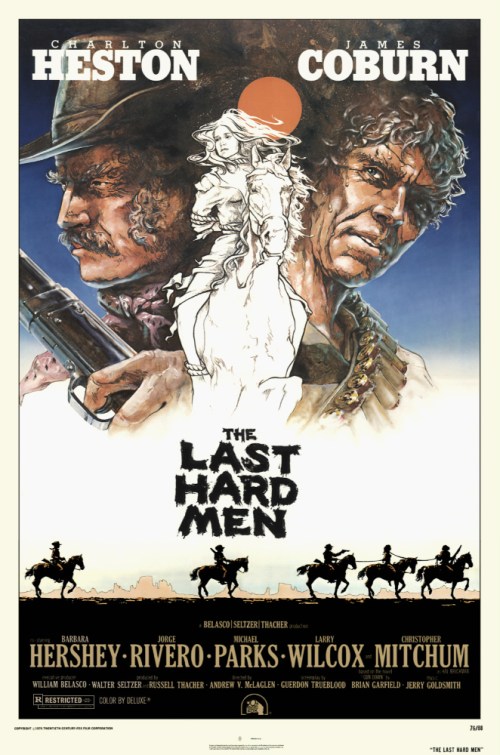
The Last Hard Men (1976)

lasthard

By Richard Winters

My Rating: 3 out of 10

4-Word Review: Kidnapping a lawmen’s daughter.

Based on the 1971 novel ‘Gundown’ by Brian Garfield who’s better known for having written Death Wish, the story is set in 1909 and centers on Sam Burgade (Charlton Heston) a retired lawman living with his grown daughter Susan (Barbara Hershey) who is engaged to Hal (Christopher Mitchum). They though are tormented by Provo (James Coburn) and his gang who have just busted out of a Yuma prison. Provo seeks revenge on Sam because years earlier Sam killed Provo’s Indian wife during a shoot-out. Provo though doesn’t want to just kill Sam, but instead inflict the cruelest revenge possible by kidnapping Susan and then having his men gang rape her while both Sam and Hal are forced to watch.

A stale, unimaginative approach that lacks any atmosphere and makes getting into it rather hard. Coburn and Heston are given equal screen time, so it’s confusing who we’re supposed to be rooting for. Sure Coburn has dark motives, but he also at one point gets rid of one of his own men (Robert Donner) for being a racist, so he’s not completely bad. The film’s biggest transgression is that it never shows, via flashback, the crucial shoot-out between the two that caused Provo to get so angry. Just having Heston briefly describe the incident to his daughter is not enough we needed to see what happened for ourselves especially since Heston becomes downright skittish about what went on and like maybe he had something to hide. Without having it played-out the movie lacks much needed context.

Coburn is a personal favorite, but as the protagonist, which he always does quite colorfully. As the villain it doesn’t work and he seems unable, or unwilling to go to the nasty depth that the script demands and instead leaves this to his henchmen, played by John Quade. Heston is adequate and Mitchum (Robert’s son) certainly displays a youthful, wide-eyed quality and it’s intriguing seeing how he grows from a young man who doesn’t seem rugged enough to take on the challenge to eventually proving himself.

In support I enjoyed Larry Wilcox, but known for starring in the ‘CHIPS’ TV-show, as he’s one of the evil henchmen that manages to show some redeeming qualities and it’s genuinely sad when he gets shot. While I’m a fan of Hershey and appreciated how she took a stretch here by playing a part outside her comfort zone I still felt she was miscast. The character needed to be sheltered and helpless in order to get the viewer to care about her predicament, but she’s too savvy and streetwise from the start making it seem like she can handle matters and take care of herself, which lessens the tension. Having her grow into becoming this way during the ordeal would’ve been more interesting.

Spoiler Alert!

The third act does have a few moments that enliven things including a large bush fire that gets started by Heston that traps Coburn and his men, but the scene that really stood out is the gang rape of Hershey, which gets done in slow-motion on the side of a hill. I’ve seen many films that feature a rape, but never done in this way, which almost gives it a sort-of lyrical quality and the only thing from the movie that stands-out. Yet even this gets botched as Heston doesn’t run out from his hiding spot to save his daughter when it occurs making it seem like he might’ve been cowardly and this was a personality trait he had been hiding only for us to learn that it was because Mitchum who knocked him out, but this seemed implausible. Heston was much bigger than Mitchum and proved to be far more astute than him in everything else, so why would this be the one moment when the young kid would be able to overpower him?

The story would’ve been more intriguing had this moment exposed a flaw in Heston’s character, which would’ve given this otherwise one-dimensional story the depth and unexpected twist that was needed and it’s just a shame it didn’t take it. Certainly if put in better hands this is the kind of material that could have strong potential, but the way it gets played-out here, even with the violent moments, it’s boring and a disappointment.

My Rating: 3 out of 10

Released: June 1, 1976

Runtime: 1 Hour 37 Minutes

Rated R

Director: Andrew V. McLaglen

Studio: 20th Century Fox

Available: DVD, Amazon Video, YouTube

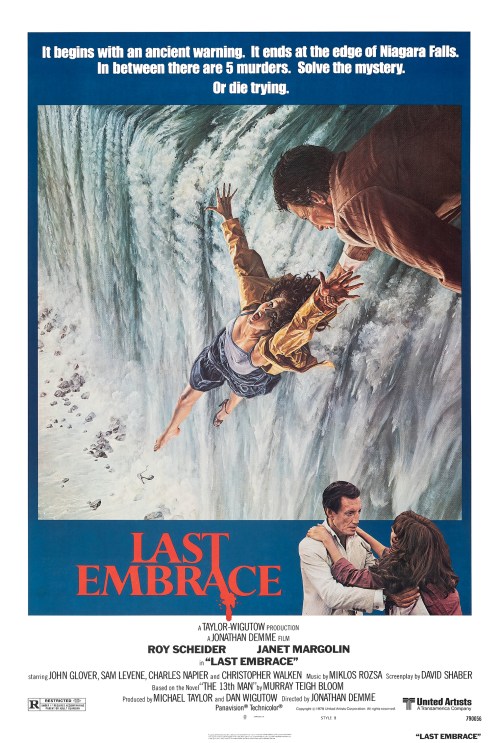
Last Embrace (1979)

lastembrace

By Richard Winters

My Rating: 7 out of 10

4-Word Review: Someone wants him dead.

Loosely based on the novel ‘The 13th Man’ by Murray Teigh Bloom the story centers around Harry (Roy Scheider) a government agent who has a nervous breakdown after his wife gets killed during a shootout while he was on a secret mission. After spending time in a sanitarium he gets out to realize that his agency no longer has any assignments for him and he fears they may want him dead while trying to make it look like an accident. When he gets back to his apartment he finds that it’s been sublet to Ellie (Janet Margolin), a doctoral student at Princeton University. He tries to get her to move-out, but can’t and then starts to receive threatening notes in Hebrew and uses Ellie’s background in that language to help him decipher what they’re saying. Soon the two go on the run convinced that the same person after Harry may also now be targeting Ellie, but nothing is exactly as it seems.

Jonathan Demme, despite his immense talent and admirable film output, never received name recognition and for the greater part of his career failed to have a hit at the box office. In fact it wasn’t until the success of The Silence of the Lambs that he even became a sought after Hollywood commodity. Even then when most people think about that movie it’s Anthony Hopkins, or even Jodie Foster that comes to mind while Demme’s directorial efforts seem overlooked. In many of his interviews this was his biggest complaint and that no matter what he did he could never break-out of the bubble to have his name put over the title like with Spielberg, Scorssese, or Hitchcock. I could understand his frustration as his movies were step above your basic indie flick and while not perfect still had far more going for it than a usual B-picture and if anything this film should’ve been the one that got him noticed.

There’s been many Hitchcock imitations with a lot of them done by Brian Di Palma, but those seemed overdone while this one gets just the right balance. The on-location shooting is splendid with my favorite moments being at Princeton University bell tower and of course the climactic sequence at Niagara Falls. I’ve personally been to the falls, but found this movie made me feel closer and more immersed in it than in person especially with the sequences shot inside the Robert Moses Niagara Power Plant and another done in the Cave of the Winds, which is what really makes the film stand-out. The music score by Miklos Rozsa, has the perfect blend of what would’ve been used by Bernard Herrman, which was Hitch’s main composer, which helps to make this seem like a movie Hitch himself could of very well done himself.

Scheider’s acting is good as he’s constantly cranky and irritable, which anyone going through his situation would be, so it was realistic and relatable, but I really hated the white suits that he wore. For one thing the guy was out of work and no longer a professional agent, so why he felt the need to dress-up all the time when he really wasn’t on the job anymore didn’t make much sense. Why they were all white was even more head-scratching. Outside of Pat Boone I don’t know of anyone who wears a white suit and it made him stand-out in all the wrong ways. If this guy is afraid that he’s being targeted then he should be dressing down so he could then blend-in, which in this movie he definitely wasn’t.

Margolin, best known for her work in the landmark indie flick David and Lisa, is good too especially with her dual personalities where she plays a nerdy student and her alluring, sexy vamp alter ego at other points. She though was not the original choice for the part as Demme wanted Lynn Lowry, who had been in his previous film Fighting Mad, but Scheider, who was dating Margolin at the time, preferred her and studio backed him on it forcing Demme to drop Lowry, but out of guilt he still paid her and allowed her to collect residuals despite her never appearing in any of it.

Spoiler Alert!

The plot is fast-moving and well crafted and keeps you guessing while also introducing a wide array of new twists without ever getting too confusing. The final twist though, in which we find that Ellie is the one after Harry and has been murdering other men as well in a revenge plot for what Harry’s and the other men’s grandfathers did to her grandmother who was gang raped by them at age 15. The idea was to tie the Ellie character to the Biblical avenger of Goel, which sounds cool, but ultimately an overreach. Had Ellie been raped directly by these men then I could see her going out of her way to seek rough justice, but doing it all for a grandmother she barely knew just didn’t seem all that believable. Also, how does this then ‘right the wrong’ by taking vengeance out on the grandchildren of the men who committed the actual crime? The grand kids had no control over what their grandparents did and weren’t even around when it happened, so how is any of this fair, or even make sense?

A better way to have ended it was to have Ellie portrayed as being a crazy kook going after these men due to a belief in some conspiracy theory only for the viewer to finally realize that she was an actual rape victim and Scheider, who we thought was this good guy, was instead the villain. Since she was raped at 15 her features could’ve changed, which would thus explain why Scheider didn’t recognize her initially. With a movie so compelled to have one twist after the other, this would’ve been the ultimate jaw-dropper. It’s just a shame they hadn’t chosen this route as the film, as slick as it is most of the way, leaves the viewer with an empty feeling after it’s over.

My Rating: 7 out of 10

Released: May 4, 1979

Runtime: 1 Hour 42 Minutes

Rated PG

Director: Jonathan Demme

Studio: United Artists

Available: DVD, Blu-ray, Tubi

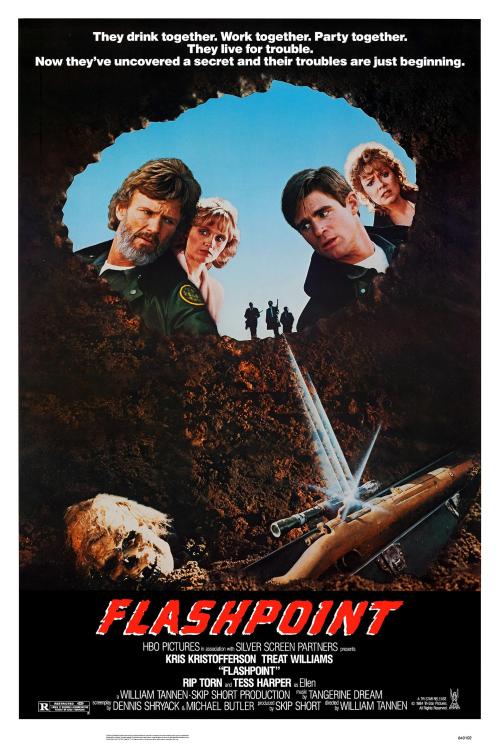
Flashpoint (1984)

flashpoint

By Richard Winters

My Rating: 4 out of 10

4-Word Review: Digging up hidden money.

Bobby (Kris Kristofferson) and Ernie (Treat Williams) are border patrol agents who stumble upon a jeep buried in the sand. Once Bobby digs it up he finds a skeleton in the driver’s seat, a scoped rifle, and $800,000 inside a rusted toolbox. Both of them are unhappy in their jobs and Bobby thinks this would be the perfect time to skip town with the loot, but Ernie thinks it’s stolen money and needs to be investigated. Since the bills are all marked with the dates of 1962 and 1963 they presume this is around the time when the bank robbery, which is where they think the deceased driver got the money from, occurred, but upon an old newspaper research at their local library they can find no such robbery happening in the amount that they recovered. Soon they face more problems when a federal man named Carson (Kurtwood Smith) takes over the agency they work at and exerts extreme control over everything they do. Bobby feels Carson is somehow aware of the money they found and knows more about the driver’s identity than he lets on. While Bobby and Ernie hide the money they find Carson and his team of secret agents hot on their path as he sends them on dangerous missions in an attempt to kill them, so they won’t let on to anyone else about what they’ve found.

This is another example where an intriguing story idea, based on the novel of the same name by George LaFountaine, almost gets ruined by lackluster direction. The mystery is interesting enough to keep you invested but there are definite lulls and cheesy side stories that seem to be challenging the viewer to turn it off before it’s over. This was also another case where the setting is supposedly Texas, which gets mentioned quite a bit, and yet it was all filmed in and around Tucson, Arizona, which is a travesty especially since the deserts of Arizona and Texas have noticeably different characteristics. I also felt that if you’re going to have a story based in the desert you should then have the time period during the summer, instead of the winter like here, where the scorching heat could be used as an added element.

Kristofferson isn’t particularly well cast here in a part that was originally intended for Paul Newman. His laid-back style of acting isn’t riveting enough though I’ll give him props for the scene where he gets shot and must crawl several yards in the dirt with one arm that he can’t move due to it being paralyzed by the bullet, which looks quite arduous to do though he does it effectively and realistically. Williams is by far the superior actor and his distinct personality where he’s the idealist, plays-off well from Kristofferson’s more jaded mindset. You even get a full view of Treat’s bare ass, which comes near the beginning and while nobody necessarily asked for it and wasn’t needed to propel the plot some may enjoy it and as male asses go it’s not too shabby.

Rip Torn, whose hair is dyed gray, does well in support where his strong Texas drawl works nicely in the supposedly Texas setting. While he’s only seen sporadically during the first two acts, to the point where I started to wonder why he even bothered to take the role as it seemed miniscule and pointless, he does come on strong during the finale. Kurtwood Smith though is dull, which isn’t exactly his fault as the part is written too much like caricature, and every successful movie needs an interesting and memorable villain, which this one clearly isn’t.

While the action is fleeting it does have one good stunt, which features Treat trying to prevent a plane, which they think holds drugs, from taking-off by reaching in through the window of the cockpit and forcing the pilot to land it. It had me holding by breath, but it got ridiculous when the plane crashes and explodes, but Treat gets saved when he supposedly jumps off and into a lake, but you don’t see this occur and the other men all presume he went down with the plane only to have Treat jump out of the water intact, but if he had dived into the pool then the water would’ve had a ripple effect from where he went in instead of it being calm and placid like it is.

Spoiler Alert!

The twist at the end in where the money and driver of the jeep are connected to the assassination of John F. Kennedy is cool though it leaves more questions than answers. Of course that might’ve been the intention, but still I feel this is a good enough story idea that it should be revisited with a better director and hopefully one day someone talented will decide to remake it in a way that’s more intriguing than what we get here.

My Rating: 4 out of 10

Released: August 31, 1984

Runtime: 1 Hour 33 Minutes

Rated R

Director: William Tannen

Studio: TriStar Pictures

Available: DVD-R

Who’ll Stop the Rain (1978)

wholl

By Richard Winters

My Rating: 8 out of 10

4-Word Review: Drug deal gone bad.

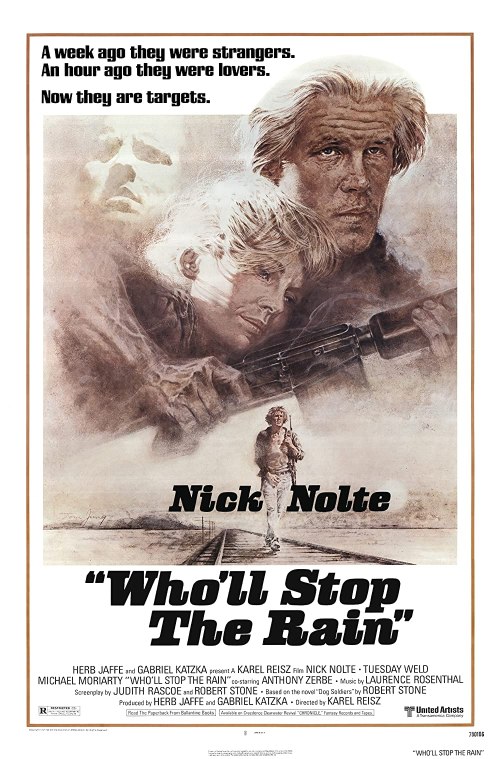
John Converse (Michael Moriarity), a war correspondent working in Saigon, approaches his friend Ray (Nick Nolte), a merchant marine, about smuggling a large bag of heroin out of the country and into the US. Ray has dealt marijuana before, but never the hard stuff and is reluctant at first, but due to his friendship with John he eventually agrees. He is told to go to San Francisco where he’ll drop-off of the drugs for payment with John’s wife Marge (Tuesday Weld). Once he gets there though he realizes he’s been followed forcing both he and Marge to go on a dangerous trip to not only elude the bad guys, but also get rid of the incriminating evidence.

The film is based on the 1974 novel ‘Dog Soldiers’ by Robert Stone, who also co-wrote the screenplay. The theme of the novel was to examine the loss of optimism and youthful ideals of the 60’s and the beginning of the age of cynicism that came during the 70’s, which for that purpose the time period should’ve been 1970 as keeping it in the present day, in this case 1978, makes it seem a bit dated and losses the context of the message. The story itself though is still quite engrossing with some of the most disturbing scenes being the ones dealing with a young, affluent suburban couple (James Granna, Timothy Blake) going to a drug party of sorts that had Ray, Marge and Ray’s friend Eddie (Charles Haid) who give them illicit substance for the first time and their immediate hallucinogenic reaction I found both frightening and impactful.

The performances are uniformly excellent especially Nolte, who was not yet an established movie star and the producers wanting instead Kris Kristofferson for the role only to finally give-in after the persistent lobbying of director Karel Reisz. Tuesday Weld is also dynamic falling into the role of a drab, middle-aged housewife with ease and completely losing the young, sexy starlet appeal that she had previously. My favorite though was Moriarty, whose glazed over eyes and emotionless demeanor perfectly reflects the apathy and soullessness of his character.

On the downside I found the character’s motivations to be confusing particularly the way Marge, who did not know Ray before this, agrees to go with him as he tries to outrun the baddies, but how would know she could trust him, or that he wasn’t in on the scheme? When she dropped her child off with some friends that’s where I felt she should’ve also gone and going back into Ray’s car, instead of calling the police, or advising her friend to do so, seemed reckless and too trusting that this stranger had her best interests at heart. In the book Ray’s intentions are not quite as noble as he decides to bring Marge along more for insurance as he think’s he’s been double-crossed by John, but presumes with Marge along he can use her as a decoy, while in the film it’s because he’s genuinely concerned for her safety. Marge too is betrayed differently as she’s not aware of the drug deal in the film, but in the book she was and I felt these nuances should’ve been brought up in the movie and the fact that they aren’t makes it less realistic and losses the whole point of the story.

John’s relationship with Danskin and Smitty (Richard Masur, Ray Sharkey), the two henchmen to corrupt FBI agent Antheil (Anthony Zerbe) gets botched too. For one thing the make-up effects are too slight as John is put through a wide array of physical tortures by the two in an attempt to get him to tell them where the heroin is and yet after it’s all over the only sign of the struggle is a slight cut on his forehead when instead his entire face should’ve been severely bruised, bloodied, and swelling. Afterwards he becomes too palsy with them even reading a book in their presence and joking around though you’d think he’d remain frightened after what they put him through and never letting down his guard in their presence because he’d know their violent side. I also didn’t like how the two start out as nasty criminals, but by the end become clueless comic foils, which hurts both the tension and grim realism.

The film though does recover especially in the final act when Ray takes Marge to an isolated cabin in New Mexico to hide-out in and then are followed by the villains culminating in a unique showdown. The isolation of the place, which sits amongst the beautiful mountains of the region is both picturesque and tranquil, and is based off of author’s Ken Kesey’s home in California where he wired the nearby trees with lights and sound effects to enhance their LSD experiences, and thus this creates an interesting battle between Ray and the thugs as he uses these same props to disorient them and it helps the movie stand-out with its memorable conclusion.

My Rating: 8 out of 10

Released: August 11, 1978

Runtime: 2 Hours 6 Minutes

Rated R

Director: Karel Reisz

Studio: United Artists

Available: DVD, Blu-ray

Starting Over (1979)

starting1

By Richard Winters

My Rating: 7 out of 10

4-Word Review: Can’t get over ex.

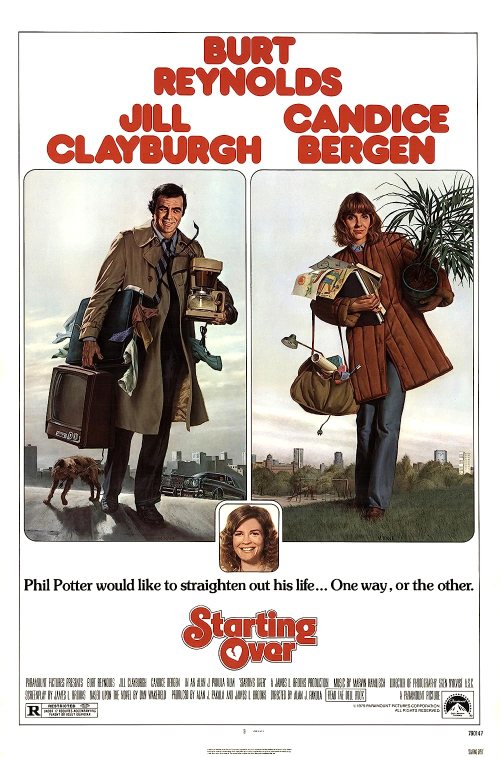
Phil (Burt Reynolds) gets a divorce from Jessica (Candice Bergen), a successful songwriter, when he finds out she’s been having an affair. He then moves to Boston where his brother Mickey (Charles Durning) and sister-in-law Marva (Frances Sternhagen) set him up with Marilyn (Jill Clayburgh) a nursery school teacher. They don’t initially hit-it-off, so he instead goes out with Marie (Mary Kay Place), but that doesn’t go over well either, so he again calls up Marilyn and this time she relents. Despite the usual ups-and-downs things between them begin to gel and soon they decide to move in together only to have Jessica reappear wanting to get back with Phil and Phil becoming torn as to what he should do.

Based on the novel of the same name by Dan Wakefield with a screenplay by James L. Brooks best known for producing the classic TV-show ‘Mary Tyler Moore Show’. Like with that show the story focuses heavily on the pitfalls of dating life with much of it on-target though it does have a serious out-of-touch quality that’s no longer in-tune with today’s generation. The big one is that they meet on their first date inside the women’s apartments, which because of safety concerns doesn’t happen much now and usually it’s always advised to meet in a public setting and not give out personal addresses until you really get to know the person better. There’s also a scene where Jessica, who wears a highly revealing outfit, meet in Marilyn’s apartment and have what we’re told is a civil three hour conversation though in this day and age it’s hard to believe two women, knowing that the other one is clearly after ‘their man’, could be that composed and most likely a fight would break-out and I’m kind of surprised knowing how emotional Marilyn was and wearing her insecurities on her sleeve, that one didn’t happen here.

On the flip side there’s some terrifically funny moments.  One is when Marilyn and Phil initially get off the bus together, before they’ve officially met, and she thinks he’s a stalker, which has a good true-to-life feel. Another great scene is when Phil and Marilyn briefly break-up and he goes to her school, where they’re having a dunk-a-teacher water party and he manages to hit the bullseye with the ball he’s throwing and she’s goes into the water repeatedly before eventually losing her cool and swearing. Phil’s anxiety attack inside a department store is memorable too as his Jessica’s call to Phil at his apartment while he’s serving Thanksgiving dinner to Marilyn and his guests, which creates quite the awkward moment. Phil’s first date with the aggressive Marie is a terrific bit too.

The acting is top notch especially Clayburgh who creates the perfect composite of single women during the 70’s who desperately wants to get into a relationship, but many times allow her fears and anxieties to get in the way. Reynolds is excellent playing against type. Normally he’s a brash womanizer, but here he’s far more reserved and indecisive.  This is also the last movie where he didn’t have his patented mustache and I felt he looked way better and younger without it. Even Bergen, in a much smaller role, is memorable particularly with her off-key renditions of the songs her character has written.

Overall I consider this one of the best romantic movies made. I will admit a modern remake would give the story a more timely update, but the situations nicely reflect the dating conundrums that affect us all.  My only complaint would be with the Clayburgh character, who seemed too insecure to be able to get into a healthy relationship. Most guys would be scared off with her constant emotional outbursts and accusations and I didn’t see why Phil stuck with it. This is one instance, especially since Phil was pretty much a hunk, that I felt the woman he fell for should’ve been better looking, or at least equal to the Jessica character that he left. I just couldn’t understand exactly why, being that there were a lot of women who could easily get into him, he’d choose, or settle for, Marilyn over all the others. Had they had more in common then maybe, but she came-off like a woman who would eventually become a cat lady and too emotionally needy to be someone you could have a long term relationship with.

My Rating: 7 out of 10

Released: October 5, 1979

Runtime: 1 Hour 45 Minutes

Rated R

Director: Alan J. Pakula

Studio: Paramount Pictures

Available: DVD-R, Amazon Video, YouTube

The Onion Field (1979)

onion2

By Richard Winters

My Rating: 7 out of 10

4-Word Review: Guilt over partner’s death.

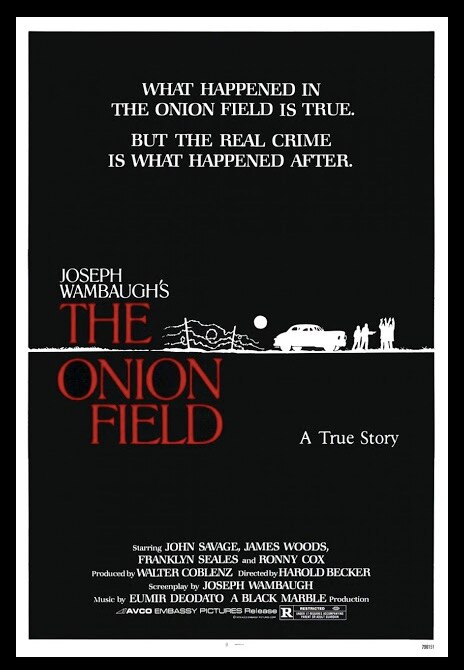
Los Angeles police detectives Ian Campbell (Ted Danson) and Karl Hettinger (John Savage) are on-duty driving around in an unmarked police car when they spot two men, Gregory Powell (James Woods) and Jimmy Smith (Franklyn Seales), driving suspiciously, so they pull them over. While Campbell is talking to Powell, Powell is able to pull out a gun he had hidden in his trousers forcing Campbell to drop his weapon. Hettinger is then told to give up his weapon as well, which he does, or risk seeing his partner get shot. The two cops are then taken at gunpoint to an remote onion field where in the darkness of night Campbell is shot and killed, but Hettinger escapes and manages to run 4 miles until he finds someone and gets help. While the two criminals are eventually apprehended and found guilty it is Hettinger that suffers the most from the guilt of surviving when his friend and partner didn’t and from the humiliation of being the subject of a police video detailing what not to do when stopping a vehicle, which leads him to a severe mental breakdown in both his personal and professional life.

The story is based on the actual incident that occurred on March 9, 1963 with the traffic stop happening on the corner of Carlos Avenue and Gower Street in Hollywood and the murder happening off of Interstate 5 near Bakersfield. It was written into a novel by former cop turned author Joseph Wambaugh in 1973. I remember reading it when I was 14 and finding it captivating from beginning to end. While the film stays faithful to it I still felt it wasn’t as effective and in a lot of ways not as gripping. Even though it was a long time ago I remember the part about Powell’s ‘disguise’ where the only thing he changed about his features was putting a distinctive mole on his left ear lobe, which sounded completely absurd. This is discussed in the movie, which gets a subtle eye roll from Smith his partner, but the irony is, which is talked about in the book and not the film, is that the witnesses from the robbery that Powell was in described the mole to the police and this litrerally threw the detectives off for awhile as they kept searching for a man with a distinctive mole that Powell had since removed, so as silly as it sounded, his idea had actually worked, but the movie never gives this pay-off.

The chase through the onion field is also really hurt. I remember finding this section the most captivating part of the book and finding it a truly tense and horrifying moment that seemed to go on forever and a major element of the story, but in the movie this moment gets trimmed down significantly. Years ago, when I first saw the movie on TV, I thought it was because they had edited it down due to time constraints in order to get more commercials in, but when I finally viewed the full version on DVD I found this wasn’t the case. For whatever reason the chase in the onion field lasts for only a few minutes and not done from Hettinger’s perspective, which is what made it such an intense reading and it’s a real shame as it makes the movie much less impactful then it could’ve been. It turns the whole onion field incident into a side story instead of the main event.

The performances by Woods and Seales are outstanding and the element that really gives the film its energy they also look exactly like the people they’re playing to the point it’s almost freaky. Woods is especially creepy and he literally demands your attention with each moment he’s in it. Seales though, whose career never really took off and he died at the young age of 37 from AIDS, is excellent too as he plays someone who is very timid especially when initially with Powell, but brazen at other points and the way his and Powell’s relationship evolves both through their criminal and then when behind bars is quite fascinating. The scream that he lets out when Campbell gets shot, which was not in the script and completely improvised, has a very riveting effect and the one thing about the film that I had remembered from watching it decades earlier.

Unfortunately the two leads, the people we’re supposed to be the most connected with, are quite boring. It’s not like it’s the actors faults either. Danson, this was his film debut, is not bad, but his character isn’t fleshed out enough. Other than enjoying playing the bagpipes we don’t learn much else about him and nothing he says his captivating, or interesting. The same with Savage his inner turmoil and mental breakdown really doesn’t have the intended emotional impact in fact his moments bogs the movie down and you can’t wait until they get back to the bad guys who as rotten as they are what gives the movie its liveliness. I realize that Wambaugh felt it was very important to get Hettinger’s story out there and it was the whole reason that motivated him to write the book, but I came away feeling, at least movie wise it would’ve worked better had it just focused on the two crooks and their weird ‘friendship’.

On the whole it’s still an adequate production that holds enough interest and makes some good points about an important event that shouldn’t be forgotten, but at times it also seems like an overreach. Wambuagh’s insistence that everything be as accurate as possible gives the narrative a cluttered feel particularly with all the various court proceedings with each one having a different set of attorney’s, judges, and courtrooms which becomes dizzying instead of riveting. Pairing certain elements down would’ve helped as it’s not quite a completely effective, despite the great effort, as it could’ve been and without question another incidence where the book is far better.

My Rating: 7 out of 10

Released: September 19, 1979

Runtime: 2 Hours 6 Minutes

Rated R

Director: Harold Becker

Studio: AVCO Embassy Pictures

Available: DVD, Blu-ray

Reuben, Reuben (1983)

reuben1

By Richard Winters

My Rating: 6 out of 10

4-Word Review: Housewives lust for poet.

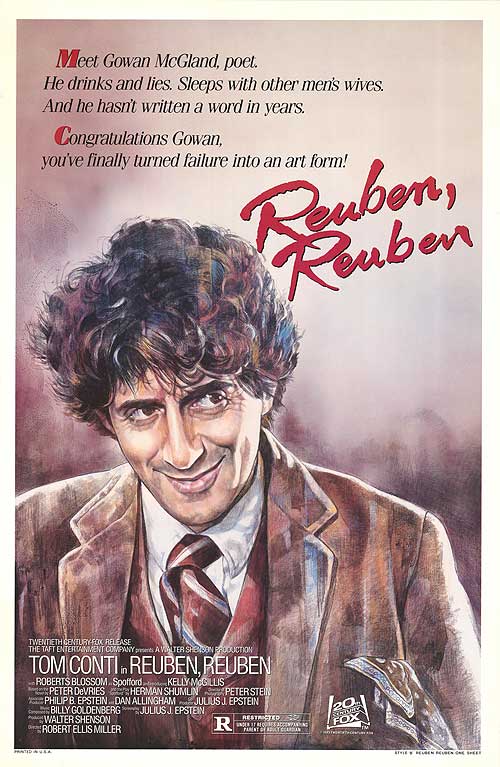
Gowan (Tom Conti) is a middle-aged poet going through writer’s block who hasn’t written anything in 5 years and manages to remain solvent by touring around a college town and reciting his older writings to women’s clubs. The stress though of not being able to produce anything new causes him to turn to alcohol and further rescinds his writing ability. Geneva (Kelly McGillis) is a college student several years his junior who spots him on a train one day and agrees to pay his fare when he’s found not to have any money. This generosity manages to have a profound affect on him and he makes a commitment to mend his ways while also going out with Geneva on casual dates. The awkward love affair doesn’t go far as Gowan continues to drink and embarrass her every time they go out. When Geneva finds out she’s pregnant the two then must decide how they will proceed.

Unusual romantic flick that has all the ingredients of failing, but manages somehow to have a certain light appeal. Much of this is thanks to McGillis, who in her film debut really shines and while this film is not one of her better known ones I still consider it her best work. Normally film’s dealing with May-December romances don’t work because the younger partner is always portrayed as being wide-eyed and naïve, but here it’s Geneva that’s the sensible one who calls all the shots and remains in control. This change of pace gives the old theme a refreshing new spin and made it palatable enough to hold my interest and in certain moments even becomes touching.

Conti gives a good performance, but he seems more like a caricature. He wears the same dowdy outfit all the way through making me wonder if that was the only suit he owned and if so whether he reeked of odor. I found it hard to believe that this guy, who looks like he was living on the streets, would attract all these frustrated housewives who’d be rushing to go to bed with him. With all the alcohol he consumed I’d have serious questions whether he’d be able to perform, or how sex with him could possibly be much better than with their husbands as I would think it might actually be worse.

Supposedly this was all meant as ‘satire’ and based loosely on the life of Dylan Thomas. Possibly in book form, as this was based on the novel of the same name by Peter De Vries and then later turned into a stage play, it might’ve worked, but as a film set in the modern day it’s confounding. Thomas hit his fame in the 30’s and 40’s when movies and television where just getting started and therefore writers held more clout, but by the 80’s there were so many other types of celebrities that some frumpy looking drunk guy who used big words to create long poems wouldn’t be someone a suburban housewife would get all that excited over. The opening sequence shows the reactions on their faces as they listen to him recite some of his writings and while one of them has a confused look on her face I felt they all should’ve and for my money that would’ve been really funny.

Spoiler Alert!

The finale, which Leonard Maltin in his review calls ‘curious’, but I’d describe more as ill-advised is the one thing that really hurts it. I’m not sure what the thinking was other than Dylan Thomas died young so possibly they felt Gowan needed to die too, but it was the wrong decision. Normally I get annoyed with movies that tack-on a happy ending and have everything work-out even when it’s not earned, but this film works in reverse by throwing in a very sad one that comes out of nowhere and doesn’t fit the tone of the rest of the movie, which for the most part had been quite whimsical.

The way it gets done is pretty dumb too as he elects to hang himself inside his apartment after he finds out all of his top teeth, many of which have been rotting for years due to neglect, would have to be removed. While losing teeth is no one’s idea of fun it does happen to a lot of folks of all ages and dentures (this was made before the advent of implants) if fitted properly aren’t always that noticeable, so to kill yourself over something like that seemed awfully rash.

Just as he’s about to hang himself he gets inspired again to write and even excited about finding new women to sleep with, but then a lovable sheep dog named Reuben runs into the room (you’d think someone planning to kill himself would have the sense to shut his door and lock it) and being overly affectionate jumps-up and knocks down the chair that he’s standing on, which comes-off as being more farcical than anything. I was fully expecting the wooden beam that the rope was tied around to break from the stress of all the weight, which in reality I think it would, but instead it doesn’t and he’s left hanging leaving me genuinely baffled. For such an otherwise light and quirky movie to end this way was very jarring.

My Rating: 6 out of 10

Released: December 19, 1983

Runtime: 1 Hour 41 Minutes

Rated R

Director: Robert Ellis Miller

Studio: 20th Century Fox

Available: DVD, Blu-ray

Pieces of Dreams (1970)

pieces1

By Richard Winters

My Rating: 2 out of 10

4-Word Review: Priest breaks his celibacy.

Father Gregory (Robert Forster) is a priest working outside of Albuquerque, New Mexico with a mainly Hispanic church membership. He had been dealing with a 15-year-old boy who was in-trouble with the law only to be called into the hospital late one night to learn that he’d been killed while trying to steal a car. It’s there that he meets Pamela (Lauren Hutton) a social worker from the local community center. The two share widely different viewpoints particularly on the topic of abortion, but despite their differences the two eventually fall in love and their relationship turns intimate. Gregory feels guilty about this due to his vow of celibacy and tries to hide the affair from Paul (Ivor Francis) an older priest whom he lives with and is known to have a prying eye. Gregory decides to ask for a leave in order to get his thoughts together, but learns that trying to find a job on the outside with little work experience can be a difficult task. While he avoids Pamela in order to figure out what direction he wants to take his life the other priests put pressure on her to break it off permanently while trying to guilt-ridden her that she’s destroying a ‘good man’s career’.

This was an unusual career move for Forster who had just completed his signature role in Medium Cool where he was seen running around naked with a nude woman inside his apartment during a provocative moment, so I guess he wanted to tackle a completely different type of character for his next project in an effort to avoid being typecast, but it doesn’t really work. He’s a fine actor, but his streetwise personality trickles through and he never really comes-off as being all that devout and thus making the career arch very expected and no surprise at all. The voice-over narration that he has during the first act, in an attempt to convey to the viewer his inner thoughts, was not needed and off-putting.

Hutton is quite beautiful. She hit her career peak with her work in American Gigolo when she was already middle-aged, so seeing her still quite youthful looking is a treat, at least to the heterosexual male viewer, and you could easily see why she was a former model. Ivor Francis, not necessarily a household name, but competent character actor during the 60’s and 70’s, is quite good as the domineering senior Priest who has his own character flaws that he tries to cover-up even though he’s more than happy to readily expose the ones he sees in others. Will Geer also shines, but isn’t seen until the tail end playing a clergyman who has an amusing line when he tells Gregory that the celibacy demand for Priests ‘will soon be going away’ even though 50 years after this was filmed nothing has changed.

The theme dealing with how religion in theory is meant to be comforting, but in practice can become something that torments people by making them feel guilty and fearing the wrath for what could be considered to others as being minor infractions, like having sexual thoughts, is on-target though not necessarily ground-breaking. Some of the other issues will seem quite dated like the married woman who fears using the pill, or any other type of contraception, as it goes against the teachings of the catholic church, though through the decades this is no longer considered as much of a ‘sin’. There’s also the scene where Gregory lectures a youth who’s in jail for smoking cannabis about how he’s ‘thrown his life away’ while pot is now legal in many states.

The real problem, or when the film ultimately ‘jumps-the-shark’, is when Gregory goes to bed with Pamela, which came off as way too seamless and rushed. Up until then the couple really hadn’t had much in common and were usually arguing over political issues and weren’t for that matter even officially dating. It seemed to me that if someone like Gregory is made to feel extremely guilty for even thinking about sex that is ability to actually perform it would be questionable. Having him run away from her when he started feeling the urge and then avoiding her due to the temptations that she gave him would’ve made more sense then just having him casually hop in the sack without a second thought like he’s just a regular guy on the make and wearing the priest collar is some sort of performance art.

What the filmmakers apparently thought would be a compelling question of would he, or wouldn’t he stay in the church is ultimately given the placid treatment. The romance angle isn’t convincing and despite some good conversational dialogue, and nice on-location shooting of New Mexico in the autumn, the story fails to resonate making the movie woefully trite by the time it finally ends.

pieces2

My Rating: 2 out of 10

Released: September 23, 1970

Runtime: 1 Hour 39 Minutes

Rated GP

Director: Daniel Haller

Studio: United Artists

Available: DVD-R (MGM Limited Edition Collection), Amazon Video

Fools’ Parade (1971)

fools

By Richard Winters

My Rating: 5 out of 10

4-Word Review: Can’t cash his check.

Mattie Appleyard (James Stewart), who lost one of his eyes during a fight years earlier and now wears a glass one, finally gets released from prison after spending 40 years behind bars. Along with him there’s bank robber Lee Cotrill (Strother Martin) and a young convict named Johnny (Kurt Russell) who both get released on the same day. Mattie’s also given a check in the amount of $25,452,32 as payment for his years of prison work. Mattie, Lee, and Johnny plan to use the money to start-up their own grocery store, but since the year is 1935 and many are poor due to the Great Depression they realize they must guard the check carefully and not cash it until it’s fully safe to. During their train ride out of town they become aware after reading the fine print that the check can only be cashed in person at the bank in the town that they’ve just left, so they take another train ride back. Unfortunately for them they don’t know that Mattie’s former prison guard Doc (George Kennedy) has already hatched a plan with the bank manager (David Huddleston) to make sure that the check is never cashed. In-fact the manager has given Doc an advance on the money to have Mattie and his friends wiped-out. Doc has hired a ‘Christian’ hit man  named Junior (Morgan Paull) to do the dirty deed, which Junior agrees to as long as it’s confirmed that people he kills are atheists, which Doc insists they are.

The film is based on the 1969 novel of the same name by Davis Grubb, who is better known for having written Night of the Hunter. It was shot on-location in Moundsville, West Virginia where Grubb was born and raised and it’s the setting that helps give the movie added character. The scenario though is rather odd and seems to want attain a certain quirky tone that it can’t quite reach. Leonard Maltin, in his review, complained about it being ‘unintentionally funny too many times to be taken seriously’. While I’ll agree the tension is lacking I do feel that this was meant to be humorous and some of it is slightly amusing, but it never gels and overall isn’t intriguing. I also felt the Russell character wasn’t needed. Maybe the producers wanted a youthful character added to attract younger members of the viewing public, but he doesn’t say, or do anything that’s funny, or helps move the story along. His romance with Chanty (Katherine Cannon in her film debut) who plays a 16 year-old who’s virginity is up for sale for a price of $100, is too forced, not believable, and adds nothing to the main plot.

There’s also several directorial errors including the first time Stewart takes out his glass eye, which was apparently so painful to wear that shooting could only last for 20-minutes at a time. In the shot we see Stewart put his hand over his eye and then it cuts to Russell’s shocked expression and then back to Stewart where the eye ball is in his hand, but we can see on Stewart’s face, just as he turns that he still has a blue eye in the socket where the glass used to be. When he removes the eye later he keeps the left eye closed in order to represent an empty socket, but the first time he doesn’t.

There’s also issues with Kennedy’s teeth. Initially I thought he was wearing braces, but then during close-ups it looks like there just supposed to be dirty, or rotting, but realistically it’s not done right. If they were truly bad teeth then some of them should’ve fallen out, or broken off instead of looking like they have been covered with black specks. There’s also a scene where he’s sitting in a car putting on his white shoes and his teeth are all white only to have in a later scene going back to them appearing dirty.

The performances are certainly a plus with Stewart’s being especially good and I admire the way he was willing to go out of his comfort zone by playing a type of kooky character he had never done before. Kennedy is also a scene-stealer in quite possibly the funniest thing he ever did. Huddleston is also solid as the corrupt bank manager and the segment where he nervously watches Stewart attempt to light a stick of dynamite inside the bank office is probably the film’s best moment. Kudos though must ultimately go to Anne Baxter who’s quite impressive as an aging, embittered prostitute who runs a whorehouse on a houseboat. I remember being blown away by her performance in The Ten Commandments and then later for her Oscar winning work in All About Eve, but her she’s almost unrecognizable in a role that is both darkly funny and sadly poignant at the same time.

My Rating: 5 out of 10

Released: June 17, 1971

Runtime: 1 Hour 38 Minutes

Rated GP

Director: Andrew V. McLaglen

Studio: Columbia Pictures

Available: DVD-R, Tubi