Category Archives: Movies Based on Novels

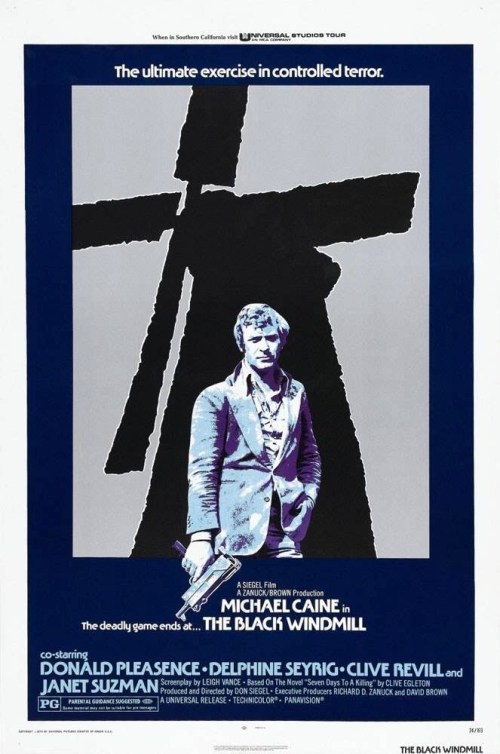
The Black Windmill (1974)

black

By Richard Winters

My Rating: 5 out of 10

4-Word Review: Agent’s son is kidnapped.

Michael Caine plays Major John Tarrant, a British Intelligence Officer, whose young son David (Paul Moss) gets kidnapped by an underground criminal organization headed by McKee (John Vernon). McKee is aware of John’s profession and insists that to get his son back he must fork-over some uncut diamonds, which had already been purchased to fund another operation. John informs his supervisor, Harper (Donald Pleasance), about their demands, but Harper begins to suspect that John may have orchestrated the kidnapping himself and thus refuses to go along with the turnover of the diamonds. Frustrated John decides to deliver them himself, but finds that he’s put himself into a perilous situation that he might not be able to get out of.

The film is based on the novel ‘Seven Days to a Killing’ by Clive Egleton and directed by Don Siegal who’s most notable for having done Dirty Harry. On the technical end it’s masterful. The lighting and editing are pristine and shot on-location in England in many scenic spots including the historic, but now closed Aldwych underground train station and the Shepherd’s Bush station as well as the climactic sequence, which takes place at the Clayton Windmills, known as Jack and Jill with Jill being built in 1821 and Jack in 1866. There’s also a terrific supporting performance by Pleasance who plays this uppity agent who won’t allow smoking in his office, nervously fiddles with his mustache, and is shocked by the forwardness of one of the other elderly agent’s younger wife, played by Catherine Schell. In fact his eye brow raising expression during his visit with her is one of the more amusing moments in the film.

The story seems a bit pedestrian with elements stolen from other better spy films including a Q-like moment where a  researcher shows Harper and John how they’ve come-up with a new invention, which is a briefcase that can shoot bullets just like a gun. Another segment has John being followed by a bad guy while hopping onto the subway, which looks like it was taken straight out of The French Connection, though much better done there.

There’s also the part where John, upset with Harper’s refusal to deliver the diamonds, breaks into Harper’s office and steals the key to the bank safe that has the diamonds in it, but this seems much too easy. You’d think an operation that has lights on top of the office doors, with green to be allowed in and red to be locked, would have a better contraption to stop someone from breaking in like burglar alarms to sound when somebody trespasses, or laser beams that would trip off and sound alarm on a mobile device carried by a security guard. Yet John is able to break-in with hardly any effort and the way he tries to disguise his voice to sound like Harper is pathetic and should’ve been enough to alert the bank manager that something fishy was going on. Also, you’d think Harper would have his eye on John, or had someone else keep tabs on him since he’d most likely be angry over the news that the agency wasn’t going to help him and thus already be predicting that he’d make an effort to steal the key before it actually happened.

The biggest issue though is that John is not emotional. His stoic nature makes him seem almost inhuman and like he may not actually care about his son’s safety at all. Supposedly this is because he’d been trained as an agent to hide his feelings, but the viewer still needs to see his softer side at some point, so we know he’s suffering inner turmoil about what’s going on and the fact that this is never shown makes it hard for us to side with him. It also gives Caine one of the flattest performances I’ve ever seen and is so stone cold it could’ve been done by a robot and you’d never know the difference.

The kid is far more engaging and if the movie had shown him more it might’ve worked better, or at least shown John and the boy together, we only see a fleeting few seconds of a photo of them, but we should’ve viewed them in a fun activity before the kidnapping, so we could feel the bond that is otherwise quite hollow. John’s relationship with his wife, played by Janet Suzman, doesn’t gel either. They’re already separated apparently because John put his career ahead of the family, but there needed to be more of an arc to make it interesting like having them bitterly at odds at the beginning only to realize they must put their animosities behind them in order to work together to find their son, but here there isn’t enough dramatic friction between the two, so seeing them rekindle things near the end packs no punch at all and like with everything else here emotionally vanquished for the audience.

My Rating: 5 out of 10

Released: May 17, 1974

Runtime: 1 Hour 46 Minutes

Rated PG

Director: Don Siegel

Studio: Universal Pictures

Available: DVD, Blu-ray

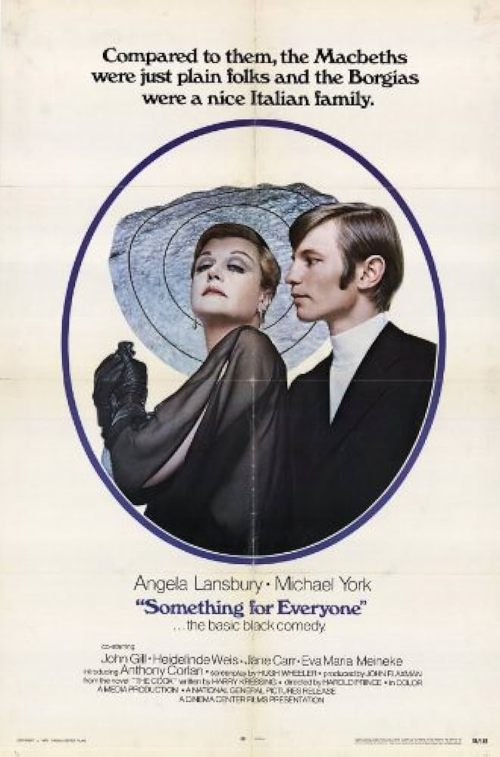
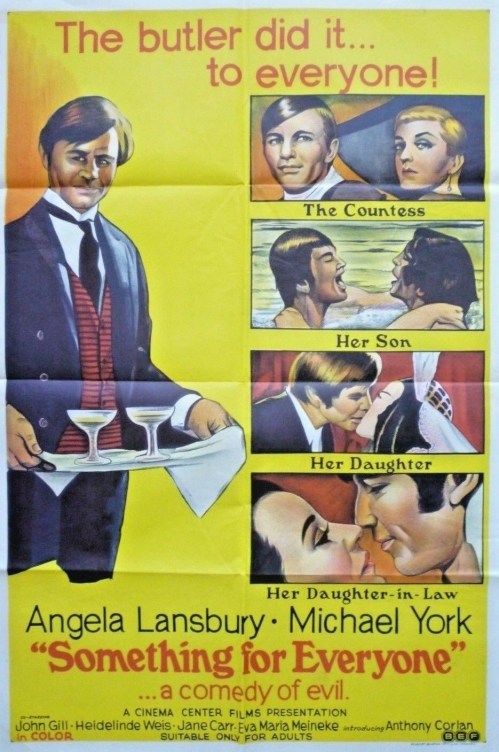
Something for Everyone (1970)

something1

By Richard Winters

My Rating: 7 out of 10

4-Word Review: Charming his way up.

Konrad (Michael York) is a young man with no money, or status, who dreams of one day owning the large Bavarian castle that he spots in the outskirts of a town that he’s passing through. He learns that it’s the property of the widow Countess Herthe (Angela Lansbury), who’s unable to live in it due to lack of finances. He schemes to become one of her servants by getting her regular butler, Rudolph (Klaus Havenstein) run over by a train. He then gets into a romantic relationship with Anneliese (Heidelinde Weis) whose parents (John Gill, Eva Maria Meineke) are quite wealthy while he also becomes lovers with the Countess’ son Helmuth (Anthony Higgins). Konrad hopes that Anneliese’s wealthy parents can use their money to reopen the castle and convinces Annelise to get into a fake romance with Helmuth that will lead to a marriage and then this will hopefully have her parent’s money flowing into the castle to get it reopened. He assures both Anneliese and Helmuth that he’ll remain their lover on the sly, but without each one knowing that they’re having sex with the same man. The elaborate plan though comes to a crashing halt when Anneliese accidentally walks in on Konrad and Helmuth and sees them kissing.

This super black comedy may be one of the darkest every made as it has no let up and absolutely everyone of the characters is a schemer and no better than the others. It’s based loosely on the novel ‘The Cook’ by Harry Kressing, but the story here is much different. In that one the main character is Conrad who spells his name with a ‘C’ instead of a ‘K’ and portrayed as a gaunt man who’s over seven feet tall and dresses in an all black unlike here where Konrad is young and handsome. In the book Conrad uses his cooking skills to get everyone to be ‘eating out of his hand’ with his delectable dishes while in the movie Konrad shows no such talent. The book had a much creepier tone while the film plays it all up for dark laughs and keeps the horror elements completely out.

I’m not exactly sure why there was such big changes made from its source material as keeping it truer to the novel had the potential of making this into a ‘food porn’ movie, which could’ve been visually sumptuous. However, the way it’s done here is still enjoyable with the majority of props going to York’s splendid performance whose boyish smile and dashing looks keeps it all quite engaging no matter what dastardly thing his character does. Reviled by the critics at the time for its ‘glorification of homosexuality’ it’s pretty amazing in retrospect how daring it was as this was filmed in 1969 and quite possibly the first film to ever show two men kissing. I remember in 1982 it was considered still quite shocking when Michael Caine and Christopher Reeve did it in Deathtrapso much so there was a report about it on CBS Evening News under the theme of movies ‘going too far’ while this movie had already been showing it, in a rather gleeful way, 13 years earlier, but maybe that’s all because this was done in Europe and not stuffy old America.

On the flip side I didn’t feel Lansbury had much of a presence. A talented actress for sure, but she doesn’t have a lot to do until well into the second act and even then isn’t real funny, and seems upstaged by the supporting cast who come-off as more colorful. It’s also frustrating that we spend the whole runtime seeing this gorgeous castle in the distance, in this case the famous Neuschwanstein Castle in Germany, but never able to go inside it. The few scenes that were supposedly its interior were instead very obviously shot on a soundstage.

Spoiler Alert!

While the script is full of many crafty twists and witnessing each nefarious character go down in a unique way is quite fun I did feel the way Konrad kills Anneliese and her parents by acting as their chauffer who crashes the vehicle down an embankment didn’t work. For one thing the killing of a wealthy family would’ve lead to a major investigation and since Konrad was driving the car, which he ‘miraculously’ jumps out of before it crashes, but he would still have to come up with a reason for why the car spun out of control. Since he doesn’t have one he would come under suspicion of the authorities instead of getting off scot-free like here.

Having Herthe’s nerdy daughter Lotte (Jane Carr) suddenly become instrumental in the whole thing by exposing the fact, at the end, that she’d been spying on Konrad the whole time and using what she knew to force him to marry her, leaved even further plot holes. The viewer should’ve been tipped off about what she was doing, even subtly, during the story as having her just turn up with all this new information makes it seem like it was tacked-on as a convenience without having it thought through with the rest of the plot. Not sure why Herthe, who was expecting to marry Konrad herself, would’ve gone along with Lotte marrying him instead, or what explanation was given to her in order for her to accept, which again just leaves open even more questions that in a truly well-crafted script should’ve been answered.

something2

My Rating: 7 out of 10

Released: July 22, 1970

Runtime: 1 Hour 52 Minutes

Rated R

Director: Harold Prince

Studio: National General Pictures

Available: DVD-R, Blu-ray

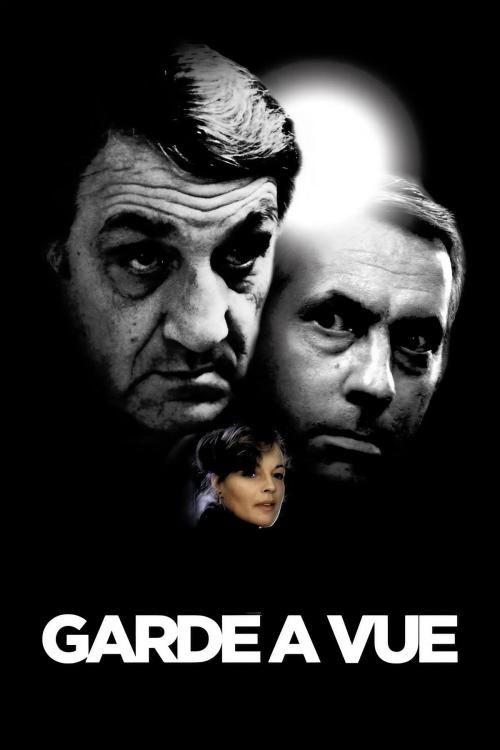
Garde A Vue (1981)

garde1

By Richard Winters

My Rating: 6 out of 10

4-Word Review: Interrogation of a lawyer.

Jerome (Michel Serrault), is a rich and powerful lawyer who is brought into a police station late one night during New Year’s Eve in order to be questioned about the rape and murder of two young girls. Antoine (Lino Ventura) is the lead investigator while Marcel (Guy Marchand) sits in the back and assists him during the interrogation. At first the conversation is light and civil, but as Antoine brings more circumstantial evidence to the forefront Jerome becomes nervous yet insists he’s still innocent. Marcel even implements some physical force against him, but Jerome’s stance never changes. In another room Antoine has a conversation with Jerome’s wife, Chantal (Romy Schneider), who confides to him that she secretly suspected Jerome to be in-love with an 8-year-old girl. Once Jerome gets confronted with this his story soon begins to change.

The film is based on the novel ‘Brainwash’ by John Wainwright and shot entirely in a studio soundstage and in chronological order. Why director Claude Miller would want to film a story that had very little if any cinematic elements to it is a mystery and if anything this might’ve fared better as a stage play. I was initially impressed with the police station room as you’d swear it was an authentic building and not just a prop built for the production. The drenching rain seen pouring down outside the windows is impressive as it gives the viewer a claustrophobic feel and I liked how eventually, when the clock hits midnight, you hear car horns honking outside to represent the New Year. However, every interrogation room I’ve seen, and I watch a lot of confession videos on Youtube from real-life cases, the rooms are very small and with no windows and the film would’ve been better served had it reflected a setting like this as it would’ve brought out better the psychological tension of the suspect and his feelings of the ‘walls closing in on him’, which with here you don’t get.

You can’t help but connect this movie with The Offencewhich starred Sean Connery and was directed by Sidney Lumet. That movie came out 8 years before this one, but had the exact same theme of a suspect being brought in over the murders of some school girls. That movie was well directed but did annoy me for the fact that in that one the suspect, played by Ian Bannen, did nothing, but give off this smirk the whole time.  This one has a much better back-and-forth between the investigator and suspect, which helps keep it compelling as more evidence gets introduced. However, in the Lumet film it had constant shots of this big bright light shining into the camera giving the viewer a point-of-view feeling of what someone in that situation would feel and thus helping hype the sense of urgency of wanting to get out of there, or say anything one needed to in order to stop the pressure, which this film doesn’t do very well. Both films though have cutaways showing the dead girl’s bodies from a distance in a secluded area, which are visually creepy, though again Lumet’s film scores a bit higher in that category too.

Spoiler Alert!

Ultimately the ending is a letdown and rather baffling as it features Jerome caving and admitting to a crime that he really didn’t commit due to the perceived police pressure. For one thing it’s hard to imagine that a seasoned lawyer would be that dumb and wouldn’t just ‘lawyer up’ himself and demand counsel of his own when interrogation got to be too much. I’ve seen a lot of true life interrogations where the pressure put on the suspect was far worse and those people refused to buckle, so seeing the character fall to pieces so relatively quickly especially when he was educated to know better makes the whole thing pathetic.

Didn’t quite get why the wife shoots herself at the end either. Supposedly it’s because she feels guilty about tabbing him for the murder when the real killer eventually gets exposed, but she did it out of honesty as she really felt he had a thing for young girls, so why should she feel tortured about saying something she truly believed? It would’ve been more surprising if she had pulled the gun on Jerome himself as he got into the car and shot him as she would feel, even if he hadn’t been arrested for this crime, that he still had some dark perversions and thus should be killed before he goes and carries out his fantasies on some other girl. Of course if she lied about him having a thing for an 8-year-old in order to get back at him over their contentious marriage then her guilt and suicide would’ve been more plausible, but I didn’t get that from watching it, so if that was ultimately her motivation then the filmmakers should’ve done a better job at intimating it.

This is the rare case where I’d say the Hollywood remake, which came out in 2000 as Under Suspicion and starred Gene Hackman and Morgan Freeman was much better done. It had a better visual balance that didn’t keep the whole thing stuck inside a police room and it better tied-up loose story ends that this one leaves open.

My Rating: 6 out of 10

Released: September 23, 1981

Runtime: 1 Hour 27 Minutes

Not Rated

Director: Claude Miller

Studio: AMLF

Available: DVD, Blu-ray

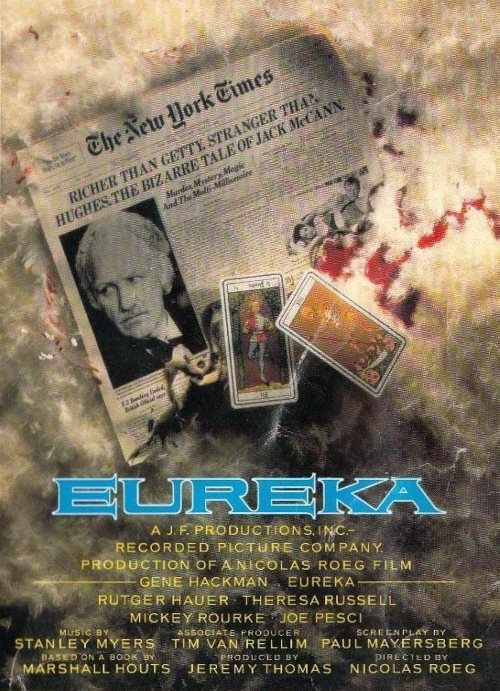
Eureka (1982)

eureka1

By Richard Winters

My Rating: 6 out of 10

4-Word Review: He discovers some gold.

Jack (Gene Hackman) has been searching the Yukon for over 15 years in the hopes of one day coming upon some gold. Then one day he finds it and becomes super rich. 20 years later he’s living on his own island, married, and with a grown daughter named Tracy (Theresa Russell). Jack though has grown ornery through the years and has managed to alienate most of his family including Tracy’s husband Claude (Rutger Hauer) whom Jack can’t get along with and the two regularly argue to the point that it also affects his relationship with his daughter. Jack is also at odds with the local mobsters headed by Mayakofsky (Joe Pesci) who wanted to open a casino on the island and are willing to resort to any violent means necessary in order to get that done.

The film is based loosely on the life of Sir Harry Oakes who, like with the main character here, scoured many countries looking for gold for 15 years before finally laying claim to a fortune. He then retired to the Bahamas and ultimately was found murdered in 1943 in a crime that has remained unsolved. The studio though did not know what type of audience to aim the film to and thus shelved it for a year only to release it to limited theaters where it managed to recoup a paltry $123,572 out of its initial $11 million budget making it one of the biggest box office bombs in history.

As a visual exercise, given its director, its a spellbinding ride. Director Nicholas Roeg approaches it as a fable-like tale and creates the artic in a surreal type of way giving it an almost outer-worldly look and feel. To an extent this works and there’s a few memorable scenes including a barefoot man lying in the cold who blows his head-off, via a loaded gun, in one very unexpected, shocking moment that’s very realistically grisly. The death by blowtorch, which happens a bit later is effectively vivid as well. However, there’s other metaphysical elements like a mysterious stone that gets handed to Jack that alludes a bit too much to a magical quality and takes away that this is actually based on a true story and instead makes it seem like it’s all just a made-up metaphorical fable, which starts to have a pretentious quality.

The plot is too thin and the second act labors badly. Joe Pesci is a dynamic actor, but here his part is boring and he doesn’t come-off as threatening enough to give his scenes the proper tension. There’s also no insight given to why the gangsters choose to pick-on Jack, as this is a man who is quite rich and could hire his own protection and enforcers and not someone you’d think could be easily intimidated. So why bother with him at all and just find another island to build a casino on? In the real-life incident Harry Oakes went out of way to try to ban casinos from the entire island nation as he did not approve of gambling and thus caused the ire of the criminal underworld, but the movie doesn’t bother to explain this and thus makes the motivations of the bad guys confusing.

Acting-wise its a joy to watch especially Hackman. He has played so many heroes in his film career that it’s fun seeing him be a jerk and he does it well particularly when he gets on his alcoholic wife about ‘laying off the sauce’. Ed Lauter, who’s usually a heavy, is entertaining with this constant nervous look on his face as he ends up being the reluctant middle-man who gets played by both sides. Rutger Hauer is brilliant as usual giving each of his moments a creepy finesse as only he can do. Two of his more memorable bits are when he swallows a small piece of gold while in Jack’s presence and when he has a meltdown at a formal dinner party and angerly, even frighteningly, demands they all must go home.

Of course being that she’s the director’s wife you get ample visuals of Theresa Russell with and without clothes on. The two became a couple while filming Bad Timing a few years earlier and despite a nearly 30-year age difference got married. I’ve often think it’s odd though when a husband directs a movie in which she’s in bed naked with another man, in this case Hauer, who’s also sans clothes. Don’t know if many other husbands would like that idea as the erotic scenes weren’t necessarily needed though I kind of wonder if it’s not another case of the trophy wife syndrome where the old guy wants to brag to the world: look at this hot little number I get to go home to and you don’t and thus the nude scenes are just there to make all the other guys jealous.

Spoiler Alert!

The climactic court room scenes, in which Hauer is placed inside a cage during the proceedings, aren’t effective. Mainly because he acts as his own lawyer and questions Russell on the stand who goes on a long, teary-eyed, rant about her father and his perceived psychological motives, that ceases to be the proper question/answer decorum that would be expected in a regular court setting. It’s unlikely that any judge would let this go on the way it does, or that the jury, or other attorneys would be so captivated as they are and not begin rolling their eyes after awhile, or objecting to the histrionics. Having Hackman killed off doesn’t help things as he was the guy the viewer most connected with while Hauer was a creepy guy who behaved erratically and expecting the audience to suddenly emotionally side with him at the end was an overreach.

Released: May 20, 1983

Runtime: 2 Hours 10 Minutes

Rated R

Director: Nicholas Roeg

Studio: United Artists

Available: DVD-R, Blu-ray

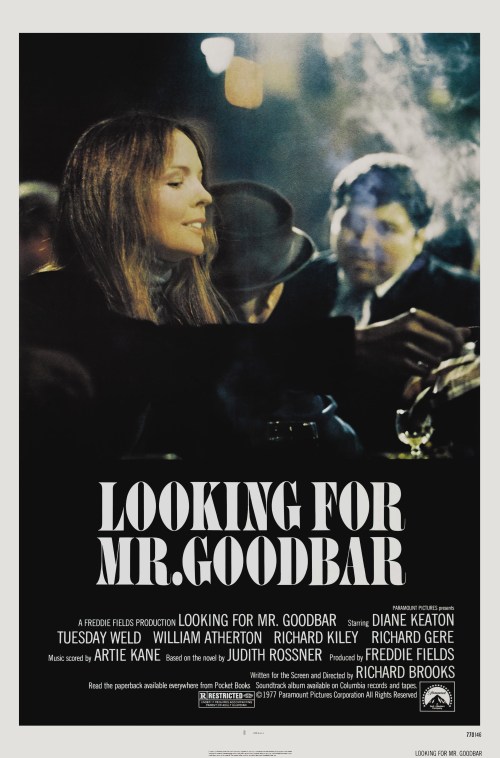
Looking for Mr. Goodbar (1977)

looking

By Richard Winters

My Rating: 7 out of 10

4-Word Review: School teacher sleeps around.

Theresa (Diane Keaton) is a young school teacher trying to get over the break-up with Martin (Alan Feinstein) a married college professor of whom she’d been in a relationship with for several years. Tired of living with her parents (Priscilla Pointer, Richard Kiley) and her domineering father she decides to get a studio apartment near the club scene. She picks-up Tony (Richard Gere) at a bar one night and takes him home. His volatile, drug induced behavior scares her at first, but eventually she enjoys his unpredictable ways. When he disappears for long periods she begins bringing more strangers home finding the one-night-stands to be a liberating change from her repressive catholic upbringing, but the more she partakes in this edgy lifestyle the more danger she puts herself in.

The film is based on the Judith Rossner novel of the same name, which itself is based on the true story of Roseann Quinn. Quinn was a school teacher living in New York City who had a propensity of bringing home men she’d meet from a bar that was across the street from her studio apartment. On the evening of January 1st, 1973 she invited John Wayne Wilson, a man she met at the bar, back to her place for intended sex, but instead it resulted in murder when he was unable to achieve an erection and he felt she was making fun of him.

Rossner read about the incident in a newspaper and became intrigued with the case and intended to write about it for an upcoming article in Esquire magazine, but the editor feared legal action since it was based on an actual case and reneged on the assignment, so Rossner turned it into a novel using fictional names for the real-life people. It got published in 1975 to rave reviews and instantly became a best seller, which caught the attention of writer/director Richard Brooks who had turned other true crime stories into hits such as In Cold Blood and felt he could do the same with this. In fact the film did quite well as it raked in $22.5 million and was the top movie in the country on its opening weekend.

While Rossner openly detested the film version I felt it does a great job of exposing the bleak, lonely existence of the 70’s single’s scene and how sexual liberation can end up being just as much of a trap, if not more, as monogamy. The dim, dark lighting, particularly inside Theresa’s apartment brings out the grim existence, and twisted personalities, of its characters nicely. The viewer feels as caught up in the depressing, aimless world as the protagonist and its the vividness of the 70’s young adult, city culture that makes this an excellent film to see simply to understand the motivations of the people who lived it. While on paper reading about someone that was a school teacher for deaf students during the day turning into a reckless, sexually promiscuous lady by night may seem shocking and hard to fathom, the film seamlessly fills-in-the-blanks to the extent  that you fully grasp, from her stifling family and religious upbringing as well as her painful break-up and insecure body image, to what drove her to it and thus cultivates a very revealing character study.

Keaton, Kiley and Tuesday Weld, who plays Theresa’s older sister who experiments with the wild lifestyle herself, are all stand-outs, but the film also has some great performances from actors who at the time were unknowns. Gere is especially good, quite possibly one of the best acting jobs of his career, as the creepy, but still strangely endearing Tony. LeVar Burton has very few lines, but still makes an impression with his pouty facial expressions as the older brother to one of Theresa’s deaf students. Tom Berenger though turns out to being the ultimate scene stealer as the psychotic who’s so on edge with his personal demons that he lashes violently out over the smallest of provocations.

Spoiler Alert!

While the film is known mainly for its notorious ending, which still packs a bit of a punch, its effect is muted by director Brooks unwisely telegraphing it ahead of time. Virtually the whole movie is done from Theresa’s point-of-view and yet at the very end it cheats it by having a scene between Gary and his gay lover giving the viewer an unnecessary warning about his mental state, which wasn’t needed. For one thing in the real-life incident the assailant was a married man and not gay, so adding in the gay subtext and using it to explain his psychosis could be considered homophobic and armchair psychology. It also hurts the shock value as the audience knows what’s coming versus having them as surprised as Theresa when he suddenly lashes out unexpectedly, which would’ve made for a more emotionally impactful, gripping finish.

My Rating: 7 out of 10

Released: October 19, 1977

Runtime: 2 Hours 16 Minutes

Rated R

Director: Richard Brooks

Studio: Paramount

Available: DVD

Hellraiser (1987)

hellraiser

By Richard Winters

My Rating: 6 out of 10

4-Word Review: Former lover needs blood.

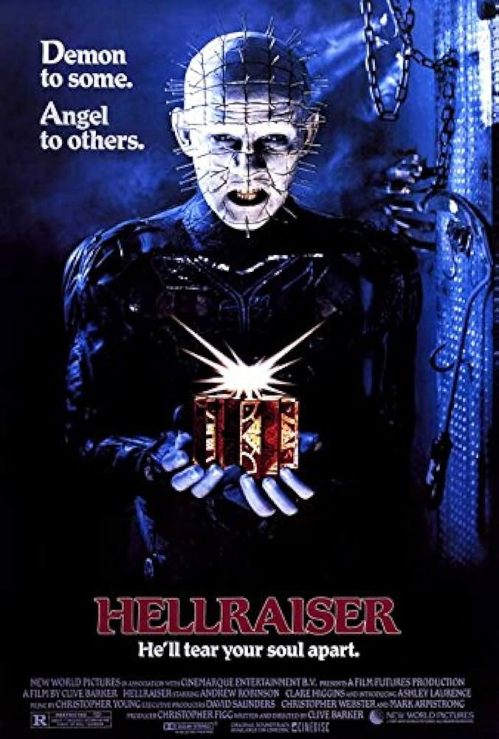
Frank Cotton (Sean Chapman) purchases a puzzle box and brings it home to solve it. When he does he finds that it brings out demons known as Cenobites who enjoy inflicting pain on others for their own pleasure. After tearing Frank apart they reset the box and return to their own dimension. Larry (Andrew Robinson), Frank’s brother, moves into the house along with his wife Julia (Clare Higgins), who at one time, unbeknownst to Larry, had a brief affair with Frank. While moving in some boxes Larry cuts his finger and bleeds onto the attic floor where Frank was killed. Pieces of Frank still exist under the floor boards and the blood allows him to regain life though his body still needs more blood to regain its full form. He convinces Julia to bring in strangers from the bar home, so that she can kill them and allow Frank to drink their blood and regain more strength. Julia agrees to do this, but then Kristy (Ashley Laurence) becomes aware of what Julia is doing and is determined to put a stop to it by confronting Frank and taking away his puzzle box.

This was the first movie directed by Clive Barker and is based on his 1986 novel ‘The Hellbound Heart’. After being dissatisfied with how Rawhead Rex, based on another novel Barker had written, he became determined to direct the next feature in order to give it, in his words, some ‘directorial oomph’, which he had felt was missing in the previous film. Special effects wise the film hits all marks and is a precursor to what’s called Horror Porn today with a lot focus put on the effects that are both realistic and cruel. Watching Frank’s body slowly take form by growing out of the floorboards is quite impressive, but my only complaint are the close-ups of the skin particularly when a hook slices it open, which to me resembled more silly putty.

While the effects are great the characters aren’t. All of them come-off as dark and mean and there’s really no one to cheer for, or side with. Supposedly it’s Kristy the viewer is intended to get behind, but she came-off looking older than college aged and more like she was in her late 20’s. She’s also worldy-wise and seems able to handle herself, as is seen when she comes into contact with a couple of lecherous movers, quite effortlessly, so there’s no real character arch. Having her start-off as shy and sheltered and then grow stronger and confident as she learns to take on the cenobites would’ve been much more interesting and would’ve allowed for tension as you would initially question whether she had to guts to confront the evil like she eventually does.

The Julia character is weak too. I didn’t understand what drew her to Frank. Maybe in the novel this gets better explained, but in the movie it’s nebulous. Her brief fling with Frank, in the few backstory scenes that get shown, makes it seem like it was rather cold and distant and Frank doesn’t necessarily treat her all that well, so why would she bother helping to bring him back to life? Maybe she had a sadomaschistic bent, but if that was the case why would she marry Larry who treats her differently almost like he’s the passive and she’s more in control. If the woman prefers the man to be in control then that’s what she looks for in her next relationship not the opposite.

Spoiler Alert!

The twist near the end where Frank kills Larry and then begins to wear his skin gets botched too. It’s intended to be a surprise reveal for the viewer who, like with Kristy, initially think it’s the real Larry though it’s pretty obvious something isn’t right as blood is seeping out on the edges of his face, which Kristy should notice, but apparently because she’s so upset she doesn’t. It would’ve been better though to have the killing played-out and shown the final shocked expression on Larry’s face when he realizes he’s been betrayed by not only his brother, but wife too, which would’ve been priceless.

What’s even more perplexing though is why is Frank speaking in Larry’s voice? He may have his skin, but not the voice box. Even if he had tried to disguise it, in an effort to trick Kristy, I don’t think it would’ve come-off so convincingly. Then, once the gig is up and Kristy realizes it’s Frank, he still continues speak with Larry’s voice by why bother at that point since he no longer needed to fool her?

My Rating: 6 out of 10

Released: September 11, 1987

Runtime: 1 Hour 34 Minutes

Rated R

Director: Clive Barker

Studio: New World Pictures

Available: DVD, Blu-ray, Amazon Video, Pluto TV, Tubi, YouTube

Slugs (1988)

slugs

By Richard Winters

My Rating: 5 out of 10

4-Word Review: Town overrun by mollusca.

Mike Brady (Michael Garfield) is a health inspector of a small town who’s finding its residents being killed and skinned by some sort of mysterious entity and the only clue are trails of slime that it leaves behind. Later, Mike and his friend Don (Philip MacHale), who works for the sanitation department, along with high school science teacher John Foley (Santiago Alvarez) determine that the culprit are slugs whose unusual aggressiveness may be tied to leakage from an abandoned chemical waste dump.

Based on the 1980 novel of the same name by Shaun Hutson the script follows the book version closely. Director Juan Piquer Simon is best known for the gory cult hit Piecesbut this movie fares a bit better on the technical end. I liked that it was shot on-location in the US, Lyons, New York, where the fall setting helps accentuate a spooky Halloween feel as Simon’s other horror film was done in Spain, but pretended to be Boston though it was easy to see the difference. The tone is a bit more playful, particularly the bouncy score, and seems to be trying for a light tongue-and-cheek approach though it could’ve used more humor and worked better had it went full into a comedy-horror versus trying to play it completely straight, which doesn’t work.

A lot of the problem is buying into these slugs being that dangerous. They’re small, slow, and squishy and can be easily smooshed with any type of hard object. Having people getting overrun and attacked by them just doesn’t seem believable. The film tries to compensate for this by showing the victims after they’ve been devoured, but a person would have to be awfully slow and inept not to be able to get away as all they’d have to do is just step on the things to eradicate them, which makes the whole concept of them being this threatening aggressor rather lame. I did though like the segment where a couple is busy making love and thus don’t notice the slugs coming into their room and ultimately have their nude bodies covered by them when they fall onto the floor, which has a provocavtive quality and I might give some credit to the final scene where Don gets attacked by them while underwater, but the rest of the slug killings come-off as exaggerated and more unintentionally comical than scary.

The fact that the town’s mayor (Manuel de Blas) refuses to listen to Mike and won’t cut-off the town’s water supply in an attempt to keep the slug infestation (they travel through the pipes) under control is too reminiscent of JawsIn Jaws seeing an elected official refusing to heed the warnings was interesting as it showed how greedy politicians can be just as much a threat to the people as a monstrous shark and maybe even more so, but here the confrontation comes-off as derivative and the actor playing the mayor isn’t as talented as Murray Hamilton who was able to make his character, as slimy as he was, fun and engaging.

The two actors who play the leads are especially bland and it’s no surprise that neither of them had much of a career in front of the camera. Both look like they’d be better suited on a soap opera, and MacHale was a cast member on both ‘Somerset’ and ‘One Life to Live’ as they have chiseled good looks, but a benign presence. In some ways it was refreshing not having teens cast in the lead as so many other horror movies do that, but there still needed to be adult characters that were interesting and multi-dimensional and these guys certainly are not. The lead guy needed some sort of fatal flaw, or some inner weakness he had to overcome that would make him unique, but instead it’s just John Suburbia going through the motions, which for me wasn’t captivating at all. A viewer needs to actually care about these people to get into it and since that doesn’t happen I found the whole thing to get pretty boring the more it went on though the movie poster is cool.

My Rating: 5 out of 10

Released: February 5, 1988

Runtime: 1 Hour 29 Minutes

Rated R

Director: Juan Piquer Simon

Studio: New World Pictures

Available: DVD, Blu-ray, Amazon Video, Tubi, YouTube

Ghost Story (1981)

ghost1

By Richard Winters

My Rating: 7 out of 10

4-Word Review: Four men carry secret.

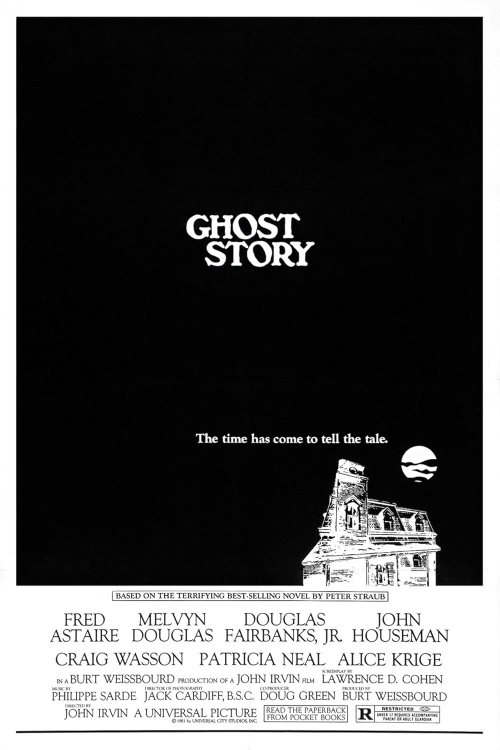
Four elderly men, Ricky (Fred Astaire), John (Melvyn Douglas), Edward (Douglas Fairbanks Jr.), and Sears (John Houseman), who all live in the same small Vermont town and are lifelong friends who call themselves the Chowder Society, get together each week to tell each other ghosts stories. Then Edward’s son Don (Craig Wasson) dies after falling out his apartment window. The men begin having reoccurring nightmares focusing on Eva Galli (Alice Krige) a woman they once knew 50 years earlier. Has she come back from the dead to haunt them and their family members? And just exactly what happened to her as she seemed to have left town without a trace? Only the four men seem to know the answer to this and all of them guard this secret quite closely, but once David (Craig Wasson) comes to town, who is Edward’s other son, he becomes determined to break their silence.

The film is based on Peter Straub’s epic novel, which was released in 1978 and was 483 pages long. Many fans of the book complained that the movie overly simplified the plot, but there is just no way you can condense a long book into a two hour screenplay and for what it’s worth I think both director John Irvin and screenwriter Lawrence D. Cohen did the best they could and if anything this might’ve worked better as a TV-miniseries where many of the story’s dramatic angles could’ve been played out more. My main complaint is that in the novel Eve Galli character was portrayed as being a manitou who could change shape being a small child at one point and a wasp at another and the film would’ve been scarier had it taken that approach.

I also didn’t like Wasson, who’s great for giving a deer-in-headlights-look, but not much else, playing both the brothers. I can’t remember if they were twins in the book, or not, but having them be twins here wasn’t integral to the plot and makes it a bit confusing. For instance when the brother falls out the window, where he is naked and full frontal nudity showing, which was bit daring at the time for males, the next shot shows Wasson, as the twin, waking out of deep sleep making it seem incorrectly that it had all just been a dream.

The film’s main selling point is seeing four legendary actors, who were all either in their 80’s, or nearing it, still able to carry a film, which they do quite well and if anything it would’ve been nice seeing them in more of it. Astaire’s presence is especially interesting, he apparently threaten to quit the movie several times during the shooting, as he had mostly done musicals and light fare before this one. The females are strong here too particularly Krige in her film debut, who gets shown nude from both the back and the front, who has a very creepy presence. Jacqueline Brookes as Melvyn Douglas’ wife has a few key moments, but Patricia Neal, as Astaire’s wife, gets barely any speaking parts at all and is entirely wasted.

The recreation of the 1930’s was my favorite part and quite well done with the characters behaving in believable ways and making it seem like they weren’t just caricatures of their era, but real people that could exist today. Finding actors to play the roles of the older men in their younger years and come off closely resembling them is amazing and much credit should go to the casting director Mike Fenton for hiring young men with just the right characteristics of their older counterparts. The only caveat is that it has the incident occurring 50 years earlier, just like in the book, but with all the actors clearly looking like they’re in their 80’s a more accurate time period would’ve been 60 years when these guys would’ve realistically been college aged.

Spoiler Alert!

The effects are good though much of the scares hinges off of sporadic close-ups of ghostly Eva’s decomposed face, which gets a bit redundant. The story leaves open a lot of questions like why does Eva’s ghost wait 50 years to haunt the men; why not begin terrorizing them 10  years later or even 20? Also, why does Eva go after the son’s of one of the culprits who wasn’t even born yet when the incident happened instead of going directly after the old guys who were responsible? Also, how does a ghost take humor form enough so that the Wasson character is able to make love to her, he complains that she’s ‘cold to the touch’, but a spirit should be trapped into being just that, or at best possessing someone else’s body, but here we have Eva literally recreated to modern day and am not sure in ghostly logic terms how that gets done though despite these issues it’s still a fun ride.

My Rating: 7 out of 10

Released: December 15, 1981

Runtime: 1 Hour 51 Minutes

Rated R

Director: John Irvin

Studio: Universal

Available: DVD, Amazon Video, YouTube

The Last Remake of Beau Geste (1979)

beaugeste

By Richard Winters

My Rating: 4 out of 10

4-Word Review: Brothers join the army.

Sir Hector Geste (Trevor Howard) decides to adopt a son to be his rightful heir and carry on the family name. He goes to an orphanage where he spots Beau (Michael York) a dashing young boy who shows immense prowess. Hector immediately decides he wants him, but it comes with the caveat that he must also take on Beau’s twin bother Digby (Marty Feldman) who’s not nearly as handsome, or brave. After bringing both boys home Hector then gets married to Flavia (Ann-Margret) a much younger woman who’s more in-love with the Blue Sapphire diamond that’s in Hector’s possession than Hector himself. In order to keep Flavia from absconding with it Beau decides to take it out of the family home and bringing it along with him to Africa where he joins the French Foreign Legion. Digby eventually joins and they go on to have many adventures, but Flavia catches up with them determined to get the diamond using any means necessary.

The film is based on the 1924 novel of the same name written by P.C. Wren that had already been made into a movie three other times: in 1926 starring Ronald Coleman, 1939 starring Gary Cooper, and finally in 1966 starring Guy Stockwell. In 1976 when Marty Feldman signed a 5-picture deal with Universal to write, direct, and star in any film project he choose he decided to do a parody on a film he had seen growing up. He mistakenly thought it was Beau Geste, but came to realize once he watched the movie that it was really The Four Feathers that had a similar storyline and came out around the same time. He eventually went with doing this version since he felt ‘The Last Remake of the Four Feathers’ didn’t sound right.

The production, which was filmed in both Ireland and Spain, was met with many obstacles, including having Feldman getting sick during the shoot and putting the production on-hold for many weeks. It eventually went over budget and over schedule and the studio was not happy with Feldman’s final cut and determined to re-edit it while giving Feldman a 2-week vacation under the guise of letting him rest and recuperate. When Feldman returned and found out what the studio had done he became irate, so the studio heads decided to make him a deal; they would show both versions to a test audiences and which ever one rated better would be the one that would be released. Feldman agreed to this and to the studios shock Marty’s cut got much higher ratings, but the studio then went back on their word and released their version instead, which did not fare well with either the critics, or public. To this day Marty’s version has never been seen, but by only a few people even though those that have viewed say it’s much funnier and efforts have been made to find it and give it a proper Blu-ray issue though this has never come to fruition as of yet.

As for this version it’s okay, but it starts out better than it ends. There’s some funny gags here and there, but the humor tends to be quite broad and many of the jokes fall flat especially after the midway point. The best moment comes when Feldman splices his character into the 1939 film version and we see his character speaking to Gary Cooper and they even share a scene together, which I found to be quite innovative for the time period. Everything else though is hit-or-miss and suffers from not enough people being familiar with the source novel and thus the in-jokes involving the story will most likely go over  most viewer’s heads it also makes many changes from the original plot with the biggest one being that in this movie there’s only 2-brothers, but in the book there was 3.

The array of famous faces making cameo appearances is fun for awhile though I felt Peter Ustinov camps it up too much as the evil General Markov and the part would’ve been better served had it been played by Roy Kinnear who instead gets wasted as Markov’s assistant. Howard is quite amusing as the elderly father and I wished he was in it more, but ultimately his character gets confined to his bed for the second and third act. Ann-Margret offers some sexiness, but really has nothing to say or do that’s funny until the very end when she tries to challenge a guy to a fist-fight, which should’ve been played-out more. Terry-Thomas gets some work before his Parkinson’s condition, which is very obvious here with his trembling left hand, became so severe that it forced him out of acting and into a retirement home not more than a year after this was filmed.

Feldman himself is quite good, but I felt he needed to be seen more, which is the biggest problem with the movie in that it’s neither character nor plot driven. Too much nuttiness and wackiness for its own good. If the comedy had been better disciplined and a smaller cast it would’ve worked better, but the barrage of constant craziness all in the name humor eventually gets overblown.

My Rating: 4 out of 10

Released: July 15, 1977

Runtime: 1 Hour 25 Minutes

Rated PG

Director: Marty Feldman

Studio: Universal

Available: DVD-R (Universal Vault Series), Blu-ray

The Day of the Dolphin (1973)

dolphin2

By Richard Winters

My Rating: 3 out of 10

4-Word Review: Training dolphins to talk.

Jake Terrell (George C. Scott) along with his wife Maggie (Trish Van Devere) run a remote island research station where, along with a small team of researchers, try to teach dolphins to communicate with humans. They’re prime subject, which they’ve been working with for 4 years, is Alpha whom they’ve successfully trained to speak some English words, but when they team him up with another dolphin named Beta he goes back to his old ways of communicating and no longer speaks with Jake, or his team. Things become further hampered when Curtis (Paul Sorvino) arrives on the island supposedly under the guise of being a journalist, but in reality he’s a spy there to infiltrate what Jake has been doing with the dolphins and report back to a secret government organization who want to then use the dolphins for their own nefarious means.

With the early success of director Mike Nichols and screenwriter Buck Henry, especially The Graduate, it seemed like these two could do no wrong and they both became a much sought after Hollywood commodity and given many top project offers. This production though came crashing down horribly and stymied Nichols career, which had previously been skyrocketing, for the rest of the decade as he helmed only one other film after this during the 70’s before finally getting his reputation back in order with the critically acclaimed Silkwood.

This thing comes-off as a misfire almost immediately and the biggest problem are the dolphins. There’s just so much they can do, liking mainly jumping in and out of water, until it becomes really boring. The long dream-like segment of watching Jake swim around in the tank with the dolphin adds nothing and got so prolonged that it practically put me to sleep. The only part where the dolphins did hold my attention was when Jake decides to split the two up where Beta is put in a pool on one side and Alpha the other and a steel partition between them. This then causes the dolphins much stress as Alpha angrily smashes his tail repeatedly against the partition in anger, but to no avail. While I did find this moment to be rather intense it does backfire in a way in that it makes Jake and the other researchers seem cruel and you start to not like them, which I don’t think was the filmmaker’s intent.

Having them learn to talk was misguided and makes it seem like a silly flick for kids with no barring in reality. Initially I was okay with them learning a few words as it came-off like they were parrots repeating sounds that they had heard, so it was borderline plausible, but then having it graduate to the point that he and others can have ongoing conversations with them and even ask them questions is when it starts to get too absurd for its own good.  In fact the only moment in the film that’s truly fascinating to see is when a mother dolphin gives birth using actual footage, which made me believe this would’ve been better off had it been done as a documentary and the fictional story left out completely.

Sorvino does add some energy with his scenes and pretty much outclasses Scott, who with his $750,000 salary, which would equate to $5,484,886 in today’s dollars, is quite dull and he manages to get completely upstaged by even the dolphins themselves. All of the main characters are quite one-dimensional, especially Van Devere who seems to agree with Scott on everything and echoes whatever point-of-view he has making her presence completely unneccesary as she’s simply him in a female form.

Having one of the research crew members turn out to being a spy doesn’t work either as the viewer is given no forewarning about this. We’re just informed later that this individual had betrayed them, but a good movie should offer hints upfront that a traitor may be in their midst and thus allow the audience to become more of an active participant as they try and figure out which of them it is. The secret government organization thing gets equally botched. A better scenario would’ve had a former friend, or associate to Jake turn on him and seek revenge by trying to destroy the research facility and all of their findings. He would be constantly lurking about, which would’ve added more ongoing tension that is otherwise lacking and given the bad guy more of a personality versus the bland government agents that are too generic to be either frightening, or memorable.

My Rating: 3 out of 10

Released: December 19, 1973

Runtime: 1 Hour 44 Minutes

Rated PG

Director: Mike Nichols

Studio: AVCO Embassy Pictures

Available: DVD, Blu-ray