Category Archives: Movies Based on Novels

The Naked Face (1984)

naked1

By Richard Winters

My Rating: 7 out of 10

4-Word Review: Is psychoanalyst being targeted?

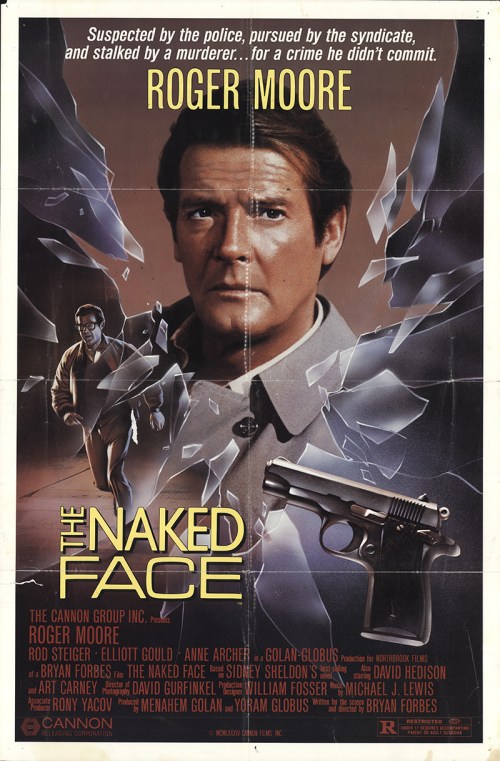
Judd Stevens (Roger Moore) is a psychoanalyst residing in Chicago who suddenly finds that people he knows are turning up dead. First it was one of his patients, whom he let borrow his raincoat. Then it’s his secretary and soon the police are suspecting him of the killings. Lieutenant McGreavy (Rod Steiger) doesn’t like Judd as it was Judd’s expert testimony that got a cop killer sent to an institution versus a jail cell where McGreavy felt he belonged. In order to get the cops off his back and find the real killer Judd  hires Morgens (Art Carney), private investigator, who seems to get a lead when he calls Judd and tells him that a ‘Don Vinton’ is behind it, but then Morgens ends up dead too, so Judd puts his trust in another police detective named Angeli (Elliot Gould) only to learn that he has ulterior motives.

The story is based on the Sidney Sheldon novel of the same name that was written in 1970 and besides this one has been remade two other times: in 1992 in Ukraine as Sheriff’s Star and then again in 2007 in India as Kshana Kshana. This version was produced by the notorious Cannon Group, which always makes me hold my breath in apprehension every time I see their logo come up before the movie begins as I’m never sure if this is going to be one of their cheaper productions, or one that was given a decent budget. While Leonard Maltin, in his review, describes it as ‘low budget’ I’d say this was one of their passable efforts as the production standards aren’t compromised in any way and if anything is rather slick. The on-location shooting done in Chicago, this was changed from the novel where the setting was Manhattan, is excellent and the plot is well paced with incremental twists to keep it flowing.

The film’s main selling point is seeing Moore playing against type as he was known as an action star, but here plays an intellectual. For the most part he does quite well and even able to hold his own when sharing a scene with Steiger, who otherwise likes to chew up the scenery and everyone else in it, but I didn’t like the big Harry Caray-type glasses that he wears. I guess this was done to make him look ‘smart’, but it wasn’t needed. The best part is seeing him get beat-up by the bad guys. When Moore was playing Bond it always seemed a bit absurd that this aging 50-something would be able to take-on virtually any villain, no matter the size, and come-out on top every time. Here he gets flattened with one punch and it’s kind of funny.

Steiger, with  his intense delivery, dominates. He’s given a lot of screen time during the first half almost making him seem like he’s the star and his stewing anger lends adequate tension, but his good-cop/bad-cop routine doesn’t work because he’s the type of character who’s impossible to like, so he needed to stay bad all the way. I also couldn’t stand the wig. He supposed to be an ugly, unlikable guy, so might as well have him naturally bald, as the rug gives him a campy look.

Gould is the outlier. He was during the 70’s a major headlining star, so seeing him pushed to the background where Steiger takes center stage is almost shocking. I remember him saying once in an interview that he didn’t like the pressure of being a leading man, so maybe this supporting bit was right for him. His character does become more prominent towards the end, but for the most part he comes-off like a faceless walk-on  and a sign of a career decline.

Spoiler Alert!

The twist ending in which it’s found that the crime syndicate was behind the killings due to the wife (Anne Archer) of the crime boss seeing Judd and fearing she may be giving him secret information during their sessions was not particularly original. It also opened up some loopholes. For instance Judd’s patient at the beginning is stabbed on the streets because he was mistaken for being Judd, but later when Judd is kidnapped and in the crime boss’ presence he isn’t immediately killed as they first want him to divulge what his wife told him, but if the idea was to extract information then why was the patient offed right away instead of taken somewhere for interrogation?

At the very end Moore is walking with Archer outside and suddenly she gets hit with a bullet, but not Moore. If she was shot by a hit man for giving out secret info then Moore should’ve received a bullet as well because it was he that she had confided in, or at least that was what they had presumed.

My Rating: 7 out of 10

Released: June 6, 1984

Runtime: 1 Hour 45 Minutes

Rated R

Director: Bryan Forbes

Studio: Cannon Film Distributors

Available: DVD, Tubi

The Sidelong Glances of a Pigeon Kicker (1970)

pigeon

By Richard Winters

My Rating: 5 out of 10

4-Word Review: Cab driver dislikes pigeons.

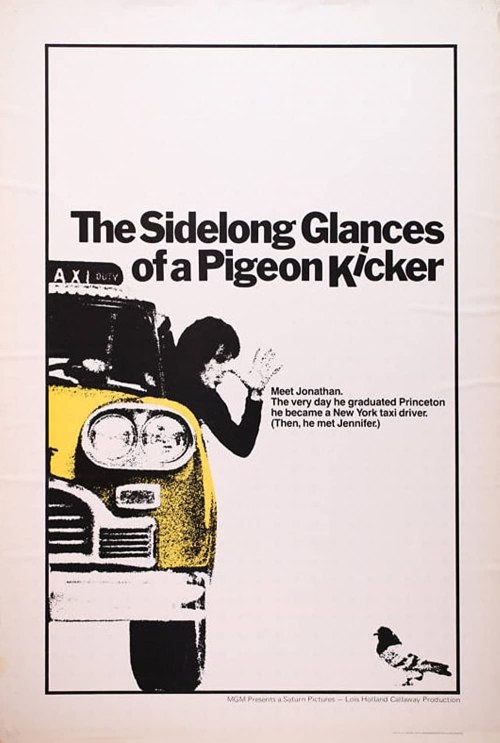
Based on the novel of the same name by David Boyer, the story centers on Jonathan (Jordan Christopher) a Princeton graduate who spends his days working as a New York cab driver with no ambition to climb up the corporate ladder. Jonathan detests the establishment, but is too old to be a part of the hippie movement, so he rebels from society in other ways by being flippant with his customers and kicking at pigeons in Central Park. His friend Winslow (Robert Walden) has problems of his own as he’s 24, but still a virgin. Jonathan takes Winslow to a party in an effort to find him a woman, but Winslow is so socially awkward that they all turn him down. Back at his apartment Jonathan meets-up with Jennifer (Jill O’Hara) who’s busy trying to ‘find herself’ while living off of her parent’s money. Initially Jonathan resists her advances, but since they’re both lonely he eventually agrees to a relationship with her as long as there are no strings attached. He even brings her to visit his mother (Kate Reid), but then at a holiday party Jennifer makes the mistake of  saying she wants to get married and have kids, which scares Jonathan away and the two break-up only for Jennifer to then sleep with Winslow, which causes Jonathan to become jealous.

This was one of an assortment of youth pictures from the early 70’s trying to analyze the alienation of the love generation and their resistance to conformity and middle class values. These films tended to be much less structured and in certain cases downright experimental, but the subject matter was still considered topical enough that the studio heads at MGM decided to pick it up for distribution only to then quickly drop it when previews of it scored low with test audiences. It was then handed over to a fledgling film company known as Plaza Pictures that re-edited it down to 90 minutes while cutting-out much of the second act in the process and then re-naming it as Pigeons, but this version did no better and the film sat in obscurity for many decades before finally getting a DVD release in 2014.

While I do like offbeat movies I did find the way this one began hard to get into as the lackadaisical pace makes it seem like there isn’t any plot and just a lot of throwaway segments dealing with the angst of big city living. It does improve and manages to even have a few keen moments. John Dexter’s direction, he was better known for his work in the theater as well as his rude behavior towards women, helps a lot. In fact it’s the directing that keeps the thing watchable and despite the modest budget it’s quite polished with the most impressive moment, outside of a taxi car driving off the dock and into the water, is when Jonathan goes under his kitchen cabinet in an attempt to exterminate hundreds of ants. This isn’t as easy as it sounds to get a camera and lighting into such a small space, nor finding all the ants, and I suspect the cabinet was specially made for the production, but still on a small scale it’s impressively done.

The film also features a great supporting cast including Walden in his film debut who is both believable and amusing as Jonathan’s shy and apprehensive friend. O’Hara is equally engaging, she looks exactly like her more famous sister Jenny O’Hara and for awhile I thought it was the same woman. Kate Reid is a scene-stealer as the meddling, oppressive mother and William Redfield has a great moment near the end playing the stepfather who openly has a one-night-stand with a lady he meets at a Christmas party and then comes home late at night to talk to Jonathan about it.

The film’s Achilles heal is the casting of Christopher. He rose to fame as the singer of The Wild Ones, which got him cast as a rock singer for the cult hit Angel, Angel Down We Gowhich generated enough notice that producers decided to take a chance on him in a lead role, but it doesn’t work. His character is unlikable and he lacks a dynamic presence let alone his disheveled mop-head hair-do that resembles a bird’s nest. Having the film begin by showing him kicking at pigeons in Central Park, fortunately his foot doesn’t seem to actually hit any of them, makes the viewer despise him right from the start and things never improve.

Spoiler Alert!

The cop-out ending is a disappointment as it features Jonathan riding off on a train headed to Des Moines, Iowa, but I’ve rarely found anyone who’s been born and raised in New York to move to the farmlands of the Midwest. Sure many New Yorkers have gripes about where they live, most anyone is never completely happy with their home city, but ultimately they remain because it’s what they’re used to. Instead of ending it with him riding away it should’ve made this a part of the movie showing his adapting to a completely new and alien place, which could’ve given the movie some interesting insight and made a stronger impression than it otherwise does.

Alternate Title: Pigeons

My Rating: 5 out of 10

Released: October 28, 1970

Runtime: 1 Hour 46 Minutes (DVD version runs 1 Hour 30 Minutes)

Rated R

Director: John Dexter

Studio: Plaza Pictures

Available: DVD

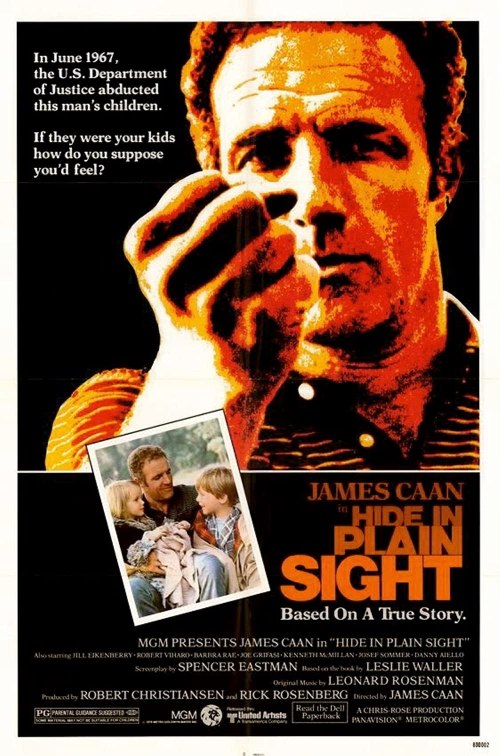
Hide in Plain Sight (1980)

hide

By Richard Winters

My Rating: 6 out of 10

4-Word Review: Searching for his children.

Thomas Hacklin (James Caan) is a divorced father of two children who has visiting rights to see his kids every weekend. One day when he arrives at his ex-wife Ruthie’s (Barbra Rae) residence he finds the home abandoned and no one around. He eventually learns that her and the kids have been put into the Witness Protection Program due to her remarriage to Jack (Robert Viharo) a gangster who qualified for the program when he became a state’s witness against the mob. Thomas’ efforts to find his kids prove futile and the authorities are no help, but he becomes relentless and hires a lawyer (Danny Aiello) to represent him in court, but even then the odds remain seemingly insurmountable.

The film is based on the novel of the same name by Leslie Waller, which in-turn was based on the actual experiences of Thomas Leonhard who one day in 1967 when he went to pick-up his kids for his weekly visitation found them gone and the house that they had been living in with his ex-wife Rochelle to have been abandoned. This then precipitated an 8-year crusade by Thomas to get them back, which proved to be a landmark legal battle, but on July 4, 1975 he was eventually reunited. The film though changed several things from the true story including adding in a subplot where Thomas gets followed by the mob and eventually leads to a violent confrontation. It also compresses the time span from 8 years to 18 months.

While I enjoyed the movie more than when I first saw it over 10 years ago the issues that I had with it during the first viewing remained the same. Most of it had to do with Caan’s, in this the only film that he directed, non-use of close-ups, which the studio heads complained about during the production. A good example of this is when Thomas and ex-wife are arguing on a public sidewalk the camera does not move-in, like in most movies, to allow us to hear what they’re saying, but instead pulls back, so they go further away, but what’s the point of seeing characters on the screen argue if we can’t hear what it’s about? Another scene has Thomas arriving at his ex-wife’s abandoned home, but instead of having the camera go inside with him as he enters it, it remains outside and then tracks around the home to the back door, which Thomas is seen leaving. This though lessens the impact as having the viewer visually witness the suddenly empty house would’ve been far more dramatic.

I did though like that many of the scenes were shot in Buffalo at the exact locations where the real-life incidents happened. The film reconstructs the look and feel of the 60’s quite nicely and many of the participants from the actual events coached the actors on how to perform their roles accurately. The acting is impressive especially by Viharo who’s mafia mobster caricature is right on-target. Kenneth McMillan is quite entertaining as a police detective who initially impedes Thomas’ efforts, but eventually has a change-of-heart. As with any great character actor, which McMillan clearly is, it’s what they add to the part that makes it interesting and here it’s his excessive eating with virtually each scene he’s in has him stuffing his face though I wondered how many takes were required to do each scene and if he ultimately overate and got himself sick while performing the role.

Spoiler Alert!

I was annoyed though with how certain fictional things that got added-in like Thomas’ dealings with the mob got played-down instead of up. The original script by Spencer Eastman called for a lengthy car chase and violent fist-fight, but Caan chose to take the subtle route making these moments less tension filled and possibly too slow and uneventful for some people to sit through. I was also amused how the actual reunion between the father and kids was different from the one in the movie where it’s portrayed as being a happy one. In real-life the kids disliked their father’s rules and ended up moving back with their mother showing how ironic life can be where you fight hard for something and then when you finally get it it ends up not being as great as you thought it would be.

My Rating: 5 out of 10

Released: March 21, 1980

Runtime: 1 Hour 32 Minutes

Rated PG

Director: James Caan

Studio: MGM

Available: DVD-R (Warner Archive Collection), Amazon Video

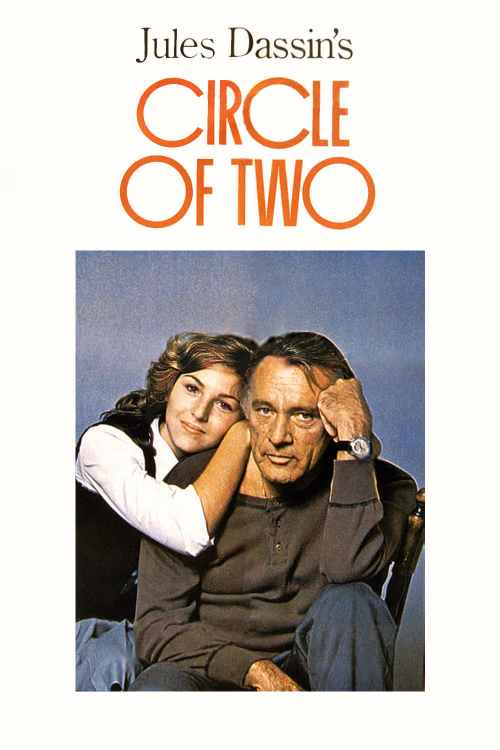
Circle of Two (1981)

circle3

By Richard Winters

My Rating: 4 out of 10

4-Word Review: Old man/young teen.

Ashley St. Clair (Richard Burton) is an aging painter of 60 who has lost his passion and hasn’t either sold, or attempted to do a painting in over 10 years. Sarah (Tatum O’Neal) is an unhappy 15-year-old who’s tired of dating guys her own age as she finds them to be immature and only interested in one thing…sex. She then meets Ashley, first after she sneaks into an adult theater to watch an X-rated movie and then later at a coffee shop. Despite the extreme differences in their ages they still connect through their mutual interest in art. Ashley even begins to paint again and the two share an enjoyable, but platonic friendship. However, once Sarah’s parents (Robin Gammell, Patricia Collins) find out about they put an immediate stop to it by locking her in her room and and in protest Sarah refuses to eat.

Based on the novel ‘A Lesson in Love’ by Marie-Terese Baird this film marks the final one to be directed by famed Greek director Jules Dassin and in many ways this may be the weakest one that he did. The whole way the relationship gets going is very rushed and forced. Bumping into the same person twice in one day, in the big city of Toronto, doesn’t seem likely and then having Sarah fall so head-over-heels for him to the point she starts spouting out the ‘L’ word quite quickly is dingy. A more plausible scenario would’ve had Ashley teaching an art class (he no longer paints, but still has to bring in an income somehow) of which Sarah attends and then through the course of several months a bond is slowly created.

The sex angle is a complete mess. Fortunately Ashley makes no moves on her, but Sarah does aggressively begin to come-on to him and at one point stands completely naked in front of him. In her autobiography ‘A Paper Life’ O’Neal expressed great discomfort in having to do this scene though I didn’t detect this, but maybe that’s just because she’s such a great actress, but either way the scene was completely unnecessary.  It’s also inconsistent with the character as she broke-up with her boyfriend Paul (Michael Wincott) because he was trying to pressure her into having sex and she was still a virgin, so if she didn’t want sex with a guy her own age why would she want it with one who was way older and is this era of pre-Viagra how could she even be sure he could do it? A better scenario would’ve had sex never coming into play and it was simply their other mutual interests that connected them and it was only outsiders, like Sarah’s parents, that presumed the worst when it really wasn’t occurring.

The one bright spot is the acting with both leads being superb. O’Neal proves that her strong and memorable performance in Paper Moon was no fluke and the only thing that keeps the film watchable. Burton is excellent as well. Although he usually has a strong presence here he wisely takes a step back playing someone who’s weak and tentative, which in many ways reflected his own career at the time where many felt he was washed-up and the years of alcohol abuse certainly did age him making him look even older than 60 when he really wasn’t, and thus a perfect fit for the part. The only issue here is that Tatum seems way too mature for 15 both physically and personality-wise and having her play someone who was 17 would’ve been more appropriate.

While the film remains marginally compelling the talky ending in which Burton goes on a long speech like a tenured professor lecturing to a college class practically ruins it. I was also frustrated that we never learn much about the old man, played by George Bourne Sr., an elderly gentleman who agrees to let Ashley paint his portrait for a fee, which in-turn revitalizes his career and I felt this character should’ve been in it more, or at least a few scenes showing what they talked about as his portrait was being done.

Tatum’s abstaining from all food plays-out poorly as well. For one thing she doesn’t change physically, so we’d never know she wasn’t eating if it weren’t mentioned. She then travels to New York and I was fully expecting her to pass-out in the middle of crowded Grand Central Station from a lack of nutrients, but apparently in-between time she had eaten something, but this should’ve been shown and the fact that it isn’t is a sign of shoddy film-making, which despite Dassin’s previous output, this whole movie ends up pretty much being.

My Rating: 4 out of 10

Released: May 7, 1981

Runtime: 1 Hour 46 Minutes

Rated PG

Director: Jules Dassin

Studio: World Northal

Available: DVD-R, Amazon Video

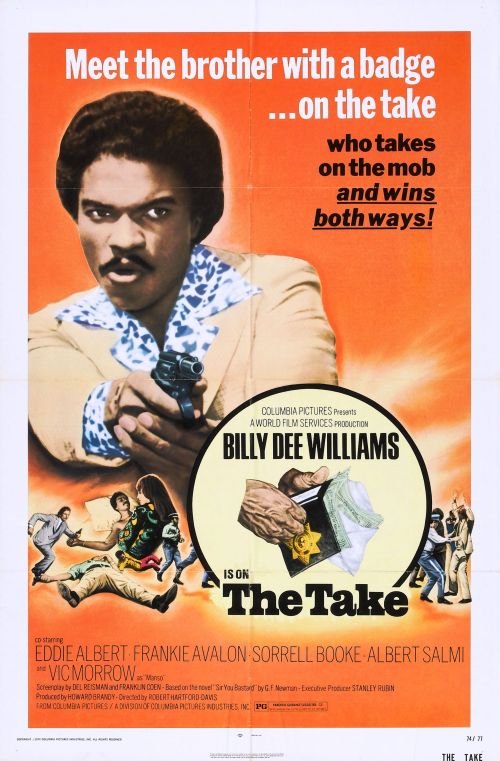
The Take (1974)

take1

By Richard Winters

My Rating: 4 out of 10

4-Word Review: Black cop accepts bribe .

Terence Sneed (Billy Dee Williams) is a San Francisco cop brought to Paloma, New Mexico to help take down local crime boss Victor Manso (Vic Morrow). The only problem is that Manso invites Sneed over to his place and offers him a significant amount of cash to get on his ‘payroll’ and thus allow him to get away with his crimes. Sneed is also informed that another top official in the police department, Captain Frank Dolek (Albert Salmi) is on the take as well. Sneed accepts the cash, but then double-crosses Manso by having Dolek secretly tailed where he finds out who all of Manso’s connections are and uses this info to try and bust Manso’s drug operation, which ends up being a tall order that gets Sneed in hot water not only with Manso, but with his police supervisor Chief Berrigan (Eddie Albert) as well.

The film is based on the 1970 British novel ‘Sir, You Bastard’ by Gordon Frank Newman, which became a bestseller and set-off a series of three books that he wrote around the Sneed character. There were though differences between the book and movie as in the novel Sneed was white and worked in Scotland Yard. The one thing though that remained the same was Sneed being unscrupulous and working outside the system.

The fact that the protagonist accepts bribes and most of the way it’s unclear whether he’s even a good guy at all is what makes the movie interesting and helps differentiate it from the other early 70’s cop action flicks. This is the complete opposite of Serpico where the cop refused all bribes and vigorously fought against it. Here we see the other angle. Instead of the main character being on the outside looking in he’s a part of the corrupt system and in order to survive in it must be willing to play along, which I found more realistic and insightful as someone who’s able to totally rise above the evil environments they’re in is rare and therefore we get more of an everyman’s perspective here. It also works against the ‘Save the Cat’ book, which has become the bible of today’s screenwriters, which insists that the main character must be likable for the movie to work. Here Sneed is anything but and at certain points when he forces an overweight suspect (Robert Miller Driscoll) to take-off his clothes and do jumping jacks in humiliating fashion to the amusement of the other cops he becomes downright nasty, but in-turn it makes the movie less formulaic, which too many movies today have become.

Williams’ skill as an actor helps to keep the character engaging and he gets great support not only by Eddie Albert as his exasperated superior, but also surprisingly by Frankie Avalon who has a small, but memorable bit as a drug dealer who initially comes-off as quite cocky, but melts dramatically once inside the interrogation room. Unfortunately for Vic Morrow, who’s played some classic villains in his career, his presence here doesn’t work. This is mainly from his get-up including dyed blonde hair and at one point a pseudo cowboy outfit, which looked campy. I also didn’t like that it’s shown right away that his character has heart problems, which telegraphs a major vulnerability that instantaneously sets the viewer into expecting that this will predictably lead to his eventual demise.

As for the action I felt it started well particularly the opening courthouse ambush, which is well choreographed with a funky score, but it becomes rather pedestrian after this. Having the main character misjudge things like when he tries the intercept Manso’s transporting of illegal goods, but ends up chasing down the wrong van each time, which were intentionally being used as decoys, was refreshing because in too many other police movies the hero cops always gets things right the first time and his hunches are never proven wrong, which again is just not how things work in reality. Either way it’s not as exciting as it could’ve been with a lot of car chases and action scenarios that ultimately prove to be generic in nature.

My Rating: 4 out of 10

Released: May 5, 1974

Runtime: 1 Hour 32 Minutes

Rated PG

Director: Robert Hartford-Davis

Studio: Columbia Pictures

Available: DVD-R

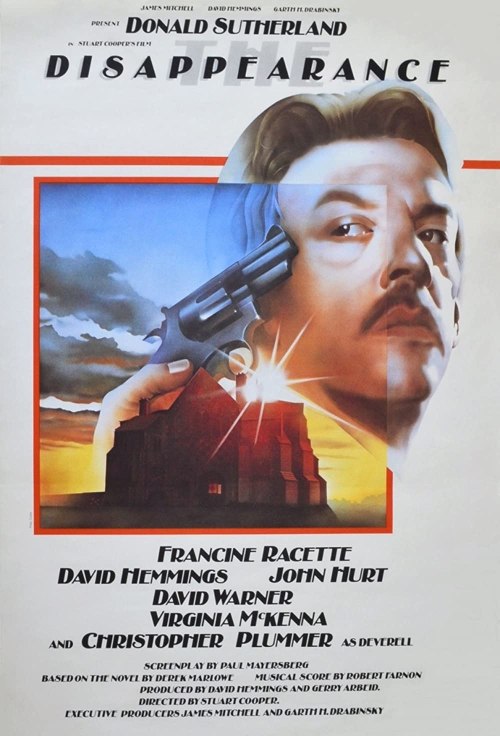
The Disappearance (1977)

disappearance

By Richard Winters

My Rating: 7 out of 10

4-Word Review: Where is his wife?

Jay Mallory (Donald Sutherland) is a professional assassin who works for a secret organization that contracts him out to do hits all over the world. After returning home from his latest assignment he finds that his wife Celandine (Francine Racette) is not there. Since they had a tumultuous relationship he initially presumes she left on her own accord, but then his friend and fellow hit man Burbank (David Warner) informs him that her disappearance may have something to do with his last hit. The organization that employs him now calls with another assignment, but this time they’re reluctant to give any details, which is unusual. Jay is afraid he’s being set-up as Burbank told him that the company is known to ‘retire’ those that are deemed no longer useful or trustworthy. He decides though to go through with the assignment as he’s curious how it will play-out and confident enough in his ability to get out of any jam, but soon finds himself faced with an entangling twist he never expected.

The film is a fascinating portrait of what can be done with creative direction. Stuart Cooper, who’s not exactly a household name and in fact this was his last theatrical film until 2010 when he did Magic Man, lends some interesting directorial touches that makes the story and characters more interesting than they might otherwise. What I especially liked was the non-linear narrative in which the movie cuts back and forth between the past to the present day. These types of storylines are typically frowned upon by Hollywood studios as they’re considered to be ‘too confusing’ for mainstream audiences to follow, but I had no such difficulty and felt it allowed in added nuance that would not have been present had the plot been approached in the conventional way. Nonetheless when the film tanked at the box office upon its initial release the studio insisted that the film be re-cut where the story would be presented in the standard linear format, but this version did even worse, so fortunately for the DVD/Blu-ray release it was brought back to its original way and labeled as being the ‘director’s cut’ though Cooper actually had no input on it, but eventually approved once he viewed it.

It’s also highly atmospheric particularly with the way it captures the cold, wintry climate of Montreal in the dead-of-winter. Having been born and raised in Minnesota I can tell a fake winter scene done on an indoor sound stage using artificial snow within seconds, but here the cold, including the mounds of snow drifts and nasty hollowing wind, is quite vivid and helps to symbolize the cold nature of the characters and the business they’re in.

I was a little more lukewarm with the acting. Sutherland can certainly be an outstanding leading man, but he seems too kind and sensitive for a person making a living killing others for money though I did like the scene where he plays memory games with his wife while at home, which brings out how crucial paying attention to detail is for his line of work. The supporting players are all familiar faces though I felt Warner was a bit wasted and underused. Virginia McKenna, best known for her starring role in the classic Born Free, is seen for only a brief bit though her interaction with Sutherland is quite pivotal while Christopher Plummer doesn’t appear at all until the final 15-minutes, but still manages to come-off with a memorable presence.

Spoiler Alert!

The film’s biggest downfall though is with the ending, which becomes one twist too many. Up until that point the twists had been a logical fit that made sense when you went back and thought about it. Then at the very end Sutherland gets shot and killed while walking home from the grocery store, but it’s never shown who did it, or why. Maybe it was the secret organization that wanted to ‘retire’ him, but this needed to be shown and explained. Just leaving the viewer hanging with a violent, but vague scenario isn’t satisfying and cheapens the rest of it.

My Rating: 7 out of 10

Released: September 17, 1977

Runtime: 1 Hour 31 Minutes

Rated R

Director: Stuart Cooper

Studio: Trofar

Available: DVD (Region 2), Blu-ray

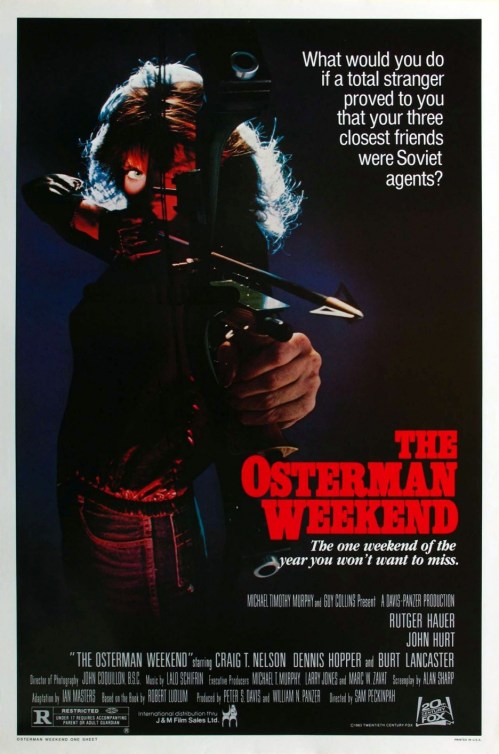
The Osterman Weekend (1983)

osterman1

By Richard Winters

My Rating: 7 out of 10

4-Word Review: His friends are spies.

Based on the 1972 Robert Ludlum novel of the same name the story centers around John Tanner (Rutger Hauer) a controversial host of a TV show where government officials are interviewed and many times put on the spot by Tanner who harbors anti-establishment political leanings. Maxwell Danforth (Burt Lancaster) is the director of the CIA who along with fellow agent Laurence Fassett (John Hurt) have uncovered a Soviet spy network within the US known as Omega. The decision is made not to arrest the three members (Craig T. Nelson, Dennis Hopper, Chris Sarandon) that have been identified as the spies, but instead try to get one to turn on the others and thus expose the organizations without tipping-off the KGB that they were aware of it all along. Since Tanner went to college with the three men and plans to have a weekend get-together with them at his place he gets chosen by Fassett to carry-out the trap where he’ll try to get one of his friends during the two-day stay to turn on the others. Tanner initially resists, but eventually agrees and has his whole house rigged with secret cameras and microphones, so the CIA is fully aware of everything that goes on, but ultimately Tanner begins to suspect that things may not be as they seem.

This was director Sam Peckinpah’s final film and 5 years after releasing his last one ConvoyHe was already quite ill due to effects of substance abuse and had to take frequent naps during the shooting day, but still managed to get the movie released on-time and within budget. Many have felt this was one of his weaker efforts, but I came away enjoying it despite the fact that Peckinpah despised the story and the Ludlum novel of which it was based and only agreed to the it because he needed the work. What I liked best was his patented use of slow-motion photography. Here I felt it came into use in excellent ways especially during the car chase. Most chase sequences in movies can get confusing because it’s usually done at fast speeds making it hard to follow and many times done with jump cuts, but here because it gets slowed down it made it more dramatic particularly with the crashes.

Admittedly some of his other directorial touches were a bit odd. The opening sequence showing two naked people in bed together making love, which was shot on video tape and has a romantic music score, making it seem like a soft core porn flick and had many of members of the film’s test audience confused and even walking out in disgust. There is a surprising level of nudity, including seeing Cassie Yates topless, that I didn’t feel was necessary. There’s also touches of humor that I didn’t care for either. Apparently this was Peckinpah’s attempt to balance the violence, but it hurts the tension. The producers didn’t like the comical bits either and cut most of them out when Peckinpah got fired during post production, but a couple do remain, which are amusing, like when Hurt has to be pretend on-the-spot that he’s a television news reader giving an impromptu weather report, but still out-of-place for this type of story.

Many critics complained about the elaborate plot Roger Ebert stated in his review that it ‘made no sense’ and caused him to become ‘angry at it’ as a result. Vincent Canby of the New York Times described it as ‘incomprehensible’ and Dave Kehr of the Chicago Reader labeled it ‘a mess’. I didn’t have such difficulty following it and although it’s a bit intricate it isn’t really all that confusing as long as you pay close attention and the twists that do occur I found enjoyable and many times was already predicting. My one complaint was be the way Tanner gets so easily persuaded that his friends, people he’s known for a long time and is very close to, are spies and he immediately turns against them. This is also a man that is supposedly ‘anti-government’, so you’d think he might like the fact that his friends are spies. A good way to have avoided this was having the character not hosting a liberal talk show, but instead a conservative one where Tanner would be a patriotic, pro-American type guy and thus making his acceptance of what the CIA agents tell him more plausible.

It’s interesting seeing Hauer, who usually plays villains, being a good guy, while Lancaster being a perennial protagonist, mixing it up here as a baddie. Both play against type well and the supporting cast has their share of moments too including Craig T. Nelson as a judo fighting expert and Hopper, who should win the award for best nervous expression. In all though it’s Helen Shaver that steals it as Hopper’s cocaine addicted wife. She’s not likable in any way and actually quite annoying, but she definitely stands-out with has a few choice moments.

Spoiler Alert!

I will admit that the ended, where Tanner tries to out the CIA director during an interview on his TV-show, doesn’t work and becomes one twist too many. Having Hauer simultaneously speak on-the-air in his studio and then show-up at the same time at Hurt’s hide-out didn’t seem realistic. Apparently this occurred because the show was taped early and only given the illusion that it was done live, but how they were able to pull all that off is a stretch and having his friend Nelson suddenly become a seasoned in-studio director when that wasn’t his job otherwise didn’t jive either. It’s not enough to ruin everything that came before it, which I overall enjoyed, but it’s still a lame ending either way.

My Rating: 7 out of 10

Released: September 30, 1983

Runtime: 1 Hour 43 Minutes

Rated R

Director: Sam Peckinpah

Studio: 20th Century Fox

Available: DVD, Blu-ray, Amazon Video, Fandor

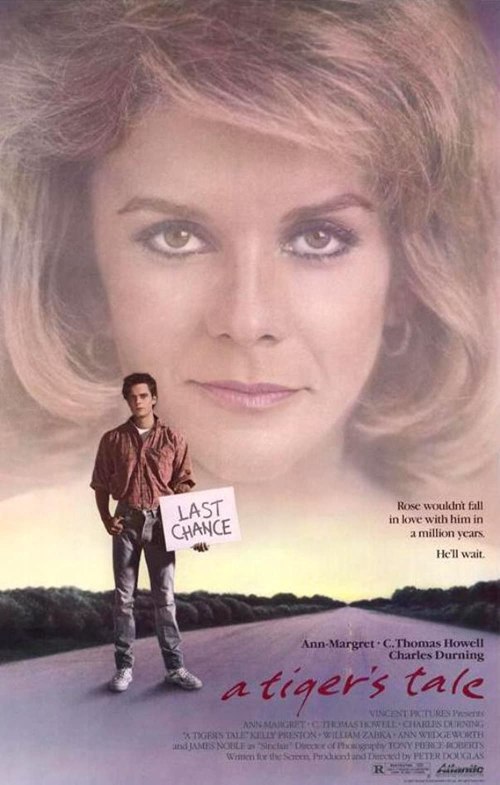
A Tiger’s Tale (1987)

tiger

By Richard Winters

My Rating: 3 out of 10

4-Word Review: Falling for girlfriend’s mother.

Bubber (C. Thomas Howell) is a high school student who’s dating Shirley (Kelly Preston) yet becomes more interested in Rose (Ann-Margaret) Shirley’s mother. The problem is Rose is an alcoholic and scared of snakes, which Bubber has as a pet and tigers, which Bubber also has as a pet. Despite all this the two slowly hit-it-off while keeping it a secret from the increasingly suspicious Shirley. Eventually she catches them in the act when she sees the two running naked at a drive-in where they tried to make love outside, but got attacked by fire ants. To get revenge Shirley pricks a hole in Rose’s diaphragm, so that she gets pregnant with Bubber’s baby. Bubber though intends to move-in with Rose to help her raise it, but Rose considers an abortion.

It’s impossible to say where this movie goes wrong mainly because it never gets going in the first place. It’s based off of the novel ‘Love and Other Natural Disasters’ by Allen Hannay III, who was paid $80,000 to have the rights to it sold to Vincent Pictures, which was owned and run by Peter Douglas, the third son of Kirk Douglas and brother of Michael. Peter then converted it into a screenplay, but without having read the book I couldn’t help but feel that something got lost in the transition. This is a big problem when novels get turned into movies as films don’t have as much depth to the story and characters as books typically do, which is why most people who enjoyed the story in book form usually end up disappointed when they see it as a movie. The elements are there for something potentially interesting, but Douglas, who also directed, doesn’t have the ability to put it altogether, which is probably a good reason why he’s never written, or directed any movie since.

I liked the setting, filmed in Waller County, Texas, but it doesn’t give the viewer enough feel of the region. Just showing the exterior of the homes and the drive-in isn’t enough. We need to see the town that they live-in in order to understand the characters and learn what makes them tick and the environments they are brought up in can have a lot to do with that, but when that environment gets captured in an ambiguous way, like here, it doesn’t help.

The story seems to want to tap into the themes of The Graduate, but that was a brilliant film and if you can’t top that, or at least equal it, then it’s best not to even try. Ann-Margaret is supposed to be an alcoholic, but we only see her with a drink in her hand at the start and then the rest of the time she seems quite sober. I also didn’t like the way she see-saws between being vampish at one moment and then a mature adult who gets real preachy with Bubber the next. It’s like someone with a split personality who isn’t fleshed-out and the same can be said for Howell’s character too.

There was potential for some funny bits like when Rose goes over to Bubber’s house and tells him she’s really frightened of snakes and then gets undressed and into bed with him. The camera then pans down to show a snake slithering under the covers and I thought this was the beginning of a really hilarious moment, but then the film cuts away. Later on Rose is shown to be comfortable in the presence of Bubber’s snake, but we never witness her transition, which was a missed opportunity for character development.  The scene where Rose and Bubber going running naked at the drive-in is dumb too because apparently only Shirley notices them even though with the screaming that the two were making it would’ve made anyone at the drive-in look-up and not just her.

Even the reliable Charles Durning gets wasted and becomes as dull as the rest. In fact the only thing that  I did enjoy was the tiger. I must commend Howell for being willing to get into a cage with it and stick his hand inside it’s mouth, but I was confused why the tiger is playful one second and then proceeds to try and attack Howell the next. Also, why would Howell want to get back into the animal’s cage later after he almost got his leg bite-off before? Even with that in mind I still felt the tiger was cool, the scene where he kills and eats a pooch of some customers that were just passing through is amusing in a dark sort of way and when he’s eventually set free is the only memorable moment in what is otherwise a misfire.

My Rating: 3 out of 10

Released: August 22, 1987

Runtime: 1 Hour 37 Minutes

Rated R

Director: Peter Douglas

Studio: Vincent Pictures

Available: DVD-R (dvdlady.com)

The Sunday Woman (1975)

sundaywoman

By Richard Winters

My Rating: 6 out of 10

4-Word Review: Murdered by phallic object.

Based on the novel of the same name by Carlo Fruttero and Franco Lucentini, the story centers on the investigation of the murder of Mr. Garrone (Claudio Gora). Garrone is found bludgeoned to death inside his apartment by a giant penis statue. Garrone was a well known architect and a lecherous ladies man who couldn’t help but make unseemly passes at every woman he came by. Commissioner Santamaria (Marcello Mastroianni) is put in charge of the case, which has many suspects. Two of the biggest ones are Anna Carla (Jacqueline Bisset) and her platonic male friend Massimo (Jean-Louis Trintignant). Anna had written a note, found by her hired help the next day, stating her desire to ‘eliminate’ Garrone. Anna, who’s quite wealthy, insists that it was all a innocent misunderstanding and Massimo backs her up, but Massimo, who has an alibi, is reluctant to divulge it because it would require him to admit that he’s gay and at Lello (Aldo Reggiani) his lovers’ house. Santamaria begins looking into other potential suspects as does Lello who wishes to get his boyfriend cleared, but the deeper Santamaria gets into the case the more he connects with Anna and despite their age difference they begin to have a romantic relationship all while she remains at the top of his suspect list.

The film, on the technical end, is well done. Director Luigi Comencini nicely captures the visual beauty of the Italian landscape and the posh older homes of Turin a city in northwest Italy where it was filmed. The soundtrack by Ennio Morricone has a nice bounce that keeps the film moving along even while not a lot is happening. There’s an array of suspects and enough red herrings to keep it intriguing and impossible to guess who’s the true culprit.

The story has its share of offbeat moments though it’s disappointing that the funniest character, Garrone, ends up getting killed as he was amusingly sleazy enough to have kept things consistently comical. While the death by giant penis statue, if memory serves me correctly, had already been used in A Clockwork Orange, it’s still a novel idea and it’s funny how Santamaria visualizes each suspect he meets bashing Garrone over the head with it as he interviews them. Traveling to the shop where the statues are made and being surrounded with hundreds of them is certainly good for a chuckle, but outside of this there wasn’t all that much that stood out, or made this any better than any other murder mystery. The ingredients are good enough to keep sufficient interest, but nothing the makes it really memorable.

I was most disappointed that Bisset wasn’t in it more. She’s fabulous, as she is in most of her movies, and though I suspect that her voice, where she speaks fluent Italian, is dubbed, I still felt she gives a spectacular performance. Mastroianni on the other hand looks tired and worn-out and like his peak years of being a international sex symbol had passed. Yet when he’s together with Bisset it clicks and Jacqueline’s superior acting camouflages their extreme age difference making them seem more like a perfect couple than it should. The two should’ve investigated the case together and become a team, as every second Bisset is not seen it flatlines. Had the two shared the screen this might’ve been special, but ultimately it misses-the-mark and never fully gels.

My Rating: 6 out of 10

Released: December 16, 1975

Runtime: 1 Hour 45 Minutes

Rated R

Director: Luigi Comencini

Studio: Fox-Lira

Available: DVD-R (dvdlady.com) (Italian w/English subtitles), Amazon Video (English subtitles)

Digby: The Biggest Dog in the World (1973)

digby2

By Richard Winters

My Rating: 2 out of 10

4-Word Review: Dog grows really big.

Billy (Richard Beaumont) is a young boy who buys an Old English Sheepdog from a local dog home manager ( Victor Maddern). However, when he brings the dog home his grandfather (Edward Underdown) doesn’t want it in the house, so his mother (Angela Douglas) tells him to give the pet to someone else. He then leaves him at the home of Jeff (Jim Dale), a researcher who works at a defense lab that is experimenting in growth formulas. Jeff is smitten with Billy’s mother, but too shy to ask her out. He ultimately agrees to take the dog as an excuse to be around the mother more. Things though turn chaotic when Jeff decides to borrow some of the growth formula at his lab, in order to feed it to his tomato plants, but instead it gets accidentally given to the dog, who then grows to gigantic proportions.

This is the type of movie that’s clearly meant for kids, but kids today, with the advanced computerized special effects seen in modern films, will quickly be turned-off by the cheesy effects here. The attempt to make the dog seem bigger by placing him in a miniaturized kitchen doesn’t exactly work. Other segments where he’s seen outdoors and at a circus don’t work either because it’s obvious that the animal was simply put in front of a green screen. The segment that has Jeff sneaking the dog outside while having him wear an outfit meant for a horse is stupid too because a horse’s head is shaped differently than a dog’s, so there would be no way it would fit over the dog like it does.

The only inspired effect is when Billy crawls into the dog’s giant mouth in order to feed it a formula that will supposedly get the animal to shrink back to normal size. The recreation of the dog’s mouth to a large size is impressive though a dog’s tongue is thinner and longer than a person’s and yet the tongue in this mouth is styled much more like a human’s. Having the kid command the dog not to swallow, as if he did it would’ve sucked the boy down the throat, is dumb because swallowing is a natural reflex when liquid is poured in, so I’m not sure it could’ve been prevented, or that the dog would’ve understood what the command ‘don’t swallow’ would’ve even meant.

The story is based on the novel by Ted Key, who besides creating the comic strip ‘Hazel’ also wrote the screenplays for Gusabout a mule who kicks field goals, The Million Dollar Duckabout a duck who lays golden eggs, and The Cat from Outer SpaceThose movies fared a bit better as they were more imaginative and had better character development. Outside of a circus scene, which features an elderly and near-sighted knife thrower played by Bob Todd, there is nothing that is funny, or even slightly amusing.

A good story should have a protagonist that the audience can root for and and a clear antagonist that the audience hates, or at least fears. This film though doesn’t have that.  Jim Dale is a likable enough, but a scientist nerd who’s awkward around women is a tired stereotype that isn’t interesting. The kid had more appeal and could’ve easily been the hero without the Jeff character even being present. The supporting cast is essentially the same person; deluded, wacky folks who are lost in their own little worlds and clueless about what is really going-on. It’s okay to have one dumb character, but when everybody is goofy it gets tiring fast. There’s no bad guy either just a bunch of buffoons running around saying buffonish things and getting into cartoonish predicaments. If that’s your idea of entertainment then have-at-it, but most will find this to be a dated and silly though those that remember watching as a kid may for nostalgic purposes like it a bit more.

My Rating: 2 out of 10

Released: December 6, 1973

Runtime: 1 Hour 25 Minutes

Rated G

Director: Joseph McGrath

Studio: 20th Century Fox

Available: DVD (Region 2)