Category Archives: Movies Based on Novels

Carrie (1976)

By Richard Winters

My Rating: 4 out of 10

4-Word Review: Prom was a disaster.

A shy, awkward teen (Sissy Spacek) who is a virtual outcast at her school and has a religious zealot for a mother (Piper Laurie), learns that she has telekinetic powers and uses them in terrifying and deadly ways after falling victim to a cruel prank at her high school prom.

Nothing really seems to mesh here and the pacing is poor. For a great deal of time you feel like you are not watching a horror movie, but instead an annoying, clichéd 70’s drama. The majority of the scares occur at the end while the rest of the film has no tension at all.  It’s visually flamboyant, but empty and unable to hide its low budget roots. Like with director Brian De Palma’s other thrillers his style and heavy-handed Hitchcock-like touches become overpowering and you lose touch with the story. Too much is orchestrated and the movie is never allowed to gel and have its own natural flow. The opening, which takes place in a girl’s shower, looks like a soft core porn flick especially with the choice of music.

The teen-age girls are certainly cruel and their snotty attitudes seem valid, but the actresses are all wrong. Yes, Nancy Allen and Amy Irving are hot to look at, but they were too old for their parts. All of them were in their 20’s and look far more like college girls instead of students in high school. The P. J. Soles character is irritating. In an effort to give the role some distinction they have her constantly wearing a pink baseball cap. She even wears it to the prom with her prom dress and looks ridiculous and yet still has the audacity to laugh at Carrie when she shows up when in reality they would most likely be laughing at her instead.

Miss Collins, the physical Ed. Teacher, which is played by actress Betty Buckley is another problem. She goes beyond the call of duty to give Carrie the individualized and sensitive attention that she needs. It sounds nice, but I couldn’t buy into it because in most cases shy students that don’t otherwise cause problems usually get overlooked even by the best of teachers simply because the school systems are too large with too many students to handle.

William Katt was not very convincing in his part as a dumb jock. John Travolta is good, but only because he is playing an extension of his Vinnie Barberino character from ‘Welcome Back Kotter’. In fact I found his portrayal here to be even funnier than his TV counterpart.

Spacek is the best thing about the movie as she brings the Carrie character to life with a vengeance. The part where she tears up the gymnasium with her powers is genuinely creepy and the way she opens her eyes and moves them around is freaky. The use of the split screen during this segment help to make it a uniquely scary moment in cinema history and saves what is otherwise a forgettable production. The famous ‘surprise’ ending isn’t bad either and even managed to startle me a little and I don’t startle easy.

Unfortunately it’s lacking the necessary ingredients overall to make it a classic. It’s based on the Stephen King novel and yet leaves certain crucial elements from the book out, which only creates more questions and confusion. De Palma takes the most simplistic parts of the story and then glossies over the rest leaving the viewer feeling unsatisfied when it is over.

My Rating: 4 out of 10

Released: November 3, 1976

Runtime: 1Hour 38Minutes

Rated PG

Director: Brian De Palma

Studio: United Artists

Available: VHS, DVD, Blu-ray, Amazon Instant Video 

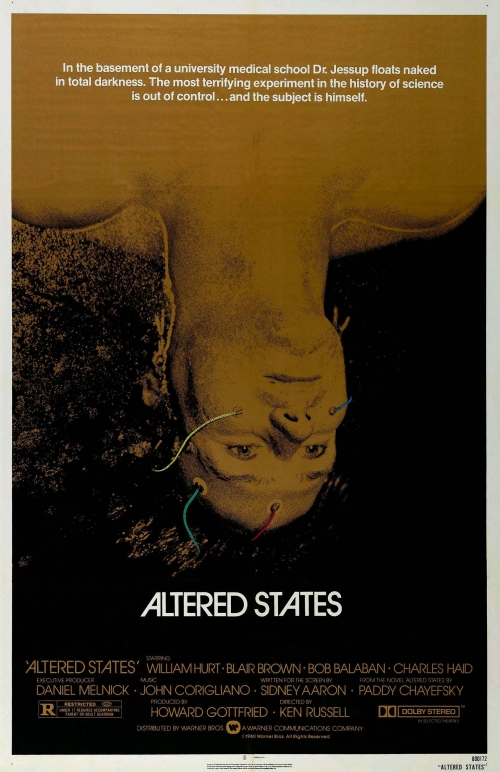
Altered States (1980)

By Richard Winters

My Rating: 5 out of 10

4-Word Review: Blair Brown’s hairy armpits.

            This film, which is loosely based on the experiences of dolphin researcher John Lily the inventor of the isolation tank, and from the Paddy Chayefsky novel comes this bizarre concoction that is half sci-fi and half surreal fantasy.  The story pertains to Eddie Jessup (William Hurt in his film debut) who spends time in his isolation tank at his Harvard research lab while taking hallucinatory drugs that send him into different states of consciousness that become increasingly more frightening and vivid until they begin to externalize in his everyday life.

It was directed by Ken Russell and if you are familiar with his work you realize that means the presence of lots and lots and lots of strange visuals that come at you in quick and unannounced ways. They are confusing, cluttered, and often times make no sense. However, since the story is pretty wide-open these trippy segments work to the film’s benefit, unlike other Russell productions where I felt they became off-putting.  They also give the movie distinction and momentum. I’ve never done LSD, acid, or meth, but these segments probably come as close to the experience of a drug trip as you will find.  It is best not to demand any logic and instead sit back and allow it to become an assault on the senses, which on that level works to excellent effect. I came away wishing these scenes had been more extended and frequent as they are the best part of the movie. Of course the state-of-art special effects are no longer as impressive and look like images put on a mat screen, but some of the other stuff is cool. My favorite part is where a naked Blair Brown and Hurt are lying on the ground and a strong wind completely covers their bodies with sand and then they slowly evaporate into the air.

Hurt does a competent job and the character isn’t the clichéd kind of sensitive modern man like most Hollywood protagonists. He is emotionally ambivalent and self-centered.  His unromantic marriage proposal to Emily (Blair Brown) is one for the books, but I liked it. Most research scientists probably aren’t a socially skilled, people person to begin with otherwise they wouldn’t be shutting themselves inside a lonely, dingy research lab all day, so in that regards I felt the script hit the target and gave the film a little more of an edge.

Blair does fine in her role as the long suffering wife and it is nice seeing her looking so young and even briefly smoking a joint. She looks great naked, but her armpits where much too hairy during the love-making scene and she should have shaved them. I also found it amusing that during the time the two were separated Eddie started to have relations with a younger student of his who continued to refer to him as ‘Dr. Jessup’ even when they were in bed together.

Charles Haid plays Mason Parrish a friend of Eddie’s who helps him out with his experiments despite strong misgivings. His rants and tirades are well-played and give the film energy when it is not in fantasy mode.

To me the movie became boring and contrived when Eddie started to mutate into that of an ape man and runs around the campus and city terrorizing everyone. It seemed too reminiscent to An American Werewolf in London, which came out around the same time as well as countless other wolf man movies. The part is also not played by Hurt, but instead Miguel Godreau, who was an excellent dancer. I was impressed with his limber body and the way he could climb things, which gave him an animalistic quality, but felt that if it represented the Hurt character then Hurt should have been performing it even if it meant allowing for certain concessions.

The opening sequence showing Hurt locked in a thin, rusty tank in an empty room is terrific. There is a certain starkness and foreboding quality, especially with the eerie music, that makes this one of the better openings to a horror movie. The use of the credit titles is creative and reminded me a bit of The Shining. However, the film’s ending is horrid and one of the worst I have seen. It reeks of being a forced ‘happy’ Hollywood ending that practically ruins the entire picture as a whole. Because of this and the fact that the script seems to only skim the surface of this potentially fascinating subject matter forced me to give it only a 5 rating.

My Rating: 5 out of 10

Released: December 25, 1980

Runtime: 1Hour 42Minutes

Rated R (Language, Brief Nudity, Adult Theme, Intense Visuals)

Director: Ken Russell

Studio: Warner Brothers

Available: VHS, DVD, Blu-ray, Amazon Instant Video 

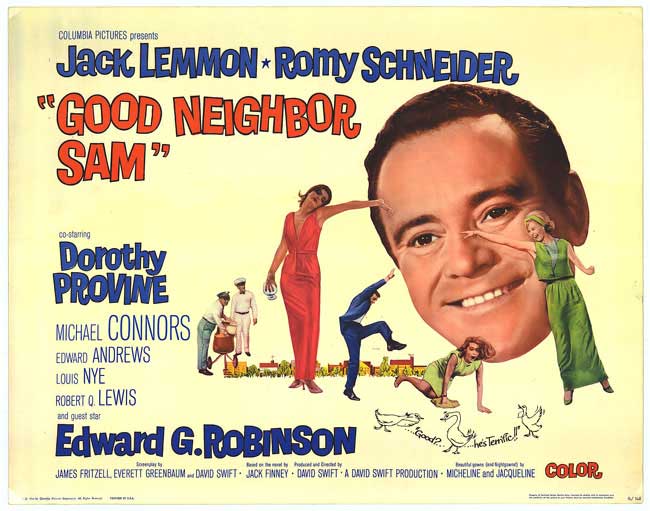
Good Neighbor Sam (1964)

By Richard Winters

My Rating: 7 out of 10

4-Word Review: Pretending to be married.

            Sam Bissell (Jack Lemmon) is an advertising executive working for a demanding client (Edward G. Robinson) who is very conservative and insists everyone around him have a clean-cut image and lifestyle. Sam’s wife Minerva (Dorothy Provine) brings home her college friend Janet (Romy Schneider) for a visit and she rents out the neighbor’s place while she is there.  Janet then finds out that she is going to be left a large inheritance, but the will stipulates that she must be married even though Janet is instead going through a divorce. For the sake of allowing her to collect the large fortune, which is 15 million dollars, Sam agrees, with the blessing of Minerva, to pretend to be Janet’s husband by staying at her place until the money is paid out.  A private detective (Louis Nye) is hired to keep a close eye on them and matters become even more complicated when Janet’s ex-husband Howard (Mike Connors) returns.

The concept is original and to my recollection has never been done before, or since, which is amazing when you think about the fact that just about everything else has. It does rely heavily on coincidence and too much of the first hour is spent setting up the plot with some extraneous scenes that could’ve and should’ve been cut. For such fluffy material, even entertaining fluff such as this, a 130 minute runtime is too long.  Three different writers were credited with doing the screenplay and the overall vision seems disjointed as at times it works as a satire, slapstick, and sex comedy, but never coming together completely as a whole. However, there is enough eventual pay off to still make it worth it.

This is one of Lemmon’s better comedy vehicles, if not his all-around best. Sometimes he comes off as too strait-laced and benign in these things, but here it works to the film’s advantage. His best part is when he dreams seeing himself getting out of bed and going over to the bedroom where Janet is and trying to seduce her. She screams so loudly that the entire town wakes up and comes over, which is funny and should have been played-out more.

Schneider though is the best thing about the movie. I loved her bright, beaming smile and effervescent personality. She sparkles in every scene and I was impressed that although she could be pleasant she could also easily get into a shouting match with Howard and the fact that she could switch emotional gears so easily and quickly proves that she had talent. Costume designer Jacqueline Moreau puts her into some snazzy outfits that look great on her including an all red jumpsuit, a strapless evening gown, and a two piece white pajama outfit with pink polka dots that was my favorite. It is a shame that due to her severe depression over the accidental death of her son as well as alcoholism and a three-pack-a-day smoking habit her career and life was cut short as she most assuredly still had a lot of outstanding parts and performances left to do.

Blonde Provine looks almost as good and equally delightful in her role where she tries holding it all together. Connors, best known for starring in the long-running TV-show ‘Mannix’, is surprisingly engaging as the ex. His arguments with Sam are fun and in order to keep the scheme going he pretends to be Sam and stays in the home with Minerva, which culminates with the film’s funniest moment, which is the early morning ‘kissing contest’ the two men have with each other’s wives.

Nye is also amusing as the detective and I got a kick out of his van that was supposedly disguised to be that of a cleaning service with a giant model of a vacuum on top of it that was used as a telescope.

The only one who gets wasted here is legendary actor Robinson who really doesn’t have anything funny to say, or do. However, his dinner party is still memorable simply because everyone gets served on all gold dinnerware, which includes the plates, cups, and utensils.

The music score is bouncy and the climatic sequence that features the main characters defacing area billboards is artsy and creative. On a lightweight, inoffensive level this satisfies and delivers a few laughs along the way.

My Rating: 7 out of 10

Released: July 22, 1964

Runtime: 2Hours 10Minutes

Rated NR (Not Rated)

Director: David Swift

Studio: Columbia Pictures

Available: VHS, DVD (The Jack Lemmon Collection)

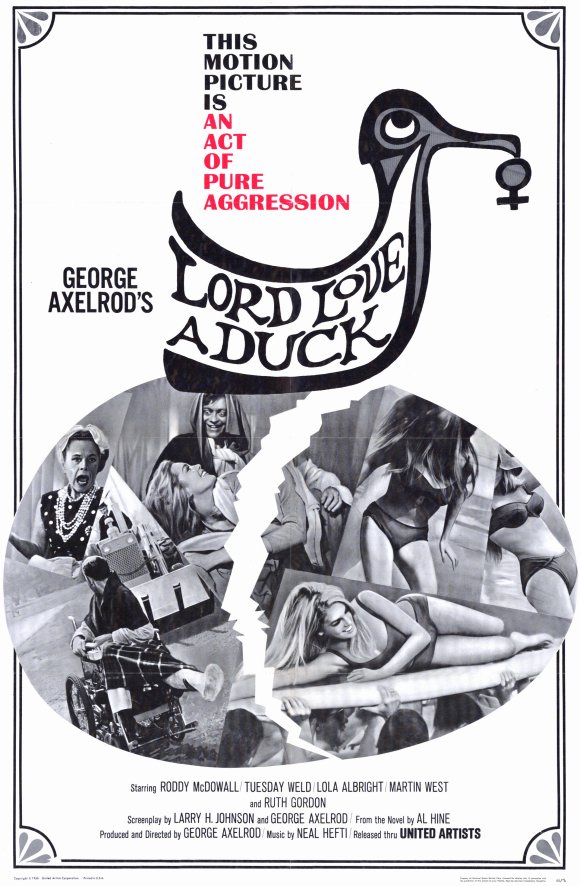
Lord Love a Duck (1966)

By Richard Winters

My Rating: 3 out of 10

4-Word Review: She wants it all.

If you ever wondered where political correctness got its start it was probably southern California in the mid 60’s. Here everything is neutralized and modified so as to ‘keep up with the times’. There’s even a drive-in church where the minister proudly exclaims that the Lord answers every prayer because “whatever happens is the answer”.

Tuesday Weld plays teenager Barbara Ann Greene who can’t be happy unless she has it all. She meets fellow high-schooler Allan Musgrave (Roddy McDowell) who because of his super intelligence is able to figure out ways for her to get what she wants. Yet the more she gets it the more unhappy she becomes.

It’s a satire on our consumer driven society, but it is too restrained and soft. A supposedly cutting edge film looking at our modernized world should have been filmed in color and not black and white. It also should have been faster paced with a heavier emphasis on the zany and outrageous. Instead we only get hints of this with a lot of slow segments and even some clumsy drama. The funny offbeat bits are spread out to thin and do not make up for the other parts that are boring and contrived.

There are some technical problems too including a lot of ‘outdoor’ shots that were really filmed indoors on a soundstage. They fortunately don’t do this anymore, but when they did it looked tacky. There is also a boom mike that is very obvious to see in several shots.

McDowell is not eccentric, nor unique enough for such an offbeat character. Although perpetually boyish looking he was way, way too old to be playing a high school student as he was 37 when this was filmed. Out of all the performers Harvey Korman comes off as the most amusing playing the overtly congenial school principal.

This film does feature an attractive cast. Of course Weld is always alluring, but she has competition from Jo Collins who was Playboy Playmate of 1965. There is also Lynn Carey daughter of the late actor MacDonald Carey from ‘Days of Our Lives’ fame. She is exceptionally good looking and watching here gyrate in a bikini to the latest dance craze is damn near pornographic. For her age Lola Albright, who plays Weld’s mother, is an absolute knockout and she can officially be crowned as a ‘milf’.

My Rating: 3 out of 10

Released: February 21, 1966

Runtime: 1Hour 45Minutes

Rated: NR (Not Rated)

Director: George Axelrod

Studio: United Artists

Available: VHS, DVD

Marathon Man (1976)

By Richard Winters

My Rating: 7 out of 10

4-Word Review: Dentist doesn’t use novocain.

            Thomas ‘Babe’ Levy (Dustin Hoffman) is a post graduate student at Columbia University and part-time marathon runner who spends a harrowing 48 hours being tortured and terrorized by a sadistic Nazi war criminal. It all starts when his brother Henry ‘Doc’ Levy (Roy Scheider) who works for a secret government organization known as ‘The Division’, secretly tracks Dr. Christian Szell (Laurence Olivier) a dentist at Auschwitz who has traveled to New York in order to collect a cache of diamonds. When Doc moves in too close Szell stabs him and despite being covered in blood Doc manages to make it all the way to Babe’s apartment before collapsing. Szell fears that Doc might have told Babe something before he died and has his men kidnap Babe where they then tie him to a chair in an abandoned warehouse and Szell tortures him by drilling into his teeth forcing Babe to use his running skills in an effort to escape.

This is an original thriller that stays intriguing and intense throughout. In the first thirty minutes alone the viewer is treated to some interesting and exciting scenarios including watching two elderly men drag racing with each other in their antique cars down a crowded neighborhood street. There is also an exploding baby carriage and an exciting fight sequence where Doc battles an attacker who tries to strangle him from behind with a metal wire. This scene is unique in that it cuts between seeing the action up close as well as viewing it from the point-of-view of an elderly man watching from across the street.

Director John Schlesinger shows visual flair with a variety of camera angles and settings. I particularly liked the part where Doc meets Szell at the red steps statue in the Arco Plaza. Having the climactic showdown between Babe and Szell take place in a pump room at the reservoir in Central Park gives the sequence added energy and distinction. I also enjoyed Babe’s cramped, drab, and cluttered apartment that had a very lived-in look and resembled exactly what a bachelor pad with someone on a low income would look like. The scene taking place at a country house is memorable simply for its extreme remoteness. I was disappointed though that although Schlesinger does a great job in setting up the atmosphere of the scene by doing a long shot looking out at the barren landscape the weather suddenly goes from cloudy to sunny in the minute it takes for the bad guy’s car to pull up the driveway. I realize certain scenes are sometimes shot over several days and this is not the first movie to have sudden weather changes during outdoor shots, but it is distracting nonetheless.

The infamous torture scene didn’t work for me. I appreciated the set-up especially the prolonged way that Szell plugs the drill into a wall outlet while talking to Babe in a calm tone. Constantly asking Babe the question ‘Is it safe?” has become a classic line and the fact that the dental torture gets extended when you think it is over is well done. Still, it didn’t seem violent enough and although pain is implied I didn’t think that the viewer really ‘feels’ it. I wanted more shots from Babe’s point of view especially as Szell sticks his metal instruments into Babe’s mouth. A close-up of Babe’s tooth and seeing the drill touch it would have helped as well. Also, Babe needs to scream in pain a lot more, he does it once briefly, but someone going through that would be doing it constantly.  Apparently the producer’s cut out portions of this scene when it upset the test audiences who saw it, but I would like that footage put back in as I feel it would make the movie stronger and give it an added kick that otherwise is missing.

Olivier is tremendous in the villainous role. His face exudes evil and this is one of his best later career roles. Scheider has his best role here and I found Marthe Keller impressive as Babe’s girlfriend. She wears an attractive hairstyle and I couldn’t get over how diametrically opposite she was compared to her character in Black Sunday that was done the very same year. She is definitely an under-rated actress that deserves more accolades as well as more parts in American productions. However, the way Babe pursues her for a date seemed to border on ‘creepy’  and overly aggressive and act as a turn-off to most women.

The film does seem derivative at certain points especially the way it portrays New York as an urban hellhole, which was quite common during the 70’s. The fact that Babe avoids confrontation and is picked on by a Hispanic gang that lives across the street seemed too reminiscent of Hoffman’s earlier film Straw Dogs. There are several flashback sequences showing Babe as a child that is done with faded color and no dialogue and look too similar to the childhood sequences done in Midnight Cowboy, which was an earlier Schlesinger/Hoffman project. Hoffman, for what it is worth, gives another one of his dedicated performances, but this film really does show in glaring detail how very puny he is and I really could have done without having to see his naked rear.

The electronic score is nice and the part where Szell gets recognized by an elderly concentration camp survivor on a busy city sidewalk and who then begins to chase after him is memorable. However, when it is all over I still felt it didn’t completely click. I’m not sure what it is. I know the ending was changed from the one in the book, but I liked this one better and felt Babe’s revenge on Szell was creative. Although controversial and edgy for its time, the torture scene seems too toned down for today’s standards. Either way, if you are looking for a competent and entertaining thriller this should fit the bill, but it is not a classic.

My Rating: 7 out of 10

Released: October 8, 1976

Runtime: 2Hours 5Minutes

Rated R: (Violence, Language, Adult Theme, Brief Nudity)

Director: John Schlesinger

Studio: Paramount

Available: VHS, DVD,  Blu-ray, Amazon Instant Video 

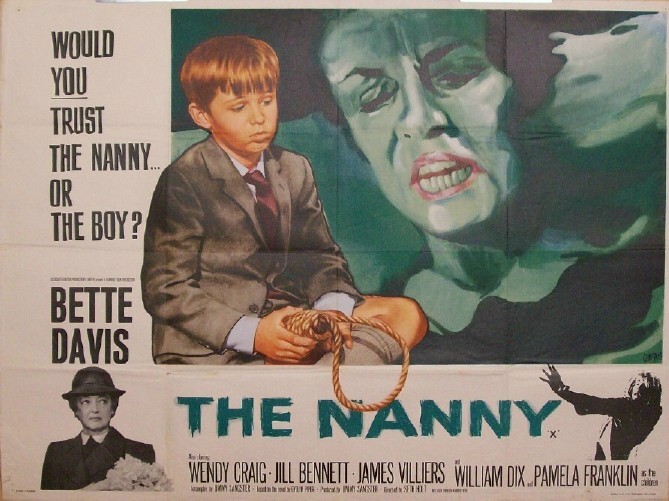
The Nanny (1965)

By Richard Winters

My Rating: 5 out of 10

4-Word Review: Kid doesn’t like nanny.

            Bette Davis plays a nanny to an upper-class British family whose oldest son Joey (William Dix) is accused of accidently killing his younger sister. Joey, who is only 10, is sent away to a home for disturbed children. When he returns he accuses the nanny as the one who did the killing and a psychological game of cat-and-mouse ensues.

Davis is sensational. She plays a type of character that she has never done before and the results are fascinating. She is much more subdued and evasive than usual and she falls into the role of the unassuming nanny in a seamless fashion. The different setting works well for her and I commend her tenacity for taking on a project that was not glamorous. She even puts on some thick eyebrows for her part and at times, especially at the beginning, she starts to resemble her most hated rival Joan Crawford.

Dix is amazingly good as the kid and it is a shame that he did only one other picture after this one. I liked the independent nature of the character and he plays off Davis quite well and showed no signs of being intimated by her. Making the adversaries have such extreme age difference and personalities gives the story an interesting edge that helps carry the picture.

The evocative black and white photography helps accentuate the dark-tone. The British setting along with the expected formalities of that culture, particularly that from the father character Bill (James Villers) give the film some distinction.

The first act though goes on way too long. We are given the general premise right up front and then have to spend the whole first hour going through the scenario that Joey doesn’t like his nanny and is suspicious of her again and again until it becomes derivative. When the second act does finally come about it seems too late. The revelation isn’t all that clever or creative and the climactic sequence desperately needed more action and punch. The final result is unsatisfying. The viewer is given an intriguing premise that it can’t sustain to the end ultimately making this a misfire despite the outstanding presence of Davis and some high production values.

There is also the issue of the three-year-old girl who is adorable and an absolute scene stealer and yet right up front you are made aware that she is killed, which makes the proceedings rather depressing. Having to then watch her actual death is disturbing and, for its time period, rather vivid and startling.

My Rating: 5 out of 10

Released: October 27, 1965

Runtime: 1Hour 31Minutes

Rated: NR (Not Rated)

Director: Seth Holt

Studio: Hammer Productions

Available: DVD

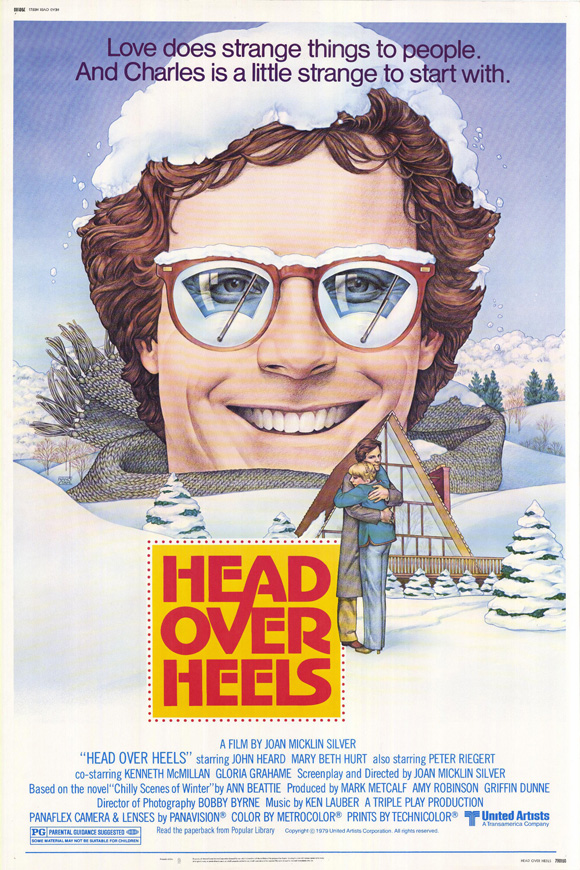
Chilly Scenes of Winter (1979)

By Richard Winters

My Rating: 8 out of 10

4-Word Review: Can’t get over her.

            Charles (John Heard) meets Laura (Mary Beth Hurt) at his job and immediately becomes smitten.  She is married and upfront about it, but since it is not going well she decides to go out with him. They soon move-in together, but it only lasts for a couple of months before Laura goes back to her husband. This is a crushing blow to Charles who obsesses about her constantly and tries any way he can to win her back.

This is in many ways a dated movie and normally I would consider that a detriment, but here I found it to be an asset. It is refreshing and fun to see a person drink a little on the job, or playfully touch a female co-worker as he walks past them and not have it become an immediate sexual harassment lawsuit. There is also the part where Laura invites Charles back to her home after only their first date, which could be considered reckless, but it’s nice to go back to an era that was more trusting and not everyone was labeled a potential psycho until proven otherwise.

There is of course the subject of stalking which is what Charles does, but here it is natural and actually kind of sweet. Some of it may be considered a little ‘creepy’, or even pathetic, but none of it is menacing, or done with criminal intent. To me this makes more sense and is more realistic to expect that when someone has strong feelings for someone else and spent special times with them that they would have trouble ‘moving-on’ when the other person breaks it off and their inability to do so shouldn’t necessarily make them ‘crazy’, or ‘maladjusted’ and this film very effectively shows that.

This is a terrific movie about relationships. The characters are real and relatable. The situations they go through are universal and the best thing is that it stays that way until the bitter end without pulling any punches. Anyone who has gone through difficult relationships will appreciate the honesty and it’s a real shame they don’t make movies like this anymore.

Heard is excellent and plays an extension of the same 60’s radical character begrudgingly moving into adult life that he did in Between the Lines, which was his first collaboration with writer-director Joan Micklin Silver. A young Peter Reigert is appealing as Charles’s roommate Sam. Kenneth McMillan, a looks- challenged character actor who usually plays slimy people, is surprisingly likable as Charles’s stepdad. Legendary screen actress Gloria Grahame, in one of her last roles, is highly amusing as Charles’s crazy mother. I was never quite sure what any of her scenes had to do with the main story, but her presence was fun anyways.

The film also contains some offbeat scenes and an original sense of humor. This includes the scene where Charles makes a miniaturized replica model of the home that Laura lives in and then uses dolls to play the parts of Laura and her husband and child. There is also the part where Charles meets Laura’s husband under the guise of being a home buyer and then stands up in front of him and states his undying love for his wife as well as a goofy conversation that he has with a wacky elderly lady roommate when he visits his mother in the hospital. The best though is the running conversation that Charles has each day with the blind cashier at a candy counter that gets better and better as the movie progresses.

The film nicely captures the wintry Utah landscape and although the original title for the film was Head over Heels this other title works much better and not only fits the season in which the story takes place, but also the ever difficult and complicated dating scene as well.

My Rating: 8 out of 10

Alternate Title: Head over Heels

Released: October 19, 1979

Runtime: 1Hour 32Minutes

Rated PG: (Brief Nudity, Adult Theme)

Director: Joan Micklen Silver

Studio: United Artists

Available: VHS, Netflix Streaming

The Little Girl Who Lives Down the Lane (1976)

By Richard Winters

My Rating: 3 out of 10

4-Word Review: She is all alone.

Rynn (Jodie Foster) is a 13-year-old girl living alone in a big house in the countryside. Her father has leased the place for three years from nosy landlady Mrs. Hallet (Alexis Smith) and her adult son Frank (Martin Sheen) who continually makes lecherous advances towards Rynn. No one has seen her father and when anyone asks for him she comes up with excuses, which starts to make everyone in town suspicious. She meets fellow teen Mario (Scott Jacoby) who she lets in on her secret and the two devise a plan that will rid them of the meddlesome Hallets.

Although she has stated in interviews that this is the least favorite out of all the movies that she has done I can’t think of anyone more perfect for the part of an independent headstrong young woman than Foster, who has always carried that persona. Despite the vast age difference she easily carries the picture from her older co-stars. There is even a nude scene involving her character although it was done by her older sister Connie working as a body double. This was done despite her adamant protests as was a scene where she goes to bed with Jacoby, which she has said made her extremely uncomfortable and probably explains her dislike for the film.

Sheen is menacing as the perverted Frank, who enjoys ‘younger girls’ and his ongoing banter and advances with Rynn is consistently creepy and tense. Alexis Smith is excellent as the mother and her worn face and attitude gives her a witchy presence and it is too bad she couldn’t have remained for the entire movie. I also found Jacoby engaging and amiable and I really enjoyed his character, which I found a bit surprising since he is best known for playing dark, sinister characters in Rivals and the TV-movie Bad Ronald.

The on-location shooting, which was done in both the Canadian province of Quebec and in Maine, is excellent and gives one a nice taste of small town life on the east coast. There is some nice synthesized music that gives the film a dark tone. The premise is offbeat and to some extent, at least during the first half, it is enough to keep you intrigued.

My main issue with the film is the fact that not enough happens. Almost all the action takes place in the main room of the house, which eventually becomes dull, especially visually. There are no scares, or shocks and the twists aren’t all that clever, or surprising. In fact the final twist I saw coming long before it happens. There are times when cutaways would have been helpful and spiced things up particularly when Rynn talks about a visit from her mother and her ‘long red finger nails’, which we never see and is just described. The conclusion leaves A LOT of unanswered questions making this thing empty and incomplete. The final shot is one very long take of a close-up of Foster staring at a subject while the credits role by, which eventually becomes annoying and it would have been better had they done a freeze-frame instead of forcing her to sit and stare at something way longer than humanely possible. Also, composer Mort Shulman is badly miscast as the policeman. His acting abilities are clearly limited and he shows no presence or authority and makes the scenes he is in weak.

It is hard to know what genre to put this in. It is really not scary and the mystery angle has too many loopholes to being taken seriously. The story, based on a novel by Laird Koenig, seems rather tame despite some dark elements and geared more for teens, or young adults.

My Rating: 3 out of 10

Released: December 25, 1976

Runtime: 1Hour 40Minutes

Rated PG (Brief Nudity, Mild Cursing)

Director: Nicholas Gessner

Studio: American International

Available:  VHS, DVD, Netflix Streaming

The Notorious Landlady (1962)

By Richard Winters

My Rating: 4 out of 10

4-Word Review: Landlady could be killer.

            William Gridley (Jack Lemmon) is an American who has arrived in London and looking for a place to stay. He rents a room from a home owned by Carly Hardwicke (Kim Novak) a gorgeous woman who Bill immediately becomes smitten with. The problem is that many people think Carly has killed in her husband even though his body has not been found. When Bill gets word of this he becomes determined to investigate the case and prove her innocence.

You would think a script written by Larry Gelbart and Blake Edwards would be funnier and full of zany scenarios and slapstick, but instead it gets grounded in a lot of dialogue for much of the first hour and forty-five minutes and only starts to get interesting during the final fifteen. The conversations lack any wit, or sharp one-liners, and the premise plods along at a much too leisurely pace. There is a segment where Bill accidentally sets fire to the patio, but I think this was simply thrown in for some action as there is very little else of it. The plot is formulaic and fails to add any new twist or perspective and once it is over it is easily forgettable. Lemmon’s character is bland and transparent and more than a little naïve since he falls in love with her immediately and is then convinced that she is innocent even though he has only known her for a day.

The best part comes at the very end where the two find themselves at a recital for a group of senior citizens that are all sitting in covered wheelchairs. This scene gets drawn out amusingly and includes a bit where an old lady named Mrs. Dunhill (Estelle Winwood) is pushed down the side of a hill, which is nicely captured in a silhouette style with Bill chasing after her. Winwood, who was already seventy-nine at the time, hams it up perfectly as the daffy old woman.  Of course all this comes much too late to really help the picture, or story, but at least it saves the film from being a complete bore, which it otherwise would have been.

Novak gives a surprisingly strong performance and a convincing British accent that I wish she had spoken in for the entire duration.  She was always a stunner, but here she may look her all-time best. One scene taken with her in the bathtub was highly risqué at the time and doesn’t leave much to the imagination. British character actor Lionel Jeffries is engaging as the inspector, but Fred Astaire is essentially wasted as Bill’s boss. The production values are decent, but the results are middling.

My Rating: 4 out of 10

Released: July 26, 1962

Runtime: 2Hours 3Minutes

Rated: NR (Not Rated)

Director: Richard Quine

Studio: Columbia

Available: VHS, DVD (Region 1 & 2)

Seance on a Wet Afternoon (1964)

seance on a wet afternoon

By Richard Winters

My Rating: 6 out of 10

4-Word Review: Psychic is a phoney.

Myra Savage (Kim Stanley) is an emotionally unbalanced woman and failed psychic who comes up with an idea that she hopes will revive her career. The plan is for her husband Billy (Richard Attenborough) to kidnap Amanda Clayton (Judith Donner) who is the young daughter of a rich businessman. They will then place her at a strategic location and hold a public séance at which time Myra will ‘miraculously’ predict her whereabouts. This will then, they hope, make her famous and world renowned, but of course things don’t work out as expected.

This is indeed a unique and unusual film that taps into some rare qualities. First and foremost is the black and white cinematography. Every camera shot and angle has a certain evocative flair that is well captured and vivid. The on-location shots pick up just the right amount of ambiance and lighting with each setting. The music score is great and helps create excellent tension. You also will love the little girl that they kidnap. She is adorable without it being forced. Her matter-of-fact sensibilities are a great contrast to Attenborough and Stanley whose characters are child-like and pathetic.

Yet the film doesn’t completely work. The story is handled in a plodding and methodical way without any twists or surprises. There is very little action, some definite slow spots and the conclusion is limp.

If you watch it for the performances then you will be more intrigued. Stage actress Stanley gives a rare film appearance here. It is easy to see why she took the role even though she was known to dislike doing films. The takes are long and give almost unlimited possibilities in creating a character, which is what all stage actors enjoy. She does well and at times may remind one of another legendary actress Geraldine Page who would have also been perfect for the part. Attenborough proves almost her equal. His expressions of shock and worry are memorable. The interplay between the two is fun especially towards the end when this otherwise passive man stands up to the domineering woman.

Overall there are some unique moments, but it is just not suspenseful enough and results in being only slightly above average.

My Rating: 6 out of 10

Released: November 5, 1964

Runtime: 1Hour 55Minutes

Rating: NR (Not Rated)

Director: Bryan Forbes

Studio: Artixo Productions

Available: VHS, DVD (Region 1 & 2)