Category Archives: Movies Based on Novels

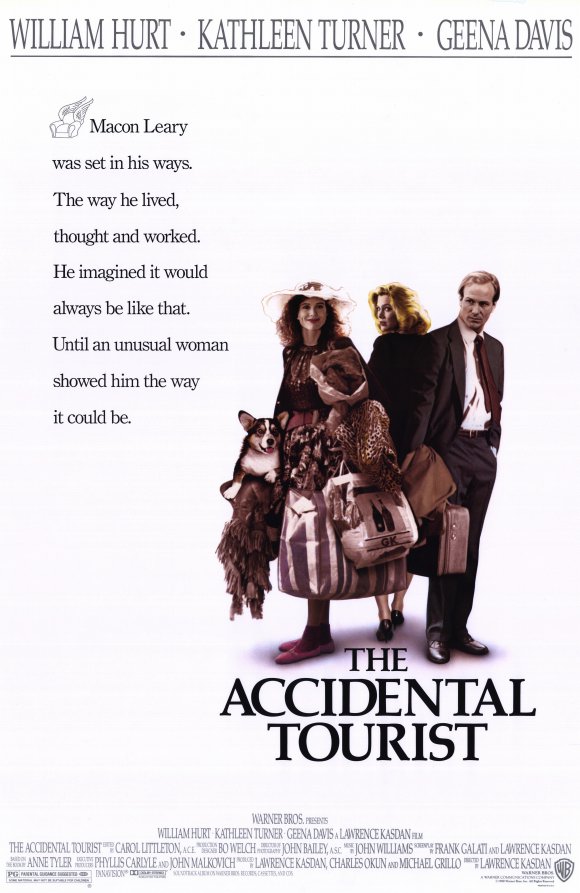
The Accidental Tourist (1988)

By Richard Winters

My Rating: 6 out of 10

4-Word Review: Introverts need love too.

            Macon Leary (William Hurt) is an introvert who writes travel books for a living despite the fact that he dislikes traveling. His marriage to Sarah (Kathleen Turner) ends after the untimely death of their son. His wife used to babysit his dog Edward while he was away, but now he decides to drop him off at the local animal shelter that is run by Muriel Pritchet (Geena Davis). She is colorful and talkative and his complete opposite and eventually a romance begins to blossom.

The film, based on the novel by Anne Tyler, takes its time in telling its story.  In some ways the leisurely pace is refreshing. Trying to get an introvert to be more extraverted is never easy and the way Macon is initially reticent towards Muriel’s advances was realistic. Yet it does drag at certain parts and seems to go on too long. The second hour, in which Sarah comes back in the picture and Macon is forced to choose between the two, is much more interesting and compelling. The side-story where Macon’s publisher Julian (Bill Pullman) romances Macon’s sister Rose (Amy Wright) was unnecessary and does nothing but make a slow movie even longer. I also didn’t find the eccentricities of Macon’s family to be all that amusing as they were exaggerated and portrayed introverts as being freaks instead of people who simply function better independently instead of within groups.

The Muriel character is a bit over-blown as well. She comes on too aggressively towards Macon before she even knows him. There is nothing shown for why she found this man immediately attractive especially when he constantly responds to her in a cold and distant way. Later on we learn that she is poor and possibly found Macon to be well-off financially and a good stable father for her son, but even so her behavior seems a bit too forward and bordering on being shameless. Her outfits are over-the-top. I realize they are supposed to accentuate her kooky personality, but they come off as gaudy and garish and like they are being worn by someone who has no sense of style or taste.  The part where she quietly hugs Macon when he explains to her about the death of his son is moving and the first moment when I began to like the character. However, director Lawrence Kasdan ruins it by then having her strip of his clothes and climb into bed with him, which took things too far. In film sometimes the strongest statements can be made with the simplest of images and it seemed like here they had it and then lost it.

Turner is okay as the ex-wife, but I initially felt the character was unnecessary. I didn’t like it at the beginning when they are breaking-up and she goes into great detail about his character faults sounding almost like she was analyzing him for a psychological assessment. It seemed to me like she was being used to help ‘explain’ his character to the viewer when in a good film the viewer should be able to come to these deductions themselves without the help of an on-screen ‘tutorial’. Later on as she fights to get Macon back the character becomes stronger and better fleshed-out. I even ended up feeling sorry for her as her own insecurities and jealousies do her in.

Hurt is solid in the lead playing an atypical role. I wanted more of an explanation about the death of their son. It takes quite a while before it gets explained and then we are told that it was during some botched robbery at a burger joint, but it was still unclear to me why he was there and not the parents, or how it all played out. Having a flashback with a news report involving the incident would have helped. The film has many other flashbacks, some of them quite good, so another in this area would have been nice.

The music score is pleasing, but too reminiscent of ones used in other films from that era. It also has a bit too much of a whimsical quality that is not fitting for a drama such as this. The Muriel’s eight year old son is cute, but a bit too cute. I found the scenes where Macon bonds with the kid to be touching, but when films seemed compelled to only show children spewing out cutesy, innocuous comments I find it a bit annoying.

Overall this is a quality production made probably more for the female viewer looking for an intelligent, sensitive romance.

My Rating: 6 out of 10

Released: December 23, 1988

Runtime: 2Hours 1Minute

Rated PG

Studio: Warner Brothers

Director: Lawrence Kasdan

Available: VHS, DVD, Amazon Instant Video, Netflix Streaming
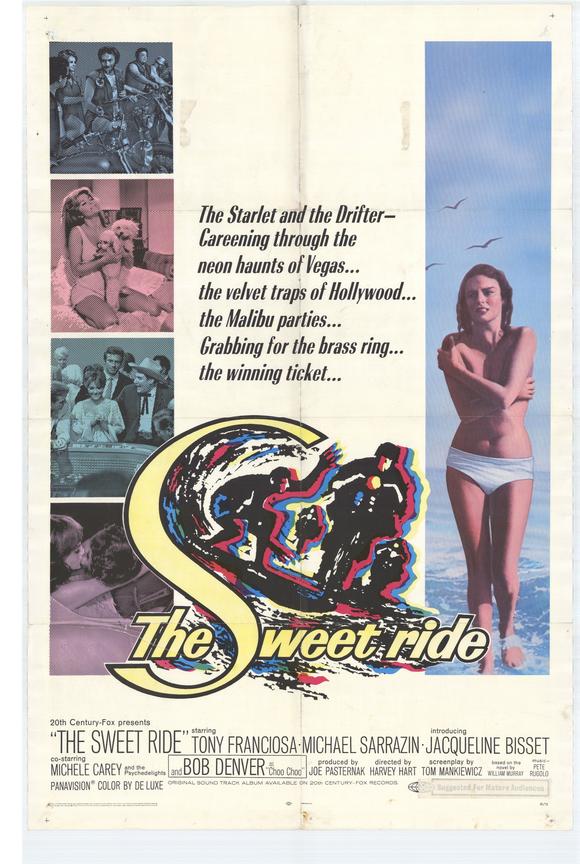
The Sweet Ride (1968)

By Richard Winters

My Rating: 4 out of 10

4-Word Review: Bachelor pad on beach.

This is an obscure and ponderous film dealing with three bachelors(Anthony Franciosa, Michael Sarrazin, Bob Denver) who live in beach house and one day come upon a beautiful woman named Vickie Cartwright (Jacqueline Bisset) swimming in the ocean. They all make a play for her yet it is Denny (Sarrazin) who she falls for. Eventually though her erratic behavior and secret past become too much for him.

The theme is similar to that of Petulia, which came out around the same time. That film proved more successful because of its intricate, stylish narrative and deeper intellectual understanding. Technically this is well directed, but the color is washed out and there seems to be an ugly brownish tone permeating every shot. Some of the sets look cheesy especially the ones used for the indoor bar scenes. The story is too pedestrian and stretched too thin. It starts with some nice interplay between the three men, but that quickly evaporates and by the second hour it has become really boring. There’s some action at the end, but it’s standard and pointless. The resolution itself is too convenient and the relationship between Denny and Vickie is unexciting.

The story does offer some potentially intriguing undertones, but the film never pursues them. The girl herself is an interesting element. We come to realize through the course of the story that she lives a very, very sad existence. The film could have been meatier had it a given us a wider scope of her life and not just the little tidbits that it does. It also could have shown us more of a background to her character and examined how she came to being the way that she was.

The film’s chief asset is the bachelor pad itself, which is a dream for the single male. It’s well designed and sits right on Malibu beach with a terrific view of the ocean. There is beer and liquor everywhere as well as beautiful women coming in and out. The constant sound of the crashing waves in the background give off a soothing effect and the setting allows this film more points than it might otherwise deserve.

Some credit must also go to Franciosa an actor that never really attained much stature. His role here may actually be his finest moment. He plays the eldest of the three men and is as tan, muscular, and good looking as any forty year old can get. He’s as flippant a character as you’ll ever see and adds zest to each scene that he is in. Some of his sardonic comments about his bachelorhood add insight as to why some people are single and want to stay that way.

Dusty Springfield belts out the opening song and really gives it her all.

My Rating: 4 out of 10

Released: June 12, 1968

Runtime: 1Hour 50Minutes

Rated NR (Not Rated)

Director: Harvey Hart

Studio: 20th Century Fox

Availability: None

The Terminal Man (1974)

By Richard Winters

My Rating: 7 out of 10

4-Word Review: Can’t control his impulses.

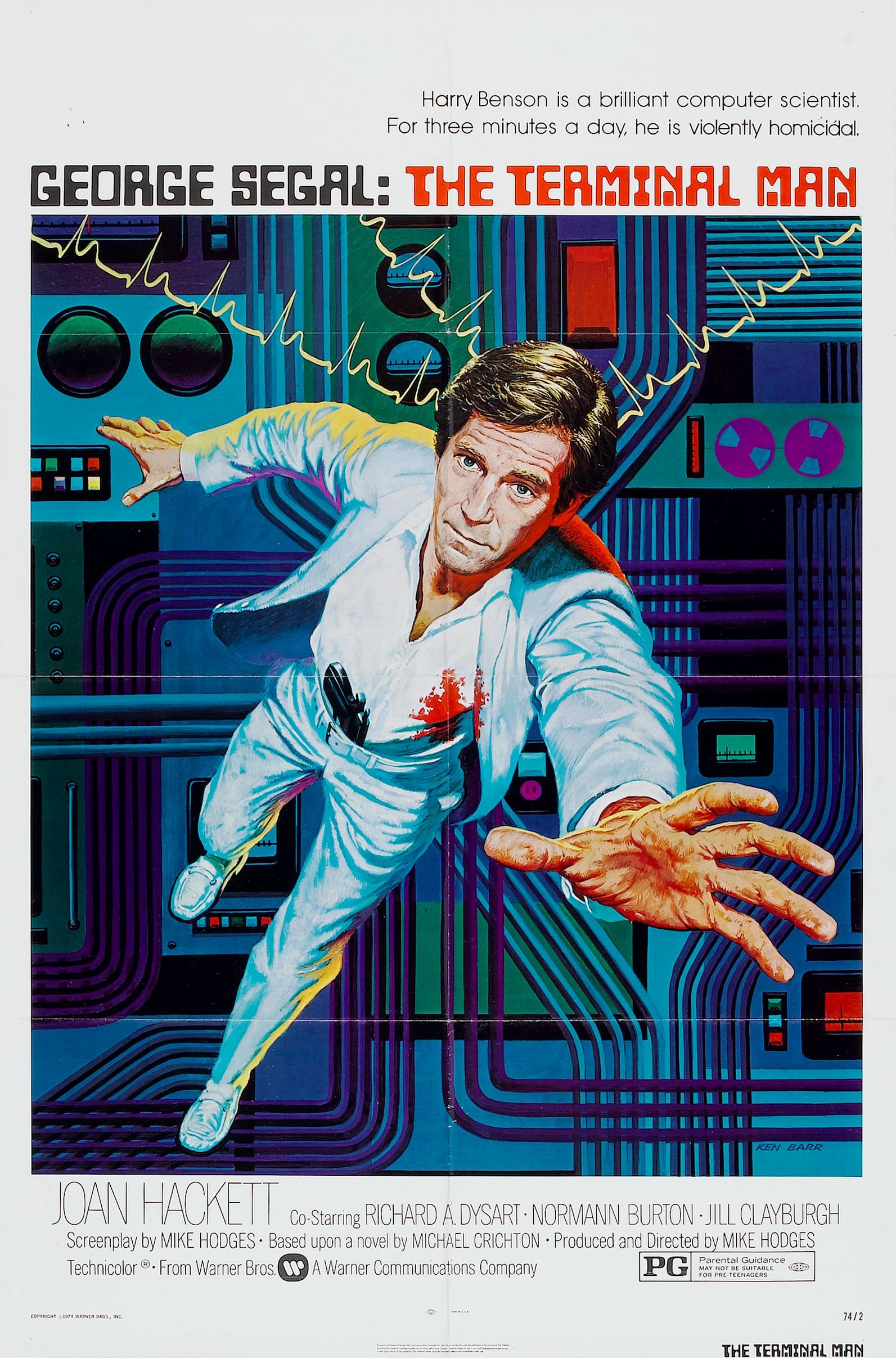
            Harry Benson (George Segal) is a brilliant computer scientist who begins to suffer from blackouts after receiving a head injury in a car accident.  During these blackouts he goes on terrifying violent sprees, which includes the abuse of his own wife and children. To help control the condition a group of doctors come up with an experimental procedure of implanting a computer chip inside his brain that will set off a signal that will alleviate these compulsions when they begin.  Unfortunately things do not go as planned and Harry’s condition becomes frighteningly worse in this cinematic realization of the Michael Crichton novel.

Director Mike Hodges visualization is the stand-out here. Every scene and camera shot fits together into a seamless whole. The first hour is filled with sets and backdrops showing a square, gray, futuristic –like surroundings while the second half features more white interiors while still maintaining the modernistic look.  Hodges shows a terrific awareness of every little sight and sound making each one an integral part of the story. From a visual perspective it is brilliantly handled and a masterpiece in need of more attention.  His use of classical music by Johann Sebastian Bach is equally effective. One particularly unique scene has Harry violently stabbing someone to death during one of his seizures, but instead of hearing the expected pounding music we instead hear the soft strains of Bach while the victim’s blood creates a red pattern on the white tiles of the floor.

The operating sequence and build-up to it is especially captivating and takes up most of the runtime.  I appreciated how a great deal of care was taken to make everything follow a very believable logic. The intricate procedure itself becomes fascinating and riveting to watch as they drill small holes into the patients head and use tiny metal tubes to literally shoot the mechanical pellets into strategic spots in the brain.

Segal, mostly know for light comedies, takes a nice break into drama here. He does a terrific job at getting the viewer to see him as a human being and feel empathy for his situation and when he has his head shaved he looks exactly like Howie Mandel . The part where he screams “Make it stop! Make it stop!” as he goes through another of his violent outbursts is especially moving and disturbing.

The supporting cast is strong as well although I didn’t particularly care for Donald Moffat and his put-on Irish accent, which was too strong and distracting and completely unnecessary.  Richard Dysart is memorable as the surgeon conducting the operation. He has two of the film’s best lines. One is when he is putting the computer chips into the brain and he states “This is the one job that can be both boring and nerve-wracking at the same time.”  Another great line of his occurs when a reporter asks him he if considers this procedure to be a type of mind control and he responds “What do you call compulsory education through high school?”

Joan Hackett gives her usual solid performance as Janet Ross the one doctor who is more concerned with the welfare of the patient then the implications of the experimental procedure. Jill Clayburgh, in an early role, plays against type here as Harry’s ditzy blonde girlfriend and the change of pace is interesting.

The film certainly makes a strong statement at the potential dangers of medical science and how the medical staff can be highly intelligent in one area, but very dense, immature and selfish in others.  The dehumanization element is pounded home to the viewer and in that respect it succeeds magnificently, but I couldn’t help but feel that it was being a bit unfair. In the years since this film was released the advancements in the medical field have improved the life and health of the patients and society as a whole. The film’s negative slant seems to conform too much to the pessimistic sentiments of its era and its unrelentingly doomful outlook is unnecessary.

My Rating: 7 out of 10

Released: June 19, 1974

Runtime: 1Hour 47Minutes

Rated PG

Director: Mike Hodges

Studio: Warner Brothers

Available: VHS, DVD (Warner Archive), Amazon Instant Video

Hopscotch (1980)

By Richard Winters

My Rating: 6 out of 10

4-Word Review: Matthau goes globe trotting.

            Veteran CIA Agent Miles Kendig (Walter Matthau) is angered when his boss Myerson (Ned Beatty) decides to demote him to a desk job due to a technicality. Miles decides to get his revenge by threatening to write a book about his past exploits and divulge top secret information. He does this while traveling the globe and making it almost impossible for the government agents to find him, or keep up with him.

Matthau’s character is very similar to the one he played in Charley Varrick where we’re given someone who looks very much like an average Joe and is unwisely underestimated by those around him only to get the last laugh when he proves how very shrewd he really is. The concept is great and it is a fantastic role for Matthau, but in Charley Varrick we at least had some tension and intrigue because the bad guys where really nasty and Matthau’s cunning was a necessity for survival. Here the bad guy is nothing more than a pompous ass and Miles’s exploits, while clever and slick, are done for his own ego and to have an excuse to show-off. Without having any real threat this charade becomes derivative and redundant.

The idea to cast Glenda Jackson as his love interest and confidant is a strange one. In House Calls the two worked well because they had such contrasting personalities and styles, but here that never plays out and for much of the movie they are not even seen together. Her character is given very little to do and the sparring that made them a hit in their first feature is nowhere to be found here. However, their wine conversation that the two have near the beginning deserves a few points.

The Myerson character is over-the-top enough to get a few cheap laughs. The best moment in the whole film is when Miles hides out at Myerson’s own home and when the FBI surrounds it in order to get him out Myerson has to watch helplessly as all the windows in his place get shot out with bullets. Herbert Lom as the Russian spy Yaskov is appealing simply because after spending years playing a cat and mouse game with Miles the two end up finding a mutual friendship with the other.

SPOILER WARNING!!

            The biggest issue I have with the film is the ending. Supposedly Miles has been able to rig an old plane to be remote controlled and then when the agents track it down with a helicopter he blows it up making it look like he went down with it and thus freeing him from being chased anymore. However, aside from the fact that rigging a plane to be remote controlled should prove to be quite complex and beyond the scope of Miles, who may be smart but most likely not that smart there is also the fact that the men in the helicopter can see him on the ground running towards the plane like he was going to get into it. Of course he doesn’t, but instead somehow runs back to a shed where he controls the plane with his remote and then eventually explodes it with a press of a button. My question is, and it is the same one that I had twenty-five years ago when I first saw it, is how is he able to run back to the shed without being detected? It was an open field without any bushes, or trees, which should have made him highly visible to anyone once the plane left the ground. To me this is a cop-out ending done because screenwriter Brian Garfield had exhausted all of his clever ideas and didn’t know how else to finish it, but it is never good when a movie ends with a big loophole.

END OF SPOILER WARNING

Matthau’s laid-back charm is always entertaining even with the weakest of scripts, but he seems to be almost sleepwalking through this one. The musical score is filled with some classical works, which helps.

My Rating: 6 out of 10

Released: September 26, 1980

Runtime: 1Hour 46Minutes

Rated R (Due to a plethora of ‘F-Bombs’ said by the Ned Beatty character)

Director: Ronald Neame

Studio: AVCO Embassy Pictures

Available: VHS, DVD (The Criterion Collection), Netflix streaming, Amazon Instant Video

Mackenna’s Gold (1969)

By Richard Winters

My Rating: 4 out of 10

4-Word Review: They all want gold.

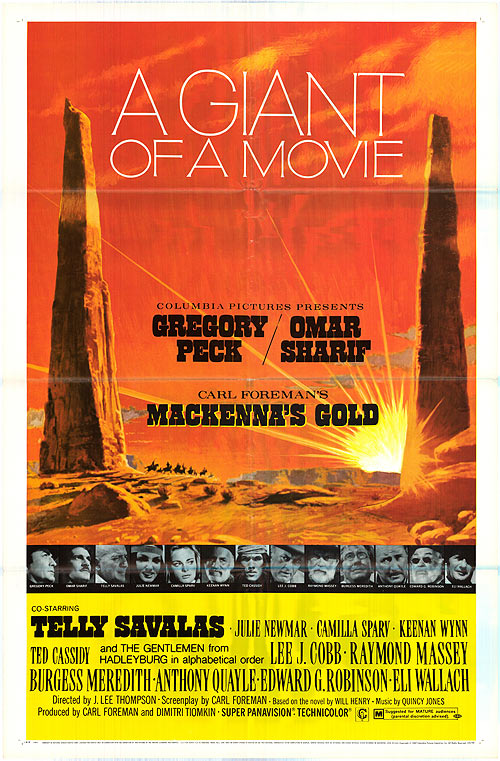
This is a sterile western with some irrelevant offbeat elements thrown in for good measure. The story consists of Mackenna (Gregory Peck) coming upon an old Indian man with a map showing the whereabouts to some gold. Feeling that the map is meaningless he burns it and tries to move on. He becomes entangled with outlaw Colorado (Omar Sharif) who feels that the map was legit, and since Mackenna was the last one to see it, forces him to come along with him and use his memory to show him the location. Ultimately they meet a wide assortment of other characters all searching for the same thing.

The cheap special effects are one of the main drawbacks. They are awful and help bring down the whole movie. The scene involving Peck being tied to the back of a horse and then lead across an old rickety bridge has to rate as the worst as the wide shots clearly shows a miniature bridge with a toy man and toy horse. The climactic sequence involving the cataclysmic destruction of an entire valley is so tacky that it is almost painful to watch. There are also other shots spliced in throughout that were done on a different film stock and this difference in grain is obvious and distracting. Even simple shots of Peck riding his horse are laughable as it becomes obvious that he is not on a real horse, but instead one of those mechanical ones that bop him up and down in perfect rhythm.

Only when the film features its stellar supporting cast does it get interesting. Unfortunately this legendary line up was only given about ten minutes of screen time a piece and then very quickly killed off one by one in ways that are particularly gruesome and demeaning.

Peck is okay in the lead and acts as a sort of stabilizer. This was the film where he starts to look elderly with some gray hair showing and a handle bar stomach. He was also not as agile as his younger costar Sharif.

Julie Newmar as Indian lady Hesh-ke is a stand out and even sexier than she was as Catwoman on the TV-show ‘Batman’. She also displays a real vicious side and this probably rates as her best performance despite the fact that she never says a single word. Camilla Sparv as Inga is almost as sexy and the two share a fun ongoing rivalry.

The film is watchable and has some nice, even exciting, aerial shots. However as a whole it is pretty ordinary. Things added to make it seem unique really end up hurting it. Jose Feliciano’s singing is out of place and the music score overall is bad. Victory Jory’s narrative is unnecessary and a feeble attempt to make the production seem like an epic, which it definitely isn’t and the mystical ending just doesn’t work.

My Rating: 4 out of 10

Released: May 10, 1969

Runtime: 2Hours 8Minutes

Rated M (Brief Nudity)

Director: J. Lee Thompson

Studio: Columbia Pictures

Available: VHS, DVD, Amazon Instant Video

Carrie (1976)

By Richard Winters

My Rating: 4 out of 10

4-Word Review: Prom was a disaster.

A shy, awkward teen (Sissy Spacek) who is a virtual outcast at her school and has a religious zealot for a mother (Piper Laurie), learns that she has telekinetic powers and uses them in terrifying and deadly ways after falling victim to a cruel prank at her high school prom.

Nothing really seems to mesh here and the pacing is poor. For a great deal of time you feel like you are not watching a horror movie, but instead an annoying, clichéd 70’s drama. The majority of the scares occur at the end while the rest of the film has no tension at all.  It’s visually flamboyant, but empty and unable to hide its low budget roots. Like with director Brian De Palma’s other thrillers his style and heavy-handed Hitchcock-like touches become overpowering and you lose touch with the story. Too much is orchestrated and the movie is never allowed to gel and have its own natural flow. The opening, which takes place in a girl’s shower, looks like a soft core porn flick especially with the choice of music.

The teen-age girls are certainly cruel and their snotty attitudes seem valid, but the actresses are all wrong. Yes, Nancy Allen and Amy Irving are hot to look at, but they were too old for their parts. All of them were in their 20’s and look far more like college girls instead of students in high school. The P. J. Soles character is irritating. In an effort to give the role some distinction they have her constantly wearing a pink baseball cap. She even wears it to the prom with her prom dress and looks ridiculous and yet still has the audacity to laugh at Carrie when she shows up when in reality they would most likely be laughing at her instead.

Miss Collins, the physical Ed. Teacher, which is played by actress Betty Buckley is another problem. She goes beyond the call of duty to give Carrie the individualized and sensitive attention that she needs. It sounds nice, but I couldn’t buy into it because in most cases shy students that don’t otherwise cause problems usually get overlooked even by the best of teachers simply because the school systems are too large with too many students to handle.

William Katt was not very convincing in his part as a dumb jock. John Travolta is good, but only because he is playing an extension of his Vinnie Barberino character from ‘Welcome Back Kotter’. In fact I found his portrayal here to be even funnier than his TV counterpart.

Spacek is the best thing about the movie as she brings the Carrie character to life with a vengeance. The part where she tears up the gymnasium with her powers is genuinely creepy and the way she opens her eyes and moves them around is freaky. The use of the split screen during this segment help to make it a uniquely scary moment in cinema history and saves what is otherwise a forgettable production. The famous ‘surprise’ ending isn’t bad either and even managed to startle me a little and I don’t startle easy.

Unfortunately it’s lacking the necessary ingredients overall to make it a classic. It’s based on the Stephen King novel and yet leaves certain crucial elements from the book out, which only creates more questions and confusion. De Palma takes the most simplistic parts of the story and then glossies over the rest leaving the viewer feeling unsatisfied when it is over.

My Rating: 4 out of 10

Released: November 3, 1976

Runtime: 1Hour 38Minutes

Rated PG

Director: Brian De Palma

Studio: United Artists

Available: VHS, DVD, Blu-ray, Amazon Instant Video 

Altered States (1980)

By Richard Winters

My Rating: 5 out of 10

4-Word Review: Blair Brown’s hairy armpits.

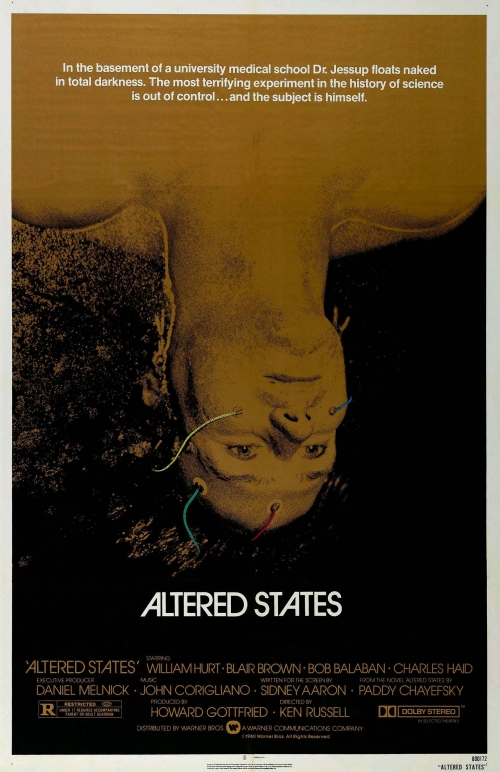
            This film, which is loosely based on the experiences of dolphin researcher John Lily the inventor of the isolation tank, and from the Paddy Chayefsky novel comes this bizarre concoction that is half sci-fi and half surreal fantasy.  The story pertains to Eddie Jessup (William Hurt in his film debut) who spends time in his isolation tank at his Harvard research lab while taking hallucinatory drugs that send him into different states of consciousness that become increasingly more frightening and vivid until they begin to externalize in his everyday life.

It was directed by Ken Russell and if you are familiar with his work you realize that means the presence of lots and lots and lots of strange visuals that come at you in quick and unannounced ways. They are confusing, cluttered, and often times make no sense. However, since the story is pretty wide-open these trippy segments work to the film’s benefit, unlike other Russell productions where I felt they became off-putting.  They also give the movie distinction and momentum. I’ve never done LSD, acid, or meth, but these segments probably come as close to the experience of a drug trip as you will find.  It is best not to demand any logic and instead sit back and allow it to become an assault on the senses, which on that level works to excellent effect. I came away wishing these scenes had been more extended and frequent as they are the best part of the movie. Of course the state-of-art special effects are no longer as impressive and look like images put on a mat screen, but some of the other stuff is cool. My favorite part is where a naked Blair Brown and Hurt are lying on the ground and a strong wind completely covers their bodies with sand and then they slowly evaporate into the air.

Hurt does a competent job and the character isn’t the clichéd kind of sensitive modern man like most Hollywood protagonists. He is emotionally ambivalent and self-centered.  His unromantic marriage proposal to Emily (Blair Brown) is one for the books, but I liked it. Most research scientists probably aren’t a socially skilled, people person to begin with otherwise they wouldn’t be shutting themselves inside a lonely, dingy research lab all day, so in that regards I felt the script hit the target and gave the film a little more of an edge.

Blair does fine in her role as the long suffering wife and it is nice seeing her looking so young and even briefly smoking a joint. She looks great naked, but her armpits where much too hairy during the love-making scene and she should have shaved them. I also found it amusing that during the time the two were separated Eddie started to have relations with a younger student of his who continued to refer to him as ‘Dr. Jessup’ even when they were in bed together.

Charles Haid plays Mason Parrish a friend of Eddie’s who helps him out with his experiments despite strong misgivings. His rants and tirades are well-played and give the film energy when it is not in fantasy mode.

To me the movie became boring and contrived when Eddie started to mutate into that of an ape man and runs around the campus and city terrorizing everyone. It seemed too reminiscent to An American Werewolf in London, which came out around the same time as well as countless other wolf man movies. The part is also not played by Hurt, but instead Miguel Godreau, who was an excellent dancer. I was impressed with his limber body and the way he could climb things, which gave him an animalistic quality, but felt that if it represented the Hurt character then Hurt should have been performing it even if it meant allowing for certain concessions.

The opening sequence showing Hurt locked in a thin, rusty tank in an empty room is terrific. There is a certain starkness and foreboding quality, especially with the eerie music, that makes this one of the better openings to a horror movie. The use of the credit titles is creative and reminded me a bit of The Shining. However, the film’s ending is horrid and one of the worst I have seen. It reeks of being a forced ‘happy’ Hollywood ending that practically ruins the entire picture as a whole. Because of this and the fact that the script seems to only skim the surface of this potentially fascinating subject matter forced me to give it only a 5 rating.

My Rating: 5 out of 10

Released: December 25, 1980

Runtime: 1Hour 42Minutes

Rated R (Language, Brief Nudity, Adult Theme, Intense Visuals)

Director: Ken Russell

Studio: Warner Brothers

Available: VHS, DVD, Blu-ray, Amazon Instant Video 

Good Neighbor Sam (1964)

By Richard Winters

My Rating: 7 out of 10

4-Word Review: Pretending to be married.

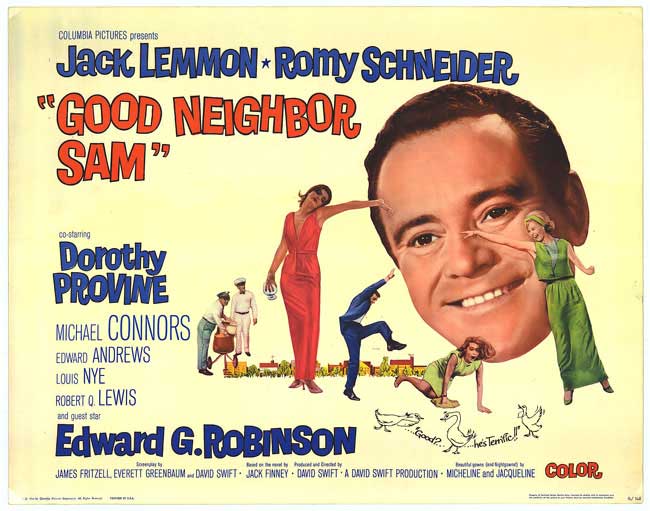
            Sam Bissell (Jack Lemmon) is an advertising executive working for a demanding client (Edward G. Robinson) who is very conservative and insists everyone around him have a clean-cut image and lifestyle. Sam’s wife Minerva (Dorothy Provine) brings home her college friend Janet (Romy Schneider) for a visit and she rents out the neighbor’s place while she is there.  Janet then finds out that she is going to be left a large inheritance, but the will stipulates that she must be married even though Janet is instead going through a divorce. For the sake of allowing her to collect the large fortune, which is 15 million dollars, Sam agrees, with the blessing of Minerva, to pretend to be Janet’s husband by staying at her place until the money is paid out.  A private detective (Louis Nye) is hired to keep a close eye on them and matters become even more complicated when Janet’s ex-husband Howard (Mike Connors) returns.

The concept is original and to my recollection has never been done before, or since, which is amazing when you think about the fact that just about everything else has. It does rely heavily on coincidence and too much of the first hour is spent setting up the plot with some extraneous scenes that could’ve and should’ve been cut. For such fluffy material, even entertaining fluff such as this, a 130 minute runtime is too long.  Three different writers were credited with doing the screenplay and the overall vision seems disjointed as at times it works as a satire, slapstick, and sex comedy, but never coming together completely as a whole. However, there is enough eventual pay off to still make it worth it.

This is one of Lemmon’s better comedy vehicles, if not his all-around best. Sometimes he comes off as too strait-laced and benign in these things, but here it works to the film’s advantage. His best part is when he dreams seeing himself getting out of bed and going over to the bedroom where Janet is and trying to seduce her. She screams so loudly that the entire town wakes up and comes over, which is funny and should have been played-out more.

Schneider though is the best thing about the movie. I loved her bright, beaming smile and effervescent personality. She sparkles in every scene and I was impressed that although she could be pleasant she could also easily get into a shouting match with Howard and the fact that she could switch emotional gears so easily and quickly proves that she had talent. Costume designer Jacqueline Moreau puts her into some snazzy outfits that look great on her including an all red jumpsuit, a strapless evening gown, and a two piece white pajama outfit with pink polka dots that was my favorite. It is a shame that due to her severe depression over the accidental death of her son as well as alcoholism and a three-pack-a-day smoking habit her career and life was cut short as she most assuredly still had a lot of outstanding parts and performances left to do.

Blonde Provine looks almost as good and equally delightful in her role where she tries holding it all together. Connors, best known for starring in the long-running TV-show ‘Mannix’, is surprisingly engaging as the ex. His arguments with Sam are fun and in order to keep the scheme going he pretends to be Sam and stays in the home with Minerva, which culminates with the film’s funniest moment, which is the early morning ‘kissing contest’ the two men have with each other’s wives.

Nye is also amusing as the detective and I got a kick out of his van that was supposedly disguised to be that of a cleaning service with a giant model of a vacuum on top of it that was used as a telescope.

The only one who gets wasted here is legendary actor Robinson who really doesn’t have anything funny to say, or do. However, his dinner party is still memorable simply because everyone gets served on all gold dinnerware, which includes the plates, cups, and utensils.

The music score is bouncy and the climatic sequence that features the main characters defacing area billboards is artsy and creative. On a lightweight, inoffensive level this satisfies and delivers a few laughs along the way.

My Rating: 7 out of 10

Released: July 22, 1964

Runtime: 2Hours 10Minutes

Rated NR (Not Rated)

Director: David Swift

Studio: Columbia Pictures

Available: VHS, DVD (The Jack Lemmon Collection)

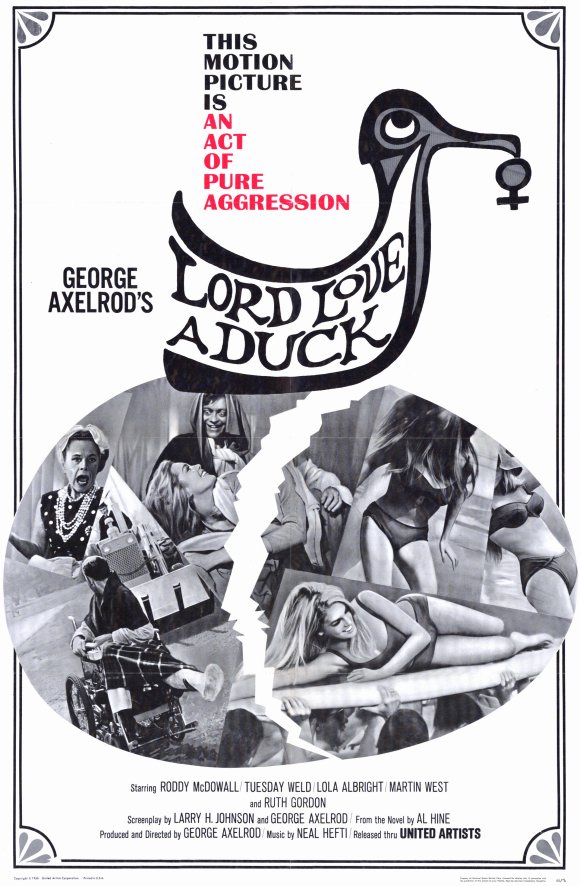
Lord Love a Duck (1966)

By Richard Winters

My Rating: 3 out of 10

4-Word Review: She wants it all.

If you ever wondered where political correctness got its start it was probably southern California in the mid 60’s. Here everything is neutralized and modified so as to ‘keep up with the times’. There’s even a drive-in church where the minister proudly exclaims that the Lord answers every prayer because “whatever happens is the answer”.

Tuesday Weld plays teenager Barbara Ann Greene who can’t be happy unless she has it all. She meets fellow high-schooler Allan Musgrave (Roddy McDowell) who because of his super intelligence is able to figure out ways for her to get what she wants. Yet the more she gets it the more unhappy she becomes.

It’s a satire on our consumer driven society, but it is too restrained and soft. A supposedly cutting edge film looking at our modernized world should have been filmed in color and not black and white. It also should have been faster paced with a heavier emphasis on the zany and outrageous. Instead we only get hints of this with a lot of slow segments and even some clumsy drama. The funny offbeat bits are spread out to thin and do not make up for the other parts that are boring and contrived.

There are some technical problems too including a lot of ‘outdoor’ shots that were really filmed indoors on a soundstage. They fortunately don’t do this anymore, but when they did it looked tacky. There is also a boom mike that is very obvious to see in several shots.

McDowell is not eccentric, nor unique enough for such an offbeat character. Although perpetually boyish looking he was way, way too old to be playing a high school student as he was 37 when this was filmed. Out of all the performers Harvey Korman comes off as the most amusing playing the overtly congenial school principal.

This film does feature an attractive cast. Of course Weld is always alluring, but she has competition from Jo Collins who was Playboy Playmate of 1965. There is also Lynn Carey daughter of the late actor MacDonald Carey from ‘Days of Our Lives’ fame. She is exceptionally good looking and watching here gyrate in a bikini to the latest dance craze is damn near pornographic. For her age Lola Albright, who plays Weld’s mother, is an absolute knockout and she can officially be crowned as a ‘milf’.

My Rating: 3 out of 10

Released: February 21, 1966

Runtime: 1Hour 45Minutes

Rated: NR (Not Rated)

Director: George Axelrod

Studio: United Artists

Available: VHS, DVD

Marathon Man (1976)

By Richard Winters

My Rating: 7 out of 10

4-Word Review: Dentist doesn’t use novocain.

            Thomas ‘Babe’ Levy (Dustin Hoffman) is a post graduate student at Columbia University and part-time marathon runner who spends a harrowing 48 hours being tortured and terrorized by a sadistic Nazi war criminal. It all starts when his brother Henry ‘Doc’ Levy (Roy Scheider) who works for a secret government organization known as ‘The Division’, secretly tracks Dr. Christian Szell (Laurence Olivier) a dentist at Auschwitz who has traveled to New York in order to collect a cache of diamonds. When Doc moves in too close Szell stabs him and despite being covered in blood Doc manages to make it all the way to Babe’s apartment before collapsing. Szell fears that Doc might have told Babe something before he died and has his men kidnap Babe where they then tie him to a chair in an abandoned warehouse and Szell tortures him by drilling into his teeth forcing Babe to use his running skills in an effort to escape.

This is an original thriller that stays intriguing and intense throughout. In the first thirty minutes alone the viewer is treated to some interesting and exciting scenarios including watching two elderly men drag racing with each other in their antique cars down a crowded neighborhood street. There is also an exploding baby carriage and an exciting fight sequence where Doc battles an attacker who tries to strangle him from behind with a metal wire. This scene is unique in that it cuts between seeing the action up close as well as viewing it from the point-of-view of an elderly man watching from across the street.

Director John Schlesinger shows visual flair with a variety of camera angles and settings. I particularly liked the part where Doc meets Szell at the red steps statue in the Arco Plaza. Having the climactic showdown between Babe and Szell take place in a pump room at the reservoir in Central Park gives the sequence added energy and distinction. I also enjoyed Babe’s cramped, drab, and cluttered apartment that had a very lived-in look and resembled exactly what a bachelor pad with someone on a low income would look like. The scene taking place at a country house is memorable simply for its extreme remoteness. I was disappointed though that although Schlesinger does a great job in setting up the atmosphere of the scene by doing a long shot looking out at the barren landscape the weather suddenly goes from cloudy to sunny in the minute it takes for the bad guy’s car to pull up the driveway. I realize certain scenes are sometimes shot over several days and this is not the first movie to have sudden weather changes during outdoor shots, but it is distracting nonetheless.

The infamous torture scene didn’t work for me. I appreciated the set-up especially the prolonged way that Szell plugs the drill into a wall outlet while talking to Babe in a calm tone. Constantly asking Babe the question ‘Is it safe?” has become a classic line and the fact that the dental torture gets extended when you think it is over is well done. Still, it didn’t seem violent enough and although pain is implied I didn’t think that the viewer really ‘feels’ it. I wanted more shots from Babe’s point of view especially as Szell sticks his metal instruments into Babe’s mouth. A close-up of Babe’s tooth and seeing the drill touch it would have helped as well. Also, Babe needs to scream in pain a lot more, he does it once briefly, but someone going through that would be doing it constantly.  Apparently the producer’s cut out portions of this scene when it upset the test audiences who saw it, but I would like that footage put back in as I feel it would make the movie stronger and give it an added kick that otherwise is missing.

Olivier is tremendous in the villainous role. His face exudes evil and this is one of his best later career roles. Scheider has his best role here and I found Marthe Keller impressive as Babe’s girlfriend. She wears an attractive hairstyle and I couldn’t get over how diametrically opposite she was compared to her character in Black Sunday that was done the very same year. She is definitely an under-rated actress that deserves more accolades as well as more parts in American productions. However, the way Babe pursues her for a date seemed to border on ‘creepy’  and overly aggressive and act as a turn-off to most women.

The film does seem derivative at certain points especially the way it portrays New York as an urban hellhole, which was quite common during the 70’s. The fact that Babe avoids confrontation and is picked on by a Hispanic gang that lives across the street seemed too reminiscent of Hoffman’s earlier film Straw Dogs. There are several flashback sequences showing Babe as a child that is done with faded color and no dialogue and look too similar to the childhood sequences done in Midnight Cowboy, which was an earlier Schlesinger/Hoffman project. Hoffman, for what it is worth, gives another one of his dedicated performances, but this film really does show in glaring detail how very puny he is and I really could have done without having to see his naked rear.

The electronic score is nice and the part where Szell gets recognized by an elderly concentration camp survivor on a busy city sidewalk and who then begins to chase after him is memorable. However, when it is all over I still felt it didn’t completely click. I’m not sure what it is. I know the ending was changed from the one in the book, but I liked this one better and felt Babe’s revenge on Szell was creative. Although controversial and edgy for its time, the torture scene seems too toned down for today’s standards. Either way, if you are looking for a competent and entertaining thriller this should fit the bill, but it is not a classic.

My Rating: 7 out of 10

Released: October 8, 1976

Runtime: 2Hours 5Minutes

Rated R: (Violence, Language, Adult Theme, Brief Nudity)

Director: John Schlesinger

Studio: Paramount

Available: VHS, DVD,  Blu-ray, Amazon Instant Video