Category Archives: Movies Based on Novels

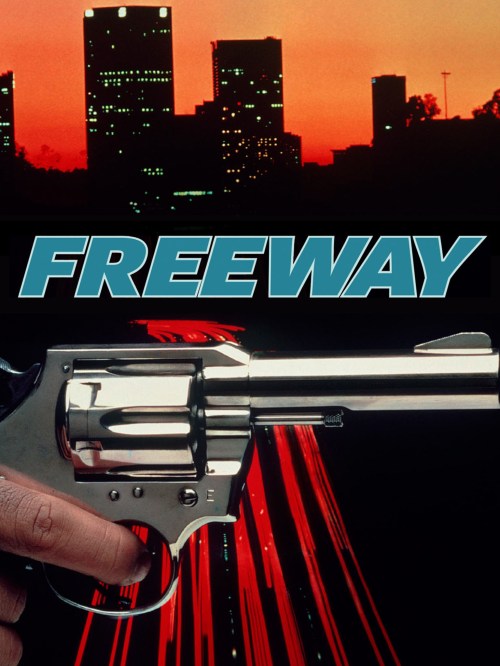
Freeway (1988)

freeway1

By Richard Winters

My Rating: 5 out of 10

4-Word Review: Killer in a car.

Sunny (Darlanne Fluegel) is an emergency room nurse still grieving over the senseless death of her fiancee at the hands of a highway killer (Billy Drago) who drove-up beside them one late night and shot him through their car window. Sunny is constantly hassling the police for updates on the case, but the police sergeant Lt. Boyle (Michael Callan) is aloof and put-off. Frank (James Russo) is an ex-cop who left the force when a drug gang he was investigating annihilated his whole family. He senses Sunny’s despair and the two team-up to find the killer along with radio talk show host David Lazuras (Richard Belzer) whose show gets calls from an unhinged man, who quotes Bible verses and claims to be the one they’re looking for.

The story has some intriguing elements and I liked how initially we don’t know the identity of the assailant, but the concept, which is based on the novel of the same name by Deanne Barkley, is poorly thought-out. This freeway shooter makes headlines for having killed many people, so Sunny wouldn’t be the only one getting on the police about finding the culprit as the entire city, which would be gripped with panic, would also be and if the city’s force wasn’t doing enough then federal agents would be brought-in.

The car that the killer drives, which is an older model with a broken front grill, is similar to the haunted vehicle used in the cult-classic The Carbut because it has a distinct appearance the guy wouldn’t be able to get away with his crimes for too long as surely other people on the very busy L.A. freeways would’ve spotted him and had his license plate, or general whereabouts, called-in. Some drivers would likely have tailed him and even cornered his car with theirs until the police got there. The car also smashes into several other vehicles, and since it was an old clunker, it would need body work, and thus pique the suspicions of the auto repairman who would likely alert authorities. In either event having the killer get away with as much as he does and with only one person emotionally vested into finding him doesn’t gel.

While the leads are bland the supporting cast is interesting. Callan, who was a semi-star during the 60’s before his career cratered, does well as the non-nonchalant police chief and still looking good despite some weight gain around the face. Clint Howard has a fun bit as a porn obsessed mechanic, who agrees to let Sunny drive his prized sports car while he gets her’s fixed. While allowing some random chick to take his car, which no auto mechanic in the history of the world would do, or feel obligated to do, I was willing to accept it using the rationale that he was hoping it might help him score with her later, but the fact that she keeps this ‘loaner’ for days, even weeks, without returning it gets ridiculous.

Country music legend Roy Clark is listed in the part of a CHP officer, but I didn’t spot him. I had a feeling it was played by someone with the same name, I know when I lived in Indy there were 7 other men in the phone book with my name, and since Roy and Clark are both quite common, it seems reasonable that it was somebody else, so listing it in Roy’s filmography on IMDb is a mistake.

The tension isn’t strong and weakens quite a bit by the third act, which is when it should’ve been the strongest. Director Francis Delia, who before this worked on music videos, tries hard to give the proceeding a stylistic touch, which might’ve fared better had the story and characters been thoroughly fleshed-out.

My Rating: 5 out of 10

Released: September 2, 1988

Runtime: 1 Hour 31 Minutes

Rated R

Director: Francis Delia

Studio: New World Pictures

Available: DVD, Blu-ray

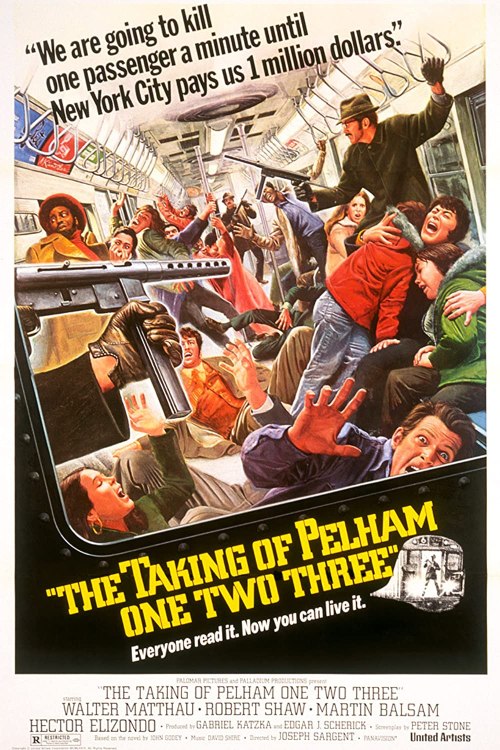
The Taking of Pelham One Two Three (1974)

taking

By Richard Winters

My Rating: 8 out of 10

4-Word Review: Subway passengers held hostage.

Four men wearing disguises and going by code names: Mr. Blue (Robert Shaw), Mr. Green (Martin Balsam), Mr. Grey (Hector Elizondo), and Mr. Brown (Earl Hindman) board the same subway car, this one being the Pelham 1-2-3, at different locations. Once all four are onboard they take out their guns and take over the subway car by holding both passengers and conductor hostage. For their release they demand $1 million in ransom to be paid in 1-hour and for every minute that it is late one passenger will be killed. They communicate these demands to Lt. Zack Garber (Walter Matthau) who is a part of the New York City Transit police. As Mr. Blue and Garber communicate with each other over the radio and the city races to meet the crooks demands Garber begins to try and surmise who these men are and how they’ll be able to get away with it since they’re trapped in an underground subway. Garber is convinced that it will not work and the men will eventually be caught unaware that Mr. Green, who used to work for the subway system until he was, in his mind, unfairly terminated, has come up with an ingenious contraption that can override the dead-man’s switch and allow the train to keep running even with no one at the controls.

The film is based on the best-selling novel of the same name by John Godey, who was a subway enthusiast and came-up with the plot after spending many years using the subway system. While the movie rights for the paperback were sold for $450,000, in anticipation that it’d make a great movie, the film almost didn’t get made due to the reluctance of the Metropolitan Transit Authority to allow the production to be filmed on-location.  Much of the reason stemmed from their fear that it might give ‘kooks’ the idea to pull-off a real-life heist, but eventually they caved once screenwriter Peter Stone added in the fictional contraption that could override the dead-man’s switch.

As a caper/action flick it is quite exciting from literally the first-frame to the last, but it’s some of the other added elements that make it a standout. I really enjoyed how the city of New York becomes like a third character and the unique, brash attitude of the people. Every character, no matter how small the part, has a distinct personality and memorable. My favorites were Mari Gorman as the feisty hooker, Michael Gorrin, as the elderly passenger convinced that the subway car must eventually come to a stop even as it careens out-of-control and everyone else panics. I also enjoyed Louie Larebee as an alcoholic woman, who is so drunk that she passes out when the crime begins and sleeps through the whole thing as well as Carolyn Nelson, the real-life wife of the film’s director Joseph Sargent, playing a college coed who believes she can stop the train through sheer mind control and meditation.

On the ground there’s some great character bits too including Tom Pedi as an aging, misogynist who doesn’t like the idea of having to work alongside women, nor that he should stop cursing because of it, who walks right into the line-of-fire when he stubbornly refuses to listen to the kidnappers warnings. Kenneth McMillan, is very funny as an exasperated street cop trying to direct traffic, and Dick O’Neill lends moments of drama as an outspoken transit employee who doesn’t like the idea of giving into the kidnappers demands and isn’t shy about voicing his disapproval, which leads to a tense confrontation with Matthau.

Matthau’s anti-hero take where he seems initially like nothing more than a aloof, laid-back guy, who doesn’t seem to have the cunning, or initiative to defeat the bad guys. At one point even openly insults a group of Japanese reporters who he thinks can’t speak English only to learn to his regret that they can, is excellent and in patented Matthau style seems to be able to do it without much visible effort.

Shaw is solid, but I felt there needed to be an explanation for how he got bought into the scheme, which never comes and ultimately is the film’s only real weak point. His personality is so different from the other men in the group that I couldn’t understand why he’d want to pull-off a robbery with them, nor why, being such a careful planner that his character is shown to be, he’d only realize as the crime is happening that the Mr. Gray was too much of a hot-head and not right for the job, as I’d think he would’ve observed this much earlier during the planning stage and had Gray removed before the actual crime had ever been carried out. Having scenes of the backstory spliced in would’ve helped made it more complete.

This was remade as a TV-movie in 1998 and then as another feature film in 2009 that starred Denzel Washington in the Matthau role and John Travolta playing Shaw’s part. I never saw the TV version and it’s been many years since I viewed the theatrical remake, but I remember finding it a letdown mainly because it centered too much around Travolta, who would go on long rants that bogged down both the pace and plot making it not nearly as exciting as this one.

My Rating: 8 out of 10

Released: October 2, 1974

Runtime: 1 Hour 44 Minutes

Rated R

Director: Joseph Sargent

Studio: United Artists

Available: DVD, Blu-ray, Amazon Video, YouTube

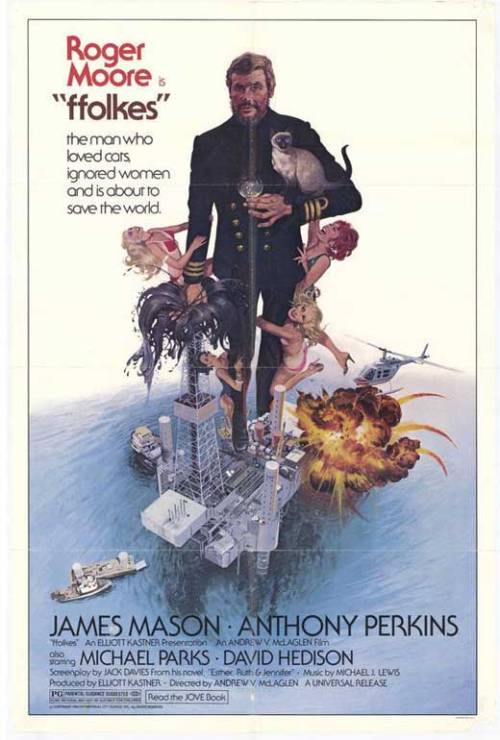
ffolkes (1980)

ffolks2

By Richard Winters

My Rating: 5 out of 10

4-Word Review: Loves cats, hates women.

Rufus Excalibur ffolkes (Roger Moore) is a cat loving misogynist who dislikes women because he grew up the youngest of five sisters and forced to wear their hand-me-downs until he was age 10. As an adult he is a counter-terrorism expert and trains a team of men to go onto ships at sea that have been hijacked. When a North Sea oil production platform nicknamed Jennifer gets taken over by a group of men posing as reporters their leader (Anthony Perkins) demands an enormous ransom and it’s up to ffolkes and his team to board the platformed and kill the terrorists without allowing the ship, which has been booby-trapped with bombs by the criminals, to blow-up.

The film, which was based on the novel ‘Esther, Ruth & Jennifer’ by Jack Davies, who also wrote the screenplay, starts out well and has all the ingredients to being a compelling thriller. The on-location shooting done on an actual ship makes the viewer feel like they’re out at sea themselves and I found the foot chase done on the vessel during a raging rainstorm to be riveting. Perkins makes for a particularly slimy villain and Micheal Parks, as the mastermind who constructs and implements the bombs, was also impressive wearing glasses that make his eyes look like they’re bulging and it’s just a shame these two men had to co-star together as they’d be able to eat-up the scenes had they been allowed to do it alone without any henchmen.

The ffolkes character works against type playing a good-guy that tests the viewer’s assumption of what’s acceptable behavior for a protagonist. Too many movies create a hero-like caricature of someone who is overly noble, brave, and virtuous until it becomes boring and contrived. At least here the guy we’re supposed to cheering for is interestingly flawed therefore more human-like than super-heroes in most other films, especially those made today, who are just too-good-to-be-true.

ffolkes though does spend too much time sitting in the background working on a crochet of a cat while giving-off glib remarks and not being as active as he should. He’s also constantly drinking scotch at all hours of the day, straight out of the bottle, which should’ve made him inebriated and this most likely would’ve come into play at some later point where he wasn’t able to pull-off an intricate task because he was too drunk, but after introducing his drinking problem during the first half, it gets completely forgotten by the second.

While the character acts extraordinarily arrogant and cocky he’s not able to pull-off the assignment quite as easily as you’d think for someone with his amount of confidence. One scene has him stupidly walking right into a gunmen and it takes the sheer luck of someone hiding in a lifeboat to save him. Another scene has him almost killed by one of his own men making him seem like he’s not as good of an instructor as his reputation suggests and all leads to him unintentionally coming-off more like a deluded idiot than the crafty mastermind with a few personality quirks that he’s supposed to be.

The story, while having a solid set-up, ultimately becomes the biggest letdown. For one thing it never shows us how they’re able to pull-off the fake explosion of Ruth, another oil platform. They talk about rigging it to seem like it exploded to fool the bad guys, and we do see something exploding, but no explanation of what it was since the real Ruth secretly remains standing. Also, most ships have a radar system, which should’ve shown that the real Ruth never went away and that they had been duped, but for whatever reason they never catch-on.

The ending surprisingly lacks very little action, which is what was blamed for the film’s poor reception at the box office. People are expecting a movie that stars Moore to have a lot of stunt work and special effects and for the most part it never happens. The villains go down too easily making it not very satisfying to see them go. There needed to be more wrinkles to the scenario and more unexpected twists as the pay-off and climactic finish is weak making one feel, despite the excellent performances, like it wasn’t worth sitting through.

Alternate Title: North Sea Hijack

My Rating: 5 out of 10

Released: April 3, 1980

Runtime: 1 Hour 38 Minutes

Rated PG

Director: Andrew V. McLaglen

Studio: Universal

Available: DVD, Blu-ray

Figures in a Landscape (1970)

figures1

By Richard Winters

My Rating: 5 out of 10

4-Word Review: Chased by a helicopter.

Ansell (Malcolm McDowell) and MacConnachie (Robert Shaw) are two men on the run in the middle of a bleak, desolate desert. What they are escaping from is never clear, but they’re constantly hounded by a helicopter that seems intent at stopping them. They come upon a small village and steal food and supplies and then continue on their escape, but find trying to get along with each other is just as challenging as avoiding the copter.

I’m a big admirer of Joseph Losey’s films and I also enjoy movies that have an air of mystery and don’t feel the need to have to explain everything, but this attempt at avante garde doesn’t work. The Barry England novel or which this is based and received high critical praise when it came out in 1968 at least made it clear that these two were soldiers who were deserting for whatever reason, but the movie doesn’t even mention this. We’re simply left with a nothing-burger of seeing two guys we have no emotional connection with scurrying around the countryside, which gets old fast and has nothing to keep it compelling though the bird’s eye shots of them on the ground looking like dots as they run at least allows it to live up to its title.

Fans of the film will admit that the story is lacking, but the helicopter sequences and stunt work more than makes up for it, but I found this aspect to be underwhelming. The camerawork of showing the copter bearing down on them while splicing in shots from the pilot’s point-of-view is well handled, but it’s not as exciting as could’ve been because when the pilots have a chance to shoot the men they don’t. McDowell’s character explains that they (the helicopter pilots) are just ‘toying with them’, but the viewer can’t be expected to get wrapped-up in a silly cat-and-mouse contest that has no life or death consequence.

Much of the blame for why this comes-off more like a misguided experiment than an actual movie, can be attributed to Shaw, who was given permission to rewrite the script and promised to have it completed by the time shooting began, but didn’t. Apparently revisions were being made on a daily basis and no one knew where the plot was going, or how to end it, which ultimately makes for a flat and detached viewing experience.

The two leads do quite well with McDowell interesting as the younger of the two, but still more emotionally mature. Shaw is equally fine giving off a maniacal laugh that I’ve never heard him do before. Their bout with diarrhea at a most inopportune time is amusing. While some may find it gross it’s something that could happen to those who haven’t eaten in awhile and feeding off canned food, so in that way the movie tackles a realistic subject other escapees-on-the-run movies shy away from though the shaving aspect was a problem in reverse. I didn’t understand why Shaw would feel it’s so important for them to remain clean shaven when they’re just trying to survive and there’s no explanation for how they were able to remain without beards at the beginning when they were running around with their hands tied behind their backs.

In any case the movie desperately needed a conclusion as way too much is left open-ended. There should’ve been a final twist, like in an episode of the ‘Twilight Zone’ that makes sitting through it worth it. Ultimately it lacks focus with a concept better suited for a novel and never should’ve been made into a movie in the first place.

My Rating: 5 out of 10

Released: July 14, 1970

Runtime: 1 Hour 50 Minutes

Rated R

Director: Joseph Losey

Studio: 20th Century Fox

Available: DVD, Amazon Video

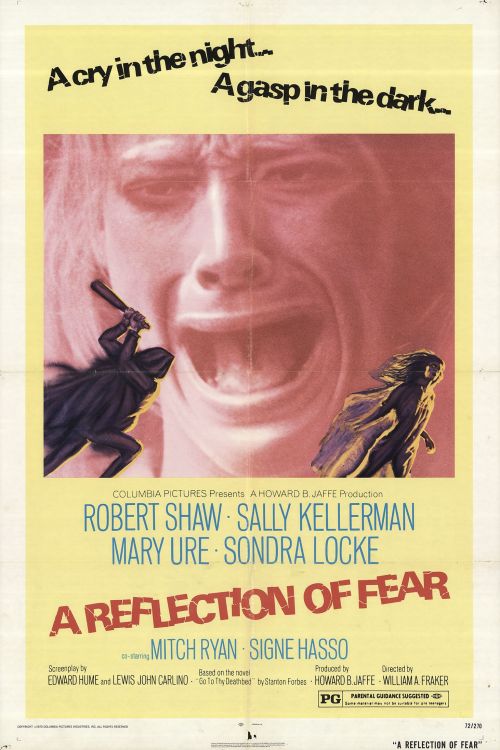
A Reflection of Fear (1972)

reflection

By Richard Winters

My Rating: 4 out of 10

4-Word Review: His daughter is disturbed.

Marguerite (Sondra Locke) is a lonely teen girl living with her mother Katherine (Mary Ure) and grandmother Julia (Signe Hasso). Through her alienation she creates an imaginary world with her dolls including one named Aron who she routinely has conversations with, but who also argues with her from time-to-time. Marguerite’s estranged father (Robert Shaw) comes to visit in order to ask Katherine for a divorce, so that he may marry Ann (Sally Kellerman). He also starts to rekindle things with Marguerite though Ann feels the two are getting much too close and fears they may be forming an incestuous relationship. Soon after both Katherine and Julia turn-up dead having been bludgeoned to death by a mysterious intruder, but who did the dirty deed? Was it an angry Marguerite, or her father, or was it the doll named Aron, who Marguerite insisted spoke to her even though no one else believed her.

The only reason to catch this obscurity is for the performance of Locke who’s absolutely brilliant. Despite being 27 at the time, she still looked like a teen and her attempt at speaking in an English accent is effective and I almost thought it had been dubbed, but it wasn’t. Her presence completely dominates the film making the supporting players seem almost non-existent and it convinced me that her relationship with Clint Eastwood, in which he according to her autobiography wouldn’t allow her to do any other projects that he wasn’t involved in, was a big mistake as she was clearly, as evidenced here, a highly gifted actress that never got her full due.

With that said I was kind of surprised to see Shaw in a film that didn’t allow him to shine and forced him to take a backseat. I can only imagine the reason that he did it was so he could work with his wife Ure, whose alcoholism had relegated her to only supporting parts toward the end of her career and in fact this was her last film before she was discovered dead in her dressing room at the young age of 42 from an accidental drug overdose. The two, for what it’s worth, do work well together. The hateful looks that she gives Shaw here seem authentic and you’d never know the two were a couple in real-life.

The story, with a screenplay co-written by Lewis John Carlino and based on the book ‘Go to Thy Deathbed’ by Stanton Forbes, has potential, but never gels. The scenario seems like it would’ve been better for a half-hour episode of the ‘The Twilight Zone’ and stretching it to a 90-minute length offered in too many slow spots where nothing much seemed to happen. The only time there’s any action is during the murder sequences, which could’ve been played-up more, otherwise it’s a lot of talk that fails to build-up the suspense or mystery in any interesting way.

Spoiler Alert!

The main problem that I had was that it was obvious to me that the doll was just a projection of Marguerite’s repressed anger, so the big reveal where she’s found to be the killer was not a surprise at all and in a lot of ways just a letdown. Had the filmmaker’s made an attempt to show the doll actually speaking instead of only been glimpsed in a shadowy way, which made it clear that he was just a figment of her imagination, then maybe there would’ve been more suspense because the viewer might actually have been made to believe that he was real, but the way it gets done here is not intriguing.

Having Shaw find out at the end that his daughter was actually a boy just made things even more confusing. Some have lauded this has being the first film with a transgender theme and a precursor to Sleepaway Camp, which is great, but what’s it all supposed to mean? Was Marguerite’s transgender issues the reason for her anger and why she lashed out into murder? Was this also the reason why her mother and grandmother kept her locked away and cut-off from potential friends, or was this instead Marguerite’s choice? None of this gets answered, which ultimately makes the film a pointless excursion.

My Rating: 4 out of 10

Released: November 15, 1972

Runtime: 1 Hour 29 Minutes

Rated PG

Director: William A. Fraker

Studio: Columbia Pictures

Available: DVD-R, Blu-ray

Zandy’s Bride (1974)

zandy1

By Richard Winters

My Rating: 7 out of 10

4-Word Review: A mail-order bride.

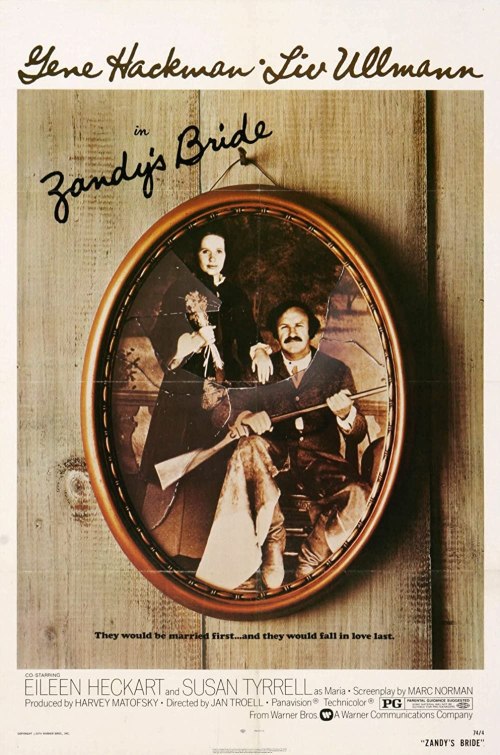
Based on the novel ‘The Stranger’ by Lillian Bos Ross the story centers on Zandy Allan (Gene Hackman) a rancher living in the remote frontier of the American west during the late 1800’s. He finds living alone while maintaining a ranch to be an arduous challenge and thus puts an ad in the newspaper for a bride. The inquiry catches the eye of Hannah (Liv Ullmann), a Swedish woman living outside of Minneapolis. She arrives in Zandy’s hometown, but Zandy is initially not pleased as she’s 32 instead of 25 and he feels she’ll be too old to bear him a son. Begrudgingly he takes her on the long horse ride back to his ranch while informing her there’ll be ‘no turning back’. Their relationship starts out rocky as Zandy expects to be able to order her around and have sex with her at will and is routinely abusive, but complains to his mother (Eileen Heckart) that he cannot understand why she doesn’t like him. Eventually the two, after many years and many fights, form a tenuous bond.

The film was directed by Jan Troell a Swedish director and cinematographer whose films The Emmigrants and The New Land gained international acclaim and won him a contract to direct a Hollywood film. Despite the presence of Ullmann, who had also starred in Troell’s other two films, and having the same frontier setting this one did not do as well either with the critics or the box office and culminated in making Troell’s foray into Hollywood filmmaking, which he said he didn’t like since union rules didn’t allow him to man his own camera like he had always done while making movies in his homeland, a short one.

A lot of the reason for this could be that it starts-off with a brutal rape scene, though not as graphic as in some other films, is still quite unpleasant particularly with Ullmann’s pleading blue-eyes and Hackman callously shouting that he ‘has a right’ as he violently strips off her clothes. While one can appreciate the film’s stark reality, as I’m sure in the remote frontier this sort-of thing could’ve easily happened, it still leaves a bad vibe since Hannah softens to Zandy despite his continually arrogant behavior too quickly. Most women would hate a man forever after that, so for the film to take the approach that love could still blossom is a bit hard to fathom. It should’ve at least taken the entire duration for this to occur instead of entering it in already by the second act.

Hackman is fantastic particularly for taking on such a unlikable role. Most other actors who’ve gained leading man status will rarely do this as they’ll feel it will affect their image, so it’s great to see an actor willing to stretch his range no matter the results. Ullmann is quite good too and it’s almost surreal hearing her speak English when I’ve seen so many films of her speaking in her native tongue. Her character though needed better fleshing-out. With Zandy we can see why he behaves the way he does when he visits his parents (Frank Cady, Eileen Heckart) and witnesses the poor way his father treats his mother, which clearly gives him the mindset that treating women that way is ‘normal’, but we get no such backstory with Hannah. Why did she choose to be a mail-order-bride when she’s so beautiful and you’d expect she’d find many suitors back where she lived? There’s no hint of her family history, or why she ended up in the situation that she does. I also felt she was too assertive too quickly and would’ve liked more of an arc where she starts out shy, but after going through the rigors that she does gains an assertiveness that she didn’t think she initially had.

Spoiler Alert!

The film ends on a hopeful note. Whether one feels this has been earned, or deserved is up to one’s subjective perspective though I was happy to see some redeeming qualities from Zandy as sitting through it watching him behave badly and never learning anything from it would’ve been too unbearable otherwise. I couldn’t help though but wonder during the many times that Zandy abandons her for months on end that one of the men from town wouldn’t have proposed to her in the process. In either case this ends up becoming the first and quite possibly only movie that could be categorized as a love story without any romance.

My Rating: 7 out of 10

Released: May 19, 1974

Runtime: 1 Hour 37 Minutes

Rated PG

Director: Jan Troell

Studio: Warner Brothers

Available: DVD-R (Warner Archive), Amazon Video

The Killer Elite (1975)

killer1

By Richard Winters

My Rating: 3 out of 10

4-Word Review: Betrayed by a friend.

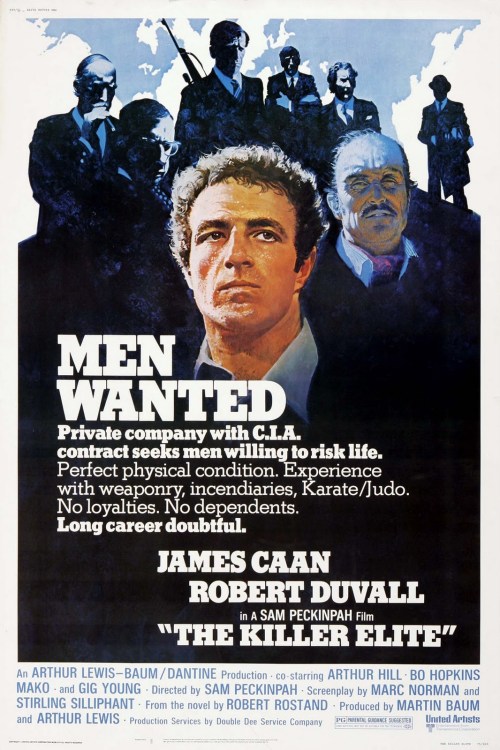
Mike Locken (James Caan) and George Hansen (Robert Duvall) are two longtime friends and hit men working for a private agency affiliated with the CIA to carry-out covert missions. During their latest assignment Mike is shocked to see George turn on him by shooting him in the knee and elbow. While Mike is able to survive the incident he is forced to go through a long and painful rehabilitation and due to the injuries is no longer considered employable as a hit man. Mike though refuses to concede and goes through martial arts training were he learns to use a cane both for protection and offensive action. He assembles his old team while vowing to get revenge on George, but fails to realize that there’s someone else behind the scenes who’s pulling-the-strings and far more dangerous.

By the mid-70’s director Sam Peckinpah had achieved a strong following of admirers with his ground breaking action films that took violence and the way it was portrayed in films to a whole new level. While he had his share of critics his movies did well at the box office, which should’ve been enough to get him any assignment he wanted, but his notoriously cantankerous behavior on the set and alcoholism made him virtually unemployable. Mike Medavoy, the head of United Artists, decided to give him a reprieve by hiring him on to direct his next project, but it was under strict conditions that allowed the studio to have final say over all aspects, which in turn made Peckinpah’s presence virtually null and void. The film lacks the edginess of his other more well known pictures. The action really never gets going and much of it was intentionally toned down in order to get a PG-rating. The tension is also lacking and great majority of it is quite boring. There’s even brief moments of humor, which only undermines the story and makes it even more of a misfire.

I liked the casting of Caan, who has disowned the film, which he gives a 0 out of 10, and Duvall, this marked their 5th film together, but the script doesn’t play-up their relationship enough. I was hoping for more of a psychological angle like why would a loyal friend suddenly turn on his partner, which doesn’t really get examined. Duvall has much less screen time and there’s no ultimate confrontation between the two, which with a story like this should’ve been a must. The drama also shifts in the third act to Caan taking on Arthur Hill, who plays a undercover double-agent, which isn’t as interesting or impactful.

Caan’s shooting gets badly botched. I will give Peckinpah credit as the surgery scenes including the removal of the bullet is quite graphic, but how Caan is able to find help after he is shot is never shown. The assault occurs in a remote location, so technically he could’ve died without anyone knowing, so how he was able to find his way out and get the attention of a medical staff needed to be played-out and not just glossed-over like it is.

The introduction of Ninja warriors was another mistake. This was courtesy of Stirling Silliphant who had been hired to rewrite the script and wanted this element put-in since he and his girlfriend Tiana Alexander had studied martial arts under Bruce Lee and felt this would offer some excitement. The result is campy though a one critic, Pauline Kael, like it as she considered it a ‘self-aware satire’ though I was groaning more than laughing.

Some felt that Peckinpah had sold-out and this movie really made it seem like he had. Nothing gels or is inspired though I will at least credit him with the building explosion at the beginning, which was an actual implosion of an old fire house that he became aware was going to happen and quickly revised the shooting schedule, so he’d be able to capture it from across the street and then use it in the film, which does help though everything after it falls flat.

My Rating: 3 out of 10

Released: December 17, 1975

Runtime: 2 Hours 3 Minutes

Rated PG

Director: Sam Peckinpah

Studio: United Artists

Available: DVD, Blu-ray (Region B/2), Tubi, Amazon Video, YouTube

Spasms (1983)

spasms3

By Richard Winters

My Rating: 3 out of 10

4-Word Review: Giant snake uses telepathy.

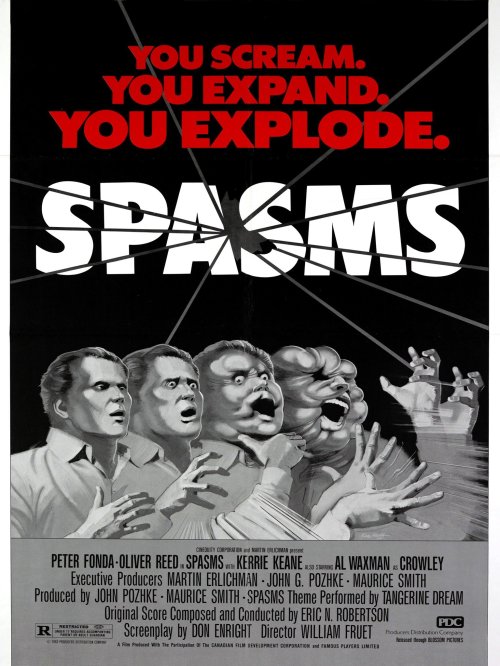
Years earlier millionaire philanthropist Jason Kincaid (Oliver Reed) got attacked by a giant serpent snake while on a trip in Micronesia. His brother, who went with him, died from the attack, but Jason survived and in the process began acquiring a telepathic connection to the snake. He pays some poachers to capture it and have it brought to his mansion. He also tries to use the services of Dr. Brasilian (Peter Fonda) who specializes in ESP research to help end the ongoing communication that the snake has with him.While Kincaid’s private lab is being constructed the snake is kept at the university lab run by Brasilian, but the reptile escapes and begins killing anyone it sees.

The film is based on the novel ‘Death Bite’ by Michael Marky and Brent Monahan, who wrote it in hopes of cashing in on the Jaws craze and having it made into a movie. The two were excited when a Canadian production company decided to produce it, but quickly became disillusioned with all the production delays and rewrites. When the original studio went bankrupt and the new one insisted on adding in a supernatural element the two writers to walk-off the set and disown the project.

Despite the film’s checkered history I found the production values to be quite impressive especially for a horror movie. The on-location shooting is varied and authentic, particularly the island setting and the main character played by Reed is less cardboard than in most other scary movies. Unfortunately the pacing is slow and not enough happens. I was expecting more scares and blood, but there really isn’t much of it.

The film’s biggest downfall is that you never get to see the snake. Initially during the attacks everything gets shown from the snake’s point-of-view by having a blue filter put over the camera lens, which doesn’t work because it’s done via a tracking shot making it look like the snake glides through the air instead of slithering like a real one would. Outside of a few seconds of seeing its head pop-up, which looks like a hand puppet, we’re never shown the beast in its entirety. Originally the idea was to use live snakes, which would’ve been great, and a 14-foot Indian Python was brought in, but this was found to be too costly and time-consuming, so it got scrapped. They then tried to use animatronics, but director William Fruet didn’t like the way it looked onscreen, so this was shelved too essentially making this a snake movie, but without any snake.

Despite being reportedly drunk most of the time during the production Reed adds a nice intensity though it made no sense at the end when he begins walking around without a cane even though he had being using one the whole time earlier. The special effects showing the victim’s arms and faces ballooning out after they’re bitten is pretty cool, but the ending is a letdown. It was supposed to feature a violent showdown between Reed and the snake, including having his arm swallowed by the beast, but director Fruet didn’t like the look of the special effects, so these scenes were cut and flashbacks showing things that had happened earlier got thrown-in simply to pad the runtime.

The big lesson here is that if you’re going to make a movie about a giant, monstrous snake then you need to at some point show it. Even if it means spending big on computer effects, or bringing in a real one, the effort has to be made. Trying to do one without actually showing the snake, as the snake here is probably seen a combined 10 seconds and never its full body, and expecting the audience to still go home satisfied afterwards is pretty absurd.

My Rating: 3 out of 10

Released: October 28, 1983

Runtime: 1 Hour 30 Minutes

Rated R

Director: William Fruet

Studio: Pan-Canadian Film Distributors

Available: VHS

The Manitou (1978)

manitou

By Richard Winters

My Rating: 0 out of 10

4-Word Review: Tumor on her neck.

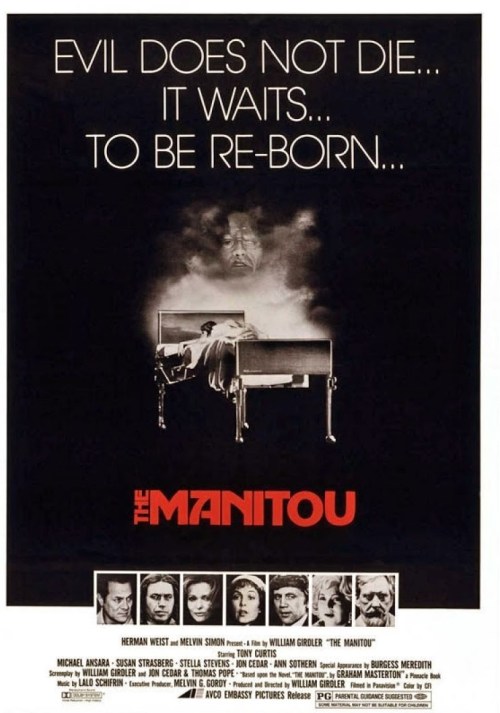
Karen (Susan Strasberg) is a middle-aged woman living in San Francisco who begins noticing a lump on the back of her neck that grows at an accelerated rate. She goes to the hospital to have it checked and the doctors there, after analyzing the X-rays, believe it to be a fetus growing within the tumor. Karen’s boyfriend Harry (Tony Curtis) does some research and discovers that the growth is an Indian shaman reincarnated from a past life who’s brought back to take revenge on the white man for driving his people off of their land. When the surgery to remove the tumor goes wrong, Harry summons the help of a modern-day shaman, John Singing Rock (Michael Ansara) to help him get the fetus removed. While John has a strong connection to the spirit world he realizes that the ones he can summon are weak compared to what the spirit who inhabits the growth on Karen’s neck can bring to life.

I’ll give writer-director William Girdler credit, during his brief life and career he directed a lot of movies, 9 of them while still in his 20’s, but the quality of the output was minimal. He did achieve a few cult hits like Sheba, Baby and Abby as well as a couple that did well at the box office, Grizzlybut this one, which came in with a high budget, could be considered his worst. The cast is interesting, though they’re well past their prime, but the plot, which is based on the best-selling novel of the same name by Graham Masterton, is too silly to be taken seriously.

Girdler shows more interest in capturing the San Francisco skyline, of which he does well, and some of the city’s more exotic locales, then spotting continuity errors. One of the most glaring ones is when the surgeon, played by Jon Cedar, who co-wrote the script, severely cuts his hand during the surgery, but then later he’s in a scene where his hands look fine and there’s no bandages on them. There’s also several moments where I was literally laughing-out-loud, like when an old lady, played by Lurene Tuttle, becomes possessed by the Indian spirit and begins dancing around the room and speaking in a deep voice, which looks as silly as it sounds. The seance is laughable too and since these have been parodied so much it’s best not even putting them into any horror movie that hopes to take itself seriously as it’ll just have the viewers-rolling-their eyes from the very beginning.

The main characters are a mess mainly because they don’t have much to do. Curtis plays this phony psychic who does nothing but stand around and watch Ansara do all the work to the extent that Ansara should’ve been the star and Curtis, who’s looking haggard and washed-up here, could’ve been cut-out completely and not missed. Strasberg is boring as the victim. She has this giant growth on her neck that’s expanding rapidly and yet she takes it in a ho-hum, laid-back fashion when anyone else would be stressing-out and going crazy with anxiety. There also should’ve been a specific reason why she got targeted with the tumor instead of just writing it off as a ‘random occurrence’.

The third act picks-up slightly and the birth of the Indian spirit where you see him claw his way out of the womb while still on Strasberg’s neck, is visually impressive from a special effects perspective, but once outside he looks too much like a dwarf in an Indian get-up. Having the entire floor of the hospital turn into a frozen polar zone is cool until you start looking at the ice blocks too closely and realize they’re just styrofoam. The climactic sequence in which a now topless Strasberg battles the Indian spirit using telekinetic powers while seemingly floating in outer space is too stupid for words and cements this as a complete embarrassment for all those involved.

My Rating: 0 out of 10

Released: April 28, 1978

Runtime: 1 Hour 43 Minutes

Rated PG

Director: William Girdler

Studio: AVCO Embassy Pictures

Available: DVD, Blu-ray, Amazon Video, YouTube

Assault (1971)

assault1

By Richard Winters

My Rating: 5 out of 10

4-Word Review: Schoolgirls attacked by rapist.

One day after school Tessa (Lesley Ann-Down), a teen who attends a local British high school in rural England, decides to cut through the nearby woods as a shortcut on her way home. As she treks through the forest an unseen assailant attacks her, which leaves her in a catatonic state. A few days later, despite the warnings, another female student goes into the woods and is later found murdered. The police inspectors (Frank Finley, James Cosmo) have idea who it could be and are unable to come-up with any leads, which frustrates the local teacher Julie West (Suzy Kendall). She decides it’s up to her to nab the culprit, so she uses herself and some of her students as bait to lure the killer out. She drives into the woods in a station wagon, but then the car gets stuck. While she tries to back it out she gets a glimpse of the perpetrator’s face as he deposits another of his victims, but when she describes to everybody what he looks like, saying he has the face of the devil, everyone thinks she’s gone mad.

This is another one of those British thrillers where in an attempt to gain more interest in the film the studio would release it under different titles. In the US the film was known as ‘In the Devil’s Garden’ to take advantage of the possession craze that was occurring after the release of The Exorcist and then a few years later it got re-released under the title ‘Satan’s Playthings’ and billed as a provocative story with erotic overtones. In either case the plot, which is based on the novel ‘The Ravine’ by Kendal Young, comes-off more like a cop drama/mystery than a horror flick.

That’s not to say it’s bad as director Sidney Hayers throws in some good touches. The attack on the girl is well handled using a hand-held camera that makes it seem unrehearsed and sudden. For a British thriller it’s even kind of racy. Normally films from England are quite timid about showing nudity, blood, or violence, but this thing does push-the-envelope a bit, far more than I was expecting, while still remaining ‘tasteful’ enough not to come under the ire of the British censors. The pounding music score helps create an urgent mood and grabs your attention at the start though it gets overplayed by the end and resembles a score heard on a cop TV-show.

The acting is good, but seeing Down looking so young and appearing much different from what we’re used to seeing her now kinda threw me off as you’d almost think she’s a completely different person. Kendall, who became a British scream queen for all the horror movies and thrillers that she was in, is quite appealing and I loved seeing her in glasses, which gives her a certain sexy look. The male actors are okay, but there’s more of them than are necessary and I think this was only done to create more suspects to choose from though their 70’s haircuts complete with long sideburns gives the film a very dated quality.

I was able to guess who the culprit was with about 20-minutes to go. It’s not that hard to figure out and the film gives-off a few too many clues to the point that it would be hard for someone not to know who it is. The story itself is standard. Not much thrills or chills though the electrocution via a cable that the victim touches while climbing up an electrical tower is admirably realistic and probably the most impressive part of the movie.

My Rating: 5 out of 10

Released: February 11, 1971

Runtime: 1 Hour 31 Minutes

Rated R

Director: Sidney Hayers

Studio: J. Arthur Rank Film Distributors

Available: DVD, Blu-ray