Category Archives: Low Budget

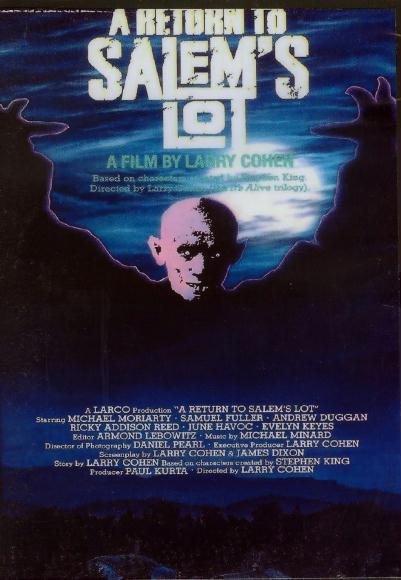
A Return to Salem’s Lot (1987)

return to salems lot

By Richard Winters

My Rating: 3 out of 10

4-Word Review: Town full of vampires

Joe Webber (Michael Moriarty) is a documentary filmmaker who is always looking to tackle the next shocking topic if it will help advance him and his film career. While vacationing in a small New England town of Jerusalem’s Lot with his teenage son Jeremy (Ricky Addison Reed) he becomes aware that the entire town is made up of a population of vampires led by elderly Judge Axel (Andrew Duggan). They are aware of Joe’s film career and give him an offer to film a documentary on them so as to give future generations a better understanding of the vampire lifestyle. Initially Joe is intrigued with the idea, but when he finds out that they want to turn his son into one of them he refuses and spends the rest of the time trying to escape and with the help of elderly but tenacious vampire hunter Van Meer (Samuel Fuller) save his son.

This flick is complete disaster from the beginning. It opens with Joe filming a documentary on a jungle cannibal tribe that looks like a real tacky rip-off of Cannibal Holocaust. The gore and special effects are abysmal and the story and characters have nothing to do with the Stephan King novel to which it is based nor the 1979 TV-Movie. Had the plot gone more with Joe filming a documentary on the populace it might have been interesting in an offbeat way, but the script brings up the idea and then never follows through with it.  There are shades of dry humor here and there and had it been more consistent with it the film could have been viewed and possibly enjoyed as a parody, but as it is it is nothing more than cheap straight-to-video fare.

The characters are poorly defined and at times even contradictory. Joe starts out as this callus man who puts his directing career first and has no concern for his son and hasn’t seen him for years, or even mentioned him to his friends. Then suddenly they get to this town and he will stop at nothing to save him. The son also does not like the father when he first sees him and yet magically and quickly bonds with him the minute they get to town. He is also described to be deeply troubled psychologically, but shows no sign of it during the course of the movie.

There is also the issue of Van Meer shooting Judge Axel in the head twice with a gun, but even as bullet holes spew out blood from his forehead he still goes on walking and talking like nothing happened. Supposedly this is to signify that the only way to kill a vampire is to stick a wooden stake through their heart and if you try to kill them any other way it won’t work, but this still doesn’t make sense. For instance if you break a vampires kneecap wouldn’t that effect the way they walk? If so then the same logic should hold true if you put two bullet holes into their brain. It would more than likely turn them into a complete vegetable a vegetable that may go on living forever until you drive a wooden stake through its heart, but a vegetable nonetheless.

Moriarty gives another great performance that completely exceeds the quality of the material. This one is even more impressive because he actually plays a normal person here and does so effectively, which is interesting given the nature of his sometimes offbeat behavior off-camera. The person though that really steals it is famed film director Fuller as the elderly vampire hunter. The guy shows an amazing amount of charisma and energy and plays up the character to an amazingly amusing degree and helps save what is otherwise a disaster.

Veteran actresses June Havoc and Evelyn Keyes appear as two of the elderly women vampires. Keyes really plays-it-up and the way she sucks the blood from one of the victims off her fingers looks down right erotic. The scene where Havoc, Keyes and writer/director Larry Cohen’s then real-life wife Janelle Webb chew on the dead body of Cohen’s real-life daughter Jill Gatsby gets a few points for audaciousness. This is also a great chance to see Tara Reid in her film debut as one of the vampire children.

The final thirty minutes is an improvement namely because of Fuller’s presence, but it does nothing to hide the film’s many other flaws, which is a perfect example of bad 80’s horror.

My Rating: 3 out of 10

Released: May 18, 1987

Runtime: 1Hour 41Minutes

Rated R

Director: Larry Cohen

Studio: Warner Brothers

Available: VHS, DVD (Warner Archive), Amazon Instant Video
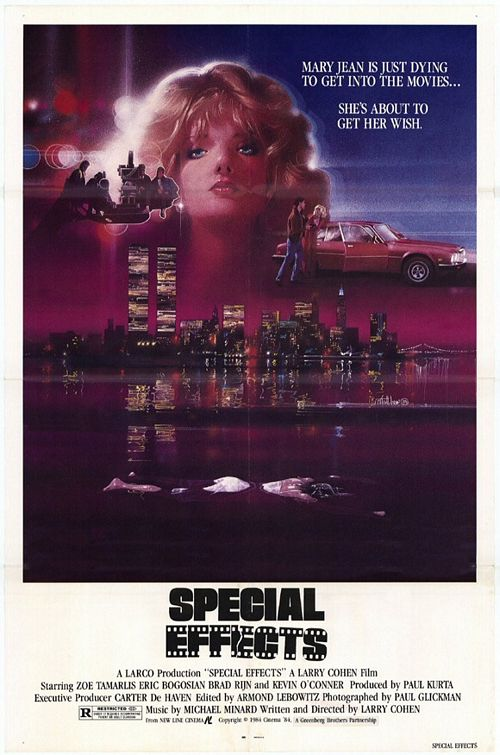
Special Effects (1984)

special effects

By Richard Winters

My Rating: 5 out of 10

4-Word Review: Murder her on film.

Snuff movies have become the thing of urban legends and apparently tapped into society’s morbid curiosity. It is really surprising how many movies and TV-shows have dealt with the topic especially recently. It all started in 1971 with the film Snuff that purportedly dealt with an actual murder of an actress done in front of the camera even though it was faked and not very good, but the film’s tagline ‘Filmed in South America where life is CHEAP’ is at least amusing. There have been films that have tried to make it look very convincing particularly the disturbing ‘Guinea Pig’ series from Japan as well as Cannibal Holocaust that got director Rogero Deodato taken to court to prove that he didn’t actually kill his cast. Although there have been executions, assassinations and suicides that have been recorded and sometimes put into documentaries there has yet to be a performer murdered in front of the camera for commercial purposes.

In today’s movie writer/director Larry Cohen takes this concept and gives it an intriguing spin. Neville (Eric Bogosian) is a down-and-out filmmaker. His last picture bombed at the box office and he is looking to make a buzz with his next project. He is fascinated with the capturing of the killing of Lee Harvey Oswald and how movies can never quite recreate death in the same way. Struggling actress Andrea (Zoe Tamerlis) answers an ad and shows up in his apartment/studio for an audition. Neville uses the allure of potential fame to get the women into bed with him, which he usually films with a camera hidden behind a two-way mirror. During the sex Andrea begins to belittle him, which angers him enough that he strangles her. Realizing that he has the murder captured on film he decides to use it to his advantage. He disposes of the dead body and then hires another woman named Elaine (also played by Tamerlis) who looks just like Andrea to star in his next film. He will then incorporate the scene of the murder into the movie. Audiences will think it was done with special effects and be so impressed with how realistic it looks that it will give Neville numerous accolades for his film making skill and bring him back to the top of the directing world.

Cohen uses the story as an excuse to expose the seedy, unglamorous side of low budget filmmaking many of which based on his own observations from working in the business. One of the more startling revelations that he shows is how the movie world is such an allure to some people that they will completely sell-out to get into it even if it means losing their dignity. This comes to a head in what is probably the film’s strongest scene when Neville is very rude and brash with Elaine when he first meets her. He shouts at her like she is sub-human and simply a piece of property, but the prospect of starring in a movie is so strong that she doesn’t walk out of there like most people would probably want to do. What is worse is the fact that Neville is aware of this and realizes he can get away with it.

The movie also looks how demeaning it can sometimes be being a filmmaker as well. Having to work and deal with various personalities and egos as well as fighting to remain in control of the project and vision. He also shows how exhausting the research phase of a production can be and how breakthroughs and inspirations usually come about by complete accident. The extended scene dealing with them trying to find an actress who resembles Andrea and auditioning hundreds of different women without any luck only to come upon Elaine by complete accident when they go to a Salvation Army store is a good example of this.

Cohen also infuses some creative camera work and directorial flair. The opening sequence showing Andrea prancing around topless in what looks to be the Oval Office of The White House has panache. The shot showing rows upon rows of hundreds of headshots of young and aspiring actresses, which includes an amusing one of Dustin Hoffman in his Tootsie character, lining the floor is impressive. I also liked the way Neville’s apartment is captured when Andrea first walks into it as well as extreme close-ups of circuit breakers being put back into a circuit box, which is really cool.

Tamerlis is fantastic in the lead. She shows a great awareness and natural acting ability in front of the camera. She plays the dual roles with two very distinct personalities and accents both of which are good. Her presence makes the film more interesting and the scenes that she is not in lack the same energy.

Bogosian easily conveys the obnoxious sarcastic personality of his character, but at times his facial expressions seem to be either lacking or over-exaggerated. Brad Rijn who plays Andrea’s husband who later gets involved in Neville’s project is weak and annoying. In some ways he seems to be the right pick for someone playing a country hick, but he has no charisma and looks too scrawny especially with his clothes off.

For a low budget 80’s flick the film has enough twists and a good enough pace to be marginally entertaining. The only thing that I really didn’t like was the synthesized electronic music score that drones on endlessly like in one of those 80’s porn flicks. I think the reason I liked the scene where Andrea’s dead body is shown inside a parked car in a lonely area of Coney Island is because it didn’t have any music and instead used the natural ambience of the location, which helped make it distinct and should’ve been done with the rest of the movie.

My Rating: 5 out of 10

Released: November 16, 1984

Runtime: 1Hour 33Minutes

Rated R

Director: Larry Cohen

Studio: New Line Cinema

Available: VHS, DVD

Q (1982)

Q

By Richard Winters

My Rating: 5 out of 10

4-Word Review: Giant bird eats humans

In celebration of cult writer/director Larry Cohen turning 72 on July 15th all this month on Mondays I will review five of his films that he did during the 80’s. Now Cohen will probably never win an Academy Award and may never be mentioned in the same context as Spielberg, Kubrik, or Hitchcock, but the man has had one hell of a career nonetheless. He has been writing for either television or movies since the late 50’s and continues to churn out creative, innovative stories and scripts. Not all of them are completely successful and some of them do misfire, but his ability to survive in the difficult, competitive Hollywood landscape and make his movies on his terms with virtually no studio interference is an amazing achievement in itself and therefore deserves recognition.

larry cohen 3

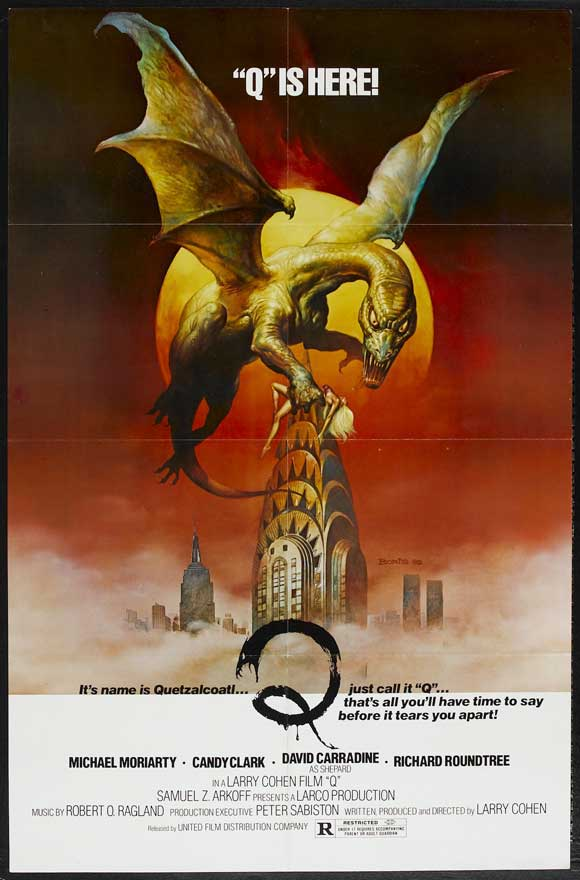
This film like most of his others has a completely outlandish plot this time involving a giant lizard-like bird that is actually the Aztec god Quetzalcoatl brought back to life and nesting inside the top crown of the Crysler Building in downtown Manhattan. The bird lays a giant egg and feeds itself on unsuspecting people.  Jimmy Quinn (Michael Moriarty) is an out-of-work lounge singer who comes upon the bird’s nest accidently while running from the cops after a botched jewelry store robbery. He decides to use his knowledge of the whereabouts of the bird to his advantage and demands that the city pay him a million dollars before he leads them to it.

Despite the crazy plot the execution is rather conventional. There are long periods of seemingly unending dialogue that is not interesting and does not propel the movie along. The bird attacks are too brief and needed to be strung out more. The movie would have worked much better and had it had a consistent tongue-in-cheek approach and editing that was more kinetic and lucid-like.

Moriarty saves the film with entertaining, edgy performance. This is a man who is known for his erratic behavior off-screen, which pretty much killed his career. In 1971 while performing on stage in a play in Houston he suddenly broke from character and told the audience as well as his fellow cast members that he felt tired and didn’t want to continue and then promptly walked off stage and went home. He was also fired from his most famous role as Ben Stone in the hit series ‘Law and Order’ for similar types of odd incidents and yet that is exactly why he is so perfect here. He gives the thing a much needed boost of weird energy and I especially liked the part when he leads two of his partners in crime up to the bird’s nest and when the bird starts feeding on them he climbs down the ladder shouting:

“Eat them! Eat them! Crunch! Crunch! Eat them! Eat Them!”

I also enjoyed when he is sitting at the bargaining table with the city and police officials demanding a million dollars before he tells them the whereabouts of the bird and insisting that it all must be tax free because:

“I’ve never paid taxes before in my life and I don’t intend to start now.”

His character is lazy, conniving, cowardly, bombastic, self-centered, egotistical, talentless, and deluded and yet strangely endearing and I even felt a bit sorry for him at the end. Candy Clark as Joan his more grounded and conscientious girlfriend makes for a good contrast.

I wasn’t as crazy about David Carradine as the tough New York cop who deals with Jimmy during his investigation. Carradine seems too aloof and detached and this doesn’t help to create any tension. Richard Roundtree as his partner is much better and I would have had him the sole investigator and cut Carradine out completely.

The special effects are a little bit better than what I had initially feared for a low budget 80’s flick, but they are not real great either. The bird when shown flying through the air just doesn’t seem gigantic or frightening enough and ends up looking like a poor man’s Ray Harryhausen creation. The final shootout with the bird was clearly done on a matted screen and looks very tacky. I actually thought the baby bird that comes out of the egg was the only halfway scary and effective moment in the whole film.

What Cohen does get right is reflecting the ambience and culture of the New York neighborhoods and crowded street culture. The aerial footage of New York’s skyline is also spectacular.

My Rating: 5 out of 10

Released: October 29, 1982

Runtime: 1Hour 33Minutes

Rated R

Director: Larry Cohen

Studio: Larco Productions

Available: VHS, DVD, Blu-ray

The Crazy-Quilt (1966)

crazy quilt 2

By Richard Winters

My Rating: 6 out of 10

4-Word Review: Married to your opposite

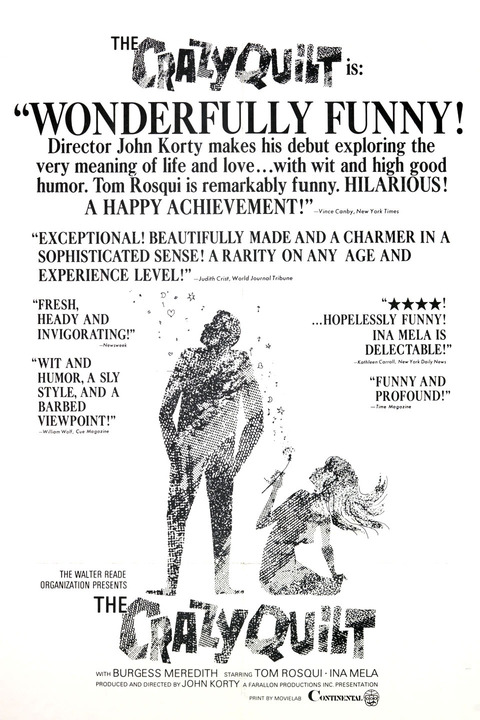
This film is based on the short story ‘The Illusionless Man & the Visionary Maid’ by Allen Wheelis and centers around Henry (Tom Rosqui) a hard-bitten realist with no illusions to anything. He lives a rather solitude life working as a termite exterminator. Then one day while walking in a park he bumps into Lorabella (Ina Mela) who is his complete opposite. She is full of ideals, dreams, and fantasies. Despite an awkward courtship the two get married and the film deals with the rocky, winding road that it takes.

This was the directorial debut for John Korty who later went on to direct the critically acclaimed TV-movies ‘Go Ask Alice’ and ‘The Autobiography of Miss Jane Pittman’. His talents are on full display here as he institutes a visual design to a story that initially doesn’t have any. I loved some of the picturesque moments particularly when Henry and Lorabella take a long quiet walk in a wide open field that eventually stretches all the way into a forest. The black and white cinematography gives it just the right cinema vertite feel and the music is perfect especially the flute solo. In an age of overblown plots and mind numbing special effects it is nice to see someone take a risk with a story that is subtle, basic, and restrained. There is some nice simple, but profound moments here that could never be replicated in the big budget productions, but have a great impact here. Despite the whimsical nature many people are sure to see a bit of themselves in the characters and it is its ability to tap into that very basic, universal truth that makes this film special and unique.

The casting is astute. Rosqui is spot-on as the realist. He has a perpetual scowl on his face that is just right for the character and seems to remain even in the brief moments when he is smiling. Mela is equally good. Her expressive eyes, delicate features, and wispy voice perfectly reflect the traits of her character and the camera captures her well. She never appeared in another movie and I was sad to hear that she died at a young age.

Initially I was put-off by the Lorabella character falling so madly in-love with Henry after she bumps into him and following him all around even though he responds to her in a very cold and reticent way. I felt it was unrealistic that someone wouldn’t notice the obvious aloofness, but then I realized that is the characters whole problem. She projects traits onto the people she meets as well as everything else in life from her own quirky mind that aren’t really there. This comes to an amusing head when she has affairs with various different men where she shows the same tendency and ends up consistently getting the same empty result. These vignettes are the funniest moments in the film as well as the scene where she bakes Henry a chocolate cake that is shaped to look like a giant termite.

I really have only a few complaints with the film. One is the voice-over narration by Burgess Meredith. Meredith has a great voice and a few of his lines are gems particularly his opening monologue and
the very last one. However, there were moments when I would rather have heard what the characters were saying especially when the couple goes to an art museum as I thought it would be interesting to hear the different interpretations each character had to each display. Near the end in an attempt to show the characters aging Henry’s hair is dyed white, but it looks tacky like it was frosted on in a similar way that is done to white Christmas trees. I also thought it was strange that in the very final scene his hair suddenly goes back to being black, which didn’t make any sense.

Since this film is very obscure and had a limited run upon its initial release the only way to obtain it is through the director’s personal website at www.johnkorty.com The neat thing here it that when you order a copy Korty personally signs the DVD and even sends you a letter along with it. For a lifelong film collector such as myself I thought that was pretty cool and it even made my day.

My Rating: 6 out of 10

Released: October 3, 1966

Runtime: 1Hour 10Minutes

Not Rated

Director: John Korty

Studio: Continental Distributing

Available: DVD at www.johnkorty.com

The Sidehackers (1969)

sidehackers

By Richard Winters

My Rating: 2 out of 10

4-Word Review: Rape, murder and mayhem

This low budget flick is probably best known as having aired on an episode of the old ‘Mystery Science Theater 3000’ TV-show. At the time the writers had not watched the movie all the way through before deciding to use it for the show and when they came upon a rape sequence half-way through it they had to edit it out and have Crow  simply explain that the character was now dead. It is also famous for being directed by Goldie Hawn’s then husband Gus Trikonis. In fact Goldie auditioned for one of the parts in the film, but since she wasn’t well known at the time she got turned down.

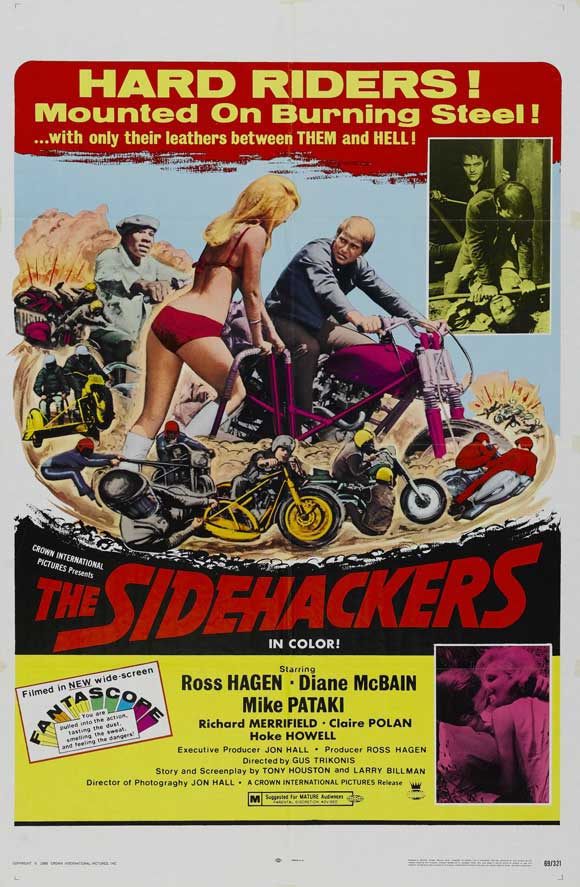
The story centers around Vince (Ross Hagen) a motorcycle racer involved in the sport of sidehacking where a passenger rides along in a sidecar connected to the motorcycle and uses his body weight to help steer the bike around curves and turns.  The psychotic J.C. (Michael Pataki) watches the sport and wants to work with Vince, but Vince becomes aware of J.C.’s volatile personality and turns him down. This angers J.C. and later when his girlfriend Paisley (Claire Polan) falsely accuses Vince of having tried to rape her J.C. flies into a rage. He and his men attack and beat up Vince and then rape and murder Vince’s girlfriend Rita (Diane McBain). Vince then spends the rest of the film trying to track down J.C. and getting his revenge.

The only diversion of this otherwise run-of-the-mill drive-in drama is the scenes involving the racing, which is better known as sidecarcross. Trikonis captures the racing in vivid style giving the viewer a good feel of the sport. Personally I thought it would be excessively dangerous for the passenger who puts himself into a very vulnerable position as he tries to steer the bike from the side and could easily fall off, or be hit by the other bikes that zoom around him. The shots of the crowd seem to show them as really being into it, but I felt that after watching it for a few minutes it would get monotonous.

With that said it is still the most interesting aspect of the film and I felt the story should have revolved around it. For instance having J.C. try and sabotage one of Vince’s races, but instead the racing scenes are shown only at the beginning before devolving into just another stale and redundant revenge drama. The dialogue is stilted, the characters bland, and the direction lifeless. Boredom quickly sets in and never goes away.

The music score is particularly horrendous. With the exception of the final fight scene when it does have a nifty psychedelic quality it is very sappy and terribly harmonized. Hearing it played over shots of Vince and Rita frolicking merrily through some open fields may be enough to make some viewers gag.

Pataki gives a good intense performance as the psycho and at times goes a bit over-the-top, but with this type of production that can only help it. The rest of the acting like everything else seems amateurish. If you want to seek this film out simply to catch the scene that was cut from the TV broadcast I would say it isn’t worth it. The sequence is not all that graphic and it is shown only as a flashback, which takes less than a minute.

My Rating: 2 out of 10

Released: May 12, 1969

Runtime: 1Hour 22Minutes

Alternate Title: Five the Hard Way

Rated M

Director: Gus Trikonis

Studio: Crown International Pictures

Available: DVD (The Savage Cinema Collection)

I Can Make You Love Me (1993)

stalking laura 2

By Richard Winters

My Rating: 7 out of 10

4-Word Review: Stalking is his passion.

To any true film fan TV-Movies have always been considered vastly inferior to the theatrical kind and I would be the first to agree.  However, there is one area where they can shine and that is in their depictions of true-life crimes. Mainly this is because they give it more time as they are usually shown in two parts over consecutive nights.  Also, their lower budgets worked better in recreating the docu-drama style.

Over the years there have been some classics in this area that have helped bring substance to the headlines as well as a better understanding of the victims, the perpetrators and the investigation. Some of the best that I would suggest would be Helter Skelter (1976) starring the Emmy-award winning Steve Railsback as Charles Manson.  The Deliberate Stranger (1986) with Mark Harmon as serial killer Ted Bundy.  There is also Deadly Intentions (1985), A Death in California (1984) with Cheryl Ladd as a woman who falls in love with her rapist, and my personal favorite Fatal Vision (1984) about the infamous Dr. Jeffrey Macdonald.

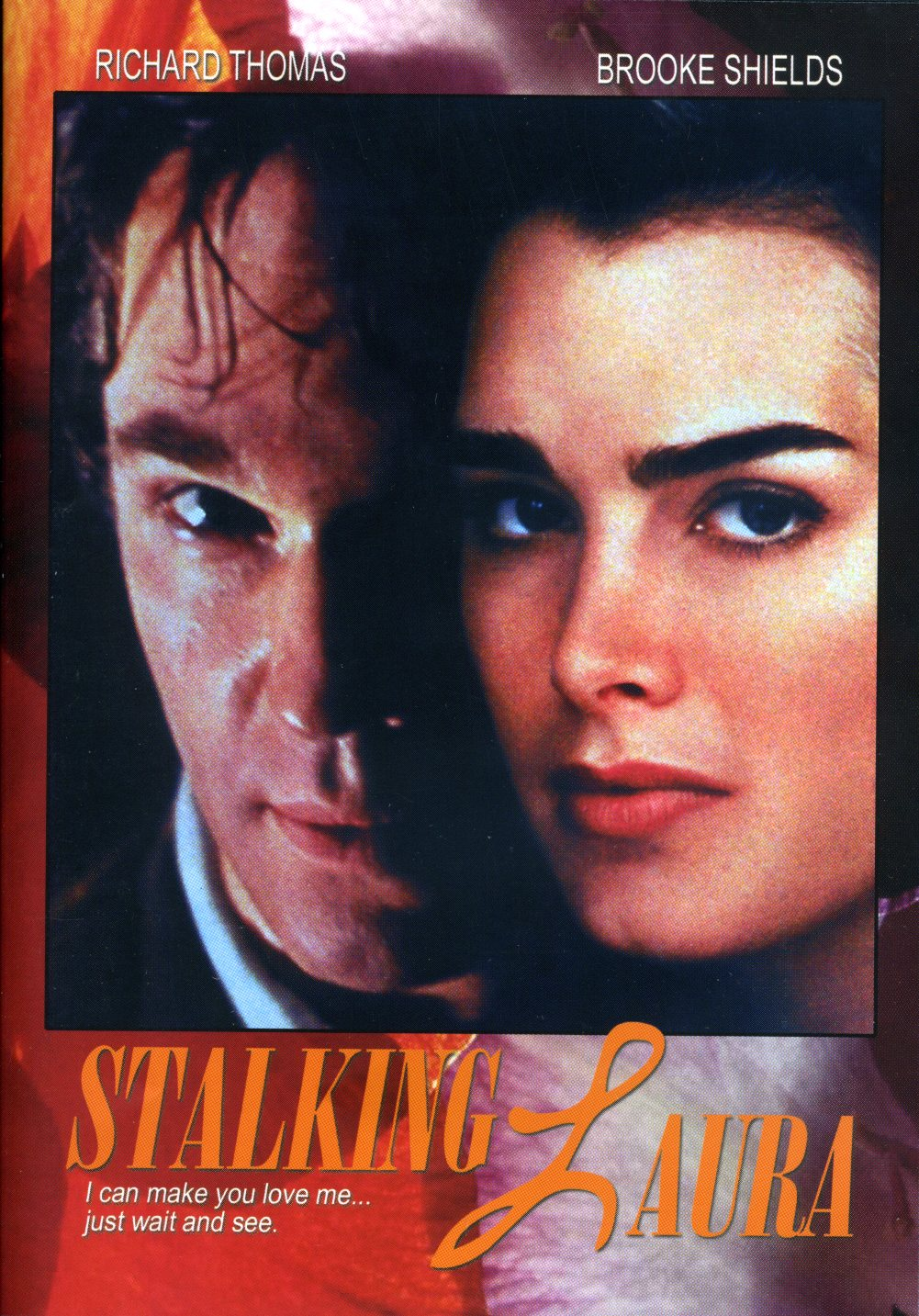
This film deals with the case of Richard Farley (Richard Thomas) that helped develop California’s first anti-stalking laws. Farley was a pudgy, middle-aged man who worked as a computer programmer at a company named ESL in Sunnyvale, California in 1984.  He had been there for 9 years and had no criminal record, but became unhinged when he met an attractive 23- year- old new employee named Laura Black (Brooke Shields).  He began to follow her around constantly as well as sending her gifts and love letters on a daily basis.  When she refused his advances he became even more persistent.  This continued for 4 years until, through his obsession, he ended up losing his job, his house, and his entire life savings, but his stalking continued. Black finally filed a restraining order against him, which sent him into a rage.  He armed himself with an array of guns, stormed the company and shot seven employees including Black, who managed to survive.

Unlike some of the previous movies that I mentioned above, this film did not get the two-part treatment.  Everything that happened gets crammed into 95 minutes, which makes a lot of it seem rushed.  Although the events took place over a four year period, the movie gives you the impression that it was just a few quick months. For the sake of time the film seems to leave certain interesting facts out, which is a shame.  For instance, in real-life Farley actually stood in front of Black’s house for hours going through every conceivable combination on her garage door opener until he was finally able to crack it.  There are also certain things that Farley expressed to Black through his letters that he ends up telling verbally to her here, which causes some of the dialogue to seem awkward.

The film was also not given much of a budget.  It was filmed on a grainy, videotape type of film stock that looks like it was done on somebody’s camcorder.  The story took place in California and yet for whatever reason it ended up being filmed in Topeka, Kansas and the differences in the landscapes are obvious and even a bit disconcerting.

Where the film really seems to come together is during the final 30 minutes where it recreates the office shooting. This sequence is well choreographed and makes you feel like you are right there.  The conversations that Farley has with the negotiator during these scenes are revealing.  I was confused after reading the accounts of the incident as to why Farley would have only shot Black once (in the shoulder) and then allowed her to escape.  Apparently, through his conversations with the negotiator, this was his intention.  He only wanted to injure her and then force her to survive so she would have to live with the ‘guilt’ of having ‘caused’ this by refusing to go out with him.

Another big selling point is the performances of the two leads. Richard Thomas as Farley is astounding.  He does not resemble the actual Farley, but makes up for it with a convincing portrayal that leaves a lasting impression. Shields is excellent as well. Normally I never gave her much credit in the past, but found a new appreciation for her acting ability here.  She does an especially good job during the scenes where she is shot and trying to escape.  It seemed like she was genuinely stressed and in real pain.

Another thing I liked here is that the character of Laura Black is portrayed as being very determined, resourceful, and strong.  She had to struggle with the company about this matter as initially they sided with Farley and was convinced that she must have ‘lead him on’. I felt it was a testament to her strength that she continued to keep working at the company and was still working there five years later when this film was made.

If you find true-life crimes to be intriguing and enjoy seeing them recreated to help your understanding of them, then TV-movies are you best source for this type of genre.  I felt that this case, with its myriad of psychological implications, was no different.

My Rating: 7 out of 10

Released: February 9, 1993

Runtime: 1Hour 32Minutes

Alternate Title: Stalking Laura

Not Rated

Director: Michael Switzer

Studio: Leonard Hill Films

Available: DVD

The Idiots (1998)

the idiots 2

By Richard Winters 

My Rating: 7 out of 10

4-Word Review: This is so retarded.

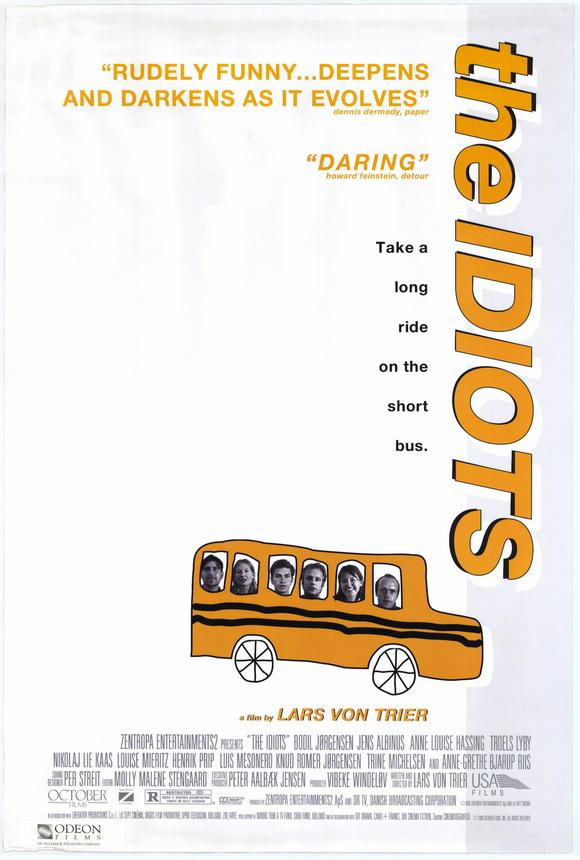
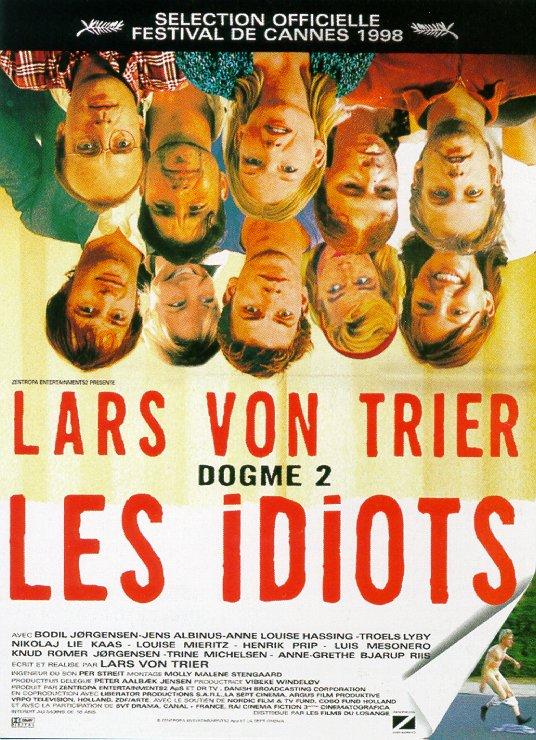
The Idiots is another shocking, controversial, and highly original work from filmmaking maverick Lars Von Trier.  This one involves a group of disenchanted people in their 20’s and 30’s, who decided to rebel from society by acting like they are mentally retarded.

Although certainly not in the best of taste, there are some funny bits here. The comedy works well because amidst all of the outrageousness it is also very revealing about human nature. One of the best segments involves an affluent couple who wish to purchase a large, upscale home.  As they are touring the place they are informed that a group of ‘retards’ live next door. The couple put on the politically correct facade by saying that wouldn’t be a problem even though their facial expressions say otherwise.  When the group pretending to be retarded pays them a visit the couple quickly runs off.  Another funny part, which may actually be the most outlandish of the whole film, involves a group of tough, tattooed bikers who help in very graphic fashion one of the group members pretending to be mentally handicapped go to the bathroom. The group’s visit to a factory is also hilarious.

The majority of the film though is actually quite serious and yes, even thought provoking. Von Trier does a good job of analyzing things from different angles while supplying no easy answers. It was interesting how the group mocks society for all of their rules and customs and yet when one of their own members starts to act erratic they tie him to a bed and refuse to free him until he ‘settles down’, thus proving that even they themselves need certain rules of behavior in order to function even if they don’t want to admit it.  Some other strong dramatic scenes involve the father of one of the members who tries taking his daughter from the group and back home with him.  There is also a revealing segment involving one of the members who decides to ‘drop back into society’ and return to his job as a college professor despite the protests from the other members.  The group also comes into direct contact with people who are actually mentally handicapped and how each of them responds to this is fascinating.

The characters are nicely fleshed out.  All of them show distinct personalities and evolve in interesting ways as the film progresses. Karen (Bodil Jorgenson) acts as they catalyst.  She comes upon the group by chance and acts as a sort of ‘conscience’ for the film.  Initially she is shocked and confused by the group’s behavior, but because she is stuck in an unhappy relationship and grieving the recent death of her son, she decides to tag along. Eventually she starts to see the benefits of ‘spassing out’ which is the group’s term for ‘finding your inner idiot’.

I liked how the film challenges the concept of true rebellion and shows how complex the fabric of society really is. Everyone would like to ‘drop-out’ at certain times and there is even a need for it, but finding the right place can be complicated. I have often felt that the true nonconformist is either living on the streets, is in prison, or a mental institution and the film pretty much comes to this same conclusion, but without advocating ‘fitting-in’ with the establishment as the answer either.

My complaints for the film centers mainly on the over use of the hand-held camera, which tends to get distracting after a while and gives the film a needless amateurish feel. I know with Von Trier’s ‘Dogma 95′ manifesto the hand-held camera is a major factor, but I think he could back off a little with it. There is also a ‘gross-out’ segment at the end where the group member’s start to drool out their chewed up food, which I found completely disgusting especially the way the camera captures it in close-up. The pacing is pretty good, but it does drag a little at times and I felt the film went on about twenty-five minutes too long.

Obviously this is a film that will not appeal to everyone and in fact I would say that the majority of people may find it off-putting.  That doesn’t mean it is a bad film because I think it is a pretty good one and I liked it overall.  However, what makes it a good film is the fact that it works off of its own vision and makes no compromises in doing so.  For most viewers especially American audiences who are used to a ‘mass-appeal’ approach to film-making, this type of concept may not connect. 

the idiots 3

My Rating: 8 out of 10

Released: May 20, 1998

Runtime: 1Hour 57Minutes

Rated R

Director: Lars Von Trier

Studio: Zentropa Entertainments

Available: VHS, DVD

Candy Stripe Nurses (1974)

candy stripe nurses

By Richard Winters

My Rating: 2 out of 10

4-Word Review: They specialize in sex.

The fifth edition of Roger Corman’s Nurses series has gone well past its expiration date and mercifully this was the final one. A creative animated opening and a funky, edgy soundtrack fail to camouflage the tired formula. Uneven balance of farcical humor and stilted drama doesn’t work and they should’ve just stuck with the comedy. The scenarios themselves are extremely trite and not worth describing.

Initially I liked the Maria Rojo character who is this punk, streetwise gal who is ambivalent to her school work and gets thrown in as a volunteer candy stripe nurse simply to give her some responsibility, but she remains apathetic to that as well. The story though shifts to her falling almost immediately in-love with one of the male patients (Roger Cruz) and then spending an excessive amount of screen-time going way out of her way to find a witness that can testify on his behalf to keep him out of jail. This segment flops mainly because I couldn’t buy into the fact that she would be so convinced of his innocence when she had just met him. Also, for a streetwise girl she ends up being too trusting and naïve. Her acting also gets worse the more the film progresses.

Candice Rialson comes off best. I’ve seen her in other drive-in films, but she seems to be having the most fun in this one particularly the scene where she works in a sex clinic and answers the phone from perverted callers. She also possesses (ahem) a really nice rack, which gets amply shown.

The sex is a little more erotic and impulsive here. The segment showing a breast in close-up amidst some shadowy lighting has some artistic flair and a nude scene involving now famous soap opera actress Robin Mattson is good. However, for the most part the sex and nudity is pretty sparse.

Famous television writer Stanley Ralph Ross hams it up as Dr. Kramer the head of the sex clinic. Dick Miller can also be seen briefly as a spectator at a basketball game. He has been in so many low budget films and many times in small and insignificant roles that it makes me wonder; is he desperate for money or just willing to do anything for it?

My Rating: 2 out of 10

Released: May 1, 1974

Runtime: 1Hour 17Minutes

Rated R

Director: Allan Holeb

Studio: New World Pictures

Available: DVD (The Nurses Collection)

The Young Nurses (1973)

the young nurses

By Richard Winters

My Rating: 3 out of 10

4-Word Review: More sex than medicine.

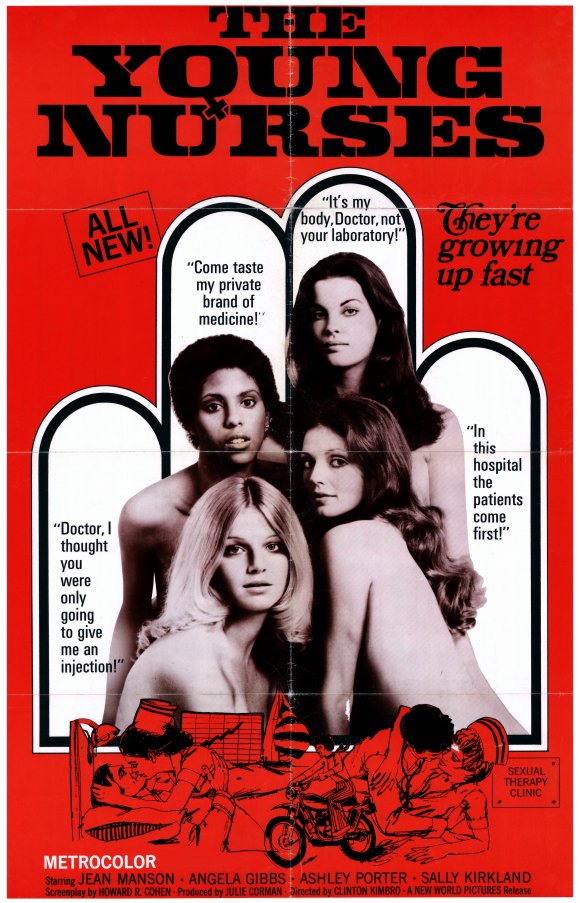
More amorous nurses, more stilted dialogue, more bad acting and more cheap production values in this the fourth edition of the Roger Corman produced series.

The formula is starting to become old and outside of some scenic ocean beach scenery and a bouncy opening tune there is very little to recommend. The story of one of the nurses (Jeane Manson) falling in love with a handsome young hunk and nursing him back to health only to have him go out and recklessly put his life on the line again is too reminiscent of story threads used in past editions of this series. This time it has to do with sailboating and the man’s broken shoulder not yet healed enough to go back out, but because of pressures from his father he decides to get into a sailboating race, which is picturesque to watch, but offers little else.

The second story line involving a drug ring working inside the hospital is equally contrived, but does at least involve one exciting chase sequence.

There is of course the expected nudity with this one having a bit more than the ones in the past. Unlike the first three this one shows full frontal nudity particularly with Manson who goes dancing along the beach naked and even into the ocean. The segment involving one of them hallucinating about a sex orgy at a black nightclub is somewhat provocative as is the vaginal self-examination booth.

However, unlike the past films of the series not all of the three leads are seen sans clothes. Although she comes close Angela Gibbs is never seen nude, but at least makes up for it by giving the best acting performance. Ashley Porter is seen nude and looks good, but her acting is terrible and possibly the worst performance of the entire series. She says her lines in a robotic fashion that quickly becomes irritating.

The film does offer some fun cameos by famous B-movie actors. Allan Arbus is amusing as a sarcastic doctor yelling at a nurse for handing him incorrect utensils during surgery. Jay Burton hams it up as an overzealous manager to a rock group. Mantan Moreland can be seen as an old man who is almost run over by a motorcycle. Dick Miller plays an abrasive cop and Samuel Fuller is the head of the drug ring. Sally Kirkland is one of the patients, Nan Martin plays a woman reporter and Mary Doyle, sister of actor David Doyle, is engaging as a bitchy older head nurse.

The picture quality is excellent and the ocean side views are scenic. Unlike with the transfers of the first two features this one, which is all part of the Nurses Collection by Shout Factory, does not have any annoying sound distortion.

My Rating: 3 out of 10

Released: March 10, 1973

Runtime: 1Hour 17Minutes

Rated R

Director: Clinton Kimbrough

Studio: New World Pictures

Available: DVD (The Nurses Collection)

Night Call Nurses (1972)

night call nurses 1

By Richard Winters

My Rating: 2 out of 10

4-Word Review: Sex makes good medicine.

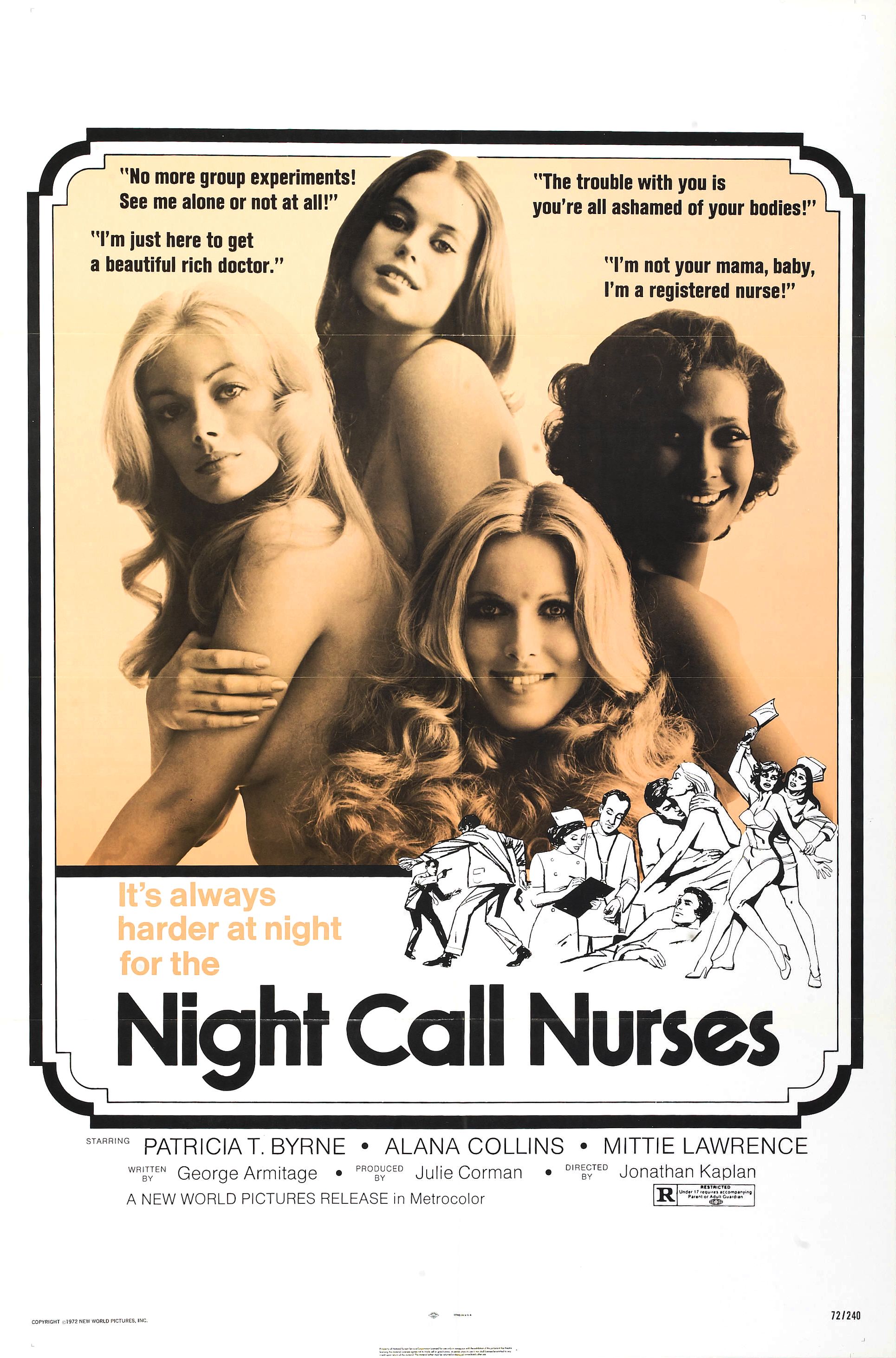
Barbara (Patty Byrne), Janis (Alana Stewart), and Sandra (Mittie Lawrence) are three young women starting out in the nursing field. The film analyzes their various and sometimes amusing predicaments while on the job as well as their sex lives.

The film moves at a decent pace, but seems disjointed with poor story and character progression. Things are thrown in just to keep it moving, but with no real connection to anything else. Amateurish production values permeate and Jonathan Kaplan’s directorial debut is for the most part best forgotten. The only mildly interesting scene involved a therapy group where all the members strip off their clothes as well as having one of the members think that she is being driven insane by the group’s instructor.

The attempts at lightheartedness and humor are strained and flat. Only one brief exchange during the entire duration managed to elicit a small chuckle from myself and it goes like this:

Male Patient: (While looking at the nurse’s nametag on her uniform) Is Janis your name, or the name of your left titty?

Janis: (While giggling) Janis is my name. Irene is the name of my left tiitty.

The acting is quite poor with everyone phoning in their parts. Alana Stewart who was at one time the wife of actor George Hamilton and later rock legend Rod Stewart as well as the mother of Ashley Hamilton and Kimberly Stewart mouths her lines in a lifeless and emotionless fashion that resembles her beautiful but blank blue eyes. However, recent pics of her are amazing as she looks like she hasn’t aged a day since she has done this and I’ll give her credit there. Despite only doing one other picture besides this one Byrne is the one that gives the strongest performance particularly her effective crying, which seems real.

There is enough nudity to satisfy the voyeurs including the opening sequence where one of the mentally-ill patients’ strips off her clothes and then jumps off the roof of a building. However, you basically only see their breasts and the sex is handled in such a mechanical and unimaginative way that it fails to titillate at all.

The Shout Factory DVD issue has a great picture quality much like Private Duty Nurses, but the sound is a problem. There is a background rumbling heard throughout that resembles talking to someone on the phone with wind blowing through the receiver, or speaking to someone in the car with the windows down and wind blowing in.

My Rating: 2 out of 10

Released: June 10, 1972

Runtime: 1Hour 14Minutes

Rated R

Director: Jonathan Kaplan

Studio: New World Pictures

Available: DVD (Roger Corman’s Nurses Collection)