Category Archives: French Films

Life Size (1974)

life size 1

By Richard Winters

My Rating: 5 out of 10

4-Word Review: A sex doll obsession.

Michel (Michel Piccoli) runs a successful dental practice, but finds that his life is empty and his marriage to his wife Isabelle (Rada Rassimov) is no longer working. He has cheated on her before, but those affairs left him with the same empty feeling, so this time he decides to take a different route by purchasing a life size sex doll that looks so real that she almost seems human. He takes her everywhere and even brings her along to a visit with his mother (Valentine Tessier) so she can meet his new ‘girlfriend’.  The doll becomes the centerpiece of his very existence and he spends every waking moment he can with her until he sees footage, from a closed circuit camera that he has set-up in his house, of one of friends having sex with her while he was away. He becomes outraged at her ‘betrayal’ and decides that her punishment will be ‘death’.

The film, which can best be described as an early, distant cousin to Lars and the Real Girl, definitely has its share of unique and memorable moments. Writer/director Luis Garcia Berlanga does an admirable job of analyzing just what might happen if sexual fantasy gets taken to its most extreme level. The scenes showing Michel taking the doll to a clothing store in order to be measured and fitted with the latest fashions and marrying the doll in a makeshift wedding are by far the film’s two best segments.

However, it’s Michel’s scenes with his wife that I found to be the most unsettling. The scene where he fondles his wife’s naked breasts late at night as she sleeps while looking at a picture of the doll is quirky enough, but then later on, in the film’s most disturbing moment, she tries immersing completely into his sexual fantasy by pretending to be a sex doll herself in a desperate attempt to win him back.

What is initially considered the sexual substitute to the real thing soon becomes the preferable choice here and it reminded me of an article I read in a science journal a few years back about young men in their 20’s forced to be prescribed Viagra because they were no longer able to achieve erections with their wives/girlfriends because the proliferation of porn on the internet had somehow dulled their senses to real sex to the point that they found it to be a ‘turn-off’. Now, if you are a fan of porn then that’s great and I don’t mean to be appear like I’m trying to knock it, but I did find it fascinating that elements of that article correlated to what this film was showing and how successful this movie was at foreshadowing the phenomenon’s that we are now seeing in our modern day culture.

Although the film is adequately directed and more of a psychological study than a perverse sleaze feast it’s still not an overall success. The main issue is that the main character acts overtly freaky about the doll from the very beginning without enough backstory to tell us why and simply saying it’s due to a unhappy marriage is not enough. A far more compelling concept would’ve been to portray the main character as being more ‘normal’ by having him feel awkward about the doll and even a bit embarrassed only to grow increasingly more obsessed as the film progresses until his ultimate infatuation with it shocks even him.

Alternate Titles: Grandeur Nature, Love Doll, Tamano Natural

My Rating: 5 out of 10

Released: August 21, 1974

Runtime: 1Hour 41Minutes

Rated X

Director: Luis Garcia Berlanga

Studio: Cinema International Corporation

Available: None at this time.
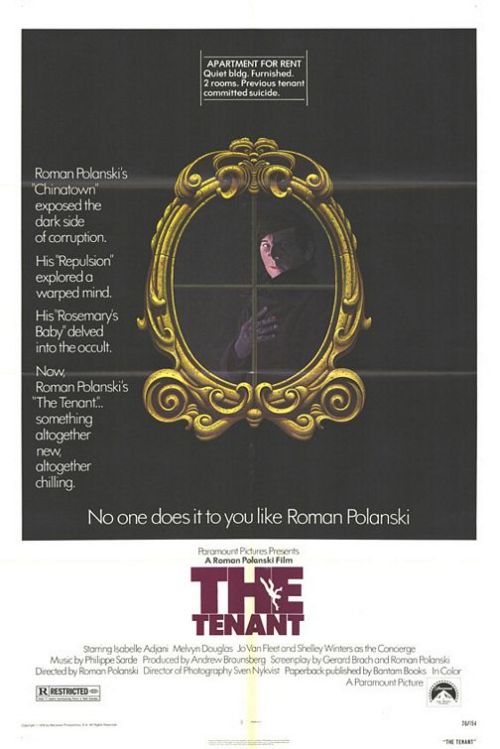
The Tenant (1976)

tenant 1

By Richard Winters

My Rating: 10 out of 10

4-Word Review: He loses his identity.

This intriguingly odd horror film may well be Roman Polanski’s best work and even better than Rosemary’s Baby as it manages to be scary in a unique way while also bringing to light many of the subtle ugliness of everyday life. Here Polanski plays a tenant who moves into an apartment were all the residents, and even the landlord (Melvyn Douglas), act slightly peculiar. The woman who lived in the apartment before him killed herself by jumping out the window and as he continues to live there he starts to feel a connection towards her while also getting the idea that somehow the other residents are in a conspiracy against him.

The film’s brilliance comes from the fact that the horror and tension is not based on any of the usual devices.  No ghosts, monsters, or psychos here. Instead the viewer gets sucked into the harsh realities of the modern urban world. The feelings of isolation, people who are cold and impersonal and apartments that are bleak and small as well as showing how these urban jungles swallow up our identities until we’re just another face-in-the- crowd.

This amazingly deep and penetrating study gets astutely underplayed with no action and little or any true scares. The tension comes through its psychological implications and the paranoia that only the Polanski character feels. Are these people really out to get him, or is it all just in his head? There are no definite answers, but theme and ideas are quite real. It’s a sort of twisted version of Rear Window and extension of Repulsion that may require a second viewing in order to completely appreciate.

Polanski scores on all levels as his performance is interesting and his ability as a director to make you feel the smallness and bleakness of the character’s apartment is also amazing. You are given a very real sense of the room’s dimensions without any inclination that it was done on a stage, or with the presence of a film crew. The eerie segments are subtle but successful with imagery that is both strange and lasting.

My Rating: 10 out of 10

Released: May 26, 1976

Runtime: 2Hours 5Minutes

Rated R

Director: Roman Polanski

Studio: Paramount

Available: DVD, Amazon Instant Video, YouTube

Coup de tete (1979)

coup de tete

By Richard Winters

My Rating: 6 out of 10

4-Word Review: Soccer player gets revenge.

Francois (Patrick Dewaere) plays soccer (football) for the local amateur team in the French town where he lives. One day, while the rich owner of the team (Jean Bouise) watches, Francois has a physical altercation with the team’s star player Berthier (Patrick Floersheim), which immediately gets the owner and the rest of his teammates to turn on him. Not only does Francois get kicked off the squad, but he loses his factory job too. Francois then gets accused of rape in a crime that was actually committed by Berthier, but the police manipulate the evidence so Francois goes to jail instead. It’s only later when the team bus gets into an accident that Francois is released from prison so he can help them win, which he does, but he also has a very creative plan that he enacts on those who wronged him.

After directing the highly successful Black and White in Color, which won the Academy Award for best foreign film for 1976, director Jean-Jacques Annaud decided to take another stab at social satire. For the most part the film works well and is filled with a lot of intriguing elements. The best part is the way it pokes fun at the fans, who are just regular people that become so obsessed with their team winning that they lose sight of everything else that is important while clinging to the misguided notion that if their team achieves victory then that will somehow make up for all of life’s other transgressions.

Dewaere excels in his usual outsider role and watching him climb up some precarious apartment building walls and at one point even pull his way up a scaffold in his effort to visit his lady friends is entertaining in itself. Dorothee Jemma is attractive as the woman who initially accuses him of rape then retracts it and the side-story dealing with the quirky romance that ensues between them is enjoyable and better than the main one.

However, like with Annaud’s first film, I didn’t find this to be quite as entertaining as all the other critics seemed to. There are certainly some amusing moments and the script by Francis Veber is highly unpredictable, but in the end it doesn’t pack the intended punch. I think the main reason for this is the fact that the townspeople who screw Francois over are just too one-dimensional. They behave like unbridled jerks without ever realizing how hypocritical they really are, which makes their ultimate comeuppance not as satisfying because I could never believe that they were real people and instead just poorly crafted caricatures.

Alternate Title: Hothead (American reissue)

My Rating: 6 out of 10

Released: February 14, 1979

Runtime: 1Hour 29Minutes

Not Rated

Director: Jean-Jacques Annaud

Studio: Gaumont International

Available: VHS (Dubbed), DVD (Region 2), Blu-ray (Multi-region) (Subtitled)

The Burglars (1971)

burglars 1

By Richard Winters

My Rating: 5 out of 10

4-Word Review: Corrupt cop hounds thief.

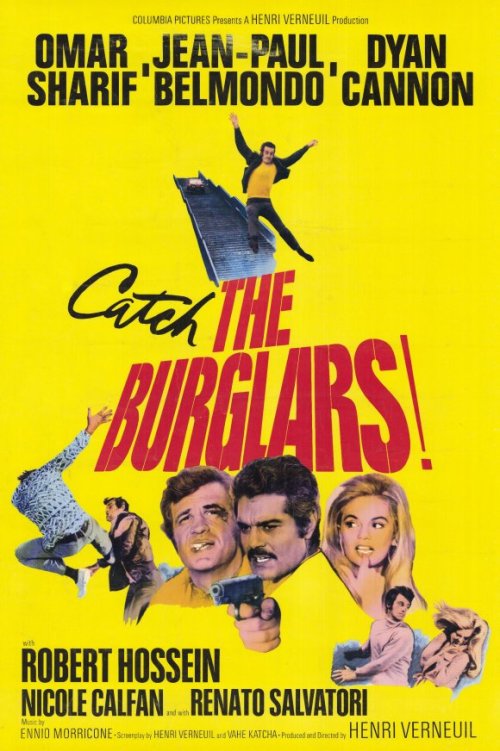
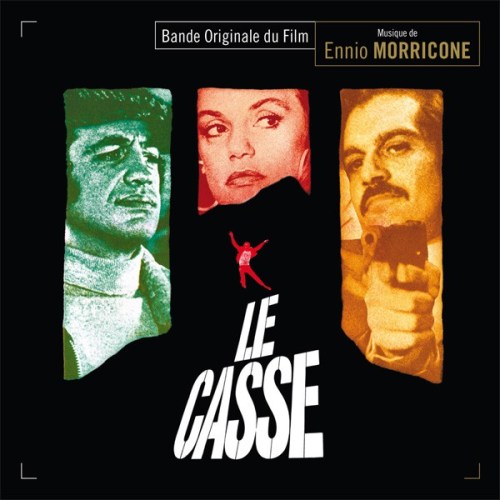
Azad (Jean-Paul Belmondo) and his cohorts pull off a daring heist by robbing a gem collector of his emeralds in his home by using a state-of-the-art machine that is able to create a key to the safe on the spot by simply entering in the safe’s serial number. However, things go awry when Abel (Omar Sharif), a corrupt police captain, becomes suspicious of their activity after seeing the gang’s car parked on the road. Initially he lets them off, but only so he can follow them later and then blackmail them for the jewels, or threaten them with prison otherwise.

The film, which is based on the novel by David Goodis and made 14 years earlier as The Burglar, which starred Jayne Mansfield, has all the trappings for being a classic heist film. I enjoyed watching the intricate way they are finally able to crack open the safe, which takes up much of the first half-hour. I also liked the creative action, stunt work, story twists, luscious Greek scenery and musical score by the legendary Ennio Morricone. Unfortunately none of this is able to overcome a rather plodding pace and a lingering feeling that you’ve seen it all before.

The film’s biggest claim-to-fame is its two chase sequences. The first is similar to the one done in The Italian Job as two small compact cars drive all over Athens, including on sidewalks, stairwells, and through crowds of people, which is exciting to watch. However, the fact that no one gets injured and no other automobiles are damaged even as the cars drive straight into on-coming traffic is hard to imagine. The camera also cuts to a close-up shot of the lead car driving on its rim, but somehow the vehicle is still able to continue to go several more miles on rough surfaces and high speeds, but why have a shot like that inserted if it ultimately doesn’t mean anything?

The second chase works better, which involves Belmondo hanging onto the side of a bus as it travels speedily down a crowded city street while he tries to kick shut the door of a police car that is following, which is quite realistic looking especially since it appears to be Belmondo himself and not a stunt double doing it. This one culminates with Belmondo being tossed from a dump truck and down a steep hill while other large rocks roll with him, which again is impressive, but the fact that he doesn’t even receive a scratch from it is hard to believe.

Sharif is outstanding in a rare turn as a bad guy. He commands every scene that he is in and in the process makes co-star Belmondo seem forgettable and unable to equal the same strong presence. Dyan Cannon, who is the only American in the cast, gets a pointless part as a pin-up magazine model that catches Belmondo’s eye. Her character doesn’t appear until an hour in and is not all that integral to the plot. Her voice is also clearly dubbed in the French version, which makes her acting here limited and probably not worth signing up for to begin with.

The climactic finish that entails a man being drowned inside a grain elevator is novel as is the final moment inside a giant, mobile chicken coop with thousands of loud, clucking chickens, but overall the film fails to illicit much tension and would’ve been better had the runtime been trimmed and the scenes shortened.

burglars 2

Alternate Title: Le Casse

My Rating: 5 out of 10

Released: October 24, 1971

Runtime: 1Hour 57Minutes

Rated PG

Director: Henri Verneuil

Studio: Columbia Pictures

Available: DVD-R

Quest for Fire (1981)

quest for fire

By Richard Winters

My Rating: 6 out of 10

4-Word Review: Cavemen search of fire.

After their tribe is attacked by another one and their only source of fire put out three male members from the group (Everett McGill, Ron Pearlman, Nicholas Kadi) set out to find fire from somewhere else and bring it back to the others.  Their quest is not easy as they are forced to travel through harsh terrain, escape from man eating tigers, and fight off a tribe of cannibals. They also meet up with Ika (Rae Dawn Chong) who comes from a more advanced tribe where the members live in huts instead of caves and who also harbors the secret to starting a fire, which she just might share with the others.

Filmed on-location in Canada, Scotland, and Kenya this film brings to life the true nature of prehistoric times in vivid detail and better than any other movie that has dealt with the same subject. The male actors were fitted with masks that gave them ape-like features and except for one brief moment there is no discernable line of dialogue and communication is spoken through grunts and groans as well as words not connected to modern day language. Some DVD issues do have subtitles, but to me this is taking the viewer out of the experience as the whole idea is to allow one a true sense of how things where like back then and therefore forcing one to try to understand things through the primitives means of communication during that period is the only way to do it and I’m thankful that the theatrical version and the streaming version that I saw did not offer them.

While I applaud the filmmaker’s commitment to keeping things close to the true form as possible and not willing to compromise it simply to make it more accessible to a mainstream audience I still found it to be confusing at spots and even at times boring. The opening battle between the two tribes seemed almost unintentionally funny and the loud, booming music played over most of the movie is a bit off-putting as there was clearly no music at the time of the setting, so silence or natural sounds would’ve kept it truer to the authentic tone.

There is also a scene where the men come upon the remains of some meat left from another tribe. The men are hungry and begin eating the remains only to realize that what they are chewing on is human flesh, which sickens them and they spit it out, but I wasn’t so sure that genuine Neanderthals such as the ones portrayed here would be so ‘civilized’ and instead more concerned with simply satisfying their hunger needs.

Rae Dawn Chong’s presence is a major plus and the movie gets more interesting when her character appears. She remains fully nude at all times while covered in body paint, but isn’t as erotic as you might think. The scene where she gets raped by the men late at night is brutal, but authentic to the animalistic level that I would assume sex would be approached with during that time period. The way her character ends up bonding and even forming a romantic attachment to the one of them as the film progresses is genuinely touching.

The film has a lot of lulls and may be just too unique for some. I found myself intrigued at certain parts and bored at others, but the scene where the men watch in amazement when Chong creates a fire for the first time is a surprisingly exhilarating moment where the viewer feels the same emotion that people back then must’ve felt, which to be able to convey such a feeling to a modern audience is an achievement in itself and a sign of astute filmmaking at its finest.

My Rating: 6 out of 10

Released: December 16, 1981

Runtime: 1Hour 40Minutes

Rated R

Director: Jean-Jacques Annaud

Studio: 20th Century Fox

Available: DVD, Blu-ray, Amazon Instant Video, YouTube

The Outside Man (1973)

outside man 2

By Richard Winters

My Rating: 7 out of 10

4-Word Review: Hit man is marked.

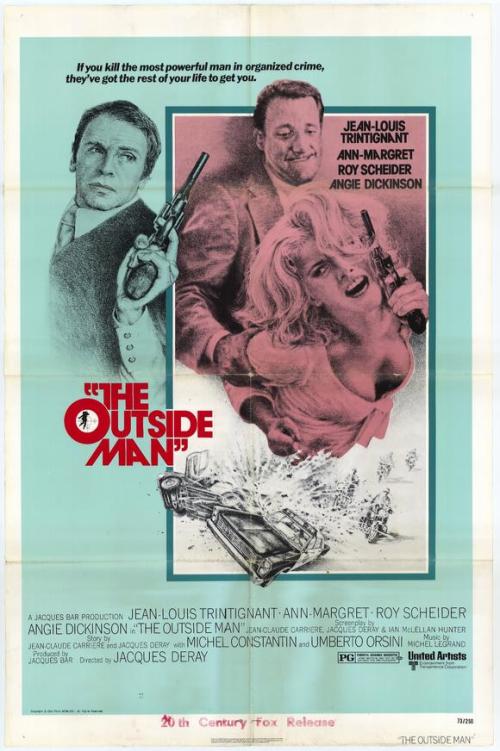
Lucien (Jean-Louise Trintignant) is a French hit man hired by an American family to assassinate a mob boss (Ted de Corsia) who’s living in Los Angeles. He’s able to pull off the job relatively easily, but then after it’s over he finds that he’s been targeted by another hit man (Roy Scheider) who is relentless and chases Lucien all over the city. Nancy (Ann-Margret) is the stripper who comes to Lucien’s aid by getting her boyfriend to create a passport for him so he can return to France, but just as he is about to board the plane he decides instead to stay in the states and turn-the-tables on the man who’s chasing him while finding who is behind the double-cross.

The film, which was done by a French production company, but filmed on-location in the states, is a lot of fun. The many offbeat touches and various stabs at dry humor keep it interesting and original while still remaining suspenseful and exciting. Some of the best moments include a hitchhiker (Edward Greenberg) who tries to convert Lucien to ‘Jesus’ as well the funeral, which eventually turns into a wild shootout amongst the various mob factions and has a corpse embalmed in a sitting position with a cigar in hand.

I also liked the way director Jacques Deray captures Los Angeles. Usually when a film is done in the City of Angels we always get shown shots of the Hollywood Walk of Fame, movie star homes, the beachfront and of course the great Hollywood sign, but here we see none of that. Instead the film captures the city’s less glamorous side including the rundown neighborhoods and even a shootout that takes place in abandoned buildings from an amusement park, which all helps to give the movie a unique vision as well as allowing the viewer to appreciate a side to the city that they may have not known even existed.

Trintignant is terrific and his perpetual look of confusion as he gets faced with one unexpected surprise after another is memorable and helps carry the film. Ann-Margret is solid as the streetwise, but kindly stripper and Scheider is quite good as the steely killer. Georgia Engel, who later became famous for playing Georgette on the ‘Mary Tyler Moore Show’ is funny as a spacy housewife who comes into contact with Lucien as he is trying to run from his killer. I especially liked the way that when a gun is pointed in her face she doesn’t scream or panic, but instead responds with silence and a deer-in-headlights look. This is also a great chance to see a young Jackie Earle Haley in his film debut as her precocious 10-year-old son.

The film’s only real downfall is its ending, which is too downbeat and ambiguous. It’s almost like they spent so much time coming up with creative concepts for the rest of it that by the time they came to the end they just plain rang out of ideas, which is a disappointment, but as a whole it’s still a gem.

My Rating: 7 out of 10

Released: January 18, 1973

Runtime: 1Hour 44Minutes

Rated PG

Director: Jacques Deray

Studio: United Artists

Available: DVD (MGM Limited Edition Collection), Amazon Instant Video

The Lady in the Car with Glasses and a Gun (1970)

lady in the car

By Richard Winters

My Rating: 5 out of 10

4-Word Review: Dead body in trunk.

Dany (Samantha Eggar) works as a secretary for Michael (Oliver Reed) who asks her to come to his place one evening to help him type an urgent report that needs to go out the next day. She agrees and then spends the night in his guest bedroom. The next morning she travels with his family to the airport where they board a plane for a vacation while she is instructed to drive their car back home, but along the way she takes a wrong turn and begins to come upon people who say they’ve seen her before even though she can’t remember them. Then she finds a dead body in the trunk and things get really bizarre.

The film, which is based on the novel by Sebastien Jasprisot and remade in 1992 and then again in 2015, has a certain appeal as the story is offbeat enough to keep you intrigued and manages to give a logical, or at least an attempted one, explanation at the end for why everything that occurs to Dany happened and the reason behind it. Unfortunately Anatole Litvak’s direction is bland despite a colorful opening montage and Reed, with his hair dyed gray, is miscast as a stuffy businessman.

One of the biggest issues though is the main character who behaves in ways that make little sense. Going to her boss’s place after work hours to write a report and even be instructed to drive his car back from the airport seems to be going well beyond the normal duties of an ordinary secretary and one that most likely would be met with resistance by anyone else and yet Dany obliges to his demands without question like she is a robot. Later a strange man (John McEnery) enters her car and makes an aggressive pass at her. Instead of leaving or running for help she instead gets into the car with him and takes him back to her hotel and goes to bed with him before she even knows what his first name is.

Spoiler Alert!

At the end we find out that Dany’s boss has set the whole thing up to make it look like Dany shot the man, whose dead body was in the trunk, in order to cover up for his wife (Stephane Audran) who was the one who really did it. Apparently she had been having affairs with many different men and shot this one when he refused to continue to see her. The husband was aware of all of these transgressions and would pay off the men to quit seeing her and when he found out that his wife had killed this one he concocts an elaborate scheme to get her off the hook, but why? Most men would not feel the need to come to the defense of an unfaithful wife especially one that continues to do it over and over again, which makes the whole storyline quite weak since it’s completely off-the-mark in terms of realistic human behavior.

End of Spoiler Alert!

My Rating: 5 out of 10

Released: October 22, 1970

Runtime: 1Hour 38Minutes

Rated R

Director: Anatole Litvak

Studio: Columbia Pictures

Available: None at this time.
And Hope to Die (1972)

and hope to die

By Richard Winters

My Rating: 7 out of 10

4-Word Review: Kidnapping a dead girl.

Tony (Jean-Louis Trintignant) is on the run from a gypsy group out for revenge and as he is being chased by them he encounters another group of criminals headed by Charley (Robert Ryan) who after some conflict take him into their fold and gives him the nickname of Froggy. Their plan is to kidnap a teen girl who is set to be the star witness at a trial of a major head of a criminal organization. Unfortunately she commits suicide before they can get to her, so they pretend that she is still alive and go through the motions of the kidnapping so as to be able to collect the payout by the organization that hired them.

This is the second of director Rene Clement’s trilogy dealing with the theme of kidnapping. The first was The Deadly Trap and the third being Scar Tissue. Of the three this one is the best mainly because of its many offbeat touches. The wry sense of humor, which is deftly interwoven into an already intricate plot, is terrific and helps make the entire thing engaging from beginning to end. My favorite parts include a contest that Froggy plays with Charley where he can stand three cigarettes on end straight into the air, which he can do with ease while Charley can’t despite his repeated efforts. The eulogy that Charley gives during a makeshift burial of one of their cohorts is priceless and the action isn’t bad either including an exciting sequence in which the group walks across a thin ladder hundreds of feet in the air that connects one skyscraper to another.

The characterizations are well done and played to the hilt. Trintignant plays another one of his outsider-looking-in roles and the way he manages to mesh himself into the group that is initially reluctant to have him is quite amusing. Aldo Ray is a scene stealer playing the gang’s resident bonehead and Tisa Farrow, who is Mia’s younger sister and looks almost like she could be her twin, is appealing in her role as a volatile young lady who knows how to use a gun and not afraid to shoot it whenever she gets the least bit riled.

The actual kidnapping, which is based on the novel ‘Black Friday’ by David Goodis, doesn’t occur until the final thirty minutes with the first hour dealing exclusively with Froggy’s assimilation into the group, which may sound boring, but really isn’t. In fact there is very little about this movie that I didn’t like and my only complaint would be the lackluster ending that doesn’t offer much of a payoff. Otherwise I feel this is a great example of how to mix humor with action, but still managing to keep things believable, fresh and inventive.

My Rating: 7 out of 10

Released: September 15, 1972

Runtime: 1Hour 39Minutes

Rated PG

Director: Rene Clement

Studio: 20th Century Fox

Available: DVD (Region 2)

One Wild Moment (1977)

one wild moment 1

By Richard Winters

My Rating: 5 out of 10

4-Word Review: Fling with friend’s daughter.

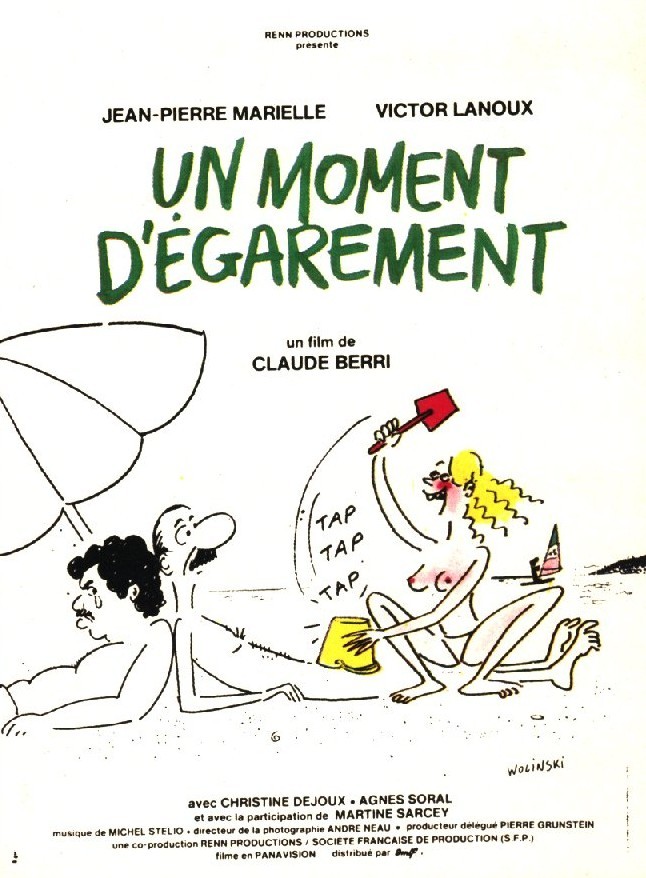
Pierre and Jacques (Jean-Pierre Marielle, Victor Lanoux) are longtime friends who decide to take a vacation together along the French Riviera and both bring along their 17-year-old daughters. One night Pierre and Victor’s daughter Francoise (Agnes Soral) attend a late night wedding party and the revelry and energy of the moment culminates with them having a tryst along the beach. Although Pierre has feelings for Francoise and vice-versa he wants to keep it from going any further for fear that it will jeopardize his friendship with Victor. Francoise though wants it to continue and the two quarrel with their mixed feelings as they ponder telling Victor about it.

Although this is not a great film it is still far superior to its American remake Blame it on Rio. For one thing it works more as a drama while the remake was played strictly for laughs. The dialogue has more of a realistic conversational quality and the characters are better rounded and more dimensional. The structure is  leisurely paced given it a day-in-the-life feel without having every scene forced to conform to contrived comedy like in the other one. The scene where the two make love has much more of a natural quality to it and less stagey. I also enjoyed more of an emphasis on subtly where the characters are not compelled to verbally describe their feelings, but instead it relies on their facial expressions, which is much more powerful.

Marielle gives a far better performance than Michael Caine did in the equivalent role who seemed awkward, stiff and uncomfortable throughout. The rift that the character has with his daughter Martine (Christine Dejoux) gets better fleshed out here while in the remake it is only briefly touched on. I also thought it was interesting that at one point Marielle’s character slaps his daughter during an argument when she comes back well after her curfew, which doesn’t get shown in the American film and I presume this is because of Hollywood’s concern that it might make the character less appealing as they always want to make their protagonists are wholly likable and politically correct, but in the process it also makes them less real.

The two daughters are much more believable and like young women ready to enter adulthood instead of a middle-aged man’s sexual fantasy like in the other one. I also found it amusing how when Francoise tells her father about her tryst he doesn’t immediately become upset about it like in the American film where sexual mores are more stringent, but only after she tells him it was with a man over 40.

Thankfully there is also no silly side-story involving one of the men’s wives having an affair with the other, which was the dumbest part about the remake and in fact there is no wife character here at all. The only real problem with this version is its abrupt ending that leaves open all sorts of loose endings and is quite unsatisfying and becomes unfortunately a major mark against it.

My Rating: 5 out of 10

Released: December 21, 1977

Runtime: 1Hour 28Minutes

Rated R

Director: Claude Berri

Studio: Quartet Films

Available: VHS

The Intruder (1977)

Capture 52

By Richard Winters

My Rating: 4 out of 10

4-Word Review: Terror on the road.

Based on a story by Dean R. Koontz and filmed in France under the title Les Passagers the plot centers on Alex (Jean-Louis Trintignant) who picks up his 11-year-old stepson Marc (Richard Constantini) from school and sets off to drive him across France and into Italy where they are to meet his mother Nicole (Mireille Darc). Along the way they become menaced by a strange man (Bernard Fresson) driving a black van that begins following them. At first Alex thinks nothing of it, but when the van tries driving them off the road they go to the police who prove to be unhelpful, which forces Alex to take things into his own hands in order to save both himself and the boy.

The film starts off well with definite hints to Steven Spielberg’s classic Duel. I enjoyed how initially everything is from Alex’s and Marc’s point-of-view where we do not know the identity of the driver in the black van, which is only seen through the perspective of their rear window that gives the vehicle a creepy presence. The banter between the boy and step father is engaging and the fact that the kid is smart and shows a keen awareness of things and not just there to be cute is great. I also liked the bawdy tune they sing together and the shot of the boy driving the car while the father leans out the passenger side window.

There is an exciting moment where the van tries pushing their car off the highway while they’re on a winding mountaintop road that is well photographed and realistic. The two are subsequently forced to ride the rest of the way in a tattered vehicle that has no windshield and looks almost as beat-up as the automobile in Planes, Trains and Automobiles.

I did not like however that fifteen minutes into the movie we are shown the face of the other driver, which takes away from the intriguing mystery angle that is what made Duel so interesting. The bad guy isn’t frightening and comes off as clumsy and careless, which makes him less threatening. The fact that he does not carry any type of weapon and must resort to grabbing a nearby fire ax in order to attack Trintignant’s character when the two confront each other didn’t make much sense.

Spoiler Alert!

The film’s biggest transgression though is that its twist ending isn’t surprising at all as the mystery man turns out to be the wife’s psycho ex-boyfriend, which is something I had guessed early on and most other viewers probably will too. It also leaves open a tremendous amount of loopholes like why Alex wouldn’t have been made aware of this boyfriend earlier as I’m sure he would’ve been stalking them long before she got remarried and why the boy wouldn’t have guessed that the stranger chasing them was this man as well as most likely he would’ve known about him too. The police investigation, which gets worked in as a sort of side story proves pointless to the plot and the fact that they end up being quite incompetent makes them seem similar to the ‘comic relief’ cops from Last House on the Left, which hurts the tension.

End of Spoiler Alert!

This film has managed to acquire a small cult following and it has good set-up, but it would’ve worked better had it been done solely from the point-of-view of the father and stepson and only revealed the face and identity of the bad guy at the very end.

My Rating: 4 out of 10

Alternate Title: Les Passagers

Released: March 9, 1977

Runtime: 1Hour 36Minutes

Not Rated

Director: Serge Leroy

Studio: Warner Brothers

Available: None at this time.