Category Archives: Foreign Films

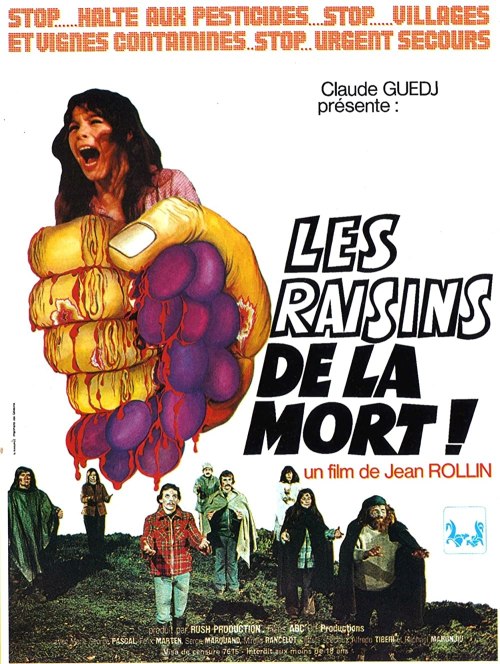
The Grapes of Death (1978)

grapes

By Richard Winters

My Rating: 7 out of 10

4-Word Review: Zombies created by pesticide.

The film opens with a shot of immigrants spraying grapes with a pesticide in a vineyard owned and run by Michel (Michel Herval). One of the men (Francois Pasal) complains of a pain on the side of his neck, but Michel insists he keep working and quit complaining. The film then cuts to two women riding inside a train car, one of them is Elisabeth (Marie-Georges Pascal) who’s the fiancee to Michel and coming to visit him. Once the train stops the man from the vineyards complaining of the pain walks onboard and proceeds to kill Brigitte (Evelyne Thomas) who was inside the train bathroom. He then takes a seat in the train car that Elisabeth is in, but once she notices the growing tumor on the side of his neck and then the dead body of her friend she runs screaming off the train. She then finds herself all alone in deserted town where everyone has the same type of tumors growing on their faces and all seem intent on trying to kill her.

This was the first mainstream horror film directed by Jean Rollin and credited as being the first gore film ever to be made in France. Rollin had made several experimental vampire flicks in the early part of the decade, but they had failed to catch-on and lost him a lot of money, which forced him into directing porn movies under the pseudonym of Michel Gentil. By the late 70’s he had made enough money with those that he was ready to jump back into doing another feature film, which for a zombie story is unique as the zombie’s here are fully conscious and well aware of what’s happening to them and kill out of a sense of rage. The film is also, for a horror movie, very quiet lacking the traditional pounding music score and instead has extended moments of near silence especially during the town scenes, which helps accentuate the creepiness.

Rollin hired an Italian production company to do the special effects, which are quite impressive. Normally I’m on here complaining how fake the effects look in most other low budget horrors, but here I was amazed with how realistic they were. The scene where a woman gets stabbed with a pitchfork while lying on a table and then continues to breath with it still in her really looks like the blades went right through her body. Another scene dealing with the decapitation of a nude woman (Mirella Rancelot) and then having one of the zombies carry the head around is one of the most graphic of its type. I did have some issues with the tumor make-up. On the train car where Elisabeth watches it grow on the side of the man’s head was cool, but on the people in the town it starts to look like smeared pizza and I wanted to see a shot of someone that had it all over their face instead just on a little part of it.

While Rollin stated that he admired the acting of his leading lady I felt she was the weakest link. Her fearful expressions and screams are great, but her performance otherwise is one-note. Part of what made Night of the Living Dead so great was the contrasting personalities of the main characters and I felt there needed to be that here. Having the two men (Felix Marten, Serge Marquand) enter near the end of the second act to help Elisabeth fight of the zombies is a great addition, but I had wished they came in sooner. I also didn’t like the way Elisabeth conveniently finds a gun inside the car she has just stolen, which she is able to use in the nick-of-time to shoot the zombies, but what are the odds? The gun should’ve been introduced earlier, perhaps as something she brought along with her at the beginning for her trip, and not just thrown-in haphazardly.

The twist at the end is not satisfying leaving the viewer feeling down and depressed when it’s over when a robust showdown was needed. I felt too that the reason for why the people were turning into zombies, which was the pesticide, should’ve been kept a mystery until the very end. Instead of opening it with the men spraying we should’ve seen the townsfolk going about their day in a normal fashion, which would’ve made a striking contrast to when Elisabeth gets there and they’re all crazy. Maybe a shot of a man spraying in the background behind the people talking could’ve been done as a little hint, or clue, but as it gets done here it’s too obvious when a subtle approach was needed.

My Rating: 7 out of 10

Released: July 5, 1978

Runtime: 1 Hour 25 Minutes

Rated R

Director: Jean Rollin

Studio: Rush Productions

Available: DVD, Blu-ray

Deadly Games (1989)

game1

By Richard Winters

My Rating: 7 out of 10

4-Word Review: Kid versus Santa Claus.

Thomas (Alain Lalanne) is a 10-year-old who’s a wiz with computers and technology. Not only has he set various booby traps throughout the large mansion that he lives in with his mother (Brigitte Fossey), but he can fix cars and even drive them. Despite being super smart he still believes in Santa Claus while his friend Pilou (Stephane Legros) tries to convince him that he isn’t real. Thomas goes on the computer in an attempt to communicate with Santa, but instead gets a vagrant (Patrick Floersheim) on the other end pretending to be the jolly red fellow. He gets Thomas to give out his address and also reveal that his mother is a rich corporate CEO. The vagrant goes to his mother’s company and gets a job as a Santa, but is soon fired by her when he slaps a child. In revenge the vagrant, still in his Santa costume, goes to Thomas’ house where he plans to kill him, but Thomas uses his technical ingenuity to set a trap.

The film is an unusual hybrid between playful children’s comedy, a holiday film, and a slasher horror, which only could’ve been made in France where filmmakers aren’t under a repressive studio system that forces all scripts to conform to a cookie-cutter formula and here allows them to deviate between genres. Many have labeled this the original Home Alone and in-fact writer/director Rene Manzor threatened to sue John Hughes, who had directed the other one, insisting that he had essentially remade his film without permission. There are though quite a few differences between the movies to the extent that I didn’t think it was an unauthorized remake at all. If anything it reminded me more of another French classic Le Joutabout a rich kid living in a big place with a wide assortment of toys. This is also the best of the killer Santa movies as You Better Watch Out and Silent Night, Deadly Night took themselves too seriously while this one has a playful edge that manages to be both amusing and tense.

The kid certainly has an engaging quality and his love for his elderly grandfather (Louis Ducreux) is quite endearing, but he’s also just a bit too smart. I was okay with him being keen on the gadgetry, but having him get underneath a car and able to not only fix it, but also drive it was going too far. I wasn’t sure that a 10-year-old could reach the pedals with his feet and still be able to see over the dashboard. Part of what makes horror movies intense is having a victim appear vulnerable, but right away with the kid being so incredibly ingenious it makes the odds stacked against the killer and thus their cat-and-mouse game not as intriguing. I also really couldn’t stand the kid’s mullet haircut.

The home is over-the-top as well. It gets referred to as a mansion, but really seems more like a castle that’s bigger than anything I’ve seen anyone else, even the billionaires and celebrities, reside in. It doesn’t even seem like a real place, but instead, in certain shots, a miniature model and at other points a painting. All the secret rooms gets a bit dizzying including the hidden one that can be entered via an old refrigerator (are they really expecting us to believe that a 10-year-old kid, no matter how smart he is, could build that?). Another moment has Thomas getting trapped inside a life sized maze, but who the hell would take the time and effort to build a maze in their very own home, which again ends up getting too creative for its own good and negates the tension instead of enhancing it.

The Santa character is a boring. Usually horror movies make an effort to give the psycho, whether it’s through flashback or dialogue, some sort-of backstory, but here this guy pops-up without any idea of who he is, where he’s from, or why he’s so crazy. There’s also a few segments where he gets caught in a trap, like when he falls through a trap door and stuck in a net, but no shot showing how he got out of the predicament. Seeing how he gets himself out should’ve been shown each time (it’s shown in a few scenarios, but not all) in order to make the plot seem more reality based and less cartoonish.

Overall, despite the over-direction, it’s still a fun, wild ride that could be enjoyed by the whole family. It does get a bit intense at times, but the quick-thinking kid always seems to be pretty much in-control. Outside of the pet dog getting stabbed none of the other killings are seen and only the feet of the dead bodies are captured on camera to represent their demise, which should make it palatable for most kids to sit through without having nightmares afterwards.

Alternate Titles: 36.15 code Pere Noel, Game Over

My Rating: 7 out of 10

Released: March 18, 1989

Runtime: 1 Hour 32 Minutes

Not Rated

Director: Rene Manzor

Studio: Deal

Available: DVD-R (dvdlady.com)
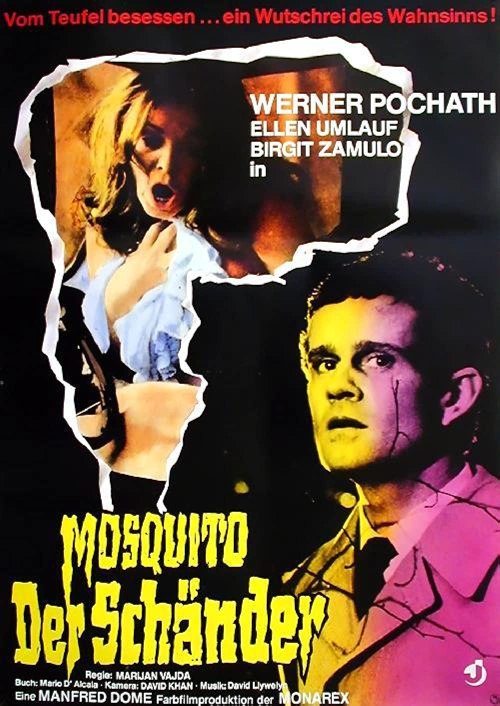
Bloodlust (1976)

bloodlust1

By Richard Winters

My Rating: 2 out of 10

4-Word Review: Deaf mute craves blood.

A deaf mute, who goes by the nickname Mosquito, (Werner Pochath) works as an accountant during the day, but at night he goes back to his lonely apartment, which is painted all black, and plays with his collection of dolls. He secretly longs for an attractive neighbor girl (Birgit Zamulo), but due to his physical limitations is unable to have a relationship with her. Living with these frustrations as well as the traumatic memories of his father beating him, which directly lead to his loss of hearing and speech, compels him to break into mortuaries at night and drink the blood from the corpses in their coffins. This creates a panic around town about a so-called vampire on-the-loose. When the neighbor girls ends up dying in a tragic accident it drives Mosquito to even darker depths as he then begins killing people and sucking their blood.

While this film has gained a small cult following it really doesn’t seem like all that much to get excited about. It was written and directed by Marijan Vajda, who’s better known as a documentary filmmaker, which is exactly what this comes-off like as the story flounders and the camera more interested in following Mosquito around and seeing what he’ll do versus propelling the plot. The characters are cardboard caricatures with Mosquito’s office co-workers behaving more like cruel adolescents and the neighbor girl seeming like she’s 4 instead of 19. Her accident, where she slips off a roof of a building, should’ve only caused an injury, since it was only 2-stories up instead of an instant death. A far better demise, which would’ve fit-in with its blood theme, would’ve had her perish in a car accident and Mosquito come to seemingly save her, but then when he arrives he instead sucks at the blood from her injuries.

The inside of Mosquito’s apartment doesn’t have enough dolls in it and to make it creepier the room should’ve been lined with shelves of dolls stretching from the ceiling to the floor. The abuse sequence gets equally underplayed as the actor playing the father is clearly softening his kicks at the victim and if anything looks like two guys playfully roughhousing. When Mosquito stabs one of the corpses in the mortuary the body deflates like a tire being slashed and not that a body made of bones. Sucking blood from dead bodies is suspect as well because if they’re put inside a coffin that usually means they’ve been embalmed and the blood drained-out.

Spoiler Alert!

I kept expecting some sort of shocking, horrifying climax to make sitting through the rest of it worth it, but nothing much happens. He does kill two people, a couple sitting in their car making-out, but they die too quickly and not enough blood to look realistic. He also retrieves the dead body of the neighbor girl out of her grave, but then proceeds to basically just kiss and fondle her a bit and that’s it. Even the arrest scene isn’t interesting as the police merely walk-in into Mosquito’s office and put the hand-cuffs on him while he sits at his desk instead of having a big, long chase that could’ve at least given it some excitement.

My Rating: 2 out of 10

Released: November 5, 1976

Runtime: 1 Hour 29 Minutes

Not Rated

Director: Marijan Vajda

Studio: Monarex

Available: DVD (Region 2), Amazon Video 

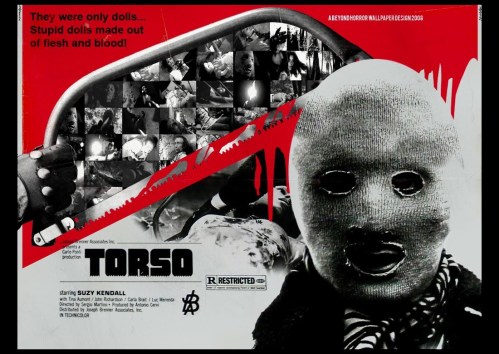
Torso (1973)

torso2

By Richard Winters

My Rating: 4 out of 10

4-Word Review: Strangler stalks college students.

Jane (Suzy Kendall) is a British student attending college in Italy where a rash of grisly murders amongst the female coeds is keeping everybody on edge. The killer’s modus operandi is a red and black scarf that he uses to strangle his victims. Jane’s friend Dani (Tina Aumont) fears that the maniac may be Stefano (Roberto Bisacco) a young man who’s been harassing her for a date and won’t seem to take ‘no’ for an answer. To get away from the terror Jane and her girlfriends decide to go to a villa in the countryside, but find that the killer strikes again, in their home, and with Jane hobbled with a sprained ankle, she’s unable to get away and must use her creative wits to escape.

Horror director Eli Roth has hailed this as being his favorite giallo and a major influence to his Hostel movies, but in retrospect it doesn’t have all that much to distinguish it. Despite its lurid title the emphasis is more on the mystery featuring a cast of lonely men who seem to lack quality social skills to go out with women and instead long for them from afar while also harboring dark violent sexual fantasies of what they’d like to do to them if they could, making this more than anything a forerunner to what’s become known as incels (involuntary celibate) today.

Director Sergio Martino captures Perugia, Italy and its many old and scary looking buildings nicely. The build-up to the murders where the victims find themselves alone in a dark,desolate area of the city, or in one instance an isolated forest, are some of the film’s best moments and could’ve been played-up more.

The deaths themselves though are uninteresting. The average time for a person to die from strangulation is 3 minutes and up to 7 to 14 seconds before they’ll pass-out, but the victim here falls over dead after the flimsy scarf is put around her neck for only 3-seconds, which all looks quite fake. The female victims never, ever fight back and just stand, or lie still and scream loudly, but do nothing else. Police will usually look for scratches on suspects as a sign that the victim fought for their life and there will be defensive wounds on the victim’s arms and hands too, so for the victims here not to attempt any physical defense looks rather pathetic. Some may say that back in this era it was considered more ‘tasteful’ to have the killing get over with quickly and watching someone try to fight-off the attacker would be prolonging it too much, but I wondered if this was also an attempt to feed-in to the male fantasy where once a man decides to make his move the females are virtually ‘helpless’ and must just passively accept their fate.

The special effects are threadbare as well. The close-ups of the knife cutting into the victim’s body has a lighter tone of skin color than the full-shots of the victim making it quite obvious that the close-ups are that of a mannequin. The scene where a car’s bumper crushes a man’s skull against a wall looks realistic enough, but then a few seconds later it cuts back to a shot of the victim and his skull is perfectly intact with only some blood running out of his nose even though the previous shot made it look like his head had been busted in half.

Spoiler Alert!

The third act in which Suzy Kendall sleeps through the murders of her friends downstairs and then awakens to find herself alone in the house with the killer still present is the only time it actually gets intense. Having her quietly observe him cutting-up her friend’s limbs is genuinely horrifying and watching her try to come-up with creative ways to escape is intriguing, but then having a male doctor swoop-in and fight-off the killer for her was disappointing as this was her story and she needed to be the one to find a way to take down the killer herself.

My Rating: 4 out of 10

Released: January 4, 1973

Runtime: 1 Hour 32 Minutes

Rated R

Director: Sergio Martino

Studio: Interfilm

Available: DVD, Fandor, Tubi

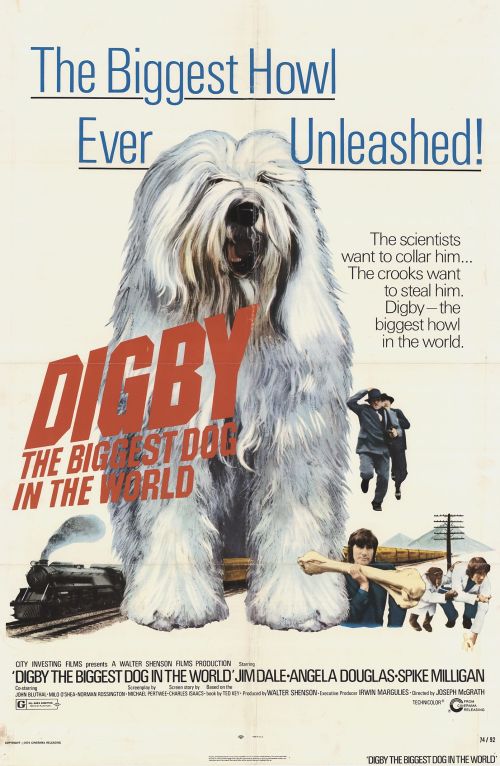
Digby: The Biggest Dog in the World (1973)

digby2

By Richard Winters

My Rating: 2 out of 10

4-Word Review: Dog grows really big.

Billy (Richard Beaumont) is a young boy who buys an Old English Sheepdog from a local dog home manager ( Victor Maddern). However, when he brings the dog home his grandfather (Edward Underdown) doesn’t want it in the house, so his mother (Angela Douglas) tells him to give the pet to someone else. He then leaves him at the home of Jeff (Jim Dale), a researcher who works at a defense lab that is experimenting in growth formulas. Jeff is smitten with Billy’s mother, but too shy to ask her out. He ultimately agrees to take the dog as an excuse to be around the mother more. Things though turn chaotic when Jeff decides to borrow some of the growth formula at his lab, in order to feed it to his tomato plants, but instead it gets accidentally given to the dog, who then grows to gigantic proportions.

This is the type of movie that’s clearly meant for kids, but kids today, with the advanced computerized special effects seen in modern films, will quickly be turned-off by the cheesy effects here. The attempt to make the dog seem bigger by placing him in a miniaturized kitchen doesn’t exactly work. Other segments where he’s seen outdoors and at a circus don’t work either because it’s obvious that the animal was simply put in front of a green screen. The segment that has Jeff sneaking the dog outside while having him wear an outfit meant for a horse is stupid too because a horse’s head is shaped differently than a dog’s, so there would be no way it would fit over the dog like it does.

The only inspired effect is when Billy crawls into the dog’s giant mouth in order to feed it a formula that will supposedly get the animal to shrink back to normal size. The recreation of the dog’s mouth to a large size is impressive though a dog’s tongue is thinner and longer than a person’s and yet the tongue in this mouth is styled much more like a human’s. Having the kid command the dog not to swallow, as if he did it would’ve sucked the boy down the throat, is dumb because swallowing is a natural reflex when liquid is poured in, so I’m not sure it could’ve been prevented, or that the dog would’ve understood what the command ‘don’t swallow’ would’ve even meant.

The story is based on the novel by Ted Key, who besides creating the comic strip ‘Hazel’ also wrote the screenplays for Gusabout a mule who kicks field goals, The Million Dollar Duckabout a duck who lays golden eggs, and The Cat from Outer SpaceThose movies fared a bit better as they were more imaginative and had better character development. Outside of a circus scene, which features an elderly and near-sighted knife thrower played by Bob Todd, there is nothing that is funny, or even slightly amusing.

A good story should have a protagonist that the audience can root for and and a clear antagonist that the audience hates, or at least fears. This film though doesn’t have that.  Jim Dale is a likable enough, but a scientist nerd who’s awkward around women is a tired stereotype that isn’t interesting. The kid had more appeal and could’ve easily been the hero without the Jeff character even being present. The supporting cast is essentially the same person; deluded, wacky folks who are lost in their own little worlds and clueless about what is really going-on. It’s okay to have one dumb character, but when everybody is goofy it gets tiring fast. There’s no bad guy either just a bunch of buffoons running around saying buffonish things and getting into cartoonish predicaments. If that’s your idea of entertainment then have-at-it, but most will find this to be a dated and silly though those that remember watching as a kid may for nostalgic purposes like it a bit more.

My Rating: 2 out of 10

Released: December 6, 1973

Runtime: 1 Hour 25 Minutes

Rated G

Director: Joseph McGrath

Studio: 20th Century Fox

Available: DVD (Region 2)

Sunday Lovers (1980)

sunday1

By Richard Winters

My Rating: 4 out of 10

4-Word Review: Stories about illicit sex.

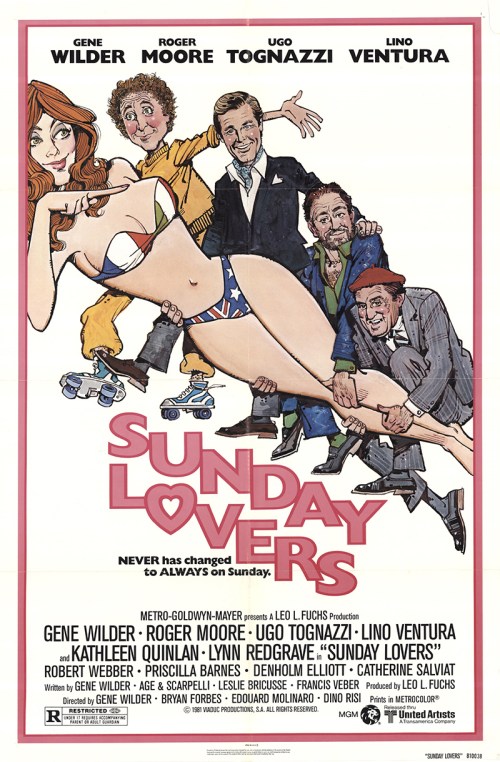
International production has 4 stories taking place in a different country with a famous male movie star and director native to that region. The stories central theme revolves around love-making, or attempts thereof, and all outside of marriage. The concept sounds like it should’ve been a creative experiment especially with all the big-name talent, but the results are flat and forgettable.

The first story, ‘An Englishman’s Home’, stars Roger Moore as Harry Lindon, a rich man who owns a villa that Winston Churchill once resided in. He meets by chance a beautiful young blonde named Donna (Priscilla Barnes), who’s an airline stewardess in London on layover and who becomes impressed with Harry’s home and goes with him to visit it. It’s there that Harry plots with his loyal butler (Denholm Elliot) to get her to go to bed with him, but his plans are disrupted when his lady friend Lavina (Lynn Redgrave) comes for a unexpected visit. He and his butler spend the evening trying to avoid having the two meet by creating a scheme where Harry will be ‘forced’ to leave the dinner table with one to answer a phantom phone call, which allows him to then visit the other one before being informed by his butler of yet another ‘phone call’.

Moore is funny with his glib and sarcastic delivery and Barnes is amusing playing-up the ditzy blonde persona. The plot though is neither original, or entertaining and becomes boring quite quickly. The ending has a novel twist, but this is where I felt the story should’ve begun, which would’ve been more interesting.

The second segment, ‘The French Method’ was written by the prolific Francis Veber and deals with Francois (Lino Ventura), a French businessman, trying to close a deal with an American businessman named Henry (Robert Webber) The problem is that Henry is a middle-aged lech who’s got the hots for Francois’ attractive receptionist Christine (Catherine Salviet). Henry insists that before any deal is made he must have dinner with both Francois and Catherine. Francois is reluctant to ask Catherine to come along, but he’s so desperate for the deal to go through he becomes willing to do almost anything. Christine agrees despite disliking Henry. Once the dinner engagement commences Henry makes clear that he wants Francois to come-up with a polite excuse to leave, so the two can be alone together. Francois does as he’s asked, but then returns to have a confrontation with Henry, which leads to unexpected results.

This segment is expertly played by the three leads particularly Ventura and the characters are fleshed-out enough to keep it intriguing. The final twist is fun making this easily the best of the four.

The third segment, ‘Skippy’, was written and directed by Gene Wilder who also stars in the lead. It’s about a suicidal patient who’s allowed a weekend pass out of a mental hospital. He then meets-up with a younger woman (Kathleen Quinlan) at a disco. They hit-it-off especially after finding that each of them are ‘nutcases’. They go back to her place and share a passionate night of lovemaking only for him to have his heart broken the next day when she confides in him a surprising revelation.

This story is helped greatly by Quinlan who is young and beautiful and you even get to see her topless though you also have to put up with Gene’s bare bum too. Either way she gives a sprightly performance, but the story is odd and takes too long to play out. I was expecting it to go in a different direction than it does and the ending offers no pay-off.

The final segment, ‘Armando’s Notebook’, stars Ugo Tognazzi as a married man whose wife goes off on a trip to visit her sick mother. Armando uses this as an excuse to hook-up with old girlfriends from the 60’s by using his little black book that still lists their addresses and phone numbers. Unfortunately when he meets them he finds that things have changed quite a bit and not for the better. Many have aged to the point that they’re no longer attractive, or have become ‘liberated’ through feminism and won’t allow him to take advantage of them like they used to. One turns-up dead while yet another has become a high class prostitute who even accepts credit cards.

While this story is watchable it’s also too jokey and features a weird bit where one of the women, played by Sylva Koscina, has acquired the ability to suck in a massive amount of air and then blows it out with hurricane force, which has a strange supernatural vibe that doesn’t fit with the rest of the material.

My Rating: 4 out of 10

Released: October 31, 1980

Runtime: 2 Hours 5 Minutes

Rated R

Directors: Bryan Forbes, Edouard Molinaro, Dino Risi, Gene Wilder

Studio: Viaduk Productions

Avaliable: None

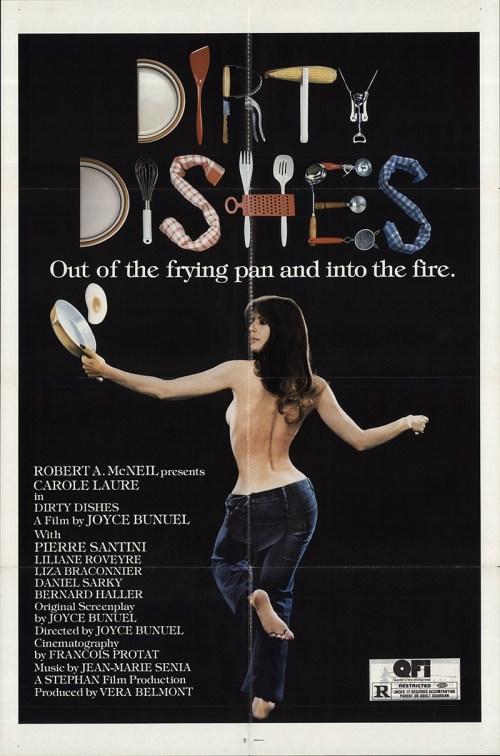
Dirty Dishes (1978)

dirty1

By Richard Winters

My Rating: 5 out of 10

4-Word Review: Housewife has nervous breakdown.

Armelle (Carole Laure) is a full-time housewife taking care of 2 young boys while her husband Marc (Pierre Santini) works a job designing car tires. Armelle is bored with the mundane chores that she must do day after day and looks forward to Thursday evenings, which is the one night that her and husband can go out, but since Marc’s job has become very demanding he can no longer do that, which makes her feel even more shut-in. She occasionally goes out with her two friends (Liliane Rovere, Liza Braconnier), but they’re trapped in the same thankless domestic routine as she is. One day she snaps and has a sexual tryst on her cluttered kitchen floor with an architect (Daniel Sarky) who works across the street, but this doesn’t subside her feelings of rebellion, so she steals a car, which almost gets her in an accident. Eventually her husband realizes her frustrations and promises that things will be different, but will this really bring the change that she wants?

Written and directed by the daughter-in-law of the legendary filmmaker Luis Bunuel, the film is a mixture of Diary of a Mad Housewife that came out 8 years earlier and Women on the Verge of a Nervous Breakdown, which was released 10 years after this one. There’s even a bit of Jeanne Dielman mixed in for good measure. The one thing that this film does do well is focusing on the mundane tasks that she does each day, which gives the viewer a clear impression of her trapped feeling. Unfortunately it doesn’t go deeper than that and ends up just being another feminist comedy that fails to have anything unique to say from the other films from that era with the same theme.

There are a some amusing lines uttered here and there, but the laughs are sporadic and there should’ve been tighter editing, which would’ve given it a frenetic pace and made the absurd moments seem less out-of-place. There’s also a few really weird tangents that come out of nowhere including a psychotic man that invades the families picnic at a park and tries running them down with his car that has no connection to the main story and wasn’t needed as was the segment at a grocery store where Arnelle breaks up a fist-fight between two men only to find that she’s been a victim of a candid camera-like prank.

There are a couple of good poignant moments particularly the scene where the couple is lying in bed and Armelle states to her husband that she feels scared and he replies: “Why, are you afraid something is going to happen to you?” and she responds: “No, I’m afraid nothing will happen and everything will remain the same.”, which hits home the characters quandary perfectly.

Laure’s is radiant and soaking in her beauty helps smooth over the slow spots. The scene where she gets rejected as a model of a dish detergent ad because she’s ‘too beautiful and no one would ever believe she does her own dishes’ is quite funny as that’s all we’ve seen her do since the film began.

The ending however offers no conclusion or answers. The character remains stuck in the same situation that she was at the start with only vague promises from the spouse that things ‘would be different’, but in cases like these that usually means things will eventually just go back to the way things were. The viewer needs to see the change for themselves, or how the character learns to adapt to the problem by finding ways to make the monotony seem more interesting, but the film shows none of this making it feel ultimately like a waste of time as both a satire and character study.

My Rating: 5 out of 10

Released: April 19, 1978

Runtime: 1 Hour 35 Minutes

Rated R

Director: Joyce Bunuel

Studio: Planfilm

Available: VHS

Crossover (1980)

patman1

By Richard Winters

My Rating: 3 out of 10

4-Word Review: He’s slipping into insanity.

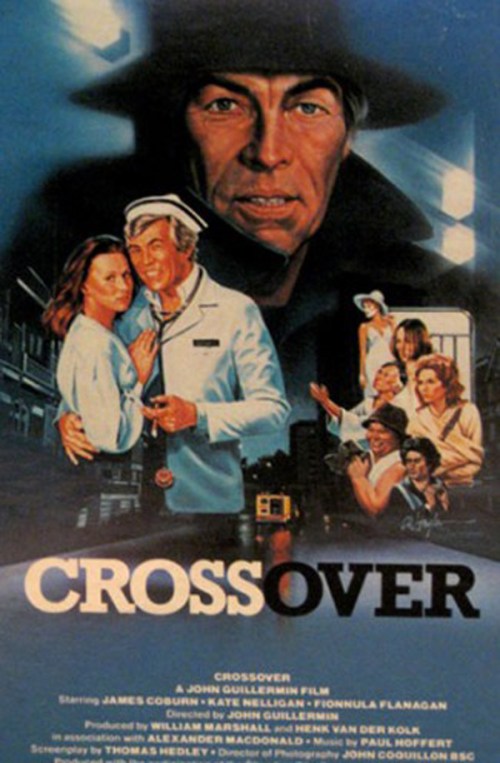
Mr. Patman (James Coburn) works as a nurse at a psychiatric ward in Canada. While he enjoys his work and the patients respond well to his methods he’s put-off by some of the other doctors and administrators who he feels don’t really care about the people they’re supposedly trying to help. He’s also carrying on an affair with two women. One is Nurse Peobody (Kate Nelligan) who works at the same hospital he does and the other is Abadaba (Fionnula Flanagan) the wife of his landlord. While trying to juggle these two women and dealing with the pressures of his job he begins seeing strange visions and fears the he may be losing his mind.

This is quite similar to Beyond Reasonwhich starred Telly Savalas. This one though fared a bit better at least for the first 20 minutes. I liked the way the hospital and the patients are portrayed where their impulsive and unpredictable behavior gives it a certain creepy vibe and the staff needs to be high alert at all times, or face the consequences, which for me brought out the realistic stresses of doing a job like that. The bleak, gray, and rainy setting of Vancouver, shot there to take advantage of the Canadian tax concessions that were given to film production companies at the time, helps accentuate the grim elements.

The film though fails to take advantage of what could’ve been an intriguing plot. Not enough weird visions are seen and the few that are, are underwhelming. It should’ve been approached as a thriller and filled with all sorts of nightmarish and surreal imagery that could’ve helped build the tension, but instead it gets treated as a drama with long talky segments between Coburn and his two girlfriends that bogs the whole thing down until you don’t care what happens. John Guillermin, the director, had helmed many successful features before this one including: King Kong, Death on the Nile, and The Towering Inferno, but shows no panache here and seems to be giving the material only a half-hearted effort. It might’ve done better had John Huston, who was the original choice to direct, had been hired instead.

Coburn, who stated that he did the movie due to an interest in the character who decides he finds the crazy world inside the hospital more comforting than the outside one, but later admitted that had he read the script after its numerous rewrites instead of accepting the offer upfront, he most likely would’ve rejected it, is excellent and the only good thing about the movie. Nelligan, who described the film as being a ‘nightmare’ while working on it as well as calling it an embarrassment, is not as interesting and the entire supporting cast is blah though the young woman patient named Miss Montgomery, played by Tabitha Harrington, who enjoys walking around nude at least offers some diversion.

The script was written by Thomas Headly Jr. in 1971 who later went on to write Flashdancewhich storywise is quite different from this. There’s also a twist ending, though I figured it out long before it gets there and others most likely will too. I feel this was the type of concept where it started with the ending and then gotten written from there, but more side elements were needed instead of just relying on the twist to make it interesting, which for a 30-minute episode of ‘Twilight Zone’ might’ve worked, but as a feature film it gets stretched too thin.

Alternate Title: Mr. Patman

My Rating: 3 out of 10

Released: September 5, 1980

Runtime: 1 Hour 37 Minutes

Rated R

Director: John Guillermin

Studio: Film Consortium of Canada

Available: DVD-R (j4hi.com)

Sonny and Jed (1972)

sonny1

By Richard Winters

My Rating: 5 out of 10

4-Word Review: Couple steal from rich.

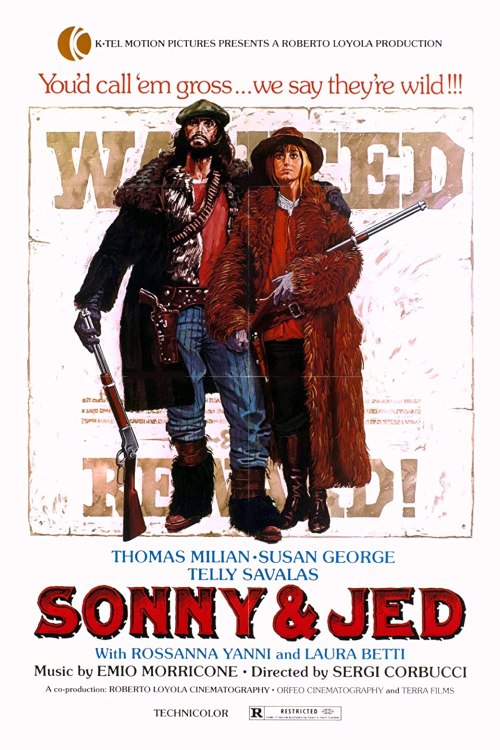
Jed (Thomas Milian) is an outlaw bank robber who sees himself as a modern day Robin Hood. Franciscus (Telly Savalas) is the sheriff determined to bring him in. When Francisus gets hot on Jed’s trail Jed uses the aid of beautiful young Sonny (Susan George) to evade capture. Sonny immediately becomes smitten with Jed despite the fact that he’s a very vocal misogynist. Sonny though ignores this as she’s so deeply wants to be in a loving relationship that she puts up with the abuse and even asks him to marry her, which he does, but his abuse continues. Jed then sets his sights on Linda (Rosanna Yanni) the wife of rich land baron Don Garcia (Eduardo Fajardo). Jed likes the fact that she has big breasts, which Sonny doesn’t, but when he puts the moves on her Sonny fights back by turning the tables on him and treating him in the same way that he did her.

After watching only a few minutes it’s easy to see why the spaghetti westerns went out of style as this lacks the lyrical quality of a Sergio Leone film, which put this unique genre on the map. Leone had that special knack that could mesh violence with subtle humor and make every scene, even one as insignificant as seeing flies fly around a person’t face, interesting. Sergio Corbucci, who directed this one, lacks that same ability and while he helmed some westerns in the 60’s this one doesn’t have a good balance. The action is bereft of any excitement while the humor is heavy-handed. The musical score by the always reliable Ennio Morricone is excellent, but everything else falls flat.

The storyline is the most annoying as Jed is too unlikable for anyone to want to fall in love with. His caustic comments on women are quite outlandish by today’s standards, which may offend some though others may get a kick out of it simply for the outrageousness. I have no doubt men back then may have been very much like his character, so on that end you could say it’s realistic, but having Sonny grow attached to him was off-putting. If he had reformed and then gotten married it might’ve made more sense, but to have the marriage occur in the middle when he’s still treating her like crap including one scene where he rapes her, just doesn’t work. His character does change a little at the very end, but it’s not enough to justify all she goes through and there’s no resolution as it shows them continuing to bicker without answering whether they were ever able to work things out, or ultimately broke-up.

Having Sonny so desperate to be loved, even at one point spying on another couple who are kissing and feeling envious, isn’t a sufficient enough reason for her to put up with the awful way he treats her. If she had been homely then maybe, but she’s actually quite attractive and could easily hold-out for something better making the way she throws herself at him too precipitous. Her character also needed more of an arc. The film teases this concept, but ultimately pulls-back when it should’ve pushed forward.

Milian’s performance is an acquired taste. Besides being vulgar and crude he also at one point scarfs up his spaghetti in such a slobbering manner that it’s genuinely disgusting and in another scene he gets under a cow and puts his lips directly over its teat and sucks the milk right out. Savalas, who is usually quite good in villainous roles, is only okay here. He’s supposed to be a relentless pursuer, but then allows Jed to escape while on a water raft instead of shooting him making him seem less threatening than he should.

Overall, this was George’s vehicle as she’s thoroughly engaging even able to mask her accent, which not all British performers can do, and at her most beautiful. I can only presume it was because of Milian’s star power that his character wasn’t downplayed because the movie would’ve worked better had it been solely centered around her and it’s just a shame she wasn’t given the keys.

My Rating: 5 out of 10

Released: August 11, 1972

Runtime: 1 Hour 32 Minutes

Rated R

Director: Sergio Corbucci

Studio: Titanus

Available: DVD-R

The Brutes (1970)

brutes1

By Richard Winters

My Rating: 6 out of 10

4-Word Review: Two men accost woman.

Werner (Klaus Lowitsch) and Michael (Arthur Brauss) are two friends from work who enjoy spending their weekends ‘cruising-for-chicks’. Their modus operandi is picking up prostitutes, or women at bars, and bringing them to one of their apartments where they either ‘share’ the woman, or partake in a threesome. One weekend they go go-cart racing and set their sights on attractive, young Alice (Helga Anders). They invite her into their car telling her that they want to take her for a swim at an isolated gravel pit. Once there Werner sexually assaults her. The next morning she threatens to go to the police, but the men talk her out of it only for the two to become adversaries when Michael wants to have sex with Alice, which Werner won’t allow.

While Savage Weekend is considered the very first slasher movie this film, which was shot in 1968, could be deemed the first rape/revenge movie. Like with that other film it was produced long before the ‘rules’ of the genre were established, so it takes many unique forays some of which are interesting and other ones aren’t.

It was the third of three films that actor-turned-director Roger Fritz directed with his wife Anders as the star. Anders was a model before she got int acting and he used her pretty looks for stories where her characters would engage in provocative lifestyles like group sex, or incest. This was the last in a trilogy meant to show the dark side of sexually liberated activities, but it doesn’t start to get interesting until they arrive at the gravel pit, which is more than 30-minutes in.

The two men are one dimensional and a turn-off. From the very first frame to the last they’re leering predators-at-large even in the presence of Michael’s mother. Had there been one random moment where they showed some surprising sensitivity towards something, or didn’t act in a predictable stalker way it might’ve had potential, but watching creeps behaving like non-stop creeps becomes boring and redundant.

The scenes at the gravel pit fare better simply because it’s atmospheric and the location becomes like a third character. There’s a few tense moments and the rape scene is surprisingly more graphic than I expected. The physical fight between the two is well choreographed and genuinely bloody though Michael gets hit on the head so much I thought he would’ve suffered serious head trauma and never able to get back-up like he does.

The three characters shift from being the victim at one point and the aggressor the next, which is intriguing. Michael’s long speech detailing the potentially degrading process that a female rape victim goes through when she decides to file a police report is on-target and ground-breaking since these same issues weren’t brought to the forefront until 1972 with the TV-Movies Cry Rape starring Andrea Marcovicci and two years later in A Case of Rape with Elizabeth Montgomery.

Spoiler Alert!

Ultimately though the ending stinks. The mod quality is cool especially its alternative soundtrack, but the scenario writes itself into a hole that it can’t get out of. Having the three go back to their normal lives and acting like what occurred was just a dark diversion, or even a lark with no long term ramifications doesn’t click. We needed to see how this experience changed them, which isn’t addressed and thus makes the whole concept placid and forgettable.

brutes2

brutes4

Alternative Title: Cry Rape

My Rating: 6 out of 10

Released: February 19, 1970

Runtime: 1 Hour 38 Minutes

Rated R

Director: Roger Fritz

Studio: Roger Fritz Film Productions

Available: DVD-R (German with English Subtitles) (j4hi.com)