Category Archives: Foreign Films

Dominique (1979)

By Richard Winters

My Rating: 5 out of 10

4-Word Review: Dead wife haunts husband.

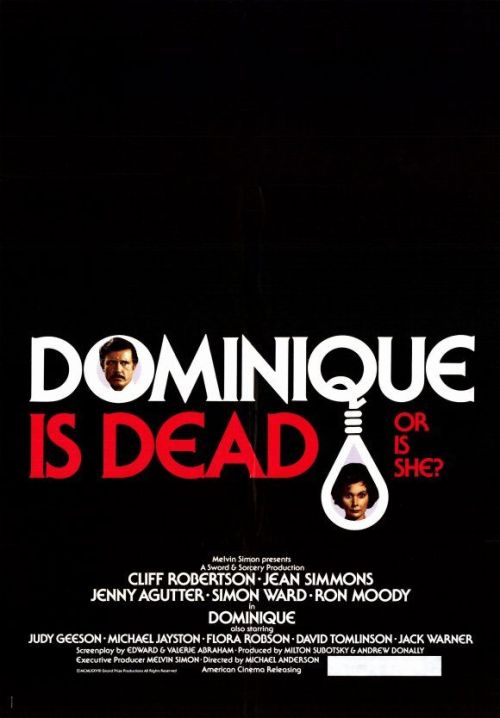
Dominque (Jean Simmons) is a woman suffering from a fragile mental state who is convinced that her husband David (Cliff Robertson) is trying to drive her insane. She eventually hangs herself and then her ghostly presence comes back to haunt him, which ends up driving him over the edge Dominique (Jean Simmons) is a woman with a fragile mental state who is convinced that her husband as well.

The film was directed by the talented Michael Anderson, but you’d hardly know it as the DVD transfer by Synergy, which is already known to produce some very low grade quality stuff and looks like somebody’s badly lighted, grainy home movie. Unfortunately this is the same transfer that gets streamed onto Amazon, so if you want to see this otherwise rare movie you’ll have to buckle-up and accept the substandard look.

As for the story, which is based on the novel ‘What Beckoning Ghost’ by Harold Lawlor, it’s not all that much better as the plot and characters come off as stiff and one-dimensional. There’s no backstory either, which I felt was needed to help explain why Robertson is an American living in England and what specific job does he do that allows him to be able to afford such a big mansion? There’s also passing mention of Dominique being in an earlier accident that might’ve helped explain her mental state, but it’s never talked about in detail, or better yet shown in flashback.

Initially it’s a mystery as to whether Robertson is trying to drive Simmons mad or if it is all just in her head. Finally towards the end he admits to it and supposedly it’s all just so he can get his hands onto her money, but wouldn’t it have been much easier to hire someone to kill her and make it look like an accident then trying to drive someone insane, which has no guarantee of working and could take years and years to accomplish? Also, if Dominique is already aware of what he is trying to do then why doesn’t she just leave him instead of turning to suicide?

The ghostly special effects consist of shots showing a piano playing by itself as well as a shadowy figure walking from a distance, which isn’t much and gets repeated at several different points, which becomes quite redundant. Both stars are wasted as well. Simmons is good, but she’s only in it at the start while Robertson much spends the entire second-half saying very little and instead relying on his almost constant shocked/scared expressions to help propel the plot along.

Despite all this it still manages to be moderately compelling and may appease those who are in to ghostly tales. The twist at the end is a definite surprise, but it also leaves open a lot of logic loopholes that makes the entire thing seem quite implausible.

My Rating: 5 out of 10

Released: March 5, 1979

Runtime: 1Hour 35Minutes

Rated PG

Director: Michael Anderson

Studio: Astral Films

Available: DVD-R, Amazon Video
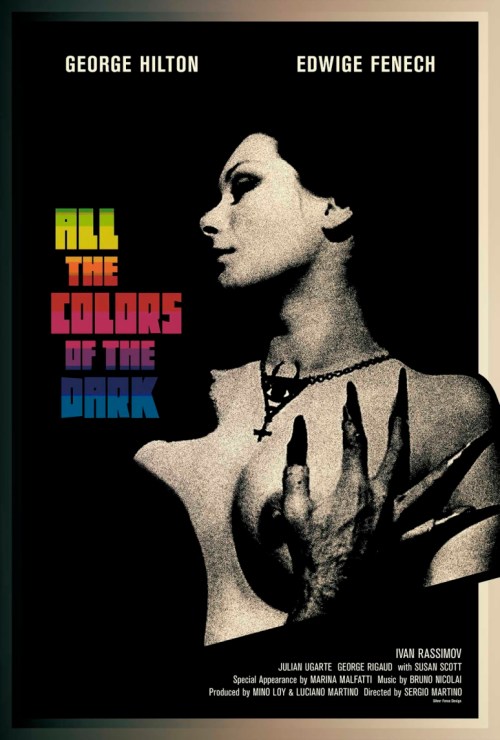
All the Colors of the Dark (1972)

By Richard Winters

My Rating: 6 out of 10

4-Word Review: Haunted by her nightmares.

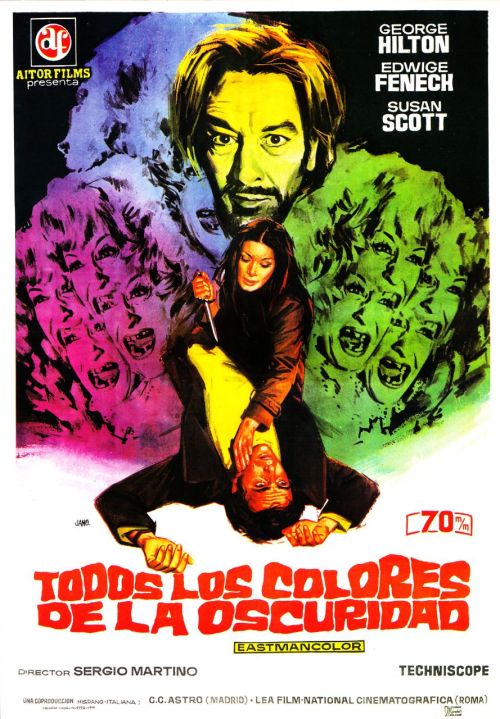
Jane (Edwige Fenech) is plagued by nightmares dealing with a blue-eyed man (Ivan Rassimov) chasing after her. She feels that the memories of the recent death of her child as well as the loss of her mother when she was younger may have something to do with it. Her sister Barbara (Susan Scott) has her see a psychiatrist (George Riguad) while her friend Mary (Marina Malfatti) suggests she attend a black mass, but neither helps and just makes things worse until she can no longer differentiate between her dreams and reality.

The film is a strong tie-in to Rosemary’s Baby and in many ways seems to be playing out the same essential plot, but doing it in a more vivid, graphic way. Instead of implying the horror like that one did this one goes straight to the stuff that was never shown or just briefly touched-on. For the most part I liked this approach as I always felt the Roman Polanski classic was too restrained and talky and could’ve gone farther cinematically with its intriguing premise than it did.

The visuals here are almost in-your-face particularly the surreal opening bit, which is the best moment in the movie. Director Sergio Martino keeps the viewer off-balance by constantly going back and forth between the present day and then to Jane’s nightmares until it becomes increasingly harder to tell the difference between them, which makes the viewer feel locked into Jane’s frightening dilemma right along with her.

Unfortunately rhe plot itself isn’t as creative and there were many times when I foresaw the twists long before they happened and could even predict when they’d come. The protagonist walks into too many traps that anyone else could’ve guessed was coming making her seem a bit dense while the cult-like mass segment had too many clichés making it campy while eroding from the rest of the film’s provocative style.

Fenech doesn’t look like the average housewife either, but more a magazine model and in fact all the women here have too much of that same appearance, which takes away from the authentic feel. Part of the reason why Rosemary’s Baby worked was because Mia Farrow came-off as fragile and vulnerable while Fenech has a detached look in her eyes that doesn’t allow her to emotionally connect with the viewer even though as the film progressed I softened on her more.

The on-going twisting of the dreams and reality eventually overstays their welcome becoming more annoying than intriguing particularly near the finish where too many false endings get played-out. Even though it never matches its first 10 minutes and isn’t as erotic as the film’s promotional poster suggests I was still glued to what was happening and it’s one of the more memorable Italian giallos of all-time.

My Rating: 6 out of 10

Released: February 28, 1972

Runtime: 1Hour 35Minutes

Rated R

Director: Sergio Martino

Studio: Interfilm

Available: DVD

Deadline (1984)

By Richard Winters

My Rating: 6 out of 10

4-Word Review: Screenwriter alienates his family.

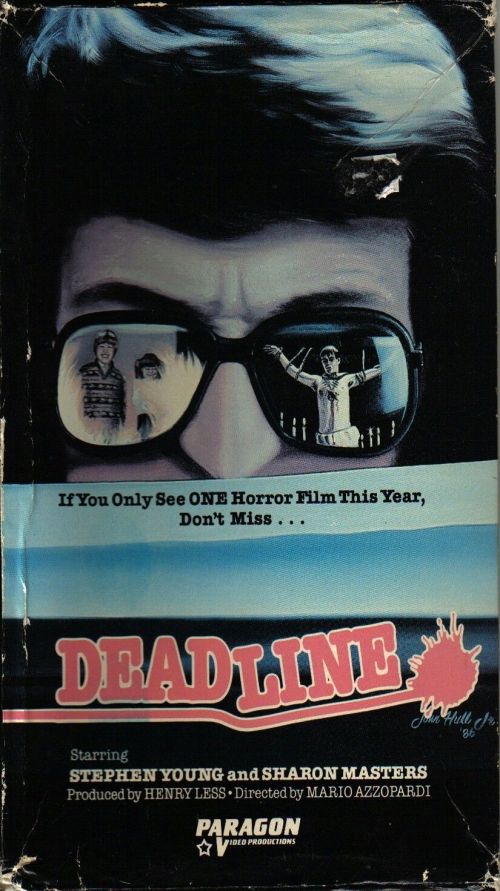
Steven (Stephen Young) is a successful screenwriter of horror movies who’s becoming tired of churning out the same old formulaic schlock. He wants his next screenplay to transcend the genre by delving more deeply into the psychological realm, or as he puts it ‘the ultimate horror’, but his producer Burt (Marvin Goldhar) is more interested in what sells and doesn’t want Steven to deviate from what has already proven to be popular. Steven then takes his frustrations out on his family by ignoring their needs and becoming more indulgent to his own, which eventually leads to tragedy.

I applaud any movie that wants to tweak the horror formula and on that level this movie succeeds and is genuinely fascinating. Too many horror films act like there has to be a madman with an ax, or some ghost or vampire to make it frightening when really some of the darker aspects of life run far deeper and although this one isn’t a complete success it still ends up making a few keen observations along the way.

What I didn’t like is the way it overstates the importance of a screenwriter, which just doesn’t ring completely true. I admit a good script is always a vital element, but the movie world is still a director’s/producer’s medium and if the scriptwriter gets a smug attitude like he does here then he’d be quickly dropped as there are no shortage of other writers around. With the exception of Charlie Kaufman most films do not hinge on the marketability of the screenwriter’s name to sell it, a big name director or star sure, but never the writer, so the fact that the movie here plays like the main character’s presence is instrumental to getting the movie made seemed to me quite dubious and only when it’s examining Steven’s frustrations with the business and his feelings that his talents are being stifled does it then become on-target.

However, the more it goes on the less like a horror film it seems. One could almost categorize this as simply being a drama looking at the personal pressures of the movie world, the challenges of being a working screenwriter and trying to attain the work/life balance, which in that area it’s insightful.  The theme though is too existential and ultimately plays like an experimental film that lacks any scares.

Spoiler Alert!

That’s not to say there aren’t some good moments that the average horror fan could still enjoy. The scene where a woman drowns inside a tub of blood is good as is the twisted sequence where a grandmother gets set on fire by her own grandkids. The segment dealing with a group of old nuns who tie a man up, cut out his heart and then pass it around while taking turns biting into it is memorable too, but the climactic finish where all the writer’s dark creations come to life to attack him gets disappointingly  underplayed, which ultimately hurts the film.

My Rating: 6 out of 10

Released: February 12, 1984 (Filmed in 1979)

Runtime: 1Hour 30Minutes

Rated R

Director: Mario Azzopardi

Studio: Pan-Canadian Film Distributors

Available: VHS

Prom Night (1980)

By Richard Winters

My Rating: 2 out of 10

4-Word Review: Accidental death spawns revenge.

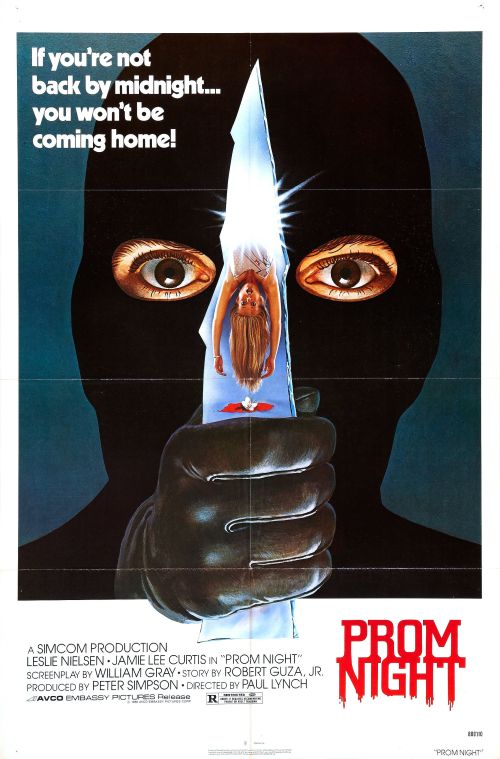
In 1974 five children go playing inside an abandoned building, but when one of them falls tragically to her death the other kids agree not to tell in order to avoid getting into trouble. Six years later these same four children are now teenagers and ready to attend the prom, but become terrified by strange phone calls from someone insisting he saw what happened and threatening to kill them to avenge the accidental death of the other one.

As modern day horror movies go this one starts out well especially the abandoned building footage with the rundown interiors helping to give the film a creepy look. The lighting and camerawork are more polished than the typical slasher production and it doesn’t reek of low budget, amateurish values that pervaded just about every other horror flick from that era.

Unfortunately after a decent beginning the pacing then slows to a crawl and except for a few creepy phone calls hardly anything goes on for the whole first hour. At one point it becomes like a sequel to Saturday Night Fever with a prolonged dance segment between Jamie Lee Curtis and her partner that does not propel either the plot or tension and was out-of-place.

The side-story dealing with the police searching for an escaped killer who they mistakenly believe killed the child is pointless and apparently added in at the last minute. I would think a coroner’s autopsy would’ve shown that the child died from the trauma of the fall and not by someone’s knife, which makes the crazy-killer-on-the-loose angle ridiculous and an obvious red-herring put in to ‘fool’ the viewer, which most seasoned horror movie fans would never be dumb enough to fall for anyways, so why insult their intelligence by even trying?

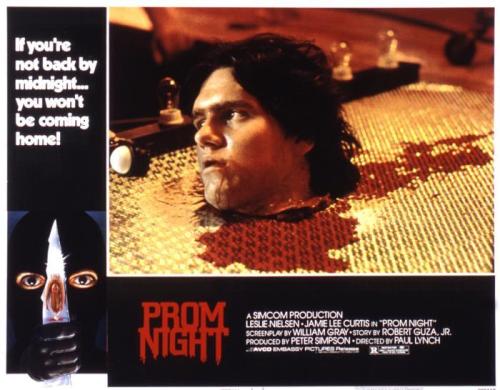
The actual killings don’t get going until 1Hour and 2Minutes in and by then it’s almost too late. The killer also conveys seemingly boundless energy as he busily wrestles a driver for control of a van, which he eventually forces off a cliff while miraculously jumping out of it just before it goes over and then manages just a short time later to chase another victim all around the school where no matter which hallway the young lady chooses to run down the killer always magically is at the end of it ready to jump out at her. The decapitation scene depicting a victim’s head rolling down the stage runway at the high school prom has to be one of the unintentionally funniest moments put on film and had me laughing uproariously.

PROM NIGHT, David Mucci, 1980, (c)AVCO Embassy Pictures

Spoiler Alert!

Normally guessing the killer’s identity is the one fun thing to do while watching these types of flicks, but here that gets ruined by implementing a character at the scene, which was Alex (Michael Tough) the younger brother of the victim who died, even though the viewer didn’t even know he was present when it happened. It’s also hard to believe that any young child could keep a secret for that long as most can’t. I understand why the other 4 kids didn’t tell, but why the younger brother who had nothing to do with the accident and only witnessed what happened? Why would he not immediately run back home to his parents, as most would and tell them about it so they could call the police?

In retrospect having the flashback at the beginning was a mistake as there would’ve been more intrigue had we not known why these four were being targeted. Only revealing the flashback at the very end would’ve then heightened the mystery, which is pretty flimsy otherwise.

My Rating: 2 out of 10

Released: July 18, 1980

Runtime: 1Hour 32Minutes

Rated R

Director: Paul Lynch

Studio: AVCO Embassy Pictures

Available: DVD, Amazon Video

Eyeball (1975)

By Richard Winters

My Rating: 6 out of 10

4-Word Review: Killer targets tour group.

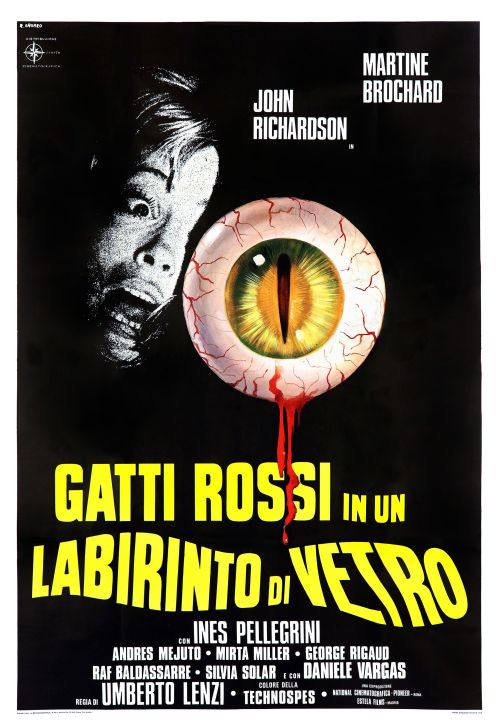
A group of visiting Americans (at least they’re supposed to be American even though they sure don’t seem like it) traveling around Spain on a tour bus find themselves targeted by a killer in a red cape that gouges out the eyes of each of his victims. Suspicion soon centers on the culprit being one of the members of the tour group, but who could it be? Maybe it’s businessman Mark Burton (John Richardson) whose wife (Marta May) was suspected of a similar crime back home, or maybe it’s the elderly reverend (George Rigaud) who’s always spotted at the wrong place whenever the crimes are committed. Inspector Tudela (Andres Mejuto) has his hands full as the list of suspects keeps mounting almost as fast as the body count.

This film is a variation of If it’s Tuesday This must be Belgium, which involved a tour group from America going around Europe, but there it was played for laughs with no killings or mystery while here it tries for horror even though it would’ve worked better had some comedy been thrown as the dialogue gets very soap opera-like. The characters are a problem too as their reactions to the murders gets underplayed, which becomes unintentionally funny, and the way they blissfully continue on with the tour after each killing and acting like it’s no big deal makes them seem cold and inhuman.

The gore is cheesy particularly the fake looking gouged out eye sockets of the victims. In reality eyeballs are more oval shaped, but here they resemble ping-pong balls and the scene where the inspector takes out a small case in his office where he has collected each eyeball from each of the victims to show it to one of the witnesses comes off as being truly twisted.

On the positive end Bruno Nicolai’s bouncy musical score is distinctive and the sunny scenery, which was shot on-location in Barcelona, Spain, is scenic and helps add a visual appeal. The mystery at least on a minor level has intrigue and is full of all sorts of clues, which allows the viewer to play along and try to figure out who did it before the authorities do.

Usually I’m able to guess the identity of a killer long before anyone else does, but in this case I was honestly shocked, so in that regard it was fun even though the motivation for why the individual does it was over-the-top. If you’re looking for 90-minutes of a whodunit, which is ultimately all this thing really is, with just enough tacky gore thrown in for cheap laughs, then it might be worth considering.

My Rating: 6 out of 10

Released: January 24, 1975

Runtime: 1Hou 31Minutes

Rated R

Director: Umberto Lenzi

Studio: Estrela Films

Available: DVD-R (as The Secret Killer)

Rabid (1977)

By Richard Winters

My Rating: 5 out of 10

4-Word Review: Graft patient craves blood.

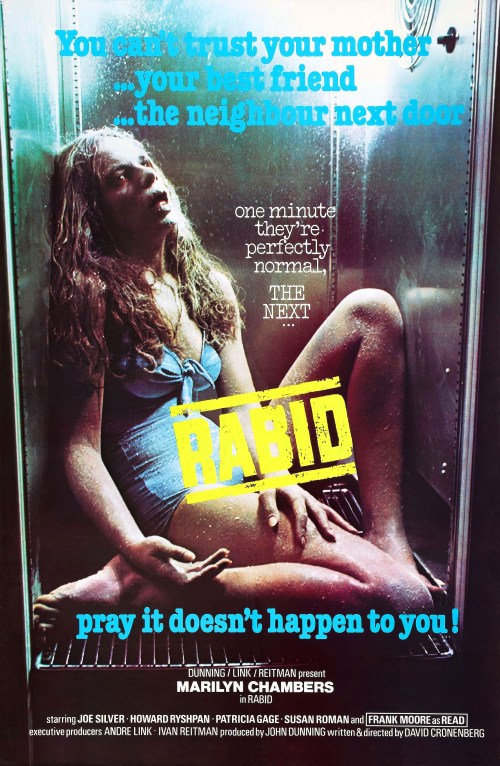
Rose (Marilyn Chambers) becomes the victim of a horrible accident when the motorcycle she goes riding on with her boyfriend (Frank Moore) crashes and she gets pinned underneath the burning wreckage. Fortunately for her the accident occurs near a clinic that specializes in plastic surgery. The head surgeon (Howard Ryshpan) is able to perform an experimental procedure on her that helps graft her burned skin back to normal, but in the process creates a strange orifice in her armpit that sucks blood from everyone she attacks. Her victims then become possessed by a rare form of rabies that sends the city of Montreal into a panic as the authorities try to control the outbreak while also trying to figure out the cause.

This marked director David Cronenberg’s third feature film and from a low budget standpoint the results are impressive. I was especially amazed by some of the car stunts including having an out-of-control vehicle jump a guard rail and crash onto a highway below where a large semi then rams into it. His ability to somehow hire an entire fleet of squad cars is admirable too as most budget-challenged films will make do with just one police car when having authorities investigate the scene of a crime/accident even though in reality there are usually many especially if the crime or accident is severe like here.

I also loved the way he captures the gray/bleak Canadian landscape, which helps supplement the film’s dark and moody tone as well as the bits of dark humor that gets implemented into the story that made me wish the whole thing had been approached as a black comedy from the start.

The horror though isn’t all that much and genuine scares are light including the scenes showing rabid people attacking others, which becomes both clichéd and redundant. The orifice itself looks like an asshole and similar to the giant one that Cronenberg created many years later for his equally provocative film Naked Lunch.

Unfortunately porn star Chambers doesn’t have the presence or talent for mainstream film work. She broke into the business years earlier with a bit part in the Barbra Streisand movie The Owl and the Pussycat, but to her surprise other film offers didn’t follow, which eventually forced her into the X-rated business, which included starring in the cult classic Behind the Green Door, but she always held out hope to one day breaking back into mainstream movies and finally got it here, but it never propelled her further.

Part of the issue is her voice which is abnormally high-pitched and at times sounds like that of a very young child’s. In certain scenes it’s worse than others, but I found listening to her speak to be disconcerting and distracting although she does still look great naked.

The somber, downbeat ending is unusual for a horror film and it might’ve had more impact had the main character been given more depth. The viewer though learns little about her and she fails to have a distinctive personality, which limits the film’s ability to be anything more than just a curio.

My Rating: 5 out of 10

Released: April 8, 1977

Runtime: 1Hour 31Minutes

Rated R

Director: David Cronenberg

Studio: Cinepix Film Properties

Available: DVD, Blu-ray, Amazon Video, YouTube

“Crocodile” Dundee II (1988)

By Richard Winters

My Rating: 6 out of 10

4-Word Review: Now that’s a knife.

Mick (Paul Hogan) and Sue (Linda Kozlowski) having been living together in her New York apartment for a year since their last adventures from the first film. Sue’s ex-husband Bob (Dennis Boutsikaris) is working for drug enforcement in South America. He witnesses and photographs the murder of a rival drug cartel leader at the hands of Luis Rico (Hechter Ubarry) and his men. Once Bob realizes that he’s been spotted he runs for cover to his hotel, but the men chase after him and kill him, but not before he sends the film negatives of the killing to Sue. The drug gang then kidnaps Sue in order to get their hands on the negative and it’s up to Mick to find a way to free her while also single-handedly fighting off the gang.

This sequel manages to avoid the missteps of so many others by wisely not trying to replay what we saw in the first installment, but instead taking it into a new direction and therefore allowing the theme and characters to progress. To some degree the plot does come off like an episode of ‘Miami Vice’ and the villains are also incredibly dull and generic. Do we really need bad guy Luis explaining to Sue why he got into the drug dealing business, because of the ‘money’ and ‘power’, as if there would be any other reason?

Having her ex-husband, someone who was never seen at all in the first film, act as a catalyst is problematic too. It seems like one’s ex-spouse; especially someone he hasn’t spoken to in years would be the last person to send crucial photographs to. He works for the DEA, so why not send it to them?

However, even with these issues I still kind of liked seeing Mick forced into action. The first film consisted mainly of him bragging about his exploits, but here we get to see first-hand some of his actual survival skills. It also puts to test his easygoing personality and we see if he can remain amazingly low-key and likable in situations that most other people couldn’t.

Unfortunately unlike in the first flick the comedy does not come from Hogan’s character, but instead from others around him that witness his exploits. Outside of an amusing segment that comes early on in the film where Mick tries to talk a man out of jumping off a ledge his character is portrayed in a darker more intense way although not enough to erase his ever going charm.

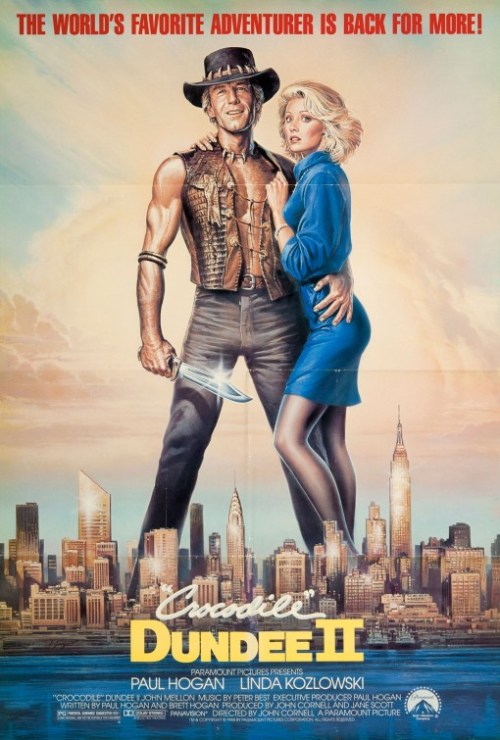
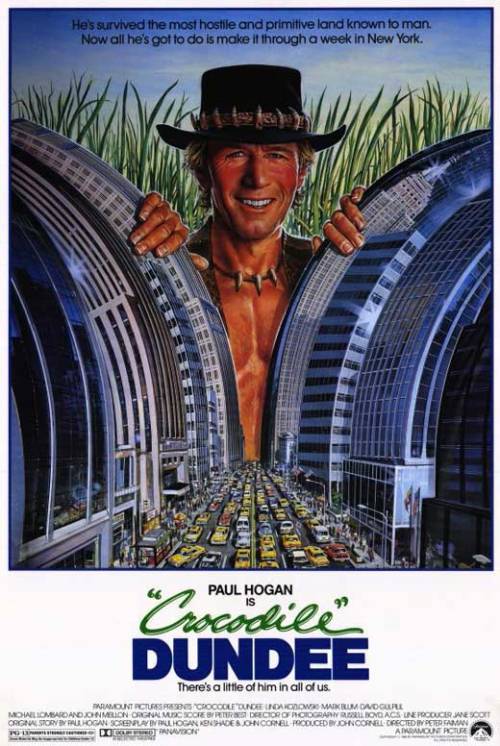
Kozlowski, who ended up marrying Hogan in real-life 2 years after this film was released, is stuck in a thankless supporting role where she doesn’t have much to do. The film poster portrays the idea that the two fight the bad guys side-by-side, but in reality Hogan does most of it while Linda simply tags along and observes. The real scene stealer is John Meillon whose last theatrical film this was. He was in the first one, but his presence there didn’t amount to much, but here his character, working in tandem with Mick, is an integral part of sending the drug gang on a wild goose chase.

The scenes shot in Australia are gorgeous and in fact the spot where the drug gang campout is the same place where Picnic at Hanging Rock was filmed. Charles S. Dutton who plays a man by name of Leroy Brown and pretends to be a drug dealer even though he really isn’t is quite amusing too and overall the film is a mildly entertaining way to spend two hours.

Spoiler Alert!

My only problem is in regards to Leonard Maltin’s review of it where he states that he felt the film was too leisurely paced and wished they’d “get on with it especially when all suspense about the outcome is eliminated”, but after watching it this makes no sense. The bad guys are not fully defeated until the very, very end in fact it quickly cuts to the credits once they are. There’s even some concern that Mick may have accidently been killed, which also occurs at the very end, so it seems that Maltin, who I generally like as a critic, either didn’t really watch the movie, or the whole thing, and therefore has no idea what he’s actually talking about.

My Rating: 6 out of 10

Released: May 20, 1988

Runtime: 1Hour 52Minutes

Rated PG

Director: John Cornell

Studio: Paramount

Available: DVD, Amazon Video, YouTube

The Romantic Englishwoman (1975)

By Richard Winters

My Rating: 6 out of 10

4-Word Review: Writer suspects wife’s infidelity.

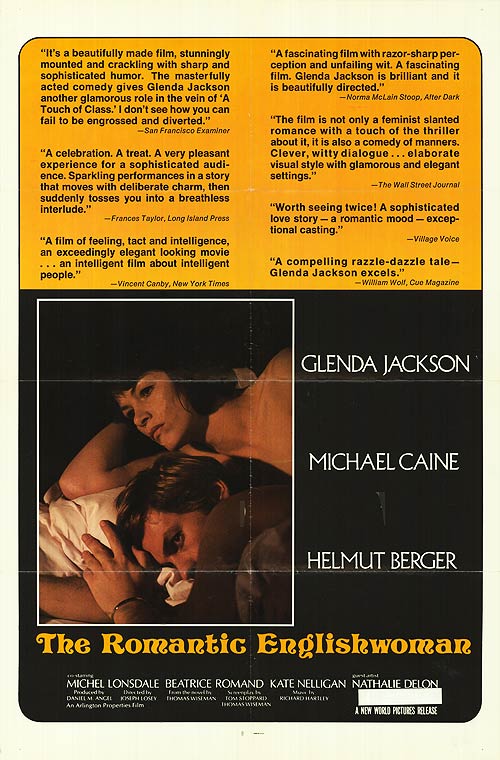
Unhappy in her marriage Elizabeth (Glenda Jackson) goes off to Baden-Baden, Germany for a little respite and there meets up with the dashing Thomas (Helmut Berger). Although quite charming Thomas is also caught up in the criminal underworld and being chased by gangsters. After the two share a brief tryst she returns home to her husband Lewis (Michael Caine). Lewis suspects that Elizabeth was unfaithful during her trip, but can’t prove it. He invites Thomas to stay at their place in order to help him finish a screenplay that he is working on and in the process the affair between Thomas and Elizabeth starts up again, but this time Lewis is determined to stop it.

The concept is intriguing, but the film gets ruined by playing its cards too early. A far more interesting scenario would’ve been to have Lewis not suspect Thomas at all or even his wife’s longing for him and instead simply invited Thomas over as a genuine writing partner and only slowly becoming aware of the tensions boiling beneath the surface. Unfortunately having Lewis almost immediately figure things out even before Thomas arrives makes for a very boring first hour with the couple arguing over the same staid, redundant infidelity talking points that have been done a million times before.

The story’s only interesting wrinkle has Thomas starting up a relationship with the nanny (Beatrice Romand), which made more sense as Elizabeth was way older than him and I failed to see why he would’ve been attracted to her to begin with. The nanny was young and cute and it was fun seeing Elizabeth seethe with the same type of jealousy as Lewis, but the film quickly kills this storyline by having the nanny forced to move out and everything goes back to the same formulaic love triangle.

Having Lewis recreating scenes in his screenplay that replicates what he is going through in real-life had potential as it nicely illustrates the thin line between fact and fiction that writers routinely do. Unfortunately the film treats these scenes in a campy/hooky manner and then drops it just as quickly as the romance scenario mentioned above.

The direction is static with a camera nailed to the ground and everything captured in a dingy, shadowy way. The opening bit detailing how Elizabeth first meets Thomas had a naturalistic quality, but the shot were she spots Thomas from across the room and her eyes remained locked on his and she never turns away is not believable. If two people are strangers and one catches the other one staring at them it’s sheer human reflex that the other one will divert their gaze as it’s rude, awkward and off-putting otherwise. Also, to have the word romantic in the title is absurd especially after the two proceed to have sex inside an elevator during their first meeting, which is pure animalistic lust and a more accurate title would’ve been ‘The Horny Englishwoman’.

Spoiler Alert!

The third act helps fill in the gaps in regards to Thomas’ secret past, but having Elizabeth run off with him makes her character seem exceedingly shallow as she essentially abandons her young child in the process. Earlier in the film she got very upset when she saw her child sitting out on a ledge and she fired her nanny for being irresponsible and not watching him more carefully only to then by running off with Thomas behave just as irresponsibly.

The film’s final shot features strange people inhabiting Lewis and Elizabeth’s home like they’re having a party without the owners there. Lewis then after having taken Elizabeth away from Thomas and back with him drives the car the two are in up to their house. Elizabeth looks shocked at seeing all the people inside, but Lewis has a jaded expression and seems to being enjoying watching Elizabeth’s discomfort, but then the film cuts to the credits and never explains what’s occurring and nothing is more frustrating than a film which ends just as it’s finally beginning to get interesting.

My Rating: 6 out of 10

Released: November 26, 1975

Runtime: 1Hour 56Minutes

Rated R

Director: Joseph Losey

Studio: New World Pictures

Available: DVD, Blu-ray, Amazon Video

“Crocodile” Dundee (1986)

By Richard Winters

My Rating: 7 out of 10

4-Word Review: That’s not a knife.

Sue (Linda Kozlowski) is a newspaper reporter who gets permission to cover a story about an Australian bushman named Mick better known by his nickname Crocodile Dundee (Paul Hogan) who was able to fight off a croc attack before successfully crawling to safety. To do this she travels to the outback, so she can learn about his way of life firsthand. After spending six weeks interviewing him she then invites him back to New York with her. Once there Mick finds the city life and the people in it quite confusing. He also takes an almost immediate disliking to Richard (Mark Blum) Sue’s fiancée.

Loosely based on actual events the laid back story goes down easy and is full of charm, but its basic premise is a bit hard-to-swallow. I thought the idea of having a reporter go clear across the globe to interview some no-name bushman over an obscure and completely unsubstantiated crocodile attack claim just wasn’t realistically worth the time or money. Crocodile/alligator attacks occur yearly all over. Why not save the money by sending the reporter to Florida instead where you could probably just as easily find and interview someone who survived a similar incident?

Most of the time a journalist will be accompanied by a photographer, but here she takes the pictures as well as doing interviews even though with most big time newspapers and many times even the small ones that is never the case. This also brings up the issue of her traveling for weeks all alone in the middle-of-nowhere and even sleeping under the stars with a man she essentially knows little about. What’s to say he wouldn’t attack her at some point and if so who would she call? I believe most women wouldn’t be comfortable in that scenario and thus having a third party present such as a photographer or other chaperone would’ve made far more sense.

The money issue, or the fact that the newspaper apparently pays him to come back to the states with Sue, seemed illogical and wasteful. Why is a newspaper spending money to bring a bushman into a foreign land? If it is to see how he adjusts to it that’s one thing, but the majority of the time Mick spends in New York he is by himself with Sue nowhere near him covering his reactions, so then what’s the point? Later Mick decides to stay in the Big Apple for a longer period, but where does he get the extra money to do that?

The scene where Mick puts a water buffalo into a trance-like sleep is baffling too. Supposedly he does this because they are driving along in a jeep and the buffalo won’t get out of the road and let them pass, but how is putting the animal to sleep where he then plops his big body onto the road going to help? The film then conveniently cuts without any explanation of how there were ultimately able to get around him.

The second act where Mick comes to New York is the funniest, but even here it doesn’t get played-up to its full potential. The amusing scene where Mick meets some prostitutes, but is unaware of what they do is hard to believe. Even a country boy should’ve been aware of the world’s oldest profession especially when he is over 40 and his naivety in that situation just doesn’t completely work. The film’s most famous scene where Mick scares off some muggers by showing them his large hunting knife also proves problematic when you realize that it is unlikely he would’ve ever been able to get that thing past customs.

Hogan’s appealing performance makes it work. However, it would’ve been better had the guy been younger like in his early 20’s instead of well over 40, which would’ve made some of his awe and wonderment seem a bit more genuine and believable.

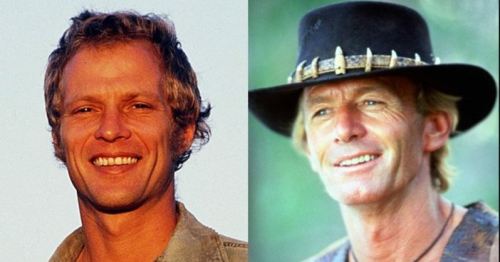
For year’s Hogan, who also co-wrote the script, insisted that the Dundee character was of his own creation, but then later it was found that it was really based on the life of Rod Ansell who in 1977 at the age of 23 got stranded in the wilderness of Australia’s Northern Territory for 7 weeks when the dinghy he was riding in capsized and in the process he fought off a crocodile whose head he kept as a souvenir. His adventures were documented in the film To Fight the Wild, as well as published in a book. He did many TV interviews about his ordeal back in the late 70’s which is where Hogan first became aware of him and then when this film became famous he sued Hogan, but lost the case and the fact that he made no money off of it became a major source of bitterness to him, which lead to his addiction to amphetamines that subsequently lead to his death in a police shootout in 1999.

Here’s a pic of Ansell alongside Hogan’s movie likeness of him:

My Rating: 7 out of 10

Released: April 24, 1986

Runtime: 1Hour 37Minutes

Rated PG-13

Director: Peter Faiman

Studio: Paramount

Available: DVD, Amazon Video, YouTube

Jeanne Dielman, 23 Commerce Quay, 1080 Brussels (1975)


By Richard Winters

My Rating: 5 out of 10

4-Word Review: She performs daily chores.

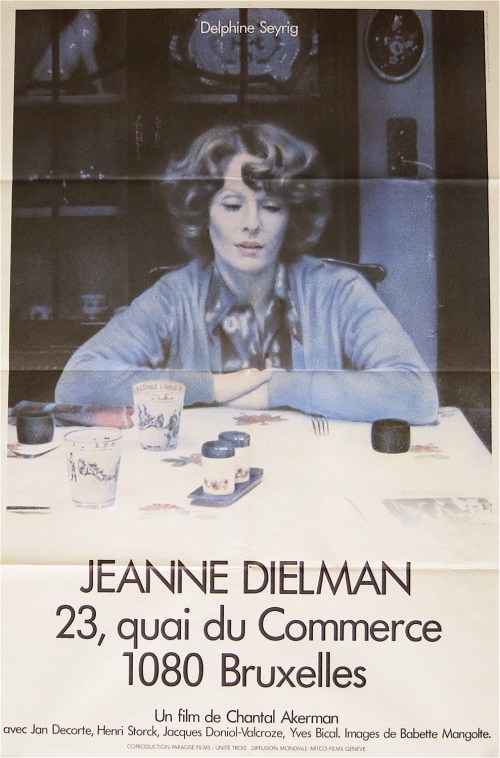
This is a highly unusual film which analyzes in minute detail the monotonous tasks that a single mother performs throughout her day and was apparently inspired by writer/director Chantal Ackerman growing up with a mother who suffered from obsessive/compulsive disorder. The story centers on Jeanne (Delphine Seyrig) a woman raising a teenage son while living in a tiny one-bedroom apartment in Belgium. During the day she entertains various men with sexual services and uses the money that she receives for this to help maintain things for both herself and her teenage son Sylvain (Jan Decorte). When she is not working as a prostitute she is busily cooking and cleaning, but as each day passes her routine becomes sloppier, which is a subconscious signal that something is bothering her and only at the very end does the viewer find out what it is.

Some have hailed this as a masterpiece including being listed among the ‘1001 Movies You Must See Before You Die’ by Steven Schneider. Normally I enjoy films that buck the conventional narrative and trying to learn about a character through the way she performs her daily routine as opposed to doing it the standard way through dialogue and action is commendable, but the cinematic flair is missing making this seem more like ‘monotonous task porn’ than a movie.

For instance when we watch Jeanne wash her dishes the camera does it in a very static way from behind her instead of doing something flashy like a close-up of the water glistening of the dish, or from some other provocative angle. Akerman has stated that she took this approach in order to show respect to her character’s ‘personal space’, but this only ends up giving it a closed-circuit TV feel.

Nonetheless I still remained strangely intrigued, but I’m not sure if this was because of some reviews I read beforehand where I was told that about the ‘surprise/shocking ending’ that would somehow make what I was watching all seem worth it, or because of what I was actually going on. I’ll agree that seeing the way she prepares and cooks her various meals is fascinating, but it’s for all the wrong reasons as you become more caught up in the task itself than the character and to say that one’s mind doesn’t eventually begin to wander after 3 hours and 20 minutes of this would be an understatement.

The 3-day arch that she goes through from where she performs her tasks proficiently on the first day only to screw them up more and more by the third one needed to be much more apparent as her ‘screw-ups’, like dropping a newly washed spoon on the floor, are too subtle and not enough of a payoff. Cinema is still a visual and dramatic art form and yet this film runs away from that at every conceivable turn making it seem more like an assault on one’s stamina instead.

Spoiler Alert!

The only true cinematic moment comes at the very end when Jeanne kills one of her male clients, but there’s no reason given for why she does this or what the aftermath will be. To have to sit through all that comes before it just to walk away with unanswered questions is frustrating and almost like being told a joke where the punchline is not an equal payoff to the long, tangent-filled set-up that it took to get there. I like the concept, which is intriguing, but it could’ve been accomplished in half the runtime making this an interesting experiment that can be appreciated as an oddity, but nothing more than that.

My Rating: 5 out of 10

Released: May 14, 1975

Runtime: 3Hours 21Minutes

Not Rated

Director: Chantal Ackerman

Studio: Olympic Films

Available: DVD, Blu-ray (Criterion Collection), Amazon Video