Category Archives: Foreign Films

Incubus (1982)

incubus1

By Richard Winters

My Rating: 5 out of 10

4-Word Review: Demon being rapes women.

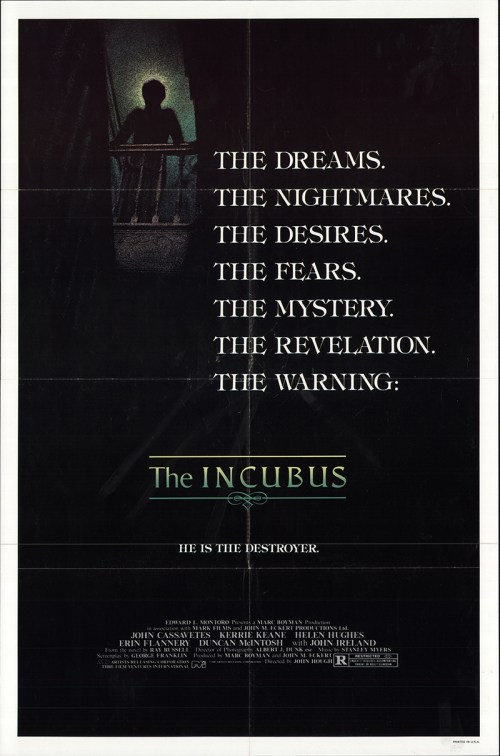
In a small Wisconsin town known as Galen the women are being sexually assaulted by a mysterious being with super human strength. When the victims are taken to the hospital they are seen by Dr. Sam Cordell (John Cassavetes) who notices an extraordinary amount of semen deposited that is reddish in color and doesn’t seem left by a human. Sam argues with the local sheriff Hank (John Ireland) about whether it’s a gang of men doing these crimes, or just one person. The two team-up with Laura (Kerrie Keane), a local reporter who has just moved into town and shares a striking resemblance to Sam’s former girlfriend who’s now deceased, to find the culprit. They begin to think it may be Tim (Duncan McIntosh) a young man who’s still living with his adopted mother (Helen Hughes) and has been dating Sam’s daughter Jenny (Erin Noble). Tim complains about having weird, vivid dreams and every time he wakes up a new crime has been reported, which makes Sam fear that Jenny may be the next victim.

This film approaches things differently from the conventional horror, especially those done in the 70’s, where there’s no character build-up and just jumps right into the attacks, but this doesn’t work because we have no idea who these people are nor care what happens to them making the viewer sit through the whole first half in a rather apathetic manner to what’s going on. The film also makes the mistake of not showing, with the exception of a brief second where we do see the creature’s hairy arm, of who this entity is until the very end though it should’ve been done sooner. Having some mystery is good, but a film has to keep upping the ante otherwise it will get tedious and seeing the attacks get done over and over in virtually the same manner without any new information or twists added soon becomes quite boring.

Listening to Sam and Hank perpetually argue who the culprit is for almost the entire film without much  clues being added in becomes tiresome too. The film though is helped immensely by John Hough’s direction who adds a lot of visual style including a cool tracking shot done from underneath a wheelchair.

I was unhappy though that it wasn’t actually filmed in Wisconsin, but instead Guelph, Ontario, which has homes and buildings that resemble more of a colonial style that you would find in the northeast versus the Midwest. Having movies filmed on-location that’s specific to the story can help give it an added ambiance and sometimes even work as a third character, but since this movie cheats on this we don’t get that here.

Casting Cassavetes, who is better known for directing groundbreaking, independent movies, in the lead was a novel move. His hawk-like facial features I always felt would’ve made him a good bad guy, but his unique acting approach does at least keep his scenes interesting though his relationship with his daughter does border on cringey. One shot has him viewing his naked daughter, who is 17, through a  mirror as she gets out of the shower, which seems to imply, though it never gets played-out, that he may have a perverse sexual interest in her. There’s another scene where he introduces her to Laura as simply being ‘a woman I live with’, which is a very weird way for a father to describe a daughter.

The supporting characters aren’t captivating at all. Laura, who’s supposed to be an aggressive journalist type, breaks down too easily after receiving minor blow back from the sheriff over her reporting, which made her seem too sensitive. If she’s truly the ‘fearless reporter’ as portrayed then she’d have to have a thicker skin and even expect some criticism when it comes. The Tim character is also a bore as we see him in only one emotional state, perplexed and confused, which makes him too one-dimensional.

Spoiler Alert!

The ending is where things get messed-up. For one thing it tries to squeeze an elaborate explanation for what’s going-on into the final three minutes, which is too short of a time period for the viewer to digest it all, or have it make sense. What really got me though is that we find out that the incubus was actually Laura, and the film ends with Sam seeing her kill his daughter, but we never see how Sam responds, or if he’s able to defeat her, which is frustrating. So much time gets spent on the boring investigation only to then abruptly end once we finally get a pay-off.

By having Laura be the ultimate villain also goes against the film’s title. According to mythology an incubus is a male demon that tries to have sex with a female human, but a succubus is a female demon, so hence the title of the movie, the way I see it, should’ve been, when given the way it turns out, Succubus.

My Rating: 5 out of 10

Released: August 27, 1982

Runtime: 1 Hour 33 Minutes

Rated R

Director: John Hough

Studio: Kings Road Entertainment

Available: DVD, Blu-ray, Pluto TV, Plex, Tubi, YouTube

Slaughter High (1986)

slaughter1

By Richard Winters

My Rating: 7 out of 10

4-Word Review: High School reunion horror.

Marty (Simon Scuddamore) is a social outcast at his high school. On April Fools Day the other students decide to play a prank on him by inviting him into the girl’s shower were they mock his naked body. This gets the students into trouble with the coach (Marc Smith) so they decide to play another joke on him by adding a chemical to his science project that causes it to explode, which topples a bottle of nitric acid off the shelf and it splashes onto his face which disfigures him. 5 years later the students reconvene for a  reunion, but find the school has been closed and in disrepair yet they still go in and have a party anyways, but soon they begin getting killed off one-by-one in violent ways. Is Marty lurking in the shadows and doing it for revenge, or is it somebody else?

I enjoyed the way the film works against the formula by having a linear narrative where the horrible accident happens right away instead of using flashbacks, or having it discussed through dialogue like in other slashers. The killings are expertly handled including one where the victim has his intestines blow directly out of his stomach, which is graphic and caught me completely off guard. The tension is good too and had me riveted at the end as Caroline Munro gets chased around the darkened building almost endlessly, which was intentionally prolonged by the filmmakers to give it a longer runtime, but in the process helps make the scenario even scarier by making it seem like the victim is stuck in a nightmarish maze that she can’t get out of.

Some viewers had issues with the cast looking too old for high schoolers, which included star Munro who was already 35 at the time. However, what really impressed me was that it was filmed in England with a mostly British cast, except for Donna Yaeger who plays Stella and a couple of others, and yet all of them with the exception of Munro were able to successfully disguise their accents to make it sound like they were genuinely American.

My only two complaints were the music score, which sounded too playful like it was intended for a comedy instead of a horror and didn’t help add to the tension and in many ways worked against it. The scene were two of the characters (Donna Yeager, Billy Hartman) have sex is ridiculous as this occurs after they had just witnessed two graphic murders and the ongoing threat of a killer lurking about, so for most people sex would be the last thing on their minds nor would they be able to perform even if they tried due to the psychological stress, so having the guy become baffled when he can’t get an erection under those circumstances was laughable as I would’ve more surprised if he had.

The twist ending is cool and even if it had been a letdown I would’ve still given it 7 points as the rest of it is highly entertaining either way. The original working title was going to be April Fool’s Daybut this got changed when the filmmakers became aware that another movie with that same title was set to be released in the US, but this movie is far better than that one.

My Rating: 7 out of 10

Released: November 14, 1986

Runtime: 1 Hour 31 Minutes

Rated R

Directors: George Dugdale, Mark Ezra, Peter Mackenzie Litten

Studio: Vestron Pictures

Available: DVD, Blu-ray, Amazon Video, Tubi, YouTube

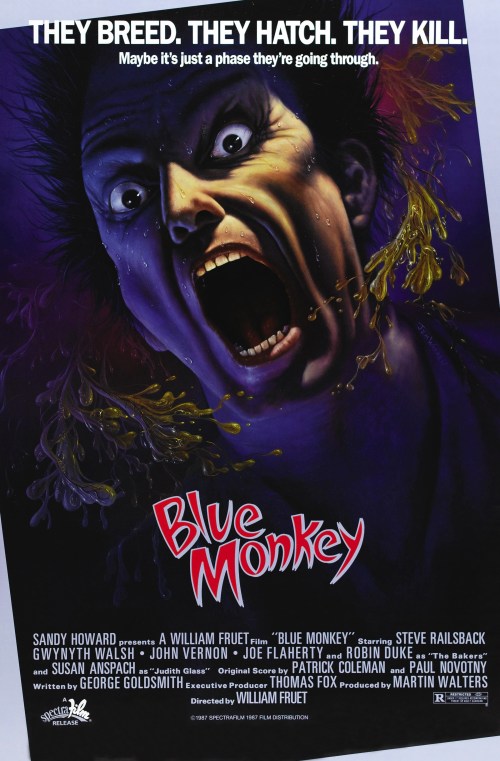
Blue Monkey (1987)

blue1

By Richard Winters

My Rating: 6 out of 10

4-Word Review: Giant insect invades hospital.

When an elderly man (Sandy Webster) gets his finger pricked by a foreign plant he’s immediately rushed to the hospital after he goes into shock. At the hospital he regurgitates an insect pupa, which is taken to the lab for observation. It is there that it gets fed a growth hormone by a group of children causing it to escape and take-over the hospital. Jim (Steve Railsback) is a police detective who was already in the hospital overseeing his partner who had gotten shot while on duty. Together with Rachel (Gwynyth Walsh), an on-call emergency room doctor, and Elliot (Don Lake), a entomologist, they go on the offence to trap the giant bug and kill it before it can reproduce.

I was initially not excited about watching this as it’s admittedly a rip-off of Alien and has many of the same shocks while being directed by Canadian horror maestro William Fruet whose other output I’ve found to be only so-so, but this one is surprisingly compelling. It also has some cool effects including seeing the characters running down a darkened hallway that’s lighted from one end with a bluish hue that gives it a surreal vibe. The shocks aren’t plentiful, but the few that they do have work.

This is also one movie where Railsback, who’s excellent playing psychos like Charles Manson and Ed Gein, is effective as a good guy. In other films where he was a protagonist like in Lifeforce he came-off as unintentionally creepy and it hurt his ability to get starring roles, but here his kindly interactions with a group of sickly children help subside that. I also enjoyed Susan Anspach, looking almost unrecognizable in her black-rimmed glasses, as one of the Dr.’s who takes matters into her own-hands without waiting for a male Dr. to tell her what to do. In fact there really aren’t too many men in white coats at the facility that seemed mainly run by females, which I found interesting.

What I didn’t like were the supporting comical characters. Helen Hughes and Joy Coghill as two drunken old ladies was not needed nor was SCTV alums Joe Flaherty and Robin Duke as a goofy couple having a baby. Sometimes in horror movies that are super intense a brief moment of levity is okay, but this movie wasn’t frightening enough for that and if anything needed to play-up the scares more instead of throwing in goofy scenes that makes it seem too much like a jokey-script instead of a scary one.

The actual bug, when seen in its giant proportion, isn’t the chilling sight you’d expect mainly because its made to look like a regular bug, but just bigger, which isn’t imaginative and more reminiscent of the tacky sci-fi ‘creature-features’ of the 50’s where insects suddenly become bigger and most people today find laughable. It also would’ve been nice during the lab scenes for the camera to have focused on the pupa under the glass instead of the scared faces of the people looking at it. We don’t need to see facial expressions to know if something is scary we just need to be shown the scary thing directly and when we don’t see it, it makes the film look cheap like it didn’t have enough money to create an elaborate effect, so it copped-out by doing it this way.

Even with some of these issues it’s still an entertaining ride. It won’t be for everyone’s tastes and it certainly isn’t going to win any awards nor was it intended to, but if you like giant bug movies this one should satisfy your appetite.  It was also filmed entirely in Canada though the setting is supposed to be the US.

My Rating: 6 out of 10

Release: September 25, 1987

Runtime: 1 Hour 36 Minutes

Rated R

Director: William Fruet

Studio: International Spectrafilm

Available: DVD, Blu-ray

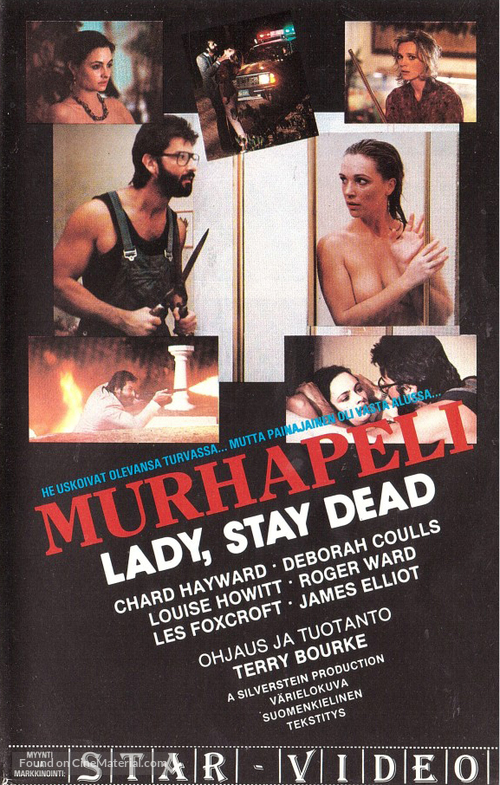
Lady, Stay Dead (1981)

lady1

By Richard Winters

My Rating: 3 out of 10

4-Word Review: Handyman obsesses over singer.

Gordon (Chard Hayward) works as a handyman and is treated poorly by his boss Marie (Deborah Coulls), a famous singer/actress, who routinely berates him as if he were a second-class citizen. Secretly Gordon fantasizes about having sex with her and one day breaks into her home and rapes her. Afterwards he drowns her by shoving her head into a fish tank. When her elderly neighbor Bill (Les Foxcroft) spots Gordon trying to discard her body he then kills him too and his dog, but Gordon fails to realize that Jenny (Louise Howitt), who is Marie’s older sister, is coming for a visit. When she arrives she quickly catches-on to what’s happening and proves to be a formidable challenge to Gordon, who wants to do to her exactly what he did to her sister.

The film was written and directed by Terry Bourke, who was credited with doing the very first horror movie in Australia, Night of Fear, which many consider a precursor to The Texas Chain Saw Massacreand this made him a horror guru in the Down Under and eventually lead to him making this one. This movie is unique in that it’s the first slasher film released in Australia and received okay reviews simply for its production values, which was a step above most other slasher pics.

Initially I was intrigued with the concept as it captures Gordon’s point-of-view and even sympathizes with him over his mistreatment by the callous Marie. It almost seemed to be playing-off the same idea of another Australian cult-hit The Plumberwhere a working-class male takes his animosity out on a female who he believes looks down on him. Had the movie stuck with this idea it could’ve been interesting and I was fascinated to see how both character’s behaviors and insights into each other would evolve as the scenario progressed, but this gets ruined by having Marie killed-off too soon.

Having her sister Jenny, who in no way looks anything like Marie even though they’re supposed to be related, become the main victim is not compelling and the story devolves from being a potentially compelling psychological flick into that of your standard cardboard thriller. Had Jenny, not knowing that Gordon was her sister’s killer initially, fallen in-love with him, could’ve lent a unique twist and might’ve saved it, but it doesn’t go in this direction either. Ultimately I was unsure why the opening bit involving Marie was even needed as it could’ve just started with Jenny as the target of the obsessed handyman and gotten played-out in exactly the same way.

The script also suffers from plot-points being too loosely connected. There’s no cyclical structure like with most stories where what see in the first act connects with what happens later. Instead characters and events get thrown in haphazardly with only the loosest of threads holding it together. The random policemen, played by Roger Ward, jumping in and becoming a major part of the action in the third-act, is a good example of this. Why not have this part played by Billy, the helpful elderly neighbor, who like with Marie gets offed too soon until you wonder why he and Marie were even in it at all.

Spoiler Alert!

The double-ending where you think the policeman has killed Gordon, but really hasn’t was no surprise at all. It’s also impossible to believe that Gordon would’ve been able to drive a squad car around while hunched beneath the dashboard and unable to look a window to see where he was going. Also, the title itself makes no sense as Marie never comes-back to life, so what the meaning of ‘stay dead’ is I don’t know.

Overall the script is too unfocused making what starts out original end-up being quite formulaic and forgettable although the segment where Gordon uses a chainsaw to cut a hole in the front door is genuinely creepy particularly the sound it makes as he does it, which is the only scary moment.

My Rating: 3 out of 10

Released: September 10, 1981

Runtime: 1 Hour 35 Minutes

Director: Terry Bourke

Studio: Ryntare Productions

Available: DVD

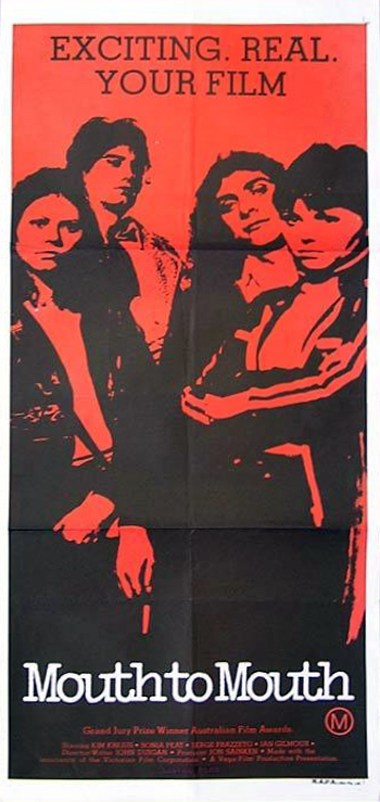
Mouth to Mouth (1978)

mouth1

By Richard Winters

My Rating: 8 out of 10

4-Word Review: Two teen girl runaways.

Carrie (Kim Krejus) and Jeanie (Sonia Peat) are two friends living in a juvenile detention center when one of them gets accused of stealing an item. Angered that they’ve been accused of doing something that they didn’t they escape into the night and onto the streets of Melbourne. They manage for find shelter in an abandoned factory building that also has an elderly homeless man named Fred (Walter Pym) living there whom they befriend. They find employment as servers in a cafe and that’s where they meet Tim (Ian Gilmour) and Sergio (Serge Frazzetto) who are two young men who have come to the city looking for employment. They girls bring them back to the factory building and the four create a makeshift home, but Carrie and Jeannie are not happy with the wages that they’re making nor having to shoplift on the side to make ends-meet. Carrie sees an ad in the paper for escorts and convinces Jeannie to join her as they’ll be able to make much more money doing that. Jeannie is reluctant at first, but eventually goes along with it, but after doing it for awhile Carrie becomes increasingly depressed, which eventually leads to her illicit drug use.

Initially I wasn’t excited to watch this as I’d seen many teen runaway movies before and failed to see what new perspective they could put on that would make it interesting, but I was surprised how very compelling it is. A lot of credit for this goes to writer/director John Duigan’s script, which has a nice conversational quality and the characters react the way real teens do where they never articulate how they really feel and go to great lengths to mask their true feelings. The setting, particularly the abandoned building is made all the more stark as a real one was used and not just some prop built on a movie set, which really hits home the kind of squalor some people will be willing to put-up with if their desperate enough and similar to the living conditions in the British film Rita, Sue, and Bob Too. 

Despite the actors having little or no acting experience they manage to give compelling performances and much of this was helped by having the cast room in a house for 2-weeks before the shooting started, which allowed them to bond with each other as well as refined their characters and rehearse their lines until it became almost natural to them. 

The script originally had more of a light-hearted tone, but after 14 rewrites it took on a harsher subject matter as director Duigan wanted to bring to life people that a middle-class movie audience only sees as ‘numbers on unemployment figures, or kids in juvenile court’ and in that regard it’s well-made. The ending is particularly gut-wrenching, but not surprising and yet I was very moved by it and it stayed with me long after it was over. 

On the complaints side it would’ve been nice to have had Fred come-up to their loft to either dinner with the four and see more how he interacted with them. The girls invite him, but he refuses, but for the sake of character development he should’ve agreed. The escort scenes only show Jeannie interacting with her client, but not Carrie with hers, which I found frustrating. Carrie is never seen visiting with her father either during the brief scene when she returns home as he’s not there, but having a conversation between the two could’ve been quite revealing. The film also features a great song entitled “The More You Love the Harder You Fall”, but no credits are given for who sings it, which is a shame.

My Rating: 8 out of 10

Released: July 20, 1978

Runtime: 1 Hour 36 Minutes

Rated M (Australian Movie Rating)

Director: John Duigan

Studio: Victorian Film Cororation

Available: DVD (Region 0 Import)

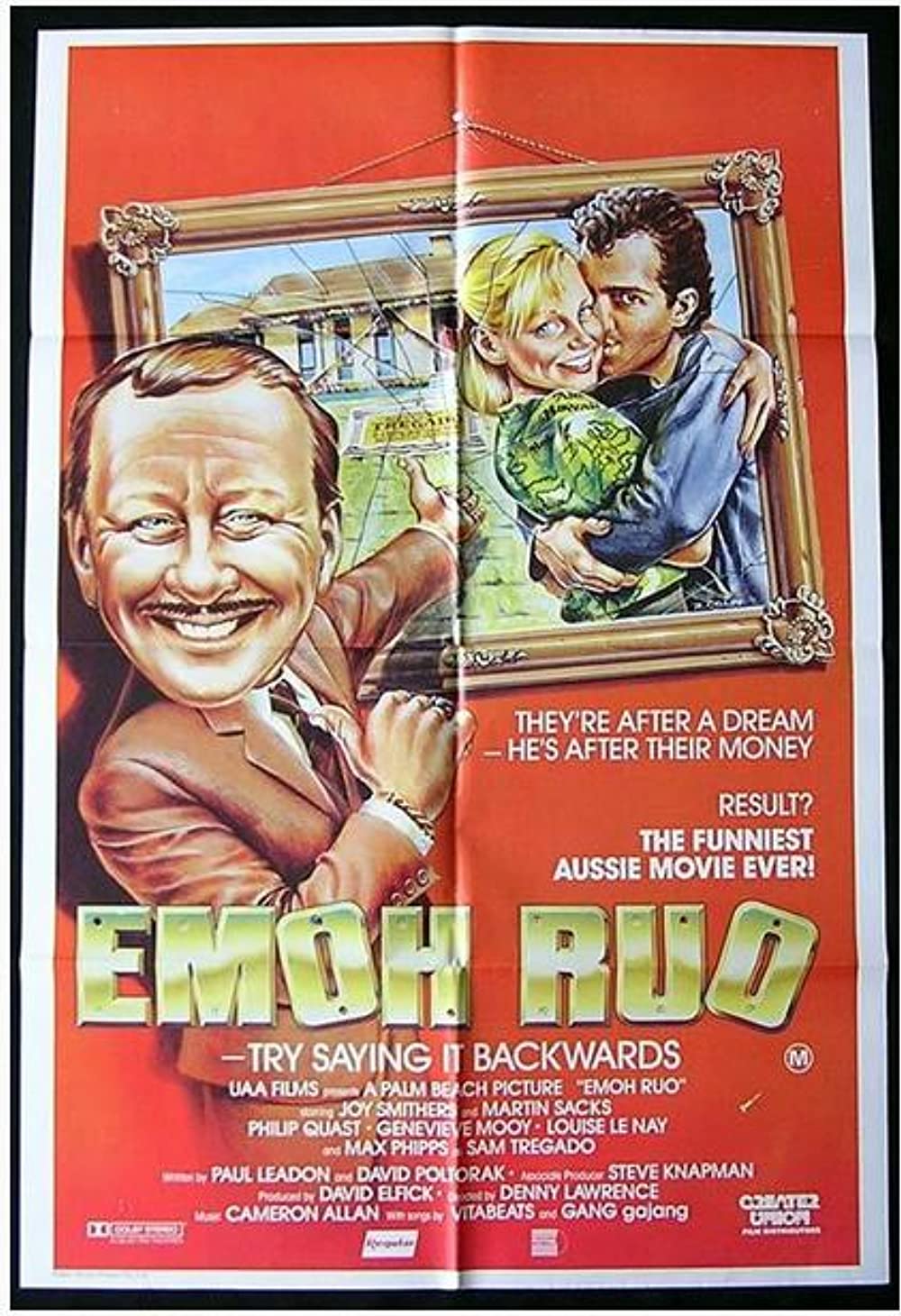
Emoh Ruo (1985)

emoh1

By Richard Winters

My Rating: 4 out of 10

4-Word Review: New house falls apart.

Terri (Joy Smithers) is tired of living in a trailer and begs her husband Des (Martin Sacks) to finally buy a house, so they can live in the burbs and be a part of the middle-class dream. After saving up enough money they put a down payment on a brand new home, but the home begins to have a lot of problems. Both Terri and Des are forced to work longer hours at their jobs in order to keep up with the bills. What seemed like a dream at first soon turns into a nightmare making living in a trailer, which they initially hated, now seem like a good idea.

This film has a lot of similarities to Steven Spielberg’s The Money Pit, which came out a year later, but this one is more amusing, at least at the beginning. Spielberg’s film, which was directed by Richard Benjamin, was too cartoonish and silly and failed to make any broader statement other than wild comical antics. This one takes more of a satirical approach and shows how suburban life may not be as great as advertised and in some ways just plain not worth it. One of the funnier moments is when Terri gets home from her overnight job and the second she walks through the door immediately falls to the floor in exhaustion while her tired husband, who’s getting ready to go to his second job, steps over her while going out the door without so much as giving her a greeting.

I did like too that this movie doesn’t immediately go over-the-top with the problems of the home repairs. The Money Pit, in my opinion, ruined things by having everything go wonky right from the start, which didn’t allow for any buildup while this one keeps the tension by showing things not working as they should and making you interested in seeing if it’s going to get worse. The nightmarish elements aren’t just isolated to the home either as their son Jack (Jack Ellis) must put up with bullies at his new school and the couple also deals with nosy, meddling neighbors.

I was surprised by the abundance of nudity, at least during the first act, which is something you’d never see in a Hollywood movie, where nudity is usually only shown in film’s aimed at adults, or with adult themes, instead of a movie like this that would otherwise be perfect for the general public. I’m not sure exactly why director Denny Lawrence decided to put it in as it doesn’t have anything to do with the plot and could’ve easily been left out, but I can only presume that because Australia is a more secular country they’re less uptight about showing skin and therefore don’t worry, or fear, that putting it into a movie, even one as otherwise innocuous as this, will be a problem, or get backlash.

What I didn’t like though was Joy Smithers as the mother. While she certainly looks beautiful, both with her clothes on and off, she was, at age 22, too young to be portraying a suburban mother of a 10-year-old child. Her acting was problematic too especially her scenes where she’s supposed to be upset that doesn’t convey the subtle comic element that a better actress could’ve brought out.

Spoiler Alert!

The third act, outside of seeing an outrageous looking BBQ pit built by the husband, fails to have much of a payoff. Many of the problems with the house never get properly addressed. For instance the shower knobs blow off the wall and spew streams of water everywhere, but the film cuts away without showing how they managed to get it under control. Having the entire house ultimately collapse isn’t impressive either as it looks too much like a prop house made of cardboard instead of brick and mortar.

I was disappointed too that the dark comical edge gets lost with a sitcom-styled wrap-up that seemed to lose complete sight of the main point, which ultimately makes the film as a whole quite transparent and forgettable.

My Rating: 4 out of 10

Released: September 12, 1985

Runtime: 1 Hour 33 Minutes

Not Rated

Director: Denny Lawrence

Studio: Palm Beach Pictures

Available: DVD (Region 4 Import)

The Fiendish Plot of Dr. Fu Manchu (1980)

fiendish

By Richard Winters

My Rating: 1 out of 10

4-Word Review: Peter Sellers’ last movie.

Fu Manchu (Peter Sellers) is a 168-year-old man, who on his birthday must drink a elixir vitae in order to remain youthful and alive. When one of his servants (Burt Kwouk) brings in the formula his shirt sleeve catches fire from all of Fu’s birthday candles and it causes the servant to use the elixir to put the flames on his sleeve out. This forces Fu to have his henchmen go on a international crime spree to find the necessary ingredients to create a new youthful formula for him to drink. After one of Fu’s men steals a diamond in an exhibit it catches the attention of Scotland Yard Chief Inspector Roger Avery (David Tomlinson) who then calls in two F.B.I. agents (Sid Caesar, Steve Franken) to help him on the case. They also visit the aging Nyland Smith (Peter Sellers) who is a former adversary to Fu and knows his traits well, but Nyland has become senile and eccentric. They also use the services of Alice (Helen Mirren) an undercover police detective who masquerades as the Queen, which they feel Fu’s men will try to kidnap, but when Alice gets kidnapped she falls-in-love with Fu and agrees to help him in his crimes.

This marked Peter Sellers last film and for all purposes it may well be the worst one he was in. He was just coming off high praise for his performance in the critically acclaimed Being There, but instead of using his career resurgence to find more highbrow fare he instead reverted back to his old ways of campy comedy. During the early 70’s, when he was in a lot of duds, his excuse was that he was doing it only for the money, but in this case I’m not sure of his reasoning. In any event it’s a train wreck from the first frame to the last.

Initially he was going to team-up with director Richard Quine as the two had worked together two years earlier in The Prisoner of Zenda, but they had a falling-out before production even began. Piers Haggard was then brought in to take Quine’s place, but he became horrified to learn that Sellers had taken it upon himself to rewrite the script turning it from a plot driven story into a cheap gag-a-minute stuff that didn’t seem to go anywhere. Haggard, despite Sellers objections, tried to turn the screenplay back to what it was, or at least in Haggard’s words, ‘give it something that resembled a beginning-middle-and-end’, but his attempts were futile and the whole thing becomes one, long misguided farce that goes nowhere and lacks any interesting elements.

A lot of the humor is lame and includes Nyland having falling-in-love with his lawn mower, which he takes with him everywhere even when he’s inside people’s homes. One segment has him ‘mowing’ the carpet of the inspector’s office, which is kind of funny, but then it cuts to a long shot where we see no damage to the carpet, so what’s the point of doing the gag if there’s no visual payoff? The bit where Nyland turns his country home into a flying machine had potential, but the abysmal special effects ruin it.

Helen Mirren almost saves it with her excellent performance and I enjoyed David Tomlinson in his last film, who shows more energy than the rest of the cast. Sellers though seems tired and worn-out and his acting lacks the required energy. In some ways he looks quite healthy here including showing a nice tan when he’s in the Nyland role, but this actually hurts the characterization as Nyland is supposed to be old and elderly, but despite his gray hair he really doesn’t look it. Peter’s two good moments comes when he’s in the Fu role and breathing heavily as he watches Helen strip, the bit at the end where he becomes a rock star is impressive and he seems to be singing in a completely different voice. If it was dubbed then it takes away from it, but if he was using his real voice then he deserves credit as it certainly didn’t sound like any of the other accents he had ever used in his career.

My Rating: 1 out of 10

Released: August 8, 1980

Runtime: 1 Hour 40 Minutes

Rated PG

Director: Piers Haggard (Peter Sellers uncredited)

Studio: Orion Pictures

Available: DVD-R (Warner Archive), Amazon Video, YouTube

Warm Nights on a Slow Moving Train (1987)

warmnights

By Richard Winters

My Rating: 4 out of 10

4-Word Review: Prostitute on the weekend.

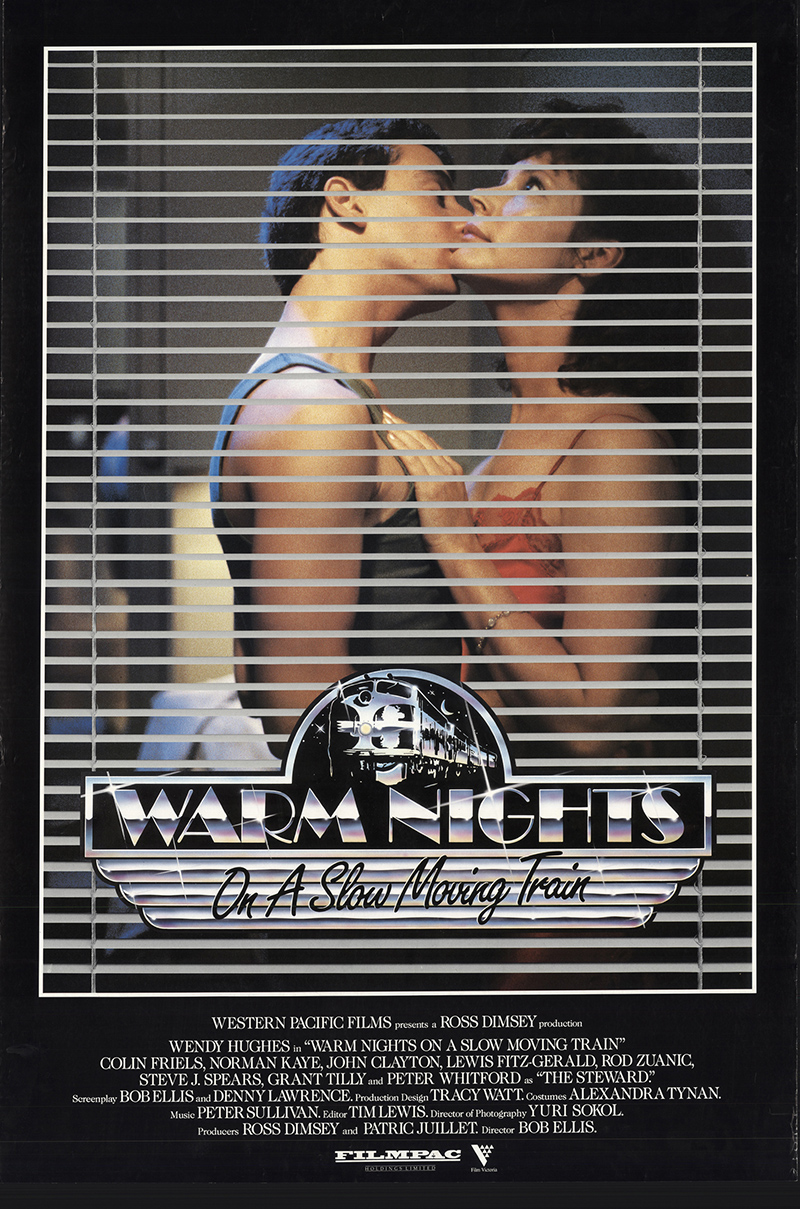
Jenny (Wendy Hughes) is an elementary catholic school teacher during the week, but on weekends she’s a prostitute riding a train that travels across the Australian countryside. She picks up lonely men that she meets at the train’s bar and takes them to her cabin for sex, but makes sure they’ve left by 3 AM. While she’s friendly and conversational with them during the night by the next day she virtually ignores them. She does this to help pay for her handicapped brother’s needs and for many years she’s able to juggle these dual lifestyles without much of a hitch. Then she meets a suave businessman (Colin Fields) who gets her involved in an assassination plot that not only disrupts her routine, but sends her precariously close to losing her freedoms.

Director Bob Ellis said the idea for the film was inspired by a long train ride that he took with actor Denny Lawrence and the two wrote the script during the duration of their trip. In order to get the needed funding it was contingent that Wendy Hughes be cast in the lead, which Ellis felt was wrong for the part, but eventually agreed to simply to get the film made. Ultimately though he and the film’s producer, Ross Dimsey, had a different vision for the story and Dimsey greatly trimmed the final cut turning what Ellis felt was one of the best scripts he had ever written into something he would later disown. The full director’s cut had been stored at his residence and he was hoping to eventually release it to the public, but it got destroyed during a house fire.

The version definitely has issues with the biggest one being the slow, plodding pace. I was also disappointed that it starts with Jenny already a seasoned hooker as I would’ve been more interested in seeing how she came up with the idea and seen the awkward moments she most assuredly would’ve gone through when she first jumped in and did it. The fact that she had no ‘Plan-B’ for the potential times when a male client might get aggressive, or not promptly leave at the agreed to time, was a weak point for me. There’s one scene where one of her johns follows her out of the train and won’t leave her alone, but she calls out to a nearby security officer to get him away from her, but if she’s a seasoned sex worker she should have another line of self-defense to use, like a gun or something, to take out if things got out-of-control and no one else was around to help her and the fact that she doesn’t have this makes it seem like she’s not as streetwise as we’re supposed to believe.

Having Jenny suddenly let down her guard and fall for one of her johns (Colin Friels) didn’t make much sense either. After years of being defensive around her clients why now get all emotional about this one who comes-off just as sleazy and aggressive and just as potentially dangerous? The assassination subplot doesn’t get introduced until 60-minutes in and the way she’s able to off the target by simply scratching the guy lightly on his back with a fingernail dipped in poison seemed much too easy.

I did like the juxtaposition of a catholic school teacher being a prostitute, but the film doesn’t explore this contradiction enough. You’d think after having done this for a long time her superiors might catch-on, or have it filter back to them, which could’ve created more conflict and added tension to a story that for the most part is too leisurely paced to hold one’s sustained attention.

My Rating: 4 out of 10

Released: May 10, 1987

Runtime: 1 Hour 31 Minutes

Rated R

Director: Bob Ellis

Studio: Filmpac Distribution

Available: dvdlady.com

The Blockhouse (1973)

blockhouse2

By Richard Winters

My Rating: 6 out of 10

4-Word Review: There’s no way out.

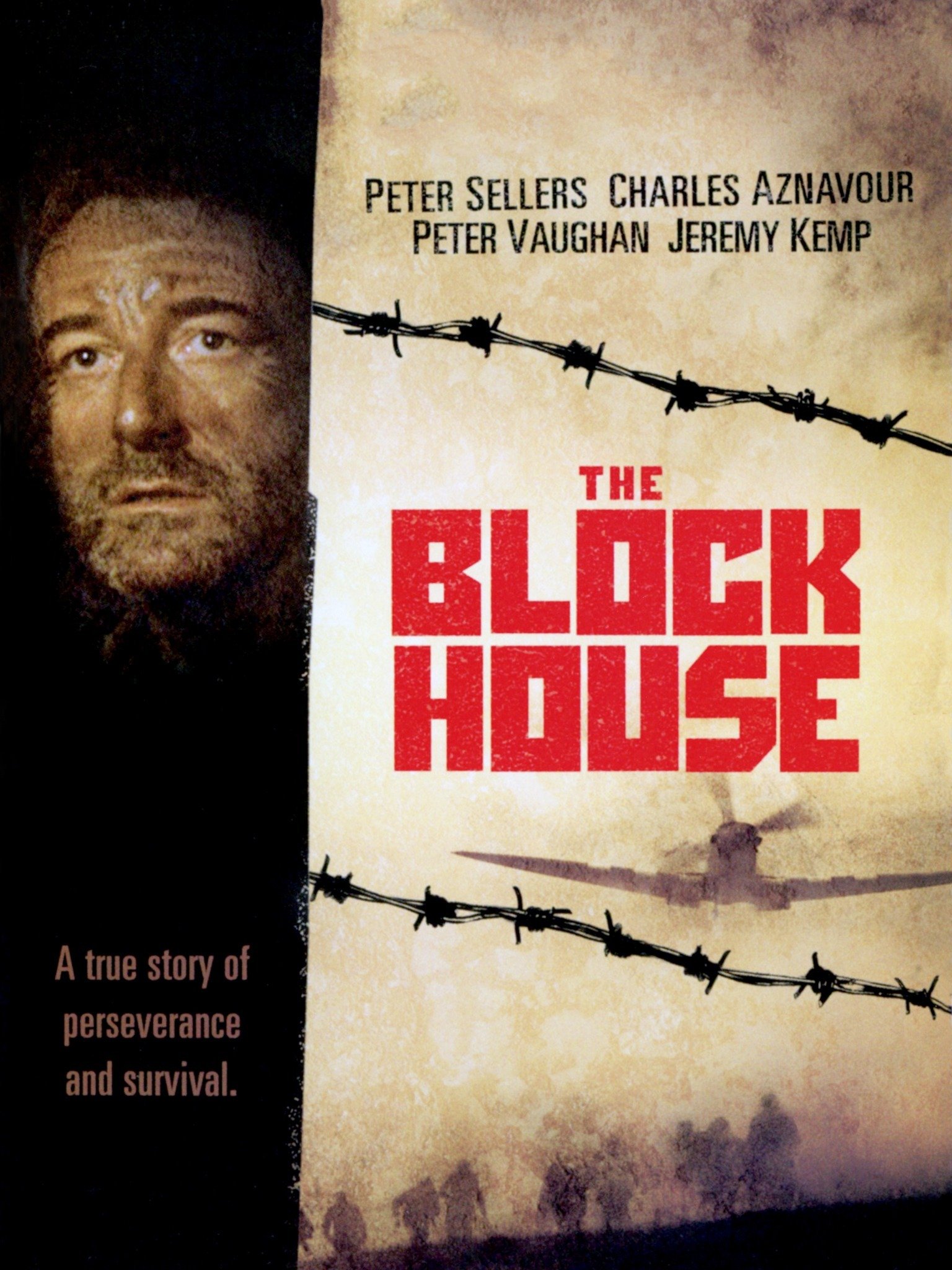
On D-Day a group of war prisoners on an island that’s run by German soldiers seek shelter from an allied air attack by finding refuge in an underground German bunker, but once inside, they realize to their horror that the shelling outside has blocked-off both the entrance and exit, which essentially traps them in permanently. They are fortunate enough to find a supply room full of enough food and wine to keep them fed for a long time, but as the days wear into weeks and then months and even years they grow tired and despondent about their situation. They try to find ways to break through the cement walls, but their attempts prove futile, which leads all of them into a mental and emotional breakdown.

The film is best known as being one of Peter Seller’s rare dramatic turns where he plays a character that is not funny or colorful. Normally his performances are quite flamboyant and over-the-top and he tends to dominate the spotlight, but here he blends in with the rest of the performers with a rare low-key portrayal that is quite impressive when given how he normally acts. This was yet another project he got involved in during the early 70’s when his career was on the down side and he was desperately taking just about any offer that came along, no matter what the quality, in an effort to bring in money. While some of those movies that he starred in during that period were truly awful (i.e. Where Does it Hurt?) this one, despite its grim theme, is unique and worth checking out particularly for those who enjoy experimental cinema.

The film was directed by Clive Rees, whose only other cinematic directorial effort was When the Wales Came, which had a similar theme about an eccentric man living an isolated existence on an island. While Rees is not as well known as Stanley Kubrick, Sellers insisted in interviews, that he was ‘every bit as good’.  While this statement may seem like an exaggeration I was quite taken aback by the gritty realism and the way the viewer feels just as trapped as the victims. The actors give all-around great performances and you see their character’s ultimate mental decline happen right before your eyes, which is both vivid and gut-wrenching. The story also looks at all aspects of their deterioration where they start to do things they had never done before including conveying certain homo-erotic elements. While none of this gets shown I was still impressed that it at least got lightly touched-on as I feared due to the period and heavy UK censorship, where this film was made, that would be one facet that couldn’t get introduced, but ultimately in a soft way it does.

If you’re looking for an entertaining crowd pleaser than this movie won’t be it. As Sellers rightly stated in his interview it’s meant for serious ‘connoisseur’s of cinema’ only. TV Guide complained that the film in their review ‘goes nowhere’ and it doesn’t reveal a ‘metaphysical reason’ for the character’s predicament, but I really didn’t think one was needed. Sometimes shit just happens and people must learn to adapt to their new harsh reality, or fall apart and in that vein I felt the movie does an excellent job and goes much further into this dark, murky psychological realm than most others would dare.

Spoiler Alert!

The story is based on the 1955 novel of the same name by Jean-Paul Clebert, who also coincidentally lived an isolated existence for many years in an abandoned village. The novel is loosely based on the actual incident that occurred on June 25, 1951 when two German soldiers in Poland were rescued from an underground shelter that they had been trapped in for 6 years. The difference is that in the movie we never see the rescue as it ends with the remaining two survivors stuck in total darkness when the last of their candles goes out. I felt it would’ve worked better had the rescue been shown as well as a better build-up where we would’ve gotten to the know the men better in the prison camp before they were forced underground, which would’ve made their mental declines even more interesting.

My Rating: 6 out of 10

Released: June 1, 1973

Runtime: 1 Hour 33 Minutes

Rated R

Director: Clive Rees

Studio: MGM

Available: DVD, Amazon Video, Tubi

Last Tango in Paris (1972)

lasttango2

By Richard Winters

My Rating: 7 out of 10

4-Word Review: Sex without knowing names.

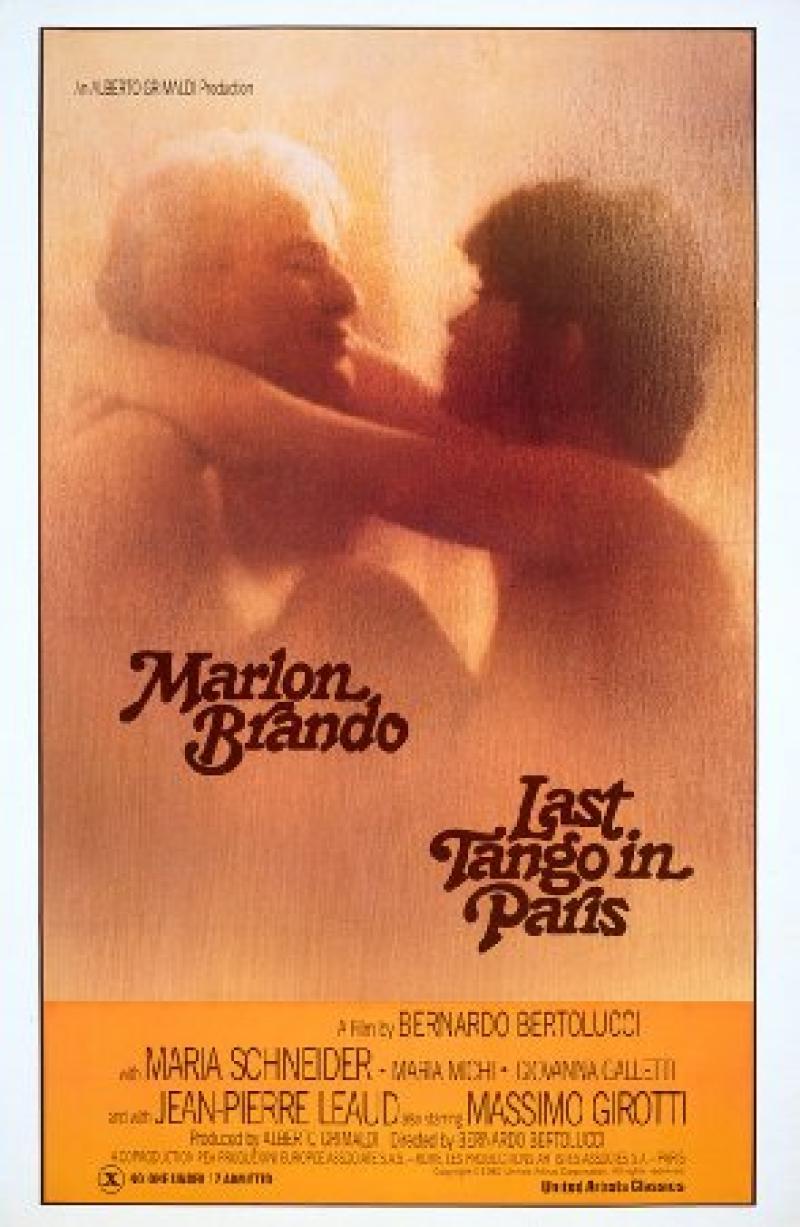
Paul (Marlon Brando) is a middle-aged American man living in Paris who’s despondent over his wife Rosa’s recent suicide. Feeling alone and without direction he meets up with Jeanne (Maria Schneider),a much younger woman, while both are looking to rent the same apartment. Jeanne is dating Thomas (Jean-Pierre Leaud) a filmmaker who wants to film her life and make it into a movie, which Jeanne is not so keen about. Despite not knowing Paul’s name, as he wants their identities to remain a mystery, she gets into a torrid sex affair with him and finds Paul’s evasive manner to be both frustrating and intriguing. However, after he rapes her he disappears and Jeanne considers their relationship over, but Paul meets her on the street a few days later, but this time he tells her all about himself, but hearing the sad details of his lonely life makes him less appealing to her. She tries to get away from him, but Paul continues to pursue her, which ultimately leads to tragedy.

The film is probably better known for the controversy and scandal it caused upon its release than anything else. While some of its sexual aspects will seem somewhat tame by today’s standards back in 1972 it became a hotly contested commodity where the government in Italy openly banned the film and ordered all copies of it seized and destroyed while also revoking director Bernardo Bertolucci’s right to vote for 5 years. Residents of Spain, where the film was also banned, would travel hundreds of miles to the French border just so they could see the film that everyone was talking about. In the US the controversy was no different with conservative pundits labeling it ‘pornography disguised as art’. In Montclair, New Jersey residents tried to physically block movie goers from going in to see the film by forming a human chain in front of the theater and those that were able to break through got labeled as being ‘perverts’.

Today the most controversial aspect are Maria Schneider’s accusations that the infamous ‘butter scene’ where Brando rapes her anally while using butter as a lubricant was not planned nor scripted and the she was taken by complete surprise. In a 2013 interview Bertolucci admits that Maria did not know the details of the scene ahead of time and this was intentional in order to capture the genuine look of shock on her face. While Bertolucci says he does not regret doing the scene he still felt bad for Maria, who maintained up until her death in 2011, that she had been both ‘violated’ and ‘humiliated’ and never spoke to Bernardo afterwards.

As for the film itself it’s interesting on a technical end, I particularly enjoyed its fragmented/dream-like narrative, but it also comes-off as being a bit overrated. It was based on Bertolucci’s own sexual fantasies regarding his desire of picking-up a young, beautiful woman off the streets and having a passionate sexual affair with her without ever knowing her name, or having any responsibilities or obligations attached to it, which is certainly an intriguing idea for a script, but the way the two come together seemed just a bit too rushed and unrealistic. Brando, who never bothered to memorize his lines and ad-libbed most of it, seems to be playing himself as he displays the same moody, self loathing quality that he also conveyed in every interview I’ve seen him in making it less about creating a character and more just him showing his true nature. Schneider is the best thing about the movie, as is the scene where the two disrupt a tango dance contest, but ultimately the film leaves one with a dark, depressed, and dismal feeling after it’s over.

My Rating: 7 out of 10

Released: October 14, 1972

Runtime: 2 Hour 10 Minutes

Rated NC-17

Director: Bernardo Bertolucci

Studio: United Artists

Available: DVD, Blu-ray, Amazon Video, Pluto TV, YouTube