Category Archives: Farce

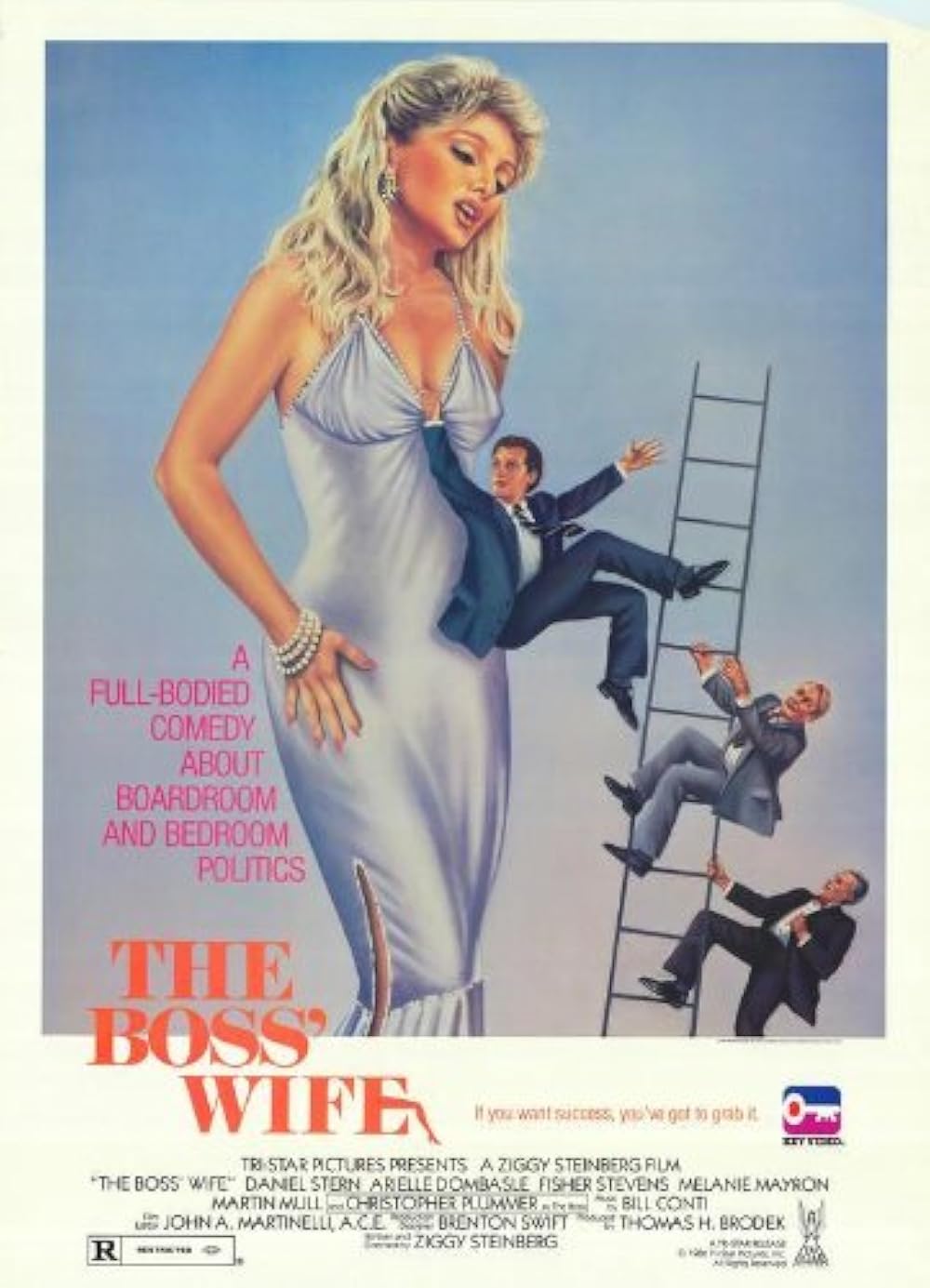
The Boss’ Wife (1986)

By Richard Winters

My Rating: 3 out of 10

4-Word Review: She comes on strong.

Joel (Daniel Stern) works at a stock firm and wants to impress his boss (Christopher Plummer) with some stock analytics and competes with fellow employee Tony (Martin Mull), who’s a major corporate brown noser. The boss though is not the smartest and misreads everything including thinking that Joel is a smoker, which he isn’t, and giving him the nickname of ‘smoky’. He also thinks that Joel is gay and having a fling with Carlos (Fisher Stevens), which neither is true, but this allows the boss’ wife Louise (Arielle Dombasle) to openly come-on to Joel while the boss, so worried that Joel may come on to him, feigns naivety at what his own wife is doing. Joel tries to avoid the woman because he fears that if he doesn’t, he’ll get caught, which will not only hurt his job advancement, but also his shaky marriage to Janet (Melanie Mayron). 

The film is the product of Ziggy Steinberg who started his careers in the 70’s writing for episodes of TV-shows and then graduating to feature films like Porky’s Revenge and then ultimately Another You, which to date has been the last writing gig he’s done. This film marked his debut as both a writer and director, but the results are so-so. The concept is predictable and better suited for an episode of ‘Three’s a Company’, which he also wrote for, than the big screen. While the attempt is for screwball the pacing is slow and not a lot of gags going on and as satire/parody its target is so obvious and been done so many times before that it hardly seems worth the effort as one could simply watch How to Succeed at Business Without Really Trying and get a lot more laughs. In fact, the only amusing moment comes when Plummer has a toy choo-choo train ride onto his desk carrying drinks and hamburgers and then Stern fumbling around to get ketchup on his burger, which causes a red mess on the boss’ desk.

The acting from the two male leads is adequate. Stern’s character is benign, but he plays it in a likable way making you connect to him and his quandaries. Plummer is quite good particularly with the way he roles his blue eyes every time he comes to a mistaken conclusion to something. Stevens has some good crude moments who initially starts out as Mayron’s employer only to create a haphazard buddyship with Stern while on the train. 

Dombasle though is quite possibly the film’s weakest link. She enters in almost like a fantasy figure and has little dialogue. Why this voluptuous woman would get so focused on Stern for no apparent reason doesn’t make a lot of sense. He does not stand out in any way and therefore a woman like her would overlook and even ignore him. She comes onto him in such a shameless and extreme manner even while in public you could argue she was mentally ill. Even if she’s desperate for sex cause she’s not getting enough from her older husband she could still, with her money, find ways to get it, through like male escorts, than groveling in such a ridiculous level towards a chump like Stern. Later it does come out that she is ‘attracted to men who resist’, which helps explain her motivations a little, but it would’ve been more entertaining had the Mull character paid her, or worked out some deal with her, to come onto Stern in  order to get him into trouble with Plummer, which would’ve offered a nice unexpected twist, which unfortunately the script doesn’t have. 

Spoiler Alert!

The final 10-minutes in which Plummer corners Stern in his rental home with both his wife and Stern’s and the myriad excuses Stern comes up with to try and get out of the jam is sort of funny, but it takes too long to get there. That frantic, hyper-pace should’ve been present from the very beginning and it just isn’t. Stern’s character arc where he finally concludes that the company culture is too conform-ridden for his liking is strained as well. If anything, he should’ve figured that out long before he goes to a company party and asked to where a silly hat like everyone else, which was one of the least problematic things at that place and yet this is where he suddenly decides to ‘draw-the-line’. 

My Rating: 3 out of 10

Released: November 7, 1986

Runtime: 1 Hour 23 Minutes

Rated R

Director: Ziggy Steinberg

Studio: Tri-Star Pictures

Available: DVD-R, Amazon Video, YouTube
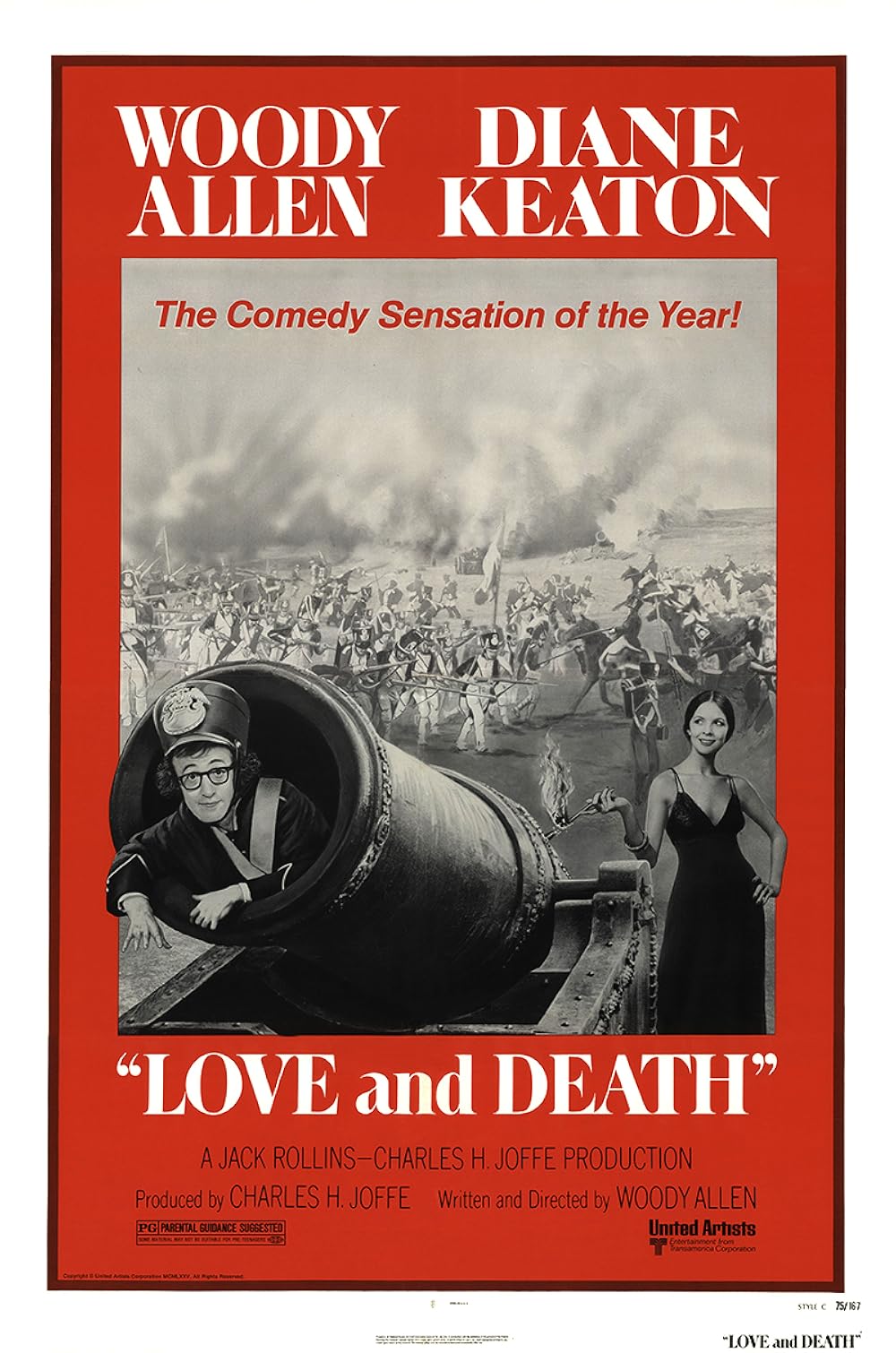
Love and Death (1975)

By Richard Winters

My Rating: 5 out of 10

4-Word Review: Attempting to assassinate Napolean.

Boris (Woody Allen) is a scrawny guy who gets overlooked by others as his three brothers tower over him. He’s secretly in love with Sonja (Diane Keaton) who he’s been friends with since childhood, yet she’s instead infatuated with Ivan, one of Boris’ brothers. However, none of his brothers are into her, so she marries someone else while Boris remains a bachelor who occasionally fools around with beautiful women like a Countess (Olga Georges-Picot), which causes her lover Anton (Harold Gould) to challenge Boris to a gun duel. Thinking Boris won’t be able to survive the dual Sonja agrees to marry him if he survives, which he miraculously does. Once married they then concoct a plan to assassinate Napolean (James Tolkan) unaware that who they’re really going after is actually an undercover double.

Allen was in the midst of writing a screenplay dealing with a New York couple who try to solve a murder, which became Manhattan Murder Mystery, but was going through a writer’s block, so he began reading a novel about Russian history, which then inspired him to write this script. Since it was nearing the deadline to have a script ready for production, he decided to submit this one, which immediately went into filming while the other one didn’t end up getting completed until 1993.

Many critics and fans at the time liked this one and it ended up making $9 million at the box office off of a $3 million budget with Gene Siskel especially enjoying it as he gave it 4 stars while commenting that he liked Allen’s return to a ‘gag driven dialogue’ versus ‘attempting to develop a story’, but personally for me I felt this was what was wrong with it. While it does start out funny as it parodies 18th Century Russian society and has one really great bit dealing with a ‘hygiene play’ warning soldiers about VD and condoms it does tend to meander quite a bit. The middle part is the most sluggish with many of the gags falling flat almost like he’d run out of ideas and was just trying to desperately throw anything in to keep it going making it come off more like an unending skit instead of a movie.

Allen’s presence while amusing most of the way becomes a bit of a detriment. Much of this can be blamed on the fact that he’s playing essentially the same character that he does in all of his movies. Case in point comes at the beginning before he officially says anything on screen and I thought to myself I bet he’s going to mention something about atheism and sure enough that’s exactly what he does talk about making it predictable and redundant. Would’ve been nice for irony’s sake had he played someone who had a deep belief in God only to lose his faith after he goes through the war, which would’ve created a nice character arc of which there really isn’t one.

There’s also the issue of him having no Russian accent nor making even a slight attempt at one. Granted Keaton doesn’t speak in an accent either though maybe you can chalk it up to her great acting that she still seems of the period anyways while Allen very much comes off like someone who doesn’t really belong there. He repeatedly makes anachronistic statements, which from time to time are amusing, but technically don’t fit within the setting. It actually would’ve made more sense to have Allen simply be a modern-day New Yorker who finds a time machine and gets zapped away into 18th Century Russia and then wanders around making comments about things, which wouldn’t have disrupted the film all that much and besides adding one little scene at the beginning showing him going into the time travel contraption there wouldn’t have needed to be anything else changed. It literally would’ve been the exact same movie and in some ways been a lot funnier, and perceptive, because of it.

It does end on a strong note as it pokes fun of Ingmar Bergman movies and even has Jessica Harper showing up. Yet I still felt most of the way it throws in whatever it can for a cheap laugh with much of the jokes, particularly in the middle, not really landing. Many fans didn’t like the way Allen crossed over to doing drama just a few years later, but after watching this I started to believe he had used up all of his comical concepts that by this time was just repeating itself and thus his foray into more serious subjects was inevitable.

My Rating: 5 out of 10

Released: June 10, 1975

Runtime: 1 Hour 25 Minutes

Rated PG

Director: Woody Allen

Studio: United Artists

Available: DVD, Blu-ray, Amazon Video, YouTube

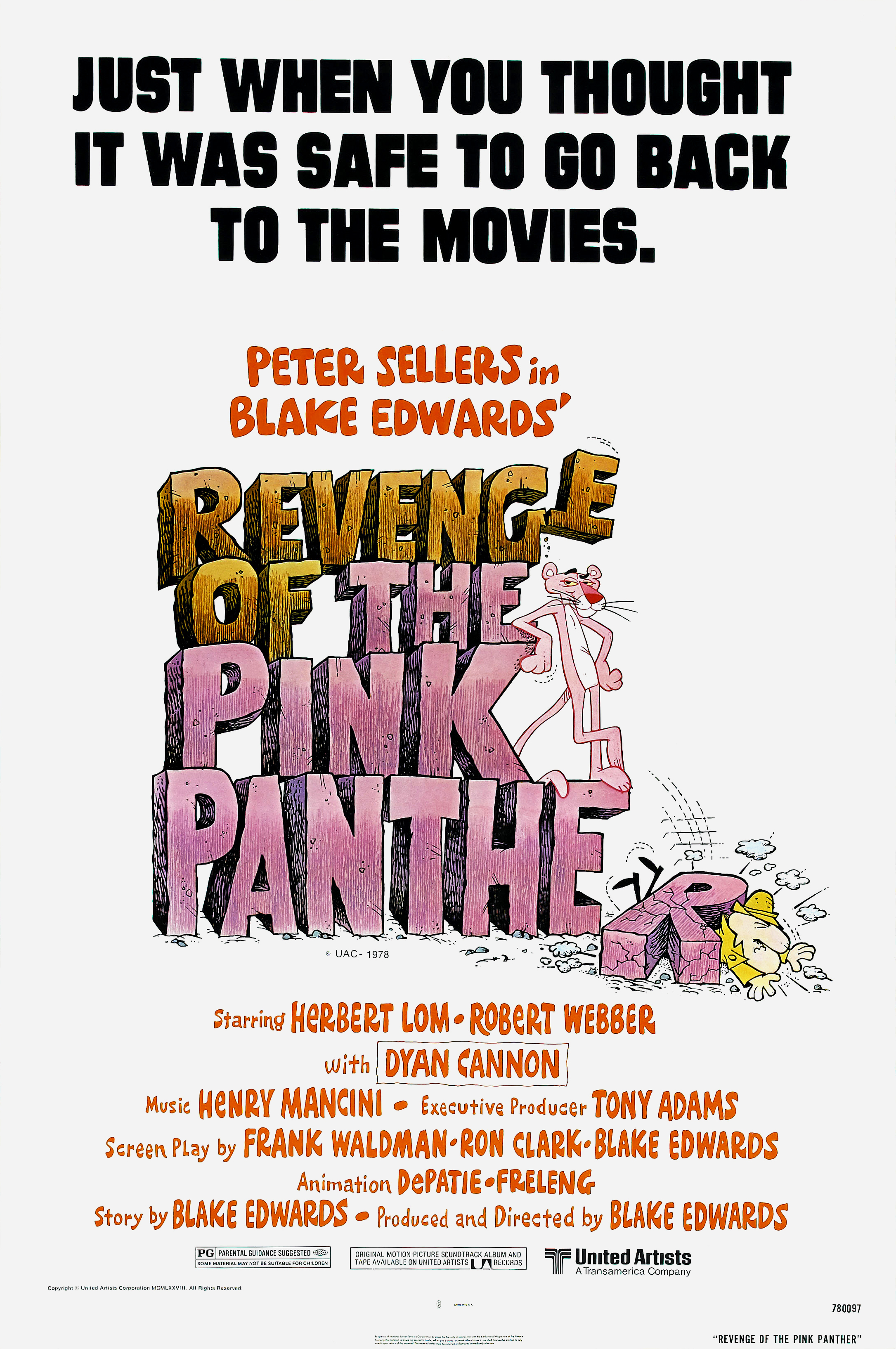
Revenge of the Pink Panther (1978)

By Richard Winters

My Rating: 6 out of 10

4-Word Review: Out to get Clouseau.

Philippe (Robert Webber) is a successful businessman who’s secretly the head of the French criminal underground. Some though are questioning his leadership considering him to be too weak to remain in that position. In order to squash the impending threat, he decides to make a bold move by having Inspector Clouseau (Peter Sellers) killed. Clouseau was considered a master detective by the outside world and only known to be an incompetent by those who worked with him, so by having him out of the way the drug dealers would feel relieved and thus Philippe would remain in power. However, things don’t get as planned as Clouseau manages to miraculously evade all attempts on his life. The media though mistakenly announces that he has died, which allows Clouseau to go undercover along with his manservant Cato (Burt Kwouk) to find out who’s after him.

This marked the fifth entry in the series and is probably the funniest. Initially director Blake Edwards had wanted to reuse footage that had been cut from the previous entry and then film new scenes around those, but star Sellers insisted he wanted an all-new story and that was probably for the best. Sellers by far gets the most laughs whereas in the one that came before this, The Pink Panther Strikes Againit was Herbert Lom as the unhinged Dreyfus, that was the most memorable, but here his part becomes much more benign, though he still gets one good scene where he tries not to breakout laughing while giving a eulogy at Clouseau’s funeral. Sellers though comes out on top here especially in his disguises like when he pretends to be a sea captain with an inflatable parrot on his shoulder, or in a hilarious send-up as a Mafia Don.

It’s great to see Kwouk, who was usually relegated to the ‘fight’ scene between him and his boss Clouseau, become more involved in the story, as the two go to Hong Kong in disguise to track down the bad guys. Dyan Cannon is a refreshing change of pace. Usually, the women in these films were young models whose sole purpose was to allude sex appeal, but here she’s middle-aged, but still attractive, and shows much more of a feisty personality. She helps build a strong secondary character and is better interwoven into the plot versus simply appearing as a potential romantic interest.

Webber though as the main villain is a detriment. I have no doubt that the notoriously insecure Sellers didn’t like the way Lom stole the film as the nemesis in their last outing and wanted to make sure that didn’t happen again. Not only is the Dreyfuss character far more neutered, but so is Webber making him seem like he’s almost sleepwalking through his role. It would’ve been more interesting had his character has some personal vendetta against Clouseau, possibly because it was Clouseau who had sent him, or one of his men to jail, and now he wanted revenge. Just having him out to get Clousau because it might bolster his own image didn’t seem to be enough of an incentive and the two, outside of one comic moment where Clouseau’s is in one of disguises, never have any ultimate confrontation. Watching him get chased around his desk and cower from Dyan Cannon may have been intended as funny, but it just further erodes his villainy making him seem even more impotent than he already is. Even a comedy still needs a bad guy that can elicit some tension and this one doesn’t.

The implementation of Mr. Chong, played by martial arts instructor Ed Parker, has potential. Supposedly he’s an ‘invincible’ fighter that can beat-up anyone and not be stopped as proven when he takes down several other men while in Webber’s office but then he gets comically defeated once he comes into contact with Clouseau. While watching him go through the floor/ceiling of several apartments below as he crash lands is visually funny it would’ve been more engaging if he had come back at some point and continued his relentless attack on Clouseau albeit with injuries in order to reclaim his reputation that he couldn’t be defeated, but in the process just became more hurt and ineffective.

Spoiler Alert!

The climactic sequence that occurs in Hong Kong is a cop-out and comes-off like they’d run out of ideas, so they tried to save it with a calamity filled chase that plays more like a cartoon, or something better suited for a live action Disney movie. Introducing yet another Mafia boss, this one played by Paul Stewart, makes things too cluttered and there should’ve been just one main bad guy that was the boss of everyone. The finale inside a firecracker factory should’ve proven dangerous and in fact we do see the entire place explode from a distance and yet everyone comes out of it unscathed, which doesn’t exactly make a lot of sense.

My Rating: 6 out of 10

Released: July 20, 1978

Runtime: 1 Hour 39 Minutes

Rated PG

Director: Blake Edwards

Studio: United Artists

Available: DVD, Amazon Video, YouTube

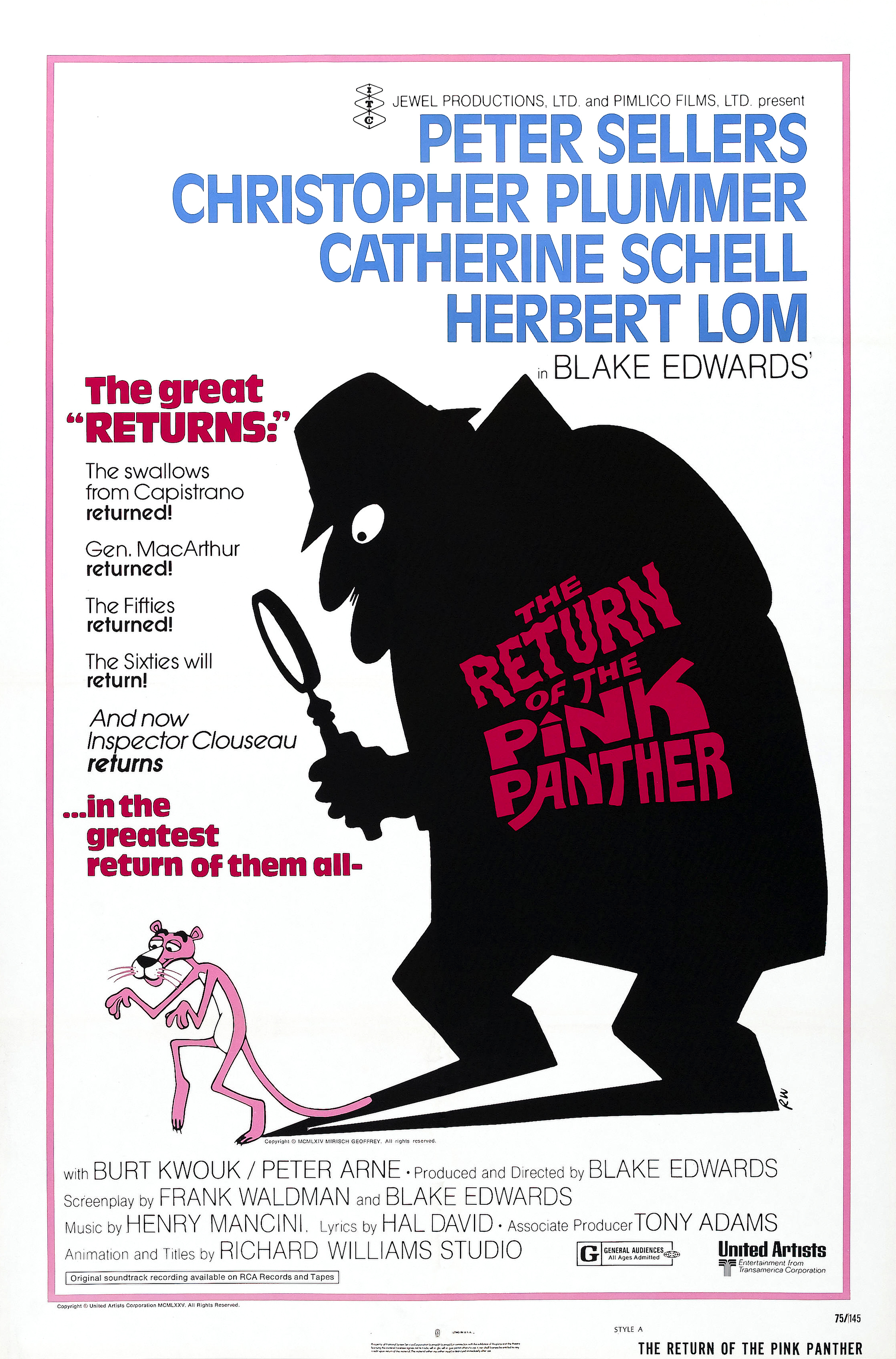
The Return of the Pink Panther (1975)

By Richard Winters

My Rating: 7 out of 10

4-Word Review: Tracking down stolen diamond.

Inspector Clouseau (Peter Sellers) has been demoted to street cop by Chief Inspector Dreyfuss (Herbert Lom) due to Clouseau’s continual incompetence, which is starting to drive Dreyfuss completely mad. However, inside the country of Lugash a prized diamond known as the Pink Panther is stolen and since Clouseau had success retrieving it the first time it went missing during a heist he is put on the case to find it again much to Dreyfuss annoyance. Clouseau suspects that the culprit is Charles Litton (Christopher Plummer), who is a notorious thief. Clouseau attempts to use several different disguises in order to infiltrate Litton’s home that he shares with his wife Claudine (Catherin Schell) in order to find incriminating evidence against Litton so that he can turn him in, but his attempts to try and a take Litton down prove to be comically inept. 

This marked the fourth installment of the Pink Panther series and the first in 10-years that reunited writer/director Blake Edwards with Sellers. Both had said after doing the second film A Shot in the Dark, that they never wanted to work with the other again due to much infighting during the production, but both had since then fallen on hard times. Edwards was by the early 70’s considered box office poison after the colossal failure of Darling Lilli which managed to recoup a measly $3 million from a $25 million budget and his other films from that era Wild Rovers and The Carey Treatment hadn’t done much better. Since Pink Panther had been his last success, he was interested in reviving it and even wrote up a 14-page treatment but found no takers amongst the major studios. Then producer Lew Grade agreed to finance it in exchange for Edward’s wife Julie Andrews agreeing to star in a British TV-special that he wanted to produce. Since Sellers career had also bottomed out, he came onboard to most everyone’s surprise without much hassle.

The film was shot in many scenic locations including Morrocco giving the optics an exotic flair and the proceedings a sophisticated European vibe making it seem like a step-up from just a silly comedy. In the first two installments all the characters were written to be funny and goofy particularly the second film, which had been based on a stage play. Here though the comedy is wisely given over to Sellers while the couple he’s after remain savvy, which makes it more intriguing as you want to see how this inept idiot takes them down, or is able to trip them up at their own game. I also liked how funny bits are interspliced with some legitimate action, especially the opening scene that features the heist, which could’ve easily fit into a realistic film dealing with a robbery. These moments help add a bit of relief from all the laughs, a sort of chance to catch your breath, while making the plot seem like it’s not just all about being a farce.

Lom adds terrific support as Clouseau’s exasperated supervisor, and his assertive acting style works nicely off of Sellers clownish one making the interplay between the two a highlight. It’s good too that Plummer replaced David Niven, who played the character in the first one, but wasn’t able to do it here due to scheduling conflicts, as Niven would’ve been too old and not plausible to have outrun the bad guys like Plummer does. 

My only issue is that Claudine is shown attempting to hold in her laughter at Clouseau right from the start like she knows he’s an idiot before she even met him, but this goes against the premise. Clouseau is considered an accomplished detective by the outside world hence why he was selected to head the case and it’s only the people that work with him and know him who are aware of his ineptness. This is the whole reason why Dreyfuss gets driven mad by him because the rest of the world celebrates the man that he knows is really a fool, so Claudine should’ve initially thought of him as being sharp and only came to the conclusion he was incompetent by the end after having dealt with him. It actually would’ve been funnier had she and Charles feared Clouseau upfront having believed his celebrated reputation and misreading his bumbling as being ‘genius’ ploys and remained that way throughout. In either case seeing her covering her mouth and shielding her giggles makes almost seem like she’s falling out of character and a blooper, similar to how Harvey Korman would unintentionally crack-up during Tim Conway’s antics on the ‘The Carol Burnett Show’ and for that reason it should’ve been avoided. 

My Rating: 7 out of 10

Released: May 21, 1975

Runtime: 1 Hour 54 Minutes

Rated PG

Director: Blake Edwards

Studio: United Artists

Available: DVD, Blu-ray, Amazon Video, YouTube

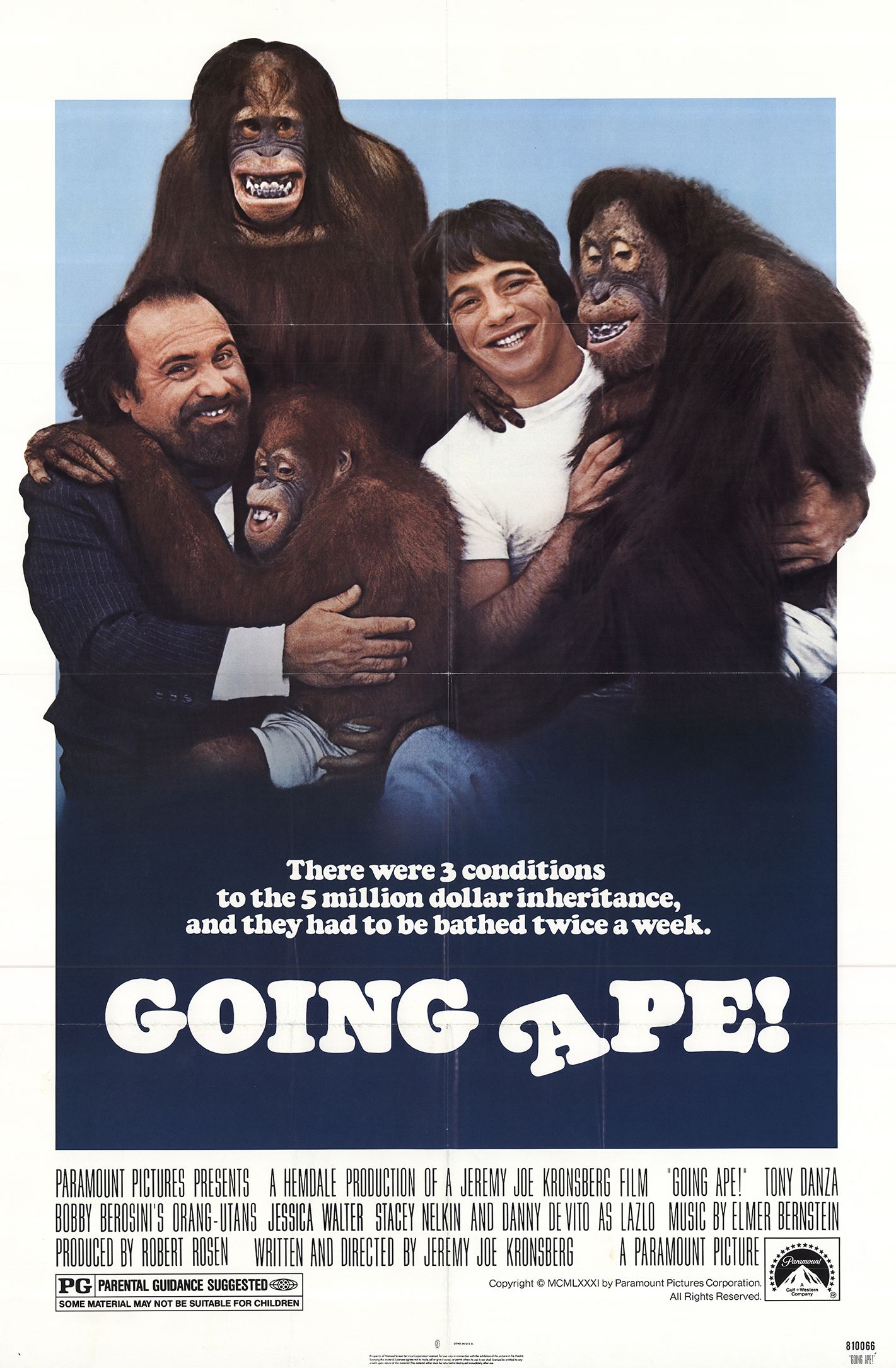
Going Ape! (1981)

goingape

By Richard Winters

My Rating: 0 out of 10

4-Word Review: He inherits three orangutans.

Foster (Tony Danza) is an outcast in his family because when he grew up, he did not get involved in the family’s circus business. Now that his father has died, he’s set to inherit nothing and everything left to his greedy sisters, at least that’s what he presumes. Instead, he’s given custody of three orangutans that were part of his father’s circus business. If he can care for them for 5-years and none of them dies he’s set to inherit the $5 million estate. Foster takes on the challenge, but his live-in girlfriend Cynthia (Stacey Nelkin) doesn’t care for it and moves-out while Foster spends the rest of the time trying to win her back. He also becomes menaced by a couple of mafia-styled hitmen (Art Metrano, Frank Sivero) who want to kidnap the apes and do harm to them because if just one of them dies then the entire fortune would go to the zoo.

In 1977 Jeremy Joe Kronsberg was a struggling writer who had only one writing credit to his name, penning an episode to the short-lived series ‘Code R’. He sent out a script called Every Which Way But Loose, that all the studios rejected it as they considered the storyline and comedy be inane and silly. However, by chance Clint Eastwood came upon it and to the surprise of many decided to take it on as his next vehicle. He had been looking to do a comedy in order to broaden his appeal and thought this script would achieve that despite the advice from his agent and production staff who all insisted it would be a bad idea. The movie managed to make a ton at the box office, which convinced Hollywood studio heads and producers alike that maybe this Kronsberg guy, which they had all considered to be a hack writer, ‘had something’ that they just didn’t see and therefore his next script, no matter how bad it may seem, was going to be automatically green-lit and what’s more he’d even be given the offer to direct it.

It was like the Hollywood dream. The little guy that everybody thought had no talent was suddenly the overnight success story, but like with a lot of Hollywood dreams, it didn’t end so well. This movie became both a critical and box office bomb and lead any potential future offers that Kronsberg may have had thrown off the table. Though he’s still alive today, at the ripe old age of 87, he never got another script or teleplay sold and his entire Hollywood ‘career’ ended up being nothing more than a 3-year flash.

The film starts out alright. I actually chuckled at the Danza character cutting-off splinters from his wood desk and trying to sell it as pieces of Babe Ruth’s bat, but the quirkiness of the beginning gets overtaken by the orangutans, which I found ugly and obnoxious. Their rotted teeth alone are disgusting to look at and every time they open their mouths it’s more unsettling than peering into a hillbilly’s. They were trained  by then world famous Bobby Berosini, a Czech born immigrant who became a famous orangutan trainer that began to do stage shows with them in Las Vega during the 70’s, but then in 1988 a Vegas dancer secretly recorded him abusing the apes, including slapping and punching them, before going onstage and when it was sent to PETA it became available to the public and his career and image took a massive downfall.

The stupid villains, which are nothing more than a hammy, cliched send-up from the Godfather movies, are pathetic and the point where the movie really goes downhill. Their pratfalls are dumber than something you’d see in a kiddie flick and devolve the film into the inanest level possible. It’s also chillingly prophetic as Metrano, who plays the head-honcho, is seen twice falling from a lofty height including once out of high-rise window, which had a creepy similarity to his real-life accident in 1989 when he fell from a ladder and became paralyzed.

Danza is likable enough, but I found his character to be ridiculous with the way he put up with the apes even as they tore-up his apartment and kind of felt he should’ve given-up on them just like his girlfriend did and came to the conclusion the money wasn’t worth the hassle and just pawned them off on somebody else, or even given them away to the zoo who seemed so desperate for the fortune. Despite winning the Razzie award for his performance I really felt it was DeVito, who speaks in an accent, that was the scene-stealer and had he been made the star it might’ve worked better.

Nelkin is cute, so she gets a few points there, and Walter has great potential as her snobby mother, but unfortunately her services here get greatly misused as she soon sides with Danza and his cause instead of working against him and becoming the chief villainess of which she would’ve been great.

There are some reviewers on IMDb who proudly insist that this is ‘the greatest movie ever made’, but I feel they are either desperate for attention and will say any outrageous thing to get it, or haven’t seen any of the timeless classics, so that they really don’t know what they’re talking about. In either case this is a bad movie that will harbor very little enjoyment to anyone who sees it whether they’re young or old. Yes, there’s a big smash-up car chase at the end, but this is just thrown-in to camouflage the lack of originality in the story.

My Rating: 0 out of 10

Released: April 10, 1981

Runtime: 1 Hour 27 Minutes

Rated PG

Director: Jeremy Joe Kronsberg

Studio: Paramount

Available: Blu-ray, Amazon Video, YouTube

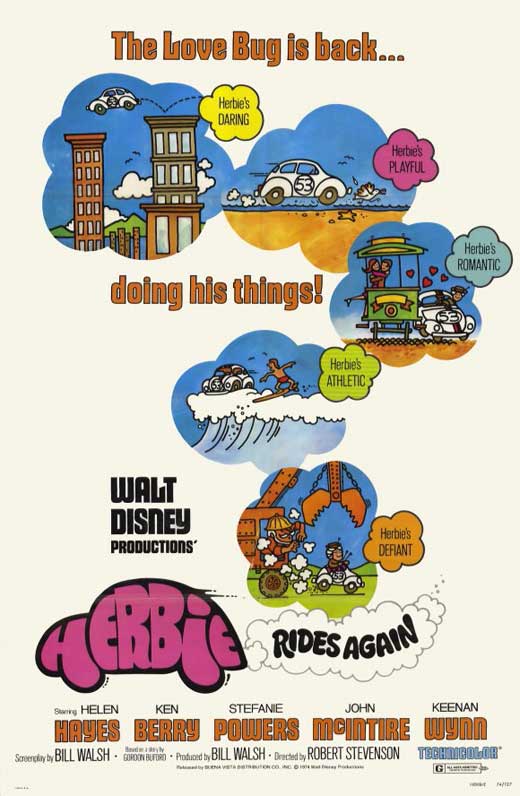
Herbie Rides Again (1974)

herbie1

By Richard Winters

My Rating: 3 out of 10

4-Word Review: Saving home from demolition.

Alonzo Hawk (Keenan Wynn) is a rich man who wants to build the world’s tallest sky scrapper on land that is currently occupied by a little firehouse built in 1892 and owned by an old lady named Mrs. Steinmetz (Helen Hayes). So far she’s refused all offers by Alonzo’s lawyers to sell, so Alonzo decides to have his nephew Willoughby (Ken Berry) go visit her as he has a very clean-cut image and hopes his nice-guy approach may be what it takes to persuade her. However, once he’s there he gets introduced by Mrs. Steinmetz former neighbor Nicole (Stefanie Powers) who’s now living with the old day due her place being demolished by Alonzo. When Nicole realizes Willoughby is related to Alonzo she immediately takes a disliking to him and even punches him in the face. Her feelings towards him though begin to change when she gives him a ride in the Volkswagen beetle that Steinmetz is taking care of for its owner while he’s away in Europe racing. Willoughby at first doesn’t believe that the car, who’s named Herbie, has a mind of its own, but soon realizes it does after his trip in it and this eventually gets him to side with Nicole and Steinmetz on the issue they’re having with his uncle and he begins fighting with the other two and Herbie to stop Alonzo from tearing the place down.

This was a rather odd idea for a sequel to the Love Bug that came-out 6 years earlier and had the VW Beetle involved in racing, but now apparently was ‘retired’ and no longer able to race effectively even though in the third entry to the series, which came-out 3 years later he does go back to racing.  The plot here though doesn’t really need the car involved to help propel it, yes the vehicle does ‘come to the rescue’ a few times, but the story could’ve easily worked with just the humans fighting Alonzo in various ways and would’ve been just as funny. To make-up for this the film does show archived footage, which goes on for several minutes, of the car ‘dreaming’ about it’s racing days though some of his race ‘victories’ could be called into question like when it decides to go off the racing track in one and cut through a forest and then back onto the track where it’s now at the front line of the other cars, which most would deem as cheating and not really an honorable win.

Overall though I really didn’t find any of the scenes with the car to be all that interesting. It’s hard to get emotionally attached to some machine that doesn’t speak, or show any expression and the only sign that it’s ‘alive’ is through its car stunts. The fact that it has seemingly no limits to what it can do, at least driving wise, I felt worked against it. To create even the modicum of suspense, or believability, there needs to be some rules to what it can and cannot do and yet here it defies all probability like driving on the side of cliffs without falling off, or being able to somehow pull vehicles, that are much bigger and weigh more, around like it does during a ‘tug-of-war’ scene with a cop car that’s attempting to tow it. It’s even able to smash through walls without receiving any damage to its front-end. I’m okay with the car having a certain ‘personality’, but when the car is able to get out of any predicament in a seeming magical way then there really isn’t any intrigue at all.

The acting by Hayes, Powers, and Wynn are good and I was especially impressed with Wynn’s ability to essentially shout out all of his lines in a consistently snarly way and yet never get any laryngitis and he certainly adds energy to all of his moments. Berry though is so vanilla that he’s just plain boring. It might’ve worked better had he remained loyal to his uncle longer, but he sides with the two ladies so easily that his character quickly becomes quite benign to the point that it would’ve been more interesting to have just the two women, and the car of course, fighting the bad guys and his presence excised from the script completely.

The nightmare segment where Alonzo dreams of being attacked by not only Herbie, but several clones of Herbie whose front hood opens up to reveal a mouth with giant teeth, which also includes a take-off of King Kong, where Alonzo is on top of the Empire State Building as he fights off the Herbie’s that are flying in a circle around him is genuinely inspired and the best part of the movie. Everything else though falls painfully flat including the cheap special effects where the exterior of the firehouse looks like it’s a painting on a back-drop, which I’m sure it was, or the scene where Herbie goes up the Golden Gate Bridge, which you can plainly tell was a miniature model matted onto a picture because as the car goes back down it starts to lose its pixelation and fade-out and disappear into thin air.

My Rating: 3 out of 10

Released: June 6, 1974

Runtime: 1 Hour 28 Minutes

Rated G

Director: Robert Stevenson

Studio: Buena Vista

Available: DVD, Blu-ray, Amazon Video, YouTube

Walk Like a Man (1987)

walk

By Richard Winters

My Rating: 1 out of 10

4-Word Review: Raised as a wolf.

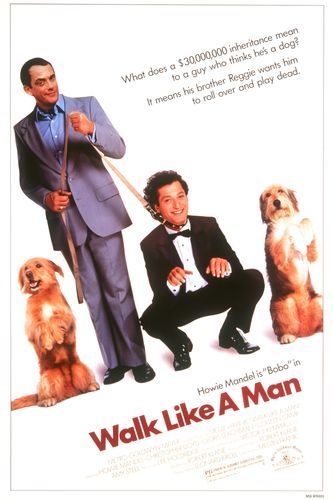
Henry (Christopher Lloyd) travels with his family to Alaska in the search of gold. His oldest son Reggie though doesn’t like the cold and so after finding his fortune Henry tells his family they’re leaving via a dog sled. Reggie is told that he’s now old enough to push the sled, which he doesn’t like, so when his father isn’t looking he hops onto the sled where his mother (Cloris Leachman) and younger 2-year-old brother, nicknamed Bobo, are. Bobo ends up getting pushed off the sled and lost in the icy wilderness where, despite the arduous search by his father who perishes while looking for him, is presumed dead. 28 years later a biologist named Penny (Amy Steel) comes across a man (Howie Mandel) with a pack of wolves. He gets identified through a tattoo as being the lost son and ‘returned’ to a now grown Reggie (Christopher Lloyd), his mother and Reggie’s wife Rhonda (Colleen Camp). Reggie has no interest in caring for his brother, who behaves like he’s a wolf, but because he’s squandered his father’s fortune and because Bobo was given a $30 million inheritance, Reggie agrees to let Penny teach him how to write, so he can ultimately sign over his money to Reggie.

The script was written by Robert Klane who burst onto the scene during the late 60’s with both ‘The Horse is Dead’, a highly irreverent, politically incorrect novel, but still quite funny, and ‘Where’s Poppa’, about a man trying to kill his senile mother. The latter got made into a movie, which was directed by Carl Reiner with the script written by Klane, that’s considered a landmark in dark comedy. So, how someone goes from doing stuff that’s highly inventive to this empty-headed, bare bones ‘comedy’ is hard to fathom, but the results are ‘blah’. The plot is threadbare and hinges on a lot of slapstick scenarios that prove to be predictable and overly-extended. Instead of picking up the pace, as a good comedic scene should, it saps the energy right out making the movie, as a whole, strained and boring.

The problems start out right away during the Alaska scene, which was clearly shot on a soundstage using fake snow, where the young Bobo falls off the sled, which if you think about it is quite horrifying as there is simply no way a toddler could survive in that climate. There’s no chance the wolves would ‘raise him’ either and instead would just eat him. Also, when he gets found by Penny he’s seen running around wearing a loincloth, but if he thinks he’s a wolf he shouldn’t be wearing anything at all just like the other wolves. Where did he find this cloth to wear, or did the wolves make that when they took up parenting him?

The running joke of Reggie’s neighbor, played by George DiCenzo, getting upset because Bobo keeps trampling through his freshly paved cement driveway, is overdone. The first time it happens it’s good for maybe a slight chuckle, but then several months later it goes back to Bobo doing it again, but the neighbor should’ve learned from the past and built a fence, or partition around the cement to prevent Bobo from going on it, or at the very least not be so shocked when the driveway gets ruined again since its already happened several times already.

The only interesting aspect is seeing Lloyd, who has later described this film as an ’embarrassment’, playing the lead. Usually he does likable, but eccentric character roles, so seeing him actually carry a film, which he does well despite the mess, is interesting and in fact he’s the only thing that gives it any energy and when he’s not in it it all falls flat. Mandel on the other hand isn’t dynamic enough to make his scenes work and his wolf routine is more tiresome than funny.

Leachman steals it as the mother with child-like instincts. She does have a few funny lines and her sitting with Bobo as Penny tries to teach him to read and write and her reactions to things being almost as clueless and fanciful is Bobo’s is definitely amusing. Steel, while quite bland, is good simply because she’s the only normal one in the movie, which when doing wacky comedies it’s nice to at least have one sensible person to help ground things.

I’ll give a point to the segment dealing with a trip to mall and the infamous sneezing scene, which did get me to laugh-out-loud, but everything else clunks badly. The final courtroom battle is especially cringey. Showing clips of ‘funny moments’ during the closing credits, which weren’t all that great when we saw them the first time, and acting like it’s some sort of ‘highlight reel’ just extends the pain further. If anything they should’ve shown bloopers and outtakes of the actor’s messing up their lines, which would’ve been funnier than hearing them speak the actual ones.

My Rating: 1 out of 10

Released: April 17, 1987

Runtime: 1 Hour 26 Minutes

Rated PG

Director: Melvin Frank

Studio: MGM

Available: DVD

One of Our Dinosaurs is Missing (1975)

one2

By Richard Winters

My Rating: 3 out of 10

4-Word Review: Nannies to the rescue.

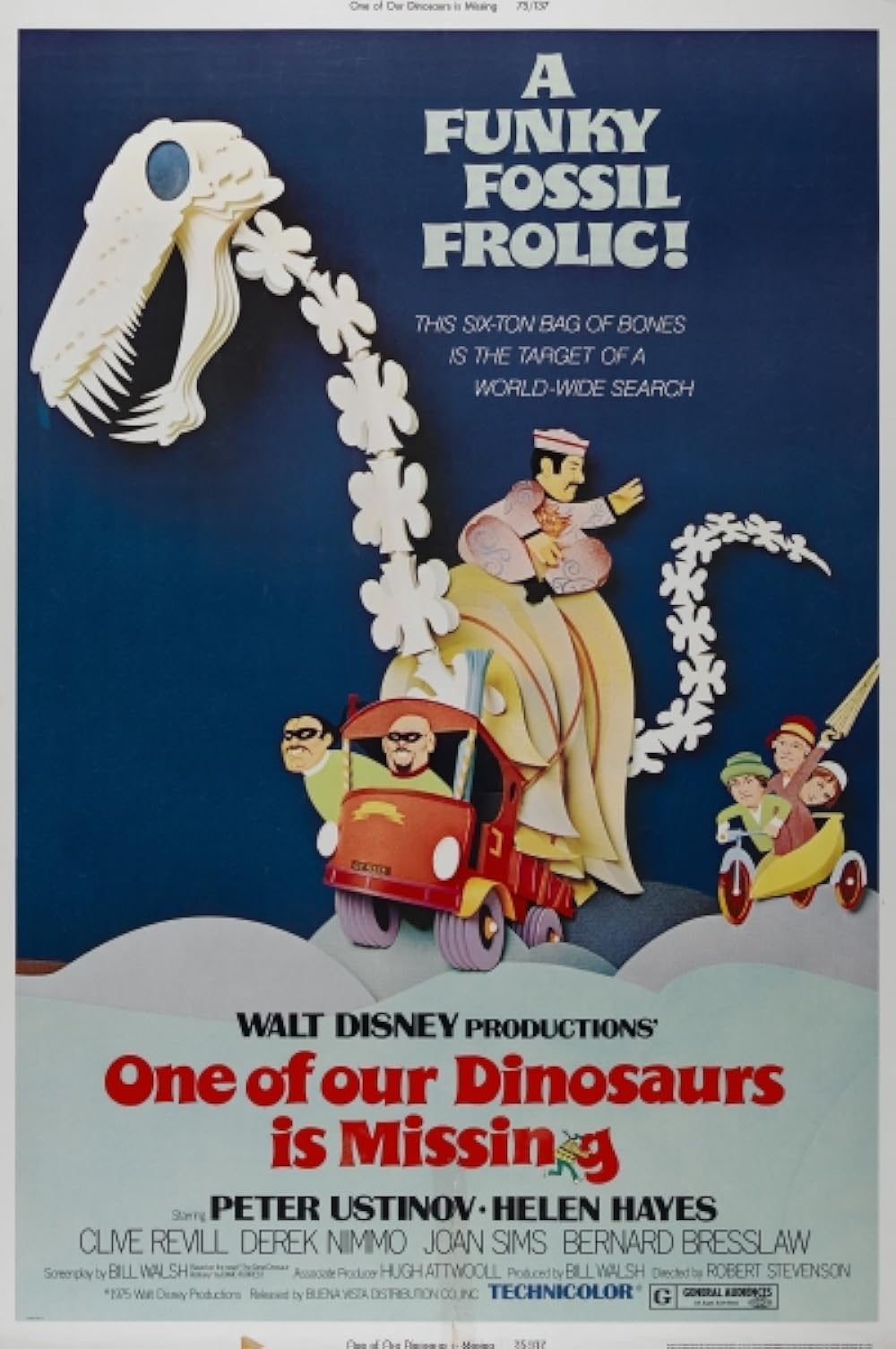
Lord Southmere (Derek Nimmo) is on the run from Chinese spies lead by Hnup Wan (Peter Ustinov) after he gets his hands on a microdot that carries top secret information. After escaping the clutches of an assassin disguised as a chauffeur he runs into a nearby building, which happens to be the Natural History Museum. It is there that he hides the microdot in the skeleton of a dinosaur that’s on display. He then bumps into Hattie (Helen Hayes) who used to his nanny and is taking a tour at the museum with other nannies. Southmere tells Hattie about the microfilm inside the dinosaur just before he faints and is captured by the Chinese. Hattie then takes it upon herself, along with her nanny friends Emily (Joan Sims) and Susan (Natasha Pyne) to retrieve the important hidden document and take it to the proper authorities.

The film is based on the 1970 novel of the same name written by David Eliades and Robert Forrest Webb, but with many changes. The book took place in the 70’s in New York City while in the movie the setting is 1920’s London. The book was also intended for an adult audience and had sex and violence in it, which got taken out for the movie, which angered the authors, who later disowned the film, as they felt the plot got too ‘dummied-down and sanitized’ in an effort to appease children viewers.

The movie really has only two amusing moments. One is where the group of nannies get on the tall skeleton of the dinosaur to search for the microfilm, which from simply a visual perspective is goofy to see and most likely will elicit a few chuckles. The second is when Hayes and company steal the dinosaur on the back of a steam lorry and the spies give chase throughout the streets of foggy London, which offers some moments of humorous reaction shots from bystanders. Otherwise there isn’t much else going for it. The opening bit that supposedly takes place in China clearly has an outdoor backdrop that is a painting and looks tacky like it was done by filmmakers that really didn’t have much heart in the material and didn’t care how cheap it came-off looking. The interior lighting is dark and dingy and having the whole plot revolve around the extreme coincidence of the protagonist bumping into his childhood nanny at the most opportune time is a bit much.

The film’s main controversy, at least by today’s standards, is Ustinov’s portrayal of a Chinese spy. To his credit he at least puts more energy into it than he did as Charlie Chan in the 80’s film Charlie Chan and the Curse of the Dragon Queenwhere he seemed noticeably uncomfortable and just phoning-it-in. Yet even here nothing his character says or does is funny. The humor is intended to come from the broad caricature, which along with his sing-song sounding delivery quickly becomes tiring. Clive Revill, another white European, also gets into the Asian get-up as Quon Ustinov’s chief rival, but he proves to be just as bland. Why they needed to be Chinese at all is hard to answer as they could’ve easily been Russian, or German and might’ve been better had they taken that route.

Hayes for her part is engaging. Most people think of her as just being this sweet old lady of which she’s the perfect caricature, but here she gives her character a feisty side. I enjoyed seeing her strut, which is far funnier than anything Ustinov does and without even hardly trying. Her ordering the other nannies around like they’re on a big-time mission and her interactions with Natasha Pyne, who plays her polar opposite as this naive and fun-loving youth who approaches the whole thing as some cool diversion, are the only things that help keep it mildly watchable.

The twist ending may make it worth it to some, but overall it’s a second-rate Disney effort that’s so poorly shot and dated. I can’t imagine any kids today could get into it. It seems like the only fans of the film were simply kids back in the 70’s who saw it then and now enjoy watching again simply for nostalgic reasons, but everyone else won’t be missing much if they decide to skip it.

My Rating: 3 out of 10

Released: July 9, 1975

Runtime: 1 Hour 34 Minutes

Rated G

Director: Robert Stevenson

Studio: Buena Vista

Available: DVD (Region 2), Amazon Video, YouTube

Blind Date (1987)

blind1

By Richard Winters

My Rating: 0 out of 10

4-Word Review: Don’t get her drunk!

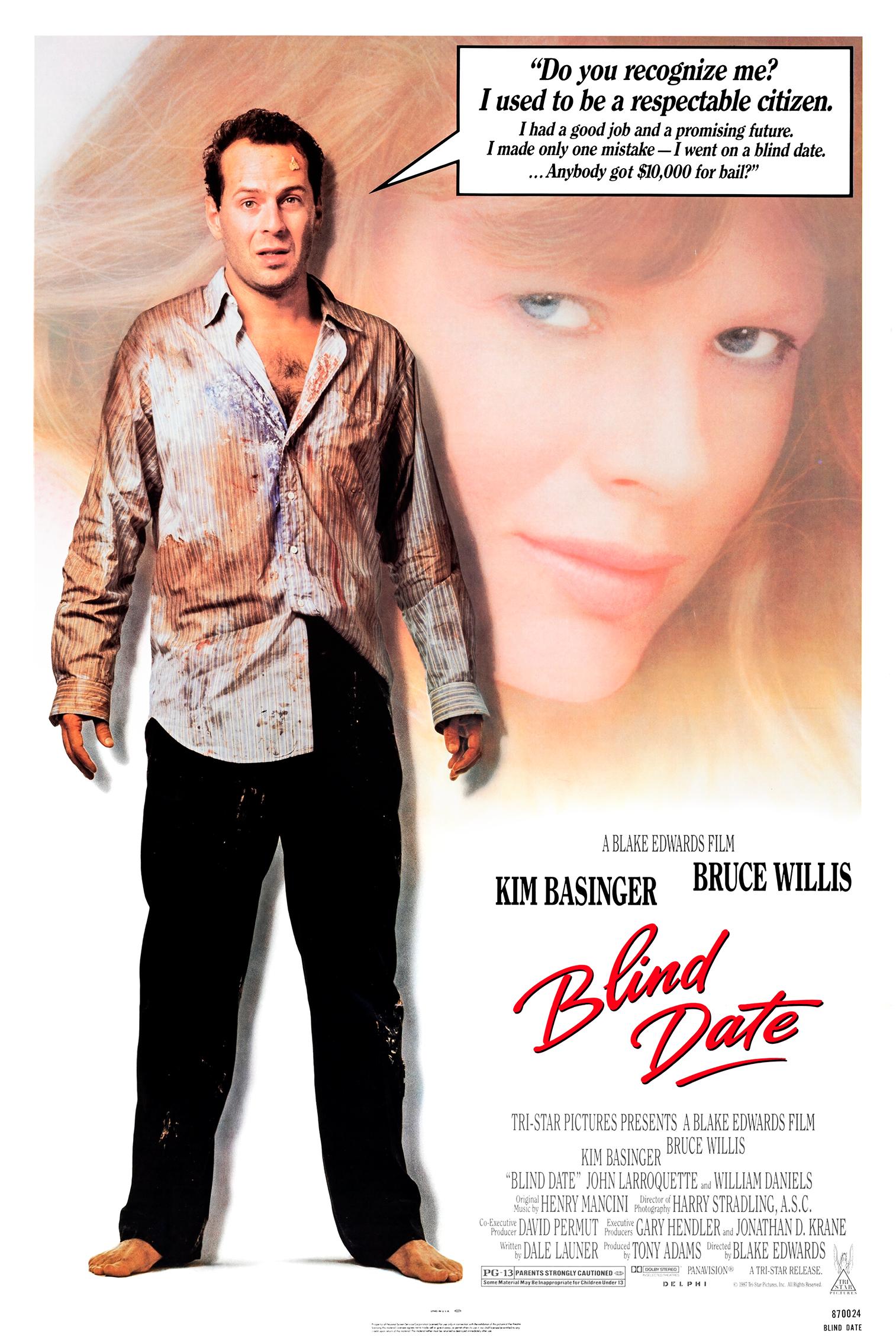
Walter (Bruce Willis) needs a date as he’s having dinner with a very important client that he has to impress in order to get a business deal to go through. Walter’s brother Ted (Phil Hartman) sets him up with his wife’s cousin Nadia (Kim Basinger). She’s a very beautiful lady who’s just getting over a bad break-up with her possessive boyfriend David (John Larroquette). There’s only one hitch: Walter must make sure that she doesn’t drink any alcohol because if she does she’ll go ‘wild’. Walter though dismisses the warning and offers her a glass of champagne, which soon leads to a night of massive calamity.

Blake Edwards directed a lot of duds in the 80’s and I thought That’s Life and Skin Deep were two of his worst, but this one clearly beats those by a mile.  It has shades of After Hours and had this thing kept the story revolving over the happenings of one night it might’ve worked a bit better, but the second-half goes way off-kilter, which really kills the whole thing and turns it into a complete catastrophe. Screenwriter Dale Launer shouldn’t be blamed either as while his name is still on the credits the script was rewritten so may times that it shared nothing with his originally concept and he ultimately disowned it.

The problem starts right away with the whole alcohol thing as Basinger acts overly drunk after having only a few sips. Her transformation into this crazy lady is more creepy than funny like she has a split personality, or some sort of mental condition. Most guys would be running from her almost immediately and never look back and how someone could ‘fall-in-love’ with her after such obnoxious and erratic behavior defies explanation. If there was ever a bad date night this would be one. The fact that she puts up $10,000 for his bail the next day shouldn’t make-up for it like it does here and where exactly is this lady getting her hands on such quick cash anyways since she can’t afford a place of her own and must reside with others?

Willis is great when he’s the one making wise-cracks like he did in the classic TV-show ‘Moonlighting’, but playing the straight-man who simply responds to all the nuttiness happening around him doesn’t work at all. Having Basinger sober up and then Willis be the one to act zany at a later party they go doesn’t make any sense and seems more like it’s some ‘crazy personality virus’ going around or a possession of some kind that like with the cold or flu can easily transfer from one person to another.

Larroquette as the psycho boyfriend pops-in way too conveniently and becomes a bit hard to imagine how he’s able to constantly track the two down no matter where the go and the fact that his car crashes into the three different storefronts, but the front end of the vehicle remains completely intact, defies logic. His character gets neutered by adding in his parents (William Daniels, Alice Hirson) during the second act whose presence doesn’t really help propel the plot along, but instead seems to take the story in an entirely different direction. Having Larroquette defend Willis in court even though he had a lot to do with why he was in trouble and whose name was mostly likely on the police report and then to have the judge turn-out to be his own father is so outlandish that it’s beyond stupid.

This movie also has somewhat of a personal connection as I was living in L.A. in June of 1986 when it was being filmed and stood around with other pedestrians for a day to watch one of the outdoor scenes that was being shot in a nearby neighborhood. The scene that I saw being filmed comes around the 1-hour mark and entails Willis throwing a beer bottle at the rear window of Hartman’s car and smashing it. The scene took several hours to film as Edwards, who sat under the shade of an umbrella while the cast and crew and had to stand under the hot sun, seemed to be dissatisfied with every take and kept making the actors do the same bit over and over that I found it to be really boring and didn’t think there could be anything duller until of course I finally watched the finished movie, which I found to be even worse.

My Rating: 0 out of 10

Released: March 24, 1987

Runtime: 1 Hour 35 Minutes

Rated PG-13

Director: Blake Edwards

Studio: Tri Star Pictures

Available: DVD, Amazon Video, YouTube

Broadway Danny Rose (1984)

broadway2

By Richard Winters

My Rating: 5 out of 10

4-Word Review: Talent agent becomes beard.

Danny Rose (Woody Allen) is a hapless talent agent who represents clients who are down-and-out, but seeking a comeback. Lou (Nick Apollo Forte) is a singer who uses Danny as his agent. Since he has some potential and might even get hired by a big star, in this case Milton Berle who plans on tabbing him as his opening act, Danny will do anything to keep Lou happy especially since Danny’s other clients tend to drop him once they become famous, which Danny doesn’t want to happen again. In order to appease him Lou has Danny acting as a ‘beard’, or a person who pretends to being a boyfriend to someone he really isn’t. In this case it’s to Tina (Mia Farrow) a woman whose been dating a gangster. Danny acts as her boyfriend to draw attention away from Lou, but her ex-gangster lover becomes jealous and thinking Danny to be the real boyfriend sends out a hit on him forcing both he and Tina to go on-the-run.

While this film did well with the critics I felt it was pretty much a letdown. What annoyed me most was the washed-up, aging comedians sitting around a cafe table and essentially telling the story, which gets done in flashback. I felt these comedians, who say nothing that is funny, or even slightly amusing, served no real purpose except for maybe padding the runtime, which was short already, and the scenario could’ve easily played-out without constantly cutting-back to these guys to add in their useless side commentary. This also cements Allen’s transition from being hip and edgy. which he was considered as during the 70’s, to out-of-touch with day’s youth and young adults by the 80’s as no one in this movie appears to be under 40.

It’s confusing too what time period this is all supposed to be taking place in. Supposedly the cutaways to the comedians is present day though with it being shot in black-and-white it hardly seems like it, and then the scenes with Danny are apparently things that happened in the 60’s. This though gets completely botched not only because of the cars they drive, which are of an 80’s variety, but there’s also a scene where Lou and Danny are walking on a sidewalk and go past a theater marque advertising Halloween III, which was  a film that was released in 1982.

On the plus side I enjoyed Mia’s performance of a hot-headed, highly oppionated Italian especially with the dark glasses and bouffant hair-do, which could’ve been done up even more. She’s known as being such a serious actress, who’s marvelous in drama, but to see her able to handle the comedy and even become the centerpiece is a real treat. Woody and her make for a quirky couple, she’s actually taller than him when they stand side-by-side, and she really gets in some good digs on him. Though with that said I actually wished that Nick had played the role of Danny as his amateurish acting made his doopy character funnier and the scenes between him and yappy Mia could’ve been a real riot.

There are a few laugh-out-loud moments, though it certainly takes it sweet time getting there. Watching Woody and Mia attempt to escape the killer by running through a field of tall grass I liked as too the scene where they are chased into a warehouse filled with parade floats and the hydrogen that escapes from them, due to the shooting bullets, causing their voices to become extremely high-pitched. The rest of the humor though relied heavily on Italian-American stereotypes that have been done hundreds of times before and isn’t original. I was also surprised that it has walk-on cameos by Howard Cossell and Milton Berle, who even appears in drag during the Thanksgiving Day parade, but are given no lines of dialogue.

My Rating: 5 out of 10

Released: January 27, 1984

Runtime: 1 Hour 25 Minutes

Rated PG

Director: Woody Allen

Studio: Orion Pictures

Available: DVD, Blu-ray, Amazon Video, Freevee, Tubi, YouTube