Category Archives: Drama

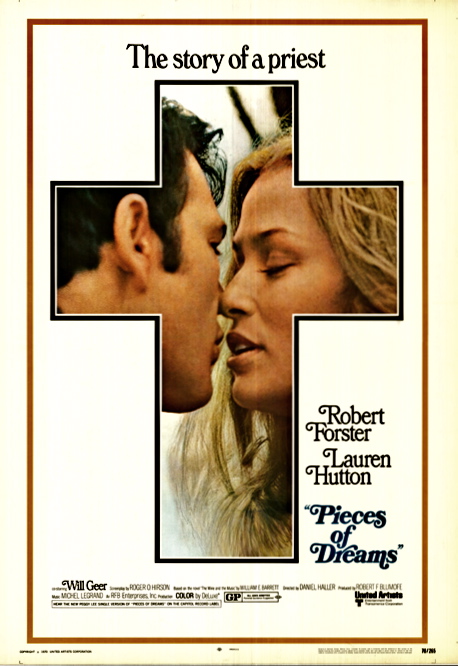
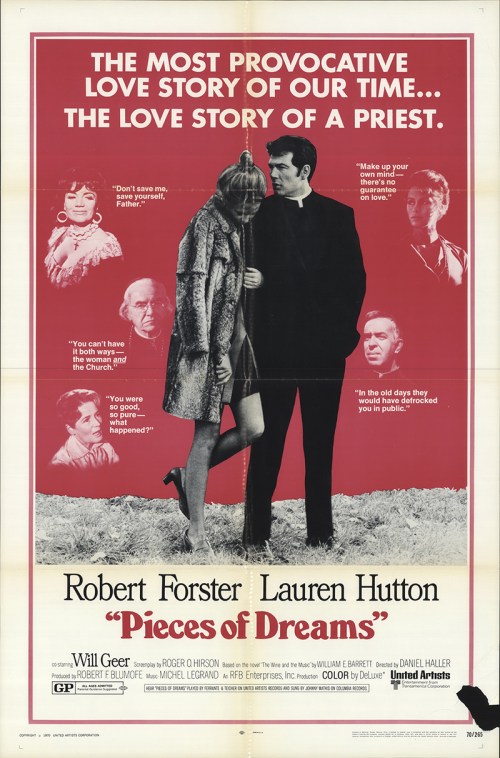
Pieces of Dreams (1970)

pieces1

By Richard Winters

My Rating: 2 out of 10

4-Word Review: Priest breaks his celibacy.

Father Gregory (Robert Forster) is a priest working outside of Albuquerque, New Mexico with a mainly Hispanic church membership. He had been dealing with a 15-year-old boy who was in-trouble with the law only to be called into the hospital late one night to learn that he’d been killed while trying to steal a car. It’s there that he meets Pamela (Lauren Hutton) a social worker from the local community center. The two share widely different viewpoints particularly on the topic of abortion, but despite their differences the two eventually fall in love and their relationship turns intimate. Gregory feels guilty about this due to his vow of celibacy and tries to hide the affair from Paul (Ivor Francis) an older priest whom he lives with and is known to have a prying eye. Gregory decides to ask for a leave in order to get his thoughts together, but learns that trying to find a job on the outside with little work experience can be a difficult task. While he avoids Pamela in order to figure out what direction he wants to take his life the other priests put pressure on her to break it off permanently while trying to guilt-ridden her that she’s destroying a ‘good man’s career’.

This was an unusual career move for Forster who had just completed his signature role in Medium Cool where he was seen running around naked with a nude woman inside his apartment during a provocative moment, so I guess he wanted to tackle a completely different type of character for his next project in an effort to avoid being typecast, but it doesn’t really work. He’s a fine actor, but his streetwise personality trickles through and he never really comes-off as being all that devout and thus making the career arch very expected and no surprise at all. The voice-over narration that he has during the first act, in an attempt to convey to the viewer his inner thoughts, was not needed and off-putting.

Hutton is quite beautiful. She hit her career peak with her work in American Gigolo when she was already middle-aged, so seeing her still quite youthful looking is a treat, at least to the heterosexual male viewer, and you could easily see why she was a former model. Ivor Francis, not necessarily a household name, but competent character actor during the 60’s and 70’s, is quite good as the domineering senior Priest who has his own character flaws that he tries to cover-up even though he’s more than happy to readily expose the ones he sees in others. Will Geer also shines, but isn’t seen until the tail end playing a clergyman who has an amusing line when he tells Gregory that the celibacy demand for Priests ‘will soon be going away’ even though 50 years after this was filmed nothing has changed.

The theme dealing with how religion in theory is meant to be comforting, but in practice can become something that torments people by making them feel guilty and fearing the wrath for what could be considered to others as being minor infractions, like having sexual thoughts, is on-target though not necessarily ground-breaking. Some of the other issues will seem quite dated like the married woman who fears using the pill, or any other type of contraception, as it goes against the teachings of the catholic church, though through the decades this is no longer considered as much of a ‘sin’. There’s also the scene where Gregory lectures a youth who’s in jail for smoking cannabis about how he’s ‘thrown his life away’ while pot is now legal in many states.

The real problem, or when the film ultimately ‘jumps-the-shark’, is when Gregory goes to bed with Pamela, which came off as way too seamless and rushed. Up until then the couple really hadn’t had much in common and were usually arguing over political issues and weren’t for that matter even officially dating. It seemed to me that if someone like Gregory is made to feel extremely guilty for even thinking about sex that is ability to actually perform it would be questionable. Having him run away from her when he started feeling the urge and then avoiding her due to the temptations that she gave him would’ve made more sense then just having him casually hop in the sack without a second thought like he’s just a regular guy on the make and wearing the priest collar is some sort of performance art.

What the filmmakers apparently thought would be a compelling question of would he, or wouldn’t he stay in the church is ultimately given the placid treatment. The romance angle isn’t convincing and despite some good conversational dialogue, and nice on-location shooting of New Mexico in the autumn, the story fails to resonate making the movie woefully trite by the time it finally ends.

pieces2

My Rating: 2 out of 10

Released: September 23, 1970

Runtime: 1 Hour 39 Minutes

Rated GP

Director: Daniel Haller

Studio: United Artists

Available: DVD-R (MGM Limited Edition Collection), Amazon Video

Coming Home (1978)

coming

By Richard Winters

My Rating: 10 out of 10

4-Word Review: Falling for injured vet.

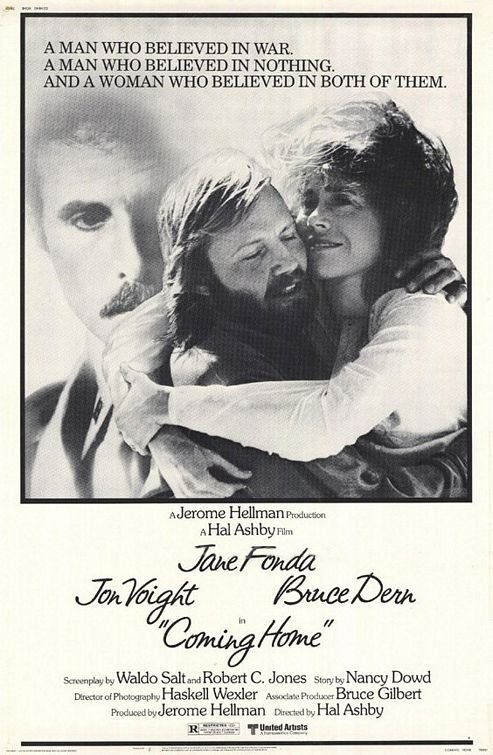
Sally (Jane Fonda) is the military wife to Bob (Bruce Dern) who’s been deployed to Vietnam. Since she now has more free time she decides to volunteer at her local VA Hospital. It is there that she meets Luke (Jon Voight) a former classmate from high school who has now come back from the war a paraplegic. Luke is very embittered about his condition and he’s initially angry and confrontational with Sally. Eventually he softens and Sally invites him to her house for dinner. It’s there that their romance begins to bloom and eventually they become intimate. Bob though, having suffered a leg injury, returns to the states and while Sally and Luke agree to keep their affair a secret Bob soon finds out, which leads to an ugly confrontation between the three.

The idea for the film was inspired by Fonda’s meeting with Ron Kovic, an injured vet who had written his autobiography Born on the Fourth of July that later, in the 80’s, became a movie starring Tom Cruise. Fonda though wanted to make a film with a character that was similar to him and got together with screenwriter Nancy Dowd in 1972 to write a script, which initially focused completely on the hospital setting without the affair, or B-story dealing with the conservative military husband. After many rewrites and bringing in Oscar winner Waldo Scott to help bolster the story the script finally managed to gain interest amongst the studios though many were still cautious about producing a movie dealing with the after-effects of the war, which at that time had never been done before, up until then only films dealing with the war, or those coming back with psychological issues, but not actual physical impairments and thus making this a first in that category.

Since Fonda was instrumental in getting the project produced she was the only choice to play Sally. I think she’s a fine actress who deservedly won the Supporting Oscar for her work here, but since she was on the front lines of the war protest and in many ways even became the face of it, the transition of her character isn’t as profound. Having an actress whose name wasn’t so aligned with left politics and who could better fit-into the part of a conservative housewife would’ve then made the character’s arch more dramatic. I felt too that Sally is too understanding of Luke right-off, the history of them going to high school together should’ve been excised, and instead she should’ve feared Luke when she first encounters him as he does act out-of-control and the romance between them happens too quickly.

Also, once her character changes her hairstyle from the old-fashioned straight to curly it should’ve remained as this visually establishes her character’s changing perspective and not go back to the straight look when she visits Bob in Hong Kong. To remedy this she should’ve decided to keep the curly look even if she feared Bob might not approve, she was technically becoming more empowered with him away anyways, and this would’ve signaled to Bob that she wasn’t the same person he knew when he left, or had the hair change occur after the Hong Kong visit, but having the hair style flip-flop works against the arch, which should be linear and not zig-zagging.

Voight, who won the Best Actor Oscar, and who had to lobby hard for the role as the producers originally wanted Jack Nicholson, is outstanding and there’s not a flaw in his performance with his best moment coming at the very end when he gives a lecture to a room full of high school students about his war experiences. My only complaint, which has nothing to do with his acting and more with the script, is when he bluntly tells Sally, when he goes to her place for dinner, that he dreams of making love to her, which seemed too forward especially since they end up having an impromptu kiss later. Since movies are a visual medium it should’ve settled with the kiss exposing the underlying brewing romance without his character having to explicitly state it. I also found it interesting that the DVD features a commentary track with Voight, Dern, and cinematographer Haskell Wexler, but Fonda is conspicuously not present and I wondered if this may have been due to Voight becoming a hardened conservative as he’s aged and because of their political differences Fonda not wanting to be in the same room with him.

Dern, like the other two, is excellent. His improvisational Dernisms as I like to call them come into play particularly when he gets intense I even learned what the slang term Jody meant, which is what he calls Voight at one point. You also, at the end, get a full view of his bare ass. Now, on the celebrity male naked ass scale I still say it’s a distant third to Dabney Coleman’s in Modern Problems  and Tim Matheson’s in Impulsebut it’s not bad.

Accolades must also go to director Hal Ashby, who was not the first choice as the studio initially wanted John Schlesinger. While Schlesinger could’ve been great I felt Ashby’s use of all natural lighting is what really makes the difference and becomes the over-riding look of the film. He displays keen use of the music too at the end when the song ‘Time Has Come Today’ by the Chamber Brothers is played and the lyrics are used to expose the underlying ticking time bomb of the situation that the three characters are veering speedily into.

My Rating: 10 out of 10

Released: February 15, 1978

Runtime: 2 Hours 7 Minutes

Rated R

Director: Hal Ashby

Studio: United Artists

Available: DVD, Blu-ray

X Y & Zee (1972)

x

By Richard Winters

My Rating: 4 out of 10

4-Word Review: Wife sabotages husband’s affair.

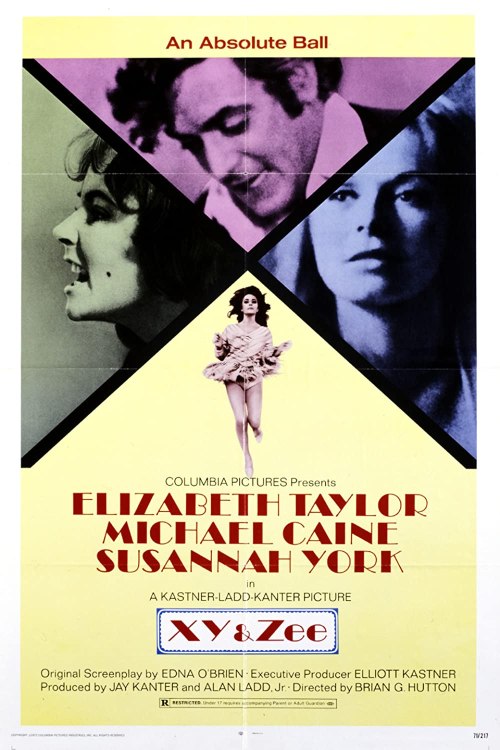
Zee (Elizabeth Taylor) is the middle-aged wife of Robert (Michael Caine) and the two have been in a tumultuous marriage for many years. Then at a party Robert spots Stella (Susannah York) who is a single mother with two boys. Robert enjoys her much calmer less confrontational demeanor, which is the exact opposite of Zee’s and the two quickly fall into an affair. Zee though becomes aware of what’s going on and becomes determined to put a stop to it one way or the other. At first she is meddlesome by constantly calling-up Stella and warning her about Robert and even going to her place of business to harass her. When that doesn’t work she tries playing into Robert’s sympathy and at one point even attempting suicide, but when all that fails and the affair continues she uses her gay friend Gordon (John Standing) to dig-up some dirt on her and when she finds out the secret that Stella has she uses it to exact her revenge.

Taylor and her over-the-top shrewish performance is the whole reason the movie works and if you watch it for that purpose you won’t be disappointed. Sure she’s played this role a bit too often to the point that it was becoming more of a caricature for her and ultimately what I feel killed her career as by the 80’s she was no longer making films for the big screen, but still when she’s as entertaining doing it as she is here it’s still a joy to watch. Unfortunately she dominates every scene that she’s in that it leaves very little room for her co-stars particularly York who’s completely dull by comparison. York certainly was an accomplished actress, but in this movie she’s unable to go toe-to-toe with her superior co-star and the film suffers for it. A strong actress with a definite presence was needed instead York just quietly sits there looking overwhelmed as Taylor’s character continuously berates her. If anything Mary Larkin, who plays Caine’s nerdy secretary, should’ve been the love interest, Caine ultimately sleeps with her anyways, as she’s so meek that you would feel sorry for her when Taylor got snarky with her, but with York you feel nothing and it’s almost like she’s transparent.

Caine on the other-hand is able to hold his own, but his frothy retorts at Taylor’s abuse is never quite as clever, or entertaining as hers. My biggest issue with his character is why doesn’t he just divorce her as he’s quite wealthy and could easily do it and yet avoids it. He mentions at one point wanting to kill her, but never just divorcing her. Since the couple never had any kids it would be less messy, so why not just take that route and then he could see York, or any other woman for that matter without worrying about Taylor getting in the way. I realize some marriages are held together for weird reasons, even those when it becomes achingly clear that it should end, but for whatever reason it doesn’t. However, after 2-hours of watching this those reasons should eventually become clear, but they never do.

Spoiler Alert!

I sat through almost the entire movie just waiting to find out what the ‘dark secret’ was that York’s character held, as described by Leonard Maltin in his review, only to finally realize it was nothing more than her being a closet lesbian. What’s worse is that nothing much happens once the secret is exposed. Maltin also describes Taylor/York’s lovemaking scene as ‘ranking high in the annals of poor taste’ though this sentence has been removed from his review in the later editions of his book presumably to avoid making him look homophobic, but whatever lovemaking he may of seen I didn’t and I watched the full 1 Hour 49 Minute newly remastered version from Columbia Pictures (same version streaming on Amazon Video), so either a minute of it got snipped on this cut, or Maltin was offended at seeing the two women hug, which is all there is.

Admittedly I was disappointed as I was hoping to see them kiss, or in bed together, which would’ve livened it up a bit and made it worth sitting through, which otherwise is a strain. The lesbian angle should’ve been introduced much earlier and showing Taylor and York not only getting-it-on and enjoying it, but inviting the reluctant Caine in as a threesome. That would’ve made the movie truly sophisticated and ahead-of-its-time, but having it end the way it does with York seeming very ashamed and defeated about her homosexuality makes it dated and out-of-touch with modern-day sentiments. A misguided relic of its period that really doesn’t have much to say and nowhere near as ‘daring’ as the filmmakers thought it was.

My Rating: 4 out of 10

Released: January 21, 1972

Runtime: 1 Hour 49 Minutes

Rated R

Director: Brian G. Hutton

Studio: Columbia Pictures

Available: DVD-R, Amazon Video, Tubi

Hide in Plain Sight (1980)

hide

By Richard Winters

My Rating: 6 out of 10

4-Word Review: Searching for his children.

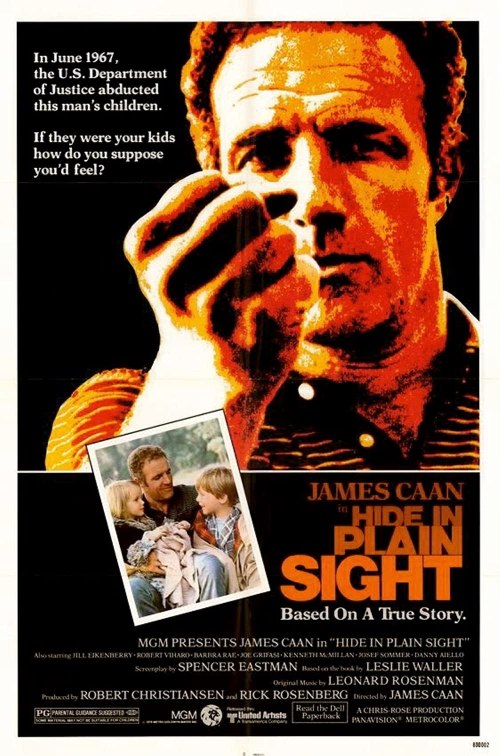
Thomas Hacklin (James Caan) is a divorced father of two children who has visiting rights to see his kids every weekend. One day when he arrives at his ex-wife Ruthie’s (Barbra Rae) residence he finds the home abandoned and no one around. He eventually learns that her and the kids have been put into the Witness Protection Program due to her remarriage to Jack (Robert Viharo) a gangster who qualified for the program when he became a state’s witness against the mob. Thomas’ efforts to find his kids prove futile and the authorities are no help, but he becomes relentless and hires a lawyer (Danny Aiello) to represent him in court, but even then the odds remain seemingly insurmountable.

The film is based on the novel of the same name by Leslie Waller, which in-turn was based on the actual experiences of Thomas Leonhard who one day in 1967 when he went to pick-up his kids for his weekly visitation found them gone and the house that they had been living in with his ex-wife Rochelle to have been abandoned. This then precipitated an 8-year crusade by Thomas to get them back, which proved to be a landmark legal battle, but on July 4, 1975 he was eventually reunited. The film though changed several things from the true story including adding in a subplot where Thomas gets followed by the mob and eventually leads to a violent confrontation. It also compresses the time span from 8 years to 18 months.

While I enjoyed the movie more than when I first saw it over 10 years ago the issues that I had with it during the first viewing remained the same. Most of it had to do with Caan’s, in this the only film that he directed, non-use of close-ups, which the studio heads complained about during the production. A good example of this is when Thomas and ex-wife are arguing on a public sidewalk the camera does not move-in, like in most movies, to allow us to hear what they’re saying, but instead pulls back, so they go further away, but what’s the point of seeing characters on the screen argue if we can’t hear what it’s about? Another scene has Thomas arriving at his ex-wife’s abandoned home, but instead of having the camera go inside with him as he enters it, it remains outside and then tracks around the home to the back door, which Thomas is seen leaving. This though lessens the impact as having the viewer visually witness the suddenly empty house would’ve been far more dramatic.

I did though like that many of the scenes were shot in Buffalo at the exact locations where the real-life incidents happened. The film reconstructs the look and feel of the 60’s quite nicely and many of the participants from the actual events coached the actors on how to perform their roles accurately. The acting is impressive especially by Viharo who’s mafia mobster caricature is right on-target. Kenneth McMillan is quite entertaining as a police detective who initially impedes Thomas’ efforts, but eventually has a change-of-heart. As with any great character actor, which McMillan clearly is, it’s what they add to the part that makes it interesting and here it’s his excessive eating with virtually each scene he’s in has him stuffing his face though I wondered how many takes were required to do each scene and if he ultimately overate and got himself sick while performing the role.

Spoiler Alert!

I was annoyed though with how certain fictional things that got added-in like Thomas’ dealings with the mob got played-down instead of up. The original script by Spencer Eastman called for a lengthy car chase and violent fist-fight, but Caan chose to take the subtle route making these moments less tension filled and possibly too slow and uneventful for some people to sit through. I was also amused how the actual reunion between the father and kids was different from the one in the movie where it’s portrayed as being a happy one. In real-life the kids disliked their father’s rules and ended up moving back with their mother showing how ironic life can be where you fight hard for something and then when you finally get it it ends up not being as great as you thought it would be.

My Rating: 5 out of 10

Released: March 21, 1980

Runtime: 1 Hour 32 Minutes

Rated PG

Director: James Caan

Studio: MGM

Available: DVD-R (Warner Archive Collection), Amazon Video

Bum Rap (1988)

bum1

By Richard Winters

My Rating: 3 out of 10

4-Word Review: 72 hours to live.

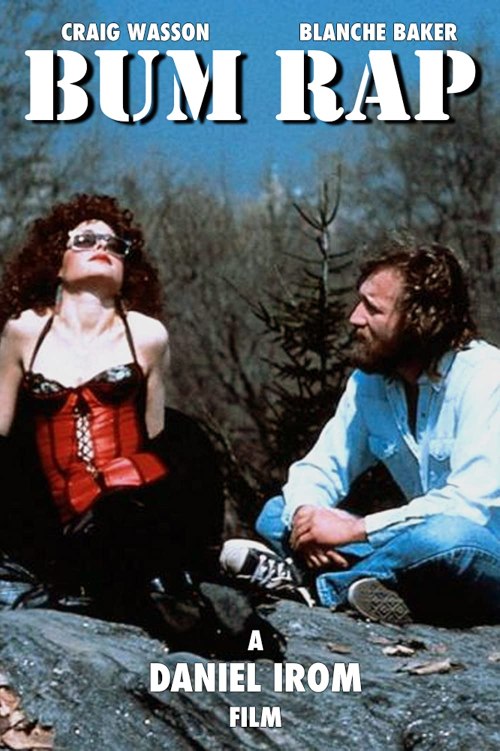
Paul Colson (Craig Wasson) seems to have very little luck. While he works during the day as a New York cab driver he longs to be an actor and he practices his craft while alone in his cab as he waits for a customer. During his free time he attends auditions, but routinely finds himself being turned down for the part. His love life isn’t much better as he’s constantly getting stuck in the ‘friend zone’ with all the eligible women that he meets. Now things have turned even more sour when he goes to a Dr. about a ringing in his ear only to diagnosed with a rare blood disorder that will kill him in only 72 hours. Will Paul find any meaning and happiness with the time he has left? He isn’t sure, but becomes determined to find out by getting together with his friends and parents (Barton Heyman, Augusta Dabney) for one last goodbye while doing so with the company of Lisa (Blanche Baker) a street prostitute he has picked-up and agrees to go along with him for his last hurrah while also harboring the same ambitions of becoming an actor.

The film seems to want to tap into the indie vibe of Stranger Than Paradise, a quirky independent, cult hit that sent it’s writer/director Jim Jarmush into stardom. It even starts out in black-and-white like that one and there are a few keen moments here. When I was younger and just out of college I attended a few acting auditions like this character and found the same thankless experiences as he did; getting turned down not so much for a lack of talent, but more because he auditioned with someone who was sexier and better looking, so naturally they get all the attention and he doesn’t. His dating quandary where he treats the women real nice, and they get along well, but in the end they still chase after a married a man who treats them poorly can be a testament to what happens to a lot of single nice guys and in this area, examining the basic struggles of an ordinary life, it hits the bullseye.

Unfortunately the film fails to gain any momentum, or move along with an intriguing pace. The scenes lack energy and in certain instances, like when he invites his friends over for a game of cards, get bogged down with archaic chatter that does not propel the plot, or reveal anything about the characters. The disease, where the doctors can pinpoint exactly what hour the person will die and in what way, comes-off like something out of a sci-fi movie and hard to take seriously. I didn’t get why it shifts from black-and-white to suddenly color after he gets the grim diagnoses. You’d think it should work in reverse, be colorful when he still thinks he’s got his future ahead of him, only to turn black-and-white when he realizes his time is very limited, or at the very least don’t have it turn color until the very end when he’s learned to accept his condition and die gracefully, or leaves to enter some sort of afterlife

Wasson, who hasn’t appeared in a movie since 2006 and now makes a living as a audio book narrator, has stated that this was his most favorite movie that he was in and it’s easy to see why as he basically propels it along particularly with his impressions of famous actors, but his character’s transition through the 5-stages of grief is much too quick. It’s odd too that he chooses not to tell any of his friends or family that he’s dying as I’d think most other people in the same situation would want to say what’s going to happen to them if for anything to look for some comfort as they grieve.

Blanche Baker, the daughter of legendary actress Carroll Baker, is a good actor, but her character is cliched. As a street prostitute she lets down her guard too easily and quickly. For all she knows this guy could be lying to her about having a terminal illness in order to gain some cheap sympathy and since she’s been a hooker for awhile and spent time with other guys of a dubious quality, I’d think her opinion of men would be pretty low and she’d not be so trusting of Wasson when he tells her his situation and instead be cynical. This idea that all prostitutes have a ‘heart-of-gold’ if you just get past their rough exterior is a stereotype as some of them due to the harsh life on the streets can be genuinely embittered. Having Wasson deal with a more hardened one would’ve not only made it more realistic, but given the scenes some pizzazz as they could bicker and argue, versus having it get so sappy that it becomes cringe-worthy.

I suppose if you give it enough time it does have a way of growing on you emotionally, but the overly choreographed ending takes away all realism. Ultimately it’s a potentially interesting idea that thinks it has a deeper message and statement than it really does.

My Rating: 3 out of 10

Released: September 26, 1988

Runtime: 1 Hour 58 Minutes

Rated R

Director: Danny Irom

Studio: Light Age Filmworks ltd.

Available: None

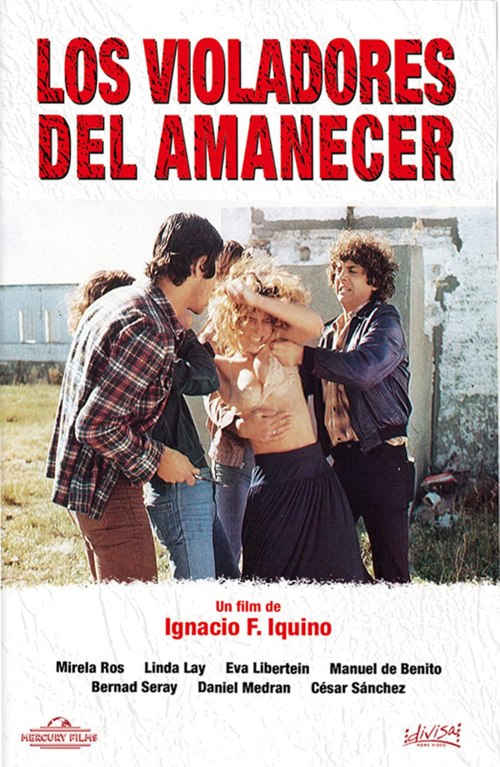
Rapists at Dawn (1978)

rapists1

By Richard Winters

My Rating: 7 out of 10

4-Word Review: Teen boys assault women.

Rubiales (Manuel de Benito), Quinto (Daniel Medran), Rafi (Bernard Seray), Cana (Cesar Sanchez) and Cana’s pregnant sister Lagarta (Alicia Orozco) roam the streets of Barcelona, Spain looking for young women to assault. The boys live on the poor side of town and are from abusive home lives with little future except working boring, low paying jobs. Feeling that society has ‘discarded’ them they they take out their hostilities on the pretty women that they meet. They pick their victims at random usually as they spot them getting out of their cars and go walking into their schools many times while in front of the victim’s family member who’ve just dropped them off. They then take the women to an isolated area and proceed to gang rape them while Lagarta acts as the look-out. The police are aware of the crimes, but seem helpless to do much about it. When they catch the boys in the act and try to arrest them the boys manage to escape making them confident that they can’t be stopped.

While films like I Spit on Your Grave and Irreversible get all the attention as being the ‘last word’ in rape movies, this one, if it was better known and more attainable, would trump those. The rapes here are graphic, prolonged and quite violent. Some will complain that it’s exploitative while others will argue that if you’re going to show rape for the violent crime that it truly is then it must be captured in all of its unpleasantness and toning it down for the sake of good taste does a disservice. Personally I found the brutal nature to be effective as I came away feeling really sorry for the victims, as it’s captured in such a real way you can barely see the acting and instead start to consider it more like a graphic documentary.

This movie also handles the aftermath in an interesting way by examining the debilitating effect the crime has on the victim psychologically and how they become like a different person. They’re outgoing and well-adjusted beforehand and then afterwards depressed, angry, and even ashamed. They turn sullen and anti-social to both their friends and family making it seem like they’ll never be the same again. The film also analyzes what happens when one of the women becomes pregnant, something that I don’t remember being touched upon in other rape films, and how the mother of the victim insist, due to religious reasons, that she keep the baby and not abort it, making her seem as cruel as the gang.

The thuggish boys are portrayed in an intriguing multi-dimensional way too. While they’re cocky when out and about they recoil and become like victims themselves when at home and dealing with their abusive fathers. I did like too that in their own twisted way they have ‘limits’ or  a ‘code of morality’ albeit a very weird one. A great example of this is when Lagarta becomes shocked when the boys continue to penetrate one of the victims even after she has clearly died. Normally Lagarta had no problem seeing them violently molest the women, but when one of them actually gets killed during the attack and the boys continue the assault it’s only then that she feels things have ‘gone too far’.

It’s hard to say what genre to put this one into. It’s not really a horror film as none of the women become Rambo-like by packing a big gun and going on a revenge tour against their assailants, which although emotionally satisfying isn’t realistic If anything it brings out how there are no easy answers, which makes it even more horrifying, but still thought provoking.

My Rating: 7 out of 10

Released: May 3, 1978

Runtime: 1 Hour 33 Minutes

Not Rated

Director: Ignacio Iquino

Studio: Ignacio Ferres Iquino

Available: DVD-R

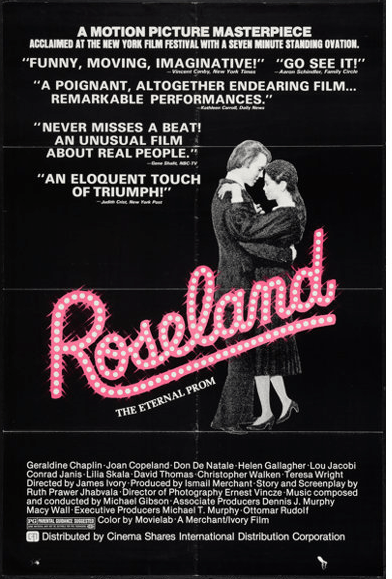
Roseland (1977)

roseland2

By Richard Winters

My Rating: 7 out of 10

4-Word Review: Participants of ballroom dancing.

In 1976 director James Ivory, who had already collaborated with writer Ruth Prawer Jhabvala on 5 other films, wanted to turn her short story ‘How I Became a Holy Mother’ into yet another movie. The story required one scene to be shot at The Roseland Ballroom, a dancing venue in New York City, that was originally built as a ice skating rink in 1922 and then converted to roller skating only to eventually become a popular retreat for ballroom dancers. When Ivory approached potential investors none of them liked the story, but did like the idea of shooting a movie inside Roseland. They agreed to give money to the project as long as the entire setting took place in that venue.

Ivory then had Jhabvala interview the people at the club to get a better understanding of the folks who went there and to help generate story ideas. It was through these visits that Jhabvala was able to come-up with three different vignettes that is based closely on real-life events that occurred with people who attended the Roseland throughout the years and most of the dancers seen in the background were actual members of the dance hall and not paid extras.

While the owners of the Roseland were happy to give permission to shoot there it did come with several stipulations. One was they could only shoot during the day on Wednesdays and could not alter any of the interiors in any way, which included the lighting. Despite these restrictions he was able to succeed pretty well though at the 30-minute mark it’s obvious in a scene where Christopher Walken and Geraldine Chaplin are supposedly in a room alone that there’s a cameraman there as you can easily see his reflection on the wall mirror. Ivory was also forced, much to his chagrin, to hire a scenic artist and art director onto his crew even though they were unable to make any changes to the set, but union rules required one must be hired anyways, and the teamsters union picketed the production outside the building until Ivory finally relented, which resulted in 2 extra people being brought onto the crew to sit around and do absolutely nothing, but still getting paid.

As for the stories they’re okay, though the first one, ‘The Waltz’ is clearly the weakest despite excellent performances by the two leads. It stars Theresa Wright as a widow named May who keeps seeing a reflection of herself and her former husband when they were much younger in a mirror in the ballroom as she dances with her new partner named Stan (played by Lou Jacobi). No one else sees this same reflection except for May and most think she’s going nutty. Stan wants May to get over her memories of her old husband and focus solely on him, but when she doesn’t he loses interest in her though May finally comes around when she realizes that the past is the past and there’s no going back, so why not instead live for the present. This segment, unlike the others, relies heavily on voice-over narration of Helen Gallagher, who plays Cleo, a dance instructor, it also enters in weird supernatural elements as it’s never explained why May keeps seeing these reflections, is she really going nuts, or is some ghostly phenomenon trying to speak to her from the afterlife? This never gets answered and hence is why the story really doesn’t amount to much.

The second story, ‘The Hustle’, is the best one and features a terrific performance by Chaplin. It involves Russel (Christopher Walken) who is seeing the much older Pauline (Joan Copeland) not so much because he loves her, but more because she pays him to be her escort and he likes the money. He then meets Marilyn (Chaplin) who has just gone through a rough break-up. He immediately becomes smitten. Marilyn is at first reluctant in getting into another relationship, but eventually falls for Russel only to learn that he’s not quite ready to give-up Pauline, or her money and seems to want to juggle the two, which Marilyn does not want. While this segment is quite captivating I would’ve like a better, more dramatic confrontation and less of an ambiguous conclusion.

‘The Peabody’ is the third and final segment. It deals with Ruth (Lilia Skala) an older woman with a strong personality looking for a suitable dance partner to win a competition. She meets Arthur (David Thomas) a meek elderly man who agrees to partner with her despite having a weak heart. Ruth takes his friendship for granted and is quite demanding of him only to learn to regret it when he’s no longer around. Skala’s performance, of which she got nominated for the Golden Globe, makes catching this part well worth it.

My Rating: 7 out of 10

Released: October 2, 1977

Runtime: 1 Hour 44 Minutes

Rated R

Director: James Ivory

Studio: Merchant Ivory Productions

Available: DVD

Not a Pretty Picture (1976)

not

By Richard Winters

My Rating: 5 out of 10

4-Word Review: Reenacting a rape incident.

While Martha Coolidge is known today for having directed such 80’s classics as Valley Girl and Joy of Sex she started her career in the 70’s doing documentaries mainly about high school students. After having done three of those she decided to do one that was more personal and dealt with a real-life incident that occurred to her when she was 16 when she got raped on a date with a college student who was 20. While she went about casting the actress to play her as a teen she was shocked to learn that the actress, Michele Manenti, had a similar experience. The film then weaves between reenactments of the date rape and the situations that lead up to it as well as the aftermath. There’s also interviews with the cast members who talk about the emotions they go through while playing the characters including Jim Carrington, who plays the rapist named Curly, who confesses that he thought women secretly wanted to be raped due to his belief that they fantasize about it.

What I got out of the film and enjoyed the most was looking at the acting process and how the performers used elements of their own experiences to help shape the characters that they play. I was genuinely surprised that only one of the cast members, Amy Wright who has a small role as Cindy, ever went on to do another movie. The two stars, who I felt were both outstanding, never acted in anything at least film or TV wise even though I felt they should’ve had long careers. I realize that the acting profession is a very competitive business and what may seem like the cream-of-the-crop in college may not be able to rise to the top in the real-world, but it still seemed sad that they weren’t able to do more, or at least more in front of the camera. It’s also surprising how non-dated this is. The conversations they have both about dating and acting is something that could’ve easily been shot today and just as topical. If it weren’t for them openly smoking indoors in a public setting, which is a major no-no now, you would never have known this was done in the 70’s.

While the conversations that Coolidge has with the cast proves to be insightful the reenactments aren’t as compelling. The scene involving the conversations that the four friends have inside a car has some interesting points, but it goes on too long and gets static. The aftermath where Martha is ridiculed by the other girls at her school and called a ‘whore’ because of the rumors that Curly spreads stating that she was a ‘willing participant’ and the stressful moments she has when she doesn’t get her period and fears she may be pregnant are quite dramatic, but the most important scene, the rape itself, gets botched. All the other recreated scenes where done as if in real-time and with sets that replicated the era, which was 1962, but with the rape it’s staged as a rehearsal with Martha and the other stagehands clearly in view as it occurs and Coolidge constantly stops the action to have them redo the scene several times in order to get it right, but this takes the viewer out of the moment and mutes the emotional impact. In hindsight I think they should’ve done the entire recreation, both the rape and what lead up to it as well as the aftermath, first and then went to the behind-the-scenes footage afterwards instead of inter-cutting it, which may have been novel for the time, but eventually gets off-putting.

The film’s focus was apparently intended to be on Martha and her reactions at seeing her own rape get played-out as the camera keeps panning back to her face as she watches the actors perform it and then at the end she describes her feelings in a emotional way. While I’m sure this was a tough thing for her to do I still felt it would’ve been more encompassing to have it about all the other women, including the actress in this film, that this has happened to and how men in that time period were able to get away with it and never had to be accountable. That to me was more disturbing and the film ends up missing that point, or not hitting-it-home hard enough, and thus isn’t as strong, or ground-breaking as it could’ve been.

My Rating: 5 out of 10

Released: March 31, 1976

Runtime: 1 Hour 23 Minutes

Not Rated

Director: Martha Coolidge

Studio: Coolidge Productions

Available: Vimeo

Saint Jack (1979)

saint1

By Richard Winters

My Rating: 7 out of 10

4-Word Review: American pimp in Singapore.

Based on the 1971 novel by Paul Theroux the story centers on Jack Flowers, an American who comes to Singapore in hopes of starting-up a profitable brothel and then moving back to the states a rich man. He finds the challenges more staggering than he initially thought and is constantly looking over his shoulder for the syndicate who would like to crush his business so it won’t compete with the other more established brothel’s in the region. In order to cover what he’s doing he works with a Chinese executive as a liaison for his clients. One such person is William (Denholm Elliot) a timid British accountant with a heart condition who has traveled to the area on an assignment. Jack enjoys William’s quiet demeanor and grows fond of him only to be heart-broken when he dies suddenly, which eventually changes Jack’s perspective on things specifically when he’s asked to take part in the blackmail scheme of a U.S. Senator (George Lazenby).

By the late 70’s director Peter Bogdanovich had fallen on hard times. He began the decade doing the acclaimed and award winning The Last Picture Show and followed it up with the equally impressive Paper Moon However, after the critically panned musical At Long Last Love his career began to tumble. He tried following this up with Daisy Miller, but it appealed to only a small audience. Nickelodeon was his attempt at returning to slapstick comedy that had won him success with What’s Up Doc, but it dived at the box office too making this once promising young talent feel fully washed-up. In an attempt for a revival he decided to go in a completely different direction by doing something with a gritty realism.

Cybill Shephard, whom Peter was in a relationship with at the time, had read the Theroux novel when it was given to her by Orson Welles in 1973. She had suggested he make it into a movie, but he had initially resisted. Then in 1978 when she sued Playboy for publishing unauthorized nude photos of her she got rights to turn the book into a movie as part of the settlement and Bogdanovich decided at that point he would do the project. Since Singapore officials were aware of the book, which had not portrayed their country in a positive light, he was forced to create a mock synopsis called ‘Jack of Hearts’, a benign love story that he used to convince the government that was the movie he was making so he could get the permission to film there, which was worth the effort as the unique ambiance of the setting is the main thing that propels the movie and could not have effectively been recreated had it been done inside a Hollywood studio lot.

Gazzara’s performance is another chief asset as he’s never at a loss for quick quips, or sarcastic replies. I loved the way he’s shown constantly moving, never sitting still in one place for too long, which nicely accentuated his situation of needing to ‘on the move’ in order to stay one-step ahead of the bad guys. Elliot is excellent as well in an atypical role. Usually he does well playing stern, jaded, and detached types, but here conveys a genuinely sensitive person who seems cut-off from the worldly ways. Lazenby, best known as the one-and-done James Bond from Her Majesty’s Secret Service, gets a small, but pivotal role as a closeted gay politician who takes a stroll in the middle of the night to hook-up with a male prostitute while Jack secretly follows him that has a great voyeuristic quality and the film’s most memorable moment.

Out of all of his movies Bogdanovich has stated that this one and They All Laughed were his two favorites. Some may not agree as the story has a fragmented style where things happen all of sudden and without forewarning. Yet for me this helped emphasize the reality of Jack’s shaky environment. While hailed by many as a great director’s least known work it deserves to be seen more and when compared to his other output clearly unique and original.

My Rating: 7 out of 10

Released: April 27, 1979

Runtime: 1 Hour 52 Minutes

Rated R

Director: Peter Bogdanovich

Studio: New World Pictures

Studio: DVD, Blu-ray, Fandor, Plex, Tubi, Amazon Video

Don’t Cry, It’s Only Thunder (1982)

dont

By Richard Winters

My Rating: 6 out of 10

4-Word Review: Medic helps out orphanage.

Brian (Dennis Christopher) is an army medic during the Vietnam War who’s stationed at a hospital in Saigon. Young and idealistic he initially cannot handle the death and carnage that he comes into at the clinic and feels he’s not making much of a difference especially as he sees the severely injured soldiers come-in and die with very little that they can do. He then makes a promise to one of them to look in on an orphanage and try to find a safe new location for the children and two nuns who look after them. At first Brian is not into the kids, but eventually he bonds with them especially Anh (Mai Thi Lien) a 12-year-old girl who cannot speak and who he wishes to adopt despite all the red tape that he must go through.

The film is loosely based on the actual experiences of Paul G. Hensler, who first wrote it into a novel before being commissioned to turn it into a screenplay. His motive was to show more of the humanitarian side to the war versus the battle scenes that made up so much of the other films that dealt with the Vietnam conflict. In a lot of ways it’s a refreshing change of pace and unlike with M*A*S*H, that focused on medics during the Korean War, there’s no humor, or pranks, but instead solely focuses on the serious side of taking care of the wounded and how emotionally exhausting it can become. There’s a few moments where a passing character will make a joke, I suppose as an ode to M*A*S*H, but instead of laughs from the others it’s met with eye rolls, which is how it should be as there’s certain situations where humor just isn’t going to help things and in some ways such as here just plain out-of-place.

Christopher, who’d been acting in films since he was 15, but rose to critical acclaim in Breaking Away only to make a bad career turn by starring-in the offbeat dud Fade to Blackredeems himself with his performance here. He does though look incredibly young almost like he’s only 14, but his youthful appearance helps explain his character’s sometimes naive nature and tendency to be overly idealistic and thus makes some of the things that he does, which an older more seasoned person might refrain from, more understandable.

I wasn’t as keen with Susan Saint James. She was 10 years older than Dennis, but looked more like it could’ve been 20 and thus making the eventual love scene between them come-off as forced and mechanical. I’ll give her credit she does have an effective emotional moment, but her character is too Jekyll and Hyde-like as she initially is really into helping the orphanage and even gets Brian more into it and then suddenly like a light switch doesn’t want to have anything to do with it, only to eventually to go back, kind of, to helping the kids out, which is like watching someone with a ping pong personality. If anything I really enjoyed the two Vietnamese nuns (Lisa Lu, Shere Thu Thuy) and the way they would sometimes compromise their moral beliefs for the sake of the kids.

The film manages to be gritty most of the way and despite being filmed in the Philippines still gives one an adequate feeling of the civilian experience in Vietnam during that time. However, the segment where a song gets played that was supposedly sung by the kids while we view a montage of them playing is over-the-top sentimental and even jarring as we were used to the background noise of battle and thus comes-off as sappy and out-of-place. Watching the kids having a bit of fun is fine, but we didn’t need the added music.

Brian’s insistence and almost obsession at adopting a preteen girl will be considered cringey by today’s standards. The film makes clear that his intentions are pure, I suppose this is why there was the sex scene thrown between he and Susan to alleviate any viewer concern that he wasn’t a red-blooded All-American guy who was into chicks his own age, but it still looks even in the most charitable way as kind of questionable especially since he can’t even have any conversations with her since she doesn’t speak. He contends that he’s the one guy who can help her, but how since he has shown no background in dealing with those with speech issues? The book cover of which the film is based has a picture of the real Hensler, of which Brian is supposed to represent, holding an infant girl, which I presume is who he wanted to adopt. Having the girl character being a baby like in the book instead of 12 going on 13 would’ve worked better, or having him try to adopt a group of kids to bring home with him, like 3 or 4 that was an even mix of boys and girls, but to have him get overly infatuated with just one makes it unintentionally seem likes his grooming her to being a Lolita in the making. A bratty child (Truong Minh Hai) even alludes to this at one point, which makes you wonder; did he know something the rest of us didn’t?

Spoiler Alert!

Overall, despite tanking at the box office, it’s an decent drama though its never been released on DVD and trying to find a print of it is difficult.  It also goes on about 15-minutes too long and loses some of its potency by the end. A perfect example of this is when the orphanage gets unexpectedly bombed without warning, which is genuinely horrific, but when another unexpected bomb goes off later the shock effect is no longer there and thus they should’ve kept it down to just one.

My Rating: 6 out of 10

Released: May 3, 1982

Runtime: 1 Hour 48 Minutes

Rated PG

Director: Peter Werner

Studio: Sanrio Communications

Available: VHS