Category Archives: Drama

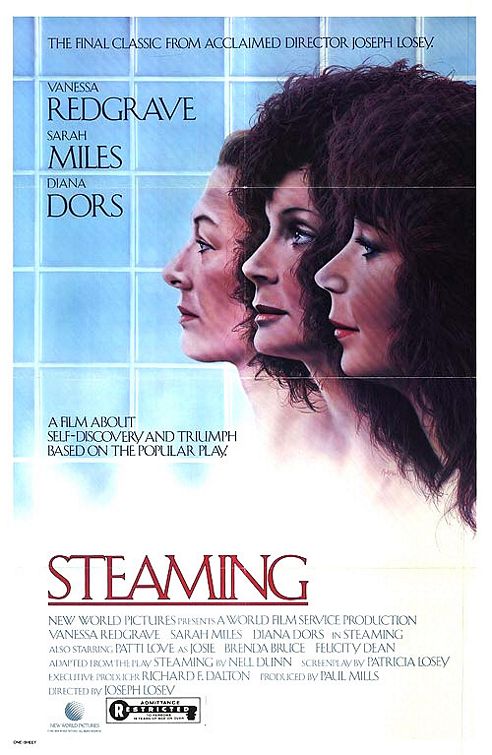
Steaming (1985)

steaming

By Richard Winters

My Rating: 2 out of 10

4-Word Review: Saving a steam room.

Three women (Vanessa Redgrave, Sarah Miles, Patti Love) congregate at a London steam room designed like a Turkish bathhouse. Despite their lifestyle differences they become good friends as they divulge their problems to one another and learn to lean on each other to help them cope with life’s difficulties. Then one day Violet (Diana Dors), who is the bath house owner, informs them that the place is set for demolition, which causes everyone to go on a mission to try and save it.

The film is based on the Nell Dunn play, which was highly regarded at the time, but makes for a very poor transfer to film. It starts out flat and never recovers. The dialogue has too much of a conversational quality that is not interesting and the problems that they discuss are not compelling, or original. The humor from the play is missing and the dry, somber tone only makes things even more boring. The only time it gains any traction is when it’s announced that the place is closing, but everything gets resolved in such a sitcom-styled way that it hardly seems worth the effort to watch.

The entire cast is made up of women and there is an abundance of nudity particularly from Miles, which doesn’t seem like a big deal these days. The biggest issue though is the fact that everything takes place from inside the bath house, which is gray, grimy, and rundown. The film should’ve had some segments shot from different locales if to only allow for some visual variety and to help the viewer understand the characters better by seeing how they react in different social settings.

Miles and Redgrave are wasted in drab roles and this goes likewise for Dors whose last film role this was. Love is the only one that shows any liveliness and although her character is a bit annoying she at least has an emotional breakdown near the middle, which adds some mild dramatic tension.

Joseph Losey was a competent director who made many interesting films, so it’s a shame that his career had to end with such a dud. He was already sick with cancer while he filmed this and like with Dors died a year before it was released. The disease may have sapped his creative energy and explain why this production is so ponderously sterile. It’s certainly a far cry from his other works as well as the Bruce Jay Friedman play Steambath, which had a similar setting, but a much more imaginative plotline.

My Rating: 2 out of 10

Released: September 28, 1985

Runtime: 1Hour 31Minutes

Rated R

Director: Joseph Losey

Studio: New World Pictures

Available: DVD (Region 2)

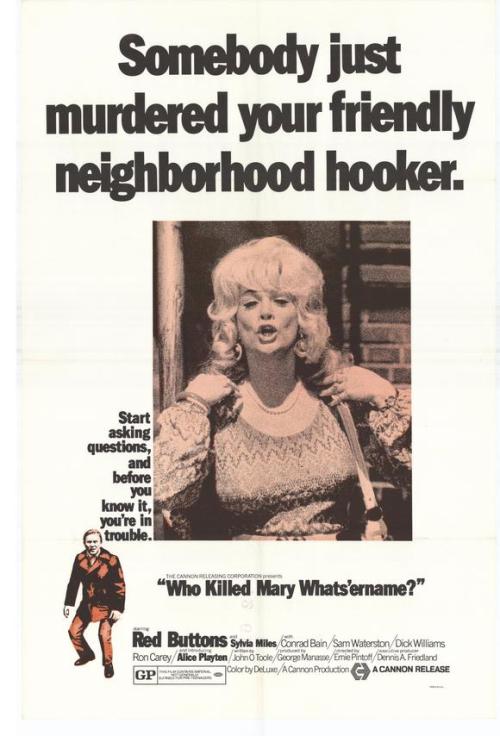
Who Killed Mary Whats’ername? (1971)

who killed mary 2

By Richard Winters

My Rating: 3 out of 10

4-Word Review: Who killed the prostitute?

Mickey (Red Buttons) is a retired diabetic boxer who is appalled to learn that a prostitute was killed in her apartment and no one seems to care. He decides to do the investigation himself and even moves in to her old place. He inquiries about her amongst the locals and begins to get a few leads including that of a young filmmaker named Alex (Sam Waterson) who may have inadvertently filmed her leaving with her eventual killer. Soon Mickey’s grown daughter Della (Alice Playten) and Val (Conrad Bain), a man he meets at a bar, are helping him in his quest, but the things they learn only reinforce how unpleasant and dangerous a hooker’s life can be.

I commend the attempt at taking a gritty look at a seedy lifestyle and its open-minded approach to the women who are in it, but the film’s poor execution makes the whole thing come off as quite amateurish and even laughable. Why a man in his 50’s would become so obsessed with finding the killer of a woman he has never known and only reads about in a newspaper is quite hard to fathom. There are probably hundreds of prostitutes that share similarly sad fates, so why get so revved up about this one? The fact that he is able to get his grown daughter and another man he meets randomly at a bar to help him investigate seems equally unbelievable and the way they are conveniently able to find clues and connect-the-dots before solving the case comes off as too easy.

The action sequences, especially the opening one in which we see the prostitute getting killed, are poorly staged and filled with chopping editing that makes it hard-to-follow and phony looking. When the 50-year-old Buttons takes on a gang of young bikers, which are led by Earl Hindman who later became famous for playing the neighbor on ‘Home Improvement’ whose face was always obscured by a fence, it becomes downright silly. Sure the Buttons character has a background in boxing, but that still doesn’t mean he can take on four guys who are twice his size and the sound effects used for the punches are overdone and cartoon-like.

A similar issue occurs when Buttons saves a prostitute from an abusive pimp while Alex films it. The first time this occurs it is mildly diverting, but then when he saves another one, who is being beaten up by some of the old ladies in the neighborhood, it becomes redundant and corny.

The resolution, in which the killer turns out to be someone no one suspected, is flat and forgettable. It is also poorly thought out as he admits to the Buttons character that he killed the two women because he didn’t want any potential witnesses, but then doesn’t bother to kill Buttons or at least make sure he is dead even after he divulges his secret to him. The killer then just casually walks away without ever allowing the viewer to know if he was caught and charged with the crimes.

My Rating: 3 out of 10

Released: November 12, 1971

Runtime: 1Hour 30Minutes

Rated GP

Director: Ernest Pintoff

Studio: Cannon Film Distributors

Available: None at this time.

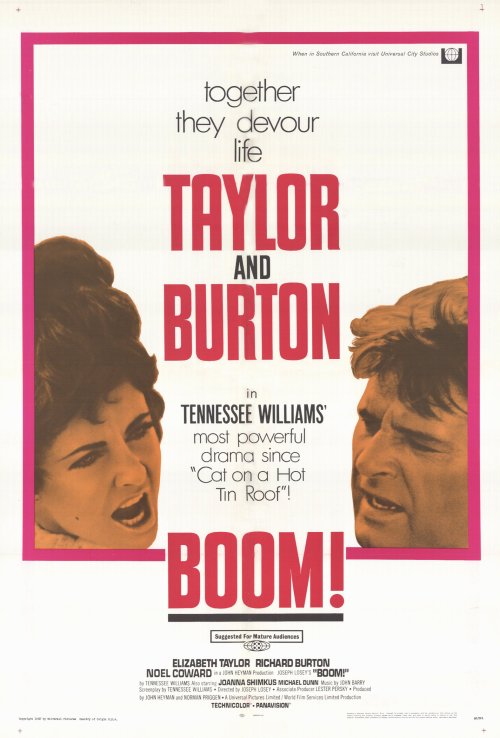
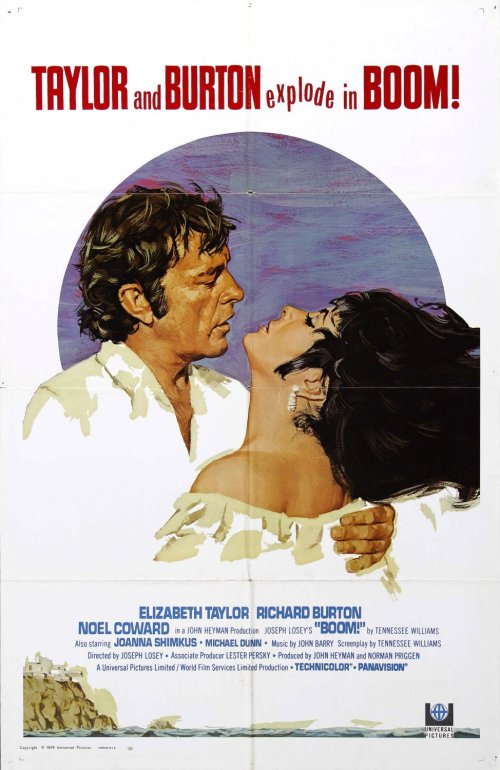
Boom! (1968)

boom

By Richard Winters

My Rating: 4 out of 10

4-Word Review: Bitchy lady rules island.

Flora ‘Sissy’ Goforth (Elizabeth Taylor) lives on a secluded island in a large mansion and surrounded by servants who cater to her every whim. She has alienated most everyone she has come into contact with and relies on her secretary Miss Black (Joanna Shimkus) to write down her autobiography that she dictates to her indiscriminately throughout the day. In comes Chris Flanders (Richard Burton) a nomadic poet living on the skids who infiltrates her palace and her oppressed sexual desires with his ruggedness and mystery. Will Sissy fall under his seductive spell, or does this mysterious stranger have even darker intentions?

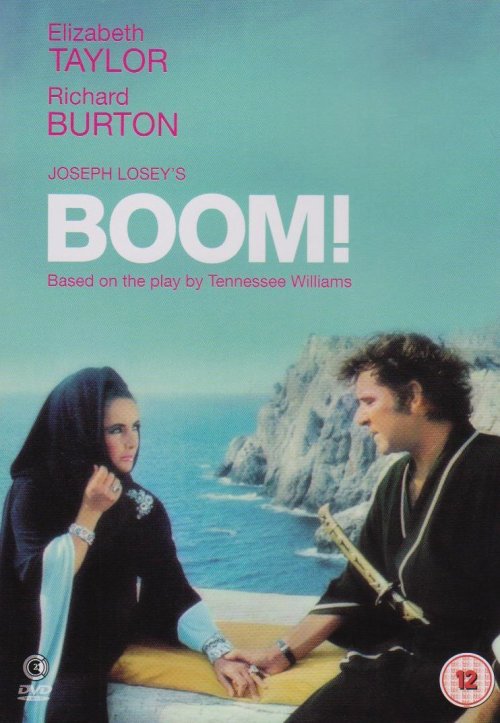
The film was directed by Joseph Losey who is one of the more inventive and groundbreaking directors who ever lived and sadly doesn’t get enough recognition. Unfortunately he was going through a bout of depression when he made this film, which caused him to abuse alcohol and seriously affected the film’s final result although it still manages to be a fascinating visual excursion nonetheless. The location shooting, which was done almost entirely on the island of Sardinia, is dazzling. The shots of the steep cliffs and crystal blue water, which are literally a part of Sissy’s backyard, are breathtaking. The modernistic mansion that she lives in is equally sumptuous particularly with its myriad collection of art paintings and wet bars that seem to pop-up every few feet in whatever room or patio the characters are in.

The acting is also outstanding as Taylor eats up the scenery with her over-the-top bitchiness and unexplained anxiety attacks, which she takes to an unprecedented campy level. The outrageous hat that she wears to her dinner date is quite possibly one of the most bizarre things ever to be put on top of a human head.

boom4

The normally commanding Burton unfortunately comes off as weak in comparison and overall looks uncomfortable in his role. The script originally called for a young man in his 20’s for the part and thus casting Burton, who was already 42 at the time, seemed misguided.

Dwarf actor Michael Dunn is excellent in support. His character utters only three words, but still makes his presence known with the way he shows complete control over his attack dogs while playing of all things Sissy’s bodyguard. Playwright Noel Coward appears in a fun bit as one of Sissy’s friends who she invites over for dinner. The friends secretly disdain each other in private, but put on a superficial friendship when together and apparently this is also how the two performers behaved with each other behind-the-scenes as well.

Unfortunately the script, which was written by Tennessee Williams and based on his play ‘The Milk Train Doesn’t Stop Here Anymore’ leaves much to be desired. The plot meanders on to an unsatisfying conclusion while rehashing old themes that had already been used in his earlier and better known works.

boom2

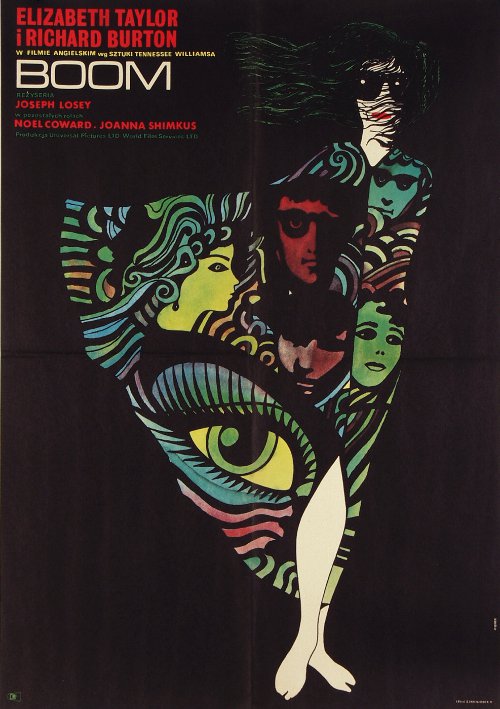
Polish Poster

My Rating: 4 out of 10

Released: May 26, 1968

Runtime: 1Hour 52Minutes

Rated PG

Director: Joseph Losey

Studio: Universal

Available: DVD (Region 2)

Independence Day (1983)

independence day 2

By Richard Winters

My Rating: 3 out of 10

4-Word Review: Getting out of Texas.

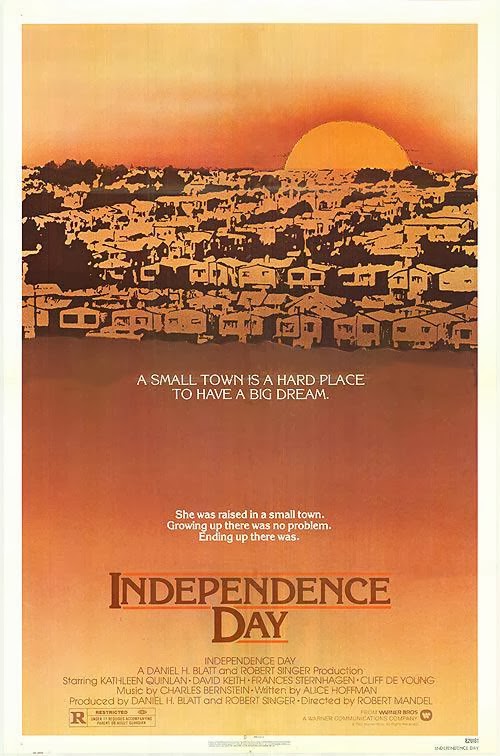
Mary Ann Taylor (Kathleen Quinlan) works as a waitress at her father’s café, but dreams of leaving her sleepy Texas town and going to school in California to study photography. Her mother (Frances Sternhagen) though is in declining health and her current boyfriend Jack (David Keith) wants her to stay which makes her decision to leave all the more difficult.

Shot on-location in Anson, Texas the film is a pleasant time-filler that fortunately doesn’t go overboard with Texas stereotypes, but it’s also rather bland and predictable. Feeling trapped in a small town is by no means a unique feeling and the film doesn’t go far enough with that theme and for the most part just touches the surface. Adding in a second storyline dealing with Jack’s sister (Dianne Weist) being abused by her husband (Cliff De Young) is a bit jarring and doesn’t really fit as there are long periods where Mary Ann is not seen at all and it would’ve made more sense had it been her sister that was being abused and not Jack’s and thus giving her more screen time.

The dramatic arcs are a bit too obvious as well and at times even bordering on being corny. For one thing the abuse issue gets introduced by having Jack visit his sister and asking her husband to borrow some money and then for no reason the husband begins throwing lit matches at his wife while right in front of Jack. Abusive people can certainly be cruel, but they’re not stupid and hurting a woman while her well-built brother sits right there is most assuredly going to get the husband into trouble, so why do it? Having Jack find out about the abuse by coming to the home one day unannounced and hearing shouting and maybe looking into a window and seeing the husband hit her would’ve made far more sense.

Having Mary Ann’s mother, who otherwise looks and acts quite healthy, suddenly fall over with fainting spells and suffering from some disease that never gets explained seemed too manufactured. Mary Ann’s arguments with Jack over whether she should go to school or stay in Texas is equally transparent especially since the two really didn’t have all that much in common and could’ve easily found other dating partners quite quickly.

Having one of the official’s from the photography school drive out to her rural home and personally offer her a full scholarship while telling her she was one of the greatest photographers he had even seen was pretty loopy too. All she did was take pictures of the town’s buildings and people’s faces, so what this guy managed to see that was so ‘brilliant’ and ‘special’ from that is hard to figure.

Quinlan and Wiest give great performances, but the movie is nothing more than lightweight drama that fails to distinguish itself from all the other B-dramas out there.

My Rating: 3 out of 10

Released: January 21, 1983

Runtime: 1Hour 50Minutes

Rated R

Director: Robert Mandel

Studio: Warner Brothers

Available: DVD (Warner Archive)

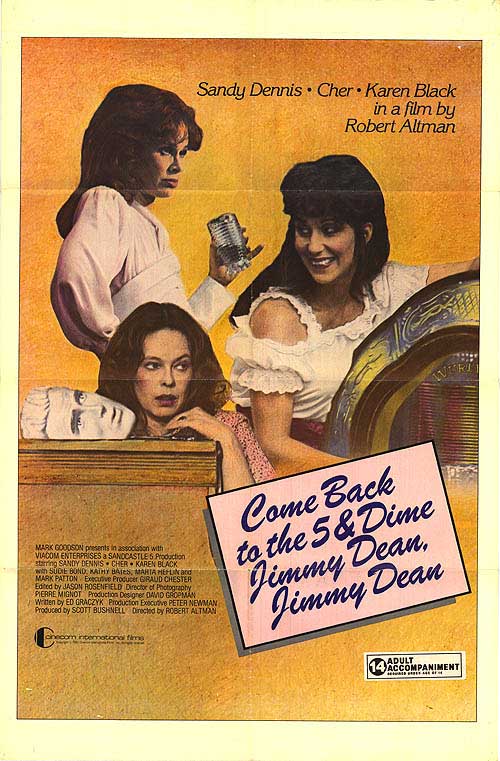
Come Back to the 5 & Dime Jimmy Dean, Jimmy Dean (1982)

COME BACK TO THE FIVE & DIME, JIMMY DEAN, JIMMY DEAN, Sandy Dennis, Cher, Karen Black, 1982, (c) Cinecom Pictures

COME BACK TO THE FIVE & DIME, JIMMY DEAN, JIMMY DEAN, Sandy Dennis, Cher, Karen Black, 1982, (c) Cinecom Pictures

By Richard Winters

My Rating: 3 out of 10

4-Word Review: Disciples of James Dean.

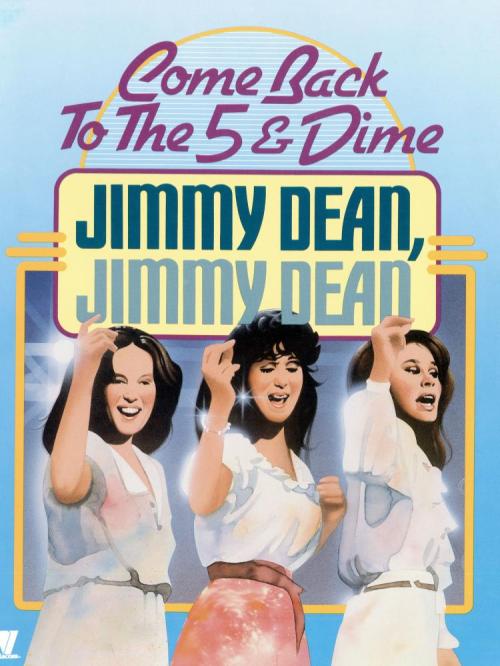
Twenty years after his untimely death five women (Cher, Sandy Dennis, Karen Black, Kathy Bates, Marta Heflin), who were big fans of James Dean and called themselves his disciples, decide to hold a reunion at a thrift shop in a small town not far from Marfa, Texas where the film Giant was made. However, the reunion is not a happy one as old wounds and secrets come to light that forces the women to analyze themselves and their lives in uncomfortable and unpleasant ways.

One of the things that really annoyed me about this movie and at times just downright confused me is that the characters show no signs of aging at all as it shifts between 1955 and the present day of 1975. Twenty years is a significant period of time and most everyone will show some signs of age, or at least changes to their hairstyle and outfits and yet with the exception of the Joe character there is no distinguishable differences between the others from one period to the next. The Cher character was particularly perplexing as her hair remains jet black for two decades and even the same exact style. One could argue that maybe she dyed it, okay, but she also manages to somehow retain her same girlish figure, which is even less likely.

I also found it hard to believe that she could afford to make a living by working at little thrift store for 20 years, or that she would even be needed as the place was small enough for one person to run and through the course of the entire movie never once does a single customer even enter the place. Her character was attractive enough to find a man, get married and run off to another town or place that had more potential. We learn through the course of the movie that she was married at one point, but then dumped, however I would think she would’ve been able to find someone else in a 20 year time span especially since she was still quite good looking.

Keeping all of the action inside the thrift store makes the film seem almost claustrophobic. I realize this was based on a stage play, but most plays that get transferred to film will have certain scenes, or cutaways added in to avoid this feeling. Even having some outdoor shots done over the opening credits would’ve given it a little more of a visual variety.

The performances are the best thing about the movie and probably the only reason to see it. All three leads recreate their parts from the stage version. Cher is sensational and in my opinion gives the best performance. Dennis is solid doing her patented fragile caricature and who displays some interesting emotional eruptions at completely unexpected times. Black is excellent as well. Usually she plays flaky types, but here is more reserved and steely. Bates is good as a loud and abrasive woman and Sudie Bond lends fine support as the shop’s overtly religious owner.

The script is passable, but the revelations that come out are stuff you’d find on a second-rate soap opera. I also found it hard to believe that these women would get together after 20 years and not have other things to talk about. Usually when people meet after not seeing each other for an extended period of time there’s always a lot of ‘catching up’ to do where they talk about all the things that have happened to them since, but here there’s none of that. Instead they come off like people frozen in time clinging to bygone issues that just about anyone else would’ve moved on from long ago.

The film ends with several shots of the store shown in an abandoned and rundown state, but with no explanation of what time period it was taken in. At first I thought this meant that maybe the reunion had never occurred. That maybe it had just been imagined, which is a concept that I liked and would also have filled in some of the gaping plot holes that I’ve described above, but then I saw the reunion banner still hanging in a tattered state from the ceiling. Others on IMDb have debated that it may represent the reunion that they had planned for 1995 that never came about, which is a good guess, but with business being as slow as it  was at that place I think it would’ve been abandoned long before 1975 let alone 1995.

come back 1

My Rating: 3 out of 10

Released: November 12, 1982

Runtime: 1Hour 50Minutes

Rated PG

Director: Robert Altman

Studio: Cinecom Pictures

Available: DVD

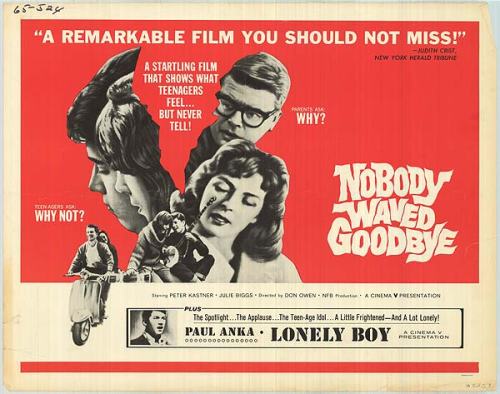
Nobody Waved Goodbye (1964)

nobody waved goodbye 1

By Richard Winters

My Rating: 8 out of 10

4-Word Review: Teen learns hard lesson.

Peter (Peter Kastner) is 18 and looking to spread-his-wings, but doesn’t like what he sees in the adult world. Everyone seems trapped by their dull jobs and mundane routines, which is something he doesn’t want to fall into. He has big dreams. He wants to run away with his girlfriend Julie (Julie Biggs) and live a life based completely on his own whims while never becoming a slave-to-the-system like everyone else. Then he gets in a fight with his parents and they kick him out and after struggling to find work without even a high school diploma his attitude quickly changes.

If you can get past the wretched opening song, which is sung by Kastner and played over the credits, then this film really hits-the-mark. I was impressed with the camera work especially during the dinner time conversations amongst the family members where director Don Owen shoots it with a hand-held camera and zooms in and out on the person’s face as they are speaking. This is something that is quite common today especially on TV-shows, but back then was rarely if ever used, which makes this well ahead-of-its-time and even groundbreaking. I also enjoyed the conversational quality of the dialogue and having two conversations going on at the same time, which again didn’t come into vogue until years later when Robert Altman did it in M*A*S*H.

The film also clearly allows for ad-libbing amongst its actors. There is a scene in which Peter and Julie go paddle boating and come upon a large sofa submerged in the water and then comment on it. Clearly the filmmakers didn’t put the sofa into the lake simply to film the short scene that has nothing to do with the rest of the story, but it still helps set the tone for keeping things fresh and real.

Kastner is great and it’s refreshing to have a protagonist in a film that you like at some points and feel like wringing-his-neck at other times. Too many movies today, especially Hollywood ones, create lead characters that are politically correct caricatures while this movie instead has real human beings that are not tailored made to conform to the likings of any particular demographic.

It’s a shame to say that a movie that came out over 50 years ago is still considered cutting-edge, but compared to the tired, formulaic glop coming out today it really is. The script is uncompromised and holds-no-punches while keeping things gritty and stark and making profound, universal points along the way. I also found it fun that the main character here, who was clearly a baby boomer, displays the same anti-establishment, anti-work attitude that now gets placed squarely onto the ‘dreaded millennials’ and yet it seems the boomers were just as reluctant to get into the rat race as all the generations that have followed them and therefore shouldn’t be waiving their finger at anyone.

nobody waved goodbye 2

My Rating: 8 out of 10

Released: August 13, 1964

Runtime: 1Hour 20Minutes

Not Rated

Director: Don Owen

Studio: National Film Board of Canada

Available: None at this time.

The Honkers (1972)

honkers 3

By Richard Winters

My Rating: 5 out of 10

4-Word Review: Rodeo star is selfish.

Lew Lathrop (James Coburn) is an aging rodeo star who returns to his hometown after an extended absence, which stirs up resentment and trouble wherever he goes. His wife Linda (Lois Nettleton) still has feelings for him despite her anger at him leaving her and never being able to stay faithful. It seems that the only true friend that he has and one that remains loyal to him even through his many shortcomings is rodeo clown Clete (Slim Pickens), but even this gets put to the test when Lew decides to jeopardize is family life once again when he decides to go after local hottie Deborah (Anne Archer) a young woman just past the age of consent who enjoys flirting with older men and shows no reluctance in having her way with them.

The film was directed by actor Steve Ihnat who never saw the final product put on the big screen as he died from a sudden heart attack at the young age of 37 five days before the film’s release. Much like with Junior Bonner and JW Coop, which came out at the same time, this has an authentic feel with the necessary level of grittiness and good rodeo footage,  but the scenes go on too long and the pace is too laid back. One shot has Coburn walking down the city sidewalk for a full several minutes with nothing else happening. Extended shots of a downtown parade and broncos bucking off cowboys in the rodeo ring are all nice, but fail to propel the plot, which seems pretty thin anyways and almost makes this come off like a documentary than a feature film.

Coburn is his usual engaging self, but seems genuinely uncomfortable getting on the broncos and even a bit out-of-place in the role. Pickens is outstanding in support it what may be the best film role of his career. Usually, especially with his country accent, he would get subjugated to hillbilly parts, but here he gets to show his dramatic side by playing a rodeo clown, which is what he did for many years in real-life before becoming an actor. Archer, in only her second film role is quite seductive and possibly at her most beautiful though the many shots showing her wearing headbands start to make her resemble Pocahontas.

Filmed entirely on-location in Carlsbad, New Mexico director Ihnat manages to take full advantage of the rustic western landscape and brilliant blue sky of the region, which is a major plus. The ending has a nice surreal quality and the story does manage to pick up a bit during the second half, but it still could’ve been better trimmed and more compact.

My Rating: 5 out of 10

Released: May 17, 1972

Runtime: 1Hour 42Minutes

Rated PG

Director: Steve Ihnat

Studio: United Artists

Available: None at this time.

Pretty in Pink (1986)

pretty in pink

By Richard Winters

My Rating: 5 out of 10

4-Word Review: Poor girl dates preppy.

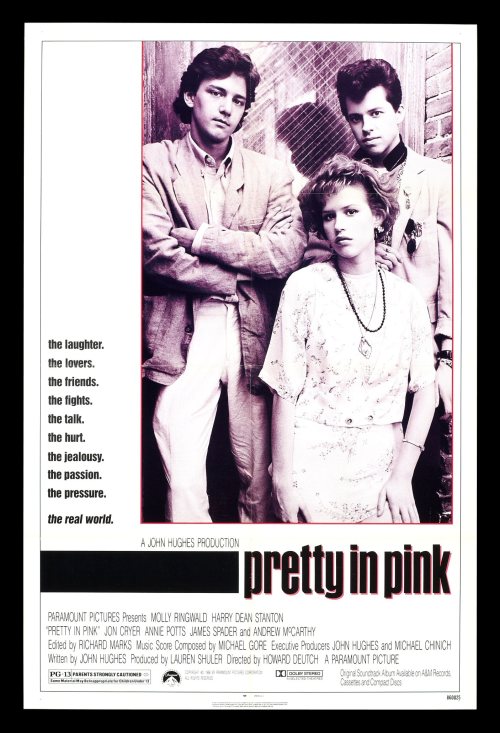
Andie (Molly Ringwald) is a teen girl from the poor side of town who one day while working at a record store meets Blaine (Andrew McCarthy) a rich, handsome, preppy kid that she immediately takes an interest in. A few days later he asks her out much to the dismay of her geeky friend Duckie (Jon Cryer) who has a secret crush on her. Blaine’s friend Steff (James Spader) is also angered about it because he had asked Andie out earlier and been rejected and these two factors cause a strain on their relationship and forces both of them to consider ending it.

One of the problems that I had right away with the film is the fact that with the exception of Ringwald, the majority of the cast who are playing these so-called teenagers were in reality way past adolescence and looking too mature. Kate Vernon, who plays a snotty girl named Benny, actually looks older than her female instructors. McCarthy and Cryer were also in their 20’s and manage to pull it off, but Spader who was 25 at the time doesn’t. He gives a great performance nonetheless, but I kept wondering with so many star struck teens out there dying to get into the business that the producers couldn’t have gotten performers that were more at the actual age of the characters.

Ringwald is fantastic in a vehicle tailored made for her and one that she really cruises with. I particularly liked her facial expressions while she attended a frat party and the moment where she decides to go to the prom despite not having a date simply to show them that they can’t ‘break her’ is fantastic. However, I wasn’t so crazy about the inferred idea that she was dating Blaine simply because he was from a rich family and could help her escape from her otherwise poor/ humble surroundings as it toys with the concept of ‘marrying-into-wealth’ which is too old fashioned. A young lady today should feel that she can work her way up the social/economic ladder on her own and not be dependent on some guy to do it for her.

I had equally mixed feelings involving Duckie. Cryer certainly gives an engaging performance, but the character’s excessive and constant need for attention-seeking humor gets overdone and I wished it had been toned down and the character made to be a little less geeky. The part where he has an instant meltdown when he finds out that Andie is dating someone else is also too extreme as it makes him seem dangerously possessive especially since he and Andie were just friends. Later when he is rude to Blaine at a nightclub only helps to make him look even more emotionally unstable.

I had this same issue with Steff who gets aggressively angry at Blaine for dating Andie and even threatens to end their friendship because of it, which to me was a complete overreaction. Sure he might be upset about it, but in real-life I think he would’ve expressed his displeasure in more subtle ways,or even just gotten over it since he was apparently sleeping with Benny who was a lot hotter looking than Ringwald anyways. In reality people generally want to hide their hurt feelings and not respond so overtly when things don’t go their way because they are usually smart enough to realize it will just make them look like a sore loser otherwise.

The Blaine character has problems too although different from the other two. The first issue is when he is at the record store and hands Andie an album cover showing Steve Lawrence, a famous crooner from the early ‘60s and frequent guest star on the old ‘Carol Burnet Show’ and asks Andie if he’s ‘hot’ or ‘trendy’. Now, I was teenager myself during the ‘80s and was in no way ever affiliated with the ‘hip crowd’, but even I and my nerdy friends where savvy enough to know that Steve Lawrence would never be considered an idol with ‘80s teens nor humiliate ourselves by asking anyone if he was. The fact that he does ask makes him seem almost mentally ill or someone who’d been living in a cave, which would be enough for most young women not to want to date him because they would think he was ‘weird’ or strangely disconnected.

The scene that takes place in the school’s library where he sends her a message via the school’s compute and even somehow manages to upload a picture of her is also dumb. Remember this was BEFORE the internet and sending emails and communications via a computer weren’t common or likely especially when they weren’t even their own, but public ones instead. In a later conversation this gets described as a ‘computer trick’ that he knows, which I guess suffices as being screenwriter John Hughes’ feeble attempt at ‘explaining it’.

In a lot ways this seems like just a basic reworking of the formula that was already used with much better success in Sixteen Candles with Cryer playing an off-shoot of Anthony Michael Hall’s character and Harry Dean Stanton as Ringwald’s sensitive father substituting for the one played by Paul Dooley in the first film. I was also disappointed that we never even briefly get to see Andi’s mother who was divorced from her father but gets discussed quite a bit and there’s even a picture of her sitting on Andie’s bedside table, which to me should’ve been enough to justify some sort of appearance by her at some point.

I liked the scene, at least on an emotional level, where Duckie physically attacks Steff after he makes a disparaging remark about Andie, but on the logical end it’s off-kilter. For one thing Andie wasn’t aware of the remark and for Duckie to take on some guy who was clearly much bigger than him it would’ve made more sense for her to have heard it and been hurt by it in order for him to come so aggressively to her defense. A later scene that takes place at the prom where a super-hot girl turns around and out-of-nowhere shows an immediate interest in Duckie who’s just standing there seemed too dream-like and fanciful.

I never saw this film when it first came out and only reviewed it now at the suggestion of some female friends in order to commemorate the 30th anniversary of its release and I have to be honest I was expecting something a lot better especially since it has attained such a strong cult following. Maybe it’s the nostalgic value that gives it its allure, but on a purely cinematic level it’s average at best with a screenplay that only touches the surface of the teenage experience while relying too heavily on age-old and very obvious dramatic devices to help propel it.

My Rating: 5 out of 10

Released: February 28, 1986

Runtime: 1Hour 36Minutes

Rated PG-13

Director: Howard Deutch

Studio: Paramount

Available: DVD, Amazon Instant Video, YouTube

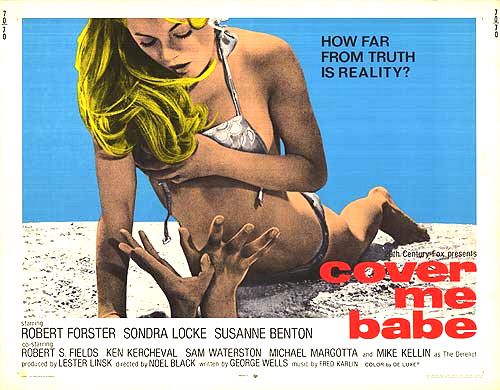
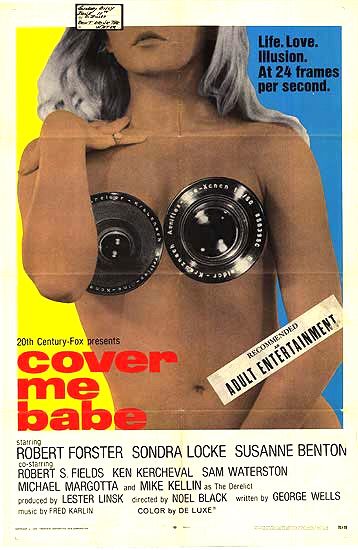
Cover Me Babe (1970)

cover me babe 3

By Richard Winters

My Rating: 3 out of 10

4-Word Review: Student filmmaker alienates everyone.

Tony Hall (Robert Forster) is a student filmmaker who feels he is a great director in the making and not afraid to let everyone know it. He becomes obsessed with capturing reality as it is and people’s emotional responses. He goads those around him including his own girlfriend (Sondra Locke) into doing things they are uncomfortable with simply so he can capture that uneasiness and the facial expressions that come with it. Some feel he is going too far, but the more they try to reel him in the more boundaries he pushes.

I’ve attended a film school in Chicago back in the early ‘90s, so for me I found this plot to be intriguing. In a lot of ways, at least at the beginning, I thought they captured the arrogance of these young would-be student directors who are convinced they are the next Kubrick or Scorsese in-the-making quite well. Their elitist attitude and willingness to compromise good taste and common sense simply to attain a shock effect to get attention are all very real.

Unfortunately the film goes overboard especially with the lead character who quickly becomes unlikable. I don’t mind a certain bit of cockiness or a say-it-like-it-is persona, but this guy is downright rude, smug, abrasive and even cruel. You spend the whole time hoping someone will punch him in his face, but it never happens and I believe this is the sole reason why this film failed at the box office as no one wants to sit through an entire movie watching a person whose behavior they can’t stand.

His excessively rude attitude towards a studio head (Jeff Corey) who wants to offer him an opportunity make a feature film is particularly confounding. It’s similar to Troy Duffy the real-life subject of Overnight and the director of The Boondock Saints who became quite arrogant to everyone once he got himself a Hollywood contract, but at least in Duffy’s case he had gotten his proverbial foot-in-the-door and therefore felt it was ‘safe’ to let his obnoxious side out, but the Forster character here doesn’t yet have one and you’re compelled to feel that the guy must be mentally ill to think he ever will by behaving in the outrageous way that he does.

Forster gives a solid performance, but the character seems too similar to one he just got done doing in Medium Cool and bordered almost on type casting. Locke is okay as the girlfriend and can be seen fully nude at the beginning, but why she would want to stick with such a jerk is hard to understand and makes her character annoying because of it. I realize some gals have the ‘bad-boy syndrome’, but it goes overboard with it here.

The film lacks a cinematic touch and its best part comes at the beginning where we watch a student film with a dream-like sequence in a Federico Fellini style that is actually pretty good. Another memorable bit comes near the end where Forster broadcasts to a group of students his own film, which features a scene showing a man jumping off a ledge and then panning over to reveal the shocked expressions of the people on the ground who witnessed it as well as the students watching it on film.

cover me babe 2

My Rating: 3 out of 10

Released: October 1, 1970

Runtime: 1Hour 25Minutes

Rated R

Director: Noel Black

Studio: 20th Century Fox

Available: None at this time.

Running (1979)

running 1

By Richard Winters

My Rating: 5 out of 10

4-Word Review: Life of a runner.

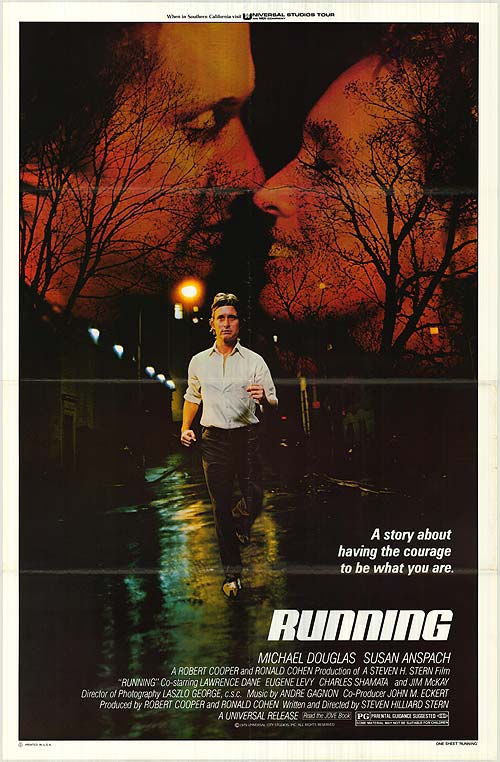
Michael (Michael Douglas) is suffering, at the age of 32, a midlife malaise. He goes from one dead end job to another and his marriage is crumbling. He runs to relieve the stress and finds that he has a major passion for it. When he qualifies for the Olympics he is initially excited, but it’s short lived because his former coach (Lawrence Dane) is on hand to constantly remind him how he has a tendency to ‘choke’ at the last minute and can never win a race when the pressure is on, which begins to wear on him psychologically.

The theme of a middle aged man having a passion for something that isn’t exactly ‘practical’ and resisting the pressures from the rest of world that tries to get him to conform to something that is, is highly relatable. I also liked the side-story dealing with the psychological element, which plays a far stronger factor in sports and amongst athletes than one might think. However, the majority of the screen time is spent with Michael trying to reconcile with his wife Janet (Susan Anspach) making it seem more like a romance and seemingly added in as ‘filler’ because the filmmakers believed that the running theme wouldn’t be enough to  carry it.

I also had a hard time understanding why the kids at high school, or at least his daughter’s friends, which gets played by Lesleh Donaldson in her film debut, would make fun of Michael simply because he was frequently seen around town running. I see joggers and runners every day and saw a lot of them back in the ‘70s too, so I don’t get why that would be a source of mockery and it seems like it was yet another manufactured dramatic element put in to give it more conflict. What’s even worse is when Michael finally qualifies for the Olympics then the kids do a full 180 degree turn and get excited about it and even run with him down the city streets, which gets corny to say the least.

Halfway in you realize this is just another variation of the Rocky formula and normally I would’ve found it annoying, but for some reason I actually got into it. I even liked the scene where he spots a giant cross standing on a hill and decides to run up the incline to reach it much like Rocky climbing the steps of the Philadelphia Museum of Art and to some degree it’s invigorating although it would’ve been nice had it shown him standing next to the cross once the climb was achieved. The final segment that takes place during the climactic Olympic race even has a twist to it that I didn’t see coming and to a degree it’s interesting though pushing plausibility. I won’t give it away I’ll just say that he doesn’t win the race, but he doesn’t exactly lose it either.

Douglas did all of his own running and to prepare for the role he would run many miles a day; IMDB states that he ran 50 to 60 miles a day, which I found hard to believe, so we’ll just say it was ‘many’. Anspach is good as the sympathetic wife particularly when the character has a conflict of emotions and breaks out in tears. Eugene Levy appears with a full afro in a rare serious turn as Michael’s attorney. Lawrence Dane is okay as the hardened coach who dispenses a lot of ‘tough love’, but little else.

My Rating: 5 out of 10

Released: November 2, 1979

Runtime: 1Hour 42Minutes

Rated PG

Director: Steven Hilliard Stern

Studio: Universal

Available: DVD (Italian Import Region 0)