Category Archives: Cult

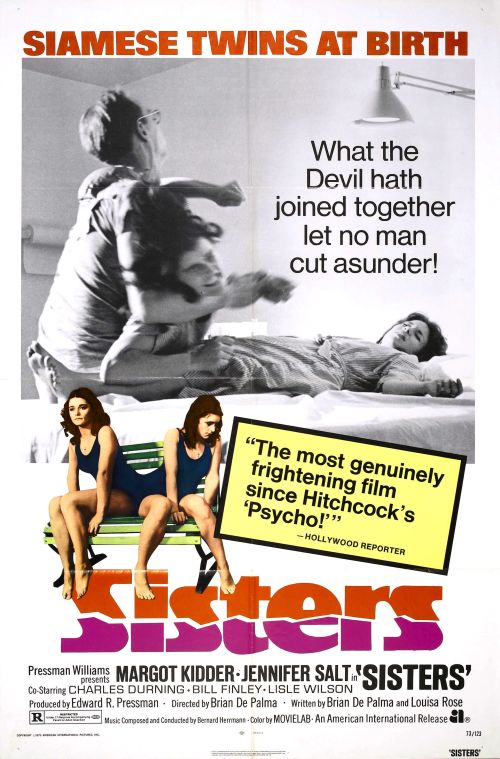
Sisters (1972)

sisters

By Richard Winters

My Rating: 7 out of 10

4-Word Review: Model has evil twin.

Danielle (Margot Kidder) is a young French-Canadian women from Quebec who aspires to be a fashion model and actress. She takes part in a TV-show styled after ‘Candid Camera’ where unsuspecting people find themselves caught up in a prank, which is where she meets Phillip (Lisle Wilson). The two go out on a date, but while at the restaurant she gets harassed by Emil (William Finley) her ex-husband. Then when they get back to her apartment Phillip overhears her arguing with another woman, which Danielle says is her twin sister Dominque. Since it is both of their birthdays Phillip decides to go out to get them a cake, but when he returns he gets viciously stabbed by the psychotic Dominque, but just before he dies he’s able to scribble the word ‘help’ onto the window with his own blood that Grace (Jennifer Salt), a journalist that resides across the street, sees. She immediately calls the police, but when they arrive into Danielle’s apartment there’s no sign of a body, or a struggle and Grace gets written-off as being a kook whose been imagining things, but she refuses to relent and begins her own investigation where she uncovers some dark details about Danielle and her sister who were once conjoined.

This was writer/director Brian De Palma’s first attempt at horror after completing many successful comedies that had gained a cult following. The story was inspired by real-life conjoined twins Masha and Dasha Krivoshlyapova who’s sad upbringing where they were taken away from their mother and had abusive medical experiments done on them at a secret hospital in the Soviet Union, and which was chronicled, much like in the movie, in a story in Life Magazine in 1966, which after reading it De Palma couldn’t get out of his head. Visually it’s excellent with great use of editing and superior score by the legendary Bernard Herrmann, who was semi-retired at the time, but enjoyed the script so much that he agreed to be the composer.

Many of De Palma’s famous directorial touches are apparent including his use of the split-screen. While it’s been used, and some may say overused, in many films from that era, it gets worked to perfection as we get to see Danielle and her ex busily cleaning-up the crime scene while Grace gets held up by the detectives and they’re not able to go into the apartment right away. My only complaint here is that with the blood splatter all over I’m just not sure they would’ve been able to wipe it all away in such a short time frame, basically about 8 to 10 minutes, which should’ve more likely taken them several hours. Not showing the clean-up and having Grace and detectives arrive to find the place spotless with no body would’ve actually added more intrigue and thus in this case the use of the split-screen, while done adequately, I don’t think was needed.

Spoiler Alert!

The script leaves open a fair amount of loopholes, for instance we see Danielle walk into a bedroom and the shadow of her head on the wall along with another one, which is supposed to represent Dominque’s, but we learn later that Dominque died years early during the surgery to separate them, so we’ve should’ve only seen one head shadow and not two. Also, Danielle is told point-blank by Grace that she’s been spying on them from across the street, so you’d think later that she and Emil would make damn sure to close the blinds on their windows when they try to remove the sofa, which has the dead body inside, but instead they continue to leave the shades wide open and allow Grace, now back in her own apartment, to continue to peer in while the couple show no awareness to the possibility and don’t even bother to look out the window to see if they can catch Grace looking in. Another head-scratcher is why there was no blood splatter on Danielle’s clothing, since she ultimately is the one that killed Phillip, when Emil walks into the apartment.

The most confusing thing though is the ending in which Grace becomes hypnotized while inside a mental hospital and begins to see herself, through a long dream sequence, as being Dominque and attached to Danielle. When I first saw this, back in the 90’s, I thought it meant that Grace was the long lost twin and that they had been separated years earlier. While Grace doesn’t look exactly like Danielle most twins don’t, and she was still around the same age, hair color, and body type, so it seemed like a legitimate explanation and I wouldn’t blame anyone else who came to this same conclusion. Apparently though that’s not the case as Grace comes back out of it only convinced, through the hypnotism, that she didn’t see the murder of Phillip, but I felt they should’ve taken it one step further by convincing her that she was Dominque, whether it was true, or not, and then brain washed to take credit for all the murders while Danielle could then get off scot-free and this would’ve then been the ultimate twist.

Granted Grace’s character is shown as having a mother (Mary Davenport), but the script could’ve been rewritten to have her taken out and Grace could’ve instead been portrayed as being an orphan, or adopted, which could’ve left open the possibility. In either case the dream segment, which is creepy and stylish done, would’ve had more of a payoff then it does had it taken this route.

My Rating: 7 out of 10

Released: November 18, 1972

Runtime: 1 Hour 33 Minutes

Rated R

Director: Brian De Palma

Studio: American International Pictures

Available: DVD, Blu-ray (Criterion Collection), Amazon Video

Sleepaway Camp III: Teenage Wasteland (1989)

sleepaway3

By Richard Winters

My Rating: 3 out of 10

4-Word Review: Angela commits more murders.

When Maria (Kashina Kessler), who has the words ‘milk’ and ‘shake’ tattooed to her breasts, goes off to camp, she is impeded by a truck driven by Angela (Pamela Springsteen) that runs her over and allows Angela to take on her identity. Angela then returns to the same campsite where she committed her atrocities from the last film, but which is now run by husband and wife Herman (Michael J. Pollard) and Lilly (Sandra Dorsey), who have turned it into a place to help reform teens with a criminal record and renamed Camp New Horizons. It doesn’t take long though for Angela to revert to her old ways and soon both campers and counselors begin disappearing with a frightening regularity.

While Part II was filming producer Jerry Silva was so impressed with what he was seeing that he immediately authorized another sequel with a script for this one being written while that one was still being shot and then only one weekend for pre-production. This also pushed the filming date back into October where not only were the leaves already changing, but in one segment you can see the breaths of the actors when they speak, which certainly does not give the viewer a summery feel.

The second installment had an okay balance between the black comedy and horror, but this one goes overboard into silly season. The initial killing is especially problematic as it has the victim chased down by a big truck in broad daylight. Yes, she eventually gets run over when she runs into a back alley, but the semi starts barreling down on her when she’s walking on an busy road with other cars, so other people would’ve witnessed what was happening and reported it making the odds of Angela getting away with it quite slim. Also, where does a woman, who was 13 when she got locked up into a mental hospital and been there most of the time until her recent release, find the time and money to learn how to drive a big rig and how was she able to steal one?

While Springsteen’s performance was slightly tolerable in the second installment I felt it got plain annoying here. She isn’t scary and even though this is meant as a dark comedy the villain should still have some frightening presence and she has none making for no suspense at all. She also has her hair dyed blonde, in order to resemble Maria, which has her looking even less like Felissa Rose who played the character in the first one and further way from the original concept making this seem like its own little movie with name-only connections to the other two.

The murders though are an improvement and the only thing that saves it. Part II put no creativity or imagination into the killings, but here we get a couple of memorable ones including Angela roasting marshmallows on a fire that’s burning two of her victims. Killing one of the campers via tying them up to a flagpole and then allowing them to drop many feet to the hard cement below was my favorite though the death by lawnmower, which apparently made some of the women members on the MPAA board, who were hired to give the movie its rating, physically sick, deserves honorable mention. Even here though there’s problems like when Angela stands over the body of a man and swings an ax on him, but then returns to the campsite wearing the same clothes she had, which would’ve been highly doubtful as they would’ve most assuredly been covered with blood splatter.

The only element I found interesting was the appearance of Michael J. Pollard who was at one time starring in Hollywood classics like Bonnie and Clyde and was even given a couple of leading man roles in  studio produced films, but here relegated to low budget direct-to-video fare. He isn’t even in it all that much as his character is one of the first to be killed though he does at least get to make-out with a hot young chick (Stacie Lambert), which may have made it worth it.

My Rating: 3 out of 10

Released: August 4, 1989

Runtime: 1 Hour 20 Minutes

Rated R

Director: Michael A. Simpson

Studio: Double Helix Films

Available: DVD, Blu-ray, Freevee, Pluto TV, Tubi, Amazon Video

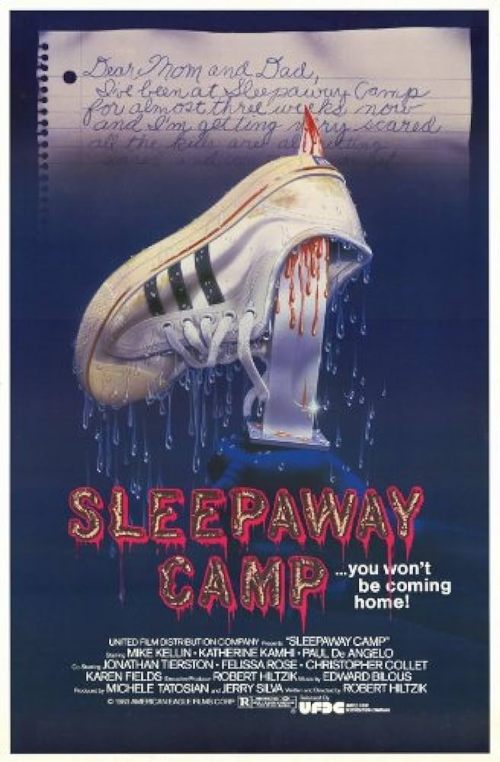
Sleepaway Camp (1983)

sleepaway

By Richard Winters

My Rating: 6 out of 10

4-Word Review: Somebody’s killing the campers.

In 1975 two children are out on a lake with their father when the boat they’re in capsizes. As they are swimming in the water another boat that is being recklessly driven rams into them killing both the father and one of the children. Fast forward to 1982 one of the surviving children, Angela (Felissa Rose), is now living with her eccentric Aunt Martha (Desiree Gold) and Martha’s son Ricky (Jonathan Tiersten). Because Angela is very shy Martha has decided to send her off with Ricky to summer camp so that she can learn to socialize better. Once there Angela’s quiet nature causes her to be bullied by the other kids, which soon leads to all sorts of violent deaths amongst both the campers and counselors. The camp owner, Mel (Mike Kellin), wants to keep the deaths out of the press and insists they’re all just been accidents, but while he does this he becomes convinced that it’s Ricky who’s behind it and resolves to teach the kid a very brutal and violent lesson.

Initially this was a low budget film made near the end of the golden age of slasher flicks that was not intended to do all that well as most studios had considered this type of horror film to have gone out of style. The critics at the time savaged it, but since then it has gained a strong cult following and considered even ground breaking for its gay subtext and gender identity roles. Writer/director Robert Hiltzik shot it at a camp in upstate New York that he used to attend when he was growing up. The camp atmosphere is very authentic and I was impressed with how many kids they were able to bring on to make it seem like a genuine camp day with tons of kids running around everywhere and all of them age appropriate to the role versus having older kids over the age of 18 trying to look younger than they are, which is what you get in most other teen flicks. The only caveat is that it was filmed in September/October of ’82 and seeing some of the trees in the background changing colors does not help give off much of a summer time feel.

The film is noted amongst slasher aficionados for its grisly deaths. When I first saw this movie back in the 90’s I hadn’t seen as many slasher movie so I wasn’t aware of how the killings here are much different  than what you usually see. In most other films of this nature the victim dies usually by a quick slash of a knife, or strangulation, which isn’t either creative or memorable, but here you get all sorts of novel deaths. Two of the best is when an overweight man (Owen Hughes) has his entire body doused with scalding water and the throbbing blisters on his skin look realistic. He also doesn’t die, which is unusual because usually the victim passes away without that much of a struggle. The death by bee hive in which the victim has his face covered by hundreds of stinging bees is equally vivid and well played-out.

The acting is impressive too as not only do you get to see Christopher Collet in his film debut, and witness his bare behind in a brief bit, but also Felissa Rose, whose quiet stare is quite penetrating and becomes the film’s most lasting impression. She apparently got the part because during the audition they were asked not to convey any lines, but to simply stare off in space while pretending to eat some candy. Prolific character actor Mike Kellin, this was his last film and he was already dying of lung cancer when he did this, is fun particularly his incredibly unfashionable choice of clothes that bring out the worst styles of the 70’s and are reminiscent of a what a middle aged suburban dad of that era might wear when attending a neighborhood backyard BBQ.

Spoiler Alert!

On the negative end I didn’t find Angela, who we learn at the very end is really a boy, to be able to realistically pull-off the murders that she does. I don’t believe she (he) would’ve had the strength to pull out the chair from underneath a heavy-set man, nor dunk the head of a bigger boy under the water, or be able to force a knife through a metal wall of a shower stall. The argument that she’s really a boy doesn’t work as her (his) body type is quite small no matter the sex and the arms are scrawny. The film does well in coming up with novel deaths, but they should’ve worked harder at thinking up killings that a small fame teen could accomplish and still be in the realm of reality, which I don’t feel these are.

With that said it’s still a cool ending. I enjoyed the weird facial expression that Angela gives off once she’s caught and the camera freezes on it while morphing into a green backdrop. The final song that gets played is creepy too, so all in all the film succeeds though it will require some suspension of belief in order to be fully enjoyable.

My Rating: 6 out of 10

Released: November 18, 1983

Runtime: 1 Hour 24 Minutes

Rated R

Director: Robert Hiltzik

Studio: United Film Distributors

Available: DVD, Blu-ray, Freeve, Pluto, Tubi, Amazon Video, 

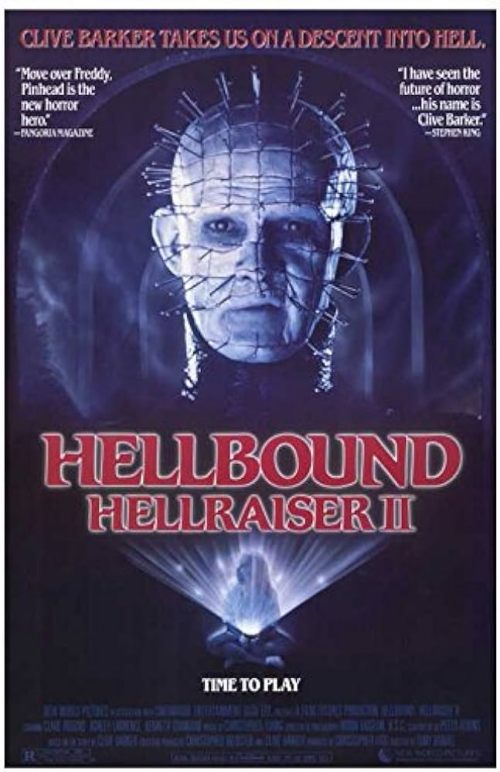
Hellbound: Hellraiser II (1988)

hellbound

By Richard Winters

My Rating: 7 out of 10

4-Word Review: The cenobites come back.

The story begins immediately where the first installment ended with Kristy (Ashley Laurence) in the hospital recovering from her injuries while she pleads with Dr. Channard (Kenneth Cranham) and his assistant Kyle (William Hope) to destroy the bloody mattress that her stepmother Julia (Clare Higgins) died on for fear that it might bring the woman back to life. Dr. Channard finds this possibility intriguing, so he brings the mattress back to his home and then has one of his mentally ill patients bleed on it, which brings Julia, minus her skin, back from the other dimension. She feeds on the patient, which gives her strength and Dr. Channard supplies her with more of them until she is able to take human form. Kristy finds out about it and travels to Channard’s home along with Tiffany (Imogen Boorman), a mental patient at the hospital whom she meets that cannot speak, but has a gift for solving puzzles. When they confront Julia and Channard all four get taken to the other dimension known as the labyrinth that houses the cenobites.

While Clive Barker wrote the script and produced he did not direct and instead handed over the reins to his friend Tony Randel. Randel wanted to turn into more of a dark fantasy and the transitions works making it visually arresting. The mazes that make up the other dimension, which are captured from a bird’s-eye view as we see tiny dots, which represent the characters running, are amazing and I enjoyed Tiffany’s brief foray into a circus like freak show that had a giant fetus with its lips sewn shut, that was creepy and I wished extended further. The scene where Julia bursts out of the mattress to attack the patient I found genuinely horrifying and a dare say one of the scarier moments in horror film history. I also liked the backstory revealing how pinhead (Doug Bradley) came into being. Supposedly this backstory was supposed to take up a major part of the runtime, but due to budget limitations it had to be scrapped and we only see a brief snippet of it through quickly edited segments, which to me was probably best.

The script though does seem a little weak in the way it sets up the premise as it’s way too convenient that the patient in the neighboring room to Kristy’s would have this fixation to solving puzzle boxes, which just makes it highly predictable where its going to go. Have her Dr. show an equal fascination with the puzzles and the cenobite world is again betting long odds and having someone with this dark obsession from outside the hospital track Kristy down would’ve been more believable. The way the mental patients are housed looks dated like we’re seeing an asylum from the 16th century though it still works, if you suspend your belief a bit, with the film’s over the top style.

I was glad that at least Andrew Robinson’s character from the first one doesn’t appear here. He was asked to reprise his role, but refused, which was good because if he had returned the script would’ve had a scene where he and Frank where together in the same body like Siamese twins, which sounded ridiculous. I also don’t like movies that have a character die-off, like Robinson’s did in the first one, and then magically come back to life later, which seems to defeat the purpose. If someone dies then they should stay dead otherwise it’s really not that horrifying seeing anyone get killed if we know that somehow they can still find a way to exist.

Spoiler Alert!

The Julia character, which was already poorly defined in the first installment, gets worse here. Supposedly, she was so madly in-love with Frank that she was willing to kill for him, which meant they must have some sort of special and perverse bond, but in this one she gleefully rips his heart out, literally. In the first one she showed signs of being conflicted over what she was doing, but here she becomes one-dimensionally evil and very boring.

The only cool thing about her is the way she sheds her skin off, but this proves problematic when Kristy puts on the skin in order to disguise herself. The women had different body types and heights, so the skin should not be able to fit her. Also, the inside of the skin was lined with blood from Julia, so putting it on should make Kristy suffocate and quite frankly gag at the grossness of having someone else’s blood seep all over her and thus not be able to wear it for more than a few seconds, or at least that’s how I would respond if I were in that situation, which makes the ending here a bit problematic.

My Rating: 7 out of 10

Release: December 23, 1988

Runtime: 1 Hour 37 Minutes

Rated R

Director: Tony Randel

Studio: New World Pictures

Available: DVD, Blu-ray, Amazon Video, Plex, Pluto, Tubi, YouTube

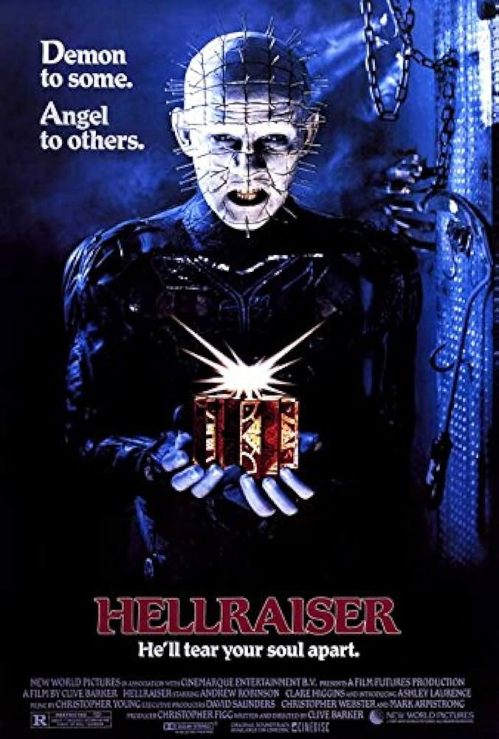
Hellraiser (1987)

hellraiser

By Richard Winters

My Rating: 6 out of 10

4-Word Review: Former lover needs blood.

Frank Cotton (Sean Chapman) purchases a puzzle box and brings it home to solve it. When he does he finds that it brings out demons known as Cenobites who enjoy inflicting pain on others for their own pleasure. After tearing Frank apart they reset the box and return to their own dimension. Larry (Andrew Robinson), Frank’s brother, moves into the house along with his wife Julia (Clare Higgins), who at one time, unbeknownst to Larry, had a brief affair with Frank. While moving in some boxes Larry cuts his finger and bleeds onto the attic floor where Frank was killed. Pieces of Frank still exist under the floor boards and the blood allows him to regain life though his body still needs more blood to regain its full form. He convinces Julia to bring in strangers from the bar home, so that she can kill them and allow Frank to drink their blood and regain more strength. Julia agrees to do this, but then Kristy (Ashley Laurence) becomes aware of what Julia is doing and is determined to put a stop to it by confronting Frank and taking away his puzzle box.

This was the first movie directed by Clive Barker and is based on his 1986 novel ‘The Hellbound Heart’. After being dissatisfied with how Rawhead Rex, based on another novel Barker had written, he became determined to direct the next feature in order to give it, in his words, some ‘directorial oomph’, which he had felt was missing in the previous film. Special effects wise the film hits all marks and is a precursor to what’s called Horror Porn today with a lot focus put on the effects that are both realistic and cruel. Watching Frank’s body slowly take form by growing out of the floorboards is quite impressive, but my only complaint are the close-ups of the skin particularly when a hook slices it open, which to me resembled more silly putty.

While the effects are great the characters aren’t. All of them come-off as dark and mean and there’s really no one to cheer for, or side with. Supposedly it’s Kristy the viewer is intended to get behind, but she came-off looking older than college aged and more like she was in her late 20’s. She’s also worldy-wise and seems able to handle herself, as is seen when she comes into contact with a couple of lecherous movers, quite effortlessly, so there’s no real character arch. Having her start-off as shy and sheltered and then grow stronger and confident as she learns to take on the cenobites would’ve been much more interesting and would’ve allowed for tension as you would initially question whether she had to guts to confront the evil like she eventually does.

The Julia character is weak too. I didn’t understand what drew her to Frank. Maybe in the novel this gets better explained, but in the movie it’s nebulous. Her brief fling with Frank, in the few backstory scenes that get shown, makes it seem like it was rather cold and distant and Frank doesn’t necessarily treat her all that well, so why would she bother helping to bring him back to life? Maybe she had a sadomaschistic bent, but if that was the case why would she marry Larry who treats her differently almost like he’s the passive and she’s more in control. If the woman prefers the man to be in control then that’s what she looks for in her next relationship not the opposite.

Spoiler Alert!

The twist near the end where Frank kills Larry and then begins to wear his skin gets botched too. It’s intended to be a surprise reveal for the viewer who, like with Kristy, initially think it’s the real Larry though it’s pretty obvious something isn’t right as blood is seeping out on the edges of his face, which Kristy should notice, but apparently because she’s so upset she doesn’t. It would’ve been better though to have the killing played-out and shown the final shocked expression on Larry’s face when he realizes he’s been betrayed by not only his brother, but wife too, which would’ve been priceless.

What’s even more perplexing though is why is Frank speaking in Larry’s voice? He may have his skin, but not the voice box. Even if he had tried to disguise it, in an effort to trick Kristy, I don’t think it would’ve come-off so convincingly. Then, once the gig is up and Kristy realizes it’s Frank, he still continues speak with Larry’s voice by why bother at that point since he no longer needed to fool her?

My Rating: 6 out of 10

Released: September 11, 1987

Runtime: 1 Hour 34 Minutes

Rated R

Director: Clive Barker

Studio: New World Pictures

Available: DVD, Blu-ray, Amazon Video, Pluto TV, Tubi, YouTube

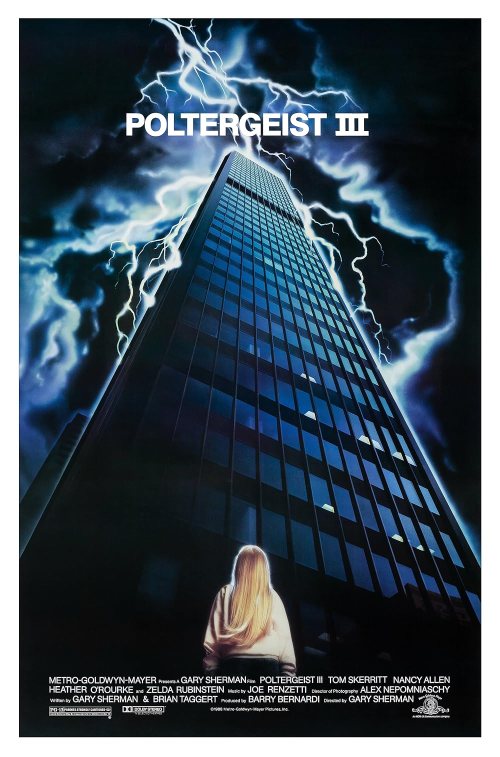
Poltergeist III (1988)

poltergeistIII

By Richard Winters

My Rating: 3 out of 10

4-Word Review: Ghosts haunt a skyscraper.

Carol Anne (Heather O’Rourke) has been sent away by her parents to Chicago so that she can live with her Aunt Diane (Nancy Allen) and her husband Bruce (Tom Skerritt) along with Donna (Lara Flynn Boyle) Bruce’s teen daughter from a previous marriage. Carol Ann is told that this is just a temporary set-up while she attends a school for gifted children. The school though is more of a therapy center for kids with emotional issues and run by Dr. Seaton (Richard Fire), who doesn’t believe Carol Ann’s stories about seeing ghosts and thinks she’s making it up to get attention and has some sort of ability to create mass hypnosis to get others to believe it too.  Soon after moving there the evil Reverend Kane (Nathan Davis) returns and begins terrorizing Carol Anne by appearing in mirrors as he continues his attempts to bring her back to the other side.

In another example of a sequel nobody asked for writer/director Gary Sherman, who had some success helming horror flicks early in his career that gained a cult following like Dead & Buried manages to inject an interesting vision. Moving the setting away from a suburban home and into a city skyscraper was a good idea as the story needed to progress somewhere and not just be a rehashing of things again and again in the same place, or one that looks just like it, would’ve give the whole thing a very redundant quality. Visually it looks sharp, I especially liked the scenes with frozen ice, with the special effects done live and not matted onto the film print later on like in the first two. The use of the mirrors, which are used as sort of window to the other dimension where the evil spirits reside, does offer a few jolts.

I liked that O’Rourke reprised her role and she gives an excellent performance, though she’s not seen all that much as she gets kidnapped and taken to the other side, which forces others to go after her just like in the first two installments, but it’s fun seeing her grow into a more accomplished actress who can handle broader speaking lines and able to hold her own in a wider variety of dramatic situations. The only negative is her visible swollen cheeks, the result of cortisone treatment shots that she was getting due to a misdiagnosis of Crohn’s disease, which gives her a chipmunk type look.

Zelda Rubinstein also reprises her role as Tangina, but like in the second installment, isn’t seen enough and it’s disappointing when she goes away. Davis takes on the role of the Reverend when Julian Beck, who played the role in Part II, died, but the character is only seen sporadically and doesn’t have all that much of a presence and an effective horror film needs a villain, whether it’s in human, spirit, or monster form, with adequate screen time to build tension and here that’s just not the case.

The storyline starts to become derivative of other better known horror flicks especially the use of the possession theme where we have an evil Carol Anne running around tricking everyone that she’s the real one, but isn’t. Her transformation into a devilish ghoul resembles a cheap imitation of Linda Blair from The Exorcist. I admit the first time it’s done it caught me off guard and was good enough to elicit a minor jolt, but then they go back to it too often where it becomes boring and predictable. The shots showing Carol Anne being spotted running away around corners and through doorways while wearing a red pajama suit is too reminiscent of Don’t Look Now, a Nicholas Roeg directed classic that dealt with parents searching for their missing young daughter and would occasionally spot her, or what they thought was her, running around street corners and through doorways in Venice while also wearing a bright red piece of clothing.

The biggest mistake though was that the reins weren’t fully handed over to O’Rourke as she was the only real carryover from the first two. Rubenstein too should’ve been given more of a part, but in any case the action should’ve followed Carol Anne all the way through and having it instead cut over to Skerrit and Allen’s characters and making them the main stars isn’t interesting at all. They come-off as quite bland and benign and just thrown in because Craig T. Nelson and Jobeth Williams didn’t want to recreate their roles. O’Rourke by this stage had enough acting ability that she could’ve carried it and the audiences would’ve excitedly been there with her the whole way, but unfortunately during the second and third act she gets relegated to cameo status while Skerrit and Allen take over, which are people we care nothing about and makes it seem like a completely different type of movie entirely.

My Rating: 3 out of 10

Released: June 10, 1988

Runtime: 1 Hour 38 Minutes

Rated PG-13

Director: Gary Sherman

Studio: MGM/UA

Available: DVD, Blu-ray, Amazon Video, YouTube

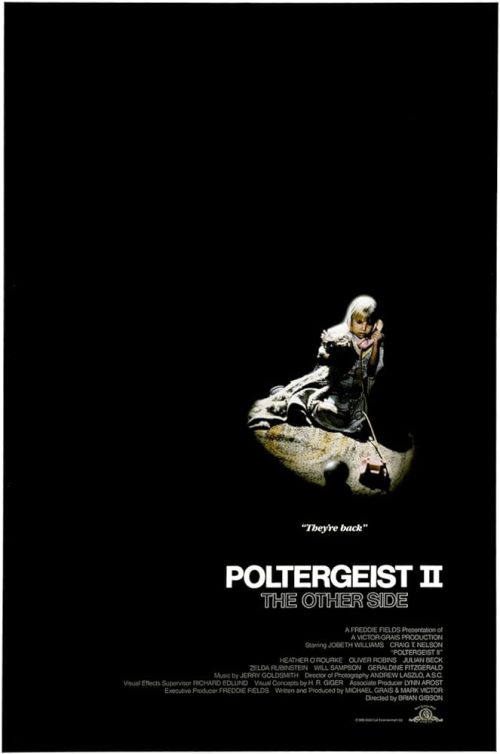
Poltergeist II: The Other Side (1986)

poltergeistII

By Richard Winters

My Rating: 6 out of 10

4-Word Review: Family gets terrorized again.

The Freeling family (Craig T. Nelson, Jobeth Williams, Heather O’Rourke, Oliver Robins) has abandoned their old neighborhood in Cuesta Vista where they were traumatized by ghosts and into the house of Diane’s elderly mother Jess (Geraldine Fitzgerald). They hope here their lives will return to normal, but at the site of where their old house once stood a ground crew digs up a cave filled with the skeletal remains of people that were lead by the Reverend Henry Kane (Julian Beck) an insane man who lead his followers to death many years prior because he proclaimed the world was going to end. His spirit though remains restless and he appears in human form to go after Carol Ann by calling her through her toy telephone. The Freeling parents realize they are no match for him, so Taylor (Will Sampson) an Indian shaman is brought in to protect their daughter as well as giving the father tips on how to fight-off the evil spirit.

As sequels go this one isn’t too bad. The script still has enough interesting twists to keep it intriguing and the special effects are greatly improved. I also liked here that we get to see the other world where the spirits live something that was woefully missing in the first. One of my favorite moments is when Steve swallows some Tequila that has a worm in it that is possessed by the spirit of the evil Kane. The worm then grows inside Steve’s body until he has to vomit it out where it continues to grow into large proportions, which is a genuinely freaky moment. Some other good scenes are when Diane gets swallowed up into the ground by skeletons reaching up from the dirt and pulling her in and watching Robbie, the son, get tied up by the metal of his braces is really cool too. It’s unlikely there would be enough metal from his braces to cover his whole body like it does here, but the segment still gets points for its creativity.

The characters though aren’t quite as interesting. The women had stood out in the first installment, but that all gets lost here. Jobeth Williams, who played this groovy, adult flower child who was open to new things and experimenting around, is much more of a subdued mom here behaving like a typical suburbanite mother would, which is boring. O’Rorke is still good and so is Rubenstein though her role is greatly diminished and I wasn’t sure why the Indian character needed to be brought in at all as I would’ve thought Zelda could’ve handled those duties. Sampson’s performance is good, but his role just seemed unnecessary. Domonique Dunne, who played the older daughter in the first one is nowhere to be seen due to her having died in real-life at the hands of her ex-boyfriend, but I still thought they should’ve mentioned something even if it was just in passing like she was away in college to help explain her absence.

On the male end Nelson’s part is much more colorful as in the first one he was rather transparent, but he gets some good lines and manages to completely take over the proceedings though I wished it had been a little more balanced between him and Williams. Julian Beck though who plays the evil preacher stands-out the most. He had been diagnosed with stomach cancer and ended up dying before the production had wrapped, but the illness did help give him a gaunt appearance, which helped accentuate his creepiness.

Logic wise there were a few holes. Having the insurance company completely unaware that Freelings house had essentially gotten eaten-up by the spirits didn’t make sense. I know the idea was that they didn’t want any publicity, but their other neighbors had witnessed the house disappearing too and there’s just no way that someone wouldn’t have leaked that to the press and it becoming a major news story as houses evaporating into thin air in front of many witnesses just doesn’t happen everyday.

Having the boy and girl continue to sleep in the same bedroom looked very off. In the first one they also shared a room, but they were much younger and here the boy already has braces making it look like he’s ready to enter adolescents and he for sure then should be in his own room. The death of the grandmother gets handled in an equally awkward way as the kid wakes up and has no idea what the parents are crying about, but the old woman died in the house he was sleeping in and therefore he should’ve been awakened by the ambulance that came to take her away. In fact we never see the body being removed making it seem that they might’ve just left her there in her bed for all we know and a scene showing the family mourning at her gravesite would’ve been a far more seamless way to have explained (shown) her passing.

Spoiler Alert!

The wrap-up is a bit too lighthearted as it shows Will Sampson driving off with the family’s beaten up car and Nelson chasing after him as they have no other way to get home. The segment though is too comedic and a good horror film should still leave the viewer with a certain bit of unsettling mystery. After all this family had gone through a lot and what’s to say that things were finally really over. The family acts too relaxed when in reality all of them should be going through some form of post traumatic stress. The fact that they act so at ease didn’t ring true as most anyone else would be in a perpetual paranoid state looking over their shoulders every second for fear that the ghosts might have remanifested. A more somber image of them quietly walking away from the sight formerly known as their home with the sound of a wind howling would’ve been more appropriate for this type of story.

My Rating: 6 out of 10

Released: May 23, 1986

Runtime: 1 Hour 31 Minutes

Rated PG-13

Director: Brian Gibson

Studio: MGM

Available: DVD, Blu-ray, Amazon Video, YouTube

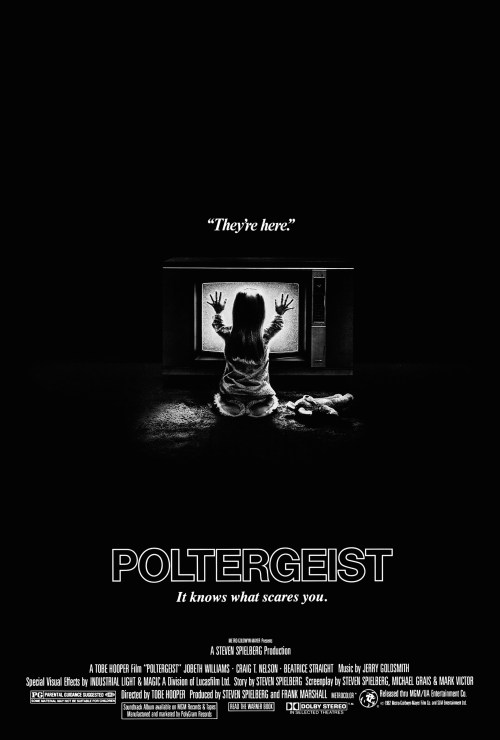
Poltergeist (1982)

poltergeist2

By Richard Winters

My Rating: 7 out of 10

4-Word Review: Ghosts terrorize a family.

A suburbanite family of five find their idyllic existence suddenly turn frightening when odd, unexplained events begin occurring inside their house. First it’s voices that can be heard coming from their television that only their 6-year-old daughter Carol Ann (Heather O’Rourke) can seem to make out. Then it’s the movement of the kitchen chairs that can glide across the floor without any help. There’s even the shaking of their entire house that they initially attribute to being an earthquake. Things though grow more serious when Carol Ann goes missing after a violent thunderstorm where her voice can only be heard coming through the television. Parapsychologist Martha (Beatrice Straight) and her team of two men (Richard Lawson, Martin Casella) get called in, but they find the conditions too extreme even for them, so instead a short statured spiritual medium named Tangina (Zelda Rubenstein) is hired. She determines that the home is being haunted by spirits who are ‘not at rest’ and may have something to do with the place being built on top of what used to be a cemetery.

The film, which was based on an idea by Steven Spielberg, who also produced, is known more for its behind-the-scenes drama, including the violent and untimely deaths of some of the cast members, which has gotten the production labeled as ‘cursed’, and for supposedly the in-fighting that occurred between Spielberg and Tobe Hooper who was brought in to direct when Steven was contractually unable to due to also directing E.T. From my perspective I can see it going both ways. It certainly has the strong atmosphere of a Hooper flick, but also done in a way so that even children could watch it and still not be too traumatized. Spielberg, who did all the casting and also storyboarded each and every scene, was known to want to make movies that the whole family could see and always wanted to keep his films, even his thrillers, at a PG rated level.

For what it’s worth I found it gripping, despite the slow start, from beginning to end and refreshing that an old fashioned ghost story was being brought back into the mainstream as too many horror movies of that period were slasher flicks, which was hurting the genre. This film emphasizes story and uses both imaginative effects and plot twists to keep it fun and surprising throughout.

Intentional or not the female characters were some of the movie’s stronger elements. O’Rourke of course, who’s become the face of the franchise, is adorable and with her bright blue eyes and blonde hair a certain angelic quality amidst the dark undertones. Rubenstein is a delight as both her height, voice and glasses, which seem to envelope her entire face, makes her presence quite memorable. Straight though is effective too as an elderly woman who at times seems ready to take on the ghostly presence and at other moments quite shaken up by them. Jobeth Williams though I found surprisingly fun as the sort of hip wife/mother who smokes pot and initially finds the weird events that go on more fun than scary. Only the presence of Dominique Dunne seemed unnecessary as she’s not in it all that much and goes off to either her friend’s house, or boyfriend’s through most of it only to conveniently reappear right at the end. Her jet black hair clashes with O’Rourke’s bright blonde, which makes for an odd gene anomaly to have sisters with such contrasting looks though this later gets explained in the book version as Dunne being the father’s daughter from his first marriage.

The special effects are a letdown. The ghostly hand reaching out of the TV-set looked too much like animation as did the very fake looking tornado, which appeared almost like it had been drawn in via black magic marker directly onto the film negative. The flying toys in the children’s room had a bit of an animated quality and the scary tree that sat outside the boy’s window looked too odd and not like any typical tree I’ve ever seen. It’s also disappointing that we never see this other dimension that Carol Ann gets trapped in we observe objects going in and out of it, returning with some sort of weird red substance that resembled raspberry jello, but the viewer really should’ve experienced this unique other world with the characters that go through it.

The TV stations signing off for the night while playing the National Anthem is something today’s audiences won’t understand as everything is 24-hours, but in the old days stations only broadcast during the day, but even here it’s a bit questionable. I was around in the early 80’s where most stations, especially in the big cities, were already running programs 24 hours a day making the sign-off angle, which is very prominently featured, dated even for then. Also, when stations did sign-off as I remember it would be a black screen that you’d see and not just static like it gets portrayed here. There was also such thing as cable back then making the prospect of static even less likely and you’d think a family that could afford a nice house like that would also have enough for a cable box.

Spoiler Alert!

The ending is a bit problematic as it has the two young kids returning to sleep in the bedroom that was once haunted. This is because Tangia states that the home has been ‘cleaned’ of the ghosts, but turns out not to be true. In either event I can’t imagine an adult let alone a kid being able to relax, or even step one foot in a room that had so many freaky things happen in it. I’d think the parents would be too nervous to even let them go in, so seeing the kids back in there like what occurred before was ‘no big deal’ proves unrealistic to say the least.

My Rating: 7 out of 10

Released: June 4, 1982

Runtime: 1 Hour 54 Minutes

Rated PG

Director: Tobe Hooper

Studio: MGM

Available: DVD, Blu-ray, Amazon Video, YouTube

My Friends Need Killing (1976)

friends1

By Richard Winters

My Rating: 4 out of 10

4-Word Review: Vet. stalks war buddies.

Gene (Greg Mullavey) is a Vietnam Vet. who’s come home after the war, but finding it hard to readjust to civilian life. He’s plagued by memories of not only the war, but some of the crimes that he and his comrades did while over there including the annihilation of a village and gang rape of a woman. He decides that the only answer is to seek out dark justice by visiting with his old buddies one-by-one in their homes and then using the opportunity to kill them when the time is right. Gene’s wife Laura (Meredith McRae) is aware of her husband’s tormented dreams, but not his homicidal plans. She works with Dr. MacLaine (Greg Morris), a psychiatrist, to track Gene down in order to stop his madness and get him the mental help that he needs.

In 1969, Paul Leder, whose attempt at an acting career had stalled, decided to take a stab at directing, which initially didn’t fare any better. His first feature, where he had Mullavey also star, was the absurdist comedy Marigold Man, about a guy named Harry who dreams of planting marigolds from coast to coast, which quickly fell into obscurity. He then hit on the idea of doing a horror film, which he felt, if done right, could do well under the low budget constraints. His first feature, which also had Mullavey in a supporting part, was I Dismember Mamathat fared a bit better than the comedy and enough to gain a cult following. Leder then reverted back to doing two comedies including the notorious Ape, an attempted parody of King Kong, that became a big embarrassment before eventually returning back to horror with this film.

On the surface it’s not bad given the limitations. It’s obviously inspired by Bob Clark’s Dead of Night, that had come out 5 years earlier and had a similar theme of a war vet. unable to get the horrors of what he went through out his mind. That one won some critical acclaim and a cult audience while this one fell through the cracks. For Paul Leder standards though it’s surprisingly watchable. Mullavey gives an effective performance where you sympathize with the man and his torment even as he goes through with his killings. The flashback sequences have a haunting quality and the film is, if anything, adequately gritty.

The killings though are where things get off-kilter. A few of them are disturbing like when he ties up one of his old buddies, while also shooting him in the arm, and then forces him to watch the rape of his wife before killing them both. Some of the others though fail to have the same dark punch. In one instance all he does his hand his old war friend a bottle of pills and tells him to swallow them, which isn’t exactly tense, while another moment has him helping to deliver a woman’s baby. There’s also a scene where Mullavey ties up his victim and then has the man’s arm poked with a syringe where he slowly bleeds to death, but horror movies work better when we see the action of him attacking the other man and just cutting away to him already tied-up misses the potential for excitement.

McRae, who at the time was Mullavey’s real-life wife, gives a poor performance particularly her anemic sounding crying. The use of music is bad too. During the killings it reflects the pounding score you’d expect in a horror flick, but in-between it has a melodic quality that you’d hear in a breezy comedy. The editing, which was also done by Leder, is choppy and too many slow parts in-between the violence. The film, which has a few interesting moments, fails to hold interest all the way through. It’s too talky with a lot of extraneous dialogue that could’ve been cut out. Having the only sound being the voices that Mullavey hears inside his head would’ve worked better.

My Rating: 4 out of 10

Released: December 10, 1976

Runtime: 1 Hour 13 Minutes

Rated R

Director: Paul Leder

Studio: Cinema Producers Center

Available: DVD-R (dvdlady.com)

‘Gator Bait (1973)

gator

By Richard Winters

My Rating: 3 out of 10

4-Word Review: Woman fights off rednecks.

Desiree (Claudia Jennings) is a peasant woman living in the swamplands of southern Louisiana. To help her bring in an income she takes part in poaching of snakes. Deputy Billy Boy (Clyde Ventura) and Ben (Ben Sebastian) are sitting in a boat in the swamp waters when they catch Desiree in the act of poaching and decide to chase her down and arrest her, or try to use it to their advantage by getting some sex out of her in return for not taking her in. Desiree though proves to be more cunning than they expected as she out races them in her boat and then when she is finally cornered she throws the bag of snakes that she has into their boat, which allows her time to escape. The deputy then must fight off the snakes by using his gun to shoot them, but in the process accidentally shoots and kills Ben. He later tells his father, Sheriff Joe Bob Thomas (Bill Thurman) that it was Desiree that shot Ben and not him. The Sheriff then goes to the boy’s father (Sam Gilman) and when given the news the father decides to chase Desiree down himself with the help of his two other sons (Douglas Dirkson, Don Baldwin) and exact a violent revenge.

This was the 7th film written and directed by Ferd Sebastian and the 4th that he did alongside his wife Beverly. It’s most likely their best known effort and came about through their friendship with Claudia Jennings. Jennings, a former Playboy model, acted in one of their other films, another B-exploitationer known as The Single Girls, and struck-up a friendship with the husband and wife filmmakers and asked them to come-up with a script in which she could star. Beverly then wrote this script seemingly overnight, I’m not sure if it was actually written in that short of time, but judging from its creativity, which is very low, it’s not that hard to believe. It was then shot in a matter of 10-days in March of 1973 at Caddo Lake, which is a state park and bayou that borders Texas and Louisiana.

The film does start out with a good speed boat chase and it captures the swamplands in vivid detail and with the exception of one scene that takes place in the town of Thibodaux, Louisiana, everything else gets done in the swamps making it seem like its own little universe. The Sebastains do wisely keep their son Tracy Sebastian, from uttering any lines of dialogue as he plays Desiree’s mute kid brother who had his tongue cut-out, which is good as he later starred-in On the Air Live with Captain Midnight and it’s just a shame he couldn’t have played a mute there as well as he gives what I consider one of the worst performances ever put on screen, but here since he can’t talk his marginal acting ability is not as apparent.

Despite the few good points the movie is otherwise a failure where the tension wanes instead of intensifying as it should. Part of the reason for this is that the story spells everything out right away and offers no surprises, or twists. The boat chases are diverting at first, but soon turn stale as they become too prevalent and almost like a loop reel where we’re just seeing the same thing done over and over again with nothing new getting thrown in. The characters, particularly the male ones, are written as being extreme southern caricatures who are too one-dimensional to being even remotely interesting and I genuinely felt sorry for actors Gilman and Thurman who had already been in the business for many decades at the time and had even been in some better financed studio films, so to have to come down to starring in this brainless dreck had to feel like a low point, but I guess a paycheck is a paycheck.

Jennings’ presence doesn’t add much as she’s seen only sporadically and most of the film time is given to the bickering male yokels. She doesn’t, despite her past of being a Playboy Playmate, appear nude as that gets left to Janit Baldwin, who plays her kid sister Julie, which will disappoint male viewers who will most likely come into this expecting the pretty Jennings to be the one who gets unclothed. When Claudia does speak it’s a trainwreck too as she sounds like someone from Europe instead of a rural southern chick. Her character is also poorly defined and doesn’t really grow, or fleshed out enough to make her seem like a real person, but instead remains more of an enigma.

Spoiler Alert!

Some on IMDb describe this as a early variation of I Spit on Your Grave, but that really isn’t accurate. In the Meir Zarchi flick the rape attack takes up the majority of the film time while here the attack isn’t even on the main character, but instead the younger sister, which is also quite brief. The female character doesn’t kill off the men one-by-one like in the other one as here the men end up killing each other for the most part, with the character’s younger brother taking care of one of them, and the final one is left to live.

Had this been more violent and explicit I might’ve forgiven the rest, but overall it’s quite tepid. It’s basically a tease of a movie that promises way more than it delivers and it’s so entrenched in stereotypes that it makes you feel like you’ve seen it, or something quite similar, a hundred times before. Sure there’s a ‘surprise twist/reveal’, but this one could see coming early on as the father of the boy who is killed and who goes after Desiree with a vengeance keeps commenting on how attractive he found her mother, which doesn’t take a genius to read into that and know most likely what he’s implying. In any case it’s not much of anything even on a B-movie level, but nonetheless got made into a sequel in 1988 though without star Jennings who died in a car accident in 1979.

My Rating: 3 out of 10

Released: October 12, 1973

Runtime: 1 Hour 28 Minutes

Rated R

Director: Ferd and Beverly Sebastian

Studio: Sebastian International Pictures

Available: DVD-R