Category Archives: Cult

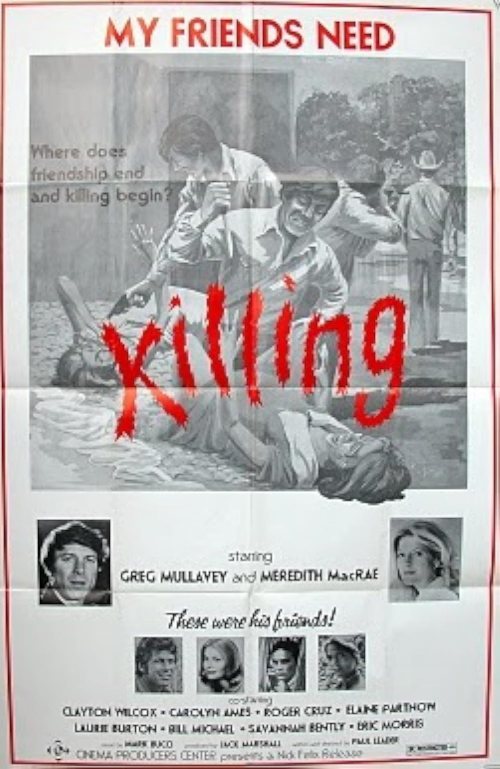
My Friends Need Killing (1976)

friends1

By Richard Winters

My Rating: 4 out of 10

4-Word Review: Vet. stalks war buddies.

Gene (Greg Mullavey) is a Vietnam Vet. who’s come home after the war, but finding it hard to readjust to civilian life. He’s plagued by memories of not only the war, but some of the crimes that he and his comrades did while over there including the annihilation of a village and gang rape of a woman. He decides that the only answer is to seek out dark justice by visiting with his old buddies one-by-one in their homes and then using the opportunity to kill them when the time is right. Gene’s wife Laura (Meredith McRae) is aware of her husband’s tormented dreams, but not his homicidal plans. She works with Dr. MacLaine (Greg Morris), a psychiatrist, to track Gene down in order to stop his madness and get him the mental help that he needs.

In 1969, Paul Leder, whose attempt at an acting career had stalled, decided to take a stab at directing, which initially didn’t fare any better. His first feature, where he had Mullavey also star, was the absurdist comedy Marigold Man, about a guy named Harry who dreams of planting marigolds from coast to coast, which quickly fell into obscurity. He then hit on the idea of doing a horror film, which he felt, if done right, could do well under the low budget constraints. His first feature, which also had Mullavey in a supporting part, was I Dismember Mama, that fared a bit better than the comedy and enough to gain a cult following. Leder then reverted back to doing two comedies including the notorious Ape, an attempted parody of King Kong, that became a big embarrassment before eventually returning back to horror with this film.

On the surface it’s not bad given the limitations. It’s obviously inspired by Bob Clark’s Dead of Night, that had come out 5 years earlier and had a similar theme of a war vet. unable to get the horrors of what he went through out his mind. That one won some critical acclaim and a cult audience while this one fell through the cracks. For Paul Leder standards though it’s surprisingly watchable. Mullavey gives an effective performance where you sympathize with the man and his torment even as he goes through with his killings. The flashback sequences have a haunting quality and the film is, if anything, adequately gritty.

The killings though are where things get off-kilter. A few of them are disturbing like when he ties up one of his old buddies, while also shooting him in the arm, and then forces him to watch the rape of his wife before killing them both. Some of the others though fail to have the same dark punch. In one instance all he does his hand his old war friend a bottle of pills and tells him to swallow them, which isn’t exactly tense, while another moment has him helping to deliver a woman’s baby. There’s also a scene where Mullavey ties up his victim and then has the man’s arm poked with a syringe where he slowly bleeds to death, but horror movies work better when we see the action of him attacking the other man and just cutting away to him already tied-up misses the potential for excitement.

McRae, who at the time was Mullavey’s real-life wife, gives a poor performance particularly her anemic sounding crying. The use of music is bad too. During the killings it reflects the pounding score you’d expect in a horror flick, but in-between it has a melodic quality that you’d hear in a breezy comedy. The editing, which was also done by Leder, is choppy and too many slow parts in-between the violence. The film, which has a few interesting moments, fails to hold interest all the way through. It’s too talky with a lot of extraneous dialogue that could’ve been cut out. Having the only sound being the voices that Mullavey hears inside his head would’ve worked better.

My Rating: 4 out of 10

Released: December 10, 1976

Runtime: 1 Hour 13 Minutes

Rated R

Director: Paul Leder

Studio: Cinema Producers Center

Available: DVD-R (dvdlady.com)

‘Gator Bait (1973)

gator

By Richard Winters

My Rating: 3 out of 10

4-Word Review: Woman fights off rednecks.

Desiree (Claudia Jennings) is a peasant woman living in the swamplands of southern Louisiana. To help her bring in an income she takes part in poaching of snakes. Deputy Billy Boy (Clyde Ventura) and Ben (Ben Sebastian) are sitting in a boat in the swamp waters when they catch Desiree in the act of poaching and decide to chase her down and arrest her, or try to use it to their advantage by getting some sex out of her in return for not taking her in. Desiree though proves to be more cunning than they expected as she out races them in her boat and then when she is finally cornered she throws the bag of snakes that she has into their boat, which allows her time to escape. The deputy then must fight off the snakes by using his gun to shoot them, but in the process accidentally shoots and kills Ben. He later tells his father, Sheriff Joe Bob Thomas (Bill Thurman) that it was Desiree that shot Ben and not him. The Sheriff then goes to the boy’s father (Sam Gilman) and when given the news the father decides to chase Desiree down himself with the help of his two other sons (Douglas Dirkson, Don Baldwin) and exact a violent revenge.

This was the 7th film written and directed by Ferd Sebastian and the 4th that he did alongside his wife Beverly. It’s most likely their best known effort and came about through their friendship with Claudia Jennings. Jennings, a former Playboy model, acted in one of their other films, another B-exploitationer known as The Single Girls, and struck-up a friendship with the husband and wife filmmakers and asked them to come-up with a script in which she could star. Beverly then wrote this script seemingly overnight, I’m not sure if it was actually written in that short of time, but judging from its creativity, which is very low, it’s not that hard to believe. It was then shot in a matter of 10-days in March of 1973 at Caddo Lake, which is a state park and bayou that borders Texas and Louisiana.

The film does start out with a good speed boat chase and it captures the swamplands in vivid detail and with the exception of one scene that takes place in the town of Thibodaux, Louisiana, everything else gets done in the swamps making it seem like its own little universe. The Sebastains do wisely keep their son Tracy Sebastian, from uttering any lines of dialogue as he plays Desiree’s mute kid brother who had his tongue cut-out, which is good as he later starred-in On the Air Live with Captain Midnight and it’s just a shame he couldn’t have played a mute there as well as he gives what I consider one of the worst performances ever put on screen, but here since he can’t talk his marginal acting ability is not as apparent.

Despite the few good points the movie is otherwise a failure where the tension wanes instead of intensifying as it should. Part of the reason for this is that the story spells everything out right away and offers no surprises, or twists. The boat chases are diverting at first, but soon turn stale as they become too prevalent and almost like a loop reel where we’re just seeing the same thing done over and over again with nothing new getting thrown in. The characters, particularly the male ones, are written as being extreme southern caricatures who are too one-dimensional to being even remotely interesting and I genuinely felt sorry for actors Gilman and Thurman who had already been in the business for many decades at the time and had even been in some better financed studio films, so to have to come down to starring in this brainless dreck had to feel like a low point, but I guess a paycheck is a paycheck.

Jennings’ presence doesn’t add much as she’s seen only sporadically and most of the film time is given to the bickering male yokels. She doesn’t, despite her past of being a Playboy Playmate, appear nude as that gets left to Janit Baldwin, who plays her kid sister Julie, which will disappoint male viewers who will most likely come into this expecting the pretty Jennings to be the one who gets unclothed. When Claudia does speak it’s a trainwreck too as she sounds like someone from Europe instead of a rural southern chick. Her character is also poorly defined and doesn’t really grow, or fleshed out enough to make her seem like a real person, but instead remains more of an enigma.

Spoiler Alert!

Some on IMDb describe this as a early variation of I Spit on Your Grave, but that really isn’t accurate. In the Meir Zarchi flick the rape attack takes up the majority of the film time while here the attack isn’t even on the main character, but instead the younger sister, which is also quite brief. The female character doesn’t kill off the men one-by-one like in the other one as here the men end up killing each other for the most part, with the character’s younger brother taking care of one of them, and the final one is left to live.

Had this been more violent and explicit I might’ve forgiven the rest, but overall it’s quite tepid. It’s basically a tease of a movie that promises way more than it delivers and it’s so entrenched in stereotypes that it makes you feel like you’ve seen it, or something quite similar, a hundred times before. Sure there’s a ‘surprise twist/reveal’, but this one could see coming early on as the father of the boy who is killed and who goes after Desiree with a vengeance keeps commenting on how attractive he found her mother, which doesn’t take a genius to read into that and know most likely what he’s implying. In any case it’s not much of anything even on a B-movie level, but nonetheless got made into a sequel in 1988 though without star Jennings who died in a car accident in 1979.

My Rating: 3 out of 10

Released: October 12, 1973

Runtime: 1 Hour 28 Minutes

Rated R

Director: Ferd and Beverly Sebastian

Studio: Sebastian International Pictures

Available: DVD-R

Roadie (1980)

roadie1

By Richard Winters

My Rating: 7 out of 10

4-Word Review: Truck driver and groupie.

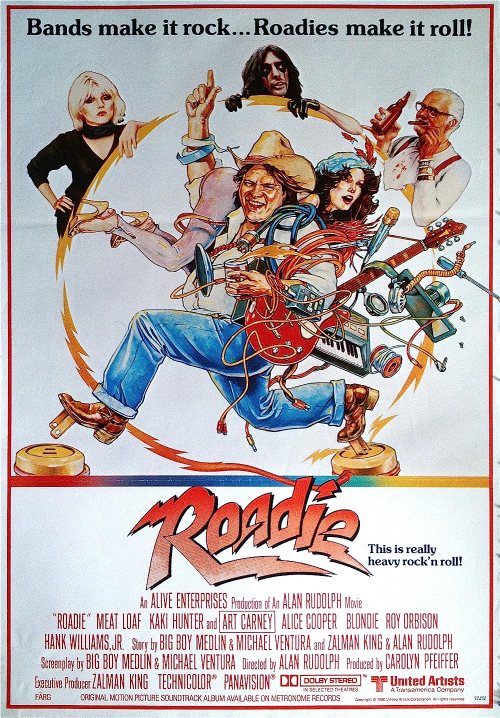
Travis (Meat Loaf) and B.B. (Gailard Sartain) are two truck drivers out making deliveries when they come upon a disabled RV on the side of the highway. Initially they don’t plan to stop, but when Travis sees Lola (Kaki Hunter), a would-be rock ‘n’ roll groupie, peering out the RV window he decides he’s ‘fallen in love’ and pulls-over. His ability to fix mechanical issues using unorthodox tools impresses Ace (Joe Spano) who’s a road manager and wants Travis to drive them to Austin to set-up equipment for a Hank Williams Jr. show. Because of his fondness for Lola he agrees and promptly quits his job as a trucker to travel all over the country meeting such rock ‘n’ roll legends as Roy Orbison and Blondie while also awkwardly courting Lola who’s more infatuated with meeting her idol Alice Cooper.

While director Alan Rudolph has never had a box office hit his movies have usually achieved success amongst the critics except for this one, but  I considered it his most original effort. Roger Ebert described it as being ‘disorganized and episodic’ even though life on the road in a tour group works that way with new issues coming up almost hourly and like driving on the open road there can be many detours and speed bumps as well as fleeting faces, which in that context the film recreates, in quirky comic form, quite well. He also complained about the lack of character development and maybe in Travis’ case there wasn’t much, but he’s such a funny caricature that I didn’t think he needed any. With Lola though I felt there was and impressed me with how much depth she ultimately showed especially since she initially seemed like nothing more than a caricature too. I really liked that she wasn’t as into Travis at the start like he was into her, which can happen a lot, and she has to grow into liking him during their many adventures though still never really openly admits to it to either herself, or others, which I felt was a refreshing change from the ‘love at first sight’ thing in the Hollywood formulas. Ebert also complained that the songs were never played to completion though the ones that are about Texas are.

There’s many unique laugh-out-loud moments. Some of my favorites was the laundromat scene where Travis and Lola have a box of Tide that supposedly holds cocaine. The car chase in Austin done at night in front of the state Capitol building is amusing as is the barroom brawl. Granted there’s been a lot of those in movies, but like with everything else it has a quirky style unlike the others especially as Travis gets hit in the head and begins rambling out incoherent nonsense. The scenes at Travis’ boyhood home where his father (Art Carney) and sister Alice Poo (Rhonda Bates) are a riot including the telephone booth connected to machine belts that allows it to go from the exterior of the home to the inside and the BBQ chicken eating scene, which may be, at least visually, the best moment in the film.

It’s also nice to have a movie that’s all about Texas to actually be filmed in Texas. Too many try to cheat it, a few of them have been reviewed here recently, that mask the Arizona desert, or even the California one to Texas, but anyone from the Lone Star State could easily detect the difference. This one truly has the Texas look and you can see this from the very first shot which features armadillos crossing the highway and because of this it gets the honor of being put into the Scopophilia movie category of ‘Movies that take place in Texas’ versus the ones that say they are set here, but filmed elsewhere.

Spoiler Alert!

Probably the only thing that doesn’t quite work is the ending where Travis and Lola are kissing in the front seat of a pick-up only to see a bright light of a spaceship. I realize the intent was to do a parody of the ‘Paradise by the Dashboard Light’ song and maybe if we had actually seen the ship, which got inadvertently destroyed before shooting began I might’ve forgiven it, or maybe even been impressed, but entering in a sci-fi genre that late becomes almost like a sell-out and too surreal for its own good. Something that stayed true to the playful quirkiness that came before it would’ve tied the bow better.

My Rating: 7 out of 10

Released: June 13, 1980

Runtime: 1 Hour 45 Minutes

Rated PG

Director: Alan Rudolph

Studio: United Artists

Available: DVD, Blu-ray

Vice Squad (1982)

vice1

By Richard Winters

My Rating: 2 out of 10

4-Word Review: Violent pimp kills prostitutes.

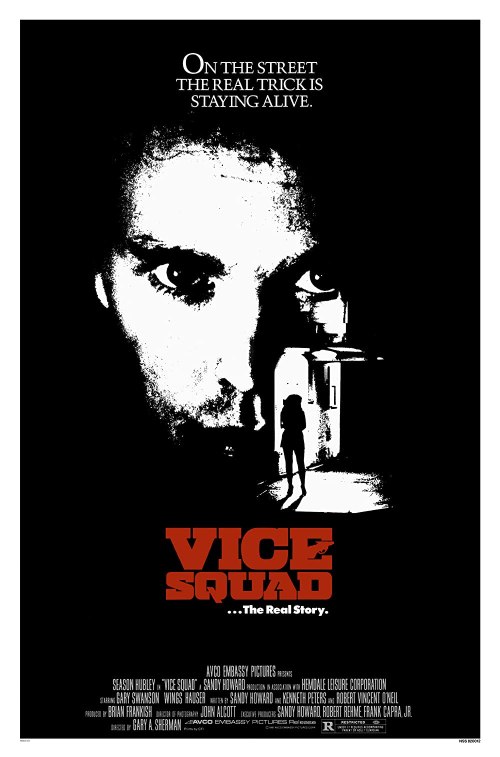
Princess (Season Hubley) is a business woman who is having some financial trouble and thus decides to go back to being a prostitute in Hollywood in an effort to support her young daughter. She becomes aware that her friend Ginger (Nina Blackwood), who is also a prostitute, has been killed after getting beaten-up by a violent pimp named Ramrod (Wings Hauser). Tom (Gary Swanson), a police detective, gets her to agree to be wired, so that she can get Ramrod to incriminate himself when she goes back to his place for a rendezvous.  The sting works and Ramrod is arrested and put into police custody, but he’s able to escape and spends the rest of the night chasing after Princess and determined to exact a revenge on her while the cops remain always one-step behind and unable to apprehend him.

This was Gary Sherman’s fourth theatrical feature and third horror one. He had started out with British cult hit Raw Meat in 1972 about a group of underground cannibals living in a London subway tunnel was met with rave reviews and fans, but his subsequent horror foray Dead and Buried and Phobia, which he co-wrote only, didn’t do as well. This one is more of a sleazy thriller meant to ‘inform’ the viewer about the brutalities of street life, but is really just an excuse to be exploitive and get cheap points for nudity and violence with characters that are cliched and situations highly derivative.

My main issue was with the prostitutes themselves for instance Ginger who runs away from Ramrod and hides out in a seedy hotel only to let him into her room the minute he comes knocking at her door. Once inside he immediately kills her while asking ‘I can’t believe you were that stupid’ and I felt like saying the same thing. It’s hard to sympathize with characters when they do incredibly dumb things and the scene would’ve worked better if Ramrod was only able to get in by crashing through the window, or breaking down the door, but having her allow him in shows no common sense especially from someone that is supposedly ‘street smart’.

This then brings up the second problem that I had, which is the fact that these women have absolutely nothing to defend themselves with in case things get ugly. They should all have guns, knives, or the very least some pepper spray especially if they’re supposedly ‘street smart’, but instead if things get bad they’re virtually helpless as is the case of when one of the male customers decides to rob Princess of her money and all she can do is give him some veiled threat that her pimp would come after him, which seemed almost laughable. Another scene has her being attacked by Ramrod where she manages to get her hands on a metal pipe and she uses it to hit him twice with it and then drops it to go hide somewhere, but why not continue to hit him until he’s either dead, or comatose? She hated his guts for killing her friend, so why back-off from giving it to him when she had the chance? At the very least, if she is going to run-off, at least continue to carry pipe, so she could use it for protection when he gets back up.

The motivations of the Princess character made no sense. She’s supposedly this L.A. businesswoman living in a nice suburban house, who’s now in financial trouble for whatever reason, but why turn to prostitution? There seemed to be hundreds of other income avenues she could’ve considered before leaping into streetwalking. If it was a high end escort gig where the male clientele could be filtered and scrutinized so it would not just be any scumbag and the prices would be high enough and in a safe neutral area, so she would just have to service one a night instead of ten, then maybe. However, here she’s forced to do one after another submitting that whatever crazy kink they wanted in whatever scuzzy locale they took her to. If she was on drugs, or teen runaway with no money, it might be a little more understandable, but the film portrays her as being smart and educated and she somehow ‘chooses’ to do this, which for me made her seem completely insane and therefore not any one that I could relate to.

The film does have some great acting by Hauser, who also sings the closing song, and Gary Sherman is good as the detective as he doesn’t have the chiseled features of a Hollywood good guy, but instead is more non-descript like how most policemen look, which I liked. Sunset Boulevard, where most of it was filmed, gets captured in a cool way giving it a surreal presence where all the action takes place exclusively at night and once the sun rises all the dark characters go symbolically back into their caves. There’s even a nifty car chase, but overall it’s flat, and predictable, and only for those who enjoy sleazy B-movies.

My Rating: 2 out of 10

Released: January 22, 1982

Runtime: 1 Hour 37 Minutes

Rated R

Director: Gary Sherman

Studio: AVCO Embassy Pictures

Available: DVD, Blu-ray, Amazon Video, YouTube, Tubi

Rapists at Dawn (1978)

rapists1

By Richard Winters

My Rating: 7 out of 10

4-Word Review: Teen boys assault women.

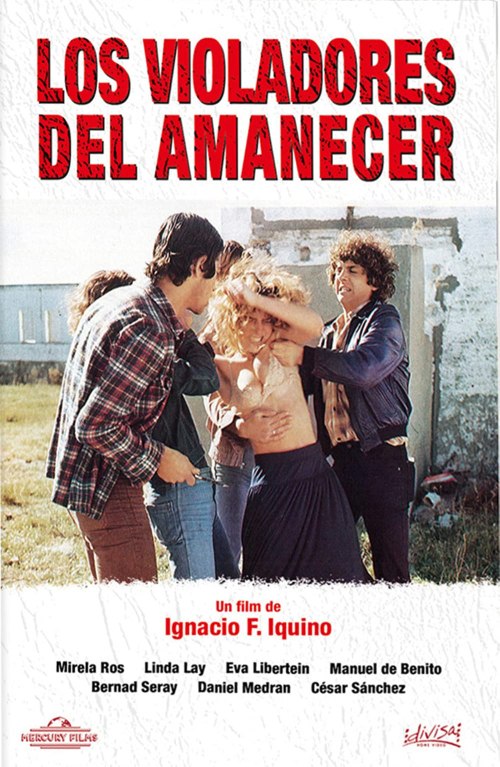
Rubiales (Manuel de Benito), Quinto (Daniel Medran), Rafi (Bernard Seray), Cana (Cesar Sanchez) and Cana’s pregnant sister Lagarta (Alicia Orozco) roam the streets of Barcelona, Spain looking for young women to assault. The boys live on the poor side of town and are from abusive home lives with little future except working boring, low paying jobs. Feeling that society has ‘discarded’ them they they take out their hostilities on the pretty women that they meet. They pick their victims at random usually as they spot them getting out of their cars and go walking into their schools many times while in front of the victim’s family member who’ve just dropped them off. They then take the women to an isolated area and proceed to gang rape them while Lagarta acts as the look-out. The police are aware of the crimes, but seem helpless to do much about it. When they catch the boys in the act and try to arrest them the boys manage to escape making them confident that they can’t be stopped.

While films like I Spit on Your Grave and Irreversible get all the attention as being the ‘last word’ in rape movies, this one, if it was better known and more attainable, would trump those. The rapes here are graphic, prolonged and quite violent. Some will complain that it’s exploitative while others will argue that if you’re going to show rape for the violent crime that it truly is then it must be captured in all of its unpleasantness and toning it down for the sake of good taste does a disservice. Personally I found the brutal nature to be effective as I came away feeling really sorry for the victims, as it’s captured in such a real way you can barely see the acting and instead start to consider it more like a graphic documentary.

This movie also handles the aftermath in an interesting way by examining the debilitating effect the crime has on the victim psychologically and how they become like a different person. They’re outgoing and well-adjusted beforehand and then afterwards depressed, angry, and even ashamed. They turn sullen and anti-social to both their friends and family making it seem like they’ll never be the same again. The film also analyzes what happens when one of the women becomes pregnant, something that I don’t remember being touched upon in other rape films, and how the mother of the victim insist, due to religious reasons, that she keep the baby and not abort it, making her seem as cruel as the gang.

The thuggish boys are portrayed in an intriguing multi-dimensional way too. While they’re cocky when out and about they recoil and become like victims themselves when at home and dealing with their abusive fathers. I did like too that in their own twisted way they have ‘limits’ or  a ‘code of morality’ albeit a very weird one. A great example of this is when Lagarta becomes shocked when the boys continue to penetrate one of the victims even after she has clearly died. Normally Lagarta had no problem seeing them violently molest the women, but when one of them actually gets killed during the attack and the boys continue the assault it’s only then that she feels things have ‘gone too far’.

It’s hard to say what genre to put this one into. It’s not really a horror film as none of the women become Rambo-like by packing a big gun and going on a revenge tour against their assailants, which although emotionally satisfying isn’t realistic If anything it brings out how there are no easy answers, which makes it even more horrifying, but still thought provoking.

My Rating: 7 out of 10

Released: May 3, 1978

Runtime: 1 Hour 33 Minutes

Not Rated

Director: Ignacio Iquino

Studio: Ignacio Ferres Iquino

Available: DVD-R

The Hired Hand (1971)

hired1

By Richard Winters

My Rating: 7 out of 10

4-Word Review: Returning to his wife.

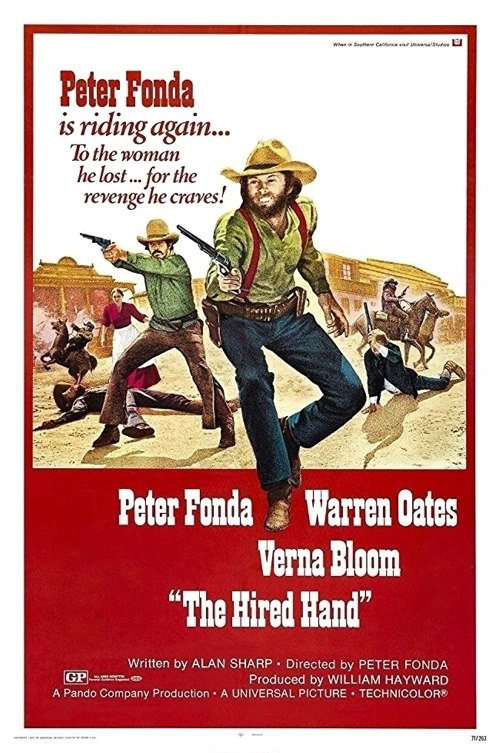
Harry (Peter Fonda) and Arch (Warren Oates) having been wandering the American West for many years, but Harry has grown weary of it. He informs Arch and their younger companion Dan (Robert Pratt) that he plans on going back to his wife Hannah (Verna Bloom) whom he abandoned many years before. Arch is not happy with this decision and tries to talk him out of it, but eventually relents and after the untimely death of Dan decides to head back with him to Harry’s former homestead. When they arrive they find that Hannah is still working the farm with her young daughter Janey (Megan Denver). Hannah is not pleased to see Harry as she had informed Janey that her father had died many years earlier. Harry tries to make amends, but Hannah resists only allowing him to stay as long as he agrees to become a hired hand and help with the chores. Both Harry and Arch agree to this, but when Arch decides to eventually head west alone and then gets abducted by a crooked sheriff (Severn Darden) Harry leaves Hannah to help save his friend much to the anger of Hannah who feels he’s again abandoning her.

This film was the product of Universal Pictures’ new policy of allowing independent pictures to be made under the studio system as Easy Rider had done well with a low budget, and no studio meddling, so they hoped to replicate that success with more films like that one. Besides this one the other movies included: Silent Running, Taking Off, The Last Movie, and American Graffiti and were all made with each director given $1 million to work with and then allowed to use his artistic freedom to create the kind of film he wanted without studio interference.

Unfortunately this movie did not do well at either the box office, or with the critics. Variety labeled it as ‘disjointed’ while Time described it as ‘pointless’. With the bad press and poor profits the studio decided to end its ‘independent movie’ division and films like this were no longer made, at least under the Hollywood umbrella. While this movie sat in near obscurity it finally found an audience in 2002 when it was shown at the Sundance Film Festival and has since acquired many admirers.

What I liked about it is how it goes against the western narrative where life in the old west isn’t portrayed as being about gunfights and saloon brawls, but instead quiet and slow paced. Harry and Arch spend their time raising livestock and doing other farm chores as just keeping the crops growing and animals fed was a mighty challenge enough. The acting by the entire cast is superb, but the real stars are Bruce Langhorn and his wonderfully unique music score, Vilmos Zsigmond’s cinematography and Frank Mazzola’s brilliant editing where he mixes in a lot of montages and overlapping still photography.

There are a few gunfights, but unlike shoot-outs in the conventional westerns this isn’t about tough brave men with nerves of steel. Instead the gunfights are seen as happening when goofball idiots, much like today, get their hands on a weapon after being triggered over something insignificant and shooting wildly before killing himself. Most westerns will prolong these moments, but here it’s quick lasting only a couple of minutes, like in real-life, and when it’s over all you see are dead bodies lying about making it seem more like a needless waste of life.

Harry and Arch’s long travels together through the desolate, lonely west are what really stands-out. You get a true sense of what the world was like back then where you might not see other people, or homes for days on end. You also get a good understanding for why Harry becomes so attached to Arch and willing to risk is life at the end to save him because for such long periods during their travels Arch was, at least from his perception, the only other person on the planet with him and this then created an indelible bond.

When it got broadcast on NBC in 1973 a 20-minute deleted scene featuring Larry Hagman as a sheriff was edited back into the film. This segment had gotten cut-out when director Fonda felt, after viewing it in the editing room, it wasn’t needed and didn’t really help propel the story. The footage can be found on the 2003 DVD issues from Sundance as a bonus extra. I watched it and enjoyed Hagman’s performance as, like with everything else in this movie, goes against the grain of the conventional western. Most of the time sheriffs where portrayed as stoic figures, but Hagman comes-off as nervous and jittery and not completely in control of the situation. I would think most lawmen back-in-the-day with dangerous outlaws roaming the countryside and invading small towns would behave much more like Hagman does here, so in that respect I felt these scenes were insightful, but ultimately agree with Fonda that they didn’t add much to the story and the film flows better without it.

My Rating: 7 out of 10

Released: July 16, 1971

Runtime: 1 Hour 30 Minutes

Rated R

Director: Peter Fonda

Studio: Universal

Available: DVD, Blu-ray, Plex

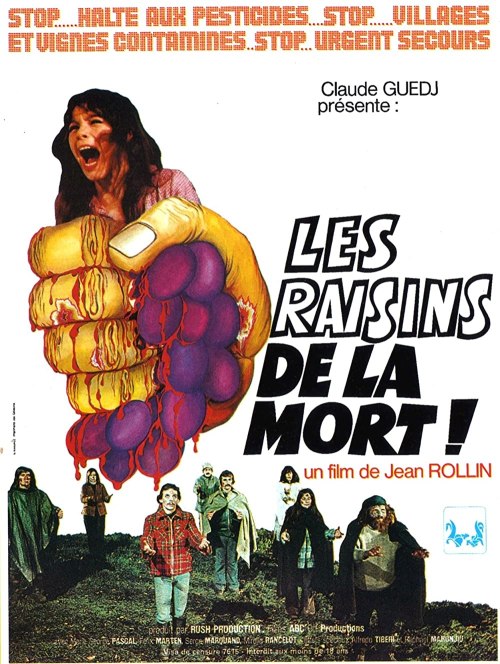
The Grapes of Death (1978)

grapes

By Richard Winters

My Rating: 7 out of 10

4-Word Review: Zombies created by pesticide.

The film opens with a shot of immigrants spraying grapes with a pesticide in a vineyard owned and run by Michel (Michel Herval). One of the men (Francois Pasal) complains of a pain on the side of his neck, but Michel insists he keep working and quit complaining. The film then cuts to two women riding inside a train car, one of them is Elisabeth (Marie-Georges Pascal) who’s the fiancee to Michel and coming to visit him. Once the train stops the man from the vineyards complaining of the pain walks onboard and proceeds to kill Brigitte (Evelyne Thomas) who was inside the train bathroom. He then takes a seat in the train car that Elisabeth is in, but once she notices the growing tumor on the side of his neck and then the dead body of her friend she runs screaming off the train. She then finds herself all alone in deserted town where everyone has the same type of tumors growing on their faces and all seem intent on trying to kill her.

This was the first mainstream horror film directed by Jean Rollin and credited as being the first gore film ever to be made in France. Rollin had made several experimental vampire flicks in the early part of the decade, but they had failed to catch-on and lost him a lot of money, which forced him into directing porn movies under the pseudonym of Michel Gentil. By the late 70’s he had made enough money with those that he was ready to jump back into doing another feature film, which for a zombie story is unique as the zombie’s here are fully conscious and well aware of what’s happening to them and kill out of a sense of rage. The film is also, for a horror movie, very quiet lacking the traditional pounding music score and instead has extended moments of near silence especially during the town scenes, which helps accentuate the creepiness.

Rollin hired an Italian production company to do the special effects, which are quite impressive. Normally I’m on here complaining how fake the effects look in most other low budget horrors, but here I was amazed with how realistic they were. The scene where a woman gets stabbed with a pitchfork while lying on a table and then continues to breath with it still in her really looks like the blades went right through her body. Another scene dealing with the decapitation of a nude woman (Mirella Rancelot) and then having one of the zombies carry the head around is one of the most graphic of its type. I did have some issues with the tumor make-up. On the train car where Elisabeth watches it grow on the side of the man’s head was cool, but on the people in the town it starts to look like smeared pizza and I wanted to see a shot of someone that had it all over their face instead just on a little part of it.

While Rollin stated that he admired the acting of his leading lady I felt she was the weakest link. Her fearful expressions and screams are great, but her performance otherwise is one-note. Part of what made Night of the Living Dead so great was the contrasting personalities of the main characters and I felt there needed to be that here. Having the two men (Felix Marten, Serge Marquand) enter near the end of the second act to help Elisabeth fight of the zombies is a great addition, but I had wished they came in sooner. I also didn’t like the way Elisabeth conveniently finds a gun inside the car she has just stolen, which she is able to use in the nick-of-time to shoot the zombies, but what are the odds? The gun should’ve been introduced earlier, perhaps as something she brought along with her at the beginning for her trip, and not just thrown-in haphazardly.

The twist at the end is not satisfying leaving the viewer feeling down and depressed when it’s over when a robust showdown was needed. I felt too that the reason for why the people were turning into zombies, which was the pesticide, should’ve been kept a mystery until the very end. Instead of opening it with the men spraying we should’ve seen the townsfolk going about their day in a normal fashion, which would’ve made a striking contrast to when Elisabeth gets there and they’re all crazy. Maybe a shot of a man spraying in the background behind the people talking could’ve been done as a little hint, or clue, but as it gets done here it’s too obvious when a subtle approach was needed.

My Rating: 7 out of 10

Released: July 5, 1978

Runtime: 1 Hour 25 Minutes

Rated R

Director: Jean Rollin

Studio: Rush Productions

Available: DVD, Blu-ray

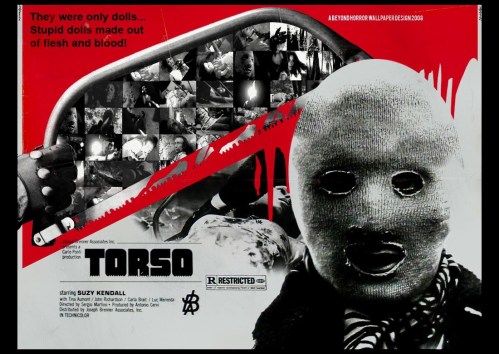
Torso (1973)

torso2

By Richard Winters

My Rating: 4 out of 10

4-Word Review: Strangler stalks college students.

Jane (Suzy Kendall) is a British student attending college in Italy where a rash of grisly murders amongst the female coeds is keeping everybody on edge. The killer’s modus operandi is a red and black scarf that he uses to strangle his victims. Jane’s friend Dani (Tina Aumont) fears that the maniac may be Stefano (Roberto Bisacco) a young man who’s been harassing her for a date and won’t seem to take ‘no’ for an answer. To get away from the terror Jane and her girlfriends decide to go to a villa in the countryside, but find that the killer strikes again, in their home, and with Jane hobbled with a sprained ankle, she’s unable to get away and must use her creative wits to escape.

Horror director Eli Roth has hailed this as being his favorite giallo and a major influence to his Hostel movies, but in retrospect it doesn’t have all that much to distinguish it. Despite its lurid title the emphasis is more on the mystery featuring a cast of lonely men who seem to lack quality social skills to go out with women and instead long for them from afar while also harboring dark violent sexual fantasies of what they’d like to do to them if they could, making this more than anything a forerunner to what’s become known as incels (involuntary celibate) today.

Director Sergio Martino captures Perugia, Italy and its many old and scary looking buildings nicely. The build-up to the murders where the victims find themselves alone in a dark,desolate area of the city, or in one instance an isolated forest, are some of the film’s best moments and could’ve been played-up more.

The deaths themselves though are uninteresting. The average time for a person to die from strangulation is 3 minutes and up to 7 to 14 seconds before they’ll pass-out, but the victim here falls over dead after the flimsy scarf is put around her neck for only 3-seconds, which all looks quite fake. The female victims never, ever fight back and just stand, or lie still and scream loudly, but do nothing else. Police will usually look for scratches on suspects as a sign that the victim fought for their life and there will be defensive wounds on the victim’s arms and hands too, so for the victims here not to attempt any physical defense looks rather pathetic. Some may say that back in this era it was considered more ‘tasteful’ to have the killing get over with quickly and watching someone try to fight-off the attacker would be prolonging it too much, but I wondered if this was also an attempt to feed-in to the male fantasy where once a man decides to make his move the females are virtually ‘helpless’ and must just passively accept their fate.

The special effects are threadbare as well. The close-ups of the knife cutting into the victim’s body has a lighter tone of skin color than the full-shots of the victim making it quite obvious that the close-ups are that of a mannequin. The scene where a car’s bumper crushes a man’s skull against a wall looks realistic enough, but then a few seconds later it cuts back to a shot of the victim and his skull is perfectly intact with only some blood running out of his nose even though the previous shot made it look like his head had been busted in half.

Spoiler Alert!

The third act in which Suzy Kendall sleeps through the murders of her friends downstairs and then awakens to find herself alone in the house with the killer still present is the only time it actually gets intense. Having her quietly observe him cutting-up her friend’s limbs is genuinely horrifying and watching her try to come-up with creative ways to escape is intriguing, but then having a male doctor swoop-in and fight-off the killer for her was disappointing as this was her story and she needed to be the one to find a way to take down the killer herself.

My Rating: 4 out of 10

Released: January 4, 1973

Runtime: 1 Hour 32 Minutes

Rated R

Director: Sergio Martino

Studio: Interfilm

Available: DVD, Fandor, Tubi

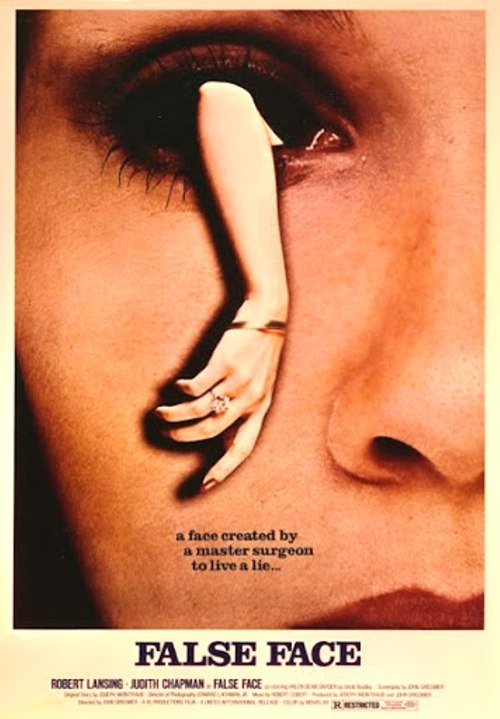
Scalpel (1977)

scalpel1

By Richard Winters

My Rating: 4 out of 10

4-Word Review: Surgeon alters patient’s face.

Dr. Phillip Reynolds (Robert Lansing) is an esteemed plastic surgeon who secretly harbors a dark side. When he sees his daughter Heather (Judith Chapman) making-love to her boyfriend he flies into a rage and kills the boy and then stages it to look like an accident. Heather runs away in terror and is not heard of for quite awhile. In the meantime Phillip’s father-in-law dies and bequeaths his entire fortune of $5 million to Heather, but since she’s nowhere to be found the money remains in escrow until she can come forward to claim it. Later, as Phillip is driving along a city street with his brother-in-law (Arlen Dean Snyder), they come upon a nightclub stripper (also played by Chapman) who has had her face crushed when a bouncer rammed it into a brick wall. Phillip decides to reconstruct the woman’s face to resemble his daughter’s, so she can claim the fortune and the two can split it. Things work smoothly as Philip trains her on all of her daughter’s traits and able to identify member’s of the extended family. Everyone comes to believe she’s the real daughter and the two are able to get their hands on the money only to have the real Heather suddenly reappear.

This movie, amongst IMDb reviewers, gets high marks with most rating it between 7 to even a 10 out of 10. I rate it lower, which I’ll go into, but they’re are things about that I did like. The performance by Lansing is excellent and perfectly conveys a character that seems nice and respectable on the outside, but could turn sinister, sometimes in unexpected ways, all of a sudden. The surgery scenes are realistic and even a bit graphic and the film has a few slick touches including the cinematography by Edward Lachman that nicely captures Georgia’s topography.

The plot has an intriguing premise and there’s no shortage of twists, but the way the stripper character gets handled I had a big problem with. There’s absolutely no backstory as to who this woman is, or why she got into the situation that she did. It doesn’t even seem like a real person, but a transparent entity that conveniently pops-in out-of-nowhere with essentially no past to her. I think the filmmakers were working-off of an old-fashioned belief that a sex workers had ‘no life’ and therefore would be more than happy to walk away from their former existence and take-on a new one without any regret, but this just isn’t true. Sex workers have friends and family and a past just like anyone else and wouldn’t necessarily want to just completely turn their backs on their old connections. The script also doesn’t bother to explain why a bouncer would shove a women’s face into a brick wall as he throws her out of the bar, or what might’ve happened to lead up to that, which to me was a plot hole.

Some may argue that maybe she lost her memory when her head hit the wall. Even if this was possibly the case (it never gets confirmed and in one instance Heather asks the woman about her past and she looks down like she does recall it, but is ashamed of it) it would most likely be temporary amnesia which can happen at times during a traumatic event or accident, but the old memories will usually come trickling back eventually. Either way it would’ve added an intriguing wrinkle to the story, if someone from her past tracked her down and became a part of the plot.

In addition I didn’t feel that Chapman’s acting was so great as she seems to be playing the same person instead of two different individuals. More contrasts needed to be made into the dual character’s personalities other than one can play the piano while the other couldn’t. I didn’t like that both spoke in an extremely distinctive twangy southern accent either. The impostor could’ve put on the affected accent when needed, but in private should’ve spoken in a way that was much different.

Spoiler Alert!

The ending in which the fake Heather takes the inheritance money after signing-off on it and then flying away on a private jet, is a letdown. Her signature would be different than the real Heather’s and during her ‘training’ on how to be like Heather that would’ve most likely been a point they’d overlook. A really cool twist would’ve had her thinking she had gotten away with it only for the jet to land and the police waiting for her as they recognized that the signatures didn’t match, or in her haste she had forgotten and wrote in her real name instead.

There’s another segment, just before the ending, where a hitman, disguised as a policeman, chases the fake Heather through a forest in an attempt to kill her, and he manages to catch-up with her and points a gun in her face, but then the film cuts away. The fake Heather then reappears in the mansion wearing the hitman’s police uniform, but no explanation for how she got away, which should’ve been played-out.

Alternate Title: False Face

Released: January 15, 1977

Runtime: 1 Hour 35 Minutes

Rated R (Reissued as PG with erotic nude scenes removed).

Director: John Grissmer

Studio: AVCO Embassy Pictures

Available: Blu-ray, Fandor, Tubi

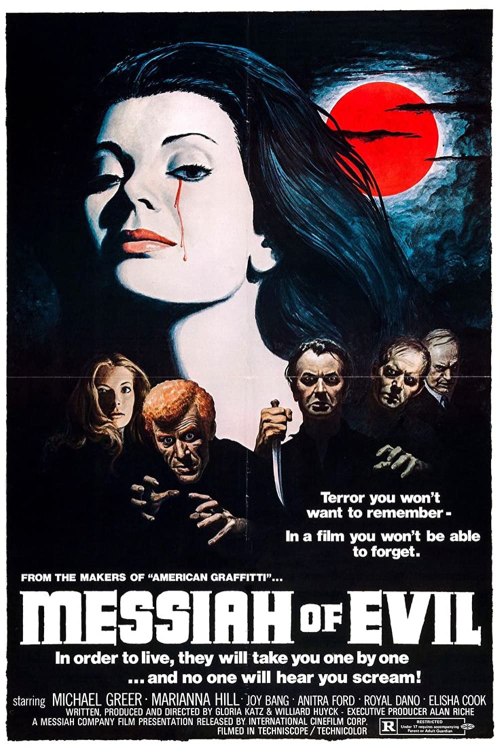
Messiah of Evil (1973)

messiah1

By Richard Winters

My Rating: 6 out of 10

4-Word Review: Town of dead people.

Arletty (Marianna Hill) travels to the seaside town of Point Dume, California to visit her father (Royal Dano) who is a popular artist there. When she arrives she finds his home abandoned and reads over his journals that he left in which he describes frightening things that have occurred to him in the days leading up. She then meets Thom (Michael Greer) and his two lady lovers, Toni (Joy Bang) and Laura (Anitra Ford). He too is searching for her father while also interviewing residents of the town about the strange events that have been happening and documenting them on tape. The four begin having weird encounters themselves as at night the residents of the town take-on a zombie-like existence where they stare at the moon and show an unusual craving for blood and meat.

The film was shot in 1971 under the title of ‘The Second Coming’, but the investors pulled their money out of the project and it was never completed. In 1973 another producer bought the footage and edited it before releasing it to theaters under its current title. It was not an instant success and fell into obscurity until another distributor bought the print 5 years later and decided to re-release it under the title of ‘Return of the Living Dead’ in order to capitalize off of the George Romero franchise, which quickly got it sued.

Today the film has gained a strong legion of fans and seen as being a unique and moody masterpiece and while it does fall short on the story end more than makes up for it with its atmosphere. It was written and directed on a shoestring by the writing and directing team of Willard Huyck and his wife Gloria Katz. Their names are most connected with the notorious bomb Howard the Duck, and while their careers were certainly stigmatized because of that, which some feel was unfair, they’re now considered neglected talents after many of those same critics saw this one.

The film certainly has some very cool and memorable moments with the best one being Anitra Ford’s trip to Ralph’s supermarket, shot on-location, and her confrontation with the zombies and subsequent chase through the store. Another great moment is when Joy Bang goes to a movie theater, where co-director Gloria Katz has a cameo as the lady in the ticket window, and while the theater is near empty when she arrives it slowly fills-up with the zombies as she’s watching the movie.

The two female leads are terrific and help give the film a personality with each scene that they’re in. Ford is better known for being a longtime show model on ‘Price is Right’  while Bang had some brief, but memorable moments in a few other films during the early 70’s before retiring from show business in order to move to Minnesota to become a nurse.

Hill though isn’t as good. She also starred in Schizoid, which was reviewed here a few days ago and like in that movie she gets upstaged by her co-stars. I did find it interesting though that in one scene here she kills someone with a scissors since that was the major weapon of choice in the other movie. I did find it odd that in the credits here her first name is listed with only one ‘n’ while in the other movie it was listed with two, so I guess, since that movie was shot 9 years after this one, that as she aged she must of grown another ‘n’.

The veteran cast of male actors are excellent too. The aging Elisha Cook Jr. has an entertaining bit as a wide-eyed homeless man telling crazy stories. Charles Dierkop is fun as a terrorized gas station attendant and Royal Dano is diverting as the father who smears his face with blue paint. The only male actor that isn’t effective is Michael Greer, who was quite flashy when playing flaming gay characters like in The Gay Deceivers and Fortune and Men’s Eyes, but when he’s stuck doing a straight guy he’s deadly dull.

Unlike the rest of the movie the ending isn’t as effective and I didn’t think the sudden voice-over narration was necessary. We had gone the whole way without it, so entering it in at the last minute becomes jarring and disconcerting. There’s also no interesting final twist and the zombie theme is too similar to the George Romero films, ultimately making this one, despite the eerie touches, seem like a poor cousin to those.

My Rating: 6 out of 10

Released: April 22, 1973

Runtime: 1 Hour 30 Minutes

Rated R

Director: Willard Huyck and Gloria Katz

Studio: International Cine Film Corporation

Available: DVD, Blu-ray, Amazon Video