Category Archives: Cult

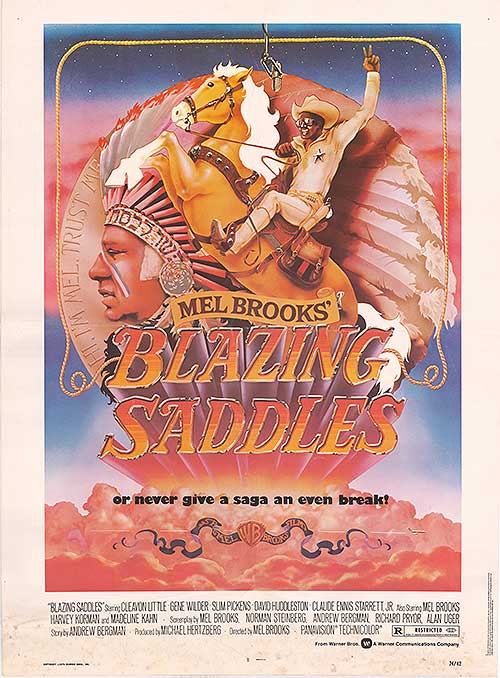
Blazing Saddles (1974)

By Richard Winters

My Rating: 7 out of 10

4-Word Review: Black man becomes sheriff.

Classic western parody centers on a new railroad being built during the 1870’s and how an attorney general named Hedley Lamarr (Harvey Korman) connives to have it run through a town called Rock Ridge, but in so doing devises a plan to have the residents run out, so the railroad can be put in. He hires a bunch of outlaws to ride into the town and terrorize the people hoping they’ll be scared off and move, but instead they put in a request to the state’s governor (Mel Brooks) for a sheriff. The inept governor gets tricked into hiring a black man named Bart (Cleavon Little) to act as the sheriff, which sends the racist residents of Rock Ridge into an outrage.

The film was known at the time for its outlandish humor, which thanks to political correctness is now considered even more outrageous and would most likely have no chance of being made today. The film’s biggest sticking point deals with its excessive use of the N-word, which writer/director Brooks was pressured to take out by the studio executives (along with many other things), but he resisted insisting that co-writer Richard Pryor and star Little had their blessing to keep it in and that most of the letters he received that were critical of the word being used were from white people. Personally I felt that it was realistic for its setting, which was supposed to be 1874, so in that regard it worked.

The stuff that got on my nerves was the constant anachronistic jokes dealing with people that weren’t even alive when the film’s setting took place. This type of humor gives the film too much of a campy feel and should’ve been scrapped. I was also disappointed when Gene Wilder talks to Little about his past and how he was accosted by a gun-toting 6-year-old, but the film doesn’t cut away to a reenactment of this, which would’ve been hilarious to see, even though it does do this when Little talks about his own past.

The funniest bits that I did find myself laughing-out-loud to where the ones involving Brooks as the cross-eyed governor, but I was frustrated that the streaming video that I watched did not have the scene where Brooks goes to the town of Rock Ridge and mistakes the wooden dummies that are there as being real-people. I remember this scene vividly when I watched it on network TV back in the 80’s and thought it was hilarious, but apparently this segment is only available on the Blu-ray version.

The acting by the supporting cast is great with Korman getting the best film role of his career. Liam Dunn is memorable as the town’s pastor and I got a kick out of Jessamine Milner as a racist old lady who later tries to make amends with Bart, but only under certain conditions. Madeline Kahn is quite good too in a send-up of Marlene Dietrich and rumor has it that she intentionally gave a bad performance in Mame, which was filming at the same time, just so the director would fire her, so she could then get the part here, but still be paid for that one as her contract stipulated guaranteed pay as long as she was terminated and didn’t quit.

The only bad performance comes from Little, who is just too serene and laid back almost like he’s treating the whole thing as a joke and doesn’t get into his part at all. I would’ve expected to see some anger from his character over the way he had been treated by white folks, but none is conveyed and instead he comes off like some guy picked off the street who mouths his lines and that’s about it. The part was intended for Richard Pryor who would’ve given the role the extra edge that it needed.

Spoiler Alert!

As controversial as the film is it’s the bizarre ending that has always had me the most baffled as it breaks the fourth wall and has the characters without warning go from the western time period into the modern-day. When I first saw this years ago I thought it was the weirdest thing I had ever seen and didn’t like it as I felt it ruined the story as I was enjoying seeing the town’s residents take matters into their own hands by literally beating up the bad guys as well as realizing that their racist ways were wrong. Having them suddenly thrown onto a Hollywood backlot made it too gimmicky and took away any possibility for some minor depth/message that the story might otherwise have had.

In retrospect I can only conclude that Brooks did this to show that these characters were never meant to be a part of the true west. In fact the whole reason that attracted him to the project, which was based off of an idea by Andrew Bergman, was because of its so-called ‘hip-talk’, which had 1974 expressions done in an 1874 setting.

If this was the case then the film should’ve started out with the characters in the modern day and then transported them via a time machine into the old west. The movie is so goofy anyways that I can’t see how this funky added element could’ve hurt it and then at the end when they return to the present it would’ve seemed more fluid and less like a cop-out where the writer’s ran out of ideas, so they decided to just go weird.

My Rating: 7 out of 10

Released: February 7, 1974

Runtime: 1Hour 33Minutes

Rated R

Director: Mel Brooks

Studio: Warner Brothers

Available: DVD, Blu-ray, Amazon Video, YouTube
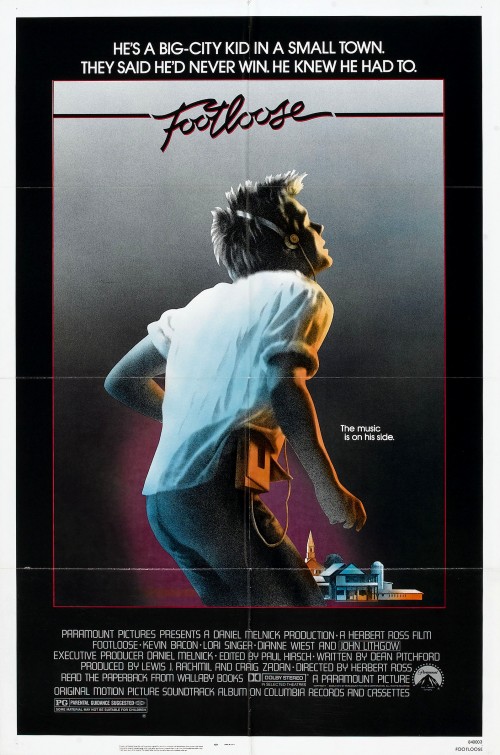
Footloose (1984)

By Richard Winters

My Rating: 3 out of 10

4-Word Review: A town bans dancing.

Ren (Kevin Bacon) is a teenager from Chicago who moves with his mother (Francis Lee McCain) to a small town in Utah where he finds that dancing has been banned by the town’s fiery minister (John Lithgow). He becomes determined to try and change that and convinces the other kids including his new found friend Willard (Chris Penn) that dancing really isn’t all that bad. He also falls for the minister’s daughter Ariel (Lori Singer) who is far more liberated than you’d expect someone from a religious upbringing to be.

I remember when this film came out and I intentionally refused to see it as I felt that the plot was too absurd to be believable. I was born and raised in a small Midwestern town of about 7,000 people and the idea that some lone minister could overtake it and start making extreme rules that everyone would follow especially in the modern era of the 80’s is just not realistic. If the town was really small and isolated with a population of like 200 then maybe but the one portrayed in the film comes off as being fairly big and was filmed mostly in American Fork, Utah, which in the 1980 census had a population of 13,606. Having a scene dealing with a literal book burning makes the thing even campier and made me believe this would’ve worked better had the setting been the 1950’s.

There is also no explanation to what the penalty would be if one is caught dancing. Everyone acts like it would mean jail time or something like that when most likely it would just be a small fine and since when have teens ever been that compliant when it comes to rules? There are several scenes where they are seen with joints, so if they’re willing to fudge the law in that respect then why not do it with the dancing too?

The concept is loosely based on an actual incident that occurred in Elmore City, Oklahoma in 1978 where the local teens challenged a city ordinance that banned dancing. However, the incident there made more sense because it was an ordinance that had been on the books for over 90 years. Many cities and towns have old ordinances and laws that are no longer relevant, or followed, but just haven’t been officially removed as opposed to some minister coming into a town and implementing a new law that everyone is forced to comply with. The town was also much smaller (population of only 653 in 1970) than the one portrayed in the movie, so religious sentiment would be more able to oppress the rest of its citizens.

The drama for the most part is limp and does not justify its runtime as there are long segments that have nothing to do with the main story including cringe worthy scenes where we watch Singer dangerously trying to leap between two moving cars and a game of chicken between tractors with Bacon and another teen driving them. There’s also a B-storyline dealing with Bacon trying to teach Penn how to dance, which gets corny.

The most annoying aspect though for me was Singer’s character as she doesn’t seem like a minister’s kid at all. She behaves in too much of a free-spirited way and I would think someone raised in such a repressed environment would reflect some religious traits and yet Singer conveys none. Having her religious at the start and even opposed to dancing and then become tolerant to it after she meets Bacon would’ve created an interesting character arch. Also, if she behaved in a cult-like manner due to her strict upbringing then it would’ve made the minister character more menacing because the viewer would be made to feel that was what he wanted to turn the rest of the town into.

Lithgow is a great actor, but he’s not right for this type of part as he is too young and was only 12 years older than Singer who played his daughter. A much older actor would’ve better illustrated how the older generation was desperately trying to cling onto their old way of life in an ever changing world and how completely detached they were from modern teens. Also, the character here doesn’t seem threatening enough as he is unable to control his own daughter so then how is he expected to control the rest of the town?

The opening bit done over the credits showing the different types of dancing feet is the best thing in the movie although some may take a liking to Bacon’s dancing inside an abandoned warehouse although much of that was done with the help of body doubles.  Otherwise this empty-headed movie, which was remade in 2011, has very little to recommend.

I did want to mention too that recently there was an 80’s podcast that I listened to where they reviewed this movie and one of the critics complained that the town had only white kids and acted like somehow that was not politically correct, but having grown up in a small town during the 70’s and 80’s I can vouch for the fact that there were little if any minorities there and therefore having an all-white cast, whether it is politically correct or not, was realistic.

My Rating: 3 out of 10

Released: February 17, 1984

Runtime: 1Hour 47Minutes

Rated PG

Director: Herbert Ross

Studio: Paramount

Available: DVD, Blu-ray, Amazon Video, YouTube
Real Life (1979)

By Richard Winters

My Rating: 4 out of 10

4-Word Review: Ordinary family reality show.

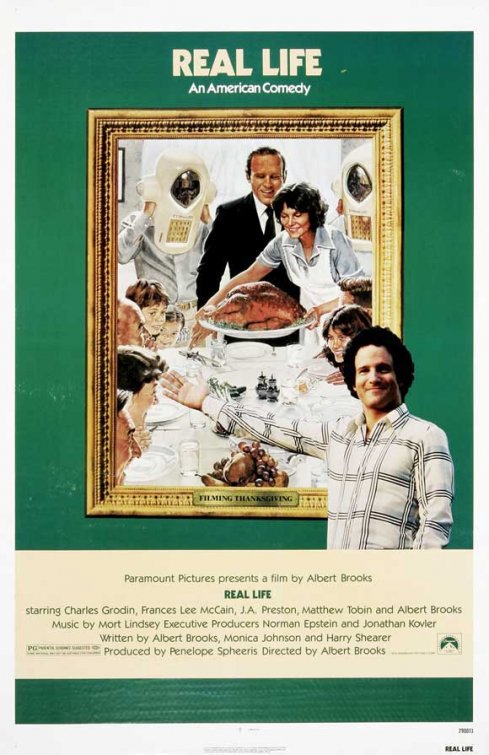
Albert Brooks plays Albert Brooks a hot shot young filmmaker determined to make a splash by filming a regular American family in their home and capturing everything that they do. The idea is for the family to go about their daily lives as if the cameras aren’t really there and then record their interactions. Things though go off-kilter almost immediately, which sends Brooks into a panic as he fears his movie won’t be entertaining enough and forcing him to compromise the project by instilling outside influences in order to make the movie more commercially viable.

This is another film that gets listed in the book ‘1001 Movies You Must See Before You Die’, but I’m not sure why. I’ll admit when I first saw it over 30 years ago it struck me as being quite irreverent and edgy at least the beginning, but the second half fades as Brooks loses sight of the main theme and writes himself into a hole. This results in a lot of tired jokes that focuses too much on the filmmaker and not the family.

The idea is based off of the documentary called ‘An American Family’, which was broadcast on PBS from January to May of 1973. This is where a filmmaking crew followed around the Loud family of Santa Barbara, California for 7 months in 1971 and filmed everything that went on between them. The idea was not to sensationalize anything, but instead have it work as an educational program examining the dynamics of how a typical American family works. Although things started out normal it soon began to unravel when the wife asked for a divorce and the couple’s 20 year-old son suddenly came out as gay. All these things were unexpected and many critics felt it was the presence of the cameras that brought them out.

Unfortunately this film misses the mark by having the family’s unraveling occur almost immediately and therefore not taking advantage of a prime comedic arch. The family members also lack any discernable personality and proceed to just get more boring as the film progresses. Certain darkly humorous moments like the scene where the father, played by Charles Grodin, performs a botched operation on a horse as part of his veterinarian practice are not funny at all and instead quite disturbing especially since a real horse was used.

The audience comes into this thing expecting to see a story about a family, but instead gets bombarded with Brooks whose sarcastic personality is only tolerable in small doses. The intended satire of a popular TV-series morphs into scenes of a narcissist filmmaker endlessly whining about his anxieties making the whole thing seem more like a vanity project or worse a limp remake of Federico Fellini’s 8 ½.

Some great moments particularly the opening scenes showing the audition phase get lost amidst a rapid fire of sardonic gags that go nowhere.  I started to wonder if Brooks had even seen the actual series that he is supposedly trying to make fun of, or if he just considered the concept as an excuse to try and make himself the star. The intended surrealism doesn’t work and actually gets in the way with a whacked-out Gone with the Wind-like finale being the worst and only helps cement this as a misfire.

My Rating: 4 out of 10

Released: March 2, 1979

Runtime: 1Hour 39Minutes

Rated PG

Director: Albert Brooks

Studio: Paramount

Available: DVD, Amazon Video, YouTube

Jeanne Dielman, 23 Commerce Quay, 1080 Brussels (1975)


By Richard Winters

My Rating: 5 out of 10

4-Word Review: She performs daily chores.

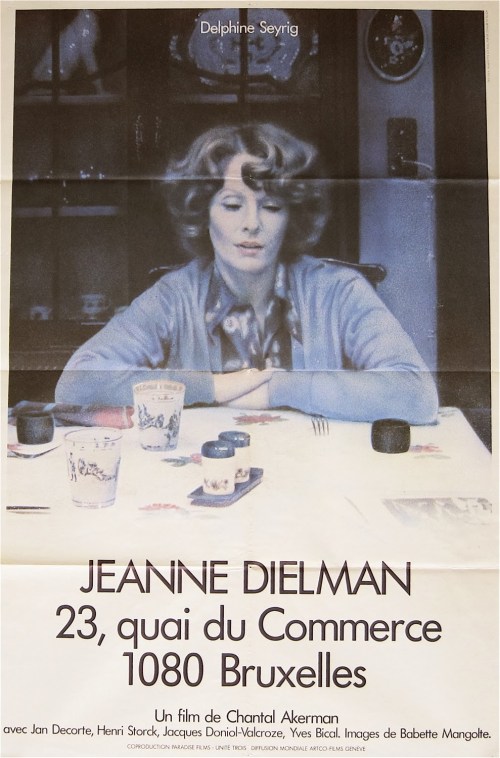
This is a highly unusual film which analyzes in minute detail the monotonous tasks that a single mother performs throughout her day and was apparently inspired by writer/director Chantal Ackerman growing up with a mother who suffered from obsessive/compulsive disorder. The story centers on Jeanne (Delphine Seyrig) a woman raising a teenage son while living in a tiny one-bedroom apartment in Belgium. During the day she entertains various men with sexual services and uses the money that she receives for this to help maintain things for both herself and her teenage son Sylvain (Jan Decorte). When she is not working as a prostitute she is busily cooking and cleaning, but as each day passes her routine becomes sloppier, which is a subconscious signal that something is bothering her and only at the very end does the viewer find out what it is.

Some have hailed this as a masterpiece including being listed among the ‘1001 Movies You Must See Before You Die’ by Steven Schneider. Normally I enjoy films that buck the conventional narrative and trying to learn about a character through the way she performs her daily routine as opposed to doing it the standard way through dialogue and action is commendable, but the cinematic flair is missing making this seem more like ‘monotonous task porn’ than a movie.

For instance when we watch Jeanne wash her dishes the camera does it in a very static way from behind her instead of doing something flashy like a close-up of the water glistening of the dish, or from some other provocative angle. Akerman has stated that she took this approach in order to show respect to her character’s ‘personal space’, but this only ends up giving it a closed-circuit TV feel.

Nonetheless I still remained strangely intrigued, but I’m not sure if this was because of some reviews I read beforehand where I was told that about the ‘surprise/shocking ending’ that would somehow make what I was watching all seem worth it, or because of what I was actually going on. I’ll agree that seeing the way she prepares and cooks her various meals is fascinating, but it’s for all the wrong reasons as you become more caught up in the task itself than the character and to say that one’s mind doesn’t eventually begin to wander after 3 hours and 20 minutes of this would be an understatement.

The 3-day arch that she goes through from where she performs her tasks proficiently on the first day only to screw them up more and more by the third one needed to be much more apparent as her ‘screw-ups’, like dropping a newly washed spoon on the floor, are too subtle and not enough of a payoff. Cinema is still a visual and dramatic art form and yet this film runs away from that at every conceivable turn making it seem more like an assault on one’s stamina instead.

Spoiler Alert!

The only true cinematic moment comes at the very end when Jeanne kills one of her male clients, but there’s no reason given for why she does this or what the aftermath will be. To have to sit through all that comes before it just to walk away with unanswered questions is frustrating and almost like being told a joke where the punchline is not an equal payoff to the long, tangent-filled set-up that it took to get there. I like the concept, which is intriguing, but it could’ve been accomplished in half the runtime making this an interesting experiment that can be appreciated as an oddity, but nothing more than that.

My Rating: 5 out of 10

Released: May 14, 1975

Runtime: 3Hours 21Minutes

Not Rated

Director: Chantal Ackerman

Studio: Olympic Films

Available: DVD, Blu-ray (Criterion Collection), Amazon Video

Local Hero (1983)

By Richard Winters

My Rating: 5 out of 10

4-Word Review: Businessman travels to Scotland.

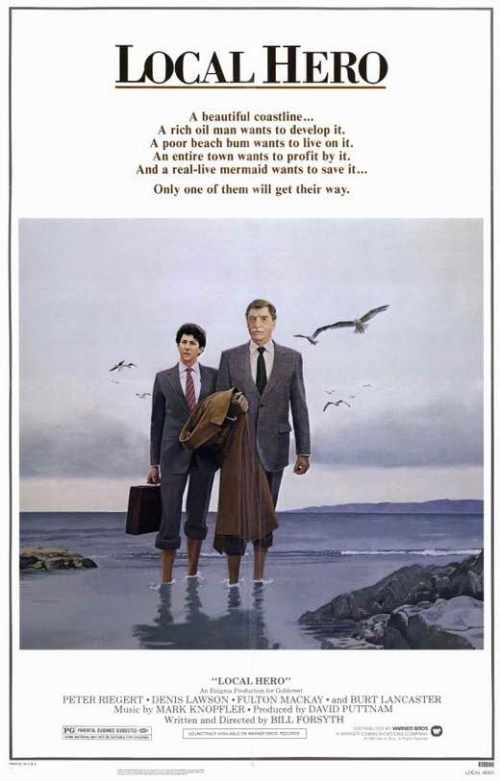
Mac (Peter Riegert) works for a gas company out of Houston, Texas that wants to buy up the small town of Ferness, which sits on the north shore of Scotland and turn it into an oil refinery. It’s Mac’s job to travel to the town and offer the citizens a generous monetary offer to sell their homes. He is not excited about going as he enjoys doing business over the phone, but once there he grows attached to the more laid-back pace. The townspeople grow found of Mac as well and eager to take the money and become rich. The problem is that through research they find that it is actually Ben Knox (Fulton Mackay) an eccentric man who lives in a ramshackle house on the beach who owns the land and he is unwilling to sell no matter what the price.

This film received positive reviews at the time of its release and one of the few movies to get a 100% positive rating at rotten tomatoes and yet after watching this now twice I’m still mystified over what all the fuss is about. When I first saw it several decades ago I came away feeling like I had just viewed something where very little happens and upon the second viewing I felt the exact same way.

I get that the emphasis is supposed to be on the quirky humor and that’s fine, there’s even a few chuckles, but the script flat lines after its initial set-up.  The eccentric characters and offbeat quality becomes one-dimensional and the story offers no true conflict or tension. Everything gets handled in such a subtle, dry way that there’s barely any drama at all and seems not really worth the effort to watch.

It would’ve worked better had there been one true antagonist, somebody that would be in stark contrast to everybody else and create genuine upheaval to the otherwise benign complacency. Initially it seemed that Lancaster’s character, who owns the oil refinery, would be a perfect foil to the serenity. Most business owners are consumed with the profit margin, but this one is instead more interested in astronomy. I realize that writer/director Bill Forsyth wanted to work against the grain and not portray the typical caricature of a hard-driven business man, but how can a guy run a successful business if the financial bottom line isn’t his main drive? Making the business owner a lovable kook as the rest takes away any potential confrontation of which this movie could’ve used some.

Riegert is equally transparent. His yuppie tendencies should’ve been played up more and his dramatic arch from big city businessman to lover of small town life more apparent. I was hoping that after he slowly became fond of the place that he would be one to throw the monkey wrench into the proceedings by refusing to make a deal and fighting to save the town even as the other residents are more than happy to leave it, which would’ve been much funnier.

The townspeople are blah too. The viewer only gets to know a few of them and they’re indistinguishable from the other. The only one that stands out is the lady with a punk look and I was intrigued to learn more about her and how she was able to get along with everyone else despite dressing in such a radical style and yet we never hear her utter a single word.

Ben Knox is the only character that offers a twist as we initially perceive him to be a homeless nobody only to realize that he ultimately holds all the cards and yet it just teases the viewer with a potential confrontation between he and the townspeople that never comes to fruition. I was also disappointed that we didn’t get to see the inside of his makeshift home that looked so rundown and precariously put together that you truly wondered what the interior looked like or how someone could survive living in it for as long as he does. Lancaster goes into the home to negotiate a deal with him and I felt the camera should’ve followed him in.

If you’re looking for lightly amusing comedy that goes down easy then you may take a little more of a liking to this. If you desire a movie with something more than just incessant whimsy then this flick will not suffice.

My Rating: 5 out of 10

Released: February 18, 1983

Runtime: 1Hour 51Minutes

Rated PG

Director: Bill Forsyth

Studio: Warner Brothers

Available: DVD, Amazon Video, YouTube

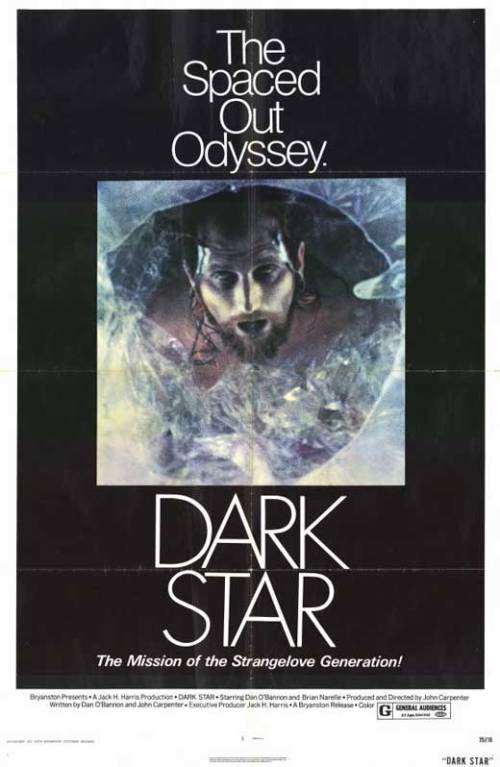
Dark Star (1974)

By Richard Winters

My Rating: 7 out of 10

4-Word Review: Four guys in space.

Dark Star is a scout ship used to destroy planets in the galaxy that are considered unstable. Its crew consists of four men: Pingback (Dan O’Bannon) who keeps a pet alien resembling a beach ball in the back storage room, Talby (Dre Pahlich) who spends all his time sitting alone in the ship’s observation deck, Boiler (Cal Kuniholm) who enjoys playing around with the ship’s emergency laser rifle, and Doolittle (Brian Narelle) who spends his time dreaming about being able to water surf again. The men have all spent 20 years on the ship and its begun to take a toll on their mental state as well as the ship’s mechanical framework, which ultimately challenges their survival.

This started as a student project while director John Carpenter and O’Bannon were attending USC’s film school back in 1970 and it was met with such enthusiasm that they decided to lengthen it into a feature film. Although critics at the time loved it the public didn’t, which caused the film to be shown to virtually empty theaters only to finally find a second life on the DVD market where it has now achieved a strong cult following.

Despite being an obvious parody of 2001: A Space Odyssey it doesn’t just play it up for cheap laughs, which why it works. Too many times parodies overplay the comedy elements by using an Airplane-like structure that is just one slapstick gag after another. Here there’s an actual story with character’s motivations that make sense given their circumstances and coming off more like a quirky observation of the psychological effects of space isolation instead of just a cheesy comedy.

The special effects are impressive especially given its limited budget. Sure some of it is tacky including having the ship’s console board made up of ice cube trays turned upside down, or space suits made of muffin tins and helmets worn by the crew that were actually designed for children. Yet there’s a share of cool moments too like the flashing lights used to represent a meteor storm in space or a scene involving a former commander (John Carpenter) kept in cryogenic suspension and even a nerve-wracking moment inside an empty elevator shaft.

The most memorable segment involves an alien that resembles a beach ball with little feet. Initially this looks absurd and makes the film seem too silly, but when the alien manages to escape from its holding cell and begins creating havoc on the ship it starts to seem, as surprising as this may sound, creepy and gives the film a certain chilling edge that was later used as the basis for Alien.

There are enough original moments here for it to be appreciated by just about any sci-fi fan with a funnybone. The fact that the story focuses on the crew’s mental deterioration and the ship’s eroding structure is not all that far off from reality either. Many other big budget sci-fi flicks, in their quest to bombard the viewer with the latest overblown special effects, usually ignore the psychological angle of being trapped on a spaceship for long periods of time would have, which thus gives this movie, as campy as it ultimately is, a certain insightful edge.

My Rating: 7 out of 10

Released: March 30, 1974

Runtime: 1Hour 23Minutes

Rated G

Director: John Carpenter

Studio: Jack H. Harris Enterprises

Available: DVD

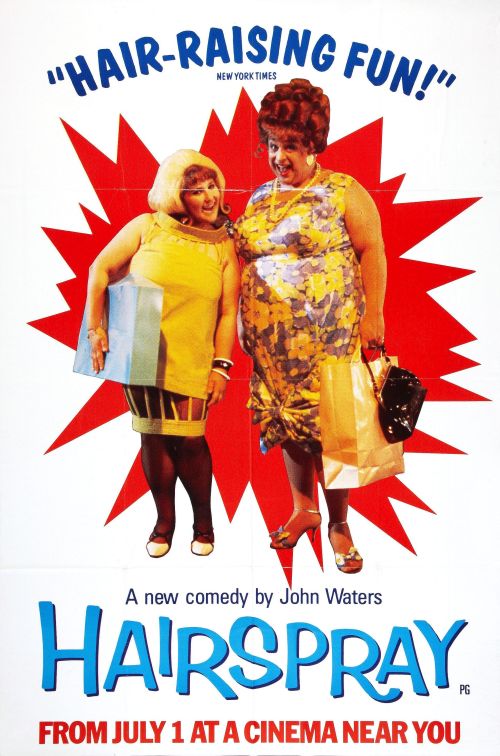
Hairspray (1988)

By Richard Winters

My Rating: 7 out of 10

4-Word Review: Integrate the dance show.

Tracy Turnblad (Ricki Lake) and her best friend Penny Pingleton (Leslie Ann Powers) audition for ‘The Corny Collins Show’ a local teen dance contest. Penny isn’t able to make the cut, but Tracy is much to the infuriation of the snotty Amber (Colleen Fitzpatrick) who was the show’s reigning dance queen. The rivalry between the two heats up even more when Tracy tries to integrate the show with black performers which incites Amber’s racist parents (Sonny Bono, Debbie Harry) to resort to desperate and violent means in order to keep the show segregated.

This was the movie where John Waters became a legitimate filmmaker who could use his craft to create a story instead of making a movie that was simply a foray into crude humor. When he first broke into the underground scene his films such as Mondo Trasho, Pink Flamingoes, and Female Trouble where refreshingly trashy and daring to show things other movies wouldn’t. The stark frankness and complete disregard of who it offended were both hilarious and groundbreaking, but by the time it got to 1981’s Polyester the formula had gotten stale and hearing campy characters shout incessantly at each other was becoming derivative while also exposing Waters as possibly being just a one-dimensional talent who was sadly losing his edge.

This film though was a complete change-of-pace with each shot and scene a loving tribute to his days growing up in Baltimore during the 50’s and early 60’s. The film has a lot of dance numbers that normally could bog the pace down, but here I got into the energy of it and it helped me to feel even more like I had been transported into a different time period. The musical soundtrack is filled with a lot of lesser known songs which most viewers will have never heard of and thus helping the film’s soundtrack avoid sounding like just another generic playlist from an oldies radio station.

Divine’s presence is much less crucial to the story’s plotline than in Waters’ past films. Sadly by this time his/her appearance was looking even more like just some fat guy wearing wig and no longer coming off in any way as being an overweight woman even though in the past films it was at times hard to tell. His physique looked so out of shape here that it should be no surprise that he died of a sudden heart attack just three weeks after the film’s release. In fact as the mother he really isn’t funny or engaging at all and only in a brief few scenes where he plays the station’s cantankerous owner Arvin Hodgepile does he show actual energy and gets a few laughs.

The original idea was to have Divine play both the roles of the mother and daughter, but fortunately that got nixed and Ricki Lake was brought in. She has a genuine, honest presence about her that creates instant empathy and it’s nice having a film showing an overweight person where her body type did not impede her from achieving her goals nor work as a detriment at keeping her down.

The supporting cast is eclectic, but unfortunately most are wasted particularly Jerry Stiller and Sonny Bono as the two fathers. Debbie Harry is great with her increasingly outrageous beehive hairdos, which become the most memorable and imaginative thing about the film. Lesser known actress Joanne Havrilla is quite funny as Penny’s racist mother especially the scene where she panics when trapped in a black neighborhood. John Waters himself gets some good comic bits playing Penny’s quack psychiatrist and Pia Zadora is engaging as a pot smoking beatnik.

The film is full of comical highlights that playfully runs the gamut between subtle, over-the-top and crude that somehow works to form a cohesive whole culminating in a very funny ‘race riot’ at the end. If the film has any fault it is in the fact that it treats racism in a little too much of a trivial way like it is just some silly thing that can be easily fixed instead of the serious and deep-rooted issue that it really is.

My Rating: 7 out of 10

Released: February 16, 1988

Runtime: 1Hour 32Minutes

Rated PG

Director: John Waters

Studio: New Line Cinema

Available: DVD, Amazon Video, YouTube

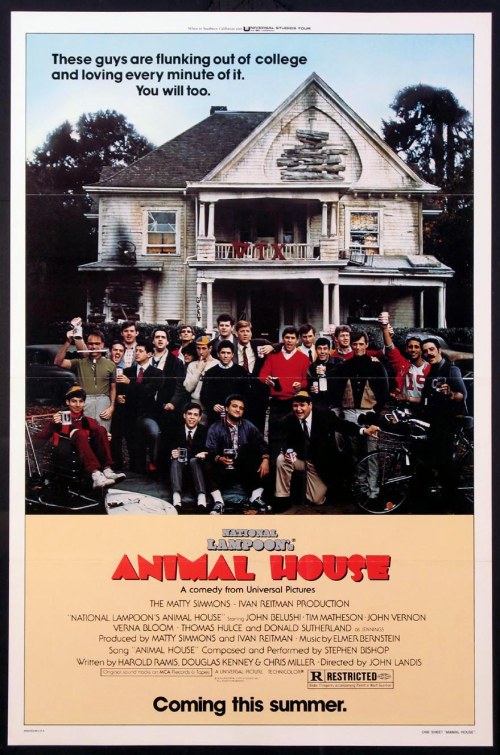
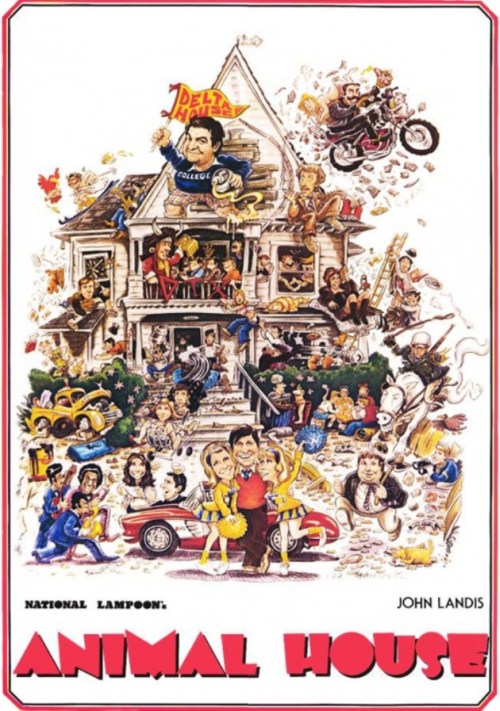
Animal House (1978)

By Richard Winters

My Rating: 7 out of 10

4-Word Review: They like to party!

In 1962 the Dean of Faber College, Vernon Wormer, (John Vernon) wants to rid the campus of the Delta Fraternity as he considers their rundown house and partying ways to be a blight to the University. He works with the clean-cut Omega President (James Daughton) to establish a kangaroo court which has Delta’s charter revoked. The Delta members then seek revenge by creating havoc at the homecoming parade of which both Wormer and his wife Marion (Verna Bloom) are attending.

The film, which was a huge box office hit at the time of its release, succeeds by wisely balancing the farcical humor with a believable setting where many of the scenarios shown were based off of real-life experiences of the film’s writer Harold Ramis and producer Ivan Reitman during their own fraternity years. While the film does devolve at the end to being just a procession of slapstick gags it also manages to provide diverse characters and a genuine college atmosphere, which was filmed on-location at the University of Oregon.

The inspired casting helps especially John Belushi who mostly improvised his part. Although he’s best remembered for his pimple gag I actually laughed more when he cries out like he’s lost some prized possession after witnessing a crate of alcohol go crashing to the ground. His ability to chug an entire bottle of whiskey in one take is impressive and I liked how his character, as crude as he is, was able to convey a sympathetic side in his attempts to ‘cheer-up’ a despondent Flounder (Stephen Furst) after his car gets wrecked.

Tim Matheson is equally engaging as the cool and collected fraternity leader whose dry delivery doesn’t initially hit you as being funny until you go back and actually think about what he has just said. Kevin Bacon is hilarious in his film debut as a member of the snotty Omega Theta Pi who tries to quell a panicked crowd only to get quite literally flattened by them.

It’s also great seeing Verna Bloom, an actress relegated to mostly plain Jane roles, wearing a snazzy brunette wig and playing a sexually frustrated woman who has an amusingly drunken ad-libbed segment. Karen Allen is gorgeous as always playing a ‘good-girl’, but who isn’t afraid to flip someone the finger if she has to. You also get a nice glimpse of her bare ass as well as Donald Sutherland’s, apparently Allen only agreed to show hers if he bared his, and for the record Matheson’s crack gets exposed briefly too.

However, what I took away from this movie the most were the politically incorrect segments. The most extreme one is when Larry (Tom Hulce) contemplates having sex with Clorette (Sarah Holcomb) after she passes out drunk, which would be considered date rape now, but treated merely as throwaway bit here. Then in a later scene Larry tries to have sex with her again only for her divulge to him that she is just 13. Although the actress looks much older and was actually 19 when it was filmed it still gets implied that they went ahead and had sex anyways despite the character’s age issue.

I was alive when this film was released and although there was criticism pertaining to the film’s overall raunchiness these specific segments, which would create shockwaves now, were never brought up. Whether things are better now, or we’ve become too sensitive about stuff that was merely considered ‘tasteless’ back then is a whole other argument. Yet when they say things shown in the ‘70s could never be done now it’s all true, which makes watching this movie and others like it feel almost like you’ve slipped into a different universe.

My Rating: 7 out of 10

Released: July 27, 1978

Runtime: 1Hour 49Minutes

Rated R

Director: John Landis

Studio: Universal

Available: DVD, Blu-ray, Amazon Video, YouTube
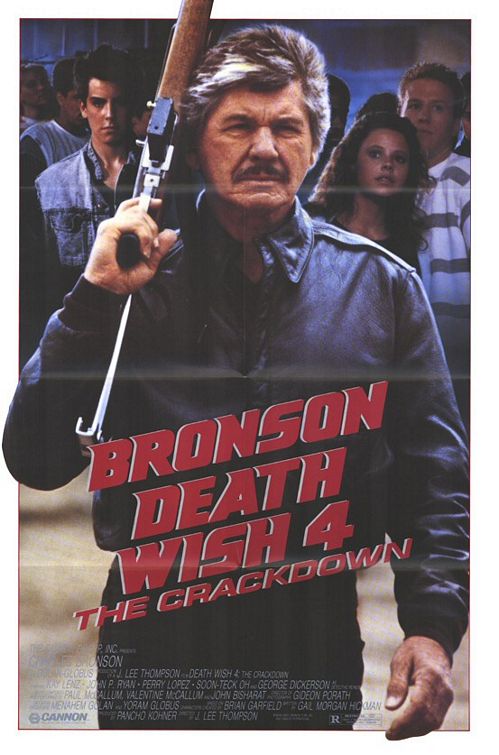
Death Wish 4: The Crackdown (1987)

By Richard Winters

My Rating: 1 out of 10

4-Word Review: Vigilante battles drug dealers.

Paul Kersey (Charles Bronson) is now living in L.A. and in a relationship with Karen (Kay Lenz) who has a teen daughter Erica (Dana Barron). Erica wants to become an architect like Paul and interns at his office, but she is also dating a boyfriend (Jesse Dabson) who is into drugs. His friendship with a drug dealer gets Erica to experiment with crack cocaine, which ends up killing her. In a rage Paul returns to his vigilante ways by killing the dealer, which then gets the attention of billionaire Nathan White (John P. Ryan) whose own daughter also died from a drug overdose. He recruits Paul into tracking down the biggest dealers in L.A. and killing them, but Paul eventually realizes that Nathan has ulterior motives.

This was the first film in the series not to be directed by Michael Winner and instead the duties were handed over to J. Lee Thompson who had worked with Bronson on several other projects previously. The script by Gail Morgan Hickman tries to take the vigilante theme in a new direction and starts out with a diverting dream sequence in which Paul sees himself as one of the victims that he shoots, which brought up a potentially intriguing subplot involving the psychological pressures one must assuredly develop when they’re constantly killing people even if it’s for ‘justice’, but the film then never goes back to it, which was disappointing.

The overall scenario, which transports Paul from dealing with ordinary street gangs to sophisticated crime families, does not work and fails to give the already tired series a new breath of life. It no longer even resembles a vigilant theme at all, but instead becomes more like an episode of ‘Miami Vice’ but without the trendy attire.

Paul is no longer just an ordinary guy with a gun either, but instead has become a sort-of James Bond incarnate who uses with all sorts of elaborate weaponry and gadgets better made for a seasoned CIA agent. He’s also able to get himself out of just about any nerve-wracking jam like when he miraculously fights off over 20 men in warehouse who are shooting at him, or magically getting himself out of a car that he is driving just seconds before it’s riddled with bullets.

Bronson looks more like he’s 45 instead of 67 and matching him up with a young girlfriend makes him appear more virile, but you know right from the start that it’s only a matter of time before she ends up dying violently. It starts to seem like Paul Kersey is a walking, talking curse as anyone who befriends him turns up dead or like the cinematic version of Jessica Fletcher.

I kept wondering when it would all start catching up with him. How can he continue to work a regular job while still spending so much time tracking down the bad guys? When does he sleep? And exactly how many people does he have to kill before the police eventually nab him, or quit allowing him to walk away from it without consequence?

Unlike the first three films this one fails to elicit any type of message or statement. It seems simply intent at being a profit making venture to cash in on those who like mindless shootouts and car explosions and nothing more.

My Rating: 1 out of 10

Released: November 6, 1987

Runtime: 1Hour 39Minutes

Rated R

Director: J. Lee Thompson

Studio: Cannon Film Distributors

Available: DVD, Blu-ray, Amazon Video, YouTube
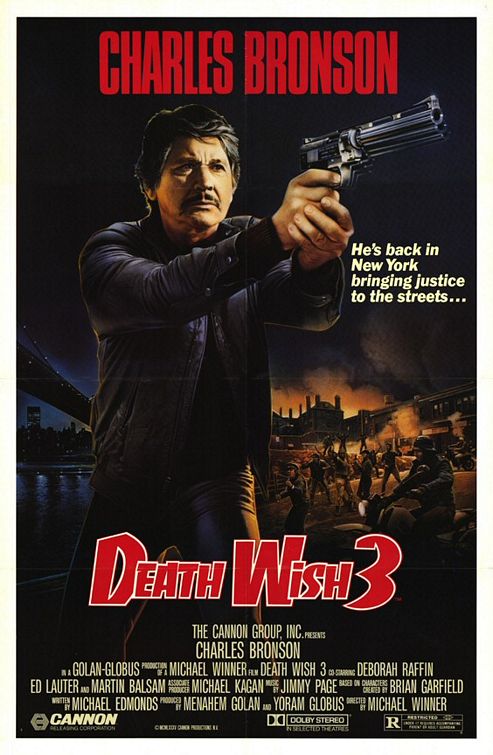
Death Wish 3 (1985)

By Richard Winters

My Rating: 2 out of 10

4-Word Review: Vigilante defends senior citizens.

Paul Kersey’s (Charles Bronson) vigilante act returns this time he goes back to New York City and defends the senior citizens in a neighborhood of his war buddy Charley (Francis Drake) who was killed by members of a street gang lead by Manny Fraker (Gavan O’ Herlihy).

The third entry in the series goes completely off-the-rails with a neighborhood setting resembling an apocalyptic world better suited for a surreal dystopian sci-fi film. The gang members behave like vile creatures straight out of somebody’s worst nightmare and look like leftover cast members from a cheesy version of The Warriors while the senior citizens seem ready to be ordained into sainthood.

After the first movie was released and met with criticism Bronson argued in interviews that his films did not promote violence and yet here that’s all you see. Not only does it brazenly promote vigilantism as being an effective deterrent to crime, but advocates that it’s the only option.

It also portrays the police in a horrible light. Yes, there are bad cops and films have every right to expose that, but there are some good ones too and this film never bothers to show that. All the viewer gets to see are brutal monsters dressed in uniform openly ignoring a suspect’s due process, or just being cowardly and inept when dealing with the real criminals. It got so bad that I was surprised that the police force nationwide didn’t boycott this flick in protest.

The only one looking like he’s having a good time is Bronson who actually appears relaxed and able to convey other emotions besides just anger. This is also the first film in the series where there is an actual clear reason for why the thugs hound him. For instance he drapes an expensive Nikon camera around his shoulder to entice the gang members to mug him and when they do he shoots them, which is the precise type of thing that should’ve been in the first two movies.

He also gets two unintentionally funny moments. One is where he is having a nice peaceful dinner with an older couple, but then excuses himself to shoot two men who are robbing his car before returning to his dinner like it was no big deal. Another scene has him getting out of his car to go grab something from a grocery store while leaving the attractive Kathryn (Deborah Raffin), who he has just started seeing, in the vehicle. While he is away the thugs break the passenger side window and knock Kathryn out before putting the car in neutral and letting it roll down the street and ultimately crashing into another car. Bronson runs down to initially save her, but once he sees the blaze he nonchalantly turns around and walks away almost like saying ‘Fuck, looks like that hot babe I wanted to date has just been burnt to a crisp. Guess now I’ll just have to find somebody else’.

The final 30 minutes is one of the most violent that I have ever seen in a film. It’s literally just one graphic image after another put to a rapid fire pace. Director Michael Winner seems compelled to throw in as many repugnant images of death, blood and rape that he can making it almost laughable in its audaciousness if it weren’t so nauseating instead.

My Rating: 2 out of 10

Released: November 1, 1985

Runtime: 1Hour 32Minutes

Rated R

Director: Michael Winner

Studio: Cannon Film Distributors

Available: DVD, Blu-ray, Amazon Video, YouTube