Category Archives: Cult

Death Wish II (1982)

By Richard Winters

My Rating: 4 out of 10

4-Word Review: Architect becomes vigilante again.

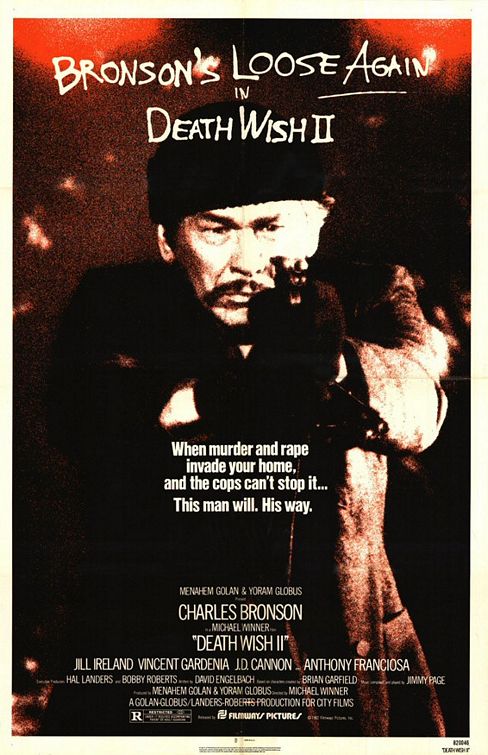
Paul Kersey (Charles Bronson) has recovered from his traumatic loss of his family from 8 years earlier and is now living in L.A. where he continues his work as a successful architect. One day while taking his new girlfriend Geri (Jill Ireland) and cationic daughter Carol (Robin Sherwood) to a fairground he gets robbed of his wallet by a gang of 5 thugs (Thomas F. Duffy, E. Lamont Johnson, Kevin Major Howard, Laurence Fishburne, Stuart K. Robinson). They use the address on Paul’s driver license to find his home and invade it while he is away. There they rape and kill his maid (Silvana Gallardo) and then when Paul returns they knock him out while kidnapping his daughter who they take back to their ‘hideout’. While there they attempt to gang rape her and in her effort to escape she’s impaled on a fence and dies. This sets in motion for Paul to return as a vigilante this time prowling the underground neighborhoods of L.A. where he’s motivated to shoot each of the 5 gang members who participated in the crime.

The film is less like a sequel and more just a slight variation from the original. Having to go through yet another home invasion/rape sequence, which is almost shot-for-shot the exact same as in the first installment (if even more exploitive) is mechanical to the extreme and an insult to the viewer. It’s like a TV-station promising their audience a new episode of their favorite series only to end up showing them a rerun instead. The story should’ve evolved more perhaps having Paul now becoming a ‘professional vigilante’ and being hired by people to track down the killers of their loved ones or at least something that would’ve taken the theme in a slightly different angle.

There continues to be the issue, like in the first film, of why does Chuck constantly get marked by these hoodlums for harassment anyways. For instance at the fairground there’s many other people milling  around and yet for some reason it’s Bronson, this very nondescript middle-aged man, that becomes their target.

The recasting of the daughter role is another problem. In the first film she was played by Kathleen Tolan and portrayed as being an adult married woman. Here though the character has regressed back to being a teenager and looking to be no older than 18 if even that.

To some degree on a sleazy B-level it actually hits-the-spot the soundtrack is done by former Led Zeppelin guitarist Jimmy Page and it is perfect especially the strained, loud electric guitar chords that effectively reflect the film’s dark, grimy mood. Most of the locales were filmed in actual buildings that were abandoned and in crime-ridden areas forcing the cast to require 20 off-duty police guards for protection. There’s even a scene featuring large squealing rats roaming around at the character’s feet as they say their lines.

The fact that Paul hunts down the actual perpetrators of the crime is on an emotional level satisfying, but it also becomes a logistical problem as it’s just not believable that he’d be able to find them all at random times, one-by-one simply by going to the city’s ‘bad areas’. I was also flabbergasted that in a later scene when Paul returns home from shopping and after dealing with his home being invaded now twice by crooks he doesn’t bother to lock the door once he gets inside, which you would think would be the first thing done each and every time!

The one interesting aspect that could’ve helped the film stand-out was the reintroducing of Vincent Gardenia who played the NYC police chief Frank Ochoa who tracked down Kersey in the first film and does the same here, but not to  arrest him, but instead to kill him. This could’ve created more tension had it been played out effectively as Kersey would constantly have to watch his back for an attack while simultaneously attacking the thugs when he came upon them. Unfortunately this side-story dies before it gets going when Ochoa gets kill just as he decides to help Kersey, which in itself could’ve been an intriguing odd couple-like pairing.

The ending  jumps-the-shark by having Kersey disguise himself as a doctor so that he can infiltrate a mental hospital in order to kill the last of the thugs who now resides there. This segment though becomes more like a scene from one those cheap horror movies with an asylum setting and not like an action flick at all.

The credibility gets seriously strained too by having Kersey constantly coming into contact with regular citizens who always conveniently side with him when it is most needed and thus helping him escape the clutches of the authorities. Sure this might happen every once in a while, but eventually he would confront someone who sees things differently, which all helps to make this film too dumb to take seriously, but slick enough to appease those looking for nothing more than simple-minded action.

My Rating: 4 out of 10

Released: February 19, 1982

Runtime: 1Hour 28Minutes

Rated R

Director: Michael Winner

Studio: Filmways

Available: DVD, Blu-ray, Amazon Video, YouTube

Roller Boogie (1979)

By Richard Winters

My Rating: 2 out of 10

4-Word Review: Save the roller rink.

Terry (Linda Blair) comes from an affluent upbringing, but resents how little attention that she gets from her busy, preoccupied parents (Roger Perry, Beverly Garland). She finds refuge with the roller skating crowd that populates Venice Beach and starts up a relationship with Bobby (Jim Bray) who has aspirations of going to the Olympics. The two team up as a couple to win a roller boogie contest only to realize that the rink where it is to be held has been threatened for closure by an unscrupulous land develop (Mark Goddard) who uses mob-like tactics to get what he wants. Terry, Bobby and he rest of the roller skating crowd plot a way to save the place before it’s too late.

The film is nothing more than a vapid gimmick made to cash in on the roller boogie fad that caught on in the late ‘70s for a few seconds before mercifully fading away. Director Mark L. Lester who has done some great work with other low budget films by making them compact and exciting fails to the do the same here. Way too much footage showing the kids roller skating around the rink that quickly becomes derivative and almost nauseating. The script by Barry Schneider is filled with an overabundance of colloquial phrases that gives the dialogue an amateurish and grating quality. It also plays up the stereotypes of rich people to the extreme almost putting it on a camp level without intentionally trying to be campy.

The storyline dealing with Terry’s rich family background doesn’t make sense. For one thing Blair is all wrong for the part as she conveys too much of a down-to-earth personality almost like she has no relation to her parents and not from that environment, but instead plucked from a working-class neighborhood and supplanted into the home like some fish-out-of-water.

Why this young woman, who has a scholarship to Juillard, would want to win a trivial roller boogie contest anyways is a mystery? What long term benefits is it going to get her? The story would’ve worked better had it borrowed the Saturday Night Fever formula where Terry was from a poor, struggling background, of which Blair’s acting skills better reflects, who needs to win the contest to achieve some money and get herself out of a desperate situation, which also would’ve gotten the viewer more emotionally connected to her dilemma.

The storyline dealing with the roller rink being forced out of business is dumb too. With such large crowds of teens the place should be rolling in dough, so why isn’t it and isn’t there another roller rink in the area that the kids could go to instead? If the kids were really smart they would simply wait a week for this silly fad to go out-of-style and then jump into the new, completely different silly fad that would come along to replace it.

Bray had no formal acting training and was merely brought in for his roller skating skills, which are impressive, but his speaking voice is annoying. Despite being from California he has a strangely distinct Nordic accent like someone raised in the upper Midwest and better suited as a cast member for Fargo. By comparison Blair’s acting comes off as pretty strong in the scenes that she shares with him, but then again with Bray’s placid presence just about anybody and their pet hamster could’ve achieved the same thing.

On the flip-side from a completely voyeuristic standpoint the film is kind of fun as it drowns itself in late ‘70’s kitsch giving it a certain tacky appeal seeing the people on screen revel in it that now I’m sure would be quite embarrassed by it, which is why I suppose this film has achieved a revival of sorts with modern day audiences.

My Rating: 2 out of 10

Released: December 19, 1979

Runtime: 1Hour 44Minutes

Rated PG

Director: Mark L. Lester

Studio: United Artists

Available: DVD, Blu-ray

Rita, Sue and Bob Too (1987)

By Richard Winters

My Rating: 5 out of 10

4-Word Review: Dad fucks the babysitters.

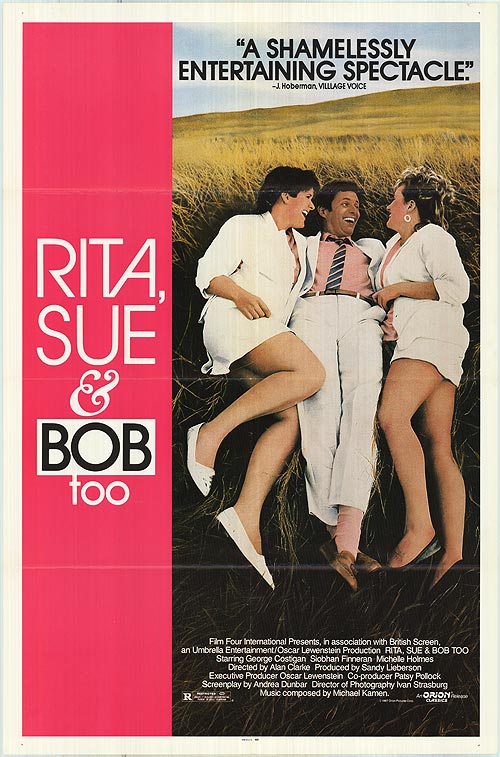
Rita (Siobhan Finneran) and Sue (Michelle Holmes) are two friends from high school who babysit for Bob (George Costigan) and his wife Michelle (Lesley Sharp). One night while Bob is taking the two babysitters home in his car he decides to make a sexual overture to them and they both enthusiastically reciprocate, which ends up turning into a mini sex orgy. Soon the three are routinely getting together for sexual trysts until Michelle eventually catches on and leaves Bob while taking the kids with her. Sue’s parents find out too, which causes a great deal of stress and infighting amongst the three.

This offbeat comedy unexpectedly became a worldwide cult hit that made stars of the three leads particularly the two women whose first film this was. Unfortunately the same cannot be said for the film’s director Alan Clarke or its writer Andrea Dunbar who both tragically died just 3 years after the film’s release. Clarke from cancer while Dunbar, who was living on welfare and an alcoholic, passed away at her local pub at only 29 years of age.

The film comes off as an odd mix of lighthearted comedy and gritty drama that doesn’t completely work. The story jumps from the upscale middle class neighborhood of Bob’s house to the abject poverty of Sue and Rita’s family life with their apartments so vividly rundown that it’s almost horrifying to imagine anyone could live in such squalor. Part of the reason for this shift is that the film was based on two of Dunbar’s plays, the first being ‘The Arbor’, which was an autobiographical story of her growing up in the slums and at the hands of an abusive father, which she wrote at the age of 15 as a class project, and the other on a later play that she wrote with the same title as the film.

I’m not sure why director Clarke choose to mix the two plays together. Maybe he thought it would give the story more substance, but it really doesn’t. The antics that go on here could’ve happened in any neighborhood and the income bracket issues showing the stark scenes of the girl’s sad home life seem inconsequential and meandering.

I didn’t like the film’s abrupt start either as it jumps almost immediately to the three getting-it-on inside the car without any backstory. I kept wondering when did Bob get the idea to make a pass at the two girls and why are the girls so unsurprised when he does? I would think most young women would be shocked when an older man that they babysat for would suddenly make an aggressive sexual come-on and yet here these two aren’t, but why? What sort of signals were the two sending out to Bob to make him feel that he could behave the way he does? Was he already getting ideas when they first came to babysit for him, or did it evolve later? These questions and scenarios never get shown or answered, but should’ve.

We also never see Rita and Sue interacting with the children. The scenes involving their babysitting shows them either sitting watching TV or stuffing their faces with snacks after raiding Bob’s refrigerator while the two children remain complete afterthoughts that are only shown briefly for a few seconds at the 54-minute mark and that’s it, which then brings me to another crucial question. Why is it necessary to hire two babysitters to watch over two kids? When I was younger and babysat I could easily watch my neighbor’s two kids without any help. When I was a child only one babysitter was hired to look after me and my two siblings. Hiring two teen girls to look after two kids is highly impractical and quite unusual to the point that it makes no sense.

The ending leaves open a lot of questions making the film seem almost like an incomplete treatment to a wider story. For instance the three end up moving in together without showing whether this unusual living arrangement would be able to sustain itself long term. I was also curious to see how Bob would explain this arrangement to his children when they came to visit. There is also a side-story dealing with Sue’s relationship with a Pakistani boyfriend (Kulvinder Ghir) that seemed better suited for another movie altogether.

The scenes involving the three inside the car are the funniest, but otherwise I’m not sure why this movie became the hit that it did.  There’s also too many tracking shots almost like director Clarke found himself a new toy that he couldn’t help playing with. Initially the constantly moving camera comes off as innovative and gives the film added energy, but it ends up getting overused.

My Rating: 5 out of 10

Released: May 12, 1987

Runtime: 1 Hour 33 Minutes

Rated R

Director: Alan Clarke

Studio: Film Four International

Available: DVD, Blu-ray

Polyester (1981)

By Richard Winters

My Rating: 4 out of 10

4-Word Review: Suburban housewife has problems.

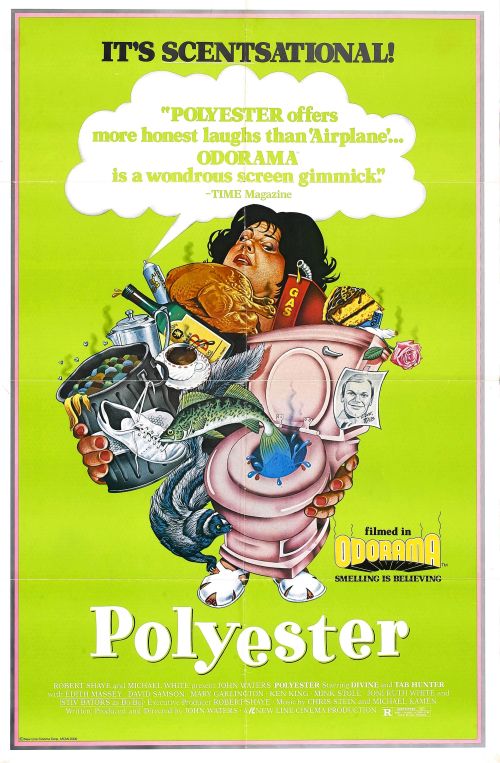
Francine Fishpaw’s (Divine) world is crumbling. Not only must she endure constant protests in front of her suburban Baltimore home dealing with people upset with her husband (David Samson) running an adult theater, but she must also deal with his affair with his sexy secretary (Mink Stole) as well. Her teenage son (Ken King) is terrorizing the city by intentionally stomping on the feet of every woman he sees and her daughter Lu-Lu (Mary Garlington) wants an abortion. She then meets the dashing Todd Tomorrow (Tab Hunter) and the two immediately fall-in-love only to find that he too has a dark-side.

This was John Waters’ first studio backed film and the first to garner an R-rating while the others had been X. While the budget is an improvement and its technicallys more polished the edginess is lost. The humor and satirical potshots don’t have the same zing and are lacking in originality and outrageousness. The gimmick of passing out a scratch-and-sniff cards where audiences could sniff the scents being smelled by the film’s main character seems excessively juvenile and the film begins with a campy scientist (Rick Breitenfeld) talking about it, which sets the tone too much on a silly/cartoonish level.

Divine’s presence helps, but she isn’t as made-up or as flashy as she was in her past films and looking much more like just some fat guy wearing a lady’s wig. I liked that her character was consistently normal for the most part as in the other films she behaved more erratically although what she goes through here is so unrelentingly traumatic that it borders on being almost cruel to laugh at. It’s also not completely easy to sympathize with her quandary as her kid’s behavior is so outrageous you have to question her parenting skills and whether she’s partially to blame for the bad things that they do.

Edith Massey is funny as a poor woman who wins the lottery and now acts a bit nouveau riche about it. It’s also fun seeing the two teens go through a Jekyll and Hyde transformation, but Tab’s appearance adds little although he does sing a decent opening title tune.

The broad humor for the most part is dumb, but I still found myself laughing-out-loud at some of it, which I suppose is a part of Waters’ ‘charm’ at getting you to laugh at things you otherwise wouldn’t. Some of the moments that had me chuckling were: a ‘nice’ picnic that gets ruined by ants and a skunk. Pregnant young women forced to go on a ‘happy hayride’ in the cold rain by two fascist nuns and the pet dog who commits suicide by hanging himself along with leaving a note saying ‘Goodbye cruel world’.  The part where overweight Jean Hill hijacks a bus and chases down a group of teens who assaulted her on the street and then bites into their car tires to disable their vehicle is pretty wacked-out too.

My Rating: 4 out of 10

Released: May 29, 1981

Runtime: 1 Hour 26 Minutes

Rated R

Director: John Waters

Studio: New Line Cinema

Available: DVD, Amazon Video, YouTube

Blue Thunder (1983)

By Richard Winters

My Rating: 7 out of 10

4-Word Review: A technologically advanced helicopter.

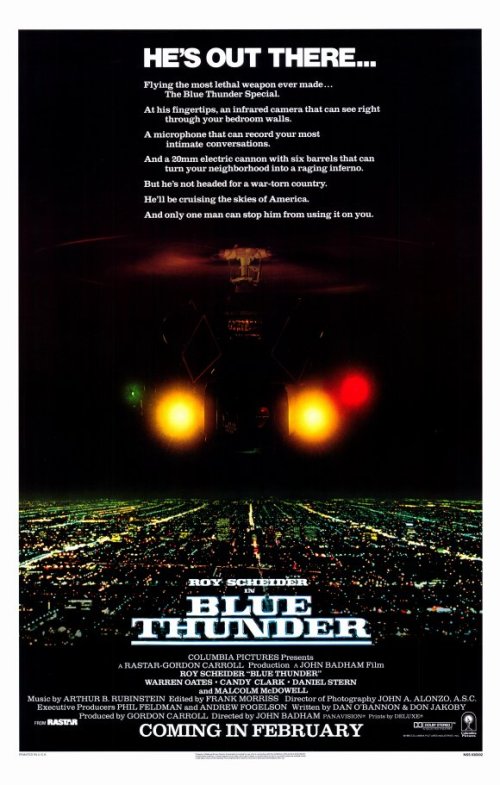
Frank Murphy (Roy Scheider) is a LAPD officer still suffering from flashbacks from his time in Vietnam while working now as part of the air patrol division where he mans a helicopter at night and gives assistance to the cops on the ground.  Due to his expertise he is given the chance to helm the first advanced helicopter called Blue Thunder, which has abilities to fight crime like no other machine before it. As he tests out the new product with his partner Richard (Daniel Stern) he overhears a conversation, through using the machines built-in microphones that can pick up voices from inside buildings, talking about using Blue Thunder for nefarious means. Frank records the conversation and then gets hounded by the bad guys who are led by his lifelong rival from his army days F.E. Cochrane (Malcolm McDowell). To escape their clutches Frank boards the helicopter and flies all over the city of L.A. while waiting for his wife Kate (Candy Clark) to get the incriminating tape to a TV-station where it will be broadcast for the public to hear, but Cochrane, who is an expert pilot as well, gets into another helicopter and tries to shoot Blue Thunder down.

The script was written by the prolific Dan O’Bannon who also wrote the scripts for Alien and Total Recall. He got the idea for this one while living in L.A. and constantly having a police helicopters routinely fly over his neighborhood at night. The original script was darker in tone and portrayed Frank as a psychotic who steals the helicopter and terrorizes the city until he is finally shot down, but that idea got nixed and like with most big-budgeted Hollywood projects got toned down to help appeal to a wider audience.

Personally I would’ve found the original idea more interesting as it also contained political overtones that get completely washed over here. The story here is pretty generic with one-dimensional villains and situations simply thrown in to create cheap conflict and nothing more.

What impressed me though was the modern visual style and effects. It hardly seems like a mid-80s movie at all let alone one that was actually filmed in late ’79 and early ’80. The overriding sentiment has a trendy feel and the cinematography is vivid and colorful. The helicopter action is the film’s biggest selling point and no matter how dippy the story gets the exciting aerial footage more than makes up for it. I loved the way director John Badham captures all sides of Los Angeles from its glitzy skyline to its more grimy and rundown working class areas. It’s also nice to have a REAL helicopter REALLY flying in the air over the city instead of computer generated effects, which makes many of today’s movies look fake and cheapens them while still keeping many of the ‘80s action flicks superior.

Scheider has never been a leading man that I’ve found particularly impressive as his presence seems transparent. However here his laid-back demeanor nicely contrasts with McDowell’s hyper one and makes the bad guy seem even more vindictive. Stern is engaging as Scheider’s partner and it’s too bad this wasn’t made into a buddy movie with Stern’s character staying on for the whole time. Clark is also enjoyable particularly with the wild look that she elicits with her eyes and the car chase that she has with the cops in an abandoned lot of a drive-In theater.

This also sadly marks Warren Oates last project. It was filmed in 1980 and he did a few other films after this one, but this was released last. Oates is one of the most distinctive character actors to ever grace the screen and even in a bland supporting role like the one here he still finds a way to enliven it.

My Rating: 7 out of 10

Released: May 13, 1983

Runtime: 1 Hour 49 Minutes

Rated R

Director: John Badham

Studio: Columbia Pictures

Available: DVD, Blu-ray, Amazon Video

Thriller: A Cruel Picture (1973)

By Richard Winters

My Rating: 6 out of 10

4-Word Review: One-eyed mute’s revenge.

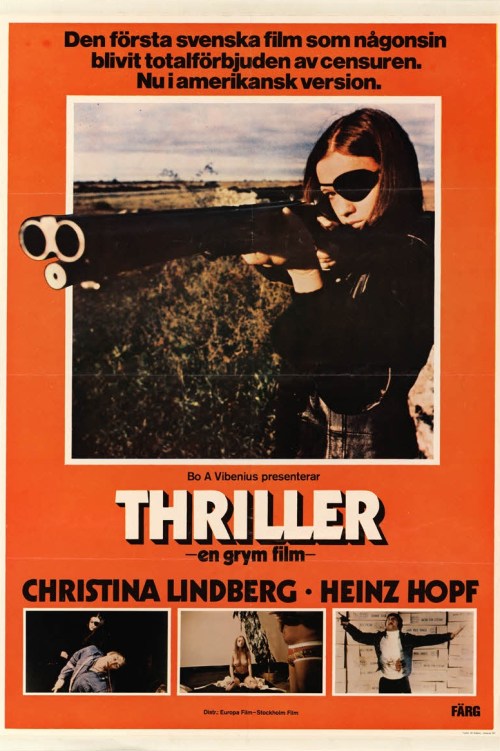
Frigga (Christine Lindberg) is a young woman in her early twenties still living at home with her father and unable to speak due to being raped by an old man at a young age, which has left her psychologically scarred. She attends therapy each week, but on one occasion she misses the bus and takes a ride from a stranger named Tony (Heinz Hopf). Tony takes her back to his place where he drugs her and then forces her to work for him as a prostitute. When she initially resists he gouges out one of her eyes with a knife. Feeling that she has no choice she eventually submits to his demands, but saves up the money she makes, so that one day she can escape from his clutches and use her funds to seek a very violent and ugly revenge on both him and all the others who were cruel to her.

In 1969 Borne Arne Vibenius, who had worked with Ingmar Bergman as an assistant director on Persona, tried his hand at directing his own film by doing the cute family comedy How Marie Hit Fredrik about a 10-year-old girl who runs away from home. The film unfortunately lost a lot of money and so Vibenius decided in an effort to recoup some of the lost funds that he would take the exact opposite route for his next project by going to the most exploitive extreme that he could, or in his words a ‘commercial-as-hell-crap-film’ which was the inspiration for this movie. However, for fear that it might ruin his reputation and stymie any future chances of making a more mainstream film he did it under a different name, Alex Fridolinski, and the actors had a clause in their contracts ensuring that they would never reveal who the real director was.

The film does successfully go to some of the most extremes imaginable which includes showing explicit hard core sex during the scenes where Frigga is shown getting it on with her customers. Apparently Vibenius used a married couple for this who went around Sweden doing live sex shows for money. Whether having the graphic sex was necessary is debatable, but it does, like with the turtle scene in Cannibal Holocaust gives the idea that there is ‘no limits’ here and if the director is willing to show this extreme what else might come next, which then gives the viewer an uneasy feeling, which I suppose if you’re doing a horror film that is the feeling to give out.

There is also a lot of extreme violence including a graphic, close-up shot of a knife cutting directly into a human eyeball, which was apparently done inside a hospital on a corpse of a teen girl who had committed suicide, which sounds ethically questionable. Yet it most assuredly will startle the viewer and some may vomit out their lunch as well.

On the cool side I loved seeing Frigga’s victims getting shot in slow-motion. Watching the blood smear all over their shirts and streams of the red stuff pouring out of their mouths has an almost poetic feel to it and clearly the film’s best moments.

There’s also a good gritty feel not usually seen in most other horror flicks. I liked the way Frigga is shown spending time learning how to shoot a gun, drive a car at high speeds and take self-defense training, so that she’ll be able to take on her enemies when the time comes instead of just showing her magically becoming this gun-toting, macho woman overnight.

The electronic music score is intense and the moody/atmospheric climactic showdown on a lonely road between Frigga and Tony is well crafted. Having Frigga not speak a single word actually gives her character a more entrenched image. Overall, the film is artsy and on the exploitative level it could be considered a trailblazer, but like its title states it’s a cruel picture that gets so excessive it leaves you cold and emotionally drained when it’s over.

My Rating: 6 out of 10

Released: May 7, 1973

Runtime: 1 Hour 47 Minutes (Complete, uncut version)

Not Rated

Director: Bo Arne Vibenius

Studio: BAV Film

Available: DVD

The Thing with Two Heads (1972)

By Richard Winters

My Rating: 4 out of 10

4-Word Review: Black man and bigot.

Dr. Maxwell Kirshner (Ray Milland) is a racist surgeon experimenting on transplanting the head of a dying animal onto one who is still living. The animal will then have two heads for a period of 35 days while the new one adapts to the body and eventually takes over at which time the original head is removed. The elderly Kirshner is suffering from a degenerative illness and needs his assistants to find someone willing to sacrifice their body, so that his head can be put on it. They eventually acquire the services of Jack Moss (Roosevelt Grier) a prisoner who was slated for the electric chair until he agrees to be part of the procedure, but when he awakens from the surgery to find the head of Kirshner next to his he escapes and goes on a desperate run to find some Dr. who will remove it from his body.

As tacky and ludicrous as the plot is it is actually an improvement from the first installment The Incredible 2-Headed Transplant as it at least defines the reason why the surgery is being done and creates some tension by having the one head grapple for control of the body from the other one. The film also has a nice pace and good tongue-in-cheek humor that is fully aware of its absurd storyline and in certain spots even plays-it-up. Unfortunately it gets too wacky for its own good, which culminates in a long drawn out car chase that would be far more appropriate for a yahoo action flick than a would-be horror film.

The performances of the two leads are the most interesting aspect. Former professional football player Grier is highly likable in the lead and seeing Milland, who won the Academy Award for Best Actor in 1945, playing in something so preposterously beneath his acting level is engaging although I found his character annoying I was hoping he’d have some sort of arch, or a softer side to his personality exposed at some point instead of being a total one-dimensional prick all the way through like he is.

To me the only good part is when Grier escapes from the authorities and comes home to his wife (Chelsea Brown) who sees his two-headed condition for the first time and the humorous exchange that they have:

Wife: You get into more shit.

(She attempts to kiss him and then moves back)

Wife: I know you don’t like answering a lot of questions, but how did that happened?

Grier: I’ll answer that later.

(She then peers down towards his crotch.)

Wife: Did they give you two of anything else?

My Rating: 4 out of 10

Released: July 19, 1972

Runtime: 1 Hour 30 Minutes

Rated PG

Director: Lee Frost

Studio: American International Pictures

Available: DVD

The Incredible 2-Headed Transplant (1971)

By Richard Winters

My Rating: 3 out of 10

4-Word Review: One body two heads.

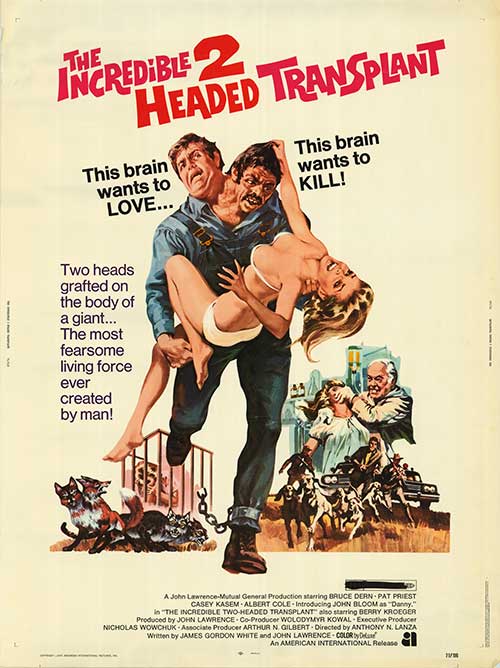
Roger Girard (Bruce Dern) is a crazed doctor who secretly experiments on planting two heads on animals and has a lab full of these creatures, which he keeps hidden from his beautiful wife Linda (Pat Priest). Only his faithful assistant Max (Berry Kroeger) knows about the research and he makes sure no one else finds out about it. One day Dr. Girard decides to test out the procedure on a human by planting the head of a homicidal maniac (Albert Cole) onto the body of a mentally challenged adult (John Bloom) whose super strength makes him hard to control and things quickly get out-of-hand when the patient escapes and goes on a murderous spree.

What inspired screenwriter James Gordon White to write this story is a mystery, but it’s rather idiotic with no specific reason why Dr. Girard feels planting another head on an animal, or human, is a good idea. The music by John Barber is the worst part as there’s too much of it and the tone changes drastically like fiddling through a radio dial with most of the melodies sounding better suited for cartoons.

The bright, sunny southern California scenery, which was shot in Santa Clarita, is nice, but I didn’t know why it was all done in the daytime. Most horror movies are shot at night in order to have the darkness elevate the fear. The nighttime scene here was clearly done in the daylight with a darkened lens put over the camera to make it appear darker than it really is. Most films do this when they have children in the cast since there are laws preventing minors from working in films past a certain time, but this had an all adult cast and therefore no reason for it not to have night scenes done when the sun has actually set.

Bruce Dern’s presence is a surprise since he was already an established actor by this time and didn’t have to accept offers to be in this dreck simply to make a living. He was apparently given a check for $1,700 as his compensation, but when he went to the bank to cash it, it bounced. Even more surprising is in a recent interview when was asked what movie he regretted doing the most he mentioned Won Ton Ton the Dog Who Saved Hollywood instead of this one.

Casey Kasem’s wild ‘70s outfits and hairstyle make his appearance almost worth it and Pat Priest, best known as the second Marilyn from ‘The Munsters’ is an attractive asset. Berry Kroeger with his goofy facial expressions makes things fun as Dern’s assistant.

The sight of the 2-headed creature is odd to say the least and there were certain shots where I wasn’t quite sure how they pulled it off, which I suppose allows for some minor intrigue. Their contrasting personalities tough should’ve been played up more and had a ‘battle’ over which side controlled the body. This element gets improved a year later when the same screenwriter came out with The Thing with Two Heads that had the head of a white racist is put onto a black man’s body. The review for that film will be posted in…TWO days.

My Rating: 3 out of 10

Released: April 28, 1971

Runtime: 1 Hour 28 Minutes

Rated R

Director: Anthony M. Lanza

Studio: American International Pictures

Available: DVD, Amazon Video

Motel Hell (1980)

By Richard Winters

My Rating: 6 out of 10

4-Word Review: Farmer Vincent’s tasty fritters.

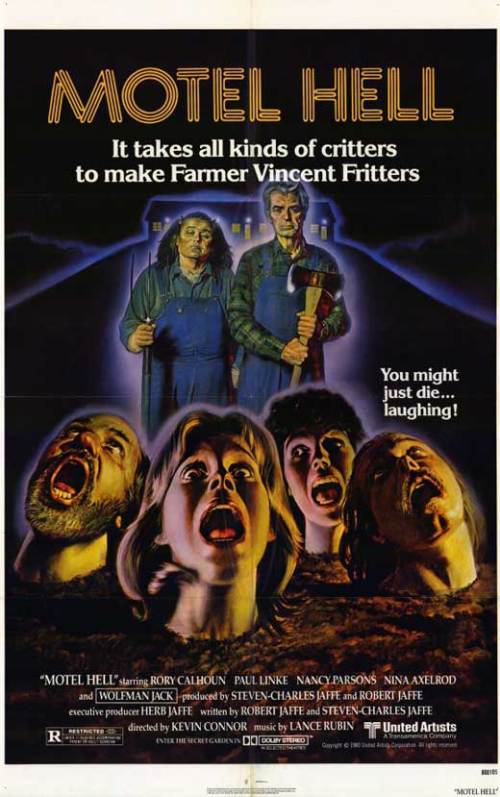
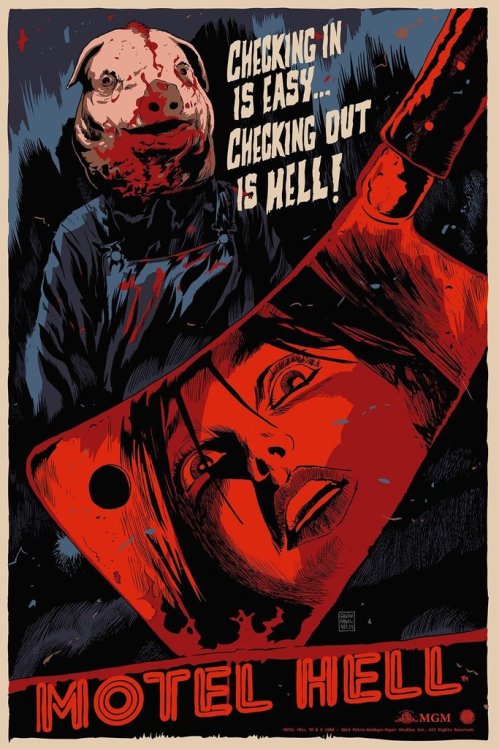
Vincent (Rory Calhoun) and his sister Ida (Nancy Parsons) run a motel out in the sticks, but their main income comes from Vincent’s delicious meat fritters that he sells to the community. No one knows that the meat is made from humans who he gets by setting traps on a nearby road that sends the vehicles of unsuspecting motorists careening out of control. Once the cars have crashed Vincent removes their bodies from the wreckage and plants them in his hidden garden while also severing their vocal chords, so they cannot yell for help. Then once they are ‘ripe’ he slices up their bodies and uses them for his product.

This is yet another rendition of Ed Gein, the Plainfield Wisconsin farmer who dug up dead bodies from a nearby graveyard and used them for all sorts of sick purposes. While there have been many other films on the topic this one nicely steps back from the shock angle and instead injects dark humor that manages to make the story both funny and involving.

The original script, which was co-written by two brothers, was darker and intended for Tobe Hooper to direct, but when he pulled out of the project and Kevin Connor was hired he insisted that all of the ‘crudeness’ be excised. The result is an agreeably quirky take on the Gein legend that lacks scares, but makes up for with style and atmosphere. I particularly enjoyed the bird’s eye view of Vincent’s and Ida’s backyard lake as well as the surreal-like hum of the sunlamps that Vincent shines on his human victims at night.

Aging cowboy star Calhoun does quite well and out of all the actors who’ve attempted to play Gein it’s Calhoun that actually comes closest to the way he really looked and spoke. The only problem was that he was clearly much older than both Parsons and Paul Linke who play his siblings and no explanation for why the parents would have kids so far apart, or even if that would be possible as in reality Calhoun was 20 years older than Parsons and 26 years older than Linke.

The climatic chainsaw duel, which was thought up at the last minute and took 5 12-hour days to film, is fun. The kinky couple (Elaine Joyce, Dick Curtis) who visit the motel under the mistaken impression it’s a hotbed for swingers and allow themselves to get tied-up thinking it’s all a part of a sex game are funny too in a film that manages to be quirky without ever getting too campy.

My Rating: 6 out of 10

Released: October 24, 1980

Runtime: 1 Hour 44 Minutes

Rated R

Director: Kevin Connor

Studio: United Artists

Available: DVD, Amazon Video

Devil Times Five (1974)

By Richard Winters

My Rating: 4 out of 10

4-Word Review: Children terrorize the adults.

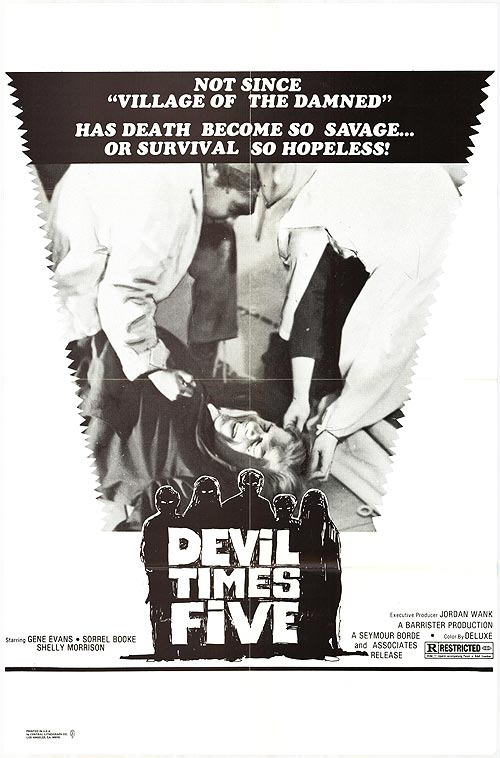
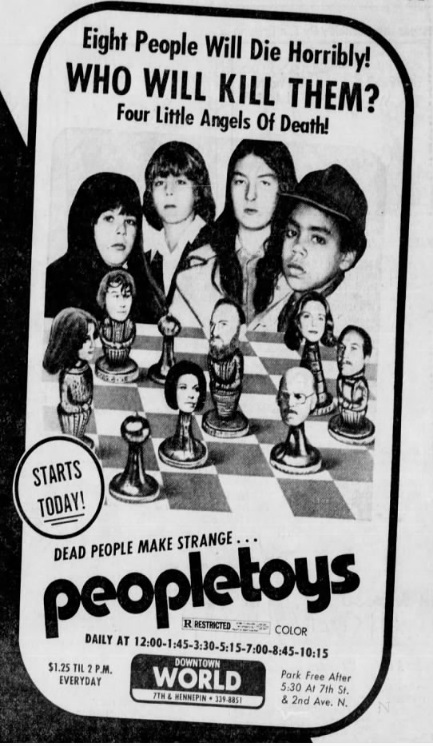
Two couples (Sorrell Booke, Shelley Morrison, Taylor Lacher, Joan McCall) visit the winter retreat ranch run by rich businessman Papa Doc (Gene Evans). They are expecting a pleasant wintry getaway, but instead find terror when a group of five children arrive (Leif Garrett, Gail Smale, Dawn Lyn, Tierre Turner, Tia Thompson). The children state that they were lost in the cold wilderness and simply there to seek refuge, but in reality they are psychotic and have escaped from a nearby asylum after the van they were riding in overturned on the icy roads. Now the adults find themselves getting mysteriously bumped off one-by-one. At first they think it’s only an accident and then realize it’s by some ‘unforeseen predator’, but fail to realize it’s actually the ‘innocent-looking-kids’ until it’s too late.

This cheaply made production has problems right away starting with the van accident. To a degree I thought it was cool seeing it overturn several times in slow-motion after it slides off the road, but I found it preposterous that none of the kids were injured and escape from the wreckage without a single scratch despite the adult driver getting badly banged up. In retrospect it would’ve worked better had this scene not been shown at all and left the viewer in the dark about what the true intentions of these kids were only to slowly unfold the truth to the audience just like it does to the adult characters.

The killings are pretty tacky as well. The scene where one of the victims gets set on fire is disturbing, but the rest doesn’t add up including when one child manages to somehow hold their adult victim underwater by using only one hand. There are also several instances where the victim dies right away when in reality they would’ve most likely only been injured including a fall through a window and another one dealing with a stabbing by a small ax. In both cases I think the person could’ve survived the initial blow and simply be writhing in extreme pain, but I presume the filmmakers felt that watching someone squirming around on the ground screaming in endless agony would be considered ‘too horrifying’ for most audiences so they went with the ‘clean-kill’ option, but unfortunately the one-blow-and-then-they’re- immediately-dead concept looks fake.

The pacing is also poor and the tension badly botched. One bit has the kids killing a man in slow motion and done through a black-and-white filter, which despite going on a bit too long is effective. Yet whatever tension gets achieved by watching that is immediately sapped when the next scene shows a drawn out session of one of the adult couples making love, which looks better suited for soft corn porn flick. The music is equally screwed-up as it sometimes sounds creepy while at other points like something heard in an elevator.

I found it interesting that it was directed by Sean MacGregor, or at least for the first three weeks of production before he got fired, as he had previously written the screenplay for Brotherhood of Satan, which had the same ‘creepy kids’-like theme. There’s also the novelty of seeing Dawn Lyn, who was 10-years-old at the time, taking part in her own mother’s murder, who plays one of the adults. Although overall it’s pretty spotty with majority of it being rather flat and forgettable.

Spoiler Alert!

I was also confused at how during the final credits it says ‘The Beginning’ instead of the usual ‘The End’. I presume this was the filmmakers attempt at being ‘clever’ by intimating that these young kids would now go on to murder many more people throughout the countryside, but since they had already killed quite a few it would’ve been more apt to say ‘The Middle’.

End of Spoiler Alert!

My Rating: 4 out of 10

Alternate Titles: Peopletoys, The Horrible House on the Hill

Released: May 31, 1974

Runtime: 1 Hour 28 Minutes

Rated R

Director: Sean MacGregor, David Sheldon (Uncredited)

Studio: Cinemation Industries

Available: DVD-R, Amazon Video