Category Archives: Cult

Mountaintop Motel Massacre (1983)

By Richard Winters

My Rating: 4 out of 10

4-Word Review: Crazy lady kills guests.

Evelyn (Anna Chappell) has just been released from a mental institution and gone back to running a rural motel. One day she finds her daughter Lori (Jill King) practicing witchcraft in their basement. Evelyn becomes so enraged by this that she ends up killing her daughter with a garden sickle. The police believe her story that it was simply an accident that happened outside in their garden and do not arrest her, but the voices inside Evelyn’s head convince her that everyone else is out to get her. This madness sends her on a killing spree at her hotel in which she is able to enter each person’s room through a trap door in their bathrooms that is connected to an underground tunnel.

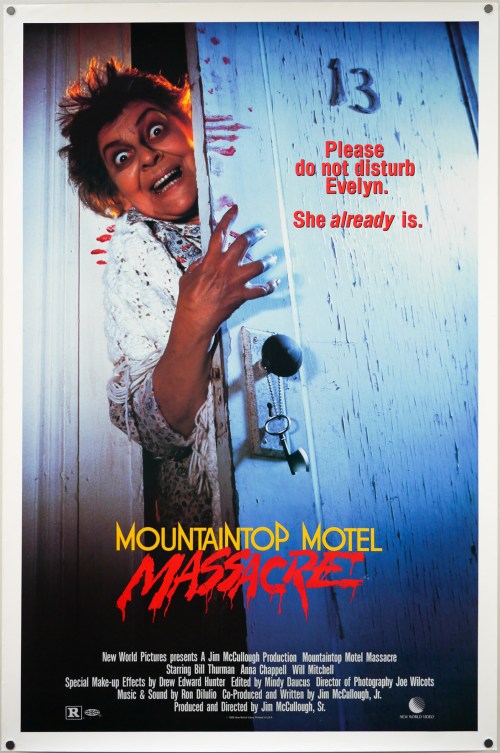
The film did only moderately well when it was released to regional theaters and then ultimately nationally in 1986 and a lot of the problem could reside around its promotional poster seen above, which seems to imply that this is a campy horror comedy, which it is not. It also features a completely different woman posing as Evelyn that is not the same one who plays her in the film.

As for the film itself it starts out okay. I liked how it comes up with this very offbeat premise about an old lady killer, but then approaches in a realistic way. Nothing gets jazzed-up for the sake of horror and everything gets handled with a slow deliberate pace including a drawn out scene showing an ambulance crew trying to resuscitate her daughter. The on-location shooting, which was filmed in an around Oil City, Louisiana in March of 1983 gives the viewer an authentic view of the winter landscape in the south and the hotel itself, which was shot at an abandoned fishing camp that sat on Cross Lake in Shreveport, helps add a rustic flair.

The cast of victims are much more diverse than in most slasher movies and fortunately doesn’t just feature teenagers or college kids. I was especially impressed with Major Brock, who plays Crenshaw, who had worked for 31 years as a baggage handler at Delta Airlines, but was convinced by the film’s director to take on the role despite having no acting experience, but he does really well, he even sleeps convincingly, and I enjoyed the character’s no-nonsense attitude and wished he had remained in it the whole way.  I was actually disappointed to see any of them die and instead wanted to see how they could get past their contrasting personalities to work as a team to overcome the crazy lady, but that doesn’t happen.

The killings though are quite boring and the idea that a sickle would be able to kill people so easily with just one swipe after spending most likely years being used in the garden, which would’ve dulled its blade, is just not believable. The victims are also too passive and just stand there when the lady attacks them instead of fighting back. The killer is after all an elderly woman, so you’d think these younger people could’ve overpowered her by even just kicking at her, which would’ve slowed her advance.

The climactic battle inside the underground tunnel offers some tension, but it seemed weird that when the people would open up the trap door that lead to the tunnel there would be this bright ray of light that would spew out making it seem like the tunnel was well lit, but then when they’d get down there the only source of light would be their lanterns, so if that’s the case were was the initial ray of light coming from?

The film would’ve worked better had it not given it all away right at the start. The identity of the killer should’ve been kept a secret until the very end and Evelyn should’ve initially been portrayed as this sweet old lady who you’d never suspect. The tunnel should not have been made known until later either and thus made it more intriguing for the viewer in trying to figure out how the dead bodies of the victims were disappearing out of their rooms.

My Rating: 4 out of 10

Released: July 15, 1983

Runtime: 1 Hour 35 Minutes

Rated R

Director: Jim McCullough Sr.

Studio: New World Pictures

Available: DVD, Amazon Video, YouTube
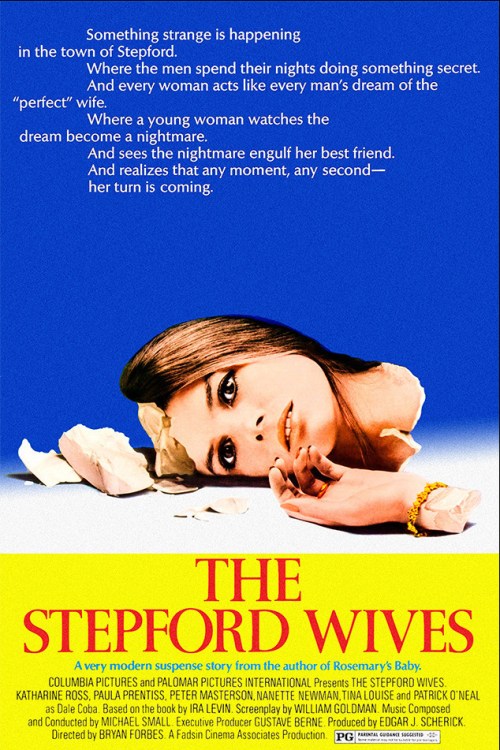
The Stepford Wives (1975)

By Richard Winters

My Rating: 7 out of 10

4-Word Review: Suburban wives become robots.

Joanne and Walter (Katharine Ross, Peter Masterson) decide to move with their two children (Mary Stuart Masterson, Ronny Sullivan) from the big city to the quiet suburb of Stepford, Connecticut. While Walter immediately starts to fit-in with the exclusive men’s club that they have there Joanne feels unable to connect with the other wives who all behave in a robotic fashion and more concerned with keeping their husbands happy and cleaning their homes than anything else. She manages to find one other woman named Bobbie (Paula Prentiss) who like her find the women’s behavior in the town to be a bit odd and they team up to investigate what the cause of it may be.

When this film was first released it was met with controversy particularly by feminists who felt the storyline was misogynistic and one protester even went as far as attacking director Bryan Forbes with her umbrella. When the movie was screened to a group of feminists they all hissed and groaned at it during the viewing while some other women, like screenwriter Eleanor Perry, came to the film’s defense calling it more of a sharp satire on men and their superficial views on women than on the women themselves.

I saw it more as a trenchant take on the suburbs, which can initially seem like a quiet, safe refuge, but ultimately can become a trap with a lot of hidden strings that you don’t initially see. While the Stepford wives do behave as overly conforming to domestic roles it’s really not all that much different than what you’d find in reality making you wonder if the rest of us suburbanites all slowly getting sucked into the Stepford trap too and just don’t realize it.

While the ill-advised 2004 remake tried to turn the concept into a comedic tale the story really works best as a horror film, which is what the 1972 Ira Levin novel, of which the film was based, intended and there are some good creepy moments. I particularly liked the moment when Joanne is talking to her therapist, played by Carol Eve Rossen, about how she feels the men in town are turning the women into robots and she fears she will be next. Her therapist advises her to grab her kids and leave town, but Joanne admits her other family members are dead and she has nowhere to go, which brought out what the truly frightening aspect of this story truly is, which is that women back then were completely dependent on their husbands for everything. Many of them weren’t in the job force and simply living off of their husband’s income. If the marriage went bad they were pretty much trapped in it, so even if a woman wasn’t getting turned into a robot like these women were they still weren’t really free either.

I also enjoyed the moment when Katharine Ross stabs Paula Prentiss, Ross had grown to like Prentiss so much during the production that she was nervous about doing this so director Forbes shaved the back of his hand and used it in place of Ross’ when the scene was shot. You may have seen many stabbing scenes in your film watching lifetime, but the one here is truly unique and quite memorable and voted as one of the 100 Scariest Film Moments by the Bravo Film Institute.

The film though still does have its share of faults. I liked how the viewer initially doesn’t know anything more than the main characters about what is going on, but ultimately the viewer starts to catch onto things more quickly than the protagonist, which proves frustrating. Joanne comes upon the creepy house where the exclusive men’s club meet, filmed at the historical Lockwood-Matthews Mansion in Norwalk, Connecticut, which looks quite ominous at night, at the film’s 60 minute mark, but then doesn’t go back to it until 50 minutes later. The viewer has already connected-the-dots that the bad things are happening inside that place, but instead of Joanne investigating the place more she goes on a wild-goose-chase with Bobbie about researching that town’s water supply, thinking that may have a chemical in it that is brainwashing the other women, which is clearly just a waste of time.

Spoiler Alert!

The film’s ending has a several issues as well. In the novel Joanne gets chased down by the town’s men, which should’ve been in the film as it would’ve allowed for some much needed action, but wasn’t. William Goldman’s script had originally called for Joanne to fight violently for her life when she gets attacked by her prototype robot, but Forbes decided to simply fade to black and not show the struggle, which makes it look like Joanne allowed herself to go down too easily.

When Joanne confronts the sinister Diz, played by Patrick O’Neal, he alludes to the idea that she wasn’t necessarily going to die, but would simply be ‘moving onto another phase’. He then describes to her about how nice it would be for a woman to be married to a husband who would adore her even when she grew ‘old and flabby’ making me think that Joanne was simply going to be taken away to another suburb somewhere else where the husbands would be the robots that the women controlled while the men remained in Stepford enjoying the wife robots. Seeing this scenario would’ve been a more interesting and unexpected twist and ultimately was later done in the 1986 TV-Movie The Stepford Husbands. 

My Rating: 7 out of 10

Released: February 12, 1975

Runtime: 1 Hour 55 Minutes

Rated PG

Director: Bryan Forbes

Studio: Columbia Pictures

Available: DVD, Amazon Video

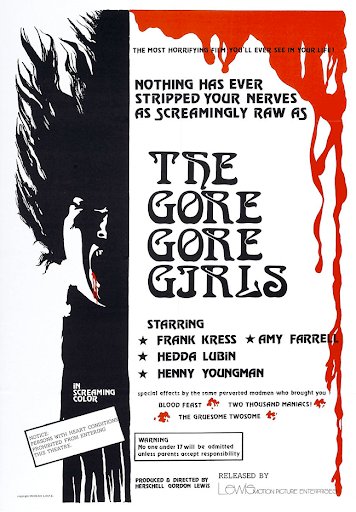
The Gore Gore Girls (1972)

By Richard Winters

My Rating: 1 out of 10

4-Word Review: Somebody’s killing the strippers.

Private investigator Abraham Gentry (Frank Kress) gets hired by Nancy (Amy Farrell), a reporter for The Globe newspaper, to investigate the murder of a stripper named Suzy Cream Puff (Jackie Kroeger). Abraham will get $25,000 to investigate the case and another $25,000 to solve it as long as he gives The Globe the exclusive story. Soon more strippers turn up dead and Abraham starts to have a long list of suspects including Grout (Ray Sager) a Vietnam veteran who enjoys smashing melons with faces drawn on them, similar to how the strippers got their heads smashed, in order to relieve his post traumatic stress disorder.

This was schlockmeister Herschell Gordon Lewis’ final film until 2002 and was meant to be a combination between the lighthearted nudies that he made in the early 60’s and the more graphic gore films that he did in the later part of the decade. The result though is a misguided mess where it seems more like a gag reel with tacky gore thrown in at certain intervals than a horror film.

The production values are really cheap even for a low budget production and contains basically just a few settings. One features the cramped living room of Abraham’s house that looks to be nothing more than a one bedroom apartment, which doesn’t quite make sense since the guy is a world famous detective you’d think he be living in a plush place especially with his elitist attitude. The other setting, which takes up the majority of the story, is the strip club that looks like it was filmed in the corner of somebody’s dingy basement.

The gory murders aren’t much fun and would be considered quite sick if they weren’t so tacky and fake. The jump cuts are the biggest problem as the bad guy kills the stripper one second and then in the next frame has seemingly been able to skin their heads completely and crushed their skulls, which is too quick. The ping pong ball sized eyeballs that the killer gouges from their heads are ridiculous looking too as eyes are actually oval shaped and not round as presented here.

The stripping routines take up too much of the runtime and seem put in simply to pad the anemic plotline. I’m not going to complain about watching beautiful women taking off their clothes, although to be honest the women here aren’t so hot, but I got real tired of hearing the same music played over and over again during each different set. Aren’t strippers allowed to come up with their own music and dance routines, or is that a new phenomenon that wasn’t a thing back in the 70’s?

I hate to psycho-analyze a film director and have never done it before, but the misogyny here is rampant. If there had been one strong, smart woman character present then it would’ve have been a issue, but instead females get portrayed here as being incredibly dumb and easily manipulated. The Nancy character is shown to be unable to take care of herself and needs a man present to look out for her particularly when she passes out on a city sidewalk after having only a couple of drinks. She faints and screams at the sight of a dead body too while the man remains stoic and shows no emotional reaction at all. Maybe this was supposed to be a part of the ‘comedy’, but it comes off as severely dated and out-of-touch with the times.

My Rating: 1 out of 10

Released: September 22, 1972

Runtime: 1 Hour 21 Minutes

Director: Herschell Gordon Lewis

Rated X

Studio: Lewis Motion Picture Enterprises

Available: DVD, Blu-ray, Amazon Video

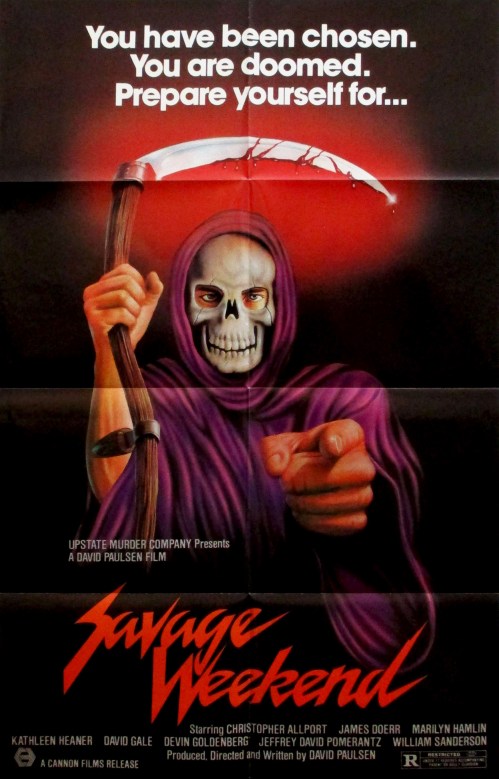
Savage Weekend (1980)

By Richard Winters

My Rating: 6 out of 10

4-Word Review: The first slasher movie.

Maria (Marilyn Hamlin), who has a very contentious relationship with her ex-husband Greg (Jeff Pomerantz), but who is now in a relationship with Robert (Jim Doerr) a successful businessman, decides to take a weekend trip with some friends to upstate New York. Robert is having a large boat built there and wants to see its progress. The quiet country atmosphere seems like the perfect spot to getaway until a masked killer shows up killing each of them one-by-one.

While Halloween typically gets credited as being the forerunner to the modern day slasher film it’s actually this one that was the first and don’t let the release date fool you. This was filmed in the summer of 1976, a full two years before Halloween came out, but was shelved by its distributors as they thought the concept of a mysterious masked killer was ‘too weird’ and wouldn’t catch on only to eventually release it to theaters once they saw the success of Halloween.

The concept for this came about completely by accident. Writer/director David Paulson was originally hired to write a screenplay for a completely different type of movie, but the investor then retracted the majority of the money he promised leaving Paulson with a mere $20,000 to work with. He decided with such little funds he’d be forced create a story that required a single setting and then came up a scenario that would make the characters stay there and thus the killer-on-the-loose idea was born.

The critics were originally not kind: TV Guide subscribed this as a ‘reprehensible exploitation film’ and ‘the gore effects are extremely gruesome’, which just isn’t true. At best the blood is quite minimal especially when compared to today’s slashers. In fact you’ll find more explicit gore in modern dark comedy films like Shaun of the Dead than you will here.

Critic Joe Baltake criticized the Nicky (Christopher Allport) the gay character stating that he ‘set gay rights activism back several decades’, which I totally disagree with. I actually liked Nicky and was impressed at the way he walked into a backwoods bar and when the rednecks tried to hassle him he single-handedly kicked their asses, which to me worked completely against the gay stereotype.

Through the years critics have become much kinder to this film and its attained a strong cult following and deservedly so. Despite being made 4 decades ago it actually comes off as fresh and inventive because it’s not stifled by the conventional ‘rules’ of the formula, which we’ve become so accustomed to now. I liked how the film opens with a point-of-view shots of our heroine running madly through the forest making the viewer feel they’re the ones being chased.

The fact that the majority of it takes place during the daytime actually makes it scarier especially with it’s weird yellowish tint that permeates every shot. I’m not sure if this was intentional or just a poor film transfer, but it helps to create a surreal look. I also really loved seeing the skeleton of the large boat that was being built inside an abandoned shed. I presume with the low budget this was not made for the story and instead simply worked into the script when the producers came upon it while scouting for locations, but the effect is cool especially when the cast walks around inside it.

The soundtrack is way different from the conventional horror film as well with a country tinged sound and at one point even a classical dance piece, but after watching soooo many scary movies with the same old Friday the 13th-like sound I was more than happy to hear something different. The characters are also multi-dimensional with distinctive personalities. Usually I more than happy to see a cardboard slasher film cast get hacked-up, but here I kind of wanted them to stay around as they were interesting. The murders also don’t work in a mechanical way, but instead start occurring suddenly to the shock of everyone else, which gives it more of a real-time feel.

The only real negative is that despite having a strong beginning and ending the middle part is slow. There’s still enough interactions between the characters to hold mild interest, but there’s no running tension. A good horror movie should be creepy to some degree from beginning to end, but the second act veers off too much making it at times seem more like a soft core porn flick, but overall for the horror connoisseur I’d still recommend this.

My Rating: 6 out of 10

Released: November 14, 1980

Runtime: 1 Hour 28 Minutes

Rated R

Director: David Paulsen

Studio: Cannon Group

Available: DVD, Blu-ray (Region 1), Amazon Video

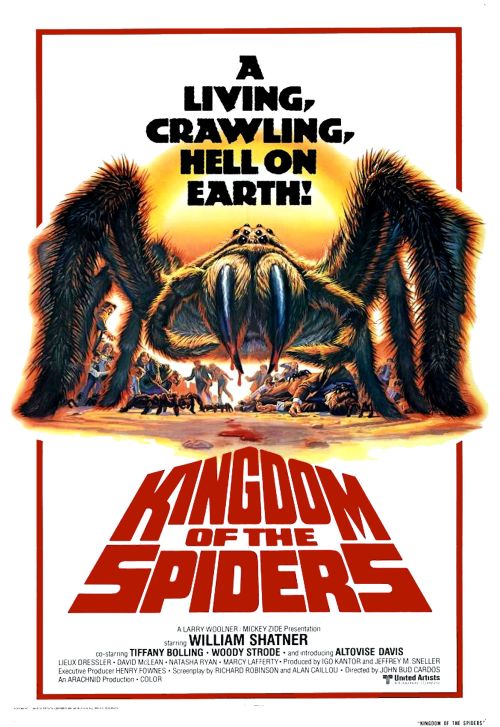
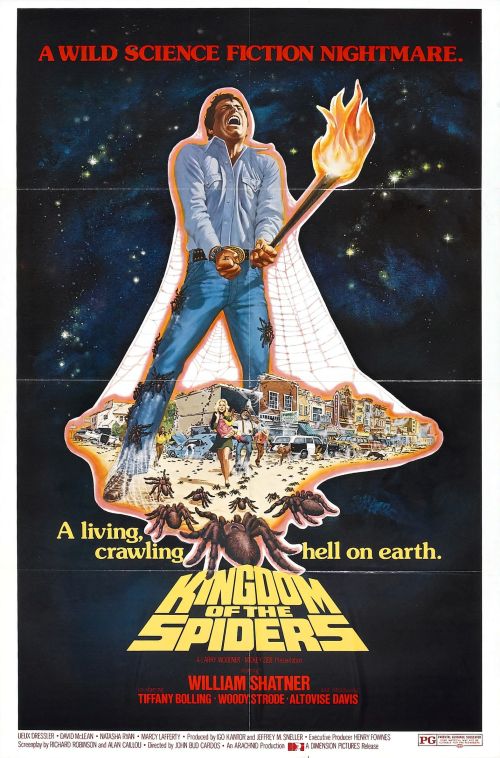
Kingdom of the Spiders (1977)

By Richard Winters

My Rating: 4 out of 10

4-Word Review: Tarantulas take over town.

Rack (William Shatner) is a veterinarian residing in a rural Arizona town who gets a call one day from a local rancher (Woody Strode) complaining that his prize calf has come down with a mysterious illness. Rack examines the animal, but can’t come to any conclusion so he sends the animal’s blood sample off to a university lab. Diane (Tiffany Bolling) a arachnologist then arrives telling him that the animal was killed by a massive dose of spider venom. At first Rack does not believe her, but as more animals and then eventually people start to fall prey to the same aggressive spiders the two soon pair up to help try to save the rest of the town and themselves.

Over $50,000 of the film’s $500,000 budget was spent on procuring 5,000 tarantulas for the film’s shoot, but personally I didn’t think it was enough. Shots showing the spiders ‘invading’ by having them lining the town’s roadways weren’t really all that frightening because there was still ample space between the spiders that a person could easily step around them and not get bit. The spiders are also very slow, so a potential victim should have plenty of time to get out of the area once they saw them converging.

The idea that the spiders are doing this is because of the heavy use of pesticides doesn’t logically work. For one thing spiders are not like ants and do not create working colonies. They are anti-social and do things alone. They can even be cannibalistic, which is why the production crew was forced to keep each of the 5,000 tarantulas in separate containers to avoid having them eat each other. With this all in mind why then would they begin behaving in ways that’s so unnatural to their species? Being desperate for a new food source is one thing, but how could the spiders communicate with each other to get them all to work together that are completely alien to their nature? Sometimes it’s very hard to get humans to work together even when they know it’s in their best interests, so suddenly getting an anti-social species to do it is breaking astronomical odds.

Another issue is how do these spiders suddenly get so smart? For instance the spiders sneak onto a crop duster plane and kill the pilot (Whitey Hughes) who was going to spray down a pesticide that would’ve destroyed their spider hills, but how would spiders have the sophistication to know that was what he was doing? Spiders cannot speak or understand English, so it’s not like they could’ve ‘overheard’ what the people were planning to do and then went on the counter-attack though that’s ultimately what the movie tries to convey happened.

The film is too dependent on viewers being creeped out at the sight of spiders and hoping that will be enough to carry through for the entire movie as pretty much nothing else happens that’s genuinely scary. Just a lot of shots of spiders slowly moving around while the actors scream in horror and try to flick them off and that’s about it. The ultimate irony is that tarantula bites are not lethal and will cause only a minor irritation similar to that of a bee sting.

Spoiler Alert!

I did however like the film’s ending which has the spiders covering the entire town with a giant cobweb. While it’s obvious that the shot of the cobweb over the town is clearly that of a painting I still felt it was a cool concept, but this needed to come in to play during the second act. Showing how the people fought through this new dilemma would’ve given the story a more creative direction instead of just waiting to the very finish to introduce it and then abruptly ending just when it finally started to get interesting.

My Rating: 4 out of 10

Released: August 24, 1977

Runtime: 1 Hour 35 Minutes

Rated PG

Director: John ‘Bud’ Cardos

Studio: Dimension Pictures

Available: DVD, Blu-ray, Amazon Video

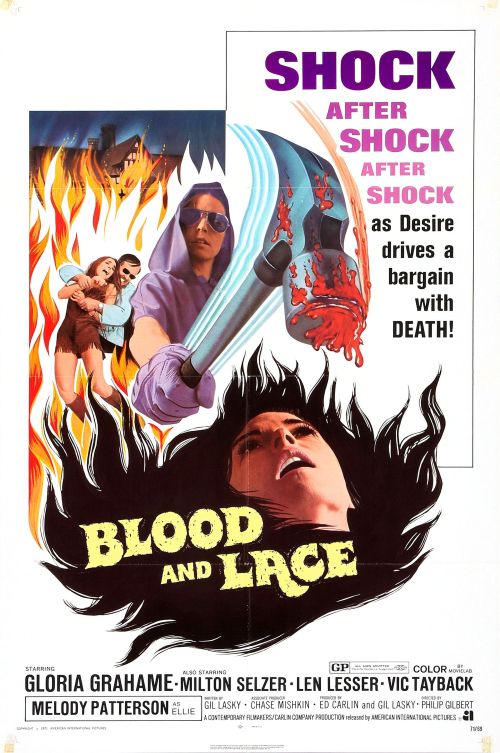
Blood and Lace (1971)

By Richard Winters

My Rating: 3 out of 10

4-Word Review: Trapped in an orphanage.

Ellie Masters (Melody Patterson) finds herself an orphan after her mother, who worked as a prostitute, is found in bed with a john both dead via bludgeoning by a hammer. Since she’s still a minor she’s required to move into an orphanage run by the corrupt Mrs. Deere (Gloria Grahame) who treats the children as slaves and when any one of them tries to escape they’re met with stern justice from resident handyman Kredge (Len Lesser) who’s in complete charge of all disciplinary functions.

The film was written by Gil Lansky who wrote some interesting cult film-like stuff in the early 70’s including The Night God Screamedwhich had some offbeat touches and worth checking out. This one too has potential, but unfortunately the production values are so bad it gets virtually ruins before it even has a chance. The chief complaint is the music. Since it was produced on a budge of only $200,000 the producers decided, in an effort to save money, that they’d use music from the free library and thus the soundtrack sounds more like something out of an old monster movie from the 40’s and ends up giving the whole thing a very tacky quality. It also gets overplayed making me genuinely consider watching it with the sound turned down especially during the chase or action sequences. Had I been in charge of production I would’ve gladly spent the money to hire a composer who could’ve given it a more appropriately modern sound, which was much needed, and would’ve felt that any money spent to get it would’ve been worth it.

The scenes in the orphanage don’t elicit much tension either and this is mainly because it looks like it would be very easy to escape from it and not as much of a prison-like atmosphere as you’d expect. The kids are able to walk freely about and not locked in their rooms or chained to their beds, which would’ve made more sense. Kredge looks too middle-aged, Lesser was 48 when it was filmed, and not necessarily in good enough shape to physically bully the kids the way he does. There needed to be more guards present who had guns and knives to keep the kids in line. Grahame also looks to thin and frail and I felt Melody, who appears much older than 18, could’ve easily overpowered her and was quite frankly frustrated that she didn’t. Her character is sassy and worldly-wise for the most part, but then also a bit too pathetically complaint to Grahame’s authority when she really didn’t have to be.

I did though like Patterson’s performance overall, she’s best known for playing Wrangler Jane in the 60’s TV-show ‘F-Troop’, but here shows an edgier side and coupled with her cute face could’ve gone on acting in many more movies, but instead after filming this she married actor James MacArthur and put her career on hold in order to move to Hawaii to be closer to him and this ultimately ended up being the last movie she did. I was also impressed with Lesser. It’s always interesting to see which actors remain professional and put in a strong acting effort even when the production is of a low grade level and in that regard he deserves accolades. I was not however as impressed with Grahame as she comes off a bit too one-note and the part would’ve been better served had it been played by a bigger bodied actress such as Shelley Winters, who would’ve been better able to convey a more imposing presence.

The film has become most famous for its opening bit, which shows a mystery assailant holding a hammer and killing their victim’s with it, but all done from his point-of-view similar to the opening bit from Halloweenwhich came out 7 years later. For the most part I liked how it gets done here, it’s the best part of the whole movie, and in some ways enjoyed this version better. My only caveat would be that I wished it hadn’t shown the hammer striking the victims as too much stop action camera work and fake blood gets used, which makes it look amateurish. The camera should’ve simply focused solely on the hammer going up-and-down and only cutting briefly to the blood-soaked victims for a brief shot after they had already been dead.

My Rating: 3 out of 10

Released: March 17, 1971

Runtime: 1 Hour 27 Minutes

Rated GP

Director: Philip S. Gilbert

Studio: American International Pictures

Available: Amazon Video

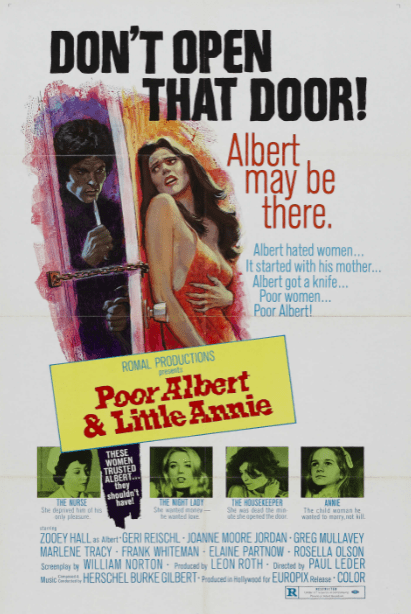
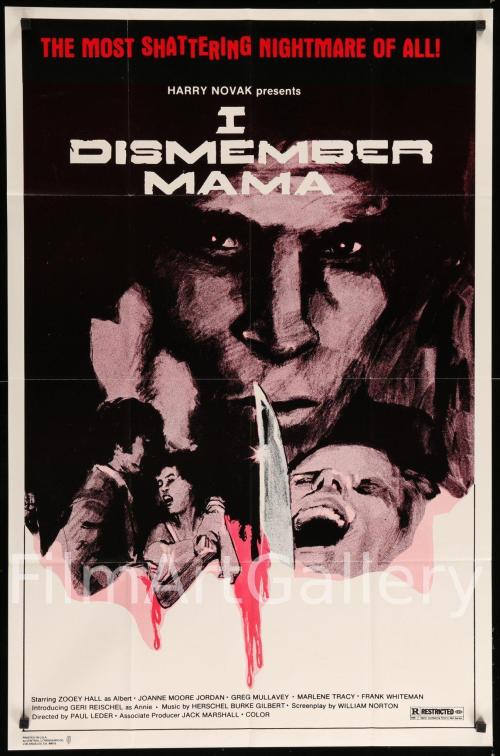
I Dismember Mama (1972)

By Richard Winters

My Rating: 1 out of 10

4-Word Review: He only likes virgins.

Albert (Zooey Hall) hates his rich mother (Joanne Moore Jordan) and at one point attempted to kill her, which got him institutionalized, but he manages to escape and is now back on the streets attempting to kill her once again. When he arrives at his old residence he meets Alice (Marlene Tracy) who’s now working as his mother’s maid. He promptly kills her, but then Alice’s 11-year-old daughter Annie (Geri Reischl) arrives asking for her. Albert is immediately taken in with the child’s innocence and purity and becomes determined to ‘save her’ from the jaded world around them. He concocts a story that her mother suddenly got sick and had to go to the hospital, so the two spend the day frolicking around at a park and later take part in a mock wedding, but by nightfall Albert’s dark urges return and this time his target is Annie.

This is yet another example of an underground 70’s exploitation flick that promises to deliver shocks via its provocative storyline, but ultimately has hardly any. The pacing is poor and filled with talky scenes that get extended far longer than they should. The dialogue lacks bite and there needed to be more action. For instance Albert’s attacking his mother should’ve been shown possibly as a flashback and not just talked about in passing. Albert’s overpowering of a hospital attendant (James Tartan) in order to escape from the institution doesn’t get shown either we just see the guard’s dead body after the carnage is over while in-between we get treated to a long extended conversation between Albert’s mother and his psychiatrist (Frank Whiteman), which is both boring and pointless.

Hall is poor in the lead and unable to convey more than one facial expression or voice tone. I didn’t like the way Reischl’s character gets written either as she’s portrayed as being too innocent and naïve. Sure kids will be more sheltered to real-world horrors than adults, but they’re not stupid and have a fear instinct like anyone else. When a creepy guy unexpectedly answers the door the warning flags would be going off for any typical 11-year-old, which was the age she was when this was filmed, and her character should’ve, and most likely would’ve been in reality, far more defensive and cautious.

I was also confused why Reischl, who is better known as being the ‘fake Jan’ who replaced Eve Plumb in the short-lived ‘The Brady Bunch Variety Hour’, got listed in the credits under the title of being ‘introduced’ like she was brand new to the film scene when she really wasn’t as she had already appeared in another horror flick The Brotherhood of Satan, which had been filmed in 1969 and released to theaters a full year before this one.

When I first watched this movie back in the summer of 1987 it had what I considered at the time one of the dumbest segments I had ever seen. It features Albert walking into a pool hall eyeing an attractive woman (Rosella Olsen) and telling her how rich he is, which is enough to get her to dump the boyfriend (Robert Christopher) she is out on a date with and immediately jump into Albert’s arms, which to me was just to heavy-handed to believe. (If picking up women could only be this easy.)However, after seeing it a second time I now consider this as attempted satire, but the segment should’ve had  a better payoff. Instead of the jilted boyfriend later crying over her dead body, after Albert had killed her, he should’ve laughed and considered it ‘sweet revenge’ for her having publicly dumped him in humiliating fashion earlier.

The film has come under attack by some for its perceived pedophilia storyline. Critic John Kenneth Muir in his review stated that watching it made him ‘feel dirty’ and the pedophilia theme ‘went too far’ for a film that had ‘no aspirations to be anything but entertainment’. Personally I found this take to be virtue signaling and disagree with it on several points.

First I don’t think this was ever meant to be ‘entertainment’. Instead it was intended like a lot of other underground flicks at that time to shock and appall and then bank on the morbid curiosity of people to fill the theater seats simply to see ‘what all the fuss is about’.

Most importantly I don’t think Albert initially saw Alice as a sexual conquest, but more as someone he wanted to protect from the awful world around them. He wanted to save her innocence instead of taking it away. Yes, it’s true there is a scene when she is sleeping in a hotel room and he starts to have impulses to deflower her, but he fights them off and then goes out to a bar where he attacks another woman who is well over 18. The perceived pedophilia theme lasts for only a couple of minutes and really doesn’t take up the bulk of the runtime like some critics seem to think it does, or want you to believe.

My Rating: 1 out of 10

Alternate Title: Poor Albert & Little Annie

Released: April 1, 1972

Runtime: 1 Hour 25 Minutes

Rated R

Director: Paul Leder

Studio: Valiant International Pictures

Available: DVD

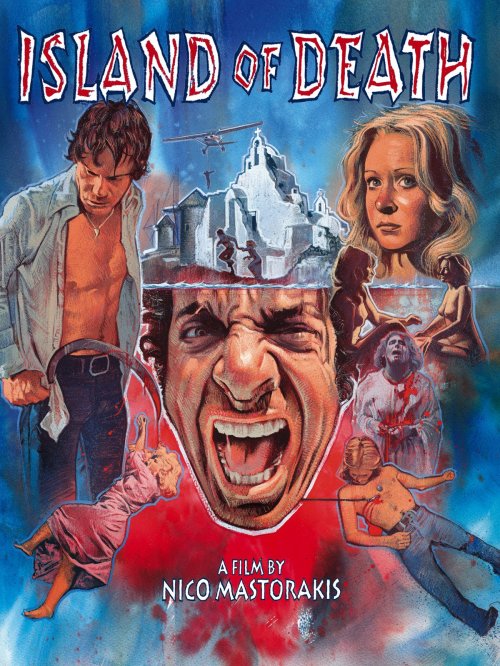
Island of Death (1976)

By Richard Winters

My Rating: 6 out of 10

4-Word Review: Couple on killing spree.

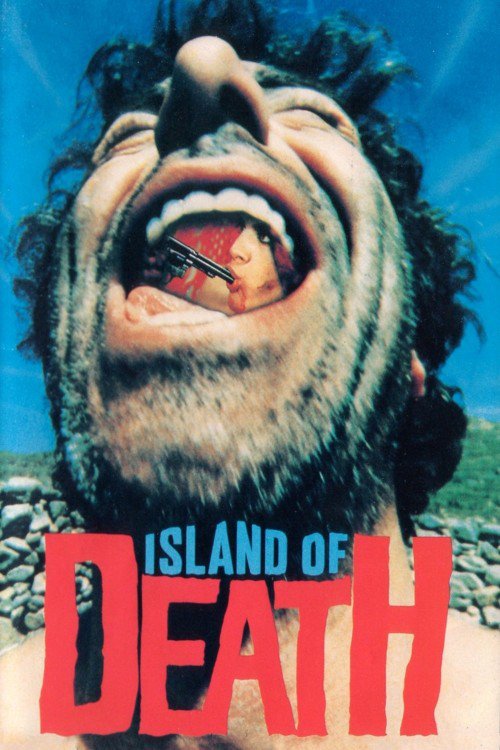
Christopher and Celia (Robert Behling, Jane Lyle) seem like a nice young couple just looking  for a little vacation as they travel to a Greek island. Yet once there they begin killing anyone who they deem ‘perverted’. First it’s a man who makes a pass a Celia, then it’s a gay couple, and a bartender who’s outed as a lesbian. Not only do Christopher and Celia kill their victims with glee, but they also enjoy taking pictures of the carnage, so that Christopher can use them for sexual arousal later.

In 1974 Nico Mastorakis, who at that time was working as an investigative journalist and before that was a popular radio DJ, became impressed with The Texas Chainsaw Massacre, and the amount of money it brought in. He was convinced that making exploitation flicks was a profitable venture and proceeded to create a film that would be as shocking as possible simply for the money benefits it would bring in. The film has certainly achieved a strong cult status and has been one of the most widely banned films in the world.

While its reputation is quite notorious I actually found the violence to be nothing special. There’s one segment where a man gets his hands nailed to a cement ground, which is pretty nasty and the killing of a baby goat, which Christopher then proceeds to have sex with is quite disturbing too, but everything else, at least gore-wise, is run-of-the-mill. The one segment that did get a bit difficult to watch simply because it gets more prolonged than the other killings and therefore makes it seem more real was when Christopher tries to force the lesbian bartender (Janncie McConnell) to swallow a bottle of hard liquor, which she repeatedly chokes on.

On the perversity level the film still scores strongly even after all these years. One of it’s more outlandish moments is when Christopher gives an unexpected golden shower to a 60-year-old woman (Jessica Dublin) who at first reacts in disgust, but then eventually gets into it. The real shocker though for me was the final twist, which I hadn’t seen coming and as jaded as I’ve become with years of watching these underground 70’s flicks, had my mouth agape.

Mastorakis shows good command with solid pacing and a script that continuously reveals many sick twists as it goes. The slow start works in its favor as it creates a romantic feel, especially with its sweet sounding score and picturesque backdrop of Mykonos, which allows for the viewer to let down their guard and then when the shocks gets going it makes it even more emotionally horrific. I also enjoyed Mastorakis use of the hand-held camera and wide angle lens something that only came into vogue many decades later.

Overall I commend the production for going all in. Too many other horror flicks, especially from the 70’s, promised exploitation, but ultimately  delivered little. It seemed like despite their provocative storylines they would end up chickening-out, so it’s nice to see one hyper-focused to truly push the envelope. Obviously this won’t be everyone’s cup-of- tea many, but if you’re compelled to make a truly underground feature then alienating some viewers is a prerequisite.

My Rating: 6 out of 10

Released: October 13, 1976

Runtime: 1 Hour 48 Minutes

Not Rated

Director: Nico Mastorakis

Studio: Omega Pictures

Available: DVD, Blu-ray, Amazon Video, YouTube

Long Weekend (1978)

By Richard Winters

My Rating: 7 out of 10

4-Word Review:  A couple battles nature.

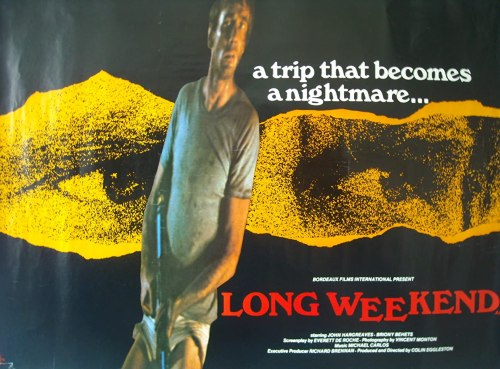
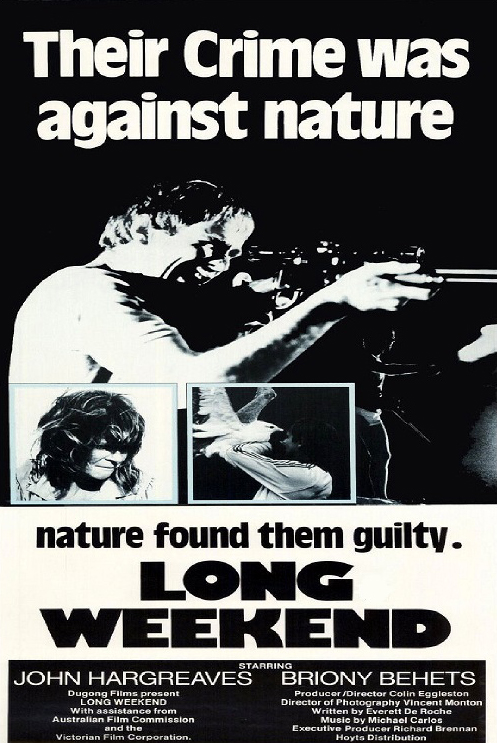
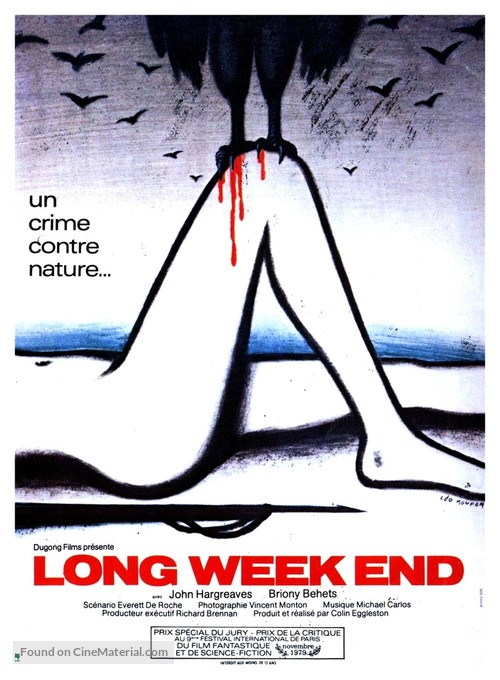
Peter (John Hargreaves) and Marcia (Briony Behets) are a young couple who are constantly at odds with each other. To help smooth things over they decide to take a trip into the wilderness and enjoy the beauty of the outdoors. Along the way they accidently hit and kill a kangaroo with their vehicle. This sets off a chain-of-events that puts them under the increasing attack of various animals. First Peter must fight off an angry eagle who swoops down at him without warning. Then a possum and even a sea cow who stalks Peter while he is swimming. The two decide they must leave the area in order to save their lives, but everywhere they turn there’s another animal waiting for them.

The story idea is certainly an interesting one, but the concept is too wide-open. Scriptwriter Everett De Roche stated that the premise was all about how Mother Earth had her own auto- immune system and when humans started acting like cancer cells she’d attack, which is great, but why just this couple? There are millions of people who behave just like them, so why don’t they end up getting the same treatment?

The plot needed an extra spin to hold it all together, but it never comes. Having this small remote place hold a mystical power that allowed animals to behave differently than they would normally do elsewhere would’ve at least given it some needed focus. Perhaps a backstory too where other people would’ve gone to this same locale and complained about being attacked. Any extra plotline would’ve helped because the idea that these animals would just randomly attack a generic couple in some isolated moment in time that they never did before or after just doesn’t cut-it.

I didn’t like either that the couple bicker right away, but then later on become lovey-dovey only to proceed back to bickering, which is too bipolar. A better approach would’ve had them getting along at the start and then with the stress of the animal attacks tear their relationship apart, which would’ve created a more interesting character arc, which otherwise is non-existent.

I would’ve preferred that the lead characters been played by macho men who arrogantly tear up the wilderness with their SUV’s and kill the animals for shameless sport. Watching these ‘tough guys’ then unravel once the animals went on the offense turning them into sniveling, frightened cowards would’ve been far more of an entertaining payoff while hitting-home the importance to respect nature  in a more stark way.

The animal attacks aren’t all that riveting and take up very little of the runtime, but the creepy atmosphere is amazing. Filmed on the island of Tasmania I enjoyed the point-of-view shots of the SUV driving through the long, tangled unique looking trees that grow down there where when captured at night and through the beams of the vehicle’s headlights come off looking like gnarled fingers protruding from the ground. The intense music and haunting call of the sea cow are also quite unsettling and get even more so as the couple continues to hear it, which helps to make this a memorable horror flick despite the few drawbacks and a great example at how strong directing can help overcome a flat script. Remade in 2008.

My Rating: 7 out of 10

Released: October 2, 1978

Runtime: 1 Hour 35 Minutes

Not Rated

Director: Colin Eggleston

Studio: Hoyts Distribution

Available: DVD, Blu-ray (Spanish), Amazon Video, YouTube

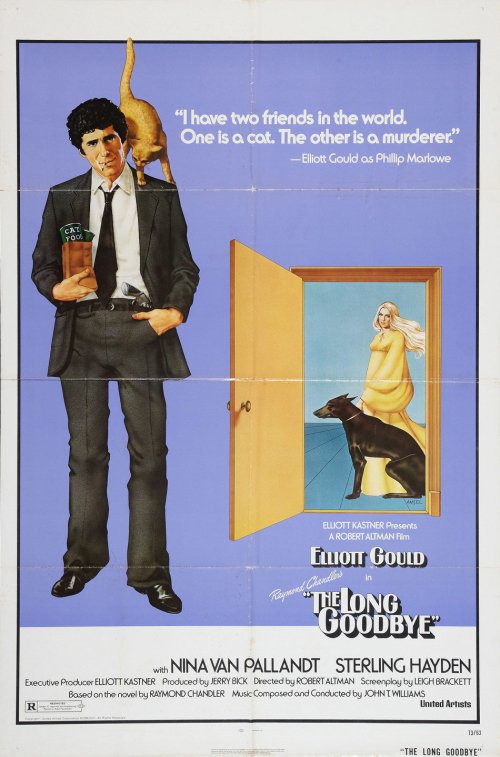
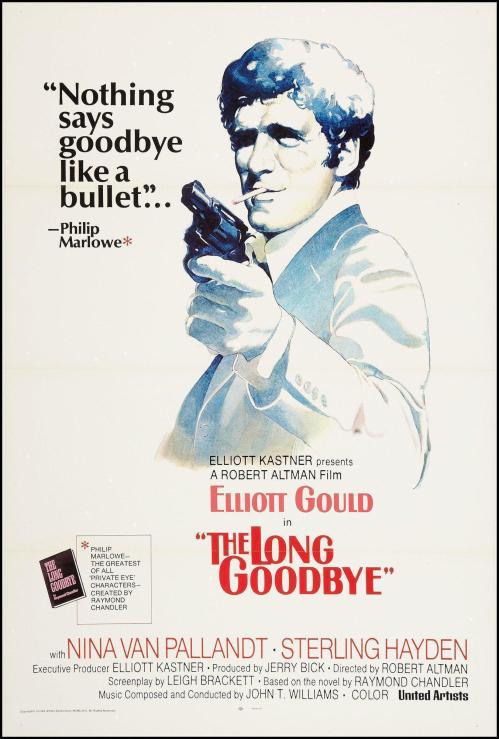
The Long Goodbye (1973)

By Richard Winters

My Rating: 7 out of 10

4-Word Review: His cat is hungry.

One night detective Phillip Marlowe (Elliot Gould) is visited in his home by his long time pal Terry Lennox (Jim Boulton), who informs Marlowe that he’s had a fight with his wife and asks him if he can have a ride to the Mexican border, which he obliges. When he returns home he is met by two cops (Jerry Jones, John S. Davies) who bring him into the station with questions about the whereabouts of Lennox whom they insist has just killed his wife. When Marlowe refuses to divulge anything he gets put into jail only to released 3-days later when it’s reported that Lennox has killed himself. Marlowe becomes suspicious about the suicide and determined to do his own investigation while also getting involved with Eileen Wade (Nina van Pallandt) and her alcoholic, writer husband Roger (Sterling Hayden) both of whom may hold the secret to Lennox and what really happened.

By the early 70’s only two of Raymond Chandler’s novels had yet to be filmed, this one and ‘Playback’. United Artists agreed to finance the film and commissioned Leigh Brackett, who had been the screenwriter for another Chandler novel turned into a movie 1946’s The Big Sleep, to write the screenplay for this one. Robert Altman was later approached to direct it and while he was not a fan of the Phillip Marlowe character, whom he labeled as being a ‘loser’, he agreed to take on the project due to the unexpected ending, which had not been in the novel, but that Brackett had added into the screenplay.

While Altman may have seemed an odd choice, he never even read the source novel of which the film is based, the eccentric little sidelights that he adds into the proceedings make it worth it. Some of the movies that he did towards the late 70’s became a bit too undisciplined where his films would go off on tangents with stuff that had very little to do with the main plot, but here the story is strong, so the little detours that Altman adds in helped to playfully accentuate the plot instead of drowning it out.

Some of my favorite Altmanisms included  Marlowe looking for food to feed his hungry cat, who I might add for an animal gives a spectacular performance, and how a stocker that he meets at the grocery store while searching for cat food he ends up meeting again at random at the police station. The next door female nudists, who are also into yoga and attract the attention of both the police and the bad guys who come to Marlowe’s place, are fun too.

There’s some marvelous framing by cinematographer Vilmos Zsigmond including capturing Roger and Eileen having an argument inside their home, which was filmed at Altman’s Malibu residence, through a glass patio door while at the same time in the reflection you see Gould walking along the beech. Later while Eileen and Marlowe are having a conversation by an open window you can see in a distance, which the other two are unaware of, Roger walking into the ocean in an attempt to kill himself.

Spoiler Alert!

The film also features what I feel is one of the most shocking and disturbing scenes that I’ve ever seen put into a movie and that’s a statement that I don’t use lightly. I’ve seen hundreds of gory horror films, but what happens here I’ve found far more unsettling. I think the reason is because it’s completely unexpected as it features the character played by film director Mark Rydell smashing a glass coke bottle onto the face of his girlfriend who just seconds earlier he had stated that he was deeply in-love with. Hearing her scream out in unending pain while cupping her hands over her face as blood spews out makes it come-off as very real. Even more amazing is that the part of the girlfriend was played by an amateur named Jo Ann Brody who never appeared in any other film and was a waitress that Altman and Brackett met when they went out to dinner while working on the script and who they asked on-the-spot if she’d like to be in their movie.

Altman admitted that he knew this violent scene, which had not been in the book, would upset some fans, but he felt it was important to bring the viewer back to the reality that these were violent characters at heart. This could also be seen as a foreshadowing to the surprise ending when Marlowe finds Lennox still alive in Mexico and then unexpectedly shoots him. In the novel Marlowe allows Lennox to walk away unharmed, but Altman liked the violent twist.

Personally I was ambivalent with the ending here and might actually have preferred the way it was done in the book. My main issue though with it is that Eileen spots Marlowe leaving the place where Lennox was just shot and since she was in a relationship with Lennox and also had strong criminal connections I’d think she’d end up, one way or another, going after Marlowe once she realized he had killed her lover causing the ending to leave open too many potentially interesting tangents that should’ve been followed through on.

My Rating: 7 out of 10

Released: March 7, 1973

Runtime: 1 Hour 52 Minutes

Rated R

Director: Robert Altman

Studio: United Artists

Available: DVD, Blu-ray, Amazon Video