Category Archives: Cold Climate/Wintertime Movies

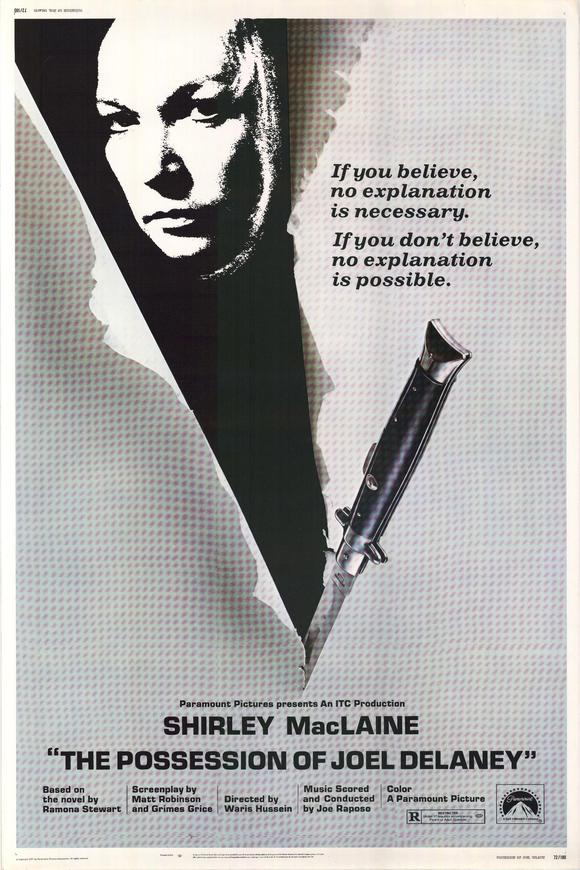
The Possession of Joel Delaney (1972)

the possession of joel delaney

By Richard Winters

My Rating: 7 out of 10

4-Word Review: Possessed by his friend.

Norah (Shirley MacLaine) is a divorced mother of two living in a well-off neighborhood of New York that is also keeping a watchful eye on her younger brother Joel (Perry King). He is a recent college grad returned from an overseas stay and still looking to find his way in the world. He lives in a poorer section of town and does so to keep a distance between he and his sister who he feels has domineering traits like his now deceased mother. As things progress he begins to show odd, frightening behaviors that at times turn violent and when conventional therapy doesn’t help Norah turns to a Puerto Rican witch doctor that is convinced that Joel is possessed.

What makes this film so intriguing is that it has far more layers than a typical horror film and its most interesting aspect isn’t the occult at all, but instead the vivid look at New York’s contrasting socio-economic and cultural make-up. It shows how buffered the rich are from the poverty stricken areas of the city and how completely helpless they become when thrown into that environment. In fact Norah’s most frightening moments are when she is taken out of the safety zone of her pampered lifestyle than in dealing with the possession of her brother.

MacLaine’s character is not too likable, but this ends up being a positive. Her exchange with a clerk at a mental hospital when she expects to receive preferential treatment is amusing as is her obliviousness to her surroundings when she walks into a rundown tenement building wearing a gaudy fur hat and coat only to later finally get the sense to take it off when walking down the street of a tough neighborhood.

King is perfect choice for the role as his clear blue eyes give off a naturally creepy look and his moments of possession are some of the most unnerving parts of the film although I would have liked more time to have been given showing him in more of a normal state. His relationship with his sister also exposes an underlying sexual theme that never gets sufficiently explored

Although the terror is more cerebral it still has some choice moments including a shot of a decapitated head of a woman hung over her nude body as well as Maclaine’s extremely odd reaction to it. The ritual involving the attempted removal of the dead soul from Joel’s body has a nice cinema vertite flair and when the man lights some kerosene on the floor and steps in it with his bare feet it looks genuine and not staged. The climatic sequence that takes place in a remote beach house is intense and includes the controversial scene showing a young boy being forced to strip as well as a young girl having to eat dog food from a dog dish that was excised from many prints, but intact on the Legend Films DVD release. There is also a cool twist that occurs at the very, very end.

My Rating: 7 out of 10

Released: May 24, 1972

Runtime: 1Hour 45Minutes

Rated R

Director: Waris Hussein

Studio: Paramount

Available: DVD

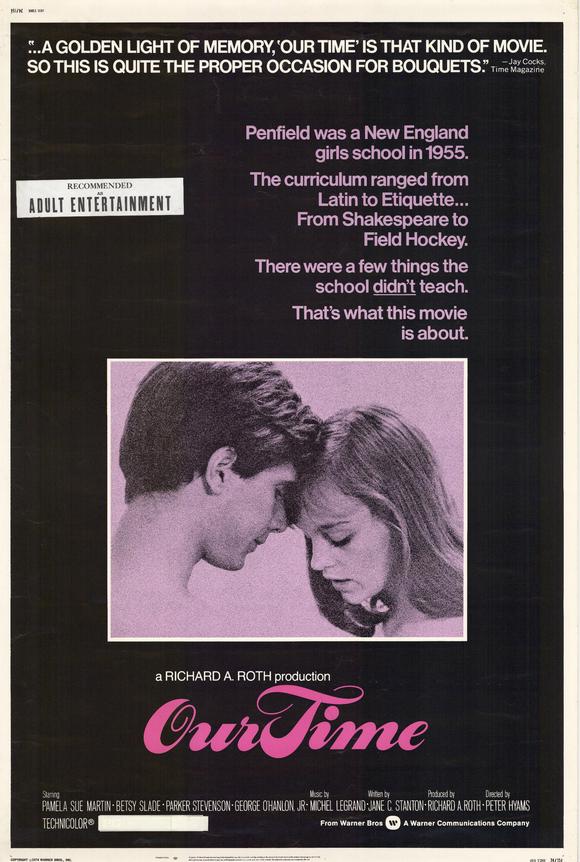
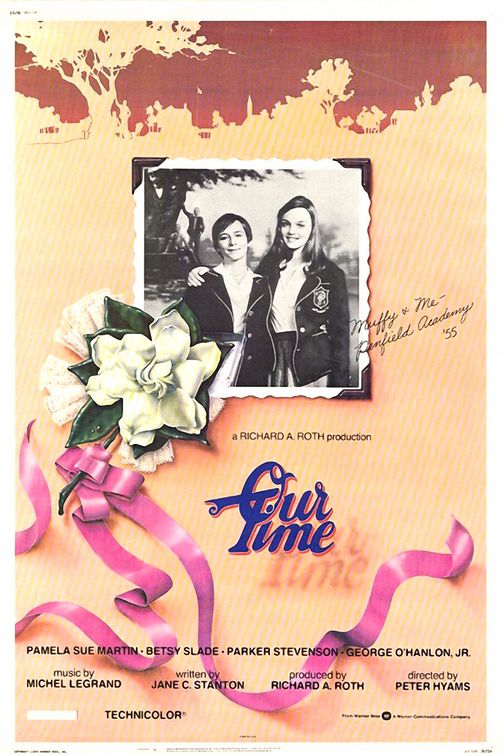
Our Time (1974)

our time 2

By Richard Winters

My Rating: 6 out of 10

4-Word Review: She gets an abortion.

Abby (Pamela Sue Martin) and Muffy (Betsy Slade) are two teen girls and the best of friends that are attending a New England all-girls school during the 50’s. Abby is in love with Michael (Parker Stevenson) and the two sneak off one weekend and consummate their relationship, which makes Muffy jealous. She is not as pretty as Abby and has a hard time getting boyfriends, but decides one night during a Christmas party to have sex with Malcolm (George O’Hanlon Jr.) in the backseat of a car simply to feel what it is like. Their experience isn’t as enjoyable, but Muffy becomes pregnant anyways and the four then spend the rest of the time looking for an underground abortionist to terminate her pregnancy.

On the technical end the film is slick. I particularly liked the opening tracking shot that takes place in a church. The camera starts at the front of the church showing a close-up of the headmaster singing with the choir and then pulls back down the side aisle to show Abby sneaking in late and then goes back up the middle aisle as she looks for a seat. In fact just about every scene features some form of a tracking shot, which may get a little overdone, but helps give the film a certain visual liveliness. Unlike Leonard Maltin who in his book described the color photography as being ‘bad’, I found it to be quite vivid with a nice soft focus lens that gives it a nostalgic-like appeal.

The story itself is predictable, but I enjoyed the sometimes humorous takes of the sexual repressive, stifling attitude of the era and how the students were made to feel like they were being watched and monitored at every second. Abby’s and Michael’s sexual encounter inside a hotel room is quite amusing, but the one done later on between Muffy and Malcolm is painful to watch and not very realistic, looking more like two clothed bodies on top of each other without much effort to simulate the sexual motions.

Martin is excellent in the lead and ironically starred just two years earlier in a similar film about a young unwed woman looking for an abortionist entitled To Find a Man. Stevenson, who later co-starred with Martin in ‘The Hardy Boys/Nancy Drew Mysteries’ TV-show looks like he is barely past puberty. Jerry Hardin, Cliff Emmich, Robert Walden and Debralee Scott can all be seen in brief bits. This is also the only other film appearance of Karen Balkin, who played the bratty student in The Children’s Hour and plays a similar type of character here.

The only issue I had with the film is with the abortion segment. Overall, from a purely dramatic level I felt these scenes were compelling and the best moments in the movie, but it seemed unrealistic especially from a 1950’s perspective that none of the four would try to convince Muffy to keep the baby. It almost comes off like these are 70’s teens with more modern sensibilities that were transplanted into a different time period than actual characters from a bygone era. The plot also becomes more like a political statement than a story and seems to lean too heavily on a liberal point-of-view.

our time 3

My Rating: 6 out of 10

Released: April 10, 1974

Runtime: 1Hour 30Minutes

Rated PG

Director: Peter Hyams

Studio: Warner Brothers

Available: DVD (Warner Archive)

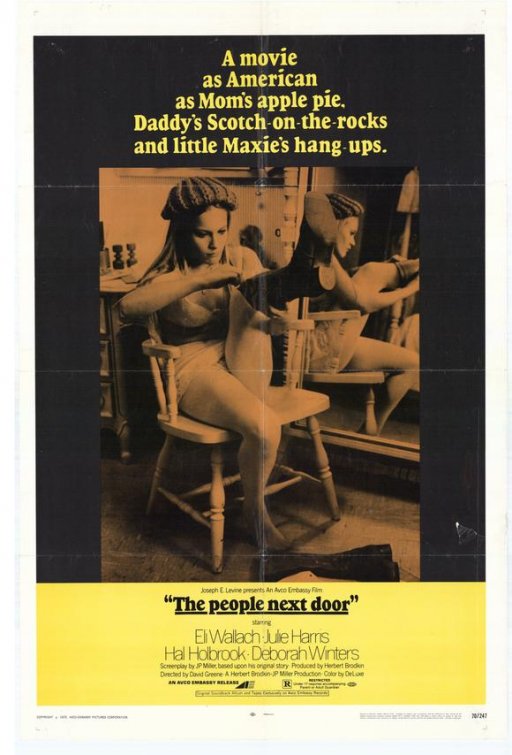
The People Next Door (1970)

the people next door 1

By Richard Winters

My Rating: 7 out of 10

4-Word Review: Daughter is on drugs.

Arthur and Gerrie Mason (Eli Wallach, Julie Harris) are a middle-aged couple living the comfortable suburban existence, which comes tumbling apart in a matter of only a few short weeks. It starts when their daughter Maxie (Deborah Winters) dabbles in acid and is sent to a mental institution. Acrimony and in-fighting commence and even with family counseling nothing helps. As both Maxie’s and Gerrie’s mental condition deteriorates it seems like their family unit is doomed while their neighbors David and Tina Hoffman (Hal Holbrook, Cloris Leachman) have issues of their own including the shock at finding out that their son Sandy (Don Scardino) is a drug dealer and was the one that gave Maxie the acid that sent things spiraling out-of-control.

There were many movies about the drug culture made during the 60’s and 70’s and many of them weren’t very good, but this one I have always liked. It is not that it doesn’t have its share of flaws like the others although not as many, but it is the performance by Winters (no relation) that knocks this to a whole new level.  Although only 17 at the time she exudes an amazing amount of composure and tackles some difficult scenes with ease and naturalism. Her blue eyes penetrate the screen, which director David Greene takes full advantage of especially during her acid trips, which get pretty freaky.

Two scenes of hers in particular really stand out and are worth catching. One is where she takes some acid and then strips off all of her clothes and goes running outside in the nude through the snow banks of their suburban neighborhood while singing and dancing to some strange song. Another is when she runs away from home and Wallach tracks her down living in squalor in a seedy, rundown apartment building with her boyfriend. When Wallach finds her she hops out of bed stark naked and walks over to him and plants him a deep kiss, which makes him violently slap her to the ground.

There are a few other interesting moments including one that takes place during a group counseling session where a young man of 20 named Wally (played by Matthew Cowles who later went on to marry actress Christine Baranski) berates in front of everyone his elderly parents who had him at a late age and he now finds them to be too old and embarrassing. The scene where David and Tina confront their son late at night about his drug dealing is also compelling.

The script by J.P. Miller has some emotionally high moments and hits on the issues of family strife head-on in a way that I felt is still impactful and relevant. Some critics argued that because Miller and director Greene were already 50 at the time that they were ‘out-of-touch’ with the youth generation, which to some extent may be valid, but the drama itself is strong and in the end that is what counts.

The only weak link is that of Wallach and Harris two very good actors who become wasted here. Both are locked in caricatures that are too broad and rigid and at times turn the thing into a heavy-handed soap opera. The correlation to the fact that while the daughter takes drugs they continue to smoke and drink becomes a bit too obvious and overplayed.

The story was originally made as a TV-movie that was broadcast on October 15, 1968 on CBS. Winters, Scardino as well as Nehemiah Persoff who plays the doctor at the institution play the same roles on that one that they do here. Lloyd Bridges and Kim Hunter played Winters’ parents and Fritz Weaver and Phyllis Newman were the Hoffman’s.

the people next door 2

My Rating: 7 out of 10

Released: August 26, 1970

Runtime: 1Hour 33Minutes

Rated R

Director: David Greene

Studio: AVCO Embassy Pictures

Available: None at this time.

Cocktail (1988)

cocktail

By Richard Winters

My Rating: 4 out of 10

4-Word Review: Chasing the American dream.

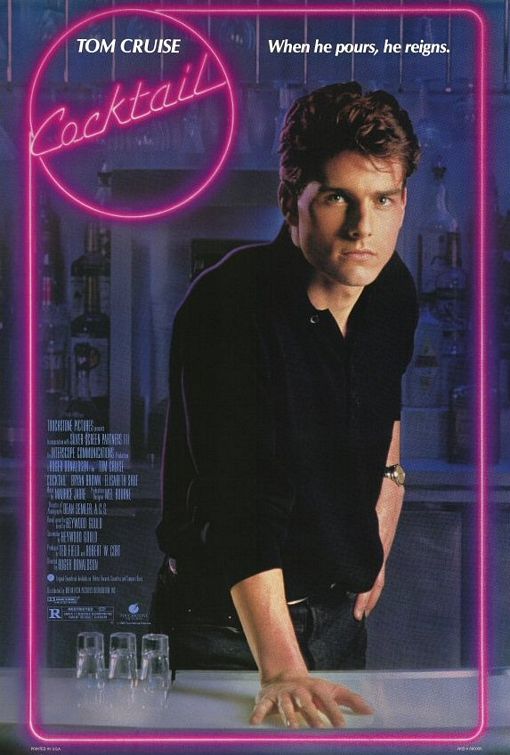
Brian Flanagan (Tom Cruise) is an ambitious young man looking to somehow make it big in the business world. He reads all sorts of books detailing strategies to become rich, but finds that without a college degree his options are limited. After numerous rejections he finally gets a job as a bartender where he becomes friends with Doug (Bryan Brown). The two make a good team behind the counter and get promoted to a ritzy nightclub, but they end up having a falling out and Brian starts up a bar in Jamaica as well as a romance with Jordan (Elisabeth Shue) only to have Doug reappear years later with a tempting job offer that Brian isn’t so sure he can refuse.

Although Cruise is engaging and does quite well in the role I couldn’t help but feel that he has played this same type of cocky, ambitious type of character in just about all the movies that he has been in. It would be nice to see him play some sort of timid, shy introvert once just to prove that he has some actual acting range.

Brown is good in support and I liked their contrasting ages. Shue is always beautiful and solid and Kelly Lynch who plays Doug’s wife Kerry gets points simply for looking really hot in a thong bikini.

The story has a great start and I thoroughly enjoyed the first half. I’ve worked as a bartender and felt that the film captures both the bar and club atmosphere accurately as well as the hectic demands of the position. In fact the on-location shooting is splendid both in the scenes done in New York as well as the islands and the interior and exterior backdrops give the film a nice added texture.

There are also some really amusing scenes here including Brian’s many futile job interviews and his dealings with an arrogant college professor that is played perfectly on cue by the late Paul Benedict. I had high hopes for the film and felt it had a great foundation for a modern day rags-to-riches story, which is where it should’ve stayed. Unfortunately the second half devolves too much into the romantic and relationship angle. To some degree I went with it, but it ends up taking over the whole plot making it generic and losing the nice gritty edge that it had at the beginning. The final thirty minutes are filled with a lot of over-the-top dramatic twists that turns the whole things into a corny soap opera that ultimately overshadows the good points.

My Rating: 4 out of 10

Released: July 29, 1988

Runtime: 1Hour 44Minutes

Rated R

Director: Roger Donaldson

Studio: Buena Vista Pictures

Available: VHS, DVD, Blu-ray, Amazon Instant Video

The First Deadly Sin (1980)

the first deadly sin

By Richard Winters

My Rating: 4 out of 10

4-Word Review: Aging cop tracks killer.

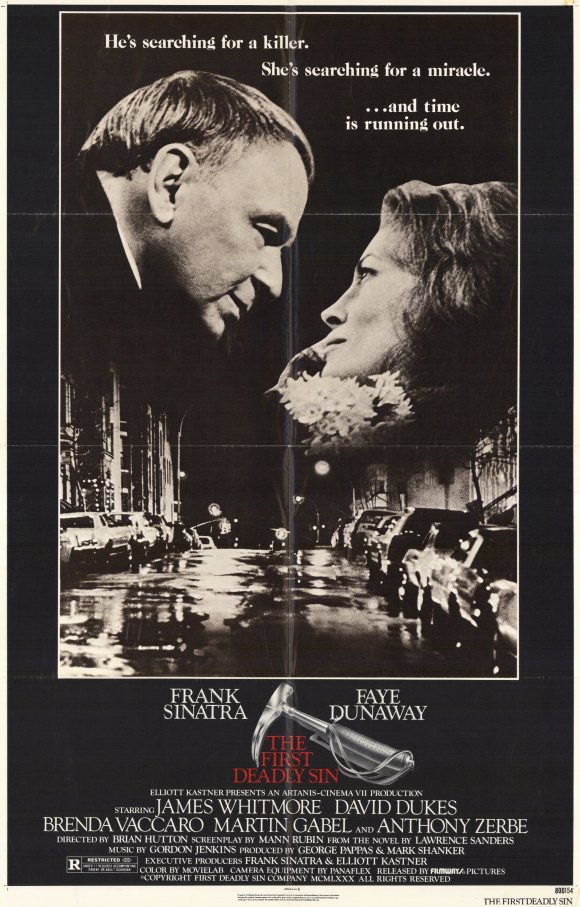
Based on the best-selling novel by Lawrence Sanders the story centers around Edward Delaney (Frank Sinatra) a cop only weeks away from retiring who becomes obsessed with tracking down a serial killer who hits people on the back of their heads with a sharp edge hammer as they are walking down the street. The problem is he has only a few clues to go on and his wife Barbara (Faye Dunaway) is in the hospital suffering from a mysterious illness that causes him additional stress and strain.

The film takes a refreshingly different approach to police work than what you will usually find in most Hollywood cop pictures. Instead of emphasizing exciting car chases and thrilling shoot-outs it instead analyzes the meticulous and often times tedious work that goes into following up every little lead while working inside a rigid system and under superiors that aren’t always supportive.  For the most part this is done quite well and at times it is even enlightening, but the whole first half is spent with Delaney trying to figure out what type of weapon was used in the killing even though we the viewer know what it is since we are shown the actual murder at the very beginning thus making the first hour seem quite derivative.

Having the film cut back and forth between scenes of Delaney and the killer doesn’t work. The psycho is played by David Dukes probably best known for playing the man who tries to rape Edith Bunker in a classic episode of ‘All in the Family’. He is a good actor, but scenes showing him alone are clichéd and at times even unintentionally funny. Director Brian G. Hutton should’ve cut them out completely as having the viewer come to realize who it is along with Delaney would have deepened the mystery angle and made it overall more intriguing.

The scenes with the sick wife don’t work either. For one thing we never find out what the mysterious illness is, which is highly frustrating and annoying. It also doesn’t make the plot or character any more interesting. Dunaway is a superior actress and she makes the most of the role’s limitations, but I felt an actress who was more Sinatra’s age would have made it more realistic instead of casting a woman who was 27 years younger.

I have always enjoyed Sinatra in his detective roles, but the character here isn’t as caustic as in some of his older films. For the most part he is pretty benign and even kind of boring. Joe Spinnell though makes the most of his bit part as an overzealous doorman who believes in rigidly following the rules and taking great pride in his doorman duties, but quickly willing to bend them the minute he is given some bribe money.

The final showdown between Delaney and the killer is quite unusual and much more low-key than you might expect. I enjoyed the twist that comes with it, but it lacks a strong impact and the film would have been better served had it had just a little more action.

This movie is also famous as being Bruce Willis’s film debut. He can be seen at the 1Hour 34Minute mark coming into a bar as Delaney walks out. He has a cap over his head and covering his eyes, but you can clearly see just by looking at his mouth that it is him.

My Rating: 4 out of 10

Released: October 3, 1980

Runtime: 1Hour 52Minutes

Rated R

Director: Brian G. Hutton

Studio: Filmways Production

Available: DVD, Amazon Instant Video

Ginger in the Morning (1974)

ginger in the morning

By Richard Winters

My Rating: 5 out of 10

4-Word Review: Older man/younger woman.

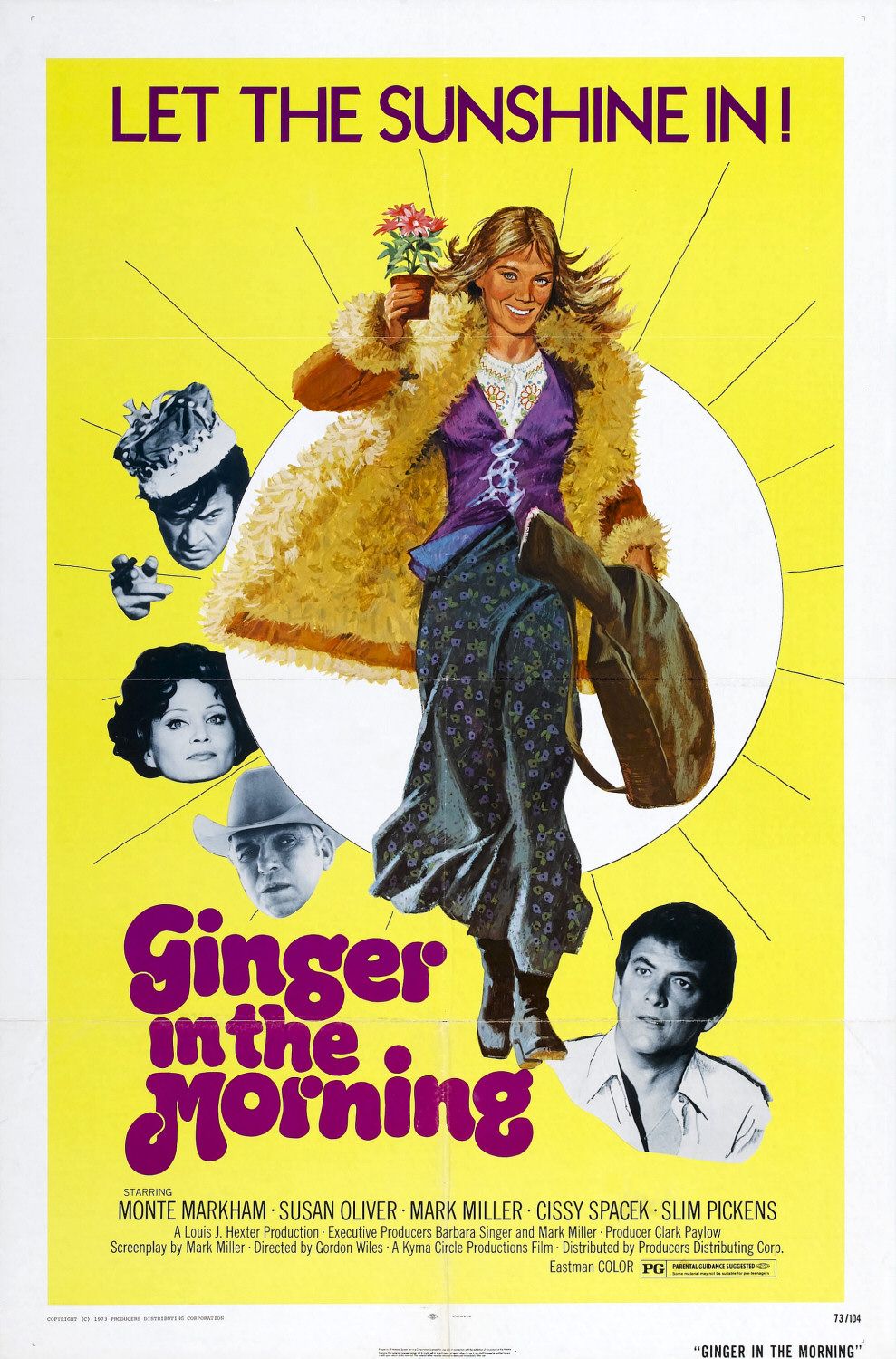
Joe is a middle-aged, recently divorced man trying to stumble his way back into the single scene. He passes by Ginger (Sissy Spacek) who is hitchhiking alongside a roadway and decides to pick her up. He is attracted to her youthful carefreeness and hopes to take advantage of her ‘free-love’ hippie attitude by bringing her back to his place for some quick easy sex. However, Ginger is secretly pregnant and looks at Joe’s maturity as a good father-figure for her child, which Joe is not ready for. Charlie (Mark Miller) is Joe’s best friend who along with his wife Sugar (Susan Oliver) barrages in and disrupts everything.

The story starts out okay with the budding relationship between the two leads and their attempts to try to get beyond the generation gap I found to be appealing. The film though shifts gears in jarring fashion by allowing Charlie and Sugar to enter into it and then gets even further away from the main theme by having the third act dealing with the male bonding between Charlie and Joe. It is only at the very end that it gets back to the romantic concept, but the whole thing ends up coming off like three movies crammed into one. All three story threads are weak and better suited for an episode of ‘Love American Style’ than a feature film.

Screenwriter Miller casts himself as Charlie who is obnoxious and dumb and given too much screen-time. Blonde actress Oliver wears a black wig that looks hideous and their incessant bickering is contrived and the cutesy way they magically make-up at the end is strained.

Markham who has been acting consistently since 1966 and remains busy even today, but has never achieved stardom is okay in a rare leading film role. His character of a middle-aged man trying to ‘connect’ with the much younger Ginger by making broad assumptions about her generation is quite relatable. Spacek though comes off best out of all of them. Her character seems like a real person while the rest are caricatures and her twangy Texas accent fits the part. She even sings the film’s theme song, which isn’t bad.

Character actor David Doyle can be seen at the beginning as a yapping man who gives Joe the ‘finer points’ of picking up women and one-night-stands. Slim Pickens is essentially wasted as the town’s sheriff, but he manages to make the most of the few scenes that he is in.

The use of a hard spotlight gives the production a cheap, low budget look and some soft lighting would have created a better mood and artistic design. There is also a boom mike that can be seen for several minutes in one scene. Yet despite the film’s amateurish look I still liked its unpretentious quality as well as the cute climatic sequence that takes place on a bus, which propelled me to give this thing a rather generous 5 rating.

My Rating: 5 out of 10

Released: July 17, 1974

Runtime: 1Hour 34Minutes

Rated PG

Director: Gordon Wiles

Studio: Kyma-Circle

Available: VHS, DVD, Amazon Instant Video

The Night of the Generals (1967)

night of the generals

By Richard Winters

My Rating: 5 out of 10

4-Word Review: A general kills prostitutes.

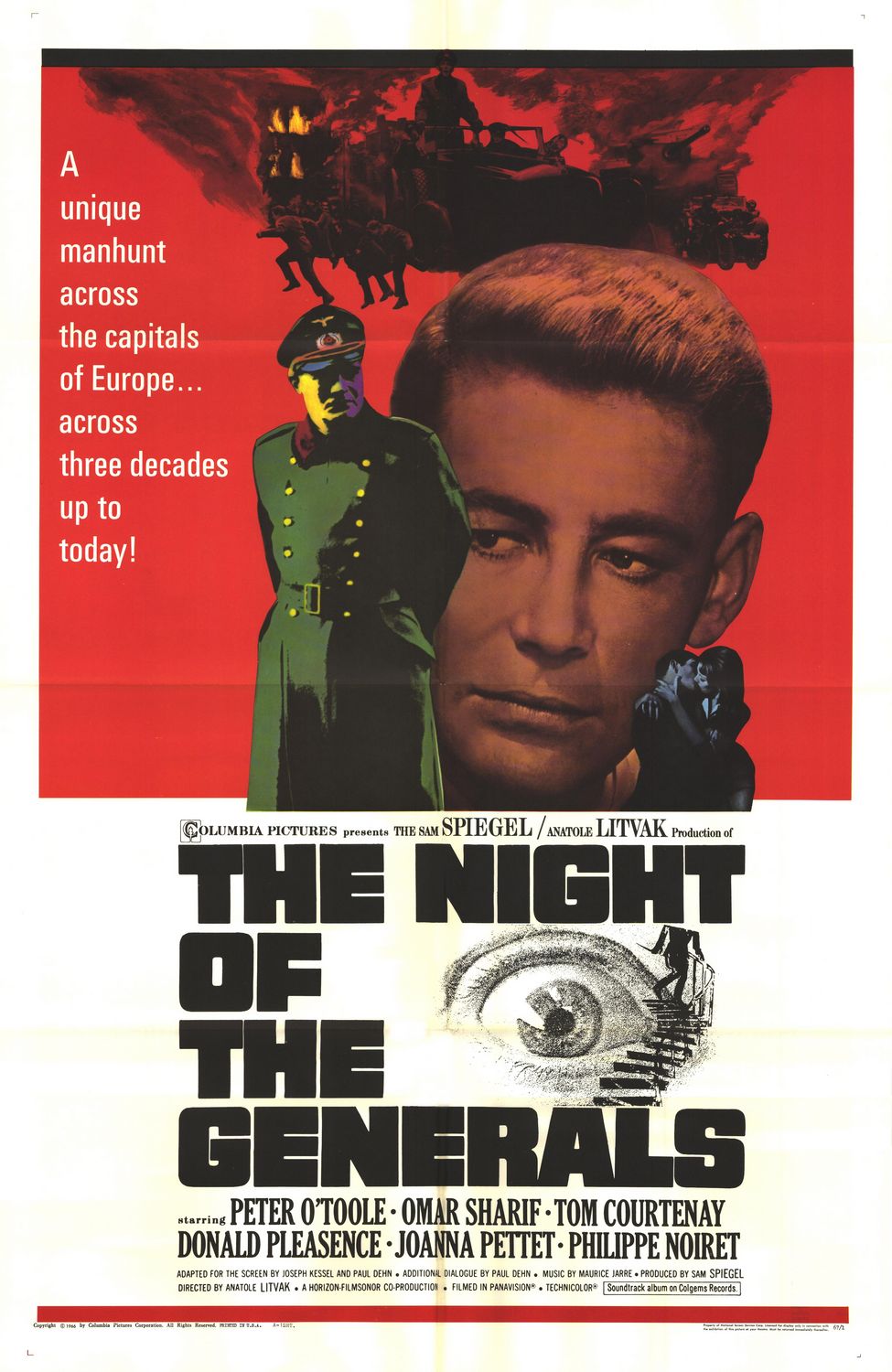
In 1942 during the height of the war a Polish prostitute is found murdered and sexually mutilated. A witness spotted a man leaving her room who was wearing a uniform that had a red stripe running down the side of his pants, which signified that he was a general. Major Grau (Omar Sharif) who is in charge of the investigation decides to interview three generals (Donald Pleasance, Peter O’Toole, Charles Gray) who were in the vicinity and have no alibi, but finds a lot of pressure not to pursue the case and it takes several decades before it finally unravels.

The storyline is compelling enough to keep you intrigued, but the script is talky with not enough action. Certain story threads seemed unnecessary and the film could have been more compact. The actors are mostly all British, but make no effort to speak in German accents despite playing Nazi roles. The music cues that are used whenever an important plot point is revealed or to transition to another scene are too loud and have a generic quality to them that does not appropriately reflect the time period.

O’Toole gives an interesting performance as psychotic ready to fall completely apart. His extreme emphasis on cleanliness especially to those that serve under him and his nervous twitches steal the film as well as a bit where he commands his men to destroy an entire block of a town simply to get at a couple of snipers. His bizarre reaction to a painting of Vincent Van Gogh that he spots in a gallery is intriguing especially when it occurs twice and his blank blue-eyed stare becomes almost piercing.

Sharif does quite well in support and despite being born and raised in Egypt does a convincing job as a Nazi and I think make-up was used to lighten his skin. Tom Courtenay is good as O’Toole’s assistant and the relationship that they form has some interesting subtexts to it.

Joanna Pettet’s appearance however seemed pointless and although the constant sparring she has with her mother (Joan Plowright) was fun it really didn’t add much to an already cluttered narrative. Christopher Plummer also gets stuck in a thankless part where he is seen for less than five minutes before promptly being killed off.

The identity of the killer gets revealed 45 minutes before the end, which hurts the suspense. I also didn’t like that the Sharif character gets killed off and the rest of the investigation is taken over by a Frenchman (Philippe Noiret) which seemed defeating since we had spent so much time siding with the character’s plight to seek justice despite all the obstacles. The film’s very final moment is supposed to be dramatic and poignant, but instead goes over-the-top and becomes weak and strained.

My Rating: 5 out of 10

Released: January 29, 1967

Runtime: 2Hours 25Minutes

Not Rated

Director: Anatole Litvak

Studio: Columbia Pictures

Available: VHS, DVD, Amazon Instant Video

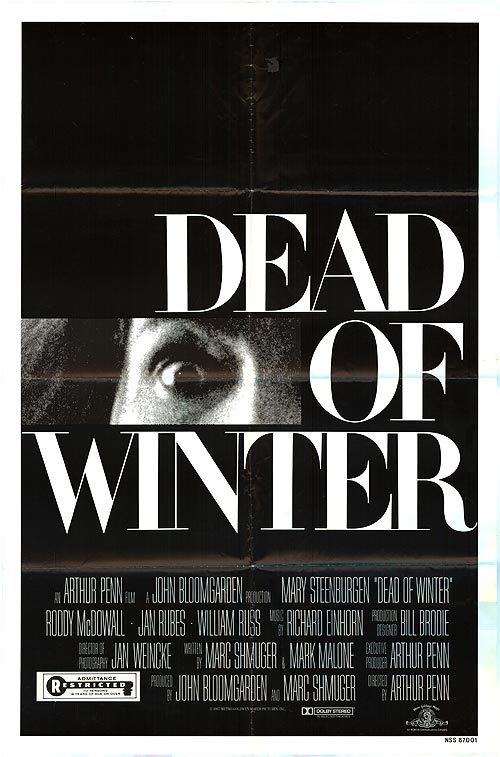
Dead of Winter (1987)

dead of winter

By Richard Winters

My Rating: 6 out of 10

4-Word Review: Trapped in a house.

Being that this has been one of the coldest and snowiest winters in Indianapolis history, which is the current headquarters of Scopophilia, as well as much of the rest of the nation I decided it would be a good time to review a film with cold weather as its theme. After all misery loves company and if we got to suffer through this crap it’s always nice to see film characters have to deal with it as well.

The film is a loose remake of My Name is Julia Ross, which came out in 1945 and starred Nina Foch, which in turn was based on the novel ‘The Woman in Red’ by Anthony Gilbert. Here the title character is Katie McGovern (Mary Steenbugen) a fledgling actress who answers an ad in a paper for an audition to a role in a low budget movie. There she meets a man by the name of Mr. Murray (Roddy McDowell) who hires her on the spot based on her resemblance to their last leading lady who walked out on the production before it was finished. He takes her to an isolated mansion that is owned by Dr. Joseph Lewis (Jan Rubes) to supposedly finish the project by playing a character named Julie Rose, but slowly she realizes this is no movie at all, but instead an elaborate blackmail scheme. Her attempts at escape are futile due to a raging snowstorm outside forcing her to try and come up with a scheme of her own in order to turn-the-tables on her captors before it is too late.

This was director Arthur Penn’s second to last theatrical feature. He had been slumming through the 80’s with movies that never quite hit-the-mark and this one proves no exception. He makes a few attempts to liven it up with my favorite being when they drug Katie and then show things from her point-of-view where everyone talks in an extremely slow way like a tape player running at a very slow speed. There are a few other touches added including some obvious Hitchcock references, which I felt really weren’t needed. Overall though the film seems pretty slow at least through the first hour with only a minimum of tension.

Part of the problem is the casting of the bad guys. While I like the novelty of two elderly men cast as the villains it really doesn’t work overall. Rubes whose character is bound to a wheelchair and speaks in a heavy Czechoslovakian accent seems almost like a cuddly grandfather for most of the way. McDowell has too much of a small frame to be intimidating and there is never any gun or other weapon used against her making me believe that since she was much younger than both of them that had she acted even slightly more aggressively than she does she probably could have overpowered them.

The characters also act pretty stupid at points. Katie goes to this very isolated place, but then when she finally is able to call the police doesn’t have the simple fortitude to know what the name of the nearest town is. She also becomes very aware that these guys are up to no good and even lets them know it only to foolishly take some hot chocolate that they serve her, which not so surprisingly is laced with a sleeping drug.  The bad guys also act dumb by disposing of her driver’s license by sloppily throwing it into the fireplace and then make no attempts to keep her away from it were she eventually spots it.

The wintry atmosphere by-and-large is well handled as cinematographer Jan Weincke deftly captures the gray unrelenting bleakness of the season. It was filmed on-location in Ontario, Canada and there is actual snow on the ground, but the snowstorm itself is fake using artificial snowflakes that they blow in front of the camera that doesn’t look quite right when compared to a real storm.

Things spice up during the final half-hour and features a few interesting twists. However the Rubes character who was stuck in a wheelchair for the entire duration of the film suddenly becomes amazingly agile and nimble using only a fireplace poker to pull himself from the chair and then uses it to balance himself as he chases Katie all around the place and even manages to somehow push himself up a long and winding staircase, which became a bit farfetched. It got to the point where I felt the writers shouldn’t have even bothered to make the character paralyzed in the first place if they were just going to completely sell-out on the concept at the end.

My Rating: 6 out of 10

Released: February 6, 1987

Runtime: 1Hour 40Minutes

Rated R

Director: Arthur Penn

Studio: MGM

Available: DVD, Amazon Instant Video

Ash Wednesday (1973)

ash wednesday 1

By Richard Winters

My Rating: 2 out of 10

4-Word Review: Liz gets a facelift.

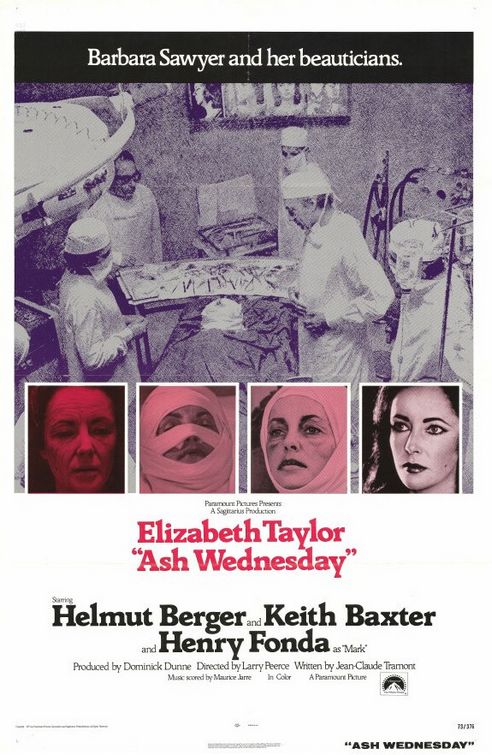
Barbara (Elizabeth Taylor) is not aging gracefully. Her husband Mark (Henry Fonda) is having an affair with a much younger woman, but Barbara is determined to win him back. She decides to get a facelift and then spends her time afterwards at a winter resort in Italy where a young man name Erich (Helmut Berger) becomes intoxicated by her sudden youthful beauty and the two go to bed together. When her husband arrives she still strives to save the marriage, but finds that to him the facelift makes no difference.

The film’s biggest claim-to-fame is the graphic and vivid look at an actual facelift surgery that sickened many viewers who watched the film when it was first released. The footage is explicit, but fascinating as well as I never quite understood how this procedure worked, so seeing it from a medical viewpoint is to a certain extent educational. I also liked that during Barbara’s stay at the hospital she meets a middle-aged man named David (Keith Baxter) who has had several of the some procedures himself and showing that this wasn’t exclusively a woman’s issue although I was confused why a man would spend so much money having facelifts, but then not bother to dye his hair.

The effects of the procedure is a bit misleading because Liz was only 40 at the time and was put into heavy makeup to make her appear much older at the beginning, so the results of the surgery are really just her as she normally looked. The idea that a facelift would have such a galvanizing effect on everyone around her is also not realistic. A recent study found that many people who had the procedure ultimately only looked 3 to 5 years younger instead of the 10-plus that they had hoped for. Sometimes a facelift can make a person look even worse, or in my opinion a sort of ‘duckface’ that this movie doesn’t even hit on, but should’ve.

I also thought that the idea that this woman would want to stay with a man who is openly cheating on her was unrealistic. If this woman was poor, lonely and homely and he was her only source of a social outlet then maybe, but this guy was loaded and I would think most women would simply hire a good divorce lawyer and take the cheating cad to the cleaners and then merrily move on especially when she had already proven to herself that she could attract other more attractive men on her own anyways.

The role itself seems to be an extension of Taylor’s own personality in that of a woman living in an insular world obsessed with shallow problems because she has too much time and money on her hands and unable to either understand or portray an average person in a regular lifestyle even if she wanted to. The wide variety of big puffy hats and scarfs that she wears becomes a bit of a distraction and almost like a character into itself.

Fonda is wasted in another one his typical latter career roles that gives him very little to do. He doesn’t even appear onscreen until the final fifteen minutes and only then long enough to tell her he wants a divorce before promptly leaving.

The opening sequence showing the two stars aging through the years during the credits is interesting and well-done especially seeing Fonda when he was young. The musical score by Maurice Jarre has a nice classic flair to it and lifts this dreary production to a more classy level than it deserves, but unfortunately doesn’t get played much after the beginning.

The film probably would’ve worked better had the surgical procedure not happened right away, but instead been done in the middle and had more of a backstory at the beginning. The facelift scenes are actually the film’s highpoint and it goes rapidly downhill afterwards until it becomes a mind numbing train wreck that isn’t worth watching for any reason.

My Rating: 2 out of 10

Released: November 1, 1973

Runtime: 1Hour 39Minutes

Rated R

Director: Larry Peerce

Studio: Paramount

Available: VHS

Messenger of Death (1988)

messenger of death 2

By Richard Winters

My Rating: 4 out of 10

4-Word Review: Chuck visits Mormon country.

Three young mothers and their children are shot to death in their home. The police suspect it may have something to do with their religious affiliation, but Denver journalist Garret Smith (Charles Bronson) thinks it’s the water company that is behind it, but as the investigation continues and with the help of fellow journalist Jastra (Trish Van Devere) the identity of who it really is surprises everyone.

The movie is unsettling from the beginning as we witness the brutal murders, which sets things at a downbeat tone. However, it also gets the viewer emotional jarred enough to want to see the killer brought to justice. The mystery is intricate for the most part and keeps you intrigued although by the end I had pretty much figured it out.

For a Bronson flick the action is minimal. There is one big shootout, but it doesn’t last long. The film’s best and most exciting sequence is when two big semi-trucks get on either side of the jeep that Garret and Jastra (Trish Van Devere) are riding in and try crushing it as it moves down the road. The scene is vivid, but suffers from the issue where neither occupant is wearing seatbelts and the vehicle does not have airbags and turns over on itself three times, which would most assuredly kill or permanently injure anyone inside and yet the two are able to miraculously get out without even a scratch.

Bronson does not carry a gun here and he has always had one in so many of his other movies that seeing without one makes him look almost naked. For an ordinary 60-something journalist his fighting skills seem too impressive. I was willing to buy into his ability to fight off a much younger professional hitman one time by using some quick thinking, but then to be able to do it again to the same person later on and give him a severe beating in the process seemed too farfetched.

Veteran character actor Jeff Corey as a fiery preacher is good in support as well as John Ireland who plays his brother. During the mid-80’s Ireland once put a full page add in Variety begging for work, so it’s good to see that those efforts paid off with his appearance here.

To-date this marks Van Devere’s last theatrical project and neither her character nor her performance adds much, but it was still nice to see a man and woman work together and not have it automatically turn sexual or into a relationship. Marilyn Hassett plays Bronson’s wife, but she was 26 years younger than him, which makes seeing them together look a bit weird.

Gene Davis who gave a terrible performance as a serial killer in an earlier Bronson flick portrays one of the hit-men. Fortunately his screen-time is contained, so his limited acting skills don’t ruin the whole picture. The way he dies made me chuckle a little as he gets stabbed while standing at a urinal and yet when he turns around his you-know-what isn’t hanging out even though I thought it probably should’ve been.

The climactic moment where the person behind the murders gets ‘unmasked’ is a little too ‘Hollywood’ and doesn’t pack the punch that a film like this needed and thus gives this already average action flick a slightly below average rating.

My Rating: 4 out of 10

Released: September 16, 1988

Runtime: 1Hour 31Minutes

Rated R

Director: J. Lee Thompson

Studio: The Cannon Group

Available: VHS, DVD, Amazon Instant Video