Category Archives: Buddy Movies

Soylent Green (1973)

soylent-green-1

By Richard Winters

My Rating: 6 out of 10

4-Word Review: People are the food.

This Review May Contain Spoilers.

The year is 2022 and the world is so overpopulated that people must sleep on stairwells and hallways and fight over getting their hands on the one and only food source called Soylent Green. Thorn (Charlton Heston) works as a police detective and assigned to a case involving the investigation of the murder of William Simonson (Joseph Cotten) who worked as a board member to Soylent industries. Thorn is convinced that there is more to the killing than simply an in-home robbery, but finds as he pursues the case that others are trying to prevent him from continuing on it, which makes him more determined to find the answers and connect-the-dots.

We’ll get the elephant out of the room right away by divulging that Soylent Green is made up of people who are killed to feed the rest of the population. Normally that would be considered a ‘spoiler’, but this film has become so well known for this ‘twist’ it that it seems almost absurd to avoid giving it away. If that ruins the film for you then I apologize, but the truth is I knew going into this how it was going to end, due to watching one of many parodies done on the movie particularly a SNL skit from years back involving Phil Hartman, and yet I came away enjoying it anyways. Mostly what I liked was the film’s neo-futuristic look that combines old buildings with a mod image and an opening sequence, which is the best part of the movie, used over the credits that was done by filmmaker Charles Braverman and shows visually through rapid-fire photographs how the world came into its bleak situation.

I was also really impressed with Heston’s performance. He is not an actor I’ve particularly enjoyed as I feel he is routinely too stiff and conveys his lines in an overly dramatic way that is quite stagey and even hammy and yet here he portrays a rough-around-the-edges man quite well and I consider this one of his best performances.

soylent-green-2

This also marks the final film of screen legend Edward G. Robinson who died only 20 days after production was completed. The scene where he and Heston eat fresh food, which is something the characters hadn’t done in a long time due to its scarcity, was completely improvised, but an excellent and memorable moment. I did feel though that there needed to be a backstory about why these two men, who had such contrasting differences in age, were living together and the fact that at one point both men say that they ‘love’ the other made me wonder if it was implied that they were gay.

The ending isn’t bad and I liked the way Thorn investigates the inner workings of the Soylent factory with the only noise coming from the plant’s machinery and no music, which makes it creepier. It is mentioned earlier though that this plant is ‘highly guarded’ and yet he is able to get into it rather easily and he walks through it for quite a bit before he is spotted by anyone and even then the men aren’t armed, which makes it seem like it isn’t too well guarded at all. Also, I didn’t get why Thorn, who is quite jaded for the most part, would get so noble and heroic once he found out the plant’s secret and feel the need to ‘warn’ others. The world they live in is quite bleak, so what is he ‘saving’ them from anyways as some may actually choose death over the squalor that they were stuck in.

The ultimate logic to this ‘clever’ twist ending doesn’t hold up too well either. For instance the idea that the company would just kill a few people here and there wouldn’t be enough to keep up with the demand and at one point does the overpopulation begin to go down? If so many are supposedly being killed to feed the others then the crowding should lessen, which again only reiterates the fact that the filmmakers hadn’t completely thought this thing through and if anything the film should’ve used Thorn’s discovery as springboard to a more complex and intricate plot instead simply relying on it as a ‘shock’ ending.

soylent-green-3

My Rating: 6 out of 10

Released: May 9, 1973

Runtime: 1Hour 37Minutes

Rated PG

Director: Richard Fleischer

Studio: MGM

Available: DVD, Blu-ray, Amazon Video, YouTube

What’s the Matter with Helen? (1971)

whats-the-matter-1

By Richard Winters

My Rating: 6 out of 10

4-Word Review: Religious lady goes crazy.

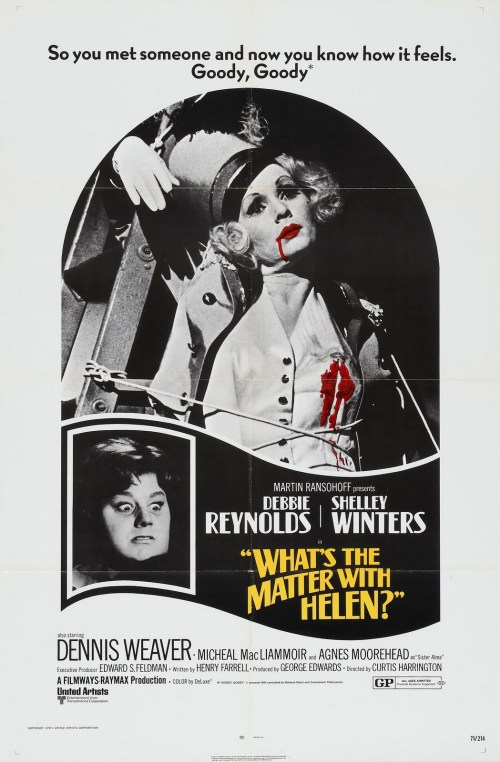
Adelle (Debbie Reynolds) and Helen (Shelley Winters) are two mothers whose sons commit a gruesome murder. Once the two men are convicted the women decide to move across the country, change their names and open up a dance studio. Adelle meets a handsome bachelor (Dennis Weaver) who is full of money, but Helen’s fortunes don’t improve. Instead she wallows in depression while receiving threatening phone calls, which gets her paranoid that someone is out to get them. She tries to seek solace through her religion, but eventually the stress becomes too much and her psychic begins to crack.

The screenplay was written by Henry Farrell famous for penning the novel What Ever Happened to Baby Jane?, which later became a big screen success. Unlike that one this was written directly for the screen and misses the textured richness of a backstory specifically how the two women first met or how their friendship blossomed.

On the visual level it starts out well and I enjoyed the use of old news reel footage to help introduce the story, but after that it goes into a lull with long, talky takes that fail to generate much excitement. The recreation of the 1930’s setting looks cheap and stagy and the film lacks a cinematic flair to help compliment it’s campy storyline. Originally director Curtis Harrington had implemented visual effects to be used in the transitions between the scenes, which would’ve helped immensely, but the producer hated them and forced them to be taken out.

On the acting end I felt Reynolds was rather boring and stuck playing a character that isn’t very interesting, which made me surprised that she put up $800,000 of her own money just to get it produced. The showy role is clearly Helen’s and Winters plays the part quite well and becomes the film’s main attraction. Usually she would take-on flamboyant-type characters, but this one required her to be more subdued and repressed and she is able to do it magnificently, which only proves what a gifted and versatile performer she was.

There are a few edgy but brief bits including the shot of a dead body that has been run over by a farm plow, which has some pretty good bloody effects. However, the shot showing a close-up of the women’s body who was the victim of the two sons isn’t effective because it supposedly gets posted in a newspaper as a lead in to the article about the crime, but no mainstream publication either then or now would print such a gruesome picture of a victim.

There were also several provocative scenes that got excised in an effort to the attain the GP rating, which included a shot of Winters kissing Reynolds on the lips as well as a murder scene that was originally intended to be much more drawn out than what it ends up being. The film’s final shot though is still well done and probably the only thing that makes sitting through this worth it.

My Rating: 6 out of 10

Released: June 30, 1971

Runtime: 1Hour 41Minutes

Rated GP

Director: Curtis Harrington

Studio: MGM

Available: DVD

My Beautiful Laundrette (1985)

my-beautiful-laundrette-1

By Richard Winters

My Rating: 6 out of 10

4-Word Review: Gay couple manage laundromat.

Genghis (Richard Graham) is a young Pakistani immigrant living in London and feeling frustrated by being trapped in his humble surroundings while living with his father (Roshan Seth) who due to his left leaning politics and alcoholism is unable to bring in any meaningful income. His Uncle Nasser (Saeed Jaffrey) is doing quite well even though some of his methods are unscrupulous. Nasser gets Genghis a job at his car washing facility, but Genghis has loftier goals. He wants to take over the rundown laundromat that Nasser owns and turn it into a thriving business with the help of his gay lover Johnny (Daniel Day-Lewis). Nasser agrees and is surprised to see what a success it becomes, but is unaware that Genghis and Johnny are funding it with the help of illegal drug money and Salim (Derrick Blanche) is onto their scheme and wants a part of the take.

The film’s screenplay was written by Hanif Kureishi who liked the title character came to Britain from Pakistan and has become a much celebrated playwright despite starting his career writing pornographic novels. The story brings out many complex issues that could prove fascinating to those unfamiliar with the political landscape of Great Britain during the Margaret Thatcher era. The problems and racism that those from Pakistan had to face in the U.K. are vividly brought to the forefront, but what is even more interesting is the pressures and loyalties that they were expected to follow amongst their own culture and families and how these could end up being just as conflicting and confining as those placed on them by the outside world.

I enjoyed many of the scenarios that the film brings out, but was frustrated that the story offers no conclusion to any of them. I was interested in seeing how Nasser would react to Genghis and Johnny’s relationship, but we never get to find out even though the film teases us with a scene where he begins to suspect it. There is also no conclusion as to what ultimately happens to their laundromat business, or whether they were successfully able to expand it, which again gets touched upon. We aren’t even able to find out if Salim was able to survive a vicious beating by some street punks or whether these same punks were ever brought to justice. Why bother bringing up all these story threads if they are just going to be left open and why should the viewer be sucked into the quandaries of these characters if it is all just leads to one big ambiguous ending?

Daniel Day-Lewis shot to stardom with his role here, but I didn’t really feel he had the body type to be considered a ‘tough guy’ or even a bouncer type. Sure he’s tall, but still pretty skinny and not exactly muscular. I also thought the trendy pseudo-hip getups and hairstyles that he and his gang have look tacky and I first saw this film back when it was released and I felt the same way about the outfits then that I do now.

The direction by an up-and-coming Stephen Frears is okay, but his use of a soundtrack that resembles the noise of a washing machine takes away from the gritty drama element that this story supposedly wants to be as does the onscreen opening and closing titles that spin around like clothes in a dryer.

my-beautiful-laundrette-2

My Rating: 6 out of 10

Released: August 18, 1985

Runtime: 1Hour 37Minutes

Rated R

Director: Stephen Frears

Studio: Working Title Films

Available: DVD, Blu-ray (Criterion Collection), Amazon Video

All the President’s Men (1976)

all-the-presidents-men

By Richard Winters

My Rating: 6 out of 10

4-Word Review: They take down Nixon.

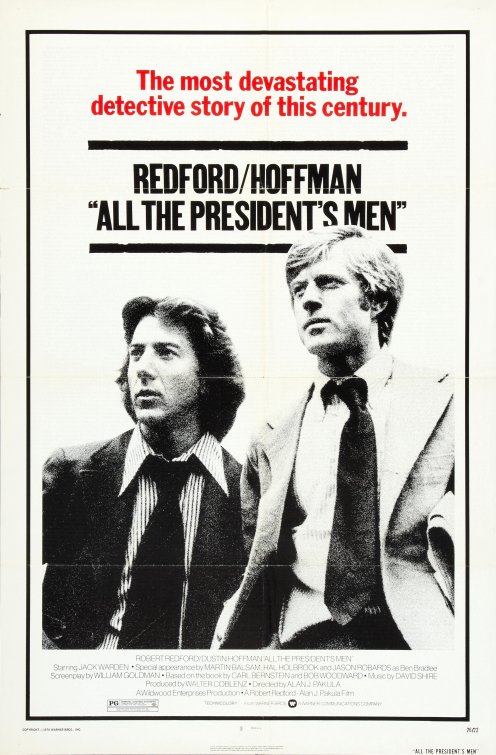
In the early morning hours of June 17, 1972 five men are found burglarizing the Democratic Headquarters at the Watergate Office complex in Washington D.C. The next day a young Washington Post reporter by the name of Bob Woodward (Robert Redford) is assigned to cover the case. Initially it was considered only a minor story, but as he digs further into the details he finds wider connections including links that lead directly to the White House. Together with Carl Bernstein (Dustin Hoffman),who is another reporter, the two men continue to research and end up battling one roadblock after another in their quest the uncover the truth.

If there is one area where this film really scores in it’s in the way that a journalist’s job gets portrayed. In fact many colleges show this film to their student who are majoring in the field in order to given them a realistic perspective of what the profession actually involves. For me I found it quite enlightening particularly the first hour. The many people and steps that a reporter has to go through just to get one solid lead is interesting as is the protocol system determining which story gets the front page and which don’t.

The layout of the newsroom was also fascinating as it all seemed very authentic and like they were working in an actual one. To my absolute shock I found out later that it had all been constructed on a film set, but so meticulously done that you couldn’t tell the difference. Initially several scenes were filmed in the real office using actual employees in the background, but the knowledge of being on camera made some behave in ways that they normally wouldn’t and this ultimately forced the filmmakers to decide to recreate it on a soundstage and use actors as the office crew.

The performances by the two leads are good, but neither of them resembles their real-life counterparts. Both Redford and Hoffman were already pushing 40 at the time and looking it while Woodward and Bernstein were still in their 20’s when this story occurred so the line that the Jack Warden’s character makes about these two being ‘young and hungry’ and looking for a good story to build their careers on doesn’t make as much sense.

The characters aren’t well fleshed out either. No time is spent on what these guys were like when not ardently following up leads, which is absolutely all we see them doing.  The original screenplay, which was written by Woodward and Bernstein, had a subplot involving the two trying to score with women, which would’ve helped add a comical touch and parts of that should’ve been kept in.

The second half lags as there are too many leads and names that get bantered about that don’t have faces connected to them making it seem like information overload that doesn’t help the viewer get as emotionally involved as they should. Having cutaways showing Nixon and/or is aides becoming increasingly more paranoid as the reporters closed in on them could’ve added that much needed extra dimension.

There is a stunning bird’s-eye shot of the inside of the Library of Congress, which is amazing and the fact that many of the scenes get filmed at the actual sites where the real-life instances occurred is both impressive and commendable. I also enjoyed the wide-array of recognizable faces that show up in bit parts including Valerie Curtain as a frightened source and Polly Holliday as an evasive secretary. They even cast Frank Wills the real-life security guard who broke the case wide open playing himself in the film’s opening scene, which is cool even though for me the film’s second half fails to be as entertaining as the first, which prevents it from being a classic.

My Rating: 6 out of 10

Released: April 4, 1976

Runtime: 2Hours 19Minutes

Rated PG

Director: Alan J. Pakula

Studio: Warner Brothers

Available: DVD, Blu-ray, Amazon Video, YouTube

Outrageous Fortune (1987)

outrageous-fortune

By Richard Winters

My Rating: 6 out of 10

4-Word Review: Bitter rivals share lover.

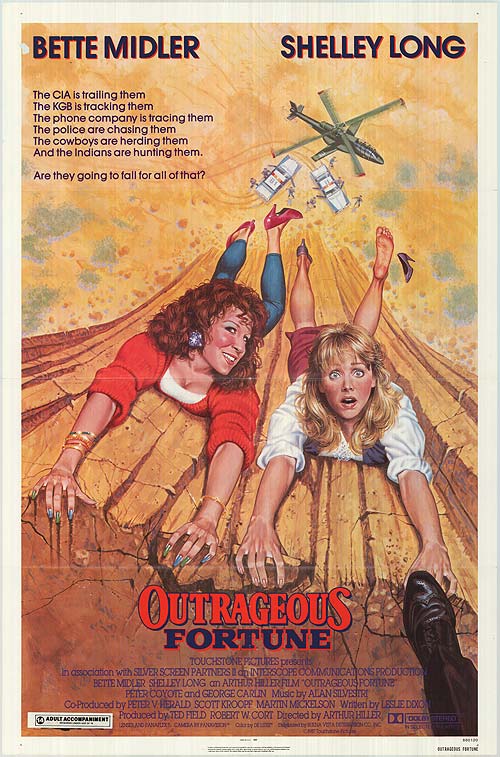
Lauren (Shelley Long) and Sandy (Bette Midler) join an acting class and find themselves at immediate odds. Little does Sandy know that Michael (Peter Coyote) the new attractive man that she has just met is also seeing Sandy on-the-side. When Michael disappears they reluctantly work together to try and find him only to realize that he may have been using both of them for nefarious and potentially dangerous means.

This is mindless, fluffy entertainment for sure and it doesn’t mind selling itself as such, but despite a runtime that goes on too long and a plot that becomes increasingly more farfetched it still works mainly because it’s genuinely funny. In fact there are several moments where I found myself chuckling out loud with the best part in my opinion coming near the beginning when Lauren begs her parents to borrow money so that she can attend an acting class.

The two leads help a lot. I always felt that Long should’ve stayed on ‘Cheers’ and her film career was for the most part a dud, but this is one of her better movie roles that takes full advantage of her prissy persona. Midler is terrific too and I admired how she really got into her part by insisting on doing her own stunts and she even has an impromptu moment where she decided to lie down on the road, which was not in the script, while a truck came dangerously close to running her over.

Coyote is good as the duplicitous boyfriend and it was interesting seeing him in a bad guy role, which he doesn’t do often, but this was yet another movie instance where we have a character that walks with a noticeable limp one minute only to have it strangely go away the next. On the flip-side Robert Prosky’s Russian professor caricature is overdone and George Carlin may be a legendary comedian, but his acting parts are never very funny.

For amiable entertainment it’s fun as long as you’re not too demanding, but there was one part that I thought was just too implausible. It comes during a chase sequence where in effort to elude the people who are after them Lauren and Sandy decide to hide themselves in two separate clothes dryers while the machines remain running. For one thing it is impossible to close the doors from the inside as they are intentionally made this way so little children can’t accidently lock themselves in. A person from the outside would have to shut the door in order for it to latch, so even if one did this for the other there is no way that they both could’ve done it. Also once the door is closed you would need someone from the outside to open it back up in order to get out and the prospect of a grown adult body being put into a dryer while it is running would most likely disable it, which makes the scene unable to meet even the minimum requiements of logic and therefore should’ve been left out.

My Rating: 6 out of 10

Released: January 30, 1987

Runtime: 1Hour 39Minutes

Rated R

Director: Arthur Hiller

Studio: Buena Vista Pictures

Available: DVD, Amazon Video, YouTube

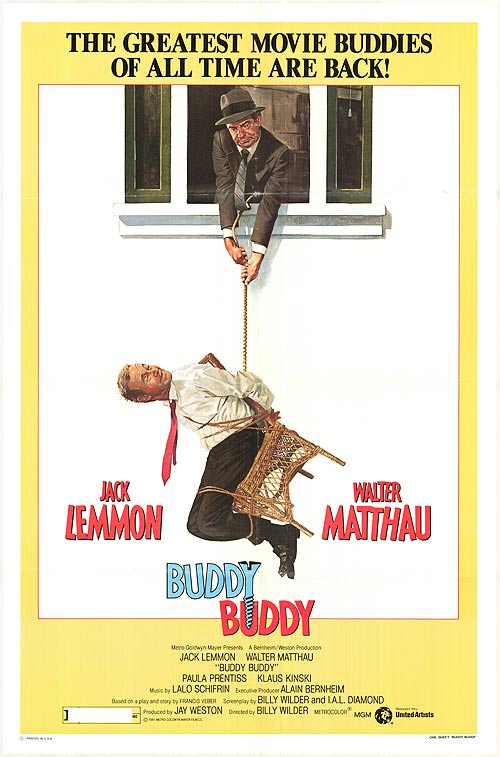
Buddy Buddy (1981)

buddy-buddy-2

By Richard Winters

My Rating: 7 out of 10

4-Word Review: Suicidal man hampers hit.

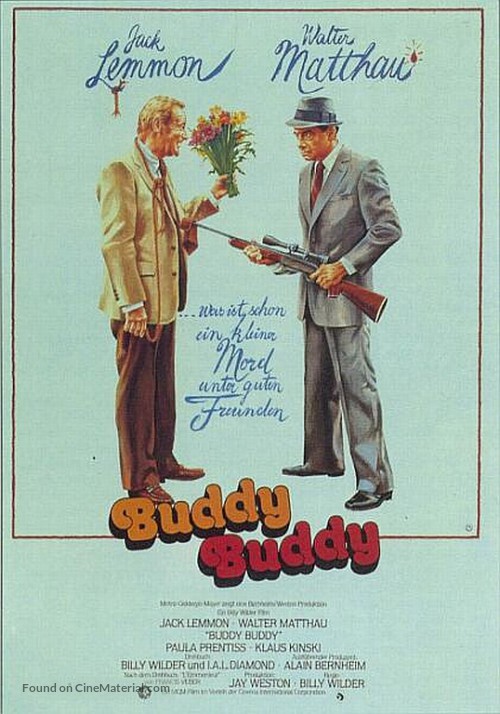
Trabucco (Walter Matthau) checks into a hotel intent on completing a hit by shooting a mob informant before he can testify at trial. He’s already killed the two other informants with relative ease, but now finds this one to be much more complicated due to having to deal with Victor (Jack Lemmon) who resides in the adjoining room. Victor is upset that his wife Celia (Paula Prentiss) has left him for a sex therapist (Klaus Kinski) and proceeds to try to hang himself by tying the noose around the water pipes in the bathroom, but all he succeeds at doing is busting the pipes and creating a flood. Trabucco decides to ‘befriend’ the man in order to keep an eye on him and prevent him from trying to kill himself again, which he feels will only lead to unwanted attention from the authorities. However, Jack causes more problems for him than the police ever could.

This was the last film directed by Billy Wilder who stated in more than a few interviews that he considers this movie to be his poorest effort and his least favorite. Matthau and Lemmon have pretty much said the same thing as well. The film was a critical flop and lost 3.5 million at the box office, which helped to prevent Wilder from ever helming another movie again.

However, I was delightfully surprised at how funny I found this movie to be. It’s not exactly laugh-out-loud hilarity, but on a low-key level it works. The part where Lemmon gets tied to a chair and his mouth gagged while he screams at an ambivalent housekeeper (Bette Raya) to free him is quite good and the part where the two men going gliding down a clothes chute is fun too.

The whole thing is a remake of the French film A Pain in the A__, but it implements changes to the plot that improves it from the original. For one thing the dialogue is funnier, the two men have more genuine conversations and they even develop a bit of a bonding. The film adds more characters too like the beleaguered Captain Hubris played by Dana Elcar who tries in vain to protect the witnesses from Trubacco, but with little success. The distinctive musical score by Lalo Shifrin is also big improvement.

Lemmon is quite funny as he plays a sort-of hyped-up version of his Felix Unger character. Matthau seems a bit stymied in a role that allows for very little expression, but he still manages to make the most of it. My favorite performance though was that of Kinski who takes a rare comic turn and utters the movies best line: “Pre-ejaculation means always having to say you’re sorry.”

Having the two actually work together to complete the hit and then make an escape from the cops is good and something that did not occur in the original. The resolution, which takes place on a tropical island, is a bit of an improvement over the first one though it’s still not perfect. In either event it’s a relatively solid comedy that offers a few good laughs and deserves more attention especially for fans of Lemmon/Matthau.

buddy-buddy-1

buddy-buddy-3

My Rating: 7 out of 10

Released: December 11, 1981

Runtime: 1Hour 36Minutes

Rated R

Director: Billy Wilder

Studio: MGM

Available: VHS

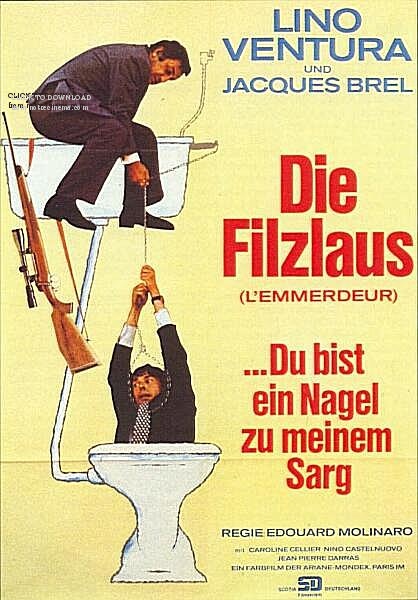
A Pain in the A__ (1973)

pain-in-the-ass-1

By Richard Winters

My Rating: 6 out of 10

4-Word Review: Loser irritates hit man.

Ralf (Lino Ventura) works as a hit man and is hired to assassinate Louis Randoni (Xavier Depraz) who plans to testify against the mob. Ralf checks into a hotel room and plans to shoot Louis as he tries to enter the courthouse from his hotel window, which sits across the street from the court building. As he prepares for the hit he becomes distracted by Francois (Jacques Brel) in the neighboring room who attempts to kill himself after his wife leaves him. Ralf is concerned that Francois’s actions will elicit unwanted attention, so in an attempt to quiet him he ‘befriends’ him, which leads to many ironic scenarios.

The film was written by the prolific Francis Veber and based on his play. Ultimately it’s just a one-joke premise, but what makes it work are the two characters particularly the hit man who is portrayed in a serious way and never once betrays the essence of who he truly is, which is that of a cold blooded killer intent on doing his job and then moving on to his next. The comedy comes from his perturbed reactions at having to deal with a loser that despite his best intentions he can’t seem to ever get rid of.

Famous singer Brel does quite well as the clingy pest who is so wrapped up in his own personal quandaries that he fails to notice that his new ‘friend’ really isn’t his friend at all. Brel’s boyish looks plays well off of Ventura’s constantly stern expression and the plot becomes almost a constant play on errors as each one misreads the other.

The overall set design though is boring and the majority of action takes place solely inside the two hotel rooms, which eventually makes the proceedings quite static. It would’ve been nice to have had more of a conversation between the two as Brel does almost all of the talking while Ventura simply remains quiet while looking bored and angered, which is fun for a while, but more of a character arc could’ve been implemented.

The ending is a cop-out and not satisfying at all. I also felt Ventura was a bit too old and the character would’ve been more intimidating had it played by someone younger and more rugged although for the record Ventura plays the role perfectly especially when he gets injected with a drug that makes him tired and reluctantly  dependent on Brel’s guidance.

In 2008 Veber directed a remake of this film, which met with some success. Also in 1981 director Billy Wilder did an American version of this with Jack Lemmon and Walter Matthau playing the two leads. That film ended up adding a few changes and will be reviewed tomorrow.

pain-in-the-ass-2

My Rating: 6 out of 10

Released: September 20, 1973

Runtime: 1Hour 31Minutes

Rated PG

Director: Edouard Molinaro

Studio: Mondex Films

Available: VHS

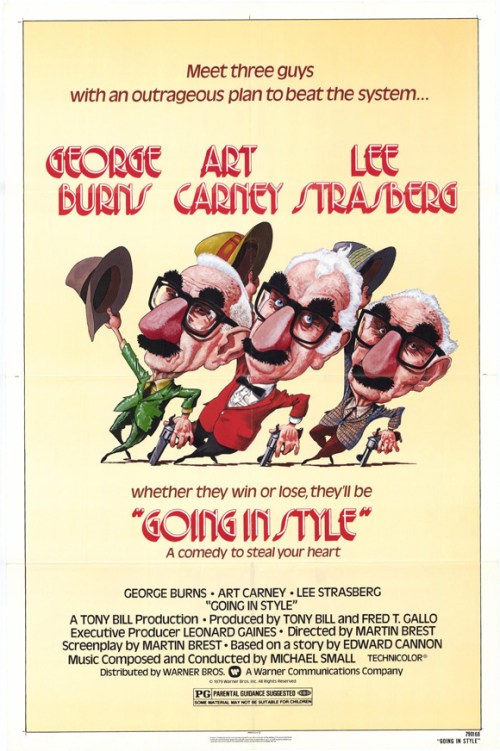
Going in Style (1979)

going-in-style

By Richard Winters

My Rating: 5 out of 10

4-Word Review: Old guys rob bank.

Three elderly men (George Burns, Art Carney, Lee Strasburg) who are living together in a rundown Brooklyn apartment and on a fixed income decide one day to liven up their lives by robbing a bank. None of them have ever committed a crime before and don’t even know how to handle a gun, but end up pulling off a major heist nonetheless and getting away with $35,000 in cash. However, things begin to fall apart once the crime is completed and even a side-trip to Vegas can’t keep the feds from slowly moving in.

On the outset the plot seems like a very funny idea and some of the social context about the difficulties of growing old that gets mixed in with it is right on-target. However, to me it just doesn’t come together. The men latch on to the idea too quickly and I would’ve expected more resistance or having at least one of them chickening out at the last second. These are individuals with no criminal record and although I realize that they are bored why couldn’t they have just taken up a new hobby or social cause instead. It’s not like they were out on the streets or completely desperate. The apartment they resided in looked livable enough and I might’ve bought into the premise better had one of them needed a major operation and thus the others were forced to go to extremes like robbing a bank to help pay for it.

The part where they sit around a table trying to figure out which stack of bullets goes into which gun is amusing and quite possibly the best bit in the film, but there’s a lot more comic potential that could’ve been squeezed out of this otherwise quirky plot that is never taken advantage of. The crime gets carried off in too much of a seamless fashion with a myriad of possible problems that could’ve and should’ve cropped up being completely overlooked.

The second half that deals with two of them taking a trip to Vegas seems like a plotline to a whole different movie.  Writer/director Martin Brest should’ve chosen one or the other by either playing up the bank robbery premise and its preparation more or just rolled from the beginning with the Vegas trip, which has a lot of funny untapped potential as well, but cramming the two together or not taking enough advantage of either one was a mistake.

Burns gives an excellent performance and I was amazed how very talented this 83 year-old gentlemen was especially when you factor in that he never had any formal acting training and was basically just a vaudeville comedian, but here he creates a convincing and surprisingly savvy character. Strasberg, who spent years as an acting teacher and didn’t do any film roles until much later in his life, is superb as well and I was disappointed his character wasn’t in more scenes.

A reboot of this film has already been completed and set for an April 7, 2017 release. It will star Michael Caine, Morgan Freeman and Alan Arkin as the three elderly men and I’m quite interested to see how the two versions deviate from the other. I’m hoping that the comedy angle gets played up more and from reading the synopsis I have an inkling it will. It hopefully will be an improvement as I came away from this one feeling like it had missed-the-mark.

My Rating: 5 out of 10

Released: December 25, 1979

Runtime: 1Hour 38Minutes

Rated PG

Director: Martin Brest

Studio: Warner Brothers

Available: DVD, Amazon Instant Video, YouTube

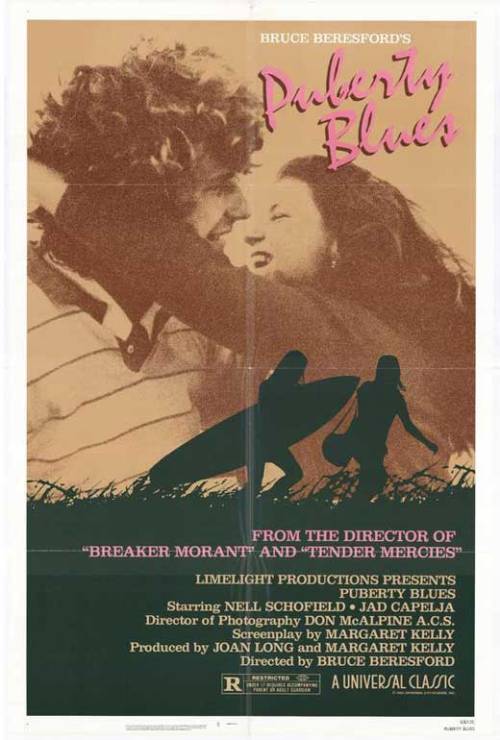
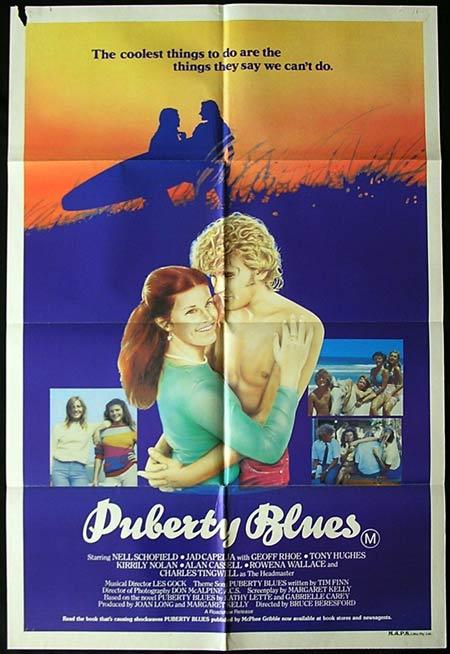
Puberty Blues (1981)

puberty-blues-2

By Richard Winters

My Rating: 6 out of 10

4-Word Review: Girls can surf too!

Debbie and Sue (Nell Schofield, Jad Capelja) are best friends attending high school in the south suburbs of Sydney. They desperately want to fit-in with the surfer group, but find that this means being pressured into having sex and experimenting with drugs and alcohol that starts to take its toll on both their grades and family life. When Debbie thinks she’s gotten pregnant by Gary (Geoff Rhoe) and he responds with indifference she realizes that the surfers aren’t as cool as she thought and pledges to become more independent by trying to do some surfing of her own, which she is told ‘girls can’t do’.

The film is based on the novel by Gabrielle Carey and Kathy Lette who became best friends at age 12 and at 16 began writing stories based on their high school experiences. While attending a writer’s workshop they met Margaret Kelly who worked as a writer in television and was impressed with the girl’s output. She got their stories optioned into a screenplay while the girls went on to write a weekly newspaper column under the byline of The Salami Sisters and their stories were eventually published into a novel. The big change between the movie and the novel is that in the book the girls were only 13 while in the movie it gets upped to 16 since that was Australia’s age of consent.

Director Bruce Beresford ends up tearing away the mystique from teen life in much the same way that he did to suburbia in Don’s Party, which leaves the viewer with a far more caustic take on the high school experience than the Hollywood version, which tends to play up the teen scene like it’s just one big raucous party. Here the cool kids are vapid, crass creatures who are unable to hold any type of interesting conversation. Their parties are lifeless affairs where they aimlessly sit around and get drunk because they have nothing better to do while the sex is shown to be an unpleasant experience for the girls who get pressured into doing it before they’re ready and leave feeling used afterwards.

This was more the way I remembered high school being and I was impressed with the film’s honesty, but the pace is too leisurely and not enough happens. There is some drama when Debbie thinks she is pregnant, but it takes an entire hour just to get there and a comical segment dealing with a goofy fight amongst the surfers, which was not in the book, is completely unnecessary.

The film though does have some funny bits including a scene where Debra brings her boyfriend Bruce (Jay Hackett) over to meet her parents (Kirrilly Nolan, Alan Cassell) as well as the shots showing the interior and exterior of Bruce’s van. This though gets coupled with an uncomfortable moment dealing with a homely girl (Tina Robinson Hansen) who gets tricked into getting into the guy’s van where she is forced into a gang bang before being coldly thrown onto the curb afterwards.

The best part is the ending where the girls grow in confidence and become unafraid at challenging the status quo. Seeing the shocked expressions  of the cool kids as they watch the girls get on surf boards for the first time and succeed at something they were told only guys could do is a treat and makes the rest of the film worth sitting through.

Many years later this movie spawned a TV-series as well as a special that aired in 2012 on Australian TV where Nell Schofield traveled back to the locations where the film was made. Unfortunately her costar Jad Capelja was not present as she had already killed herself in 2010 after spending years battling drug addiction and mental illness.

puberty-blues-1

My Rating: 6 out of 10

Released: December 10, 1981

Runtime: 1Hour 27Minutes

Rated R

Director: Bruce Beresford

Studio: Roadshow Film Distributors

Available: VHS, DVD (Pal Region 0), Blu-ray (Region B/2)

Weird Science (1985)

weird science

By Richard Winters

My Rating: 6 out of 10

4-Word Review: Geeks create hot babe.

Gary (Anthony Michael Hall) and Wyatt (Ilan Mitchell-Smith) are two geeky high school buddies who can’t seem to make it with the girls, so they try to concoct one using Wyatt’s computer. The result is the creation of the voluptuous Lisa (Kelly LeBrock) who is not only super smart, but has a really bitchin’ bod as well. Soon the two boys become quite popular and even host a wild part at Wyatt’s house while his parent are away, but things eventually get out of control and the two learn a valuable lesson that being ‘cool’ isn’t everything.

Director John Hughes purportedly wrote the film’s script in a matter of  2 days and it shows as the logic is nonsensical and so poorly thought that it seems almost done on a grade school level. Normally I’d have written the whole thing as a mess, but the more I thought about it the more I realized that to an adolescent this really could make sense as it fits in perfectly with the dreamy, fantasy filled concept most boys at that age have and that is where it succeeds.

The dialogue is sharp and the gags quite clever particularly the send-up to 2001: A Space Odyssey. The barrage of weirdness creates a certain rhythm that hooks you and keeps you captivated almost like a drug trip until you simply turn off your brain and enjoy the ride for what it is.

Hall is especially dynamic particularly the part where he gets drunk and starts speaking in an accent. LeBrock makes for a terrific contrast to the boys and manages to hold-her-own while Bill Paxton scores as Wyatt’s obnoxious older brother.

Smith was the only one that I didn’t care for. His face is certainly photogenic and could be considered a heartthrob to any teen girl, but his voice is quite nasally to the point that I felt it was annoying. He also lacks Hall’s comic panache although some viewers may be impressed at how good he looks in women’s underwear.

There are some really funny scenes here with Hall’s introduction of Lisa to his parents (Britt Leach, Barbara Lang) and the nuclear missile that goes straight through Wyatt’s home being the two best, but the film ends up being straddled with a wrap-up that is too tidy and the need to preach generic ‘life lessons’ that ultimately gives it a formulaic and limited feel.

My Rating: 6 out of 10

Released: August 2, 1985

Runtime: 1Hour 34Minutes

Rated PG-13

Director: John Hughes

Studio: DVD, Blu-ray, Amazon Instant Video, YouTube