Category Archives: Buddy Movies

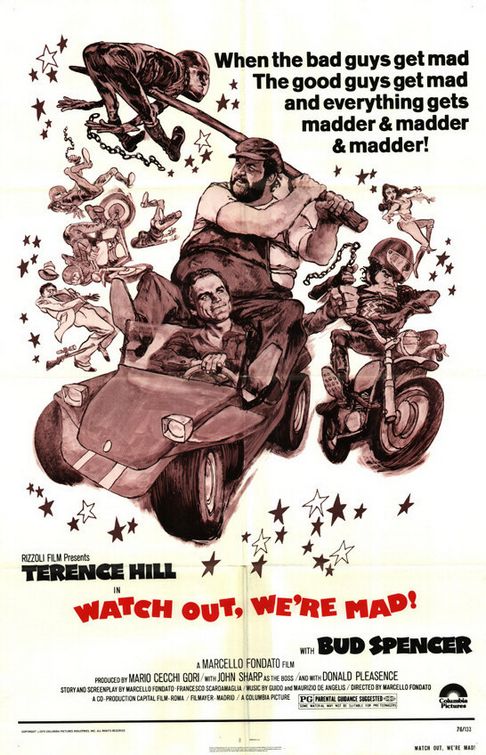
Watch Out, We’re Mad! (1974)

watch out were mad

By Richard Winters

My Rating: 6 out of 10

4-Word Review: Replacing a red buggy.

Kid (Terence Hill) and Ben (Bud Spencer) are two race car drivers who participate in a race that ends in a tie that forces the two to settle on sharing the prize, which is a red dune buggy. The two though want the vehicle all for themselves and decide to settle on who gets to keep it by having a hot dog eating contest at a local bar. As they busily eat their hot dogs a local mobster known as The Boss (John Sharp) orders his men to destroy the place in an effort to get local businesses to leave, so that they can then use the land to build a giant skyscraper. Ken and Ben don’t mind the chaos, but when the mobsters then destroy the buggy they get mad…really mad! They confront The Boss and his equally nefarious psychiatrist (Donald Pleasence) insisting that the buggy MUST be replaced and it MUST be the same red color, or there will be trouble. The mobsters initially scoff, but find that these two men are far more resourceful and determined than they could’ve imagined.

This is the seventh teaming of Hill and Spencer who did their first movie together in the 1967 spaghetti western Blood River. They work well together and it is clear that they share a deep camaraderie. The film is full of all sorts of zany slapstick and I enjoyed most of it particularly the bar scene as well as a bumper car segment at a carnival. The best moment though is when they ram their car through the doors of a ritzy restaurant where the mobsters are dining and proceed to drive the car through every inch of the place while popping hundreds upon hundreds of giant balloons that lay all over.

The biggest issue though it that it doesn’t make any sense why these two would be so cocky and arrogant in the face of otherwise dangerous mobsters. Yes, it’s funny that these two ordinary schmucks seem oblivious to danger and can more than handle themselves, but it would’ve worked better had they been initially intimated and then slowly evolved into being more confident. You also have to question how these men acquired such powerful fighting skills, which made me believe that the characters should’ve been portrayed as police or government agents with some kind of combat training instead of just ordinary car mechanics that would not in any way be able to fight these bad guys off as consistently as they do.

The story is one dimensional and there really isn’t much of a third act with the broad plot simply an excuse to showcase a lot of slapstick. The humor is clearly on a kiddie level, but funnier than you might think even though there are certain routines that go on longer than they should and some that seem to repeat themselves. Still it’s refreshing to watch a film made in an era where slapstick was still considered a legitimate form of entertainment and not simply relegated to kid flicks and cartoons.

My Rating: 6 out of 10

Released: March 29, 1974

Runtime: 1Hour 37Minutes

Rated G

Director: Marcello Fondato

Studio: Columbia Pictures

Available: DVD

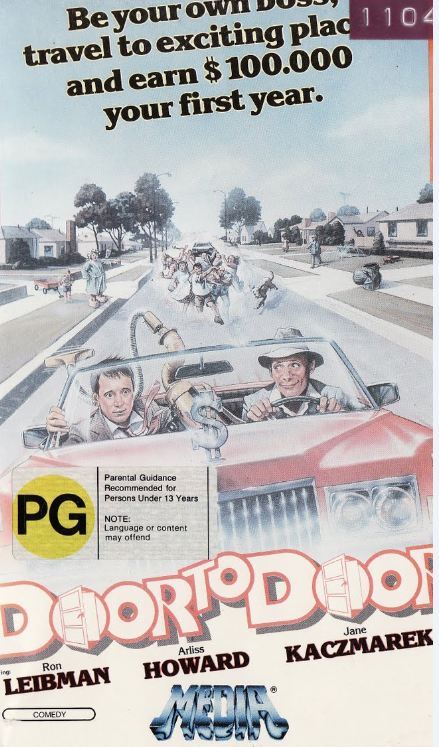
Door to Door (1985)

door to door 3

By Richard Winters

My Rating: 0 out of 10

4-Word Review: Schmuck can’t sell shit.

Leon (Arliss Howard) has taken a sales job, but is finding very little luck with it. He meets by chance Larry (Ron Leibman) who is a more seasoned sales professional and who promises to take Leon under his wings and ‘show him the ropes’. Unfortunately for Leon Larry is not very ethical and sells vacuums for a company that he does not actually represent forcing the two to go on the run from a bounty hunter (Alan Austin) who has been hired by the vacuum company to track them down.

I’ve worked in sales at various points in my working life and can attest that it is usually quite thankless and never lives up to the great promises of a high lucrative potential salary that the ads always suggest. The movie lightly touches on these aspects as well as a ‘motivational’ speech given to a group of sales people to get them ‘pumped up’, but it doesn’t go far enough with it. What starts out as a satirical look at life in the sales world quickly devolves into just another contrived and generic comedy/romance.

The plot is also highly illogical, which includes a tidy wrap-up that makes no sense at all. The biggest issue is that Larry pays this bounty hunter not to turn him in, but why bother? Larry has proven to be successful at sales, so why not get a legit sales job as there are always a ton of them around and quit the charade while spending half of his earnings paying off someone that he doesn’t need to. It also doesn’t make complete sense for the bounty hunter to keep accepting the payoff either as eventually the company is going to quit employing him when he is unable to ever manage to find Larry and hire someone else who can, which means Larry will no longer have the need to keep paying him and eventually cut off both of the bounty hunter’s income streams.

Leibman has enough of an acting pedigree that he shouldn’t feel the need to appear in this transparent, low budget, obscurity simply to collect a buck, but with that said he still gives an energetic performance and can be seen sans his usual toupee. Jane Kaczmarek is attractive as the love interest, but Howard is dull in the lead and has a perpetually mopey expression that I found annoying.

A story dealing the trials and tribulations of working a sales job is ripe with comical potential, but this thing, which was filmed on-location in Covington, Georgia, doesn’t even touch the surface. The scene where Larry stupidly drives his Cadillac into a river is the film’s one and only mildly interesting moment, but otherwise this bland movie lacks any type of originality or imagination.

My Rating: 0 out of 10

Released: August 3, 1985

Runtime: 1Hour 30Minutes

Rated PG

Director: Patrick Bailey

Studio: Castle Hill Productions

Available: VHS

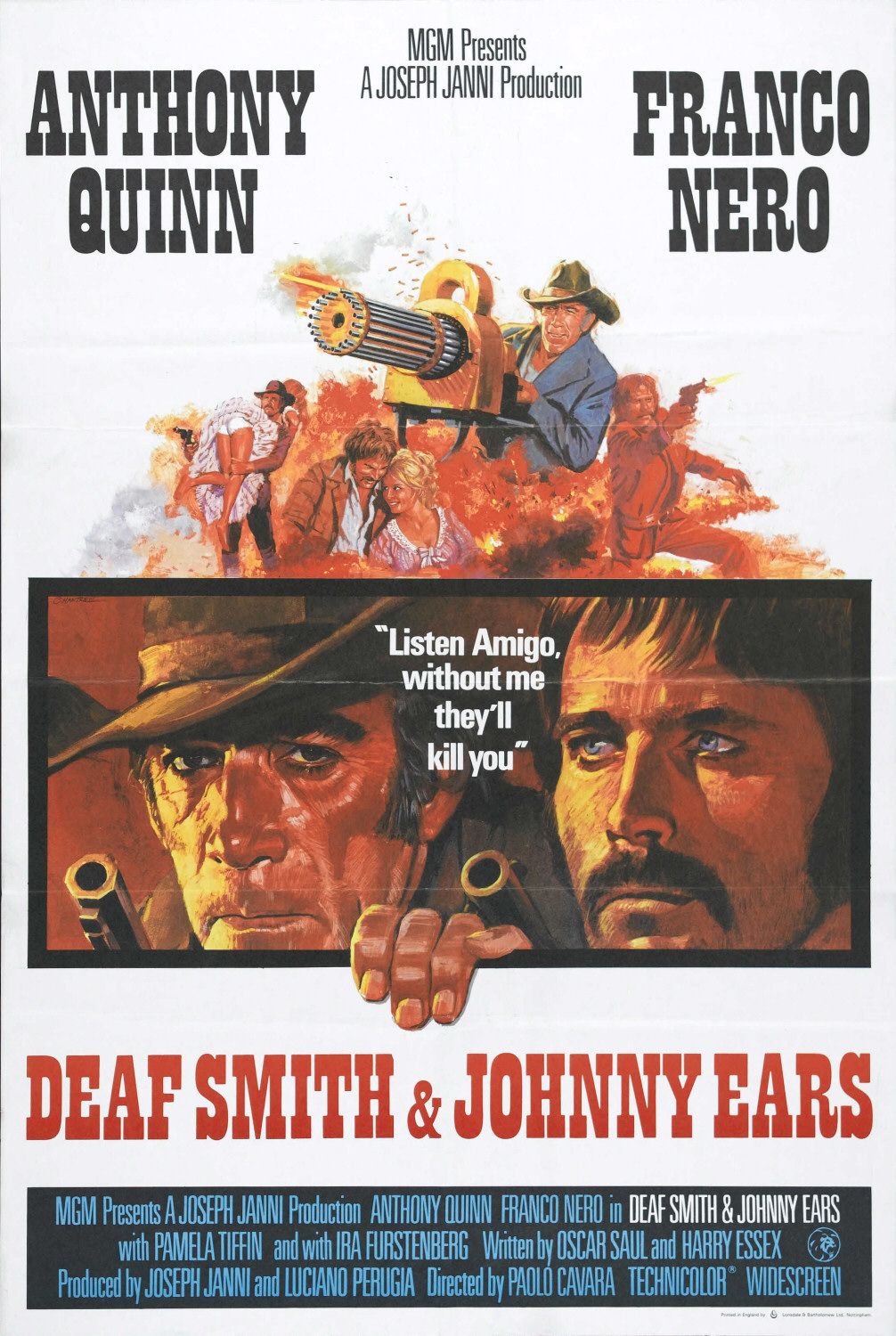
Deaf Smith and Johnny Ears (1973)

deaf smith and johnny ears

By Richard Winters

My Rating: 3 out of 10

4-Word Review: Deaf mute saves Texas.

Deaf Smith (Anthony Quinn) and Johnny Ears (Franco Nero) are two special agents hired by President Sam Harris to put down any rebel factions that may try to impede Texas from achieving statehood. While Deaf, who lacks the ability to speak as well as hear, works on bringing down the bad guys by sneaking into one of their hideouts Johnny seems more interested in the women particularly a hooker named Susie (Pamela Tiffin) who he meets at the local cathouse.

These are the type of cheap, low grade, generic productions that end up giving spaghetti westerns a bad name. Had Sergio Leone been put in charge of this it might have been something special, but the director here has a poor eye for detail and lacks Leone’s poetic nuance. The action is poorly choreographed and unexciting and during a shootout inside a darkened cave it even becomes confusing and irritating. The music is loud and blares out melodies that do not reflect the period and the villain is bland and not given enough screen time to be able to create any type of effective menace.

Quinn, who doesn’t speak a single line of dialogue, is fabulous and manages to steal every scene that he is in. Nero on the other hand tends to overact especially with his exaggerated facial expressions. Tiffin, who appears nude from a distance during a segment done near a stream, shows a good campy side especially with the scene where she beats up Nero.

There was an actual Deaf Smith that the character here is loosely based on although the real Smith suffered only a partial loss of hearing and was not a mute. His real-life adventures were much more interesting than the ones portrayed here and the film would’ve done better had it stuck to those.

The movie also suffers from some anachronistic errors including having a scene featuring a Gatling Gun even though the setting for the film is 1836 and the gun itself wasn’t invented until 1862 when it was first used during the Civil War. The prop used to represent the gun looks cheap and flimsy while painted in a garish gold color that doesn’t deserve the Gatling name and only helps to cement this as barely watchable tripe.

My Rating: 3 out of 10

Alternate Title: Los Amigos

Released: March 29, 1973

Runtime: 1Hour 28Minutes

Rated PG

Director: Paolo Cavara

Studio: MGM

Available: None at this time.

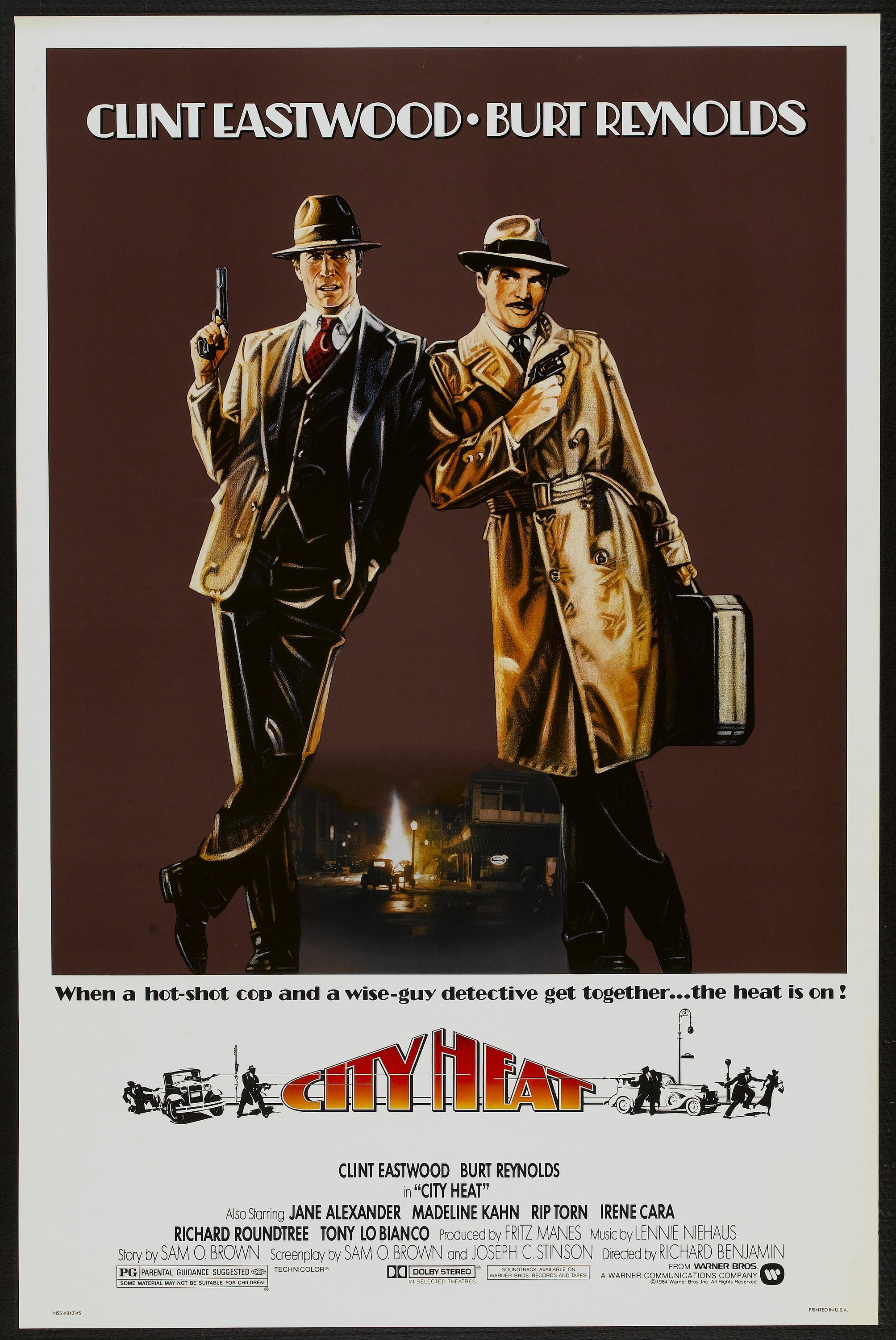
City Heat (1984)

city heat

By Richard Winters

My Rating: 5 out of 10

4-Word Review: Clint and Burt together.

Mike Murphy (Burt Reynolds) is a private eye living in 1930’s Kansas City who at one time worked as a cop. When his friend Dehl (Richard Roundtree) gets murdered after obtaining the secret accounting records of a local mobster and then trying to blackmail him with it Mike goes on a mission to find the culprit, but soon finds himself in over his head. His former police partner Speer (Clint Eastwood) gets involved and the two reluctantly work together to solve the case despite the many clashes with their personalities and methods.

The script was written by Blake Edwards who gets credited under the pseudonym Sam O. Brown. He was originally slated to direct, but Burt didn’t want to work with Edward’s wife Julie Andrews who was cast in the role that later went to Madeline Kahn because the two had clashed just a year earlier while starring in The Man Who Loved Woman. Clint desired a less intense director at the helm, so the two used their star status to have Edwards yanked from the project and replaced with actor-turned-director Richard Benjamin. The result is a strange mish-mash of a movie that at times seems like a pedestrian action flick and at other moments becomes a campy comedy.

The film starts off well. I enjoyed the fight Reynolds with has with two men inside a café while Eastwood sits back and does nothing, but things deteriorate quickly after that. Part of the problem is Eastwood and Reynolds are only funny when they are seen together and working off of each other’s contrasting styles. Alone there are boring at least here with Eastwood playing too much of a caricature of himself while Reynolds is unconvincing as a tough guy. The film would’ve worked much better had the two been partners from the very beginning instead of throwing in this contrived bitterness between the two, which is never funny or interesting.

Outside of Rip Torn’s performance as a rival gang boss the supporting cast is wasted especially Jane Alexander in a thankless throwaway role as Reynold’s secretary. Kahn manages to have some redeeming moments when she gets kidnapped by the mob and then beats her captors at poker, but it is not enough. Irene Cara sings a few good tunes, but proves to be weak as an actress.

The shootouts are great and the best thing in the movie as unlike the rest of the film they manage to have a nice balance between being exciting and funny. Unfortunately the plot itself is overblown, confusing and formulaic and a prime example of a Hollywood production relying too much on the charisma of its two stars while failing to supply them with material that is fresh or original.

My Rating: 5 out of 10

Released: December 7, 1984

Runtime: 1Hour 33Minutes

Rated PG

Director: Richard Benjamin

Studio: Warner Brothers

Available: VHS, DVD, Amazon Instant Video, YouTube

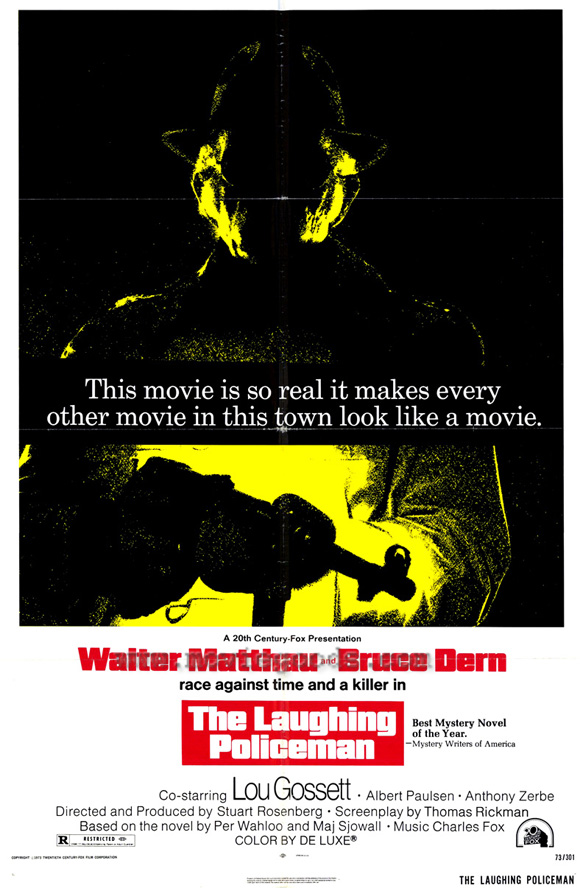
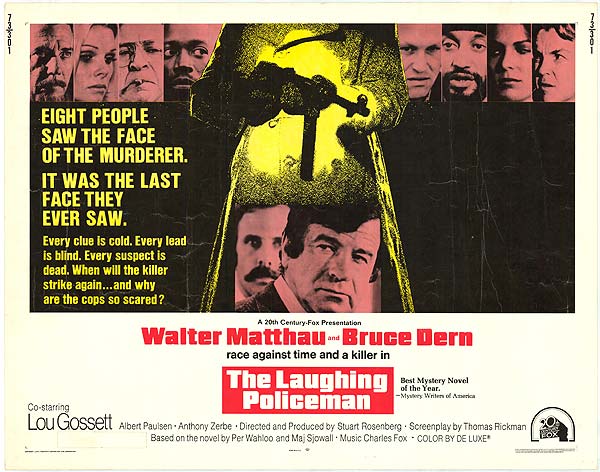
The Laughing Policeman (1973)

the laughing policeman 1

By Richard Winters

My Rating: 7 out of 10

4-Word Review: This policeman isn’t laughing.

8 passengers on a San Francisco bus are slaughtered to death by a mysterious gunman for no apparent reason. When Police Sargent Jake Martin (Walter Matthau) investigates he finds that his patrol partner is one of the victims. He soon learns that his partner was working on another case during his off hours dealing with a murdered prostitute that Jake had also worked on, but couldn’t crack. He begins to believe the two cases are somehow connected, but his brash department head (Anthony Zebe) doesn’t agree and thinks it is a waste of time to pursue the possible connection while also sticking him with Leo (Bruce Dern) a younger cop who doesn’t always like to play within the rules and whose manner and methods conflicts with Jake’s.

The film, which is based on the novel by Per Wahloo and Maj Sjowall who also did the book version for Man on the Roof, has a finely detailed gritty nature about it that looks at the methods of a police investigation in a realistic and unglamorous fashion, which significantly helps this one stand out from the usual cop dramas. I loved the way they searched for clues on the bus and the autopsies of the victims as well as pursuing leads that never pan out, which is a very common occurrence in most police investigations, but rarely is ever shown in movies. There is even a shot of a tow truck removing the disabled bus from the accident scene once the investigation is completed.

Although the novel’s setting was Stockholm the movie transplants the action to San Francisco making the Bay City almost like a third character. Director Stuart Rosenberg manages to nicely capture the eclectic vibe of the area and the disdain many people had for the police during that era. The movie also uses very little music, which is a major asset and helps accentuate the realism. Outside of the closing credits the only time there is really any other music is near the end when Jake and Leo start following a suspect, which comes off as jarring and should’ve been left out.

Matthau who’s mostly known for his comedic parts does well in an atypical role, which due to his casting and the film’s strange title may make some think it is a comedy though this is far from it. Dern is terrific in a role that takes full advantage of his edgy acting style and I liked how the two characters don’t get along at first, but eventually get past their differences and use each other’s unique strengths to their advantage. I was disappointed though that there is a side-story dealing with Jake’s tumultuous relationship with his teenage son that gets introduced early on, but then dropped and completely forgotten during the second half.

Louis Gossett Jr. gets a star making turn as a brash street cop and Zerbe is superb in support as the gruff police chief. Joanna Cassidy has a brief, but interesting bit as a witness and I liked the shot showing her and Dern sitting amidst a row of tables with table legs made to look like human ones. It’s also amusing to note that Albert Paulsen’s character who becomes the main suspect in the film never utters a single word of dialogue.

Spoiler Alert!

The film’s biggest downfall though is with its ending. It is very hard to believe that a character such as Paulsen’s that is portrayed as being rich and having a lot of connections would feel the need to shoot and kill the bus passengers himself as most if not all rich people simply hire someone else to their dirty work. I also didn’t think that someone who walks down the street surrounded by lawyers would crack as quickly as this one does when Matthau comes to question him about the case. A typical well-off businessman would simply ‘lawyer-up’ and trust that the minimum evidence that the police have would not hold up in court instead of jumping into his car and racing down the city streets in a panic such as he does here. The finale becomes too conveniently Hollywood-like and seems to sell out on the film’s original concept, which left this viewer with a flat and ambivalent feeling towards it when it was over.

the laughing policeman 2

End of Spoiler Alert!

My Rating: 7 out of 10

Released: December 20, 1973

Runtime: 1Hour 52Minutes

Rated R

Director: Stuart Rosenberg

Studio: 20th Century Fox

Available: DVD

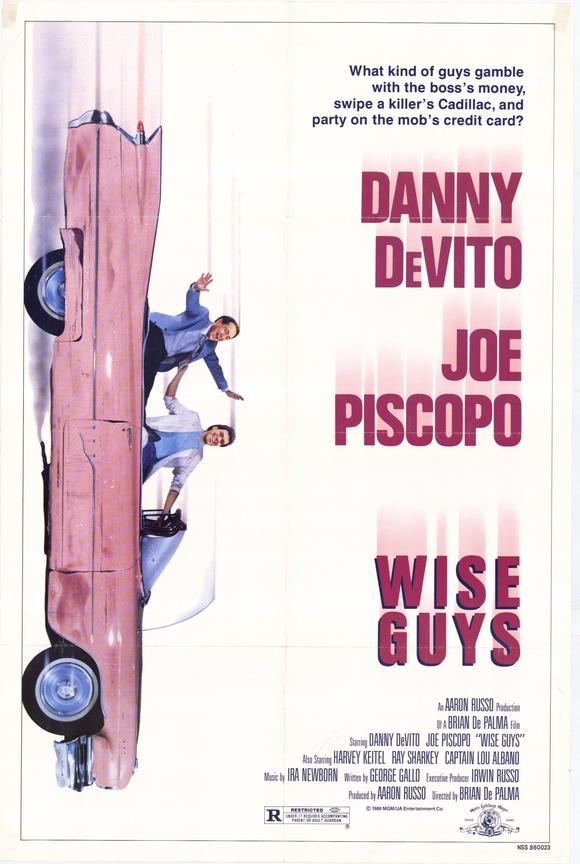
Wise Guys (1986)

wise guys

By Richard Winters

My Rating: 3 out of 10

4-Word Review: Hiding from the mob.

This review contains some Spoilers!

Harry and Moe (Danny DeVito, Joe Piscopo) work as errand boys for a Newark, New Jersey mob run by Castelo (Dan Hedaya). They are tired of doing all the odd, dangerous jobs that no one else wants to and long to one day break away and open up their own restaurant, but lack the required capital. Then one day they are assigned to go to the track to bet on a certain horse, but Harry is convinced that another one will win, so they place all $250,000 dollars on that one only to lose. Now they must go on the run searching for Harry’s Uncle Mike who they hope can replenish them with the lost money before the mob’s henchman The Fixer (Captain Lou Albano) catches up with them to dispense their punishment.

Director Brian De Palma returns to his comical roots of Hi Mom! and Greetings, but unfortunately this film lacks the creativity and originality of those and instead comes off as just another tired, generic 80’s comedy. The attempted twists are not interesting or surprising. Having them lose on a ‘sure thing’ after they initially start gloating when it looks like their horse would win is comedy writing 101. The Sting-like ending is equally contrived and something I figured out long before it gets revealed. Again, you simply have to know the rules of a Hollywood comedy, which states every ending must be a ‘feel good’ one, so if a main character suddenly dies you automatically know there’s got to be some sort of catch to it such as is the case here.

The motivations of the characters are loopy. For one thing going back to their boss while putting up only a mild resistance after they’ve lost the money for what will most definitely be punishment and torture seems dumber than dumb even for these dimwits. The idea that they would both stay loyal to one another even during torture is not believable. Yes it may sound noble, but realistically especially when their families were being threatened it would have to be expected that at least one of them would crack and betray the other. Then the boss has them assigned to kill the other one and for a while they both secretly consider it, but this doesn’t make sense either because if they are going to remain so loyal to the other during torture then shouldn’t it be expected that they would immediately tell each other that they’ve been pegged to kill the other and then come up with some alternative plan to get out of it?

The destruction of Fixer’s convertible becomes another logical blunder. Yes, they both despise him and the chance at destroying his prized possession would seem tempting to anyone in their shoes, but they also need his car to get away and go places, so destroying it until it is literally inoperable becomes really stupid.

DeVito is great at playing arrogant, sarcastic jerks, but as a sympathetic good guy he is benign and out-of-place. I also didn’t care for wrestler-turned-actor Albano’s presence as his character is too one-dimensionally crude and obnoxious and the part where he is shown lying on his back with his big fat belly exposed is just plain gross to look at.

There have been some great gangster movies throughout cinema history, but they all tend to be ones that take the genre seriously and when they try to give it a comical spin it comes off as lame like this one. The part where Harry’s grandmother (Mimi Cecchini) reveals a million dollar bills that she has ‘stuffed under her mattress’ and the way all of Castelo’s henchmen eagerly light up his cigarette every time he puts one in his mouth, which happens twice with the second time being the gem, are the only two mildly amusing moments in this otherwise flat comedy.

My Rating: 3 out of 10

Released: April 18, 1986

Runtime: 1Hour 40Minutes

Rated R

Director: Brian De Palma

Studio: MGM

Available: VHS, DVD, Amazon Instant Video

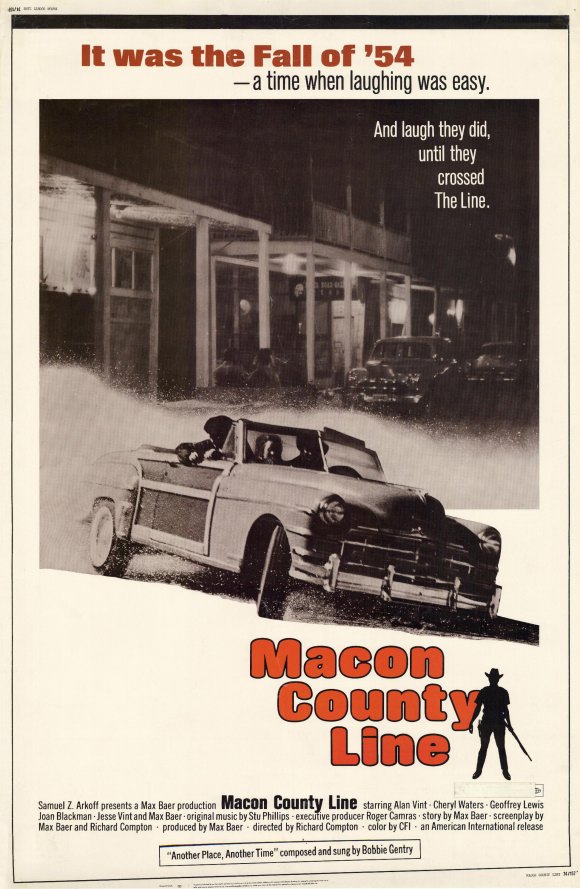
Macon County Line (1974)

macon county line 3

By Richard Winters

My Rating: 6 out of 10

4-Word Review: Sheriff attacks innocent trio.

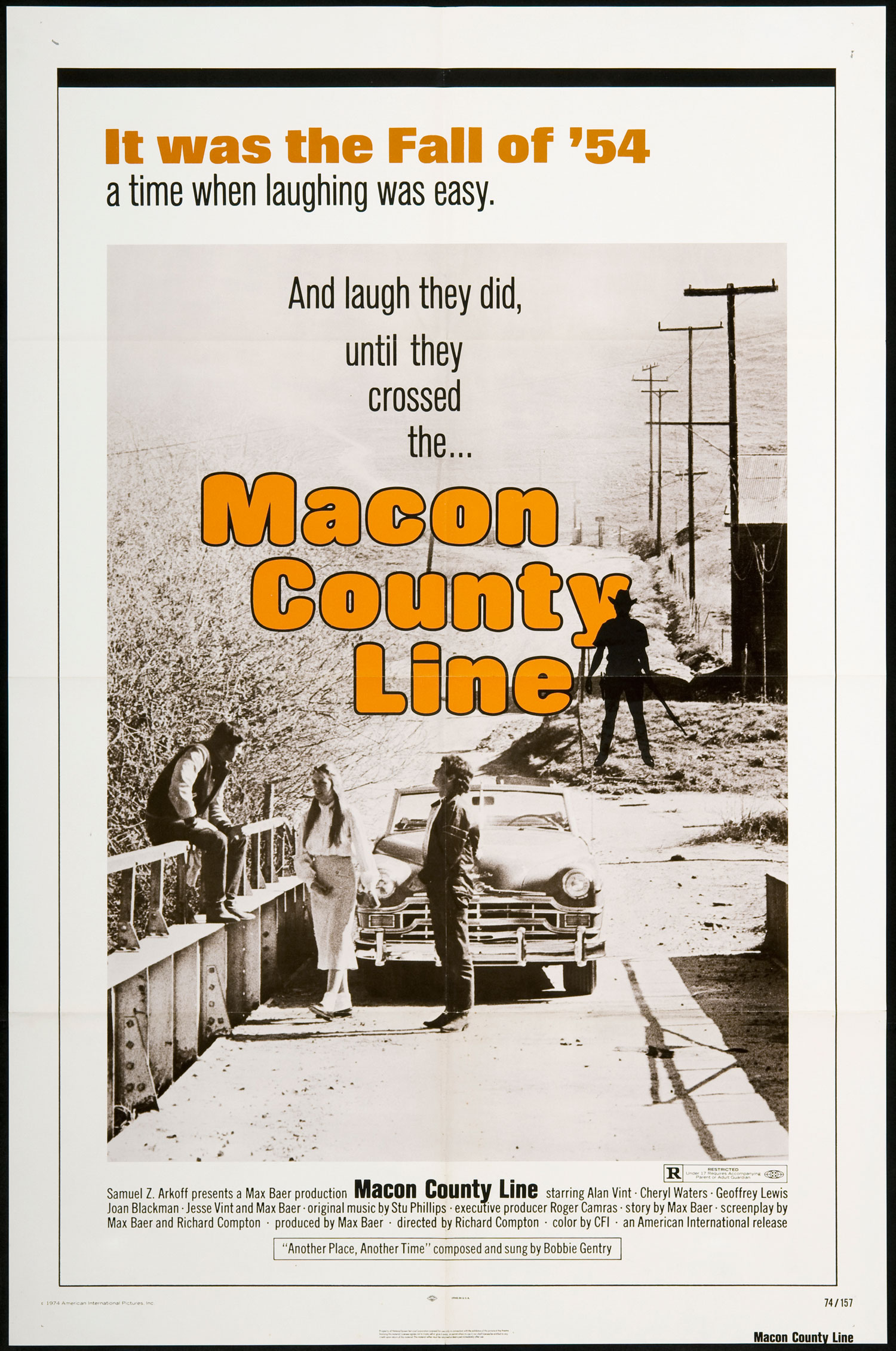
The year is 1954 and Chris and Wayne Dixon (played by real-life brothers Alan and Jesse Vint) are two brothers traveling through the Deep South for one last hurrah before joining boot camp. Along the way they pick up attractive hitch-hiker Jenny (Cheryl Waters) and the three appear ready to party it up when their car suddenly breaks down in front of an isolated country home. Unbeknownst to them the home’s inhabitant (Joan Blackman) has been murdered and when her husband, who just so happens to be the county sheriff, (Max Baer Jr.) arrives to find the carnage he immediately suspects it’s the kids sleeping in the nearby car. Thus begins a wild night chase through the country backwoods as the three try desperately to outrun a man with an unrelenting rage while pleading with him that they are innocent.

The film is a definite step above the average drive-in fare of that era with characters that manage to avoid the usual stereotypes and clichés. The 1950’s are painted in a little more of an edgier way and populated by people that are much more crass than what you will find in an old episode of ‘Leave it to Beaver’ or some sanitized recreation of that period, which I found to be refreshing. The music, particularly La Vern Baker’s gospel tinged opening song and Bobbie Gentry’s closing one is great and really helps to create a definitive mood. There are also two really good flashback sequences including a dimly lighted, moody one dealing with police brutality of a criminal and an ‘interrogation’ scene done at a police station that isn’t bad either.

Unfortunately the story is thin and hinges solely on the frantic chase that takes up the movie’s final 20 minutes, which is well edited and even features a twist ending, but up to then it is rather uneventful with too much time spent on the trio’s visit with a dimwitted auto mechanic (played by Geoffrey Lewis) that adds unnecessary comic relief.  There is also an ill-advised, dream-like segment where Jenny and Chris decide to take off their clothes and make love in some stagnant water found inside an old, rusted circular drinking trough in an abandoned barn that not only takes away from the film’s grittiness, but also seemed extremely unhygienic as well. I was also expecting more car chases especially with all he nicely refurbished vintage cars that appear, but the only one that they do have gets shot at night and the camera focuses more on the driver’s nervous faces in a cheesy melodramatic style than on the automobiles.

The film was produced and co-written by Max Baer Jr. who is better known as Jethro from the hit 60’s TV-series ‘The Beverly Hillbillies’ and in fact he wrote the story for this movie on the back of some Hillbilly scripts during breaks in filming. Although this was filmed in Sacramento the location is supposed to be the south and could’ve been either Georgia, Tennessee, or Alabama as all three of those states have a Macon County, but the real irony is that the two brother are from Chicago and we even see a close-up of their Illinois plate, which also has a Macon County although it’s likely the story wasn’t set in that one.

macon county line 4

My Rating: 6 out of 10

Released: August 8, 1974

Runtime: 1Hour 28Minutes

Rated R

Director: Richard Compton

Studio: American International Pictures

Available: DVD

Partners (1982)

partners

By Richard Winters

My Rating: 2 out of 10

4-Word Review: Pretending to be gay.

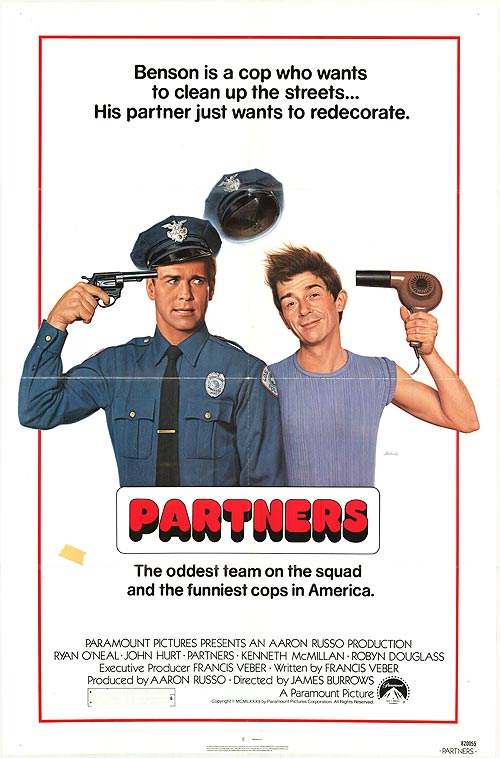
A serial killer targeting gay men is on the prowl. When one of his victims turns out to be the son of an influential politician pressure is put on the police force to find the culprit. The police chief (Kenneth McMillan) feels he has no choice but to pair Sgt. Benson (Ryan O’Neal) a straight cop with Kerwin (John Hurt) who is a gay desk clerk at the station. They are to masquerade as a gay couple in hopes of infiltrating the gay underground and find clues to the elusive killer, but their contrasting personalities and lifestyles threaten to blow their cover before they can make headway.

This film was controversial at the time of its release for its overuse of gay stereotypes and there are indeed some especially at the beginning, but the film’s biggest offense is that it is just plain boring. The idea that two cops could be forced to pretend to be a gay couple or have one of them pose naked for the cover of a gay men’s magazine as part of their investigation is dubious enough, but had it been funny I might have forgiven it. Unfortunately this thing can’t even elicit a few chuckles.

The idea that Kerwin would automatically fall in love with Benson while working together simply because he is another man is absurd and makes about as much sense as a heterosexual male falling for every woman that he meets, which of course doesn’t happen. The Benson character is also quite callous and disrespectful to Kerwin while showing blatant homophobic tendencies and being a confirmed ladies’ man, so I didn’t see what there was about him that Kerwin would have fallen in love with anyways.

Benson’s transformation to being more sensitive to gays and their issues during the course of the story might have been more compelling had it been better written. However, his liberal use of the word ‘faggot’ makes the film seem quite dated and wouldn’t be heard in a movie today especially from a character that is supposedly a protagonist.

Hurt plays the gay caricature well, but the idea of placing someone on such a dangerous mission without having any undercover experience of even knowing how to use a gun seemed stupid and unrealistic. Out of all the characters McMillan’s comes off best and he even manages to be slightly amusing, but unfortunately isn’t seen enough. Character actors Jay Robinson and Sydney Lassick can be spotted very briefly.

This was intended to be a parody of Cruising, which was released 2 years earlier and was a much more serious and graphic look at a true life killer of gay men. That film starred Al Pacino and will be reviewed next Monday.

My Rating: 2 out of 10

Released: April 30, 1982

Runtime: 1Hour 32Minutes

Rated R

Director: James Burrows

Studio: Paramount

Available: VHS, DVD

Dead Heat (1988)

dead heat

By Richard Winters

My Rating: 5 out of 10

4-Word Review: These cops are dead.

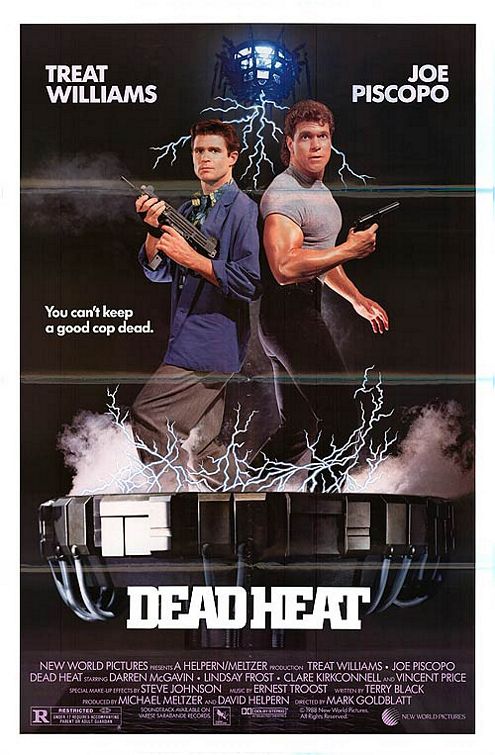
Roger and Doug (Treat Williams, Joe Piscopo) are two cops fighting bad guys that seem to be indestructible. They get shot at, but never die. Upon further investigation it seems some maniacal madmen (Darren McGavin, Vincent Price) have come up with a resurrection machine that can bring dead people back to life and they are being used as zombies to rob banks and commit other types of crimes. When the two cops end up being killed while on-duty they are put onto the resurrection machine themselves and ultimately making it dead cops chasing after the dead bad guys.

The film’s script by Terry Black is creative and has enough energy to be passably entertaining. Unfortunately the pace is too fast and the runtime too compact making the many elaborate twists and turns happen too quickly and conveniently and many times making no sense. Mark Goldblatt’s direction looks amateurish with a faded color and a film stock that looks like it was initially done on video and then transferred to film. The special effects are surprisingly good given the budget and for the most part the film’s only saving grace. The two best moments are when the two leads get attacked by produce at a meat market including that of a beheaded steer as well as when the Randi character (Lindsay Frost) decomposes right in front of Roger.

The acting is genuinely poor and Piscopo is especially weak, but has funny enough lines to at least be humorous. McGavin looks understandably embarrassed and seems to be simply going-through-the-paces while Price in one of his last film roles appears tired, old and frail.

William’s gives an okay performance and I liked how his is more subdued and educated character played off of Piscopo’s hyper one, but the way his character responded to things seemed weird. For instance when he finds out that he is dead and brought back to life for only a short time before decomposing he doesn’t respond with panic, but instead continues to go about his job in a very matter-of-fact way and when his partner is found dead in a particularly gruesome way he doesn’t react with any type of emotion or shock.

The film also fails to follow through on its own logic. For instance when Roger finds out he is dead and then gets cut on some glass he does not bleed, but later on when he gets shot there is blood coming out of his bullet holes. The bad guys cannot be killed by bullets because essentially they are dead already and yet somehow can still be stopped by electrocution or impalement with a pole, but why as essentially they should still be able to continue no matter what the injury.

The final act becomes like a cheesy B-horror movie that goes way over-the-top and overall the whole thing is badly disjointed. However, it’s an okay time-filler if approached with exceedingly low expectations.

My Rating: 5 out of 10

Released: May 6, 1988

Runtime: 1Hour 23Minutes

Rated R

Director: Mark Goldblatt

Studio: Image Entertainment

Available: VHS, DVD, Blu-ray, Amazon Instant Video

Your Three Minutes Are Up (1973)

your three minutes are up 2

By Richard Winters

My Rating: 6 out of 10

4-Word Review: Road trip goes bad.

Charlie (Beau Bridges) is unhappy with his life. He is stuck in a dull job and engaged to Betty (Janet Margolin) who is constantly nagging him. He longs for a more carefree existence that is friend Mike (Ron Liebman) enjoys. Mike does not work a job and spends most of his time trying to cheat what he feels is a cold and impersonal system, but also has to deal with constant calls from bill collectors and the stress of trying to make ends meet with very little money. The two decide on a whim to take a little road trip, but during the course of their journey things begin to unravel as both men realize there are limits to everything and once you cross it you must pay the consequences.

The film like the characters spans the entire critical spectrum. The script, which was written by James Dixon who appears as the character Howard is incisive and taps into something every individual on the planet must deal with, which is learning how to balance individuals desires with societal demands. Other films have lightly touched on it, but few delve into it quite this deeply. I especially enjoyed the Charlie character who starts out as an obedient schmuck that gets ordered around by everyone, but also harbors a pent up anger that comes out slowly until it finally erupts into volcanic proportions that shocks even him.

Unfortunately the direction by Douglas Schwartz is dull and unimaginative. The budget was clearly low, which gives the movie a cheap TV-Movie look and feel. The framing and camera work is uninspired and could have used more close-ups, tighter editing and better lighting. The film also contains four generic sounding songs all sung by Mark Lindsey the former lead singer from Paul Revere and the Raiders that lack distinction and give the movie a dated quality.

I also didn’t care for the Margolin character. She is a beautiful woman physically, but the character is too much of a one-dimensional nag. Why she would continue to call Charlie and beg him to come back when he clearly lied to her while also openly telling her that she annoyed him didn’t make much sense. The scene where she walks in on him in bed with two naked women and instead of just ending the relationship immediately she stays and tries to ‘reason’ with him, which came off as pathetic and unrealistic.

This also marks the film debut of Nedra Volz a late bloomer into acting who at age 65 started a two decade career playing old lady roles in various TV-shows and movies. She can be briefly spotted at the 31-minute mark playing an old lady sitting on a bench at a bus stop and accepting a free newspaper only to become shocked and embarrassed at its provocative headline.

nedra volz

June Fairchild who appears as a woman who stuffs her face with food at a fancy restaurant thinking that she is being treated to dinner only to end up getting stiffed with the bill ironically had her real-life paralleling the lead character’s quandary in the movie. She was in a string of films during the 70’s, but when the offers dried up she became a homeless alcoholic living on skid row and the subject of a February, 2001 article in The Los Angeles Times. Friends came to her rescue and she managed to get back on her feet and now judging by some recent pics is looking happy and still quite attractive.

june fairchild 1

My Rating: 6 out of 10

Released: August 7, 1973

Runtime: 1Hour 27Minutes

Rated R

Director: Douglas N. Schwartz

Studio: Cinerama Releasing Corporation

Available: YouTube