Category Archives: 80’s Movies

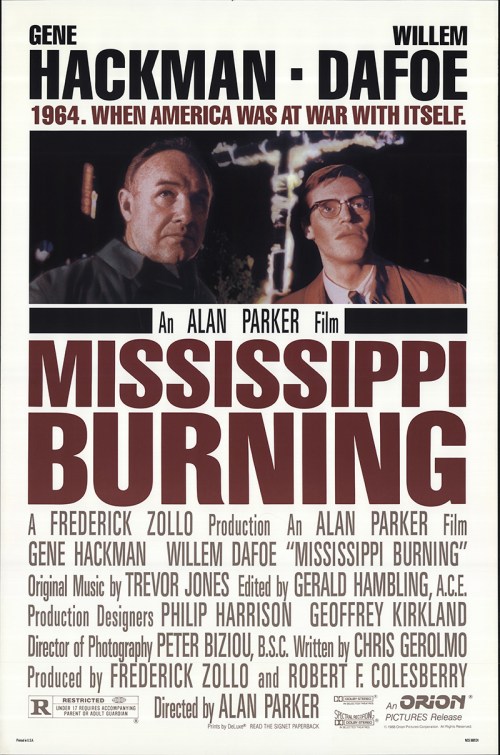
Mississippi Burning (1988)

By Richard Winters

My Rating: 6 out of 10

4-Word Review: Searching for missing activists.

Rupert Anderson (Gene Hackman) and Alan Ward (William Dafoe) are two FBI agents sent to Jessup County, Mississippi in 1964 to investigate the disappearance of three civil rights activists who had been canvassing the area trying to get the African Americans registered to vote. The two soon find that any attempts to get to the truth are stymied by the town’s sheriff (Gailard Sartain) and his deputy (Brad Dourif) who exert a fear over the residents not to say anything. However, Rupert finds a ray-of-hope in the form of the deputy’s wife (Frances McDormand) who shows signs of harboring a dark secret. Rupert feels if he can somehow get her to talk that they could then crack the case.

The film is based on the murders of James Earl Charney, Andrew Goodman, and Michael Schwerner, who were killed on June 21, 1964 in Philadelphia, Mississippi while in the area promoting voter registration rallies.  Screenwriter Chris Gerolmo began writing the script after doing research on the incident and his intent was to keep the story as accurate as possible, but once Alan Parker was hired to direct big rewrites were made causing major friction between the two. The ultimate product, once it was eventually released, became quite controversial at the time mainly from surviving family members of the slain activists for the way the film fictionalized things.

Ultimately though I felt it was pretty well made and I was very impressed with the visual aspect that director Parker bought to it. Filmed on-location in several small towns throughout the state of Mississippi the film manages to bring to life the period in stunning detail. The only caveat being the portrayal of the white townspeople who all come-off as one-dimensional racist stereotypes. Of course we know there were bigots living there, but I suspect there had to be some that weren’t and even if the reason they didn’t come forward is because they were scared the film should’ve made an attempt to show this.

The portrayals of the two agents and the different ways they approach the case is interesting. I liked seeing Hackman in a more detached, laid-back character who isn’t as constantly intense as he usually is. Dafoe is good to with his hard-nosed, by-the-books mentality, but we learn absolutely nothing about their private lives especially Dafoe’s which makes him less interesting as we only see him in one type of setting. I thought it was a bit weird too that Dafoe, who in real-life was 25 years younger than Hackman, got cast in the role of Joseph Sullivan, who was the real-life FBI agent that he was portraying in the film, as Sullivan was in reality 9 years older than John Proctor whom Hackman portrayed.

Spoiler Alert!

Using Mrs. Pell, the deputy’s wife, played by McDormand, as the tipster that let the agents know where the dead bodies were buried, was creative license that the screenwriter used since at the time the identity of the real tipster, then known only as ‘Mr. X.’ was a mystery. Eventually in 2004 it was revealed to be that of Maynard King, a highway patrolman. Using the deputies wife in place of the patrolman was okay, but it becomes too obvious that she’ll eventually squeal since it’s made to look like she’s the only non-racist person in the town and thus signaling upfront that she’ll do the conscientious thing. It would’ve been more intriguing as she been a bigot and then to everyone’s shock ultimately reveal the secret anyways for whatever reason.

Having her husband bring home a group of men to observe him beating her when they become aware that she’s told the agents the victim’s whereabouts to me didn’t ring true. I would think any husband, even the abusive kind, would want to keep the couple’s arguments private and not let the whole world in on it. If he loved her even a little I would think he’d give her a chance to explain herself before her tore in on her, but bringing along friends to witness the event rarely occurs even in the most abusive of relationships. Even if it was done to protect his reputation (making sure the other racist townspeople knew he had nothing to do with his wife’s betrayal) I think he’d still have them stand outside the home while he beat his wife and not like it’s done here.

I was glad at least that upon Hackman’s urging a scene featuring him sleeping with McDormand was left on the cutting room floor. A law enforcement agent sleeping with a potential witness is highly unethical even if Hollywood movies do it all the time. Hackman should not have to sleep with her to get her to do the right thing nor does a budding friendship between a man and woman, especially if one of them is married, necessarily always have to automatically lead to sex because many times in reality it won’t.

The film’s second act is also problematic as it sets up the premise, agents looking for missing activists in a racist southern town, and then goes nowhere with it. No new wrinkles get entered in and too many ugly racial confrontations get shown until it becomes almost too depressing to watch. We understand up front the injustice that is going on and don’t need this to constantly get repeated like it does.

The ending scene has the whites now standing side-by-side with the blacks in unity, which is nice to see, but a bit over-the-top dramatically. Where were these open-minded white folks at the beginning, or are we to accept that this one incident as now ‘cured’ the town of it’s racist behavior and moving forward everyone will now hold hands and sing Kumbaya?

My Rating: 6 out of 10

Released: December 2, 1998

Runtime: 2 Hours 8 Minutes

Rated R

Director: Alan Parker

Studio: Orion Pictures

Available: DVD, Blu-ray, Amazon Video
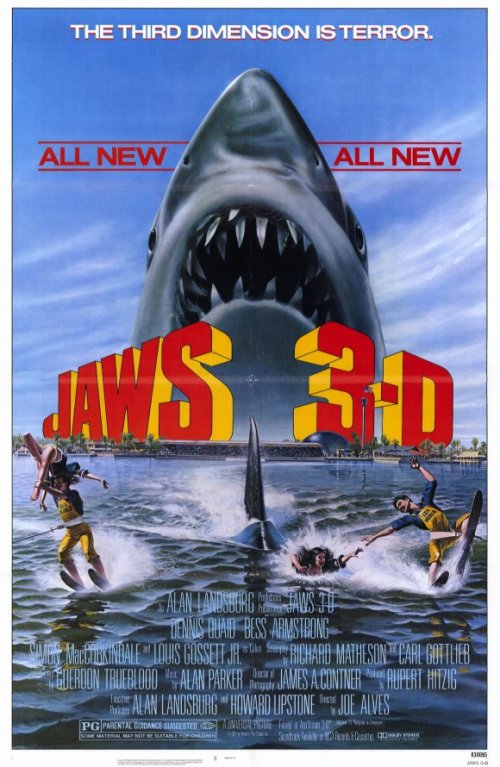
Jaws 3 (1983)

By Richard Winters

My Rating: 2 out of 10

4-Word Review: Killer shark attacks Seaworld.

A new theme park has opened up in Orlando, Florida. This one has been designed by Calvin Bouchard (Louis Gossett Jr.) and will feature underwater tunnels and an aquatic pool with dolphins and whales. However, just before the grand opening a great white shark and its offspring sneak in through the park’s closing gates. It’s now up to Mike Brody (Dennis Quaid) the son of Chief Brody from the first two Jaws movies, and marine biologist Kathryn (Bess Armstrong) to stop the shark from attacking the people as they venture into the water and tunnels.

This sequel was originally conceived as being a spoof and the title of it was going to be Jaws 3, People 0. John Hughes was commissioned to write the screenplay and Joe Dante was slated to direct. It was even going to have the author of the ‘Jaws’ novel, Peter Benchley getting eaten by a shark right at the beginning in his very own backyard pool, but Steven Spielberg became aware of the idea and threatened to pull out of the deal he had with Universal if they went through with it, so it was nixed, which is a shame because even if the humor had been lame it would still have been better than anything you’ll see here.

Like with most sequels there aren’t enough new elements entered into the mix to make what we see interesting. It just replays on the same tired formula including the scene where Quaid frantically warns everyone to get out of the water much like Roy Scheider did in the first one, which comes off as derivative and uninspired. The idea of having the two male characters be the sons of Chief Brody, in an apparent desperate attempt to tie this one in with the first two, is really dumb. The odds that the Brody offspring would continue to get into situations that would involve killer sharks are quite low and the fact that they do makes the family seem like they’re affected by some sort of curse.

The storyline dealing with Brody’s younger brother Sean (John Putch) who comes to visit and his extreme fear of going into the water, due to is childhood trauma of the shark attack years earlier, is stupid too especially since he immediately goes into the water with the coaxing of bikini clad Lea Thompson. If his fear was that severe no woman, no matter how beautiful, would get him to go against it. Why even enter in this plot element if they’re just going to have him get over the problem right away? Why not put it to good use by creating a scene where Quaid is trapped in the water and relying on his younger brother to overcome his fear so he can jump in to save him and thus create tension with the viewer wondering whether he’ll be able to do it or not?

The shark attacks take too long to get going and then when they do they happen too quickly. The 3D effects, like having a severed arm floating towards the viewer, are cheesy and not scary at all. Although with that said, the brief sequence showing a man being eaten by the shark from inside the shark’s mouth is pretty cool and the only reason that I’m giving this film any points at all.

I also found the entire cast, and their benign side-story issues, to be completely boring. The viewer is supposed to have some concern for the welfare for these individuals, but I had none. Simon MacCorkindale is semi-colorful and gets thrown in to act as a potential jerk to the rest, but this doesn’t get played-up enough.

Spoiler Alert!

I had a lot of issues with the climactic sequence too. For one thing it features the cast standing inside an underwater control room watching the shark coming at them through the glass window causing them to simultaneously scream at the same time, but it’s shown in slow-motion making it come off as corny and unintentionally funny. My biggest beef though is that the shark is able to burst through the glass without any problem. I’ve been to underwater aquariums and the glass that is used is of a much thicker variety than ordinary windows in order to withstand the water pressure and yet here the shark shatters it away in seconds like it was the same type of glass used for your living room window.

End of Spoiler Alert!

While a small cult in recent years has taken to this film it was lambasted quite justifiably by the critics upon its initial release with one calling it: “a cheese soaked ocean thriller with no evident reason to exist.” The film’s opening weekend did quite well, but once the bad word-of-mouth got going the box office receipts dropped sharply. Don’t be fooled by seeing Richard Matheson’s name listed on the screenwriting credits either. All he did was supply an outline, which he insisted got heavily revised later on by script doctors. He also labeled the final product, once he finally saw it, as a “waste of time”.

My Rating: 2 out of 10

Released: July 22, 1983

Runtime: 1 Hour 39 Minutes

Rated PG

Director: Joe Alves

Studio: DVD, Blu-ray, Amazon Video, YouTube

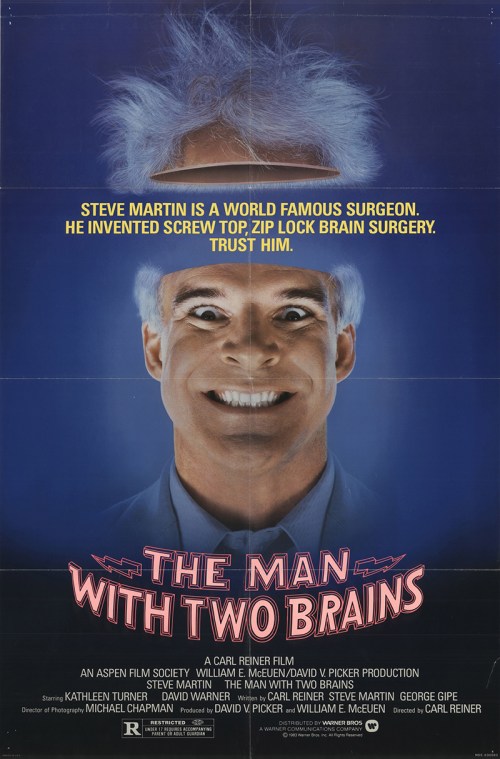
The Man with Two Brains (1983)

By Richard Winters

My Rating: 6 out of 10

4-Word Review: Brain in a jar.

Dr. Michael Hfuhruhurr (Steve Martin) is a world famous brain surgeon who accidentally hits Dolores Benedict (Kathleen Turner) one day while driving his car. He immediately does surgery on her and during the recovery the two get married. However, Dolores is only interested in Michael’s money and continues to see other men behind his back. Michael on-the-other hand  meets with Dr. Alfred Necessiter (David Warner) who keeps live brains in jars in his condo. Michael (Steve Martin) begins communicating with one of the brains (voice of Sissy Spacek) via telepathy and decides it is she that he really loves. When he becomes aware that the brain will not survive much longer on its own he desperately tries to find a suitable body to transplant it into.

This Steve Martin/Carl Reiner production, which is their third project together, certainly has its moments and I particularly liked the the mysterious elevator killer although once his identity is finally revealed viewers today will have no idea who that person actually is. However for the most part the film is highly uneven. Having it centered as a horror movie parody would’ve given it better focus and the jokes more of a point-of-view instead of just throwing in any haphazard gag it wants many of which have nothing to do with its already paper thin plot.

I realize this is all meant to be a very silly comedy, but having two victims get hit by a vehicle, once with Turner and then later on with Stephanie Kramer, in her film debut, where neither victim shows any sign of blood, scratches, or bruising is a bit ridiculous. This is where if it had been approached as a horror/comedy then they could’ve thrown in some gore, but in an over-the-top goofy way, that would’ve allowed a new dimension for laughs while also given it just a smidgen of reality to it, which otherwise is lacking.

Martin’s ability to have a conversation with a brain in a jar without any special apparatus connecting the two is equally ridiculous. The excuse is that it’s ‘telepathy’, but why is he able to communicate with just the one brain when there are many others that are also in the room? What special ability does this brain have over the others and why is Martin the only one that can hear it and no one else?

Having Martin hear Spacek’s voice as her thoughts come into his brain doesn’t make sense either. The definition of telepathy is the  communication of thoughts and ideas other than the known senses, but nothing to do with voices. Thoughts in themselves don’t have a distinct voice connected to them unless the brain is attached to a voice box, which this one isn’t.  It is true that thoughts going on in person’t own head may have that person’s voice, so Martin should actually be hearing his own voice as his brain deciphers the messages being sent to it from the other one much like if he were reading out loud a note that had been written by someone else.

This also marks an odd career choice for Turner who burst onto the scene with her sexy performance in Body Heat . I realize that in her effort to avoid typecasting she wanted to do something that was completely different from her first film, but her character is too campy and one-dimensional and she ends up getting completely upstaged by Martin in every scene they’re in. The role also has a creepy foreshadowing as her character gains a lot of weight much like she has in reality due to her rheumatoid arthritis. In real-life it’s the drugs and chemo that caused the weight gain while here it’s created through make-up and a body suit and intended for comical effect.

There’s also an interesting behind-the-scenes story dealing with a scene involving a 5-year-old girl, played by Mya Stark, who must verbally repeat back to Martin from memory a very complicated set of directions that he had just told her. Since she was too young to read no cue cards were used and director Reiner figured it would take all day to film the scene convinced that many retakes would inevitably be required for her to finally get the lines right, but instead to his shock she repeated the lines back correctly the very first time. Then 30 years later in 2012 Reiner was standing in line at a store when a female business executive approached him and introduced herself. She stated that they had met many years before, but Reiner didn’t recognize her until she told him that she was that little girl now all grown up.

My Rating: 6 out of 10

Released: June 3, 1983

Runtime: 1 Hour 31 Minutes

Rated R

Director: Carl Reiner

Studio: Warner Brothers

Available: DVD, Blu-ray, Amazon Video, YouTube

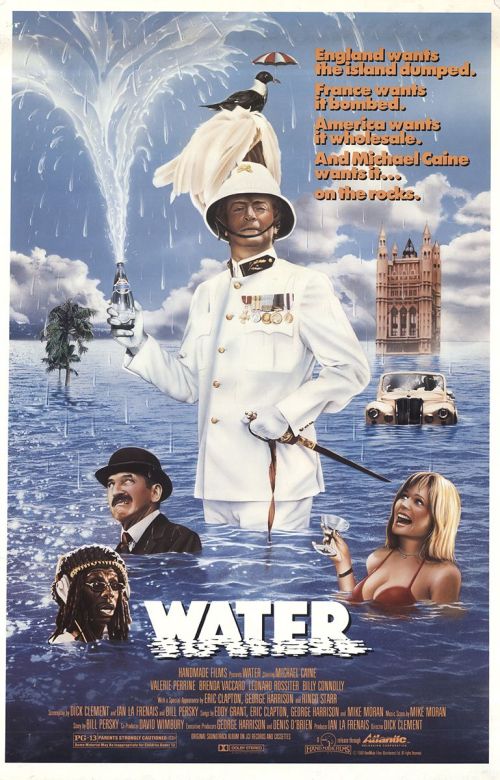
Water (1985)

By Richard Winters

My Rating: 4 out of 10

4-Word Review: Island nation fights back.

Governor Baxter Thwaites (Michael Caine) runs the British Colony island of Cascara a largely peaceful place that is mostly ignored by everyone else. Then one day one of the oil rigs on the island taps into a underground reservoir of water that has all of its impurities already removed. The delicious tasting drink, that can also be used as a laxative, becomes much sought after from bottling companies across the globe. Now suddenly the British government wants everyone on the island to move out and find some other island to live on while taking over and turning this one into a profit making venture.

The film is patterned after many British satires of the 50’s through the 70’s like The Bed Sitting Room and O Lucky Man that mixes in wacky characters with absurd comic scenarios and also trying to make sharp political observations in-between. Unfortunately this film, which is based on a story by Bill Persky who appears briefly as a TV director, goes soft and is too similar in its vapid tone to Persky’s other social satire flop, Serial, which came out 5 years earlier. The message is too ambiguous and the plot too cluttered with insignificant characters that it becomes almost nonsensical.

The characters are so eccentric that the viewer cannot identify with, or care about any of them. The film in a way comes off as almost racist since the island is populated with black people, but the main characters are all white while the blacks folks get completely pushed into the background. If anything the viewer could’ve sided with the islanders and their quest to protect their homeland, but since all focus is put on the British people who control them, that never happens.

The eclectic cast is the only thing that somewhat holds it together. Brenda Vaccaro, who normally plays in dramatic roles, is very funny as Caine’s feisty wife although I could’ve down without her misguided accent. Valerie Perrine, with her clear blue eyes is fun too as an idealistic social activist although she was already in her 40’s at the time in a role which would’ve been better served by someone in their late teens or early 20’s.

Caine on-the-other-hand isn’t all that entertaining with the exception of the scenes showing him wearing a cocked hat, which are amusing.  He at least seems more comfortable here than in Blame it on Rio, which he did the same year as this one, but due to the subject matter in that one he clearly looked quite awkward and stiff while here he’s having a fun time even if the audience really isn’t.

This also marks the last feature film appearance of Leonard Rossiter, who died in his dressing while waiting to go on stage in a play he was in just a few months after completing his filming here. Normally he’s enjoyable to watch even when he’s playing a stuffy character, which is what he usually did anyways, but here he’s too much of a jerk and I did not find him to be humorous or interesting in any way.

If there is one person that ultimately does comes-off best it would be Billy Connelly who’s hilarious as this rebel leader who refuses to speak and instead communicates everything through singing. Dick Shawn is also quite good as this arrogant actor whose career has declined and now forced, much to his dismay, to being a spokesperson for informercials. You can also spot Joyce Van Patten very briefly in an uncredited role as a TV news reporter.

George Harrison, who also produced the film, appears near the end playing the bass guitar in front of political leaders at the UN while Ringo Starr handles the drums and Eric Clapton does the vocals, but the movie would’ve been more entertaining had all three of them been given roles to play, or at  least it couldn’t have hurt. The film’s title is a bit misleading too as the water ultimately has nothing to do with what saves the island from takeover, or allows them to keep their independence.

My Rating: 4 out of 10

Released: January 11, 1985

Runtime: 1 Hour 55 Minutes

Rated PG-13

Director: Dick Clement

Studio: Atlantic Releasing Corporation

Available: DVD

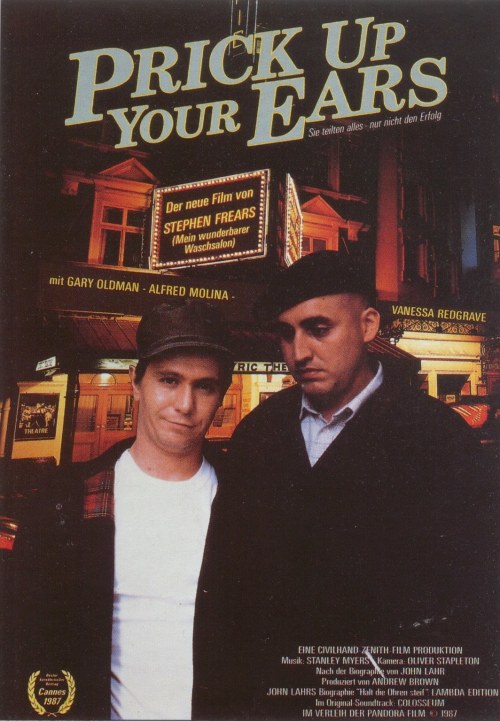
Prick Up Your Ears (1987)

By Richard Winters

My Rating: 7 out of 10

4-Word Review: Bio of Joe Orton.

This film, which is based on the biography of playwright Joe Orton that was written by John Lahr, has two diametrically different story lines going on at the same time. One part has John Lahr, played in the movie by Wallace Shawn, going around interviewing people that knew Orton when he was alive, which includes Orton’s theatrical agent Peggy Ramsey (Vanessa Redgrave). The other part delves into Orton’s (Gary Oldman) relationship with his Kenneth Halliwell (Alfred Molina) showing how it began and then eventually ending in tragedy.

The film, which was directed by the usually reliable Stephen Frears, starts out right away with the murder scene showing Halliwell covered with blood as he stands over Orton’s body that he has just killed, which to me was a mistake. Sometimes using flashbacks in films can help accentuate the story, but here it gives too much away way too soon. What’s the point of continuing to watch the movie if the viewer knows exactly how it will end? Even if one such as myself was aware of Orton’s demise, which occurred on August 9, 1967 in Islington, England, it still should’ve approached the material in a linear way having the murder occur at the very end after we had gotten to understand and feel for the characters and therefore making the act all that more impactful.

The story should’ve started with the scene, which doesn’t occur until 30 minutes in, where Halliwell and Orton are attending a acting improv class, which is where the two first meet and the funniest moment in the movie. In the scene the students are instructed to pass around a make-believe cat and when this invisible cat gets handed to Halliwell, and to the shock of the other students, but to the amusement of Orton, he kills it and then hands it back to the instructor.  This moment also perfectly reflects the black humor that became so apparent in Orton’s plays as well as conveying the weird dynamic that the two had.

When the film focuses solely on the two lead characters and their love-hate relationship it is quite interesting. Molina gives a powerhouse performance and dominates every scene that he is in. His mental deterioration is both vivid and horrorifying and  leaves a lasting impression. Yet there are also other moments where you feel sorry the guy and it helps to make sense of what lead to the tragedy as you see how Orton, who is much younger and better looking, openly have trysts with other men that he randomly meets while Halliwell, fully aware of what is going on, gets pushed into the background and unable to do anything about it.

The film is also filled with some memorable imagery. The scenes where Orton and sometimes Halliwell would pick up strangers for indiscriminate sex, like in dingy public restrooms with the lights turned off and even at times inside the bathroom stalls themselves while constantly in fear of getting caught and arrested, is well captured. The tiny room that the two lived in for years, with pictures that cover every inch of the walls, gets recreated to a perfect tee. Based on images of the actual room found on Google it looks exactly like the one in the movie and its claustrophobic dimensions hits home making it seem amazing that such significant long lasting stage plays, that were later made into movies, could’ve been written in such an insignificant space that seemed no bigger than someone’s walk-in closet.

The opening bit that focused on Orton’s agent and having her reminisce about her experiences dealing with him is boring and should’ve been taken out of the final cut. Viewers come into this wanting to learn more about Orton and his relationship with Halliwell and that’s where the film should’ve started and stayed. I admit Redgrave gives a very good performance as the agent, so having brief scenes with her in them that intercut between the ones dealing with the lovers might have been interesting, but too much time gets spent on the side characters that almost dismantles the entire rest of the film.

Spoiler Alert!

I didn’t like how loud crashing music gets abruptly played during the murder sequence either. The soundtrack had been quite subtle up until then, so having it suddenly get loud is jarring and goes against the tone of the rest of the film. It also puts too much of a theatrical quality to the murder that was not needed. The  visuals are all that is needed to show the shocking and gruesome nature of the act without music needing to be any part of it.

My Rating: 7 out of 10

Released: April 17, 1987

Runtime: 1 Hour 45 Minutes

Rated R

Director: Stephen Frears

Studio: The Samuel Goldwyn Company

Available: DVD

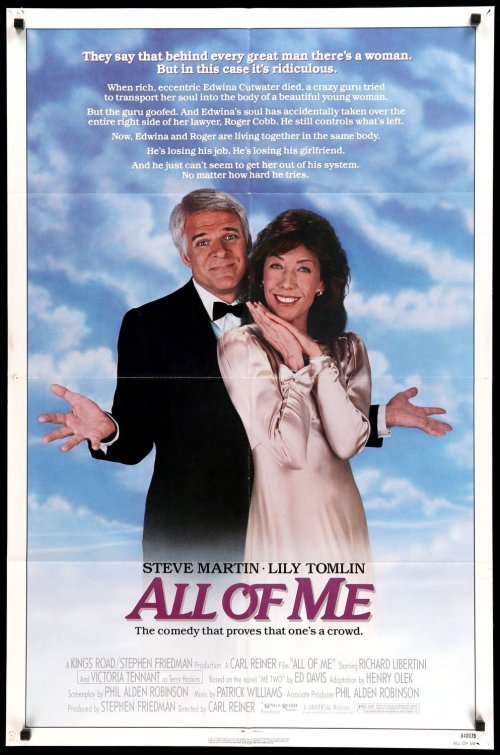
All of Me (1984)

By Richard Winters

My Rating: 3 out of 10

4-Word Review: Two people, one body.

Roger (Steve Martin) is a lawyer who finds his job unfulfilling while Edwina (Lily Tomlin) is a millionaires suffering from a terminal illness and about to die. She has employed the services of a mystic named Prahka Lasa (Richard Libertini) who has mastered the ability to transfer human souls. She wants her soul placed into the body of a young woman named Terry (Victoria Tennant). Roger is then hired to change Edwina’s will, so all of her money will go to Terry, but a mishap occurs transferring Edwina’s soul to Roger’s body instead. Roger controls the left side and Edwina controls the right. While the two can’t get along they’re required to work together to find the guru and get the mistake corrected.

The film, which is based on an unpublished novel called ‘Me Two’ by Edwin Davis, has its share of funny moments, but they mainly come during the first half. Martin’s physical comedy that he does on a busy sidewalk as he’s required to learn to walk in tandem with the other soul is a laugh-out-loud moment though it would’ve heightened the humor had more passerby’s looked at him as if he were a nut. The scene at a urinal were Martin must cooperate with Tomlin in order for him to take a pee is quite good too and the best moment in the movie.

The script though cheats the scenario by entering in too many illogical points. The concept of a soul ‘sleeping’, had me baffled. Now, I admit I haven’t kept up on the latest in soul science, but it seems to me that a soul should have no need or require sleep. Only the body that a soul is housed in needs to sleep from time to time when it runs out of energy, so through that logic Martin and Tomlin’s souls should have to go to sleep at the same time since they are both housed inside a body that is tired instead of having one remain awake while the other isn’t. The courtroom scene in which Martin sleeps while Tomlin busily moves the body around seemed quite ridiculous too as it’s hard to imagine anyone could sleep while their body talks and walks and in front of other people that speak directly to it.

The scene in the church in which Martin wakes up and doesn’t hear Tomlin’s voice, so he immediately presumes that she’s asleep, is flawed too. Nobody had given him information that souls can sleep, so why does he jump to this conclusion? Why not consider other possibilities instead like maybe her soul had left his body, or that what occurred previously had just been an hallucination or dream?

While both Martin and Tomlin give good performances the supporting cast, or at least the cardboard characters that they’re forced to play, help to bog the whole thing down. Madolyn Smith, as Martin’s jilted fiancee, is too much of a broad caricature while Tennant, who Martin later married in real-life, makes for an incredibly dull villainess.

Libertini is annoying too particularly with his inability to differentiate between a telephone and a toilet bowl. Every time the phone rings he thinks it’s coming from the toilet and never picks up the receiver. It’s an attempted parody to show that he comes from a culture that is technologically deprived, but even the dumbest most isolated person with a modicum of common sense will eventually realize that the ringing sound is coming from the little box in the living room making this lame bit, which gets repeated multiple times, quite dumb.

The biggest downfall though is that the two get too chummy too quickly. Having them remain adversarial and constantly fighting for control of the body would’ve invited far more comically dynamic scenarios than what we are actually given. The plot twists in the third act aren’t interesting either and I found myself getting less engaged the more it went on and left with a flat feeling when it was over.

My Rating: 3 out of 10

Released: September 21, 1984

Runtime: 1 Hour 33 Minutes

Rated PG

Director: Carl Reiner

Studio: Universal

Available: DVD, Amazon Video, YouTube

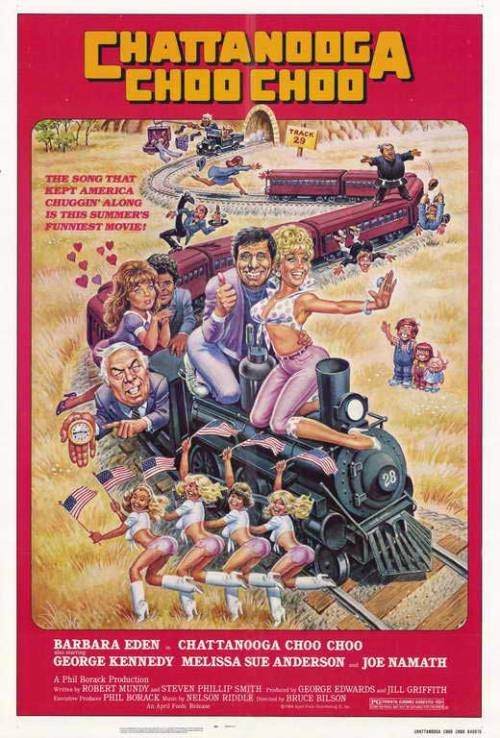
Chattanooga Choo Choo (1984)

By Richard Winters

My Rating: 1 out of 10

4-Word Review: Must arrive on time.

Bert (George Kennedy) is an unscrupulous, conniving owner of a football team who’s having an affair with the beautiful Maggie (Barbara Eden) whom he promises to marry once the father (Parley Baer) of his wife Estelle (Bridget Hanley) dies. He’s hoping to get a large chunk of the will, but finds that it comes with one big stipulation: he must restore the historic locomotive, the Chattanooga Choo Choo, and take it from New York City to Chattanooga, Tennessee within 24-hours and make sure that it arrives precisely on-schedule and if not he’ll lose out on a million dollars.

Producer George Edwards inadvertently struck gold in 1977 when he produced a film based on a hit song, Harper Valley PTA, that did marginally well, so he decided to try his luck with another one, but this time the attempt is an embarrassing failure. Part of the reason is that at least with the Tom T. Hall ditty it had a plot already in the lyrics, but this one doesn’t and the lame scenario that gets written around it is both threadbare and corny.

While Kennedy manages to be amusing he’s also unlikable and the viewer has no interest in seeing him achieve the challenge. For the story to have been more effective the character should not have already been rich, but instead poor and needing the money to help his family survive, which would’ve built more of an emotional interest at seeing him succeed.  Kennedy should’ve also driven the train himself, which would’ve created more comic scenarios instead of just seeing him basically sit back in the diner car doing nothing but nervously glance at his watch while others do the actual work.

Eden is a bore and speaks with in an annoying accent that makes her seem like a floozy from the streets. Bridget Hanley overdoes it with her caricatures of nouveau riche wife that is irritatingly cliched although it’s interesting to note that she did costar with Eden 17 years earlier in a season two episode of ‘I Dream of Jeannie’ titled: ‘My Master, the Swinging Bachelor’.  Jineane Ford, a former Miss USA winner who spent 16 years as a news reporter for KPNX-TV in Phoenix, gets exploited by being forced to play a stutterer, which the filmmakers apparently thought should be a source of amusement, but it isn’t and shouldn’t have been implemented.

Watching Parley Baer’s dead body entombed inside a large box car, which then gets lowered into a giant grave is the film’s one and only original moment. Some may also find Tony Azito as a double-jointed waiter whose never dropped a drink amusing too, but everything else falls flat. More focus needed to be spent on the train scenario, like having it run into a storm, which could’ve threatened its arrival time, or dealing with mechanical problems, instead of dwelling in silly juvenile escapades that are both unfunny and pointless even for mindless escapism.

My Rating: 1 out of 10

Released: May 25, 1984

Runtime: 1 Hour 41 Minutes

Rated PG

Director: Bruce Bilson

Studio: April Fools Productions

Available: VHS

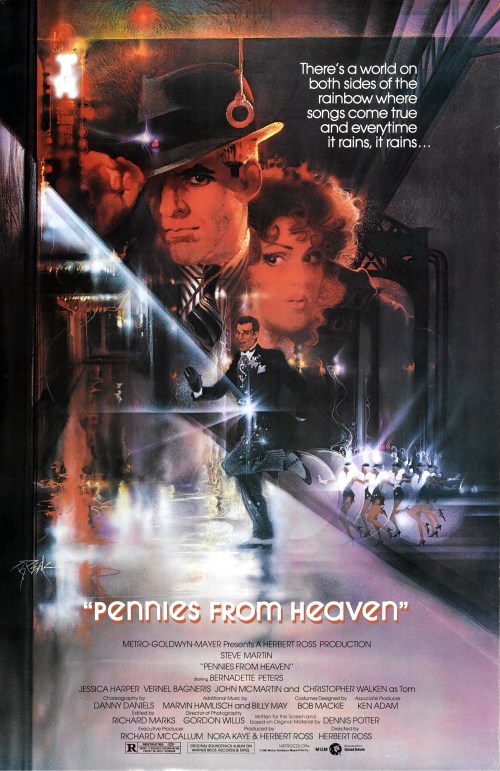
Pennies from Heaven (1981)

By Richard Winters

My Rating: 7 out of 10

4-Word Review: Escaping from the depression.

Arthur (Steve Martin) is a struggling sheet music salesmen during the depression, who’s looking to escape his dreary existence by becoming a songwriter, but finds that no one including his wife (Jessica Harper) cares about what his dreams, which leaves him feeling lost and alone. He then meets perky schoolteacher Eileen (Bernadette Peters) and the two begin an affair despite her not knowing that he is already married. When she gets pregnant and loses her job because of it Arthur is nowhere to be found and instead he gets unjustly tabbed for committing rape on a blind woman (Eliska Krupka) that he did not do.

The film is based on a 6-part miniseries that aired on the BBC in 1978 and starred Bob Hoskins. Martin saw it and was so enamored with the story that he became compelled to have it remade here and the studio even hired the same writer, Dennis Potter, to pen the script although the studio forced him to do 13 rewrites before they finally accepted it. Despite the extravagant musical numbers, which are pretty good, and positive critical reception, the filmed failed to achieve any success at the box office where it took in a paltry 2 million that barely made a dent in its 22 million budget.

A lot of the blame can be placed on the casting of Martin. While I admire him for not allowing himself to be typecast, and for dying his hair brown here, he still comes off as misplaced. You keep waiting for him to say something goofy and absurd like his character in The Jerk would and when he doesn’t you start feeling bored and frustrated. For his part he lashed out at those that didn’t like it calling them ‘ignorant scum’ while anyone who did enjoy the film he labeled ‘wise and intelligent’.

Yet his character is also a problem as he comes off as arrogant and selfish the whole way through. He constantly antagonizes his shy wife pressuring her to submit to his kinky sexual fantasies and when she doesn’t he threatens to walk out. He then lies about his marital status to Peters and is cold and ambivalent when she gets pregnant making him seem like a true jerk and not the funny kind in his earlier film.

Jessica Harper I enjoyed much more. I think she gives her finest performance here and I was genuinely surprised she wasn’t nominated for an Academy Award. Her interpretation of a shy, sheltered Midwestern wife from a more innocent era is completely on-target and I came to sympathize far more with her than Martin. The line that she utters when the police investigators come to her house, after Martin gets accused of rape, is the best moment in the movie. Peters is good too, but I felt her character got in the way and the film would’ve gelled better had it focused solely on the dysfunctional marriage.

The dance numbers are well choreographed with the best one being with Christopher Walken who does a bona fide striptease that took him over 2 months to rehearse. The bit in which Martin and Peters find themselves transported inside a film starring Fred Astaire and Ginger Rogers is quite cool too although Astaire himself tried blocking the footage from being used. He later commented that as a viewer ” I have never spent two more miserable hours in my life” and describing every scene in the film as being “cheap and vulgar.”

The story though starts out too slowly and for the first hour seems like there really isn’t any plot at all. It improves by the second half, but there needed to be more urgency at the beginning and many viewers may not be willing to stick with it.  Having the actors lip-sync the songs was a bad idea too. It gives the whole thing an amatuerish vibe making it seem like it was intended to be a campy comedy when it really wasn’t.

My Rating: 7 out of 10

Released: December 11, 1981

Runtime: 1 Hour 48 Minutes

Rated R

Director: Herbert Ross

Studio: MGM

Available: DVD, Amazon Video, YouTube

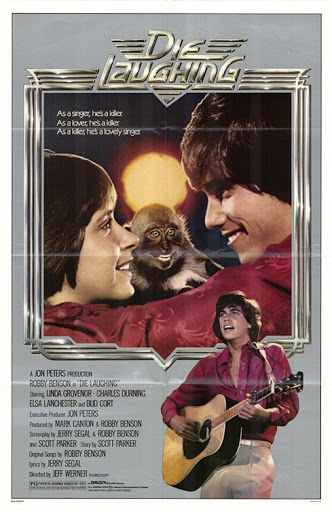
Die Laughing (1980)

By Richard Winters

My Rating: 1 out of 10

4-Word Review: Cabbie accused of murder.

Pinsky (Robby Benson) works as a San Francisco cab driver during the day, but aspires to being a professional singer and attends numerous auditions, but to no avail. One day he picks up a passenger who gets shot and killed while in his cab and Pinsky is mistakenly tabbed as being the killer. Feeling he has no other options he takes the briefcase that the victim was carrying and hides out at his girlfriend Amy’s (Linda Grovenor) apartment. Inside the box they find a live monkey who has apparently memorized the secret formula for turning atomic waste into the plutonium bomb and it’s now their job to keep him away from Mueller (Bud Cort) and his cohorts who want to kidnap the monkey and use what he knows for nefarious purposes.

The film starts out with some potential as it uses Benson’s wide-eyed, deer-in-headlights persona to good comical use, at least initially. Unfortunately by the second half it pivots too much the other way and the minor laughs at the beginning get completely lost when he suddenly becomes this seasoned spy who can quickly think on his feet and outsmart the bad guys at every turn.

Again, this is just an ordinary Joe whose main drive is to make it into the music business, so why get so emotionally invested in a spy case that does nothing but get him deeper and deeper into a dangerous situation? Why not just give the bad guys what they want, hope it appeases them enough that they’ll set you free and then go to the authorities, who are much better positioned to handle this situation, and let them do the rest?

I also thought it was ridiculous that when the couple are tied up and thrown into some dark backroom that they do not respond to the predicament, like any normal person would, with fear and panic, but instead use the moment to become romantic! The fact that they manage to untie each other by biting down on the thick ropes that bind them is absurd as the only thing that would accomplish is a lot of broken-off teeth.

Benson’s musical interludes are a bore and he ends up singing the same damn song three different times. He also performs at a concert when just a little while earlier he was being surrounded by spies ready to push him off of a ship, which would be such a traumatic experience for most people that it’s doubtful he’d be able to emotional calm down enough to focus on singing, or do anything for a long time afterwards.

The story also suffers from having too many villains, Cort is the main one, but he’s seen only intermittently while a bunch of others busily chase Benson around until it becomes dizzying trying to keep track of them all. The plot itself is overblown, relies heavily on worn-out spy genre cliches making it come off like a cheesy parody of James Bond that will cause many viewers to be rolling-their-eyes almost immediately at the campy, strained gags.

My Rating: 1 out of 10

Released: May 23, 1980

Runtime: 1 Hour 48 Minutes

Rated PG

Director: Jeff Werner

Studio: Orion Pictures

Available: DVD-R (Warner Archive), Amazon Video, YouTube

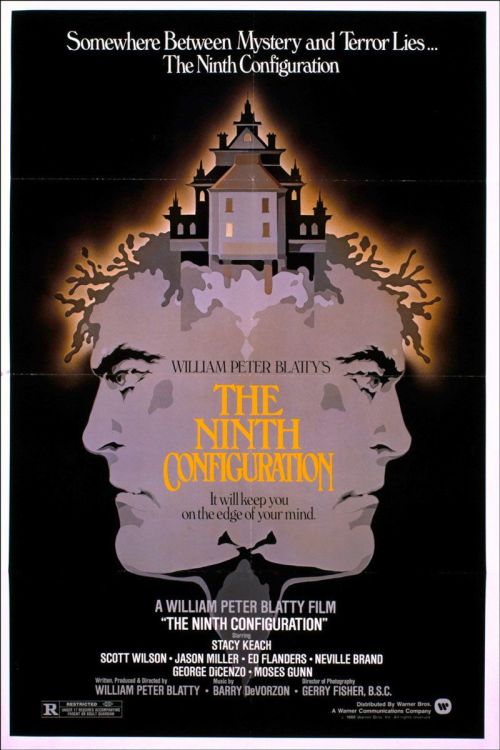
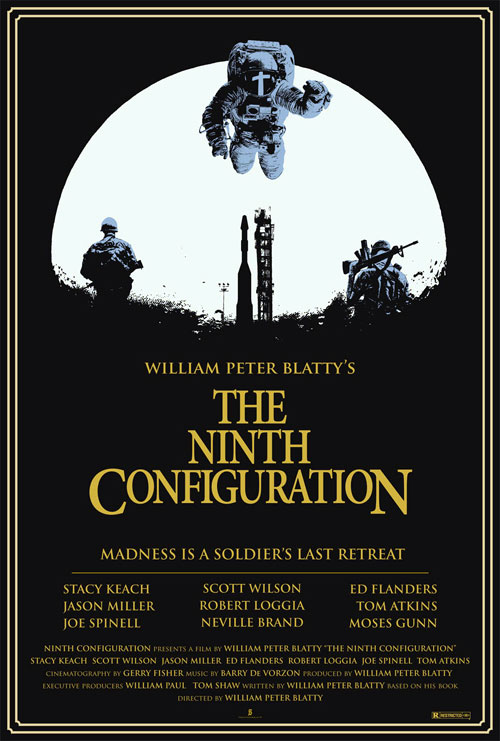
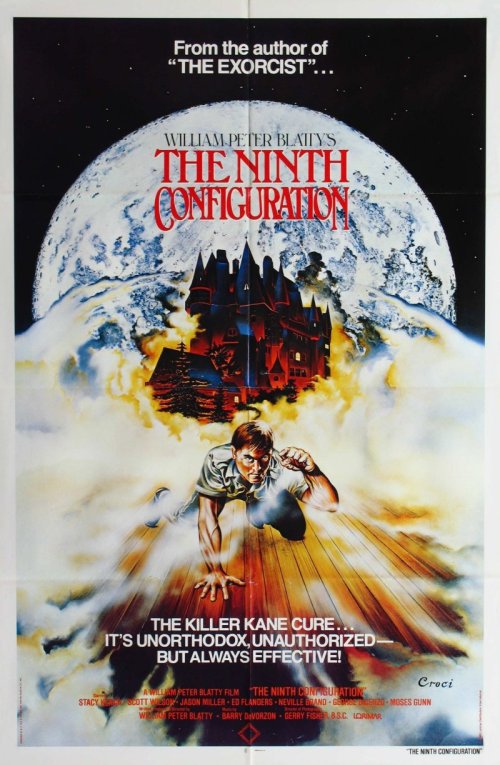
The Ninth Configuration (1980)

By Richard Winters

My Rating: 6 out of 10

4-Word Review: Insane man runs asylum.

Col. Vincent Kane (Stacy Keach), a former marine who is suffering from demons of his own, is selected to head a psychiatric institution built inside a converted castle that specializes in military personal who fought in the Vietnam war and now feign insanity. The challenge is to find if these men are truly mentally ill, or just faking it and Kane’s technique, which allows the patients to openly act out their darkest fantasies, is considered unorthodox. He begins to have an unusual friendship with one of them, Billy Cutshaw (Scott Wilson) a former astronaut who bailed out of an important mission with a nervous breakdown just before lift-off. The two begin to debate the existence of God and the correlation between faith and sacrifice.

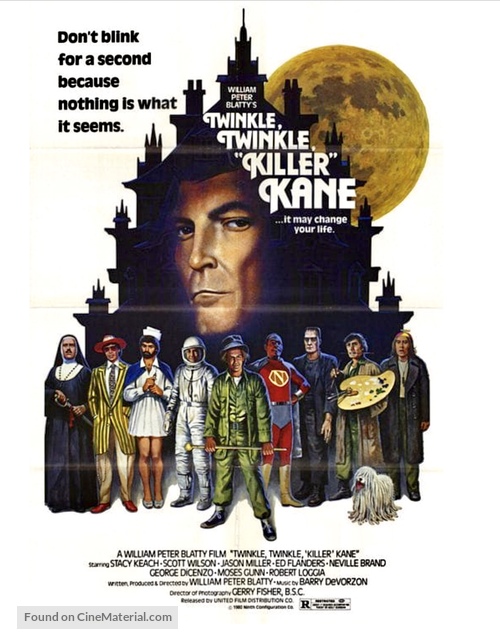
The film has a rocky tone in which part of it delves into campy humor while the other half is more serious. The reason for this is that when William Peter Blatty first wrote the novel of which this movie is based in 1966 it was called ‘Twinkle, Twinkle “Killer” Kane!’ and told in a darkly humorous vein. In 1978 he rewrote the story with a more serious tone and that version was published with the same title as this film.

For me I found the humor off-putting and not funny at all. The whole first hour becomes a complete waste with comical bits that rely too much on mental hospital stereotypes and overall campiness from the performers. There’s also long drawn-out segments dealing with the patients barging into Kane’s office and going on long circular rants that are quite boring.

The second half improves when the tone becomes dramatic, which is what I wished it had been all the way through. It also features a wild barroom fight, which is a bit over-the-top with the way the biker gang dress and behave, but also features some great choreographed violence and a creepy performance by muscleman Steve Sandor as the head of the gang that torments both Keach and Wilson. The second act also features a few surreal, dreamlike sequences, which are the best moments of the film.

The eclectic cast is interesting, but many of them, including Robert Loggia and Moses Gunn, gets wasted in small roles and little screen time. Wilson and Jason Miller are good as two of the patients, but Neville Brand is the best as a drill sergeant that at times seems to be channeling R. Lee Emery and at other moments a confused, overwhelmed man with a deer-in-headlights expression. Blatty, who casts himself as one of the patients is good too, not so much for anything that he says or does, but for his unique facial features, especially his eyes making him look like a guy possessed and the fact that he wrote The Exorcist is even more ironic.

Keach is also excellent, in  a role that was originally meant for Nicol Williamson, but who got fired from the production early-on. Keach manages to be both creepy and hypnotic at the same time. A guy you fear one minute and feel sympathetic for by the end and he does it here without his usual mustache allowing the cleft lip that he was born with to be on full display.

The setting, which was filmed at Castle Eltz in Germany and done there because Pepsi financed the film under the condition that it had to be shot in Europe, is an impressive site. Yet it’s hard to believe that such a Gothic styled fortress, which began being built before 1157, could ever exist inside the USA, which is were the setting is supposed to take place.

The discussions that Keach and Wilson have in regards to the existence of a supernatural being are fascinating and help push the film forward, but the ending, which features a mystical twist, was not needed. The tone, even with the humor, was quite dark, so having it suddenly finish with an ‘uplifting’ moment doesn’t click with everything else that came before it and comes off like it’s selling out on itself.

Alternate Title: Twinkle, Twinkle, “Killer” Kane

My Rating: 6 out of 10

Released: February 29, 1980

Runtime: 1 Hour 58 Minutes

Rated R

Director: William Peter Blatty

Studio: Warner Brothers

Available: DVD, Blu-ray, Amazon Video