Category Archives: 80’s Movies

Vasectomy: A Delicate Matter (1986)

vasectomy1

By Richard Winters

My Rating: 0 out of 10

4-Word Review: Father considers male sterilization.

Gino (Paul Sorvino) is a proud Italian man who has fathered eight children, but now his wife Anna (Cassandra Edwards) doesn’t want anymore kids and pressures him to get a vasectomy. Gino fears the procedure, but eventually agrees only to have an angry confrontation with the doctor (William Marshall), which sends him running away from the operating room. Anna insists that he still must go through with it, or he won’t be allowed back into bed with her until he does. Meanwhile Gino must also worry about his greedy relatives, who’ve concocted an elaborate plan to steal money from the bank he works at and put it out of business.

I don’t know if I’ve ever seen a movie quite this bad. It’s not so much for any technical miscues. No shaky camera, boom mikes getting into the screen, atrocious lighting, schlocky sets, or bad acting. In fact all of those things are okay. What really reeks is the bland script that is poorly paced and not funny. The film starts out really slow and never gains traction. For a comedy there needs to be a lively plot and quick edits, but this thing dies out before it even has a chance to get started. 18-minutes in and I was still waiting for the first laugh and became genuinely confused whether this was meant to be a comedy at all. 

The main plotline is so weak that the inane crooked loan scheme is added jut to pad the runtime. The living situation of the family is rather unrealistic as well. Of course since it was the 80’s, the height of capitalism, the question of whether a family could actually afford 8 kids is never addressed, but most people, even those working at a bank, might find that situation financially challenging. The home looks too well maintained for having all those kids too who would most likely be running around and disorganizing everything. The mother is never shown having to deal with them either. In fact she comes-off as an affluent suburbanite who’s fully in-control of her life and able to out with her lady friends without the typical struggles of having to juggle her personal life with child rearing demands. All 8 kids end up being boys, but what are the odds of that? They’re also all around the same age like she popped them all out simultaneously and all of them get crammed into the same bedroom even though the house they resided in looked big enough that that shouldn’t have been necessary.

Paul Sorvino manages to be solid even though with his rotund belly he does look a bit pathetic during the scenes where he wears a baseball uniform. He does though sing the national anthem surprisingly well, apparently he sang opera to the crew between takes, and the segment where he goes in to the operation and babbles incessantly, is actually kind of amusing. I was not impressed though with Edwards as she looked too young to be his wife like she was still in her 20’s while he was already in his late 40’s. 

While I’m not a violent person I would consider, if I ever met the director of this, Robert Burge, to punching him as I honestly felt like he maliciously stole 90-minutes of my life and I don’t understand what the purpose was for it. 33,000 scripts get submitted yearly, but only 1 percent of those ever gets sold or produced, so how the hell did this one sneak through? Even a crew member from the film stated in his IMDb review that he’d give this a negative rating if he could. Maybe the director was a guy that had enough funds he was able to produce it himself and therefore didn’t feel the need to answer to anybody. If that were the case then this would’ve been an instance where having never made a movie would be better than living with the embarrassment of your name being attached to this mess for all those unfortunate enough to see it.

My Rating: 0 out of 10

Released: September 26, 1986

Runtime: 1 Hour 30 Minutes

Rated PG-13

Director: Robert Burge

Studio: Vandom International Pictures

Available: VHS, DVD-R (dvdlady.com)


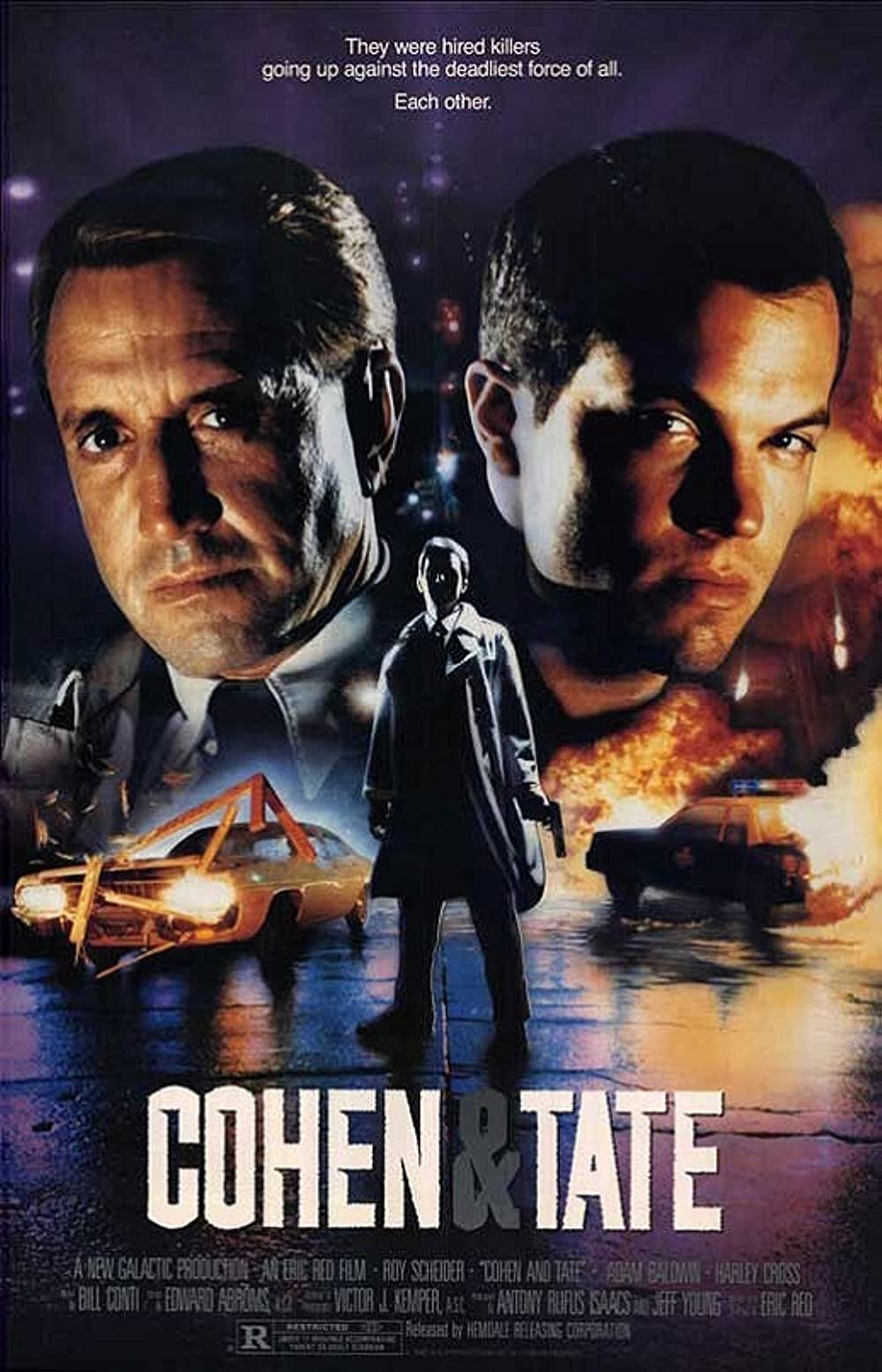
Cohen & Tate (1988)

cohen

By Richard Winters

My Rating: 6 out of 10

4-Word Review: Child witness gets kidnapped.

Travis (Harley Cross) is a 9-year-old who witnesses a mob hit and for his own protection both he and his parents (Cooper Huckabee, Suzanne Savoy) are put into a witness protection program where they are uprooted from the home they’d live-in and moved to an isolated place that has federal agents standing guard outside around-the-clock. One day the place gets invaded by Cohen (Roy Scheider) and Tate (Adam Baldwin), who are two hit men working for the mob. The mob wants to prevent Travis from testifying in court, so the two hit men kill the parents and the federal agents and then kidnap the boy and take him on a long road trip to Houston where the mob bosses can question him directly. Along the way Cohen and Tate bicker and make clear they do not like each other and Travis exploits this to get them to fight more and then uses it as a diversion to escape.

After writing the screenplays for The Hitcher and Near Dark Eric Red was finally given the green light to direct his own movie and tension-wise the film is compact, but visually it’s boring. The car ride taking place almost completely a night where we see nothing but the interior shots of an old, grimy car enveloped by pitch blackness is not interesting and having it instead take place in the daylight where the rugged, but scenic Texas landscape could’ve added ambiance would’ve worked better. The night setting also adds in a few logic loopholes like when the kid runs down the highway there’s tons of traffic, but why would there be so many vehicles in the dead of night and the middle-of-nowhere? Also, you’d think a least a few of those drivers who saw a kid running on the road might want to pull over and offer assistance, but none of them do.

The film’s only surprising element is seeing Roy Scheider play a bad guy, which he rarely ever did. The role was originally intended for Gene Hackman, who turned it down, and then offered to John Cassavetes, who also passed on it, which is ashame. Cassavetes, with his tall stature and hawk-like facial features would’ve been perfect. Scheider, for what it’s worth, is okay, but he looks frail especially when seated next to the much bigger and younger Baldwin making his character appear weak and vulnerable. The film wants to portray Scheider as being in-control, but that’s not really how it ever comes-off. 

The in-fighting between the hit men is a big problem as it telegraphs right away the eventual meltdown between the two and Bladwin’s character, as a young thug with a violent, quick triggered temper, is about as cliched as you can get. These guys don’t come-off as being very smart either making the film’s ironic theme at seeing this young kid outsmart them at every turn not that impressive since anyone with an IQ of 5 could’ve easily done the same thing. A well run criminal plan, or any plan for that matter, predicts unexpected possible problems upfront and has a Plan-B already in-place in-case they arise, but these guys seem like they never bothered to think through anything making their constantly perplexed expressions at every blunder that comes along unintentionally comical and more like they’re stooges instead of bad-ass killers.

The boy is another issue as he’s too savvy for his age. Most kids would be paralyzed with fear at being kidnapped by two thugs who’ve just killed his parents (it’s later learned that the father survived the attack, but upfront he didn’t know this). A normal kid would’ve sat in the back of the car crying and not known what to do, but this one acts super street smart and even talks back to the killers, which isn’t interesting or realistic. A better approach would’ve had him terrified and helpless at the beginning and then slowly becoming more emboldened as the story progressed. 

Spoiler Alert!

The ending is anti-climactic. A police helicopter spots the stolen vehicle that Scheider and the kid are in, so at the last second Scheider veers the car off the highway and drives it into the business district of Houston. However, there are no cars or people around even though it’s during the day. The police squad cars then quickly race in and surround them like they were waiting for him, but how would they have known he would end up in that area since he veered off the highway in an impulsive spur-of -the- moment way?

My Rating: 6 out of 10

Released: October 12, 1988

Runtime: 1 Hour 26 Minutes

Rated R

Director: Eric Red

Studio: Hemdale

Available: DVD-R (MGM Limited Edition Collection), Blu-ray


Beverly Hills Cop II (1987)

beverly2

By Richard Winters

My Rating: 6 out of 10

4-Word Review: Going back to L.A.

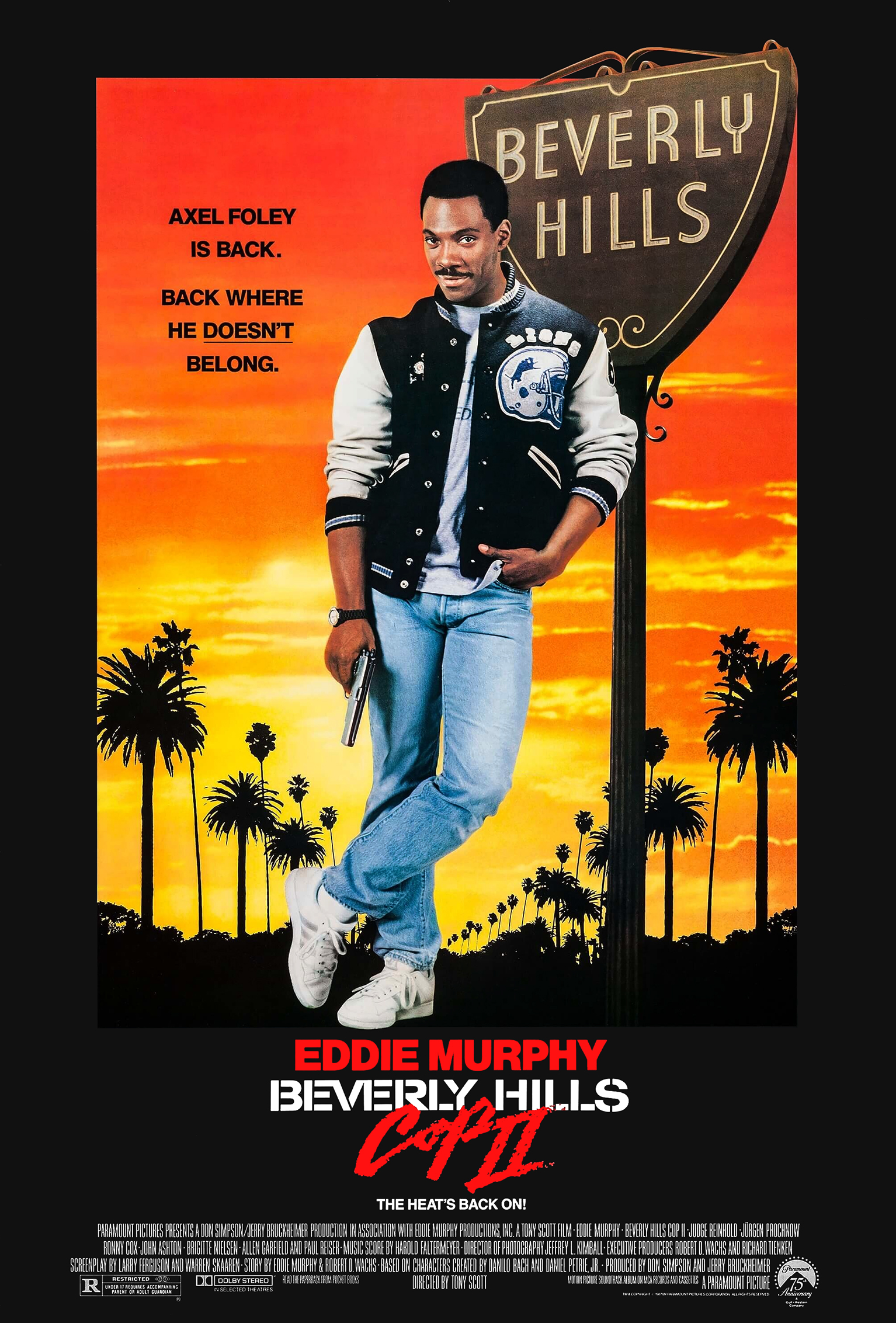
Captain Andrew Bogomil (Ronny Cox), Sergeant John Taggart (John Ashton), and Detective Billy Rosewood (Judge Reinhold) are working on a case known as the ‘Alphabet Crimes’ due to a monogrammed envelope in alphabetic sequence that gets left at the scene of each robbery. Billy decides to get the F.B.I. involved in order to have them help solve the case, but this upsets the new police chief, Harold Lutz (Allen Garfield), who demotes both Taggart and Rosewood to traffic duty and then suspends Bogomil when he tries to come to Rosewood’s defense. On his way home Bogomil gets shot and seriously wounded when he pulls over to help Karla Fry (Brigitte Nielson) who acts as a stranded motorist, but in reality is a part of the organization behind the crimes. When Axel (Eddie Murphy) hears about Bogomil’s shooting he immediately travels to L.A. and again hooks-up with Taggart and Rosewood to solve the case and avenge Bogomil’s assault. 

If  you can get past the overly complex crime mystery, which comes-off as a cheesy variation of Agatha Christie’s ‘The Alphabet Murders’, which apparently was the ‘inspiration’, this sequel, as 80’s sequels go, isn’t bad. Despite Leonard Maltin’s criticism in his review where he didn’t like that Bogomil and Axel had now become chummy and even planning a fishing trip together, I liked it. Maltin considered this ‘inconsistent’ with the first film where the characters were at odds through most of it, but I felt they had grown to like each other after what they had gone through previously and had no problem with it. What I didn’t like though was that Lisa Eilbacher for whatever reason doesn’t return and in her place they stick-in Alice Adair, who plays Bogomil’s daughter, that Axel is good friends with, but since she never appeared in the first one this relationship comes-off as quite forced. 

Having Ashton and Reinhold reprise their roles is great too, but they have little to do. In the first film they worked with Axel more as a team with each using their unique abilities to help take down the bad guys, but here Axel does virtually everything. This was most likely the result of Murphy co-writing the script where he vainly makes his character almost like a super hero and able to solve difficult clues and even at one point hacking into the criminal’s computer system while Ashton and Reinhold act as nothing more than observers who follow along, but add little input. I also didn’t like Reinhold’s character turning into a gun collecting nut, which was something that was never alluded to at all in the first one, but gets played-up here even though it makes the guy seem unintentionally creepy. There’s also a lot of talk about Ashton’s tumultuous marriage to the extent that I felt at some point we needed to see the wife, but never do. 

The humor is silly and doesn’t blend well with the action. What made the comedy work in the first one is that it remained on a believable level, but here starts to get downright stupid. A perfect example of this is when the three guys get into a strip club by pretending Taggart is the former President Gerald Ford, even though he doesn’t look that much like him, but it still manages to fool everybody in the place, which had me eye-rolling instead of laughing. The car chases are a bit farcical, much like the ones seen in a Disney movie, where they attempt to work-in a cheap laugh here and there as it’s going on instead of just making it exciting and realistic. 

I did like Brigitte Nielsen as the villainous and felt that given the time period having a female play a nefarious bad guy was novel. Maltin, in his review, described this as being ‘misogynistic’, but if the ultimate idea is for everybody to be equal then a woman should have just as much chance to play the occasional heavy as any man. Jurgen Prochnow, who plays the head of the evil operation, is too similar to Steven Chekoff, the bad guy from the first installment, to the extent that it seemed like that character had never really died, but instead got reborn through this guy, but his steely, ice-cold presence is cliched, over-the-top, and most of all not interesting.

Having Axel return to L.A. was a mistake and whole thing basically ends-up being a mindless rehashing with no particular point. Like with the first incarnation the producers considered many different potential scenarios before finally settling on this one including having Axel go to Paris and even London where he’d work with Scotland Yard. I would’ve preferred him staying in Detroit and then having Bogomil, Taggart, and Rosewood go there maybe to visit him while inadvertently getting caught-up in a case happening in the Motor City. This then would’ve turned-the-tables by having the three in a foreign environment and seeing how they adjusted to it and would’ve added revealing character development, which is otherwise missing.

My Rating: 6 out of 10

Released: May 19, 1987

Runtime: 1 Hour 40 Minutes

Rated R

Director: Tony Scott

Studio: Paramount

Available: DVD, Blu-ray, Amazon Video 


Beverly Hills Cop (1984)

beverly1

By Richard Winters

My Rating: 8 out of 10

4-Word Review: Detroit cop in L.A.

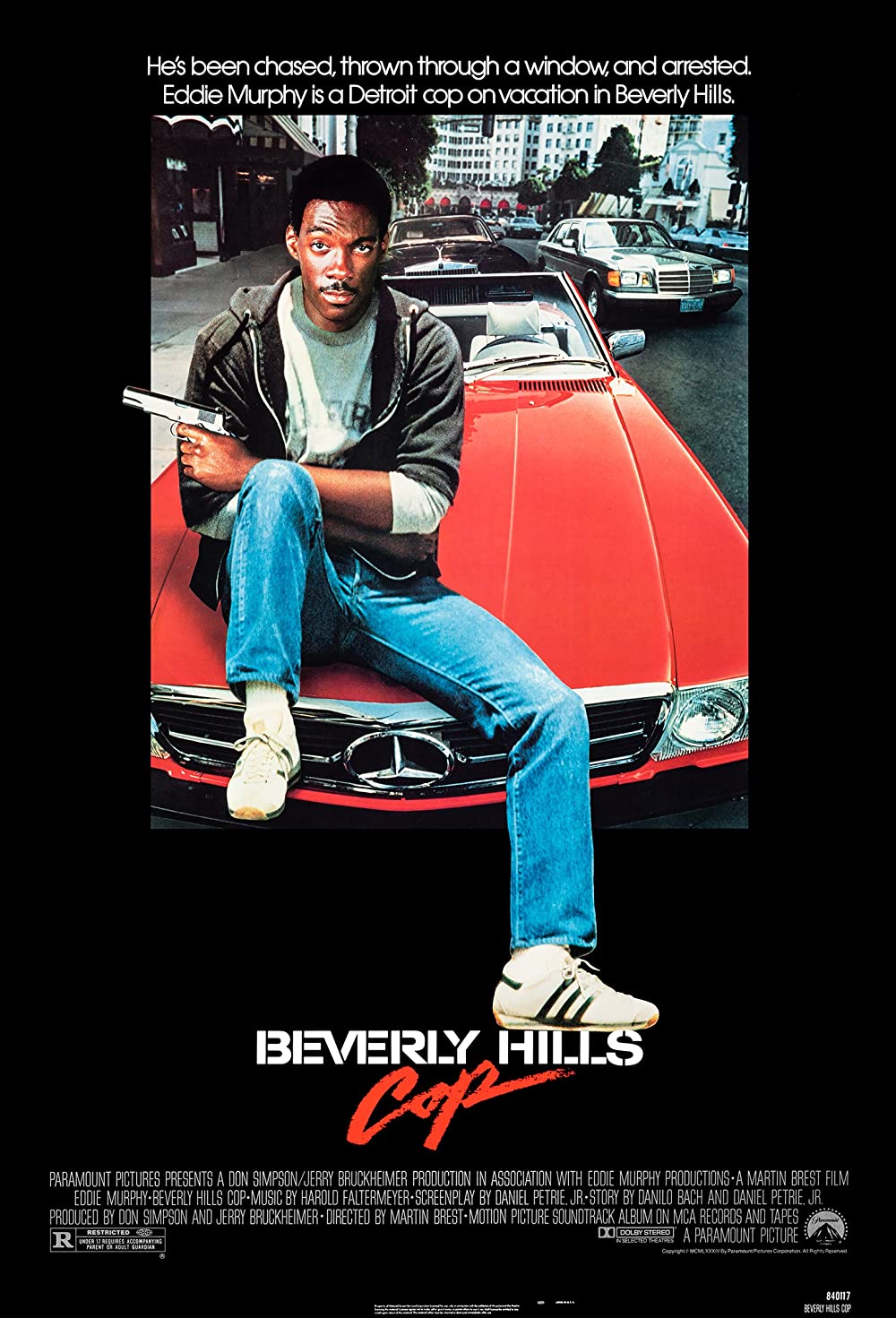
Axel Foley (Eddie Murphy) is a Detroit cop who likes working outside the system and by his own rules, which frequently gets him into clashes with his superior Captain Todd (Gilbert R. Hill). When his childhood friend, Mikey Tandino (James Russo), comes to visit him from Beverly Hills, but later is murdered, Axel requests to be put on the case, but Captain Todd refuses to assign him thinking Axel was too close emotionally to the victim to be able to give the case a fair investigation. To get around this Axel requests some time-off for a vacation, so that he can travel to Beverly Hills and do some investigating on his free time. When he arrives he meets-up with Jenny (Lisa Eilbacher), who was a mutual childhood friend of both Axel and Mickey. She works at an art gallery owned by Victor Maitland (Steven Berkoff), who may be the one behind Mikey’s murder. When Axel tries to follow-up on this lead he gets himself in trouble with the police department there and quickly learns that in Beverly Hills everything is very much by-the-book. 

This film is a great example of how an idea for a movie can go through many changes before it finally comes to fruition. The original concept came about in 1975 when Michael Eisner, then head of Paramount Pictures, got pulled over for speeding while driving an old station wagon and was taken aback by the condescending way the Beverly Hills police treated him simply because he was driving a beat-up car. He came to the conclusion that the Beverly Hills police department was highly status conscious and wanted to bring this angle out in a movie. He sent out an open call asking for writers to submit scripts with a premise dealing with an outsider coming into the Beverly Hills police unit and clashing with their culture. Most of the scripts that were sent in he didn’t care for until finally in 1983 the one written by Daniel Petrie Jr. caught his eye. 

Both he and producer Jerry Bruckheimer enjoyed the comical elements that were in it and cast Sylvester Stallone as the lead, but he wanted the comedy removed and they refused to abide, so he walked-off the project and was eventually replaced by Murphy. Director Martin Brest, who had just been fired as director of War Gameshad grown disillusioned with Hollywood and considered getting out of the business, but was hounded so much by Bruckheimer that he had to change his phone number, but when the calls continued anyways he finally flipped a coin, so as to decide whether he’d do the project, or not. When he result came up heads he said ‘yes’ and because of the film’s later box office success he eventually had that coin framed and mounted on his office wall.

Eddie Murphy is clearly the entertaining catalyst that drives this and I was happy that despite him being black his race is never a factor. It’s also great that his hard-nosed supervisor that routinely chews-him-out isn’t some authoritarian white guy either, but instead an actual black police chief, Gilbert R. Hill, who was brought in as a police consultant, but eventually got cast and his exasperated expressions are more than enough to elicit genuine laughs. 

It would though have been nice to see Murphy, at least briefly, in a police uniform as the character comes-off as being too outside the system, so for the sake of balance seeing that at times he was still ‘a part of the team’ and had to conform. He also mentions being an expert thief during his youth, so for added character development this should’ve been explored; what caused him to change his ways and become a cop instead of remaining a thief? Unfortunately this aspect is never answered.

John Ashton and Judge Reinhold as the two cops who initially act like adversaries, but ultimately work together with Murphy as a team, are terrific. During the 70’s and 80’s cops weren’t usually portrayed in nice ways. Most movies either characterized them as being excessively buffoonish, or entirely corrupt, but here they got humanized. Ashton in particular is a perfect caricature of a cop without it having to go overboard and the script makes great use of Reinhold’s wide-eyed expression by working it into him being young and inexperienced. The conversation the two have while in the squad car where Reinhold talks about the ‘five pounds of red meat in the bowels’ was taken nearly word-for-word from what the two used during their audition that got them the roles.  

The car chases, particularly the one at the beginning shot in Detroit, are quite exciting and this is one of the rare cop films that manages to blend the humor with the action without having to compromise on either. The only complaint I have, and this may sound shallow to some, is that I couldn’t stand the mole, or whatever it is, on the center of Steven Berkoff”s forehead. I honestly found it very distracting, and there are quite a few close-up shots of his face, so it’s hard not to see it and in fact with each scene he’s in I kept focusing more on that than what was being said. There are pictures on the net of him as a child and even young adult where the growth was not apparent, so I’m not sure at what age it occurred, but since it’s in such a prominent part of his face, I would have, if I were him, had it surgically removed if medically possible. 

My Rating: 8 out of 10

Released: December 1, 1984

Runtime: 1 Hour 45 Minutes

Rated R

Director: Martin Brest

Studio: Paramount

Available: DVD, Blu-ray, Amazon Video

Off Beat (1986)

offbeat1

By Richard Winters

My Rating: 4 out of 10

4-Word Review: Not really a cop.

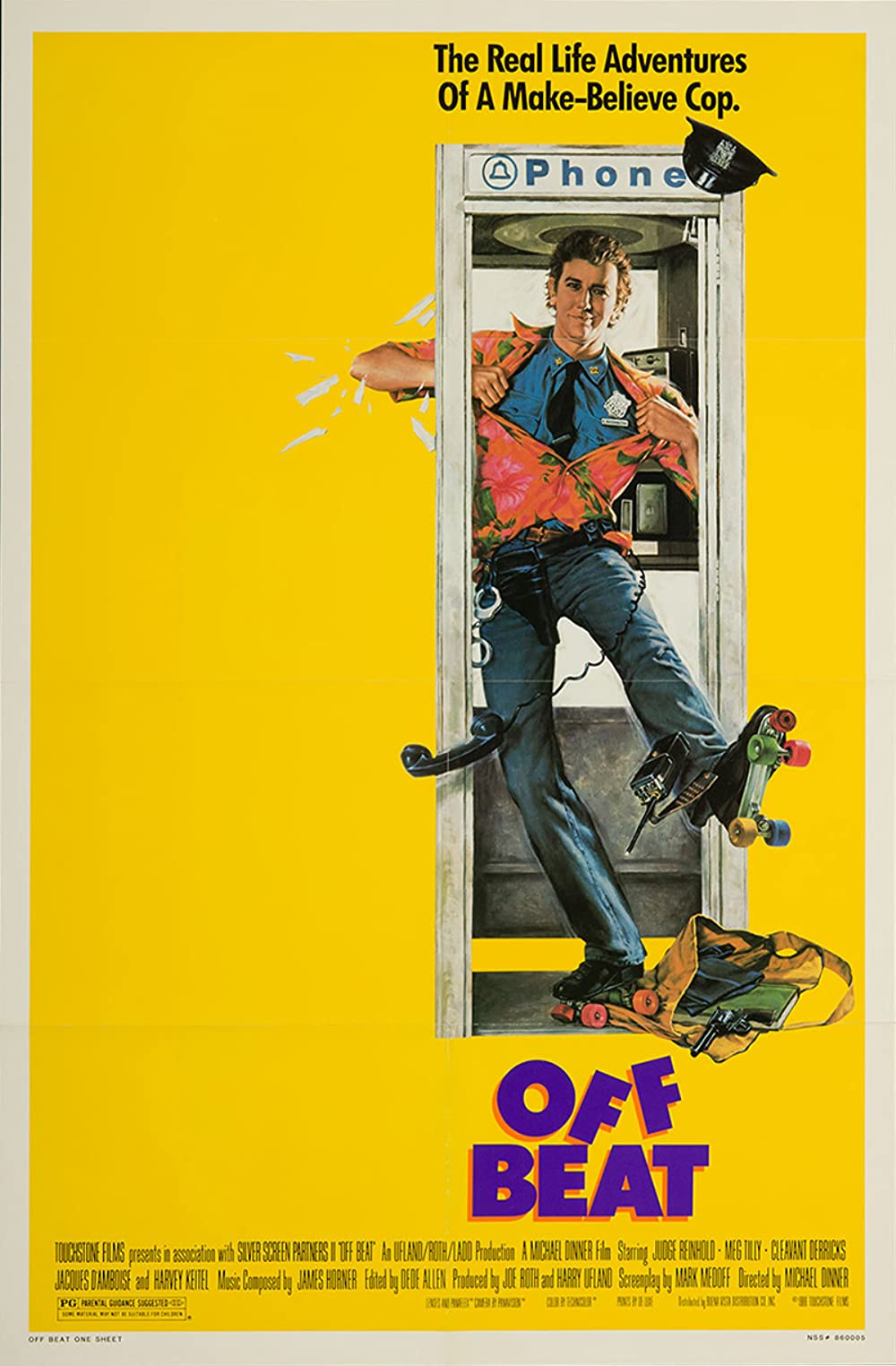
Joe (Judge Reinhold) works in the basement of a library. While he doesn’t hate his job he’s still looking for direction in life and feels he has missed his calling though he’s not really sure what that is. He’s friend with Abe (Cleavant Derricks) who is a New York City cop. One day Joe inadvertently messes-up a criminal sting that Abe was working on and in an effort to make it up to him Joe agrees to volunteer for a charity event that will require him to do ballet. It’s part of a city wide effort to get one policeman from each precinct to take part and Abe was chosen by his supervisor, but he has no interest, so he gets Joe to take his place while Joe pretends that he’s a cop in order to qualify for the audition. Joe is convinced he won’t make the cut, but when he meets the beautiful Rachel (Meg Tilly), who’s a cop that’s also trying out for the performance, he decides to press-on with it and in-turn finds that dancing gives him the interesting challenge that was otherwise missing in his life as well as a romantic relationship with Rachel. 

One of the things that really hurts the film right from the start is the totally wacky premise that seems to stretch all credibility. I found it very hard to buy into the idea that a policeman would be obligated, and in some ways almost forced, to get involved in a charity event that would take-up so much of his free time and require an extraordinary amount of rigorous training for no pay. Asking some cops to spend a few hours on one weekend at a soup kitchen passing out meals to the homeless is more reasonable, but pushing people into ballet that have no skills, or business in doing is just plain far-fetched. I felt too it was testing the friendship to obligate Joe in what turns out to being a very time consuming endeavor. Granted he learns to enjoy it, but upfront I can’t expect anyone to go that out of their way, even for a friend, over some simple mistake that the made earlier. Originally, and I can’t remember where I read this, the premise was for the characters to be prisoners and getting involved in the dance charity event would allow them the potential of getting their sentences shorten, which made much more sense, but the producers wanted to take advantage of the spate of comical cop movies that were popular at the time and therefore changed the characters into cops, but this just makes it dumb. 

The attempted comedy doesn’t gel either. It starts out at a park with undercover cops secretly listening into a conversation of two people, which seemed to have been taken right out of the opening scene in the far better movie The Conversation. It’s not made clear if that was meant to be an attempted parody of that one, but it doesn’t work either way and it’s best not to imitate a classic if you can’t improve on it as it ends up reminding one of that movie and how much more entertaining it was than this one. Later on there’s a bank robbery segment, which again seemed strikingly similar to another 70’s classic Dog Day Afternoonand again it’s not clear if this was intentionally stealing from that one in an effort to be amusing, but it doesn’t click either way. 

Reinhold shows why his Hollywood leading man career never lasted. He’s just not funny and all he seems good at is having that wide-eyed deer-in-headlights look and not much else. Other talented actors like Joe Mantegna, as Reinhold’s dance rival, and John Turturro, as Reinhold’s obnoxious boss, don’t get enough screen time and the friction that their characters create isn’t played-up enough, or results in any interesting confrontation. I did though really like Meg Tilly, who plays against type, as she’s usually cast as soft-spoken, flighty characters, but here plays someone who is tough and outspoken and does quite well.

The script, which was written by Mark Medoff, who had better success penning stageplays like Children of a Lesser God and When You Comin’ Back, Red Ryder?, does have a few heartfelt moments and having a main character feeling lost and directionless in this confusing world will be easily relatable to many, but there are just too many segments where the comedy misses-the-mark. The scenes where Reinhold is forced to try and chase down a thief and another moment where he has to arrest someone, but because he’s not a trained cop he doesn’t really know what he’s doing, could’ve been comical gold, but the film doesn’t play it out enough to be effectively hilarious. It peters-out with a fizzle by the end making it a definite misfire that didn’t do well with either the critics, or at the box office. 

My Rating: 4 out of 10

Released: April 11, 1986

Runtime: 1 Hour 32 Minutes

Rated PG

Director: Michael Dinner

Studio: Touchstone Pictures

Available: VHS, DVD (Region 2)

Melvin and Howard (1980)

melvin1

By Richard Winters

My Rating: 7 out of 10

4-Word Review: Melvin meets Howard Hughes.

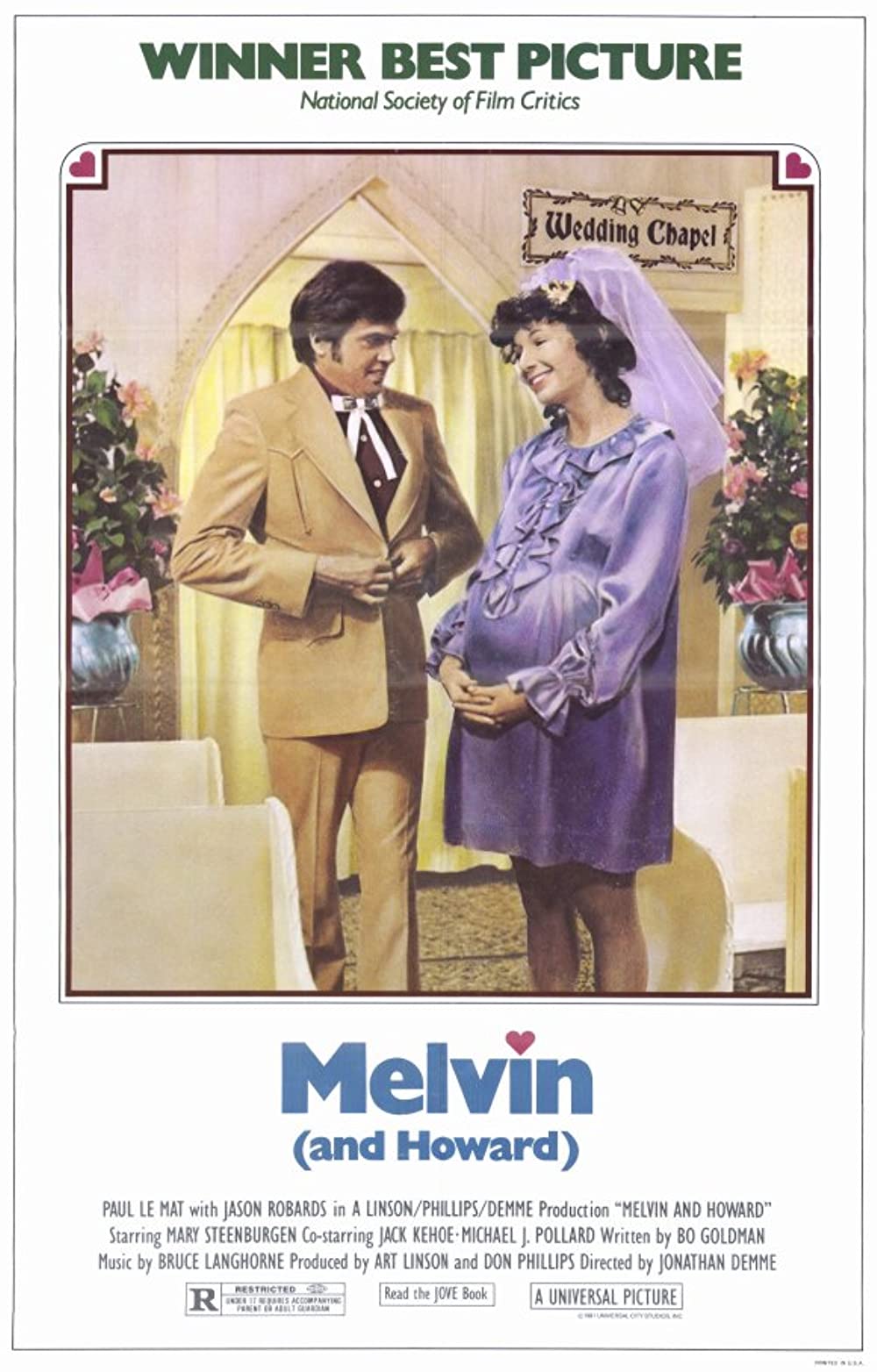
The film is based on the true story of Melvin Dummar (Paul Le Mat), who on one night in December, 1967 came upon what he thought was a homeless man (Jason Robards) on the side of the road of a lonely desert highway after he parked his pick-up in order to take a pee. He gives the man, who is banged-up from a motorcycle stunt gone wrong, but who refuses medical attention, a lift and they have a long conversation as he takes the man to the Desert Springs Hotel in Las Vegas. During the trip he admits to being Howard Hughes, who at the time was one of the richest men in the world. Melvin does not believe him initially and goes about his life working odd jobs including that of being a milk man. He lives with his wife Lynda (Mary Steenburgen) and daughter Darcy (Elizabeth Cheshire) in a rundown mobile home, but Lynda leaves him and becomes a stripper. Melvin marries another woman named Bonnie (Pamela Reed), but his financial troubles continue until he receives an envelope stating that he’s been given $156 million from Hughes in his final will and testament. Melvin thinks his struggles are finally over, but they’re just beginning as he must go to court and defend himself from those who feel that the document was a forgery.

The star of this film is Jonathan Demme’s superb direction. He first directed while working under Roger Corman and doing a couple of cheap exploitation/drive-in flicks before branching out on his own with the quirky Citizens Band that had plenty of potential, but didn’t quite gel. This one clicks from beginning to end and helped greatly by the Academy Award winning script by Bo Goldman. I really enjoyed the dry, offbeat humor with the funniest moment being inside the little white chapel when Melvin decides to marry Lynda a second time after she gets pregnant. The scene where Lynda almost gives an elderly man (played by Herbie Faye in his final film appearance), who was acting as a witness to the proceedings, a heart attack when she kisses him after the wedding is over, s hilarious as is Melvin and Lynda working as witnesses to other weddings that go on there and being kissed, sometimes quite sensuously, by the other brides and grooms. The film also shows a good understanding of working class people, showing their struggles in life without ever demeaning them. The on-location shooting in both Utah and Nevada where many of the real-life events happened gives it a nice, gritty feel and look.

While I’ve complained about Paul Le Mat’s acting in some of my other reviews his performance here is perfect in a role he was born to play. He looks very much like the real Melvin Dummar, who can be seen briefly standing behind the counter at a bus terminal, and even more ironically is that now, in the year 2022 with his gray beard and hair that he sports as seen in pics from his twitter account, exactly like Howard Hughes in this film. Steenburgen, who netted the Oscar for Best Supporting Actress, is a lot of fun particularly when she strips off her clothes and walks around fully nude in a public bar in a scene that had to be shot 9 different times as she was so nervous doing it. Dabney Coleman, in a small bit near the end, is quite good as the cynical judge, but I was disappointed that Gloria Grahame is given only one word of dialogue. Supposedly she had more lines, but her scenes got cut, but why bother to bring in a famous Academy Award winning actress if you’re not really going to use her?

My complaint comes mainly with the TV game show that Melvin and Lynda enter that works as a talent contest and called ‘Easy Street’. It was meant to be a hybrid of the ‘Gong Show’ and ‘Let’s Make a Deal’ where a contestant does some sort of act showcasing their talents and if the audience is pleased with it the contestant wins a prize by choosing what’s behind one of three doors. The problem here is that it’s made too look too easy as Lynda’s tap dancing should’ve gotten her booed off of the stage instead of cheered. Having them get lucky and win a big prize, $10,000, negates the hardship theme. It doesn’t propel the plot either as Melvin quickly misspends the money and they end up in the exact same situation there were in before with Lynda walking out on him, for a second time, which comes-off as redundant. The satirical elements of the game show isn’t played-up enough and the segment is more surreal than amusing.

I also felt the opening sequence where Melvin picks-up Howard should’ve been saved until the end. In the real-life event there was speculation that Melvin was a part of the ruse as his second wife Bonnie had worked for a magazine called ‘Millionaire’ that had access to Hughes memos and signature and some had felt that she had used this inside knowledge to forge the will, which was rife with spelling errors and other discrepancies. The film though doesn’t bring any of this up and acts like Melvin is totally innocent where as adding in some nuance where the viewer isn’t completely sure if Melvin is complicit could’ve added some interesting intrigue and then having the scene where he picks-up Howard, showing that he was telling the truth after all, be the surprise reveal instead of giving it all away right at the start. The title is also misleading. Makes it seem like it’s going to be some sort of buddy movie when really Howard is in it only at the start and then pretty much disappears.

My Rating: 7 out of 10

Released: September 19, 1980

Runtime: 1 Hour 35 Minutes

Rated R

Director: Jonathan Demme

Studio: Universal

Available: DVD, Blu-ray

Bum Rap (1988)

bum1

By Richard Winters

My Rating: 3 out of 10

4-Word Review: 72 hours to live.

Paul Colson (Craig Wasson) seems to have very little luck. While he works during the day as a New York cab driver he longs to be an actor and he practices his craft while alone in his cab as he waits for a customer. During his free time he attends auditions, but routinely finds himself being turned down for the part. His love life isn’t much better as he’s constantly getting stuck in the ‘friend zone’ with all the eligible women that he meets. Now things have turned even more sour when he goes to a Dr. about a ringing in his ear only to diagnosed with a rare blood disorder that will kill him in only 72 hours. Will Paul find any meaning and happiness with the time he has left? He isn’t sure, but becomes determined to find out by getting together with his friends and parents (Barton Heyman, Augusta Dabney) for one last goodbye while doing so with the company of Lisa (Blanche Baker) a street prostitute he has picked-up and agrees to go along with him for his last hurrah while also harboring the same ambitions of becoming an actor.

The film seems to want to tap into the indie vibe of Stranger Than Paradise, a quirky independent, cult hit that sent it’s writer/director Jim Jarmush into stardom. It even starts out in black-and-white like that one and there are a few keen moments here. When I was younger and just out of college I attended a few acting auditions like this character and found the same thankless experiences as he did; getting turned down not so much for a lack of talent, but more because he auditioned with someone who was sexier and better looking, so naturally they get all the attention and he doesn’t. His dating quandary where he treats the women real nice, and they get along well, but in the end they still chase after a married a man who treats them poorly can be a testament to what happens to a lot of single nice guys and in this area, examining the basic struggles of an ordinary life, it hits the bullseye.

Unfortunately the film fails to gain any momentum, or move along with an intriguing pace. The scenes lack energy and in certain instances, like when he invites his friends over for a game of cards, get bogged down with archaic chatter that does not propel the plot, or reveal anything about the characters. The disease, where the doctors can pinpoint exactly what hour the person will die and in what way, comes-off like something out of a sci-fi movie and hard to take seriously. I didn’t get why it shifts from black-and-white to suddenly color after he gets the grim diagnoses. You’d think it should work in reverse, be colorful when he still thinks he’s got his future ahead of him, only to turn black-and-white when he realizes his time is very limited, or at the very least don’t have it turn color until the very end when he’s learned to accept his condition and die gracefully, or leaves to enter some sort of afterlife

Wasson, who hasn’t appeared in a movie since 2006 and now makes a living as a audio book narrator, has stated that this was his most favorite movie that he was in and it’s easy to see why as he basically propels it along particularly with his impressions of famous actors, but his character’s transition through the 5-stages of grief is much too quick. It’s odd too that he chooses not to tell any of his friends or family that he’s dying as I’d think most other people in the same situation would want to say what’s going to happen to them if for anything to look for some comfort as they grieve.

Blanche Baker, the daughter of legendary actress Carroll Baker, is a good actor, but her character is cliched. As a street prostitute she lets down her guard too easily and quickly. For all she knows this guy could be lying to her about having a terminal illness in order to gain some cheap sympathy and since she’s been a hooker for awhile and spent time with other guys of a dubious quality, I’d think her opinion of men would be pretty low and she’d not be so trusting of Wasson when he tells her his situation and instead be cynical. This idea that all prostitutes have a ‘heart-of-gold’ if you just get past their rough exterior is a stereotype as some of them due to the harsh life on the streets can be genuinely embittered. Having Wasson deal with a more hardened one would’ve not only made it more realistic, but given the scenes some pizzazz as they could bicker and argue, versus having it get so sappy that it becomes cringe-worthy.

I suppose if you give it enough time it does have a way of growing on you emotionally, but the overly choreographed ending takes away all realism. Ultimately it’s a potentially interesting idea that thinks it has a deeper message and statement than it really does.

My Rating: 3 out of 10

Released: September 26, 1988

Runtime: 1 Hour 58 Minutes

Rated R

Director: Danny Irom

Studio: Light Age Filmworks ltd.

Available: None

Hysterical (1982)

hysterical1

By Richard Winters

My Rating: 1 out of 10

4-Word Review: Ghostly witch haunts lighthouse.

While Casper (Bill Hudson) has had success writing racy novels he longs to author something of a serious quality and thus uproots out of New York and drives across the country to Oregon where he takes-up residence in a town called Hellview. It is there that he rents a lighthouse as he feels it’s secluded locale will give him the quiet that he needs to complete his book. However, he’s unaware that the place is haunted by Venetia (Julie Newmar) a woman who committed suicide at the lighthouse 100 years earlier. She now sees this as an opportunity to resurrect Captain Howdy (Richard Kiel) a man she was in-love with, but who she killed when he threatened to dump her and return to his wife. As Casper notices more and more bizarre occurrences happening at his place he requests the services of Dr. Paul Batton (Mark Hudson) and his assistant Fritz (Brett Hudson) to aid him in solving the supernatural mystery.

This was the one and only film to feature the Hudson Brothers, which were a famous teen idol band who rose to fame in 1974 when they were a summer replacement series for the ‘Sonny and Cher Show’ only to get enough good ratings that they were offered their own Saturday morning show ‘The Hudson Brothers Razzle Dazzle Show’ during the 1974-75 season. The brothers came from humble beginnings born in Portland, Oregon and raised by a single parent mom after their father announced one day, when they were quite small, that he was ‘going out to get some cigarettes’, but then never returned. They formed their band when there were still just kids and first called themselves the My Sirs and then The New Yorkers followed by Everyday Hudson and then just Hudson. Their biggest success came during the mid-70’s where they had a couple of top 40 Billboard hits including ‘So You Are a Star’ and ‘Rendezvous’  though by the end of the decade their fame had significantly faded and their final studio album ‘Damn Those Kids’, which was released in 1980, failed to sell at all.

The fact that these guys were no longer a big act makes is surprising that they would’ve been given the funding to make this film, which was shot in the fall of 1981 as they were clearly on a career decline. The script is credited as being written by the three brothers with help from Jeffrey Ganz who got brought in as a ‘comedy consultant’. The humor derives almost exclusively  as a collection of gags that poke fun of famous scenes from popular horror movies of the day. Unfortunately none of it is funny and results in coming-off as quite cheap and cheesy. It’s also not clear what age group they were going with here as the band, during the 70’s, was quite popular with children and the film does have a lot of silly, cartoon-like bits that they would enjoy, but it’s also laced with stuff more attuned to older adolescence and even one moment that features a topless woman. The special effects are corny and having the victims of Captain Howdy turn into zombies the second they’re killed isn’t very inspired. Since they become zombies after getting axed to death you’d think they’d have obvious flesh wounds and missing limbs, but here they don’t just faces that become pale white and regurgitating the phrase ‘What difference does it make?’ and that’s it.

The film’s only cool moment is when the zombies do a rap song and dance, which is amusing, making me believe this would’ve worked better as a horror musical like Rocky Horror Picture Show. I was surprised too that the brothers never break-out into their old rock routine especially since it’s built into the script that the zombies respond well to music. The brothers don’t even do the film’s opening and closing song, which is instead sung by a female performer named Harriet Schock.

The cast is filled with a lot of familiar character actors, with some of them, like Bud Cort as a lispy mad scientist, doing okay. It’s funny seeing Murray Hamilton playing a mayor who’s reluctant to close the beaches since that’s the exact same role he played in Jaws, but this irony quickly wears thin. Robert Donner, doing a send-up of Crazy Ralph from Friday the 13th, where he proclaims “You’re doomed” to everyone he meets gets old real fast. Other actors like Keenan Wynn, who was related to the Hudson family through marriage and appeared here in a small and insignificant role as a favor, gets completely wasted.

Today this film sits in absolute obscurity and deservedly so. The Hudson Brothers themselves, though all still living, are relics of the past as well. Lead singer Bill is probably better known as being married to Goldie Hawn and the father of actors Kate and Oliver Hudson.

My Rating: 1 out of 10

Released: December 22, 1982

Runtime: 1 Hour 27 Minutes

Rated PG

Director: Chris Bearde

Studio: Embassy Pictures

Available: DVD-R

A Tiger’s Tale (1987)

tiger

By Richard Winters

My Rating: 3 out of 10

4-Word Review: Falling for girlfriend’s mother.

Bubber (C. Thomas Howell) is a high school student who’s dating Shirley (Kelly Preston) yet becomes more interested in Rose (Ann-Margaret) Shirley’s mother. The problem is Rose is an alcoholic and scared of snakes, which Bubber has as a pet and tigers, which Bubber also has as a pet. Despite all this the two slowly hit-it-off while keeping it a secret from the increasingly suspicious Shirley. Eventually she catches them in the act when she sees the two running naked at a drive-in where they tried to make love outside, but got attacked by fire ants. To get revenge Shirley pricks a hole in Rose’s diaphragm, so that she gets pregnant with Bubber’s baby. Bubber though intends to move-in with Rose to help her raise it, but Rose considers an abortion.

It’s impossible to say where this movie goes wrong mainly because it never gets going in the first place. It’s based off of the novel ‘Love and Other Natural Disasters’ by Allen Hannay III, who was paid $80,000 to have the rights to it sold to Vincent Pictures, which was owned and run by Peter Douglas, the third son of Kirk Douglas and brother of Michael. Peter then converted it into a screenplay, but without having read the book I couldn’t help but feel that something got lost in the transition. This is a big problem when novels get turned into movies as films don’t have as much depth to the story and characters as books typically do, which is why most people who enjoyed the story in book form usually end up disappointed when they see it as a movie. The elements are there for something potentially interesting, but Douglas, who also directed, doesn’t have the ability to put it altogether, which is probably a good reason why he’s never written, or directed any movie since.

I liked the setting, filmed in Waller County, Texas, but it doesn’t give the viewer enough feel of the region. Just showing the exterior of the homes and the drive-in isn’t enough. We need to see the town that they live-in in order to understand the characters and learn what makes them tick and the environments they are brought up in can have a lot to do with that, but when that environment gets captured in an ambiguous way, like here, it doesn’t help.

The story seems to want to tap into the themes of The Graduate, but that was a brilliant film and if you can’t top that, or at least equal it, then it’s best not to even try. Ann-Margaret is supposed to be an alcoholic, but we only see her with a drink in her hand at the start and then the rest of the time she seems quite sober. I also didn’t like the way she see-saws between being vampish at one moment and then a mature adult who gets real preachy with Bubber the next. It’s like someone with a split personality who isn’t fleshed-out and the same can be said for Howell’s character too.

There was potential for some funny bits like when Rose goes over to Bubber’s house and tells him she’s really frightened of snakes and then gets undressed and into bed with him. The camera then pans down to show a snake slithering under the covers and I thought this was the beginning of a really hilarious moment, but then the film cuts away. Later on Rose is shown to be comfortable in the presence of Bubber’s snake, but we never witness her transition, which was a missed opportunity for character development.  The scene where Rose and Bubber going running naked at the drive-in is dumb too because apparently only Shirley notices them even though with the screaming that the two were making it would’ve made anyone at the drive-in look-up and not just her.

Even the reliable Charles Durning gets wasted and becomes as dull as the rest. In fact the only thing that  I did enjoy was the tiger. I must commend Howell for being willing to get into a cage with it and stick his hand inside it’s mouth, but I was confused why the tiger is playful one second and then proceeds to try and attack Howell the next. Also, why would Howell want to get back into the animal’s cage later after he almost got his leg bite-off before? Even with that in mind I still felt the tiger was cool, the scene where he kills and eats a pooch of some customers that were just passing through is amusing in a dark sort of way and when he’s eventually set free is the only memorable moment in what is otherwise a misfire.

My Rating: 3 out of 10

Released: August 22, 1987

Runtime: 1 Hour 37 Minutes

Rated R

Director: Peter Douglas

Studio: Vincent Pictures

Available: DVD-R (dvdlady.com)

Evil Town (1987)

evil1

By Richard Winters

My Rating: 2 out of 10

4-Word Review: Old people kidnap travelers.

Chris and Julie (James Keach, Michele Marsh) along with another couple (Robert Walker Jr., Doria Cook-Nelson) are traveling through rural California from Los Angeles when they begin to have car trouble and stop-off at a rundown gas station in a small town. Earl (E.J. Andre), the old man who runs the station, inspects the vehicle and tells them it’s a water pump issue that will take at least a day to repair. Since it’s late at night he and his wife Mildred (Lurene Tuttle) offer them their spares room to sleep over in, but the couples decide they’d rather camp-out. However, they become harassed by unknown peepers, so when that car is found to have even more issues the next day and forced to spend yet another night there, they agree to stay at the elderly couple’s home. It is here that they get fed a poison that knocks them-out and they are then taken to a nearby hospital run by Dr. Schaeffer (Dean Jagger) who needs bodies of young people in order to conduct his experiments on the aging process.

This film is a great example of how funding is so crucial to a production and once it runs out there isn’t much else to do. Filming began under the working title ‘God Bless Grandma and Grandpa’ in the fall of 1973 in Mendocino, California and was directed by the talented Curtis Hanson, but money ran out before they could shoot the ending. In 1977 a different production company bought the unfinished footage and tried to market it as a movie under the title Dr. Shagetz, but with no real ending it failed to catch-on and the entire thing fell into obscurity. Then in 1984 another independent studio bought the lost footage and attempted to again redistribute it, but this time by adding in new footage, which they hoped to edit around the old footage in an effort to make it seem like a complete movie and then ultimately released to select theaters on June 2, 1987.

Unfortunately by the time they were ready to shoot the new stuff many of the elderly actors from the original were already dead, or to old at that point to perform. The four younger stars who made-up the two couples had no interest going back to finish shooting a movie the had long ago forgot about. This resulted in new actors getting hired to play both the roles of the protagonists and the bad-guys and while it’s edited in a way to make it seem like the new stars are interacting with the old ones from the lost footage it’s quite clear that they really aren’t and whole thing ultimately comes-off as two bad movies compressed into one really lousy one.

The story idea I liked and has definite similarities with Homebodies that also featured old people as the killers. There are a few good moments like having the actions scenes done in slow-motion and Keach forced to fight-off the old people who attack him by jumping on him one after the other. The scene where he gets surrounded by a group of chanting old folks while trapped in an old, nonoperational car isn’t bad either, but the pacing is slow and takes too long to get going.  The added footage is highly exploitative and basically consists of Playboy Playmate Lynda Wiesmeier running around topless in the night as she tries to avoid two killers.

Jagger, who was clearly at the tail-end of his long career, which at one point featured winning an Academy Award in 1949 for best supporting actor, gives an interesting performance. His shiny bald head along with the shaded glasses he wears gives him a creepy look and the odd speech pattern that he uses here make him seem genuinely menacing. Had the story stayed focused solely on him and had the original production been better funded and retained the first director this thing might’ve had a chance and even cult potential, but the way it is now it’s just a sad curio showing what might’ve been.

My Rating: 2 out of 10

Released: June 2, 1987

Runtime: 1 Hour 22 Minutes

Director: Curtis Hanson (70’s footage), Mardi Rustam (80’s footage)

Rated R

Studio: Trans World Entertainment

Available: Blu-ray