This is a variation of the film Three in the Attic and for a time was called Three in the Cellar to try and capitalize off of the success of that one. Ironically both films starred Judy Pace. In this one Colin Slade (Wes Stern) is a nerdy college student who loses his scholarship to a computer glitch. When he can’t get college president Maurice Chamber (Larry Hagman) to help him, he decides to get revenge by seducing both his wife (Joan Collins) and daughter (Catlin Adams).
The production proudly proclaims to be filmed on location in New Mexico, which is obvious from the start and nothing to really boast about since it hurts the film as a whole. Shot in wintertime it’s dusty, desolate landscape leaves the viewer with a cold, lonely feeling, which configures poorly with a story that is supposed to be lighthearted and whimsical. The big, modern cement buildings used as the campus looks like they would be better suited for a corporation than a student body. The students themselves, or what little you see of them, look all suspiciously over the age of 24.
Director Theodore J. Flicker nicely camouflages the fact that this is a very low budget production. His script is compact and well-paced. He frames and cuts his shots so you don’t notice how lacking in personality or energy it really is. Yet he also shows little connection to the student uprisings that dominated the campuses of that era and seems to view it as a sort of silly amusement. He keeps the film at this tone the whole time and thus makes it as silly and forgettable as the characters and situations he tries to satirize
Hagman comes off best. He plays it with a fun mixture of traits from two of his best known characters. He has J.R. Ewing’s arrogance coupled with Major Nelson’s frantic anxiety.
The film also has two fun and unique scenes. One has Hagman climbing up an actual radio tower to save Stern who is threatening to jump off. The second one has a pornographic movie shown to a group of unsuspecting and shocked senior citizens
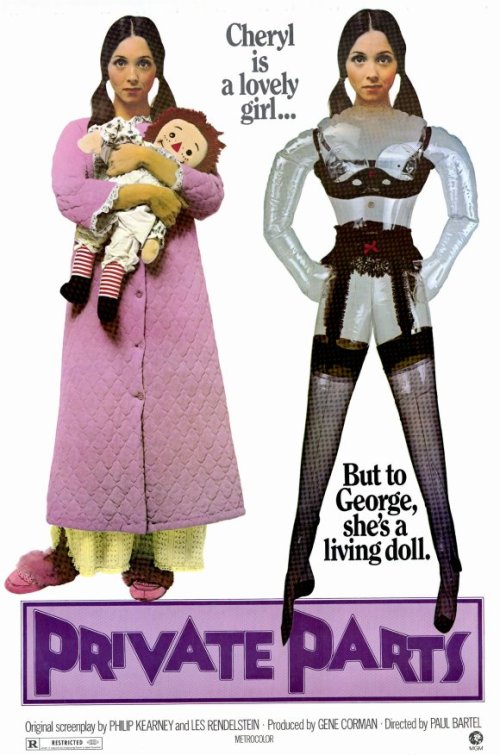
Cheryl (Ayn Ruymen) is a teen who cannot get along with her sister and boyfriend and decides to move out of their apartment and into a seedy hotel run by Martha (Lucille Benson) a very strange old lady. Here she lives next to voyeuristic photographer George (John Ventantonio) who has a big sex doll fetish. Cheryl secretly spies on George having sex with his doll and starts to get off on it. George becomes aware of Cheryl spying on him and likes it, which causes them to form an odd relationship and that is when things really get weird.
The film’s intrigue comes from the way it see-saws between being a perverted character study, horror film, and dark comedy. Director Paul Bartel makes great use of lighting, setting, and camera angles. There is also one truly odd and memorable sequence involving Ventantonio filling up his sex doll with water and then pumping it full of his own blood. The story is subtle enough to keep you involved and guessing and may even take a couple of viewings before you truly ‘get it’.
Much like with his later and better known film Eating RaoulBartel examines the psychological complexities that make up people’s sexual nature and how perversions and fetishes are a normal part of it. The mindset is that everyone probably has a weird fetish of some kind and the open minded approach is what ultimately makes it refreshing and intriguing.
Although the film teases you with some sex and violence it never really goes all out. By dancing the line between being a horror film and a sex flick it fails to make a lasting impression despite a few good moments.
This is an interesting curio for sure and for its time was really pushing the envelope, but suffers from a low budget and isn’t scary or gory enough. However, George’s sex doll is unforgettable and watching it fill up with his blood is one of the damnedest looking sights ever put on film.
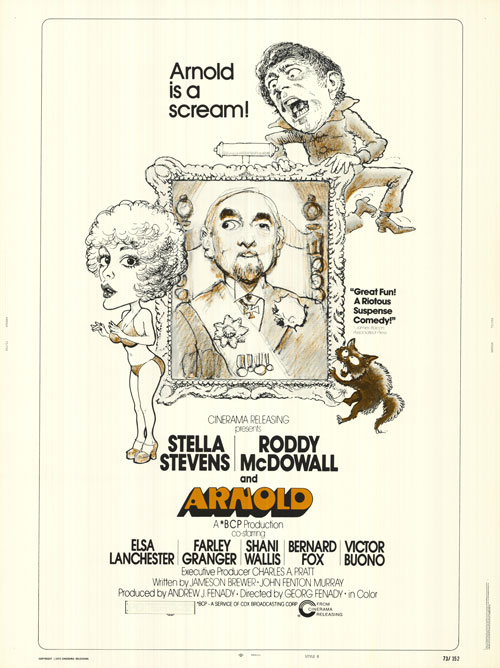
Arnold (Norman Stuart) is a dead corpse who at his funeral marries the ravishing Karen (Stella Stevens). She gets all of his wealth and to live in his mansion as long as she never leaves the side of his coffin and takes it everywhere she goes. His other greedy relatives aren’t happy with this arrangement, but they all end up being killed off in weird and mysterious ways, which makes Karen feel that Arnold may not actually be dead and that she may be his next victim.
Although this is an obscure film it has managed develop a small cult following, but I was not impressed with it. It has too much of the contrived old-fashioned horror movie elements without adding anything new to it. Even done in the spirit of parody it is too clichéd. The sets are unimaginative and cheap. All the outdoor scenes where clearly done inside on a soundstage, which is always annoying. The humor is sparse and relies mainly on corny one-liners. The story is devoid of any scares, gore, or special effects. The plot is cheesy and the whole thing looks like it would be better suited for a 70’s TV-sitcom than the movie screen. It was filmed simultaneously by the same director and writer as Terror in the Wax Museum and the whole thing has a very rushed and sloppy quality about it.
There are a plethora of B-actors making up the cast many of whom look to be phoning in their parts simply to collect a quick paycheck. Jamie Farr, in a heavy disguise, never even utters a word of dialogue, which is actually for the best. The only performance I liked was Bernard Fox as the incompetent police inspector. Some of his lines are amusing especially his last one and he is the one thing that saves this from being otherwise a complete waste of time.
I did like the theme song sung by Shani Wallis who also appears as Arnold’s widow Jocelyn. It has a certain toe-tapping quality to it and Shani gives it energy and verve. The complete rendition is sung over the closing credits.
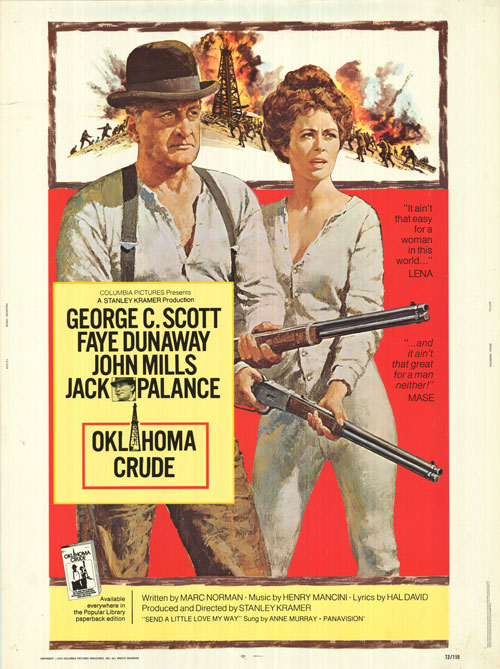
Lena Doyle (Faye Dunaway) runs a wildcat oil rig on land that she owns in Oklahoma. She is convinced that there is oil there and protects it with a feisty independence. Her father Cleon (John Mills) decides to hire Mason (George C. Scott) a lazy drifter that he picks up in town. Mason’s job is to guard against the impending invasion of the oil company headed by Hellman (Jack Palance) who wants the land and potential profits for themselves. Lena and Mason do not get along at first, but when Hellman and his men seize the land in a hostile takeover Lena and Mason form an uneasy alliance in an attempt to take it back.
Director Stanley Kramer can be considered overrated by many and I am pretty sure that he and critic Pauline Kael never exchanged Christmas gifts. However, this film has an edginess to it that I liked. The script, by Marc Norman, is full of original scenes and snappy dialogue. The on-going banter between Lena and Mason is particularly good with their conversation of how Lena wished she could be both a man and woman at once and which sexual organ she would favor being the best. Although the line where is states “You gutless men don’t know your balls from teabags” is good too.
The movie nicely mixes in the feminist issues of the 70’s within the western motif and approaches it in an even keeled way. It was very in vogue at the time to arbitrarily label the male as the chauvinist, but here it examines the strengths and weaknesses of both sides while ultimately showing how both need to rely on the other to succeed.
Dunaway has always been a personal favorite of mine no matter what that silly Hilary Duff says. Is anyone going to remember Miss Duff in 20 or 30 years? I think not. Sure Dunaway can have her bitchy side, but maintaining a career in Hollywood can sometimes create that. Either way her bitchiness is put to terrific use here. Her pouty, icy cold stares that she gives to Mason were alone worthy of an Oscar nomination.
Scott was always known to have a strong and stubborn personality both in front of and behind the camera, so seeing him play a character that is meek and aloof is fun. His performance here rates as his most amusing second only to the one he did in Dr. Strangelove.
Palance again scores as the bad buy. He played a lot of heavies during his career, but this one is his best. There is just something about his deep, raspy voice and leering grin that make him a memorable villain. Having him wear a bowler hat and black suit along with all of his henchman is perfect.
Mills comes close to stealing the film. The man has some very endearing moments and I felt the idea of pairing his refined British sensibilities along with Dunway’s caustic and vulgar manner was interesting. The scene where he climbs to the top of the oil rig in order to reattach the cable while Hellman and his men busily shoot at him is quite intense.
Why this great movie has never been released on VHS, DVD, or Blu-ray is a mystery. It has many fans and sure to gain more once they see it. The version existing right now on Amazon Instant Video is excellent. It is a widescreen with vivid colors and clarity. It nicely brings out the barren wide-open landscape and although it was not actually filmed in Oklahoma still gives one a good idea as to why the region is called ‘Big Sky Country’.
John Ebony (David Hemmings) leaves his job in advertising to follow his dream of becoming a school teacher. He gets a job at an all-boys private school in rural England replacing a teacher who died accidently by falling off a cliff. His pupils soon tell him that they were the ones who killed the teacher and they will do the same to him if he doesn’t do as they say. John can’t find anyone who believes him even his own wife Sylvia (Caroline Seymour) laughs it off. Soon John finds himself a virtual prisoner of his own students and forced to follow their dictates while he tries to figure out who the ringleader is and bring them to justice.
Director John Mackenzie does a terrific job of building the tension slowly. The film works at a deliberate pace allowing the viewer to see things from John’s point-view-of. The slower pace keeps things realistic and therefore more effective. Geoffrey Unswoth’s cinematography is vivid. I loved the way the steep cliffs are captured at the beginning and a camera is thrown off the cliff making the viewer feel like the victim as they see the landscape swirling on screen before completely submerging in water. A nightmare sequence where John dreams of being accosted by the boys in much the same way as his predecessor is visually exciting. The on-location shooting at an actual private boy’s school in Wales only helps to add to the authenticity.
The students themselves are quite effective and much better than their counterparts in the similar Child’s Play where they came off as too robotic. Here they have more diverse personalities. Their snarky behavior and the taunting both to their weaker peers and to John was so on-target that it made me feel like I was right back in high school. Their polite and formal facades are a thin veil to their sinister side that becomes increasingly more apparent as the film goes on. The pinnacle comes when they lock Sylvia in a darkened gymnasium and threaten to gang rape her. The lighting, done exclusively with flashlights and the frenzied action make this a memorably creepy moment.
John makes for a solid protagonist. The viewer can feel and understand his unique quandary and the character is believable enough to help make the movie engrossing from beginning to end. My only quibble would be near the end when the boys ask him to come with them to look for one of the students that have disappeared and he agrees. I thought this was a little hard to believe as it was right after they had tried to attack his wife and the search was being done near the cliffs, which would put John at a vulnerable risk.
The twist at the end is a bit of a surprise and is overall satisfying. Despite what is stated in the review in Leonard Maltin’s ‘Movie and Video Guide’ there is no revelation of any kind after the closing credits. I have seen this film now twice from two different sources and both times the only thing that comes after the credits is the Paramount logo.
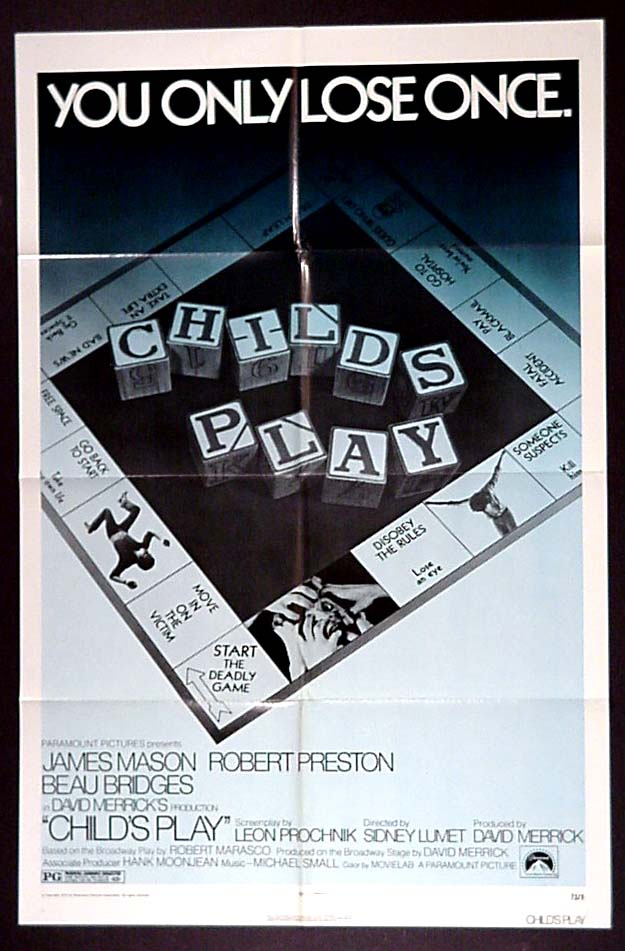
If you are looking for a review about the Chucky doll then you will have to wait as that will come at a later time. This is the first film to use that title and it is based on the Broadway play by Robert Marasco who in turn based it loosely on an early Ingmar Bergman movie called Torment. The story deals with an exclusive all-boys school where bizarre unexplained random acts of violence begin to occur between groups of students. New teacher Paul Reis (Beau Bridges) becomes determined to unravel the mystery and begins to suspect that it may have something to do with a long running feud between two of the school’s older instructors Joseph Dobbs (Robert Preston) and Jerome Malley (James Mason)
The film opens right away with a nice creepy tone and a foreboding score that immediately got me wrapped up into it. The dark, shadowy lighting of the interiors helped accentuate the sinister feel. It is also great to have the film shot in an actual boy’s school instead of building sets to recreate the look. Just hearing the floorboards creak underneath the feet of the actors as they walk around helps to create an already strong atmosphere.
Mason is terrific. I think it is impossible for the man to ever give a weak performance even if the script itself is poor. He is captivating every time he is on the screen and his ability to display wide ranging emotions without flaw never ceases to amaze me. Everything always seems to come so naturally with this man in all of his performances that you never see the acting, or technique behind it. It is a shame this movie is so obscure because watching his performance alone makes the film worth seeing and the desperate, lonely character that he plays is interesting in its own right.
Preston doesn’t seem as strong. He is a good actor at times, but not for this type of part and having him wearing a moustache doesn’t help. Supposedly the part was originally intended for Marlon Brando, who would have been more interesting, but he ended up backing out.
Bridges is okay as the protagonist, but he has played the role of a wide-eyed idealist coming into an ugly situation while oblivious to all of the dark aspects a little too often making it an annoying caricature.
The movie fails in the fact that it cannot hold the tension and there are too many talky scenes with little action in-between. The students come off as robotic like and the scenes involving them attacking another student inside a gymnasium looks staged and rehearsed. Director Sidney Lumet would have done better had he used a hand-held camera and gotten right in the middle of the fray making it seem more spontaneous and vivid.
I also had a hard time believing that so many students could get effectively brain washed and sworn to secrecy. I could buy maybe a few, but having so many seemed implausible and ruined the film for me. However, the explanation for the cause to the violence is an original one that I wouldn’t have thought up myself. Also, the surprise twist at the very end is kind of cool.
A similar film to this one entitled Unman, Wittering, and Zigothat also came out in the 70’s and dealt with murder at an all-boys private school will be reviewed next Friday and fares a bit better.
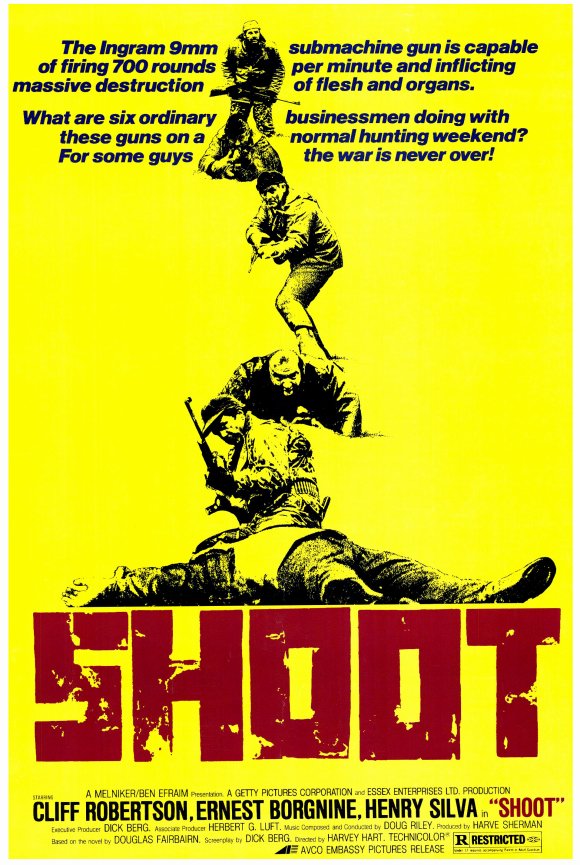
Rex (Cliff Robertson) is a man who really enjoys hunting and especially likes his guns, just watch the way he cleans and caresses it at the beginning, it’s almost obscene. He takes his buddies out on a hunting party in the woods. They come upon a group of other hunters and for some inexplicable reason they begin shooting at each other until one of the men in the other party dies. Rex and his group go back home sure that the police will be contacted and an investigation to pursue, but that doesn’t happen, so Rex thinks they are out for revenge instead. He becomes convinced that the other party plans to attack his group at the exact same spot the very next week. He gets his men ready for battle and dressed in army gear as they prepare for what they believe will be all out warfare.
Part of the problem with this film, which is based on the novel by Douglas Fairbairn, is that it doesn’t make any sense. Rex and his buddies meet the other party from across the river and then the two groups proceed to just stand there in silence like zombies before all the shooting breaks out. There is no reason for why any of it happens and I found it hard to believe this could ever occur in real-life. I am not a hunter myself, but I presume different hunting parties come into contact with each other all the time and it doesn’t end up with them trying to kill each other. I would also think that they may politely greet each other and share some sort of brief conversation in passing. Having all the men not say anything seemed odd and unfounded. The story would have made more sense had the groups spoken to one another and then somebody said something that was insulting and then it escalated. Doing it the way it is done here seems stupid and it is hard for any viewer to get into the plight of characters when there is no reasonable motivation.
The logic for the second half of the story works just as strangely. There is absolutely no reason to believe that the other hunters are planning any type of revenge at the same spot for the next week. The men don’t even know who any of them are. It would have worked better had the other group sent Rex’s group some sort of threatening message, or harassed them in some way to make the threat more real. Watching them prepare and discuss at length for a battle that may never occur is a waste not only of their time, but the viewers as well.
In between there is a long, boring middle part, which includes a scene where Rex visits the widow (Kate Reid) of the man that his group shot while under the pretense that he was an old friend of the deceased. Reid gives an interesting performance, but having her come on to Rex so shamelessly and even tells him that she wasn’t wearing any underwear seemed absurd and unnecessary. A similar scene happens in Rex’s office when the wife (Helen Shaver) of one of his friends aggressively flirts with him as well. Neither of the scenes helps propel the story, or characters and just another clue of a sloppy and unfocused script. There are a few too many shots exposing the boom microphone making me wonder if director Harvey Hart was only going through the motions on this one.
Robertson and Ernest Borgnine as Rex’s friend Lou are adequate, but the characters are painted in one-dimensional ways. The hunters are portrayed as violent prone loons with a penchant for shooting at anything and unable to display any type of sophistication, or rationale. The ultimate anti-gun, anti-violence message is heavy-handed and predictable. This was a trendy theme during the 70’s, but there had been so many better films on the subject that the producers shouldn’t have even bothered to make this one.
The on-location shooting in Ontario, Canada is poorly done. The buildings used for the interior scenes are dull and unimpressive with no visual style or sense. The outdoor scenes are flatly shot and done in the dead of winter, which gives the film a very brown, gray, and drab look. It would have been better had this been done in the summer as the green foliage would have been more scenic. There is also the issue of snow cover. On the first Saturday during their initial hunting trip there is no snow, then on the following Tuesday when Rex visits the grieving widow of the man that they shot there is a good six inches of the white stuff. Then on the following Saturday when they meet in town to get ready for their trip the snow is all gone only to again appear when they get to their hunting site.
I did like the solo trumpet soundtrack although it gets overplayed. The unexpected violent ending is indeed a surprise, but only helps in creating more loopholes. This was another attempt at cashing in on the success of Deliverance by coming up with a similar theme, but lacking the superior execution of the original. Another Deliverance-rip-off that came out in the 80’s Southern Comfort will be reviewed on Monday.
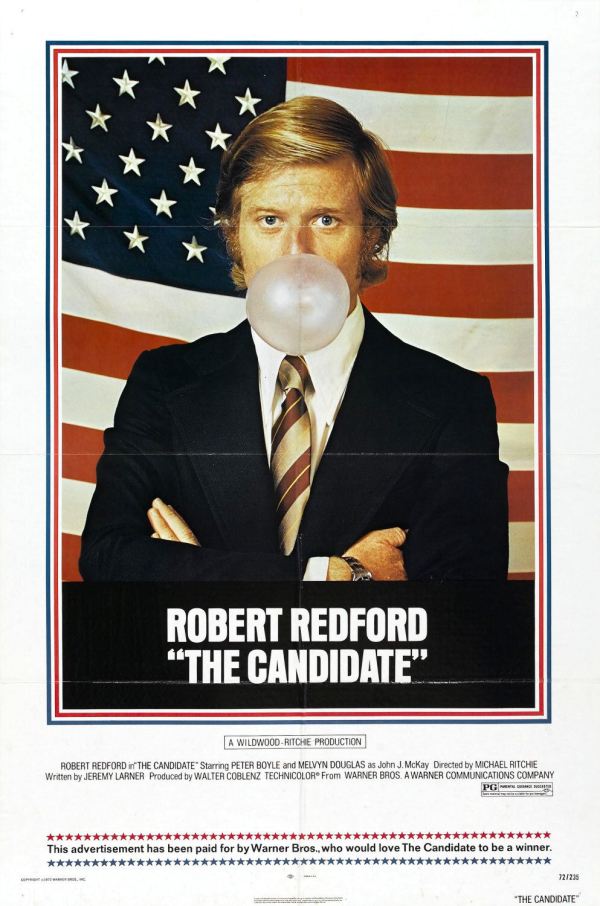
In commemoration of Election Day and the fact that all the campaigning and political punditry will finally be coming to a merciful end we present a rare Tuesday post here at Scopophilia. Although done 40 years ago this wry look at the inner-workings of the political campaign trail is as incisive and timely as ever and hasn’t lost any of its punch. The story deals with Bill McKay (Robert Redford) a young lawyer from California who is persuaded to run for senate against the incumbent Crocker Jarman (Don Porter). McKay represents the youthful idealism while Crocker is very entrenched with the establishment.
The film was directed by Michael Ritchie who may not be a household name, but he is the creator of his own genre. He took the examination of competition and how embedded it is in American culture to new heights. Through his various movies he showed how it infiltrates every aspect of our society and no one is immune to it. From Smile to The Bad News Bears and Downhill Racer he showed how even the most unlikely of individuals can become fiercely competitive when driven. He also made his characters strangely endearing no matter how sordid or ugly the competition made them become.
This film works along those same lines only it shows it from a political perspective. It is smart, fast, cynical, funny, dramatic, revealing, and entertaining all at the same time. This should rank as one of the best movies made about political campaigning. It’s still timely and cutting edge and works almost like a documentary. The quick editing creates a seamless style. The film makes interesting observations without taking away from the flow of the story. In fact one of the reasons it is so captivating is because it is downright educational. When the film is over you feel much wiser to the business of politics and as exhausted as the candidate himself.
Redford is terrific. He has a real gift for underplaying everything to the point that it looks like he isn’t even acting at all. He plays off his pretty boy looks, but doesn’t stay trapped to a heroic image. He harbors a lot of idealistic traits one would want in a candidate and yet he is still quite human. There are some definite shades of John F. Kennedy here. He has a troubled marriage and is even caught fooling around with an admiring female supporter. Although he has honorable ideas he is far from having all the answers. Probably the most interesting insight of this movie is the fact that he ends up getting as sucked into the mechanics and compromises of the political machine as his ‘old school’ foe. It perfectly illustrates how immense and encompassing the political machine is and how no one is really going to change it.
This is an excellent and well-crafted picture that not only hits the bulls- eye, but does it many times over. I love Redford’s final line and Boyle, as his campaign manager, has never been better.
Bob (Murray Head) is having a relationship with middle-aged divorcee Alex (Glenda Jackson) as well as a family doctor named Daniel (Peter Finch). He jumps between the two of them whenever the mood hits. Both Alex and Daniel are aware of the other and are not happy about it, but feel if they push the issue Bob will simply leave them. The film focuses on the frustrations and loneliness that Alex and Daniel feel in dealing with Bob and their less than ideal situation.
This film is engrossing from beginning to end. Director John Schlesinger was still in top form as the camera work, cinematography, and editing is first rate. Everything is meticulously orchestrated to the point that every shot seems to tell its own little story. The narrative is done in a fragmented style going back and forth between the present day to scenes from when both Alex and Daniel were younger. Much of it comes off like thoughts going on inside someone’s head and the film’s style is masterful and flawless.
What I really liked about this movie is the fact that it focuses not so much on each person’s time with Bob, but actually more on their time away from him. The points this film makes about the difficulties of communication that people have when they are in a relationship as well the glass wall that sometimes gets created is completely on-target. The film’s subtitles and nuances are perfectly balanced and if you are a viewer with more sophisticated tastes then this will be time well spent.
Things are revealed about the characters through visual and subtle means, which I loved. When Alex drops an ashtray and then proceeds to clean it up simply by rubbing the ashes into her rug, or the precarious way she makes herself on cup of coffee in the morning while rushing off to work nicely reflects her out-of-control life and the topsy-turvy way she approaches it. The scenes where Daniel attends a Bar mitzvah is excellent and for me some of the strongest moments in the movie.
The portrayal of the children here is above average as well. They are not cute and well-behaved, but instead realistically rambunctious and mischievous. I liked the wild, endless energy that they display and how easily chaotic they turn their household into, or how the parents had become immune and deaf to all of it. Having the 4-year-old smoke pot while Alex and Bob, who are babysitting, decide to overlook it may be pushing things a bit far, but I still liked the mod approach the film takes, which reflects nicely the unconventional lives of the characters.
The film’s biggest flaw is Head himself. The man is mainly known for his singing career and his acting ability is clearly limited in comparison to Finch and Jackson who are both excellent. The character is dull and the film does not make much of an attempt to analyze him like it does with the other two. In a way Head’s one-dimensional performance works because the character seems to be used as a ‘pretty boy’ who the other two are attracted to because of his looks and youth and therefore revealing the insecurities that they have about themselves as well as giving a pertinent warning that when one pursues someone solely based on their sex appeal the relationship is doomed.
I liked how at the very end Daniel and Alex do meet and have a brief conversation though I wished it had been just a little more extended. Having Finch talk directly to the camera at the closing is a bit disconcerting though what he says is interesting.
My Rating: 9 out of 10
Released: September 8, 1971
Runtime: 1Hour 50Minutes
Rated R
Director: John Schlesinger
Studio: United Artists
Available: VHS, DVD, Blu-ray (The Criterion Collection), Amazon Instant Video
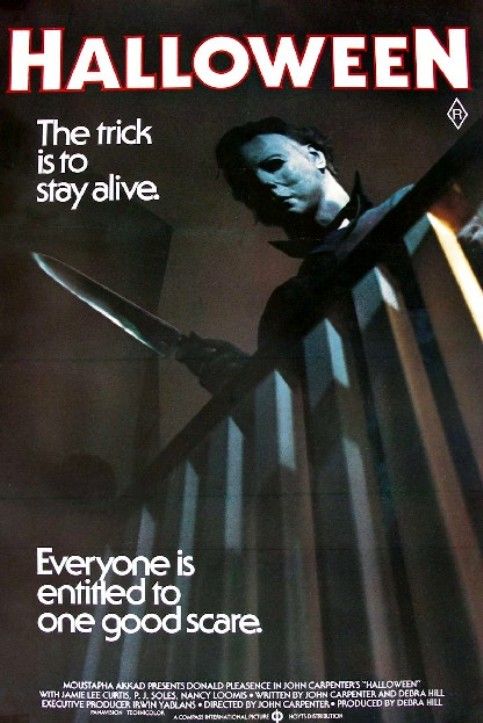
On Halloween night in 1963 6 year old Michael Myers stabs to death his older sister Judith. He is taken away to a mental institution, but fifteen years later he escapes and comes back to his hometown of Haddonfield to stalk three teenage women (Jamie Lee Curtis, Nancy Loomis, P.J. Soles) on Halloween night.
I first saw this film 25 years ago when I was in College and thought it was cool, but now on my second viewing I’m not quite as impressed. There are still some good things about it, but also in my opinion some glaring loopholes. I’ll start with the things I liked.
Cinematically it is a well mounted thriller. The lighting is perfect. The dark shadowy interiors create the feeling of menace and the little light that is shown has a bluish tone and resembles authentic moonlight. The music by director John Carpenter is distinct and has an effective up-tempo beat almost like a warning siren. The editing and pacing is great. It builds the tension nicely and has some creepy imagery.
One of the scenes I always found to be the creepiest is when Tommy, the young boy that the Curtis character is babysitting, sees from across the street Michael carrying one of his dead victims from the car to the house. In fact all the long shots showing Michael are the most effective. Somehow it was a combination not only of the way the actor walked in the costume, but his mask as well, which was apparently a William Shatner Captain Kirk mask that was painted all white.
The fact that there is never any reason given for why Michael became the way he did is also good. There are many similar true-life crimes where even after the murderer is interviewed by the psychiatrists they still can’t always come up with a satisfying explanation. Movies that try to show the reason behind why the bad guy becomes murderous usually end up being contrived and clichéd.
The three actresses looked too old for teenagers and in the case of both Loomis and Soles where already in their late twenties. Loomis though is kind of funny in her part especially with the way she interacts with Lindsey (Kyle Richards) the young girl that she is babysitting. Curtis is good and although I respect her right to going natural with the gray hair that she now sports I still felt she was at her most attractive when she had the long red hair like she has here.
On the negative side there seemed to be too many story elements that didn’t make sense. For instance Michael is institutionalized when he is six and then escapes fifteen years later and is able to miraculously drive a car even though he was never trained. The book version of the movie explains this anomaly by stating that when Dr. Loomis (Donald Pleasance) would take Michael to sanity hearings over the years that Michael would watch very closely how Loomis operated the vehicle and thus ‘learned’ how to drive, but that still doesn’t make sense because watching how something is done and then finally doing it yourself are two completely different things. Besides if watching how somebody drives where enough then every child who watched his parents drive could learn it and there would be no need for driving schools. Also, Michael escapes from the asylum without any explanation, which seemed way too convenient.
When Dr. Loomis shows up in town and tells the sheriff (Charles Cyphers) that there may be an escaped mental patient in the vicinity the sheriff comes up with the logical step of warning everybody about it, but Loomis disagrees and his reasoning is ridiculous. Also, when Laurie (Curtis) gets a call from Lynda (Soles) that sounds like she is being murdered Laurie doesn’t do the most sensible thing and that is to call the police and let them investigate it. Instead she decides to go over to the home in the middle of the night and investigate it herself, which not only needlessly puts her in a dangerous position, but also leaves the two kids that she is supposed to be watching home alone in bed, which is something a good babysitter should never do.
I also had some problems with the setting itself. Now of course the town of Haddonfield is fictitious, but the state of Illinois isn’t. It is situated right in the middle of the Midwest and there are no palm trees anywhere within its borders and yet I spotted a few lining the streets especially near the beginning when Laurie is seen walking home from school. I didn’t buy into the idea that the Meyers house would stand vacant for 15 years either. There are a lot of homes that have murders committed in them that do not remain abandoned, or considered ‘haunted’. In some cases the original house is torn down and a new one is built in its place such as the infamous John Wayne Gacy house in Des Plaines, Illinois, which is now being occupied by a new family. The neighborhood in the film looks nice and well-kept. The other homeowners wouldn’t stand for a building being abandoned for that long as it brings down the property values.
When I first saw this movie I got a real kick out of the part where Michael kills a man and then hangs him by a knife on a wall and stares at the corpse in a child-like way. However, on second viewing I don’t think the blade of the knife would have been long enough, or strong enough to go through a man’s body as well as a wooden door.
The opening sequence where we see Michael killing his sister from his perspective didn’t completely work with me either. I liked the idea of seeing the action through the two eye holes of the mask that Michael was wearing, but I think if someone is stabbing someone else that they would be looking at what they are doing, but instead the eye holes remain fixated on the sister’s face during the stabbing that is being done on the lower parts of her body, which looked stilted and unrealistic.
Now, I know this movie has a large legion of fans and some may take umbrage to my negative points, but hey, I take my film criticism seriously and feel I need to say it the way I see it. That is not to say that I ‘hated’ the movie either. I still liked it overall, but when given the issues that I described above I can only give it 6 points.