Category Archives: 70’s Movies

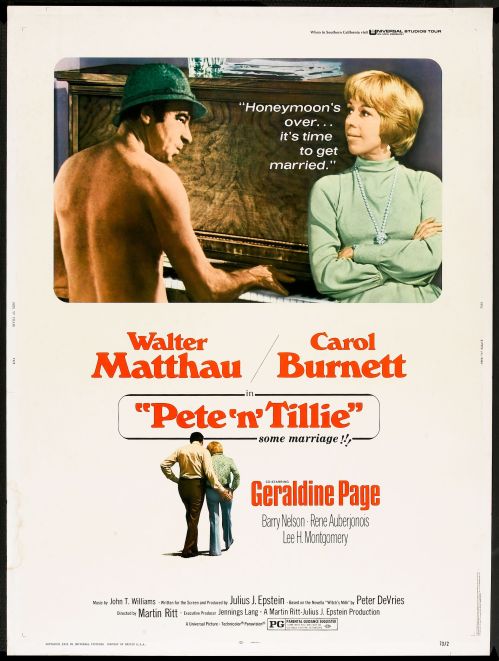
Pete ‘n’ Tillie (1972)

By Richard Winters

My Rating: 6 out of 10

4-Word Review: Marriage and then tragedy.

Tillie (Carol Burnett) is a 33-year-old secretary still looking for ‘Mr. Right’. Her friend Gertrude (Geraldine Page) sets her up with Pete (Walter Matthau) a lifelong bachelor. The two don’t hit-it-off initially, but the other prospects are so dim they decide to make a go of it, so they get married and have a kid (Lee H. Montgomery) only to then be faced with terrible news.

On the onset this may seem like a misfire. The viewer expects, especially with these two stars, a very broad comedy of which this is not. Instead the script, which is based on the novel ‘Witches’ Milk’ by Pete De Vries, relies heavily on dry wit particularly through the dialogue, which on a low key level is quite funny. The attempt to create a sort-of unromantic romance that goes completely against what we’ve come to expect in most other romantic films is commendable and for the first hour or so it kind of works.

Matthau again shines by managing to make an unlikable character likable and even downright engaging while Montgomery is fun as the kid by playing a child that seems far more mature and sensible than his two parents. Burnett’s performance though doesn’t work as well. She’s known for her hammy performances from her TV-show and yet here plays a more serious part that barely has much comedy to it at all. The scene where she  screams up to the sky in a fit of rage over her son’s death is her best moment, but overall her appearance here is largely forgettable.

Her character’s motivations are confusing as well particularly with the way she jumps into marriage with a man she really doesn’t like and who would repel most other women and then she decides to stay with him even as it becomes painfully clear that he’s cheating on her. It just seemed that a reasonably attractive woman such as herself should have other male suitors to choose from, so why she sells-out for this one and sticks with him when others would run is not clear and the movie should’ve done a better job at answering this.

Geraldine Page’s character seems completely out-of-sync with the proceedings. She’s personally one of my favorite actresses and even though she was nominated for an Academy Award for her performance here I didn’t see what her presence added to the story. Having her pass out at a courthouse simply because she doesn’t want to reveal her age gets rather exaggerated. The physical altercation that she has with Burnett afterwards does not fit the tone of the rest of the film, which tried to be low-key while this bit becomes over-the-top slapstick and completely out of place.

Had the film focused entirely on the courtship phase this thing could’ve been a winner as it has a nice dry offbeat touch. Even the melodrama of the second act I could handle, but the crazy antics of the third act don’t work at all and the ending leaves no impact at all making this an interesting experiment that ultimately fails.

My Rating: 6 out of 10

Released: December 17, 1972

Runtime: 1 Hour 40 Minutes

Rated PG

Director: Martin Ritt

Studio: Universal

Available: DVD-R (Universal Vault Series)
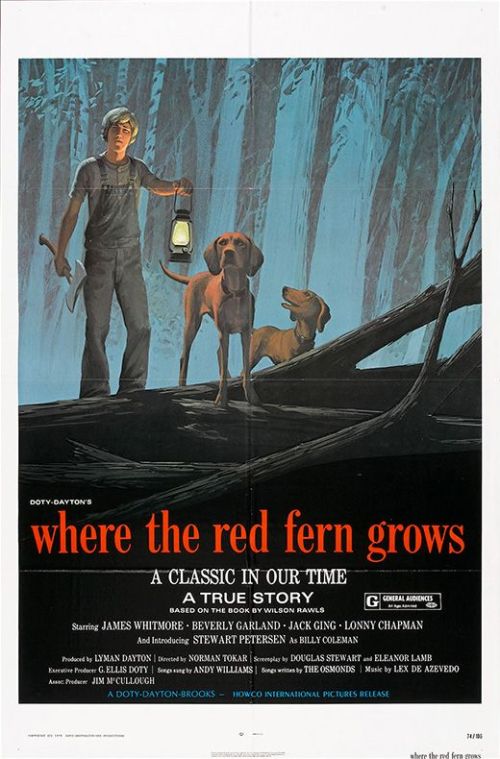
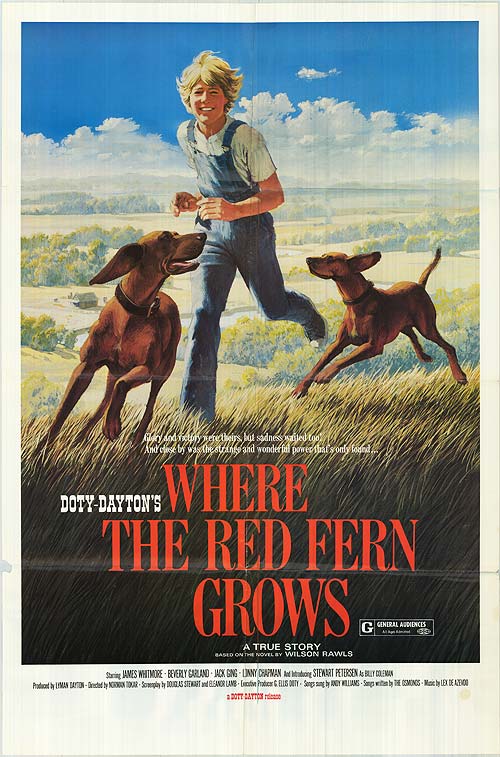
Where the Red Fern Grows (1974)

By Richard Winters

My Rating: 6 out of 10

4-Word Review: Kid raises two hounds.

Billy Colman (Stewart Petersen) is a 12-year-old boy living on a farm in rural Oklahoma during the depression. He becomes obsessed with owning a coon hound which he can train to hunt raccoons. His family is too poor to buy him one, so he spends his summer doing a number of odd jobs until he’s finally able to buy two Redbone Coonhound puppies, which he raises and trains into becoming championship hunting dogs.

The film is based on the 1961 novel by Wilson Rawls, who provides the opening voice-over narration and the script here closely follows the action of the book. It was directed by Norman Tokar, who seemed to specialize in stories of young boys bonding with their pets as he also directed the film versions of Big Red and Rascal. The production was clearly done on the low budget side, which is distracting at first, but eventually meshes with the stark, rural, and economically challenged setting quite nicely.

While the story seems believable enough and may open some viewer’s eyes, such as my own, to the sport of coon hunting, which still thrives today in certain parts of the country, I found certain elements of it to be hard to believe.  For instance Billy decides to walk all the way from his lonely farmhouse to the town of Tahlequah, which is 30 miles away and apparently able to do it in one day. I was also not sure how he would be able to find the town since he did not travel along any type of highway or road, but instead trudged through open fields and without the benefit of either a map or a compass.

The scene where Billy intentionally trips a nasty boy by the name of Rubin (Rex Corley) which causes the kid to fall on the ax that he is carrying and dies seemed questionable from a modern day viewpoint simply because everybody believes the story that Billy tells them and no charges were made. The film and book, which I remember reading in the 6th grade and in fact this is the only part of the story that I remembered, portray this as being an unintentional accident, which it was. However, these days the kid could potentially be put on trial for manslaughter charges especially since there was clearly bad blood between the two, but maybe it is a testament of simpler times that everyone, including seemingly the victim’s parents, believe the story he tells them without question, but in any other era that might not have been the case.

I found it interesting to see Beverly Garland, whom I first became aware of when she played Fred MacMurray’s second wife in the TV-show ‘My Three Sons’ and who looked quite middle-aged then, but for some reasons gets cast here as a young housewife and manages to somehow pull it off despite nearing 50 at the time. Petersen though, who got cast after a long auditioning process of over 500 candidates, is only adequate, but doesn’t quite hit the mark especially with his inability to convey anything other than one facial expression. I also thought the coonskin cap that he ends up wearing made him come off looking like a Davy Crockett or Daniel Boone Jr. although maybe back in the day that was considered ‘cool’.

Certain animal right’s activists of today may not take kindly to what was once considered just a ‘charming’ coming-of-age tale. Although no actual killing of any animal is ever shown it is certainly heavily implied. It got to the point where I started to feel sorry for the raccoons particularly during the hunting competition where night after night different hunters would go out into the forest to see how any many they could catch and then come back with the numerous pelts that they skinned from them making me wonder if there could possible be any raccoons left to kill.

Spoiler Alert!

The film though does manage to end on a strong note although even here this gets botched because as the family goes to the dog’s grave to see this magical red fern growing on top of it we also see a big boom microphone hanging down from the top of the screen , which completely sucks all the magic right out of the scene. This same story was remade in 2003 and in 2018 a 45-minute documentary was released showing behind-the-scenes footage/stills of the movie as it was being made and also featuring interviews with the actors.

My Rating: 6 out of 10

Released: June 21, 1974

Runtime: 1 Hour 37 Minutes

Rated G

Director: Norman Tokar

Studio: Doty-Dayton Releasing

Available: DVD, Amazon Video, YouTube

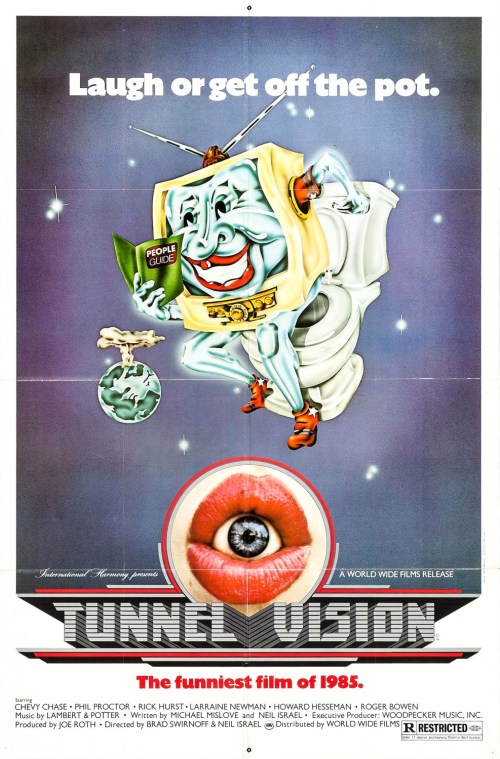
Tunnel Vision (1976)

By Richard Winters

My Rating: 1 out of 10

4-Word Review: Lame parody of television.

The year is 1985 and due to a new Bill of Rights an uncensored television network has been created, which causes many viewers to become hooked on its content watching it for hours while neglecting their other responsibilities. The head of the network, Christian A. Broder (Phil Proctor) is brought in for a senate hearing where the network’s programs are examined by a government panel to see if it should be allowed, or if censoring it would be the better option.

What was considered ‘pushing-the-envelope’ in its day would now barely pass as a blip on the radar of the average seventh grader. I was honestly expecting much more sex and nudity here, but ultimately the film offers very little and nothing is worse than smug filmmakers thinking they’re making something ‘edgy’ when they really aren’t. I also got tired of seeing a close-up shot of a plastic eyeball popping out of a woman’s lipstick laden lips, which I suppose might be considered by some as being sort-of sexy looking, but after it gets shown over and over again it becomes annoying.

The overall tone is too inconsistent. Certain provocative bits get lumped in with a lot of goofy, mindless ones, which creates a casual chuckle every 20 minutes or so but then coupled mainly with a lot of groans in between. The film also never cuts away to show any reaction shots of the conservative committee who are supposedly watching these ‘shocking’ clips, which could’ve added in an extra layer of humor. The viewer is also required to be highly familiar with mid 70’s programs and commercials as otherwise many of the in-jokes will go completely over their heads especially to those born at a later time.

The film was written and directed by Neal Israel who managed to have one hit Bachelor Party in 1984, but overall his other output conveys the same mindless, lame comedy as this one and whose talents seem limited. Had there been some visual flair it might’ve helped, but everything looks like it was filmed inside someone’s suburban home using low-budget home movie-like production values. Also, for a film that was supposed to be a peek into the future it certainly doesn’t have much of a futuristic design and instead reeks of mid-70’s sensibilities.

Of course there’s a lot of politically incorrect bits here too, which includes a parody of ‘All in the Family’ that features a Romanian gypsy family that spouts every conceivable ethnic slur, but this segment like so many of the others are just not that funny or imaginative. The only interesting aspect about the film is that, besides showing some young up-and-coming stars at the beginning of their careers, it also features many behind-the-scenes announcers whose voices you’ll immediately recognize, but not their faces, so seeing them in front of the camera for a rare time like Donny Darko who portrays a newscaster named Steve Garvey is kind of cool, but otherwise this thing is nothing more than a dated dud.

My Rating: 1 out of 10

Released: March 3, 1976

Runtime: 1 Hour 7 Minutes

Rated R

Director: Neal Israel

Studio: World Wide Pictures

Available: DVD

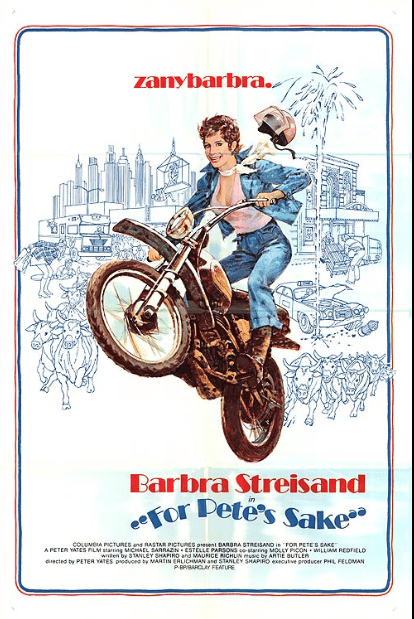
For Pete’s Sake (1974)

By Richard Winters

My Rating: 6 out of 10

4-Word Review: Can’t make ends meet.

Henrietta ‘Henry’ (Barbra Streisand) struggles with hardly any money in the bank as her husband Pete (Michael Sarrazin) works a low paying job driving a cab while he tries to finish college. Then Pete gets a tip from a fellow driver telling him to invest in potbellies as they are expected to have a huge gain in the market, but to do so he will need $3,000. Since he does not have this Henry decides to do some jobs that will pay her quick cash including prostitution and hauling stolen cattle, but everything that she does just gets her further into trouble.

Part of the fun of watching films from decades past is seeing how things have changed and in certain circumstances how they haven’t. Here you get to see virtually the same struggles that a young couple of today face and how the companies and banks joyfully screw them over if it means helping them either save or make a buck. Some of the segments at the beginning where she argues with representatives of these companies over either bills or loans are funny and helps give this otherwise innocuous comedy a bit of an edge.  It also allows for a great chance to see Anne Ramsey in an early role playing a rep at a phone company who not only looks way younger than from her better known role in Throw Momma From a Train, but even marginally attractive and with a much softer sounding voice.

Barbra is great in the lead that takes advantage of her rambling, fast-talking manner which she gets whenever she’s exasperated with the best bit being the running joke where she is constantly calling a distant relative in Dallas begging them for money while also updating them on her latest calamity. It’s also great seeing her play against her Hollywood celebrity image by effectively portraying a very drab everyday person sporting short hair, which was a wig created for her by her romantic partner at the time, hair stylist Jon Peters. It’s also interesting seeing this very liberal icon in a very anti-PC moment when she hands a box of Fruit Loops to an effeminate store clerk (played by Vincent Shiavelli) and tells him “I’m sure you’ll love these.”

The comedy has consistent laughs although the first hour works best and I particularly enjoyed the interplay that she has with the male customers she brings into her apartment while working as a prostitute and I wished this segment had been extended more. She also gets in a few juicy jabs towards Estelle Parsons, who plays the snotty, rich wife of Pete’s brother (William Redfield), that are delightfully savage.

Unfortunately the final third gets a bit too silly and exaggerated making the story lose its footing by becoming too frantically dizzying.  There’s still a couple of good bits here like watching the stolen cattle crash through a movie screen that is showing a film with a herd of cattle on it. I also enjoyed The French Connection parody where Babs plays the same cat-and-mouse game on the subway that Gene Hackman did with Fernando Rey only she does it with a police dog. However, some of the other bits including the appearance of Bill McKinney in a weak tribute to Deliverance are sterile  and helps to deflate an otherwise sparkling Streisand vehicle.

The script also suffers from illogical loopholes. Like the fact that despite having financial difficulties they still employ a housekeeper (played by Vivian Bonnell), but why would a young couple struggling with money and living in a tiny one bedroom apartment with no kids and a wife who stays home all day need hired help?

Pete gets exposed as having some major chauvinistic traits too by forebiding his wife from working full-time because ‘his ego couldn’t take it’, which doesn’t make him seem like a ‘great catch’ at all. Forcing his wife to stay stuck in the kitchen/home because that’s where he feels ‘she belongs’ while he’s unable to provide for her with his own job makes him seem like a total dud that’s not only not worth helping, but, especially in today’s world,  have him deservedly kicked to the curb in no time.

My Rating: 6 out of 10

Released: June 26, 1974

Runtime: 1 Hour 30 Minutes

Rated PG

Director: Peter Yates

Studio: Columbia Pictures

Available: DVD, Amazon Video, YouTube

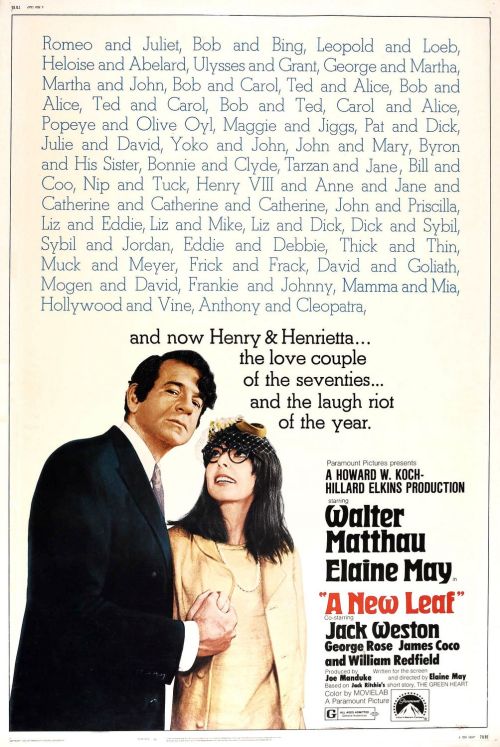
A New Leaf (1971)

By Richard Winters

My Rating: 7 out of 10

4-Word Review: Marrying for her money.

Henry Graham (Walter Matthau) has been living off of his vast inheritance for years only to find that his overspending and has now made him broke. Since he has no work history and no interest in getting a job he decides the only other alternative is to marry a rich woman. He finds his target in the form of Henrietta (Elaine May) who is an heiress to a massive family fortune. She is also quite homely, socially inept, and very into botany. Henry decides to ask for her hand in marriage and then once they are hitched kill her off and acquire her fortune for himself, but nothing goes as planned.

The plot is based on a short story ‘The Green Heart’ by Jack Ritchie and is full of many ingenious twists that helps propel the dark comedy along at a very even tone. Director May’s use of dry, subtle humor comes in perfectly for this type of material. So many other Hollywood comedies feel the need to bombard the viewer with broad, in-your-face gags so it’s genuinely refreshing to have a film take a more restrained approach by allowing the humor to peculate more. Instead of a rapid fire, gag-a-minute pace the film stretches the comical bits out for several minutes allowing the actors to play up the scene to a full crescendo with Henrietta’s inability to wear her evening nightgown properly on their honeymoon being quite possibly the funniest.

The characters are made up of extreme caricatures and in less talented hands could’ve been a detriment, but Matthau manages to play his part so astutely that the viewer ends up liking him anyways and his arc, where he reluctantly and quite unexpectedly ends up helping Henrietta out of several jams that she wasn’t aware of, is quite satisfying. George Rose, who sadly and ironically ended up having the same fate that almost befell the May character here when in 1988 in an attempt to get his hands on Rose’s fortune the teenage son that he adopted killed him while trying to make it look like a car accident, lends great support as Matthau’s wise and loyal butler.

Like with May’s other projects including the notorious Ishtar this film suffered many cost overruns and production delays most notably the 10 months it took to edit the film, which initially ended up having a 180 minute runtime and featured a secondary story dealing with Matthau poisoning a blackmailer played by William Hickey. The then head of Paramount Robert Evans decided, much to May’s objections, to cut this part out, which shortened it to 102 minutes, which I personally feel was a good idea. While I usually like director’s cuts the story here is too thin for a 3-hour length and in many ways goes on a bit too long the way it is although it would still be cool to see the extra footage, which is rumored to have been either lost or destroyed, as a bonus feature on a future DVD/Blu-ray release.

As a simple black comedy it comes off pretty well and even has a cute twist ending. Although a box office flop at the time it has garnered strong acclaim and since become a cult classic. The two stars also reunited 8 years later playing another couple in the Neil Simon farce California Suite

My Rating: 7 out of 10

Released: March 11, 1971

Runtime: 1 Hour 42 Minutes

Rated G

Director: Elaine May

Studio: Paramount

Available: DVD, Blu-ray, Amazon Video, YouTube

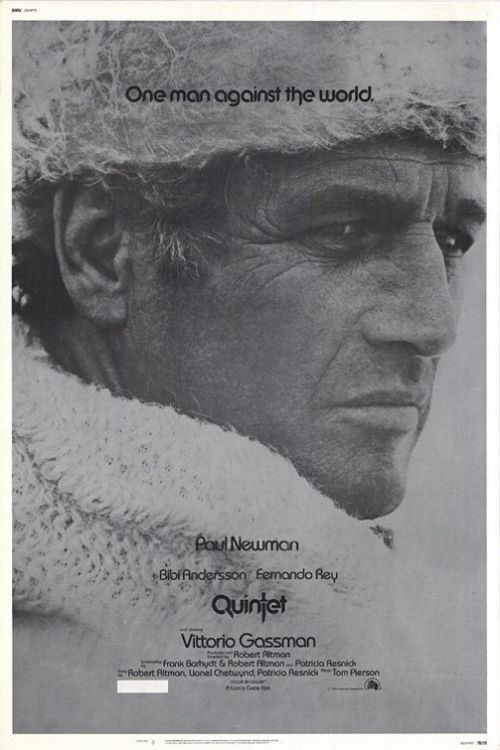
Quintet (1979)

By Richard Winters

My Rating: 4 out of 10

4-Word Review: Deadly game/frozen tundra.

During a future ice age Essex (Paul Newman) and his pregnant companion Viva (Brigitte Fossey) travel north in hopes of finding his brother Francha (Thomas Hill). They come to his apartment to find him and a group of other people playing a board game called Quintet, which has become the popular form of entertainment in an otherwise frozen, barren world. While Essex goes out to buy firewood the rest of the inhabitants in the apartment are killed by a bomb and when Essex chases the perpetrator (Craig Richard Nelson) he finds a list of five names inside the man’s pocket and realizes that the board game is now being played out in real-time with the winners killing the losers, which forces Essex to become a reluctant participant.

Although director Robert Altman had started the 70’s with the blockbuster hit M*A*S*H and followed it with Nashville his star status by the end of the decade had become severely tarnished especially after he helmed a succession of box office bombs with this film being a financial failure as well, which pretty much put the nail in the coffin for his career and hampered his ability at getting top projects afterwards, but I will at least give him credit for going outside of his comfort zone. While his past films were all dramedies this one was an interesting stab at sci-fi that if anything creates a vivid atmosphere. I particularly like the opening shot that shows nothing but snowy white and the sound of a cold hollowing wind only to slowly see the formation of two human figures walking in the far distance.

Unfortunately the other elements of the film are not as inspired. The costumes worn by the characters look like something leftover by a  Shakesperian college stage production and the board game itself played by the participants sparks no interest in the viewer because it’s never clear how it’s played. Supposedly the working rules of the game were passed out to audience members as they entered the theater, but it would’ve been nice had these same rules been explained in the movie itself.

The setting, which was filmed on-location inside  the abandoned buildings leftover from Montreal’s World Expo ’67 gives off an interesting futuristic vibe, but I was confused why despite being in the future there was no modern technology. I realized it was a new ice age, but are we to believe that all the computers and gadgets from the past generations got frozen over and the only thing left were the buildings? I also didn’t like how Altman smeared the edges of the lens with a translucent substance where only the middle part of the screen is in focus while the edges are fuzzy, which was intended to give it an ice over look, but doing this in literally every shot got to be a bit much.

Watching the characters die or wondering who will be next offers no tension at all as killing them seemed almost favorable as it put them out of their misery and away from their otherwise bleak existence. The plot needed an added angle to give it more intrigue like perhaps having a warm destination that still existed that the characters would try to get to while avoiding being killed in the process. Having it play out though the way it does with everyone locked inside this icy setting is not compelling at all. Altman proves here to be completely outside his realm while it also wastes Newman’s acting talents to the point that I was surprised why he even bothered to take the part at all. Some may wish to seek this out as a curio, but outside of its icy atmosphere there’s little else to recommend.

My Rating: 4 out of 10

Released: February 9, 1979

Runtime: 1 Hour 58 Minutes

Rated R

Director: Robert Altman

Studio: 20th Century Fox

Available: DVD, Amazon Video, YouTube

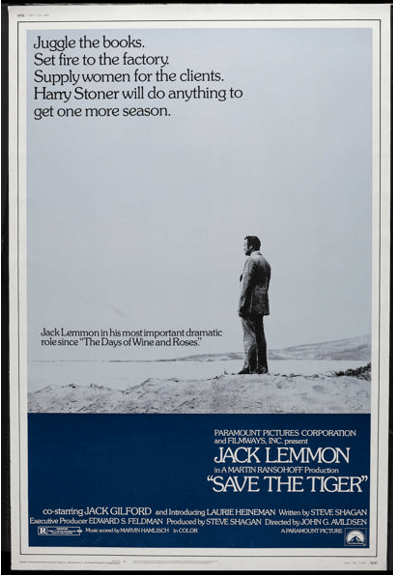
Save the Tiger (1973)

By Richard Winters

My Rating: 8 out of 10

4-Word Review: Arson is the solution.

Harry Stoner (Jack Lemmon) seems to be the embodiment of the American Dream living in a large house in an exclusive neighborhood and driving a  fancy car, but underneath the facade he’s struggling. His apparel business is on the brink of financial collapse and he decides along with his business partner Phil (Jack Gilford) to torch the place so they can collect on the insurance money, but the closer they get to the date the more despondent he becomes.

The producers realized upfront that this was not going to be an audience pleaser  and therefore made it on a small budget with Lemmon agreeing to waive his usual fee and instead working for scale, which at the time amounted to $165 a week. The effort though paid off as this film is able to tell its story with unflinching honesty without having to make the usual compromises in order to gain mass appeal.

What I really liked is how the main character gets attracted to the tantalizing aspects of corruption just like the world around him as opposed to how it’s done in most other films where the protagonist somehow manages to rise above the fray and remains magically immune from the corruptible forces. What’s even better is that it shows how sometimes even good people can be driven to do bad things especially when up against a system that is cold and unyielding.

John G. Avildsen’s direction has a nice day-in-the-life feel especially the way it captures Harry’s routine at work and all the contrasting personalities and egos he must deal with as well as a hectic and seemingly never ending pace. I also enjoyed Harry’s hook-up with a hippy (Laurie Heineman) and how despite their vast age differences and perceptions they’re still able to form an interesting bond. How a transient woman who has worked no job could somehow get a house sitting opportunity at a dreamy Malibu pad is a good question, but the scene there between the two is one of the film’s best moments and Lemmon’s raw meltdown at that point is what most assuredly netted him the Oscar.

I enjoyed Gilford’s performance as well and was impressed seeing him in a rare dramatic role, but his character seemed more like a metaphor to Harry’s conscience than a real person and his constant yammering about arson being a federal crime becomes redundant. Harry’s mental breakdown onstage brought unneeded surrealism to a film that otherwise pushed hard for gritty reality and the result is jarring. Having him see images of his dead army comrades sitting in the audience looks inauthentic as their dead pale faces appear to be covered with nothing more than theatrical make-up.

It also would’ve been nice had there been some conclusion to the arson scenario. The viewer is left hanging with the idea that they will go through with it, but nothing is conclusive. I realize with the budget restraints that showing a burning building as the final image would’ve been difficult but helpful and giving us some sort of hint whether Harry and his partner were able to pull it off, or got caught would’ve been nice too. Besides Thayer David, who plays the arsonist, is so good in his role that he should’ve been in more scenes anyways.

Overall though I liked the cynical tone and how the script doesn’t pull any punches while it paints a terse, vivid portrait of the so-called American Dream and how those that appear to be living it aren’t always so happy.

My Rating: 8 out of 10

Released: February 14, 1973

Runtime: 1 Hour 40 Minutes

Rated R

Director: John G. Avildsen

Studio: Cinema International Corporation

Available: DVD, Amazon Video, YouTube

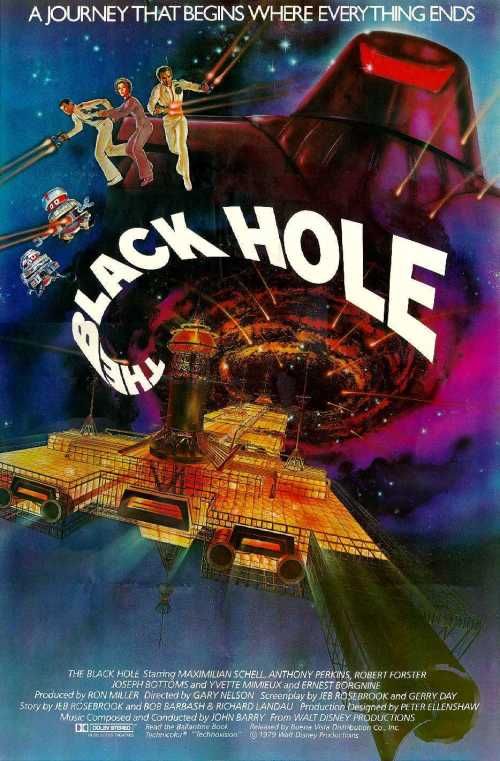
The Black Hole (1979)

By Richard Winters

My Rating: 4 out of 10

4-Word Review: Area of gravitational acceleration.

On their return trip to earth a crew of 5-people (Robert Forster, Yvette Mimieux, Joseph Bottoms, Anthony Perkins, Ernest Borgnine) on board the USS Palomino spot a large spaceship and are baffled at its ability to withstand the gravitational force of the nearby black hole. They decide to investigate the ship and find that it is being run by Dr. Hans Reinhardt (Maximilian Schell) who has been for the past 20 years the sole human survivor after the rest of the crew supposedly returned to earth, the members of the Palomino though are suspicious about this explanation since the robed android drones seem to strangely have human-like qualities. They become further alarmed when they learn that Reinhardt plans on taking the ship through the black hole, which they feel will lead to a sure death to all those on board.

For the most part the special effects look awesome  and one gets a true feeling of the vastness of space in this one with Reinhardt’s ship getting captured in a way that makes it look large and impressive. Even the interiors give off a sort-of mansion-like feel and that the characters are inside of a large scale vessel with many rooms as opposed to simply being sets on a soundstage.

Unfortunately the script lacks imagination and becomes just another formulaic madman in space scenario that offers no new twists to the genre. The tone is extremely downbeat and despite being produced by Disney doesn’t seem to be something aimed for kids. The story is also devoid of action and when there finally is some it’s short and fleeting and comes off like a second-rate laser shoot-out.

The characters don’t show enough contrasting personalities and are too old. Usually pre-teens relate better to movies with performers around their same age range, but here everyone is middle-aged and in Borgnine’s case even well past that. Bottoms is the youngest and should’ve carried the film, but his acting is so transparent you end up wishing he hadn’t even been in it.

It’s also ridiculous that Mimieux could communicate with the ship’s robot via ESP even though mental telepathy cannot be substantiated by the scientific community and therefore should not be introduced into a sci-fi flick that is supposedly trying to be taken seriously.  I did enjoy Perkins in his part, but he should not have been the one to turn around one of the drones and unmask them to expose a shriveled face underneath, which for trivia purposes was the film’s director Gary Nelson, since it will remind viewers too much of a similar reveal scene near the end of Psycho of which he famously starred in.

Schell as the resident nutcase is a complete bore in a performance that is so pathetically cliched that it borders on camp. He reminded me of James Mason’s character from 20,000 Leagues under the Sea, which was also produced by Disney and should’ve been enough to have Mason invited back to play the part here as he would’ve been far more interesting.

The robots outshine the humans particularly Roddy McDowell and Slim Pickens, who strangely go uncredited, as the voices of the  ‘good guy’ droids. However, the army of villainous androids that try to stop the crew from escaping walk too stiffly almost like mimes playing into the cliche of how people perceive robots to move, but by the year 2132, which is when this story takes place, you’d think technology would’ve improved enough to have created androids that would’ve had more fluid-like motions. They’re also too easy to pick-off almost like sitting ducks in a shooting gallery, which saps the shoot-outs of any tension.

The ending is the biggest disappointment as it never clearly explains what happens to the crew when they go through the black hole. There’s a lot of heavy-handed imagery including a cool hell-like visual, but nothing conclusive, which makes the whole thing a big buildup to nothing.

My Rating: 4 out of 10

Released: December 21, 1979

Runtime: 1 Hour 38 Minutes

Rated PG

Director: Gary Nelson

Studio: Buena Vista

Available: DVD, Amazon Video, YouTube

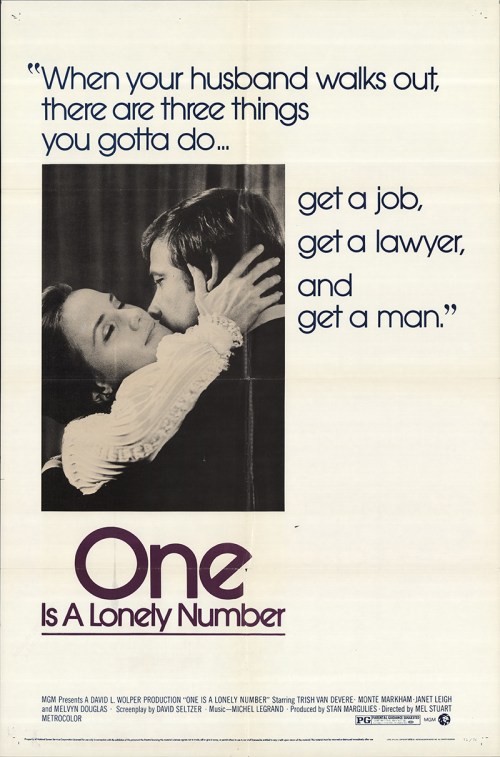
One is a Lonely Number (1972)

By Richard Winters

My Rating: 7 out of 10

4-Word Review: Adjusting to being single.

Amy (Trish Van Devere) is shocked to learn that her husband (Paul Jenkins) of 10 years wants to move out and get a divorce. She thought they had a happy marriage, but apparently he was seeing another woman on the side. Now she must learn to survive on her own and get a job despite not having any work experience.  She must also get back into the dating scene but finding quality men is tough as most are only interested in having sex while others pretend to be single when they’re really not.

David Seltzer’s script, which is based on the short story ‘The Good Humor Man’ by Rebecca Morris, is full of interesting insight on just how tough divorce can be on women particularly from that era where wives much more dependent on their husbands financially and not expected to venture into the work world as much as they are now. Mel Stuart, best known for directing documentaries as well as the original Willy Wonka and the Chocolate Factory,  proves quite adept with the material making it seem almost like a documentary and I especially liked his use of the hand-held camera and the way it would glide through the different settings that Amy was in and making the viewer feel like they were right there with the characters.

Although her name has come back into the headlines in 2017 when she and her adult son were accused of imprisoning a teenage girl in their Malibu home against her will, Van Devere has otherwise fallen into complete obscurity having not appeared in anything since 1993. I have often wondered if her career would’ve achieved more prominence had she not gotten married to George C. Scott when she did, which obligated her during the 70’s to star with him in many of his film’s which were box office bombs and critically panned and tarnished her star power. Here though she’s excellent playing an even keeled woman who isn’t sterotypically emotional. Her only gaffe comes when she breaks down crying while inside a clothing store, which didn’t come off as genuine and should’ve been taken out especially since she ends crying later on in two other scenes.

Janet Leigh is equally good as Amy’s snarky, man-hating friend. I was also impressed with Jonathan Goldsmith, who goes by the last name of Lippe here, who is better known by today’s audiences as the ‘Most Interesting Man in the World’ from the Dos Equis beer commercials. Here he plays a creep who doesn’t look or act anything like his TV- counterpart, as a job coordinator who expects to be ‘rewarded’ by Amy for finding her a job.

The film’s only drawback is that it doesn’t analyze the marriage enough as we’re never given any understanding for why Amy misses her husband, or why she would’ve fallen in love with him in the first place since he pretty much comes off as a selfish, indifferent jerk every time he is shown. Having some flashbacks to when she was married might’ve helped flesh out the character’s personality by showing her at different stage in her life instead of just focusing on the one. Otherwise this is a solid sleeper that hasn’t dated too badly and is waiting to be discovered by a new audience.

My Rating: 7 out of 10

Released: June 19, 1972

Runtime: 1 Hour 37 Minutes

Rated PG

Director: Mel Stuart

Studio: MGM

Available: YouTube

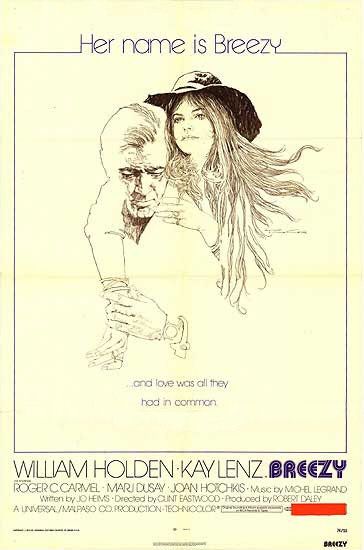
Breezy (1973)

By Richard Winters

My Rating: 7 out of 10

4-Word Review: Hippie falls or businessman.

Edith Alice ‘Breezy’ Breezerman (Kay Lenz) lives the life of a hippie after losing both her parents to a car accident years earlier. Her transient lifestyle consists of one-night-stands and hitching rides from strangers. One day she jumps into a car owned by Frank Harmon (William Holden). Frank is a middle-aged man who went through a tumultuous divorce years earlier and isn’t interested in getting into a relationship especially with someone young enough to be his daughter and yet Breezy’s carefree ways begin to grow on him and despite his reluctance the two slowly form a bond.

The script was written by Jo Heims who also penned Clint Eastwood’s earlier hit Play Misty for Me. Originally she wanted Clint to play the part of Frank, but he felt he was too young for the role and decided he would direct instead although you can still spot him for a brief second leaning against a wooden rail during a scene at a boardwalk. Unfortunately his fan base  was expecting to see more of an action or western flick and not some laid-back counter-culture love story and much of his following gave it a-bad-word-of-mouth to others who then stayed away. After some bad reviews from an initial screening the studio decided to shelve it for a year before finally releasing it to select theaters with very little promotion, which caused it to tank at the box office, but this is definitely a movie that deserves a second look.

One of the things that I liked is that it tackles the controversial subject of relationships with a wide age difference something that is still sometimes considered ‘gross’ even by otherwise liberal minded people today. Yet the subject gets examined in a refreshingly non exploitative way where it is actually the man who is reluctant to get involved and even at one point outright rejects her while she continues to pursue it convinced that despite one of them ‘being on this planet a little bit longer than the other’ they still have the same wants and needs.

The film like its title has a nice ‘breezy’ pace too that reflects its Bay area setting quite well and allows the viewer to get to know the characters and their interpersonal dynamics without ever feeling that it gets rushed or is forced. The introspective script makes many key insights particularly with the Holden character and how his ‘old school’ upbringing and fear of being judged by others makes him hesitant to get involved despite the strong feelings that he has for her.

Eastwood shows astute direction as well. I particularly liked the scene where Holden writes down the phone number from a lady guest and then the camera follows the woman out of the house and remains focused on her through the front window as she gets into a cab while we also see the back of Holden’s hand who crumples up the piece of paper with the phone number on it and throws it into an ashtray, which shows us his disinterest in her visually without having it verbally explained and is a hallmark of good filmmaking.

The motivations for Breezy’s character particularly the reasons for why she falls so quickly for Holden isn’t clear. There is also a scene where Holden puts an injured dog that he rescued from the side of the road into his car, but it never shows what he did with it. Then an hour later that same dog comes back into play as we realize he had taken it to a vet., but I felt that segment should’ve been shown since it ends up being integral to the story otherwise this is a really well made sleeper looking to find new fans who can appreciate an intelligently done romance.

My Rating: 7 out of 10

Released: November 18, 1973

Runtime: 1 Hour 46 Minutes

Rated R

Director: Clint Eastwood

Studio: Universal

Available: DVD, Blu-ray (Region B), Amazon Video, YouTube