Category Archives: 70’s Movies

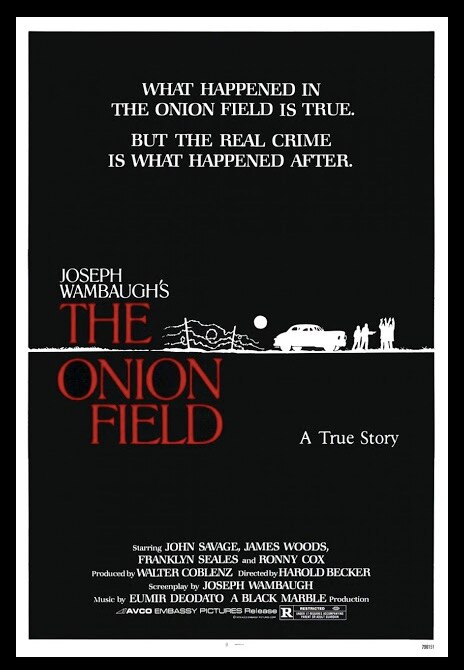
The Onion Field (1979)

onion2

By Richard Winters

My Rating: 7 out of 10

4-Word Review: Guilt over partner’s death.

Los Angeles police detectives Ian Campbell (Ted Danson) and Karl Hettinger (John Savage) are on-duty driving around in an unmarked police car when they spot two men, Gregory Powell (James Woods) and Jimmy Smith (Franklyn Seales), driving suspiciously, so they pull them over. While Campbell is talking to Powell, Powell is able to pull out a gun he had hidden in his trousers forcing Campbell to drop his weapon. Hettinger is then told to give up his weapon as well, which he does, or risk seeing his partner get shot. The two cops are then taken at gunpoint to an remote onion field where in the darkness of night Campbell is shot and killed, but Hettinger escapes and manages to run 4 miles until he finds someone and gets help. While the two criminals are eventually apprehended and found guilty it is Hettinger that suffers the most from the guilt of surviving when his friend and partner didn’t and from the humiliation of being the subject of a police video detailing what not to do when stopping a vehicle, which leads him to a severe mental breakdown in both his personal and professional life.

The story is based on the actual incident that occurred on March 9, 1963 with the traffic stop happening on the corner of Carlos Avenue and Gower Street in Hollywood and the murder happening off of Interstate 5 near Bakersfield. It was written into a novel by former cop turned author Joseph Wambaugh in 1973. I remember reading it when I was 14 and finding it captivating from beginning to end. While the film stays faithful to it I still felt it wasn’t as effective and in a lot of ways not as gripping. Even though it was a long time ago I remember the part about Powell’s ‘disguise’ where the only thing he changed about his features was putting a distinctive mole on his left ear lobe, which sounded completely absurd. This is discussed in the movie, which gets a subtle eye roll from Smith his partner, but the irony is, which is talked about in the book and not the film, is that the witnesses from the robbery that Powell was in described the mole to the police and this litrerally threw the detectives off for awhile as they kept searching for a man with a distinctive mole that Powell had since removed, so as silly as it sounded, his idea had actually worked, but the movie never gives this pay-off.

The chase through the onion field is also really hurt. I remember finding this section the most captivating part of the book and finding it a truly tense and horrifying moment that seemed to go on forever and a major element of the story, but in the movie this moment gets trimmed down significantly. Years ago, when I first saw the movie on TV, I thought it was because they had edited it down due to time constraints in order to get more commercials in, but when I finally viewed the full version on DVD I found this wasn’t the case. For whatever reason the chase in the onion field lasts for only a few minutes and not done from Hettinger’s perspective, which is what made it such an intense reading and it’s a real shame as it makes the movie much less impactful then it could’ve been. It turns the whole onion field incident into a side story instead of the main event.

The performances by Woods and Seales are outstanding and the element that really gives the film its energy they also look exactly like the people they’re playing to the point it’s almost freaky. Woods is especially creepy and he literally demands your attention with each moment he’s in it. Seales though, whose career never really took off and he died at the young age of 37 from AIDS, is excellent too as he plays someone who is very timid especially when initially with Powell, but brazen at other points and the way his and Powell’s relationship evolves both through their criminal and then when behind bars is quite fascinating. The scream that he lets out when Campbell gets shot, which was not in the script and completely improvised, has a very riveting effect and the one thing about the film that I had remembered from watching it decades earlier.

Unfortunately the two leads, the people we’re supposed to be the most connected with, are quite boring. It’s not like it’s the actors faults either. Danson, this was his film debut, is not bad, but his character isn’t fleshed out enough. Other than enjoying playing the bagpipes we don’t learn much else about him and nothing he says his captivating, or interesting. The same with Savage his inner turmoil and mental breakdown really doesn’t have the intended emotional impact in fact his moments bogs the movie down and you can’t wait until they get back to the bad guys who as rotten as they are what gives the movie its liveliness. I realize that Wambaugh felt it was very important to get Hettinger’s story out there and it was the whole reason that motivated him to write the book, but I came away feeling, at least movie wise it would’ve worked better had it just focused on the two crooks and their weird ‘friendship’.

On the whole it’s still an adequate production that holds enough interest and makes some good points about an important event that shouldn’t be forgotten, but at times it also seems like an overreach. Wambuagh’s insistence that everything be as accurate as possible gives the narrative a cluttered feel particularly with all the various court proceedings with each one having a different set of attorney’s, judges, and courtrooms which becomes dizzying instead of riveting. Pairing certain elements down would’ve helped as it’s not quite a completely effective, despite the great effort, as it could’ve been and without question another incidence where the book is far better.

My Rating: 7 out of 10

Released: September 19, 1979

Runtime: 2 Hours 6 Minutes

Rated R

Director: Harold Becker

Studio: AVCO Embassy Pictures

Available: DVD, Blu-ray

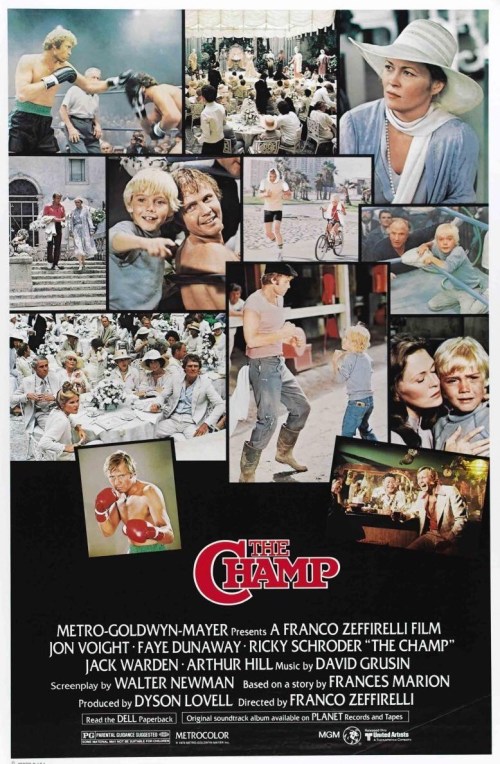
The Champ (1978)

champ1

By Richard Winters

My Rating: 7 out of 10

4-Word Review: Idolized by his son.

Billy (Jon Voight) is a former boxer whose been out of the ring for 7 years. Now at age 37 he works as a horse trainer. His 8-year-old son T.J. (Ricky Schroder) idolizes him and refers to his as ‘The Champ’ instead of dad. Billy though suffers from many inner demons including his perpetual drinking and gambling as well as not making enough money to sufficiently support either himself, or his son. Nonetheless he continues to go out gambling whenever given the chance and he manages to win enough money to buy his son a horse, which they name She’s a Lady. They enter Lady into a race where T.J. meets Annie (Faye Dunaway). Unbeknownst to T.J. Annie is his mother whom she gave up at birth, but now that she’s married to a wealthy man (Arthur Hill) she wants to have custody. Billy refuses to allow it, but when he loses the horse because of a gambling debt and Annie gives him the money to pay it off he eventually relents and has T.J. go live with her while he’s in jail for assault. Once he’s released the father and son reunite, but Billy realizes he must make more money in order to keep him and thus decides to go back into the ring one last time despite warnings from Jackie (Jack Warden), his former manager, that to do so could be life threatening.

The film is remake of the 1931 classic with Wallace Beery playing the part of the father and Jackie Cooper as the son. Director Franco Zeffirelli remembered watching it as a child and it having a profound effect on him. Then years later while he was in his hotel room while on-location filming another feature he saw it come on television and the film again moved him in such a way that he decided he wanted to do a remake. This though wasn’t the first remake as it had already been done in 1953 as The Clown starring Red Skelton though the story had been revised without the boxing theme and the climactic event at the end doesn’t take place at a sporting event, but instead a dangerous stunt that the lead character must do during a live broadcast of a TV special.

While this one stays more faithful to the original concept it was still panned by many critics as being overly sentimental and soap opera-like. Many who were fans of the original felt this one fell far short and complained about the long running time, this one runs of full 2-hours while the older one was only 83 minutes, with the feeling that it stretched the plot out too much and at spots was too slow. Though I’ve never seen the 30’s version I found myself genuinely wrapped up in the drama and the characters.

Many at the time complained that Voight was going back to the same type of Joe Buck character that he played in Midnight Cowboy, but I disagreed. That character was genuinely stupid, but Billy isn’t he’s just down-on-his-luck and suffering from basic human frailties, which made his situation far more compelling.

Schroder is an absolute jewel. He got the part after beating out over 2,000 others and it’s easy to see why. His ability to cry on demand with real tears streaming down his face is amazing and not something other actors are able to do. He’s cute and engaging without it ever getting forced, or overdone. His presence gives the film its energy and virtually the sole reason for why it works as well as it does.

The main complaint that I did have was with Annie. She’s marvelously played by Dunaway, who’s always been one of my favorite actresses and it’s a good role for her acting style as she’s excellent at playing characters that have a bit of a cold and aloof manner while not easily able to show their soft side, but with that said I still couldn’t understand what made the character tick, or her motivations. For one thing she seemed to have nothing in common with Billy, so what brought them together in the first place was a mystery and then having her abandon the kid while she went off living her life seemed pretty extreme. In most cases it’s the father that shirks the responsibility of raising the child, but here it’s reverse, but with no clear explanation as to why. There’s a vague excuse later on that it was so she could ‘pursue her career’, but then this doesn’t explain why she now wants to get close to her son. If she was selfish back then what made her change to suddenly want to be loving and caring? She went 7 years without ever seeing the kid, and did pretty well without him, so why now must she have him? I felt there needed to be some extra context added like she had been addicted to drugs when she had TJ, which then made her deemed unfit to raise him, but now that she had kicked the habit she wanted him back, or maybe she had suffered a miscarriage with her second husband and this made her feel guilty about the child she had let get away and this motivated her to want to seek out TJ, but without any of this added information the character comes-off as transparent, unrealistic, and unrelatable.

I will agree with Leonard Maltin in his review where he states that it looks like Faye wants to go to bed with her own kid. This occurs during the scene where Ricky is on her yacht and looking off in the distance while Faye comes up behind him and begins sniffing his hair like she’s getting turned-on by him. To call this a cringey, awkward moment is an understatement and it’s unintentionally laughable. Why it was left in, or why Zeffirelli thought it would be a good idea to put in I don’t know. The movie manages to recover, but it’s a segment that is indeed ridiculous.

The boxing element is another problem as it gets introduced way too late. It gets briefly mentioned throughout the first 2 acts and there’s even a quick scene where Billy shows up at a gym, but overall it gets played-out as a side-story only to suddenly, 90-minutes in, becomes the main focus, which gives the film a very disjointed feel. Jack Warden’s character doesn’t appear at all until near the end almost like it’s a tacked-on bit that doesn’t really flow with everything else that came before. The boxing scenes are impressive and helps to effectively expose the brutality of the sport, but I felt Billy’s training and decision to enter the ring should’ve been made sooner and the boxing scenes mixed-in throughout, but either way it’s still an competent tearjerker that shouldn’t leave a dry eye in the house.

champ2

My Rating: 7 out of 10

Release: March 20, 1979

Runtime: 2 Hours 3 Minutes

Rated PG

Director: Franco Zeffirelli

Studio: MGM

Available: DVD, Amazon Video, YouTube

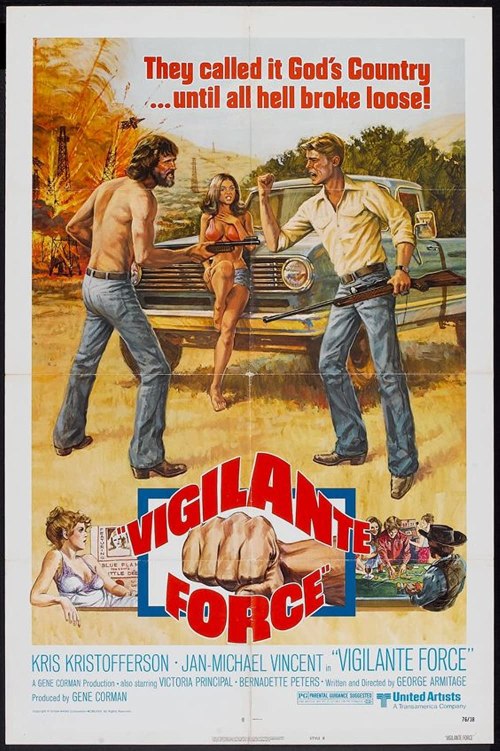
Vigilante Force (1976)

vigilante1

By Richard Winters

My Rating: 4 out of 10

4-Word Review: Veteran takes over town.

After oil is found near a small California desert town many people, including oil workers, move in looking for work. All the new people coming in causes a great deal of  crime in the community and the local police force is too small to handle the influx. Ben (Jan-Michael Vincent), a longtime resident, decides to hire his brother Aaron (Kris Kristofferson), a veteran of the Vietnam War, to help act as a peacekeeper. Aaron then brings along some mercenaries to assist him, but he and his new associates begin acting more like the bullies forcing everyone to submit to their ways of doing things, or face the consequences. This causes Ben to come to the painful realization that his brother is more of a problem than the solution and forcing him to take matters into his own hands in order to rid the town of him.

This was the third film directed by George Armitage, who did Private Duty Nurses and Hit Man before this one and all three being produced within the Roger Corman family, this one by Roger’s older brother Gene, who approached George about the project having only the title in mind and no actual story. Armitage, who had only 30-days to film, decided to make it an allegory of the Vietnam War where a group of strangers would come into a town, much like the American soldiers did when they came upon a small village in Vietnam, and take it over while focusing on the helpless nature of the residents who could do seemingly little about it.

While the concept had lots of potential the execution is rushed making the story come-off as cluttered and unfocused. It’s one of the few films made where there’s violence and action immediately before there’s barely any onscreen credits, but the motivations of why it’s happening is not clear, so it’s more confusing than exciting.  The plot doesn’t make much sense. Why are these new people all resorting to criminal behavior including robbing a bank? Other towns that boast job opportunities don’t necessarily have a  dramatic spike in crime especially if the new people coming in are actually getting employed, which the film intimates they are, so then why the anger and chaos? It seemed to me that there needed to be some sort of crime boss behind it, but there really isn’t. There’s a certain figurehead shown briefly later on, but he seems to be more of a symptom of the crime that’s already had been occurring versus the main orchestrator.

The setting also has a strong country feel with men folk walking around and behaving like blue collar cowboys making Texas a better location for the town than California. Even if for budget reasons is still had to be done in Cali I would’ve at least made it seem like it was the Lone Star state, which is considered a ‘rebel’, redneck state to begin with and thus making the behavior of the townspeople seem a little more organic.

I loved Kristofferson whose laid-back demeanor comes-off as creepy and menacing, but I would’ve liked his dark side to have been played down more at the beginning. The viewer should’ve been roped-in into believing he was a good guy, or hero, and then had the big reveal in the third act that he really wasn’t versus it being obvious right from the start that there was something not right about him.

Bernadette Peters, who plays his on-again, off-again girlfriend, is a delight, but Vincent is not as good. He’s unable to equal Kristofferson’s screen presence and way too naïve. It’s obvious to everyone his brother is trouble, but he remains oblivious for too long making him seem dumb and then when he finally does catch-on he comments that he was aware of his brother’s ‘problematic side’ ever since they were kids, but if that were the case then why did he hire him in the first place?

If you like basic 70’s action, including car chases, fist fights, and explosions, then this may suffice even with the wobbly story. Anyone though expecting anything more will most assuredly walk away disappointed as the script lacks nuance and surprise.

My Rating: 4 out of 10

Released: September 9, 1976

Runtime: 1 Hour 29 Minutes

Rated PG

Director: George Armitage

Studio: United Artists

Available: DVD-R (MGM Limited Edition Collection), Blu-ray

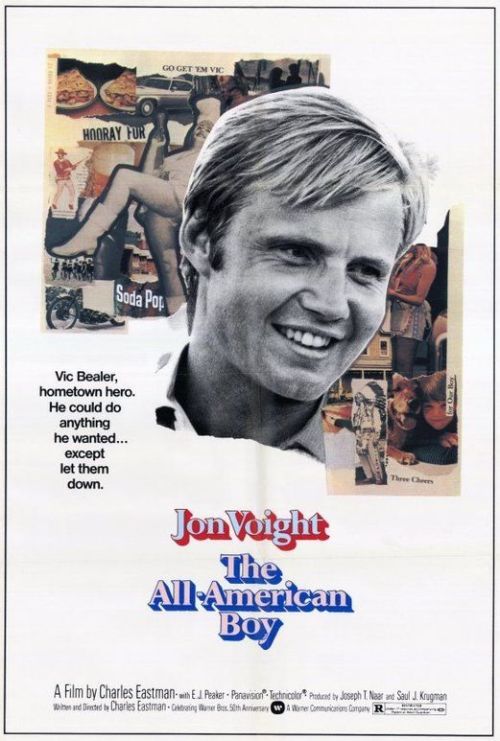
The All-American Boy (1973)

american

By Richard Winters

My Rating: 4 out of 10

4-Word Review: Amateur boxer seeks fame.

While Jon Voight is best known in the world of boxing movies for having done The Champ in 1979, which some consider infamous, his first go-around was actually this one though it remained stuck on the studio shelf long after it was filmed only to be released after his success in Midnight Cowboy. He plays the character of Vic (Jon Voight) a talented, good-looking man whose shown ability in the amateur ring and now is ambitious about making the Olympic team. Arty (Ned Glass) takes him under-his-wing, even lets him stay at his place, while he trains him, but then all of sudden Vic decides he doesn’t want to be a boxer anymore, to the shock of everyone, and never bothers to give anyone any explanation as to why.

The script was written by Charles Eastman, who also directed, and who was the brother of Carole Eastman, who wrote the script for Five Easy Pieces under the pseudonym of Adrien Joyce. Like with his sister’s script it works as a character study and the story is broken up in sections, in this case ‘The Manly Art in Six Rounds’. At various times, usually every 10-minutes, a title will appear on screen such as ‘Round 1’, or ‘Round 2’, but honestly I didn’t see the point  and it doesn’t really make it more interesting and could’ve easily be discarded and probably should’ve been.

On the writing end, particularly the dialogue, it works. Eastman creates a conversational quality where what the characters say is never ‘too on the nose’ (screenwriter’s lingo for being too specific) and the viewer must read into it in order to understand what they mean. In that area the film works, but it’s also highly talky and begins to have a stagnant feel. There’s also very little about the actual sport of boxing. If you’re expecting something like Rocky where there were long segments dealing with the his preparation you’ll be out of luck here. I got particularly frustrated with the scene dealing with Vic getting ready for a contest where he’s seen standing around while other participants and fans enter into the arena, which gets drawn-out, and then just as the fight is supposed to begin it cuts away showing Vic on the phone describing what happened, but to have to sit through a long build-up just to see no action is a letdown.

There finally is some boxing about 50-minutes in and the choreography in the ring, with each participant getting some hits on the other, appears realistic though there’s no blood, or bruising. What makes this segment unusual is more what occurs amongst the audience where one of the spectators, played by Noble ‘Kid’ Chissell, a former professional boxer from 1924 to 1934, begins to masturbate underneath his raincoat, which he has over his lap, which becomes painfully obvious to the other people around him.  Why this was put-in I don’t know. It’s not clear either whether he’s getting-off on the two boxes, or his attraction is to one of the pretty ladies in the audience (I’d presume it was the boxers), but such a bizarre character doing such a strange thing in public needed better fleshing-out and quite frankly more screentime as cringe or not I found his appearance to be one of the few diversions and far more intriguing than the main star.

Seeing a young Anne Archer, who looks almost like an adolescent here, this counts as her film debut since it was filmed before either The Honkers or Cancel My Reservationwhich were both released earlier, is a pleasure though her character doesn’t have a lot to do. E.J. Peaker is quite good as Vic’s on-again, off-again girlfriend, who has a memorable bit inside a recording studio as she attempts to boost her singing career. Jeanne Cooper, better known for her work on ‘The Young and Restless’, which lasted for 5-decades, is quite striking. The best acting though goes to Ned Glass, who is engaging as the foul-mouth manager who spews the F-word seemingly non-stop.

The ending in which Vic gets on a helicopter and is cheered on by his fans and supporters who gather to see him off is the film’s best moment. It’s not like anything super exciting happens, but the location, filmed in the hills just outside of Vacaville, California, where the grass is dark brown, but the trees that dot the landscape remain green gives-off a surreal effect. It goes on for a full 20-minutes all in this vast brown countryside with characters running around in it and at certain points even sliding down the hillsides. The unusual topography leaves a lasting impression and I’ll give props to the filmmakers for taking full-advantaged of it and the one element that allows this otherwise sterile production to stand-out.

My Rating: 4 out of 10

Released: October 24, 1973 (Filmed in 1970)

Runtime: 1 Hour 58 Minutes

Rated R

Director: Charles Eastman

Studio: Warner Brothers

Available: DVD-R (Warner Archive), Amazon Video

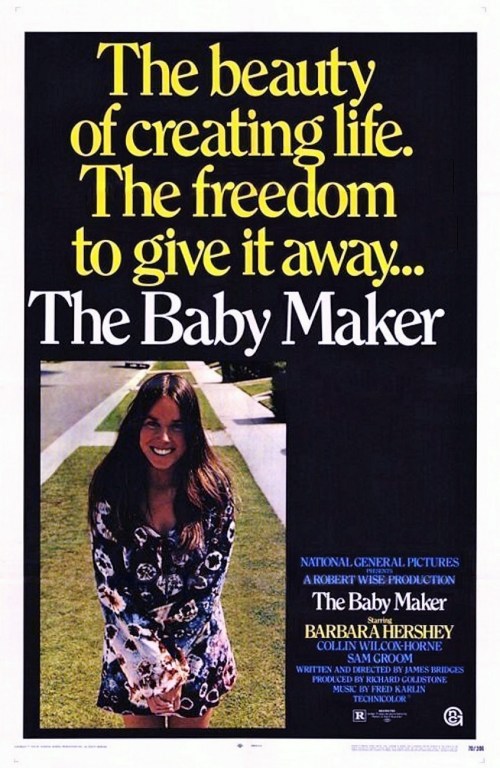
The Baby Maker (1970)

babymaker1

By Richard Winters

My Rating: 4 out of 10

4-Word Review: Paid to give birth.

Tish (Barbara Hershey) is a young, free-spirited women who’s a part of the hippie movement and looking for alternative ways to make money without having to do the usual 9-to-5 job. She becomes aware of the idea of being a surrogate mother hired to give birth to a baby from a couple who cannot have one themselves. The couple in this case are Jay (Sam Groom) and Suzanne (Collin Wilcox Paxton) who are middle-aged and due to a medical complication the wife is unable to have children. They agree to pay Tish an upfront allotment of money as well as covering the rent for the apartment that Tish shares with her boyfriend Tad (Scott Glenn). Things start smoothly enough, but ultimately underlying tensions soon surface like Suzanne’s concern that Tish is getting involved in too much physical activity and with her husband’s seemingly infatuation with the young woman. Tish’s boyfriend also begins to have problems with the agreement especially since Tish has stated she’ll not have sex with him during the course of the 9-month pregnancy.

This was the first film directed by James Bridges, who got his start writing teleplays for the ‘Alfred Hitchcock Presents’ TV-show before blossoming into a career helming such critically acclaimed efforts as The Paper Chase and Urban CowboyWhile the film is not perfect I did feel on the technical end it was well done with vivid cinematography that makes the viewer feel quite intimate to both the characters and their setting as well as a good time capsule to how things looked back in that era. The subject matter was quite unique for the period that even had some film critics labeling it as a ‘travesty’ while another called it ‘insufferable’. While I didn’t find it to be either it does show how provocative the issue was and thus overall making it a groundbreaking movie.

More than anything I really enjoyed the performance by Hershey who seems born to play this role and like she’s hardly even acting and instead just being herself. The carefreeness of her character really comes through especially when she decides to impulsively take-off her clothes while in front of the couple whom she’s just met, and jump into their backyard pool. You feel like she’s a perfect composite of most of the flower children back then and highly revealing to what made them tick. What I didn’t like though was how we never learn what gave her the idea to be a surrogate mother and I felt the film should’ve started from this point instead of having her already done it one time before without any backstory to what first gave her the motivation to even consider what at the time was not a typical thing that most people even the young hippies were doing.

I found the supporting characters to less interesting. Glenn, in his film debut, was the most baffling as he plays this overly selfless boyfriend who goes along too graciously with Tish’s idea of having someone else’s baby. Most guys would not be cool with this, or need more time to warm-up to it especially since it would require her sleeping with a married man. Having her then refuse to have sex with him while the pregnancy went on would be way too much for most men to handle, so the fact that he stays with her even after being told this made him seem unrealistic. Had he gotten into the relationship knowing upfront this is what she did for a living then maybe, but she just springs it on him after she’s agreed to the contract, which would’ve made anyone in that same situation quite upset, and justifiably so. I felt too that him ending up sleeping with one of her friends (Helena Kallianiotes) should’ve been understandable given the circumstances and Tish, being the supposedly open-minded, unconventional person that she is, should’ve allowed for it and possibly even invited it instead of growing jealous and throwing blue paint on them like she does.

I had the same issues with the couple. Collin Wilcox Paxton is excellent and light years away from her most famous role of Mayella Violet Ewell, the backwoods southern white woman who falsely accuses a black man of rape in To Kill a Mockingbird, but there’s just not enough tension between her and Tish, or in the scenes with her husband, which is the film’s biggest failing. It seems more concerned with tackling a novel concept in as genteel a way as possible, but in the process forgets that this is a drama and there needs to be conflict going on in order to keep it riveting. Certain potentially explosive problems are brought-up, but then quickly downplayed. There’s no surprise twist or altercation. It leisurely limps itself along to a hum-drum finish that has no impact at all and unfortunately ruins an intriguing concept that could’ve gone in many different, interesting directions, but ultimately doesn’t.

My Rating: 4 out of 10

Released: October 1, 1970

Runtime: 1 Hour 49 Minutes

Rated R

Director: James Bridges

Studio: National General Pictures

Available: DVD-R (Warner Archive), Amazon Video

Silent Movie (1976)

silent

By Richard Winters

My Rating: 3 out of 10

4-Word Review: Marcel Marceau says no.

Mel Funn (Mel Brooks) was a one-time top Hollywood movie director, whose career spiraled downward due to alcoholism. He though, along with his two sidekicks, Marty (Marty Feldmen) and Dom (Dom DeLuise), aspires for a comeback. His idea is to make a silent movie, but the studio head (Sid Caesar) initially rejects it and only warms up to it when Mel convinces him that he can bring in some top name stars. Mel and his two buddies then set out to find the talent and although it isn’t easy they’re able to get Burt Reynolds, James Caan, Paul Newman, Anne Bancroft, and Liza Minnelli. The movie is eventually made, but then on opening night the one and only print of it gets stolen by a greedy conglomerate named Engulf and Devour, who want the studio that produced the movie to go under in order for them to take it over.

In 1975 after the success of Blazing Saddles and Young Frankenstein, writer-director Brooks was on top of the film world and I suppose any zany idea he came up with the studios would be willing to roll with considering his already built-in cult following, so it’s no surprise it got made. It even, to my surprise, did quite well at the box office pulling in $36 million from a $4 million budget though this was mainly due to the fact that Brooks had his legion of fans upfront who would be willing, if not running to see his next movie even if it was about farm pigs mating. What really flabbergasted me was how, at least at the time, most critics reviewed it favorably with Roger Ebert even giving it 4-stars. I for one though found very little that was funny and felt more like Anne Bancroft, who was Brooks’ wife, who responded negatively to Alan Alda when he congratulated the couple on it after watching it during an opening night screening. After describing how hard he laughed Bancroft then turned to her husband and said: “You see Mel, I told you some idiot would find this funny.”

A lot of the problem is with the script, or lack thereof where too much emphasis is placed on disconnected gags and not enough on  story. Many silent films from the era had intricate plot lines, so to say because the movie didn’t have dialogue, only title cards, so it had to remain simple is just not a good excuse. There needed to be more at stake and a threatening bad guy, some would say that Harold Gould, who plays the head of the conglomerate is the heavy, and he probably is, but he’s too bumbling, not seen enough, and there’s never any confrontation/showdown between him and Mel.

Having three guys essentially playing the protagonist didn’t make much sense either. I didn’t understand what bonded them, or since Mel was down-on-his-luck, where they would find the time, or money to traipse around in a snazzy little sports car all day and not have to work. There’s little distinction between the three and they could’ve been combined into one person, preferably Marty, whose odd face is perfect for this kind of material.

The humor is on the extreme kiddie level, which may disappoint some Brooks fans who at the time was known for his bawdy and even envelope pushing material. The gags aren’t all that imaginative. I think the only one I got a kick out during the entire 87-minute runtime was the heart machine at the hospital, which inadvertently gets turned into Pong, the very first video game. The Geriatric Lounge where no on one under 75 is admitted and everyone gets carded was alright too, but literally everything else falls flat and for the most part horrendously lame. The jokes have very little to do with the plot, which is anemic enough, and thus takes away from the main storyline as they just get haphazardly thrown in at regular intervals and in certain cases take quite a long time to play-out, which robs the movie of any momentum and makes it seem like it’s bogging down and going nowhere.

The cameos by the famous stars are wasted. I did like Bancroft, who does a rare comic turn from her usual drama forte, and is quite good particularly with the freaky eye trick that she does, which was taught to her by Carl Reiner. Paul Newman, who goes on a wild wheelchair race, isn’t bad either, but Reynolds segment doesn’t have enough going-on and Caan’s moments, in which the four try to eat melon balls inside his trailer that has a broken spring, is just plain silly and highly strained. In Minnelli’s bit she does nothing but just sit there as the other three try to sit down at her table while wearing body armor, which again takes agonizingly long to play-out and less sophisticated than a comic bit on ‘Sesame Street’.

I will give Brooks all the credit in the world with his ability and daring to come-up with what many people would consider an unworkable idea and have the guts to pull-it-off, or at least attempt to. However, like with History of the World, Part 1it becomes an overreach that can’t equal its grand concept. Having characters that weren’t broad caricatures and a script that didn’t rely so heavily on mindless shtick would’ve helped.

My Rating: 3 out of 10

Released: June 17, 1976

Runtime: 1 Hour 27 Minutes

Rated PG

Director: Mel Brooks

Studio: 20th Century Fox

Available: DVD

Pieces of Dreams (1970)

pieces1

By Richard Winters

My Rating: 2 out of 10

4-Word Review: Priest breaks his celibacy.

Father Gregory (Robert Forster) is a priest working outside of Albuquerque, New Mexico with a mainly Hispanic church membership. He had been dealing with a 15-year-old boy who was in-trouble with the law only to be called into the hospital late one night to learn that he’d been killed while trying to steal a car. It’s there that he meets Pamela (Lauren Hutton) a social worker from the local community center. The two share widely different viewpoints particularly on the topic of abortion, but despite their differences the two eventually fall in love and their relationship turns intimate. Gregory feels guilty about this due to his vow of celibacy and tries to hide the affair from Paul (Ivor Francis) an older priest whom he lives with and is known to have a prying eye. Gregory decides to ask for a leave in order to get his thoughts together, but learns that trying to find a job on the outside with little work experience can be a difficult task. While he avoids Pamela in order to figure out what direction he wants to take his life the other priests put pressure on her to break it off permanently while trying to guilt-ridden her that she’s destroying a ‘good man’s career’.

This was an unusual career move for Forster who had just completed his signature role in Medium Cool where he was seen running around naked with a nude woman inside his apartment during a provocative moment, so I guess he wanted to tackle a completely different type of character for his next project in an effort to avoid being typecast, but it doesn’t really work. He’s a fine actor, but his streetwise personality trickles through and he never really comes-off as being all that devout and thus making the career arch very expected and no surprise at all. The voice-over narration that he has during the first act, in an attempt to convey to the viewer his inner thoughts, was not needed and off-putting.

Hutton is quite beautiful. She hit her career peak with her work in American Gigolo when she was already middle-aged, so seeing her still quite youthful looking is a treat, at least to the heterosexual male viewer, and you could easily see why she was a former model. Ivor Francis, not necessarily a household name, but competent character actor during the 60’s and 70’s, is quite good as the domineering senior Priest who has his own character flaws that he tries to cover-up even though he’s more than happy to readily expose the ones he sees in others. Will Geer also shines, but isn’t seen until the tail end playing a clergyman who has an amusing line when he tells Gregory that the celibacy demand for Priests ‘will soon be going away’ even though 50 years after this was filmed nothing has changed.

The theme dealing with how religion in theory is meant to be comforting, but in practice can become something that torments people by making them feel guilty and fearing the wrath for what could be considered to others as being minor infractions, like having sexual thoughts, is on-target though not necessarily ground-breaking. Some of the other issues will seem quite dated like the married woman who fears using the pill, or any other type of contraception, as it goes against the teachings of the catholic church, though through the decades this is no longer considered as much of a ‘sin’. There’s also the scene where Gregory lectures a youth who’s in jail for smoking cannabis about how he’s ‘thrown his life away’ while pot is now legal in many states.

The real problem, or when the film ultimately ‘jumps-the-shark’, is when Gregory goes to bed with Pamela, which came off as way too seamless and rushed. Up until then the couple really hadn’t had much in common and were usually arguing over political issues and weren’t for that matter even officially dating. It seemed to me that if someone like Gregory is made to feel extremely guilty for even thinking about sex that is ability to actually perform it would be questionable. Having him run away from her when he started feeling the urge and then avoiding her due to the temptations that she gave him would’ve made more sense then just having him casually hop in the sack without a second thought like he’s just a regular guy on the make and wearing the priest collar is some sort of performance art.

What the filmmakers apparently thought would be a compelling question of would he, or wouldn’t he stay in the church is ultimately given the placid treatment. The romance angle isn’t convincing and despite some good conversational dialogue, and nice on-location shooting of New Mexico in the autumn, the story fails to resonate making the movie woefully trite by the time it finally ends.

pieces2

My Rating: 2 out of 10

Released: September 23, 1970

Runtime: 1 Hour 39 Minutes

Rated GP

Director: Daniel Haller

Studio: United Artists

Available: DVD-R (MGM Limited Edition Collection), Amazon Video

Coming Home (1978)

coming

By Richard Winters

My Rating: 10 out of 10

4-Word Review: Falling for injured vet.

Sally (Jane Fonda) is the military wife to Bob (Bruce Dern) who’s been deployed to Vietnam. Since she now has more free time she decides to volunteer at her local VA Hospital. It is there that she meets Luke (Jon Voight) a former classmate from high school who has now come back from the war a paraplegic. Luke is very embittered about his condition and he’s initially angry and confrontational with Sally. Eventually he softens and Sally invites him to her house for dinner. It’s there that their romance begins to bloom and eventually they become intimate. Bob though, having suffered a leg injury, returns to the states and while Sally and Luke agree to keep their affair a secret Bob soon finds out, which leads to an ugly confrontation between the three.

The idea for the film was inspired by Fonda’s meeting with Ron Kovic, an injured vet who had written his autobiography Born on the Fourth of July that later, in the 80’s, became a movie starring Tom Cruise. Fonda though wanted to make a film with a character that was similar to him and got together with screenwriter Nancy Dowd in 1972 to write a script, which initially focused completely on the hospital setting without the affair, or B-story dealing with the conservative military husband. After many rewrites and bringing in Oscar winner Waldo Scott to help bolster the story the script finally managed to gain interest amongst the studios though many were still cautious about producing a movie dealing with the after-effects of the war, which at that time had never been done before, up until then only films dealing with the war, or those coming back with psychological issues, but not actual physical impairments and thus making this a first in that category.

Since Fonda was instrumental in getting the project produced she was the only choice to play Sally. I think she’s a fine actress who deservedly won the Supporting Oscar for her work here, but since she was on the front lines of the war protest and in many ways even became the face of it, the transition of her character isn’t as profound. Having an actress whose name wasn’t so aligned with left politics and who could better fit-into the part of a conservative housewife would’ve then made the character’s arch more dramatic. I felt too that Sally is too understanding of Luke right-off, the history of them going to high school together should’ve been excised, and instead she should’ve feared Luke when she first encounters him as he does act out-of-control and the romance between them happens too quickly.

Also, once her character changes her hairstyle from the old-fashioned straight to curly it should’ve remained as this visually establishes her character’s changing perspective and not go back to the straight look when she visits Bob in Hong Kong. To remedy this she should’ve decided to keep the curly look even if she feared Bob might not approve, she was technically becoming more empowered with him away anyways, and this would’ve signaled to Bob that she wasn’t the same person he knew when he left, or had the hair change occur after the Hong Kong visit, but having the hair style flip-flop works against the arch, which should be linear and not zig-zagging.

Voight, who won the Best Actor Oscar, and who had to lobby hard for the role as the producers originally wanted Jack Nicholson, is outstanding and there’s not a flaw in his performance with his best moment coming at the very end when he gives a lecture to a room full of high school students about his war experiences. My only complaint, which has nothing to do with his acting and more with the script, is when he bluntly tells Sally, when he goes to her place for dinner, that he dreams of making love to her, which seemed too forward especially since they end up having an impromptu kiss later. Since movies are a visual medium it should’ve settled with the kiss exposing the underlying brewing romance without his character having to explicitly state it. I also found it interesting that the DVD features a commentary track with Voight, Dern, and cinematographer Haskell Wexler, but Fonda is conspicuously not present and I wondered if this may have been due to Voight becoming a hardened conservative as he’s aged and because of their political differences Fonda not wanting to be in the same room with him.

Dern, like the other two, is excellent. His improvisational Dernisms as I like to call them come into play particularly when he gets intense I even learned what the slang term Jody meant, which is what he calls Voight at one point. You also, at the end, get a full view of his bare ass. Now, on the celebrity male naked ass scale I still say it’s a distant third to Dabney Coleman’s in Modern Problems  and Tim Matheson’s in Impulsebut it’s not bad.

Accolades must also go to director Hal Ashby, who was not the first choice as the studio initially wanted John Schlesinger. While Schlesinger could’ve been great I felt Ashby’s use of all natural lighting is what really makes the difference and becomes the over-riding look of the film. He displays keen use of the music too at the end when the song ‘Time Has Come Today’ by the Chamber Brothers is played and the lyrics are used to expose the underlying ticking time bomb of the situation that the three characters are veering speedily into.

My Rating: 10 out of 10

Released: February 15, 1978

Runtime: 2 Hours 7 Minutes

Rated R

Director: Hal Ashby

Studio: United Artists

Available: DVD, Blu-ray

Fools’ Parade (1971)

fools

By Richard Winters

My Rating: 5 out of 10

4-Word Review: Can’t cash his check.

Mattie Appleyard (James Stewart), who lost one of his eyes during a fight years earlier and now wears a glass one, finally gets released from prison after spending 40 years behind bars. Along with him there’s bank robber Lee Cotrill (Strother Martin) and a young convict named Johnny (Kurt Russell) who both get released on the same day. Mattie’s also given a check in the amount of $25,452,32 as payment for his years of prison work. Mattie, Lee, and Johnny plan to use the money to start-up their own grocery store, but since the year is 1935 and many are poor due to the Great Depression they realize they must guard the check carefully and not cash it until it’s fully safe to. During their train ride out of town they become aware after reading the fine print that the check can only be cashed in person at the bank in the town that they’ve just left, so they take another train ride back. Unfortunately for them they don’t know that Mattie’s former prison guard Doc (George Kennedy) has already hatched a plan with the bank manager (David Huddleston) to make sure that the check is never cashed. In-fact the manager has given Doc an advance on the money to have Mattie and his friends wiped-out. Doc has hired a ‘Christian’ hit man  named Junior (Morgan Paull) to do the dirty deed, which Junior agrees to as long as it’s confirmed that people he kills are atheists, which Doc insists they are.

The film is based on the 1969 novel of the same name by Davis Grubb, who is better known for having written Night of the Hunter. It was shot on-location in Moundsville, West Virginia where Grubb was born and raised and it’s the setting that helps give the movie added character. The scenario though is rather odd and seems to want attain a certain quirky tone that it can’t quite reach. Leonard Maltin, in his review, complained about it being ‘unintentionally funny too many times to be taken seriously’. While I’ll agree the tension is lacking I do feel that this was meant to be humorous and some of it is slightly amusing, but it never gels and overall isn’t intriguing. I also felt the Russell character wasn’t needed. Maybe the producers wanted a youthful character added to attract younger members of the viewing public, but he doesn’t say, or do anything that’s funny, or helps move the story along. His romance with Chanty (Katherine Cannon in her film debut) who plays a 16 year-old who’s virginity is up for sale for a price of $100, is too forced, not believable, and adds nothing to the main plot.

There’s also several directorial errors including the first time Stewart takes out his glass eye, which was apparently so painful to wear that shooting could only last for 20-minutes at a time. In the shot we see Stewart put his hand over his eye and then it cuts to Russell’s shocked expression and then back to Stewart where the eye ball is in his hand, but we can see on Stewart’s face, just as he turns that he still has a blue eye in the socket where the glass used to be. When he removes the eye later he keeps the left eye closed in order to represent an empty socket, but the first time he doesn’t.

There’s also issues with Kennedy’s teeth. Initially I thought he was wearing braces, but then during close-ups it looks like there just supposed to be dirty, or rotting, but realistically it’s not done right. If they were truly bad teeth then some of them should’ve fallen out, or broken off instead of looking like they have been covered with black specks. There’s also a scene where he’s sitting in a car putting on his white shoes and his teeth are all white only to have in a later scene going back to them appearing dirty.

The performances are certainly a plus with Stewart’s being especially good and I admire the way he was willing to go out of his comfort zone by playing a type of kooky character he had never done before. Kennedy is also a scene-stealer in quite possibly the funniest thing he ever did. Huddleston is also solid as the corrupt bank manager and the segment where he nervously watches Stewart attempt to light a stick of dynamite inside the bank office is probably the film’s best moment. Kudos though must ultimately go to Anne Baxter who’s quite impressive as an aging, embittered prostitute who runs a whorehouse on a houseboat. I remember being blown away by her performance in The Ten Commandments and then later for her Oscar winning work in All About Eve, but her she’s almost unrecognizable in a role that is both darkly funny and sadly poignant at the same time.

My Rating: 5 out of 10

Released: June 17, 1971

Runtime: 1 Hour 38 Minutes

Rated GP

Director: Andrew V. McLaglen

Studio: Columbia Pictures

Available: DVD-R, Tubi

The Swinging Barmaids (1975)

swinging

By Richard Winters

My Rating: 3 out of 10

4-Word Review: Killer stalks cocktail servers.

With a script written by Charles B. Griffith, better known for having done Little Shop of Horrors, the story centers on Tom (Bruce Watson) a serial killer who stalks women who work at a bar called The Swing-a-Ling Club. His first victim is Boo-Boo (Dyanne Thorne), whom he felt ‘disrespected’ him when she referred to him as ‘sonny’ when she served him his drink, so he quietly followed her home and attacked her and afterwards took photos of her in provocative poses. He then changes his appearance and gets a job at the bar as a bouncer. He proceeds to kill two more of the waitresses, Marie (Renie Radich) and Susie (Katie Saylor) before setting his sights on Jenny (Laura Hippe). However, with Jenny he begins to admire the fact that she insists on staying faithful to her fiancée Dave (Jim Travis) and therefore he considers her to be ‘pure’ deserving of respect instead of a gruesome death. While visiting her at the home of her parents (Milt Kogan, Judith Roberts) he tries to convince her to dump Dave and get with him and he won’t take ‘no’ for answer. Will Lieutenant White (William Smith), who’s been investigating the case and does not consider Tom as a suspect, be able to connect-the-dots before it’s too late?

For an exploitation flick this one doesn’t seem all that titillating. The film’s promotional poster seen above alludes to ‘loose women’ having indiscriminate sex, the film was later reissued as Eager Beavers, which pushes this concept in an even more explicit way, but really you don’t see much of that onscreen. The women, who appear to be around 30 and looks-wise are okay, but nothing that would be considered stunning, come-off as basic working-class folks just trying to do their hum-drum jobs and not oversexed vamps in any way. Their personalities are indistinguishable from the other and their conversations deal with run-of-the-mill issues that aren’t compelling, or original. They also speak in a cliched, Flossie-like tough girl way of a New York street hooker, which I found annoying.

Having it shown right away who the killer is doesn’t help matters. Part of the fun of a slasher film, which this isn’t as it was made before that concept came into vogue though still follows the same basic formula, is trying to guess who the bad guy is, but having that quickly revealed losses the potential mystery element that could’ve made it more intriguing. We learn nothing about the killer, other than a police detective ‘profiling him’ as being someone with ‘mother issues’, but this is something the viewer needs to see and learn visually instead of having it explained to them. Smith as the good-guy is weak too. He’s been great in some of his other film roles, but he’s rather detached and downright irritable in this part and there’s long segments where he’s not even seen.

Gus Trikonis’ direction helps to give it a few extra points. While the killings lack blood I did like the way the hand-held camera follows the victim around as she gets chased through her apartment, particularly during the first attack, which lends an authentic, vivid feel as she tries to fight-off her attacker. The underwater photography showing one of the victims getting drowned is impressive as well, but there are some directorial mistakes here too.

One is when Tom kills Marie and then poses her naked body on a deck chair outside on the patio. The club owner Zitto (Zitto Kazann)  comes along and finds her there with Tom hiding behind the bushes and could’ve easily escape undetected, but instead he proceeds to attack Zitto, who is his boss and could identify him, so why not just get away from the crime scene instead of making things potentially worse for himself?

Another segment has Susie inside a film studio looking up towards a bright spotlight where Tom is standing, but because the light is so bright she must shield her eyes and cannot make out who’s talking to her.  When the viewer though is shown a point-of-view shot we can easily identify him, but if we’re really supposed to be seeing things from her perspective then the light should be blinding for us as well.

Another flawed moment has Jenny’s mother getting a call from a Smith warning her that Tom could be dangerous. She’s to pretend that she’s talking to someone else on the other end, so as not to tip-off Tom, who is sitting close by and can overhear what she’s saying. However, in the film the viewer can hear Smith’s voice through the receiver making it seem that if we can hear it then Tom should be able too. To have prevented this the film should’ve cut away every time Smith spoke showing him at the phone booth and therefore never would’ve heard his voice through the receiver.

Some may enjoy the sleazy storyline and Grindhouse reputation, but even on that level, there’s more explicit and violent stuff out there and it all gets handled in a highly routine way. In fact the only unique thing about the production is that both of the leading actors ended up committing suicide. Hippe’s was in 1986 and Watson, who suffered from manic depression, was in 2009.

swinging2

Alternate Title: Eager Beavers

Released: July 16, 1975

Runtime: 1 Hour 28 Minutes

Rated R

Director: Gus Trikonis

Studio: Premiere Releasing Organization

Available: DVD-R