Category Archives: 70’s Movies

Sisters (1972)

sisters

By Richard Winters

My Rating: 7 out of 10

4-Word Review: Model has evil twin.

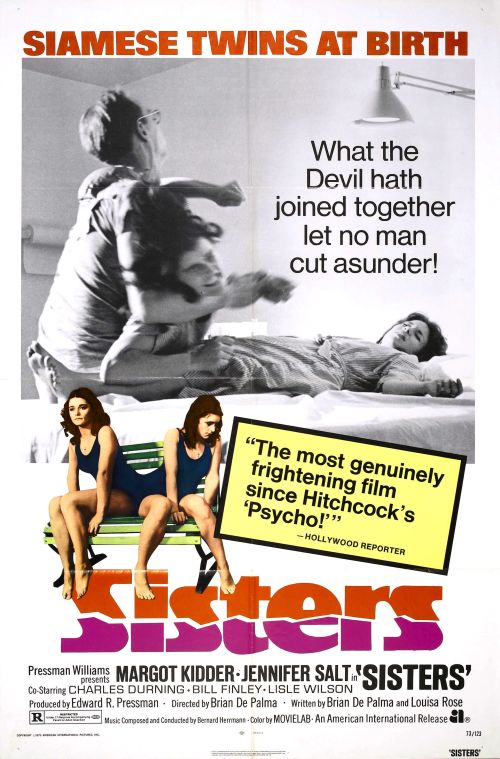
Danielle (Margot Kidder) is a young French-Canadian women from Quebec who aspires to be a fashion model and actress. She takes part in a TV-show styled after ‘Candid Camera’ where unsuspecting people find themselves caught up in a prank, which is where she meets Phillip (Lisle Wilson). The two go out on a date, but while at the restaurant she gets harassed by Emil (William Finley) her ex-husband. Then when they get back to her apartment Phillip overhears her arguing with another woman, which Danielle says is her twin sister Dominque. Since it is both of their birthdays Phillip decides to go out to get them a cake, but when he returns he gets viciously stabbed by the psychotic Dominque, but just before he dies he’s able to scribble the word ‘help’ onto the window with his own blood that Grace (Jennifer Salt), a journalist that resides across the street, sees. She immediately calls the police, but when they arrive into Danielle’s apartment there’s no sign of a body, or a struggle and Grace gets written-off as being a kook whose been imagining things, but she refuses to relent and begins her own investigation where she uncovers some dark details about Danielle and her sister who were once conjoined.

This was writer/director Brian De Palma’s first attempt at horror after completing many successful comedies that had gained a cult following. The story was inspired by real-life conjoined twins Masha and Dasha Krivoshlyapova who’s sad upbringing where they were taken away from their mother and had abusive medical experiments done on them at a secret hospital in the Soviet Union, and which was chronicled, much like in the movie, in a story in Life Magazine in 1966, which after reading it De Palma couldn’t get out of his head. Visually it’s excellent with great use of editing and superior score by the legendary Bernard Herrmann, who was semi-retired at the time, but enjoyed the script so much that he agreed to be the composer.

Many of De Palma’s famous directorial touches are apparent including his use of the split-screen. While it’s been used, and some may say overused, in many films from that era, it gets worked to perfection as we get to see Danielle and her ex busily cleaning-up the crime scene while Grace gets held up by the detectives and they’re not able to go into the apartment right away. My only complaint here is that with the blood splatter all over I’m just not sure they would’ve been able to wipe it all away in such a short time frame, basically about 8 to 10 minutes, which should’ve more likely taken them several hours. Not showing the clean-up and having Grace and detectives arrive to find the place spotless with no body would’ve actually added more intrigue and thus in this case the use of the split-screen, while done adequately, I don’t think was needed.

Spoiler Alert!

The script leaves open a fair amount of loopholes, for instance we see Danielle walk into a bedroom and the shadow of her head on the wall along with another one, which is supposed to represent Dominque’s, but we learn later that Dominque died years early during the surgery to separate them, so we’ve should’ve only seen one head shadow and not two. Also, Danielle is told point-blank by Grace that she’s been spying on them from across the street, so you’d think later that she and Emil would make damn sure to close the blinds on their windows when they try to remove the sofa, which has the dead body inside, but instead they continue to leave the shades wide open and allow Grace, now back in her own apartment, to continue to peer in while the couple show no awareness to the possibility and don’t even bother to look out the window to see if they can catch Grace looking in. Another head-scratcher is why there was no blood splatter on Danielle’s clothing, since she ultimately is the one that killed Phillip, when Emil walks into the apartment.

The most confusing thing though is the ending in which Grace becomes hypnotized while inside a mental hospital and begins to see herself, through a long dream sequence, as being Dominque and attached to Danielle. When I first saw this, back in the 90’s, I thought it meant that Grace was the long lost twin and that they had been separated years earlier. While Grace doesn’t look exactly like Danielle most twins don’t, and she was still around the same age, hair color, and body type, so it seemed like a legitimate explanation and I wouldn’t blame anyone else who came to this same conclusion. Apparently though that’s not the case as Grace comes back out of it only convinced, through the hypnotism, that she didn’t see the murder of Phillip, but I felt they should’ve taken it one step further by convincing her that she was Dominque, whether it was true, or not, and then brain washed to take credit for all the murders while Danielle could then get off scot-free and this would’ve then been the ultimate twist.

Granted Grace’s character is shown as having a mother (Mary Davenport), but the script could’ve been rewritten to have her taken out and Grace could’ve instead been portrayed as being an orphan, or adopted, which could’ve left open the possibility. In either case the dream segment, which is creepy and stylish done, would’ve had more of a payoff then it does had it taken this route.

My Rating: 7 out of 10

Released: November 18, 1972

Runtime: 1 Hour 33 Minutes

Rated R

Director: Brian De Palma

Studio: American International Pictures

Available: DVD, Blu-ray (Criterion Collection), Amazon Video

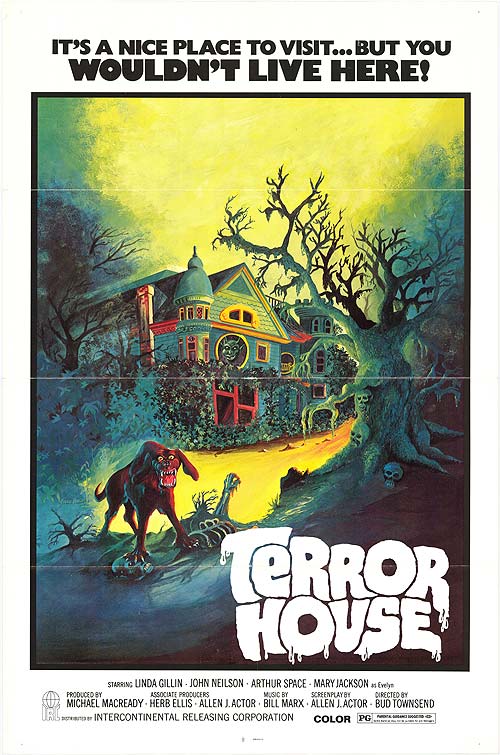
Terror at Red Wolf Inn (1972)

terror1

By Richard Winters

My Rating: 4 out of 10

4-Word Review: An appetite for humans.

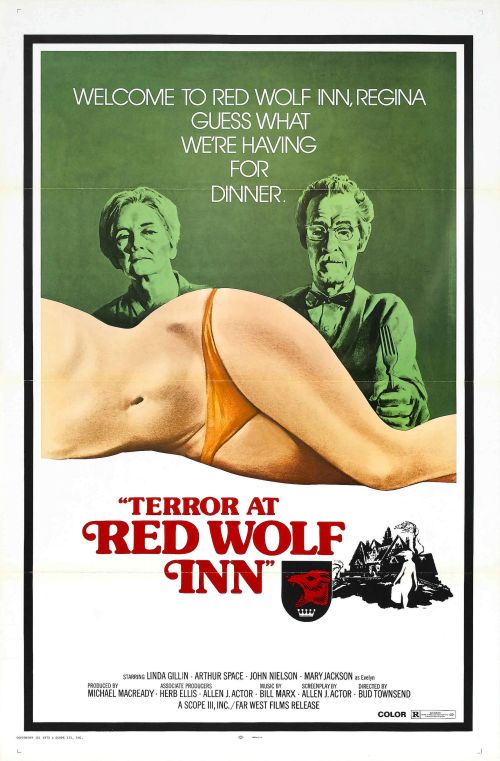
Regina (Linda Gillen) is a shy college student living in a dorm by herself who doesn’t have enough money to go to Spring break with the rest of her friends, so she’s forced to stay on the campus all alone while the others go. Then she receives a letter telling her that she’s won a free trip to a bed and breakfast resort called the Red Wolf Inn. She’s offered a private plane ride to get there and once she arrives she’s greeted by a kindly elderly couple (Arthur Space, Mary Jackson) who own the place and two other women, Pamela (Janet Wood) and Edwina (Margaret Avery), who are also staying there, as well as the couple’s adult grandson Baby John (John Neilson). While things start out well Regina soon grows uncomfortable and convinced that the couple has ulterior motives. When both Pamela and Edwina disappear Regina fears she’ll be next, but her efforts to escape are thwarted trapping her in the home to become the next meal item unless she can convince Baby John, who has fallen for her, to help her find a way out.

This very odd piece of 70’s horror that seems to want to combine a grisly theme with offbeat humor definitely has a few keen moments. My favorite was the way Regina finds out that she’s ‘won something’ and excitedly shouts it out to her otherwise empty dorm building. Some may consider this exaggerated as most people today would be highly cynical of such a letter, but back in the 70’s, (and I was around then), the teens were more trusting and had a propensity to be experimental and act as if life was just one big adventure, so in that respect the movie gets it right and this became for me one of the funnier moments The only caveat is how did the couple find out about Regina to send her the letter? Why was she chosen and how often and how many of these letters did they mail and how many of them got answered, which never gets addressed, but should’ve.

On the horror end its not very scarry and only borderline creepy. There is a dream sequence that had the potential of being cool, but doesn’t go on long enough. Regina’s attempt at escape I did like, but it does leave open plenty of loopholes like why was a motorboat, that wasn’t tied to any dock, conveniently left out in the bay for her to swim to? Initially I though it was an intended trap and she’d get into it and see dead bodies lying there, but that’s not the case as she uses it to get over to a neighbor’s house, but no ones inside and all the other buildings in the area are eerily empty, but why? The dinner scene in which everyone chomps at their food like pigs could’ve been considered revolting and upsetting had it been confirmed that it was people they were eating, but this wasn’t yet established, so the shock effect is lost.

Some have labeled this as a comedy-horror and one of the first films to use this sub-genre, but outside of the opening bit there really isn’t anything all that amusing. There are some moments of extreme awkwardness like when Baby John smashes the head of a baby shark repeatedly against a rock while a shocked Regina looks on in horror before he turns to her and confesses how much he loves her, which is darkly humorous in a distorted type of way, but outside of that the chuckles are as infrequent as the scares.

Spoiler Alert!

I did enjoy Mary Jackson’s performance who goes from nice old lady to threatening matron effectively, but the wrap-up leaves much to be desired. Initially it’s sort-of exciting as Regina and Baby John make a daring run for it only to be chased down by the older couple’s dog and then viciously attacked by both the pet and the old man. The film then cuts to show Regina and Baby John back inside the kitchen of the grandparent’s home having supposedly gotten the upper hand, but this is a struggle that needed to be played-out, the film lacks action anyways and this would’ve offered much needed excitement and tension. Showing the old couple’s decapitated heads inside the freezer had a gory appeal, but then having the old guy look up and wink ruins it and turns the whole movie into one big stupid joke.

Some viewers insist that the 77 minute version, which is what’s available on DVD despite the cover saying it’s 90 minutes, is the edited version with certain scenes of ‘horror’, or other ‘dark’ moments left out and this is based mainly on the fact that IMDb lists the original runtime as 90 minutes and Leonard Maltin’s review book says it’s 98 minutes, but I’m not so sure. As short as the 77 minute runtime is it still came off as draggy. This was also made in an era where implying the violence and gore was considered shocking enough making me believe that the DVD cut is pretty much the whole thing. Even if a longer version may exist it’s doubtful that it would be filled with more carnage as it’s clear that the filmmakers were going for a soft tongue-and-cheek approach making me believe the supposed lost scenes would’ve amounted to being talky bits that wouldn’t have added much.

terror2

Alternate Title: Terror House

My Rating: 4 out of 10

Released: September 27, 1972

Runtime: 1 Hour 17 Minutes

Rated R

Director: Bud Townsend

Studio: Red Wolf Productions

Available: DVD

Tales that Witness Madness (1973)

tales

By Richard Winters

My Rating: 3 out of 10

4-Word Review: Four tales of terror.

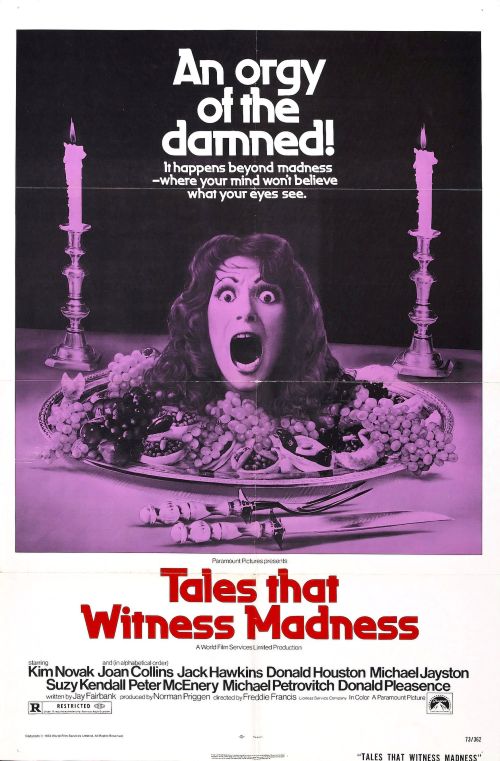
Directed by legendary cinematographer Freddie Francis, the film revolves around four stories where the protagonist is perceived as having gone mad, but in actuality it’s evil from another dimension that gets them to see or do odd things and in reality they’re the sane ones. The connecting element is Donald Pleasance who acts as their psychiatrist who keeps them at his clinic in an effort to improve their mental state. In the first story we have a boy named Paul (Russell Lewis) who boasts about having a live tiger in his room even though his parents (Donald Houston, Georgia Brown) don’t believe him. The second story deals with Timothy (Peter McEnery) an antique collector who’s able to ride an old Penny Farthing bicycle that allows him to go back into time and inhabit another man’s body. The third tale deals with a man (Michael Jayston) who brings home a dead tree and mounts it in his living room much to the annoyance of his wife (Joan Collins). The final story is about a rich socialite (Kim Novak) who courts a younger man only for him to have show more interest in her beautiful daughter (Mary Tamm).

This Review Contains Spoilers!

The first story is pretty weak mainly because you presume going in that there’s probably, despite the long odds, some sort of tiger present because after all this is a horror movie dealing with the supernatural, so seeing the parents getting attacked at the end isn’t surprising, or even shocking and you’re pretty much just waiting for it to happen from the get-go. Director Francis makes the mistake of attempting to film the attack as it happens by editing in stock footage of a tiger and mannequin parts with red paint standing in for the parent’s bodies, but it all looks quite fake. Since the tiger figures in again at the very end of the movie a better idea would’ve been to keep it a mystery whether he existed, or it was just a homicidal child that had killed his mom and dad. When the parents walked into the son’s room the camera should’ve remained outside in the hall and the viewer hearing their screams, which would’ve been scarier than anemic special effects that we ultimately do see.

The second story is limp as well as it features a picture of ‘Uncle Albert’ whose facial expressions and eyes are constantly moving and changing, which has been parodied in many other films making this one seem more campy than scarry. The third tale is dumb too as anyone who brings a dead tree into their living room and wants to keep it there is mentally ill and the wife would’ve been smart to have left him versus fight for his affections. The twist here is no surprise either as I saw it coming right from the start though Collins does give a good performance and the viewer gets treated to a shot of her breasts although I suspect it was done by a body double.

The fourth segment is the only one that merits any type of mention as it features the bad guys not only killing the daughter, but slicing her up and then serving her to the mother as a piece of ham during a Hawaiian-style luau. The audacious idea deserves some points and Novak’s performance is fun as is Tamm’s in her film debut, who you also get to see nude from the backside, but it fails to make up for the rest of it, which isn’t up to par with the other British Anthology horror films from that period.

My Rating: 3 out of 10

Released: October 31, 1973

Runtime: 1 Hour 30 Minutes

Rated R

Director: Freddie Francis

Studio: Paramount

Available: DVD, Blu-ray, Amazon Video, YouTube

My Friends Need Killing (1976)

friends1

By Richard Winters

My Rating: 4 out of 10

4-Word Review: Vet. stalks war buddies.

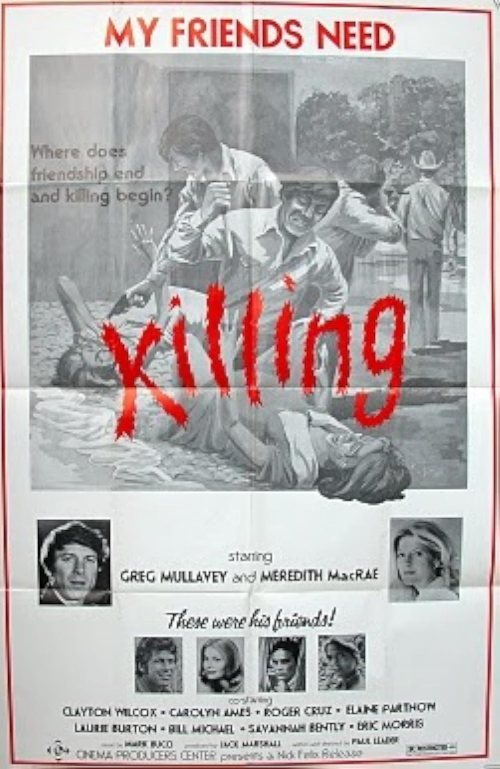
Gene (Greg Mullavey) is a Vietnam Vet. who’s come home after the war, but finding it hard to readjust to civilian life. He’s plagued by memories of not only the war, but some of the crimes that he and his comrades did while over there including the annihilation of a village and gang rape of a woman. He decides that the only answer is to seek out dark justice by visiting with his old buddies one-by-one in their homes and then using the opportunity to kill them when the time is right. Gene’s wife Laura (Meredith McRae) is aware of her husband’s tormented dreams, but not his homicidal plans. She works with Dr. MacLaine (Greg Morris), a psychiatrist, to track Gene down in order to stop his madness and get him the mental help that he needs.

In 1969, Paul Leder, whose attempt at an acting career had stalled, decided to take a stab at directing, which initially didn’t fare any better. His first feature, where he had Mullavey also star, was the absurdist comedy Marigold Man, about a guy named Harry who dreams of planting marigolds from coast to coast, which quickly fell into obscurity. He then hit on the idea of doing a horror film, which he felt, if done right, could do well under the low budget constraints. His first feature, which also had Mullavey in a supporting part, was I Dismember Mamathat fared a bit better than the comedy and enough to gain a cult following. Leder then reverted back to doing two comedies including the notorious Ape, an attempted parody of King Kong, that became a big embarrassment before eventually returning back to horror with this film.

On the surface it’s not bad given the limitations. It’s obviously inspired by Bob Clark’s Dead of Night, that had come out 5 years earlier and had a similar theme of a war vet. unable to get the horrors of what he went through out his mind. That one won some critical acclaim and a cult audience while this one fell through the cracks. For Paul Leder standards though it’s surprisingly watchable. Mullavey gives an effective performance where you sympathize with the man and his torment even as he goes through with his killings. The flashback sequences have a haunting quality and the film is, if anything, adequately gritty.

The killings though are where things get off-kilter. A few of them are disturbing like when he ties up one of his old buddies, while also shooting him in the arm, and then forces him to watch the rape of his wife before killing them both. Some of the others though fail to have the same dark punch. In one instance all he does his hand his old war friend a bottle of pills and tells him to swallow them, which isn’t exactly tense, while another moment has him helping to deliver a woman’s baby. There’s also a scene where Mullavey ties up his victim and then has the man’s arm poked with a syringe where he slowly bleeds to death, but horror movies work better when we see the action of him attacking the other man and just cutting away to him already tied-up misses the potential for excitement.

McRae, who at the time was Mullavey’s real-life wife, gives a poor performance particularly her anemic sounding crying. The use of music is bad too. During the killings it reflects the pounding score you’d expect in a horror flick, but in-between it has a melodic quality that you’d hear in a breezy comedy. The editing, which was also done by Leder, is choppy and too many slow parts in-between the violence. The film, which has a few interesting moments, fails to hold interest all the way through. It’s too talky with a lot of extraneous dialogue that could’ve been cut out. Having the only sound being the voices that Mullavey hears inside his head would’ve worked better.

My Rating: 4 out of 10

Released: December 10, 1976

Runtime: 1 Hour 13 Minutes

Rated R

Director: Paul Leder

Studio: Cinema Producers Center

Available: DVD-R (dvdlady.com)

‘Gator Bait (1973)

gator

By Richard Winters

My Rating: 3 out of 10

4-Word Review: Woman fights off rednecks.

Desiree (Claudia Jennings) is a peasant woman living in the swamplands of southern Louisiana. To help her bring in an income she takes part in poaching of snakes. Deputy Billy Boy (Clyde Ventura) and Ben (Ben Sebastian) are sitting in a boat in the swamp waters when they catch Desiree in the act of poaching and decide to chase her down and arrest her, or try to use it to their advantage by getting some sex out of her in return for not taking her in. Desiree though proves to be more cunning than they expected as she out races them in her boat and then when she is finally cornered she throws the bag of snakes that she has into their boat, which allows her time to escape. The deputy then must fight off the snakes by using his gun to shoot them, but in the process accidentally shoots and kills Ben. He later tells his father, Sheriff Joe Bob Thomas (Bill Thurman) that it was Desiree that shot Ben and not him. The Sheriff then goes to the boy’s father (Sam Gilman) and when given the news the father decides to chase Desiree down himself with the help of his two other sons (Douglas Dirkson, Don Baldwin) and exact a violent revenge.

This was the 7th film written and directed by Ferd Sebastian and the 4th that he did alongside his wife Beverly. It’s most likely their best known effort and came about through their friendship with Claudia Jennings. Jennings, a former Playboy model, acted in one of their other films, another B-exploitationer known as The Single Girls, and struck-up a friendship with the husband and wife filmmakers and asked them to come-up with a script in which she could star. Beverly then wrote this script seemingly overnight, I’m not sure if it was actually written in that short of time, but judging from its creativity, which is very low, it’s not that hard to believe. It was then shot in a matter of 10-days in March of 1973 at Caddo Lake, which is a state park and bayou that borders Texas and Louisiana.

The film does start out with a good speed boat chase and it captures the swamplands in vivid detail and with the exception of one scene that takes place in the town of Thibodaux, Louisiana, everything else gets done in the swamps making it seem like its own little universe. The Sebastains do wisely keep their son Tracy Sebastian, from uttering any lines of dialogue as he plays Desiree’s mute kid brother who had his tongue cut-out, which is good as he later starred-in On the Air Live with Captain Midnight and it’s just a shame he couldn’t have played a mute there as well as he gives what I consider one of the worst performances ever put on screen, but here since he can’t talk his marginal acting ability is not as apparent.

Despite the few good points the movie is otherwise a failure where the tension wanes instead of intensifying as it should. Part of the reason for this is that the story spells everything out right away and offers no surprises, or twists. The boat chases are diverting at first, but soon turn stale as they become too prevalent and almost like a loop reel where we’re just seeing the same thing done over and over again with nothing new getting thrown in. The characters, particularly the male ones, are written as being extreme southern caricatures who are too one-dimensional to being even remotely interesting and I genuinely felt sorry for actors Gilman and Thurman who had already been in the business for many decades at the time and had even been in some better financed studio films, so to have to come down to starring in this brainless dreck had to feel like a low point, but I guess a paycheck is a paycheck.

Jennings’ presence doesn’t add much as she’s seen only sporadically and most of the film time is given to the bickering male yokels. She doesn’t, despite her past of being a Playboy Playmate, appear nude as that gets left to Janit Baldwin, who plays her kid sister Julie, which will disappoint male viewers who will most likely come into this expecting the pretty Jennings to be the one who gets unclothed. When Claudia does speak it’s a trainwreck too as she sounds like someone from Europe instead of a rural southern chick. Her character is also poorly defined and doesn’t really grow, or fleshed out enough to make her seem like a real person, but instead remains more of an enigma.

Spoiler Alert!

Some on IMDb describe this as a early variation of I Spit on Your Grave, but that really isn’t accurate. In the Meir Zarchi flick the rape attack takes up the majority of the film time while here the attack isn’t even on the main character, but instead the younger sister, which is also quite brief. The female character doesn’t kill off the men one-by-one like in the other one as here the men end up killing each other for the most part, with the character’s younger brother taking care of one of them, and the final one is left to live.

Had this been more violent and explicit I might’ve forgiven the rest, but overall it’s quite tepid. It’s basically a tease of a movie that promises way more than it delivers and it’s so entrenched in stereotypes that it makes you feel like you’ve seen it, or something quite similar, a hundred times before. Sure there’s a ‘surprise twist/reveal’, but this one could see coming early on as the father of the boy who is killed and who goes after Desiree with a vengeance keeps commenting on how attractive he found her mother, which doesn’t take a genius to read into that and know most likely what he’s implying. In any case it’s not much of anything even on a B-movie level, but nonetheless got made into a sequel in 1988 though without star Jennings who died in a car accident in 1979.

My Rating: 3 out of 10

Released: October 12, 1973

Runtime: 1 Hour 28 Minutes

Rated R

Director: Ferd and Beverly Sebastian

Studio: Sebastian International Pictures

Available: DVD-R

The Last Remake of Beau Geste (1979)

beaugeste

By Richard Winters

My Rating: 4 out of 10

4-Word Review: Brothers join the army.

Sir Hector Geste (Trevor Howard) decides to adopt a son to be his rightful heir and carry on the family name. He goes to an orphanage where he spots Beau (Michael York) a dashing young boy who shows immense prowess. Hector immediately decides he wants him, but it comes with the caveat that he must also take on Beau’s twin bother Digby (Marty Feldman) who’s not nearly as handsome, or brave. After bringing both boys home Hector then gets married to Flavia (Ann-Margret) a much younger woman who’s more in-love with the Blue Sapphire diamond that’s in Hector’s possession than Hector himself. In order to keep Flavia from absconding with it Beau decides to take it out of the family home and bringing it along with him to Africa where he joins the French Foreign Legion. Digby eventually joins and they go on to have many adventures, but Flavia catches up with them determined to get the diamond using any means necessary.

The film is based on the 1924 novel of the same name written by P.C. Wren that had already been made into a movie three other times: in 1926 starring Ronald Coleman, 1939 starring Gary Cooper, and finally in 1966 starring Guy Stockwell. In 1976 when Marty Feldman signed a 5-picture deal with Universal to write, direct, and star in any film project he choose he decided to do a parody on a film he had seen growing up. He mistakenly thought it was Beau Geste, but came to realize once he watched the movie that it was really The Four Feathers that had a similar storyline and came out around the same time. He eventually went with doing this version since he felt ‘The Last Remake of the Four Feathers’ didn’t sound right.

The production, which was filmed in both Ireland and Spain, was met with many obstacles, including having Feldman getting sick during the shoot and putting the production on-hold for many weeks. It eventually went over budget and over schedule and the studio was not happy with Feldman’s final cut and determined to re-edit it while giving Feldman a 2-week vacation under the guise of letting him rest and recuperate. When Feldman returned and found out what the studio had done he became irate, so the studio heads decided to make him a deal; they would show both versions to a test audiences and which ever one rated better would be the one that would be released. Feldman agreed to this and to the studios shock Marty’s cut got much higher ratings, but the studio then went back on their word and released their version instead, which did not fare well with either the critics, or public. To this day Marty’s version has never been seen, but by only a few people even though those that have viewed say it’s much funnier and efforts have been made to find it and give it a proper Blu-ray issue though this has never come to fruition as of yet.

As for this version it’s okay, but it starts out better than it ends. There’s some funny gags here and there, but the humor tends to be quite broad and many of the jokes fall flat especially after the midway point. The best moment comes when Feldman splices his character into the 1939 film version and we see his character speaking to Gary Cooper and they even share a scene together, which I found to be quite innovative for the time period. Everything else though is hit-or-miss and suffers from not enough people being familiar with the source novel and thus the in-jokes involving the story will most likely go over  most viewer’s heads it also makes many changes from the original plot with the biggest one being that in this movie there’s only 2-brothers, but in the book there was 3.

The array of famous faces making cameo appearances is fun for awhile though I felt Peter Ustinov camps it up too much as the evil General Markov and the part would’ve been better served had it been played by Roy Kinnear who instead gets wasted as Markov’s assistant. Howard is quite amusing as the elderly father and I wished he was in it more, but ultimately his character gets confined to his bed for the second and third act. Ann-Margret offers some sexiness, but really has nothing to say or do that’s funny until the very end when she tries to challenge a guy to a fist-fight, which should’ve been played-out more. Terry-Thomas gets some work before his Parkinson’s condition, which is very obvious here with his trembling left hand, became so severe that it forced him out of acting and into a retirement home not more than a year after this was filmed.

Feldman himself is quite good, but I felt he needed to be seen more, which is the biggest problem with the movie in that it’s neither character nor plot driven. Too much nuttiness and wackiness for its own good. If the comedy had been better disciplined and a smaller cast it would’ve worked better, but the barrage of constant craziness all in the name humor eventually gets overblown.

My Rating: 4 out of 10

Released: July 15, 1977

Runtime: 1 Hour 25 Minutes

Rated PG

Director: Marty Feldman

Studio: Universal

Available: DVD-R (Universal Vault Series), Blu-ray

The Day of the Dolphin (1973)

dolphin2

By Richard Winters

My Rating: 3 out of 10

4-Word Review: Training dolphins to talk.

Jake Terrell (George C. Scott) along with his wife Maggie (Trish Van Devere) run a remote island research station where, along with a small team of researchers, try to teach dolphins to communicate with humans. They’re prime subject, which they’ve been working with for 4 years, is Alpha whom they’ve successfully trained to speak some English words, but when they team him up with another dolphin named Beta he goes back to his old ways of communicating and no longer speaks with Jake, or his team. Things become further hampered when Curtis (Paul Sorvino) arrives on the island supposedly under the guise of being a journalist, but in reality he’s a spy there to infiltrate what Jake has been doing with the dolphins and report back to a secret government organization who want to then use the dolphins for their own nefarious means.

With the early success of director Mike Nichols and screenwriter Buck Henry, especially The Graduate, it seemed like these two could do no wrong and they both became a much sought after Hollywood commodity and given many top project offers. This production though came crashing down horribly and stymied Nichols career, which had previously been skyrocketing, for the rest of the decade as he helmed only one other film after this during the 70’s before finally getting his reputation back in order with the critically acclaimed Silkwood.

This thing comes-off as a misfire almost immediately and the biggest problem are the dolphins. There’s just so much they can do, liking mainly jumping in and out of water, until it becomes really boring. The long dream-like segment of watching Jake swim around in the tank with the dolphin adds nothing and got so prolonged that it practically put me to sleep. The only part where the dolphins did hold my attention was when Jake decides to split the two up where Beta is put in a pool on one side and Alpha the other and a steel partition between them. This then causes the dolphins much stress as Alpha angrily smashes his tail repeatedly against the partition in anger, but to no avail. While I did find this moment to be rather intense it does backfire in a way in that it makes Jake and the other researchers seem cruel and you start to not like them, which I don’t think was the filmmaker’s intent.

Having them learn to talk was misguided and makes it seem like a silly flick for kids with no barring in reality. Initially I was okay with them learning a few words as it came-off like they were parrots repeating sounds that they had heard, so it was borderline plausible, but then having it graduate to the point that he and others can have ongoing conversations with them and even ask them questions is when it starts to get too absurd for its own good.  In fact the only moment in the film that’s truly fascinating to see is when a mother dolphin gives birth using actual footage, which made me believe this would’ve been better off had it been done as a documentary and the fictional story left out completely.

Sorvino does add some energy with his scenes and pretty much outclasses Scott, who with his $750,000 salary, which would equate to $5,484,886 in today’s dollars, is quite dull and he manages to get completely upstaged by even the dolphins themselves. All of the main characters are quite one-dimensional, especially Van Devere who seems to agree with Scott on everything and echoes whatever point-of-view he has making her presence completely unneccesary as she’s simply him in a female form.

Having one of the research crew members turn out to being a spy doesn’t work either as the viewer is given no forewarning about this. We’re just informed later that this individual had betrayed them, but a good movie should offer hints upfront that a traitor may be in their midst and thus allow the audience to become more of an active participant as they try and figure out which of them it is. The secret government organization thing gets equally botched. A better scenario would’ve had a former friend, or associate to Jake turn on him and seek revenge by trying to destroy the research facility and all of their findings. He would be constantly lurking about, which would’ve added more ongoing tension that is otherwise lacking and given the bad guy more of a personality versus the bland government agents that are too generic to be either frightening, or memorable.

My Rating: 3 out of 10

Released: December 19, 1973

Runtime: 1 Hour 44 Minutes

Rated PG

Director: Mike Nichols

Studio: AVCO Embassy Pictures

Available: DVD, Blu-ray

Last of the Mobile Hot Shots (1970)

lastmobile

By Richard Winters

My Rating: 4 out of 10

4-Word Review: A game show wedding.

Myrtle (Lynn Redgrave) and Jeb (James Coburn) meet at a game show being taped in New Orleans and find themselves working together as contestants when brought up onto the stage. They end up winning some money, but are told that they cannot collect it until they’re officially married on live television, which they both agree to. After the nuptials they travel to an old mansion known as the Waverly Plantation that has been in Jeb’s family since 1840. Jeb wishes to use the money earned on the game show to fix up the place, but finds his plans being stymied by Chicken (Robert Hooks) a multi-racial half-brother that has been residing at the place and maintaining it for many years. Chicken insists that he’ll become the next owner of the place once Jeb succumbs to terminal cancer, but Jeb wants Chicken off the premises immediately and have the document stating that Chicken is the next of kin to be destroyed. He orders Myrtle to flirt with Chicken until she can get him into a compromising position so that she can steal the document. Once that is retrieved he then wants her to kill him with a hammer while Jeb waits upstairs. Though initially reluctant Myrtle decides to go through with the plan only for Chicken to turn-the-tables on them with an unexpected twist.

While playwright Tennessee Williams is celebrated for his acclaimed work like A Streetcar Named Desire and Cat on a Hot Tin Roof many people don’t realize that his biggest success came early in his career while towards the end,  especially by the mid-60’s through to his death in 1983, his output was very little and what he was able to get produced was generally not well received by either the critics, or the public. This film is based on his play The Seven Descents of Myrtle, which was originally written as a short story in 1942 and published in 1954. Williams then decided to turn it into a one-act play in 1967, but then expanded it to a full length stage production, which premiered on Broadway on March 27, 1968 with Harry Guardino as Chicken and Estelle Parsons playing Myrtle. This version though only ran for 29 performances and was generally considered a failure.

However, director Sidney Lumet saw the production and decided he wanted to take a stab at turning it into a movie. He made several changes to the story with the biggest one being that in the play the Jeb character, who was called Lot, was a closeted transvestite, which is something that the movie doesn’t bring up at all though would’ve been far more interesting had it done this. The play also doesn’t feature the game show segment, which was very surreal and makes the film seem almost like a misguided parody.

I did enjoy the way famed cinematographer James Wong Howe captured the decaying mansion, which was filmed on-location in St. Francisville, Louisiana, a famous small town known for its abundance of historic old buildings. Everything else though falls flat. The opening bit at the game show is funny, but becomes jarring with the second-half, which is more dramatic making it seem like two completely different movies with highly inconsistent tone rammed into one. The Myrtle character is not fleshed-out enough to make any sense, or even seem remotely believable and ultimately like with the rest of them comes-off as an empty composite that is not relatable in any way to real people.

The acting though by Redgrave is quite strong. Normally British actors have a hard time masking their accent, but here she’s able to speak in an authentic Southern dialect without her European voice being detectable in the slightest and she puts on a provocative striptease to boot. Hooks dominates the proceedings and ultimately outclasses Coburn who later admitted regret at doing the project and considered his appearance here to be a low point in his career. Having Williams write the screenplay might’ve helped and I’m not sure why he wasn’t asked, but Gore Vidal doing the task turns the whole thing into an absurd misfire that should never have been attempted.

My Rating: 4 out of 10

Released: January 14, 1970

Runtime: 1 Hour 40 Minutes

Rated X

Director: Sidney Lumet

Studio: Warner Brothers

Available: DVD-R (Warner Archive)

The Twelve Chairs (1970)

twelve

By Richard Winters

My Rating: 7 out of 10

4-Word Review: Which chair has fortune?

Vorobyaninov (Ron Moody), an poor man living in 1920’s Russia, is summoned to the deathbed of his mother-in-law. She confides in him that there’s a stash of priceless jewels sewn into the seat cushions of one of the twelve chairs from the family’s dinning room set. Unfortunately the newly formed Russian state has appropriated all private property and it’s up to Vorobyaninov to track them down. He teams up with Ostop (Frank Langella) a local con-man to help him, but they have competition. Father Fyodor (Dom DeLuise), a priest, also becomes aware of the jewels when he goes to the mother-in-law’s home to give her the last rites. All three go on a mad dash to retrieve the jewels, but the more chairs they manage to find the more frustrated they become.

The film is based on the 1928 Russian novel of the same name by Ilf and Petrov a famous duo who were quite popular during the early soviet period and wrote not only many satirical novels, including this one and its sequel ‘A Little Golden Calf’, but also several short stories, articles, theatrical plays, and even screenplays. The Twelve Chairs novel though was their most popular and has been made into a movie 18 different times. It had already been done 6 times before Mel Brooks did his with the first version being in 1933 and the most recent rendition of it done in 2013 in Italy.

This version is the most popular and a bit of stretch from Brooks’ other films, which relied on a lot of gags and slapstick. This one has its fair share of those though the first act is quite talky and not too much going on. Brooks himself appears as a character, but he can’t really enliven it. It’s not until the men finally come upon the chairs and start tearing them up one-by-one that it really starts to get funny. The chair thing could’ve gotten redundant as the men rip open the seat cushions in pretty much the same quick way, but Brooks manages to approach each of these scenes in a creative way, so instead of becoming monotonous it remains fresh and comical. My favorite of these is when Ron Moody and Frank Langella chase Dom, who has one of the chairs, through an open field that’s done in stop-action.

The film’s detraction though is the casting of the two main characters. Langella is a terrific actor, but not in comedy. He did appear in the dark comedy Diary of a Mad Housewife, where he was very good, but that took advantage of his glib demeanor and pouty expression and his character there was meant to be unlikable. Here though he has nothing amusing to say and remains a complete jerk the whole way. There is one point where he and Moody are in a row boat and Moody states that he’s cold and Langella gives him a jacket to wear, which I guess was Brooks’ attempt to make him likable, but it’s not enough and the movie is really hurt by spending so much time focused on a guy who’s one-dimensionally cold and responds to antics around him in the same sneering way. He was recommended to Brooks by his wife Anne Bancroft who had performed with Langella in a Broadway play that had a short run, but I felt this is one time when he shouldn’t have listened to her.

Ron Moody, a talented actor as well, has the same issue. The character is meant to be dim-witted, but it doesn’t come-off in a natural way. His banter with Langella is flat and annoying with the bickering doing nothing but slowing up the pacing. Without question DeLuise is the funniest. He’s just as conniving and greedy as the other two, but for whatever reason it doesn’t seem as ingratiating. His character’s ineptness had me laughing and he should’ve been the star while Langella and Moody could’ve been shown only sporadically as the occasional nemesis.

Spoiler Alert!

The ending is much different than the one in the book. In the novel version Vorobyaninov kills Ostap by slitting his throat with a razor in order to keep the loot for himself only to find that it’s not there, so he then goes insane. In the movie Vorobyaninov and Ostap team up to become beggars on the street by pretending Vorobyaninov has an epileptic condition and requesting people throw money at him to help him. Wikipedia, in a line that has since been deleted, stated that this was a ‘happier’ ending though trying to make a living being a street beggar all day can’t be all that fun.

What amused me though is that in both versions the jewels are never recovered by the two men. In the movie the jewels were found first by someone else who used it to build a clubhouse for pompous old men making it seem like greed was inevitable. In the book though the money gets used to build a recreational center that can be used by the entire community and thus giving it more of a pro-communist bent.

My Rating: 7 out of 10

Released: October 28, 1970

Runtime: 1 Hour 33 Minutes

Rated G

Director: Mel Brooks

Studio: UMC Pictures

Available: DVD

The Last Word (1979)

lastword1

By Richard Winters

My Rating: 2 out of 10

4-Word Review: He won’t move out.

Danny (Richard Harris) is a stubborn and eccentric man who refuses to move out of an apartment building that has been marked for demolition. After his attempts to get a lawyer and also collect welfare prove futile he decides to kidnap the Marshal (Jorge Cervera) who comes to his apartment to serve him his eviction notice. He chains the Marshal to a pipe in his bathroom and then barricades himself and his three children inside. A TV news reporter (Karen Black) feels this will be a juicy story and gets permission to go up to Danny’s place in order to interview him live on the air while the police captain (Martin Landau), who was at one time an old friend to Danny, plots on a way to get him out even if it means deadly force.

This stale drama borrows on a lot elements that have been done before and fails to add anything interesting to the mix. The chief flaw is that there isn’t any explanation for why Danny won’t move out when everyone else in the building does. The apartment itself is quite cramped and nothing special and chances are he could’ve found something bigger, or just as adequate. Without proper motivation the protagonist’s quandry becomes rather irrelevant and even selfish as his stubbornness puts the rest of his family through a lot of needless stress and trauma and having the character be someone who is old and on a fixed income with nowhere else to turn, as much of a caricature as this is, would’ve at least gotten more emotional appeal from the viewer, which with the way it gets done here you really don’t get.

Harris execellent acting helps, but all his inventions start to become a bit cheesy especially his ‘gas masks’ which is nothing more than paper folded around the face with a Campbell’s soup can taped to the bottom, which apparently should be ‘sufficient’ to breath through if under attack, but look laughable and most likely the gas vapors would seep through the paper and thus making them a poor defense. Black, who would co-star with Harris 6 years later in Martin’s Day, plays a serious career driven woman, which is a nice variation from her usual flaky, ditzy types, but her character is unlikable, who initially tries to exploit Danny’s situation for her own gain and having her ‘come around’ at the end to be on his side isn’t enough to make up for it and she should’ve been portrayed as being more emphatic from the beginning.

His three children, played by Penelope Milford, Dennis Christopher, and Natasha Ryan all display the same type of personality and thus become indistinguishable and boring. They all seem to love their father quite a bit and are very loyal and yet refer to him as Danny instead of Dad, which is a bit weird. Landau displays a nice acerbic quality, and the first film where his hair begins to show a few spots of gray, but his character should’ve been the one to go up to the apartment and break into it, especially since he and Danny had a history together, versus having him remain on the ground while his men did the task, which loses out on what could’ve had more dramatic impact.

Spoiler Alert!

The first act is a strain to sit through and is approached in a way that would’ve made it better served as a TV-movie. The second act gets a little more tense when he barricades himself into the apartment and the way he uses all of his different inventions to stop the cops from getting inside is marginally entertaining, but the film leaves way too many things open ended. He eventually gets cuffed and arrested, but no closure as to what happens to him after that. Does he go to trial and win his case? Does he and his family get a new place, or does the building get saved and what happens to the Governor (Biff McGuire) who was exposed as being corrupt? None of this gets answered, which makes the ending like the rest of the film quite unsatisfying.

My Rating: 2 out of 10

Released: October 10, 1979

Runtime: 1 Hour 42 Minutes

Rated PG

Director: Ray Boulting

Studio: Variety International

Available: None